



Abstract
While most research explaining the persistence of gender inequality has focused on how decision makers’ own biases perpetuate inequities, a growing body of work points to mechanisms of bias that may arise when a decision maker is concerned with satisfying a third party or audience. Using data from 2007 to 2013 on 2,310 members of a popular networking organization for entrepreneurs, I examine the extent to which the presence of third parties leads to gender inequality in resource exchange, or connections to potential clients. I show that decision makers are most apt to favor male network contacts in exchanges involving a third party when considering whether to connect a contact in a male-typed occupation. Decision makers do not display this gender bias in exchanges that do not involve a third party or when sharing connections to potential clients with contacts in gender-neutral or female-typed occupations. This setting offers a unique opportunity to compare gender inequality in exchanges involving a third party with cases that do not involve a third party, providing direct evidence of the effects of audiences or third parties for gender inequality.
Despite legal and policy initiatives to reduce gender inequality, such as Equal Employment Opportunity regulations, gender differences persist: women receive lower wages, face inequities in hiring, and receive penalties in performance evaluations relative to men (England et al., 1994; Fernandez-Mateo, 2009; Bertrand, Goldin, and Katz, 2010). Often gender is thought to be factored into evaluations in the absence of objective quality information, but even in settings with merit-based practices and when objective performance information for evaluating candidates is available, men are advantaged over equally performing women (Foschi, 2000; Castilla and Benard, 2010; Botelho and Abraham, 2017). Observed gender differences are most pronounced when gender is salient and task-relevant (Ridgeway, 1997; Wagner and Berger, 1997), such as in gender-typed roles and occupations, where stereotypically male or female traits are considered important for success (Perry, Davis-Blake, and Kulik, 1994). For these roles, gendered archetypes define what occupants ought to be like and are used to evaluate candidates (Heilman, 1983; Perry, Davis-Blake, and Kulik, 1994; Gorman, 2005), so women in male-typed, or gender-incongruent, roles are often evaluated as less competent than similar men (Davison and Burke, 2000; Eagly and Karau, 2002; Turco, 2010), and their successes are commonly attributed to luck rather than to skill (Swim and Sanna, 1996).
Most research on the activation of gender bias has focused on personal biases stemming from an individual decision maker’s beliefs related to men’s and women’s strengths (Fiske, 1998) or to gendered performance expectations (Berger et al., 1977; Correll and Ridgeway, 2003). But a growing body of work points to a second potential source of gender bias that may arise when a decision maker is concerned with satisfying a third party or audience. This audience-based driver of gender bias relates to the broader argument that when a decision maker is concerned with how their selection will be perceived by a relevant third party, they engage in a higher-order process, making their choice based on what they expect will gain approval from this audience. Decision makers often rely on status orderings in these cases based on the belief that most other people prefer higher-status options (Uzzi and Lancaster, 2004; Adut, 2005; Espeland and Sauder, 2007; Correll et al., 2017). Since gender is associated with status beliefs and performance expectations, such that men are generally perceived as being higher status than women (Berger et al., 1977; Correll and Ridgeway, 2003), gender-based status orderings provide one basis for making these inferences. Thus decision makers may infer that most other people prefer men and, as a result, favor male candidates, even if they personally do not believe them to be higher quality (e.g., Correll et al., 2017). Consistent with this line of reasoning, labor market research in economics and sociology has suggested that employers may favor men in hiring and promotion because they believe that their customers, whom they strive to satisfy, prefer men (Becker, 1971; Neumark, Bank, and Nort, 1996; Beckman and Phillips, 2005; Fernandez-Mateo and King, 2011).
Despite existing theory predicting that audience-based mechanisms of gender bias exist, empirical research in this tradition has largely focused on male-dominated contexts or roles (e.g., Fernandez-Mateo and King, 2011; Correll et al., 2017). Therefore it remains unclear whether we should expect decision makers to generally favor men in cases involving a third party or whether, as with the activation of personal biases, this higher-order process is a function of the salience of gender. A decision maker may be more apt to invoke third-order inferences, resulting in a male advantage, when considering individuals in male-typed roles because the decision maker may infer that a third party or audience most likely prefers, or at least expects, a male candidate in these cases. In gender-neutral and female-typed domains, in contrast, where gender differences in outcomes are often found to be less pronounced, it is less clear that a third party would hold strong gender beliefs or expectations. To advance our understanding of the effect of third parties on gender bias, we must examine potential heterogeneity in decision makers’ propensity to favor men based on whether they are assessing contacts in roles or contexts ranging from male- to female-typed.
In this study, I examine resource exchange among small-business entrepreneurs belonging to a business networking group to uncover whether and under which conditions the presence of a third party leads to gender differences in the resources that men and women receive. Entrepreneurs become members of these business networking groups to generate connections to potential new clients through their social ties to the other members in their same group. Similar to broader instances of resource exchange among network contacts, in this setting exchange takes two distinct forms (Rubineau and Fernandez, 2014). The first type occurs when one member acts as a broker connecting a fellow member in the same group to an outside contact—client, friend, or family member—who is a potential resource provider. In this triadic exchange, for a broker’s decision to connect a fellow group member with this third party or audience to be successful, the outside contact must be satisfied with, or approve of, the connection. The second type of exchange is dyadic, occurring through a direct connection between two group members, whereby one provides a resource directly to another. Since dyadic exchange does not involve a third party or audience, it provides a necessary baseline for identifying the effect of audiences in activating gender bias. To attribute observed gender differences in triadic exchange to an audience-based mechanism of bias, it is necessary to show that there is less bias in parallel dyadic exchanges. Importantly, in this setting members represent a broad set of occupations that range from female- to male-typed, allowing for an examination of whether inferences of a third party’s gender preferences vary based on the gender-typing of a network contact’s role. This study advances our understanding of audience-based mechanisms of bias by drawing on role incongruity theory to examine the precise conditions under which decision makers activate third-order inferences, leading to a male advantage.
Audience-based Mechanisms of Gender Bias in Triadic Exchange
Existing empirical studies examining the effect of audiences on gender bias point to the types of scenarios in which audience-based mechanisms of gender bias may come into play, namely cases in which an intermediary, or broker, is deciding whether to connect two otherwise disconnected groups of actors. Becker (1971) argued that employers’ beliefs that their customers prefer men, and not simply their own gender preferences, may drive employers to favor men in hiring (see also Neumark, Bank, and Nort, 1996). Fernandez-Mateo and King (2011) provided empirical evidence consistent with this line of reasoning, arguing that because employment agencies, acting as hiring intermediaries, anticipate that their clients—the hiring firms—prefer male employees, they disproportionately select male candidates from the overall pool to advance in the hiring process. Relatedly, the likelihood that female attorneys are promoted to partner has been found to be significantly greater in law firms with women-led corporate clients (Beckman and Phillips, 2005).
In each of these empirical examples, the decision maker sits between two groups of actors: the individual being evaluated and the relevant audience. Because of their position, these decision makers are brokers deciding whether and when to connect two actors who would otherwise remain disconnected. This triadic process is largely inescapable, generally underlying exchanges among network contacts (Rubineau and Fernandez, 2014) and many common labor market practices, including job referral programs within organizations (Fernandez, Castilla, and Moore, 2000; Fernandez and Sosa, 2005) and organizations’ use of hiring intermediaries to fill job vacancies (Fernandez-Mateo, 2007; Fernandez-Mateo and King, 2011). For example, job referrals result from the triadic exchange of information, whereby a broker who knows of a job vacancy decides whether to refer a network contact seeking a job to the employing organization looking to fill that vacancy.
In triadic exchange, the success of a broker’s decision to connect two contacts often depends on approval from at least one of the contacts, typically the relevant third party or audience who serves as the resource provider. As a result, research on network exchange has shown that this process is not automatic: individuals commonly assess their contacts before deciding whether to make such connections (Lin, 2001; Smith, 2005; Marin, 2012). For example, Smith (2005) found that decisions about whether to refer one’s contact who is seeking a job to one’s employer are largely influenced by expectations of how doing so will affect the decision maker’s own reputation with their employer. In addition, the effect of relationship-based concerns is not limited to cases of triadic exchange—research on negotiations has found that individuals sacrifice economic gains to preserve their relationship with exchange partners (Curhan, Elfenbein, and Xu, 2006). For example, recent labor market research has suggested that new hires are less likely to negotiate for higher starting salaries when they are slotted, or hand-picked, for a position by the hiring manager (Keller, 2018).
Correll and colleagues (2017) provided a useful lens for understanding how gender may factor into a decision maker’s assessment of whether to connect a contact to a third party or audience. They argued that decision makers make third-order inferences about the likely preferences of others based on widely accepted status orderings and favor higher-status options given the belief that most other people favor them as well. Since people automatically sex-categorize others with whom they are interacting, gender stereotypes, including gender status beliefs, tend to be accessible and are likely to affect judgments in cases of personal biases (Fiske, 1998). Given that gender is a status characteristic, such that men are generally perceived as the higher-status actors (Berger et al., 1977; Correll and Ridgeway, 2003), decision makers may similarly infer that a relevant audience prefers men, leading to a male advantage.
Though triadic exchange is often interpersonal, occurring among network contacts such that one individual is deciding whether to connect two specific network contacts (Rubineau and Fernandez, 2014), research on these higher-order processes, including work on the effect of audiences for gender bias, has largely examined cases in which the relevant audience is a broad group of actors. Studies in the hiring context have focused on audiences that are collectives, showing that employers favor male candidates to satisfy their customers (e.g., Becker, 1971; Neumark, Bank, and Nort, 1996). In these cases, decision makers cannot know the actual gender preferences of these general audiences, so they infer that on average the audience likely holds widely shared gender beliefs. While knowing the preferences of a third party allows one to make the selection that will satisfy that audience (Lerner and Tetlock, 1999), in most cases one does not have perfect information about the preferences of even specific others, particularly as related to gender. Therefore in interpersonal exchange it is unclear whether decision makers similarly infer that their contacts hold common gender expectations and preferences. Examining the extent to which decision makers incorporate gender beliefs in triadic exchange when the relevant audience is a specific other allows for an extension of theory from the realm of audiences of collectives to interpersonal network exchange.
The proposed role of third parties does not necessarily depend on the decision maker personally subscribing to the conventional status hierarchy. This is the case of pluralistic ignorance whereby “no one believes, but everyone thinks that everyone believes” (Krech and Crutchfield, 1948: 388–389; see also Prentice and Miller, 1993). Correll and colleagues (2017) provided empirical evidence for this, showing that participants in a lab study were more likely to exhibit a preference for a high-status brand of chocolate over an equal-quality (identical) supermarket brand when making the selection for a gift basket rather than for their own consumption. With gender beliefs, irrespective of whether one personally endorses them, the assumption is that these status beliefs are widely shared such that most others hold them (Ridgeway, 2001; Sechrist and Stangor, 2001). This allows for the possibility that a decision maker may personally prefer a female candidate yet favor the male, higher-status candidate when coordinating decisions with a third party, as is the case in triadic resource exchange. For observed gender differences to be attributed to a third party or audience, rather than to personal gender beliefs, decision makers must exhibit a greater preference for men in cases involving a third party than in otherwise similar exchanges not involving a third party. Thus:
Boundary Conditions of Audience-based Mechanisms of Gender Bias: Gender-role Incongruity
To the extent that decision makers favor men in triadic exchange, it is important to consider the conditions under which gender-based status beliefs are most apt to lead to a male advantage in the presence of a third party. Prior research on the activation of personal gender beliefs has shown that evaluators or decision makers are most apt to factor gender into their assessments when gender is salient, which is common when a task or role is gender-typed (Kanter, 1977; Foschi, 1989; Ridgeway, 1997; Wagner and Berger, 1997). Gender-typing of roles emerges when the characteristics seen as important for performing well in a role overlap with either masculine or feminine gender stereotypes (Perry, Davis-Blake, and Kulik, 1994). This relates to the notion of the “ideal worker” or characteristics of the individuals expected to be strong performers in that role (Acker, 1990; Williams, 1999; Bailyn, 2006). Whereas feminine stereotypes center on communal characteristics such as helpfulness, cooperativeness, and sympathy for others, male stereotypes involve agentic characteristics including competence, assertiveness, and decisiveness (Fiske and Stevens, 1993; Abele, 2003). Thus a role becomes gender-typed when the ideal-worker image is itself gendered, such that either stereotypically male or female traits are considered important for success in that role (Perry, Davis-Blake, and Kulik, 1994). One primary driver of this role gendering is the numerical representation of men and women in a particular role, such that masculine personality and physical attributes are commonly perceived as essential for success in occupations historically dominated by men (Cejka and Eagly, 1999).
Gender-role incongruity theory describes how a mismatch between the gender-type of a role and the gender stereotype associated with a given individual based on their sex contributes to gendered outcomes (Eagly and Karau, 2002). Gendered role definitions become prescriptive in that they indicate what occupants of a given role ought to be like and are used to evaluate candidates (Heilman, 1983; Perry, Davis-Blake, and Kulik, 1994; Gorman, 2005). As a result, women in male-typed contexts are evaluated as less competent than similar men (Davison and Burke, 2000; Eagly and Karau, 2002; Turco, 2010), and their successes are commonly attributed to luck rather than to skill (Swim and Sanna, 1996). This is one reason female leaders are viewed less favorably than male leaders: there is a perceived mismatch between the communal characteristics associated with the female stereotype and the agentic traits ascribed to the archetypal leader (Heilman, 2001; Eagly and Karau, 2002).
Gender-incongruence penalties do not seem to operate the same way for men in female-typed occupations, with men often reaping benefits from their position as tokens, ascending to high-status positions in these occupations more quickly than women (Williams, 1992; Kmec, 2008). One possible explanation is the overarching status ordering of gender whereby men are generally recognized as being of higher status (Berger et al., 1977; Correll and Ridgeway, 2003). Even though in female-typed contexts the specific skills relevant to the task align with female stereotypes, men are still perceived as having greater general competence. Thus taking together expectations of general competence and role-specific skills, we generally do not expect a marked advantage for women in female-typed fields (Ridgeway, 2001).
Despite existing theory suggesting that audience-based mechanisms of gender bias generally exist (e.g., Fernandez-Mateo and King, 2011; Correll et al., 2017), the degree to which a decision maker activates third-order inferences leading to a male advantage may similarly depend on the extent to which the network contact seeking resources is in a male-typed role or occupation. As noted, when there is uncertainty about a third party’s preferences, decision makers tend to rely on widely held status beliefs to infer the likely preferences of a relevant third party or audience (Correll et al., 2017). The gender-typing of roles may strengthen this inference, as it suggests that in a male-typed role most other people are especially likely to prefer or at least expect a man.
To be clear, a decision maker may infer that their third-party contact is biased or may simply infer that since men tend to be in male-typed occupations their third party likely expects a man. As a result, even if a decision maker does not personally share this gender belief or preference, they may anticipate that their third-party contact does, irrespective of whether this is actually the case. Furthermore, since gender is particularly salient and personal biases are more apt to be activated in cases of male-typed roles, it is also more likely that the individual decision maker holds common gender beliefs that men are of higher status, and thus more competent, than women in these cases (Berger et al., 1977; Correll and Ridgeway, 2003). To the extent that decision makers hold implicit gender beliefs themselves, they may also be more apt to favor men in exchanges involving a third party for at least two key reasons. First, if a decision maker expects that men will outperform women in male-typed tasks, they may anticipate that their third-party contact will have a more positive experience with a male network contact. Second, if a decision maker simply prefers to engage with men in male-typed roles, they may assume that their third party holds the same preference. Though personal gender beliefs may increase a decision maker’s tendency to favor men in cases involving a third party, observed gender differences can be attributed to a third party or audience only to the extent that decision makers exhibit a greater preference for men in cases involving a third party than in cases that do not. Thus a decision maker’s tendency to favor male network contacts when connecting them to their third-party contacts may be a function of the network contact’s role or occupation, such that:
Methods
Effectively testing these hypotheses requires an empirical setting and an analytical strategy that meet the following criteria. First, to provide direct evidence that observed gender differences result from an audience-based mechanism, the same set of actors must engage in both dyadic and triadic exchange. Only by showing that a gender difference exists in triadic exchange, where there is a third party—even when there is less or no evidence of a gender difference in cases not involving a third party—can we definitively attribute differences to the presence of an audience. Second, there must be variance in the gender-typing of the roles or occupations that network contacts hold. Third, it is necessary to observe resource exchange among a closed set of actors, where men and women in the same types of roles have an equal baseline opportunity to receive resources.
Research Setting and Data
Data for this study were collected from “RefClubs,” a popular organization whose primary purpose is to bring together entrepreneurs seeking to grow their businesses and to give them a forum for resource exchange, namely the sharing of information about potential new clients. Members pay annual dues and in return gain access to a networking group of other entrepreneurs in the same proximate geographic region. 1 Individuals join these instrumental networking groups with the explicit goal of establishing and leveraging social ties with other members of the group to generate new business.
I collected, coded, and analyzed records of resource exchange among members in 37 distinct RefClubs network groups using archival records. The quantitative data I analyzed included complete information on all exchanges among the 2,310 members in these 37 unique network groups from 2007 to 2013. To deepen my understanding of this empirical context, between October 2011 and October 2013 I spent 40 hours observing individual weekly group meetings across 10 unique groups and conducted 18 semi-structured interviews with individual members.
The primary resource exchanged among members in these groups is connections to potential new clients, whereby one member is the decision maker determining whether to share this sought-after resource with a fellow member in the same group, the resource seeker. This access to potential new clients takes two distinct forms that, consistent with existing research on resource exchange, I call triadic and dyadic exchange (Rubineau and Fernandez, 2014). Triadic exchange occurs when one member acts as a broker connecting a fellow member, the resource seeker, to a third-party contact—client, friend, or family member—who is a potential resource provider. For example, the accountant in a group connects the real estate agent in the same group to one of her clients who is looking to hire a real estate agent. In this triadic exchange, the outside contact (client) serves as the relevant third party or audience. Dyadic exchanges do not involve a third party but occur instead between two members in the same group: one member indicates interest in potentially hiring a fellow network group member, the resource seeker, to fulfill their own personal or business needs.
These dyadic exchanges provide a necessary baseline for identifying the effect of audiences in activating gender bias. For example, observing that women are less likely to be referred for an engineering job may be because the referrers anticipate the employer prefers or expects a male candidate for the male-typed engineering position. Alternatively, this same observation could simply be the result of the decision makers’ own gender biases, such that they would favor the male candidate even if the exchange did not involve a third party. Thus this observation of gender inequality is insufficient for concluding that the observed male preference resulted from the presence of an audience, or third party, and existing research in this area has noted that this is typically very difficult to establish empirically, particularly in the field (Neumark, Bank, and Nort, 1996; Fernandez-Mateo and King, 2011; Correll et al., 2017). Showing that gender differences exist in cases where a third party is involved, but not when the exchange is dyadic, does not definitively mean that the decision makers are not biased. Rather, it provides more direct evidence of audience-based mechanisms of bias by showing that biases are activated only in the presence of a third party.
Each networking group includes on average 40 members who meet weekly. The meetings are highly structured and aimed at giving members an opportunity to learn about one another’s businesses and to engage in dyadic and triadic exchanges. Meetings run from 90 to 120 minutes and occur outside normal business hours, typically either in the early mornings or evenings. During meetings each member is allotted a time slot to speak to the group to educate other members about their business in an effort to facilitate exchange. Members are expected to attend every meeting, so in any given week each member could receive an exchange from any other member in their group. 2 This is significant because to accurately attribute observed gender differences in resources received to the activation of gender biases, it is necessary to compare resources received by men and women with the same baseline opportunity to receive resources.
Since all members give short presentations to the group, and the purpose of joining these groups is to grow one’s business, this setting minimizes concerns that observed gender differences are due to women’s tendency not to ask for help. Research has shown that women are less likely to make requests than their male counterparts (Babcock and Laschever, 2003). To the extent that women do not make their needs known, they could receive fewer connections to third parties not because other members in the group are favoring men in triadic exchange but because it is easier to identify opportunities to give to men because they ask. In this empirical context, however, this is an unlikely explanation, for two key reasons. First, entrepreneurs join these instrumental business networking groups to grow their businesses by gaining connections to new potential clients. Second, the structure of the weekly meetings ensures that all group members publicly state their needs each time. I observed that all members leveraged the opportunity to discuss their businesses and to express the types of clients they were seeking at that time. Furthermore, members can sign up for a longer presentation time to pitch their work to the group, and I found that men and women were equally likely to do so.
Resource exchange among members, which occurs during weekly meetings, generates a nontrivial source of revenue: each member receives an average of 23 exchanges per year, corresponding to approximately $8,000 in new business per member per year. For each exchange, the member initiating it must complete a form to document the details, including the type of exchange (dyadic or triadic), the name of the member initiating it, and the name of the member receiving it. One copy of this form goes to the member receiving the resource, and a second copy is entered into the group’s records by an administrator. In addition, all exchanges and successful business transactions resulting from earlier exchanges are announced verbally to the group during the weekly meeting, making all exchanges visible to group members. This visibility is constant across both dyadic and triadic exchange, so to the extent that visibility minimizes gender bias in exchange—given people’s general desire to appear equitable—it should have a similar effect on both types of exchange.
Members own and run a wide range of business types across a broad set of fields, as illustrated in figure 1. Within each network group, only one member from each detailed occupational specialty is permitted, thus reducing competition among members in resource exchange. For example, while a group may have two members from the legal occupation, both of whom are attorneys, it is not possible for two family-law attorneys to be in the same network group. The noncompeting nature of these groups reduces the likelihood that observed gender differences in exchange patterns result from men and women being differentially affected by competition.

Distribution of entrepreneur-members to occupation categories based on Bureau of Labor Statistics Standard Occupational Classification (SOC) codes.
To join RefClubs, interested entrepreneurs typically apply to a group that is geographically close to where they operate their business. While groups impose some basic expectations on applicants, namely that they are operating a business and ideally for over one year, applicants are rarely denied admission to a group if there is an opening for their occupation. Vacancies occur when existing members exit a group, most commonly when relocating their business, operating at capacity, or facing constraints on their ability to attend weekly group meetings. Turnover and enrollment patterns during the study period do not differ significantly by gender.
The unobtrusive nature of data collection used in this study offers a key advantage for understanding how third parties affect the activation of gender biases. This study relies on an analysis of network records generated through RefClubs’ preexisting process, allowing me to observe the actual exchange of resources among entrepreneurs without influencing their actions. It is typically difficult to observe such processes outside the lab, and studies examining exchange processes within networks typically rely on self-report network surveys (for an exception using e-mail data see Kleinbaum, Stuart, and Tushman, 2013; Srivastava, 2015). Self-reports have been found to be tainted by the subjective perceptions of survey respondents, leading scholars to question the reliability of commonly used network survey methods for understanding exchange among contacts (Bernard, Kilworth, and Sailer, 1981; Quintane and Kleinbaum, 2011).
Empirical Strategy
By design, this empirical setting allows for a comparison of the number of exchanges that men and women with access to the same set of potential exchange partners receive from network contacts. Another key element for testing my hypotheses is comparing men and women in the same occupations. It is well established that men and women tend to be sorted into different occupations (Fernandez and Sosa, 2005), particularly among entrepreneurs where men and women historically own businesses in different industries (Rosenfeld, 2002). As figure 2 reveals, the representation of female members in this setting similarly varies across occupations. The overall gender composition of these network groups mirrors that of entrepreneurship more generally (e.g., U.S. Department of Commerce, Economics and Statistics Administration, 2010: 1), with approximately 35 percent of members being female, and female members are underrepresented in occupations at the far left of figure 2 and overrepresented in occupations at the far right. Thus it is plausible that, despite having access to the same set of potential exchange partners, women receive fewer exchanges than men in the same group as a function of occupational sorting. For example, members may provide female members in their group with fewer connections to third parties not because they are women but because there is less demand for the businesses that women tend to represent, such as education and training, than for those dominated by men, such as construction and trades. Furthermore, to uncover whether the effects of third parties for gender inequality are most pronounced in male-typed occupations, it is necessary to compare men and women in male-typed occupations.

Representation of women in occupation categories based on Bureau of Labor Statistics Standard Occupational Classification (SOC) codes.
Because within any single group in my setting there can be only one member from each detailed occupational category, simply comparing the number of dyadic or triadic exchanges that men and women receive does not directly allow for a comparison of men and women in the same occupations. To more carefully compare similar men and women, I used a unique identification strategy focusing on replacement events that accounts for occupation and network group simultaneously. I analyzed cases in which a member exits a group (“leaver”) and is replaced by a member in the same detailed occupation entering the same group (“replacer”). Leveraging replacement events allows for a comparison of men and women in the same occupations who have access to approximately the same set of potential exchange partners. This offers a natural laboratory for identifying whether and when audience-based mechanisms of gender bias lead to unequal outcomes for men and women.
During my study window, I observed 416 such replacement events. To ensure that the replacers and leavers had access to approximately the same set of potential exchange partners from whom they could receive resources and were in the same detailed occupation, I used strict boundaries to define replacement events. First, I defined replacements using the narrowest definition of occupational specialty available; for example, a replacement event occurs if a real estate attorney leaves Group A and is replaced by another real estate attorney in that same group. If instead the real estate attorney’s spot in Group A is filled by someone in the same general occupation, such as a tax attorney, or in another occupation altogether, such as a web designer, no replacement event occurs. Because men and women are sorted into different detailed occupations, using this more fine-grained occupational definition accounts for typical gender sorting even within broad occupational categories. Second, I included only those replacement events in which the replacer enters a group within 12 months of the leaver exiting the same group, with a mean length of 133 days between exit and replacement, to maximize the overlap in potential exchange partners available to each of the involved members. In any 12-month period, more than 70 percent of members remain, resulting in the leaver and the replacer having approximately identical access to resources through social ties in this context. 3
Table 1 illustrates the types of replacement events I observed. Of the 416 events meeting the above criteria, approximately 60 percent involved a same-gender replacement. While these cases alone do not provide a means for comparing the number of connections to potential clients that women receive relative to comparable men, they provide a baseline for comparing the replacement cases involving a gender switch. Comparing differences between the exchanges received by a replacer and the leaver they replaced across the different categories allowed me to rule out a key alternative, namely that observed gender differences are not simply the effect of being a new member to the group.
Replacement Events by Type

The sample of members involved in a replacement event is representative of the study population in several key ways. Replacements occurred in each of the 37 network groups in my study population and represent most of the occupation specialties present. The occupation specialties not represented among replacement events are those that are least common in this setting, each representing less than 5 percent of all members. Similar to the gender composition of the overall study population and to women’s presence among entrepreneurs more generally, 35 percent of those in the replacement sample are female. The distribution of men and women across occupations in this sample also mirrors the broader pattern, with most occupations being within 2 percentage points. Table A1 in the Online Appendix (http://journals.sagepub.com/doi/suppl/10.1177/0001839219832813) shows that the replacement sample is very similar to the study population in terms of key variables—most notably the pattern of exchanges initiated and received, particularly in terms of triadic exchanges, is very similar in the replacements sample and the study population. Members included in the replacements sample, on average, initiate and receive slightly fewer dyadic exchanges per year than members in the study population overall. The replacement sample does not differ from the study population in terms of additional meetings, absences, or tenure.
Variables and Empirical Model
Because limiting the analysis to replacement events provides the most appropriate test of my hypotheses, the analyses in this study largely center on this sample, though results are robust to analyses of the full sample. Models are based on results from ordinary least squares (OLS) regressions to compare the number of dyadic or triadic exchanges received by men and women who are in the same detailed occupations and who have access to approximately the same potential exchange partners.
The main dependent variables, difference in triadic exchanges and difference in dyadic exchanges, are the difference in the average number of exchanges received by a replacer and the leaver that they replaced for each respective type of exchange. I calculated the difference in the number of exchanges received by the replacer and the leaver they replaced as follows:
In these analyses, the key independent variables are the four types of replacement events: male-to-male, female-to-female, female-to-male, and male-to-female. I created four dummy variables to capture each of these categories, with male-to-male as the reference group. The effect of each of the three remaining categories represents how the difference between the number of exchanges received by a replacer and leaver in the given category compares with the respective difference in replacement events in which a male replaces another male.
All models include controls for the following individual characteristics at the level of both the leaver and the replacer: the number of total exchanges given by a member per year; the total number of times that a member met with another member in addition to the weekly group meeting per year, or additional meetings; tenure with the group in years; the total number of weekly meetings that a member missed, or absences, per year; and the total dollar amount that a member generated for other members in thousands, or dollars generated, per year. Whereas replacers are compared directly with the leaver they replace, which is within network group and detailed occupation, comparisons across categories of replacement are not necessarily within group or occupation. Therefore, in a final model predicting each of the main dependent variables, I included fixed effects for network group and occupation using Bureau of Labor Statistics Standard Occupational Classification (SOC) codes. 4
Results
Before examining whether there are gender differences in the number of connections that members receive to third-party resource providers from their network contacts, it is necessary to determine whether male and female members differ in substantive ways that could contribute to differences in the number of exchanges they receive. Table 2 reveals that, on average, male and female members do not differ in the number of exchanges they give to other members, the amount of money they generate for other members through exchanges, or their tenure with the group. Women engage in more additional meetings and have fewer absences from the weekly meetings than do men. This comparison suggests that men and women contribute similarly to their groups and that women are slightly more engaged. Table 2 also shows that on average women receive fewer total exchanges (sum of dyadic and triadic).
Basic Descriptive Statistics for Key Variables by Gender, First Year in Data*

p≤ .05; ••p≤ .01; •••p≤ .001.
Comparisons robust for each nth year in the data and by calendar year. First year is used because it captures all members.
Indicates whether differences for male and female entrepreneurs are statistically significant based on two-sided t-tests.
Gender Bias in Triadic Exchange
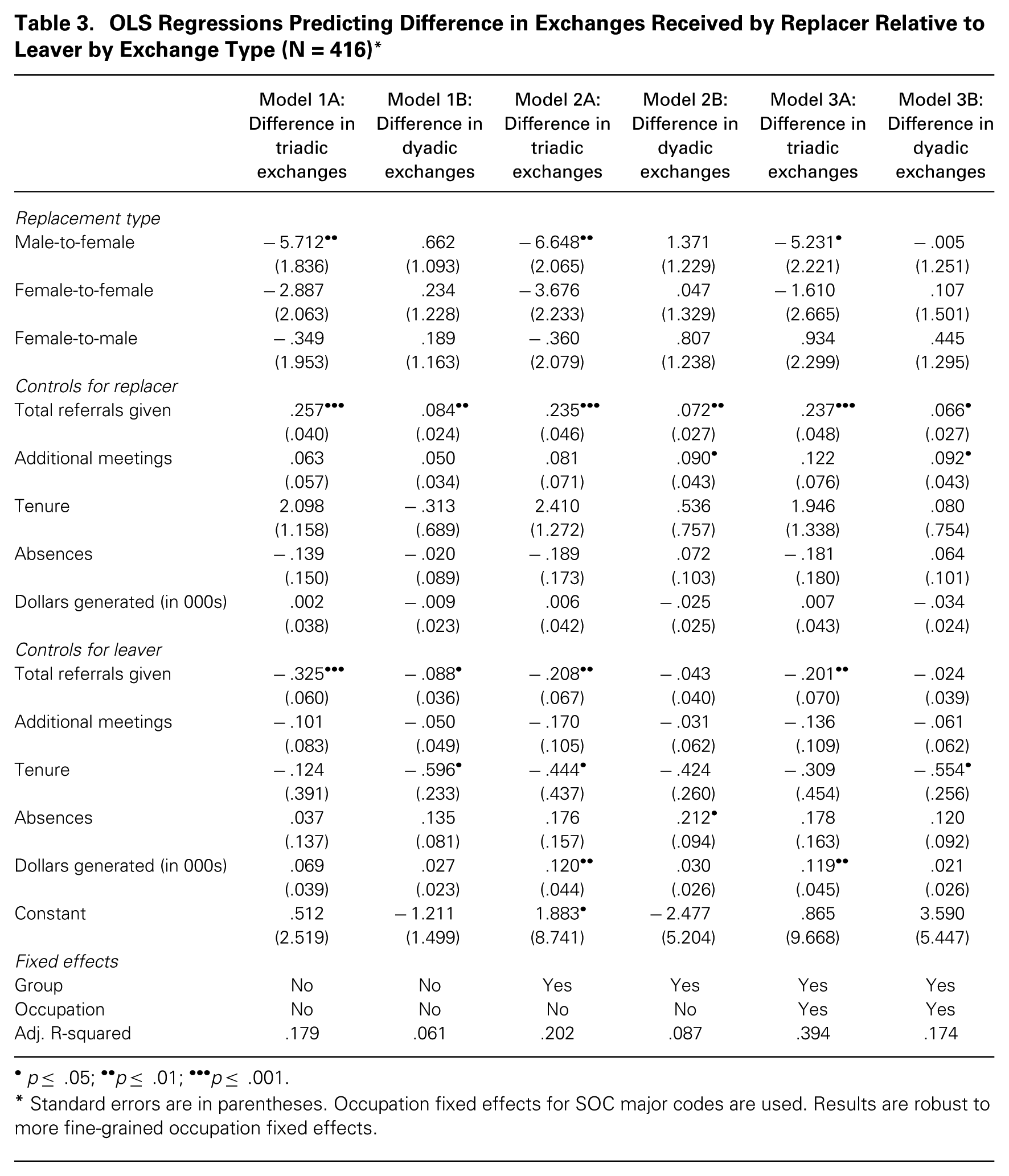
Table 3 presents analyses comparing the number of exchanges that men and women in the same detailed occupation in the same networking group received by exchange type. Models 1A, 2A, and 3A predict the difference in the number of triadic exchanges received by a replacer relative to the leaver they replaced, whereas models 1B, 2B, and 3B predict the difference in the number of dyadic exchanges. In all models, the constant term provides the estimated difference between the number of exchanges the replacer received and the number the leaver received for the omitted category, male-to-male replacements, conditional on the covariates. In other words, the constant tells us how many more or fewer exchanges a male replacing a male received than the man he replaced. The coefficients on male-to-female, female-to-male, and female-to-female dummy variables provide estimates of whether the difference in what the replacer received relative to the leaver he or she replaced in each respective replacement category is significantly different from the observed differences in the male-to-male replacement category.
OLS Regressions Predicting Difference in Exchanges Received by Replacer Relative to Leaver by Exchange Type (N = 416)*
p≤ .05; ••p≤ .01; •••p≤ .001.
Standard errors are in parentheses. Occupation fixed effects for SOC major codes are used. Results are robust to more fine-grained occupation fixed effects.
The results presented in table 3 provide clear support for hypothesis 1, showing that women receive fewer triadic exchanges, or third-party connections to potential clients, from their fellow network group members. In addition to all controls included in model 1A, model 2A introduces group fixed effects, and model 3A introduces occupation fixed effects to allow for a comparison of male-to-male and male-to-female replacement events within the same group and occupational category. As each of these models shows, the gap between the number of triadic exchanges a replacer received and the number of triadic exchanges the leaver being replaced received is far wider in the male-to-female category than in the male-to-male category. Whereas a male member in the male-to-male category receives approximately the same number of triadic exchanges as the leaver he replaced (i.e., constant term is not statistically significant), a female replacer in a male-to-female replacement event receives five to nearly seven, or approximately 30 to 41 percent, fewer third-party connections than the man she replaced. Given that on average members received approximately $8,000 per year in revenues resulting from exchanges, each exchange can be valued at approximately $348 on average. Therefore, this gender difference means that women are receiving approximately $1,740 to $2,436 less in revenues per year. Models 1B, 2B, and 3B show that women receive as many dyadic exchanges as the men they replace, given that the coefficient on male-to-female is not significant and is substantively zero. Therefore the results presented in table 3 provide direct evidence that the presence of a third party leads to women receiving fewer connections to third-party resource providers from their network contacts.
Across all models predicting differences in dyadic (models 1B, 2B, 3B) or triadic (models 1A, 2A, 3A) exchange, the coefficients of the other two replacement categories—female-to-female and female-to-male—are not significant. This indicates that replacers in these categories, like the male replacers in the male-to-male category, receive a similar number of dyadic and triadic exchanges as the person they replaced. One may expect male members replacing female members to receive more exchanges than the women they replaced in male-typed occupations. In this setting, however, there are few such cases, likely contributing to the non-significant effect. A post-estimation F-test comparing whether the effect for the male-to-female category differs significantly from the female-to-female and female-to-male categories reveals that these differences are also statistically significant.
Qualitative evidence from my interviews with members provides additional support for the notion that, in deciding whether to make a triadic exchange, members care about pleasing their third-party contacts. Members commonly mentioned the importance of maintaining a positive relationship with their outside contacts, particularly clients. They also mentioned trying to take their third-party contacts’ preferences into account before making triadic connections. In interviews, when discussing the criteria for deciding whether to make a connection between a fellow member and a third-party contact, members commonly stressed the importance of making a good match. One member shared, “You can be a pretty good judge of who is going to hit it off with who and certain things like that. It really comes down to a fit.”
Effect of Gender-role Incongruity in Triadic Exchange
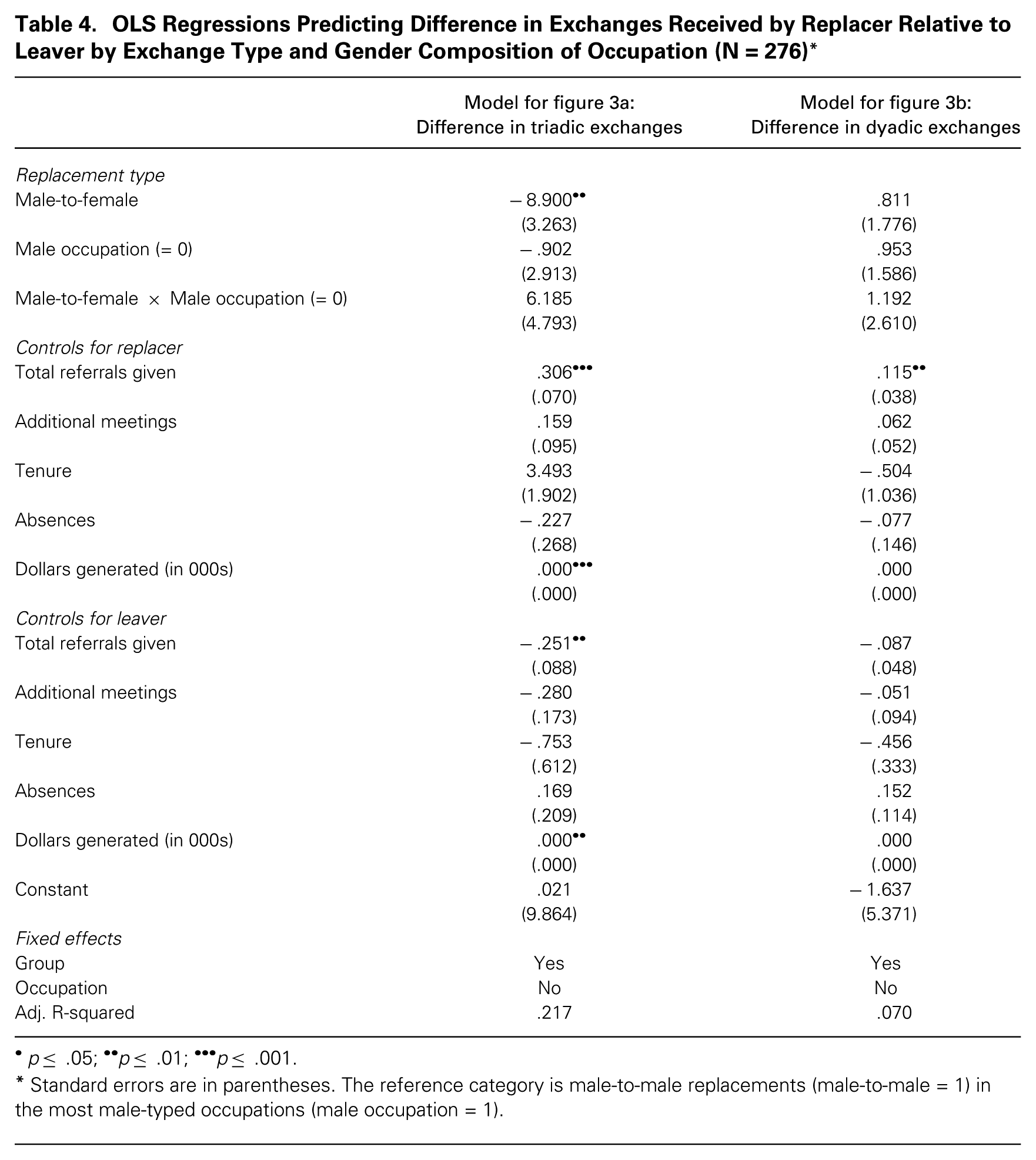
The next set of analyses test hypothesis 2 by examining whether the effect of third parties for driving gender differences in the resources men and women receive is heterogeneous with respect to the gender-typing of their occupation. Figures 3a and 3b are marginal effects plots from an OLS regression, shown in table 4, predicting the difference in the number of exchanges (3a predicts triadic exchanges; 3b predicts dyadic exchanges) received by replacers relative to the leaver they replaced based on whether the replacement occurred in a male-typed occupation. To provide an appropriate test of whether women in male-typed occupations receive fewer triadic exchanges than similar men, these analyses are limited to observations in the male-to-female and male-to-male replacements. These models include all controls at the level of the leaver and the replacer, as well as a dummy variable for male-to-female, and they introduce a dummy variable, male occupation, which takes a value of 1 for occupations in which 70 percent or more of occupants are male. These models also include interactions between male-to-female replacement and male occupation. Since hypothesis 2 predicts the largest difference in triadic exchange among those in male-typed occupations, the reference category in these models is male-to-male replacements (male-to-male = 1) in the most male-typed occupations (male occupation = 1).
OLS Regressions Predicting Difference in Exchanges Received by Replacer Relative to Leaver by Exchange Type and Gender Composition of Occupation (N = 276)*
p≤ .05; ••p≤ .01; •••p≤ .001.
Standard errors are in parentheses. The reference category is male-to-male replacements (male-to-male = 1) in the most male-typed occupations (male occupation = 1).
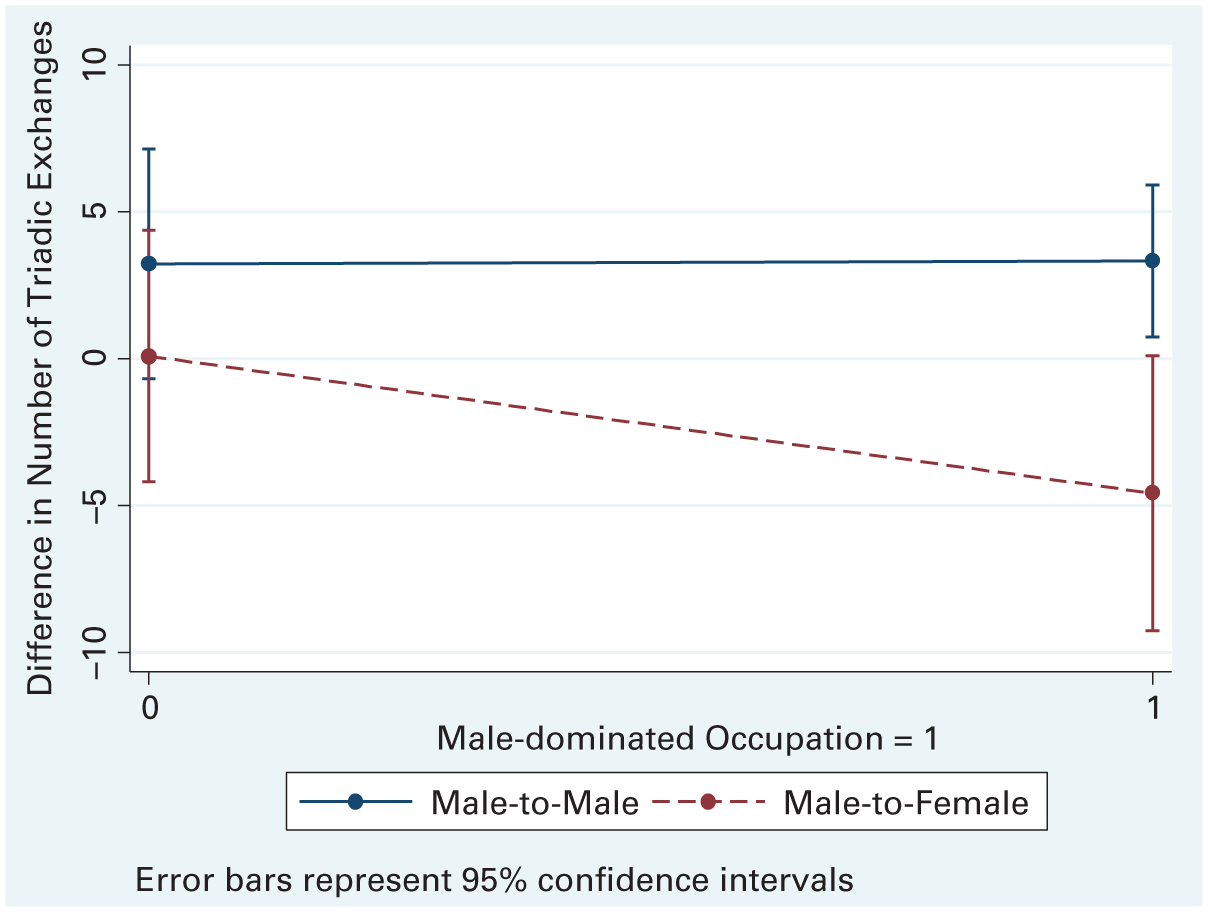
Predicted difference in triadic exchanges received by replacer relative to leaver in male-to-female replacements versus male-to-male replacements by gender composition of occupation.
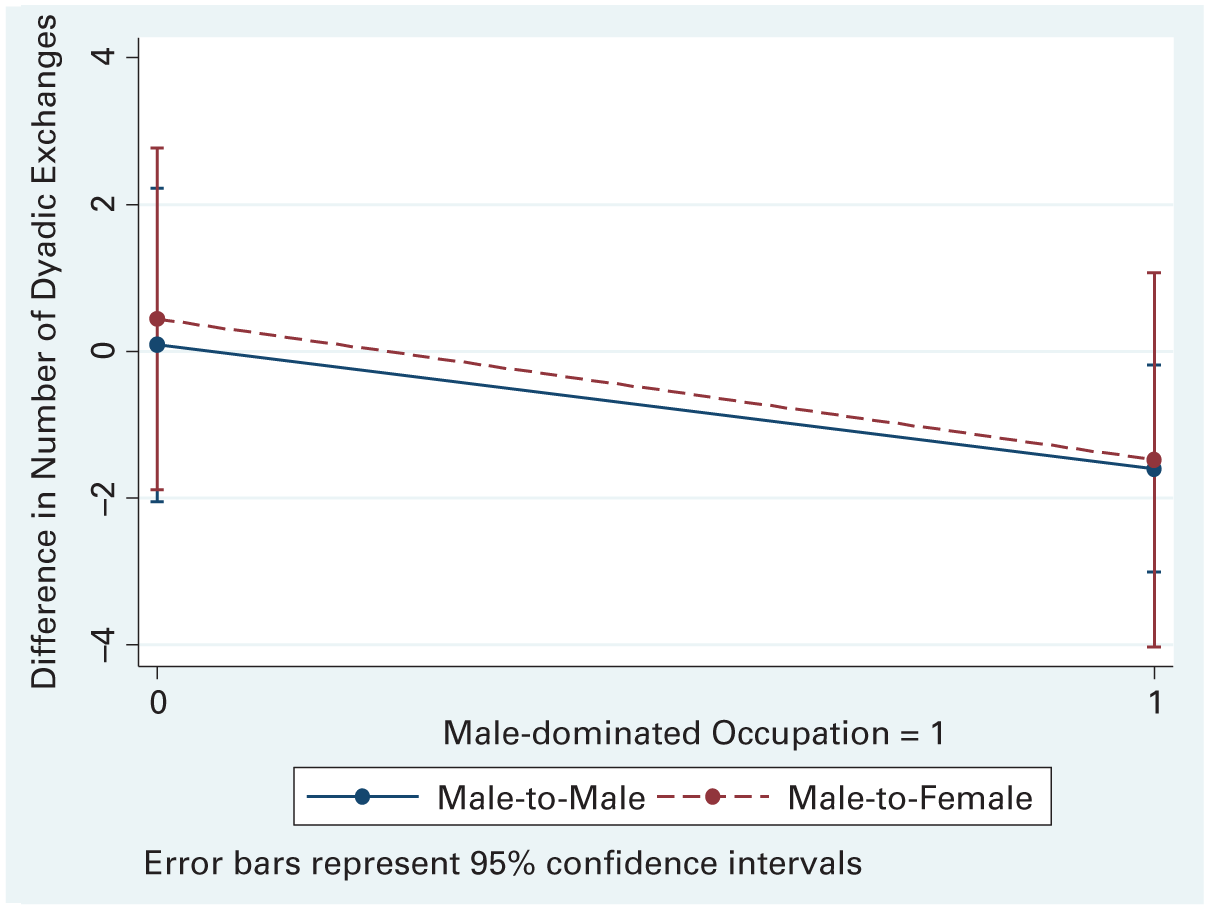
Predicted difference in dyadic exchanges received by replacer relative to leaver in male-to-female replacements versus male-to-male replacements by gender composition of occupation.
Figure 3a compares the relative number of triadic exchanges received by replacers versus leavers in the male-to-female category with the difference for the relevant reference group, male-to-male, by male occupation. Consistent with hypothesis 2, figure 3a reveals a clear pattern: women receive fewer triadic exchanges only when in occupations that are predominantly male. Whereas women in occupations that are more than 70 percent male receive 4.6, or 27 percent, fewer triadic exchanges than the men they replaced, there is no gender difference in triadic exchanges received by men and women in occupations that are less than 70 percent male (gender-neutral or female-typed). Figure 3b provides the necessary comparison for attributing this gender difference in triadic exchange to the presence of a third party by examining dyadic exchanges, showing the relative number of dyadic exchanges received by replacers as compared with leavers in the male-to-female versus male-to-male replacement category. These results reveal that women receive just as many dyadic exchanges as men, even when in the most male-typed roles.
Moving from the replacement events sample to the overall study population, a parallel comparison of gender differences in exchanges received based on the gender-typing of the occupation also supports hypothesis 2. Using data from the full study population, figures 4a and 4b predict the number of triadic and dyadic exchanges, respectively, that members received based on their gender and the gender-typing of their occupation. The underlying negative binomial regression models shown in table 5 include all controls and introduce percent male in occupation buckets, an ordinal variable ranging from 1 to 6 and measuring the degree to which actors in each occupation tend to be men, with 1 being most female-typed and 6 being most male. Using the full study population data allows for this more fine-grained specification of the gender-typing of the occupation than the dichotomous specification captured by the male-occupation variable in the replacement analyses. I created buckets for the gender composition of occupations such that 1 = < 30% male in occupation, 2 = 30–39% male in occupation, 3 = 40–49% male in occupation, 4 = 50–59% male in occupation, 5 = 60–69% male in occupation, and 6 = ≥ 70% male in occupation. Because, by definition, there are few women in the most male-dominated roles (and few men in the most female-dominated roles), I lumped the most-gendered occupations into these larger buckets. These models include both the main effect of percent male in occupation buckets and interactions between female and percent male in occupation buckets. Similar to the previous set of models, the reference category in these models is men (female = 0) in the most male-typed occupations (percent male in occupation buckets = 6).
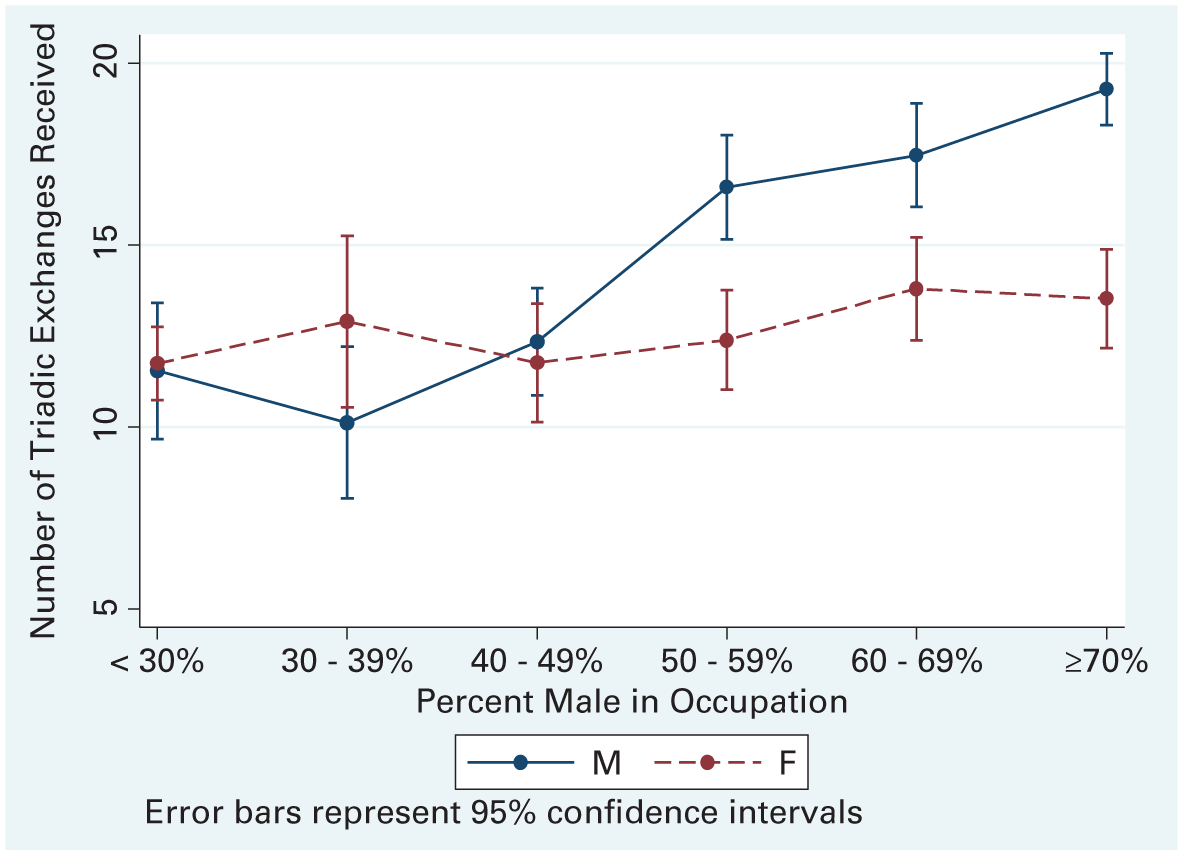
Predicted gender difference in triadic exchanges received by gender composition of occupation.
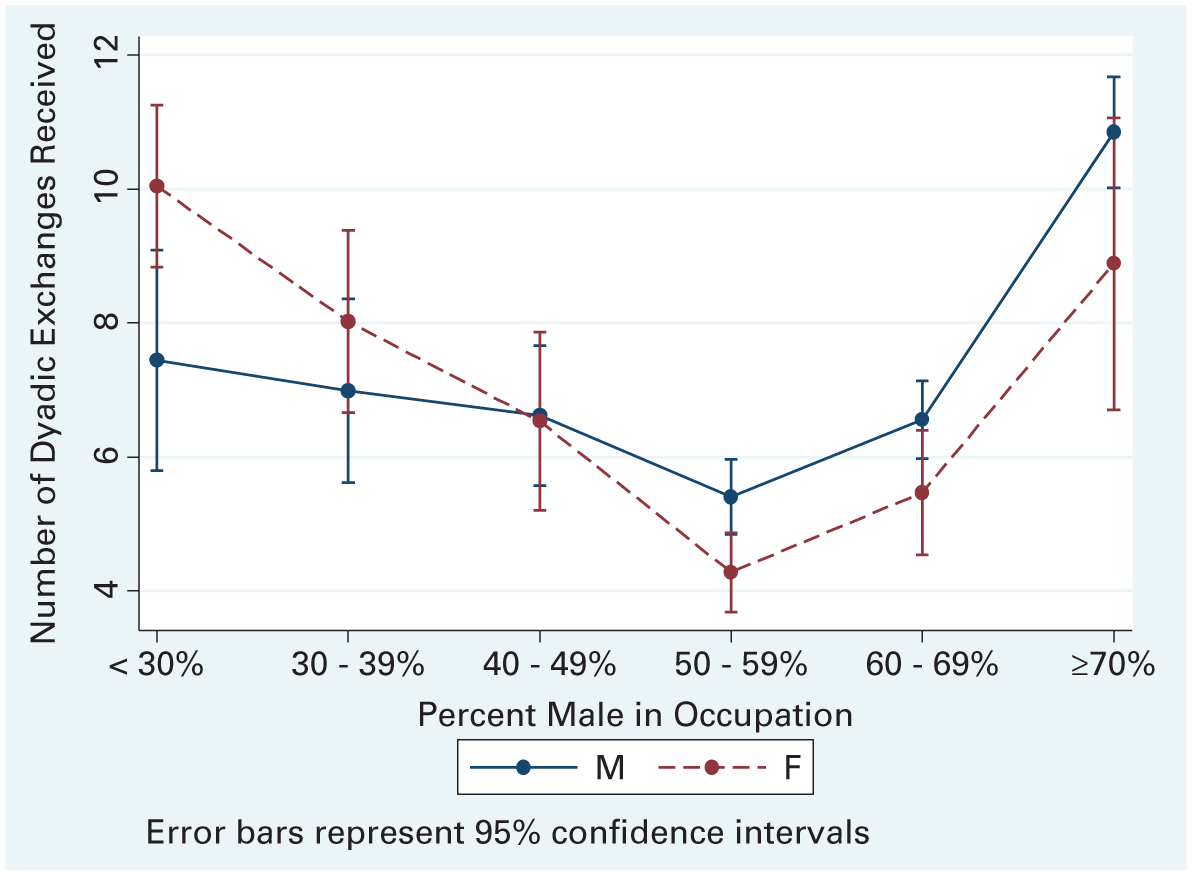
Predicted gender difference in dyadic exchanges received by gender composition of occupation.
Negative Binomial Regressions Predicting Total Exchanges Received in Year by Exchange Type and Gender Composition of Occupation*
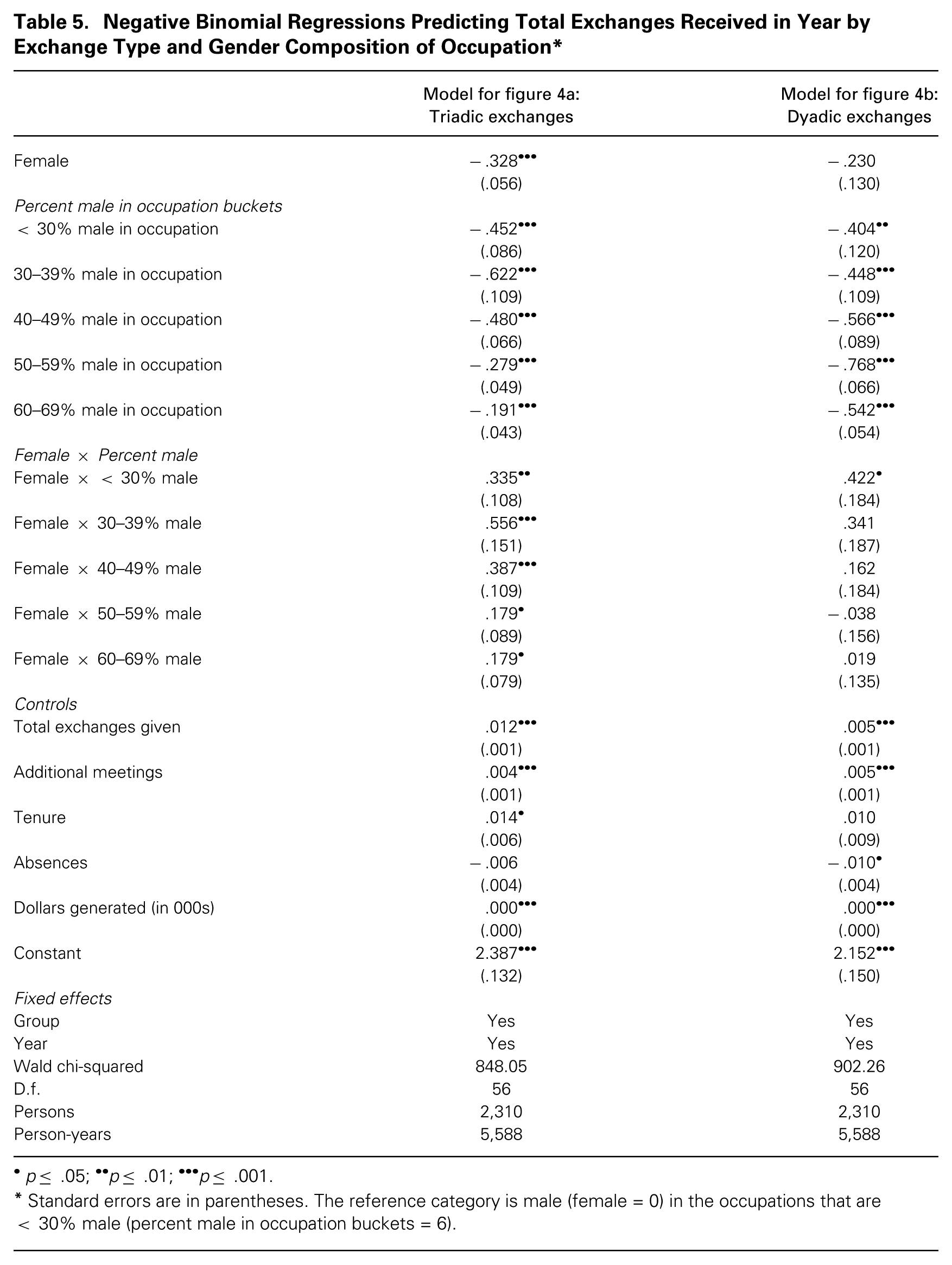
p≤ .05; ••p≤ .01; •••p≤ .001.
Standard errors are in parentheses. The reference category is male (female = 0) in the occupations that are < 30% male (percent male in occupation buckets = 6).
The marginal plot presented in figure 4a used the estimates from these models (table 5) to make this comparison. Consistent with the results centered on the replacement events, figure 4a reveals that only women in male-dominated occupations receive fewer triadic exchanges than their male counterparts. Comparing women and men in occupations that are less than 50 percent male reveals that in these occupations women receive the same number of triadic exchanges as men. In occupations that are 50 percent or more male, however, there is a clear gender difference in number of triadic exchanges received. This difference is especially pronounced in the most male-typed occupations, in which women receive nearly 30 percent fewer triadic exchanges than do men. Confirming that this pattern of gender differences is driven by the presence of a third party, figure 4b depicts the effect of the gender composition of the occupation that a member occupies on the predicted number of dyadic exchanges received by men and women. This figure reveals that there are no significant differences in the number of dyadic exchanges that men and women receive, irrespective of the gender-typing of the occupation. Thus women in male-typed occupations receive fewer exchanges than men only when the exchange involves a relevant third party, providing clear support for hypothesis 2.
Robustness Checks
Differences in the quality of leavers
One possible alternative mechanism for the finding that women receive fewer triadic but not dyadic exchanges relates to potential heterogeneity in the leavers by replacement category. If women are replacing top-performing men but men are replacing lower-performing men, it is possible that women receive fewer triadic exchanges than the men they replace because they are replacing the stars in the group. If women are replacing very poor performers, they may receive fewer exchanges not because they are women but because other group members do not value the particular occupation they represent. In either case, my results could be biased, such that a gender difference would be overstated.
While this is unlikely, it is also falsifiable. Table A2 in the Online Appendix depicts the mean number of triadic exchanges received by leavers in each of the four replacement categories per year. As the table shows, male leavers receive on average approximately 16 to 17 triadic exchanges, and female leavers receive approximately 13. Importantly, the mean number of triadic exchanges received by a leaver does not differ significantly based on whether a male leaver is replaced by a male or a female. This captures potential differences due to the quality of the leaver as well as potential differences in the opportunity to generate exchanges for a given occupation. Thus it is unlikely that differences in the number of connections to third-party contacts received by the leavers account for the finding that women receive fewer than the men they replace.
Discussion
Decision makers’ personal gender beliefs are frequently cited as key drivers of gender inequality. A growing body of research suggests that audience-based mechanisms of gender bias may also contribute to a male advantage, whereby a decision maker favors male candidates because they believe a relevant third party or audience prefers men (Becker, 1971; Neumark, Bank, and Nort, 1996; Fernandez-Mateo and King, 2011). Despite existing theory predicting that audience-based mechanisms of gender bias generally exist (e.g., Fernandez-Mateo and King, 2011; Correll et al., 2017), it remains unclear whether we should expect decision makers to universally favor men in cases involving a third party. This study broadens our understanding of the conditions under which the presence of a third party or audience is most apt to advantage men by examining resource exchange among entrepreneurs in occupations ranging from female- to male-typed. Results revealed that in interpersonal resource exchange, only women in male-typed occupations are disadvantaged in accessing resources through exchanges involving a third party.
These findings have several implications for research on audience-based mechanisms of inequality, gender-role incongruity, and resource exchange within networks, particularly among entrepreneurs. First, this study advances theory on audience-based mechanisms of gender bias by drawing on role incongruity theory to argue and show that the effects of audiences are heterogeneous. Existing studies in this tradition largely conclude that women will be disadvantaged in cases involving a relevant third party or audience, without accounting for how the effect of a third party may be a function of role incongruity. A closer look at these empirical studies reveals that most have focused on male-dominated contexts or occupations, such as information technology (Fernandez-Mateo and King, 2011) and law enforcement (Correll et al., 2017). By examining the effect of third parties across occupations varying from female- to male-typed, this study establishes boundary conditions for when audience-based mechanisms of gender bias are most apt to lead to differential outcomes for men and women, namely only among those in male-typed roles. Furthermore, this study moves from the usual focus on general audiences that are collectives of actors (e.g., a firm’s customers) to demonstrate that audience-based mechanisms of gender inequality also operate in interpersonal triadic exchange. One fruitful direction for future research may be to further unpack when audiences lead to inequality across contexts by considering additional characteristics of the various actors involved in the triadic exchange. For example, it is plausible that in a more homogenous setting in which all members are in the same occupation (for example, Zuckerman and Sgourev, 2006), where gender is arguably less salient, the activation of audience-based biases would be diminished. Another possible extension of this work would be to consider whether male and female decision makers differ in their propensity to favor men in exchanges involving a third party.
Second, this study provides more direct empirical evidence of the effect of audiences on gender inequality by comparing gender differences in cases that involve a third party with cases that do not. To definitively show that a third party or audience is driving observed gender differences, it is necessary to show that a male advantage exists in decisions involving a third party, even when there is less or no gender difference in personal decisions not involving a third party in the same context. While recent empirical work on status orderings for consumer and cultural goods has made progress in this direction (Correll et al., 2017; Sharkey and Kovács, 2017), studies on the effect of audiences for gender inequality have largely not had this necessary baseline (Becker, 1971; Neumark, Bank, and Nort, 1996; Fernandez-Mateo and King, 2011). The two types of exchanges in my empirical setting—dyadic and triadic—allow me to address this gap. That I find evidence of bias in triadic exchanges only in male-typed occupations, and not in dyadic exchanges in these same male-typed occupations, provides direct evidence that the presence of a third party activates this male preference. It is important to note that even if there was some evidence of bias in dyadic exchange, as long as there was a larger gender difference in cases involving a third party, the conclusion would still be that the presence of a third party contributed to observed gender differences in triadic exchange.
A fruitful direction for future research is to disentangle the reasons why decision makers who exhibit bias in the presence of a third party may not exhibit any bias in decisions that do not involve a third party. One likely explanation for the observed equality in dyadic exchanges in this study is that members in this setting are themselves unbiased. Having directly interacted with female fellow group members may provide individuating information that reduces bias (Pettigrew and Tropp, 2006; Hinds and Cramton, 2013). Importantly, this is not simply a unique feature of this research setting. In interpersonal triadic exchange more generally, a decision maker frequently interacts with, and has the information needed to assess, both individuals at risk for being connected. It is also possible that anticipating that giving an exchange to a female member may evoke future reciprocity may similarly lead members to set aside their gender biases. Identifying the factors that lead to equality in dyadic exchange is beyond the scope of this study, but these results suggest that even if members generally hold common gender biases, these biases are not being activated in dyadic exchange.
Third, this study contributes to role incongruity theory by uncovering an additional pathway through which women in gender-incongruent roles face penalties. Research in this tradition has documented that evaluators’ own biases often lead them to favor men in male-typed contexts, showing that women are penalized both in terms of gaining access to these positions and in subsequent performance evaluations. This study shows that even when personal biases do not affect evaluations, assessments hinging on a third party may still lead to a disadvantage for women in gender-incongruent roles. Furthermore, this study shows that the presence of a third party does not lead to a female advantage in female-typed contexts. In describing how gender status orderings are reproduced, Ridgeway (2001: 651) said, “As people interact to create new social practices, gender status beliefs are likely to implicitly shape what they do, causing them to rewrite gender inequality into the new social forms they develop.” My findings suggest that even if individuals are not reproducing these gender beliefs generally, the presence of a third party may activate reliance on the gender status ordering in male-dominated contexts and similarly fortify this hierarchy.
Given the central role of resource exchange for entrepreneurial success (e.g., Stewart, 1990; Hallen, 2008), this study also makes an important contribution to our understanding of how networks may yield unequal benefits for male and female entrepreneurs. Most existing research has suggested that female entrepreneurs derive fewer benefits from their networks because they have fewer valuable contacts (e.g., Aldrich, Elam, and Reese, 1997; Renzulli, Aldrich, and Moody, 2000; Ruef, Aldrich, and Carter, 2003). This study suggests that female entrepreneurs, especially in male-typed fields, may also be less successful at accessing resources from their network contacts when doing so involves a third party. More generally, network scholars have long argued that specifying individual-level differences in how actors use social ties provides an opportunity to make theoretical progress (Ibarra, Kilduff, and Tsai, 2005; Renzulli and Aldrich, 2005). This study reinforces that to advance our understanding of how networks lead to gender inequality, particularly in entrepreneurial outcomes, it is necessary for future research to move beyond structural explanations and examine how resources are exchanged among network contacts.
Because this study is based on data from a single organization, it is necessary to consider unique elements of this setting and scope conditions to the generalizability of results. One notable feature of this setting is that all exchanges initiated are visible to all other members. Thus fellow group members are also a type of audience that could arguably impose expectations of what is appropriate in this context (Zuckerman et al., 2003). One implication is that a desire to appear equitable to fellow members diminishes the tendency for gender to affect resource exchange. But this is improbable for several reasons. Most notably, two specific features of this setting highlight that it is very difficult for members to observe that a fellow member is being gender-biased in resource exchange. First, despite the visibility of actual exchanges, there is no visibility into decisions not to exchange resources with fellow members, as no one can observe when a fellow member withholds an exchange. Therefore, from the perspective of fellow members, observing that a member gives more resources to men may simply be a function of their opportunities to give—not of bias. Second, the noncompeting nature of these groups means that decision makers are never directly deciding between a male and a female electrician, for example. As a result, members are not observing that a fellow member is disproportionately connecting with the male electrician. Moreover, to the extent that visibility affects exchange, there is no reason to expect that it differentially mitigates bias in dyadic versus triadic exchange. Each member announces all exchanges that they initiated to the group during the weekly meeting, making dyadic and triadic exchanges equally visible. Therefore, if visibility suppresses the activation of personal biases in direct exchange, my findings show that this is insufficient for suppressing the activation of bias when a third party is involved. 5
This study sheds light on one possible reason that networking efforts are not always effective for redressing gender inequality, as Kalev, Kelly, and Dobbin (2006) found to be true for women in management. To the extent that these initiatives help employees ascend into management by fostering connections that lead to subsequent job referrals, given that management is typically male-typed, my findings suggest that women will receive fewer such referrals as people will be less likely to refer women for these positions. This study thus has important practical implications for reconceptualizing organizational approaches for redressing such inequality, offering particularly useful insights for organizations using employee referral programs in settings that are male-dominated. Often these employers struggle with identifying female candidates. My findings suggest that in cases of male-typed roles employers should make their preference to attract more female candidates known, so that employees are not left to infer the employer’s preferences or expectations, which would likely lead them to conclude that men are preferred. More generally, making gender preference clear may offer a relatively costless first step toward minimizing the effects of audience-based gender biases.
Supplemental Material
DS_10.1177_0001839219832813 – Supplemental material for Gender-role Incongruity and Audience-based Gender Bias: An Examination of Networking among Entrepreneurs
Supplemental material, DS_10.1177_0001839219832813 for Gender-role Incongruity and Audience-based Gender Bias: An Examination of Networking among Entrepreneurs by Mabel Abraham in Administrative Science Quarterly
Footnotes
Acknowledgements
This research has benefited from the comments of Roberto Fernandez, Susan Silbey, Emilio Castilla, Ray Reagans, Tristan Botelho, Kathy Phillips, Ezra Zuckerman, Kate Kellogg, Sameer Srivastava, Julia DiBenigno, Aruna Ranganathan, Phech Colatat, and numerous seminar and conference participants. I also thank the Kauffman Foundation and the American Association of University Women for their generous financial support. All remaining errors are my own.
Supplemental Material

Notes
Author’s Biography
References
Supplementary Material
Please find the following supplemental material available below.
For Open Access articles published under a Creative Commons License, all supplemental material carries the same license as the article it is associated with.
For non-Open Access articles published, all supplemental material carries a non-exclusive license, and permission requests for re-use of supplemental material or any part of supplemental material shall be sent directly to the copyright owner as specified in the copyright notice associated with the article.
