




Abstract
Many organizations rely on group work to generate creativity, but existing research lacks theory on how groups’ responses to recognition for creative achievement shape their subsequent creative outcomes. Through an inductive study of bands nominated for a Best New Artist Grammy from 1980 to 1990, we develop a theory of reactions to early recognition in creative groups. Our multi-method analyses include oral histories from members of each band and quantitative data, which we use to triangulate the processes they describe. Our findings reveal that groups developed sets of emergent reactions and active adjustments to the recognition and its consequences, which we call “recognition orientations.” We identify three such orientations—absorbing, insulating, and mixed—that reflect how groups interpret recognition and integrate it into their subsequent processes. Most groups struggled by absorbing recognition, which led to internalizing expectations and opening their relationships to outsiders, ultimately inhibiting creativity. Some groups began to insulate themselves from recognition by externalizing expectations and bounding relationships, allowing them to sustain creative output over time. Finally, other groups developed a mixed orientation, initially experiencing the pitfalls of elevated recognition-seeking but ultimately attempting to insulate their need for external recognition by refocusing on their creative process. These findings reveal that recognition can upend the creative process, and groups that begin absorbing recognition are, ironically, less likely to earn it again in the future. Filling a critical research gap on creative production among groups that intend to continue working together, the results distinguish the skills needed to manage recognition from those needed to generate creativity, and offer insight into how groups enact longevity.
Recognition for creativity is ubiquitous. Systems for recognizing creative achievement have existed throughout history—laurel wreaths were given in ancient Greece to recognize poets and musicians—and exist in every creative field today, including film (e.g., Academy Awards, Golden Globes), literature (e.g., Nobel Prize in Literature, Man Booker Prize, National Book Award), advertising (e.g., Clio Awards), theater (e.g., Tony Awards), math (e.g., Fields Medal), architecture (e.g., Pritzker Prize, Royal Institute of British Architects Gold Medal), food (e.g., Michelin Stars, James Beard Award), design (e.g., Red Dot Awards), visual art (e.g., Turner Prize), and music (e.g., Grammys). If creativity is the development of ideas, products, and processes that are novel and deemed useful (Amabile, 1988), then judgment is inherent to creative production (Csikszentmihalyi, 1999), and creative recognition by the public and by domain experts is an extreme, ritualized form of such judgment (Anand and Watson, 2004). Even creatives who subscribe to the ideal of l’art pour l’art (art for art’s sake) must stop and take notice when their work is recognized for creativity. 1 Such recognition is the purest indication of having produced something particularly creative (Amabile, 1982). Thus recognition for creativity should be a crowning achievement for creative groups. Yet closer scrutiny of recognition and what it represents to its recipients may reveal an experience that is not exclusively positive (Jensen and Kim, 2015; Deichmann and Baer, 2022).
Because the conditions surrounding the creative process are complex and “fragile” (Ford, 1996: 1128), recognition may signify genuine achievement, but it also presents potential challenges for the recognized. First, recognition signals that a group has done something deemed right and should, therefore, continue to do whatever it did to garner recognition in the first place. But the complexity and fragility of the creative process (e.g., Bielby and Bielby, 1994; Shalley and Gilson, 2004; Mueller, Melwani, and Goncalo, 2012; Perry-Smith and Mannucci, 2017) make it difficult to know which aspects of creative output are being rewarded, leaving creative groups potentially unsure of how to respond to recognition in subsequent creative endeavors. Second, recognition comes with increased exposure, expectations, and pressure to recapture whatever lightning the group previously bottled. But the skills that go into generating a creative product are likely quite different from and possibly even antithetical to those needed to deal with increased popularity and scrutiny.
These challenges are likely particularly profound for groups that are early in their tenure, as they have had fewer opportunities to get comfortable with their creative process and with one another. Such groups are also unlikely to have dealt with anything as potentially destabilizing as the experiences that accompany recognition. In contrast, recognition after several cycles of creative work would provide group members with more time and experience to test and solidify productive work patterns (Gonzalez-Mulé et al., 2020) and to gradually acclimate to increasing interest from outside parties. Thus while recognition seems like something that creative groups would desire, relatively new groups may struggle upon receiving it. Furthermore, recognition is a forcing function: because of the questions and challenges it prompts, those garnering recognition cannot simply go back to what they were doing prior to receiving it—they must engage with it in some way. This aspect of recognition is implicit in Harvey’s (2014: 338) suggestion that “One question for further research is how having one breakthrough idea shapes a group’s subsequent creative process and outcomes.” Thus we focus on the moment of (early) recognition and its aftermath. 2 Specifically, we ask, how do creative groups make sense of and respond to recognition, and how does the response shape a group’s subsequent creative process and outcomes?
Although organizations regularly rely on group work to generate creativity—particularly groups that work together on multiple projects and develop a long, shared history (Fischer and Boynton, 2005; Gardner, Gino, and Staats, 2012)—there is currently no theory to fully answer these questions (Baer et al., 2010; Harvey, 2014). First, although evaluating and recognizing creativity is key to identifying creative achievement, research has rarely focused on what happens next: “The field is wide open for future research. . . . Analyzing the consequences for awards recipients’ self-esteem and their risk-taking is of major importance” (Frey and Gallus, 2017: 198). Second, while research has suggested that teams with more time together perform better on a host of (non-creativity-related) outcomes (Gonzalez-Mulé et al., 2020), Kurtzberg and Amabile (2001: 288) observed that most empirical evidence of group creativity is derived from groups that had no history with each other, no established patterns of interaction, no knowledge of each other’s strengths and weaknesses, and no strong incentive to cooperate or create a mutual understanding that would have helped them as a team at some future time. In other words, the bulk of knowledge on this topic has been generated based on the performance of groups of people who had never met before and would likely never meet again. We therefore develop theory for groups whose members have a history with one another—and intend to continue to work together—using early recognition as a critical triggering event because of the aspects of creative production that such recognition brings into relief.
To tackle our research question, we build theory by studying groups wrestling with how to respond to industry-wide recognition for early creative success. We use an inductive study of 52 bands and artists that were nominated for the Best New Artist Grammy from 1980 to 1990. We analyze archival interviews that compose an oral history of each band by the band members themselves, and we triangulate this qualitative data with quantitative data on their musical output and its acoustic qualities over time. Through this process, we qualitatively induce three emergent reactions that we label “recognition orientations”—absorbing, insulating, and mixed—which indicate groups’ ongoing responses and reactions to the recognition for creative success. Ironically, groups ostensibly most likely to want to generate future recognition (absorbing) seem most likely to sabotage it, whereas groups less focused on garnering recognition (insulating) seem most likely to maintain it. Thus a group’s recognition orientation appears to play a substantial role in its ability—or inability—to match the creative output that garnered recognition in the first place.
Given the inductive nature of our study, the following review showcases gaps in theory that motivated our study and highlights literatures that served as “orienting points” to which we became sensitized during our analyses (Dutton et al., 2006: 61). Specifically, our review draws on three areas of research at the intersection of group creativity and recognition: early experience in group development, group boundaries, and expectations.
Creative Groups and the Mixed Bag of Early Creative Recognition
Csikszentmihalyi (1999: 314) suggested, “What we call creativity is a phenomenon that is constructed through an interaction between the producer and audience. . . . Creativity is not the product of single individuals but of social systems making judgments about individuals’ products” (emphasis in original). Yet while evaluating creative work is a common, repeated element of the creative process, both evaluators and creative workers struggle with the assessment of novel products and with determining what a creative product or idea could eventually become (Harrison and Rouse, 2015; Berg, 2016). This lack of clarity motivates creatives to seek awards and other recognition as a means of ratifying their work as creative:
The approval [advertising creatives] seek is from peers in advertising who share their aesthetic sense. Industry awards are a powerful source of peer approval, as well as professional networking. A creative award confirms that the winner works to a set of values that are more valued than those of the advertising business alone. And, unlike everyday work, creative awards are permanent. Almost any creative who has won an award will display it in his or her office, not at home. The plaque or trophy affirms creative permanence. (Hackley and Kover, 2007: 70, emphasis in original)
The need for recognition as a proxy for permanence seems heightened in creative work because the creative process is an inherently risky, low-probability endeavor.
Early Experiences and Group Development
Whether specifically sought or not, recognition likely causes a cascade of issues for creative groups, forcing them to engage with it. First, recognition—especially early in a group’s career—might alter subsequent creative efforts. Researchers have long been interested in the stages that groups go through in their time working together (Tuckman and Jensen, 1977; Gersick, 1988, 1989). More-contemporary research has argued for attention to the formative moments within groups, warning that “those who ignore or in the laboratory cannot replicate this surprisingly time-consuming period run the risk of overlooking important, even critical determinants of the ways in which actual project teams subsequently develop and perform” (Ericksen and Dyer, 2004: 469). Though models of the creative process describe creativity ending when a new idea has been evaluated and implemented (Amabile, 1988), in reality the end of one creative process is the beginning of the next: “The idea that results from creative synthesis is . . . both the outcome of the creative process and its starting point” (Harvey, 2014: 335). However, Anderson, De Dreu, and Nijstad (2004: 158) highlighted that this “inherent cyclicality”—how success or failure in one creative effort influences the next—has rarely been studied, particularly among intact groups. Recognition during one of these initial cycles could alter the starting point for the next cycle, potentially serving as an imprint that changes the group’s approach to the next cycle and beyond. Eventually, reactions to recognition might become woven into the creative trajectory of the group. How groups might work through and with this shared history is an open question.
Group Boundaries
Second, recognition can challenge group boundaries. Clear boundaries are a key condition for team effectiveness (Hackman, 2002), which implies that boundary management—determining who and which ideas are allowed to enter a group—is critical for creative groups. But recognition could push on these boundaries. For example, awards make the nominated group a center of gravity with which other artists and producers want to be associated:
After someone wins a Grammy, they instantly get a lot of press and recognition. There is a much bigger focus on them than before. At this point the label starts spending some money on them because Grammy award winners are important. They provide credibility. People—potential artists, producers, and the like—walking into the label think, “This is cool, they have Grammy award winners here.” (Anand and Watson, 2004: 68)
Some research suggests that this recognition is exactly what groups need to sustain creativity: to bring in new voices that encourage creative abrasion, pushing against old ideas with new ones (Choi and Thompson, 2005; Skilton and Dooley, 2010; Soda, Mannucci, and Burt, 2021). Supporting this proposition, Ferriani, Cattani, and Baden-Fuller (2007) found that film production teams recognized for their creative work subsequently gained access to resources like good scripts or new collaborative partners that bolster future creative efforts. Other scholars have cautioned against too many outside voices, suggesting that creative recognition will breed a sort of feeding frenzy whereby outsiders will want to join the group to take advantage of its success rather than contribute fundamentally new ideas (Shalley and Perry-Smith, 2003). Presenting evidence of this trend, Simonton (2005) suggested that for movie production teams, larger production budgets (which bring in outsiders and typically come with recognition of earlier work) have a negative relationship with critics’ reviews and no relationship with winning awards. Still others have proposed a middle ground in which groups cultivate a sense of elasticity: they may make boundaries explicit yet also allow individuals within the group to transgress the boundaries in ways that support innovation (Harrison and Rouse, 2014). At the very least, early recognition likely portends a qualitative shift in managing group boundaries, leaving groups to decide who to allow in and why.
Expectations
Third, recognition could alter expectations for future performance. Recognition can draw in more-diverse audiences with differentiated tastes, again complicating the assessment of creative output (Kovács and Sharkey, 2014). This, too, could have a profound influence on subsequent production. Audiences lured in by the recognition and not necessarily the work itself bring expectations likely quite different from those of existing critics and fans—and how to meet these varied expectations may not even be clear to creative workers themselves. For example, Rossman and Schilke (2014) found that producing Oscar bait movies—i.e., films created to seek recognition by using themes typically rewarded by the Academy and/or similar to prior years’ Oscar winners—is a high-risk, high-reward strategy. These films either go on to receive multiple Oscar nominations or are complete flops, demonstrating how difficult it is even for insiders to know what garners recognition in creative endeavors. Seeking recognition based on prior expectations or what was previously rewarded is hardly a sure bet. These considerations intensify when groups are involved: instead of one person reacting to new signals, audiences, and expectations, a collective must now make sense of how it organized its work previously, attempt to determine why it was recognized, and endeavor to be creative yet again. Because groups are prone to overconfidence (Janis, 1972), groups with early success might be particularly prone to feeling confident in their subsequent ability to select creative ideas (Skilton and Dooley, 2010). That is, a key feature of the creative process—dispassionate selection from among many potential ideas—might become warped as groups focus on regaining recognition as a filter for their creative choices.
Thus early creative recognition likely adds significant complexity to an already uncertain set of circumstances for creative groups. In contrast to the positive potential that early recognition may portend and inspire, it also may create a false sense of understanding of how to navigate the creative process, ultimately stifling subsequent creative output (Skilton and Dooley, 2010). Group members are simultaneously dealing with novel ideas and learning how to develop them while still figuring out how they should work with one another (Harrison and Rouse, 2015) and coping with the many changes—including increased stress from expectations and responsibilities (e.g., Merton, 1968)—brought on by recognition. Unlike commercial success alone, critical recognition of creativity ratifies what a group has done and prompts a reckoning with new audiences and expectations (Kovács and Sharkey, 2014), more responsibilities stemming from new social and cultural contexts (Jensen and Kim, 2015), and new interlocutors (Cattani, Ferriani, and Allison, 2014). How groups orient themselves to these changes—as well as the increased exposure—likely goes a long way toward determining their future creativity. Fundamentally, early recognition has great potential to disrupt groups’ ability to generate creative work. Groups must come to terms with what recognition means to them and how it will influence their future together. With multiple group members navigating group boundaries and audience expectations, recognition likely gives rise to different reactions and future outcomes for different groups. Given the state of the literature, we sought to inductively explore these dynamics.
Methods
Research Context
Sampling logic
As our research focuses on the effects of early recognition on creative groups over time, we used a logic of purposeful sampling (Patton, 2002; Yin, 2009) to find an extreme context—one that offers a transparent, unfettered view of the dynamics of interest (Eisenhardt, 1989; Pettigrew, 1990; Yin, 2009). The music industry requires constant competition among new songs for radio play and weekly changes in Billboard chart positions, creating an extremely competitive environment that “works to privilege innovation” (Toynbee, 2000: 10). Yet to maintain a career, musicians cannot rely on “sudden bursts of innovation but the continual production of familiarity and newness” (Negus, 1998: 362; cf. Askin and Mauskapf, 2017). Hence, “people who make popular music are creators” (Toynbee, 2000: 35; emphasis in original). Popular music fits the logic of an extreme context for studying the interplay of creativity and group work over time because it privileges creative work: “Like any cultural artefact . . . music is the result of a variational-selection process” (Mauch et al., 2015: 9). Moreover, the popular nature of pop music privileges creative work with widespread appeal, thereby promising insight into creative work that can have a practical impact, much the same way that studying Edison’s light bulb (Hargadon and Douglas, 2001) or the emergence of the iPod (Dedrick, Kraemer, and Linden, 2010) offers insights on generating broadly influential creative products.
We bounded our sampling by looking at groups that earned a nomination for the Grammy for Best New Artist, a legitimate arbiter of creativity in the pop music field (Anand and Watson, 2004). The Best New Artist Grammy has been awarded annually since 1959 by the Recording Academy (formerly the National Academy of Recording Arts & Sciences), which was founded with “the explicit mandate of instituting annual awards that would recognize artistic merit rather than commercial appeal or sales” (Anand and Watson, 2004: 63, citing Schipper, 1992). This is generally the way it continues to be, and as with other Grammys, the Recording Academy voting members determine the nominees and winners. 3 In spite of the award’s prestige (Anand and Watson, 2004; English, 2005), there is folk wisdom that winning the Best New Artist Grammy is also a curse; many winners have struggled to match their early success in the years that followed. For example, Colin Hay, lead singer of 1983’s Best New Artist, the group Men at Work, reflected jokingly while reading the inscription on the actual Grammy Award, “‘Men at Work—Best New Artists–slash–Kiss of Death Award’” (VH1, Where Are They Now? Men at Work, 2002). Our own music listening habits led to a similar conclusion, which motivated our data collection.
Sample selection
Because our research questions focus on the experience and aftermath of early recognition for creative groups, we sampled 52 bands and artists nominated for the Best New Artist Grammy from 1980–1990. We excluded three nominees from our analyses: Robin Williams, who was nominated for a comedy album and was primarily a comedian; the Blues Brothers, who formed through the television show Saturday Night Live and also had comedic aims; and Milli Vanilli, whose Grammy was later revoked due to the revelation that the members had not actually performed on the nominated album. While the Grammy sample includes both bands and individual artists, our qualitative analysis revealed that solo artists tend to have primarily a mixed orientation (described below). Hence we focused our theorizing on creative groups rather than on solo artists.
The time frame we studied allowed us to collect data through most of a full career, as the bands that began their careers in 1990 (the end of our sampling frame) became eligible to be inducted into the Rock & Roll Hall of Fame in 2015. We were therefore able to examine the aftermath of the wins or nominations over a substantial time horizon. Selecting this time frame also allowed two other benefits. First, prior to the 1980s, there was less media focus on popular music, meaning fewer interviews were conducted and, as a result, less available data, especially for lesser-known bands. Focusing on the ten years between 1980 and 1990 allowed us to capitalize on the increased availability of band interviews, which provide evidence of groups’ responses and reactions to recognition. Second, bands that became popular in the 1980s were subject to disruptive shifts in music, revealing this period as a time of heightened musical creativity (see Figure 2a in Askin and Mauskapf, 2017). These shifts included the introduction of MTV (1981) and the mainstreaming of hard rock, synthesizers, and other computerized sounds that expanded the realm of recording possibilities (Théberge, 2004; Serrà et al., 2012).
Data and Analyses
Qualitative data
We searched newspaper, magazine, and video databases with the name of each band and band member to locate publicly available interviews for the groups and artists in our sample. For our entire sample, we collected over 4,130 pages of text, including transcribed video interviews. We then ordered these interviews by date for each band, creating, in effect, an oral history of each band’s career by the band members themselves.
Quantitative evidence of creativity and recognition
As our emergent themes coalesced around different reactions to recognition, we sought to triangulate these findings with quantitative data where appropriate. Two themes stood out in our data that merited triangulation. First, bands varied in their descriptions of the degree to which they experimented with the acoustic features of their songs on subsequent albums or kept a signature sound. As we fully describe in the findings, we gathered data on the acoustic features of later albums and compared them with the acoustic features of the Grammy-nominated album to triangulate whether there was additional evidence suggesting that bands experimented with their sound. Second, bands varied in their longevity and performance over time. To further investigate these issues, we gathered not only data on subsequent Grammy nominations but also data for every original U.S. studio album released by the groups, the album’s peak position on the Billboard 200 albums chart, RIAA rankings, “Best Ever Albums” rankings in release year and overall, and the number of songs covered by other artists (collected from secondhandsongs.com). 4 Following prescriptions for inductive research to use multiple forms of data for triangulation (Rouse and Harrison, 2015), we used these data to triangulate our qualitative data with indicators of ongoing creative productivity (album releases and time spent working on new material) and associated forms of creative performance (e.g., critics’ and fans’ rankings, album sales, chart positions, songs covered by other artists). See Online Appendix B in this article’s supplementary material for the latter analyses.
Inductive Analyses
We used an inductive approach to analyze our data (Corbin and Strauss, 2008), iterating between coding the data and developing theory. We began by creating an oral history for each band, ordering their quotes in chronological sequence. We used these oral histories for open coding, using in vivo codes or verbatim statements to categorize dynamics within groups that appeared to relate to the experience of early creative recognition and its aftermath. We then created condensed timelines for each band that summarized key events (e.g., Best New Artist nomination/win, album releases, breakups, and reunions) along with the codes. At this point, we began comparing patterns to look for second-order themes that might explain similarities or differences between groups. During this part of the process, we realized there were distinct orientations to recognition that seemed to impact groups’ ability to stay together and/or to continue to create new music. As these more-abstract categories began to crystallize, when it provided additional insight for theorizing we collected and analyzed quantitative data (acoustic measure of music, performance of later albums, etc.) to triangulate with our emergent themes.
In our data, we treat nominees and winners of the Grammy for Best New Artist as part of the same category. While winning is undoubtedly meaningful, the more substantial recognition is whether a band is separated from a larger field of other fledgling bands struggling to make a name for themselves. This separation occurs with a nomination. The effect of being nominated alone is likely particularly strong in creative work because of the inherently equivocal nature of creativity: it is difficult for creative workers to know how to evaluate their own creative performance (Berg, 2016), especially early in a career. A nomination provides strong recognition that the group is actually producing something creative. To validate these assumptions, we used ANOVAs to compare the creative performance of nominees and winners. These analyses showed that while winners fare better in terms of Billboard chart rankings and album sales (RIAA rankings), nominees and winners do not perform differently in terms of creative productivity, whether measured by the number of years spent working on new material or by the number of albums released. The winners also do not perform differently in terms of Best Ever Album ratings, regardless of whether the album that achieved early success is included in the analysis. When the early successful album is excluded, the winners do not perform differently in terms of covers by other artists, as Table 1 shows. Moreover, through our qualitative analysis, we discovered that nominees and winners were more or less equally present among each of the three orientations that emerged. 5
Means, Standard Deviation, and ANOVAs Comparing Grammy Nominees/Winners on Measures of Creative Productivity and Success*
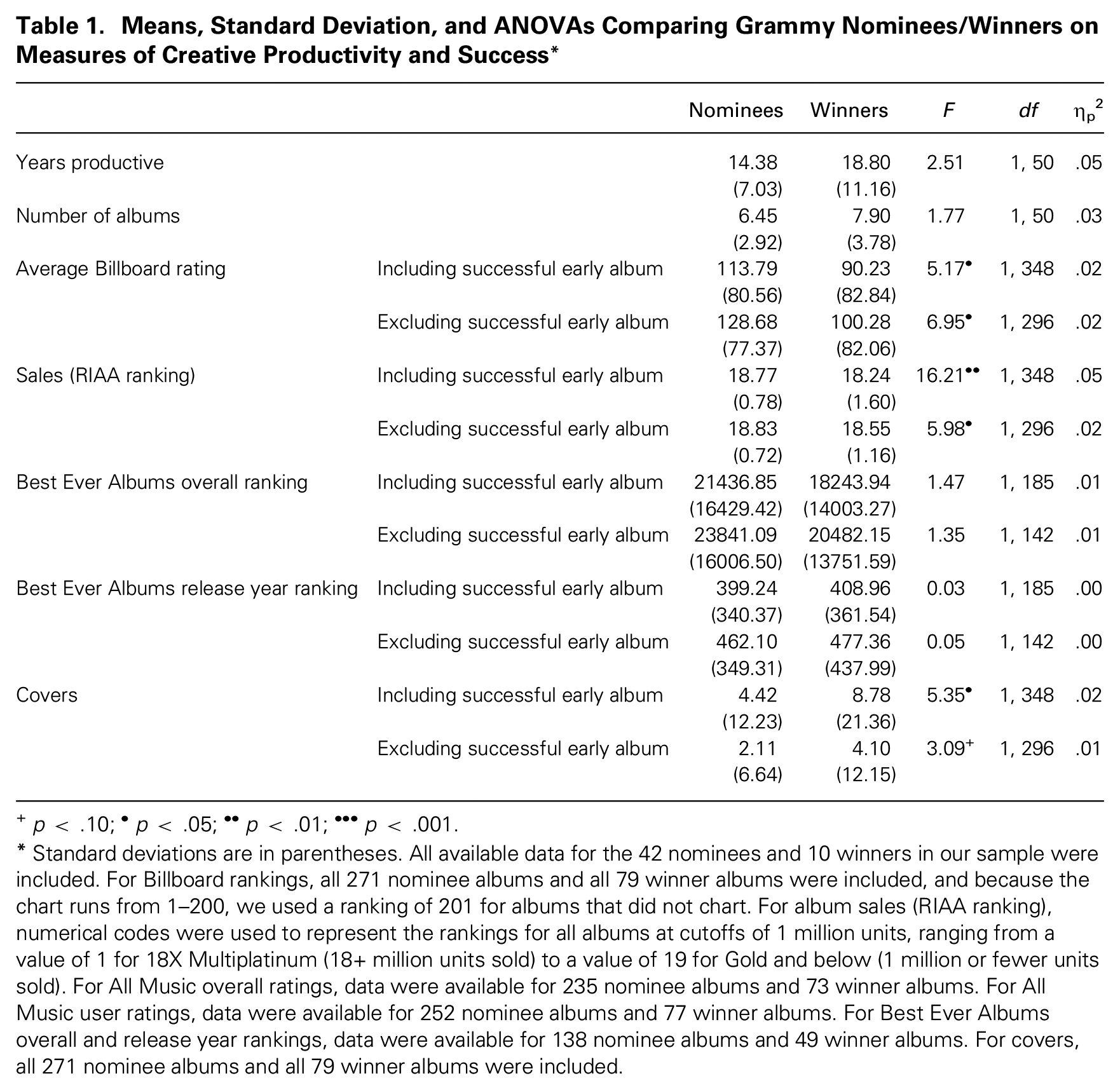
p < .10; •p < .05; ••p < .01; •••p < .001.
Standard deviations are in parentheses. All available data for the 42 nominees and 10 winners in our sample were included. For Billboard rankings, all 271 nominee albums and all 79 winner albums were included, and because the chart runs from 1–200, we used a ranking of 201 for albums that did not chart. For album sales (RIAA ranking), numerical codes were used to represent the rankings for all albums at cutoffs of 1 million units, ranging from a value of 1 for 18X Multiplatinum (18+ million units sold) to a value of 19 for Gold and below (1 million or fewer units sold). For All Music overall ratings, data were available for 235 nominee albums and 73 winner albums. For All Music user ratings, data were available for 252 nominee albums and 77 winner albums. For Best Ever Albums overall and release year rankings, data were available for 138 nominee albums and 49 winner albums. For covers, all 271 nominee albums and all 79 winner albums were included.
Findings
The Impact of Early Recognition
In general, bands described their early years with a sense of cohesion—the togetherness they felt in playing for smaller audiences and relying on their internal chemistry. The nomination for a Grammy for Best New Artist seemed to upend everything, acting as a strong signal of early creative recognition against which band members needed to orient their creative work.
6
Early recognition seemed to disorient bands in part by adding more to their lives: providing new opportunities to tour, creating more events to promote their music, and generating a tangible need to create new music as well. Band members typically described this turning point in their careers as surprising:
I think it took everyone by surprise because I think that at that time, and the way the business was, it wasn’t something that was necessarily predictable. . . . It was a very quick ascension to work out and I mean, yeah, it took us by surprise. (Geoff Downes, keyboard player, Asia, 2012)
The recognition also included a sense of escalation that obscured the bigger picture of their creative work: “That whole thing where we got more and more successful, things just like escalated so much and I think I got really wrapped up in the minutia and didn’t see the big picture at all” (Jane Wiedlin, guitarist, The Go-Go’s, 2000). Other bands also described this experience of receiving early creative recognition as overwhelming and crazy:
It was . . . overwhelming. I thought I was ready for it, but there was no way to prepare yourself for something like that. And it really was instant. We were playing a club like the Troubadour—300 people—one night, and the next day we were the biggest group in the world. It was crazy, really crazy. (Doug Fieger, lead singer, The Knack, 2010)
Corrine Drewery, lead singer of Swing Out Sister, perhaps summarized it best by calling this period a “whirlwind” in which “everything was happening with such intensity, you’d have needed a few weeks to recover from each event, and we were doing them all in one week” (2008).
Against this destabilizing backdrop of early creative recognition, bands were prompted to reflect on what they wanted from their creative pursuits. Mark Knopfler of Dire Straits remarked, “When people are telling you it’s the biggest band in the world, that’s a reason to take a look at it. Because the public emphasis might shift away from the quality of what you’re doing, to the scale of what you’re doing” (1992). Our inductive analyses revealed that groups develop different orientations “to take a look at” early creative recognition and that these orientations influence the development of their creative practices over their careers. By orientation, we mean a set of emergent reactions and active adjustments to the consequences of recognition with the goal of guiding future creative production. Implicit in this definition is that we conceptualize an orientation as more of a gerund rather than a noun—as a set of orienting responses (Weick, 1979) rather than as a collection of dispositions or traits. That is, orientations dynamically emerge as groups wrestle with newfound recognition and adapt to their new reality, asking themselves key questions about their purpose, goals, and career trajectory. Orientations become sticky or stable as groups use the answers they generate as guides for future behavior and as past behavior becomes the history against which groups must reconcile their relationships and work styles. (For some groups, the dynamism reemerges if they reassess their responses and attempt new answers.) For example, Annie Lennox of Eurythmics recalled, “Casting aside the trappings of success and fame, I had the chance to ask, ‘What am I really doing this for?’” (1991). Put simply, early recognition and all that comes with it lead groups to ask themselves, Is this what we want?
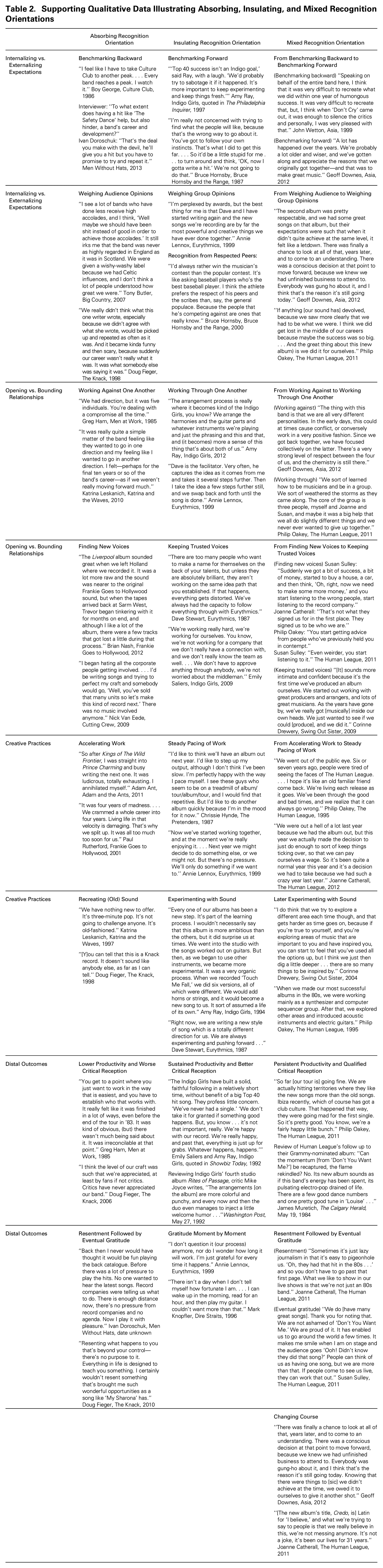
What enables some groups to maintain their creativity after intense early recognition seems to depend on how they answer this question. Specifically, we find that different answers are associated with changes in groups’ acceptance of outside expectations and in how they manage relationships with both group members and outsiders. Our inductive model of creative recognition orientations reveals that groups respond to this question in two ways. One response is through an absorbing orientation, which develops as groups begin internalizing industry and other outsiders’ expectations while opening relationships within the group to other creative influences—they “absorb” the (often negative, at least as far as creativity is concerned) externalities that accompany early recognition. In contrast, an insulating orientation develops when groups deflect others’ expectations—focusing instead on their own—while bounding relationships exclusively to those within the group and other advisors (“trusted voices”). The mixed orientation represents a subset of bands in our sample that begin with an absorbing orientation and attempt to transition to insulating. Figure 1 provides a visual summary of this process. For narrative simplicity and to better capture the emergence of these orientations over time, in the sections that follow we focus on one exemplar band for each orientation: The Go-Go’s (absorbing orientation), Sade (insulating orientation), and A-ha (mixed orientation). Table 2 provides support for these orientations from other bands in our sample.
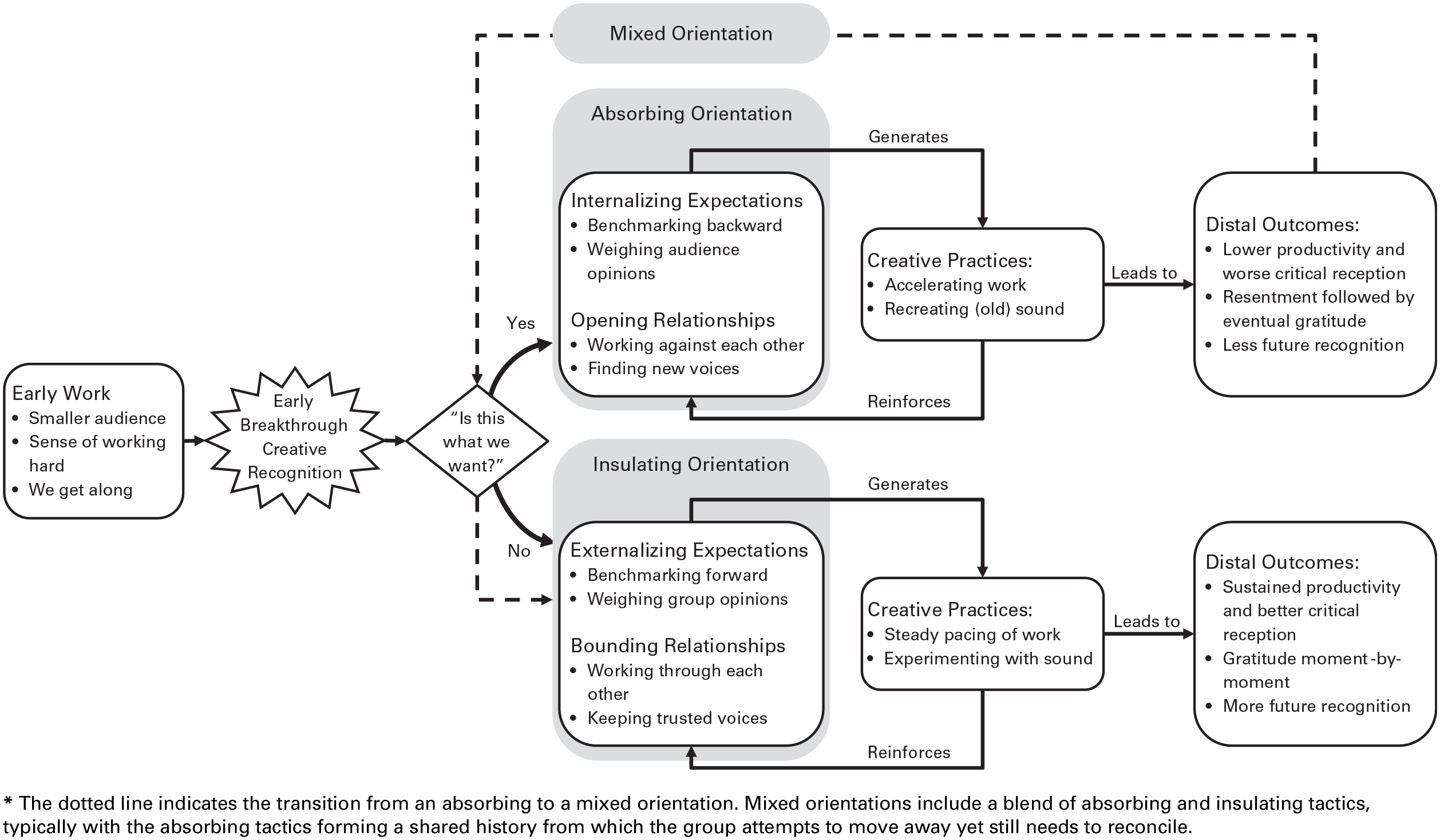
A Descriptive Model of Early Creative Recognition in Group Work*
Supporting Qualitative Data Illustrating Absorbing, Insulating, and Mixed Recognition Orientations
Absorbing Recognition Orientation
Most groups (27 out of 52) that were nominated for a Grammy for Best New Artist seem to answer yes to the question, Is this what we want? Critically, at the very least, they do not say no. But over time, this generally affirmative response to the recognition from the nomination leads to an absorbing orientation toward future recognition, which manifests in groups’ behaviors and the outcomes they achieve—or fail to achieve.
Like all the groups in our sample, The Go-Go’s—Charlotte Caffey (guitar, keyboards), Belinda Carlisle (vocals), Gina Schock (drums), Kathy Valentine (bass), and Jane Wiedlin (guitar)—were surprised and caught off guard by their early recognition, as Caffey explained: “Within 9 months [of their Grammy-nominated album’s release], it had sold millions of copies, we had a Grammy nomination, it was No. 1 . . . it was so intense and insane, we didn’t know which way to turn” (2000). Interviews reveal that the recognition was a big deal for the band:
When did it sink in for you guys, what you had achieved?
[To Carlisle] Maybe at Saturday Night Live? Do you think maybe?
Yeah, that and probably the Grammys, and being acknowledged in the way, too. (2020)
The Go-Go’s responded to this inflection point with an increased desire for recognition. Months after learning of their nomination, the group so deeply wanted to win the Best New Artist award that they left the ceremony when Sheena Easton was announced as the winner: “We were like, ‘We’re outta here.’ We didn’t win, we’re not gonna sit through this. . . . [W]e thought we should’ve won” (Carlisle, 2020). Reflecting their growing focus on future recognition, Schock described asking the other Go-Go’s, “How big do you want to be, anyway?” The group responded, “We want to be bigger than ABBA. Bigger than The Police. Bigger than Sting!” (1982).
Our inductive analyses reveal that an absorbing recognition orientation emerges as groups begin internalizing expectations, which includes benchmarking backward and weighing audience opinions, and opening relationships, which includes working against one another and finding new voices.
Internalizing expectations: Benchmarking backward
Almost immediately after receiving their early recognition, absorbing groups begin to use it as a benchmark for the recognition they expect in the future. Perhaps the most succinct description of this need came from the Human League: “When you get a number one it’s very strange. When it happens, it’s a moment of euphoria, followed by a huge crash. You just know someone is going to say, ‘Oh, I bet you can’t do that again’” (Joanne Catherall, singer, 2009). The Go-Go’s felt this, too. Early on, they described feeling a sort of omnipresent pressure and struggling to deal with it through humor: “We laugh a lot, but when we’re together we have to giggle. It puts everything on a more superficial level, but it’s the only way to deal with the pressure. It’d be torture if we couldn’t goof off” (Wiedlin, 1982). Looking back on this period, they could see that the pressure came from having to live up to the early album and the recognition it gained. In talking about their second album, Valentine noted that the song “Vacation” provided a bit of a reprieve because it matched the sound and performed comparably to singles from the band’s first album. This reprieve was short-lived, though; the practice of benchmarking on the past ensured that future releases would be fraught with the same pressure:
If it wasn’t for “Vacation,” it would’ve been the end of our career. We had to have another hit. If we made a second record without something that could get on the radio, that would’ve been it for us. The same with Talk Show. Without “Head Over Heels,” it would’ve been over. So thank goodness we were able, despite falling apart at the seams, to generate “Vacation” and “Head Over Heels” and some smaller singles, with videos that were catchy, and other good songs that still hold up to light. (Valentine, 2000)
As a result, the group felt that it was chasing its own legacy. Caffey explained, “We knew that we had a legacy of songs that we had to kinda . . . not try to recreate, but try to live up to. And that was our bottom line” (2000). The pressure to match the recognition of their debut made the creative process increasingly challenging. Valentine remarked that their process had become “brutal,” and Wiedlin concurred that “we’re being all hyper-critical on ourselves” (2000). Part of the reason for this is that absorbing groups obsess over audience opinions and reactions.
Internalizing expectations: Weighing audience opinions
Absorbing groups grow to care deeply about external audiences’ opinions and reactions to their work. They begin treating these opinions—whether from fans, record label executives, critics, other bands, or all four—as evidence of creative success and factor them into their creative process. As audience opinions become a barometer for their sense of progress and achievement, these groups desire greater future recognition, particularly from new audiences and fan groups. Early on, Schock said as much: “Sometimes the recognition gets weird, and there are some people in the industry who aren’t ready to accept us yet. But just the other night, we were at a Japanese restaurant and this Japanese girl came running up to me saying, ‘Go-Go! Go-Go!’ That was really neat” (1981). As recognition increased their profile, The Go-Go’s also fixated on whether critics and other gatekeepers had misrepresented or overlooked them—and found respite in the warm reception from fans. Valentine explained, “I felt that we had been dismissed and overlooked a lot. . . . Sometimes I would see ‘Women who Rock,’ and we would be, like, a footnote” (2021). She elaborated that “hearing from fans” helped to “make up for a lot of rejection.” The Go-Go’s also described longing for years to be inducted into the Rock & Roll Hall of Fame: “Every year in the past it was like, ‘Oh, you’re gonna be inducted next year, definitely.’ And it just kept . . . We were like, ‘Okay, Hell’s bells, we’re not ever gonna be inducted” (Schock, 2021).
Because absorbing groups fixate on achieving greater recognition from external audiences, these groups tend to use audience opinions as cues that dictate major group decisions, such as whether to keep pursuing a particular sound or even to reunite. Reflecting on how Beauty and the Beat sounded slicker and more heavily produced than the band’s raucous and raw live shows, Valentine said, “In time, what we thought had been a too-sterile production stopped bothering us. My opinion changed proportionally with the increasing sales. . . . None of the stuff we disliked stopped our first album from being one of the most successful debuts ever” (2020). Hence The Go-Go’s even began subverting their own tastes and creative direction because the public response was so positive. Audience relationships are therefore closely tied to how absorbing groups make sense of their work and play a major role in their creative decisions. But these are not the only relationships that take on new meaning for absorbing groups; relationships with one another and with outsiders change as well. We label these changes as “opening relationships,” which includes working against one another and finding new voices.
Opening relationships: Working against one another
Absorbing groups initially describe themselves as a unit, a collective: “We were united against the world, that’s the way I felt with these girls. We could do no wrong. We were just like this pack of chicks having the time of our lives, kinda carte blanche to the world, and it felt like a team at that time” (Caffey, 2000). But after early recognition, absorbing groups shift from working together as a group toward a collection of individuals working against one another. Wiedlin captured the transition succinctly: “In the beginning we were a gang of girls out to have a good time. Then we got famous and instead of being The Go-Go’s against the world, it became The Go-Go’s against each other” (2020). For The Go-Go’s, fragmentation manifested in their opinions about their creative work. After releasing their second album, two of the group members voiced a fundamental disagreement in terms of how they conceived of the group’s style:
We always wanted to be a pop band; we just didn’t have the ability at the time. It evolved as we became technically able with our instruments.
I prefer to call it a rock and roll band myself.
Or pop-rock. It’s a combination.
Yeah, but I’ve always hated pop music.
I’ve always loved pop music! (1982)
This fracturing reared its head in their songwriting as well. Carlisle highlighted the outsize weight of individual opinions, describing how each song “has to pass a lot of tests” (2000). Wiedlin concurred: “Every song has to please five different people’s taste, and we don’t have the same taste” (2000). As a result, good ideas could fizzle:
Sometimes a writer or a pair of writers will be so excited and so proud of a song. . . . You really don’t know. You really can think you have something special, and then you take it in, and all it takes is for one person to go, “I don’t know,” and then it’s back to the drawing board. (Valentine, 2000)
The decision process regarding new material shifted from being communal to combative. The group described itself as “fragmenting very quickly” and attempting to maintain an “eye in the hurricane” in the midst of “a lot of conflicting energy” (Valentine, 2018). Valentine revealed, “There’s been times we’re in the dressing room, throwing stuff at each other. I think somebody got hit once” (2018).
Opening relationships: Finding new voices
Out of a desire to replicate their early recognition while also appealing to new audiences, absorbing groups open their group boundaries, allowing external figures to affect their creative process. Schock reflected, “We didn’t have any time to think, they’d [the record company and its representatives] tell us what to do and we’d just do it. . . . We did everything that they told us to do. We didn’t know any better. And we were so used to working like dogs, we just thought, ‘Oh, this is the way it goes’” (2000). The Go-Go’s hoped that outsiders’ ideas would improve the creativity of their next albums; by the late 1990s, they were relying on more producers than ever. Valentine noted, “Not only does [a song] have to process and screen through all five Go-Go’s, but our producers, our record company” (2000). Reflecting on their work process for their third album, Carlisle revealed that their song “Head Over Heels” was a lyrical description of what was going on in the band: “That song lyrically was about how we were all feeling being under this microscope, having so much fame, the confusion, the self-sabotage. We started to implode a bit” (2016). The lyrics reveal that they might have opened the band too much to outside influences: “No more connections, I don’t need any more advice.”
By internalizing expectations and opening relationships, absorbing groups seem to limit their ability to regain the levels of creativity and recognition they desperately want to preserve. Instead, these groups grow to adopt creative practices of accelerating work and recreating (old) sound, as well as more distal, career-defining outcomes of lower productivity and worse critical reception and resentment (toward aspects of their early recognition) followed by eventual gratitude.
Creative practice: Accelerating work
In absorbing groups, creating a new album becomes intertwined with pressure from the record label, a feeling that they will lose their existing audience if they wait too long. This creates a sense of urgency. In a 1982 interview, Rolling Stone noted that after six months of nonstop touring, The Go-Go’s’“nerves were frayed, their tempers on edge,” and they were facing strong pressure to keep up their momentum after their first album. The record label provided them with new producers, and they rushed to release their second album, Vacation, within the year. Reflecting on that record, Valentine noted, “We rushed ourselves. The label wanted to release another single, and possibly more. . . . I wish somebody had told us to shut up and take some time off and then go out on the road again. Because we were not ready for the second record” (2020). Such frenetic pacing seems to amplify tensions in absorbing groups, which manifests in exhaustion and breakups—and, not surprisingly, detracts from creative performance. Interpersonal conflict grew as The Go-Go’s wrote and released their third album, Talk Show, in 1984. The album maintained the pop-rock style of the group’s first two albums but was a commercial letdown, selling fewer than 500,000 copies. Tensions in the group continued to build. By 1985, the group members were fighting with each other and acrimoniously decided to disband to pursue solo work. Carlisle reflected, “It would’ve been foolish to carry on the way we were with all that anger and resentment” (1990). Eventually the band entered cycles of optimistic reunions and frustrated breakups that continued through the 2010s. The group’s final album, God Bless The Go-Go’s, was a critical and commercial failure. The group continued to tour until 2013, when Valentine sued her bandmates over financial issues.
Creative practice: Recreating (old) sound
Due to their heightened need for renewed recognition, absorbing groups fixate on the aesthetic qualities of their music, particularly those of the early album that brought them their initial creative recognition. When commenting on their fourth album, Caffey identified certain aesthetic qualities as being essential to the group’s musical history: “We’ve always been very melodic, we’ve always had harmonies, and great bass parts and guitar parts and drum parts. . . . Our classic elements are there” (2000). This connection to a particular aesthetic heavily influenced The Go-Go’s’ subsequent work, as they held the aesthetics of their first album as a standard to meet—part of their benchmarking behavior. Valentine echoed the sentiment: “Our standards are really, really high, I think. It’s going to sound like The Go-Go’s. If it’s coming from us, and being filtered through us, what we’re gonna end up . . . it’s gonna sound very like the Go-Go’s” (2000). Schock added, “[We’re making] good Go-Go’s music, like, what we sound like, only, you know, new songs” (2000). This focus on “standards” and “sound” seemed to limit the band’s ability to experiment and produce albums that critics and fans saw as creative or as an evolution.
Distal outcome: Lower productivity and worse critical reception
The Go-Go’s released three albums in rapid succession in the early 1980s and only one additional album nearly two decades later. The frenetic pacing, infighting, and routine breakups dramatically impeded the group’s ability to generate more creative output. Commenting on their 1990 compilation album, Valentine revealed that the band’s issues felt irreconcilable and inimical to future creativity: “[It] was a horrible breakup. We never discussed future possibilities. When it was over, I walked away without any expectations of doing anything else with The Go-Go’s” (1994).
Without sufficient time or motivation to experiment and with a fixation on recreating their early sound, absorbing bands tend to stagnate creatively. This pattern is reflected both in reduced numbers of albums after the one that spawned the early creative recognition and in lackluster reviews of the albums that are released. The Go-Go’s’ second album, Vacation, was a commercial disappointment: it was certified Gold, whereas Beauty and the Beat had gone Triple Platinum. Music critic Stephen Thomas Erlewine noted that the album had a slicker, more radio-ready sound than their initial release—likely due in part to the involvement of new producers—which cost the album some of the “giddy sense of fun” that marked their debut. 7 Robert Christgau, another respected music critic, also noted the album’s “uniform thinness” in comparison to Beauty and the Beat. 8 Erlewine further commented that despite having some solid songs, the group’s third album, Talk Show, was “undermined by its own ambition” and “cluttered with half-realized songs and an overly detailed production.” 9
Distal outcome: Resentment followed by eventual gratitude
Amid these cycles of exhaustion, breakup, and attempted reunion, absorbing groups resent aspects of their early recognition. In addition to feeling mislabeled as a 1960s girl group, The Go-Go’s resented that their early recognition overshadowed their later projects. Referring to their 2001 album, God Bless The Go-Go’s, Wiedlin said, “I really stand behind that record. I think the songwriting is good, so it’s very unfortunate to me that hardly anyone ever heard that record” (2020). In 2011, in response to a journalist asking if she thought The Go-Go’s had “been properly acknowledged for [their] music,” Wiedlin responded, “No, I do not believe we got our propers, but I hope someday we will.” With distance, though, they eventually came to feel gratitude for the early output that garnered their early creative recognition, specifically for the album or hit song that drove the Best New Artist nomination. Valentine commented, “What we did in our past, I mean our first record, in my opinion, was a really great classic record. It just transcends all time” (2000). The Go-Go’s also longed for the circumstances surrounding the creation of their first album, before the challenges presented by early recognition entered the picture. Schock explained:
What I remember to be the best time was before we got really, really huge—before we got really successful. . . . Everyone knew each other, and everyone was friends with each other. . . . And also making our record was a wonderful thing, our first record. And we got to go to New York to make it. That was our dream-come-true. (2000)
By benchmarking backward, weighing audience opinions, and opening their relationships and expectations to outsiders, absorbing groups become increasingly consumed with earning future recognition. Groups then find themselves making albums in response to external pressures, leading both to frenetic pacing that ultimately leaves them less productive (often because of multiple breakups) and to efforts to recreate their old sound. The resentment engendered through this process eventually gives way to gratitude for the creativity that brought them early recognition, but ironically, additional recognition rarely materializes.
Insulating Recognition Orientation
Some bands (8 out of 52) instead exhibited what we refer to as an insulating recognition orientation. “Insulating” denotes the band’s willingness to shield themselves from others’ expectations and influences; the band Sade serves as our exemplar. Like absorbing groups, insulating groups work hard at the beginning of their careers—“We haven’t stopped for a year—writing, recording, touring” (Sade Adu, 1985)—and they have high hopes for their creative performance: “We all wanted success for the album, we all dreamed of that. . . . That’s basically what pushed us along” (Adu, 1984). Similar to The Go-Go’s, Sade was nonetheless surprised by their early creative recognition; Adu commented, “It has surprised everybody” (1985). But unlike The Go-Go’s, and like other insulating groups, they did not care deeply about the Grammy. Adu was in Germany when the awards ceremony took place, and she recounted being informed by her record company that the group had won Best New Artist: “She said, ‘Congratulations! You’ve won a Grammy.’ And I was like, ‘Oh, thanks, yeah, I won a Grammy.’ And then I got to know what a Grammy was” (Adu, 2000).
Unlike absorbing groups, insulating groups do not orient themselves toward achieving future recognition. Forced, like all recognized groups, to deal with the increased scrutiny that comes with the creative recognition, insulating groups instead answer not quite to the question, Is this what we want? Adu remembered reflecting on the changes that recognition brought: “Your life changes. Beforehand, I was living my little anonymous life. But that whole machine that starts going . . . It was all about how that change was going to affect my life” (2016). Our inductive analyses reveal that an insulating recognition orientation emerges as groups begin to chart their own path by externalizing expectations, which includes benchmarking forward and weighing group opinions, and bounding relationships, which includes working through one another and keeping trusted voices.
Externalizing expectations: Benchmarking forward
Instead of focusing on—and becoming overly attached to—the intense creative recognition of the early album, insulating groups focus on what will come next. Adu acknowledged the expectations that accompanied Sade’s early recognition but seemed more interested in moving past it:
Everybody’s very skeptical about someone who has early, huge success. I want to prove to myself that there’s something there. I want to make a great album to follow Diamond Life, to stretch and come forward as a band. We’ve only just started, and we’ve got a lot to do. Diamond Life has been a success, but that’s finished now. We’re only just getting used to working together as a band. (Adu, 1985)
As this quotation attests, insulating groups have high standards for what they want to produce, but they avoid benchmarking on past recognition, choosing to free their current work from their prior creative achievement. Instead, they focus on the future as a new creative endeavor; a sense of “progress” in their music becomes a central part of their process. Adu elaborated:
I think you have to distance yourself from the previous album. Otherwise, you don’t really progress. The best part of what we do is make the records. If you don’t have any part away from the music business and such, there is nothing really that inspires you to make the record. And though it seems like we’ve been away longer because the record comes out and then tour so the gap between the record for us is shorter than a person who gets an album from us. (Adu, 2017)
Externalizing expectations: Weighing group opinions
An insulating orientation also has implications for how groups react to external audiences’ evaluations of their work. Though Sade enjoyed receiving recognition for their work, external validation was not their primary motivator. What mattered most was how the group itself felt about the music:
Is it a difficult act to follow that sort of success?
Not really because the success of the album makes no difference to how we feel. Because all the competition comes from inside us you know the competition with ourselves to try and get better and want to get better comes from inside so it isn’t a pressure from outside really. (1985)
Recognition and rewards were something of an afterthought for the band. Adu explained, “[My] number one [motivator] is people and caring for people and people caring for me. . . . Number two is the music we’re making, and number three is getting some rewards from it, if you like” (1984). Unlike absorbing groups, insulating groups deprioritize seeking broader recognition; they work instead to hone an internal sense of creative success. Adu noted that most important to the band was “making something that has quality and something that is lasting” (1984). Insulating groups also sometimes find satisfaction in respected peers’ acknowledgment of their work; Adu commented on caring about “the opinion of people I respect, whose taste I consider valid” (1986). Ultimately, though, the group’s inner barometer for creative success was most important: “It’s important that we succeed, but only as long as we’re sticking to our lines and principles. Success for the sake of success is nothing. Success in everybody else’s terms means nothing” (1986).
Bandmate Stuart Matthewman reflected on incorporating this inward orientation into the group’s creative process: “We never think about the record company, we never think about friends or fans, we never think about radio. . . . We’re not thinking about anyone else. . . . I do think you should think about the fans but hopefully our fans will grow with us” (2012). Hence insulating groups appreciate external audiences but do not allow them to influence the creative process or how the group evaluates its own creative performance. As Adu explained in 2010, “Artistically, I have high aspirations. I don’t want to do anything less than the best I can do.”
Bounding relationships: Working through one another
While reflecting on their first album that garnered Grammy recognition, Adu noted that a key goal was “to stick together as friends, and enjoy it, keep enjoying it. I mean that is of fundamental importance, that we keep enjoying each other’s company. I think that’s the only way we can keep making good albums anyway” (1984). This sense of working as a collective endured. Years later, in a description dominated by the collective first-person “we,” Matthewman took pains to note that group members were not simply responsible for playing their own instruments but that they played through each other:
What we do is, we just go into the studio and we just write songs. We don’t write songs for any specific purpose. We don’t write for radio, then say, “Now we’re going to write a ballad and a hip-hop track.” It just kinda happens. It’s whatever feeling we feel. I think working that way, our music is more permanent. We’re a four-piece band, and if you take any member out, it’s going to sound slightly different. . . . Sade doesn’t play guitar, but she plays it through me. . . . We all kinda play each other that way. (1996)
Working “through” each other involves a sense of open, unfettered collaboration. Adu described, for instance, how the band would let its songwriting process evolve naturally and make creative choices “without pragmatism”:
When we’re in the studio, what we do just sort of happens and evolves without pragmatism. . . . It’s all about choices. . . . We know that between us, we will somehow make the right decision. We many times do the wrong thing. You just have to know when the moment happens. (2011)
This is not to say that the process was devoid of conflict. Sometimes the intuitive “magic” of their decision making also required a “fight,” but they were “grappling” and “strangling” the music, not each other: “Well, some [songs] come as if by magic, you know, as if they were already written by somebody and we’re going through the process. Others you have to grapple with them and get them on the floor and strangle them and fight with them to get them to work” (Adu, 1992). Matthewman affirmed that the group continued to follow this more collaborative and intuitive approach to decision making: “We just do what sounds right to us at that time. . . . It always ends up kind of sounding like us anyway” (2012).
Bounding relationships: Keeping trusted voices
Unlike absorbing groups, which perceive pressure to make a certain kind of product in order to earn more recognition, insulating groups use their success as a resource to protect their creative freedom. Upon the release of their first album, Adu explained, “Success means we can carry on without compromise, make another record and see where that leads us” (1985). In addition to maintaining full creative control over their work processes, Sade insulated themselves from external influences while working on their second album: “I was away from the media, I was away from any sort of pressure from the record company, we were all sort of in our own little environment, and I think that comes through in the album. When there was something to write, we got together and wrote it” (Adu, 1988). The group maintained this protective ethos over time: “It is almost like a church, because you’re going to that room, you know your purpose, you know what you’re going to do in there, and you don’t have to take anything in with you that you don’t want to take in there” (Adu, 2010).
As a band, they also pressed to keep working with trusted producers. In the midst of their early recognition, there was a push for Sade to work with top producers like Quincy Jones. One recounting of these events noted,
All those same record companies, who turned them down were crawling all over Sade. They were desperate to sign her. The record companies all told her that they were going to send her to America, that she was going to be great, and she was going to work with Quincy Jones. She said, “I don’t want to go to America and work with Quincy Jones. I love Quincy Jones, but I’m quite happy here, and I’m quite happy working with Robin (their then-producer).” The record companies weren’t pleased when she told them that. She said, “That’s too bad.” CBS Records, now Sony Records, were the only record company who said, “If you want to work with Robin, you can work with Robin.” (Robin Millar, Producer for Diamond Life and Promise, 2014)
In addition, Sade acknowledged that they were part of the machine of the music industry, but they made an effort to distance themselves from extraneous activities. Group members relied on one another to maintain their guiding principle of staying focused on the music:
[T]here are four of us, and we can remind each other what our initial principles were without getting lost. It’s not just me. [Our principles are to] not do the things that demean what you do. To try and avoid as much as possible doing things that have nothing to do with what you set out to do—with the music. (Adu, 1990)
By refusing to benchmark backward, working through instead of against one another, and focusing on the group’s trusted insiders, insulating groups create space for themselves to continue their creative endeavors on their own time and with their own principles. This orientation, in contrast with an absorbing one, seems to generate creative practices that are much more beneficial to the creative process: steady pacing of work and experimenting with sound. Over the long run, this appears to enable sustained productivity and better critical reception and gratitude moment by moment.
Creative practice: Steady pacing of work
While absorbing groups exhibit frenetic pacing, insulating groups seem to tune into the natural ebbs and flows of creative energy. Rather than creating a new album because of external pressure, which engenders the tension observed in absorbing groups, insulating groups take time off when they feel creatively depleted, regardless of how they believe this may impact their ability to achieve ongoing recognition for their work. The members of Sade made a habit of stepping back from the spotlight as a deliberate response to having released and promoted a new album. Adu commented on the benefits of this practice for interpersonal relationships and for their overall enjoyment of the work: “Without [the long breaks between records and tours] we probably would have been d-i-v-o-r-c-e-d a long time ago. Actually, the gaps make making a record such a special privilege” (2010). Matthewman affirmed this appreciation for time apart: “If we were together all the time, we probably wouldn’t have lasted as long as we did” (2012).
Rather than reuniting in attempts to garner recognition, insulating groups get back together when they feel a renewed sense of purpose as artists. Adu explained that the group reunited to work on their 2010 album, Soldier of Love, somewhat spontaneously:
I think the first call was to Stuart, asking him to get together for a couple of weeks. I just wanted to dip my toes into it. I didn’t want the whole huge pressure of “Oh right, we are going to make an album” and what that entails. I didn’t want any expectations, I wanted to do this with no connections with the real music world. (2010)
Matthewman commented that the group has experienced several “false starts,” and rather than forcing new material, they continue to work only if what is emerging feels right: “We’d made a few false starts over the years. Usually, everything starts as a demo, the demos become master (recordings), and we end up staying together if the vibe suits” (2002).
Creative practice: Experimenting with sound
Insulating groups describe themselves as open to stylistic exploration and welcoming the surprises that emerge when experimenting with new aesthetics. As Adu put it, “If you try to get a certain feeling, all you get is contrivance. . . . We have our own feeling and our own sound that comes from many things. . . . We don’t consciously try to make any songs or records that sound like anything or anybody” (1985). Elaborating on this openness to different sounds, Matthewman reflected on how the group would not seek a particular sound ahead of time:
I think our formula is the fact that we don’t really have a formula. That and we all listen to a lot of music. Being a musician and fans of music, we’re obviously influenced by what’s going on, but we never make a conscious decision to go, “Oh we should do a track with more hip-hop,” or, “We should do a track that’s kind of more reggae.” We just do what we do and it comes out in some way. . . . We have no rules in the studio so anyone is, you know, always open to try anything. Whether it’s messing with guitar or reggae bass line or some strange keyboard thing that Andrew might do or snare drums on a song that Sade might want to try. You know we’re open for anything. (2012)
Rather than being oriented toward a particular sound or set of expectations, insulating groups allow in-the-moment feelings to guide the unfolding of their creativity. Whereas absorbing groups tend to be quick to claim a particular genre or style as “their sound,” insulating groups tend to explore different sounds and influences and sometimes defy categorization altogether. As Matthewman explained, “Our music has a lot of soul but I don’t think it’s soul music necessarily. It’s difficult for us to describe it” (1996). The lack of fixation on a sound leaves insulating groups more likely to come back together without expectations and with room to experiment, both of which seem to support long-run outcomes.
Distal outcome: Sustained productivity and better critical reception
Reflecting on the band’s lengthy journey, Adu noted,
We’ve been together for 18 years, so we’ve always got new generations of people discovering our music for the first time. I think what people respect is the fact that we don’t try to do anything but what we do. We don’t try to do anything contemporary. We don’t try to do hip hop or house or whatever. We all love it. They are great influences but [we] just do what we do. (2017)
While the group has taken up to ten years in between albums, Sade has never officially broken up. Their albums have continued to generate critical recognition—music critic Kitty Empire deemed their 2010 album “another triumph for quality over quantity”—and widespread appeal: each album has placed in the Top 10 on Billboard’s album chart. 10 Throughout these cycles of hiatuses and reunions, insulating groups are better able to remain creatively productive.
Distal outcome: Gratitude moment by moment
While absorbing groups experience late gratitude for their early creative work and seek to recreate their early album, insulating groups exhibit gratitude for their ongoing ability to create. Adu expressed her appreciation for the spontaneous emergence of new ideas: “We were jamming, and I just started to sing. It was a nice vibration, and the words just came into my head from nowhere. I didn’t leave that night feeling, ‘Wow, we’ve got a song,’ but we went back into the studio the next day, and there it was” (2000). She later described, “I feel lucky that we still have that platform and we didn’t just jump and somebody pulled away the net. To continue doing what we do and know that we are loved is a great thing” (2011). Insulating groups exhibit not only appreciation for the present moment but also an excitement about what they can achieve in the future. As Adu said, “It’s that feeling that you can get a little bit better. That there’s somewhere to go and you haven’t expressed it all” (2011).
While absorbing groups tend to indulge external influences, latch onto particular aesthetics, and attend too much to audience opinions in hopes of achieving future recognition, insulating groups bound their relationships by working through one another, deflect expectations that arise from their early recognition, and focus on moving forward. Following early recognition, their practices support creativity by allowing them to remain open to experimentation rather than being wedded to a particular style or set of audience expectations. As we demonstrate further via quantitative data below (in the section “Triangulation and Alternative Explanations”), insulating groups remain productive for a longer period of time, produce more albums, and ultimately receive more recognition over the course of their careers.
Mixed Orientation
Some bands (17 out of 52) initially exhibit an absorbing recognition orientation but attempt to reorient, resulting in something closer to an insulating recognition orientation. The result is a set of mixed approaches and outcomes, revealing that recognition orientations can be both dynamic—groups can continue to adjust and change—and sticky, as they still carry the history (and potential scars) of their original response. We refer to this as a mixed recognition orientation, and the band A-ha—comprising Magne Furuholmen (keyboards, guitars, and vocals), Morten Harket (vocals), and Pål Waaktaar-Savoy (guitars)—serves as an exemplar.
For A-ha, as with the other bands in our sample, the Grammy nomination was a welcome surprise but one that came with many additional challenges. Waaktaar-Savoy described how the nomination was a signal the band had made it but was accompanied by heightened attention and anxiety: “It sort of struck you when you got a Grammy nomination and you went to that kind of thing, and it was like, you look on the other people, and they’re so nervous for you that you start to get nervous yourself. It’s like, ‘Oh shit, they’re freaking out’” (2001). Furuholmen echoed the sentiment about the increased anxiety and traced its path to the band’s eventual breakup:
I don’t know if I did cope with [the increased stress]. I mean I pretended I was coping with it. And I kept the act going for a long time. It was kind of panicky for a long time. I think most of the stuff that happened since the breakup of the band was due to the fact that you’re still kind of suffering the shockwaves of the first round. (2001)
Acknowledgment of the missteps made in the face of increased scrutiny and expectations appears to have led them to ultimately choose to revisit their recognition orientation.
Changing course
What enables these bands to break away from certain aspects of the absorbing groups’ experience and have long, productive careers? Mixed groups spoke of a turning point at which they returned from time apart with a new perspective that enabled them to break some of the habits associated with an absorbing orientation. Waaktaar-Savoy delineated three periods in A-ha’s career, beginning with their absorbing turn toward pop music and ending with returning to songwriting as more-seasoned artists:
It feels like we have had three different careers with the crazy teen thing and people living on your doorstep. Then we got fed up of being pop stars and we wanted to do more live shows, so we played live. Then the last part of our career was coming back and finding people at different stages of their life and trying to still make music. (2010)
Furuholmen described it as getting “back to zero”: “I think it’s important that you don’t want to fully embrace this idea of yourself as this famous person. You want to be able to get back to zero and try your hand at challenges that don’t allow you this sense of entitlement” (2019). Lead singer Harket described the need to change their perspective on recognition as “kind of [a] breakdown, but one that you induce yourself, because you’re not willing to carry on the way you are” (2000).
From internalizing to externalizing expectations
Like absorbing groups, mixed groups are initially overly attuned to audiences’ opinions. A-ha continued to seek renewed mainstream recognition: when their 2005 album, Analogue, produced a mainstream hit song in Europe, Waaktaar-Savoy remarked, “Thank you for giving us a top 10. We needed that, badly” (2006). At the same time, they yearned for recognition from a wider audience. A-ha had earned accolades and adulation from their initial pop audience, but they strove to be taken seriously by other groups. Furuholmen explained that after moving into the pop style of music, the group began to feel that their “boy band” image was “too small a suit” for the kind of recognition they sought (2000). Similar to The Go-Go’s, A-ha cared deeply about external validation. When they played to a record-breaking crowd at the 1991 Rock in Rio concert, they received virtually no media coverage, and according to Furuholmen this made the group feel “alienated,”“hopeless,” and “ignored” by the music industry (2009).
Mixed groups attempt to transition away from internalizing expectations toward externalizing their own expectations, with mixed success. Despite record label executives pressuring A-ha to recreate their first hit, the group began to distance themselves from these expectations. Speaking about their later work, Furuholmen noted, “People would say, ‘There’s no ‘Take on Me’ on this record,’ and we’d say, ‘Yeah, great!’ We knew that the expectation was to regurgitate our own success and that wasn’t what we were about” (2009). Waaktaar-Savoy explained how, by the early 2000s, the group was no longer willing to present itself in a certain way to appease others’ expectations: “We were never comfortable with the teenage image that we had before. . . . We should never have done any of that. This time none of that is an issue anymore. It is good in a way” (2000). Yet the group continued to express frustration that they had not been recognized as serious musicians; Furuholmen commented that they grappled “with the fact we felt the music was not given enough credence” (2021).
From opening relationships to bounding relationships
Like absorbing groups, mixed groups also start out by opening their relationships to external influences in an attempt to recapture the magic that prompted their early recognition. Early in A-ha’s career, Furuholmen explained, “I would think it would be very snobbish not to do everything [that we are asked to do by the record label and fans]. We don’t choose to do this or that. Whoever wants us to do it, we’ll do it” (1988). Harket later described realizing that the band had lost sight of its own priorities in those years: “[Y]ou find that you tend to go along with what people want and you don’t really check on things to see if it’s really worth doing and whether you agree that this is the thing to do” (2000). As they allowed new voices to influence their work in hopes of earning more recognition, concomitantly their ability to work with one another suffered (working against versus working through each other). A-ha initially broke up because band members struggled with getting individual credit for their work: “So it wasn’t drugs that broke up the band for the first time, in 1993, but internal tension over the high-stakes decision making and credit-taking that fame brought. ‘Suffice to say that our individual versions of our history together differ wildly,’ Furuholmen sighs” (Financial Times, 2016). 11
As A-ha regrouped, they tried to imagine the band as its own entity: “A-ha is not me, Pål, or Magne, it is its own individual that has its own identity and characteristics. It is a result of a particular meeting point between the three of us” (Harket, 2010). These moments, when the band really felt like a collective, kept the members willing to engage with one another and take on new creative endeavors. In speaking about their 2009 album, Foot of the Mountain, Furuholmen described this sense of collective effort: “[T]he outset was quite exciting, it showed me—proved to me—over the course of three or four songs . . . that we can still do interesting stuff together when we co-write, and we can still add something to each other’s creative process” (2009). Even so, the new sense of a collective was partially fraught with the feeling that individual concerns could reemerge or even be foisted upon the band by external expectations:
It’s very much a three-person effort on every level, and any attempt to write the story differently always kind of bugs me. People do tend to look at it very superficially and then define roles very clearly based on personality or based on what they think they know, and sometimes we do feel very annoyed. (Furuholmen, 2009)
A-ha’s mixed recognition orientation helps to illustrate the dynamic nature of orientations. Though absorbing orientations are sticky, bands can attempt to change them over time. Breakups and other dramatic interactions can signal that they should change their current recognition orientation and answer the question Is this what we want? in a new way. However, bands that attempt to transition often seem to struggle with fully changing; their initial orientation toward recognition seems to leave scars—a shared history of decisions that the band will always have to reckon with. The members of A-ha, for instance, maintain a level of ambivalence toward one another and have come to expect conflict to reemerge in the later stages of their creative process. Furuholmen explained how “high spirits” typically gave way to “everyone . . . lobbing grenades”:
I think the mood got a little more sombre as we got closer to the release of that album, but this is pretty much the case with every album that we’ve done; it starts out with everyone in high spirits, kind of coming out of the trenches waving white flags at each other, and then it tends to end up with everyone kind of lobbing grenades over the edge and getting dug in! (2009)
Harket summarized this tension simply: “We both do and don’t get on. In certain ways we never do, in that we are not cut out the same way. We are very resilient individualists. A decision is usually arrived [at] through exhaustion. We don’t mate easily” (2010) (see also Bechtold, Choi, and Nijstad, 2012). However, the band now tends to deal predominantly with one another instead of having to do so in addition to dealing with the input, demands, and requests of others.
Creative practice: Attempting steady pacing of work
Mixed groups begin like absorbing groups, accelerating their work. A-ha described their work as “chaotic” but “exciting,” including “days and nights” in the studio and feeling a sort of “high” from the work (Furuholmen, 2019). But the drain on energy quickly became apparent, as Harket noted: “We were screwed up. We had no energy left. We realised we were reaching the end of the line. We had to get away from the whole circus and breathe fresh air; become a band again. . . . It would have been a bigger risk not to [take time off]” (1990). Other members of the band conceded that they had grown exhausted and then needed to reorient the band to working together in a different pattern: “I think we sort of run ourselves into the ringer when we get together, that we always need to step back, and I think it’s when we step back that . . . it seems to do our career a lot of good. We have to go away to get better, that’s sort of how it is” (Waaktaar-Savoy, 2015). They described the early, accelerated period as resulting in attempts to “kill off” the band, whereas later they focused on working together at a pace that was “enjoyable”:
Strangely we have tried to kill off A-ha a few times but without success—it just keeps bouncing back at us. This time around we figured it would be nice to do the whole first album as a kind of celebration of 35 years in the band, and let’s do something we haven’t done before. . . . I think we are done with farewell tours. [Laughs] I think we will keep going for as long as any one of us feels like doing it. Right now we enjoy touring together, so that’s what we will do, and if that stops being enjoyable, then I don’t think there is any reason to do it. We have a faithful bond—there’s shared history that follows us around no matter how far we run in any direction. (Furuholmen, 2019)
Notably, this quote highlights that, as with other mixed groups, A-ha reorients to try working together in new ways. Yet they still have a “shared history” that, for better or worse, anchors them to previous choices.
Creative practice: Later experimenting with sound
Mixed groups are somewhat stuck between the push to be more experimental, which often comes with an attempt to be more insulating, and the pull to recreate prior sounds. Harket noted this ambivalence in the sound of A-ha’s albums: “We wanted the freedom to be playful, to experiment and do what we felt like doing, but we were heavily affected by the success that the first record gave us” (2009). In 2000, Furuholmen commented that the band was no longer beholden to their earlier work: “We are not going out for anyone in that way [anymore]. We don’t think like that. We just make our music and we make music that we respond to ourselves.” They even felt that their newer work had moved far enough away from their early sound that it served as an elegy for that prior work: “That album (Memorial Beach, released in 1993) felt like a requiem. It was clear we wanted to get out of the pop business” (Furuholmen, 2009).
Distal outcome: Persistent productivity and qualified critical reception
In general, mixed groups work together for longer periods than absorbing groups but cannot achieve the level of critical success that insulating groups do. The big differentiator for mixed groups is the ability to mend wounds that emerged during their absorbing orientation period, which allows them to have a longer career together. Even so, this extended time working together is marred by echoes of their early absorbing orientation; as they attempt to craft an insulating orientation, aspects of their early history linger, thwarting a complete transition. Waaktaar-Savoy described the difficulty of moving past patterns that inhibited the group’s creativity: “You do get caught up, things get into patterns. . . . It takes away a little bit of that supernatural—where things are sort of allowed to evolve without having anybody influencing us” (2015). Furuholmen commented on the group’s reluctance to embrace its history: “Embracing [recognition] is a big issue in this band. Embracing our history is a big problem. We were always very reluctant pop stars. Reluctance has been part of our history throughout” (2009). Because of these lingering scars, mixed groups’ creative endeavors do not unfold easily, and maintaining creativity calls for a willingness to persist despite these challenges. Furuholmen explained, “It’s taking us four years to make records, and it involves a lot of debate and disagreements, and it’s not always something that comes out feeling like a strong team effort” (2010).
Like the band itself, critics also had difficulty fully moving on from A-ha’s earlier decisions, noting anchors to their older work. Commenting on their ninth album, a critic for The Guardian (2009) wrote,
A-ha have rediscovered the synthesizer, but it’s a bit desperate to claim, as their press release does, that their current sound sits “comfortably alongside the likes of Little Boots and La Roux.”Foot of the Mountain’s core consists of the same grown-up wistfulness that’s powered Barlow and company’s comeback. This sort of thing comes naturally to A-ha, whose 1980s hits were shot through with melancholy; as they reach middle age, they’re simply growing into themselves.
12
Distal outcome: Resentment followed by eventual gratitude
Like absorbing groups, mixed orientation groups struggle with feeling pigeonholed by aspects of their early recognition. A-ha expressed that their “boy band” image “can’t be further away from where we came from. We were in a band—different bands—from the time we were 12 years old, we wrote our own material from a very early age. . . . I think that was an unjust image” (Furuholmen, 2000). The group also continued to resent their lack of respect (until later in their career) among serious critics: “Once you were in Smash Hits, the serious music papers immediately discarded you as fluff” (Furuholmen, 2016). This is not to say that they are not proud of their early hit songs; on the contrary, they have come to feel grateful for their early hits. But they are equally proud—if not more so—of their later creative efforts. Harket spoke of the group’s pride in the hit song “Take on Me” and their sense of distance from it as they have moved in new directions: “I don’t regret it—we’re proud of it, but at the same time we’re somewhat disassociated from it because we’ve had a long-standing career of doing a lot of other things since then, which sums up what we are. And it’s just living its life on its own, parallel to us” (2015).
Mixed recognition orientation groups change their response to the question, Is this what we want? Initially they respond like an absorbing group, latching onto audience opinions and benchmarking against their early recognition, but they ultimately find frustration with one another and with this decision. Later they develop a measured appreciation for their “big album.” Ultimately they change their relationship with recognition and look somewhat more like insulating groups, though the challenging early years leave a mark. As we show below, mixed groups remain productive for a period, similar to insulating groups (and greater than absorbing groups), and they produce more albums than absorbing groups yet struggle to receive recognition over the course of their careers.
Triangulation and Alternative Explanations
While building our qualitative data set, we discovered a vast trove of quantitative data that could support our theorizing by triangulating our findings and ruling out alternative explanations. We collected acoustic data (creative practices), career productivity and recognition data (distal outcomes), and biographical data to do just that.
Triangulation of creative practices: Recreating or experimenting with sound?
Tables 3A and 3B summarize our analyses of the acoustic attributes of bands’ albums after those that received early creative recognition. The former, to control for differences across orientations in band longevity, compares acoustic attributes from just the first two post-Grammy-nominated albums, while the latter compares the attributes among all post-Grammy-nominated albums. The right sides of both tables show that absorbing groups generally produced music with less variety than did insulating and mixed groups, whether we look at only the first two albums released after the Grammy nomination or at the bands’ entire catalogues. Moreover, when we compare variances across all three orientations, we find that insulating groups are significantly different (i.e., they show higher variance) on six (two subsequent albums) and eight (all subsequent albums) of the 12 acoustic attributes, lending further support to our identification of aesthetics as a key difference between groups with different orientations.
Acoustic Feature Comparison of Variances by Orientation, Songs from First Two Post-Grammy-Nominated Albums*
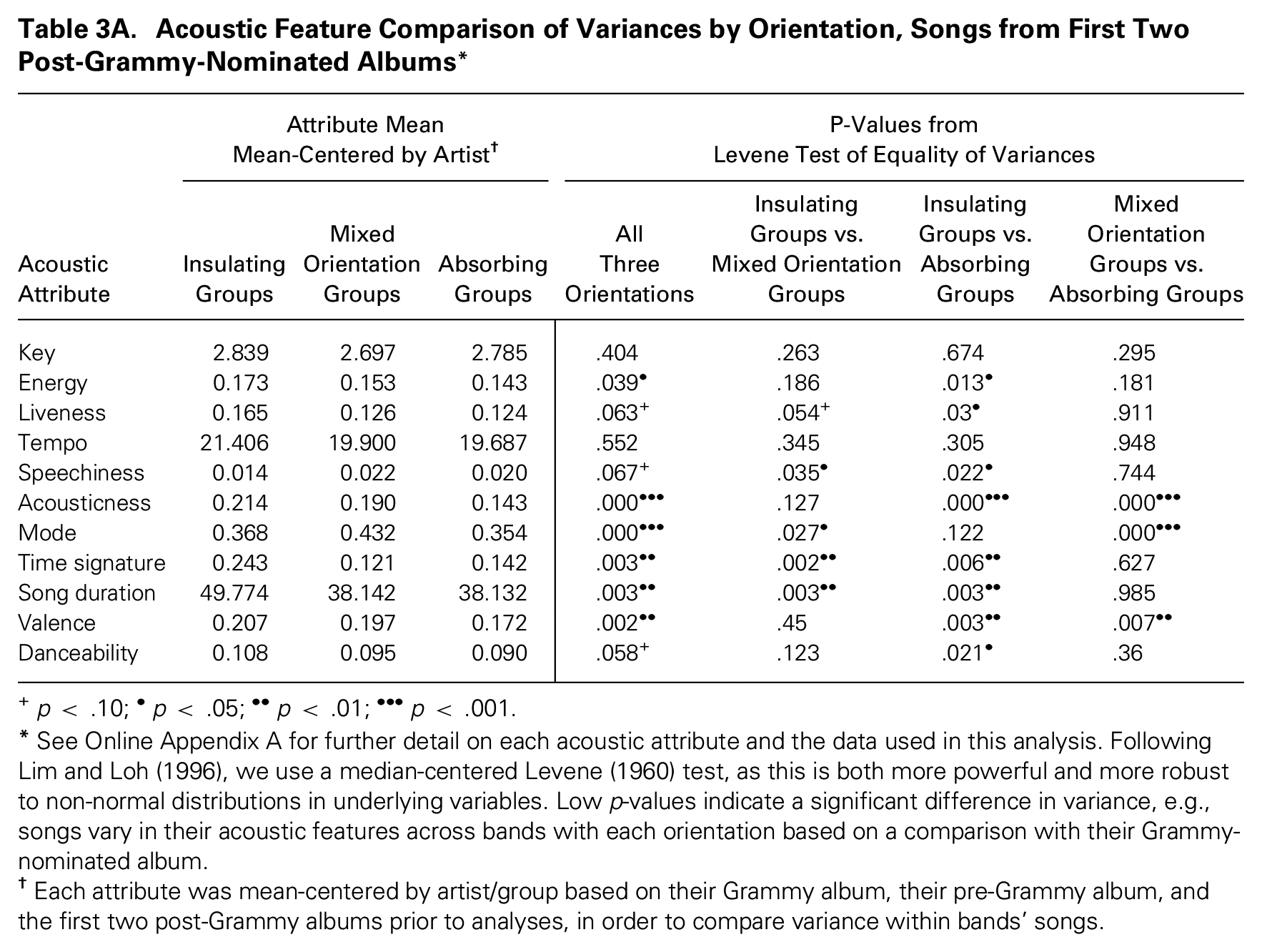
p < .10; •p < .05; ••p < .01; •••p < .001.
See Online Appendix A for further detail on each acoustic attribute and the data used in this analysis. Following Lim and Loh (1996), we use a median-centered Levene (1960) test, as this is both more powerful and more robust to non-normal distributions in underlying variables. Low p-values indicate a significant difference in variance, e.g., songs vary in their acoustic features across bands with each orientation based on a comparison with their Grammy-nominated album.
Each attribute was mean-centered by artist/group based on their Grammy album, their pre-Grammy album, and the first two post-Grammy albums prior to analyses, in order to compare variance within bands’ songs.
Acoustic Feature Comparison of Variances by Orientation, Songs from All Post-Grammy-Nominated Albums*
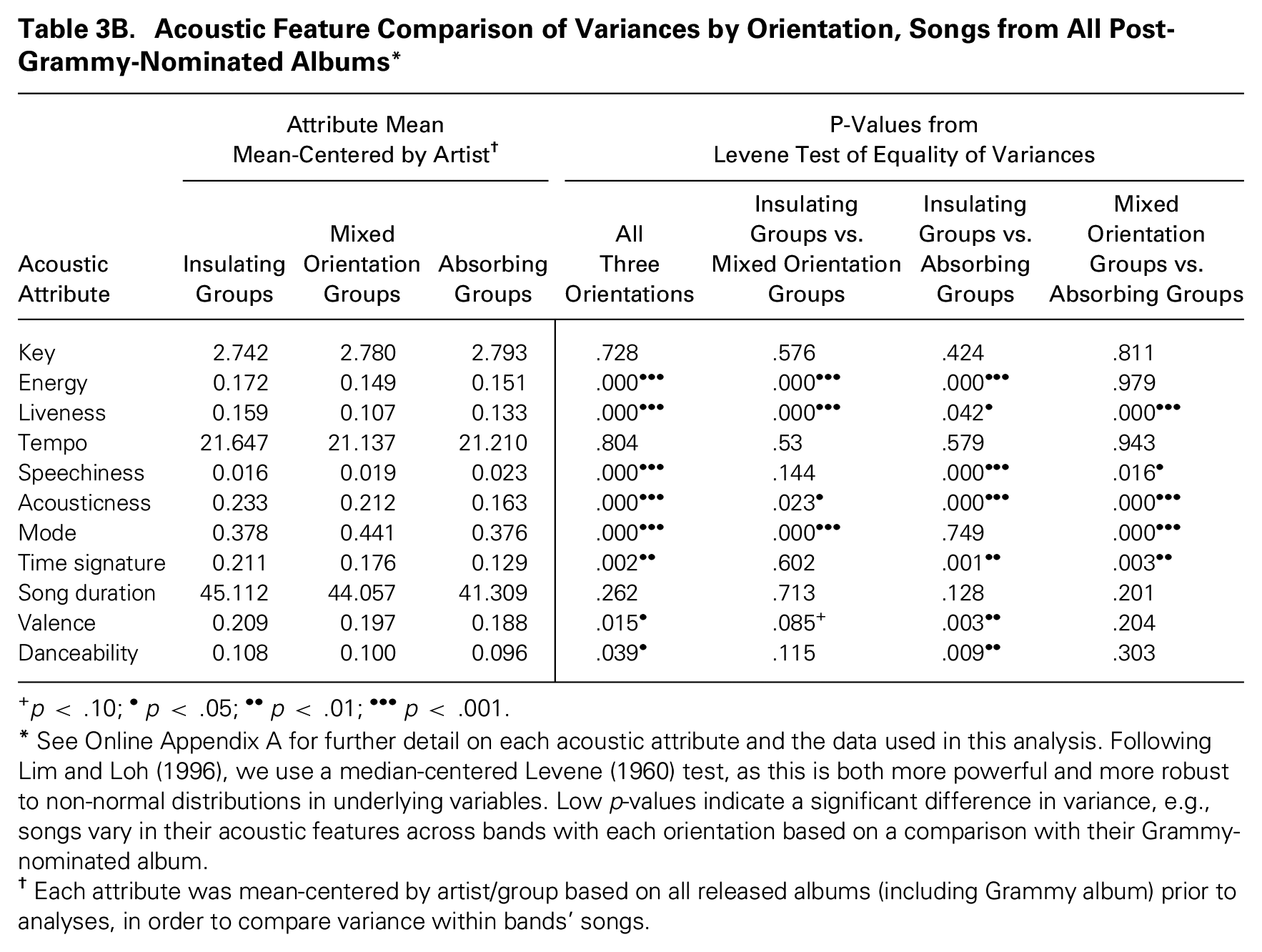
p < .10; •p < .05; ••p < .01; •••p < .001.
See Online Appendix A for further detail on each acoustic attribute and the data used in this analysis. Following Lim and Loh (1996), we use a median-centered Levene (1960) test, as this is both more powerful and more robust to non-normal distributions in underlying variables. Low p-values indicate a significant difference in variance, e.g., songs vary in their acoustic features across bands with each orientation based on a comparison with their Grammy-nominated album.
Each attribute was mean-centered by artist/group based on all released albums (including Grammy album) prior to analyses, in order to compare variance within bands’ songs.
In general, we find that on some of the more standard musical features, specifically key and tempo as well as song duration, in the full catalogue comparison, songs from each orientation tend not to be different from one another. Given the relatively limited set of possibilities for each of these attributes in popular music production, these findings are unsurprising. However, on the more subjective attributes—those that better capture the elements of songs that make them stand out and for which there are many more possible values—insulating groups tend to produce music with greater variance after the recognition of an early album. Comparing orientations pairwise in terms of variance on the acoustic attributes, we find that insulating groups are significantly different from absorbing groups on eight musical attributes (in the first two post-nomination albums) and from mixed groups on four (absorbing and mixed groups are significantly different from each other on three). This triangulates with our qualitative finding that insulating groups experiment more with their sound overall (whereas absorbing groups become locked into a sound) and that mixed groups are initially more like absorbing groups but, over the course of their career, start to become more varied in their sound.
Triangulating distal outcomes: Lower or sustained productivity?
Our emergent theory suggests that absorbing groups work over a shorter period and thereby produce fewer albums (creative output). Moreover, in qualitative terms they describe themselves as experimenting less with their sound and feeling under-recognized (their albums garner less acknowledgment from domain experts, as measured by additional nominations). Given our inductive stance and the small samples of each orientation, our goal was to use quantitative data for triangulation and to enhance the descriptions of the groups. Insulating groups and mixed groups spent more time being productive (i.e., years active) than absorbing groups did (MInsulating = 19.75, S.D. = 9.24 vs. MAbsorbing = 11.04, S.D. = 6.12 vs. MMixed = 19.76, S.D. = 6.82, F[2,49] = 10.45, p < .001, ηp2 = .30). A second ANOVA revealed that insulating groups and mixed orientation groups created more original albums than absorbing groups did (MInsulating = 8.00, S.D. = 3.02 vs. MAbsorbing = 5.26, S.D. = 2.64 vs. MMixed = 8.47, S.D. = 2.81, F[2,49] = 8.10, p = .001, ηp2 = .25).
Distal outcome: Future recognition?
Though recognition can come in multiple forms, the triggering event for the groups in our data was an early Grammy nomination. As we are interested in how orientations ultimately influence future creative production, we looked at subsequent Grammy nominations for all bands in our sample to see how they fared on this measure of recognition. When we compare the average number of additional Grammy nominations (not including the original year in which they were nominated and not double counting multiple nominations for a single piece of work), insulating groups received 5.13, absorbing groups received 1.85, and mixed orientation groups 1.71. In addition, three insulating bands were inducted into the Rock & Roll Hall of Fame: Dire Straits, The Pretenders, and Eurythmics. The Go-Go’s are the only group from either of the other orientations that have been nominated or inducted. 13
Alternative explanations: Biographic comparisons
Perhaps groups whose members had prior band experience, that were self-formed, whose members were from the same geographical area, that had been together longer before being nominated, or that had fewer members would be better equipped to manage the impact of recognition for early creative success. To help rule out these alternative explanations that might explain why groups exhibited differences in terms of ongoing creativity, we turned to biographic and demographic data.
Using the additional data we collected, we created a dummy for whether individual group members had prior band experience (1 = one or more band members had prior experience; 0 = no band members had prior experience). We measured group formation by determining whether outsiders (primarily record label executives) were described as involved in the group’s formation (1 = outsiders involved; 0 = outsiders not involved). We measured whether group members were from the same geographical area by researching band members individually and creating a dichotomous variable: when group members’ hometowns were within the same part of the country (for large countries) or within the same country (for small countries), we used 1 to indicate hometown proximity (0 = not close). We recorded how long groups had been together prior to their nomination in years based on the difference between when the groups initially formed and when they were nominated. We also recorded the number of group members.
Tables 4 and 5 summarize the biographical comparisons between absorbing, insulating, and mixed groups and reveal that the only significant difference with each orientation is the number of group members, as groups with more members are more likely to be absorbing groups. Considering our qualitative findings, we believe this is likely because it is more difficult to break the behavioral patterns that arise with the challenges prompted by early recognition when there are more group members. With more people involved, more egos need to be handled. Otherwise, we observe no significant differences in these possible alternative explanations across the three orientations. Little, if anything, about bands’ histories appears to play a role in determining which orientation they adopt following early recognition.
Frequencies, Percentages, and Chi-Square Results for Prior Band Experience, Group Formation, and Hometown Proximity by Orientation*
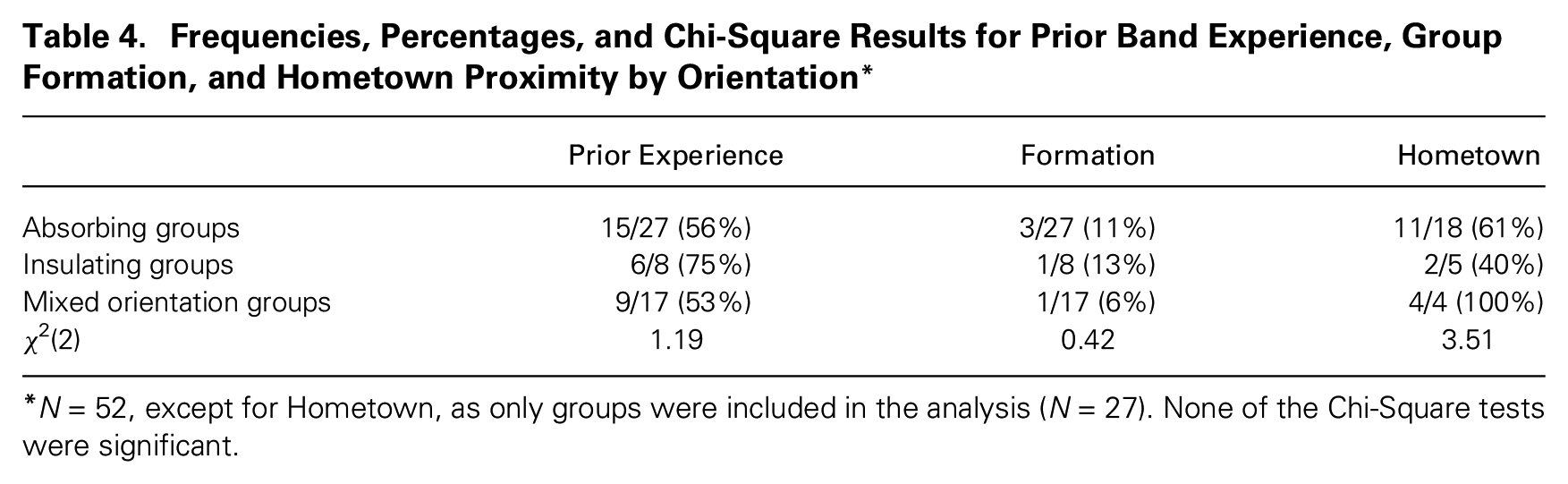
N = 52, except for Hometown, as only groups were included in the analysis (N = 27). None of the Chi-Square tests were significant.
Means, Standard Deviations, and Discriminant Analyses of Years Together Prior to Grammy Nomination and Number of Members by Orientation*

p < .10.
N = 30. Because a majority of solo artists (12) end up in the mixed orientation category, we removed solo artists from the analysis of the number of members so as not to distort the size of the group. Standard deviations are in parentheses.
Discussion
Recognition for achievement acts as a forcing function for creative groups. Even groups whose members may be indifferent to recognition must, upon receiving it, make sense of what they did to garner the recognition and, in turn, decide how they will respond to the heightened expectations for their future work. We show that the skills required for managing recognition are not the same as those required for generating creativity, even though how groups manage recognition substantially impacts their process for generating future creativity. Rather than any one tactic or factor contributing to ongoing creative output and (future) recognition, a constellation of reactions and adjustments—an orientation—appears to play a significant role in how successfully groups “get on” after early creative recognition. These orientations are sticky but not static: they dynamically emerge in the aftermath of early recognition and then require ongoing cycles of interpretation and interaction.
Our theory of recognition orientations therefore contributes to research in three ways. First, recognition orientations highlight the interpretive burden that recognition places on creative groups and their process. By detailing the difficult, dynamic relationship between creativity and recognition, our findings reveal that this ostensibly beneficial public mark of achievement can have negative short- and long-term consequences, particularly when it comes early in a group’s tenure. Furthermore, early recognition rarely appears to benefit a group in the long run, save perhaps for buying insulating groups the freedom to experiment. Second, we highlight how recognition affects groups’ expectations and relational dynamics: groups either absorb new voices and opinions or insulate themselves from them. Paradoxically, groups that approach recognition with a need for more of it often doom themselves never to find it, while those that insulate themselves from recognition show that a group can continue to be particularly creative without changing the group’s composition. Finally, our work also contributes to recent heightened interest in what happens in the wake of creative recognition (e.g., Berg, 2022; Deichmann and Baer, 2022; Negro, Kovács, and Carroll, 2022) by expanding exploration of the outcomes of creative work. In particular, we highlight the importance of creative group members’ continued engagement with one another and the role of gratitude in the creative process. These new outcomes open space for intriguing new questions.
Recognition Orientations
Past research on recognition has viewed it primarily as an additive, rather than integrative, attribute. That is, research suggests that recognition can increase status (Merton, 1968) and explores the benefits (e.g., Azoulay, Stuart, and Wang, 2014; Foster, Rzhetsky, and Evans, 2015) or pitfalls (e.g., Jensen and Kim, 2015) that may accompany status. Other research highlights how recognition adds a larger audience (Kovács and Sharkey, 2014), which might create additional value for recognized products (Deuchert, Adjamah, and Pauly, 2005) but may also create a sense of envy from others (Gallus and Frey, 2016). Notably, each of these outcomes adds to the group but sits largely outside the group’s internal dynamics. Our research opens opportunities for new theorization of the creative process by highlighting how groups wrestle with interpreting and then absorbing or insulating themselves from recognition, eventually forming an orientation toward recognition that influences their subsequent attempts at creativity. An emphasis on recognition as something that forces orienting to a new reality (“we are widely recognized for our creativity” versus “no one knows our work”) reveals a more dynamic, interpretive aspect of how groups approach creativity. A recent review emphasized the need to understand how creative groups accomplish this interpretive work:
How do [groups] that achieve rapid success manage the pressure of a large audience and the felt need to continue to produce work . . . ? The same is true of collaborations: What efforts do members of creative groups engage in, after a project ends, concerning identity (“Who can we be as a group, if this is what we produce?”), interpretation (“What did this project mean for us?”), relational connections (“Which relationships from this collaboration do we preserve, and how?”), or projections (“What future ideas do we have now, based on this collaboration?”)? (Harrison et al., 2022: 12)
Our model of creative recognition orientations provides some answers to these questions. We show that groups that receive recognition actively navigate and renegotiate their expectations and relational boundaries. This renegotiation is out of necessity; groups are made up of individuals, each of whom is likely to interpret recognition differently. Indeed, because recognition creates a heightened awareness of external expectations, navigating different individual interpretations is not only complicated but requires skills the group has likely not had to develop because their prior focus was largely on generating new ideas. Subtle misalignments in orienting at the beginning become sticky, and ultimately differences in degree become differences in kind that can erode future creativity (in the case of absorbing or mixed orientations).
Understanding groups’ recognition orientations provides a foundation for reconciling past research revealing that some groups benefit from recognition while others do not (Faulkner and Anderson, 1987; Delmestri, Montanari, and Usai, 2005; Tommaso, Petruzzelli, and Albino, 2017). Whether a group will flourish or flounder depends less on the recognition itself and more on how the group orients and adapts to new expectations and the associated changes to their working relationships. Thus, identifying recognition orientations reveals that an apparent boon for creative groups—recognition for outstanding work—can quickly become a bane as groups are forced to wrestle with what it means to them and integrate recognition into how they work together.
Managing Expectations and Relationships in Creative Groups
Our research on recognition orientations also contributes by revealing a paradox: by shunning outsize expectations and outside input, groups might be more likely to be more creative and sustainably meet those expectations. Insulating groups grow to pay careful attention to the potentially damaging role of expectations, and they dampen the voices that would try to tie future output to their recent recognition—e.g., you need more recognition, and it can be achieved only if your work looks and sounds like this. Rather than chasing widespread future recognition, insulating groups seem to think carefully about what recognition means to them and to choose carefully whose recognition they might desire as they move forward. By dialing into a less fickle and more understanding audience of respected peers—or even limiting their “audience” to themselves alone—they give themselves more freedom to experiment, compared to groups that double down on matching or exceeding prior recognition. The result is that expectations and relationships within a group seem most attuned to limiting the pressures of recognition.
The insulating practice of closing the group off to outside voices and input appears to run counter to received wisdom about how groups maintain creativity (Choi and Thompson, 2005; Skilton and Dooley, 2010; Soda, Mannucci, and Burt, 2021). However, note that our analyses do not suggest that the most creative groups isolate themselves completely—far from it. Instead, insulating groups protect and pace their time together but take breaks when necessary, going with the creative flow rather than forcing the issue if the timing or creative energy does not feel right. During these planned, amicable breaks, groups are likely to receive infusions of external influence or simply become able to return to the group with new eyes. The key here is that external influences are filtered through existing group members rather than having a direct influence themselves (cf. Reagans and Zuckerman, 2001). The group members, already more attuned to one another, are better equipped to filter the external influences through a collective lens based on intuition about what makes good music for them. Rather than having a lack of outside voices cause creative inertia and reliance on what worked previously (Shalley and Perry-Smith, 2008), insulating groups are able to add external influences to the group’s process and output without introducing new people (and their opinions) for whom the group’s practices must adapt.
Considering New Outcomes of Creativity
We turn finally to the expansion of outcomes worth considering when we look at the creative process. A recent review article suggested that researchers should “examine creativity as an independent variable and then ask the question: What happens next?” (Harrison et al., 2022: 12; see also Harvey, 2014; Harrison and Wagner, 2016). Our work breaks new ground on this front by introducing new outcomes to research on the creative process: group longevity and gratitude.
Group longevity (and lack thereof)
Prevailing theory about groups notes that group breakup, also labeled “adjourning” (Tuckman and Jensen, 1977: 426) or “exit” (Moreland and Levine, 2001: 72), is an important part of the group experience. Yet few studies examine group dissolution; most research examines why individuals leave a group, operating under the assumption that most members remain (O’Reilly, Caldwell, and Barnett, 1989; Jackson et al., 1991). Recognition orientations provide insight into how groups enact longevity, including why groups choose to continue working together or to disband entirely. Moreover, our findings distinguish between varieties of group separation that might otherwise look similar to outside observers: hiatuses inspired by insulation and breakups born from absorption. Our distinction provides deeper insight into whether groups dissolve as an acknowledgment of depleted creative energies or as a last resort.
Recognition orientations also provide a potential resolution to divergent findings regarding group longevity and creativity. While some work suggests that group members need to leave so that new ideas can arrive in the form of new members (Skilton and Dooley, 2010; Soda, Mannucci, and Burt, 2021), other research indicates that groups that sustain longevity can maintain creative productivity (Simonton, 1977, 1997). We show that an absorbing orientation tends to lead groups toward breakup, even if the group is opening its relationships and finding new voices—perhaps even because of that. This discovery suggests that our view of individual turnover in a new group (or adding new members) may not take a sufficiently long perspective. That is, though a new producer might be able to milk another hit out of a band, absorbing outside input and expectations seems to create conditions that trade the future for the present. Hypothetically, if the same band adopted an insulating orientation, they might not produce the immediate hit, but because they continue working through each other and producing music over a longer time, they have the chance to outperform the additional hit that an absorbing orientation might have earned them in the short term. Laying bare the stresses that groups endure as their recognition orientations emerge highlights the reality that creative pressures can break a group. Future research should do more to explore group breakdowns and the long-term consequences for those involved; our data indicate that attempting creativity after a breakup is rife with its own particular challenges that can thwart future efforts.
Gratitude
Creativity scholars have shown great interest in the relationship between creativity and emotions (Baas, De Dreu, and Nijstad, 2008), generally focusing on broad groups of emotions—positive (Amabile et al., 2005), negative (George and Zhou, 2002), or ambivalent (Fong, 2006)—as predictors of creative behavior. We contribute to this line of research by highlighting emotions as an output of, rather than an input to, creativity. Moreover, we build new theory by highlighting the role of a specific emotion: gratitude. When a group receives recognition, the emergent recognition orientation changes the group’s trajectory, leading them to reflect on their work in distinct ways and creating divergent interpretations for the group members to consider. Absorbing groups eventually grow to feel gratitude for past accomplishments, whereas insulating groups express appreciation in the present. With these findings, we begin to crack open the door to interweaving notions of creativity, temporality, and emotion. Early recognition for creativity, if not handled appropriately, may create an emotional longing for the past. This longing appears to restrict the ability to generate new ideas: groups might see the creative process as a restrictive time machine that forces them to try to recreate prior work. In contrast, gratitude for the present seems to encourage groups to appreciate their unique creative process, which creates a willingness to reengage with one another and openness to new ideas and directions.
Taken together, these outcomes provide new opportunities for theorizing about creativity, especially as scholars embrace longer time horizons to capture creativity as an input into groups’ subsequent creative efforts. Gratitude conveys meaning because it is defined as “thankful appreciation” for experiences (Watkins et al., 2003: 432), suggesting that it motivates reflecting on the significance of an experience and thereby serves to anchor the meaning of the experience. The addition of gratitude to longevity and productivity, therefore, offers a new frontier for creativity research—one which Amabile and Pratt (2016) suggested deserves exploration—because it locates meaning not as a motivational input that catalyzes creativity but as an output of creativity that crystallizes its meaning and importance.
Moreover, our findings suggest that gratitude may not be universally beneficial. We distinguish two forms of gratitude: one associated with divergent recognition orientations and the other with divergent long-term outcomes. Whereas absorbing groups’ gratitude for the past is associated with attempts to recreate the source of their early recognition, insulating groups’ moment-by-moment gratitude is tied to protecting their unique creative process and seems to support creative exploration. In this way, our findings on groups’ sustained productivity provide new insight because they hint at two ways that meaning can be derived from the creative experience and potentially serve as an input for subsequent creative cycles (cf. Mannucci, 2017). Insulating groups in particular appear to exhibit a virtuous gratitude–creativity cycle; their gratitude for both how they work together and what they produce appears to catalyze future collaboration and creativity.
Limitations and Future Directions
We describe the limitations of our methods and findings both to add boundary conditions and nuance in interpreting our results and to motivate future research. While our inductive methods enable us to heed calls in the literature to study intact groups over time—and triangulating our findings with quantitative analysis provides additional trustworthiness to our theorizing of how reactions to early recognition impact groups over time—we still lack the precision to claim causality among the key constructs in the study. A common recommendation for a study claiming this limitation is to suggest that future researchers adopt experimental methods that can precisely account for causality. While we endorse that direction and agree that establishing causality provides important insights, we also strongly encourage additional inductive work on creativity over the course of careers both at the individual and group levels. Existing theory already captures how individuals and groups can master diverse inputs to generate one creative idea, but we still know far too little about how creative experiences and their aftermath influence subsequent creative experiences, particularly over a longer time horizon. Research using inductive methods and extreme samples that offer theoretical transparency offers the hope of providing rich theories that seed new concepts for future deduction.
Our choice of sample might limit generalizability, but inductive studies should be evaluated less on generalizability and more on the transferability of the theory to contexts with similar characteristics. Our theorizing may not entirely translate to groups operating within organizational structures with some oversight by a manager and a lower risk/reward proposition (success with a creative project is unlikely to lead to a worldwide response). Yet many organizations use structures like skunk works (Brown, 2004) and accelerators or labs (Cohen, 2013) to mimic the lack of an organizational setting that the bands in our sample experienced, and teams often work together to create products, like the songs studied here, intended for large, multinational markets. Moreover, the teams that form startups and even those that work together over long periods—for example scientists, engineers, filmmakers, and consulting teams—mirror many descriptors of the groups studied here: the ambiguity of criteria for success, a relatively small team size, and significant product complexity. Our theorizing best transfers to groups in these settings.
A final suggestion for future exploration pertains to recognition, which has rarely been studied and even less so at the group level. We examined the special case of early recognition because its influence might be particularly powerful due to the importance of primacy in group development, forcing groups to reckon with themselves and their processes (Ericksen and Dyer, 2004). But our emergent theory creates a foundation for new, field-level questions as well. What is the responsibility of a field for recognizing creativity, particularly if recognition for creative success will influence—and quite possibly ruin—future creativity? How might a field better curate or cultivate ongoing creativity after acknowledging outstanding early output? Indeed, other fields that rely on creativity, including science, design, business, and art, have “30 under 30,”“40 under 40,” and “Best New Scholar/Scientist/Artist” awards. If sustaining creativity may have less to do with achieving an initial breakthrough idea than with how groups grapple with the response to that idea, perhaps such recognition practices merit more scrutiny.
Supplemental Material
sj-pdf-1-asq-10.1177_00018392221136158 – Supplemental material for Recognition Killed the Radio Star? Recognition Orientations and Sustained Creativity After the Best New Artist Grammy Nomination
Supplemental material, sj-pdf-1-asq-10.1177_00018392221136158 for Recognition Killed the Radio Star? Recognition Orientations and Sustained Creativity After the Best New Artist Grammy Nomination by Spencer H. Harrison, Noah Askin and Lydia Paine Hagtvedt in Administrative Science Quarterly
Footnotes
Acknowledgements
Articles are always collective pursuits supported by a community of scholars. We would like to thank our editor, John Wagner, and three anonymous reviewers who continually helped us refine our ideas. In addition, we would like to thank participants at INSEAD’s Qualitative Brownbag, members of the Creativity Collaboratorium, and attendees of the 2019 Creative Industries Conference in Paris, as well as seminar participants at Harvard Business School, Boston College, London Business School, and the University of Ljubljana, where earlier versions of this paper were presented. One of the most joyous aspects of having a paper accepted is finally choosing a title that you will no longer have to revise. But, as we are music lovers, in this case there were just too many good options, and since you are likely second-guessing our choice right now (we probably are, too), we wanted to catalogue other titles we loved. All were taken from song lyrics that we considered but opted not to use because the band was not in our sample (Everybody Wants to Rule the World; This Must Be the Place; Under Pressure; It’s the End of the World as We Know It?), the song was from the wrong era (Something In the Way; Semi-Charmed Life; Bittersweet Symphony), or the band was in our sample but we just thought the title we picked was better (Don’t You Want Me; Sweet Dreams Are Made of This).
2
Early recognition can be contrasted with consecration, which is the elevation of art or artists to particularly high status, often retrospectively (see Becker, 1982; Schmutz, 2005). Whereas early recognition is a marker of potential, setting expectations for future creative excellence, consecration is acknowledgment of continuous or particularly “sacred” (Bourdieu, 1984: 6) creative achievement. Consecration typically occurs toward the end of artists’ careers, though not always.
3
The voting members are “professionals with creative or technical credits on at least six commercially released tracks (or their equivalent). These may include vocalists, conductors, songwriters, composers, engineers, producers, instrumentalists, arrangers, art directors, album notes writers, narrators, and music video artists and technicians” (Academy, 2018;  ).
).
4
For albums that did not reach the Billboard 200, a value of 201 was used in our dataset. A lower number indicates better chart performance. We used numerical codes to represent levels of RIAA certifications at cutoffs of 1 million units. These codes range from a value of 1 for 18X Multiplatinum (18+ million units sold) to a value of 19 for Gold and below (1 million or fewer units sold). Hence a lower number indicates a better RIAA ranking and more units sold. The Best Ever Album rankings were collected from , a website that aggregates over 31,000 listed rankings of albums generated by music critics and fans to create an overall score of album performance compared to all other albums. As with the prior measures, a lower number indicates better performance.
5
To illustrate, four of ten winners of the Best New Artist Grammy in our sample are insulating groups, two are absorbing groups, and four are mixed groups.
6
Because our sample explicitly focuses on groups managing early creative recognition, we refer to this as “recognition” throughout the paper for brevity’s sake, unless we are explicitly referring to a later period in their career. Similarly, we often refer to groups with the absorbing, insulating, and mixed recognition orientations as “absorbing groups,”“insulating groups,” and “mixed groups,” respectively.
13
While The Go-Go’s unquestionably deserve this honor, some people credit a recently released documentary about the band for the nod, implying that the honor is based less on their overall body of work and more on their early success: “For any potential [Hall of Fame] voter who viewed the quintet as a fun relic of the New Wave era, the documentary reframes the group as rock & roll survivors who captured the zeitgeist. It’s a vivid portrait of a breathless run to the top of the charts. . . . Ultimately, [the documentary] is a work of advocacy, a film designed as much to win over skeptics as it is to appeal to longstanding fans” (Erlewine, 2021).