




Abstract
This paper examines how traditional authorities in Kom and Bali, Cameroon, assert control over land amid competing state power and legal systems. Using ethnographic data, it shows that the fons employ hybrid strategies-symbolic, performative, and material to reinforce legitimacy and influence land governance. The fon of Bali engages in state politics and elite networks, gaining material legitimacy but losing grassroots trust. Conversely, the fon of Kom remains politically neutral, basing legitimacy on cultural continuity and moral authority. The study finds that moral legitimacy rooted in grassroots perceptions is more crucial for effective land conflict mediation than formal legal authority or political alliances. By challenging rigid state-tradition binaries, the paper highlights how both actors contribute to land tensions. It concludes that sustaining traditional authority depends on adaptive strategies and maintaining community trust and neutrality, offering broader insights into legitimacy and conflict resolution within hybrid political orders.
Introduction
The political landscapes of many African states are shaped by overlapping state and traditional institutions that exercise public authority in ambiguous and intersecting ways. Responsibilities are rarely clear, and the state's governance gaps create openings for other actors to assert control (Moore, 1973; Lund, 2006). Recent scholarship in Cameroon (Ngwoh, 2019; Sunju and Page, 2022) shows how institutional ambiguity and the interplay between customary and state authorities shape land allocation, dispute resolution, and informal enforcement, illustrating the dynamics explored here.
Authority here refers to the socially recognised right to exercise power, whether grounded in legal, traditional, or charismatic bases (Weber, 1958). Legitimacy, in turn, denotes the extent to which such authority is perceived as appropriate and accepted, based on shared norms, moral justification, and performance (Beetham, 1991; Williams, 2010). Legitimacy is therefore best understood as an ongoing evaluative process shaped by both rulers and those they govern, as well as by multiple legitimacy communities – that is, distinct groups such as local populations, elites, and state actors whose expectations and judgments define what counts as acceptable rule (Black, 2008; Alagappa, 1995; Moe, 2011). This perspective also highlights that traditional authorities operate in constant interaction with state bureaucrats and political actors, whose actions influence their legitimacy and conflict–mediation roles. In such contexts, public authority becomes a terrain of competition in which state and traditional leaders negotiate legitimacy through everyday practices such as land allocation, dispute resolution, and resource control (Benton, 2002; Lund, 2006). Rather than treating them as opposing categories, this paper adopts a relational approach that views both institutions as co–constitutive and dynamically intertwined.
At the continental scale, Wegerif et al. (2025) provide a comparative overview of land tenure governance across 18 African countries, highlighting uneven reform outcomes and the hybrid arrangements that generate both opportunities and conflicts. Situating Cameroon within this broader landscape shows that the dynamics in Kom and Bali reflect wider African patterns, making the case instructive for understanding hybrid governance and land tenure.
Existing scholarship on land politics in Africa has largely focused on institutional authority over land access and the political stakes involved (Boone, 2003; Evers et al., 2005; Lund and Boone, 2013). Studies on legal pluralism and hybrid political orders explain how overlapping mandates produce competing legal orders (Hooker, 1975; Von Benda-Beckmann, 1981; Tamanaha, 2008; Boege et al., 2009; Richmond, 2010; Moe, 2011). Yet less attention has gone to how traditional leaders cultivate moral, material, performative, and relational legitimacy, and how these forms shape their capacity to mediate land conflicts amid institutional ambiguity and political rivalry. There is also limited engagement with how complementary and contradictory state–traditional interactions generate predatory practices such as informal taxation, rent-seeking, and patronage that intensify the conflicts they claim to resolve.
This article argues that traditional rulers’ authority in land governance is shaped not simply by their relationship to state power, but by the types of legitimacy they cultivate and the audiences they prioritise. A comparative analysis of Kom and Bali shows how the fons’ divergent strategies for reclaiming land authority illuminate broader tensions in Cameroon's legal pluralism and grassroots governance. In this study, “fon” refers to the paramount ruler of a Grassfields fondom, often called a “chief” in official contexts. Traditional councillors, village notables and village heads operate under the fon's oversight and together constitute traditional authorities. The term Grassfields refers to the highland region of the Northwest and Western parts of Cameroon, characterised by open grassland vegetation that distinguishes it from the surrounding forest zones. The label originated in colonial geographical descriptions and has since been used to denote both the ecological landscape and the culturally distinct area associated with centralised chiefdoms (Nkwi, 1987; Warnier, 1985).
The alignment of Bali's fon with state actors and political elites grants him access to development resources and performative legitimacy. However, it also undermines grassroots trust and weakens his authority to mediate disputes, especially in a context of intense land conflicts where his perceived partisanship fuels suspicion. In contrast, the fon of Kom maintains political neutrality and cultivates moral and relational legitimacy, enabling him to retain informal authority over land and mediate conflicts across the fondom without accusations of bias. At the same time, the article recognises that state bureaucrats, such as Divisional Officers (DOs), state-appointed administrative officials who represent the central government at the divisional level, share the same plural legal arena and enact legitimacy through mandate, patronage, or everyday governance. Their interactions provide the institutional context in which the fons’ authority is claimed and contested.
By treating land governance as a contested policy field, the paper shows that legitimacy is not only a resource for institutional survival but a determinant of conflict mediation effectiveness. It argues that in legally plural and politically hybrid settings, deep moral legitimacy among local populations, not proximity to the state or elite networks is the most decisive factor shaping traditional authority, a pattern also reflected in comparative studies across Africa (Wegerif et al., 2025). Hybrid governance also enables predatory behaviour by both state and traditional actors, who often prioritise extraction over equitable conflict resolution.
The article draws on three literatures: legal pluralism (Hooker, 1975; Von Benda-Beckmann, 1981; Tamanaha, 2008), hybrid political orders (Boege et al., 2009; Richmond, 2010; Moe, 2011; Meagher, 2006, 2012) and political legitimacy (Suchman, 1995; Tyler, 1997; Schatzberg, 2001; Black, 2008; Williams, 2010; Lavi, 2016). Recent work on land governance and normative pluralism in Cameroon and across Africa (Bah and Teguia Kenmegne, 2025; Wegerif et al., 2025; Sunjo and Page, 2022; Ngwoh, 2019) further highlights how overlapping institutional arenas, political alliances, and socio-environmental pressures shape authority and legitimacy in land conflict mediation.
By weaving these perspectives together, the article offers a nuanced reading of the bifurcated state 1 (Mamdani, 1996), showing how traditional authorities operate alongside and in competition with state institutions in ways that both manage and generate conflict. The paper proceeds by outlining the methodology and study context. It then reviews the literature on legal pluralism and hybrid political orders. It analyses the legal framework governing traditional authority in Cameroon to examine how the 1974 land ordinances reshaped customary tenure. It then explores how both state and traditional actors assert land authority while pursuing self-interest, before turning to the strategies fons use to maintain relevance and legitimacy. The article concludes by reflecting on how different forms of legitimacy shape conflict-mediation capacity in plural political orders.
Background to the Study Area
The research sites, Kom and Bali, are located in the North–West Region of Cameroon, one of the two Anglophone regions formerly administered under British colonial rule as part of the League of Nations Mandate (1922–1945) and later the United Nations Trusteeship (1946–1961) (Ndobegang and Sama, 2009). The region is characterised by centralised fondoms where fons wield significant socio-political and spiritual authority (Nkwi, 1987).
Kom and Bali were selected for their institutional comparability. Both maintain centralised political structures as well as Grassfields institutions, such as the Kwifoyn (regulatory society) and manjong (warrior societies transformed into socio-political associations). Their structural parallels make them ideal for a comparative study of land governance and legitimacy. A key distinction is Kom's matrilineal succession system, compared with Bali's patrilineal arrangement, though this difference does not undermine broader institutional comparability.
Geographically, Kom lies in Boyo Division in the mountainous Bamenda Grassfields (Nkwi, 2011). Meanwhile, Bali, situated in Mezam Division, occupies flatter terrain near the Mbu-Baba highlands, with fertile valleys extending toward Baforchu, Bawock and Mbufung (Sone, 2012). Although both communities experience similar pressure-state involvement in land governance, demographic expansion, and shifting political landscapes; they have followed divergent conflict trajectories. Bali has witnessed recurring land disputes, intensified by overlapping authority claims and partisan politics. The peak was the violent Bali–Bawock conflict of March 2007, during which over 300 houses were burned, more than 2000 people were displaced, and several deaths were reported. Kom, by contrast, has remained relatively stable, with fewer overt conflicts despite facing similar governance challenges. This divergence, against a backdrop of institutional similarity, offers a useful frame for analysing how legitimacy, leadership strategies, and governance structures mediate conflict and order in plural political settings.
Methodology
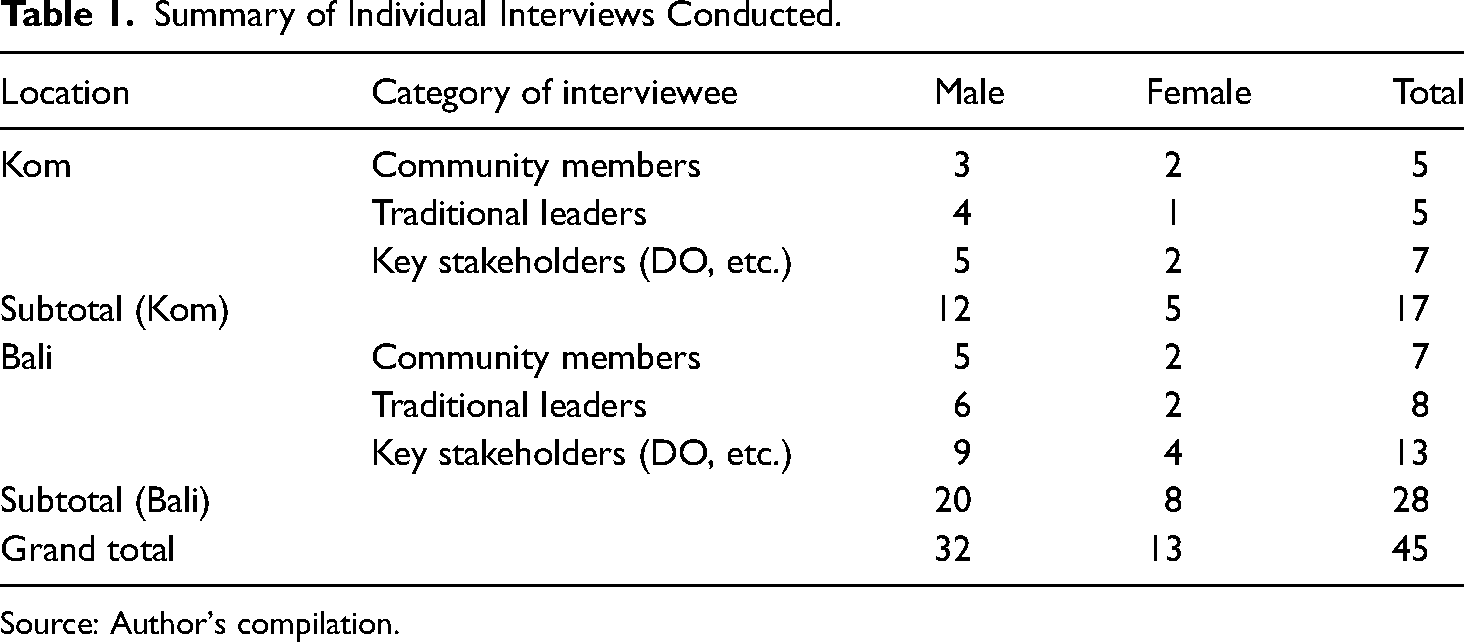
This paper draws on eight months of ethnographic fieldwork conducted between February and September 2015 in the North–West Region of Cameroon, divided equally between Kom (Boyo Division) and Bali (Mezam Division). In addition to this initial period, the research benefited from renewed ethnographic engagements and follow-up interviews conducted intermittently between 2016 and 2025, providing longitudinal insight into shifts in legitimacy claims, conflict trajectories, and state-traditional relations. A comparative case study approach enabled an examination of how traditional authorities assert control and legitimacy over land in two socially and politically distinct settings. Data collection employed semi-structured interviews, three focus group discussions (FGDs), participant observation, and archival research. In total, 45 interviews were conducted: 12 community members (farmers and grazers), 13 traditional leaders, and 20 stakeholders including DOs, mayors, politicians, and NGO personnel. See Table 1 for a summary of the interviews conducted.
Summary of Individual Interviews Conducted.
Source: Author's compilation.
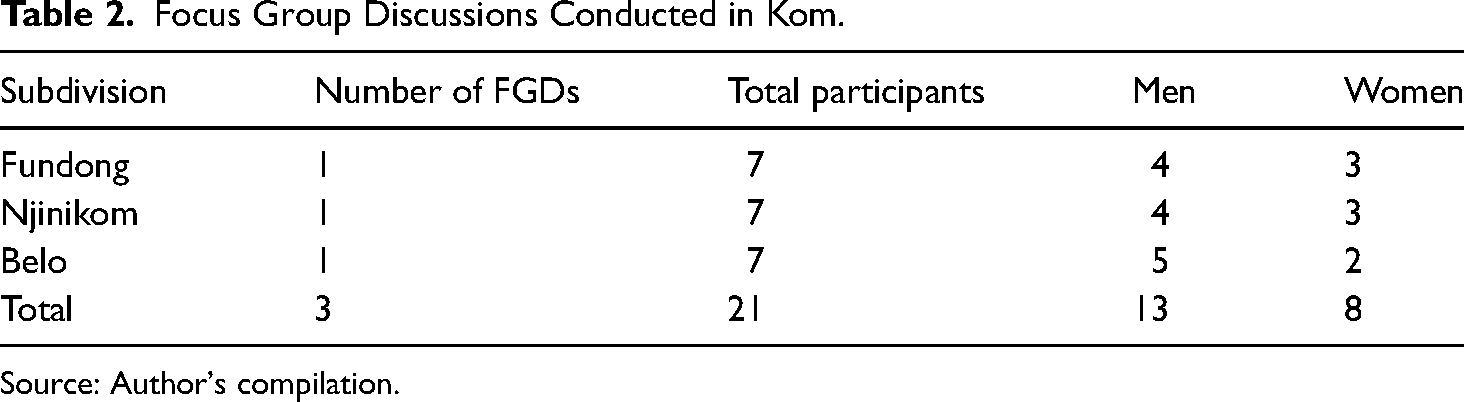
While both Kom and Bali received comparable fieldwork attention, interview distribution differed due to contextual constraints. In Kom, three FGDs were used to complement individual interviews and capture broader community perspectives. Each comprised seven participants drawn from Fundong, Njinikom, and Belo, with two to three women per group (see Table 2). FGDs were not feasible in Bali because of insecurity and the sensitivity surrounding land conflict. Although both Kom and Bali have been indirectly affected by regional instability, Bali has experienced periodic violent confrontations, notably, with the Bawock community, which shape how residents discuss land and authority. During fieldwork, heightened political tension and insecurity made group discussions risky; individual interviews were therefore used to protect anonymity and minimise harm. I acknowledge that the richer ethnographic detail in Kom, strengthened by FGDs creates asymmetry in data depth. This is treated as a methodological limitation. However, it is mitigated through longitudinal follow-up interviews, extended participant observation, and complementary secondary sources for Bali, including Mairomi and Kimengsi (2021), whose analysis of governance contestations and predatory state–customary interactions help contextualise Bali's dynamics.
Focus Group Discussions Conducted in Kom.
Source: Author's compilation.
The methodological reflections also draw on Mairomi and Kimengsi (2021), whose work on actor interactions in the Western Highlands complements this study of state bureaucrats, local elites, and customary authorities in contested land spaces. As a researcher from the North–West Region of Cameroon, I entered the field from a neutral standpoint. This positionality shaped local interactions: in Kom, long-standing relationships with gatekeepers facilitated access, whereas in Bali, political tension sometimes influenced perceptions of my presence. I remained attentive to how these dynamics affected participants’ willingness to discuss sensitive issues involving traditional leaders and state officials.
All research activities were reviewed and approved by the Human Ethics Sub-Committee at the University of Melbourne. Informed consent was obtained from all participants, either self-read or read aloud in a preferred language and signed before participation. Given the region's episodic violence and political contestation, explicit safeguards were adopted: interviews were held in neutral locations; recording was avoided when participants expressed discomfort; and questions linking fons or bureaucrats to immediate political events were excluded to avoid prompting conflict-driven responses.
Reframing Authority: Custom, State and the Politics of Legitimacy
African states are characterised by overlapping political orders in which formal and informal institutions coexist, compete, and collaborate (Meagher, 2006, 2012). These arrangements blur boundaries of public authority, particularly in rural contexts where traditional leaders exercise influence parallel to or in interaction with state institutions. To ground this analysis, it is important to clarify how these coexisting orders function and why they matter for land governance, offering a clearer conceptual link to the dynamics explored below.
Legal pluralism and hybridity offer tools for analysing this complexity. Legal pluralism refers to the coexistence of multiple legal systems within a single political entity (Hooker, 1975; Von Benda-Beckmann, 1981; Merry, 1988; Griffiths, 1989; Tamanaha, 2008). As Tamanaha (2008) notes, pluralism is not merely about parallel legal systems but about overlapping and sometimes conflicting norms that vary in legitimacy and enforcement. These include customary, religious, and statutory laws competing for authority in everyday life.
In such contexts, actors navigate among these systems in what Von Benda-Beckmann (1981) calls “forum shopping”: strategically selecting forums likely to yield favourable outcomes. This strategy applies not only to litigants but also to institutions; state officials, fons, and religious authorities may engage in “shopping forums” by seeking disputes that enhance their relevance or political capital. Legal pluralism, therefore, creates a terrain where citizens and authorities manipulate jurisdictions to advance interests, fostering rivalry and ambiguity over mandates.
Recent scholarship on Cameroon expands this picture beyond a legal-structural view. Bah and Teguia Kenmegne (2025) introduce normative pluralism to highlight how multiple, coexisting normative orders-customary, statutory, religious, and informal interact, overlap, and sometimes contradict one another in shaping everyday socio-environmental governance. Their observation that actors navigate not only legal systems but also moral expectations, affective ties, and material incentives underscores why legitimacy remains central in land governance. This insight reinforces the argument that fons operate within dense normative landscapes where formal jurisdiction alone does not determine authority.
While legal pluralism highlights competition, hybridity offers a more collaborative perspective. Developed partly as a critique of the failed-state thesis, hybridity emphasises complementarities between governance orders (Clement et al., 2007; Osabu-Kle, 2000; Menkhaus, 2007; Boege et al., 2009; Richmond, 2010; Moe, 2011; Goodfellow and Lindemann, 2013; Bagayogo, 2016). Scholars such as Boege et al. (2009), Richmond (2010), and Moe (2011) argue that hybrid political orders may produce more inclusive and adaptable governance, especially in decentralised or fragile contexts, as formal and informal institutions interact and adjust to local realities.
However, this optimistic framing has generated critique. Meagher (2012), comparing rebel movements in the Democratic Republic of Congo and the Bakassi Boys in Nigeria, demonstrates how hybrid authorities can reproduce predatory and unaccountable patterns. Informal actors may replicate state coercion without offering genuine alternatives. Meagher cautions against assuming local embeddedness equates to legitimacy and urges scholars to distinguish constructive from corrosive hybridity. Hybridity's value, she argues, lies in clarifying rather than obscuring how local authority relates to local legitimacy.
Building on these insights, Bah and Teguia Kenmegne (2025) stress that governance outcomes in Cameroon depend not only on institutional arrangements but on how normative orders assign value, obligation, and authority to actors. Their argument that normative expectations around land shape both compliance and resistance supports my framing of legitimacy as emerging from moral, relational, and performative claims rather than legal positioning alone. This provides a sharper conceptual transition into the legitimacy framework by showing that fons’ authority arises within rather than outside the normative ecologies structuring everyday decision-making. Integrating insights from normative pluralism thus demonstrates that legitimacy is produced across overlapping moral, political, and social orders that both constrain and enable traditional authority.
Conceptualising Legitimacy in Grassroots Governance
Legitimacy is central to understanding the contemporary relevance of traditional authority. Scholars widely agree that legitimacy is socially rooted in community norms, shared perceptions, and collective expectations rather than merely legal authorisation (Black, 2008). It extends beyond legal validity to encompass the perceived right to rule, grounded in shared beliefs about what is appropriate or effective (Suchman, 1995; Tyler, 1997; Schatzberg, 2001). Suchman's (1995) influential typology remains foundational, distinguishing pragmatic, moral, and cognitive legitimacy. Pragmatic legitimacy rests on the delivery of tangible benefits; moral legitimacy reflects conformity to normative expectations; and cognitive legitimacy arises when an authority is accepted as necessary or inevitable.
These categories have since been expanded by others. Schatzberg (2001) links moral legitimacy to symbols, values, and myths that shape notions of rightful authority in African political cultures. Tyler (1997) emphasises material legitimacy, grounded in a leader's ability to provide services or resources. Lavi (2016) introduces performative legitimacy, highlighting how authority is enacted and reaffirmed through public rituals, speech, ceremony, and representational practices. Tyler (1997) also identifies a fourth dimension-relational legitimacy, based on a leader's capacity to affirm social identity, foster belonging, and sustain interpersonal trust within the community.
Although analytically distinct, these forms of legitimacy often overlap in practice, making conceptual precision essential. Performative legitimacy concerns the symbolic enactment of authority, rituals, public gestures, ceremonies, and other representational acts whereas relational legitimacy concerns the quality of social relationships and the leader's ability to maintain trust and affirm a shared sense of belonging. The former is event-centred and symbolic, while the latter is interactional and affective. Making this distinction explicit provides a sharper framework for analysing how traditional leaders deploy symbolic performance and interpersonal connection as distinct yet complementary bases of authority.
These distinctions become particularly salient in contexts of legal and normative pluralism. Drawing on Bah and Teguia Kenmegne (2025), the concept of normative pluralism demonstrates how multiple overlapping normative orders such as statutory, customary, religious and communal produce competing expectations about what constitutes legitimate authority. Their work shows that legitimacy is shaped not only by legal plurality but also by plural moral worlds, each with different criteria for evaluating rightful rule. In such environments, traditional leaders must navigate diverse and sometimes conflicting value systems, appealing variously to moral norms, material expectations, performative displays of authority, and relational ties.
Insights from Alagappa (1995), Black (2008) and Moe (2011) that legitimacy communities (the distinct groups whose expectations, recognition, and contestation shape what counts as rightful authority) rarely respond to a single basis of legitimacy is therefore particularly useful. In rural African contexts where the state may be weak or contested, traditional rulers must strategically mobilise multiple forms of legitimacy to maintain relevance among diverse constituencies. This multiplicity becomes crucial in settings of hybrid governance and normative pluralism, especially in conflict-prone policy domains such as land allocation, dispute resolution, and resource management. Understanding how these forms of legitimacy intersect and how actors deploy them strategically within plural normative landscapes offers deeper insight into why some traditional authorities succeed while others falter in mediating community conflicts.
Traditional Authority and Land Governance in Cameroon
The role of traditional leaders in Cameroon is defined by legal instruments that both empower and constrain them. Law No. 77/245 of July 1977 classifies chiefs as auxiliaries of the state, entrusted with delegated governance functions under the supervision of local bureaucrats. 2 Traditional councils, often appointed or dissolved at the discretion of DOs, reflect the influence of state authority in local governance. DOs, hold limited civil and commercial jurisdiction. While this framework appears to institutionalise customary authority, it simultaneously subjects it to political interference. Such categorisation, especially for first-class fons like in Kom and Bali tends to consolidate administrative dominance rather than strengthen customary authority.
Further legislation reinforces these dependencies. Ordinance No. 74-1 of 6 July 1974 3 and Decree No. 76-166 of 27 April 1976 4 vest all land in the state but require the participation of traditional authorities in Land Consultative Boards chaired by DOs. These Boards oversee land disputes and land-use decisions. Section 12 of Decree No. 76-166 requires the presence of the fon and two elders for decisions to be valid; verdicts issued without them are null and void. This gives traditional rulers formal authority but also reinforces dependence on administrative officers who control procedures and timelines, levers often used strategically. It also confirms that fons’ participation remains embedded in state-led structures they do not control.
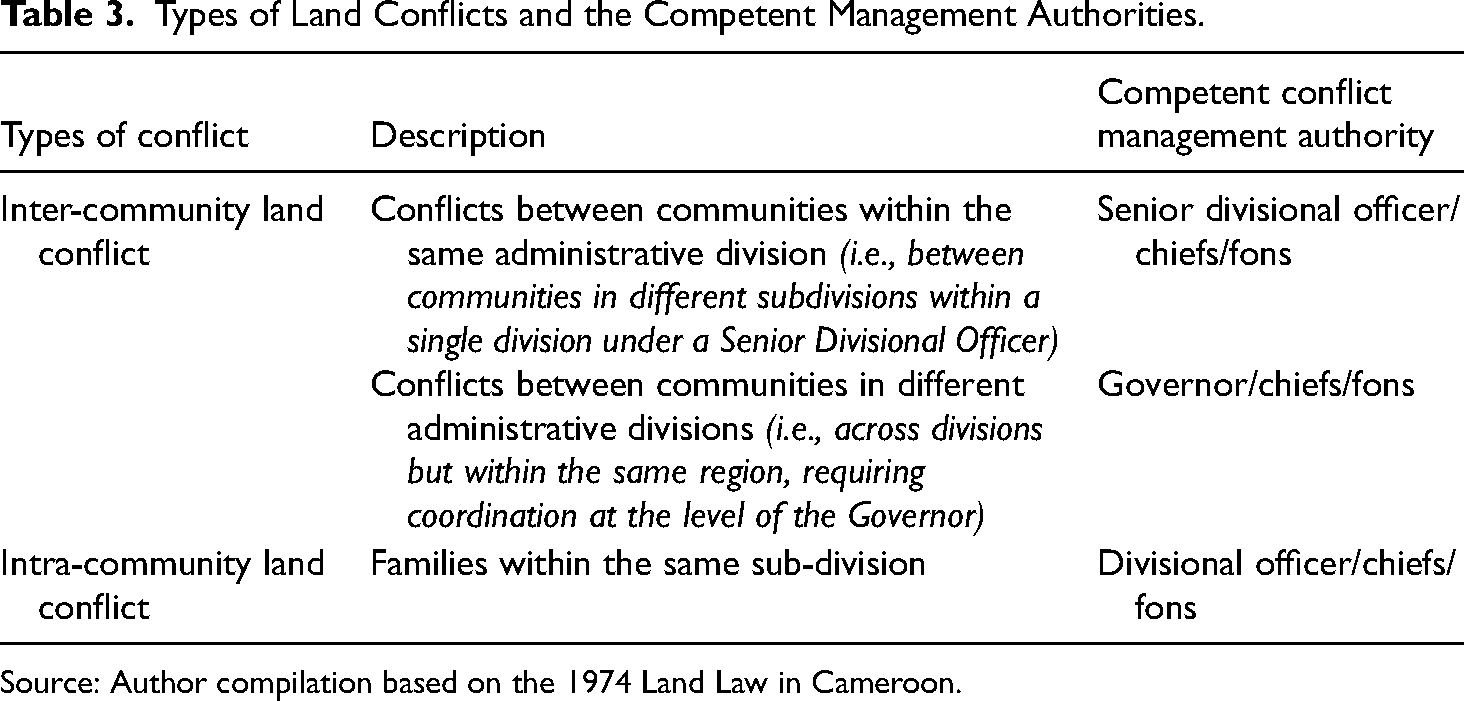
Scholars (Sobseh and Willibroad dze-Ngwa, 2021; Fonjong et al., 2020) note that although fons have statutory roles, their influence is shaped by the ways administrative actors interpret the law. The 1974 Land Ordinance further distinguishes inter-community and intra-community conflicts, assigning them to different state and customary actors (see Table 3). While systematic on paper, this architecture frequently produces overlapping jurisdictions. Research on African land governance (Benjaminsen et al., 2006; Peluso and Lund, 2011) demonstrates that such ambiguity enables bureaucratic discretion and forum-shopping, turning legal clauses into political resources.
Types of Land Conflicts and the Competent Management Authorities.
Source: Author compilation based on the 1974 Land Law in Cameroon.
This legal architecture simultaneously formalises and fragments traditional authority. It grants fons recognised roles in land conflict management but binds their influence to procedural frameworks dominated by state bureaucrats. The requirement for their presence on Land Consultative Boards affirms their institutional relevance while exposing them to selective exclusion or symbolic inclusion depending on political interests. Law No. 2006/015 of 29 December 2006, which outlines Cameroon's decentralisation framework, adds another layer of complexity. 5 It reaffirms the auxiliary status of traditional rulers while mandating closer collaboration with elected municipal officials.
As Teclaire et al. (2022) observe, this decentralised framework multiplies governance actors and intensifies fragmentation, requiring traditional rulers to navigate increasingly intricate institutional expectations. Traditional authority is thus legally embedded within a decentralising governance matrix still shaped by strong executive control. In such a setting, legal authority alone is insufficient. As Meagher (2012) argues, such authority must be complemented by legitimacy derived from community acceptance and performance. Ultimately, the efficacy of traditional rulers in land governance hinges on their ability to negotiate these hybrid arrangements where statutory roles, customary expectations, and political dynamics intersect. However, while legal frameworks define the formal authority of traditional rulers, they also create openings for contestation, as fons, state actors, and local stakeholders navigate overlapping claims and competing interests over land.
Land conflicts in Cameroon have been exacerbated by the 1974 Land Ordinance, which replaced customary tenure with a system favouring private ownership. The law created a gap between customary and statutory tenure, assuming that customary claims lacked security to encourage agricultural investment (Fisiy, 1995). Individual ownership was prioritised over communal or customary rights (Fonjong et al., 2010), undermining traditional rulers’ authority while empowering DOs, who now supervise national lands and exercise powers formerly held by fons. This overlap created space for bureaucratic discretion, allowing administrators to arbitrate access while pursuing their own interests.
Two dynamics have heightened land contestation in the North–West region. First, the settlement of Fulani graziers, migrants from Nigeria since the early nineteenth century, has generated recurring disputes as grazing competes with farming. Second, increasing demand for food and cash crops intensifies farmer–farmer conflicts (Angwafor, 2014; Fonjong et al., 2010). In Kom, informants explained that Fulani graziers once paid an annual tribute of one cow per family to the fon as recognition of his authority over Kom land, a practice that declined once the state challenged the fon's claims (Interview 1, 2015).
Encouraged by local administrators, graziers now refuse tribute, cutting a key palace revenue stream. Traditional authorities, including the fon of Kom, have resorted to selling unoccupied land to graziers in defiance of state law. As the fon recalled, his predecessor Jinabo II received repeated warnings from the DO of Fundong Central for interfering with land management in Kom, with all land issues deemed under the Land Consultative Board. When asked why he sold land contrary to Kom customs, the fon responded: Why should we not sell it? Why keep it and for who when the government now claims ownership of the whole land including where we are sitting. Even if we do not sell it, the DO and his people will eventually sell it to the Fulani and swallow the money or buy their big jeeps. So, I think between me, my colleagues and the government people, it is not a question of selling it, it is rather a problem of who sells it first (Interview 2, 2015).
Navigating Land Conflicts: State and Traditional Actors
This section examines how state and traditional authorities, as competing mediators, operate at the grassroots to influence land governance while also pursuing self-interest. Although the fons of Kom and Bali agree that land governance should fall under their authority, they adopt different strategies to circumvent state constraints. What matters is not simply defiance of statutory law but the forms of legitimacy: moral, performative, or relational that they mobilise to justify intervention in land disputes. As Mairomi and Kimengsi (2021) show, Cameroonian governance involves constant negotiation among customary actors, bureaucrats, and external agents, making legitimacy fluid and contested. While traditional rulers rely on cultural and historical claims, their room for manoeuvre is frequently shaped by the predatory practices of state actors. DOs are not neutral arbiters; they are deeply implicated in the politics of land and legitimacy. Mairomi and Kimengsi (2021) illustrate how bureaucratic actors intervene in rangeland disputes using state-backed authority to redirect or complicate conflict processes. Understanding their role reveals how the state often exacerbates rather than resolves tensions.
State Bureaucrats: Neutral Mediators or Political Actors?
Local bureaucrats such as DOs are expected to manage conflicts impartially, yet in practice they often manipulate procedures for personal or political gain. In Kom, one interviewee recalled a DO who encouraged Fulani graziers to move cattle near farmland despite prior clashes: “The DO ruled that the farmers were supposed to protect their food crops from the grazing cattle… he even advised the Fulani people to bring their cattle next to the farms” (Interview 3, 2015). Rather than resolving disputes, such decisions entrench tensions and create opportunities for rent-seeking. DOs often perform neutrality; organising site visits, consulting fons, invoking laws while achieving little substantively. As another informant explained: “They collect huge sums of money from rich cattle grazers who want to continue judicial processes… and from farmers who wish to slow the process to avoid eviction” (Interview 4, 2015).
This reflects Von Benda-Beckmann's (1981) observation that protracted disputes may serve the interests of both authorities and disputants when continued access to land or rents is possible. Bureaucratic practices thus draw on their own forms of legitimacy: procedural (administrative rituals), institutional (appeals to statutory authority), and performative (the display of impartiality masking predation). Thus, bureaucratic predation is not merely opportunistic; it is embedded in the state's own struggle to appear authoritative. State actors further inflame tensions by redrawing administrative boundaries without community consultation. “Communities who traditionally would pay allegiance to one fondom are administratively placed under another fon… this arrangement alters traditional boundaries… and this brings about conflict” (Interview 5, 2015).
Commissions of inquiry often reproduce rather than resolve uncertainty. In Kom, several disputes persisted through cycles of new inquiries each time a DO was transferred: “When a new DO arrives, he starts a fresh commission… By the time things are moving, he's transferred… It's like they enjoy keeping the conflict alive” (Interview 6, 2015). These cycles allow administrators to collect document fees, ‘consultation’ payments, and other informal rents while postponing resolution. Such behaviour reflects broader patterns of state corruption and accumulation (Bayart, 1993; Van de Walle, 2001). As Lund (2006) and Klem and Suykens (2018) note, authority is often maintained through transgressive practices where legality is strategically bent to preserve influence. Mairomi and Kimengsi (2021) confirm that these dynamics are widespread in Cameroon's governance environment, reshaping the legitimacy landscape in which traditional rulers operate.
Traditional Authorities: Strategies, Legitimacy and Conflict Management
Control over land has long been central to traditional authority. In Kom and Bali, fons continue to assert custodianship despite a state that now legally governs land tenure. Although both operate under the same statutory constraints, they cultivate different forms of legitimacy to reassert influence and intervene in land conflicts. A Kom respondent emphasised enduring authority: “The fon of Kom has been there before the coming of the government DO and will still be fon when the government leaves… Kom people belong to the fon and not the DO” (Interview 7, 2015). In Bali, similar frustrations were expressed: “How can we say we have a fon… when he does not control land? How can the government share land… while the fon and we, his children, die of starvation for lack of farmland?” (Interview 8, 2015).
These testimonies highlight deeper struggles between state and traditional authority. They also show that traditional power is continuously negotiated within legal, administrative, and political constraints. For many interlocutors, the fon embodies continuity and moral rootedness, while the DO represents transient, external authority. This tension illustrates that while fons act strategically, their agency remains shaped by the broader legal and political framework governing land. These broader strategies manifest in a range of everyday practices, symbolic gestures, and embedded performances through which traditional rulers materially assert their claims to authority.
Embedded Strategies and Symbolic Gestures
Traditional rulers translate these broader struggles into concrete, everyday practices, selectively drawing from both customary and statutory systems to navigate state pressure and reaffirm their authority. They do not passively comply with state directives but rather adopt hybrid strategies to assert control over land and reaffirm their relevance. In Bali, for instance, traditional leaders who participate in the state-backed Land Commission require those involved in land disputes or certificate applications to first visit the palace with a symbolic gift; typically drinks or 5000 CFA francs. This gesture, while seemingly benign, is compulsory. Its significance lies not merely in custom, but in its procedural function: failure to comply can lead the fon to boycott the commission's deliberations. As one Bali farmer explained: “If you go to the commission without greeting the palace first, your matter will not even be heard. The palace must open the road” (Interview 9, 2015). He further explained, “…the gift is not small thing…if you skip it, the palace will not stand for you at the commission” (Interview 9, 2015).
According to Decree No. 76/166 of 27 April 1976, which governs the functioning of Land Consultative Boards, Article 2 explicitly requires the presence of the traditional authority for any meeting to be valid. In the absence of the fon, all proceedings and decisions are rendered null and void. In this way, traditional leaders leverage both legal provisions and customary expectations to assert gatekeeping power over land governance, ensuring that their authority remains central to the process. Such hybridisation shows how traditional and statutory systems interact and sometimes collide, demonstrating that the fon's interventions occur within, not outside the constraints and opportunities created by state law.
This practice not only reinforces the fon's political presence but also elevates his moral and material authority. Yet its coercive character raises questions about the authenticity of the legitimacy being claimed. One Bali informant put it more bluntly: “It is a way to show you accept the fon before your matter goes far. If you refuse, you are on your own” (Interview 10, 2015). As Meagher (2012) argues, such forms of imposed authority often reflect predatory practices, where legitimacy is pursued not through consent but through strategic extraction. The requirement to “gift” the palace therefore becomes a performative act of subordination, one that solidifies the fon's role in the governance of land, even as it mirrors the exploitative tendencies of state officials.
In Kom, the fon employs different but equally strategic tactics. He allocates communal or national land to relatives and sells land to outside investors, particularly as a means of generating personal revenue. Additionally, Fulani graziers are required to offer cattle during major palace events; a form of symbolic taxation that projects continued authority over ancestral land. One elderly Kom respondent noted, “When the cows come to the palace, it reminds everyone that the land is still under the fon's shadow, no matter what the government papers say” (Interview 11, 2015). These strategies illustrate agency, but they also reflect how the fon of Kom manoeuvres within the pressures of administrative encroachment. In both Bali and Kom, the capacity of the fon to act is shaped by the structural realities of a centralised land regime and the incentives of local bureaucrats.
Despite the differences in their strategies, both fons engage in what may be termed “activist” interventions that cut across jurisdictional boundaries to challenge the state's supremacy. By collecting taxes, imposing fees, and demanding ritual recognition, they reinforce their role as custodians of land. These practices confer both material and performative legitimacy, which in turn confer them the moral authority necessary to mediate land-related disputes. In doing so, traditional leaders effectively reshape the field of land governance from below, operating within, beyond, and at times against the formal structures imposed by the state. However, such interventions remain embedded in a context where statutory authority ultimately rests with the state, meaning that the assertion of traditional power is always partial, negotiated, and sometimes fragile.
Legitimacy Claims and Implications for Conflict Management
The fons of Bali and Kom navigate land governance and conflict differently, depending on the type of legitimacy they cultivate. In Bali, the fon primarily pursues material and performative legitimacy by aligning with political elites and state bureaucrats through active engagement in party politics. These alliances provide access to development resources, enhancing political stature. Yet this legitimacy is contingent and volatile, dependent on project success and alignment with state interests. Crucially, it does not replace the structural limits imposed by statutory land law, which remain identical for both Kom and Bali. As Williams (2010) observes, state goals often conflict with local community interests, compromising authority for leaders reliant on state support.
Sobseh and Dze-Ngwa (2021) further show that land tenure insecurity and mistrust in state-backed institutions exacerbate local conflicts. When traditional legitimacy is politically entangled, communities perceive both state and palace decisions on land as self-interested and untrustworthy. This dynamic is central to understanding why the fon of Bali faces greater contestation when intervening in local conflict within his administrative area. Despite efforts to restore moral legitimacy, his political engagements alienate segments of the community, particularly those with divergent political affiliations who view him as partial and politically compromised. His relational legitimacy is similarly contested, especially among opposition supporters excluded from village affairs. As a Bali land claimant noted during fieldwork, “Once your case touches politics, the palace already knows who to support. That is why some of us don’t bother going there again” (Interview 12, 2015). Here, state alliances, while boosting development credentials, can hinder effective land governance, rendering state-based legitimacy counterproductive. As a Bali opposition supporter noted, “We cannot trust a man who eats with the government to protect our land or defend our interest against the government…his mouth is already full” (Interview 13, 2015).
In contrast, the fon of Kom cultivates moral legitimacy by emphasising his role as custodian of tradition. He maintains only formal relations with the state, limiting his role to an auxiliary under the law. This stance, widely interpreted by the Kom grassroots as protecting communal values, reinforces trust even under legal constraints. One Kom farmer explained, “Our fon keeps away from politics because politics destroys a man's truth. That is why we still trust him to represent our interest when land is concerned…at least we know his heart” (Interview 14, 2015). This distinction between the fons of Bali and Kom highlights different pathways to legitimacy, not greater or lesser legitimacy, but legitimacy grounded in different forms of wilful acceptance and audience alignment. Although some political elites argue that this limits development allocations, the fon consolidates authority through grassroots support and sustained communal solidarity. As the quote above demonstrates, the fon of Kom survives political pressure through sustained communal solidarity, rooted less in concrete protection of ancestral land than in his ability to project a posture of resistance and autonomy from a state seen as intrusive. This posture is captured vividly in the words of the fon: What qualifies land as mine? Is it that government book you people call land title or the fact that I am the legitimate ruler of Kom? My son, as far as we are concerned, it is not a question of registering Kom land before claiming total ownership. Kom is mine, the grazing land is mine, and it does not matter what the government thinks (Interview 2, 2015).
The fon of Bali enjoys respect for enabling development but faces moral legitimacy challenges in land conflicts due to perceived partiality. As one informant remarked, “For the fon to challenge the state on land issues would be like biting the finger that feeds him” (Interview 15, 2015). Another elder noted, “If development money comes from the government, how do you expect the fon to contest them when they take our land? It is not possible” (Interview 16, 2015).
These challenges were magnified during the Bali-Bawock crisis, where questions of identity and belonging shaped the conflict. Neighbouring fons, siding with the Bawock community, attempted to redraw internal boundaries to carve Bawock from Bali, despite Bali's position that no formal boundary existed between them. Confronting these intrusions, the fon of Bali reportedly asked the visiting fons, “my brothers, you have always visited Bali through the front door, how come you now enter through the back door?” (Interview 17, 2015). This assertion reinforced his authority and challenged the legitimacy of external interference. While some Bali factions supported him, many Bawock residents resisted, claiming autonomy and rejecting Bali's governance. As one Bawock community member explained, “he says we are Bali, but he treats us as strangers in our own land. His politics divides us rather than protects us” (Interview 18, 2015).
According to interviewees in the field, Bali historically emerged as a conglomerate of smaller communities that settled under the paramount fon, each maintaining its own clusters and family leaders in a loose federation. As one elder explained, “we came together under the fon of Bali generations ago, but each village kept its own leaders and customs. That is why even today, some families feel they can act independently” (Interview 19, 2015). Over time, these overlapping identities have occasionally been instrumentalised by local political elites against Bali's authority. This complexity sharply contrasts with Kom, where a relatively homogenous community has prevented such distinct ethnic categories from crystallising; allowing the fon of Kom to cultivate a more unified moral authority. This historical layering helps explain why Bali's fon faces intensified challenges in asserting moral legitimacy, navigating both alliances with the state and intra-community disputes shaped by long-standing settlement patterns and identity dynamics. These pre-existing pressures on moral authority were only magnified by the upheavals of the post-2016 Anglophone crisis, which tested the capacity of fons to maintain legitimacy under extraordinary political and security pressures.
The Anglophone crisis further clarifies these dynamics. In Bali, the fon's perceived state alignment made him a target for separatist groups, causing palace abandonment and disruption of routine governance, including land dispute management. In Kom, careful neutrality strengthened the fon's moral authority. Amid military raids and separatist ambushes around Belo-Kom, he performed cleansing rituals, pouring libation for all Kom people killed, soldiers and separatists alike and insisting they be buried “as Kom people, not as enemies” (Interview 20, 2025). This stance protected the palace from attack, reinforced perceptions of custodianship over land and people, and deepened grassroots legitimacy. The Anglophone crisis thus did not merely form the backdrop but actively recalibrated legitimacy, weakening rulers entangled in political alliances while strengthening those projecting neutrality and moral guardianship. Taken together, these dynamics demonstrate that legitimacy is performed and contested, shaping everyday strategies through which traditional rulers assert influence within restrictive legal and political environments.
Conclusion
This paper has argued that public authority in land governance is neither fixed nor inherently coherent, but continuously negotiated through performances, appropriations, and transformations of overlapping sources of legitimacy. Ethnographic examination of interactions between traditional rulers, state bureaucrats, and grassroots communities in Kom and Bali shows that legitimacy is enacted, contested, co-opted, and at times undermined by the very actors who claim it. These processes reveal how authority is materially and morally sustained or eroded through strategies that both reflect and subvert legal, customary, and political orders. Linking these findings to broader debates, the cases speak back to discussions on hybrid governance and legal pluralism rather than merely illustrating them.
Focusing on land governance highlights how traditional rulers and state bureaucrats borrow from multiple normative repertoires to perform legitimacy. These repertoires are shaped by legal pluralism, competing policy priorities, and diverse audience expectations. Fons navigate this terrain by improvising between customary authority and statutory legality, often deploying hybrid strategies reflecting pragmatic adaptation and political ambition. Yet these strategies carry risks, sometimes mutating into extractive practices that mirror the very state corruption they claim to resist. This dynamic resonates with continental analyses showing that hybrid land institutions frequently reproduce inequalities when customary recognition is partial or politicised (Wegerif et al., 2025).
The comparative cases underscore uneven outcomes. In Bali, the fon has cultivated performative and material legitimacy through alliances with state actors and elites, gaining access to development resources. Yet this top–down approach compromises moral and relational legitimacy, especially in land disputes. Moral legitimacy, rooted in perceptions of fairness, cultural continuity, and custodianship, is essential to managing conflict. Without it, a fon's capacity to arbitrate disputes or defend ancestral land is weakened. The Bali case shows the tension between political alignment and community trust in contexts where legitimacy must be performed across multiple, sometimes contradictory, audiences. Sobseh and Ngwa's (2021) findings on tenure insecurity in the Bamenda Grassfields corroborate how mistrust in state-backed arrangements exacerbates contestation, supporting the Bali analysis.
In contrast, the fon of Kom has pursued a more apolitical and culturally embedded strategy, distancing himself from partisan politics and reinforcing authority through moral and symbolic acts resonating with local expectations. Authority is sustained less by legal mandates or political capital and more by community perception as guardian of land, lineage, and cultural values. This grassroots–driven legitimacy enables him to symbolically resist state interference in land matters despite lacking formal authority. The comparison reveals that while material and performative legitimacy can yield immediate political dividends, moral legitimacy provides a deeper, more durable foundation in hybrid and legally plural governance systems. This finding aligns with analyses showing negotiated authority produces stability and contestation depending on recognition inclusiveness (Nyiayaana, 2023).
The paper also shows that state and traditional actors are not strictly antagonistic but entangled in competition, collaboration, and co-dependence. Neither can function in isolation; both rely on each other's institutional and symbolic capital. As Moe (2011) suggests, public authority is often shared, and its boundaries are negotiated locally. Sovereignty is relational, overlapping, and contingent, complicating Mamdani's (1996) dichotomy of citizens and subjects and suggesting a field of competing authorities with ambiguous, mutually constitutive interactions (Williams, 2010).
By linking empirical findings to continental syntheses (Wegerif et al., 2025; Nyiayaana, 2023) and gendered exclusion research in Cameroon and Africa (Ndam Iliassou et al., 2023), this paper shows how negotiated legitimacy can reproduce inclusionary or exclusionary outcomes across African contexts. Ultimately, the capacity of traditional authorities to mediate land conflicts depends less on formal jurisdiction and more on community perceptions and acceptance. Legitimacy is not fixed but precarious, constantly negotiated. While gendered dynamics are not directly analysed, West Cameroon research highlights how women's access to land is constrained by norms and practices (Ndam Iliassou et al., 2023), signalling a gap: moral claims of traditional authority can obscure patterns of exclusion, suggesting future work must attend more closely to gendered recognition.
Future research could explore how citizens navigate overlapping authorities in everyday life, including ‘forum shopping’ across state and traditional institutions for justice, recognition, or land security. Longitudinal studies could examine how traditional leaders’ legitimacy evolves amid decentralisation and the Anglophone crisis. Such research should also interrogate differential legitimacy across social groups; men and women, different socio-economic strata to understand the distributive consequences of hybrid governance.
Footnotes
Acknowledgements
This article draws on fieldwork and analysis undertaken as part of my doctoral research at the University of Melbourne. I gratefully acknowledge the support of the Melbourne International Research Scholarship (MIRS), my supervisors, and the research communities of Kom and Bali, whose generosity and insights made this work possible.
Data Availability Statement
The data used in this article are primarily qualitative and were collected through interviews, FGDs, and archival research. Field notes were taken and processed manually. As a result, there is no database available for publication.
Declaration of Conflicting Interests
The author declared no potential conflicts of interest with respect to the research, authorship, and/or publication of this article.
Ethical Approval and Informed Consent Statements
The author affirms that all participants provided written informed consent prior to participation. The research objectives were explained in a language they understood, and the consent form was either read aloud or self-read, depending on literacy levels. All participants signed the consent form before the interviews or FGDs were conducted.
Funding
The author disclosed receipt of the following financial support for the research, authorship, and/or publication of this article: This article is based on doctoral research funded by the Melbourne International Research Scholarship (MIRS) at the University of Melbourne (2015–2018).
