




Abstract
Using data on Korean youths aged 15–29, this study illustrates the processes through which Korean youths make transitions to adulthood along with their life course, focusing on four transition markers—school enrollment, labor force participation, marriage, and the establishment of an independent household. Distinguishing young people’s status in the productive and reproduction spheres, I consider the combination of study and work statuses to represent the productive sphere and the combination of marriage and household headship to represent the reproductive sphere. I examine how these statuses change with age, with an explicit focus on gender differences. The investigation reveals the significance of educational institutions for transitions to adulthood among Korean youths and also substantial gender differences in the transition process. I also investigate heterogeneity in these statuses of young people by looking at how parental education and occupation affect the transition statuses. Family background matters more for Korean women’s transition to adulthood than it does for Korean men’s.
A large body of research in the United States and Europe has examined the dynamic and complicated processes of transitioning to adulthood (Settersten, Furstenberg, and Rumbaut 2005; Corjin and Klijzing 2001). In particular, comparative studies have illustrated how cross-national variation in key institutions relevant for the transition to adulthood, such as the educational system, family system, and labor market, are responsible for different patterns in the processes of becoming an adult among European and American young people (Breen and Buchmann 2002; Cook and Furstenberg 2002). These studies have extended our understanding of national differences in the pattern and timing of the transition to adulthood and how national contexts of social institutions structure processes of becoming an adult in the context of the United States and Europe.
In addition to studies in developed countries, a growing number of studies have extended to developing (or less developed) countries, highlighting both convergence and divergence of the transition to adulthood between young people in developing and developed countries (Cynthia 2005; Cynthia et al. 2006; Grant and Furstenberg 2007). The extension of interest to developing societies, which vastly differ in social institutions and cultural norms surrounding the transition to adulthood compared to those in developed societies, contributes to a better understanding of how processes of becoming an adult are contingent on broader social contexts as well as influenced by global trends.
A striking omission in the literature of the transition to adulthood, however, is the focus on young people in East Asia, such as Japan, South Korea (referred to as Korea hereafter), and Taiwan. These East Asian countries have economies as developed as those in many European countries, but they have distinctive educational and labor market arrangements and cultural norms, providing an interesting comparison to the experiences of young people elsewhere in the world (see Park and Sandefur 2005). Young people in contemporary East Asia are the most educated in the world, revealing a dramatic increase in education compared to their parents’ generation. East Asian countries show extraordinary performance not only in terms of quantity of education but also in quality. Students in East Asia have levels of academic achievement and literacy skills higher than their counterparts in any other place, as demonstrated in various international surveys of student achievement such as TIMSS (Third International Mathematics and Science Study) and PISA (Program for International Student Assessment) (United Nations Children’s Fund [UNICEF] 2003; Organisation for Economic Co-operation and Development [OECD] 2001). On the other hand, strong cultural norms still bear significant influences on young people’s social behaviors. In East Asia, marriage and childbearing are still closely connected, resulting in negligible nonmarital childbearing (Lin, Choe, and Tsuya 1999).
This article, following the previous study by Park and Sandefur (2005), provides some descriptions of institutional and cultural forces that create a set of opportunities and constraints within which Korean young people make decisions about their transitions to adulthood. This will help us to understand specific features of transition outcomes in Korea. The article describes transition outcomes among Korean young people aged 15–29, with a focus on four transition markers: school enrollment, labor force participation, marriage, and headship of the household. A good deal of research on the transition to adulthood has focused on cross-national variation and within-country differences across demographic groups in the pattern and timing of key transitions markers, such as the completion of education, entering the labor force, family formation, and leaving home (Hogan and Astone 1986; Sandefur, Eggerling-Boeck, and Park 2005). Following the insight by Buchmann and her colleagues (2008), this article considers study and work status in combination, rather than as separate markers, to represent young people’s status in the production sphere, and marriage and household headship in combination to represent young people’s status in the reproduction sphere.
Studies of transition markers in the United States have highlighted heterogeneity in the pathways and outcomes of the transition to adulthood among young people from different socioeconomic and racial/ethnic backgrounds (Furstenberg et al. 2004; Sandefur, Eggerling-Boeck, and Park 2005). Following the insights of previous studies, I examine how individual and family characteristics affect the process of becoming an adult among Korean young people. I pay particular attention to gender difference in the transition outcomes and the way in which individual and family characteristics are associated with those transition outcomes.
Institutional and Cultural Contexts in Korea
Demographic changes and youth population
The share of those aged 65 and older in the total population did not pass 7 percent until 2000 in Korea. In 2000, the youth population aged 15–29 accounted for about one-quarter of the total Korean population (8 percent for 15–19, 8 percent for 20–24, and 9 percent for 25–29). However, with the rapid aging of the Korean population, the share of the youth population has decreased and is expected to continue to do so in the coming years (Statistics Korea 2011). In contrast, the share of elderly Koreans will increase, to an expected 14 percent by 2018. What is remarkable is the speed of the transition—from 7 percent in 2000 to 14 percent in 2018. To complete a similar transition, it took 115 years in France, 40 years in Germany, and 24 years in Japan, the latter of which is one of the most rapidly aging countries (Howe, Jackson, and Nakashima 2007). The rapid aging of the Korean population has occurred in the context of a continuous decline in mortality, on one hand, and a sharp decline of fertility, on the other hand. The total fertility rate fell rapidly from 4.5 in 1970 to 1.5 in 2000. The total fertility rate in 2006 was 1.1, one of the lowest levels in the world (Howe, Jackson, and Nakashima 2007). The youth population has already declined from 26 percent in 2000 to 21 percent in 2010 (Korean Statistical Information Service [KOSIS] 2012). The decline has been particularly substantial for the 20–24 and 25–29 age groups.
School enrollment and the educational system
One of the remarkable developments during the past few decades in Korea is its dramatic expansion of education. The expansion of education enables more young people to stay in school for longer. Within a generation, Korea has moved from a country with considerably low levels of educational attainment among its population to one with the highest level of educational attainment in the world (Park 2007a). Statistics compiled in 2004 by the OECD show that almost all Korean young people aged 25–34 completed upper secondary education (i.e., high school diploma), which is the highest percentage among OECD countries (OECD 2006). The level of educational attainment among young adults in Korea is astonishing given that only 34 percent of all Koreans 55–64 years old completed upper secondary education, which is a comparably low level among OECD countries. The extraordinary variation between the younger and older groups highlights the pace at which education has expanded in Korea.
The dramatic expansion of education in Korea has allowed almost all young people up to age 18 to stay in school. Because enrollment in upper secondary school is nearly universal, it is very rare to find young people who are out of school at secondary school age. However, Korean upper secondary students attend different types of schools. After the compulsory six years of primary school and three years of middle (lower secondary) school, students are sorted into two different types of high schools: academic high schools and vocational high schools. However, there is no between-school tracking at the primary and lower secondary levels. It is also important to note that upper secondary education in Korea is not compulsory, and families often bear tuition and other educational expenses. Currently, about 75 percent of high school students enroll in academic high schools designed mainly to prepare students for tertiary education, while the remaining 25 percent of students go to vocational high schools, which prepare students for the labor market. Importantly, female and male students do not differ in terms of overall enrollment nor in the type of upper secondary schools they attend. The share of students who attend academic high schools is almost identical between female and male students (OECD 2006).
After high school, students may proceed to junior college or university. Most junior colleges offer two-year programs, aimed at practical and occupational skills, while university programs typically last four years and lead to a bachelor’s degree. Despite severe criticisms of the entrance examination system, student scores on the national entrance exam remain the most important criterion for college admission. Usually four-year universities require much higher test scores for admission than do junior colleges. What is impressive is that educational expansion in Korea occurred not only at the primary and secondary levels but also at the tertiary level. The increase in college education was particularly substantial during the 1980s and 1990s. In 1980, about only 40 percent of academic high school graduates moved on to tertiary education, while in 1998 about 80 percent of them did so (Korean Educational Development Institute [KEDI] 2000). Korean men and women do not show significant gender differences in regard to the overall transition to tertiary education (Park 2007a). Gender difference even in the type of tertiary education (i.e., two-year junior college vs. four-year university) is not substantial (Park 2007b). This is in sharp contrast to Japan, where expansion of tertiary education among women was driven primarily by women’s increasing attendance at two-year junior colleges rather than at four-year universities (Brinton and Lee 2001).
Because of the critical role that test scores play in college admissions and the subsequent impact of educational qualifications, particularly college degrees, on life chances in Korea, there is intense competition and pressure on students for college admission, especially at top universities (Sorensen 1994). A significant proportion of students, who currently attend regular schools during the day, go to private cram schools (hakwon) or have private tutoring after regular schooling to enhance their academic achievement. According to a national survey cited by Park, Byun, and Kim (2010), eight out of ten students in primary and secondary schools in Korea were enrolled in some kind of private supplementary education after regular schools in 2007. Even after graduating from a high school, a substantial number of students spend additional years in private cram schools to retake the national entrance exam for better scores.
An important consequence of the excessive demand for university education is a considerably low rate of labor force participation among high school students in Korea. For instance, almost half of American youths aged 15–19 participated in the labor force in 1996, while about 10 percent of corresponding Korean youths did so (Park and Sandefur 2005). Given the time spent preparing for the entrance exam by attending private cram schools or receiving private tutoring at night, it is difficult for Korean students to combine study with full-time or even part-time work.
The labor market in Korea
The unemployment rate among Korean youths aged 15–29 had been considerably low in comparative perspective until 1998 when, affected by the “economic crisis” that began at the end of 1997, it suddenly increased to 12.2 percent from 5.7 percent in the previous year (Jeong and Kim 2005). In 2000 after the Korean economy recovered from the crisis, the unemployment rate for Korean youths decreased to 7.6 percent. However, because of the slow economy and expansion of education, recent youth cohorts in Korea take longer and find it more difficult to attain regular, permanent jobs after leaving school than their counterparts did in previous decades (see Jeong 2007). At the same time, nonregular employment among younger workers, as well as among older workers, has grown rapidly.
The Korean economy has long relied on large firms, called Chaebols (Brinton 2001; Monk-Turner and Turner 1994). Since the economic crisis, these large firms—which provide secure jobs, good salaries, and benefits to their employees—have reduced the number of jobs available to young people leaving school and have recruited more experienced senior workers as a way of dealing with economic globalization and competition (Lee 2003). The change in the employment structure and recruitment among large firms has particularly affected the employment situation of young people with college degrees who have been traditionally preferred by large firms. Facing difficulty in attaining jobs in large firms, growing numbers of college students stay longer in school to increase their human capital so that they can be more competitive. In Korea the distinction between education and the labor market is sharp. It is rare that people who had left school for the labor market go back to school. Therefore, college students often spend more time than is required in school to better prepare to enter the labor market. Economic globalization and competition have influenced employment practices among medium and small-size firms as well, resulting in more flexible employment contracts and a growing number of part-time and temporary jobs.
The prolonged transition from school to regular work was also likely affected by supply side factors in interaction with changes in employment structure and recruitment practices. The sharp increase of younger cohorts with college degrees and the resulting credential inflation has probably deteriorated the employment situation for those with a college degree. Those who do not go to college but enter the labor market upon high school graduation also may have increasing difficulties in getting jobs due to a mismatch between their skills and the rapidly changing economy. Korea’s academic-oriented educational policy has prevented vocational education from developing as a substantial alternative to college. Vocational programs currently offered in vocational high schools tend to emphasize general skills rather than improving students’ specific skills for corresponding occupations (Chang 2001). Graduates from academic high schools do not receive any systematic job training in school either.
Although recent changes in economic structure and employment have likely affected both young men and women, there are other recent changes to the Korean labor market that may affect the labor market positions of women more seriously. A distinctive feature of the Korean labor market is the relatively low rate of participation among women (Lee 1993). Although gradually increasing, this low rate of female participation stands out not only in comparison to most Western countries but also in comparison to other countries in East Asia, such as Japan. Figure 1 presents the labor force participation rates of women for each age group in Japan, Korea, and the United States in 2000 (International Labour Organization [ILO] 2008). Across all age groups, Korean women have a substantially low rate of labor force participation compared to their Japanese and American counterparts. Considering the almost similar levels of tertiary education among recent cohorts of women in the three countries, the substantially low level of labor force participation among young Korean women is striking.
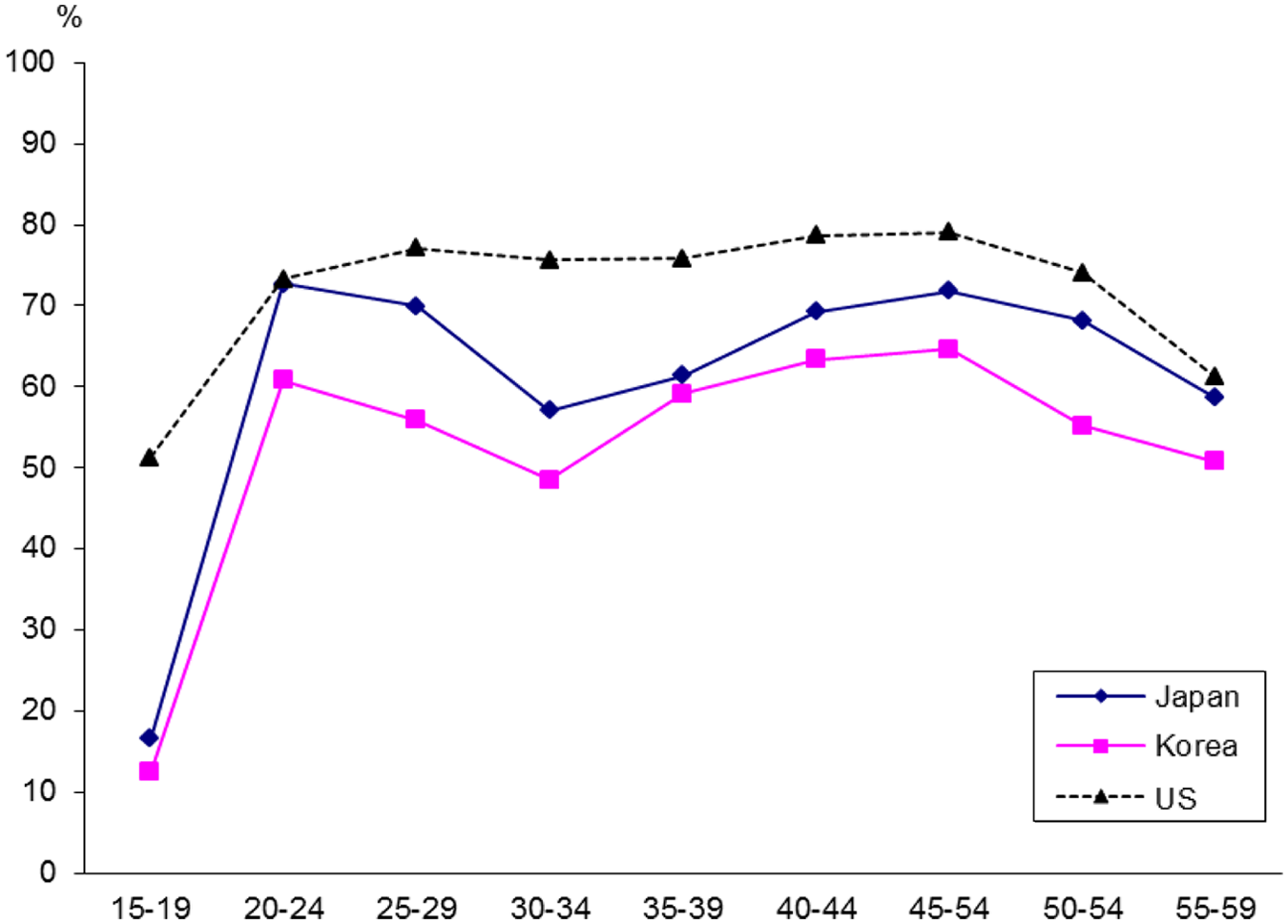
Female Labor Force Participation Rates by Age (Year = 2000)
The gap in the labor force participation rate between Korean and American women is particularly significant in two age groups: 25–29 (56 vs. 77 percent) and 30–34 (49 vs. 76 percent). There is also a significant difference among those 15–19. The considerably lower rate of labor force participation among Korean women at these ages, compared to their American peers, reflects the difficulty in combining work and study during the high school years for Korean women. The relatively large gap between Korean and American women in the age groups 25–29 and 30–34 is primarily due to withdrawal of Korean women from the labor market during marriage and childbearing. In other words, in Korea there still exists the typical M-shaped curve of female labor force participation. The rate increases again as women return to the labor market after age 35. The M-shaped pattern indicates that it is difficult for women to combine family and work, and thus women would rather withdraw from the labor market during family formation. Brinton (2001) highlighted the rigid employment structure of the Korean economy—it is dominated by larger firms with work environments that make it less favorable for women to combine family and work. Interestingly, Japan, another East Asian country whose economy relies on large firms, also shows this M-shaped pattern of female labor force participation.
Cultural norms
Traditional Confucian norms, although much weaker than they were in the past, continue to exert an influence on the population’s demographic and social behaviors in contemporary Korea (Park and Cho 1995; Park and Sandefur 2005). The influence of this patriarchic culture is particularly substantial in social behaviors regarding marriage and childbearing. Strong cultural stigma on out-of-wedlock childbearing leads Korean young people to tightly connect childbearing and marriage. Nonmarital and teenage births are negligible in Korea. Statistics for twenty-eight OECD nations show that teenage birth rates, defined as births to women under 20 years old per 1,000 15- to 19-year-olds, are lowest in Korea (3 births) and highest in the United States (52 births) (UNICEF 2001). Cohabitation or living together without formal marriage is rare among Korean young people. Cultural norms for intergenerational relationships also affect young adults’ living arrangements with their parents. Compared to Western countries, studies show that Korean young adults, along with other East Asian young people in neighboring countries, leave the parental home at much later ages (Yi et al. 1994).
Data and Methods
The data for this analysis are taken from the Korean Labor and Income Panel Study (KLIPS), conducted by the Korean Labor Institute. The KLIPS, which began in 1998, is a longitudinal survey of a representative sample of Korean households and individuals in the household who reside in nonrural areas (Phang et al. 2002). In its first year the KLIPS interviewed 13,317 persons in 5,000 households. In addition to a household survey, individuals aged 15 or older within a household were surveyed to provide detailed information on economic activities, employment conditions, school enrollment, and other demographic characteristics. In the second follow-up, 79 percent of original respondents in the first year of the survey were reinterviewed, and a few hundred new members were added (who were age 15 in 2000 or who could not be interviewed in previous surveys because of absence). In particular, in the second follow-up, a special module of the questionnaire was distributed to youths aged 15–29 in response to growing interest in youth unemployment after the economic crisis. The current analysis uses the sample of those aged 15–29 in the 2000 survey, whose total number was 3,234. Because 19 respondents did not report at least one key variable pertaining to school, work, marriage, or the household headship, they were excluded from the analysis, resulting in a total of 3,215 cases (1,702 females and 1,513 males). Because the KLIPS survey only pertains to the urban population, this article examines only young people in urban areas in Korea. However, given the high concentration of Korean young people in urban areas (in the 2000 Korean Census, about 91 percent of those aged 12–24 lived in urban areas), the exclusive focus on urban areas is meaningful.
To examine the process of the transition to adulthood, two major outcomes are examined in this study. Reflecting young people’s status in the productive sphere, the first outcome is the combination of school enrollment and work. Specifically, four different groups of young people are compared: (1) those who are currently in school only (not working at all), (2) those who are currently in school but also work, (3) those who work only (not in school), and (4) those who are neither in school nor in work. Those who were engaged in paid work at least 1 hour during the past week; who were engaged in family work more than 18 hours even if not paid; or who had jobs but temporarily did not work because of illness, vacation, or other reasons are defined as working.
The second outcome pertains to young people’s transitions in the reproductive sphere. Specifically, considering combinations of marriage and the headship of household, three groups of young people are distinguished: (1) those who are never married and not the head or spouse of the head of household, (2) those who are ever married and the head or spouse of the head of household, and (3) others (who are ever married or the head/spouse of the head of the household, but not both). Because the 2000 KLIPS did not collect information on fertility history, being a parent, another major marker of the transition to adulthood, is not considered in the current study. However, note that the mean age at first marriage among Korean men in 2000 was 29.3 and the mean age for women was 26.5 (Korea National Statistics Office [KNSO] 2005). Therefore, even if questions about fertility history were asked, the number of Korean young people aged 15–29 who were parents would have been very small, rendering the analysis very difficult.
For the descriptive purpose, I first present the status of Korean young men and women in each of production and reproduction spheres by single year of age to show how the status changes over age. Because I use the cross-sectional data collected at one time point, this description is somewhat limited in providing a life-course perspective that would follow the same cohort over time. However, given the limited age span (those aged 15–29), the difference across age groups can be useful to obtain an insight into how the status of Korean young men and women (of the same birth cohort) would change as they get older. In other words, I employ a synthetic cohort approach.
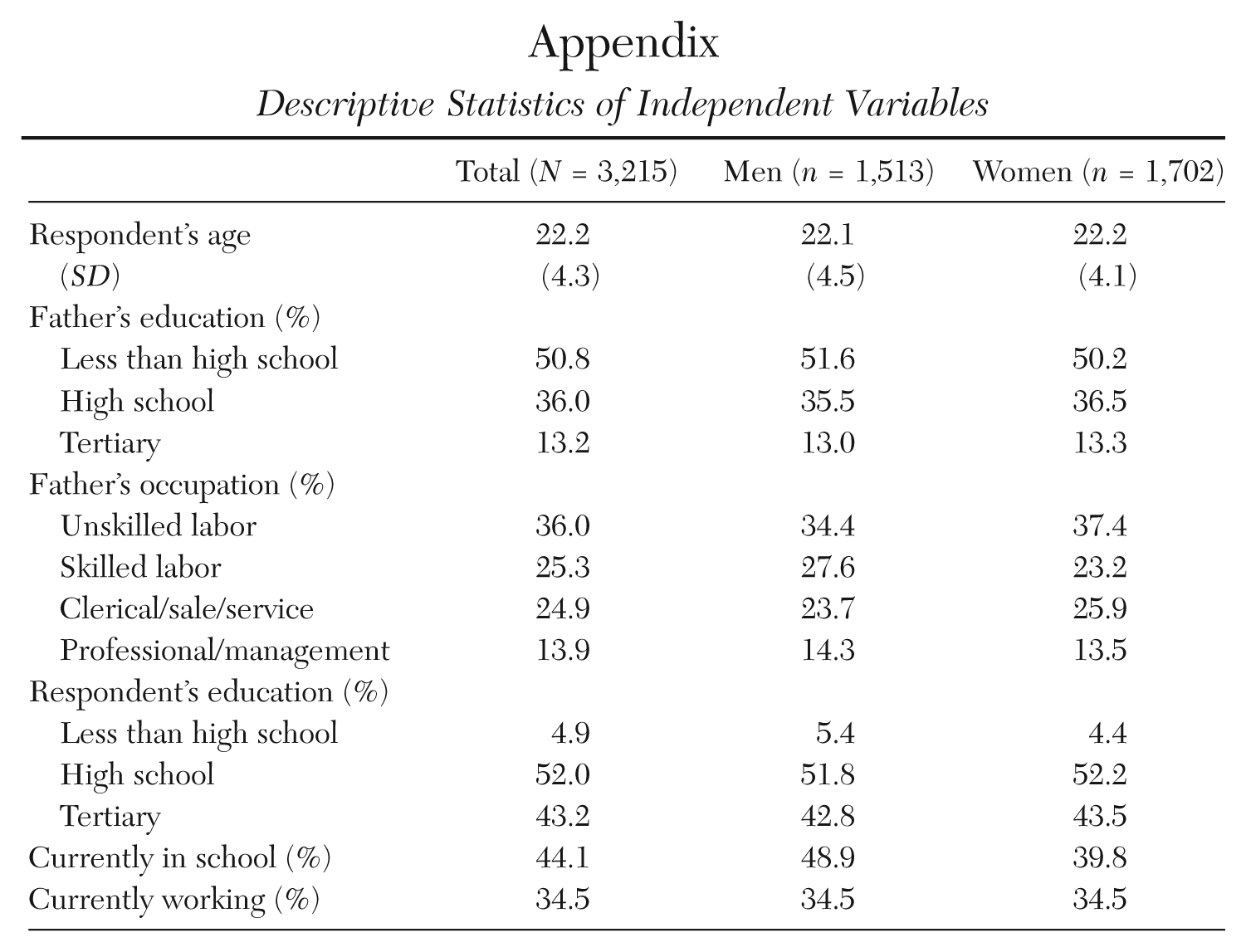
After illustrating these statuses, I move to a multivariate model to address how individual and familial characteristics affect the specific statuses of Korean youths. Considering that an individual can occupy one of four study and work combination statuses and one of three marriage and household headship combination statuses, I employ the multinomial logit model (Long 1997). Specifically, I investigate how age, father’s education, and father’s occupation affect the likelihood of belonging to a specific category of study and work combination statuses for men and women, separately. For the models for marital status and household headship combination statuses, I include three production-sphere related variables in addition to age, father’s education, and father’s occupation: respondent’s education, whether the respondent is currently in school, and whether the respondent is currently in work. Father’s education has three categories: less than high school completion, high school completion, and tertiary completion. Father’s occupation is classified into four categories: unskilled labor (including those who do not have a job), skilled labor, clerical/sale/service, and professional/managerial. Due to the small sample size, I combine clerical, sale, and service jobs into one category. Respondent’s education refers to the current level of education and has the same three categories as father’s education. The appendix presents the descriptive statistics of independent variables included in the models for the total sample as well as for men and women separately.
School Enrollment and Labor Force Participation
Figure 2 illustrates the activity status of Korean young men aged 15–29, at each age, in regard to school enrollment and work combination statuses. Up to age 18, almost all Korean young men stay in school, reflecting the universal enrollment in secondary education in Korea. At age 19, about half of Korean men leave school. The share of young men who are neither in school nor in the labor force sharply increases from 7 percent at age 18 to 33 percent at age 19, slightly increases at age 23, and suddenly drops at age 24. The high percentage of young men who are neither in school nor in work at ages 19–23 may reflect, among others, the following two factors. First, as pointed out earlier, a substantial number of youths have already graduated from high school but go to private cram schools to retake the national entrance exam for better scores the following year. Because they have already graduated from high school and the cram schools they attend are not regular schools, they are no longer considered to be in school. Obviously, they are not working, either.
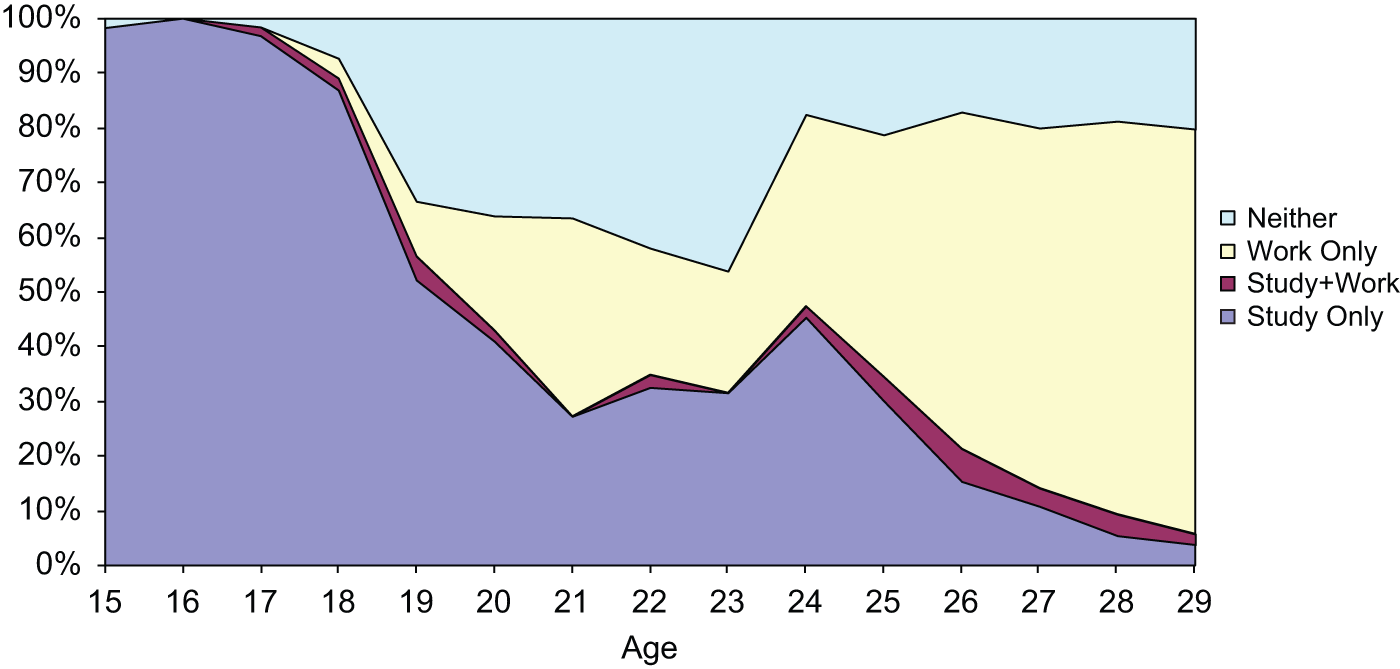
Study and Work Combination Statuses among Men by Age
Second, Korean men have to serve in the military for two years on average upon high school graduation unless enrolled in tertiary education. Those who are admitted to colleges upon high school graduation tend to stop studying after the first or second year of college and join the military. Before and after the transition to the military, people often spend some time not engaged in regular work or studying to adjust to the transition. Therefore, the ages 19–23 are particularly unstable, and the stage is a temporary one for many Korean men, which likely leads to a high percentage of youths neither being in school nor in work. Military service is also likely related to the increase of the percentage of youths who are in school at age 24. Upon completion of military service, those who have left college return to complete their education.
After age 24, the percentage of those who are in school continues to decline, while the share of youths in work continues to grow, resulting in about 75 percent in the labor force at age 29. Figure 2 also shows the extremely small share of youths who combine work and study across all ages for men, illustrating the point made earlier that pressure and competition for college entrance prevents high school students from being involved in employment. Interestingly, however, the figure shows that not only high school students but also college students do not usually combine work and study in the Korean context.
Figure 3 shows the activity status of Korean women aged 15–29, at each age. A distinctive feature among women compared to men is the continuous decline in the percentage of youths who are in school across ages. There is no peak at a later age as is seen for men. The overall continuous pattern of status change is also found for the share of young women who are neither in school nor in work. The share increases from 1 percent at age 17 to 65 percent at age 29. Meanwhile, the percentage of women who work increases overall up to age 26 and then declines.

Study and Work Combination Statuses among Women by Age
As a result, at age 29, Korean men and women show an opposite pattern in regard to their relative share of the “working only” status and the status of “neither in school nor in work.” The majority of Korean young men are engaged in work, while the majority of Korean young women are neither in school nor in work. Among those women who are neither in school nor in work, some are facing difficulties in getting jobs similar to men in the same status, while some have left the labor market, probably due to marriage and childbearing. Considering the comparably high level of educational attainment among recent cohorts of Korean women, the low level of attachment to the labor market among Korean young women is striking.
Marital Status and Household Headship
Figures 4 and 5 present the status of Korean young men and women in regard to combinations of marital and household headship status by single year of age for men and women, respectively. For men, the share of young people who are ever married and the household head/spouse of head is not substantial until age 26 when 19 percent of Korean young men show the same status. After that, there is an overall increase in the share of those who are ever married and the household head/spouse of head, resulting in about 30 percent at age 29.
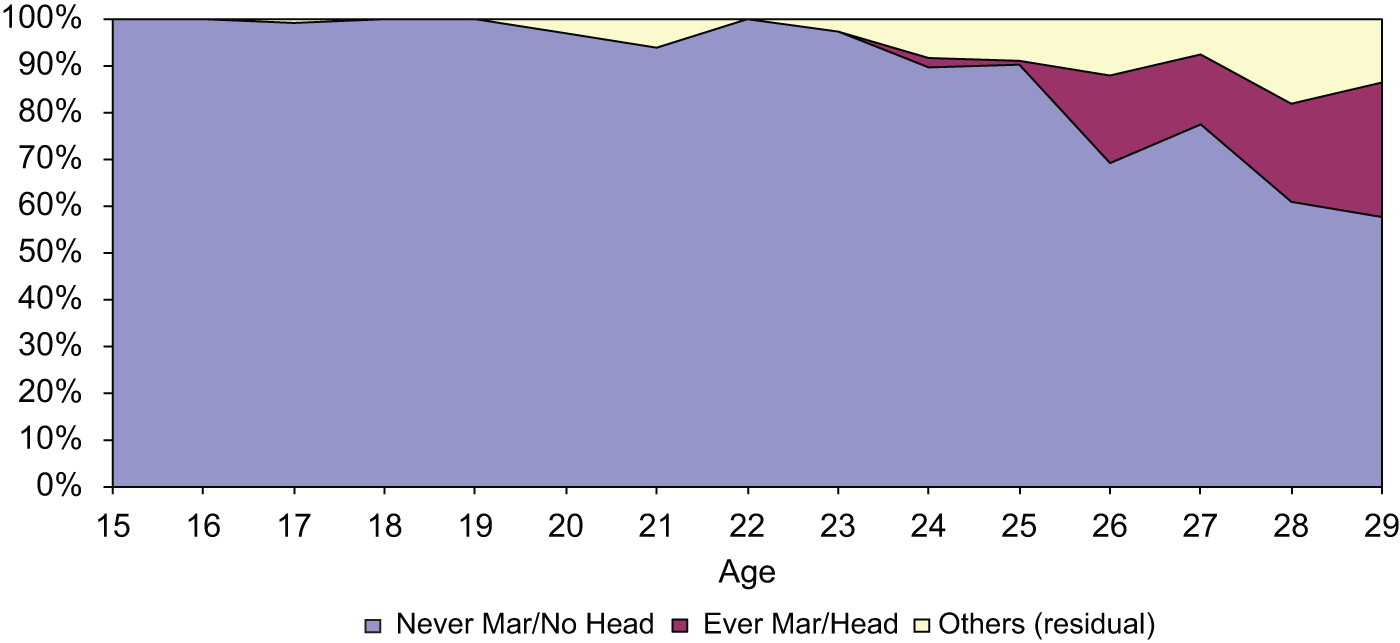
Marriage and Household Headship Combination Statuses among Men by Age
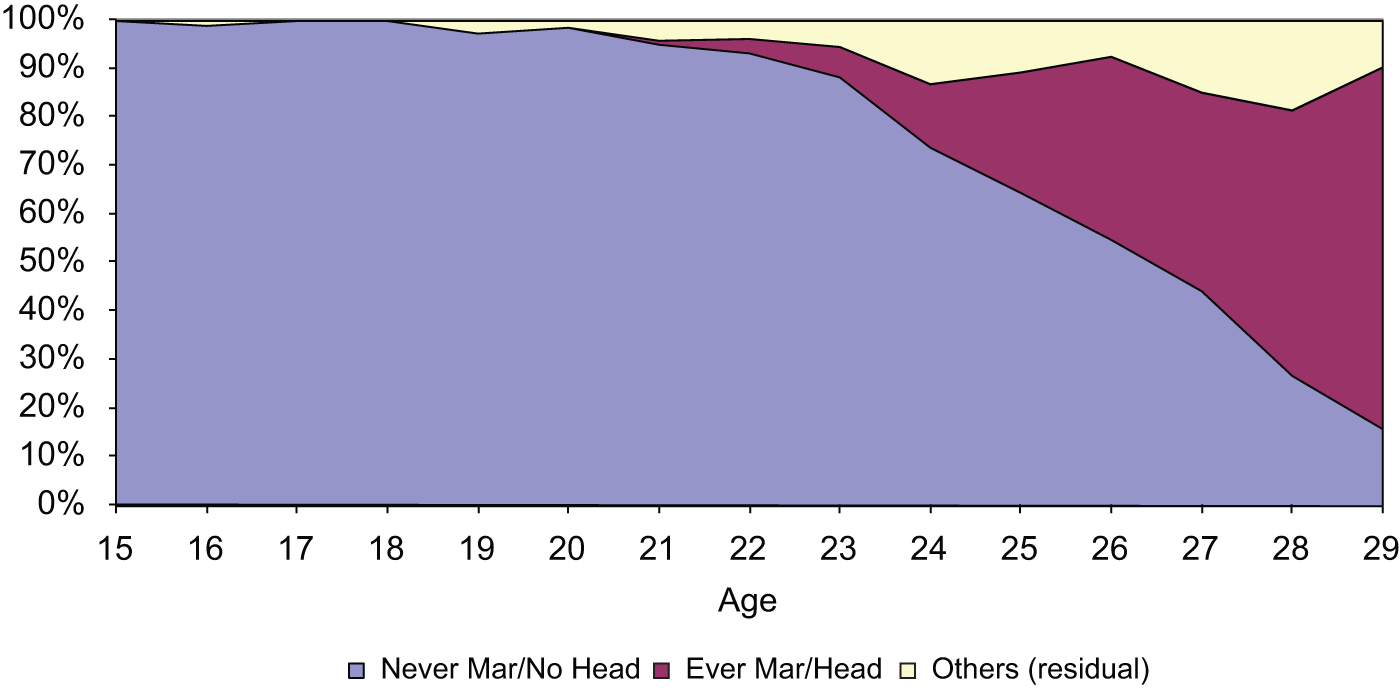
Marriage and Household Headship Combination Statuses among Women by Age
The increase of the share of those who are ever married and the household head/spouse of head starts a little earlier for women than for men—25 percent at age 25. The proportion of young women belonging to the category increases substantially after age 25, resulting in 75 percent at age 29. The fact that 75 percent of women at age 29 are ever married and the head/spouse of the head explains the considerably low level of attachment to the labor market among Korean young women as found in Figure 3.
Results of Multivariate Analyses
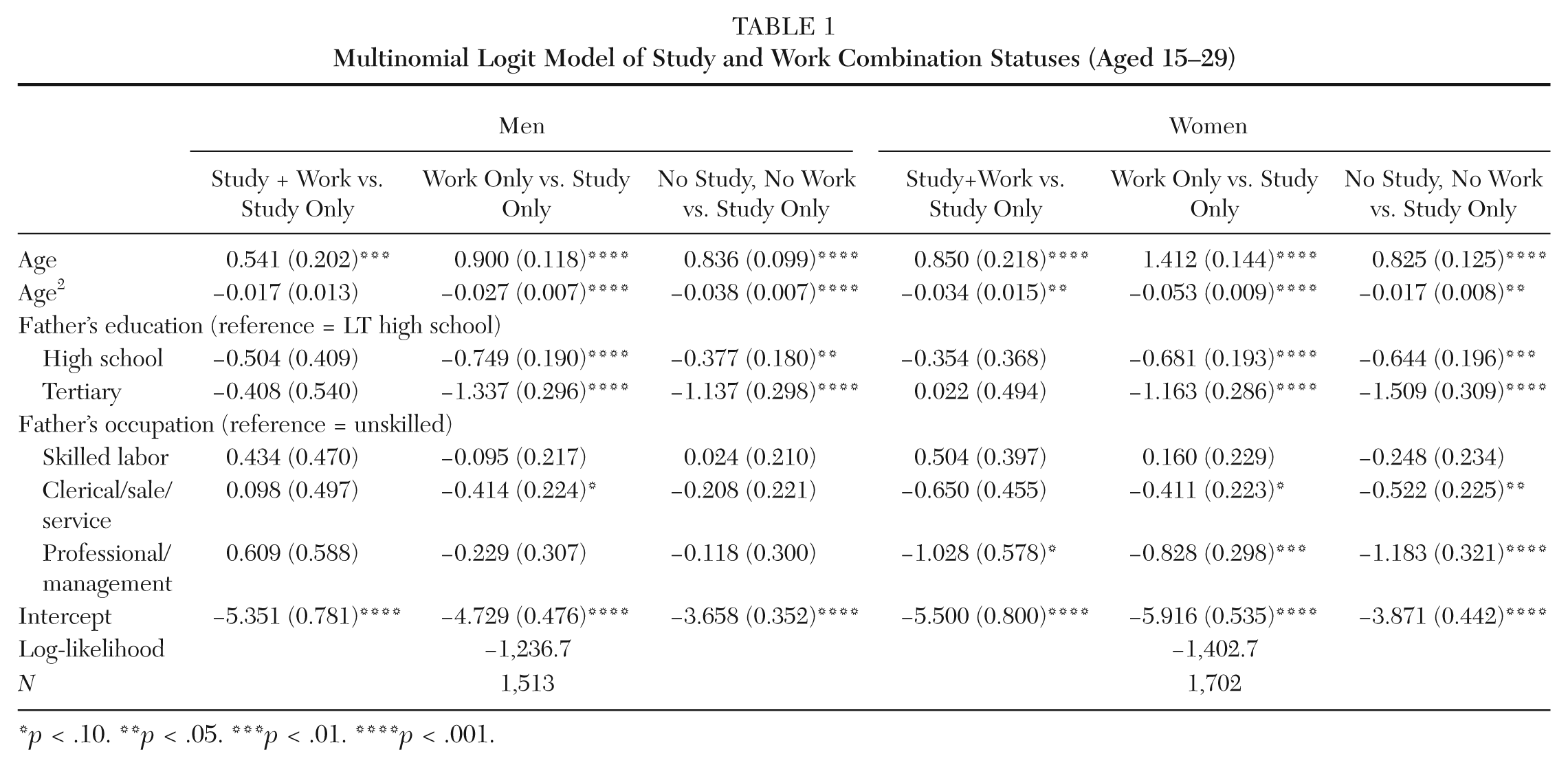
Table 1 presents the results of multinomial logit models that contrast the status of being in school only to each of the three other types of statuses among men and women. Models include age (in the form of age −15), age squared, father’s education, and father’s occupation as covariates. Older male youths are more likely to be in other types of statuses than the status of school only with a decreasing rate. Male youths whose fathers had a higher level of educational attainment are more likely to be in school than in other statuses as compared to their counterparts with a father with a lower level of educational attainment. Once father’s education is controlled, the effects of father’s occupation seem to be rather negligible on Korean men’s status in the production sphere.
Multinomial Logit Model of Study and Work Combination Statuses (Aged 15–29)
p < .10. **p < .05. ***p < .01. ****p < .001.
Turning to the result of the same multinomial logit model for women, the nonlinear effect of age is found among women as well, albeit at a different magnitude. An interesting difference in the results between men and women is the relatively stronger effect of father’s occupation among women than among men. Korean young women whose fathers had professional or clerical/sales/service jobs are significantly more likely to be in school than in other types of statuses as compared to their counterparts whose fathers had unskilled jobs. Overall, the results in Table 1 indicate that although young people’s demographic characteristics and their family background affect the transition to adulthood in Korea, differentiations in the transition to adulthood by individual and family characteristics are more apparent among Korean women than among men.
Table 2 presents the result of multinomial logit models that contrast those who are never married and are not the household head/spouse of the head (NMNH), to those who are ever married and the head/spouse of the head (MH), and to others who have made only one transition, for men and women, separately. In addition to age, father’s education, and father’s occupation, the models for the reproduction sphere add three other variables that are related to individuals’ characteristics in the production sphere: whether a respondent is currently in school, respondent’s education, and working status. In other words, to some extent the models explore the relationship between the production and reproduction spheres.
Multinomial Logit Model of Marriage and Household Headship Combination Statuses (Aged 15–29)

p < .10. **p < .05. ***p < .01. ****p < .001.
For the comparison between MH and NMNH, neither father’s education nor occupation is statistically significant for Korean men. The effects of father’s education and occupation are relatively stronger for the comparison between others and NMNH. The likelihood of MH over NMNH is much lower for those who have tertiary education than those who have less than high school education. Those who are currently working have a greater likelihood of MH over NMNH as compared to those who are not working.
The results for women in Table 2 show some interesting differences as compared to men in the way in which individual and family characteristics affect marriage and household headship combination statuses. First, differences in marriage and household headship combination statuses by father’s occupation seem more apparent among women than among men. Second, individuals’ school enrollment and educational attainment have stronger associations with the combination statuses of marriage and household headship for women than for men. School enrollment, after other covariates are held constant, has a significantly negative association with the likelihood of MH or others compared to NMNH for women, but this is not the case for men. The likelihood of MH or other statuses over NMNH is much lower for women who have a high school or college education than women with less than a high school education. Note that although tertiary education has a significant effect for men, high school education does not.
Finally, working status has a negative association with the likelihood of MH over NMNH for women, which is in sharp contrast to the positive association for men. The significantly negative association between working status and the likelihood of MH over NMNH for women seems to reflect the difficulties that Korean women face in combining family and work. In interpreting results in Table 2, however, it is important that the relationship between the combination statuses of marriage and the household head/spouse of the head and respondents’ own characteristics such as school enrollment, education, and working status not be interpreted as a causal relationship. In particular, due to the nature of the cross-sectional data used for the analysis, it is difficult to establish which causes which. For instance, it is not clear whether women’s educational attainment affects marriage and the household headship combination statuses or vice versa.
Conclusion
The rapid expansion of the educational system during the past few decades has made Korean young people one of most educated populations in the world. Universal enrollment in secondary schools, along with pressure and competition for college admissions, has contributed to a high degree of homogeneity in study and work statuses before the age of high school graduation. Most of those of high school age are in school and hardly combine study and work. Moreover, because the Korean educational system does not practice grade retention, heterogeneity in the life course during the high school years is further reduced. The highly standardized life course among Korean youths clearly highlights the importance of education as an institution in shaping the life course of young people.
Heterogeneity in study and work statuses becomes substantial only after high school graduation, as some young people make the transition to college, while others start working. Another group of Korean youths continues to prepare for college entrance exams even after high school graduation; they are neither in school nor working and thus add heterogeneity to study and work statuses. Another factor that increases the heterogeneity of the life course for Korean men is their military service. Around the time of entrance into and exit from the military, Korean young men often occupy a temporary status that is neither “in school” nor “in work.” Despite that most Korean young men have to serve in the military sometime in their 20s, little research has systematically explored consequences of military service in the process of becoming an adult among Korean men.
Korean women show much earlier transitions to marriage and head of household than their male counterparts, reflecting their lower mean age at first marriage. After age 24, which is close to the four-year college graduation, the percentage of women who are married and the household head or spouse of head rapidly increases to 75 percent by the age of 29, while the corresponding percentage at age 29 for men is only 29 percent. The analysis of study and work combination statuses among women clearly shows a large proportion of women in their late 20s neither in study nor in work. Along with the rapid increase of women who are married and the household head or spouse of head for this age group, the large proportion of women who are neither in study nor in work means that many women withdraw from the labor force upon marriage. What is more surprising is that the withdrawal of Korean women from the labor force occurs despite the fact that the level of educational attainment among Korean women is comparably high.
The results from the multinomial logit models have shown individual and family characteristics that affect young people’s life courses in Korea. Most of all, there is a strong effect of age on both study and work combination statuses, and marital status and household headship combination statuses. As young people get older, they are less likely to “only study” and to be “never married and not the household head or spouse of head.” In addition to the strong age effect, father’s education also influences transition outcomes, particularly increasing the likelihood of “only studying” for both men and women. However, father’s occupation seems to have much stronger effects on study and work combination statuses among Korean women than men. Father’s occupation also matters more for women than men in differential outcomes in marriage and household headship combination statuses. Moreover, respondents’ own characteristics related to the production sphere, such as educational attainment, study and work status, which are dependent upon family background particularly among women as the analysis in this study shows, have stronger associations with their marriage and household headship combination statuses among women than among men. Family resources, therefore, seem more critical in achieving favorable transition outcomes among Korean women than among men.
Footnotes
Appendix
Descriptive Statistics of Independent Variables
| Total (N = 3,215) | Men (n = 1,513) | Women (n = 1,702) | |
|---|---|---|---|
| Respondent’s age | 22.2 | 22.1 | 22.2 |
| (SD) | (4.3) | (4.5) | (4.1) |
| Father’s education (%) | |||
| Less than high school | 50.8 | 51.6 | 50.2 |
| High school | 36.0 | 35.5 | 36.5 |
| Tertiary | 13.2 | 13.0 | 13.3 |
| Father’s occupation (%) | |||
| Unskilled labor | 36.0 | 34.4 | 37.4 |
| Skilled labor | 25.3 | 27.6 | 23.2 |
| Clerical/sale/service | 24.9 | 23.7 | 25.9 |
| Professional/management | 13.9 | 14.3 | 13.5 |
| Respondent’s education (%) | |||
| Less than high school | 4.9 | 5.4 | 4.4 |
| High school | 52.0 | 51.8 | 52.2 |
| Tertiary | 43.2 | 42.8 | 43.5 |
| Currently in school (%) | 44.1 | 48.9 | 39.8 |
| Currently working (%) | 34.5 | 34.5 | 34.5 |
NOTE: This article builds on the theoretical framework and methodological approach advanced by the research group Adolescent Regimes in the Developing World: A Comparative Perspective. The author thanks Marils Buchmann, Carlos Costa-Ribeiro, Elizabeth Fussell, and Silvia Giorguli, who headed the research group, for their useful comments on earlier versions.
Hyunjoon Park is Korea Foundation Associate Professor of Sociology and Education at the University of Pennsylvania. He is interested in stratification and family in comparative perspective, focusing on Korea and Japan. With Emily Hannum and Yuko Butler, he is editor of Globalization, Changing Demographics, and Educational Challenges in East Asia.