



Abstract
This article examines the forces shaping the labor supply and wages of immigrant Hispanic women in new destinations. The analysis draws on data collected in Durham, North Carolina, and evaluates how labor market outcomes are influenced by variables including human capital, immigration characteristics (including legal status), family structure, and immigrant-specific labor market conditions such as subcontracting. Findings indicate that the main determinants of labor supply among immigrant Hispanic women in Durham relate to family structure, with human capital playing a relatively minor role. Important variation is observed in the degree of work-family conflict across occupations. For wages, human capital and immigration characteristics (including documentation) are more important than family structure. Results show that the position of immigrant Hispanic women in Durham’s low-wage labor market is extremely precarious, with multiple, overlapping sources of disadvantage, particularly related to legal status and family structure.
Over the past 20 years, three key trends have transformed the U.S. Hispanic population: a massive increase in immigration that swelled the number of foreign-born from 8.4 million in 1990 to 21.2 million in 2010, a sharp rise in both the absolute and relative size of the undocumented population, and the dramatic dispersal of this population outside of traditional receiving areas to “new destinations” across the country. The prospect for the successful incorporation of recent, particularly undocumented, immigrants into the labor market looms large in both academic and public debate on the subject. The more pessimistic voices in this debate point to the marked deterioration that has occurred in recent decades in the work conditions of the low-skill labor market as a critical challenge to immigrant adaptation. Hispanic immigrants in particular are disproportionately concentrated in the low-wage sector, registering some of the lowest earnings and highest rates of working poverty in the country (Hauan, Landale, and Leicht 2000).
Within this larger debate, there is also growing interest in the particular labor market experiences of immigrant women. High rates of family poverty among immigrant Hispanics suggest the urgent need for female labor force participation among this group, and yet their paid employment trails far behind that of native women. Moreover, even though nearly 45 percent of adult Hispanic immigrants are women, the common presumption that they are secondary migrants joining husbands already in the United States has contributed to their relative neglect in labor market research (Donato et al. 2008). Their high rates of employment instability and part-time and informal work likewise make it difficult both to measure their employment position and to accommodate their experiences within theories of incorporation based on the male experience. And finally, while a number of qualitative ethnographic studies have highlighted the complex interplay between gender and immigration and provided a nuanced portrayal of the constraints on paid work among immigrant Hispanic women, these studies have to date focused exclusively on traditional areas of settlement, leaving open the question of how women are faring in new destinations.
Thus an immigrant- and women-centered analysis of the variation in employment outcomes among Hispanics in new destinations holds the potential to significantly add to our understanding of immigrant women’s work. Here I draw on original data collected in Durham, North Carolina, to provide a detailed account of the labor market position of immigrant Hispanic women. The analysis focuses on two critical aspects of economic incorporation: labor supply (the decision to work, in which occupations, and how many hours per week) and wages; and the human capital, immigration, and family characteristics that structure variation in outcomes. This analysis is particularly concerned with whether immigrant Hispanic women in Durham are able to convert greater human capital and U.S. experience into better wages and employment outcomes and with the extent to which they are able to balance paid work and family obligations. Results highlight the extremely precarious position of immigrant Hispanic women in Durham’s low-wage labor market and multiple, overlapping sources of disadvantage, particularly relating to legal status and family structure.
Background
The growing emphasis on free trade, reduced regulation, and heightened flexibility (including the greatly diminished strength of labor unions) has transformed the U.S. employment structure in recent decades, contributing to rising inequality by skill and the erosion of wages and work conditions in the lower segment of the employment hierarchy (Kopczuk, Saez, and Song 2010). Nonstandard work arrangements, such as on-call work, temporary help agencies, subcontracting, independent contracting/contingent work, and part-time employment in conventional jobs, have grown dramatically, increasing their dominance in industries where they were already common and spreading to numerous other areas of the economy, with negative implications for both wages and job quality (Ferber and Waldfogel 1998; Kalleberg 2011).
As conditions in the low-wage labor market worsened, the share of workers in this sector who were foreign-born rose appreciably, from a mere 12 percent in 1980 (Enchautegui 1998) to 50 percent in 2010 (Bureau of Labor Statistics 2011). The concentration of undocumented workers has been especially dramatic; for 2005, it was estimated that they made up a full 23 percent of low-skill workers (Capps, Fortuny, and Fix 2007). Indeed, recent immigration policies, such as the 1986 Immigration Reform and Control Act (IRCA) and 1996 Illegal Immigration Reform and Immigrant Responsibility Act (IIRIRA), which imposed and then heightened employer sanctions for the hiring of undocumented labor, have contributed to marginalizing undocumented workers, particularly by hastening the shift to subcontracting in immigrant-intensive areas (Gentsch and Massey 2011). The end result is that citizenship and legal status increasingly drive labor market outcomes, including the sorting of workers into the least desirable jobs (Donato and Massey 1993; Donato and Sisk 2013; Hudson 2007; Phillips and Massey 1999).
Gender also figures prominently at the intersection of economic restructuring and immigration. First, women in general have long been disproportionately concentrated in low-wage and nonstandard employment, and they are also less likely than their male counterparts to receive employer-sponsored health insurance and retirement benefits. Moreover, their employment patterns are shaped by family characteristics to a far greater degree than is the case for men (Donato, Piya, and Jacobs 2014). It is telling that while parenthood is often unrelated to job quality for men, women having children increases their exposure to adverse work conditions, and having children may also depress wage growth for women (Kalleberg 2011).
Second, structural changes in the U.S. economy in recent decades have substantially increased the demand for low-skill female labor. While innumerable manufacturing jobs have left the United States for lower-wage countries, those that remained have tended to be downgraded, with lower rates of unionization and wages. This, in tandem with the explosive growth of “caring” jobs in childcare and health fields, has dramatically increased the demand for women’s low-skill labor. As native women have gained greater access to a wider range of better jobs, it is increasingly immigrant women who meet this rise in demand (Gonzalez Baker 1998; Myers and Cranford 1998).
Despite growing demand for their labor, there is ample evidence that Hispanic immigrant women are disadvantaged in the U.S. labor market. Their concentration in a handful of highly disadvantaged occupational niches is extreme, making it difficult to maximize the returns on human capital (Catanzarite and Aguilera 2002; Cobb-Clark and Kossoudji 1999). Indeed, immigrant Hispanic women are more likely to work part time; average lower starting wages and wage growth; and receive a lesser payoff for factors such as education and labor market experience than non-Hispanic white women, native Hispanic women, and immigrant Hispanic men (Blau and Kahn 2007; Capps, Fortuny, and Fix 2007; De Jong and Madamba 2001; Hall, Greenman, and Farkas 2010; Rivera-Batiz 1999; Valenzuela and Gonzalez 2000).
While prior studies have made important strides in outlining the labor market position of immigrant Hispanic women, a number of gaps remain. First, studies that compare immigrant Hispanic women to their native counterparts generally lack data on such factors as time in the United States, documentation, subcontracting, and other structural aspects of the immigration experience. Thus, while they give a sense of Hispanic immigrant women’s disadvantage relative to others, they are far less able to assess key sources of variation in outcomes within the immigrant population. At the same time, immigrant-oriented data sources, such as the Legalized Population Survey or the New Immigrant Survey, tend to focus on legal immigrants, necessarily excluding the vast majority of recently arrived entrants to the low-skill labor market. Many of these studies are also male-centric, in that they compare men and women along the dimensions that they have in common, such as hourly wages and the return on education, to the relative neglect of factors more pertinent to women, such as variation in labor supply and the constraints imposed on paid labor by family life. Our deepest understanding of the complex interplay between gender, legal status, and labor market incorporation among immigrant women comes from ethnographic accounts (Hondagneu-Sotelo 2003). However, these studies rely on relatively small and nonrandom samples and to date have overwhelmingly focused on traditional areas of immigrant settlement in the West and Southwest. The extent to which their observations are generalizable, particularly to new destinations, remains an open question.
Accordingly, the main objective of this article is to provide a deeper understanding of the economic position of immigrant Hispanic women in new destinations and the social forces that shape variation in their outcomes. Integrating the literatures on gender, immigrant adaptation, and low-wage labor markets, we take a broad view of economic incorporation, considering both labor supply and wages. As a first step, we elaborate on the labor supply of immigrant Hispanic women, with a focus on explaining who works and in which occupations, as well as variation in hours worked among the employed. We also consider variation in immigrant Hispanic women’s wages, considering both hourly and weekly pay. The primary motivation in both sets of analyses is to understand the extent to which human capital, migration, and family considerations explain variation in women’s labor market outcomes. We also elaborate on the role of employment characteristics in shaping hours worked and wages, both in terms of their direct impact and the extent to which they mediate the effect of human capital and immigration characteristics (particularly legal status) on outcomes, as the channeling of immigrant women into particular occupational niches is likely to translate into differential returns on work.
Data and Methods
The analysis draws on original and locally representative ethnosurvey data collected among Hispanic immigrants during 2006 and early 2007 in the Durham/Chapel Hill, North Carolina, metropolitan area (for the sake of parsimony, referred to simply as Durham, where the vast majority of respondents live). Durham represents a valuable vantage point to study Hispanic immigrant incorporation. The area has been growing rapidly, as part of the national shift in this population from Rustbelt to Sunbelt states. The influx of highly educated workers attracted to growing job opportunities in the nearby Research Triangle Park, universities, and other large employers generated an intense demand for low-skill service and construction labor. Some employers responded by recruiting Hispanic immigrant laborers from more traditional receiving areas or even directly from Latin America, and a cycle of chain migration began that saw the Hispanic population explode from a mere 1 percent of the total population of Durham in 1990 to nearly 9 percent by 2000 and 11.9 percent by 2007 (Flippen and Parrado 2012). The Hispanic population of Durham is primarily of Mexican origins (70 percent), though there are also a sizable number of Hondurans (17.5 percent), Salvadorans (5.5 percent), and Guatemalans (4.5 percent).
The precarious position of Hispanic immigrants in Durham presented unique challenges for approximating a locally representative sample. Our study relied on a combination of community-based participatory research (CBPR) and targeted random sampling to overcome these difficulties. CBPR is an approach to research that incorporates members of the target community in all phases of the research process (Israel et al. 2005). In our case, a group of fourteen community members assisted in the planning phase of the study, survey construction and revision, and devising strategies to boost response rates and data quality. In addition, CBPR members were trained in research methods and conducted all surveys. Finally, through ongoing collaborative meetings, the CBPR group was also influential in the interpretation of survey results.
At the same time, the relatively recent nature of the Hispanic community in Durham rendered simple random sampling prohibitively expensive. We therefore employed targeted random sampling techniques (Watters and Biernacki 1989). Based on CBPR insights and field work in the community, we identified forty-nine apartment complexes and blocks that housed a large number of immigrant Hispanics. We then collected a census of all the apartments in these areas and randomly selected individual units to be visited by interviewers. Using community members as interviewers helped to achieve a refusal rate of only 9 percent, and a response rate, which also discounted randomly selected units in which contact was not made after numerous attempts, of over 72 percent. A total of 882 and 1,299 interviews were conducted with immigrant Hispanics women and men, respectively, between the ages of 18 and 49. All interviews were conducted in Spanish, usually in the homes of respondents, with interviewers filling out paper surveys that included a mix of close-ended and open-ended questions. A main advantage of the collaborative data collection approach was the ability to develop a questionnaire specifically tailored to assess the experience of immigrants in the low-wage labor market (for a more detailed project description, see Parrado, McQuiston, and Flippen 2005).
Our main outcomes of interest relate to labor supply and compensation among Durham’s immigrant Hispanic women. Labor supply is captured by three dependent variables. The first is simply a dummy variable indicating whether the respondent was working at the time of the survey. The second dependent variable combines labor force participation with type of occupation and comprises seven categories: not working, working in food preparation, cleaning, childcare, laundry, factory, or other jobs. The multinomial approach assesses not only the impact of human capital, family obligations, and immigration characteristics on employment probabilities, but also whether the social factors shaping labor force participation differ across occupations. The final dependent variable critical to understanding women’s labor supply is hours worked per week (logged). Immigrant women, in particular, often work less than full time, including a considerable number who work very few or erratic hours. This may be particularly common among women with greater family obligations.
Assessing working immigrant women’s compensation is somewhat more complex. Because women’s labor supply is highly variable, it is difficult to construct a single measure of wages that gives a comprehensive view of earnings. Focusing on hourly wages alone overstates the incomes and living standards for women who work relatively few hours per week. And focusing on weekly wages alone fails to capture the experience of women who achieve modest weekly incomes only by working very long hours. The analysis therefore includes both hourly and weekly wages as dependent variables, the latter of which reflects both labor supply and compensation.
Independent variables fall into three broad categories: human capital and immigration characteristics, family structure, and mediating employment characteristics (in the models of hours and wages). First, theorists have long debated whether the monetary returns on human capital are suppressed in low-wage segments of the economy, which is characterized by instability and limited prospects for upward mobility (Hall and Farkas 2008; Piore 1970). While factors such as age, education, length of U.S. work experience, and English language ability have been found to predict wages even among low-skill immigrant workers (Bleakley and Chin 2004; Catanzarite 2000; Chiswick 1984; Hall, Greenman, and Farkas 2010; Kossoudji 1988; Phillips and Massey 1999), there is evidence that immigrants’ return on human capital and experience are substantially lower among both women and undocumented workers (Blau and Kahn 2007; Hall, Greenman, and Farkas 2010). Thus, their impact on both wages and labor supply in new destinations such as Durham remains open to question. Likewise, while a number of studies have found a direct negative effect of undocumented status on wages, net of differences among immigrants in human capital considerations (Donato et al. 2008; Hall, Greenman, and Farkas 2010; Phillips and Massey 1999; Orrenius and Zavodny 2009; Rivera-Batiz 1999), the impact of documentation on women’s labor supply and wages in new destinations has yet to be established.
Accordingly, we include both age (including a squared term to capture nonlinear effects) and educational attainment as rough measures of human capital. Educational attainment is measured by a set of dummy variables distinguishing between those with 6 or fewer years, 7 to 9 years, and 10 or more years of completed schooling. These distinctions correspond to primary, secondary, and above secondary education in Mexico. Immigration-related characteristics include a variable capturing self-reported number of years of residence in the Durham area, and English ability, which is measured by a dummy variable indicating whether the respondent reported being able to speak English well or very well (as opposed to “more or less” or “not at all”). 1 A dummy variable for undocumented status reflects the response from a direct question on legal status.
The second set of independent variables included in the analyses relates to family structure. Previous research suggests that women’s family obligations undermine labor force participation. While the negative impact of children on women’s paid work is lower today than in previous generations, mothers remain more often responsible for childcare than fathers and, thus, must replace their own reproductive work with paid help in order to be employed. Children thus effectively raise the wages needed to make work pay (England, Garcia-Beaulieu, and Ross 2004). The relationship between marriage and employment is less uniform, though at least for Hispanic women there is evidence of a negative effect even in the absence of children (Greenlees and Saenz 1999; Menjivar 2000; Kahn and Whittington 1996). Likewise, a substantial body of work documents a significant earnings penalty to motherhood among the general population (Anderson, Binder, and Krause 2003), though studies that examine the issue among low-skill Hispanic immigrants are scant.
To examine the potential conflict between work and family obligations among the women in our sample, we account for both marital status and presence of children in the household. Specifically, a set of four mutually exclusive dummy variables indicate whether a woman is married and living with children, married and not living with children, unmarried and living with children, or unmarried and not living with children. Married women include both those who report a formal, legal marriage and those who report being in a consensual union.
And finally, the models of hours worked and wages among working women also include a number of mediating employment characteristics as independent variables. Nonstandard work arrangements, particularly subcontracting, are both very common in the low-wage labor market and often associated with lower wages among both the general population (Kalleberg 2011) and immigrants (Massey 2010). Hispanic immigrants are also disproportionately employed in small firms and job sites where other Hispanics predominate, which has been shown to undermine wages among Hispanic men (Catanzarite and Aguilera 2002). We expect the same to be true for women. As such, we also consider five mediating employment characteristics in our models of hours worked and wages among working women: occupation/industry (described above), firm size (a dummy indicator of whether a person is working in a firm with ten or fewer workers at all locations), Hispanic work sites (a dummy variable indicating whether the respondent reported working mostly with other Hispanics), and exposure to nonstandard work arrangements (measured through a dummy indicator of working for a subcontractor).
The statistical estimation varies according to the distribution of the dependent variables. For the analysis of being employed where the dependent variable is a dummy indicator, we estimate logistic regression models. For the analysis of working in a particular type of occupation where the dependent variable comprises seven mutually exclusive categories we estimate multinomial logit models with the reference group being women who were not working. For the continuous dependent variables, i.e. hours worked per week, hourly wages, and weekly wages, we report results from standard ordinary least squares (OLS) models. 2
Descriptive Results
Table 1 presents descriptive results for the dependent variables in the analysis, providing results for men as a counterpoint for assessing the unique position of immigrant Hispanic women. While the overwhelming majority of men (96.0 percent) were working at the time of interview, among women 61.8 percent reported working for pay. Moreover, as previous studies have documented, the occupational concentration of immigrant Hispanics in Durham is extreme, with considerable differences by sex. A stunning 88.5 percent of all men in the sample were working in construction, yard work, or food preparation (68.1, 7.4, and 13.0 percent, respectively). Among women, just more than two-thirds worked in one of three areas: cleaning (32.9 percent, which includes both private house cleaning and offices or hotels), food preparation (30.7 percent) or factory work (10.2 percent). An additional 5.9 and 5.5 percent of women worked in childcare and laundry, respectively. Finally, while virtually all men were working at least 40 hours in a typical week, women’s work hours were much more variable. The average work week was 35.7 hours for women (compared to 41.6 for men), but ranged from a mere 5 hours to 60 hours per week. Only 68.3 percent of working women reported working at least 35 hours during a typical week, while 21.5 percent reported working between 20 and 35 hours weekly, and an additional 10.2 percent reported working fewer than 20 hours per week.
Descriptive Results by Sex

Average hourly wages were also markedly lower for women than for men, $8.03 relative to $10.90. Not only were average hourly wages lower, but the distributions also varied in important ways, as seen in Figure 1. There is a sizable subset of women, close to 5 percent, who earned very low wages—some as little as $2 per hour. There is no male equivalent of this phenomenon. Likewise, the modal earnings categories for men were $10–12 and $12–15 an hour, and a nontrivial number, close to 8 percent, earned in excess of $15 an hour. For women, the most common categories were $6–7 and $7–8 an hour, and a scant 10 percent earned more than even $10 an hour.
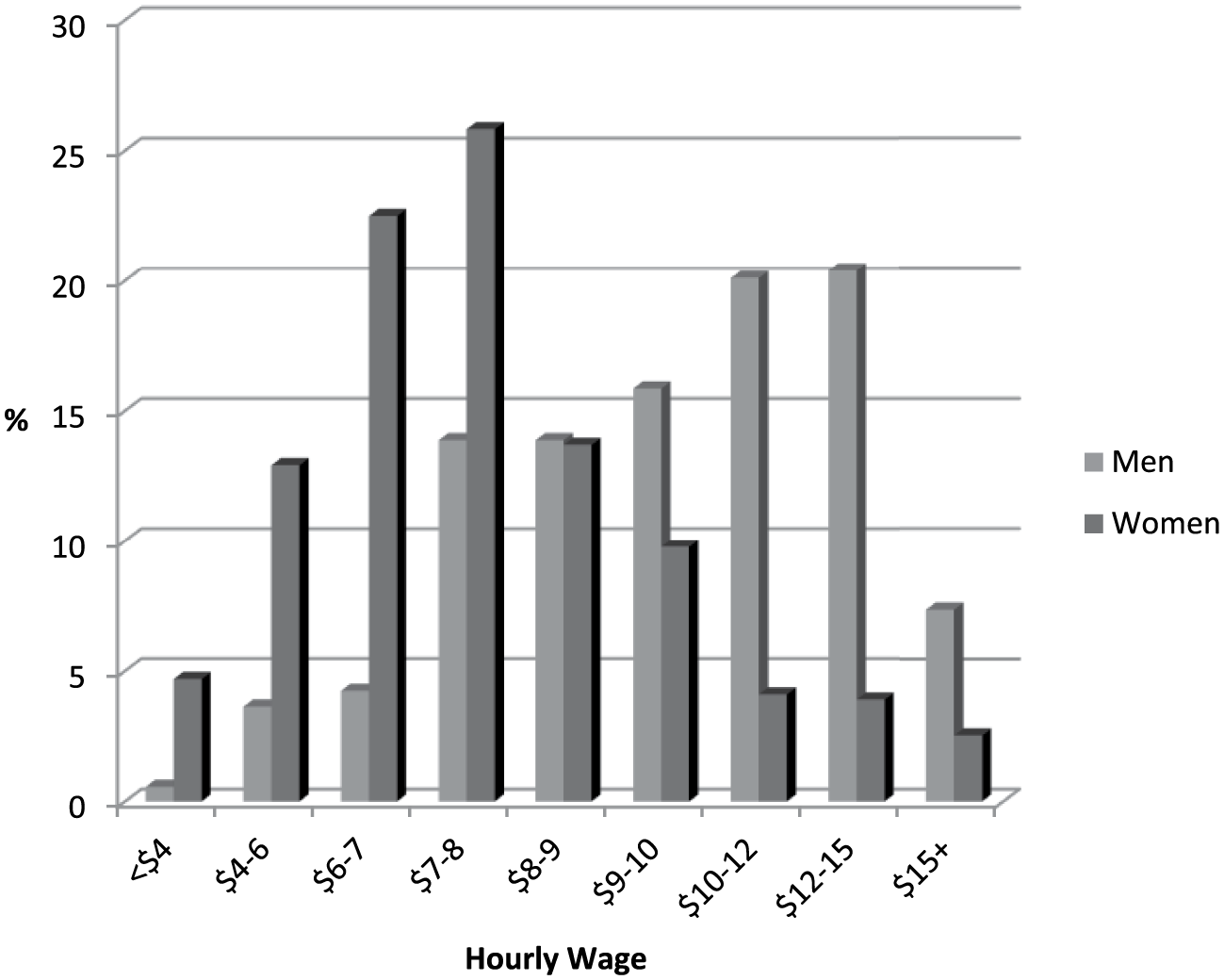
Hourly Wages by Sex
Table 1 also presents human capital, immigration, family status, and mediating employment characteristics for the women in our sample, again providing data on men for comparison. Our sample is in many ways typical of immigrants in new destinations: the women are relatively young, with an average age of 30.1 years, and poorly educated. Averaging just under 8 years of schooling, 43.5 percent of immigrant Hispanic women in Durham did not advance beyond primary school, an additional 26.3 percent finished between 7 and 9 years of education, and just under one-third (30.2 percent) completed 10 or more years of schooling. Respondents were also recently arrived, averaging a mere 4.2 years in Durham. Reflecting this recent arrival, only 6.8 percent of women reported speaking English well or very well; and an overwhelming majority, fully 90 percent, were undocumented at the time of interview. While the men in the sample averaged slightly better English skills and longer residence in Durham, overall sex differences in human capital and immigration characteristics were remarkably modest.
The main factor that distinguished women from men relates to family structure. Just over 62 percent of women in the sample were married and living with children at the time of survey, and an additional 17.9 percent were married with no coresident children (the majority were childless, though a small share had children in their home communities). The greater incidence of men migrating without their families meant that only 35.1 percent of men were married with children in Durham, and an additional 30 percent were married and without coresident children. Women were also far more likely than men to be single parents (10.8 vs. 2.0 percent). Thus, overall, a very small share of immigrant Hispanic women were free of work-family conflict in Durham; only 25 percent were not raising children, and less than 9 percent were neither married nor residing with children.
Finally, women exhibited a number of mediating employment characteristics that also differed from men and have been shown to negatively impact wages (Flippen 2012). In addition to their occupational concentration described above, a sizable number of women were paid via a subcontractor (14.5 percent), though this figure is nearly half the number exhibited among men (25.8 percent). Women were also less likely than men to work in a predominantly Hispanic work site, though the number was large for immigrants of both sexes (60.1 vs. 67.7 percent). However, more than half of all women (54.8 percent) worked for a firm of ten or fewer employees, a figure that is higher than that reported by men (44.6 percent).
Multivariate Results
While the overall pattern described above highlights many elements of disadvantage associated with the secondary labor market, there is considerable variation in employment outcomes and work characteristics among Hispanic immigrant women in Durham. The next set of analyses investigates the dimensions undergirding this variation and how various employment characteristics relate to one another. We first investigate the factors associated with labor supply. Table 2 reports results from logit and multinomial logit models predicting the odds of working as well as of being in one of six employment categories, relative to not working. As described above, these models give us a sense for both what kinds of factors predict employment among these women and for whether the conflict between work and family is lower for some occupations than for others. Results demonstrate relatively modest effects of human capital on the labor supply and occupational choices of immigrant Hispanic women. While age is positively associated with employment both overall and in most occupations relative to not working, the impact of education is more complex and in many ways departs from human capital theory. Specifically, Table 2 shows considerable nonlinearity in the effect of education on labor force participation; while women with intermediate levels of education are only 0.73 times (exp[−0.32]) as likely to work as those with 10 or more years of education, the least educated women are no less likely to work than the most educated. It is only in childcare that the least educated are also least likely to work, possibly due to the greater interpersonal skills required to find work as a nanny.
Binomial and Multinomial Logit Models Predicting Employment in a Particular Type of Occupation.

NOTE: Reference category = not working. Standard errors in parentheses.
p < .10. **p < .05.
The impact of immigration characteristics on employment is likewise limited and mixed. Longer periods of residence in the Durham area are associated with higher likelihoods of working overall, and the positive effect is particularly significant for factory and non-niche “other” occupations, relative to not working. Similarly, speaking English well significantly expands employment opportunities. Women with good English skills are 1.79 times (exp[0.58]) more likely to work than women with more limited English ability. The positive connection between English and working is likely to be mutually reinforcing but appears to be particularly strong for jobs that require personal interactions such as childcare and non-niche occupations. The effect of lack of documentation, though negative, is not a significant constraint on women’s employment propensities. However, there is important variation across occupations with undocumented women significantly more likely to work in childcare (1.61).
Instead, the key determinants of labor supply relate to family structure. Overall, women who are married and living with children are significantly less likely to work than other women. Unmarried women not living with children are the most likely to work relative to married women with children, followed by unmarried women with children and married women without coresident children. Thus, from a simple comparison of the size of the coefficients across categories, it would seem that being married alone is at least as large an impediment to working as is having children, if not larger. Indeed, additional models (not shown), which control for marital status and children separately, show that marriage exerts an independent and significant negative effect on working even after accounting for the presence of children. It is important to note, however, that for two occupations, namely, childcare and laundry work, there are few differences between women who are married with children and others with respect to employment probabilities. This suggests that the conflict between work and family is lower in these occupations.
Of course, immigrant women’s labor supply is not adequately described by the distinction between working and not working alone, as 32 percent of all working women do not work full time. Table 3 therefore reports results from OLS models predicting the log of hours women work in a typical week, among working women. Once again we see relatively little effect of human capital and immigration characteristics on this dimension of women’s labor supply. Women with greater time in Durham work significantly longer hours than those who are more recently arrived, though substantively the effects are modest; each additional year in Durham increases the number of hours worked by a mere 1 percent. Neither education nor English skills promote longer hours among the employed.
OLS Models of Log of Hours Worked per Week among Working Women

NOTE: Standard errors in parentheses.
p < .10. **p < .05.
Legal status, on the other hand, does exert a significant influence over hours worked. While the undocumented were no less likely than their peers with legal status to work, among the employed they average a significantly shorter (10 percent) work week. Interestingly, the effect loses statistical significance in model 2 when we control for mediating employment characteristics. Additional models (available upon request) show that undocumented women are more likely to work for a subcontractor, at predominantly Hispanic work sites, and for small firms, the latter of which is also associated with a shorter work week. It is thus the funneling of women into disadvantaged, mediating work that accounts for the shorter work week of undocumented respondents.
Regardless, as was the case for the models predicting employment, the primary determinant of work hours among immigrant Hispanic women is family structure. And there is again evidence that both marriage and the presence of children exert independent, negative effects on work hours. For instance, unmarried women with and without coresident children are both significantly more likely to work than married women with children, and the size of the coefficient is roughly comparable for the two groups, suggesting that children do not pose an additional barrier to longer work hours among employed nonmarried mothers. Married women without coresident children, on the other hand, are only marginally more likely to work longer hours than their counterparts with children, suggesting that marriage itself is an important impediment to work among these women, irrespective of childrearing. Once again, these impressions are confirmed in models measuring marriage and childrearing separately (not shown). And finally, of the remaining mediating employment characteristics introduced in model 2, factory employment offers women the greatest access to longer work hours, as this is the only occupation that averages a significantly longer work week (15 percent) than food preparation. Employment in small firms, in contrast, is associated with 9 percent fewer weekly hours worked.
Turning to compensation outcomes, Table 4 presents results from OLS models predicting both hourly and weekly wages (logged). Across models the effect of human capital on wages is weak. Only after controlling for mediating employment characteristics do we find that lower levels of education negatively affect wages. Results show that compared to women with 10 or more years of education, both the hourly and weekly wages of women with lower levels of education are 7 percent lower. Immigration characteristics, on the other hand, are among the most important determinants of wages among the women in our sample. The effect of time in Durham is statistically significant, though substantively small; every additional year in Durham increases hourly and weekly wages by 1 and 2 percent, respectively. English language ability, in contrast, has a more sizable effect; women with good English skills average 17 and 14 percent higher hourly and weekly wages, respectively. Thus, part of the effect of education on wages is no doubt mediated by its association with English fluency. Once again, undocumented status significantly undermines immigrant women’s labor market position. Results show that undocumented women earn 16 percent lower hourly wages than their documented counterparts. Since lack of documentation also undermines the hours that women work, when we measure the compounded effect on weekly wages undocumented women earn a full 22 percent less than documented immigrants. The negative effect of undocumented status is reduced, but not eliminated, once mediating labor market characteristics are taken into account. Specifically, results for the full model show that lack of documentation reduces women’s hourly and weekly earnings by 8 and 16 percent, respectively. It is worth noting that this figure is considerably higher than the negative effect of being undocumented among men in Durham (self-identifying reference).
OLS Models Predicting Log of Hourly and Weekly Wages

NOTE: Standard errors in parentheses.
p < .10. **p < .05.
While family structure was by far the most important determinant of immigrant Hispanic women’s labor supply, it has very little effect on the wages of working women. Among women who work, neither marriage nor childrearing significantly predicts hourly wages. Thus, the effect of family structure on weekly wages is completely driven by its impact on hours worked per week. Differences in weekly earnings by family status are nonetheless dramatic, as unmarried women with and without children earn 12 and 14 percent higher weekly wages, respectively, than married women with children.
Not surprisingly, wages vary considerably according to our mediating employment characteristics. With respect to occupation, women engaged in both cleaning and non-niche occupations earn significantly more per hour and per week than those in food preparation, while those in childcare earn significantly less. Factory employment is also associated with higher weekly wages, but the effect mainly stems from the larger number of hours that factory women work since there is no positive effect on hourly wages. While these differences across occupations are telling, they mask important variation within categories. To illustrate these differences, Figure 2 shows the wage distribution for women employed in childcare, cleaning, and food occupations in relation to the federal minimum wage ($7.25 per hour).

Distribution of Hourly Wages in Relation to Minimum Wage within Childcare, Cleaning, and Food Occupations
Virtually no women working in cleaning and food preparation earn less than the official minimum hourly wage. The wages for those employed in food preparation tend to concentrate around the minimum wage and decline rapidly at higher levels. Cleaning also tends to concentrate around the minimum wage, though the likelihood of higher wages is much greater than in food occupations. Virtually all of the higher-earning women in cleaning are independent house cleaners, while most of the lower-earning women either clean hotels or offices, or work for a house-cleaning subcontractor. In sharp contrast to both food and cleaning workers, women engaged in childcare show a clearly bimodal distribution, with a large number earning substantially below minimum wage.
In fact, almost 45 percent of women in childcare earned less than 75 percent of the established minimum wage (or $5.44 an hour). At the same time, only 6 percent earned around minimum wage, and a full 34 percent earned more than 1.25 times the minimum wage (or $9.06 an hour). Without exception, the higher-earning women in childcare are nannies for families outside of immigrant communities, while the very low wage earners are uniformly women who care for the children of other immigrant women out of their own homes. These women, who often cannot earn enough to pay for childcare themselves, are forced to accept as little as $60 to $80 a week for full-time childcare.
Finally, returning to Table 4, contrary to expectations, subcontracting is not negatively associated with wages. Working in a Hispanic work site, on the other hand, significantly reduces women’s hourly wages. The effect on weekly wages, while negative, fails to reach statistical significance. Finally, working for a small firm reduces weekly wages by 9 percent. It is important to note that these effects closely correlate with lack of documentation. Small firm employment is the main factor mediating the negative effect of documentation on wages. Rather than acting independently, these dimensions intersect in a manner that compounds the vulnerabilities of immigrant women.
Conclusion
The low-wage labor market, which has experienced a sharp deterioration in work conditions in recent decades, has grown increasingly reliant on immigrant labor. Hispanic immigrants, including a large number of women, have stepped in to meet this growing demand. Still, we know less than we should about the economic incorporation of immigrant women, particularly in new destinations. This article draws on original data that are specifically tailored to capture the employment dynamics of low-skill immigrants and examines the forces shaping both labor supply (the decision to work, in which occupations, and how many hours per week) and wages (hourly and weekly) among immigrant Hispanic women in Durham.
Results indicate that when it comes to labor supply, it is primarily family status and not human capital that shapes outcomes among Durham’s immigrant Hispanic women. Both marriage and childrearing exert an independent effect, dampening the likelihood of working and reducing the number of hours worked in a typical week among those who are employed. The negative effect of marriage and childrearing holds across occupations, with the notable exceptions in childcare and laundry work, where the conflict between work and family is dramatically reduced. Human capital characteristics such as education, English language ability, and years in Durham all exert a far more modest influence on women’s labor supply than expected.
Results for models predicting wages, on the other hand, show the opposite pattern. Among women who work, it is human capital and immigration characteristics, and not family structure, that are the primary determinants of wages. Women who are more educated, speak English well, and with longer periods of residence in Durham all earn higher hourly and weekly wages than their less advantaged peers. Marriage and childrearing, on the other hand, have no effect on hourly wages and lower weekly wages only because women who are married or with children tend to work shorter hours.
One of the most consistent and troubling findings relates to the impact of legal status on women’s work. While documentation did not predict women’s ability to find employment, it funneled them into childcare, small firms, subcontractors, and predominantly Hispanic work sites. Many of these characteristics, in turn, were associated with shorter average work weeks or lower wages. Moreover, even when we account for the disadvantaged mediating employment characteristics associated with lack of legal status, undocumented women still earn significantly lower hourly and weekly wages than other women. The size of the effect is also substantively large. Our estimates show that the combination of lack of documentation and concentration in small firms that are characteristic of immigrant Hispanic women in Durham reduces their weekly wages by 25 percent.
Our study also highlights the extremely marginal position of immigrant Hispanic women’s occupational niches in the U.S. economy. While a handful of women, most working outside of areas of immigrant concentration or independently employed as housecleaners, earn a decent hourly wage, the majority earn close to the official minimum wage. Moreover, nearly 40 percent of our sample earned less than the minimum wage; and a nontrivial number, roughly 5 percent, earned less than $4 an hour. These women, who consist almost entirely of women who provide childcare services to other immigrant women out of their homes, represent the most precarious of an already highly vulnerable population.
These findings, together with the previous literature, suggest serious impediments to the labor market incorporation of low-skill immigrant Hispanic women that extend far beyond their human capital characteristics. The current anti-immigrant atmosphere and emphasis on employer sanctions have resulted in an extremely precarious labor market position for both legal and undocumented Hispanic immigrants, who suffer from multiple, overlapping elements of disadvantage. The meager impact of classic aspects of assimilation (e.g., time in the United States) on employment outcomes suggests that without policy changes, contemporary immigrants in the low-wage labor market may face a lifetime of low wages. Such a prospect undermines immigrants’ ability to provide for their old-age security and to contribute to their children’s education, and undermines the potential for intergenerational social mobility.
While a large and growing body of work examines work-family balance among professional and white women, there is growing interest in how it shapes employment and earnings among low-skill and minority women. More work on how work-family issues play out among immigrants is clearly in order. Results also confirm the importance of considering multiple dimensions of immigrant Hispanic women’s work simultaneously, to gain a more accurate sense for the forces shaping economic integration. It is not sufficient to examine only the factors predicting whether women work; different occupations vary in the extent of work-family conflict, and there is wide variation in the number of hours worked among working women. Extending studies based on immigrant men to include women (i.e., focusing largely on hourly wages) misses critical aspects of women’s economic disadvantage.
Moreover, while these findings were obtained from a case study of Durham, North Carolina, there is ample reason to believe that they may be widely applicable. Other new destinations, particularly southeastern cities such as Charlotte, North Carolina, and Atlanta, Georgia, differ somewhat in their industrial compositions from Durham. They nevertheless share the pattern of dramatic growth in their native populations, with attendant increases in demand for low-skill labor and a sharp rise in Hispanic immigrant populations after 1990. The large share of undocumented migrants across new destinations bodes poorly for women’s successful labor market integration across the region. The situation could be even more precarious in traditional immigrant gateways, where labor markets are saturated with immigrant labor and new arrivals face intense competition with coethnics, including a large number with legal authorization to work.
Footnotes
NOTE:
This research was supported by grant #NR 08052-05 from NINR/NIH.
Notes
Chenoa A. Flippen is an associate professor of sociology at the University of Pennsylvania. Her research addresses diverse topics in racial and ethnic stratification, including minority aging and retirement security, the impact of residential segregation on minority housing wealth, the social mobility consequences of internal migration, and Hispanic immigrant adaptation.