




Abstract
This article adopts a mixed-methods approach to illustrate how economic, political, and social mechanisms work across time to shape individuals’ migration decisions. First, using large-scale survey data from the Mexican Migration Project, we show that economic, political, and social factors all matter for migration decisions but that social factors come to matter most for migration over time. Second, drawing on 120 in-depth interviews with migrants and their family members in four Mexican communities, we find that communities’ migration histories shape how economic, political, and social factors contribute to migration decisions at different points in time. In communities with limited migration histories, individuals migrate to relieve economic pressures on themselves or other household members. In communities with more established migration histories, information and assistance from current or returned migrants help to overcome potential barriers to making the journey. Finally, in communities with a high incidence of migration, social factors act as independent causes of migration—apart from economic needs. These findings provide a deeper understanding of the processes underlying Mexico-U.S. migration, which is crucial for anticipating future flows and crafting policy responses.
The Mexican-origin immigrant population in the United States has increased twentyfold since 1960 to peak at approximately 12 million in 2010 (Passel et al. 2014). A vast literature attributes this pattern to distinct economic, political, and social theories of migration. Some theories suggest that individuals move for economically motivated reasons, such as in response to wage differentials between an origin and a destination country (Harris and Todaro 1970; Sjaastad 1962) or to guard against insurance or credit market failures at places of origin (Stark and Bloom 1985; Taylor 1987). Another theoretical tradition explains international migration as a product of political processes that have produced economic interdependence between developed and developing world regions (Castells and Laserna 1989; Sassen 1991, 1988). A final perspective known as the cumulative causation theory of migration highlights the importance of social ties between individuals in origin and migrants in destination for initiating and sustaining international movement (Massey 1990). Scholars have found empirical support for each of these theories under certain conditions (see Garip [2016] for a review), but research is ambivalent about how economic, political, and social factors contribute differentially to migration flows across time.
This article adopts a mixed-methods approach to illustrate how changing economic, political, and social mechanisms work over time to shape individuals’ migration decisions. First, we analyze data from 92,527 individuals (and 16,026 U.S. migrants) surveyed by the Mexican Migration Project (MMP124) to estimate models showing that these three types of factors matter in first-time migration decisions. We then adopt a temporal perspective and scrutinize an untested claim of cumulative causation theory—that the proliferation of connections to prior migrants over time reduces the effect of economic or political indicators on migration propensities. We find evidence that social factors matter more for migration as migrant networks expand over time, net of economic and political considerations.
Second, drawing on 120 in-depth interviews with migrants and their family members in four Mexican communities, we describe how a community’s migration history shapes how economic, political, and social factors contribute to individuals’ migration decisions. In communities with limited migration histories, individuals report they migrate to relieve economic pressures within the household. In communities with established migration histories, the growing presence of current and returned migrants provides information on the likely economic efficacy of a U.S. trip and helps to overcome social, psychological, and economic barriers to initiating U.S. migration. Finally, in communities with a high incidence of migration, social factors tend to become independent drivers of migration—inducing individuals to make a trip to the United States even in the absence of financial need.
Our findings advance scholarship on international migration in several ways. First, our multiple methods extend research that views migration as a social process (see Menjívar 2010) by relating large-scale, statistically established trends to qualitative, micro-level accounts of migration decision-making in different contexts. Second, and in contrast to much research that views economic, political, and social theories of migration as competitive explanations (see, e.g., Massey, Durand, and Malone 2003), we treat them as complementary. Economic, political, and social factors all contribute to international movement, but uncovering how requires appropriate contextualization within a sending community’s migration history. Doing so, we argue, offers a deeper understanding of the dynamics underlying Mexico-U.S. migration and is crucial for anticipating and responding to future flows.
From Economic to Social Theories of Migration
More than 200 million people worldwide live outside their country of birth (World Bank 2009). A substantial literature characterizes the decision to migrate between countries as driven by various combinations of economic, political, and social factors. Although scholars note that certain factors may matter more or less for migration across time (see Massey et al. 1993), research has generally not scrutinized how this temporal dynamic operates.
Early research emphasized the economic and, to a lesser degree, political motivations underlying international migration. 1 In neoclassical economics, individuals are said to migrate when they expect to earn higher wages in a destination country (Harris and Todaro 1970; Sjaastad 1962). The new economics perspective conceptualizes migration as a household-level response to economic uncertainty at places of origin, such as missing or failed markets for insurance or credit (Stark and Bloom 1985). Another perspective understands migration as a result of economic and political interdependence between developed and developing countries brought by globalization. Motivated by economic disruptions to their own livelihoods, individuals in developing nations are thought to draw on historical economic and cultural connections to developed countries as they choose where to migrate in search of new economic opportunities (Castells and Laserna 1989; Sassen 1991, 1988).
Anthropologists and sociologists began amassing evidence in the 1980s on the importance of social ties for international movement, ultimately to complicate these dominant economic and political explanations. Researchers working in rural Mexico first noted the importance of social connections for migrating to and succeeding in the United States (Mines 1981). Later work using large-sample survey data from multiple Mexican communities corroborated this finding: individuals with social ties to prior U.S. migrants are significantly more likely to migrate themselves (Massey and España 1987), a trend that held in other settings as well (Boyd 1989).
In 1990, the idea that social ties matter for international movement would become formalized in a programmatic article about the “cumulative causation”—or self-feeding character—of migration. Massey (1990) postulates that each act of migration leads to a series of changes in the sending community that makes future migration more likely. With each new migrant, the social networks that connect individuals in an origin to migrants in a destination expand. Prospective migrants then rely on these networks to migrate themselves, further expanding the network. This feedback loop ultimately makes migration flows self-sustaining and decouples them from the economic or political conditions that initiated them.
The cumulative causation theory inspired a rich empirical literature evaluating whether and how social ties matter for migration (see Garip and Asad [2015] for a summary). Social ties to past migrants have been shown to not only increase individuals’ migration propensities (Dunlevy 1991; Fussell and Massey 2004; Massey and Zenteno 1999; Massey and Espinosa 1997) but also to decrease the effect of individual characteristics on those propensities (Garip and Curran 2010; Massey, Goldrin, and Durand 1994; Winters, Janvry, and Sadoulet 2001). The multiple mechanisms underlying these so-called network effects on migration have also been outlined (Garip and Asad 2016; cf. DiMaggio and Garip 2012): network peers provide information or help that reduces the costs and increases the benefits of migration; they also offer social rewards (or impose sanctions) that encourage (or discourage) migration; and they generate a pool of common resources that increases the value and reduces the costs of migration.
Massey’s (1990) theory posits not only that social ties matter but also that connections to prior migrants reduce the effect of economic and political factors on migration propensities. However, disciplinary differences and methodological shortcomings have limited researchers’ ability to evaluate this claim. Analyses of large-scale survey data in economics, political science, and sociology have led scholars in each discipline to accumulate evidence that supports their own field’s preferred theory (see Hagen-Zanker [2008] for a review). It would nevertheless be misleading to suggest that any one theory is more correct than the others. Economic, political, and social motivations for migration need not exist independently of one another. For instance, a Mexican farm laborer may desire to migrate to the United States in search of higher wages but may not do so until a social connection helps him to secure employment (Aguilera and Massey 2003; Amuedo-Dorantes and Mundra 2007; Drever and Hoffmeister 2008; Elliott 2001; Hagan 1998; Hanson and Pratt 1992; Hondagneu-Sotelo 1994; Munshi 2003; Portes and Rumbaut 2006; Wilson 1998). Likewise, a wealthy Mexican landowner may encourage his son to migrate not because his family has financial need, but because a culture of migration has developed locally (Cohen 2001; Kandel and Massey 2002; Mines 1981; Reichert 1981; Wiest 1973) that frames migration as a rite of passage (Piore 1979) or an affirmation of identity (Hernández-Leon 1999; Levitt 1998). Finally, a mother concerned about growing levels of violence in Mexico (Ríos and Shirk 2011) may opt to leave for the United States with her children only when another relative first decides to make the journey herself (Segura and Zavella 2007).
Even when researchers allow for potential complementarities across the dominant theories of international migration, methodological shortcomings impede scholarly efforts to determine which theories prevail under what conditions, and why. For example, although Massey and Taylor (2004, 383) recognize that theories “may prove more or less efficacious in accounting for immigration patterns in different times and places,” regression models employed so widely in the interdisciplinary study of migration necessarily treat the different theories as competitive—rather than complementary—accounts (Garip 2012). Some research based on regression analysis has suggested that the new economics and cumulative causation theories of migration—but not neoclassical economics—contribute to Mexico-U.S. flows (Massey and Espinosa 1997). Meanwhile, the strongest tests to date of network effects on migration have been unable to rule out competing economic and political explanations (Palloni et al. 2001). Qualitative accounts of international migration flows have attempted to reconcile these multiple perspectives by suggesting that economic, political, and social motivations may all be at work simultaneously (Mines and Janvry 1982), but these studies generally lack attention to the temporal aspect of migration dynamics. Combining large-scale survey data with in-depth fieldwork may therefore help to illuminate how economic, political, and social mechanisms work to shape individuals’ migration decisions across time (see Garip 2016).
A Brief History of Mexican Migration to the United States
For many years, Mexican migration to the United States has been the largest sustained international flow of people in the world. This stream began in the early 1900s when U.S. labor recruiters followed newly constructed railroads in West-Central Mexico in search of workers (Durand, Massey, and Zenteno 2001). It gained momentum after the United States entered the First World War and expanded further during the economic boom of the 1920s (Cardoso 1980), only coming to an end with the onset of deportations in the wake of the Great Depression (Hoffman 1974). Upon entering the Second World War, however, the United States established the Bracero Program, which from 1942 to 1964 recruited 4.6 million Mexicans to the United States for short-term farm labor (Cornelius 2001). An additional 3 million Mexican migrants entered the United States without documents during this period (Passel and Woodrow 1987).
Several changes to U.S. immigration policy followed the abrupt end of the Bracero Program in 1964 to impede Mexicans’ access to legal migration, even as economic and political conditions mobilized additional flows of U.S.-bound migrants (see Asad and Hwang 2018). The Immigration and Nationality Act of 1965 and its subsequent 1976 amendments reduced the number of visas available to Mexicans and restricted family migration. These constraints, coupled with Mexico’s bleak economic climate after peso devaluations in 1976 and 1982, gave rise to another round of undocumented U.S.-bound migration, with an estimated 4.5 million Mexicans entering the country undocumented between 1965 and 1986 (Massey, Durand, and Malone 2003).
In an attempt to constrain undocumented immigration, the 1986 Immigration Reform and Control Act (IRCA) increased border enforcement and imposed sanctions on U.S. employers who knowingly hired undocumented workers. It also granted amnesty to 2.3 million undocumented Mexicans, which had the unintended consequence of incentivizing newly legalized migrants’ family members to migrate (Massey and Espinosa 1997). These incentives, combined with declining wages and increasing inflation in Mexico, ensured sustained undocumented migration to the United States through the 1980s (Meza 2006).
The Immigration Acts of 1990 and 1996 once again sought to deter undocumented flows by further tightening border security and increasing employer sanctions. The 1996 legislation also prohibited the use of public benefits by undocumented migrants, a change that unintentionally led to higher naturalization rates among Mexican lawful permanent residents, who then used their newly acquired citizenship to sponsor the entry of their immediate relatives (Massey, Durand, and Malone 2003).
Mexico signed the North American Free Trade Agreement (NAFTA) with Canada and the United States, which took effect on January 1, 1994. In December of that same year, Mexico experienced yet another currency devaluation. Both events led to increasing numbers of Mexicans migrating to the United States. NAFTA displaced rural farmers through deregulation in agriculture (Fernández-Kelly and Massey 2007) and devalued the skills of working-class individuals by transforming the industrial composition (Hernández-León 2008). The devaluation led to the worst debt crisis in Mexico in decades. Within a year, the country defaulted on its foreign debt, the gross domestic product (GDP) shrank by 6 percent, and the unemployment rate doubled (Meza 2006). As a result, from 1994 to 1998, U.S. border apprehensions increased from 1.1 to 1.7 million. By 2000, the Mexican-born population in the United States had reached 8.4 million, about 45 percent of whom were estimated to be undocumented (Bean and Stevens 2003).
Methodology
Here we adopt a mixed-methods approach to uncover how economic, political, and social factors contribute to aggregate Mexico-U.S. flows at different points in time. Our analysis proceeds in two parts. First, we employ regression analysis on a large-sample dataset to show how economic, political, and social factors all matter for Mexicans’ migration decisions. Second, we draw on 120 in-depth interviews with migrants and their family members to evaluate how these distinct factors shape Mexicans’ migration decisions in different historical periods. We capitalize on the complementarity between both types of data—quantitative for observing large-scale patterns and qualitative for identifying the microsocial mechanisms underlying these patterns—to arrive at a comprehensive understanding of individuals’ migration decisions.
Quantitative strategy
The quantitative data come from 124 Mexican communities surveyed by the Mexican Migration Project (MMP124). While not nationally representative, the data provide an accurate profile of current and former migrants to the United States with family members in Mexico (Zenteno and Massey 1999). The MMP researchers surveyed each community once between 1982 and 2008 in the winter months when U.S. migrants typically visit their families in Mexico. The researchers asked individuals residing in one of two hundred randomly selected households in each community to provide demographic information and to state the timing of their first and last trip to the United States. Using these data, we construct a panel dataset with retrospective reports from 92,527 individuals. We focus on the demographic, economic, political, and social factors associated with an individual’s likelihood of taking a first trip to the United States.
To avoid endogeneity problems because factors related to migration may change as a result of prior U.S. trips, we do not study subsequent trips. For each year from age 15 to the survey date, we reconstruct an individual’s personal, household, and community attributes by using the data on the timing of various events (e.g., marriage and asset purchases). Since each community is surveyed in a specific year, and because the data are collected retrospectively, we observe data from a larger number of communities as we go back in time (e.g., 48 in 2000 versus 124 in 1970) but a smaller number of individuals (due to age restrictions to be included in the sample). We thus confine the analysis to data observed from 1970 to 2000, as the sample size drops sharply outside this range.
For each person-year, we compute the migration prevalence index, defined as the percentage of people in a respondent’s community who have ever migrated to the United States prior to that year. We classify person- and community-years into five progressive categories based on quintiles of the migration prevalence index. We then estimate a logistic regression model predicting the likelihood of first U.S. migration separately within each prevalence category and compare coefficient estimates across the five categories. This strategy, formerly used by Massey, Goldrin, and Durand (1994) and Garip and Curran (2010), allows us to evaluate the changes, if any, in the relative importance of the economic, political, and social factors in predicting migration across different stages of the migratory process.
Four variables capture economic and political conditions relevant to migration decisions: the average hourly wage in the United States (in constant 2000 U.S. dollars), the inflation rate in Mexico, the ratio of available visas to Mexican migrants, and the logarithm of the volume Mexico-U.S. trade (again in constant 2000 U.S. dollars). Three variables are used to capture the social context of migration: the number of U.S. legal residents and all U.S. migrants (including nonresidents) in the household and the migration prevalence ratio in the community. We include additional controls for individuals’ demographic characteristics (e.g., age, household position, and sex), education (primary, some secondary, or completed secondary schooling), occupation (agriculture, manufacturing, or service sector), domestic migration experience (whether they have ever migrated in Mexico), household wealth (number of rooms in the respondent’s dwelling, value of land owned, and whether household owned a business), and community type (rural or metropolitan).
Qualitative strategy
The qualitative data focus on economic, political, and social factors underlying migration to evaluate how a community’s migration history renders some factors more or less important to individuals’ reported migration decisions. We conducted 120 in-depth interviews with households in Jalisco, Mexico, during the summer months in 2011. Jalisco is a state in west-central Mexico and historically a major sender of migrants to the United States and provided a manageable and safe study site where MMP researchers based at the University of Guadalajara could provide support and facilitate our access to the communities. 2
We selected four study sites from among communities previously surveyed by the MMP in Jalisco with the objective of maximizing the diversity of migrant characteristics. 3 Each site was distinct in containing a large concentration of different “migrant types” identified in a prior analysis of the MMP data (Garip 2012). The first community, a rural village of only one thousand residents, was home to a large share (approximately 30 percent according to the MMP data) of older migrants, typically male household heads with little education and wealth who started migrating in the 1970s and early 1980s to fill the farm jobs in the United States. The second community, a slightly large rural town of about three thousand residents, contained a majority of male migrants, often adult sons from relatively wealthy households who started to migrate in the mid-1980s, a period of economic volatility in Mexico stemming from the peso devaluations of 1976 and 1982. The third community, an industrial town of about nine thousand inhabitants in central Jalisco, distinctly included a significant share of women who migrated to join their newly legalized husbands in the United States after the Immigration Reform and Control Act in 1986. The fourth community, a poor urban neighborhood in Guadalajara, contained mostly educated male migrants working in manufacturing, who first migrated to the United States in the mid-1990s, after the inauguration of NAFTA in 1994.
We assigned each community to a quintile of the migration prevalence index based on the measures reported in the MMP for each decade. To ensure comparability of the migration prevalence index across community-years, we fixed the decade of observation to the 1980s (the earliest decade in which all four study sites were surveyed by MMP researchers). 4 The resulting classification places the second community into the first quintile (low migration prevalence), the first and fourth communities into the third quintile (medium migration prevalence), and the third community into the fifth quintile (high migration prevalence). We structure our qualitative analyses around this categorization to evaluate how a community’s history of migration shapes the economic, political, and social mechanisms underlying migration decisions.
Our team, led by the senior author, included six students (four women and two men) from the University of Guadalajara, all of whom had previously worked for the MMP and thus had experience in the study communities. As locals with credentials from the University of Guadalajara, the students easily established rapport with the respondents, and despite the sensitivity of the research topic, the refusal rate was less than 5 percent. We spent about a week in each community and interviewed around thirty households with at least one current or returned migrant. In some cases, group interviews were conducted when more than one previous migrant was present in the household. Of the total 134 respondents, 49 were migrants themselves, 49 were parents of a migrant, and 28 were spouses of a migrant. The remaining 8 included siblings, children, or nieces of migrants. 5
The semistructured interviews lasted from about 5 to 90 minutes and averaged around 20 minutes. (Some respondents chose not to elaborate on the questions, while others provided detailed stories, leading to variation in interview times.) The questions were open-ended and inquired about the circumstances surrounding the first migration decision, which, for some respondents, required a recollection of events in the distant past. To minimize recall bias, we elicited information on landmark events, such as marriage or birth of a child, and then asked the respondent to relate the migration decision to those events. 6 We asked about the migrant’s goals in moving north, as well as whether and when they achieved that goal. This strategy allowed us to see if respondents’ reports of the first migration trip were influenced by the actual outcome of that or subsequent trips (Barclay 1986)—for example, whether migrants were able to buy a house with their earnings from early trips and then on later trips reported saving for future investments. 7 We also asked about family and community circumstances around the time of first trip as factual information is better recalled than attitudes (Berney and Blane 1997). The interviewers transcribed the Spanish-language audio recordings themselves, and a team of Mexican research assistants then translated the transcriptions into English. Two bilingual research assistants in the United States checked and corrected the translations to ensure accuracy before coding the interview data using the qualitative analytic software Atlas.ti.
Quantitative Results
Figure 1 uses a dot plot with bars corresponding to 95 percent confidence intervals to present coefficient estimates from the logistic regression of first U.S. migration (Kastellec and Leoni 2007). 8 The five vertical panels correspond to samples based on the quintiles of community migration prevalence, which trace shifts in the standardized coefficient estimates for seven variables across communities at different stages of migration prevalence. (Table A1 in the online appendix lists estimates for all variables included in the model.) In the first panel from the left, the odds of first U.S. migration increase with the hourly wage earned in the United States and the inflation rate in Mexico. The odds of migration also increase with the ratio of available visas to Mexican migrants and the volume of Mexico-U.S. trade. As expected, migration is more likely from households containing prior U.S. migrants as well as from communities with a high prevalence of migration. These findings are in line with theories that connect migration to higher expected earnings in destination, economic uncertainty at places of origin, economic and political ties between origin and destination communities, and social ties between individuals at origin and destination.

Estimates from Logistic Regression Model of First U.S. Migration in Five Progressive Categories, Based on Quintiles of the Migration Prevalence Index
As we move from the first to the fifth panel, however, the model estimates change considerably as communities shift from those with less than 3 percent prevalence to those with prevalence ratios of more than 20 percent. The standardized coefficient estimate for the hourly U.S. wage drops from .16 in the first stage of migration prevalence to .08 in the last stage (p < .05 for all estimates, exceptions indicated). The coefficient estimate for the Mexican inflation rate drops from .15 in the first stage to –.07 in the fifth stage; the estimate for the Mexico-U.S. trade indicator declines from .74 to –.07, and that for the ratio of visas to migrants decreases from .12 to .02 (all at p > .05 in the final stage). By contrast, the coefficient estimates for the number of U.S. residents in household and the migration prevalence in community both increase from about .02 (p > .05) in the first stage of migration to .17 in the fifth stage (p < .05). The estimate for the number of nonresident migrants in the household remains around .54 at all stages of migration prevalence.
As communities move from low to high levels of migration prevalence, then, the effect of the economic and political context indicators on individuals’ migration propensities declines in size (and the coefficients sometimes switch signs) while the effects of social context indicators either remain constant or increase in size. This pattern is further reinforced in Table 1, which presents likelihood ratio test statistics comparing the full model to a baseline model without the social context indicators. The test statistic is higher, suggesting the higher explanatory power of the social context indicators at higher levels of migration prevalence. This finding supports the idea—put forth in cumulative causation theory—that migration decisions are increasingly a function of past migration patterns in communities with high migration prevalence.
The Likelihood Ratio Test (Full Model to Baseline Model), by Quintiles of Community Migration Prevalence
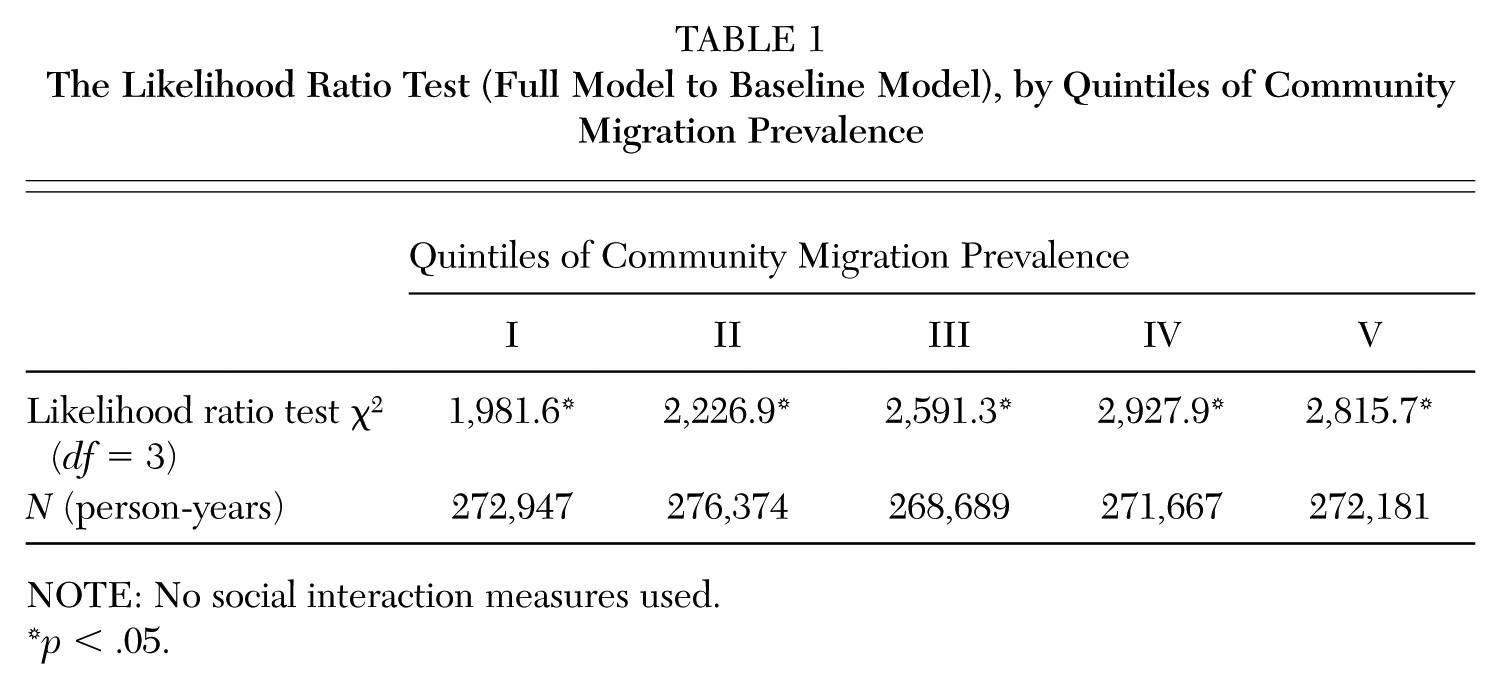
NOTE: No social interaction measures used.
p < .05.
Qualitative Findings
Our qualitative findings build on the results from the quantitative analysis and depict the myriad ways economic, political, and social factors shape individuals’ migration decisions. Table 2 summarizes the definitions, coding, and means for 120 respondents who reported their motivations—economic, political, and/or social—for their first U.S. trip during our interviews with them. Among these 120 respondents, 83 percent discussed economic rationales as a reason for migration, 15 percent mentioned political factors, and 63 percent named social factors. But, as we highlight below, how economic, political, and social factors shaped the migration decision varied by the history of migration in respondents’ sending community. Although respondents consistently report economic motivations for journeying to the United States, social factors come to dominate economic ones in communities with more extensive histories of migration.
Definitions, Coding, and Means for Migrants’ Reported Motivations for First Mexico-U.S. Trip, by Community Migration Prevalence

Based on 120 unique respondents; excludes respondents who did not address the question of why people migrate.
Migration in low-prevalence communities
Respondents living in a community with a limited history of migration overwhelmingly reported economic rationales for their migration decisions. Facing a difficult economic climate in Mexico, coupled with the potential of earning high wages in the United States, many saw international migration as their only real opportunity for socioeconomic advancement. As one respondent speculated, “The thing is that here, there are no jobs—that’s one reason. The other is that they pay really low salaries here.” The father of a migrant son echoed this sentiment: “They go because there are no jobs here.” The mother of two migrant sons concurred, describing how bleak local economic conditions influenced their migration decisions: “You see, here sometimes a job ends suddenly, which is why [my sons] made the decision to leave.” In addition to limited work opportunities, some respondents attributed nascent rates of migration to sudden economic pressures such as rising land costs and/or interest rates in the community. The father of a migrant son explained how land in his home community “has become very, very expensive”:
People come to buy [land] at very high prices and sometimes they sell between themselves, [making] it more expensive. A small lot [in this community] costs around 60,000 or 70,000 pesos [roughly $5,000 to $5,800 in 2011 U.S. dollars]! That’s for a 10 by 15 meter parcel—that’s it, they’re not very large.
In addition to rising land costs, other respondents described how increasingly expensive prices for local goods and services complicated their ability to make ends meet: “I’m telling you, we pay the same [prices] as the tourists. And the salaries, for me, are very small. They pay the day laborer … one thousand pesos … per week at the most, and to [have us] buy at the same price? No.” The confluence of these factors, one respondent explained, makes it such that “someone who lives here hardly ever has enough to eat.” People from this community thus migrate “because they have to. They want to achieve something,” as the mother of a migrant son put it.
Our interviews made clear that increasing economic pressures on respondents’ livelihoods framed their decisions to migrate to the United States. Migration was viewed as a short-term strategy to achieve a specific goal that would help to relieve economic pressure on either the individual or the household. This goal entailed earning enough money to own a business in Mexico, buy land in Mexico, or build a house in Mexico; none of our respondents reported a desire to remain in the United States. As the sister of two braceros summarized,
I think that people migrate to have greater opportunities and for a more solid economy. … They have the idea of saving up money [and] coming back here to be with their family, [especially] since many cannot take their family with them anymore. [They go to] gather some money, even if the family here suffers a bit, but they can own a small business in the future and, if they haven’t paid for their home, they can pay for it. … It is a good aspiration. Who wouldn’t want their family to live better even if it means having to make sacrifices?
Other respondents agreed with this assessment, suggesting that people migrate “to search for a good life and, well, to improve.” Respondents offered that economic advancement was unattainable in Mexico due to the rising cost of living in their home communities. According to one mother of two migrants, “You can only do so much with your money here … and then they pay better there, so that is why they migrate.” Indeed, higher wages in the United States, combined with a lower of cost of living in Mexico, made the United States an attractive option for many of the migrants in this low-prevalence community. As the father of a migrant son described,
I have told him that he has to save [his money] and that he has been lucky to be able to go [to the United States]. He has to save it because, [in this community,] one doesn’t make the money they make there. [The money] that comes from [the United States] lasts here and there it doesn’t. So I tell him, “If you’re going to work, work hard and then you send it here, where it lasts.” … So he gives us [money] … depending on how he’s doing with his job.
The father uses the funds his son remits to Mexico for a specific purpose—to buy land and, ultimately, to build a larger house for the family: “I bought this little plot in installments, little-by-little. I told him, ‘Go and see if you have luck so that you can begin building [us a house].’”
In low-prevalence communities, respondents generally viewed migration to the United States as a short-term strategy for achieving economic advancement. Once they had met the goal of their trip to the United States, many were quick to return home. One migrant, who had returned to Mexico after earning enough money to establish a small business, explained his decision in this way: “If one has his own shop, little-by-little one moves on, and makes enough for his basic needs. So, I’m better off. I had accomplished something and [my family and I] could now live off what [we] had. So what else could I want?” Once the goal of the migration trip had been met, respondents in the low-prevalence community were likely to return home.
Not all respondents viewed migration to the United States as a lucrative opportunity. In some cases, when the perceived costs of migration outweighed its potential benefits, some would-be migrants decided to remain in Mexico. These decisions were especially likely in our low-prevalence community because, as the wife of one migrant explained, fluctuations in the U.S. economy, coupled with changing political conditions in the form of increased enforcement at the border and throughout the country, made it difficult for potential migrants with limited social connections to find work in the United States:
Because of the [economic] crisis, there wasn’t as much work. It’s no longer the same as it was before because before it was better. [Work] was better paid. … Then this whole period of crisis came and piled up [got worse], and that was when the amount of work began to fall. Before [my husband] used to tell me that, there was work whenever he wanted it. You could go to a Seven Eleven and they would hire everyone. At 8am, people would come. Someone would say, “I want five,” and then five people would go. “I want ten,” and ten would go. In other words, all they had to do was wait and they didn’t really have to choose the job. Lately, he said, it was no longer convenient to be standing there because La Migra [U.S. immigration enforcement] could come and start a raid and take them.
In cases such as these—when jobs are scarce, enforcement is high, and the likelihood of earning money low—respondents described themselves as being more likely to remain in their origin community, if only because household members discouraged their repeated trips. Importantly, respondents only became aware of these more restrictive policies targeting undocumented immigrants by having first attempted to migrate to the United States themselves. Once aware of the changing political conditions in the United States (i.e., heightened immigration enforcement), respondents reevaluated the costs and benefits of migration. For example, one former migrant reported having been caught twice—and, on one occasion, jailed for two months—while attempting to migrate, and was unable to earn money to support his family during this time. After being taken out of the labor force, the risk of being captured while crossing the border became too great to justify another trip north.
Given the salience of changing economic and, to a lesser extent, political conditions to respondents in this community, only 54 percent of respondents reported having been influenced by social factors to migrate to the United States. Nevertheless, a number of respondents continued to venture north. The interviews reveal why: the community’s limited history of migration meant that very few prospective migrants “knew what life was like over there [in the United States],” as one migrant put it. Although a small number of returned migrants in their origin community could have been used to evaluate the feasibility of a trip to the United States, respondents recounted that they could not always discern how truthful previous migrants were about their experiences across the border. As the mother of a migrant son summarized, “Sometimes the ones that have left come back and say that they’re really happy. I don’t know how true that is.” Another migrant agreed, suggesting, “It’s all an illusion. They come and tell you that everything is very pretty and good and that it’s paradise there. But you become disappointed. … There are different kinds of illusions and these illusions drag you into misery.”
Accordingly, in this low-prevalence community, social factors mattered for migration insofar as several first-time migrants journeyed to the United States together to discover “what life was like.” But these social connections were not always reliable, particularly since U.S. migration was so new to the origin community. For example, although one migrant had left for the United States with a close family member, the migrant’s mother described in an interview that her son was unable to advance economically in the United States because the brother-in-law he went with ultimately “dumped my son.” “And that’s what you hear; that this guy or that guy is a very good pal, but once there, they change.”
The migrant son moved into his own apartment, paying rent independently. As a result, he could not save money, and “he came back [to Mexico] the same way he left—with empty pockets.” One former migrant suggested that a lack of reliable social support might also account for why so few women from his community leave for the United States. The migrant explained that women face dangers throughout the migration journey and, without a reliable social network, cannot guarantee their own safe passage north:
There aren’t many single women—maybe about 2 percent—because they have problems crossing. [T]hey’re really assholes, the coyotes [smugglers]. They’re abusers and they’re very…. I’ve talked with a lot of women who’ve tried migrating. Many are raped and left behind and all—a lot of cruelty. And the worst part is that, all Mexican coyotes are the ones doing that silliness—that’s the problem. [Interviewer: But sometimes they’re friends.] There’s a saying: “Over there, no one is a friend. Your best friend is a peso in your pocket.”
Under conditions of low migration prevalence, then, economic and political motivations generally mobilized the outflows, while the lack of social connections to previous migrants rendered social factors less important to the migration decision than in communities with extensive migration histories.
Migration in medium-prevalence communities
As we move from low- to medium-prevalence communities, respondents’ reported motivations for undertaking migration continue to be tied to economic forces (80 percent). Several suggested higher wages in the United States influenced their migration decision. In the words of one migrant, “We cannot live with 700 or 800 pesos per week [that we earn here]” (around $58 to $67 in 2011 U.S. dollars). Another recognized that “while we had enough to eat and live well, we did not have enough to own a house or a place to live.” As with migrants in the low-prevalence community, most of these trips were short term, done with a specific purpose in mind: “You have to go with a certain purpose. For example, if you don’t have a house, your purpose is to build a house. If you don’t have a car, maybe that’s your purpose. The people that [have a purpose] come back [to Mexico].”
The wife of a migrant concurred, describing how her husband—who left for the United States to earn money to build a home—expressed similar logic: “He told me, ‘I am going for a short period of time, but I am going to take advantage of that time and will work in whatever I can.’ He stayed there for a year,” remitting 10,000 pesos (around $830 in 2011 U.S. dollars) monthly to build the house, “and returned because it got harder to find work.” One respondent, whose brother and sister-in-law migrated to the United States for a similar purpose, noted the financial benefits of international migration: “Money lasts longer from there when they send it here. [Interviewer: Do you think it’s good that they left?] Yes, I think so. Otherwise, they would have never bought their plot of land or built anything.”
While economic motivations continue to factor into respondents’ migration decisions, a substantial proportion of respondents (24 percent) in middle-prevalence communities also noted the importance of political factors. These political justifications for migration are laced with social meaning, however. As more members of a community leave for the United States, respondents in middle-prevalence communities explained how a growing presence of returned migrants has made prospective migrants aware of the challenges associated with journeying north. As the mother of a migrant daughter and son explained, “They say now it takes more time to cross [to the United States].” Drawing on institutionalized resources such as coyotes, however, can facilitate migration and alter potential migrants’ cost-benefit calculations (see Garip and Asad 2016). For example, one migrant described how his father became a smuggler himself after having helped several relatives to cross: “Because it was easier [to cross the border] before; it was very easy. He took lots of people [to the United States].” Against the backdrop of heightened border security, respondents in middle-prevalence communities relied on social ties to find a trustworthy and competent migrant, with one respondent suggesting that “even for finding a coyote, you need to know people.”
Aware of the challenges associated with crossing to the United States due to increased border enforcement, coyotes inflated the fees they charged for their services. As the wife of a migrant explained, her husband crossed from Piedras Negras to Texas in 1999 and paid $2,000. Although he sent money to his family every two weeks, he was unable to save enough money to purchase a home. He would return to Mexico every few months to visit his family, but the husband would then rehire a coyote to travel to the United States, who reportedly charged $2,500, $2,800, and $3,000 for each subsequent trip.
For many, the consequences of not hiring a coyote could be detrimental to their economic pursuits. The brother-in-law of two male migrants explained how Customs and Border Protection officials captured his relatives twice and warned them that were they caught again, they would likely face a prison sentence:
One time, they detained them and sent them back here [to Mexico]. They were deported. They tried to cross three or four times after that, but they detained them and threatened them that, next time, they would be detained for five years.
9
That last time they [held] him [my brother-in-law] for four or five months … just for trying to cross. “Next time it won’t be five months; it will be five years,” they told him. So [my brother-in-law] thought: “No, I won’t try again. It would be five years without supporting my family.”
With severe consequences for failing—that is, not providing for one’s family—some migrants ultimately opted out of the migration process altogether.
While many respondents left for the United States with a specific, attainable goal in mind, many (60 percent) also reported that their pursuits were influenced by a growing number of current or returned migrants in their origin communities. One former migrant described how his friends encouraged him to go to the United States:
They would tell me, “Come! Work hard. You can make it.” That’s how I was encouraged. They would tell me how much I could make in an hour, and when you realize how much a dollar is worth and how much you can make in one week there, that’s when you say, “I’m going for a walk.” The temptation is great and, as they say, “If they can do it, why not me?”
Nevertheless, many realized upon arrival that the promises of material wealth they received from community members were actually the product of returned migrants’ false accounts of life across the border. One former male migrant complained, “Look, I decided to migrate not out of necessity—we all have necessities—but because I was told what you earned there [in the United States], and that I would be swimming in dollars. That is not true. You have to work very hard to be able to earn money. The situation is very difficult there.” The father of six migrant children agreed with this assessment:
[They went] precisely due to the comments that some migrants say when they come back. Unfortunately, sometimes they say wonderful things about being there [in the United States] and they come with jewelry, but they are showing something that is not true. I have friends [in the United States], and on one occasion I went and visited them. They were working like the other employees, just like all the workers here in construction. But when they came here, they came with gold bracelets, and some of them even with pick-ups. … In real life, it’s a very hard routine; it’s very hard to live in the United States. [You] wake up at four in the morning to avoid the traffic, go to work, and come home quickly before the traffic starts again. It’s very hard.
In contrast to those in the low-prevalence community, respondents in the middle-prevalence communities described how a growing presence of current or returned migrants illuminated the potential economic benefits of migrating to the United States. Although social ties sometimes provided misleading information about how efficacious migration could be, the institutionalization of resources from prior migrants—such as coyote networks—helped to facilitate migrants’ passage to the United States and contributed to aggregate flows from the communities.
Migration in high-prevalence communities
Respondents in high-prevalence communities note the importance of both economic and social rationales to their migration decisions (80 percent). In contrast to low- and middle-prevalence communities—where social factors were largely secondary to economic incentives—respondents in high-prevalence communities described how their social ties represented causes of international migration in and of themselves. One former migrant highlighted how the cyclical nature of encounters between migrants and nonmigrants in his community suggested the economic efficacy of migration to prospective migrants:
Suddenly, you would stop seeing neighbors and you knew they were there [in the United States]. It was a two- or three-year process. When you saw them come back home, you were happy to see them. It was funny because you could see changes in their way of dressing and talking and what they had, right? Mainly the clothes or tennis shoes from the 1990s and early 2000s, and you could see friends’ clothes or the way they dressed, right?
These everyday encounters would help to form a culture of migration in the high-prevalence community. As the sister of two male migrants explained, this culture of migration propels more individuals to migrate, even when financial need is not a factor: “Before, the way of life was different. Before, men were satisfied with having enough to eat. And now, no, we want more.” Accordingly, these and other migrants in high-prevalence communities come to view migration as a chain process, whereby “more people go there because three or four people from [here] went there, and those people help another five, and those five bring ten [more],” as one former migrant put it. Eventually, migration becomes so ingrained in the high-prevalence communities that “each [sending] state knows where its people are [in the United States].”
Respondents noted that network-induced migration is not always conducive to purely rational economic desires. One former migrant, who currently has two brothers in the United States, extended this argument when comparing the desirability of settling in either California or Oregon: “In California, whether you work or not, they take taxes—on food, on clothing, and on whatever you buy. … But, in Oregon, it’s different—they don’t charge tax on what you buy. They [only] take taxes from your paycheck.” When asked why more migrants do not consider these factors when migrating, the respondent explained that “people go where their family is”:
The problem is this: people go to where their family is. They go where their friends are and where their relatives are. They go where any acquaintance is. People get stuck at that. Like, from this town … everybody goes to Medford, Oregon, [which is on] the frontier between California and Oregon because there is a lot of work on pine trees there.
Indeed, even though social networks may serve as an impediment to pure income maximization, respondents in our high-prevalence community recognized that support from past migrants who are established in the United States is crucial for their own successful border-crossing experience. As one former migrant explained,
Sometimes, the friends who lived with me in the apartment would say, “Hey, my brother is coming. Lend me money for the coyote and $700 dollars for the rent. I can’t pay rent until I have a job.” So, I paid their rent [and] meals, and [then] readjusted when they started working. If there were five of us [living in one apartment], we each had to pay a certain amount for meals and we helped each other that way. So, [when someone new came in,] they would settle in for two months and, once they did, they would pay for the rent, food, the telephone bill, electricity, cable. … [I would say,] “You know you have to pay for all of that,” to an uncle of mine. “I paid for the coyote and helped him out.”
By relying on social ties for a rotating line of credit, potential migrants can reduce the costs of migration and, ultimately, undertake the journey themselves.
Despite heightened enforcement at the Mexico-U.S. border, few respondents (13 percent) in high-prevalence communities mentioned political factors as important to their migration decisions. This can be attributed to the development of a culture of migration that has normalized the narratives associated with immigration enforcement. Put differently, respondents universally understood the dangers of clandestine border-crossing as inherent to the process itself; connections to prior migrants are nevertheless recognized as a critical—and abundant—resource to facilitate U.S. travel. As the relative of three migrants who crossed with one coyote recounted,
The first time only one crossed. Then, with the same coyote, the other two crossed. The first one left and said, “I’m here now,” and then he sent money so the other two could cross … with the same fixer. … Coyotes can help cross from Mexico to the U.S. They [the relative and the coyote] knew each other. Everybody around [here] knows who the coyotes are. “Go with José.” “Go with that guy.” “Look out for this one.” And then the coyotes ask, “Who sent you?” “Herbierto’s brother.” “Oh, OK. Let me talk to him.” “Luis, did you send this person? Oh, OK. I’ll look after them.”
One former migrant, who found a coyote without relying on his network ties, described how perilous this approach could be:
I struggled a lot because of the coyote. La Migra caught many of my travel companions and I had to hide by hanging over a tree for them not to see me. Afterward, I went to this place, but then the coyote sold me to another coyote … just like selling an object. They carried us in a box in a truck [and] we were about to get caught by La Migra. It was really dangerous in these refrigerator boxes because, if they turn off the refrigerator, all the people choke.
Women were especially vulnerable to these dangers. In contrast to the lower-prevalence communities, it was common for women from this high-prevalence community to migrate to the United States, largely to reunite with their husbands. According to our respondents, women are more likely than men to face difficulties while crossing the border, as the sister of two migrants explained when describing why she did not migrate: “I’ve heard that some people who went as wetbacks [undocumented] suffered a lot and girls got raped, so I was terrified, so I thought I’m comfortable here [and didn’t go with them].” Indeed, crossing illegally to the United States can be a dangerous feat, as the sister of a female migrant explained:
She went illegally and says she suffered a lot because she crossed through Tijuana, crawling through the hill and had scratches all over. They covered themselves when they saw the plane go by, lying on the ground and covering themselves with sticks so they wouldn’t be seen. My sister says her experience was terrible. When she got there [to Los Angeles], she had scratches and dirt all over … but she left because her husband went there first.
Despite the danger, respondents suggested that the journey to the United States is worth the effort—particularly for women. As one father of a migrant son and daughter described, women may be more successful than men in the United States: “It is much more difficult for a woman to cross to the United States because they’re at risk. … [But it] is easier for a woman [from this community] to find a job in a house as a maid [in the U.S.]. That’s a job free of expenses—she eats there and lives there and doesn’t pay rent! Her paycheck is full for her.”
In high-prevalence communities, then, economic and social rationales for migration overlap. Unlike in the low- and middle-prevalence communities we studied, respondents in high-prevalence communities described how migration decisions occurred even absent financial need.
Conclusion
Until the 1980s, researchers attributed higher rates of Mexico-U.S. migration to distinct economic and political theories of migration. Motivated by higher wages in destination, tough economic conditions in origin, or other economic disruptions to their livelihood, individuals were thought to migrate in pursuit of material gain. With the development of the cumulative causation theory, however, scholars have noted that migration streams, once initiated, tend to achieve a self-feeding character and, through the expansion of social networks, connect migrants in destination areas to individuals at places of origin. Studies, nevertheless, disagreed on how economic, political, and social explanations of migration operated over time to shape migration decisions.
We studied how economic, political, and social factors work across time in the Mexico-U.S. migration context with multiple methods. First, we employed regression analysis on large-sample quantitative data to establish statistically how these three sets of factors shape individuals’ migration decisions. We then drew upon in-depth interviews to describe how a community’s migration history influences and structures the different ways that economic, political, and social variables affect individual migration decisions. This approach—applicable to any question where researchers suspect peer influences—is becoming increasingly prevalent in the social sciences (Lamont and White 2008; Lieberman 2005; Manski 1993; Small 2011).
We first analyzed the migration choices of more than ninety-two thousand individuals between 1970 and 2000 in 124 Mexican communities surveyed by the MMP. Similar to prior work, we found that having prior migrants in the household and the community increases individuals’ likelihood of migrating. This positive effect is stronger in communities with higher migration prevalence, while the effects of the economic and political context indicators are typically lower. This pattern provided evidence for an implication of cumulative causation theory that has not been tested to date: that social ties evolve to become an increasingly important predictor of migration behavior as sending communities gain in migration prevalence.
We then analyzed 120 in-depth interviews with migrants and their household members in Mexico to illustrate the different ways economic, political, and social factors mattered for how individuals reported making the decision to migrate. In communities with limited migration histories, we found that individuals reported migrating to relieve economic pressures on themselves or their household members. In communities with more-established migration histories, our respondents described how a growing presence of current or returned migrants suggested the economic efficacy of a U.S. trip and helped to overcome potential difficulties to the journey for new migrants. Finally, in communities with a high incidence of migration, we found that respondents understood social factors to be independent drivers of migration—inducing individuals to make a trip to the United States even absent financial need.
Understanding how economic, political, and social theories of migration operate over time is essential to anticipate changes in migrant streams and to design effective policy interventions. Our findings suggest that immigration policy may be out of line with how individuals decide to migrate. Once initiated, a migrant stream will likely gain momentum. As more people migrate from the sending community, these individuals are unlikely to respond to purely economic or political rationales when undertaking the migration decision. Thus, while economic and political incentives may be responsible for the initiation of migrant flows from some areas, it is social structure that sustains them across time.
Footnotes
Note:
We thank Alba Villamil for comments on an earlier version of this article. Audiences at the Harvard Migration and Immigrant Incorporation Workshop and the Weatherhead Center for International Affairs also offered helpful suggestions. All errors are authorial.
Notes
Asad L. Asad served as a postdoctoral fellow at the Center for the Study of Inequality at Cornell University before joining the faculty of Stanford University as an assistant professor of sociology in 2019. His work focuses on social stratification, migration and immigrant incorporation, and race/ethnicity.
Filiz Garip is a professor of sociology at Cornell University, where she directs the Center for the Study of the Economy and Society. Her work focuses on the intersections between migration, economic sociology, and inequality. She is the author of the book On the Move: Changing Mechanisms of Mexico-U.S. Migration (Princeton University Press 2016).