



Abstract
The unemployment rate among youths (age 20–29) in South Korea has increased sharply from 6.6 percent in 2002 to 9.8 percent in 2016. At the same time, the college entrance rate remains around 70 percent, and skill mismatch among college goers is a critical policy concern. Little attention has been paid to temporal change in labor market outcomes among college graduates or to the kinds of graduates who are particularly vulnerable to labor market uncertainty. We investigate how labor market experiences for college graduates have changed over time using data from nine different graduating cohorts of the Graduate Occupational Mobility Survey (GOMS). The results reveal that the proportion of those searching for a job has increased over time, and that even for those who were employed, job quality deteriorated. We also find a growing gap in labor market outcomes by reputation of graduating universities and college major.
The youth (age 20–29) unemployment rate in South Korea has increased sharply, from 6.6 percent in 2000 to 9.8 percent in 2016. As presented in Figure 1, the increase is especially striking from 2011 to 2016 and depicts a dramatic contrast with the trend for the entire population. Examining unemployment by education level reveals that the greatest increase is among young people with a college degree or greater education, in contrast to the pattern in the first decade after 2000, when the unemployment rate was higher among those with a high school degree or less education (Korean Statistical Information Service [KOSIS] 2017).
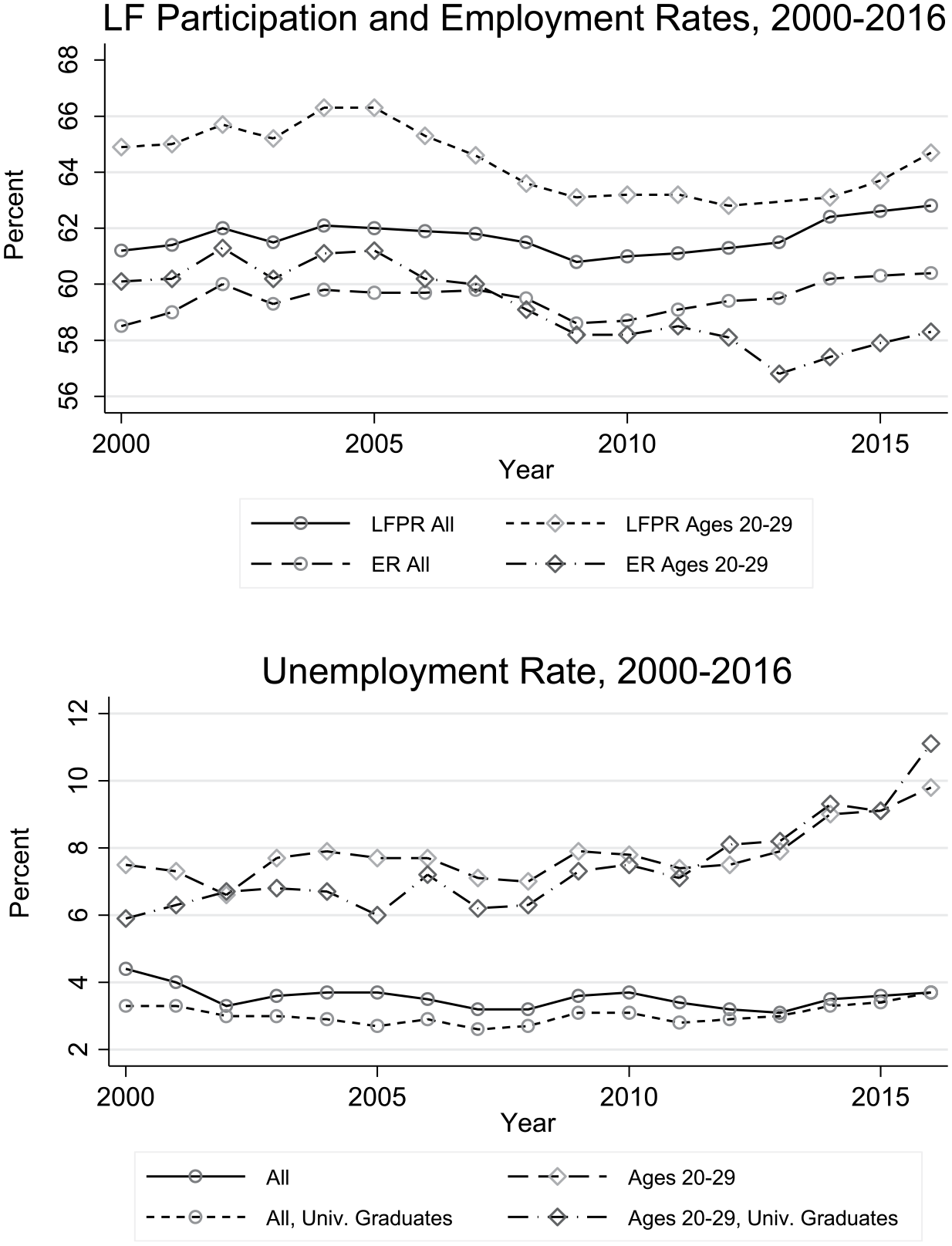
Labor Market Statistics in Korea, 2000–2016
Another key feature of the labor market in Korea is that as of this writing, the labor force participation rate (the percentage of youth employed or seeking employment) among youth is lower than that for the overall population (by 2.1 percentage points in 2016 [Figure 1]). Before 2007, the youth employment rate was higher than that of the overall population. In short, labor market conditions for youths in Korea are poor compared to other age groups, particularly for youths with a college degree or above. Despite the worsened labor market conditions for Korean youth, especially for college graduates, the college entrance rate remains around 70 percent, indicating that skill mismatch and overeducation, sometimes described as the “education bubble” in the labor market, are critical policy concerns for the country (J.-H. Lee, Jeong, and Hong 2014).
Several studies have examined the transition from school to work for college graduates in Korea (for summaries, see D. Lee et al. 2015; Shim and Kim 2015). However, most previous studies were based on a single cohort at a specific time point. To date, little attention has been paid to temporal changes in the labor market transitions of college graduates or the characteristics of those who experience particular difficulties in the labor market. In this study, we use data from the Graduate Occupational Mobility Survey (GOMS) to investigate how labor market experiences for Korean college graduates have changed over time and to identify the characteristics of the most vulnerable group in this difficult time of increasing labor market uncertainty. In the next section, we review existing evidence related to our topic. Then we describe the data and our empirical strategy and present our estimation results. Finally, we discuss the implications of our findings and suggest future research.
Background
School-to-work transition and labor market outcomes for college graduates
There have been dramatic changes in the Korean labor market over the past few decades, such as advances in technology, globalization, and the decline of marital unions. Under this changing environment, young adults in many countries struggle to secure economic stability and independence, which are important markers of the transition to adulthood (Danziger and Ratner 2010). Admittedly, the transition to adulthood is a dynamic and complicated process that takes place under diverse socioeconomic and cultural contexts. Hence, it can take on a variety of patterns and forms (see, e.g., Buchmann and Kriesi 2011; Yeung and Alipio 2013). Increasing economic hardship and instability in the labor market, especially in regions experiencing a sharp rise in housing prices, can potentially cause delays in other markers of the transition to adulthood, such as independent living arrangements, dating, marriage, and fertility (see Yeung and Alipio 2013). Although educational attainment has expanded dramatically in every region of Asia, the most dramatic increase in enrollment in higher education has been in Korea (Park 2013). This rapid expansion of higher education has posed another layer of challenges to college graduates, who form the majority group of youths in Korea, as they prepare to find jobs and also strive to compete and survive in the labor market.
There has been wide academic discussion on the determinants of labor market outcomes among college graduates. The literature on the transition from school to work, especially for college graduates, can be classified into two streams (D. Lee et al. 2015). The first stream focuses on the supply side of the labor market, and the second stream focuses on the demand side of the labor market. In the first stream, human capital theory emphasizes that the knowledge and skills accumulated through higher education increase a worker’s productivity in the labor market (Becker 1975). Hence, it is important to consider the contents and quality of educational investments, such as college major and college quality, in examining one’s labor market performance. On the other hand, the status attainment model suggested by Blau and Duncan (1967) maintains that socioeconomic backgrounds such as parental education and household income can affect the labor market outcomes of college graduates, arising from differences in educational and occupational aspirations and academic and mental abilities.
In the signaling model of the second stream, both quantity and quality of applicant’s education signal the applicant’s ability to a potential employer when there is information asymmetry between applicants and employers (Spence 1973). In a similar setting of incomplete information, a worker’s observable characteristics can provide useful information to potential employers who use the group average as a proxy for a worker’s unobserved ability—a practice called statistical discrimination (Aigner and Cain 1977; Phelps 1972). In those models, the reputation of the university from which the applicant graduated and a worker’s gender and age can be informative to employers, and they can be important factors in determining labor market outcomes.
Features of the education system and the labor market in Korea
Korea is well known for its rapid expansion in educational attainment. Nearly all Korean young people complete high school, and the vast majority of them go to college (Park 2013). Before 1992, the proportion of high school graduates who advanced to college was less than 35 percent. However, the college enrollment rate increased to 80 percent during the 1990s, along with an increase at postsecondary institutions (S. Choi 2015). As of 2017, the proportion of the population aged 25 to 34 with tertiary education amounted to 69.8 percent—the highest among the OECD countries (OECD 2018).
This dramatic expansion in educational attainment changed college graduates from the minority to the majority in a very short time (S. Choi 2015). In such an environment, high-income families privately consume additional educational resources through private supplementary education, and many students in primary and secondary education heavily depend on private supplementary education as an essential means to get ahead of other students in a so-called hypercompetitive Korean society. This has resulted in increased social stratification and inequalities in access to higher education (J. Choi and Cho 2016).
This race to get ahead, however, is not over even at college. During college, students endeavor to accumulate so-called specs, which means a set of potential qualifications that can show readiness for a job, including experience of winning a contest, certificates of various expertise in finance and computer programing, internships, volunteer work, certified test scores for English and other foreign language proficiency, and GPA. It takes enormous effort and cost to have satisfactory specs, and college students rely on a number of costly private services and training programs to achieve specs. Over the last two decades, for instance, English training abroad (ETA), a short-term language study program where students spend several months taking language courses abroad, has become an increasingly popular option among Korean college students despite its huge cost (Y. Choi 2015).
Korea’s labor market structure is also closely related to intensified educational competition among college graduates. Many studies have found that the Korean labor market is segmented into an internal and external one. Wages, job security, and fringe benefits are different in these two segments, and mobility between them is very low (Y. Choi 2015). After the Asian economic crisis of 1997, the internal labor market weakened as policies and the business environment moved in a direction that increased employment flexibility. Along with the tendency of firms to hire an experienced employee rather than a fresh graduate, nonstandard and precarious work have increased. Thus, it is getting harder for college graduates to enter the internal labor market as standard workers at a large firm.
Many studies on labor market performance of youths have documented the importance of earlier labor market outcomes on long-term career and family formation. Studies that analyze variations of economic conditions at the timing of entry into the labor market, for instance, have found that a typical recession reduces initial earnings of fresh college graduates by around 9 percent, and the negative effect is persistent up to 7 to 10 years after graduation (Kahn 2010; Oreopoulos, Von Wachter, and Heisz 2012). In a recent study, Han (2018) examined the effects of labor market conditions at the time of graduation, measured by the local unemployment rate, on labor market outcomes and fertility behaviors in Korea. When demand in the local labor market is weak at the time of graduation, male college graduates particularly show a persistently lower chance of working in a large firm. In addition, Han showed that fertility behaviors are temporarily influenced by local labor market entry conditions, which is consistent with earlier studies in Germany and Japan (e.g., Hashimoto and Kondo 2012; Hofmann and Hohmeyer 2016).
In sum, college students are well aware that one’s first job after college graduation plays a very important role in determining long-term career trajectories and many other important markers throughout the life cycle. Thus, many students delay their official graduation until they find a good job that meets their expectations with a satisfactory long-term potential even when they have fulfilled all graduation requirements. Here, we examine temporal changes in the labor market outcomes of college graduates and the characteristics of those who experience particular difficulties under increasing labor market instability. This will help to draw implications related to other demographic and social consequences that are closely linked to labor market outcomes such as residential independence, marriage, and having children (see Danziger and Ratner 2010).
Data and Empirical Strategy
Data
We use data from the GOMS, a nationally representative survey of college graduates in South Korea who graduated from either a two-year or four-year college. The GOMS records demographic characteristics of individuals and their labor market outcomes 18 to 24 months after college graduation.
Our sample consisted of nine waves of the GOMS. The first cohort, the GOMS2005 cohort, graduated from college in August 2004 or February 2005. In a similar manner, we analyzed the GOMS2007 (second), GOMS2008, GOMS2009, GOMS2010, GOMS2011, GOMS2012, GOMS2013, and GOMS2014 (ninth) cohorts. The last cohort, GOMS2014, graduated from college in August 2013 or February 2014. For GOMS2014, the survey was conducted in September 2015. Thus, surveys were conducted from September 2006 for GOMS2005 to September 2015 for GOMS2014, 18 to 24 months after the college graduation of each cohort.
We restricted our analytic sample to only four-year college graduates (72 percent of the survey participants). Two-year colleges in Korea mostly focus on vocational training, and the curriculum and contents of two-year (vocational) and four-year (academic) colleges are not comparable to each other even if they offer the same majors. Therefore, the students who enter each type of institution differ in their motivations and goals for attending college. The most important reason for this restriction is that those who graduate from four-year colleges, especially those who major in the humanities and social sciences, face particular challenges in the current labor market and receive more policy attention because of their increasing unemployment rate.
We further restricted our analytic sample to those who graduated from a college within three to eight years of matriculating. The three-year restriction is to exclude transfer students who reentered a college after attending another college for more than two years. Transfer students are sometimes treated differently in the labor market compared to those who enter one college and remain there, because transfer students often transfer from less prestigious colleges. We also excluded those who stayed in college for more than eight years to prevent possible selection bias by excluding those who greatly exceeded the normal length of college enrollment, which is up to six years, including two years of military service for males. We excluded those who attended a university of theology because, in many cases, it is not the main goal of those students to pursue a career in the labor market after college graduation. After dropping observations with missing values for the main variables in our analysis, our final analysis sample included 98,245 college graduates from nine different graduating cohorts.
Measures
Outcome variable
To examine temporal changes in the early labor market outcomes of young college graduates in Korea, we used labor market status and working conditions at the time of survey as our main outcome variables. In each wave of the survey, respondents were asked to describe their main activities in the preceding week. Based on their answers, we classified respondents into four categories: (1) working (72.8 percent), (2) schooling (10.8 percent), (3) job searching (13.3 percent), and (4) other activities (3.1 percent). The other activities category included those who declared their main activities as full-time caregiving, housekeeping, preparing for marriage, taking a break, and so on. However, only 3.1 percent of our analytic sample belonged to this fourth category, comprising 4.3 percent of female graduates and 2.1 percent of male graduates.
For those who worked the week before, we noted whether they worked in a large establishment (more than three hundred employees). If respondents declared that they worked, we also noted whether they were hired with a stable contract for more than one year. These two job characteristics are generally regarded as a good proxy for a preferable workplace that provides good working conditions, fringe benefits, and social insurance.
Covariates
To identify differences in labor market outcomes depending on observable characteristics of respondents and to identify the most vulnerable groups over time, we considered demographic characteristics and socioeconomic background as well as university characteristics. In the analyses, we controlled for respondent age and gender at the time of the survey.
Parental education level is the higher of the mother’s and father’s level of education. In the GOMS, parental education level is divided into seven distinct levels: (1) no formal education, (2) graduated from elementary school, (3) graduated from middle school, (4) graduated from high school, (5) graduated from two-year college, (6) graduated from four-year university, and (7) completed graduate program. For our analysis, we collapsed these seven levels into five by combining (1), (2), and (3) as middle school graduate or below.
As another socioeconomic indicator during college, we used information on household income at the time of college entrance. In the GOMS, household income comprises nine distinct levels in units of 10,000 Korean Won (approximately $8.8): (1) none, (2) 100 or less, (3) 101–200, (4) 201–300, (5) 301–400, (6) 401–500, (7) 501–700, (8) 701–1,000, and (9) 1,001 or more. For our analysis, we combined the levels of household income into seven levels by combining (1), (2), and (3) into an income level of 200 or below. (Please note that in the GOMS2005, the income category questionnaire was slightly different. Two income levels of [7] and [8] were combined into a level of 501–1,000. We treated this income category in the GOMS2005 as comparable to level [7] in other graduating cohorts. Even if we assume that the income category is comparable to level [8], our results are almost the same.)
Using university names in the GOMS data and relevant statistics from the 2015 evaluation report of Korean universities conducted annually by the news company Joongang Ilbo, we categorized universities included in the GOMS data into five types. Type 1 contains top-tier universities in Seoul, those consistently ranked one to six by the evaluation report since 2000. Graduates from those universities scored around the top 2 percent in the national college entrance examination. Type 2 includes the next five universities in Joongang Ilbo’s 2015 evaluation report, which are also in Seoul. Type 3 includes the remaining thirty-one universities in Seoul. The thirty-nine public universities outside Seoul are Type 4. Type 5 contains the 129 private universities outside Seoul. Among the universities outside Seoul, public universities are generally preferred to private ones.
The GOMS provides seven broad categories of college major: (1) humanities; (2) social sciences; (3) education; (4) engineering; (5) natural sciences; (6) medical sciences; and (7) arts, music, and physical education.
Summary statistics
Descriptive statistics for the sociodemographic characteristics of our sample are presented in Table 1. We first present the mean of each variable based on the pooled sample (GOMS2005–GOMS2014) and then present statistics for the individual graduating cohorts from 2005, 2010, and 2014 to show changes in the covariates over time. Because we restricted the age of the sample to younger than 30 years, the average age of the pooled sample was 26.1 years at the time of the survey. Consistently across the graduating cohorts, about 55 percent of graduates were male and 45 percent were female.
Summary Statistics of the Respondents

For the entire sample, the proportion of parents with a four-year university degree or above was 36 percent. Due to educational expansion in Korea, that percentage grew from 31 percent in GOMS2005 to 45 percent in GOMS2014. Overall, 37 percent of respondents had a household income below 300, and the proportion of respondents whose household income was above 700 was about 9 percent of the entire sample. However, income distribution varied across cohorts.
Of all respondents, 8 to 10 percent graduated from the top six universities in Seoul (Type 1), and about half graduated from private universities outside Seoul (Type 5). As to the distribution of college major, graduates who majored in engineering formed the largest group (27 percent), followed by the social sciences (23 percent). The largest number of respondents was in GOMS2005; the remaining cohorts were all of a similar proportion.
Analysis
Our goal was to analyze the labor market status and job quality of respondents about two years after graduation. Because labor market status is classified into three categories (1 = working; 2 = schooling; 3 = job searching), we used multinomial logit models to predict the likelihood of staying in school after college graduation and the likelihood of conducting a job search, relative to working in the labor market, by respondent demographics and family and university characteristics across graduating cohorts, as specified in the following equation:

where Yit is the current activity among the three categories of respondent i from graduating cohort t. In the estimation, we included four dummy variables for parental education, using parents with a middle school degree or below as the reference group. We included six dummy variables for household income at the time of college entrance, with a household monthly income of 200 or below as the reference group. As mentioned earlier, we distinguished five types of universities. So we include four dummy variables, with Type 1 as the reference group. For college major, we set humanities as the reference group and include six dummy variables. μt is a graduating cohort fixed effect to capture differences from the reference group, the 2005 graduating cohort. By including the cohort fixed effects, we tried to account for varying economic conditions that are common to each graduating cohort. We first pooled the sample across all nine graduating cohorts and performed the multinomial regression model. Then we estimated this regression model separately for each graduating cohort to allow for differential degrees of relationship between the outcome variables and covariates.
To analyze whether a respondent worked with a stable contract for more than one year or worked in a large establishment, we applied a logit model to the dichotomous variable with the same specification as in the multinomial logit model above.
We first present coefficients and standard errors from the multinomial logit regressions as our main results. Then we consider the average marginal effect for each control variable to assess the magnitude of the effect using the MARGINS post-estimation command in Stata. For easier understanding, we also present the results by covariate in our figures.
Results
Current labor market status
To investigate temporal changes in labor market outcomes in the medium term, we analyzed the labor market status of respondents at the time of the survey, 18 to 24 months after graduation, using a multinomial logit model. The temporal change in the proportion of graduates conducting a job search, in contrast to those currently working, would reveal the difficulties faced by each graduating cohort in the labor market during the first two years after college graduation (Table 2). To make it easier to understand the estimation results, we calculated the marginal effect across different observable characteristics, presenting the results in Figure 2.
Current Status and Job Quality 18 to 24 Months after College Graduation

NOTE: Standard errors in parentheses.
p < .1. **p < .05. ***p < .01.

Predictive Margins of Conducting a Job Search at the Time of the Survey (Pooled Sample from GOMS2005–GOMS2014)
First, after controlling for other variables, the predictive margin for conducting a job search increased consistently over time, as shown in panel A of Figure 2. For the GOMS2007 cohort, the difference from the GOMS2005 cohort, the reference group, was fewer than 1.4 percentage points. However, the difference between the GOMS2014 and the GOMS2005 cohorts had widened to about 5.0 percentage points. This result clearly shows the increasing difficulty in finding a job faced by the most recent cohort amid deteriorating labor market conditions.
To determine the most vulnerable group in the worsening labor market environment, we provide the predictive margins for conducting a job search across several key characteristics. As presented in panel D of Figure 2, we found a consistent difference in the probability of conducting a job search 18 to 24 months after college graduation by type of university. Compared to those who graduated from a Type 1 university, those who graduated from Type 2 universities experienced 2.5 percentage points greater chance of conducting a job search at the time of the survey. Graduates from both public universities (Type 4) and private universities (Type 5) outside Seoul experienced 5.7 percentage points greater chance of conducting a job search.
Although parental education did not show a systematic relationship with conducting a job search at the time of the survey (panel B of Figure 2), monthly household income at the time of college entrance did show a meaningful correlation with conducting a job search. As household income increased, the marginal probability of conducting a job search monotonically decreased, with a reduced magnitude of about 5 percentage points for graduates in the top income category of 1,000 or above compared to graduates with household income below 200 (panel C of Figure 2).
In terms of college major (panel E of Figure 2), those who majored in the humanities, social sciences, or education had a higher probability of conducting a job search than those with majors in engineering or medical sciences. The gap in the marginal probability of conducting a job search between a humanities major and a medical sciences major was 10.5 percentage points.
Quality of current job
To examine temporal changes in the job quality of a respondent’s current job, we present estimation results from the logit model in columns (3) and (4) of Table 2. Compared with the graduating cohort of 2005, the GOMS2011, GOMS2012, and GOMS2014 cohorts showed a significantly negative correlation with possession of a stable contract for more than one year. To better understand the economic meaning of these coefficients, we calculated the marginal effects of each covariate, and we present them in Table 3. As presented in column (4) of Table 3, household income was positively related with having a stable contract. College graduates from wealthy backgrounds with household incomes above 1,000 were more likely to have a stable job by 5.4 percentage points compared to their counterparts from households with incomes less than 200. Similarly, in terms of college type, those who graduated from private universities outside Seoul (Type 5) showed a 3.6 percentage point lower chance of having a stable contract compared to those who graduated from the most prestigious universities (Type 1). In terms of college major, those who majored in humanities were found to have the most difficulty in finding a stable job. Those who majored in engineering were more likely to have a stable contract by 8.5 percentage points compared to those who majored in the humanities. There are also differences across graduating cohorts. For instance, the probability of having a stable work contract was lower by 3.6 percentage points for the GOMS2011 cohort and 3.7 percentage points for the GOMS2014 cohort compared with GOMS2005 cohort.
Marginal Probability of Conducting a Job Search (Pooled Sample)

A similar association exists in terms of size of firm where a graduate worked. As household income increased, the marginal probability of working at a large establishment monotonically increased, reaching 5.1 percentage points for graduates in the top income category of 1,000 or above, compared to graduates with household incomes below 200. The difference in chances of working at a large establishment was quite substantial across graduates from different types of universities. Compared to those who graduated from a Type 1 university, those who graduated from Type 2 universities experienced a 13.3 percentage point lower chance of working at a large establishment at the time of the survey. Graduates from private universities outside Seoul (Type 5) experienced a 32.8 percentage point lower chance of working at a large establishment. Although it fluctuated over time, recent graduating cohorts showed a lower chance of working at a large establishment. The marginal effects show that the GOMS2013 cohort and GOMS2014 cohort were 3.0 percentage points and 3.9 percentage points, respectively, less likely to work at a large establishment than the GOMS2005 cohort.
In sum, the proportion of those who were searching for a job at the time of the survey instead of working or staying in school for additional education increased over time. In addition, even those who were employed 18 to 24 months after their college graduation experienced deteriorating job quality in terms of job stability and establishment size.
Variation by graduating cohort
Thus far, we have presented estimation results based on the pooled sample, including dummy variables to distinguish each graduating cohort and examine temporal changes in labor market outcomes. These analyses assume that the degree of correlation between each outcome variable and covariate is common across graduating cohorts. In other words, we have estimated the average effect across years. In Table 4, we present a multinomial regression for each cohort separately to assess potentially different magnitudes of correlation between labor market status and each covariate over time. We calculate the marginal effects, which we present in Table 4, and plot the marginal effects for each covariate in a separate panel in Figure 3.
Marginal Probability of Conducting a Job Search by Graduating Cohort


Predictive Margins of Conducting a Job Search by Graduating Cohort
As seen in panels B, C, and D of Figure 3, despite variations in the degree of association between each covariate and the marginal probability of conducting a job search, each level within the same covariate followed a similar trend and maintained the gap between levels. In terms of household income, the gap in the probability of conducting a job search was 5.7 percentage points lower in 2005 for graduates whose household income was above 1,000 compared to those from households with incomes below 200. This gap narrowed to 3.5 percentage points in 2014. Similar patterns were observed for other levels of household income. Regarding parental education, no systematic pattern emerged (panel A of Figure 3).
However, as shown in panel C of Figure 3, the gap between university types generally increased. Compared to those who graduated from a Type 1 university, graduates from a Type 5 university faced a 5.3 percentage point higher marginal probability of conducting a job search in 2005, which increased to 8 percentage points in 2014. Although there was a fluctuation due to the business cycle, the gap between graduates from Type 2 (also Type 3 and Type 4) universities and those who graduated from Type 1 universities widened.
Last, there was a growing gap between groups based on college major. In GOMS2014, those who majored in the humanities were the highest proportion conducting a job search (23.1 percent; see Table A1 in the appendix for details). In contrast, the proportion conducting a job search was 6.8 percent among those who majored in medical sciences and 12.3 percent among those who majored in engineering. Overall, the ranking based on the proportion of respondents conducting a job search was stable, but the gap widened unfavorably for those who majored in the humanities. The gap in the marginal probability of conducting a job search between a humanities major and a medical sciences major was 16.1 percentage points for the GOMS2014 cohort, increasing from 8.5 percentage points for the GOMS2005 cohort.
Discussion and Implications
Our investigation shows how the labor market experiences of Korean college graduates have changed over time and identified characteristics of the groups most vulnerable in this difficult time of increasing labor market uncertainty, 18 to 24 months after college graduation.
The proportion of those who were searching for a job rather than working or staying in school increased over time. Even among those who were employed at the time of the survey, job quality deteriorated in terms of job stability and firm size. Comparing results separately by year shows a growing gap in the labor market outcomes by type of university and college major. Those who graduated from less prestigious universities in the hierarchical structure of Korean higher education and those who majored in the humanities, social sciences, or education faced particularly significant difficulties in employment that increased over time.
Although this study carefully describes temporal changes in several important labor market outcomes among young graduates from four-year universities according to demographic, family, and university background, it has several limitations. First, in thinking about the transition from school to work, it is important to examine the process of obtaining a first job and the quality of that first job. Unfortunately, in the GOMS survey, graduates who remained in their first job until the survey reported job conditions that were potentially 18 to 24 months after their first day at work. During that time, they might have experienced significant changes, even in the same workplace. Therefore, we focused directly on temporal changes in labor market outcomes 18 to 24 months after graduation.
Second, we narrowed our focus to those graduating from four-year universities to produce a homogeneous and comparable analytic sample. However, a more comprehensive understanding of the overall situation of the youth labor market will require an analysis of those who graduated from two-year colleges and those who chose not to go to college.
Last, future research with longitudinal data will enable analysis of more long-term labor market transitions and accompanying outcomes. In November 2015, GOMS conducted a long-term follow-up survey for the cohorts from 2005, 2007, and 2008, and the data will be available to the public in due course. This will provide a better understanding of labor market transitions and outcomes of young college graduates within a 10-year window of college graduation.
The gaps in the labor market outcomes by school type and major are not unique to Korean college graduates. Long (2010) shows that college quality increases earnings, and the magnitudes of the effects increased between the 1970s and 1990s in the United States. Audit studies have also found that graduates from elite universities earn more in their midcareer years and receive more employer responses compared to their counterparts from less selective institutions (Gaddis 2014; Vedder, Denhart, and Robe 2013). A growing body of research reports substantial differences in the various dimensions of labor market outcomes by fields of study in Canada, the United States, and European countries (e.g., Livanos 2010; Kim, Tamborini, and Sakamoto 2015; Monaghan and Jang 2017; Pullman 2018; Reimer, Noelke, and Kucel 2008; Roksa and Levey 2010). In line with rapid technological change and globalization, the gaps in labor market outcomes by college reputation and major will widen.
As labor market instability increases and concerns about youth unemployment and precarious work grow (Kalleberg and Hewison 2013; Shin 2013), the Korean government has implemented various policies to help vulnerable youths in the labor market. Financial subsidies and tax benefits for middle or small-sized firms have been expanded for new and young employees, and it is mandatory for at least 3 percent of the employee pool in public institutions and enterprises to be young employees aged 15 to 34. Recently, the government launched an online platform to provide information on labor policies and real-time employment counseling for youth, and also established college-based employment centers to help college students to successfully transition from school to work.
Despite various recent policy interventions in Korea, there remain substantial and growing differences in the labor market outcomes by school type and college major, as shown by our results. Hence, further support is needed for vulnerable groups of young college graduates, especially those who graduate from less prestigious colleges or those who major in the humanities or social sciences. As confirmed in this study, even among those who were employed, the gaps in job quality have widened over time by school type and major, even around 18 to 24 months after graduation. Hence, the current college evaluation system should be improved to further take into account various measures of job quality from a long-term perspective. In addition, incentives and policy guidance are needed to encourage colleges to think about the labor market performance of their graduates. And the government and interest groups should put more effort into encouraging both colleges and students to prepare well to meet the changing demands of the labor market in an era of rapid technological development.
Footnotes
Appendix
Distribution of Current Status at the Survey by Characteristics

| All |
G2005 |
G2010 |
G2014 |
|||||||||
|---|---|---|---|---|---|---|---|---|---|---|---|---|
| Work | School | Search | Work | School | Search | Work | School | Search | Work | School | Search | |
| Parental education | ||||||||||||
| Middle school or below | 77.9 | 8.2 | 13.9 | 78.7 | 8.6 | 12.7 | 81.0 | 6.9 | 12.1 | 76.2 | 6.7 | 17.1 |
| High school | 76.4 | 9.3 | 14.2 | 77.3 | 10.8 | 11.8 | 78.1 | 8.5 | 13.4 | 74.0 | 9.4 | 16.6 |
| Two-year college | 75.0 | 10.0 | 15.0 | 80.4 | 10.8 | 8.8 | 77.9 | 10.2 | 11.9 | 71.2 | 10.2 | 18.6 |
| University | 73.7 | 13.4 | 13.0 | 75.2 | 14.3 | 10.5 | 74.6 | 12.0 | 13.4 | 72.7 | 13.7 | 13.6 |
| Graduate school | 68.9 | 19.1 | 12.0 | 72.0 | 18.9 | 9.1 | 71.6 | 16.7 | 11.8 | 62.5 | 22.6 | 14.9 |
| Household income (in 10,000 Korean Won) | ||||||||||||
| ~200 | 76.2 | 9.5 | 14.3 | 77.7 | 9.7 | 12.6 | 79.5 | 7.9 | 12.6 | 72.0 | 11.4 | 16.7 |
| 200~300 | 75.0 | 9.9 | 15.2 | 75.3 | 11.3 | 13.4 | 77.0 | 8.4 | 14.6 | 73.5 | 10.1 | 16.4 |
| 300~400 | 75.0 | 10.6 | 14.5 | 77.2 | 12.1 | 10.7 | 76.8 | 9.1 | 14.1 | 72.6 | 10.6 | 16.8 |
| 400~500 | 74.6 | 11.7 | 13.7 | 77.3 | 12.9 | 9.8 | 74.8 | 11.8 | 13.5 | 72.5 | 11.7 | 15.8 |
| 500~700 | 75.8 | 13.3 | 10.9 | 77.5 | 13.8 | 8.7 | 76.4 | 12.4 | 11.2 | 71.7 | 14.6 | 13.7 |
| 700~1,000 | 74.0 | 15.1 | 10.9 | 77.5 | 13.4 | 9.1 | 70.8 | 17.1 | 12.1 | |||
| 1,000~ | 75.0 | 15.8 | 9.2 | 79.0 | 14.6 | 6.4 | 80.4 | 13.2 | 6.4 | 71.7 | 16.4 | 11.9 |
| College type | ||||||||||||
| Type 1 | 68.0 | 23.8 | 8.1 | 71.5 | 21.5 | 7.0 | 70.0 | 20.1 | 9.9 | 61.3 | 30.0 | 8.6 |
| Type 2 | 73.2 | 15.3 | 11.5 | 76.0 | 14.6 | 9.4 | 77.0 | 13.4 | 9.6 | 67.2 | 19.6 | 13.2 |
| Type 3 | 75.2 | 11.8 | 13.0 | 76.9 | 13.0 | 10.0 | 77.3 | 10.4 | 12.3 | 70.0 | 14.5 | 15.5 |
| Type 4 | 74.0 | 10.8 | 15.2 | 77.2 | 10.3 | 12.5 | 74.3 | 11.1 | 14.6 | 73.7 | 10.8 | 15.5 |
| Type 5 | 77.1 | 8.6 | 14.3 | 77.8 | 9.7 | 12.5 | 79.5 | 7.3 | 13.2 | 74.5 | 8.7 | 16.8 |
| College major | ||||||||||||
| Humanities | 72.0 | 11.5 | 16.5 | 73.6 | 12.9 | 13.5 | 75.7 | 11.1 | 13.2 | 66.0 | 11.0 | 23.1 |
| Social sciences | 78.3 | 5.2 | 16.5 | 80.0 | 5.1 | 14.9 | 78.7 | 5.6 | 15.8 | 76.4 | 5.7 | 17.9 |
| Education | 76.9 | 4.3 | 18.8 | 83.1 | 3.8 | 13.2 | 72.4 | 5.1 | 22.5 | 80.0 | 4.2 | 15.9 |
| Engineering | 76.0 | 13.9 | 10.1 | 76.0 | 15.7 | 8.3 | 78.7 | 12.0 | 9.2 | 72.7 | 14.9 | 12.3 |
| Natural sciences | 65.7 | 21.2 | 13.1 | 67.0 | 21.2 | 11.8 | 69.9 | 18.3 | 11.7 | 61.1 | 23.1 | 15.8 |
| Medical sciences | 85.2 | 8.7 | 6.1 | 86.6 | 8.2 | 5.3 | 84.0 | 11.2 | 4.8 | 87.3 | 5.9 | 6.8 |
| Arts, music, & physical | 78.1 | 10.0 | 11.9 | 81.2 | 10.3 | 8.5 | 81.5 | 7.7 | 10.8 | 75.9 | 9.9 | 14.2 |
| Overall | 75.1 | 11.2 | 13.7 | 76.8 | 11.8 | 11.4 | 77.0 | 10.1 | 12.9 | 72.4 | 12.1 | 15.5 |
NOTE:
This work was presented at the international conference “Labor Market Uncertainties for Youth and Young Adults” at the Asia Research Institute, National University of Singapore, November 9–10, 2017. This work was supported by the Laboratory Program for Korean Studies through the Ministry of Education of Republic of Korea and Korean Studies Promotion Service of the Academy of Korean Studies (AKS-2016-LAB-2250002).
Jaesung Choi is an associate professor in the Department of Global Economics at Sungkyunkwan University in Seoul, Korea. His research interests are labor, education, and program evaluation. His research focuses on evaluating education and labor market policies in Korea.
Hannah Bae is a doctoral student in the Economics Department at the University of California, San Diego. Her fields of interest are labor economics and economics of education. She uses empirical analysis to understand the labor market for youth and the elderly in Korea.