



Abstract
The economic crisis has had an earth-shattering effect in Spain at all levels: economic, political, institutional, and social. There are different interpretations about the causes of the crisis. Most of the analyses on the economic crisis in Spain have concerned themselves with phenomena like mismanaged banks, excessive debts, the bubble in the real estate sector, or the loss of competitiveness. Others have sought to explain the crisis as a byproduct of European Monetary Union integration. This article moves beyond those explanations and argues that a fundamental reason for the crisis is rooted in the process of institutional degeneration that preceded the crisis.
Between 1996 and 2007, the Spanish economy was one of the fastest growing and the most successful economies in Europe. High levels of immigration, low interest rates, and the liberalization and modernization of the Spanish economy all contributed to this spectacular performance. This success, however, came to a halt in 2008, and in the winter of 2013, Spain is still suffering the effects of a very painful economic crisis.
The great recession that began in 2008 has been blamed on global capital imbalances, inadequate central bank policies, greed, the failure of institutions, faulty risk-assessment models, or the pervasive belief that “this time was different,” that we had found the cure against the business cycle, and that housing prices would go on rising forever. Although the global economic crisis has been a significant contributing factor in this downturn, this article shows that domestic factors largely help account for Spain’s current economic problems.
The crisis in Spain took place in the context of two larger transformations: first, a socioeconomic transformation driven by globalization (with the downward pressure that it has been exerting on wages), as well as the introduction of new technologies (with its impact on the labor market). Changing family structures, the decline of unions, the erosion of civil society, and educational gaps have also impacted the socioeconomic fabric of the country. In addition, the economic crisis has taken place in the context of the unraveling of the national fabric. After decades of authoritarianism, the democratic transition of the late 1970s that culminated with the 1978 Constitution seemed to settle many of the division that had torn the country for centuries. The crisis, however, has exposed the fragility of that settlement and is battering institutions, political parties, and national elites.
The crisis has had an earth-shattering effect in Spain at all levels: economic, political, institutional, and social. There have been different interpretations about the causes and culprits for the crisis. Most of the analyses on the economic crisis in Spain have concerned themselves with phenomena like mismanaged banks, excessive debts, the bubble in the real estate sector, or the loss of competitiveness (Barrón, 2013; Molinas, 2013; Ortega & Pascual-Ramsay, 2013; Quaglia & Royo, 2013; Royo, 2013). Others have sought to explain the crisis as a byproduct of globalization and/or European Monetary Union (EMU) integration because it eliminated exchange rate risks in a way in which investors in the southern countries accepted lower yields (Armigeon & Baccaro, 2013; Bermeo & Pontusson, 2012; Cameron, 2013; Kahler & Lake, 2013). This led to massive capital inflows toward the periphery that fueled booms that turned into bubbles (in the case of Spain, particularly in the real estate sector), causing massive current account deficits. When the global financial crisis hit these countries, the bubble burst and investors refused to continue financing these deficits, which exposed these uncompetitive economies.
The article seeks to contribute to the debate about the causes of the crisis in Spain and seeks to complement these analyses. It moves beyond the above explanations and argues that a fundamental reason for the crisis is rooted in the process of institutional degeneration that preceded the crisis (Ferguson, 2013). The article seeks to explore the consequences that the institutional degradation has brought to the Spanish economy, and it argues that the institutional degeneration led to a Spanish version of crony capitalism characterized by the misgovernment of the public, an outdated and inadequate policy-making process; an inefficient state; and an often corrupt and inefficient political class. Mismanaged banks, excessive debts, bubbles in the real estate sector, or competitiveness losses are all symptoms of an institutional malaise that intensified in the years prior to the crisis. Indeed, we cannot understand the bubble in the real estate sector, the loss of competitiveness, or the financial crisis without referencing the institutional divergence in the rule of law between Spain and the European Union (EU) core. The real estate bubble, the competitiveness divergence, and the financial crisis are all rooted on the rule of law divergence. Moreover, it was this institutional divergence that made it difficult to implement the reforms that EMU demanded (and that Germany is now demanding). This article seeks to examine the causes of Spain’s “stationary state” and argues that they are in large part the result of “laws and institutions.” They are the problem, and the economic crisis is a symptom of the institutional degeneration (Ferguson, 2013, pp. 8-10).
This research builds on and develops further the institutional approach by Ferguson (2013), and Acemoglu and Robinson (2012), identifying the distinctive institutional features that underline countries’ economic success (or lack thereof). It shows that the economic success spurred by the country’s modernization and EU membership was not sustained because the governments (at all levels: local, regional, and national) became less accountable and responsive to citizens. In terms of causal mechanisms between institutional degradation and economic crisis, it shows (following Acemoglu and Robinson’s [2012] terminology) that institutions across the country became more “extractive” and concentrated power and opportunity in the hands of only a few. Indeed, political and economic institutions came short in empowering and protecting the full potential of Spanish citizens to innovate, develop, and invest. They did not foster the degree of “creative destruction” that is vital for innovation and sustainable growth, and instead they promoted an unsustainable model based on a real estate bubble. Finally, institutional deterioration made it difficult to implement the economic reforms required as members of a monetary union. Political and economic institutions resisted reforms because they would jeopardize the existence of the extractive rent-seeking mechanisms that became the main source of rent for the economic and political elites that controlled them.
The article is organized as follows: Section 2 briefly reviews the literature on external and domestic factors feeding the sovereign debt crises. Section 3 analyzes some of the causes of the crisis. Sections 4 and 5 discuss the process of institutional degeneration and institutional divergence that led to the crisis. It finishes with a conclusion.
Literature Review
The economic literature has paid considerable attention to the economic factors associated with sovereign debt crises (see Quaglia & Royo, 2013). One of the most extensive studies of financial crises highlighted a strong causal link between banking crises and sovereign defaults in developed and developing countries (Reinhart & Rogoff, 2009). Kaminsky and Reinhart (1999) also pointed out the link between banking crises and balance of payment crises (the so-called “twin crises”). They found that financial liberalization often precedes banking crises and also that problems in the banking sector typically precede a currency crisis—the currency crisis often deepens the banking crisis, activating a vicious spiral. Economic crises occur as the economy enters a recession, following a prolonged boom in economic activity fueled by credit, capital inflows, and accompanied by an overvalued currency. These accounts, written by economists, draw our attention to banking crises and balance of payments crises as the precursors of sovereign debt crises. The accounts are, however, devoid of political analysis and do not explain the initial causes of banking crises and balance of payment crises.
In the political economy literature, several complementary explanations account for the occurrence of sovereign debt crises, mainly in developing countries. These explanations can be articulated either at the international level, whereby the focus is on external factors that caused the crisis, or alternatively at the national level, whereby the focus is on the domestic factors that caused the crisis (for a similar macro–meso distinction, see Germain, 2012). At the international level, different authors have pointed out a variety of factors that can fuel sovereign debt crises, namely the impact of capital liberalization (Stiglitz, 2000); the activity of bond markets (Mosley, 2003) and financial innovation, especially financialization (Hardie, 2011); the spread of neoliberal ideas (Major, 2012); and the lack of a proper hegemon in the international system (Kindleberger, 1973)—more recently in the EU (Mabbet & Schelke, 2013). Finally, Skocpol’s (1979) seminal comparative work on social revolutions argued for structural analysis and emphasized the effects of transnational and world-historical contexts upon domestic political conflicts.
Although some elements of the crisis can certainly be explained by international factors—such as financial liberalization—these factors are basically the same for all countries, especially within the relatively homogenous regional block of the Euroarea. Hence, they are not well suited to explain differences in the outcomes of the sovereign debt crises across countries. These background factors fueled the sovereign debt crisis, but domestic factors better explain different dynamics of the crisis across countries (see Haggard & Mo, 2000; Jabko & Massoc, 2012).
An obvious starting point to investigate the importance of national-level institutional factors in how the sovereign debt crisis played out is the literature on varieties of capitalism (VoC) (for comprehensive analyses, see Amable, 2003; Becker, 2006; Hall & Soskice, 2001; Hancké, Rhodes, & Thatcher, 2007; Schmidt, 2002; for a review, see Jackson & Deeg, 2008). These works have examined the main components of varieties of capitalism, namely industrial relations institutions, education and training systems, corporate governance and systems of corporate financing, product markets, social protection systems and welfare states, and public intervention in the economy.
This literature has generally focused on the Anglo-Saxon and continental varieties of capitalism, characterizing them, respectively, as “liberal market economies” and “coordinated market economies.” The Southern European countries have been overlooked or placed in a residual category of “Southern European” or “State-led” model of capitalism (Della Sala, 2004; Royo, 2008; Schmidt, 2002). The literature on varieties of capitalism is of limited utility in explaining the dynamics of the economic crisis in Spain, because it inaccurately predicts similar outcomes among countries with similar institutional frameworks.
For instance, in the academic literature, Italy and Spain are often grouped together in the same variety of “Southern European” capitalism. Consequently, one could have expected similar outcomes from the crises in the two countries. However, Spain experienced a full-fledged sovereign debt crisis resorting to Euroarea financial assistance for its banks, whereas Italy did not. Indeed, Spain experienced a severe banking crisis including the bailout of a number of the country’s banks, which substantially increased the public deficit and debt. By contrast, Italian banks, with one exception, did not experience such significant losses and they needed no recapitalization by the government (Quaglia & Royo, 2014). To be fair, this literature was not developed to explain sovereign debt crises, but rather to tease out institutional complementarities that can enhance or hinder the competitiveness of national economic systems in the world economy.
Finally, the literature on domestic political economy institutions and economic policies (e.g., Mahoney & Thelen, 2009; Thelen, 2004) is of relevance for this research, in particular those works that have looked at the interaction between domestic and external factors in economic policy. Some authors have examined the effects of “internationalization” and “liberalization” on domestic political economy institutions, such as financial markets (Deeg & Luetz, 2000; Pérez, 1998; Thatcher, 2007) and systems of corporate finance and governance (Deeg & Pérez, 2000). Other authors have highlighted the role of the state and domestic political institutions in framing globalization (Weiss, 2003), and more generally in political economy (Schmidt, 2009). This article is grounded in the comparative historical analysis literature. It seeks to offer a historical grounded explanation of the 2007 economic crisis in Spain, and it is concerned with causal analysis (the causes of the economic crisis) while emphasizing processes over time.
Methodology
This article has chosen an historic and institutional approach that considers the objectives of policy makers and social actors, as well as the way that they interpret existing economic and political conditions. This approach allows the researcher to examine the ways institutions structure the relations among actors and shape their interests and goals, thus constraining political struggles and influencing outcomes (Steinmo, Thelen, & Longstreth, 1992, p. 2).
Most of the research material for this project has been gathered in Spain. In order to pursue this analysis, the author conducted an extensive review of the secondary literature and has interviewed scholars, social actors, and policy makers. The author has met with employers and representatives from the main business confederations in Spain and has conducted interviews with the leaders of the employers’ association and the major trade unions, as well as leaders and representatives of the main political parties. In addition, the author has interviewed former and current high-ranking officials from state agencies: ministries of labor, economics, and the central banks. Finally, the author has conferred with leading scholars and specialists in politics, industrial relations, and economics in Spain and the United States. In addition, secondary sources of data come from the libraries and records of selected government departments and the social actors.
Understanding the Crisis
Who was responsible for the crisis? Fingers can point in all directions, but it is a collective failure. 1 Spain squandered the privileges of EMU membership, and a lot of the ongoing resentment from its European neighbors comes from that. But it is not just the Spaniards’ fault. Although it is true that a series of Spanish governments bears a large part of the responsibility for mismanaging the economy and finances of the country (particularly at the local and regional levels), there are also other culprits. European banks, for instance, also fueled the real estate bubble because they continued to lend money to Spaniards, and the subprime crisis in the United States ignited an unprecedented global financial crisis with severe effects on the European and Spanish economies.
In addition, the fundamental institutional design problems of the EMU, which did not include a fiscal union, a European joint bank regulator, or a system to deal with financial institutions in stress, also go a long way in explaining the crisis of the Eurozone. Spain, like Ireland, is suffering the consequences of these deficiencies; the country’s financial crisis has precipitated a national debt crisis because it cannot afford to bail out its own financial institutions. The EMU also lacked effective mechanisms to control the member states’ finances and to penalize those who violated the budget rules. And this did not start with the current crisis; when the Euro was first introduced, the Germans and the French were the first ones to argue vehemently for the rules to be watered down to avoid spending cuts. Eurozone countries minimized these risks and are now dealing with the consequences of their hubris, while they are trying to make the institutional changes (a fiscal union and a European-level bank regulator), but in a much more difficult political and economic environment (see Ewing, 2012).
Furthermore, investors also share some of the blame; they underpriced the risk of Spanish debt before the crisis, but now they overreact to even minor events, causing havoc with the borrowing costs of the country and thus on its economy. European governments, including the German and French, also lent money to Spain so it could be used to buy German exports. The financial regulators also overlooked the problems of the banks and cajas (savings and loans) and failed to act decisively to address them. The national governments in Spain did little to address the real estate bubble and to shift the existing economic growth model. What we are witnessing today at the national and European levels is a blame game that underscored the erosion of the principles of cooperation and solidarity that have underpinned the process of European integration.
As much as there has been a fixation with the economy, with economic policies and with the economic responses to the crisis, it is impossible to understand what has happened without focusing on the politics. In the case of Spain (and the Eurozone as well), it is only appropriate to update the famous campaign slogan, “it’s the economy, stupid,” that James Carville coined during the first Clinton presidential campaign with a new version, “it’s the politics, stupid.” The politics of the crisis, both at the domestic and European levels, have been simply abysmal. Indeed, 5 years into the crisis, it is still perplexing that the political leaders of the country do not have a clear and coherent diagnosis of the crisis, that they keep blaming others for what is happening to the country and fail to assume any responsibilities, 2 that they do not yet have a credible long-term plan on how to get the country out of the crisis, and that they insist on austerity and undermine the decisions (such as investment on Research-Development-Innovation [R-D-I] and education) that would set the path for a sustainable future growth. In this regard, the crisis exposed the deficiencies of a political class, supported by its political parties, which developed its own particular set of interests and instruments to sustain it through a system of rent-seeking based on crony capitalism.
Politicians in Spain have been blamed for the real estate, infrastructure, and the renewable energy bubbles, and for the collapse of the cajas, which ultimately led to the EU bailout (Molinas, 2013). According to an influential newspaper article titled “Theory of Spain’s Political Class,” published by Cesar Molinas in the Spanish daily El País (which became the basis of his book published in 2013), the roots of the current problems originate in the transition to democracy when politicians adopted a proportional representation voting system with closed, blocked lists that sought to consolidate the party system by strengthening the internal power of the party leaders and adopted the decentralization of the Spanish state (see also Molinas, 2013). The consequences of these decisions have been enduring. The choice of voting system and blocked lists resulted in a professional political class owing its allegiance to the leaders of the party (which are the ones that place them in the voting lists and/or give them public jobs for the compliance and submission). This has led to a structure in which there is very little contestation within parties and in which loyalty, rather than merit or competence, rules. At the same time, the decentralization process—originally designed as a top-down process, became a bottom-up one led by local and regional elites—has led to the creation of 17 regional governments, as well as thousands of public agencies and companies that became instruments of political patronage. The subsequent decentralization of political parties that followed the political one led to the emergence of regional, local elites that took over the local and regional institutions, including the cajas, whose boards were quickly filled with political appointees who used their position for their own personal gain and/or as a clientelist instrument to finance their projects.
These developments, according to Molinas (2013), can be largely attributed to the collusion between the political and economic elites who developed a system to “extract” resources from taxpayers for their own benefit. They developed the rent-seeking mechanisms that have allowed them to extract these resources, and they have colonized the institutions that make these decisions, as well as the ones (i.e., the cajas) that provide the funding to implement them. Their selfish interests took prevalence over the general ones. This explains why they failed to articulate a clear diagnosis of the crisis (except blame each other and/or other external forces—the global crisis, such as the EU, Brussels, and Germany); why they failed to assume any responsibility for the crisis, not even an apology; and why they have failed to develop a clear strategy to overcome the crisis beyond waiting for others (the EU/European Central Bank) to come up with solutions and/or wait until it is over. This collusion also explains the resistance from the political and economic elite to reforms because they would jeopardize the existence of the extractive rent-seeking mechanisms that became the main source of rent for most of them. As a result, reforms were often equated during the crisis with fiscal consolidation (budget cuts and tax increases) and masked decisions (like the cuts in education, research, development, and innovation) that will be detrimental to the future competitiveness of the country (Armigeon & Baccaro, 2013, pp. 165-184) (see Molinas, 2013). The growing capital flight also symbolized the selfishness of the country’s elites: in one month (July 2012), they withdrew 74.2 billion euros from Spanish financial institutions, the largest amount since 1997, and between July 2011 and 2011, the net fall in deposits reached 55 billion (“El Banco de España,” 2012; “La Banca Española Sufre,” 2012; Mahoney & Thelen, 2009). If the elites do not trust the future of the country and pull out their capital, can the regular citizens believe in its future?
But the problem, as convenient as this “theory of Spain’s political class,” is not only with the political class and the extractive political and economic elites but also with a civil society that tolerated such abuses and repeatedly voted for politicians accused of corruption. As widespread as it became across the country to blame politicians (who became favorite scapegoats for everything that is wrong with the country), this fixation also offered a convenient excuse to overlook Spanish citizens’ collective responsibility of the crisis. In many ways, it would be far easier if political parties and the political class could be blamed for everything. However, this explanation fails to account for citizen and voter behavior. Were these parties and these politicians imposed? Who voted for them? Who failed to hold them accountable? Who ignored the rampant corruption and continuing scandals? Who questioned their decisions? Who wondered where the funds for those scandalous projects came from? These are all important questions that also need to be answered. The crisis exposed a passive society that failed to hold its political class accountable, that was not vigilant, and that was more interested in perpetuating and living the “fiesta” than in asking the tough questions challenging the status quo. As long as the society benefitted, it did not question the situation.
With this behavior, many see one of the enduring legacies of Francoism. Political participation and political dissatisfaction in Spain has been a subject of extensive research (McDonough, Barnes, & López Pina, 1998; Pérez Díaz, 1993). These studies emphasize the exceptionally low rates of civic engagement and political participation in Spain, the very low understanding of important political issues among Spanish citizens, and the systematic distortion of the public sphere. Fishman (2004, 2012) brilliantly explored the paradox of a country in which collective protests end up “disengaging” rather than “engaging” and in which the public sphere often elicits disappointment, despite the high number of expressed grievances.
The crisis, if anything, proved the conclusion that Spain has a largely apolitical society: the “emperor has no clothes.” Indeed, a recent European poll from Eurobarometer (June 2013) shows that Spain is, together with Portugal, the European country in which there is the least interest in politics: only about 30% of the population shows some interest in politics. According to Vallespín, in studies about political commitment, Spain scores high only in the “demonstrations” variable (see Vallespin, 2012). In other words, Spanish citizens are “reactive”; they mobilize ad hoc demonstrations when specific interests that affect them are touched but later disconnect very rapidly at the same speed with which they were compelled to demonstrate on the streets. The expectations that rose by the May 15 movement (in many ways similar to the “Occupy Wall-Street” and “We are the 99” movements in the United States), with its indictment of the political class, did not prove lasting. Voters continued voting for the traditional parties, and the percentage of absenteeism or null votes increased very marginally in successive elections. This lack of citizens’ responsibility, not just the politicians’, also needs to be accounted for. If there is an important lesson from the crisis, it is that citizens need to assume their responsibilities. It is time for Spanish citizens to stop merely protesting and to start engaging, to channel the high level of popular energy toward becoming real citizens who hold their governments and politicians accountable for their acts and decisions. Only time will show whether the crisis has any such effect.
Spanish society is now confronting one of its worst crises in its recent history, yet it does so from a position of pessimism. Polls show that the crisis led to a profound sense of demoralization and a crisis of self-esteem, with Spaniards being increasingly pessimistic about their future. According to polls from the Center of Sociological Research (CIS), the assessment of the future evolution of economic conditions has deteriorated markedly in less than 1 year: 32.8% of the respondents felt that it would worsen by November 2011, 40.5% by July 2012, and 48.6% felt in July of 2012 that their personal economic situation was worse than before (see CIS’s Barómetro Julio 2013; “La Evolución de la Percepción Económica,” 2011). In some ways, the crisis has led observers to look at what happened in 1898, when Spain lost its last colonies (Cuba and the Philippines) in the war against the United States (Ortega, 2012). This “disaster” was the spark of a profound reflection about the country’s political structures, and it ignited a debate about the need to reform them to allow Spanish people to fulfill their political aspirations. It would take almost a century of political turmoil, and a bloody civil war, to fulfill that goal. With the transition to democracy in the 1970s, it seems that the country had finally found the political system that would allow it to move forward and complete the processes of democratization and modernization, while resolving some of the country’s historical challenges (such as dealing with the aspirations of its three historical regions: the Basque Country, Galicia, and Catalonia). The crisis has placed this achievement into question. The enormous progress of the past three decades stalled and is now being questioned. The crisis is viewed as a deep humiliation by the Spanish people and has a profound demoralizing and debilitating effect, both at the individual and collective levels. One of the manifestations of this phenomenon is the generalized resignation and sense of apathy against the crisis. Another is the yearning for the past, particularly for the transition years in which politicians were willing to work together and overcome their differences in pursuit of the common good, something lacking during the current crisis.
Institutional Degeneration
Spain is facing not only a political and economic crisis but also an institutional one (Royo, 2013, pp. 22-27). Indeed, a salient feature of the crisis is the extent to which the country’s institutions, established during the democratic transition of the 1970s, have been battered. One of the worst consequences of the crisis, beyond the dramatic social and economic costs, has been the delegitimization of institutions at all levels (see Table 1). The discredit of institutions is running wide and deep, partly as discussed above, not only because they have been colonized by the political elites regardless of qualifications but also because Spanish citizens have tolerated it: they have been willing to live with dysfunctional institutions as long as they benefited from them, rather than risking institutional changes that could work against them. 3
Consideration of Different Institutions.
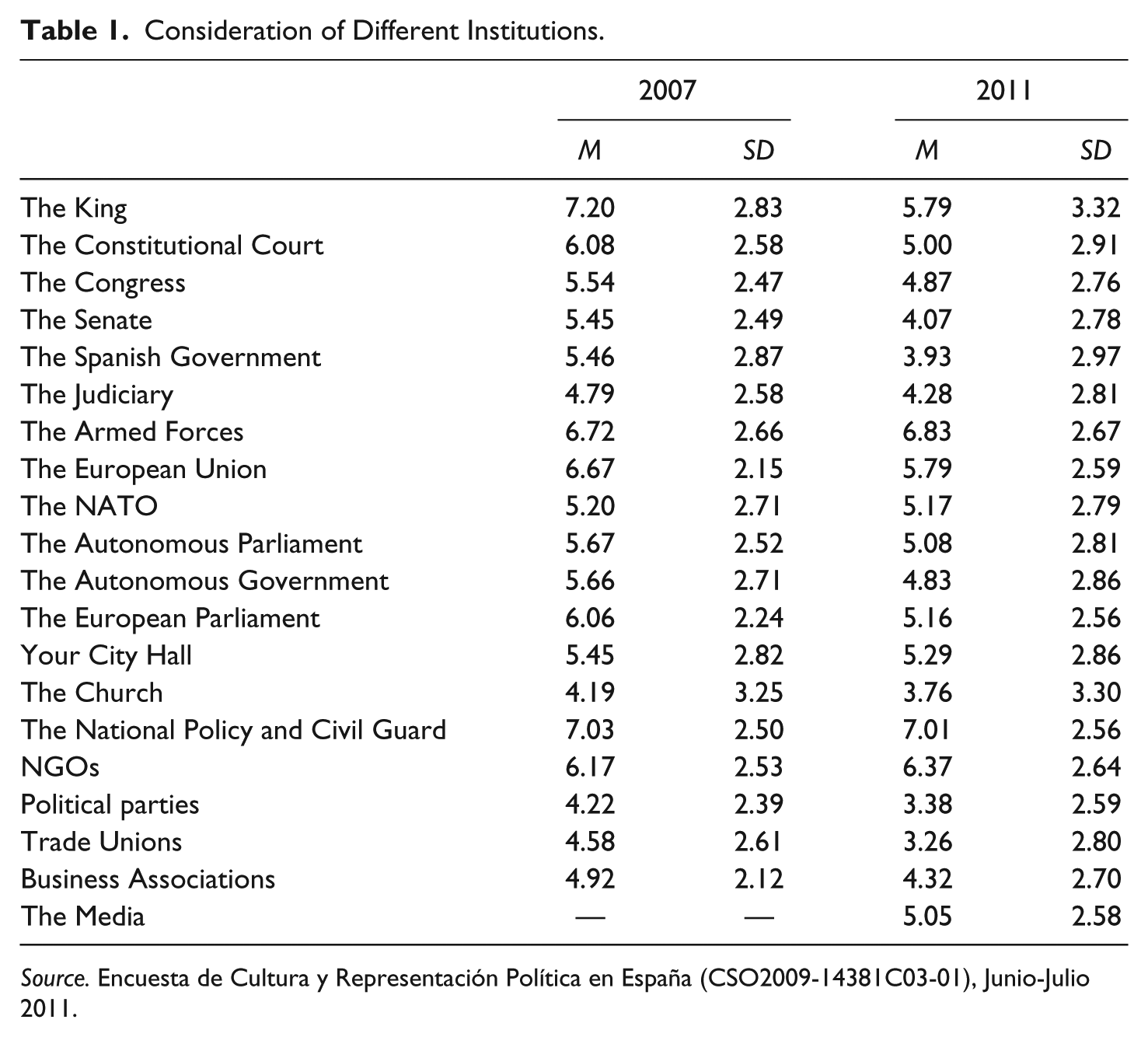
Source. Encuesta de Cultura y Representación Política en España (CSO2009-14381C03-01), Junio-Julio 2011.
However, although much of the focus from Spanish citizens and Spanish media has been on the impact of the crisis on institutions, which have been battered by the crisis, in this article I make the case that the process of institutional degeneration preceded the crisis and was in fact a contributing factor to the crisis. Indeed, in the years prior to the crisis Spain seemed to have fallen into the category of countries in which institutions had become extractive and concentrate power and authority in the hands of a few. In a recent seminal work, Acemoglu and Robinson (2012, pp. 73-79) showed that nations thrive when they develop “inclusive” political economic institutions and fail when they have extractive ones that concentrate power and opportunity in the hands of the elites. They show that inclusive economic institutions: that enforce property rights, create a level playing field, and encourage investments in new technologies and skills are more conductive to economic growth than extractive economic institutions that are structured to extract resources from the many by the few . . . [inclusive ones] are in turn supported by, and support, inclusive political institutions, [which] distribute political power widely in a pluralistic manner and are able to achieve some amount of political centralization. (Acemoglu & Robinson, 2012, p. 43)
They conclude that “it is politics and political institutions that determine what economic institutions a country has” (p. 43). According to their view, the role of inclusive political institutions is to promote sustainable economic growth, which requires innovation. Therefore, they need to protect and empower citizens to innovate and invest and need to foster Schumpeter’s process of “creative destruction,” which is conducive to innovation.
Unfortunately, the crisis in Spain exposed an institutional model that in many cases unleashed an extractive model of crony capitalism. A central problem, as noted by Molinas (2013), was the colonization by the new political elites that emerged since the transition of critical institutions, such as the Constitutional Court, the Bank of Spain, the General Council of the Judiciary, or the National Stock Market Commission. These institutions became politicized and largely lost legitimacy (see Table 1). As a result, institutions that should have played a central role holding politicians accountable (the judiciary, parliament, regulatory bodies, etc.) largely failed to fulfill that responsibility and instead have become transmission belts of the politicians (and worse, in many cases, part of a patronage system), validating their (often questionable) decisions and giving them a free pass.
The problem extended to political institutions such as the Spanish Congress, which failed to fulfill its accountability role in the years prior to the crisis. The Senate is predominantly considered useless (see Table 1) (for instance, despite the fact that it is considered the regional chamber, in the previous legislature it did not introduce a single amendment to the half dozen regional statutes that were approved by Congress), and Congress (the lower chamber) is dominated and instrumentalized by the party that holds a majority. They largely appear as spectators of the crisis, as both the Socialist and the Conservative governments often resorted to decrees for most of their measures, and the prime minister (PM) rarely spoke (particularly Rajoy) in Parliament. Parliamentary rules allow the government with an absolute majority (or with a sufficient parliamentary majority in case of coalitions) to avoid debates or even full disclosure, and they can veto calls from the minority parties requesting the presence of cabinet ministers for questioning. During its first 8 months in power, the People’s Party (PP) submitted to Congress 27 royal decrees that only required the validation of Congress without any opportunity for amendments. The PP government allowed only eight of them to be processed as law proposals. Since 1978, there has never been a year in which a government approved as many decrees as 2012. During that period, PM Rajoy went to Congress only when obligated (i.e., during the control sessions and after the two European summits). All the other parliamentary requests to question him were rejected. When the 65-billion-Euro austerity package was rammed through Congress in July 2012, he was absent from parliament (and during the debate, one of the PP deputies caused a political storm when she greeted the cuts for unemployed by saying que se jodan—let them screw themselves) (Gardner, 2012). And in 2012, there was not even a State of the Nation debate. In 1 hour, it approved 10 billion worth of cuts in health and education. In the summer of 2012, while the German Bundestag was debating the conditions for the financial rescue to Spain, the Spanish Congress was on recess, and it did not even vote on that memorandum (the only way it was vetted was in a commission attended by Minister Guindos, but without a vote). The Spanish daily El País submitted a request for information on official trips from members of Congress; initially, it received a positive response, but 3 months later, it was informed that the secretary general had decided that such information could not be released and that it would have to wait for the implementation of the new Law of Transparency. And there are no firm plans to change any of this: the Socialists have, now that they are out of power, presented some proposals to change the electoral law and the internal functioning of Congress, but the PP is not making it a priority to address them. Five legislatures ago, a group finished a proposal with the support from all parties to reform the Congress’ bylaws, but the initiative was stopped by the Spanish Socialist Workers’ Party (PSOE) and the PP, and it has not been reopened. In sum, the walls that currently surround the Spanish Congress are the metaphors of separation between the legislative powers and the citizens (“Parapetados tras las Vallas,” 2012).
In addition, time after time investigative commissions have worked as forums to express grievances but rarely as places in which people have been held accountable, or that had led to any significant political and/or criminal responsibilities. The recent commission that looked at the collapse of Bankia is just an example of this diluted (if not nearly useless) role: Former leaders of the bank, former political leaders (including the former Minister of Finance Salgado), and the former Governor of the Bank of Spain were all questioned about the disaster. They all gave their own reasons, largely blaming others for the outcome, yet nothing substantive came out of the process (which is still under judicial review). For instance, Bankia’s former chairman, Rodrigo Rato, questioned by the parliamentary panel, underlined the extent to which his decisions were regularly approved by auditors, financial consultants, regulators, and the Bank of Spain’s inspectors, and directly contradicted the testimony of Miguel Ángel Fernández Ordoñez, the Socialist-appointed Bank of Spain governor, who had stepped down a few weeks earlier, and who had claimed during his testimony that he had not pressed Mr. Rato to merge Caja Madrid with the Valencian Bancaja to form Bankia. Mr. Rato declared that in June 2010 he was called to the Bank of Spain and in effect was forced to negotiate with Bancaja. 4 Recent reports show that Caja Madrid gave loans to customers who lacked the resources to pay back (“Caja Madrid Concedía Prestamos,” 2012). The fourth largest financial institution collapses and is no one responsible (Ortega, 2012)? How can we be surprised that a government that seems incapable of engaging its own citizens, or institutions such as Congress, can inspire any confidence on markets and investors? That sums it all.
This colonization from politicians extended to public companies and agencies, including the cajas, which were staffed (and led) by acolytes of the politicians with no educational background or professional experience in the field, who were appointed for their loyalty and allegiance to their political patrons. Under their leadership, they became piggy banks and instruments for regional and local leaders of all parties to distribute patronage. A study from Vicente Cuñat and Luis Garicano (2010) shows that the main difference between banks and cajas was not so much the latter’s political nature but the lower level of professionalization of their managers: Only 31% of their presidents have postgraduate degrees—half of them have banking experience, and half of them have occupied political positions before becoming presidents. According to them, this development means that cajas could have saved 12,000 million euros had they had better prepared and qualified managers without a political past. Cajas, with a political president, have on average 0.93 points more of delinquent loans than those that do not, 0.98 points more if the president does not have postgraduate degrees, 0.93 points more when there is no financial experience, and 2.84 points more if there are those who meet all the three conditions (see “La Politización Eleva la Morosidad,” 2010).
It should not be surprising, therefore, that many of their decisions led to the financial bailout (Ortega, 2012). The real estate boom at the heart of the crisis was fueled by the cajas, and the property burst blew holes in their balance sheets that are the heart of the current financial crisis. The government’s response to the crisis of the cajas also leaves many questions unanswered: Why did it give 16 billion to Caja de Ahorros del Mediterraneo (CAM) or 23 billion to Bankia instead of letting them fail? Why did it recently give 5 billion to Bankia instead of waiting for the EU funds?
Other institutions that should have played a vital role to build up confidence, both domestically and internationally, such as the Bank of Spain (which initially was widely praised), had already been dragged through the mud of partisan warfare prior to the crisis, and its governor, Miguel Angel Fernández Ordoñez, was compelled to resign before his term expired amidst the controversy of Bankia’s collapse and his failures in managing the financial crisis. This was another instance of damaging politization of the institutions and dereliction of responsibility from the two leading parties: by appointing as governor someone who did not have the appropriate background but was politically closely linked to the Socialist government that appointed him (he had long been associated with the Socialist Party and had served in several government positions throughout his career) and also by failing to provide the necessary regulatory oversight over the institution.
The battering has previously reached untouchable institutions like the monarchy, which no longer seems like the unifying force that it was in the past (see Table 1). King Juan Carlos was revered for his role in bringing democracy to the country. Now, however, Spaniards are questioning their king and scrutinizing his lifestyle and the lack of transparency. The controversy over the king’s elephant-hunting trip to Botswana in the spring of 2012, in which he broke his hip, generated a public outcry because it exposed a murky world of business contacts and details about the king’s lifestyle (including speculation about his relationship with a German princess who accompanied him in the trip) at a time of national crisis. It led to an unprecedented public apology, but the damage was already done. The royal family’s estimated fortune at up to 1.79 billion euros had been the subject of growing scrutiny. The safari was organized by a Syrian magnate who had worked together with the king on a 9.9 billion bullet train contract that the king had helped broker in 2011 for a Spanish consortium in Saudi Arabia. This controversy has been compounded by an influence-peddling case aimed at the king’s son-in-law, Iñaki Urdangarín, who stands accused of using a nonprofit foundation to embezzle public money for sporting events and to use his position to bypass standard bidding procedures. A growing number of Spaniards, including some smaller parties, are using the crisis as a further reason to challenge the monarchy. According to polls, most Spaniards, however, still support him and value his role as a representative of the country and a unifying force, yet they yearn for more transparency (“Chastened King Seeks Redemption,” 2012). 5
Another crucial institution, the family, which has been a stabilizing force and which has played a crucial role in the provision of welfare, also seems to be fraying as unemployment increases and the entire members of the family lack any source of income. More and more families are leaning on their elderly relatives (pensions are among the very few benefits that have not been slashed). The situation is so dire that many families are removing their relatives from nursing homes, so they can collect their pensions. A survey from Simple Lógica found a sharp increase in the number of older people supporting family members: In February 2010, 15% of adults 65 years or older said they supported at least one relative, and in the survey conducted 2 years later, the number had increased to 40%; the association of private nursing homes has reported that 76% of its members had vacancies in 2009, while that number had increased to 98% in 2011. There is more and more evidence that retired people willing to share their pensions to support their families have been the silent heroes of this economic crisis. This may be one of the reasons why conflict in the streets has not been even more intense (“Spain’s Jobless Rely on Family,” 2012).
Institutional Divergence
A central theme of this article is that the economic crisis in Spain cannot be explained without reference to the process of institutional degeneration that took place in the country in the years that preceded the crisis. This institutional degeneration has had economic consequences. Membership in a monetary union would have required a series of structural reforms to ensure that the economic structure of the country was prepared to compete in the context of a monetary union. However, successive governments failed to address the imbalances of a growth model based on construction (it was an economic “miracle” based on bricks and mortar) and tackle the core problems of the Spanish economy: inflation differentials, the loss of competitiveness, and the relatively low productivity of labor.
Although factors such as inertia driven by economic success, the process of European integration, social bargaining, and ideological/programmatic consensus all help explain continuities in economic policies in the years prior to the crisis and the failure of successive governments to address the shortcomings of the Spanish economy (see Royo, 2013, pp. 105-118), the process of institutional degeneration was also a crucial factor. Political and economic institutions resisted those reforms because they would have jeopardized the existence of the extractive rent-seeking mechanisms that became the main source of rent for the economic and political elites who controlled them. Indeed, the economic divergence in productivity and competitiveness between Spain and the EMU core that preceded the crisis were consequences of the institutional divergence in the rule of law between the core and Spain. In other words, competitiveness divergence was rooted on rule of law divergence. Finally, this institutional divergence made it harder to implement the structural reforms that EMU membership demanded.
Competitiveness, broadly defined, includes the ability of the government to approve and implement effective laws, the protection of intellectual property, the efficiency of the legal framework, lack of corruption, the ease to set up new business, and predictable and effective regulations (see World Economic Forum [WEF], 2010). In the case of Spain there is ample evidence that the country had been suffering an institutional loss of competitiveness in the years that preceded the crisis. Table 2 provides some evidence from the WEF’s annual competitiveness’ report:
WEF Competitiveness Ranking: Spain 2006-2010.
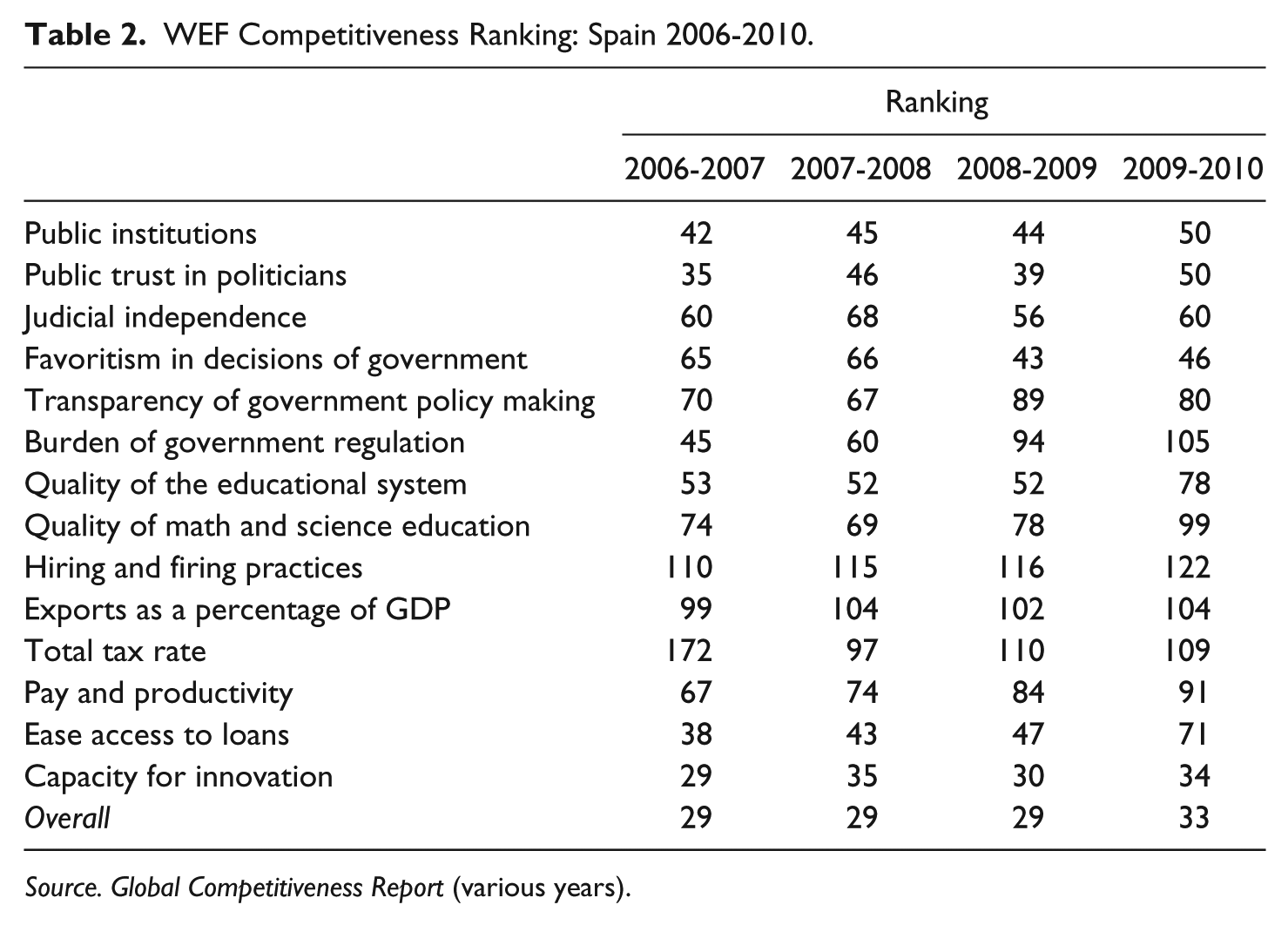
Source. Global Competitiveness Report (various years).
According to the WEF’s annual 2012 competitiveness ranking of 144 countries, Spain was placed 36th. The report highlights the vast differences between the best and worst performing nations in the Eurozone, stressing that the process of convergence among Eurozone economies has reversed and is one of the causes of the current difficulties of the Eurozone. According to the report: one of the shared features of the current situation in all these [Southern European] economies is their persistent lack of competitiveness and therefore their inability to maintain high levels of prosperity. . . . Over all, low levels of productivity and competitiveness do not warrant the salaries that workers in Southern Europe enjoy and have led to unsustainable imbalances, follow by high and rising unemployment. (see http://reports.weforum.org/global-competitiveness-report-2012–2013/; see also “Competition Gap Grows in Europe,” 2012)
Although it is true that these surveys are based largely on survey data, and therefore are subjective, other research seems to confirm the premise. The International Finance Corporation’s Doing Business, which reports data on the ease of doing business, ranks Spain Number 30 in 2006, 39 in 2007, and 44 in 2013. In 2004, in variables like “enforcing contracts,” the number of procedures was 20, the number of days 147, and the cost (as percentage of income per capita) 10.7. In 2006, it was 23 procedures, 169 days, and 14.1% (see also Figure 1 from the IMF).

Business environment: Selected ranking within Organisation for Economic Co-operation and Development (OECD), 2013. Reprinted with permission of International Monetary Fund, IMF Country Report No. 13/244, 2013 Article IV Consultation: Spain, p. 22, available online at http://www.imf.org/external/pubs/ft/scr/2013/cr13244.pdf.
In the World Justice Project’s Rule of Law 2013 Index (which provides data on nine dimensions of the rule of law), Spain scored relatively low in providing mechanisms for public participation, in effectively enforcing government regulations (ranked 22), in judicial delays, in effective enforcement of civil justice, and in police discrimination. The World Bank indicators of World Governance suggest that between 1996 and 2005 Spain had suffered a decline in the quality of governance in dimensions such as control of corruption (83.9% to 82.5%), government effectiveness (from 90.2% to 89.3%), regulatory quality (from 84.8% to 88.2%), the rule of law (from 90.9% to 84.2%), and voice and accountability (from 89.9% to 84.1%). Transparency International’s Corruption Perception Index ranked Spain 22 in 2001, 30 in 2012, and 40 in 2013. These data seem to confirm a decline in institutional quality. And this deterioration is even more meaningful in comparative terms with the core EMU members, thus leading to a process of institutional divergence.
The performance of the education sector, another key institution, has also left much to be desired: almost one in every three people between the ages 18 and 24 are early school dropouts (this represents double the EU average), and according to the Organisation for Economic Co-operation and Development (OECD), results of Pisa’s test in reading, math, and scientific knowledge are poor; there is no university in the top 150 in the main rankings; up to 35% of university students drop out before graduation; and only a third complete on time (Chislett, 2011). In 2012, 47% of Spaniards had only completed primary education (24% in the EU and 26% in the OECD): 22% high school (48% in the EU and 44% in the OECD) and 31% university degrees (28% in the EU and 30% in the OECD); the graduation rate in high school was 48% and in professional training 28%; and 26.5% of youths between 18 and 24 years old did not study beyond mandatory education. The problem is not just insufficient resources: average annual public spending per student in public education in Spain is comparatively higher—$10,094 in Spain, $8,307 in the EU, and $8,329 in the OECD. 6 Research, development, and innovation spending, at 1.38%, is significantly lower than the EU average. The latest OECD Pisa report (2013) shows that in math and reading there has been virtually no improvements during the prior decade (i.e., Spain was ranked 33 of 65 countries in math), and this despite the fact that the budget on education had increased 35% during that decade.
Finally, the situation of the judiciary, a central institution to apply the law and hold people accountable, has also been deteriorating. One problem is that Spain’s courts are unprepared and do not have the means to deal with the quantity and the kind of cases that have emerged during the last decade. Courts have been particularly drowned with corruption cases since the beginning of the 2008 financial crisis (more than 800 as of summer of 2013), some of them affecting previously untouchable institutions like the royal family (Villoria & Jiménez, 2012). 7 According to Joaquim Bosch, a magistrate who is also the national spokesman for Judges for Democracy, their caseload has grown twofold to threefold between 2008 and 2013, leaving some specialized courts that deal with special crimes and corruption (like the Audiencia Nacional) on the brink of collapse. As of summer 2013, the judiciary has accumulated a backlog of more than 3 million unhandled complaints, a problem compounded by the government decision to make budget cuts. As a result, courts are overwhelmed with caseloads and are prone to unreasonable delays (the majority of cases languish in courts for years). They are perceived as easily politicized and public trust has been undermined by persistent leaks (according to a poll from El Pais, 92% of people surveyed in January 2013 agreed that the slowness of the Spanish courts made it harder for them to fight corruption). Their decisions are largely determined by the preferences of the particular judges in charge of any given cases (in Spain, they take the lead in investigations, rather than prosecutors, and they have the power to stall or speed up cases and to decide how far to pursue any investigation), and some of them have media stars, upstaging politicians as decision makers. Finally, the constant judicial reforms seem to run in one direction: increasing political control over the judiciary. As a consequence, the country is suffering a judicialization of politics, which has compounded the traditional perception of politicialization of justice (“Political Inquiry Makes Judge a Star,” 2013).
Conclusions: The Unwinding
Those who still argue that the crisis was caused by EMU’s institutional deficiencies, the subprime crisis in the United States, neoliberal policies, or deregulation need to take into account the domestic institutional dimension.
The crisis has exposed an unsustainable economic model that had no long-term prospects. The emperor had no clothes. Spaniards are outraged not merely by the actions of bankers and politicians (pretty much most people had a sense of what had been going on) but also by the amorality of the whole situation and the complete disregard on the part of the majority of the country’s elite on the impact that their actions could have on people. This seems to be a result of the complete disconnect between actions and consequences. The ruling class is a community interwoven by personal and/or financial connections that have worked to their advantage, often at the expense of regular citizens. That interweaving generated clientelistic networks that have provided a safety net that will not let them fall. Elites became complacent, they had been coasting for a long time, and they could not grasp the unsustainability of their course of action. Their own success skewed them in an optimistic direction and kept them from seeing what was happening around them. For them, actions and consequences did not apply. They did not seem to appreciate that their actions could make any difference, or that they had responsibilities over the consequences of their actions (see “The Psychology of an Irish Meltdown,” 2013). When the crisis hit the country, they were out of answers. Their complacency took the place of serious thinking about the country’s future.
People in Spain demand answers, for the corruption and impunity, for the severe budget cuts, for the taxes, for the dramatic increase in unemployment, for the pessimism and desperation that has spread across the country. But it would be too easy to just blame the political and economic elites. That account leaves aside the responsibility of people who were not part of the political elite but also invested into the property pyramid scheme the fueled the bubble. They also seemed to forget that their actions had consequences.
Indeed, a central problem has been the lack of accountability: In the years prior to the crisis, there was (in Spain and many other countries) a feeling of impunity that came from nonpunishment. As of 2013, the list of those who have been sent to jail for their part in the housing bubble and all that followed it is remarkable thin. As indicated above, Bankia, the fourth largest financial institution, collapses and no one is responsible? Just a handful of corruption cases have resulted in convictions or reached any conclusion to date (winter 2013). Certainly, if there is nothing criminal in the conduct of the managers and/or the regulators, it must be because the criminal law is defective in that area.
It is essential that the culture impunity that characterized the years prior to the crisis has to change. In this regard, one of the few positive outcomes of the crisis seems to be that Spanish society has stopped being tolerant with corruption. This will be crucial to prevent future crisis: Bankers and politicians must know that if they break the rules, they could go to prison. The country needs simple rules and strong enforcement, and accountability must also extend to politicians.
Spain seems to conform to Mancur Olson’s (1984) institutional sclerosis thesis, according to which over time all political systems succumb to sclerosis because of rent-seeking activities by organized interest groups, which lead to cronyism and corruption, and thus an erosion in the rule of law. The solution, therefore, must come from civil society. Indeed, civil society needs to be strengthened. Historically, Spaniards (as other continental Europeans) have preferred equality to liberty, which led to the development of strong states but conversely weak civil society (Ferguson, 2013). We need a better balance.
From a theoretical standpoint, the analysis of the Spanish case shows that institutions do not stand still. On the contrary, they evolve through their ongoing adaptation in response to changes in the political, social, economic, and international (i.e., the EU) environments. These changes have illustrated the ways in which the functions and roles of these institutions have evolved over time. Yet it calls into question the presumption that increasing economic integration into EU/EMU will force the institutions of member states into convergence on a common model. Indeed, Spanish institutions have proved to be remarkably resilient in the face of significant exogenous shocks. EU/EMU membership did not radically reshape or disrupt previous patterns. Nor did it generate the degree of institutional innovation that could have been expected. To understand why, future research should explore the political coalitions under which these institutions have evolved.
Furthermore, the focus of the VoC literature has been on how national institutional differences condition economic performance, public policy, and social well-being and whether national institutions will survive the pressures for convergence generated by the crisis. This article contributes to this literature by highlighting how national institutions have conditioned economic performance in Spain.
The initial response to the global financial crisis showed that cross-national differences persisted. Although financial capitalist states converged as a result of the combined processes of globalization and European integration rendered the “Mediterranean” model far less distinct from other models than before, in the case of Spain, the crisis initially led to extensive regulatory intervention that served to reinforce the preexisting model, and changes in the years immediately preceding the financial crisis were not reversed. However, it is likely that the recent restructuring of the Spanish financial system and labor regulations will accelerate its convergence toward a more liberal market economy model, more based on the markets.
Moreover, despite the grouping of Spain in the “Mediterranean” variety of capitalism, there are important differences in how the crisis played out among those countries. A coherent variety of Mediterranean capitalism is missing, and certain domestic political economy institutions—namely, banks—are key to explaining the outcome of the sovereign debt crisis. In light of recent events, the literature on varieties of capitalism, and the literature in political economy more generally, should pay more attention to banks and national banking systems (Quaglia & Royo, 2014).
Yet it is important to stress that the process of institutional change is not linear and that there is also strong path dependency; therefore, it is still too premature to confirm any definitive outcomes. In addition, the analysis of the Spanish experience with the crisis confirms the thesis that coordination is a political process and that strategic actors with their own interests design institutions (Thelen, 2004). Institutional change is a political matter because institutions are generated by conflict, they are the result of politics of distribution, and hence, they are politically and ideologically construed and depend on power relations. In other words, institutional change is driven by politics. In this regard, the crisis is having a profound effect on power relations and the interests of actors. The (yet undetermined) outcome(s) of these changes will in turn influence the process of institutional change. But it is still too premature to make definite conclusions, and that is a limitation of this article.
The implications for policy making are also significant. The experience of Spain shows that economic convergence is not sustainable in the absence of institutional convergence. This casts the fundamental challenge of policy making in a new light, suggesting that policy makers should not only focus on policy reform but also on an institutional one as well.
In the years prior to the crisis, the country seemed to be in “a place of suspended effects,” an Indian summer characterized by a series of bubbles: the housing bubble, the stock market bubble, the alternative energy bubble. One by one, they all burst, and their bursting showed that they had been merely temporary solutions to long-term problems (Packer, 2013, p. 382). The bubbles disguised the reality that things were fundamentally not working, they were the excuse not to address the fundamental structural challenges that the Spanish economy faced since it joined the EMU, and they provided distractions and evasions from those long-term challenges. But during that time, key institutions continued to erode. Ultimately the Spanish experience shows that causes and effects are inextricably linked. In their state of ecstasy and oblivion, Spaniards seemed to forget that simple reality. The lives of millions of Spaniards have been transformed by the dissolution of many of the things that used to hold them together, and the crisis has resulted in the breakdown of the preexisting social compact. None of this can be explained without examining the process of institutional degeneration that preceded the crisis and the failure of the Spanish elites. The effect of that betrayal will take decades to fully unfurl.
Footnotes
Declaration of Conflicting Interests
The author declared no potential conflicts of interest with respect to the research, authorship, and/or publication of this article.
Funding
The author received no financial support for the research, authorship, and/or publication of this article.