




Abstract
In Southern Europe, the economic crisis (2008-2013) triggered a deeper political crisis, affecting a number of aspects of a representative democracy. Italy provides a particularly telling case of what happens when an economic crisis occurs in an unstable political context characterized by low government effectiveness, low efficiency, corruption, decline of electoral participation, fragmented and radicalized party competition, social inequality, high public debt, and other related features, here summarized in the model of “stalemated democracy.” On the basis of a comprehensive data set developed along with eight dimensions of democracy assessment and taking into account the policies pursued during the years of the crisis, we analyze the different effects of economic crisis—some of them expected, others more surprising—and how those effects characterize Italian political crisis and a new phase of great uncertainty. In the concluding remarks we offer an explanation of the role played by the economic crisis, focusing on the interplay between veto rules and actual veto players. Such an explanation is also relevant to see key, more in-depth aspects of Italian democracy during last 20 years and earlier.
The economic crisis of 2008-2013 subjected all European democracies to a pressing need: coping with public expenditure reduction or reallocation, and adapting public and private institutions to a partially new, uncertain environment. How can we explain the difficulty encountered by Italian democracy in this situation? Why was it possible that an economic crisis catalyzed a political crisis? Is it that the seeds of the political crisis were already flourishing during earlier years? To address these questions, we would like to spell out how the preexisting context, already characterized by change and uncertainty, paved the way for the political impact, what the key changes are, and which aspects did not change due to a high resiliency. That context had been shaped by the previous democratic crisis, which took place in the early 1990s, as well as by European constraints. Thus, the subsequent 2008-2013 economic crisis acted as a catalyst for that previous unsolved political crisis and brought about new changes, but also showed how resilient some key, in-depth features of Italian democracy are.
Here, we start by assuming that the relevant dimensions to be checked for change are those suggested by the theoretical frame, which was developed to analyze the quality of democracy (see Morlino, 2012, chapters 7 and 8). To summarize this frame very cursorily, it is worth recalling that a good democracy is, first and foremost, a broadly legitimated regime that completely satisfies citizens (quality in terms of result), one in which the citizens, associations, and communities of which it is composed enjoy liberty and equality, even in different forms and degrees (quality in terms of content), where the citizens themselves have the power to check and evaluate whether the government pursues the objectives of liberty and equality according to the rule of law (quality in terms of procedure). There are eight possible dimensions or qualities along which a democracy might vary, which are summarized in Table 1 (first column). The first five dimensions are procedural. Though also relevant to the content, these dimensions mainly concern the rules. The first procedural quality is the rule of law. The second and third procedural qualities regard the two forms of accountability (electoral and interinstitutional). The fourth and fifth are the classic participation and competition. The sixth and seventh dimensions are substantive in nature. The sixth refers to full respect for rights that are expanded through the achievement of a range of freedoms. The seventh is the progressive implementation of greater social and economic equality. The final, eighth dimension concerns the responsiveness or correspondence of the system to the desires of citizens and civil society in general.
Qualities and Relevant Empirical Dimensions.

When this theoretical frame is applied to the Italian case, the qualities are empirically analyzed by selecting their relevant dimensions, as listed in Table 1 (second column). In fact, as we consider the 2008-1013 period for the economic crisis and its political consequences and the previous 15 years (1992-2008) when the previous context is analyzed, it is fairly obvious that not every empirical dimension is relevant. In fact, some dimensions show no variations, as they are only sensitive in the long run. Thus, a selection of dimensions is necessary 1 and what the following pages show can be summarized into three key points: Italian democracy was featuring before 2008 already a lack of institutional capacity in coping with changes; the second and crucial point is the stalemated nature of Italian politics; and finally, the pivotal mechanism, which is responsible for this, is the existence of veto rules that are easily activated by a wide range of different and fragmented players. For these empirical reasons we deem the Italian case of great interest to unveil the engines that drive a democracy to cope with an economic crisis. Among the several potential forces we consider (as in Table 1) is, What are the most critical ones to explain the crisis undergone by Italy after 2008?
The findings we are going to present are drawn from a research project of the democratic changes carried out in Italy. We will present here the results of our analysis on the basis of a dimensional approach to change, showing first the changes featured by the democratic dimensions in the period before the crisis and then discussing the changes in the dimensions during the period characterized by the economic crisis. We will then present the explaining hypotheses and suggest a few conclusive remarks. What the case study here shows is a confirmation of the veto players’ approach with some nuances, mostly related to the role played by the veto rules—that is, the rules that allow the activation and the mobilization of the veto actors. Moreover, what we can see is a critical role played by the lack of institutional capacity. This is a point made by a large amount of literature of comparative politics and democratization studies. Once the rules are adopted, the key variable in preventing or triggering the changes is the capacity to implement those rules. This also holds for Italy. A final point concerns the methodology. We combined qualitative and quantitative analysis in dealing with such a complex phenomenon, especially if observed over a long period of time and described not only at the macro level but also at the more specific level of actors.
A Context of Change and Uncertainty
The institutional and political context featured by the Italian democracy before the economic crisis can be described as a combination of a highly uncertain setting deprived of actors capable of either reducing such an uncertainty with a strong decisional entrepreneurship or governing the changes necessary to stabilize the system. As we are going to see, a deep transformation began in Italian politics in the early 1990s. This is herein described along with the reconstruction of the changes undergone by each empirically relevant dimension (see Table 1).
The entire decade that started with the Clean Hands Investigation (1992) and ran until 2001 was distinguished by increasing awareness among policy makers and judicial actors about the inefficiency of the legal system. The latter has been medicated by the legislative measures, which have been—once adopted—jeopardized by a poor implementation (Carnevali, 2013; Sciacca et al., 2013). We consider not very surprising then the backlog of first instance and appeal cases, which did not decrease. 2 In 2008, 57% of cases pending before the European Court of Human Rights (ECtHR) concerned Italy’s violations of the right to a fair trial.
Another important subdimension of the rule of law is the fight against corruption. In a comparative perspective the perception of corruption in Italy has been fairly high (Global Corruption Barometer of 2003 and 2004). 3 The number of proposed measures to contrast this phenomenon rose to 72 during the XIII legislature (1996-2001), but only two became law.
The analysis of these two subdimensions implicitly reveals the role played by the third subdimension of the rule of law, namely government effectiveness. This third subdimension underlies our analysis both of the modern judicial system and the fight against corruption. In fact, it is a cross-sector feature of the entire policy-making system. Figure 1 indicates a nonlinear change, which started with the Bassanini reforms in 1992 and 1993, both of which impacted positively on government effectiveness, which showed a small improvement until 1998. Since then, the investment of material and professional resources (see Di Mascio & Natalini, 2014) in the public sector has been dramatically reduced. 4 From 2001 to 2007, government effectiveness dropped rapidly and steadily (see Figure 1). 5
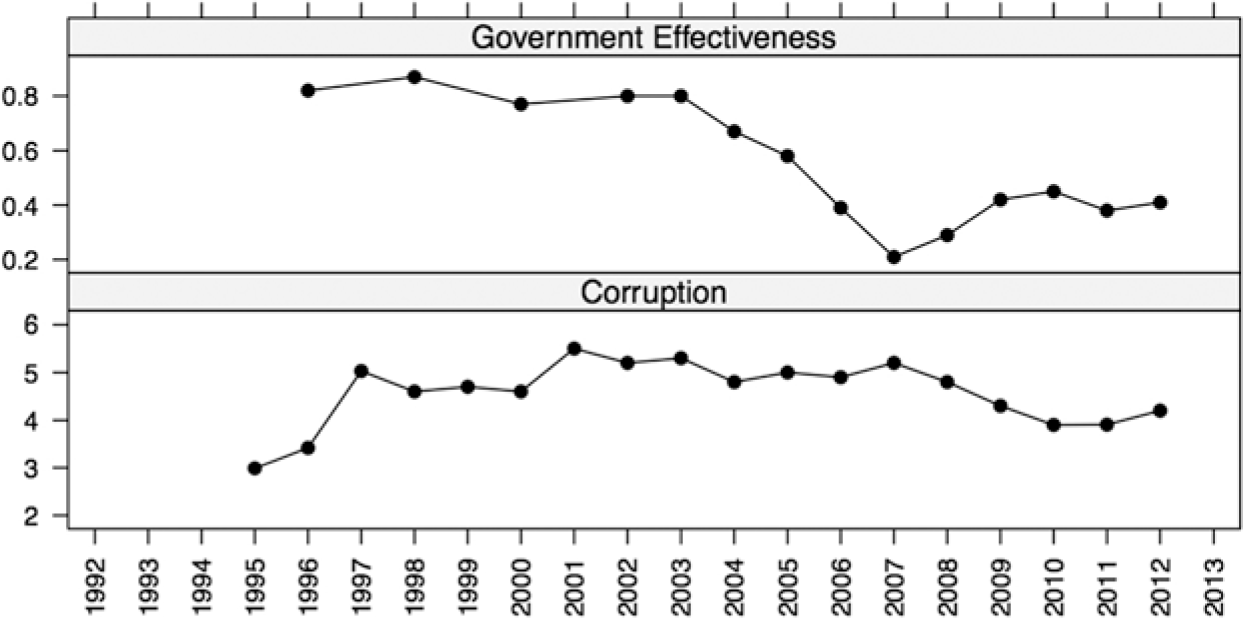
Key aspects of the rule of law.
If, on the whole, the rule of law is distinguished by its deterioration during the period analyzed, electoral accountability—measured as the presence and stability of alternatives—follows a more complex path. The starting point is the early 1990s, when the widespread restructuring of the parties and the party system took place. In this domain, the two most important events occurred in 1991 and 1994. The former saw the crisis of the left, leading to the establishment of the Democratic Party of the Left, now Democratic Party (PD); the division between it and Communist Refoundation, now Left, Ecology, and Freedom (SEL); the creation of the Northern League (Lega Nord, LN); and in the center-right, the creation, in 1994, of Forza Italia (FI) driven by the delegitimization and crisis suffered by the five traditional parties that had anchored Italian democracy for almost three decades (Morlino, 1998). However, stability was not restored following the 1994 elections. Overall, the 1991-1996 period saw the emergence of many new parties, movements, and electoral coalitions, and various splits, divisions, and mergers. The irony is that these major changes in the political parties went hand-in-hand with a fair degree of party-system continuity, particularly with regard to fragmentation. As a matter of fact, none of these new actors ended up reanchoring Italian democracy and thereby stabilizing the political landscape (Morlino, 1996). Even the change of the electoral law did not respond to the need of stability. During this phase of party crisis, there was a change in the electoral law, from a highly proportional system to a mixed one in 1993 and then to another mixed system with a bonus for the electoral majority in 2005. Already in 1994, and with more evidence in 2001, citizens had a greater opportunity to punish incumbents, especially coalition leaders. Hence, each election offered the concrete possibility of party alternation to the government in power.
However, voter preferences in terms of candidates and the selection of the candidates, made by the political parties, ran along parallel and unrelated tracks. The mechanism of the closed lists adopted in 2005 as the result of a proposal made by the center-right majority created hyperverticalized candidate selection. Consequently, cooptation of the national party leaders adopted has become the only path for entering parliament, with the dual outcome of making the parties more cohesive as well as developing personalization and opportunities for abuse within parties. A further indicator considered was the propensity of voters to change their electoral orientation. On the whole, these aspects seem to compensate and mitigate the effects of the increased possibility to identify clear political alternatives to the incumbent government. As shown in Figure 2, there was a leap in electoral volatility in 1994, further growth in 2001, and then an evident decline until 2008, which emphasizes a stabilization of alternatives. 6
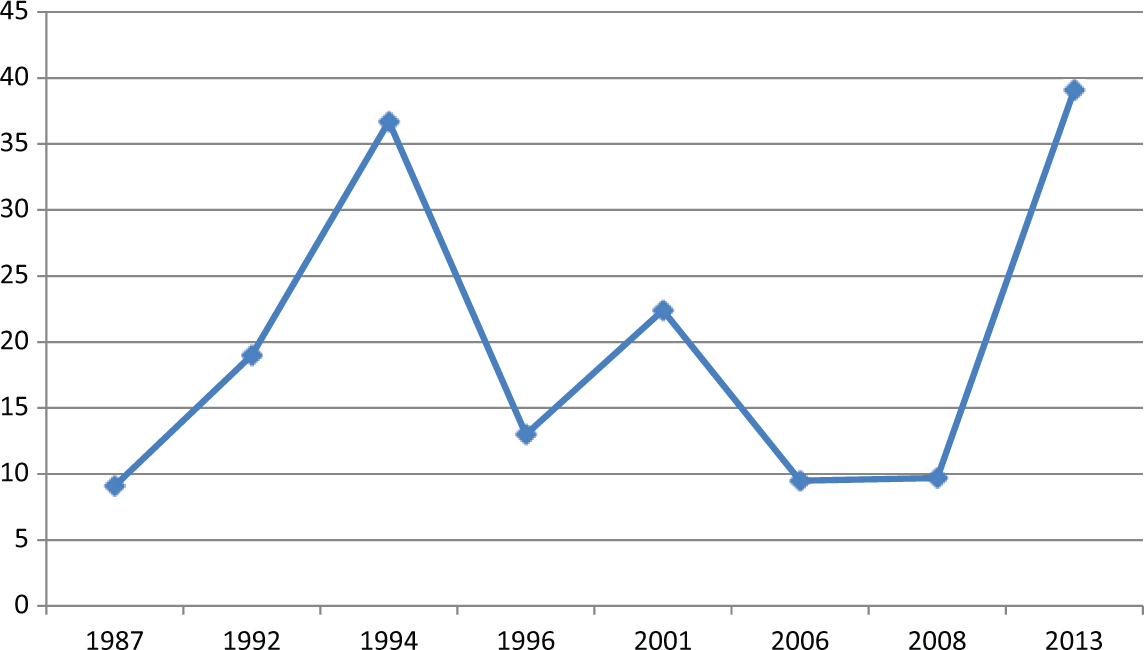
Trends in electoral volatility (1987-2013).
The period from 1992 to 2008 is apparently marked by an improvement in electoral turnover. Above all, since 1996, when party competition began to display a more evident bipolar dynamic, with the consequent turnover between the incumbent parties and the opposition, each election has led to a complete change of the cabinet. In a way this seems to move in the direction of a deepening of electoral accountability (Rombi & Venturino, 2013). But the analysis of the data on party competition displays a highly fragmented multiparty system (see Table 2), compounded by a new radicalization—that is, greater distance between the parties, whose main divide is the Berlusconi–anti-Berlusconi cleavage (Ceccarini, Diamanti, & Lazar, 2012).
Fragmentation and Polarization of Party System (1992-2013).
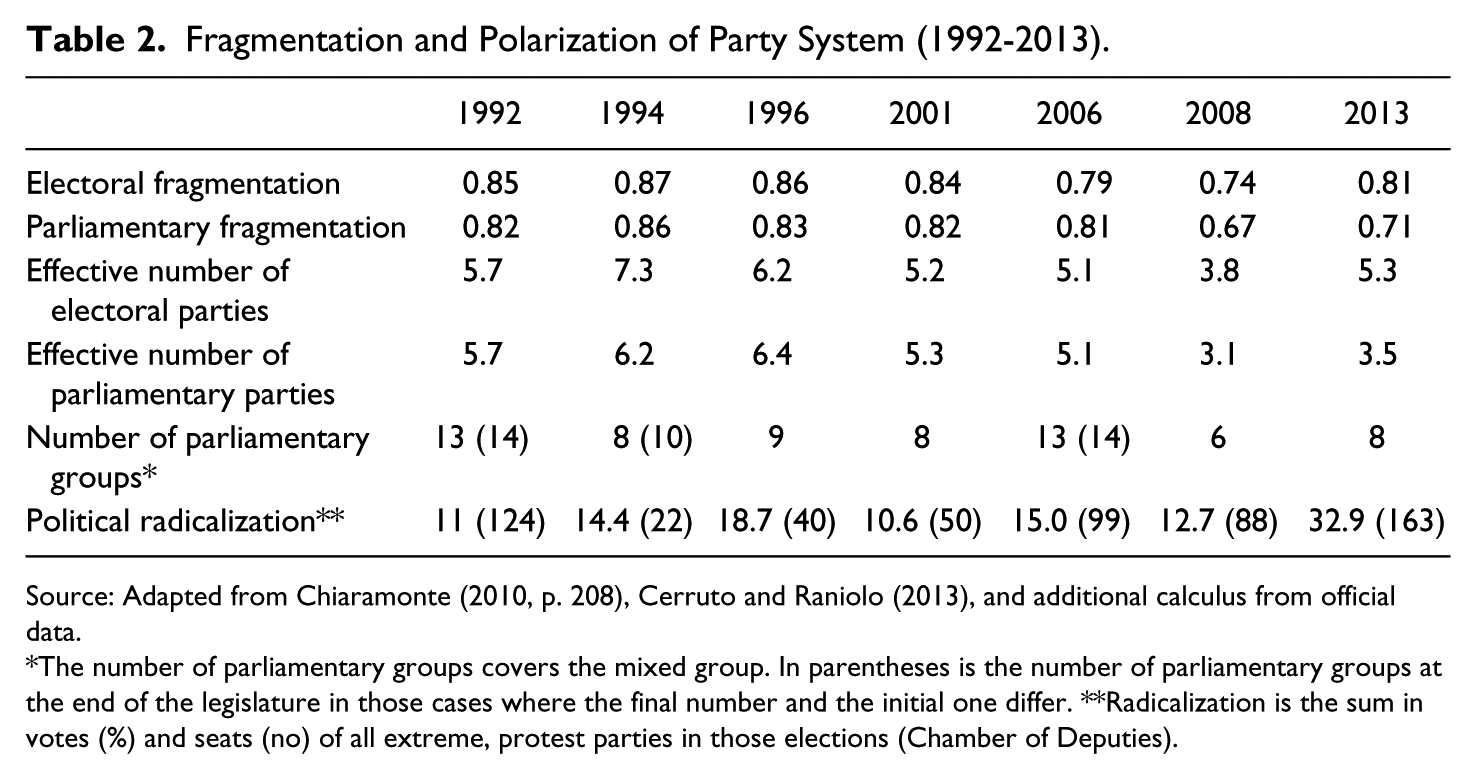
Source: Adapted from Chiaramonte (2010, p. 208), Cerruto and Raniolo (2013), and additional calculus from official data.
The number of parliamentary groups covers the mixed group. In parentheses is the number of parliamentary groups at the end of the legislature in those cases where the final number and the initial one differ. **Radicalization is the sum in votes (%) and seats (no) of all extreme, protest parties in those elections (Chamber of Deputies).
It should be pointed out that the possible grouping of Italian parties around two poles is a different aspect vis-à-vis the increase of the ideological distance among the political actors—that is, party radicalization. The combination of these two vectors “heated up” the political system and jeopardized the stability and decisional capacity of every executive in power during these years. The radicalization of political competition is presented in Table 2 and is given by the sum of votes and seats of extreme, radical parties. Moreover, the exacerbated interparty competition combines with a radical loss of the internal regulative capacity enjoyed by political parties until 2006. Since the early 1990s, the Italian political parties have ceased to be the backbone of the political system. If the democratic consolidation of the Italian republic had relied for the most part on their anchoring capacity (see Morlino, 1998), then the last two decades have witnessed a deanchoring process that creates scope for new actors to enter the arena. If a high dissatisfaction is present (see below), these may become antiparty movements.
The collapse of the previous party system in the early 1990s and the subsequent failure to restructure it affected the dynamics of the legislative-executive relationship in several ways. Traditionally, Italian politics featured a consociation pattern of legislative decision-making, whereby parliament acted as an arena for mutual and multilateral conflict negotiation. Instead of playing a zero-sum game, the governmental majority and the opposition have always been inclined to accommodate their different interests alongside a distributive mechanism of policy making. Contrary to expectations, following the collapse of the party system in the wake of the Clean Hands enquiry (1992), and a dramatic increase in intraparty fragmentation and interparliamentary mobility of deputies, there was also a basic continuity. In fact, when submitting a bill to the legislative arena, the cabinet was confronted with (1) the lack of any cohesive action by parliamentary opposition and also (2) the need to negotiate step by step the proposal with its own majority. The entire amending process in the Italian legislative arena shows this when the origins of amendments are taken into account. Thus, a close, in-depth analysis of the legislative decision-making process from 1993 through 2006 reveals the peculiar distribution of amendment proponents, who seem to belong predominantly to the majority (Capano & Vignati, 2008; Zucchini, 2008). In other words, the opposition does not perform a clear-cut and effective role as a veto player within the parliament, whereas deputies and senators who supposedly support the cabinet, as they belong to the parliamentary majority, engage in a time-consuming process of bargaining within the majority (Capano & Vignati, 2008, Table 3). The way the bargaining takes place depends on the specific decision-making process that unfolds within the parliamentary committees. Moreover, the number of amendments grew steadily during the 2001-2006 period (Visconti, 2012, p. 78), when in principle one might have expected Italian democracy to start acting as a bipolar system, with a majority cabinet on the one hand and the opposition on the other. Therefore, the cabinet still remains locked into a continuous bargaining process with both its own majority and the opposition. In such a political setting, the role of the opposition is performed in different nonparliamentary arenas—namely, the oversight institutions.
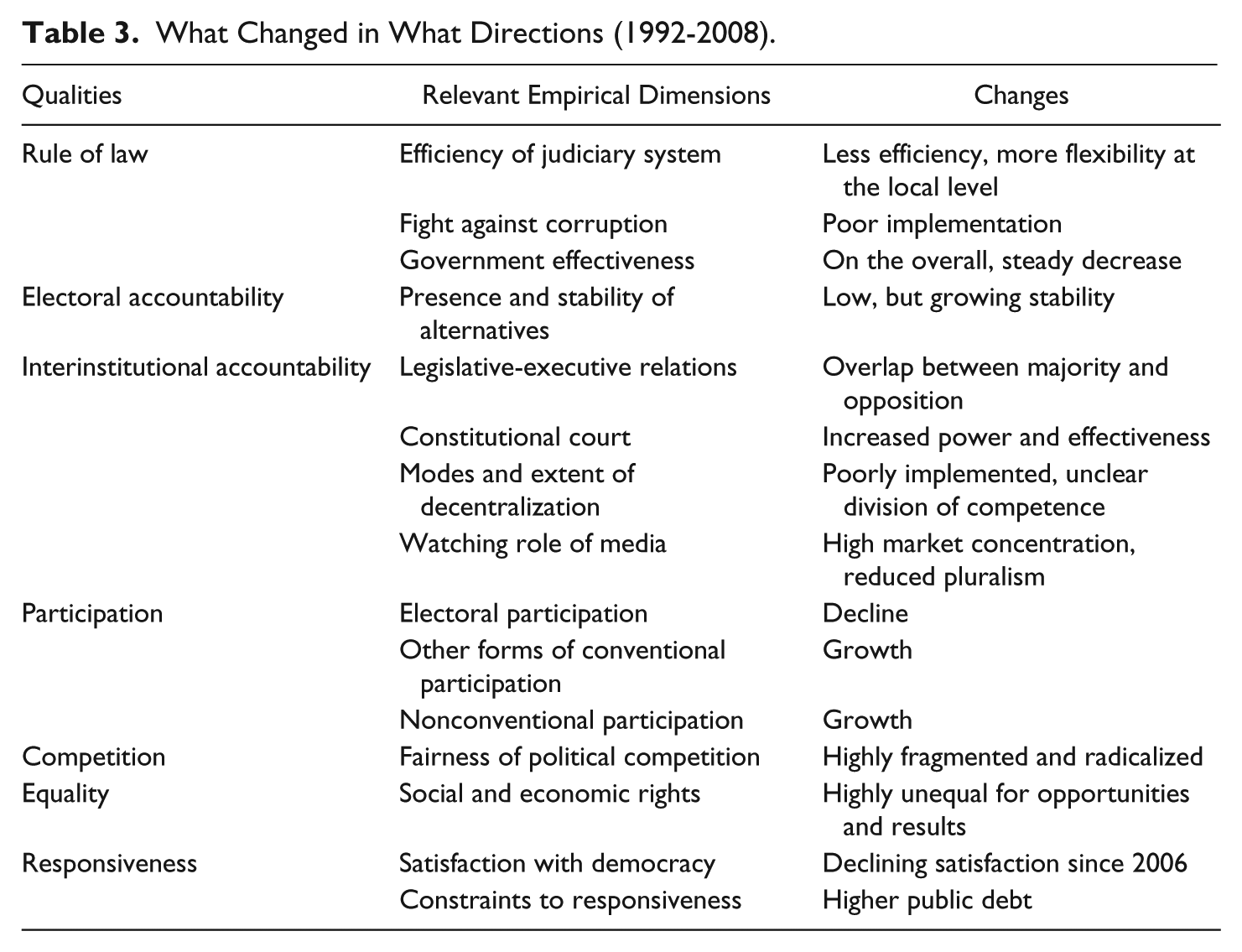
What Changed in What Directions (1992-2008).
With regards to interinstitutional accountability (see Table 1), an additional issue to be mentioned is the constraint set by the Constitutional Court to the government strategy of issuing decree laws, irrespective of whether they met the criteria of “necessity and urgency” (see the Italian Constitution, Art. 77). Even though one might expect that the government, deprived of a traditional strategy for circumventing parliamentary blocking intervention but also of a protection from parliamentary snipers, especially dangerous with bare majorities, had refrained from governing with decree laws, in fact the number of “necessity and urgency” laws remained high (44 in 1997, 29 in 1998, 42 in 1999, 36 in 2000 up to 52 in 2001, 44 in 2002, and 48 in 2003) (Senate of Republic, 2013, p. 8). 7
If the capacity of the opposition to hold the government accountable has been weakened, especially in the 2 years after the election held with the new electoral law (in 2006 for the first time), the power of the Constitutional Court, conceived as an expected capacity of settling conflicts, which otherwise were not managed by the representative institutions, increased. The number of rulings issued by the Constitutional Court on the basis of an abstract, ex ante judicial review procedure increased from 31 in 1993 to 52 in 2008. 8 Moreover, from 1992 to 2008 the number of rulings at odds with a law of the incumbent government dropped from an average of 14.48% in 1992-1998 to 8.51% in 1999-2005, and then up again to 12.1% in 2006-2008. In the overall system of interinstitutional accountability, the media also play a key role in holding all rulers (both elected and nonelected officers) answerable to public opinion. To perform this role and to resist the capturing strategy that any veto player may adopt to influence the media, freedom of press and the rate of market concentration should be, respectively, high and low. According to Freedom House, Italy’s press was free in 2002 but in 52nd place, whereas in 2006 it ranked 65th (still free). The RC4 9 in the daily newspaper market changed from 41 to 43 in the 1992-2006 period, whereas the public channels and the Mediaset 10 channels together covered 100% of TV supply during the entire period analyzed here. As a matter of fact, the Italian media played either the role of amplifying the voice of some political parties or the role of idea-brokers themselves, especially as a consequence of cases of political or administrative corruption.
The system of interinstitutional accountability has not been improved by the decentralization process. Since the 1970s, when the regions were first set up, the decentralization process has been deepened by two normative acts. The first one was the 1993 electoral reform, which introduced direct elections for town and city mayors, the presidents of the provinces, and for town and provincial councils. The second, more important step was the constitutional reform passed in 2001, whereby the regions were vested with legislative power in key areas, such as social policies, environmental policies, health policies, to mention just the most critical ones. However, the actual possibility of local authorities to act as veto players and to balance the power of the central government is weak. Regions had been granted with effective legislative powers. However, their administrative capacity and the actual possibility to govern locally remained limited. In the years 2001-2008, the transfer of public funds from the central government to the local authorities has remained stable (even if meanwhile the local taxation expanded), with the exception of a limited growth from 2007 to 2008. In 2002, the number of cases of conflicts between the regions and the central government brought before the Constitutional Court was 31; there were 108 in 2003, 122 in 2004, 95 in 2005, 103 in 2006, 53 in 2007, and 124 in 2008. This high level of conflict stems from the complex normative framework, which regulates the attribution of competences to the local authorities and the ongoing process of legislative adaptation, which since the 2001 constitutional reform has continued to partially modify the competences and the tools made available to local authorities to perform their tasks.
The last procedural dimension we consider here is participation, notably in terms of electoral participation, other forms of conventional participation, and nonconventional participation. Even though Italians have voted less since the 1970s, Italy is still one of the most participative (electorally speaking) countries in the European Union (88.9%) (Cerruto & Raniolo, 2013). From 1992 to 2008 electoral participation dropped from 87.3% in 1992 to 80.5% in 2008 (Facello & Quaranta, 2013), whereas the interest in politics remained stable, and then rose between 2005 and 2008 (see Figure 3). This interest is not channeled by parties. Party affiliation and party membership dropped considerably, from 78.7% in 1996 to 51.9% in 2008 (see Facello & Quaranta, 2013). However, data collected on the nonconventional form of participation reveal an antiestablishment and an antiparty attitude. Party disaffection and antiestablishment attitudes together contributed to the creation of a new political demand, addressed to potentially new players (especially nontraditional political parties). Nonetheless, attended demonstrations and attended rallies do not show any significant change until 2008.

Conventional and nonconventional participation.
The overall picture of the procedural dimensions has a paradoxical reflex at the level of responsiveness. Satisfaction in democracy features a positive trend until 2006, even though this should be combined with a differential trend of trust for each institution. This shows very clearly the careful management of public perceptions of government, especially by Berlusconi, who was the prime minister from 2001 through 2006, and then again from 2008 through 2011. Trust in parliament increased from 1990 to 2004, then dropped slightly, before increasing again until a radical slowdown in 2006. Trust in the judiciary stands higher than trust in all other institutions, but seems to reflect the legitimacy and the trend of popular support for the judiciary in connection with the big political scandals, starting with the Clean Hands enquiry in 1992.
To measure the barriers that hinder the capacity of rulers to be responsive to the ruled, we argue that the course taken by the public debt indirectly limits the range of policy options rulers can opt for, and consequently the possibility for their choices to be responsive exclusively to citizens decreases. In this picture, the intervention of a supranational actor, such as the European Union, especially on those constraints that are negotiated and agreed at that level, affects the possible extent of responsiveness. It should also be added that Italy’s public debt dropped from 1993 to 2002, but then increased slightly (see Figures 4). This reflects the trend of democracy satisfaction, as we have already noted.
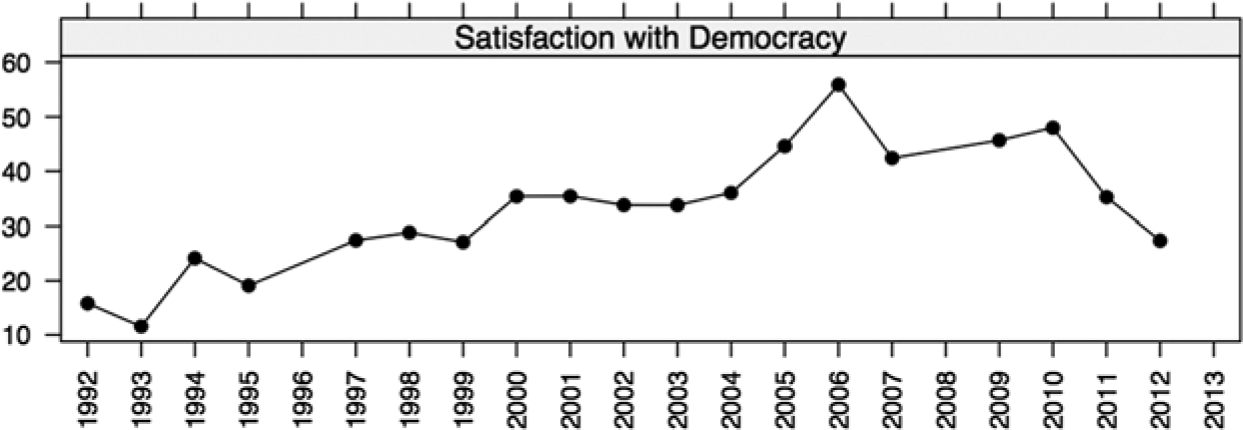
Satisfaction of democracy as perceived responsiveness.
The last dimension to examine is equality, measured as economic and social rights. Here, we refer to a number of economic indexes that reveal whether or not wealth is equally distributed (especially in terms of employment and GDP), and how public expenditure has been used (or not used) to ensure “equality of opportunities,” principally access to education and access to public services such as health care and legal aid. Let’s start with the unemployment rate. This decreased until 2007, with an upward peak in 2000. Per capita GDP was almost stable during the period considered, whereas the peak in GDP growth was in 2000, after which it decreased slightly—though at a slow pace—until 2008. A further point worth addressing is the reduction of public expenditure on education and training: In 1993, Italy allocated 5.4% of its GDP to this sector, whereas by 1998 it had already fallen to 4.75%, reaching 4.5 in 2008. 11 To conclude this excursus, Table 3 offers an overview of changes that took place from 1992 through 2008, which we can now selectively recall. Rule of law scores lower and worse in the three subdimensions considered.
Furthermore, the two possible “engines” of democratic change—that is, participation and competition (see Morlino, 2012)—show a significant change. Political competition has become more fragmented and more radicalized, whereas participation has shifted from electoral participation toward other forms of participation, such as nonconventional ones, although in a moderate way. In addition, the entire system of interinstitutional accountability features a radical change, which combines subversion and replacement. First of all, the executive power remained weak in setting and running the agenda, whereas the legislative power did not show any cohesion, either in the majority or in the opposition. Second, the oversight institutions, which include all specialized courts, have ended up complementing the role played by the representative institutions and carrying out a more prominent and diffuse control, thereby acting as an actual and effective veto power. Third, the media, which are expected to play the role of watchdogs, have a very limited pluralism due to the high ownership concentration and the lower (in comparison with other advanced democracies) freedom of press. It is also worth stressing at least one positive feature among all the changes we have discussed: that is, a greater possibility of electoral accountability as the key result of the presence of party alternatives and an effective alternation at the cabinet level between the center-right and center-left coalitions.
Within this picture, the European Union played a distinctive, important role. On the one hand, the fact that the government is also held accountable to European Union law and to European Union mechanisms of policy coordination further reduced its autonomous capacity to set the agenda. Likewise, the fact that the courts can play a two-level game, by referring to the European Court of Justice and the ECtHR, empowered the latter two. However, the normative inputs from Brussels to promote the free market of media, especially in the broadcasting and digital sector, have not been effective enough in redirecting the change suffered by the media in Italy. This also holds good for the equality dimension. European norms are growing fast in this sector and might justify the expectation that Italy is pushed toward a positive change. As a matter of fact, to date this has not been the case. Because the implementation of European Union norms in this sector depends structurally on the capacity of the domestic institutions to pursue the requested policies coherently, the state of the art of interinstitutional accountability (especially the subdimension of executive-legislative relations) and government effectiveness prevents the country adapting as it should.
The Political Impact of the Economic Crisis
Despite the fact the crisis might be depicted along with the trends of several indicators, we selected the most critical ones, as portrayed in Figure 5. This shows how the crisis is immediately mirrored by a rise in the public debt and unemployment and, after a few months, in inflation as well as by the decline of GDP. When we consider the impact on democratic dimensions, what do we see? If quantitative data are complemented by qualitative analysis on a few aspects, the new picture partly confirms the expectations but also shows some surprising and salient effects. Moreover, in carrying on this inquiry, we only need to single out those aspects, included in Table 3, which bring about the subsequent political crisis, characterized—as we are going to see—by the growth of distance between institutions and citizens, the reversing of a decentralization process, and a decisional stalemate.
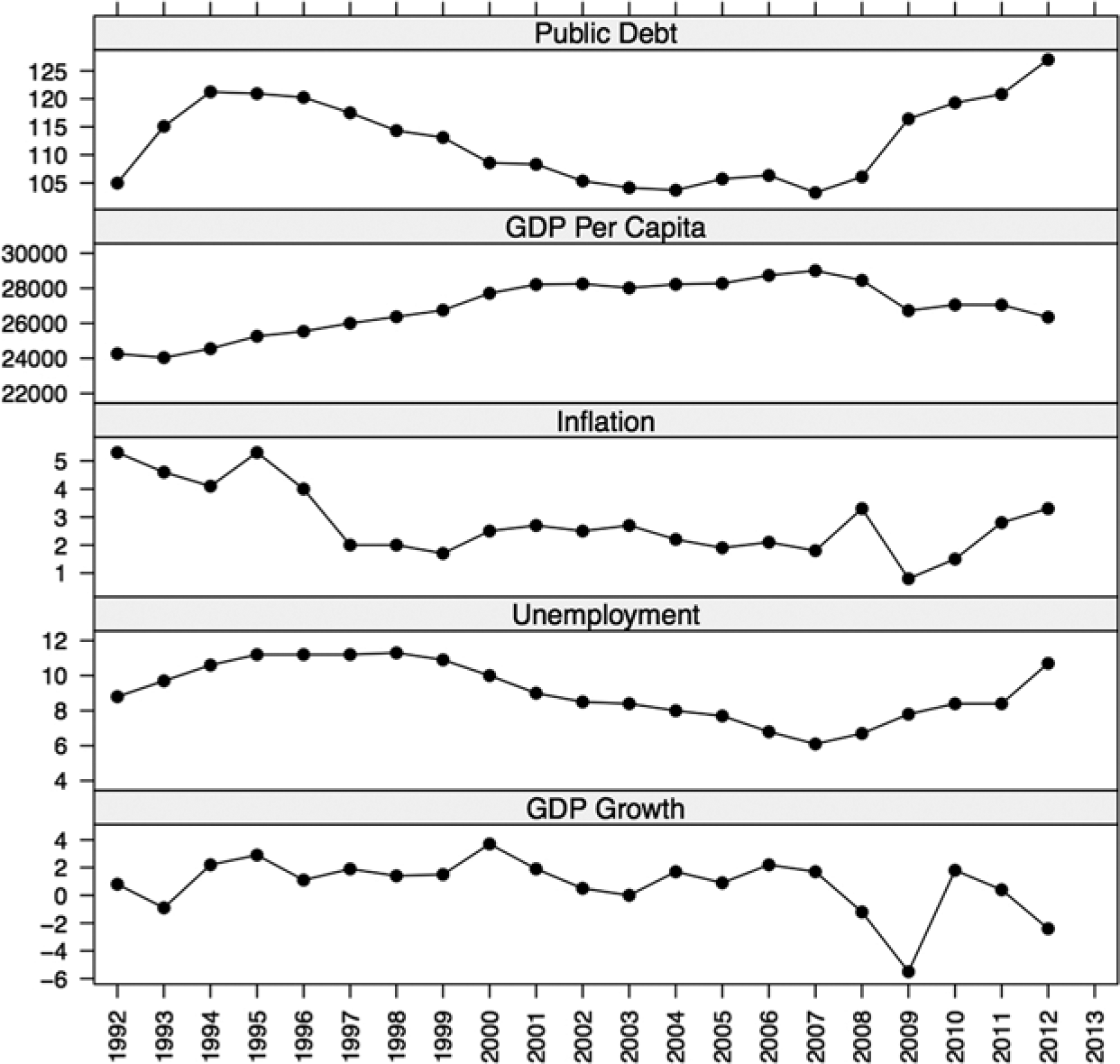
The economic crisis: Main indicators.
Accordingly, we do not consider the low efficiency of the legal system, 12 government effectiveness, the role of the media 13 , and others (see Table 3 and Table 5). Thus, the very first and most relevant aspect concerns the reshaping of relationships between political institutions, especially political parties, and citizens. There are new parties, such as the centrist Scelta Civica (Civic Choice), led by the technocratic prime minister of the 2011-2013 cabinet, Mario Monti, and the Movimento 5 Stelle (Five Star Movement), a protest party led by Beppe Grillo, who has been adapting for Italian voters certain issues and aspects of the Pirate parties that first emerged in a few central and northern European countries. Party realignment is vividly mirrored by electoral volatility—39.1, the highest one in Italian electoral history (see Figure 2). At the same time, there has been the growth of opposition, which had already started in 2010 with the split of the rightist component of the PDL, led by Gianfranco Fini, and the creation of a new parliamentary group. At the 2013 general election, the political institutionalized opposition became much stronger, winning 12,111,015 votes (35.7%), a figure produced by adding together the votes of the right (about 2.6%), Northern League (4.1%), Five Star Movement (25.6%), Civil Revolution-Ingroia (2.3%), and Stop to Decline (1.1%). 14 The greater resulting fragmentation and radicalization can be seen in the last column of Table 2, and the picture of a new party system characterized by antiestablishment extremist parties comes out in an evident and strong way.
If we complement these data with those regarding a marked dip in satisfaction with democracy (see Figure 4) and a relative, low growth of conventional and nonconventional participation (see Figure 3), we cannot help coming to a slightly surprising first conclusion: The distance between civil society and political parties is growing, but at the same time, the protest parties 15 are permitting an institutionalization of that dissatisfaction and are accordingly keeping nonconventional participation fairly low, with violence being limited to a few circumscribed episodes, especially a few demonstrations in Rome, during these years. 16 If the Greek and Spanish protests are recalled, the difference with the Italian case is evident. But there is also the clear possibility of supposing that the economic crisis may have hit Italy less than the other two countries, especially in view of Italy’s strong tradition of nonconventional participation.
The second and more surprising effect is the disappearance of any political discourse on decentralization, the beginning of an opposite trend back to unitarianism, and consequently the nonimplementation of previous decisions made to achieve a much stronger decentralization. To start with, then, it can be recalled that during the 1990s and in the first years of Berlusconi’s government (2001-2006), the debate on regionalization, decentralization, and related parliamentary decisions was politically highly relevant, thanks also to the existence of widespread support for decentralization on the left and the pivotal role of the Northern League in the coalition with Berlusconi. During the last 5 years, all this has disappeared. The legitimacy of local authorities has been eroded by recent episodes of corruption and the abuse of power, which has undermined a mainstream belief of those who were in favor of decentralization, namely that it is possible to have a politics of a higher quality at the local level than at the national level. The Northern League itself had an internal crisis and change of leadership, from the founder of the party (Umberto Bossi) to a new, younger leader (Roberto Maroni). With the economic crisis and the election of Maroni as President of Lombardy, all the issues relating to decentralization have disappeared from the national debate and have also been forgotten by the left.
If the key indicators of centralization/decentralization are considered (see Figure 6), one can see a sharp decline in local transfers since 2009 and a shrinking of local expenditures since 2008, only partially compensated by some growth of local government revenues. 17 It is possible to see here both a trend toward a central control of expenditures and, accordingly, a drive toward centralization, and the resistance of local power; in relation to the regions, this means a cutting of expenditures on health, a very sensitive issue for citizens. If, finally, we consider government decisions in these years (see Table 4), there has been, on the one hand, the so-called law of fiscal federalism (2009), presented as a landmark for the Italian process of decentralization and, on the other hand, some preliminary decisions about axing the provinces, the intermediate local level of government (2011-2012). But if we look at the implementation of these decisions, we see that almost nothing has come of them, with a ruling of the Constitutional Court declaring one of them unconstitutional. It should also be mentioned here Law 243, adopted in 2012, which introduced the constitutional principle of “balanced budget” as a constraint to all types of public policies, either adopted by the central government or (and surely mostly) adopted by the local authorities.
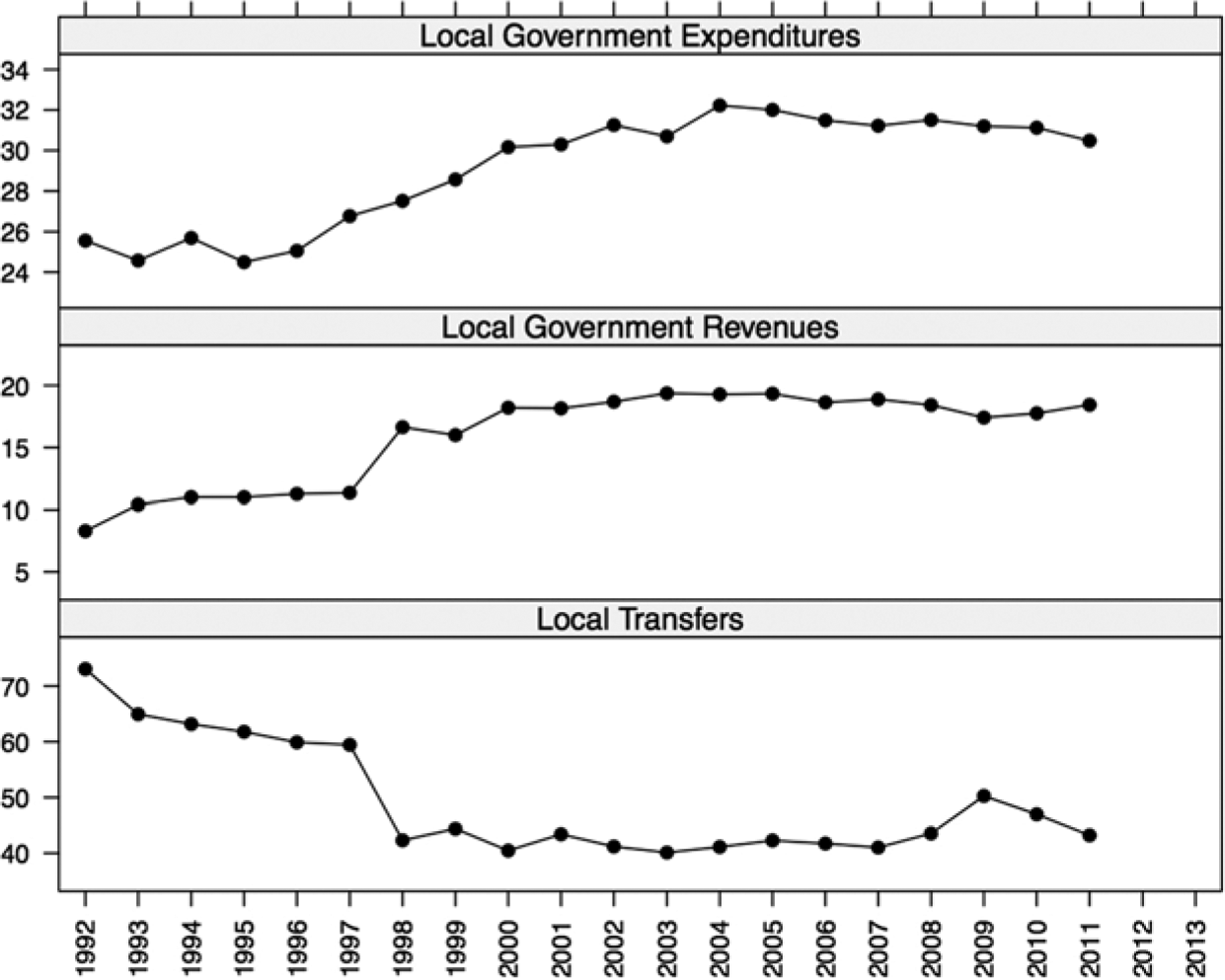
Trends in decentralization and centralization: Key indicators (1992-2013).
Main Policy Reactions to Crises, Per Year/Month, Cabinet, and Content (2008-2013).
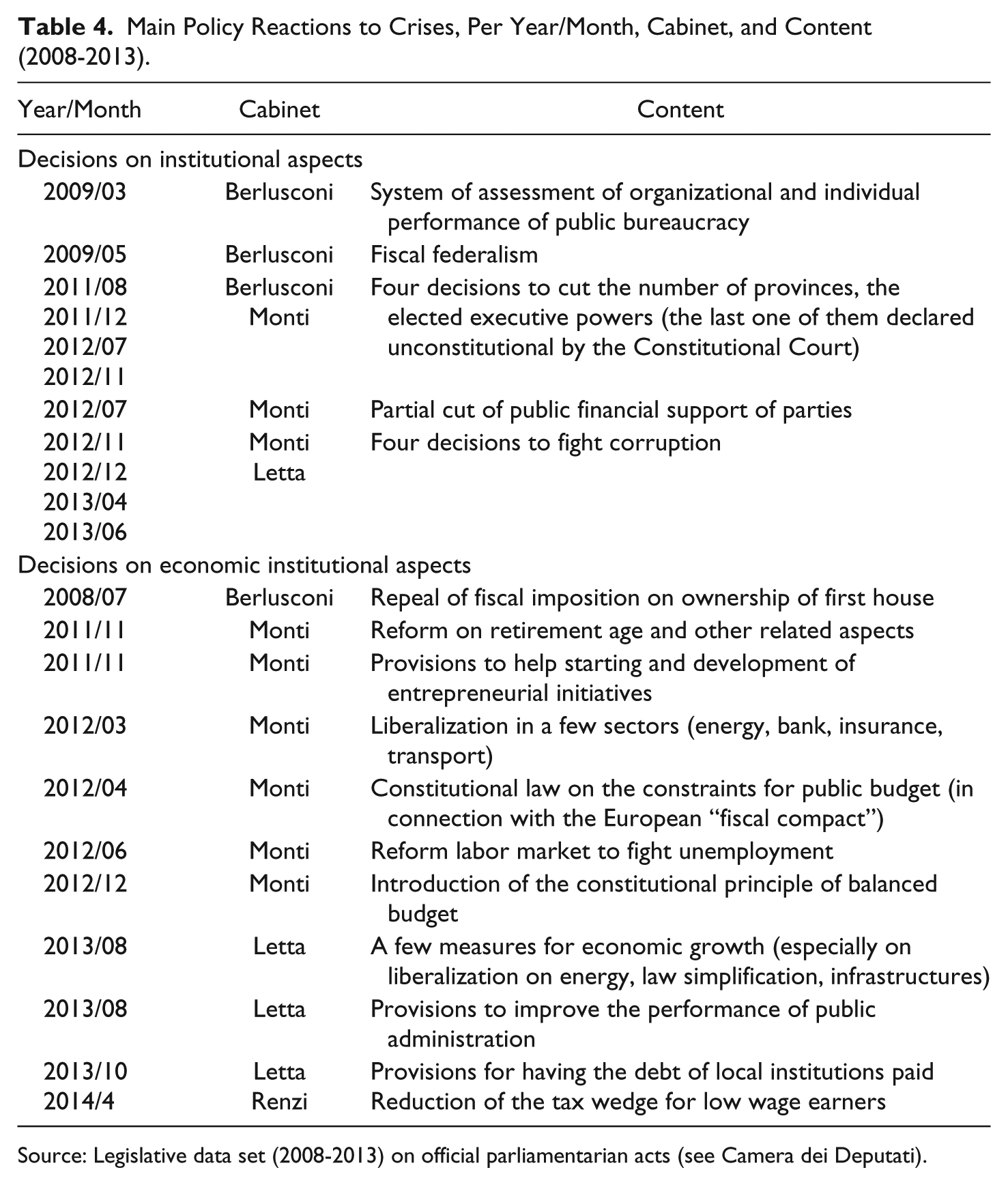
Source: Legislative data set (2008-2013) on official parliamentarian acts (see Camera dei Deputati).
On the whole, this suggests very explicitly that there is a clear trend back toward unitarianism at the level of expenditure and revenue management, decisions regarding decentralization that would involve more expenses have been put on hold, and at the same time, there is not sufficient effectiveness to abolish an intermediate, traditionally important, level of government (the provinces) and consequently to save significant economic and bureaucratic resources. It must also be added that, in the perspective empirically analyzed here, considering the relationships between central institutions and peripheral ones as possible grounds for mutual checking as a key element of a rich complex of interinstitutional accountability makes no sense.
These considerations are fully consistent with the third, very revealing effect of the crisis. When all the policies for coping with the economic crisis are considered (see Table 4), we can very evidently see two types of policies. The first includes institutional, partially symbolic policies that are designed to generate stronger confidence for the incumbent cabinet, whether it is chaired by Berlusconi (2008-2011), Monti (2011-2013), or Letta (2013-). Here one should notice further the role played by technocratic cabinets. In particular, Monti’s cabinet was meant to be a way to negotiate—and accommodate—the Italian approach to the economic crisis at the European level. The pattern has been replicated also by Letta’s cabinet, with some key differences in the domestic pattern of negotiation, due to the split of the center-right party, the loss of the leader Berlusconi, and the escalation of the intraparty conflict in the Democratic Party.
The second type relates to economic decisions, some of them with institutional features or consequences. If we disregard the most recent decisions made in 2013, the effective implementation of which is still impossible to assess, there are two different outcomes: the economic decisions are basically implemented due to the impetus of the European Union, and the institutional ones have remained largely unimplemented. 18 More specifically, the decision-making process of government and parliament, already traditionally poorly effective (see Table 3), was ill-prepared to make the profound changes an effective reaction to the crisis would have involved. The same can be said for the subsequent implementation process. The only decisions that are made and at least partially implemented are those made under the constraints of the European Union. In fact, the two most important decisions in recent years, one regarding pensions and the other concerning the incorporation of the fiscal compact into the Italian constitution, are of this kind. Otherwise, resistance during all three governments in power since 2008 has been strong and apparently offers no way out. Table 4 gives a clear picture of institutional resilience and stalemate, additionally confirmed by all the difficulties in changing a poorly effective decision-making process; discussions about electoral reform, the reform of the second Chamber, and other constitutional changes have been going on for years, and at least three parliamentary attempts have been made to push through reforms. 19
When we reflect on the different ways in which the economic crisis has impacted on Italian democracy, we see clearly how the economic crisis brought about the political crisis, as revealed in Table 5: The reshaping of party alignments, protest parties, growing dissatisfaction, and decisional stalemate are the recurring key aspects of every political crisis. It is impossible to explain how this kind of impact and transformation has been possible without taking into due consideration the previous context and its low stability (see previous section). However, both the transformation into a political crisis as well as the previous context should be explained. In this regard, the main question seems to be, Why has there been such great resistance to change and to adapting to the challenges of an economic crisis? But the answer to this question actually sheds a good deal of light on the very reasons for the crisis of the early 1990s—that is, why there was so much resistance to change in those years.
The Impact of the Economic Crisis (2008-2013).

An Explanation and Some Concluding Remarks
The analysis developed in the previous pages shows, at first sight, that the worsening of one subdimension is constantly related to the deterioration of the others (see also Morlino, 2012, chapter 8). Hence, we should ask what is the key factor behind them that prevents Italy from coping successfully with the economic crisis, as other countries in similar economic conditions within the European Union have done. To sum up, financial and economic crises have affected Italian democracy by magnifying the distance between institutions and citizens, by reversing the decentralization process and by creating a decisional stalemate. Let’s take it for granted here that every democracy would be in a difficult situation if faced by a deep economic crisis. The data on other European democracies provide strong empirical evidence for this. The relevant issue is that an effective democracy is able to reduce some of the negative and often unavoidable aspects of a crisis, whereas Italian democracy is unable to cope with difficult situations, even if expected. If this reasoning is correct, then the question is, Why is there difficulty to adapt, and why is there no political crisis in other democracies, even ones more deeply hit by the financial and economic crises?
If we accept that the main problem is decisional inefficacy, traditional rational choice theory (see, for instance, Buchanan & Tullock, 1962) affirms that a high number of active players accounts for that problem: the higher the number of actors, the weaker the decisional efficacy. In fact, Table 2 shows both high fragmentation and the growth of it. But this hypothesis is falsified by a comparative check. Other countries have been hit by an economic crisis and have high fragmentation, but have not experienced the political crisis of the kind Italy had in the early 1990s and now. Table 6 (second and third columns) shows this. Pursuing the same line of reasoning, we can add that the distance of a position on ideological and policy issues among a high number of parties, complemented by the impossibility of manufacturing a parliamentary majority, is an even stronger explanation for such inefficacy. With his notion of polarized party system, indirectly, but explicitly, Sartori (1976) would have supported this explanation. Moreover, it can be added that to justify their role and to win the vote of citizens, party leaders emphasize their mutual differences, even when the antisystem parties, which were the key element in Sartori’s analysis of polarization, are disappearing in a new political context where democracy is largely accepted almost all over the world. Even following Dalton (2008) and his new measure of polarization, 20 this hypothesis lacks conviction. After all, first, the key variable still is the number of parties, and hence it is not supported comparatively; second, during the last two decades in Italy, there has been no stability of parties, but on the contrary a total or partial renewal of them, whereas the hypotheses on self-imposing parties that have to distance from one another to justify their existence eventually imply a high stability; third, Table 6, column 4 shows again how there are other highly polarized party systems. Thus, we do not discard completely that part of the explanation lies in the high number of parties and the polarization, which for 2013 in Italy partially overlaps with the radicalization as measured here (see last row of Table 2) and increases between 2008 and 2013. But on comparative ground, we have to acknowledge that this is only a partial, insufficient explanation. Moreover, we should recall that there are two aspects to account for, not just one—as shown by our previous analysis, we need to explain both the low decisional inefficacy and the poor implementation of approved bills.
Effective Number of Parties in Europe (Selected Countries).
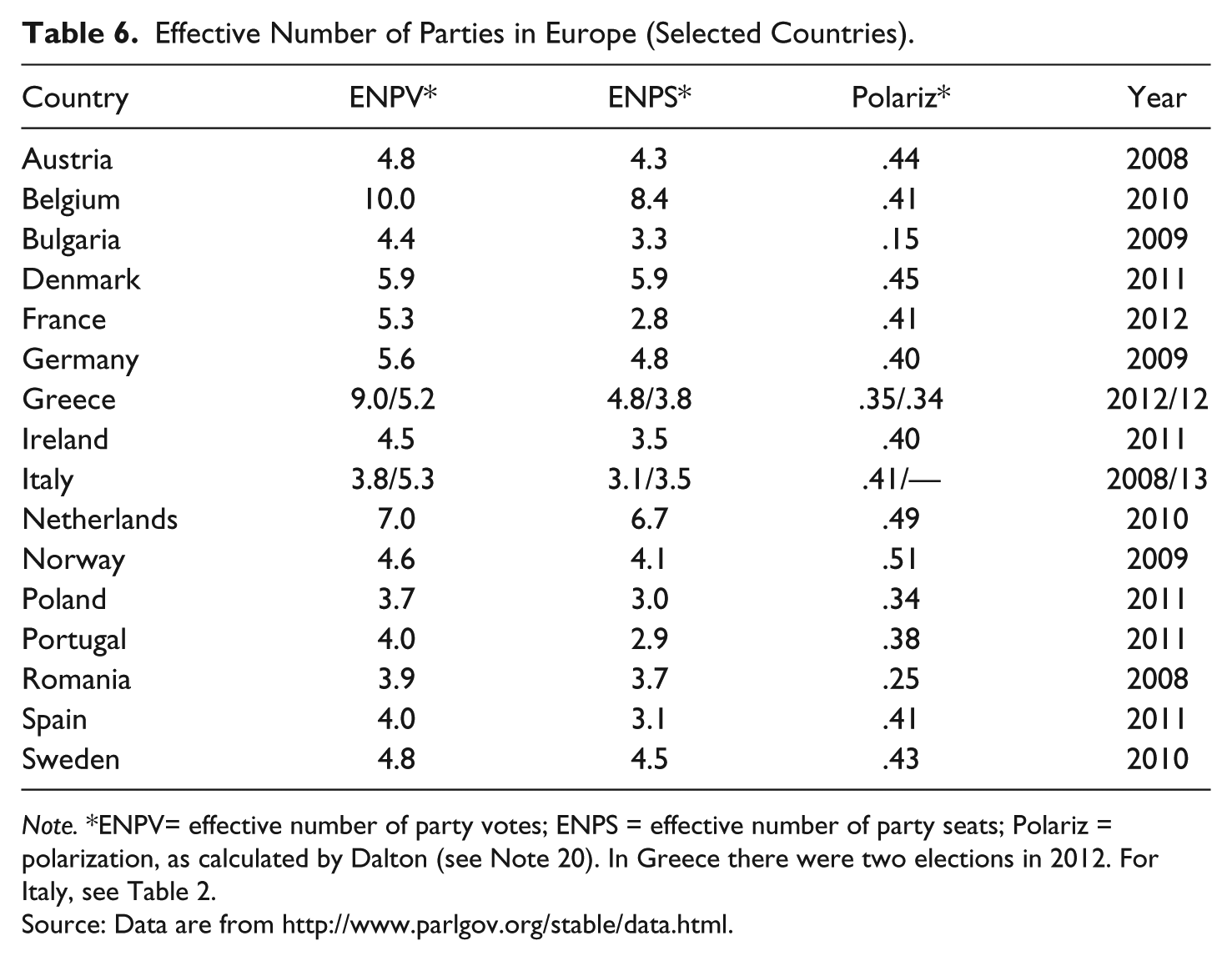
Note. *ENPV= effective number of party votes; ENPS = effective number of party seats; Polariz = polarization, as calculated by Dalton (see Note 20). In Greece there were two elections in 2012. For Italy, see Table 2.
Source: Data are from http://www.parlgov.org/stable/data.html.
The additional factor, which is distinctive of the Italian case and can complete our explanation, is the existence of “veto rules” and consequently the presence of activated veto powers. 21 Here, we take into account the societal, more or less organized actors, who are able to block any decision they do not like at different levels, local and national. This is possible because a veto potential is created by the existence of “veto rules,” mainly formal ones. They are nonchallenged norms aimed at giving guarantees to minorities or specific actors to be protected. The most important example of veto rules is in the existing procedures for law-making by a Parliament, formed by two Chambers with the same legislative powers, which makes for a cumbersome, complex decision-making process where all actors, interest groups included, can intervene and reintervene, if they are not satisfied, even at the subsequent phase of implementation. Another important example of a “veto rule” is art. Article 138 of the Italian constitution creates barriers to the constitutional reforms by requiring an overqualified majority—in the two Chambers. 22 Another set of veto rules that demands a high consensus is present in the parliamentary standing orders.
Barriers entrenched into the constitutional design to the approval of comprehensive reforms go hand in hand with a style of legislative decision making, which is patently marked by a fatal combination: decree laws necessity and urgency adopted by the executive to make laws and fragmented amendments made by both the majority and the opposition. This ends up producing poorly elaborated legislation and introduces a double level of uncertainty and ineffectiveness—at the level of law making as well as at the level of law implementation.
Inside them, positive incentives to fragmentation are embedded so that they are detrimental to the capacity of the country to cope with external and compelling challenges, such as the crisis. Still another example is the possibility granted to all local authorities to bring a case before the regional administrative courts and afterward to appeal to the supreme administrative court. A last example of veto rules is offered by a scrutiny of the judicial sector. Each level of jurisdiction is open to access without any specific constraint. 23 The lack of formal constraint is compounded by the existence of informal incentives to delay the final judicial decision, such as a disproportionate number of lawyers (almost four times the number displayed by France), and their presence within the procedural codes of norms, which allow the parts to object also when this option is due simply to a delay in the decision. Therefore, the high litigation rate of the Italian society 24 and the lack of any mechanism to set disincentives for the escalation of the demand of justice are key factors to establish the veto rules as well as to justify and to shield them from possible reform. 25
In general, at different levels of government, Italian democracy is disseminated with veto rules that make the adoption of a decision and its implementation more cumbersome and difficult and create the possibility of political actors to intervene and act as veto powers at any point in the policy-making process. Hence, a vicious mechanism of stalemating is set up: A high number of actors, some of them radicalized, are able to stalemate a democracy because of the existence of those veto rules, which are embedded in the various institutions at different phases—decision making and implementation—and levels—central and local. No doubt that when the number of actors is higher and they are more radicalized, the stalemate is higher, but this game is only possible because of the existence of those veto rules. 26
Although setting up such rules and powers to protect Italian democracy just after World War II, following 20 years of Fascism, and at the beginning of the Cold War, can be approved and is easily understood, 60 years later and more than 20 years after the fall of the Berlin Wall, the continuing existence of rules and powers that retain certain actors and modes of perpetuating a conservative stalemate is difficult to justify. 27 Especially when an economic crisis demands quick reactions and effective decisions, the rigid guarantors of democracy pave the way for a democracy without qualities that is unable to respond to the crisis. This is more so in a complex, fragmented, mobilized society where the decision-making process is in itself more difficult, the thrust for higher inequality is in the way the world economies are developing, and above all groups with mobilizational or status resources are able to set up barriers against decisions that could harm them. The lack of trust in the parliamentary means that dealing with conflicts and dissent creates cultural justification for this state of matter and therefore creates barriers to its change. 28
The existence of veto rules and consequent veto powers has led to the consolidation of a proportional or consensual model of democracy. When, after the political crisis of the early 1990s, there was an attempt to develop a majoritarian model, characterized by higher decisional efficacy and the possibility of implementing decisions regarding changes to the electoral law and other reforms, such as the direct election of the mayor at the municipal level or of the president of regions, these veto rules were not even touched. Consequently, the change of Italian democracy did not take place and the institutional model was frozen in a midway position. Even the reforms of the standing orders of the Parliament—which took place in 1991 for the lower Chamber and in 1999 for the Senate—did not transform the previous law-making style. They only introduced a few: stricter majoritarian and pro-government rules: the unanimity rule regarding parliamentary groups and agenda setting was set at a lower quorum of three-quarters; the Government was given the opportunity to notify of its priorities; more restrictions were introduced regarding amendment selection, discussion and voting. A distinction between opposition and majority was formally introduced. (Capano, 2005, pp. 9-10)
This notwithstanding, the parliamentary committees system remained very strong, the number of MPs requested to create a parliamentary group remained very low, and thereby an embedded incentive to fragmentation was perpetuated. Thus, the internal procedures of the legislative arena match and magnify the intraparty fragmentation and the intracoalition fragmentation, which usually marks the cabinet. Italian cabinets have always been coalition-governments. The instability of the parties, especially of the parties’ factions, has been a facilitating condition in undertaking distributive negotiation within the cabinet and consequently within the parliamentary majority. Therefore, the capacity of pursuing straightforwardly regulative policy objectives has been fundamentally undermined. To this we can add the relatively poorly innovative policy frames promoted by the party leaders. As a matter of fact, the possibility of observing the creation of an advocacy coalition promoting a new policy frame is radically reduced by the fact that, even if this coalition had gained a governing position, it would be somehow forced to negotiate the frame itself in a patchy and hieratic system of side payments.
As a way of concluding, let it be recalled that the economic crisis of these years asks for the overcoming of the low decisional efficacy complemented by low levels of effective implementation. In addition, by itself an economic crisis brings about harsher conflicts and, consequently, an even more difficult decision-making process, as every decision may involve serious costs for social groups and citizens. Hence, the only possible decisions are imposed by external powers and are implemented only if they cannot be circumvented. If this analysis is correct, finding a way out of such a “stalemated democracy” is almost impossible. Changing it would involve both a change of formal and informal rules. But there are too many rules, at a number of different levels and domains. The consequent legislative interventions should therefore be numerous and never ending. That change would involve a massive change in the consciousness of citizens and elites. If Italian political elites will be able to find the narrow path out of this situation, they will invent a route out from the crisis that will be seen in the years to come.
Footnotes
Acknowledgements
In addition to our warm thanks to Anna Elisabet Zamora and Xavier Coller for their precious suggestions, we would like to express our gratitude to Anna Bosco, Giliberto Capano, Sabino Cassese, Roberto D’Alimonte, Fabrizio Di Mascio, Sergio Fabbrini, Carlo Guarnieri, Nicola Lupo, Bernardo Mattarella, Liborio Mattina, Alessandro Natalini, and Francesco Raniolo for reading and commenting on a previous version of this work.
Declaration of Conflicting Interests
The author(s) declared no potential conflicts of interest with respect to the research, authorship, and/or publication of this article.
Funding
The author(s) received no financial support for the research, authorship, and/or publication of this article.