



Abstract
The candidate selection process in the United States has been, since the second half of the 20th century, one of the most inclusive and decentralized among the developed democracies. While such systems often presuppose party weakness or lack of control over the process, this article shows that patterns of campaign finance indicate that party weakness over candidate selection in the U.S. case may be overestimated. It also argues that a very open selection process offers opportunities for insurgent movements within parties that bring new ideas and demands. Finally, it suggests that political culture may mediate the relationship between party strength and democratized selection methods.
The United States has long been seen as an outlier in the candidate selection literature (Gallagher & Marsh, 1988; Hazan & Rahat, 2010) because of its very open, decentralized, and inclusive process. Since parties in Europe are introducing some elements of the U.S. model in their selection processes, there are a number of compelling reasons to analyze how the selection process works paying attention to three of its “unexpected” consequences. First, some parties in Europe have moved to democratize candidate selection (Pennings & Hazan, 2001); yet highly decentralized systems may have the unintended or paradoxical consequence of producing parties that are less responsive to voters (Spies & Kaiser, 2014). Second, the openness of the U.S. selection process has meant that parties are especially predisposed to pressures from external movements. Recently, other countries have faced challenges at the intersection of movements and the party system around selection issues (Della Porta & Chironi, 2015). Finally, the uniqueness of the U.S. case may be attenuating as the electorate grows more polarized and parties reemerge as important actors in the selection process (Jacobson, 2015).
The literature on candidate selection in decentralized systems shows that there are often paradoxical relationships between the level of inclusiveness of party systems and other democratic values. Rahat, Hazan, and Katz (2008, p. 676), for example, have argued that “the three democratic values of inclusive participation, competition and representativeness are unlikely to be simultaneously maximized” and that highly democratic selection mechanisms often produce unrepresentative candidates. Similarly, while pressures for more democratic control over selection are often aimed at curbing the power of elites, the outcomes may be the reverse. Greater democracy may lead to the role of party elites actually being strengthened (Pennings & Hazan, 2001).
In the United States, beginning in the 1970s, pressures for greater accountability and openness of candidate selection led to a highly decentralized system that has not produced candidates or elected officials who are particularly representative of the electorate. The openness has, however, meant that U.S. parties are susceptible to insurgent movements that are at times able to take advantage of decentralized selection methods to bring about changes in the way candidates are selected or to promote candidates who are nonmainstream. The evidence also suggests that despite the relatively high levels of inclusiveness and openness of U.S. candidate selection that seem to have diminished the role of party elites, the specific features of American political culture complicate such a view. In particular, the role of money in politics has to some extent helped elites retain a gate-keeping role for candidates, and the growing partisan polarization of the U.S. electorate is shifting power back to elites.
The article begins by describing the candidate selection process at the state and federal levels as well as the features of the system, such as the role of campaign finance that influence selection processes. It also looks at some of the consequences of the U.S. system: First, it examines implications for representation, as one of the key arguments in the literature about the importance of candidate selection is its role in electing officials who represent different social groups (Caul, 1999; Norris, 1997; Rahat, 2007). It then considers another outcome that is less discussed in the literature—the susceptibility of U.S. politics to insurgent movements. Using three case studies, the term limits initiative, Internet insurgency, and the Tea Party, I show that the decentralization of candidate selection means that parties can be powerfully influenced by external organized social actors and movements, though not always in ways anticipated by movements.
The Origins of Openness and Inclusivity
Candidate selection in the United States is unusually open compared with many advanced democracies. As Hazan and Rahat (2010) point out, the United States is at one end of the spectrum in terms of the inclusivity of the candidate selection process. Theoretically, almost anyone can stand for office, since it is U.S. state law that regulates the process as opposed to the parties themselves as in much of Europe (Hazan & Rahat, 2010). Yet the trend toward democratization of selection is one seen elsewhere, including in European parties (Pennings & Hazan, 2001). As Dalton, Scarrow, and Cain (2003) note, a democratic wave in the late 20th century has pushed many parties to moderate the control of elites and give more power of selection to rank and file members.
The openness of U.S. selection mechanisms has evolved over time; calls for democratic reform came earlier than they did elsewhere, and the current configuration of practices is a relatively recent phenomenon. The primary system, where party-registered voters choose among candidates to select the nominee to run in the general election, dates back to the Progressive Era of the early 20th century. Electoral reform at that time sought to bring more direct democracy to voters and allow them to exercise some influence over party leaders with respect to candidate selection for the presidency (Ceaser, 1981). For presidential races, state-level primaries (secret ballots cast statewide) and caucuses (local meetings where public discussions yield candidates) were added to the national convention system where state delegates came to elect the national candidate, though many delegates continued to be effectively chosen or controlled by party bosses.
More recently, the push for greater say from the base in presidential candidate selection came about as a result of the chaotic and ideologically divided Democratic National Convention of 1968 where delegates from the Democratic Party sought to nominate a presidential candidate. Hubert Humphrey, the vice president and the establishment candidate, won the party’s nomination despite not having contested a single primary (Paulson, 2000). This led to calls from the base for greater representation in the process. The McGovern–Fraser Commission was formed in 1969 to address the issue of selection and the reforms coming out of that stated that delegates to the nominating convention had to be chosen in open contests by party members (Piroth, 2000).
While the Commission was a Democratic initiative, it had an effect on state-level Republican nominating rules for presidential contests as well because it is state legislatures that set statutes on nominating procedures. Democrats often controlled these bodies in the 1970s so that both parties ultimately adopted similar procedures (Huckshorn & Bibby, 1983). Currently, in most states, Democrats and Republicans hold binding state-level primaries or caucuses to choose delegates to send to the national nominating conventions that select the parties’ presidential candidates. Yet as Meinke, Staton, and Wuhs (2006) show, there is much more fluctuation in the kinds of state-level selections that are held than is typically recognized. They argue that states have sometimes switched back and forth between caucuses and primaries and between more open and closed primaries since the McGovern–Fraser reforms were instituted partly due to calculations on the part of elites of how to maximize their influence.
Thus, even in a highly inclusive system, political elites may have the ability to tinker with delegate or candidate selection rules in order to shape electoral outcomes. States are more likely, Meinke et al. (2006) contend, to gravitate toward primaries, which offer some potential electoral benefits for parties such as boosting voter turnout in the general election but less control over selection, when elites are ideologically close to their electorate. Conversely, they are more likely to opt for caucuses when more distant from their voters because the greater party control in a caucus process may offer elites a better chance of convincing a smaller number of voters to support their preferred candidates.
Elites face other trade-offs in the choice of selection methods. More open primaries where members of other parties or unaffiliated voters can vote to select the party’s candidate in the general election tend to weaken the role and power of elites compared with those where only voters registered as affiliated to the party can vote to choose the candidate. Yet more inclusive primaries may produce other outcomes desirable to elites such as more moderate general election candidates who may be more electable (Kaufmann, Gimpel, & Hoffman, 2003).
Beyond the Presidential Selection Process
States impose other selection criteria on candidates in addition to primaries structure. In the United States’ federal system, there are essentially 50 separate sets of rules governing eligibility and thresholds for candidates, even for national-level office, that vary widely from state to state. Just as elite political calculations play a role in the type of primary held, ballot access rules result from “strategic parties mak[ing] institutional choices in their favour” (Lewis-Beck & Squire, 1995, p. 420). Rules form barriers that advantage the two major parties and discourage third parties (Rosenstone, Roy, Behr, & Lazarus, 1984), but stringent criteria such as high filing fees also cut down on the number of major party candidates as well as those from minor or third parties while protecting incumbents (Stratmann, 2005).
The relatively central and strategic role of parties and party elites in candidate selection rules is not inconsistent with state legislative responsibility for those rules since as Persily (2001) points out, the lines between the state and parties may be blurred because the party in power is often writing the election laws. However, it does suggest that parties in the United States influence candidate selection more than is often recognized, albeit through different and more indirect mechanisms than their counterparts elsewhere.
Table 1 shows the different selection criteria established by the states for candidates for national executive and legislative office and state legislatures. With the exception of constitutionally stipulated age and citizenship requirements for the Presidency, Congress, and Senate—the president must be at least 35 years old and a U.S. citizen by birth; members of Congress must be at least 25 years of age and citizens for 7 years, while Senators must be 30 years old and have held citizenship for 9 years—the states set the qualifications for potential candidates.
Selection Criteria for Candidates for National Executive and Legislative Office and State Legislatures, Financial Reporting Requirements, and Term Limits by State.
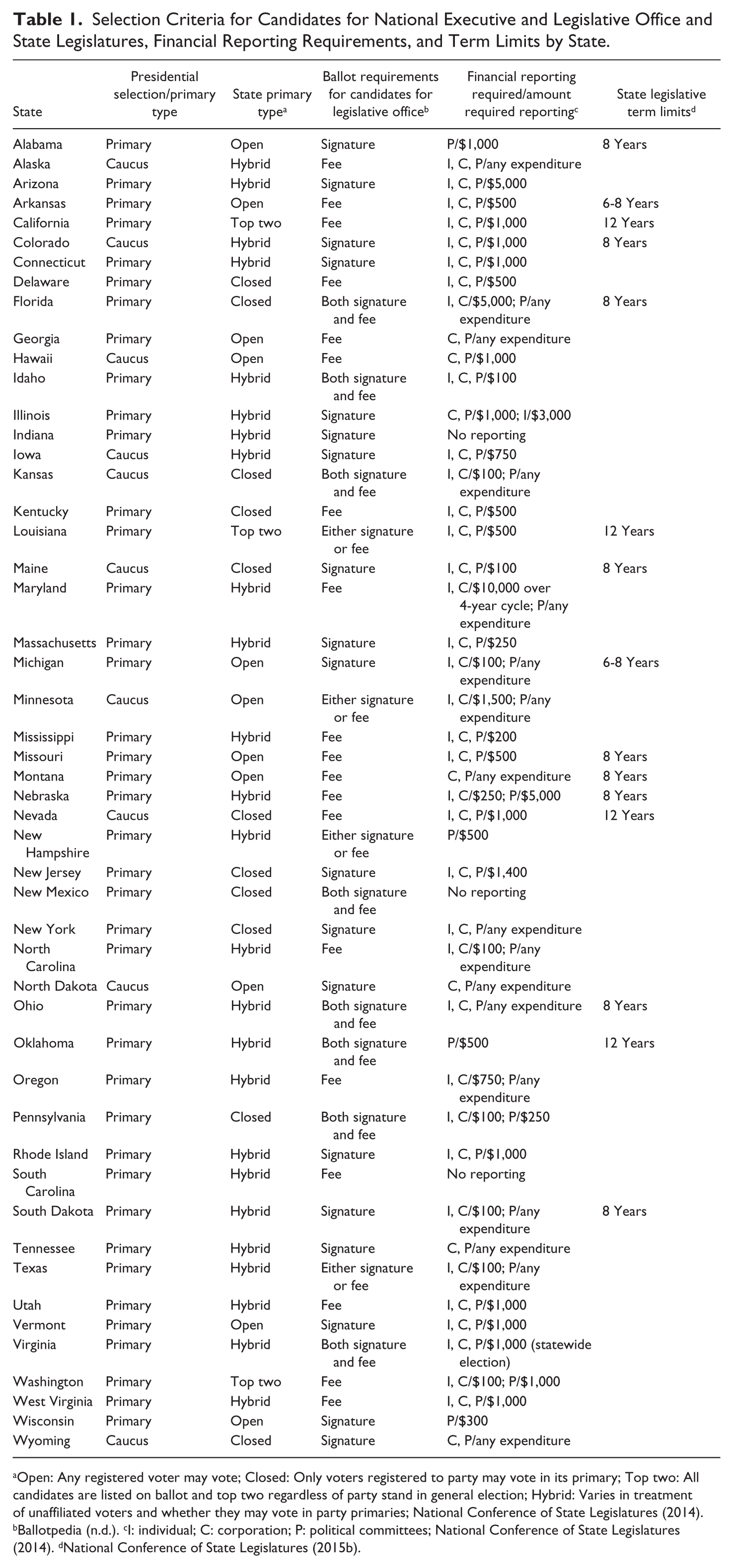
Open: Any registered voter may vote; Closed: Only voters registered to party may vote in its primary; Top two: All candidates are listed on ballot and top two regardless of party stand in general election; Hybrid: Varies in treatment of unaffiliated voters and whether they may vote in party primaries; National Conference of State Legislatures (2014). bBallotpedia (n.d.). cI: individual; C: corporation; P: political committees; National Conference of State Legislatures (2014). dNational Conference of State Legislatures (2015b).
Primary rules for legislative elections run from more to less restrictive. Open primaries are the most inclusive and anyone may vote in the party’s primary. In closed primaries, only voters registered with a specific party may vote to choose its candidate who will stand in the general election. Between those is the hybrid or semi-open primary, which allows unaffiliated voters to cast a ballot in partisan primaries. Other thresholds for potential candidates exist who generally signal their intention to run by filing an official declaration with the state and paying a filing fee and/or submitting a petition with a specified number of required signatures of eligible voters. Filing fees can be a low as $2 in New Hampshire or can rise to a few thousand dollars to run in state-level races, while the cost to run for national legislative office can be very high, although the average across all states is $1,465 (Ballotpedia, n.d.).
In many states, there are separate procedures for partisan candidates versus those running as independents or minor-party candidates; for example, there may be a different threshold of signatures independent candidates must obtain to be put on the ballot or they may only appear in the general election race rather than in the primary. Most but not all states also allow write-in or sticker candidates for whom the requirements tend to be quite minimal. Although difficulties for third parties to appear on the ballot wax and wane over time and differ across states, they remain strong (Rosenstone et al., 1984) and while court decisions have tended to support the autonomy of the major parties from the states in terms of control over candidate nomination, they have strengthened the ability of states to impede minor parties (Black, 1996).
Campaign Financing
Table 1 also lists state-level campaign finance rules and reporting requirements that candidates must follow. The United States is unique among democracies in the expense of its campaigns (Rosenberg, 2014) and access to money is one of the factors that acts as a gatekeeper to candidacies. While the need for individual politicians to raise funds for races suggests a candidate-centric view of the selection process, the interplay of party, and candidates around funding is more complex. How money is channeled into races sheds light onto both the salience of parties and the nature of inclusivity of candidate selection in the American context.
At both the federal and state levels, the role of money in politics is a key feature of the American political landscape. The financial requirements to mount a competitive campaign have been growing. In 2016, for example, analysts predict that the presidential race could cost anywhere from $5 to $10 billion (Hunt, 2015; Parnes & Cirilli, 2015). As Steger (2000) points out, the rising cost of presidential campaigns since the 1970s means that candidates need to raise enormous sums of money, particularly because of the scheduling of the primaries.
As a result of the reforms in the post–McGovern–Fraser era, primaries produce delegates who are committed to voting for the candidates at the nominating convention. This means there are no longer “brokered” conventions where the party’s nominee is unknown ahead of time (Bernstein, 2015). An unintended effect has been to shift the primary season earlier and to crowd the electoral calendar near the start of the process. States have moved up the dates of their primaries in a process known as frontloading as they seek both to gain influence over the choice of the nominee (Ridout & Rottinghaus, 2008) and secure the economic benefits to local economies that decline as the primary season progresses (Atkeson & Maestas, 2008; Lessem & Urban, 2015). Frontloading means that campaigns now require much of the money to be raised even before the primaries begin in order to get name recognition and endorsements that are crucial to winning.
This tends to limit the pool of viable candidates to those who have access to either very large donors or personal fortunes. While U.S. electoral campaigns have been costly affairs for some time, in the 5 years since the landmark Citizens United (Citizens United v. FEC, 2010), Supreme Court decision that removed limits on independent spending in races by outside groups such as corporations, unions, and other political action committees (PACs), spending has skyrocketed. This is true across many levels and has trickled down: Between 2010 and 2004, outside spending in Senate races more than doubled and the money largely comes from exceptionally wealthy individuals (Vandewalker, 2015).
Even at the state and local levels, the effects of the court case have been notable in driving up the costs of races (Lee, Ferguson, & Earley, 2014). The role of wealthy donors may even be more pronounced; as Lee et al. (2014, p. 1) argue, “it is possible for a single funder to dominate the discourse and machinery of politics in a way not seen at the federal level.”
The importance of funding in the American political market place tempers our understanding both of its openness and the strength of parties. First, while in theory, the control of the process by state laws rather than party elites means that anyone can run for office, in practice, the need to secure funds means that candidates who have access to resources, especially those provided by the dense and highly partisan networks created by PACs are more likely to prosper than candidates who do not belong to such networks (Desmarais, La Raja, & Kowal, 2015). Second, while parties may have a lesser role in directly selecting candidates than in more closed systems, they possess a fair amount of indirect control. Herrnson (2009) has argued that by expanding our view of parties’ reach to include the role played by party-affiliated or party-allied organizations in funding candidates, it becomes clear that parties have much more influence in candidate selection than they are typically given credit for. Parties play a key role in connecting candidates with fundraisers and advertising (Herrnson, 1986) and half of political funds raised nationally in the United States go to parties, which allows them to work on behalf of candidates, for example, by registering and mobilizing voters (Ansolabehere & Snyder, 2000).
Representativeness
While the drive for greater responsiveness to the rank and file led to a more inclusive selectorate in the United States, it appears to have done little for the representativeness of candidates. This is unsurprising as Rahat et al. (2008) have argued that highly inclusive candidate selection systems are typically low on indices of representation because competition among candidates is unlikely to produce a pool that mirrors the allocation of social attributes like gender or class in the population. More tightly controlled selection systems can more efficiently construct candidate lists that conform to a desired distribution. Even then, achieving that requires purposive action on the part of elites.
This section examines two of the characteristics that the literature often points to as being underrepresented in candidate selection processes—gender and social class—and discusses those in the context of the United States. With respect to gender, the United States lags behind many of its European counterparts in terms of elected representatives (Santana, Coller, & Aguilar, 2015): At the national level, barely a fifth (19.4%) of legislators are women, while at the state level, roughly a quarter of lawmakers are female, though it varies from a low of 12.3% in Louisiana to 41% in Colorado (National Conference of State Legislatures, 2014).
Parties in the United States, particularly the Democrats, have long advocated more gender equality in their decision-making bodies. Just after women were awarded the right to vote in 1920, the national committee of the Democratic Party selected one man and one woman from each state for membership and the McGovern–Fraser Commission recommended that the gender makeup of delegates to the national convention more closely resemble the electorate (Kunin, 2008). Yet with little direct control over who runs for office, parties would need to identify and develop strategies to cultivate female candidates. Since women are no less likely to win than men, when they do run, (Dabelko & Herrnson, 1997; Darcy, Welch, & Clark, 1994) expanding the number of female candidates is a way to address the gender gap in representation.
Women’s motivations to run for office are different than men’s: They are less ambitious with respect to running for office, less likely than men to be self-nominators as candidates, less confident about their qualifications, and more pessimistic about their chances of winning (Carroll & Sanbonmatsu, 2013; Lawless & Fox, 2005; Preece, Stoddard, & Fisher, 2014). As noted above, parties and their affiliated organizations often have a larger role in recruitment than they are credited with and they can provide money and services to potential candidates (Herrnson, 2009), but they need to better understand how to deploy those.
Because women are less likely than men to self-nominate, they need to be recruited; it is especially critical that parties make an effort to identify and target potential female candidates (Sanbonmatsu, Carroll, & Walsh, 2009). Although parties are acutely aware of the need to actively encourage female candidates to run, they are not always effective at it. Crowder-Meyer (2013) looks at the gendered nature of local party networks and concludes that one of the reasons parties in the United States often do such a poor job of recruiting women is they fail to look for candidates in the places they are likely to be. For example, women may be active at different (lower) levels of politics than men like school boards or more likely to be found among the social networks of party members than within the ranks of elected officials. Fox and Oxley (2003) also found evidence at the state level that the recruitment process itself is gendered. Women are more likely to be recruited at the selection stage into stereotypically female types of office (lower level, associated with certain types of issues) and that has implications for the future makeup of legislative bodies due to politicians’ career trajectories.
There is a partisan dimension to female candidacies. At both the state and national levels, Republican women fare less well than Democratic ones in terms of reaching office (Carroll & Sanbonmatsu, 2010) and while the reasons for the difference are complex, recruitment strategies play a role. For example, Fox and Lawless (2010) highlight the important ancillary role Democratic women’s organizations play in helping convince female candidate to run, something that has no counterpart in the GOP. 1 Republicans are also less likely to recruit women in part because they tend to focus more narrowly on networks of activists and officials (Crowder-Meyer, 2013).
Targeted messages can play a role in encouraging women to become candidates. Broockman (2014) points to journalistic accounts and political memoirs that have long highlighted the role that personal appeals by political elites to potential candidates play in the recruitment process. He shows using a field experiment with a national political organization that significantly more activists who had personally been encouraged became candidates than those who had not been directly pushed. He concludes that candidate entry into the field should be seen as “strategic mobilization practiced by rational political elites” (Broockman, 2014, p.114).
Financing may also play a role. While generally scholars have found little difference in the fundraising abilities of male and female candidates (Uhlaner & Schlozman, 1986), effort expended on collecting money may differ. Jenkins (2007) shows that female politicians perceive fundraising to be more time consuming and involving more donors than their male peers do, which may in turn discourage women from running. In addition, the partisan gap may also in part be explained by access to money. There are more female-centric PACs, such as the powerful Emily’s List which focuses on electing prochoice Democratic female candidates in the Democrat’s orbit than in the Republican’s. These PACs, in addition to raising money, also carry out some of the work of recruiting and training women to run for office (Elder, 2014).
Social class is another attribute that theorists have argued ought to be represented by members in elected bodies. Mansbridge (2015, p. 263) claims that
representatives who have themselves lived through typically working-class experiences will be more likely than others to understand the nuances of these issues and thus be able to represent their working-class constituents more insightfully than even committed and well-meaning representatives who have not had similar experiences.
In the United States, unlike in many European countries, the percentage of nationally elected legislators from the working class has never been very large; throughout the 20th century, the members of Congress from a working-class background hovered about 2% (Carnes, 2012). Does it matter that elected officials are so overwhelmingly likely to come from the middle and upper middle classes? There is evidence that personal wealth does influence the behavior of officials; Griffin and Anewalt-Remsburg (2013) found that controlling for party affiliation and constituents’ views, wealthy legislators were more likely to vote to repeal or reduce the estate tax in the United States. Similarly, Carnes (2015a) found that Congressional legislators’ class background was related to their voting on economic issues and argues that while the makeup of the political class was not responsible for the increasing concentration of wealth in the United States, it could account for the rather tepid response to it by politicians.
As with gender, there does not seems to be a bias on the part of the electorate in that voters are not less likely to vote for working-class candidates than others (Carnes, 2015b), but rather there is not a concentrated effort to recruit such candidates. Just as targeted outreach efforts to women and political training have increased the number of female candidates and elected officials, existing programs that focus on recruiting and training working class candidates have been successful. Carnes and Broockman (2013) point to efforts by state branches of the AFL-CIO trade union as well as union-backed programs in some localities that have had effective results.
While there are solutions to the lack of economic diversity in the candidate pools of the major parties, as with other characteristics like gender, in a decentralized system of recruitment, there has to be a determined, concentrated effort by party and party-affiliated gatekeepers to develop and encourage potential candidates to run. Currently in the United States, the rate of unionization is at the lowest point in almost a century (Greenhouse, 2013), highlighting the weakness of organized labor and suggesting an uphill battle for such an effort. At the same time, the public’s view of unions is improving and the percentage of people who would like unions to have more influence on policy is growing, though there is a sharp partisan division in attitudes (Saad, 2015), so that there may be scope, at least among the Democratic Party, to enhance the representativeness of candidates.
Inclusive Selection Processes and Political Insurgencies
The candidate selection process in the United States suggests another tendency of inclusive systems that receives little attention in the literature: the susceptibility to insurgent movements. These use the openness and porousness of procedures to try to effect changes, often to the way candidates themselves are selected. This may be a way to democratize candidate selection further or to force the inclusion of the voices of those who feel left out. We can speculate that in a decentralized system where party control of the process is weak, this is likely to be more common than working internally to change party rules. Instead, insurgencies attempt to institute rule changes externally. Here, I analyze three examples of changes in the political arena that may erode the power of parties in controlling the candidate selection: the term limits movement, the role of the Internet, and the growth of the Tea Party.
The Term Limits Movement
The first example is the term limits movement, a citizen-led, direct democracy initiative beginning in the late 1980s that sought to directly influence and regulate candidate selection and recruitment by imposing limits on the number of terms a state legislator could serve (Caress & Kunioka, 2012). Activists sought to break the hold that special interests were thought to have on elected officials as well as to make legislators more accountable to voters. As economist Milton Friedman (1993) argued at the time, citizen initiated term limits were an indication that voters were not getting the legislation they wanted. Others saw this as a way to open up the candidate selection process and allow representation of groups such as minorities and women who were shut out of legislatures by incumbents who had a lock on their seats. Some antifederalist term limit crusaders sought to return politics to an image of civic republicanism they associated with the country’s founders (Grofman, 1992).
The movement did not take hold everywhere but rather was limited by electoral laws to states where citizen initiatives allow citizens to directly or indirectly introduce laws onto the ballot (National Conference of State Legislatures, 2015a). That states did not impose term limits in the absence of such mechanism suggests that parties, or at least state legislatures, were opposed to limits. Today, 15 states, shown in Table 1, still have term limits for incumbents in state legislators, typically 8 years although a few states allow for longer lifetime, nonconsecutive totals (National Conference of State Legislatures, 2015b). Twenty-three states ultimately passed term limit laws but they were struck down in eight states by state supreme courts. Likewise, the movement to impose state-level limits on U.S. congressmen and senators saw those rules struck down by the Supreme Court’s 1995 decision in the U.S. Term Limits, Inc. v. Thornton case.
A quarter century after the height of the movement, one of the most comprehensive examinations of the impact of term limits concludes neither the initial fears of chaos nor all the hopes of citizen empowerment have been realized, yet the institutional nature of state legislatures where term limits exist has been remarkably transformed (Caress & Kunioka, 2012).
Insiders suggest that on the whole, the power of legislatures has diminished, as has the influence of formerly powerful figures like long-term speakers of the house or key committee chairmen. In addition, the workings have in some cases been affected as institutional memory is lost, leading to the unintended consequence that lobbies have become more influential as they fill the gap of expertise that may formerly have resided in the legislatures. The career progression of state-level politicians also appears changed. Unlike the expectations of reformers, limits seem not to have led to the self-recruitment of a new type of representative, one who is a “citizen legislator” (Caress & Kunioka, 2012). Rather, career politicians are still the norm but their pathways to power are slightly different than they might otherwise have been. Many enter the lower chamber with a great deal of political experience at the local level under their belts and plan their future shifts to the upper chamber or national-level politics. One of the important effects appears to be the timing of a run for office; rather than go up against an incumbent, challengers in term limit states seem to wait until the seat is vacant, making incumbent seats even safer.
These career data highlight a point made forcefully by the institutional literature on candidate selection (Fox & Lawless, 2004). Changes in formal rules governing who can run, even with the express purpose of recruiting a wholly different type of candidate, may not produce the expected outcomes. In this case, politicians have adapted their career strategies to the changed institutional conditions rather than conditions producing new types of candidates.
Social Media and Insurgencies
A second case study examines how the interplay of inclusive, decentralized candidate selection and candidate-driven campaign financing allowed an Internet-based insurgency that saw new forms of fundraising and voter outreach. As Chadwick and Howard (2010) point out, the use of Internet technology in campaigns has more to do with existing institutional structures than the diffusion or availability of the Internet. The United States’ decentralized primary system has made it well suited for Internet-based insurgencies.
The Internet has played a key role in campaigns at all levels of elections since the 2004 presidential campaign, when unknown Howard Dean, Democrat from the state of Vermont, rocketed to prominence in advance of the primaries by raising large sums of money using the Internet. This insurgency was fueled by thousands of small donations online allowing the Dean campaign to shatter previous fundraising records (Cornfield, 2005). He was then able to using the Meetup.com platform to turn his “virtual support into a real political force” (Anderson, 2004) and to attract young people, many of whom felt disaffected from politics, using a technology they understood and championed. By 2008, the power of the Internet was apparent, as Barack Obama became the first outside Democratic candidate since Jimmy Carter to secure the party’s nomination. Like Dean, Obama was very effective at online fundraising and early on, raised an unprecedented amount of cash from millions of small and first-time donors, revolutionizing campaign funding in the United States (Luo, 2008).
Unlike Dean, Obama was able to convert his organization into a highly functional apparatus on the ground that allowed him to win both the nomination and the election. Thus, the Internet was critical for an insurgency candidacy like Obama’s for two reasons: the monetary resources necessary to run competitively in the primaries and the ability to mobilize grassroots activists. Yet it was still up to the campaign to turn the momentum provided by those into an effective ground game.
Candidates quickly picked up the lessons of the importance of new media from 2004 as crucial in establishing a campaign. In 2006, this was partially set in motion as Facebook made the unprecedented move of creating a standard profile template that all U.S. congressional and gubernatorial campaigns could fill in (McGirt, 2009). While that year, social media still was more of a phenomenon at the national level than in local campaigns (Williams & Gulati, 2012), there were also partisan differences in the effective use of the Internet by candidates. In 2008, Democratic presidential candidates had more elaborate campaign websites and were more likely to actively use their social media channels (Vaccari, 2012; Williams & Gulati, 2012) though by the 2010 mid-term elections, Republican congressional candidates had caught or eclipsed their Democratic rivals (Heaney, Newman, & Sylvester, 2010).
Similar patterns characterize state-level races albeit with a slight time lag. Data collected in 2001 showed that challengers or candidates for open seats in state legislatures were more likely than incumbents to communicate with potential voters, organize support and resources, or recruit volunteers using social media (Herrnson, Stokes-Brown, & Hindman, 2007). Those same authors found little partisan difference, a finding echoed more recently by Williams, Gulati, and DeLeo (2013) who found only minor difference across parties.
By now, social media has become an intrinsic part of the political landscape in the United States and is part of the necessary institutional structure characterizing candidacies at both the national and state levels. Its use is standard in state legislative campaigns and in addition to connecting with supporters, it has become an important part of the way campaigns raise funds (Squire & Moncrief, 2015).
The Tea Party Insurgency
The final example of a political insurgency in the United States that sheds light on the functions of candidate selection is the rise of the Tea Party, a social movement born in 2009 that channeled antitax, antigovernment spending—particularly around the issue of national health insurance—attitudes. Across party systems, social movements play an important role in injecting issues into politics. While social movements have sometimes mobilized to successfully form new parties such as the Greens in a number of European countries or nationalist populist parties such as France’s National Front, Schwartz (2010) notes that in the United States, movements often target the parties to further their agenda and parties, in turn, use them strategically for electoral advantage.
In the case of the Tea Party Movement (TPM), the relationship between the movement and the Republican Party is complex and has changed over time. Skocpol and Williamson (2012, pp. 88-89) suggest that the initial conditions that allowed the rise of the TPM were a function of the Republicans’ weakness in the aftermath of the Obama victory: “it was a juncture of openness and opportunity because, in the wake of the discredited Bush presidency and failed McCain campaign, official GOP organizations were not going to be able to control what happened next.” Using the primary process in 2010 to run their own candidates or offer support to others, the Tea Party stunned the Republican establishment by winning numerous primary battles against Republican incumbents (Rosenthal & Trost, 2012).
The openness of candidate selection procedures contributed to the strength of the TPM within the GOP, but one of its hallmark characteristics that distinguished it from other Republicans was its unwillingness to compromise its political principals for electoral expediency (Bailey, Mummolo, & Noel, 2012). This has brought it into conflict with the Republican establishment on policy issues such as immigration reform and the debt ceiling, has caused the Congressional party leadership difficulties and has produced electoral losses as extreme candidates who won the primary nomination were defeated by more centrist Democrats in the general election.
By 2014, the Republican party fought to tame the Tea Party insurgency in its midst by ensuring that vulnerable establishment candidates had the financial resources to fend off Tea Party challengers using some of its allies for assistance. As a vivid illustration of how crucial the access to outside money is for candidate selection, the Chamber of Commerce spent tens of millions of dollars in selected congressional and senate Republican primary races in 2014 to ensure the defeat of Tea Party candidates (Drew, 2015; McCormick & Giroux, 2014).
Regardless of whether the Tea Party becomes a permanent feature of the Republican Party or, as is more likely, it fades away as many insurgent social movements within both parties have done in the past, it highlights two features of the party system in the United States. First, unlike some other Western democracies, where parties like France’s Front National and Italy’s Lega Nord on the right or Spain’s Podemos, and Greece’s SYRIZA on the left have contested or sometimes supplanted mainstream parties, the highly decentralized nature of selecting candidates in the United States (Lundell, 2004; Pennings & Hazan, 2001; Whiteley, 2011) means that such insurgent pressures have largely taken place within the parties themselves.
Second, it underscores the interplay among political culture, candidate selection, and movements. It does so by highlighting the role that political culture plays in shaping opportunities for insurgent movements (Kitschelt, 1986) as well as the role of candidate selection in molding political culture. The Tea Party emerged at a point of high and increasing political polarization of contemporary American politics and society (Abramowitz, 2010; Fiorina, Abrams, & Pope, 2006; Iyengar & Westwood, 2015). Abramowitz (2011) argues that the movement grew out of the Republican base that had been steadily moving to the right over the past three decades, which allowed it to flourish.
The Tea Party example also shows the way in which candidate selection methods influence the political culture. The openness of the primary system means that the activist bases of both the Democrats and Republicans who are much less moderate than the general electorate have been able to mobilize support for more extreme candidates (Brady, Han, & Pope, 2007) leading Masket (2009, p. 51) to conclude that the “candidate selection process works systematically to produce polarized partisan office holders.” Existing centrifugal tendencies of the political culture were exacerbated by an inclusive selection system that in turn created the conditions for the emergence of an insurgent movement.
Conclusion
The discussion of candidate selection in the United States presented here offers a nuanced view of the implications of a relatively decentralized and inclusive system of candidate selection. As it developed in the latter part of the 20th century, greater inclusion was meant to democratize the process by taking control from party elites and putting into the hands of voters (Pennings & Hazan, 2001). Consistent with much of the literature, this system was not particularly effective in producing a more representative pool of candidates or elected officials.
It also discussed other sources of influence over selection, particularly financial, that have grown in importance over time. On one hand, the indirect role of parties in channeling funding to candidates either directly or through intermediaries suggests that the view of the U.S. candidate selection system as one of very weak party control (Bartels, 1992; Gallagher & Marsh, 1998) may have somewhat underestimated the ability of parties to influence the outcomes of elections. On the other hand, the openness of the system has meant that insurgent movements can emerge, taking parties by surprise and flourish at least for a time. As other party systems move to more open methods of candidate selection, the U.S. example may provide insights about the boundaries between movements and parties.
Finally, although a full discussion of the link between political culture and candidate selection is beyond the scope of the present article, the experience of the United States suggests potentially fruitful areas for new research along these lines. While there appears to be a mutually reinforcing relationship between a divided American political culture and its decentralized candidate selection processes, some evidence suggests that parties are increasingly able to reassert and strengthen their control over candidates (Jacobson, 2015) as the polarized electorate rewards those who toe the party line. To better understand the complex relationship between the strength of parties and the inclusivity or exclusivity of candidate selection processes, future work might examine the potentially mediating role played by political culture.
Footnotes
Declaration of Conflicting Interests
The author(s) declared no potential conflicts of interest with respect to the research, authorship, and/or publication of this article.
Funding
The author(s) received no financial support for the research, authorship, and/or publication of this article.