



Abstract
The 2014 “mother of all elections” in Belgium offers a unique opportunity to test whether candidate selection for regional and federal elections work alike or differently. The fact that Belgian “statewide” parties do not exist anymore and that Belgium is a quasi-closed list system, giving parties almost unlimited control over candidate selection enhances the uniqueness of the Belgian case. This article verifies whether these “regional” parties select candidates according to different methods for both elections and whether candidates for both elections display different attributes. Our exploratory analysis draws on in-depth interviews with party actors, on the 2014 Belgian Candidate Survey and on an extensive database of regional and federal parliamentary/executive careers since 1991. Our results show that selection procedures strongly differ across parties but hardly within parties regarding regional and federal elections. Besides, regarding candidates’ attributes, only few differences were found between levels. Hence, both levels seem to work alike.
Among the federations and regionalized countries included in this special issue, Belgium clearly constitutes a unique case in terms of basic party system features. In Belgium, “statewide” parties (cum regional branches in the substate entities) just do not exist anymore. Apart from the extreme-left newcomer PTB-PvdA, all parties are organized at the regional level only. Hence, the “Belgian” party system is actually the sum of two regional party systems, a Flemish and a Francophone one.
This unique case allows us first to verify whether these regional parties select candidates according to different methods for regional and federal elections both in terms of rules and practice, and second whether the outcome of the selection, that is, candidates, for both elections display different attributes.
This article answers these questions within the particular context of the 2014 “mother of all elections.” They constitute the first electoral campaign since the sixth State reform (2012–2014)–which devolved extensive policy sectors to regional tiers of government. These elections took place in a decade of strong electoral volatility–and consequently high intra-party competition. Also, important electoral reforms were implemented. From 2014 onward, regional, federal, and European elections shall be organized jointly in principle. And for the first time in Belgian history, multilevel electoral candidacy is forbidden.
The structure of the article unfolds as follows. In the first section, we sketch the main lines of the political and electoral context and describe how candidates and MPs career patterns have been hitherto studied in Belgium. Second, based on these specificities of the Belgian political system, we develop our two main research questions and related hypotheses. Third, the methods for data collection and data analysis are outlined. Finally, we present the empirical findings about formal and informal party procedures for both regional and federal elections and explore the differences observed between regional and federal candidates’ profiles.
Party Systems, Electoral Rules, and Career Patterns: The Specificities of the Belgian Political System
Party System and Processes of Regionalization and Federalization
After three waves of devolution reforms (1970, 1980, 1988), the 1993 reform completed the transformation of the Belgian unitary state into a complex and highly atypical federal system (Deschouwer, 2012). It also modified the structure, composition, and functioning of the federal Parliament and executive, and created fully fledged substate quasiautonomous political systems, namely the (partially overlapping) three cultural communities (Dutch-speaking, French-speaking, and German-speaking) as well as the three regions (Flanders, Wallonia, and Brussels-Capital).
Regarding powers and budgetary means, all reforms have empowered the substate governments and weakened the federal authority. Since the most recent devolution reforms from 2012 to 2014, the share of federal government decreased expenditures to 37% and the regional ones boosted to 63% (social security and local government excluded). Hence, the latest leap forward of regional empowerment turned this level into a prominent career level per se. Indeed, regional MPs control now much more budgetary means and policy sectors, especially those relevant for pork barrel politics and individual constituency service, a traditional MP role (De Winter & Brans, 2003).
The Belgian party system is among the most fragmented in West Europe (attaining 9.1 “effective parties” in 1999, 7.8 in 2014), due to the breakthrough of ethnoregionalist parties in each of the three regions, the split of the statewide Christian-Democrat, Liberal, and Socialist parties into two organizationally independent Flemish and French-speaking parties from the 1968 to 1978 period, and the emergence of the ecologist parties and the Flemish separatist Vlaams Blok at the end of the 1970s. At the 2014 elections, six Flemish parties and six Francophone parties are represented in the House of Representatives (Rihoux, Dumont, Deruette, De Winter, & Baudewyns, 2014). Therefore, since 1978, one cannot strictly speak anymore of a single Belgian statewide or federal party system, as there exist two distinct noncompetitive party systems: a Flemish and a Francophone. 1
The skyrocketing fragmentation boosted electoral volatility. Since the 1980s, overall aggregate volatility surpassed usually the 10% level. But among individual voters, post-vote shifting between two successive elections was about three times higher, with a peak of 41% in 2014 (Dassonneville & Baudewyns, 2014). This creates high electoral insecurity for parties and candidates, increasing the electoral marginality of many positions on candidate lists. Consequently, the average duration of a legislative career has by now declined to 68.8 months in the federal House 2 , to 45.6 months in the Flemish Parliament, and to 42.3 months in the Walloon Parliament (own calculations from Dodeigne, 2014b).
Electoral Rules
The federal Parliament consists of the House of Representatives and the Senate. The latter is since 2014 not anymore elected in a direct way. Currently, the 150 Representatives are elected in 11 constituencies (the 10 provinces plus Brussels), with district magnitudes varying from 4 to 24 seats. Seats are allocated between constituencies and parties through proportional representation, following the D’Hondt method, with a 5% constituency threshold since 2003. Since 1995, regional MPs are directly elected (1989 in Brussels). The 124 members of the Flemish Parliament are elected in the five Flemish province-wide constituencies plus Brussels; the 75 members of the Walloon Parliament are chosen in 13 subprovincial constituencies. The 89 members of the Parliament of the Brussels Region are chosen in a single region-wide constituency, electing 72 Francophone and 17 Flemish MPs. Eligibility requirements at regional and federal elections are generally undemanding, but since 1995, several measures have been introduced to enhance gender equality. Since 2007, parties have to present perfectly gender-balanced lists with the two top positions occupied by candidates from different sexes. These quota measures have boosted the representation of women of less than 1 out of 10 before 1995 to 4 out of 10 in 2014 (Erzeel, Celis, & Severs, 2014).
In 2014, electoral constraints were introduced: candidates cannot anymore be simultaneously candidate on a regional, federal, or European list. This constitutes a major change, as multilevel candidacy was very common practice (see below). Furthermore, regional, federal, and European elections are organized simultaneously. In addition, anticumul rules were introduced for the Walloon Parliament, limiting the cumul of a local executive office (mayor, alderman) with parliamentary office to maximum one quarter of MPs in each party, that is, those that obtained the highest “penetration rates” (percentage of preference votes in the constituency). Hence the federal House–where accumulation is still allowed–has arguably become more attractive for local office holders.
The Allocation of Seats to Candidates
At all electoral levels, the system of allocating seats to candidates is based on two alternative ways of casting votes: a list vote, endorsing the order of candidates on the list, and a preference vote for one or more candidates of the same list. Every candidate whose number of preference votes reaches the “eligibility figure” (calculated by dividing the party’s total constituency vote by the number of seats it won, plus one) receives a seat. Usually, only candidates at the top of party lists do. For the allocation of the remaining seats, a complex mechanism is used that takes candidates’ score in preference votes into account, but only to some extent (De Winter, 2006). 3
In fact, voters rarely manage to alter the ordered list (this has happened in less than 1% of all MPs elected since World War I), even though preference voting has increased from 16% in 1919 to 57% in 2014. In 2014, only six candidates (i.e., 4%) were elected “out of list order.” Thus, in practice, voters only decide the number of seats a party will receive, while selectorates decide who will fill these seats. Apart from the “effective” candidates on parties’ list, we find an additional type of candidate, the “substitute” candidates. If an elected official were to abandon office (mostly due to the promotion to an executive office after coalition formation), she or he is replaced by the first substitute. Hence, in constituencies in which a coalitionable party has a ministrable candidate, that first substitute position is nearly a guaranteed ticket to parliament. 4 This practice further reinforces the power of party selectorates.
To conclude, the Belgian electoral system used for both regional and federal elections is formally often labeled as a semi-open list system (André, Depauw, & Deschouwer, 2012; Carey & Shugart, 1995). Yet, in practice, it operates as a quasi-closed list system, giving the party leadership “virtually unrestricted control” over candidate selection (Borchert, 2011, p. 126).
Career Patterns: Toward Two Distinct Political Arenas
The establishment of regional tiers of government, as well as their incremental empowerment over the past two decades, has renewed the research interest for the study of Belgian parliamentarians. Yet most research concerns MPs’ candidacies and career patterns, not candidates per se. While the processes of candidate selection were initially well documented in the literature (De Winter, 1988), the impact of federalization has been–surprisingly–relatively ignored by the scholarly community (exception made for Depauw & Thomas, 1997; Fiers, 2001).
Research on MPs’ career patterns permits, however, to draw two important conclusions about the territorial dynamics defining elite circulation in Belgium. First, all studies on MPs’ careers underline the “integrated” nature of the regional and federal electoral arenas. Since the first 1995 regional elections, level-hopping movements–from and toward regional and federal electoral arenas–have been regularly observed. 5 If we exclude the first regional legislative term, which always constitutes very specific regional elections (Stolz, 2010), 6 we observe 105 movements toward the national level in Wallonia and Flanders between 1995 and 2014. In the meantime, there are 143 federal parliamentarians and/or members of the federal cabinet shifted toward the Walloon/Flemish regional level (aggregate figures from Dodeigne, 2014b). A quick comparison with regions from other regionalized countries and federations such as Spain, the United Kingdom, and Canada illustrates the fact that level-hopping movements are high in Belgium, while similar to the Spanish case where level-hopping movements are frequently observed at regional and national elections (Dodeigne, 2014b; Stolz, 2010).
The high frequency of movements across levels is mostly due to party electoral strategies. The party leaderships being in control of the process of candidate selection (see below), incumbent regional and national MPs are often “replaced” at another level of government by party selectorates. The motivations can be either party internal incentives (e.g., geographic repartition, diversity purpose, factional dispute, etc.) or party external electoral goals in terms of office and vote-seeking strategies (e.g., placing popular candidates on strategically crucial lists, irrespective of the level of government; Dodeigne, 2014a). The weight of the party leadership in the processes of candidate selection is due to the “partitocratic” nature of the political system (De Winter, Della Porta, & Deschouwer, 1996) which is, furthermore, reinforced by the quasi-closed nature of the electoral systems employed (infra).
Second, extant research indicates that–despite the integrated nature of the regional and federal electoral arenas–MPs’ career patterns have evolved toward a territorial differentiation between levels of government: incumbent regional and federal MPs are often candidates at another tier of government but rarely shift level (even when they are elected). In fact level-hoppers constitute a minority of all parliamentarians because the high number of movements is often caused by a restrictive group of level-hoppers who regularly switch levels (Dodeigne, 2014a). They are the “popular stars” of political parties, usually members of the regional and federal cabinets. In this respect, level-hopping is triggered by the formation of the regional and federal governments, often implying “multilevel reshuffles” in which incumbent MPs/minister are called at another level (Dandoy & Dumont, 2012). Hence, a large majority of Flemish and Walloon MPs have been conducting careers at a single level of government (and not across levels, 71.2% and 71.5%, respectively in the 1991–2014 period; Dodeigne, 2014b). The electoral reforms implemented at the 2014 elections have enhanced this trend toward differentiation.
Research Question and Hypotheses
This article undertakes an exploratory analysis seeking to grasp to what extent there is or not differentiation between federal and regional candidate selection. Our first exploratory research question is the following:
We furthermore want to study the “output” of the selection processes. Selectorates may consider different criteria for regional and federal candidates. Our second exploratory research question is therefore:
We advance three hypotheses to respond to our two research questions. While our hypotheses draw on the state of the art about candidate selection in multilevel systems, they are mostly based on the specificities of the Belgian context, namely a context of identical parties but increasingly autonomous and equipotent political arenas.
First, we hypothesize that the selectorates would be fundamentally the same for both regional and federal elections because of the distinctiveness of the Belgian party system. There is nothing tautologically in this affirmation: Having the same regional parties operating at both levels does not automatically entail that the same selectorates are involved. In fact, distinct selectorates (at the regional, district, or local levels) could be involved depending on the type of elections. Yet, in the context of the 2014 joint elections, we posit that it is in the party’s interest to coordinate candidate selection at all levels. In Norris and Lovenduski’s (1995) terms, electoral lists result from the equilibrium between candidates’ supply (realistic positions, office experience, policy expertise, electoral popularity, etc.) and selectorates’ demand (candidates performing well at elections, geographical repartition, cultural diversity, candidates loyal, and dedicated to the party, etc.). The equilibrium to be achieved in 2014 was particularly difficult because of the numerous positions to fulfill (about 400 individual candidacies per party) in a context of major electoral reforms (most important: interdiction of dual candidacies, reduction of federal positions, and anticumul rules at the Walloon Parliament). It was in the interest of Belgian parties to control both regional and federal elections in order to achieve the most satisfactory equilibrium between their own priorities and their aspirants’ requests.
Second, we hypothesize that similar procedures are used to select regional and federal candidates. In multilevel systems, one could expect, on the opposite, that procedures would differ between elections when one level of government is seen as prevailing over the other in terms of hierarchy. This is the main reasoning behind the concept of “first-order and second-order elections”–used in electoral studies to explain voters’ behavior in multilevel systems (Reif & Schmitt, 1980; Schakel & Jeffery, 2012). Likewise, as voters often opt for different parties at regional, national, and European elections in multilevel systems (based on their perception of the hierarchy between layers of government), we could assume that selectorates use different selection methods at the 2014 joint elections. As we suggested in Hypothesis 1, even a unique selectorate in charge of all selections would be capable of organizing selection processes differently to reflect the hierarchy of tiers of government. Yet our analysis of career patterns in Wallonia and Flanders indicates that parties and their MPs’ behavior do not reflect such hierarchy. Thus, we hypothesize that there are few level differences, if any, in party procedures. However, this hypothesis does not prevent parties to apply different selection methods for different types of candidates. While we expect no difference across selection processes for both tiers of government, this does not mean that parties apply homogenous selection procedures for all candidates on a given list. Differences are expected to occur, primarily between candidates on different positions (e.g., realistic and unrealistic positions). We hypothesize that while the method may vary according to the type of position, the party will not differentiate for both regional and federal elections.
Third, we posit that the output of the selection process would not vary much in terms of candidates’ attributes. Our main assumption is that similar selectorates combined with similar selection procedures should lead to similar selection criteria, with three exceptions. First, selectorates are more likely to recruit regional candidates with former regional experience rather than federal parliamentary/government experience (Hypothesis 3.1), as career pattern analyses have amply shown. Belgian politicians–except ministers–tend to have single-level career. In search of equilibrium during list formation, it is the parties’ interest to try and limit the moving of incumbent MPs between arenas. Another argument is that political parties are arguably best served by MPs with expertise and network built at a specific tier of government instead of another.
Second, selectorates would favor the recruitment of federal candidates who express a greater federal than regional territorial interest (Hypothesis 3.2). In that respect, party favor “regionalist” candidates, in terms of devolution preferences, to run for regional positions and federalist candidates for federal positions (Dodeigne, Gramme, Reuchamps, & Sinardet, 2014; Pilet, Tronconi, Onate, & Verzichelli, 2014). In search of list equilibrium (Norris & Lovenduski, 1995), it is less costly for party selectorates to recruit candidates that campaign at the level of government that best corresponds to their territorial identification and institutional preferences than the opposite.
Third, in line with the assumption supported by Deschouwer and Bradbury (2011) and Dudzinska, Poyet, Costa, and Wessels (2014), we expect that federal candidates would present different conceptions of territorial representational focus in comparison with regional candidates, each focusing more on their respective tier of government. Therefore,
Last but not least, in line with our explicitly exploratory goals, we included a battery of 10 items for which no hypotheses can be clearly stated in one direction or another (perceived selectors’ criteria, party centeredness of their campaign, party delegate representational style, party office experience, perceived level of intra-party competition, dissatisfaction with the tier of government the candidate ran for, territorial identity, age, gender, family composition).
Data Collection and Analysis
For the first research question, we use original qualitative data on the 11 Belgian political parties that had representatives at both federal and regional levels at previous elections (2009 and 2010) and that obtained seats at the 2014 regional and federal election. 7 In order to go beyond the mere formal selection processes, various data sources have been combined to get a comprehensive picture of the reality of party practices in terms of selection methods. Party official statutes have been consulted, next to party internal non-statutory documents containing rules specifically related to the process of list drafting as well as other less formal documents–used to contextualize and exemplify some points of the procedures (e.g., posts on parties’ pages on social media, parties’ websites, and parties’ newsletters). The analysis of party statutes and documents is substantiated by semi-structured interviews conducted with the political secretary of each party (sometimes called general director or national secretary) to grasp the crucial informal side of the selection process (Cheng & Tavits, 2011). The political secretary is in charge of the coordination of the candidate selection process, to a greater or a lesser extent, depending on parties. In two parties, an additional key figure has been interviewed. In particular, interviewees highlighted the relative importance of each stage and nuanced some rules recorded in party documents. Interviews also help understand how political parties managed the three simultaneous selection processes (regional, federal, and European). Finally, printed media provided additional information on the processes. 8
For our second research question, we rely on quantitative data. Two main data sources are used. First, the Belgian Candidate Survey includes all candidates at the regional and federal elections of May 2014, covering all parties having obtained at least one parliamentary seat at these elections (14 parties in total). The population of interest covers 5,254 individuals from which a sample of 1,816 candidates participated in our post-electoral questionnaire (i.e., a total response rate of 34.6%). All parties are almost equally represented, with a slight over-representation of the green parties and a small underrepresentation of far-right parties. The questionnaire tackled issues of campaigning, political themes, democracy and representation, political background and political activities, and socio-demographic characteristics. 9 The second source is Dodeigne’s (2015) database, which covers the political trajectories of Brussels, Walloon, and Flemish regional and federal parliamentary/executive careers since 1991 (n = 1,356).
Given the exploratory goal of this article, we do not develop multivariate models but only run analyses of variance. The technique is designed to identity statistically significant differences between regional and federal candidates (our independent variable of interest) regarding the profiles of candidates recruited (our dependent variable). To test our “quantitative” hypotheses, the variables are operationalized as follows:
Results
Party Selection Procedures
The selection of candidates in Belgium is organized by political parties, as no legal rules stipulate how electoral lists have to be drafted–apart from gender quotas. Political parties remain the absolute gatekeepers to elected office given that they decide on their own rules (De Winter, 1988). While there is no distinction between the national and the regional branches, when we refer to the “national” or the “party” level, this means the regional level (either Flemish, for Dutch-speaking parties, or French-speaking).
This section outlines the main features of candidate selection processes in Belgian political parties, comparing 11 parties along several dimensions–which are developed in the analytical framework of Hazan and Rahat (2010; inclusiveness and centralization of the selectorates, and length and “assortedness” of the selection mechanisms) and by Norris and Lovenduski (1995; process institutionalization). In the next paragraphs, we focus on the prevailing practices in each party, which do not exhaustively mirror the specific procedures that occurred due to the particular context in some constituencies (e.g., when a small party expected no candidate to win in a small constituency like Ecolo in the Luxemburg constituency). Our analysis reveals that there is hardly any difference between processes of selection for candidates on regional and federal lists. Differences are instead to be found between the type of candidates and the type of party.
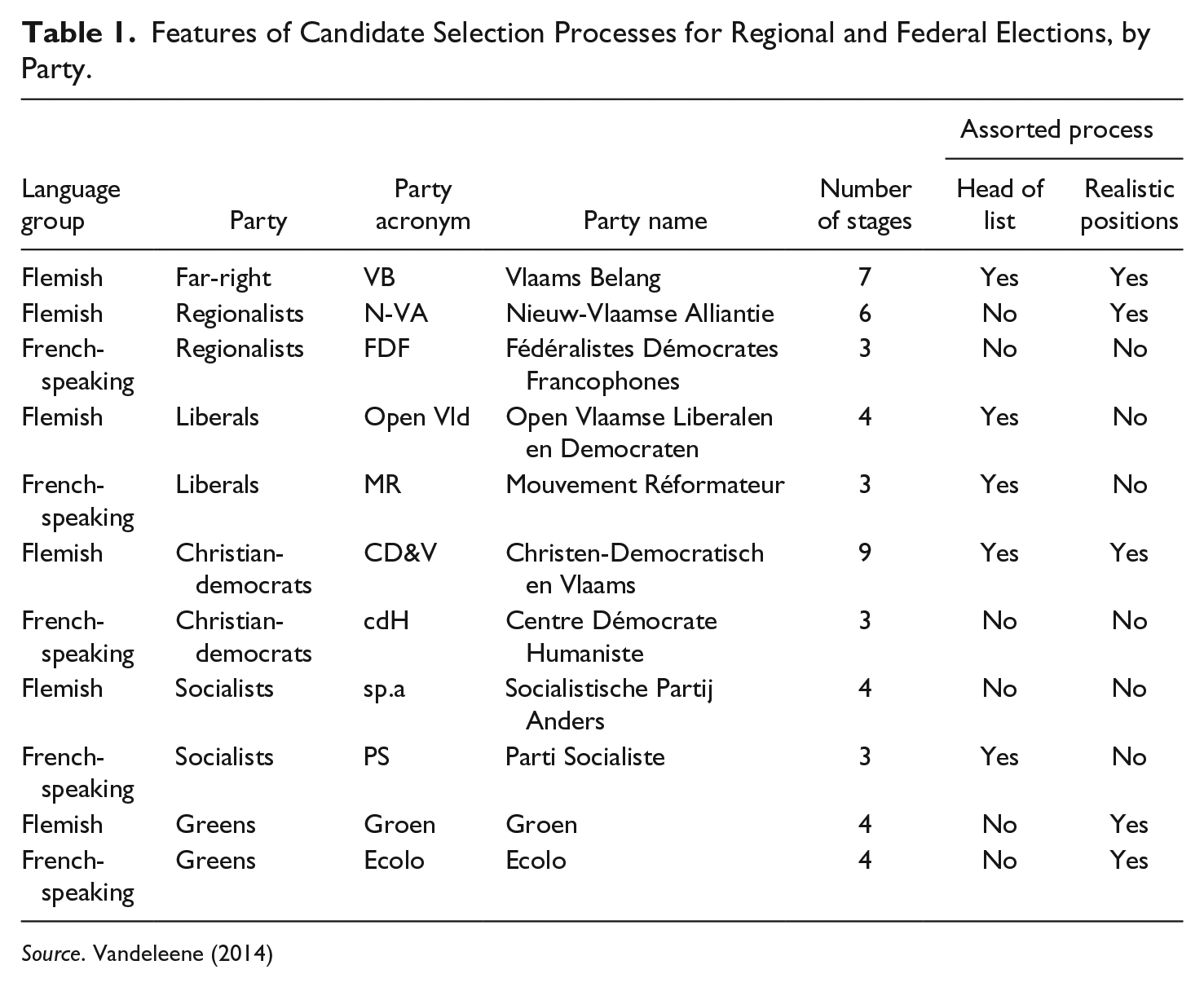
Table 1 indicates that all political parties in Belgium selected their candidates in 2014 according to a “multistage method” (Hazan & Rahat, 2010), ranging from three to nine different decision-making moments. These (lengthy) processes de facto involved many party actors (from three to six different actors) that did all have something to say about the candidates although not all actors or stages are decisive.
Features of Candidate Selection Processes for Regional and Federal Elections, by Party.
Source. Vandeleene (2014)
These numerous actors are situated at different positions in the party hierarchy. Nearly all parties involve actors taking responsibilities at the national level (i.e., the central party level) as well as at the constituency level. Constituencies for federal elections correspond to the Belgian provinces. Accordingly, most parties draft federal lists with the help of the provincial boards, 10 or with committees at the provincial level or even gatherings of rank-and-file members domiciled in the province–yet national actors such as party boards, party congresses, or list committees still remain powerful. The same principle holds for regional lists, for which national actors are involved but where decentralized actors also intervene. For Flemish parties, the processes are identical for regional and federal lists since the constituencies are the same. For French-speaking parties, however, most regional constituencies tally with the arrondissements (i.e., subprovincial territories). This entails that for some parties, subprovincial actors participate in the decision on candidates–what does not prevent provincial actors to play a role. These coordinate the various processes that simultaneously take place within the province (from two to five arrondissement lists per party). Three parties do combine central and decentralized actors: the MR and the FDF have quite a centralized process while the Open VLD is only decentralized to the constituency level. In brief, candidate selection processes are in most cases neither fully centralized nor decentralized; it is a mix of both.
Regarding inclusiveness, that is, the size of the selectorate, no party is entirely exclusive or inclusive. Several selectorates play a role in all parties, what entails various sizes as far as the actors in charge of the selection are concerned. Party leaders are obviously key actors in the selection process. Leaders are either elected or appointed in a body at the national level without having been delegated by another party body. This refers in concreto to the party presidency and other national leaders (chairmen of parliamentary party, political secretary, director of the party study center, ministers, etc.). They mostly intervene at the beginning of the decision-making process or at the very end, so they hold the power of suggestion or are veto-players. In all parties, more inclusive actors also draft the electoral lists through party or provincial congresses of delegates, large committees, or members poll. Even though in all parties actors are multiple, there remain differences not in terms of type of list (federal or regional) but depending on the parties. Some parties are more inclusive than others. This is, in particular, the case for both green parties where rank-and-file members directly intervene in the drafting of the lists. Party members also play a direct role in approving the lists as a whole (via an online poll in the Open VLD and via an on-site voting in the CD&V).
In most parties, processes are institutionalized, that is, interviewees admit that the selection occurs in this way–what does not mean that every decision is formalized, that is, that the rules of the game are stipulated in party documents. The various stages and decision-making actors are described in shorter or larger written party documents but there is still room for informal mechanisms. For instance, most parties acknowledge that the selection occurs in more decision-making stages than devised in the official documents. Some parties add a consultation/proposition stage before the process really starts or a last stage that entrusts a selector with filling the gaps in a given list. Some other parties add stages because they follow a different process for specific types of candidates (the so-called “assorted” method [Hazan & Rahat, 2010]). This is, in particular, the case for the Vlaams Belang. Regarding the nature of the selectorates, a vast majority of the involved actors are foreseen in formalized procedures, with the exception of the MR and the involvement of leaders of the provincial sections.
Finally, parties differ regarding the complexity of their selection process. An “assorted” selection process differentiates among several types of candidates, that is, some candidates are selected differently from others, be it by other selectorates and/or at different moments. As already highlighted by Hazan and Rahat (2010), several Belgian parties use assorted methods to select their candidates. Two main types of candidates benefit from a differentiated process. First, the head of list is a prominent figure in the campaign and for most parties a safe place (i.e., the candidate is certain to seat in the Parliament). Next to the first on the list, some parties select the candidates for realistic positions differently from the rest of the list. These spots refer in most parties to the number of seats obtained at the last elections eventually adapted according to recent polls.
When a party applies an assorted selection process, it does so for all lists, regional and federal. As shown in Table 1, three parties select their heads of list along another procedure than his or her fellow candidates: the CD&V, the MR, and the Open VLD. Besides, the PS and the FDF also applied assorted methods for some regional or federal heads of list, but not all. Four parties applied an assorted procedure for the safe and remaining places: Ecolo, Groen, the CD&V, and the N-VA.
Figure 1 outlines who has the last decisive say on candidates on realistic positions for each party. When the very last say is purely formal, the previous actor in the decision-making process has also been taken into account. Parties can be divided into five groups, from the most exclusive selectorates to the most inclusive.
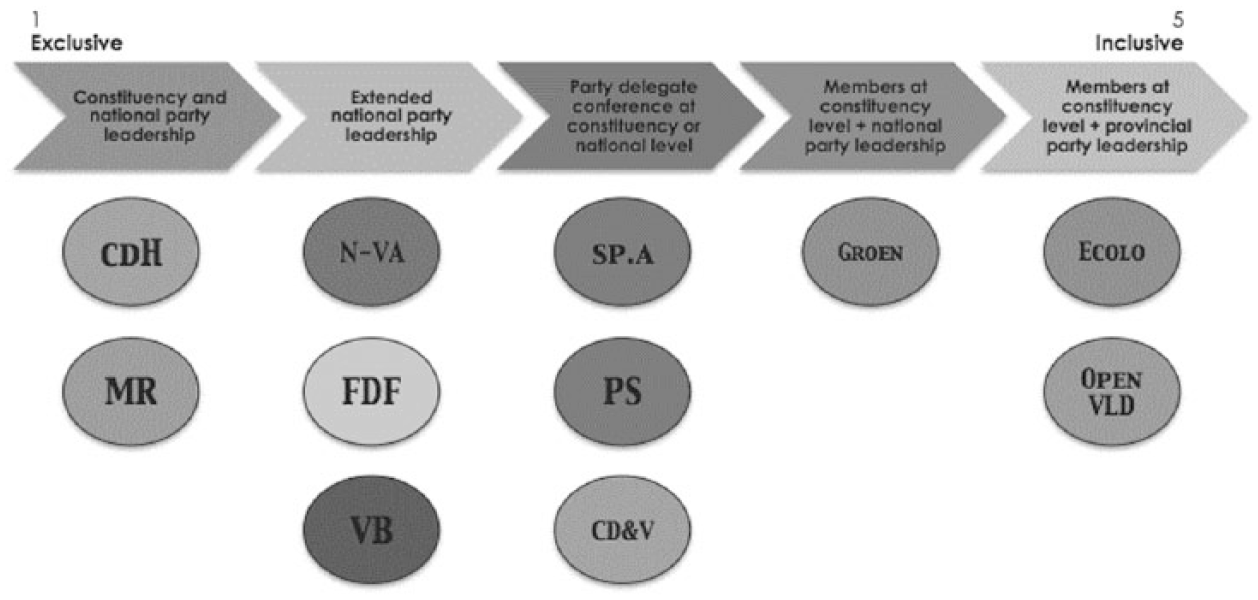
Key selectorates along the Inclusiveness Scale (five categories).
The first two parties use rather exclusive selection methods for realistic positions. The most powerful selectorate in the cdH is a committee at constituency level together with the top candidate of the list, and for the MR it is a committee organized at the national level. The next group (FDF, N-VA, and Vlaams Belang) entrusts the last decision on candidates for realistic positions to a meeting of the extended national party leadership. These selectorates include quite a lot of individuals but most of these are not delegated by another party body and sit in the selectorate because of their position in the party hierarchy. Parties calling on delegates to decide on candidates constitute the third group. A (territorial and functional) delegate conference is organized at constituency level for both socialist parties and at the national level for the CD&V. For these three parties, a smaller selectorate, however, prepares the decision. Fourth, Groen consults rank-and-file members during a meeting at constituency level where members vote on a draft-list prepared by a committee at the national level. Finally, Ecolo offers to rank-and-file the last say on candidates on realistic positions, even though a small committee at constituency level prepares the draft. Candidates on realistic positions for Open VLD lists are selected by a committee at constituency level and later approved by members through an online vote.
The previous paragraphs underline that, regarding the number of stages and selectors, the degree of centralization and of inclusiveness of the selectorates, and the degree of institutionalization of the process, Belgian political parties follow similar rules and procedures for regional and federal lists. The selection differs not depending on the type of election, be it regional or federal, but on the type of party.
To sum up, even though political parties differ on the crucial point of the last decision maker, this key selectorate does not differ for regional and federal candidates within a same party. Selection processes were organized in parallel, and most of the time, the same selectorate drafted both regional and the federal lists for a given constituency. Given the triple election, there was in all parties a need for coordination. While in some cases, this happened quite informally; in others, it was institutionalized in procedures. For instance, the CD&V set up a national committee that gave advice for all regional and federal lists. Groen used a similar committee that auditioned all candidates for all lists and prepared model lists for the realistic positions, for all lists at the same time. Also in the MR and FDF the main selectorate was a list committee that supervised all lists, what should prevent coordination problems. The N-VA designated a provincial coordinator in each province, charged with the coordination of all regional and federal lists. All coordinators were high-profile figures that de facto regularly kept in contact. Finally, in the Open VLD, there was no specific coordination between selectorates. The European list was the only one managed at the central party level. For the other lists, even the candidacy occurred at the constituency level without the obligation of informing the national level.
Who Is Selected? “What the Selectorates Want”
To what extent do selectorates consider candidates’ attributes to determine the regional and federal electoral lists? The federal level does not constitute the ultimate apex of the Belgian political system neither does the regional level. There is instead a territorial differentiation between the regional and federal electoral arenas, although a small proportion of politicians–mostly the “big fishes” of the political parties–follow multilevel paths. Given the lack of a clear territorial hierarchy, the synchronization of the 2014 mother of all elections and the identical selectorates deciding on federal as well as regional lists, we do not expect to find huge differences in terms of the profile of candidates across tiers of government.
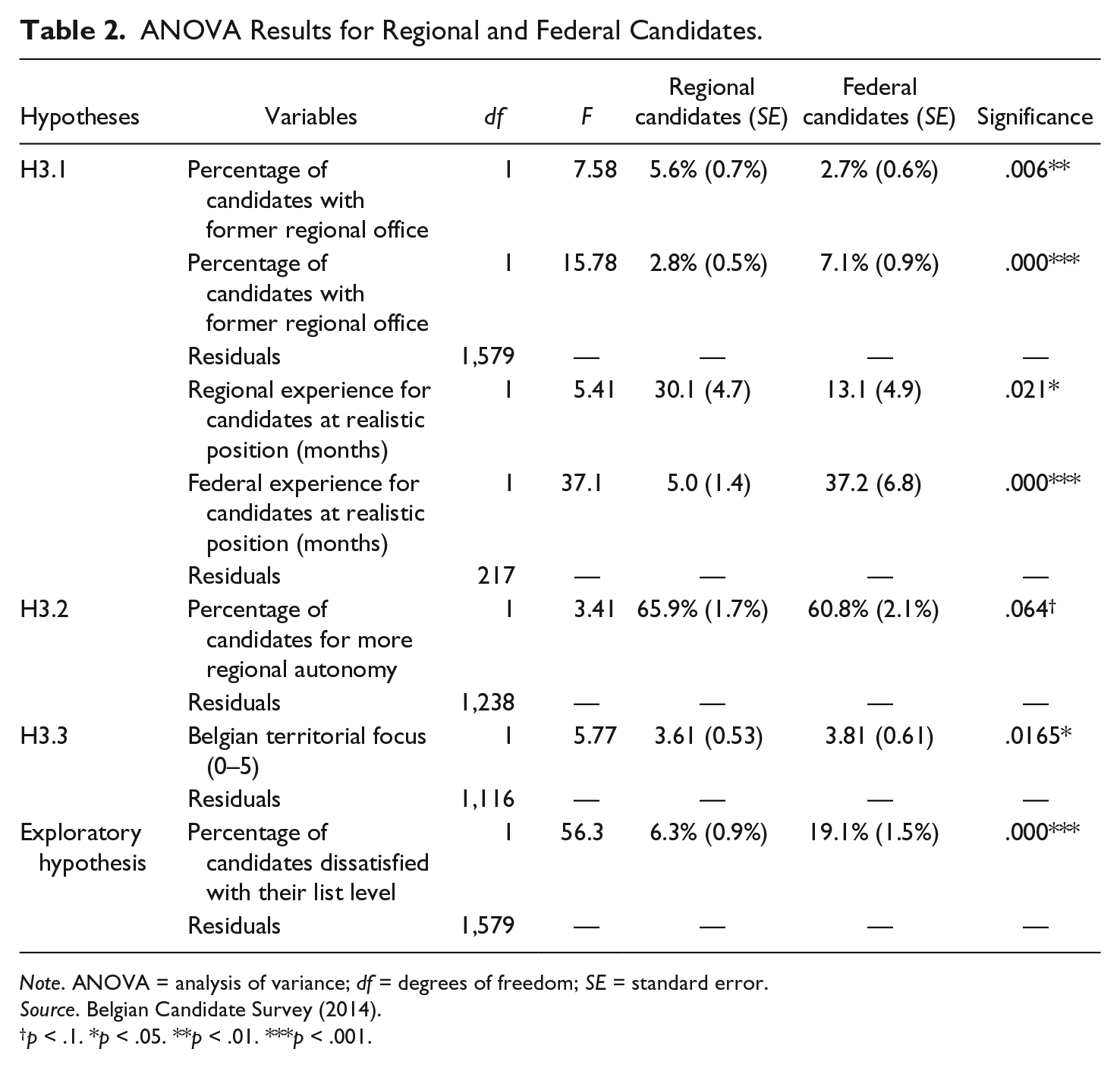
We proxy “what selectors want” by analyzing the output of the selection process, that is, attributes of the candidates they selected. In line with our hypotheses, the analyses of variance (see Table 2) show that there are some significant differences between regional and federal candidates’ attributes (significance level <.10), regarding candidates’ former parliamentary/executive experience, territorial representational focus, devolution preferences, and candidates’ list dissatisfaction.
ANOVA Results for Regional and Federal Candidates.
Note. ANOVA = analysis of variance; df = degrees of freedom; SE = standard error.
Source. Belgian Candidate Survey (2014).
p < .1. *p < .05. **p < .01. ***p < .001.
First, party selectorates do recruit experienced regional MPs/cabinet members on their regional electoral list, and vice versa for federal candidates. On the one hand, we encounter 5.6% of all regional candidates with former regional parliamentary/cabinet experience but only 2.7% with former federal experience. On the other hand, federal candidates also are most often recruited among former federal rather than regional politicians, respectively 7.1% and 2.8%. Furthermore, if we only take realistic positions into account, regional experience is on average twice as large for regional candidates (30.1 months) than for federal candidates (13.1 months). At federal elections, candidates with federal experience (37.2 months) is five times higher than regional candidates (5.0 months).
Second, in terms of devolution preferences, federal candidates favor less a scenario of increased regional autonomy in comparison with regional candidates. On the 0 to 10 devolution scale, there are 65.9% of the regional candidates that score below the value 5 (i.e., scenario of increased regional autonomy) for only 60.8% of the regional candidates.
Third, regarding territorial focus (i.e., the municipal, the constituency, regional, or Belgian focus), the only significant difference is the stronger focus of federal candidates on Belgium (3.81 score on the 1 to 5 scale vs. 3.61, for regional candidates).
Finally, we observe that regional candidates are much more satisfied with the list they were campaigning for than federal candidates (19.1% dissatisfied federal candidates vs. 6.3% regional candidates). 11 The search of list equilibrium is never perfect and various candidates would ultimately feel dissatisfied with the positions they obtain, be it regional or federal, and in particular, in a context of joint elections where–in theory–one can choose between three list types. Our tentative explanation is the context of the sixth State reform (with a massive transfer of powers to the regional tiers of government) in which the 2014 joint elections took place: The empowerment of regional tiers of government has rendered regional positions more attractive for ambitious candidates. In addition, due to the Walloon anticumul rules, some local office holders may have been “transferred” by their party to the national level, where the cumul is still allowed, even when they would have preferred the regional level arguably more useful for serving their commune’s interests.
Conclusion
The presentation of the Belgian case has shown some similarities but also some dissimilarities between regional and federal elections. First, the party system is similar for both regional and federal electoral arenas. As parties are organized at the regional level, the same regional parties run for regional and federal elections. All political processes at the federal as well as regional level (e.g., candidate selection and campaigning) are commanded exclusively by regional parties. Second, electoral rules are identical, with a small dissimilarity for the Walloon regional elections (interdiction of accumulation of a local executive mandate with the Walloon parliamentary mandate while electoral constituencies are smaller). Third, despite the integrated nature of the regional and federal electoral arenas, the analysis of career patterns proves that the situation in Belgium evolves toward a territorial differentiation between these arenas. Representatives tend to develop their careers at a single level of government, either federal or regional.
The 2014 “mother of all elections” constitutes an excellent case for answering the question of whether candidate selection methods differ across levels, due to the novel synchronization of regional, federal, and European elections, as well as a further empowerment of the regions, skyrocketing fragmentation and volatility, and changes in electoral rules limiting multilevel candidacies.
In this context, we examined the degree of differentiation in terms of candidate selection methods and profiles for the 2014 federal and regional elections both qualitatively and quantitatively. Our qualitative analysis reveals that there is hardly any difference between processes of selection for candidates on regional and federal lists, as the same party actors are involved in both processes. However, there exist major differences between parties, in terms of the number of stages and selectors, centralization, inclusiveness, institutionalization, multilevel coordination, and the “assortedness” of these processes. In other words, candidate selection procedures strongly differ across the 11 Belgian parties but there is almost no difference within parties regarding regional and federal elections.
Regarding the output of the selection process, that is, the profile of the candidates selected—a proxy of “what the selectorates want”—we found only a few quantitative significant differences between levels. First, party selectorates do recruit experienced regional MPs/cabinet members on their regional lists, and vice versa for federal candidates. Second, federal candidates favor less a scenario of increased regional autonomy in comparison with regional candidates. Third, in terms of territorial representational focus (i.e., the municipal, constituency, regional or Belgian focus), federal candidates have a stronger focus on Belgium while other territorial focus are not statically significant. Finally, regional candidates are much more satisfied with the list they were campaigning for than federal candidates (of which one out of five would have liked to run on a regional list instead of a federal one).
Overall, our exploratory analysis showed interesting results about the degree of regional/federal differentiation regarding the type of party selectorates, the procedures they use, and the outcomes produced in terms of profiles of candidates recruited. Nevertheless, more refined research, testing multivariate models for each of the dependent variables explored, should be systematically conducted to test the robustness of these results while deepening its relevance for multilevel Belgium in particular, and multilevel systems in general. Last but not least, given the novelty of the 2014 context, we could expect more differentiation at the next mother of all elections in 2019, when parties and candidates would have fully adapted to the new rules of the game.
Footnotes
Acknowledgements
As coordinators of the BCS, Audrey Vandeleene and Lieven De Winter warmly thank the members of the CESPOL research center (Université catholique de Louvain) and of the network PARTIREP II for their valuable contribution at the various stages of the project.
Declaration of Conflicting Interests
The author(s) declared no potential conflicts of interest with respect to the research, authorship, and/or publication of this article.
Funding
The author(s) disclosed receipt of the following financial support for the research, authorship, and/or publication of this article: This research acknowledges the financial support of the F.R.S.-FNRS (CDR J.0141.14) as well as the Interuniversity Attraction Pole PARTIREP II (Belgian Science Policy) for the Belgian Candidate Survey 2014.