



Abstract
This article addresses the emergence of “lowest-low” fertility in some countries, primarily in Southern Europe and East Asia, and poses the question of why we find such large differences in birth rates across postindustrial societies. A set of macro–micro mechanisms are identified, which are examined empirically using comparative data for seven countries from the Gender and Generations Survey. Social norms, and in particular social norms related to gender roles, are at the center of the analysis as a mechanism that conditions the translation of intentions into behavior. Societies that discourage gender equity in the private sphere of the household tend to be characterized by a strong breadwinner ideology. In these societies, the valorization of women’s role as household manager and mother is mirrored by the valorization of men’s role as breadwinner for the household. In these societies, there is a strong norm that a young man should be able to support a family prior to getting married and becoming a parent, that is, that males should prove themselves to be adequate breadwinners. When combined with changing structural conditions, such as high unemployment rates, prolonged periods of education, and increasingly insecure terms of employment in flexible labor markets, this norm will lead to declining birth rates. Hence, norms work as a mechanism that filters the effect of structural conditions so that structural constraints on fertility, such as limited labor market opportunities for young men, will affect fertility outcomes via the mechanism of gender-role norms.
Keywords
Introduction
One of the most dramatic demographic phenomena in postindustrial societies over the past few decades has been the emergence of what demographers have termed “lowest- low” fertility (Billari & Kohler, 2004; Kohler, Billari, & Ortega, 2002). Total fertility rates that are moderately below replacement level are considered to be low, but lowest-low fertility is the term given to rates below 1.3 children per woman; such rates are far below the level required for a population to naturally reproduce itself. While fertility rates of 1.4 (Italy) or even 1.2 (Singapore) may not be regarded as problematic from a global population perspective, such rates portend critical future problems for the societies experiencing them. A high ratio of elderly to working-age adults puts tremendous pressure on pension and social welfare programs and also increases health-related expenditures. Such fiscal problems are coupled with less tangible but nonetheless serious consequences such as a loss of vitality and innovation in the economy and society and increased friction over immigration as a solution to a very top-heavy age pyramid. For these reasons, lowest-low fertility is often discussed in government, media, and scholarly reports as not just a social problem but as a “crisis” in postindustrial societies (McDonald, 2000a; Morgan, 2003).
Despite the concerted attention of demographers, the causes of extremely low fertility in societies as apparently culturally disparate as Greece, Japan, Hungary, Singapore, South Korea, and Portugal remain under debate. Three broad strains of theory have addressed the question of why postindustrial fertility has declined to such low levels in many postindustrial societies. The beauty of these theories—second demographic transition theory, a theory of social policy-driven change, and gender equity theory—is that they tackle the variation in fertility rates across countries as an important explanandum. However, the macro-level nature of the theories renders them difficult to test empirically, especially because of a lack of specificity as to the mechanisms that link the macro-level context to individuals’ fertility aspirations and behaviors.
This article takes up the challenge of theorizing the mechanisms through which the varied cultural contexts of postindustrial societies influence individual fertility. In doing so, I take seriously Coleman’s assertion that explaining the macro–micro transition—the transformation of individual behaviors into macro-level phenomena—is a central challenge for the social sciences (Coleman, 1990, 1996). Accompanying this challenge is a related one: The thorny problem of explaining how individuals are influenced by norms, which are a key macro-level property. Accordingly, a complementary aim of the article is to theorize and empirically explore how cultural norms condition the effect of macro-level structures and institutions (such as family policies and labor market institutions) on individuals’ intentions and behaviors. In this way, how the interaction between culture and structure affects individuals is an important component of the inquiry presented here.
The first part of the article briefly outlines the three major approaches to the puzzle of variation in fertility levels across the postindustrial world. Second, I take up the third approach—gender equity theory—as the most promising of the three, and articulate how the theory can be extended to what I call a “gender-essentialist theory of fertility” that specifies a set of mechanisms through which the normative context in a society affects individual fertility. Third, I identify young adults’ inability to fulfill fertility intentions as the most important proximate predictor of low fertility in postindustrial societies, where modern means of birth control are widespread and it is more common for couples not to reach their fertility goals than for them to have more children than desired (Bongaarts, 2001; Breslin, 1997). Fourth, I articulate more fully the mechanism-based approach of gender-essentialist theory and generate specific predictions concerning how cultural norms condition the effect of structural conditions on individuals’ ability to fulfill their fertility intentions. Finally, I provide an empirical illustration of the norms-as-mechanisms approach using data on fertility intentions in seven postindustrial societies that exhibit fertility levels ranging from moderate to lowest low.
Theories of Comparative Postindustrial Fertility
As fertility levels declined across many parts of the postindustrial world in the late 20th century, a strain of theory emphasizing the increased individualization of the life course and the decline of normative influences on individuals’ demographic choices became popular. Second demographic transition theory posits that increasing individualism and postmaterialist orientations have led more and more couples to voluntarily delay or forgo childbearing altogether (Lesthaeghe, 1995, 2010; Van de Kaa, 1987). While rarely tested empirically (Vitali, Billari, Prskawetz, & Testa, 2009), the logical extension of this view is that in societies where people express the most individualistic goals and strive toward self-actualization, fertility aspirations should be lower and hence the country’s total fertility rate will also be lower.
Despite these theoretical claims, there has been little empirical substantiation of the idea that individuals’ fertility aspirations and realized fertility are the lowest in societies characterized by the greatest “individualism” (Esping-Andersen & Billari, 2015; Scott & Braun, 2006). Instead, it is precisely in those postindustrial societies characterized as being the most “familistic”—all of Southern Europe and all of East Asia—that fertility is the lowest (Zuanna & Micheli, 2004). The geographical patterns of fertility across the postindustrial world suggest that the fit between individualistic values and fertility is actually the opposite from what second demographic transition theory predicts: Fertility rates in Northern Europe, North America, and Oceania (Australia and New Zealand) are considerably higher than in the “familistic” societies of Southern Europe, Eastern Europe, and East Asia. This has given pause to demographers’ attention to values as the “driver” of fertility variation across the postindustrial world. Moreover, the purported irrelevance of social norms, according to second demographic transition theory, has also increasingly been regarded as dubious (Liefbroer & Billari, 2010; Therborn, 2002). As Liefbroer and Billari (2010) point out, theorists of individualization in postindustrial society (adherents of second demographic transition theory) have emphasized modern individuals’ liberation from the social norms associated with institutions such as church and family. While demographers have by and large agreed with the assumption that individual demographic choices in postindustrial societies are subject to few normative constraints, recently the tide has begun to turn toward a renewed consideration of the role of norms. In their exploratory study of life course norms in the Netherlands, a highly secularized society, Liefbroer and Billari (2010) find clear evidence of demographic norms such as those governing age at entry into a union and the timing of childbearing. This leads them to conclude that “the processes of individualisation and the SDT [second demographic transition theory] might be linked to the substitution of old norms by new norms, rather than to the disappearance of norms altogether” (p. 302).
A second line of theorizing has focused on how state policy interventions can render work–family trade-offs more manageable, especially for women. Following the opportunity costs logic of Becker (1981), it is theorized that interventions that render it less costly for women to have careers and children will help sustain fertility. Accordingly, researchers have examined the relationship between national fertility levels and policy measures such as high-quality public child care, parental leave, and job flexibility (Diprete, Morgan, Engelhardt, & Pacalova, 2003; Gauthier, 2007; Sleebos, 2003). While some empirical studies find positive relationships, others are less conclusive, leading to debate over which policies are likely to boost fertility.
A third perspective on fertility variation across postindustrial societies emphasizes the constraints that individuals—especially women—face in trying to fulfill their fertility aspirations. Compared with the second demographic theory assertion that postindustrial fertility aspirations are low, this perspective shifts attention to the conditions under which individuals’ ability to fulfill their aspirations is constrained. In a series of widely cited articles, McDonald (2000a, 2000b, 2006, 2009) posits that the gap between women’s fertility aspirations and behavior is likely to be strongest in those countries where the gap between progress toward gender equity in the public and private spheres remains the largest. He points to the fact that women’s advance into higher education and the labor market has been a universal trend across postindustrial societies, while the corresponding rebalancing of the gendered division of household labor and child care has lagged behind. This asymmetry in the amount of change in the public and private spheres has rendered women’s “second shift” (housework and child care) a continuing phenomenon (England, 2010). McDonald’s theory thus posits that women’s fertility intentions may not be fulfilled in societies where the time bind makes it infeasible for them to have multiple children while simultaneously participating in the labor market. As he notes:
In expressing higher “ideal preferences” on average, women are effectively commenting upon the nature of the social-institutional settings in which they consider having children. They are saying that, in a different institutional setting, they believe they would have had more children. (McDonald, 2006, p. 485)
Figure 1 illustrates the causal logic of gender equity theory.

Causal logic of gender equity theory.
McDonald’s gender equity perspective on fertility has garnered increased attention in the past few years as an explanation for why some postindustrial societies and not others are experiencing very low fertility. Esping-Andersen and Billari (2015) posit multiple family equilibria, with an intermediate (and presumably unstable) equilibrium lying between a high-fertility regime dominated by a male breadwinner–female caregiver arrangement and a moderate-fertility regime dominated by gender egalitarianism. In the unstable intermediate equilibrium, the gender-role revolution has progressed in the sense that women’s public roles have broadened, but has stalled in the sense that men have not assumed greater responsibility in the private sphere of the household. Consistent with Esping-Andersen and Billari’s (2015) model, recent work has shown that societies experiencing a fertility recovery from lowest-low levels in the past several years are indeed those where progress toward gender equality has continued apace (Myrskylä, Goldstein, & Cheng, 2013; Myrskylä, Kohler, & Billari, 2009).
From Gender Equity to Gender Essentialism
While second demographic transition theory assigns primacy to value change, McDonald’s theory assigns primacy to structural contradictions and the underlying ideology that supports a “separate spheres” view of men’s and women’s lives. This view is not incompatible with the earlier view of the new household economics that women make decisions on the trade-off between labor force participation and children based largely on their opportunity costs (Becker, 1981); this is also the framework on which most policy interventions are based. However, there is an empirical contradiction when one examines the comparative data on fertility rates across postindustrial societies: A large body of literature documents that the previously negative relationship between women’s labor force participation and fertility at the country level reversed by 1980. Now, the countries with near-replacement fertility tend to simultaneously be the ones with the highest rates of female labor force participation (Rindfuss, Guzzo, & Morgan, 2003). This casts doubt on an explanation that gives primacy to the trade-offs between women’s labor force participation and child rearing.
This article proposes a modified explanation that does three things: It “brings men back in” to the analysis of fertility, it focuses on why fertility intentions are often unfulfilled in postindustrial societies, and it brings cultural norms front and center as a set of conditions that mediate the relationship between structural conditions and fertility. While fully acknowledging the structural time bind McDonald identifies for women in postindustrial economies, the proposed framework goes beyond this as an explanation of low fertility. I bring in cultural norms attached to the male breadwinner–female caregiver model. I term this approach a gender-essentialist theory of low fertility.
In the gender-essentialist approach, gender-role norms are theorized to act as a mechanism that conditions the translation of intentions into behavior. Societies where gender equity in the private sphere of the household has not substantially progressed tend to be characterized by a strong male breadwinner ideology. In these societies, the valorization of women’s role as household manager and mother is mirrored by the valorization of men’s role as breadwinner for the household. While this enactment of masculinity is a cultural ideal, its achievement rests on institutional and economic conditions that make it possible for young men to achieve breadwinner status. Historically, if young men encounter difficulties in finding stable, full-time jobs that can support a family, this has generally led to delayed marriage and hence lower fertility (unless men marry much younger women). The reason for this relationship between young men’s structural (economic) position and lower societal fertility rates is that in most “traditional” societies, there was a norm that a young man should be able to support a family prior to getting married and becoming a parent. What linked the structure of labor market opportunities to ultimate fertility outcomes, then, was the cultural norm specifying that young men should prove themselves to be adequate breadwinners before “qualifying” to start a family. If such structural conditions are not met, men in societies dominated by a male breadwinner norm will be more likely to delay marriage and fatherhood until such time that they can meet the cultural expectation of being a good breadwinner.
Similarly, in societies with strong normative expectations for women to be “good wives, wise mothers” (Ochiai & Molony, 2008), women can arguably balance motherhood and postindustrial labor market opportunities only when workplaces exhibit some flexibility in working hours, tolerance for discontinuous labor force participation, and so on. Otherwise, norms of the “ideal worker” and the “ideal mother” collide (Cha, 2010), leading to a higher age at marriage for women and to lower fertility.
The gender-essentialist theory of low fertility, then, posits that postindustrial societies that retain a strong male breadwinner–female caregiver ideology are likely to have lower fertility than those that adhere to a more egalitarian ideology in which men’s and women’s roles are more balanced across the labor market and household spheres. Why? Because in the former societies, both men and women are subject to rigid normative expectations for family behaviors (on the cultural side) that promote higher fertility but may nevertheless, by virtue of structural conditions, be difficult to fulfill. Conversely, more gender-egalitarian societies offer more fluid normative options for fulfilling work and family roles and thus permit a wider range of possibilities—and less reliance on particular institutional and economic conditions—for “doing family” than the strong male breadwinner–female caregiver model allows. This will facilitate people’s ability to meet their intentions for having children.
In taking into account both the cultural and structural conditions under which lowest-low fertility rates may occur, the gender-essentialist theory of low fertility sheds the spotlight not on the level of fertility aspirations or intentions themselves but on the mechanisms that intervene between fertility intentions and behavior. To wit, it posits that the important variability across postindustrial societies lies not in the magnitude of individuals’ or couples’ average fertility intentions, but in the conditions they perceive as facilitating or inhibiting their ability to fulfill those intentions. It is predicted that fertility will be lower in postindustrial societies dominated by a strong male breadwinner–female caregiver ideology, because two gender-specific conditions must be met: The institutional and economic environment for young men to become breadwinners, and conditions (such as parental leave policies and flexible work hours) that render it possible for young women to be virtuous mothers and to simultaneously avail themselves of the expanding labor market opportunities that characterize postindustrialism.
Figure 2 depicts the gender-essentialist theory of fertility, positing that gender-role norms interact with structural conditions to affect the delay or forgoing of entry into marriage/stable unions and the inability of both men and women to fulfill their fertility intentions. Given the primacy assigned in this framework to intentions, it is important to explain demographers’ renewed empirical interest in intentions in recent years and their newly generated interest in men’s as well as women’s intentions.
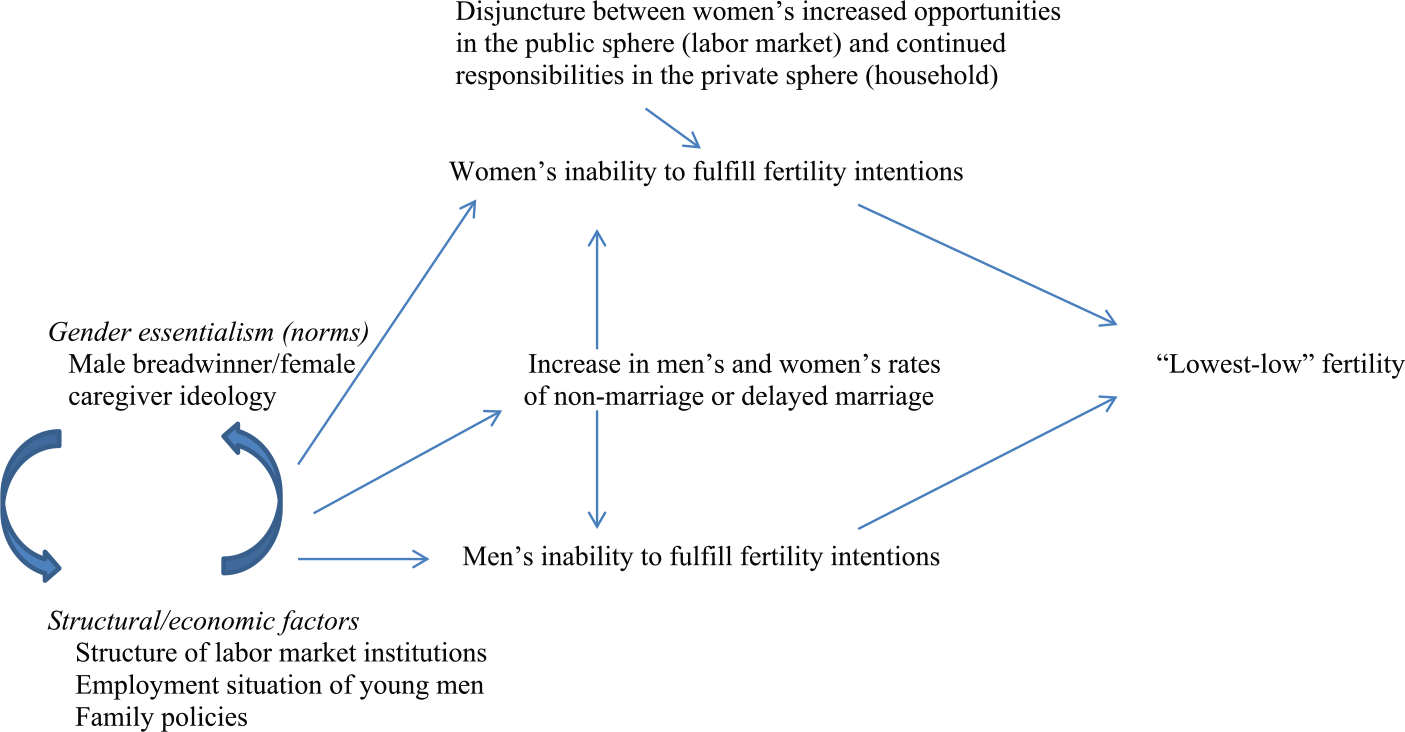
Causal logic of gender-essentialist theory.
Fertility Intentions
One of the most puzzling aspects of postindustrial fertility is that the majority of individuals claim to want more children than they end up having (Bongaarts, 2001; Rossier & Bernardi, 2009). In other words, it is not necessarily the case that individuals or couples in low-fertility societies state desired family sizes lower than those stated by individuals in more moderate-fertility societies (as second demographic theory posits). So, fertility aspirations in and of themselves cannot explain the variation in fertility levels across countries in the postindustrial world.
Aspiration, Intentions, and Behavior
Given the idealized nature of stated aspirations, preferences, or desires, demographers have increasingly focused in recent years on trying to explain the gap between fertility aspirations and actual fertility. A central concept in this line of inquiry is “intentions,” which are considered to be one step closer than aspirations to actual anticipated behavior (Ajzen, 1991; Miller & Pasta, 1995). As Miller and Pasta (1995) point out:
Desires represent what the individual himself or herself wants. They are wishes and as such do not, as a general rule, lead directly to action. Rather, they are first translated into intentions, which are conscious commitments to act in a certain way or to try to achieve a certain goal at some future time. (p. 533)
A significant body of empirical research has demonstrated that fertility intentions are more predictive than fertility aspirations or desires (Hagewen & Morgan, 2005; Schoen, Astone, Kim, Nathanson, & Fields, 1999). Fertility aspirations or ideal family size are likely to reflect social norms concerning the “appropriate” number of children in a family, whereas intended fertility is more likely to include individuals’ estimation of the probability that they will actually have a(nother) child. While uneven access to birth control in developing societies weakens the association between fertility intentions on the one hand and actual fertility on the other, demographers concur that this association is generally higher in the contemporary developed world where knowledge and availability of contraception is widespread. Contraceptive failure or underuse does result in higher numbers of “mistimed” or unplanned births in some settings and populations than others; adolescent unmarried women account for a significant proportion of such births in most societies, especially the United States (Morgan & Rackin, 2010). Even so, fertility intentions have been shown to be strongly predictive of fertility behavior, especially for older women and in cases where the question is worded so as to address anticipated behavior over the short term (3-5 years; Liefbroer, 2005; Miller & Pasta, 1995; Schoen et al., 1999; Testa & Toulemon, 2006; Thomson, 1997). Researchers have compared the predictive validity of positive intentions (i.e., intentions to have a child in the next 3-5 years) with negative intentions (intentions not to have a child within that time frame; Bongaarts, 2001; Régnier-Loilier & Vignoli, 2011; Symeonidou, 2000; Testa & Toulemon, 2006) and have also shown that men’s fertility intentions as well as women’s are predictive of couples’ behaviors (Testa & Toulemon, 2006; Thomson, 1997), a fact that has not heretofore been incorporated into theoretical reasoning in the literature on low fertility.
How Intentions Are Shaped: The Theory of Planned Behavior
Demographers’ study of fertility intentions draws on Ajzen’s (1991; Ajzen & Fishbein, 2005) “theory of planned behavior,” which views intentions as “the final common pathway” through which desires, significant others’ perceived desires, and constraints affect behavior (Miller & Pasta, 1995). The most obvious facilitating condition for fertility is being biologically capable of producing a child and engaging in intercourse without birth control (proceptive as opposed to contraceptive behavior). Above and beyond that, the theory of planned behavior suggests the importance of the significant other’s intentions/agreement with the idea of producing a child and the significance of the attitudes of parents and close friends toward the idea of the individual having a child(ren). Rossier and Bernardi (2009) hypothesize the importance of social networks, positing that networks operate through three mechanisms: social influence (others’ positive attitudes toward family formation), social learning (how individuals form realistic fertility intentions through observing and interacting with others), and social support (the availability of informal child care).
To date, demographers utilizing the theory of planned behavior in empirical research on fertility have focused on indirect measures of social influence (Billari, Philipov, & Testa, 2009; Philipov, Spéder, & Billari, 2006; Rossier & Bernardi, 2009) and on individuals’ expectations of the costs and benefits of having a child (Liefbroer, 2005). Demographers have typically considered individual-level data on fertility intentions in one or a small number of country settings rather than in a larger number of countries that exhibit cultural and institutional variation (Mills, Begall, Mencarini, & Tanturri, 2008; Puur, Oláh, Tazi-Preve, & Dorbritz, 2008; Torr & Short, 2004). Individuals’ fertility intentions are seen as being shaped within the micro-level context of social interaction (Miller & Pasta, 1995). The nearly exclusive focus on individual-level determinants of intentions assumes a process that is not specific to context, and results in a missed opportunity for theorizing how contextual mechanisms condition how intentions translate into behavior. These individual-level analyses by and large constitute a separate body of literature from the other, more macro-oriented literature addressing the question of why fertility rates show considerable variation across postindustrial societies.
In a sense, demographers’ variable-based approach, in Abbott’s (1997) and Sørensen’s (1998) terms, has substituted for deeper theorizing about how individuals’ responses to contextual conditions—especially cultural norms—affect fertility intentions. Without including empirical variation in cultural contexts, it has been impossible to theorize and examine how place matters for shaping individuals’ intentions and for shaping perceptions of whether they will be able to fulfill those intentions.
The gender-essentialist theory of fertility bridges this divide by theorizing how intentions (a micro-level phenomenon) are either constrained or, conversely, freed up to become actions by virtue of individuals’ perception of the conditions that affect their decision making. I theorize that the processes or mechanisms through which intentions are shaped are different in theoretically predictable ways in low- and moderate-fertility countries. In contexts characterized by strong gender-essentialist norms guiding family formation behaviors, norms fundamentally act as a filter through which structural conditions such as difficult economic circumstances affect fertility intentions. Intentions are more conditional in such settings because the normative requirements for motherhood and fatherhood are stronger. This results in lower fertility.
In addition to the likely intellectual reasons, one of the practical reasons that demographers have focused heavily on variable-based theorizing and individual-level survey data—without explicit attention to either cultural or structural context—is the empirical difficulty of testing models across a large enough number of countries to see how context matters. Hierarchical linear models are an appealing strategy for looking at the importance of conditions at various levels such as country versus individual (De Rose & Racioppi, 2001), but such models require comparable individual-level data across a substantial number (i.e., 20-30) of macro-level settings. Unfortunately, such data are unusual.
For the theoretical purposes of the present article, nearly ideal data to examine the role of context do exist, but only for a small number of countries. The Gender and Generations Programme (GGP), run and developed by a consortium of 11 European institutes and coordinated by the Netherlands Interdisciplinary Demographic Institute, runs a comparative survey across several postindustrial societies that asks young adults about their fertility intentions and, most important for present theoretical purposes, the conditions they perceive as facilitating or hindering the realization of their intentions. These perceptions—rarely asked about in surveys—provide insight into how gender-essentialist norms influence how intentions translate into behavior. The seven European countries for which the “conditions” question are available (at the time of this writing) are Austria, Belgium, France, Germany, Hungary, Italy, and Norway. Four of these countries (Austria, Germany, Hungary, and Italy) represent settings characterized by very low fertility, while the remaining three (Belgium, France, and Norway) have moderate fertility levels.
The gender-essentialist theory of fertility predicts that the salience of structural conditions for fertility will vary according to the strength of gender-essentialist norms in society. Based on the differing cultural contexts of low- versus moderate-fertility postindustrial societies, I hypothesize how individuals’ intentions in different societies will be affected by various conditions. In this way, I consider individuals’ perception of the macro-level context as a mechanism affecting intentions and eventual action. Specifically:
In postindustrial countries dominated by gender-essentialist (male breadwinner–female caregiver) norms, fertility levels will be lower.
In postindustrial countries dominated by gender-essentialist norms, individuals will perceive greater constraints to fulfilling their fertility intentions. It is expected that this will be particularly evident in the case of financial constraints, as these are closely related to the idea that only when men are able to adequately fulfill a breadwinner role should marriage and child rearing ensue.
Overall, individuals’ fertility intentions in gender-essentialist postindustrial societies will be more tentative (i.e., less certain) than the intentions of individuals in postindustrial societies with more flexible gender-role norms.
Due to the normative requirements for men in breadwinner societies, it is expected that men generally feel greater constraints to becoming parents than women do. The gender difference should be particularly strong with respect to financial conditions. This is not expected to be the case in moderate-fertility countries with weaker breadwinner norms.
Empirical Approach
I take advantage of unique survey data (the Gender and Generations Survey, or GGS) from the GGP to empirically investigate the mechanisms through which the macro-level context affects individuals’ fertility intentions. The survey data include an unusual set of questions that query individuals about the extent to which they perceive specific conditions affecting their fertility intentions. Individuals were asked “Do you intend to have a/another child during the next 3 years?” with the response categories being definitely not, probably not, probably yes, definitely yes. A later question asked “How much would the decision on whether to have or not to have a/another child during the next 3 years depend on the following?” with the conditions being:
Your financial situation
Your housing conditions
Your work
Your partner’s/spouse’s work
Availability of child care
Your opportunity to go on parental leave
Your health
Respondents were asked to indicate whether their decision would depend not at all, a little, quite a lot, or a great deal on each of these conditions. The scale runs from 1 to 4, with a higher score indicating a greater degree of conditionality.
The seven countries in the analysis have been included in a prelimary project analyzing variation in the total fertility rates of 24 Organization for Economic Cooperation and Development (OECD) countries from 1990 to 2008 (Brinton & Lee, 2013). In that project, latent-class analysis was employed to generate “classes” of individuals based on their gender-role attitudes. Data came from the World Values Survey, which has questions on gender-role attitudes that specifically reflect individuals’ normative conceptions, that is, how they feel men and women “should” behave with regard to labor market and domestic responsibilities. 1 The resulting latent-class structure is composed of three clusters that we termed “conservative,” “egalitarian,” and “gender-role progressive.” For brevity’s sake, I will refer to these as gender-role classes. While the first two classes are intuitively straightforward, the third represents a more nuanced set of gender-role attitudes that is generally supportive of gender egalitarianism but is agnostic with respect to whether women “should” or “should not” participate in the labor force.
Table 1 shows total fertility rates for the 24 postindustrial societies in 2000 and the country-level distribution of individuals across the three gender-role classes. Fertility rates below 1.5 are indicated in italics. When the proportion of a country’s population in a given gender-role class exceeds the grand mean for the 24 countries, this is indicated in boldface.
Total Fertility Rate and Distribution of Gender-Essentialist Attitudes by Country.
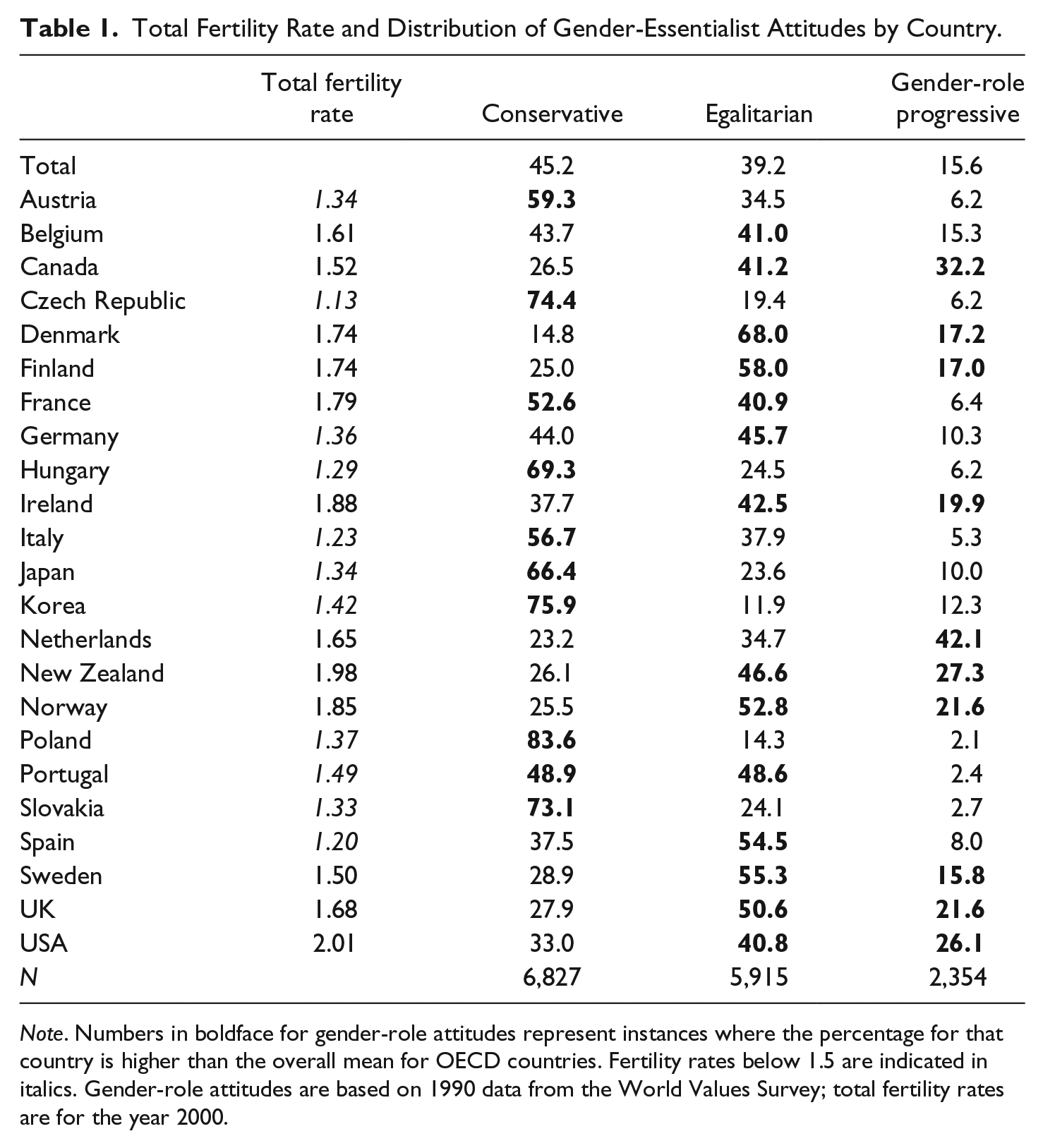
Note. Numbers in boldface for gender-role attitudes represent instances where the percentage for that country is higher than the overall mean for OECD countries. Fertility rates below 1.5 are indicated in italics. Gender-role attitudes are based on 1990 data from the World Values Survey; total fertility rates are for the year 2000.
Consistent with intuition, countries generally considered to have traditional gender-role norms tend to have a higher percentage of individuals in the conservative class than the OECD countries’ average. This includes Eastern European and East Asian countries as well as Austria, France, Italy, and Portugal. Countries with higher percentages of individuals in the egalitarian class include those in Northern Europe and North America as well as Australia, Belgium, France, Germany, Ireland, New Zealand, Portugal, Spain, and the United Kingdom. The Netherlands has a higher-than-average percentage of individuals only in the gender-role progressive class. Several countries have higher proportions of individuals in both the egalitarian and gender-role progressive classes: Australia, Canada, Denmark, Finland, Ireland, New Zealand, Norway, Sweden, the United Kingdom, and the United States.
Consistent with the first prediction of gender-essentialist theory, the fertility rate for each country is closely related to individuals’ views on gender essentialism in that country. The zero-order correlation between the total fertility rate and the proportion of the population supporting conservative (male breadwinner–female caregiver) gender-role norms is −.69 (p < .001), showing that postindustrial societies tend to have lower fertility rates if they are dominated by conservative gender-role norms. Conversely, the proportion of a country’s population adhering to egalitarian gender-role norms is positively correlated with the country’s total fertility rate (a correlation of .46, p < .05), and this is also the case for the proportion of a country’s population adhering to gender-role progressive norms (a very strong correlation, .73, p < .001).
The three gender-role classes were used in a longitudinal regression analysis predicting total fertility for each country from 1990 to 2008 (Brinton & Lee, 2013). Together with three aspects of the structural and economic context—labor market structure, economic conditions for young male workers (the strength of employment protection for midcareer workers, which renders employment opportunities weaker for young men), and family policies—the gender-role classes were statistically significant predictors of country-level fertility, controlling for gross domestic product, economic growth, and aggregate female labor force participation. Furthermore, the interaction between the proportion of a country’s population adhering to conservative gender-role norms and male youth unemployment was negatively related to total fertility. This indicates support for the idea that the combination of a male breadwinner ideology and an unfavorable economic environment exerts a dampening influence on fertility via young men’s difficulty in securing employment and consequent “breadwinner” status.
Given these macro-level results on the gender-essentialist theory of low fertility as applied to the comparison of fertility levels across postindustrial societies, I turn now to how the theory can be explored at the micro level of individuals’ fertility intentions.
Contextual Mechanisms: Constraints on Fulfillment of Intentions in Varied Postindustrial Settings
The seven European countries for which GGP micro-level data on fertility intentions are available represent four of the low-fertility countries and three of the moderate-fertility countries in Table 1. Table 2 lists these countries, drawing the data from Table 1. As reported above, with the exception of France, moderate-fertility countries have lower percentages of individuals who hold conservative gender-role attitudes than low-fertility countries; again with the exception of France, the proportion of gender-role progressive individuals is higher in the moderate-fertility countries than in the low-fertility countries.
Distribution of Gender-Role Norms for Selected Postindustrial Countries.
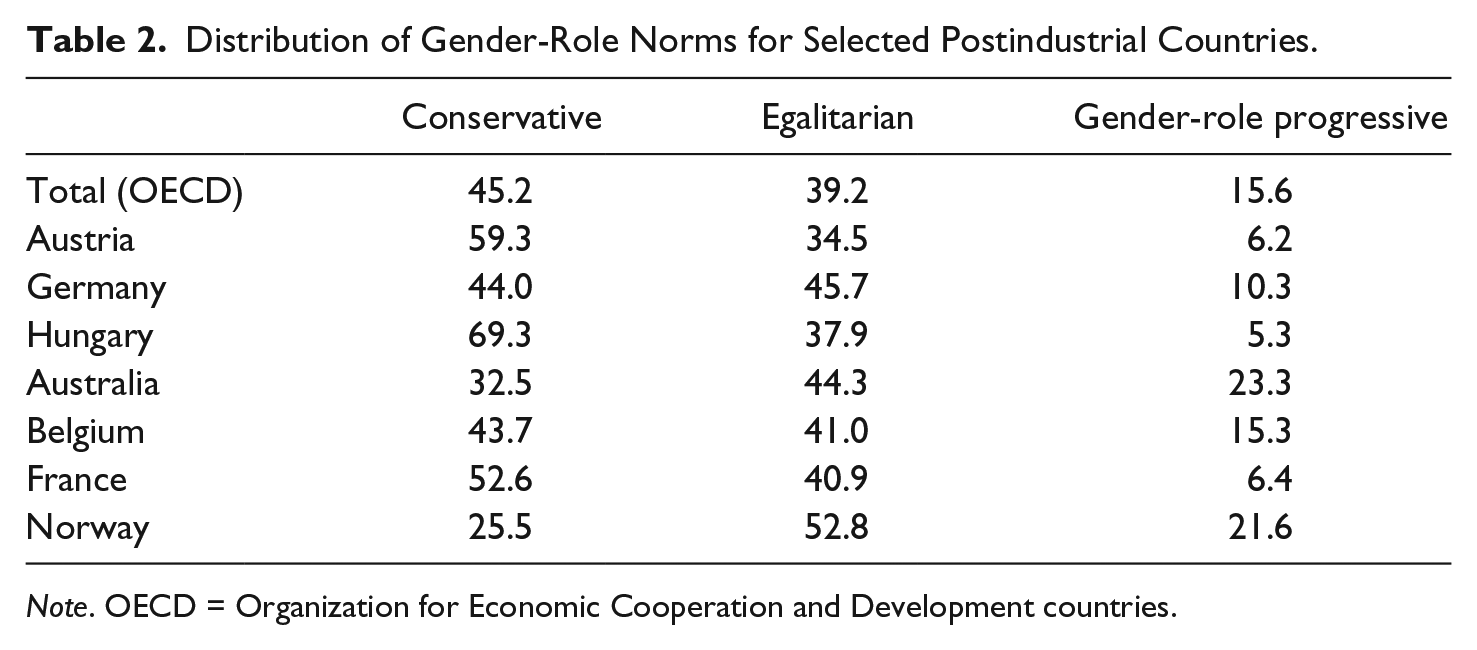
Note. OECD = Organization for Economic Cooperation and Development countries.
To explore the mechanisms through which the macro-level normative context affects fertility, I turn to the individual level to examine fertility intentions in each of the seven countries where the GGP “conditions” question for fertility intentions was asked. In each country, I restrict the sample to married men and women between the ages of 20 and 45 years. This limits the sample to individuals for whom the salience of fertility intentions is the greatest.
Perceived Constraints
The second hypothesis drawn from the gender-essentialist theory of fertility specifies that individuals in male breadwinner–female caregiver societies will tend to perceive greater constraints to fulfilling their short-term fertility intentions than individuals in societies with a weaker degree of gender essentialism. Table 3 groups the four low-fertility societies together and the three moderate-fertility societies together, and shows the level of perceived constraint that individuals perceive relative to their fertility intentions. The scale runs from 1 to 4, with 4 indicating the highest degree of conditionality.
Perception of Different Constraints to Fertility Intentions, by Country.
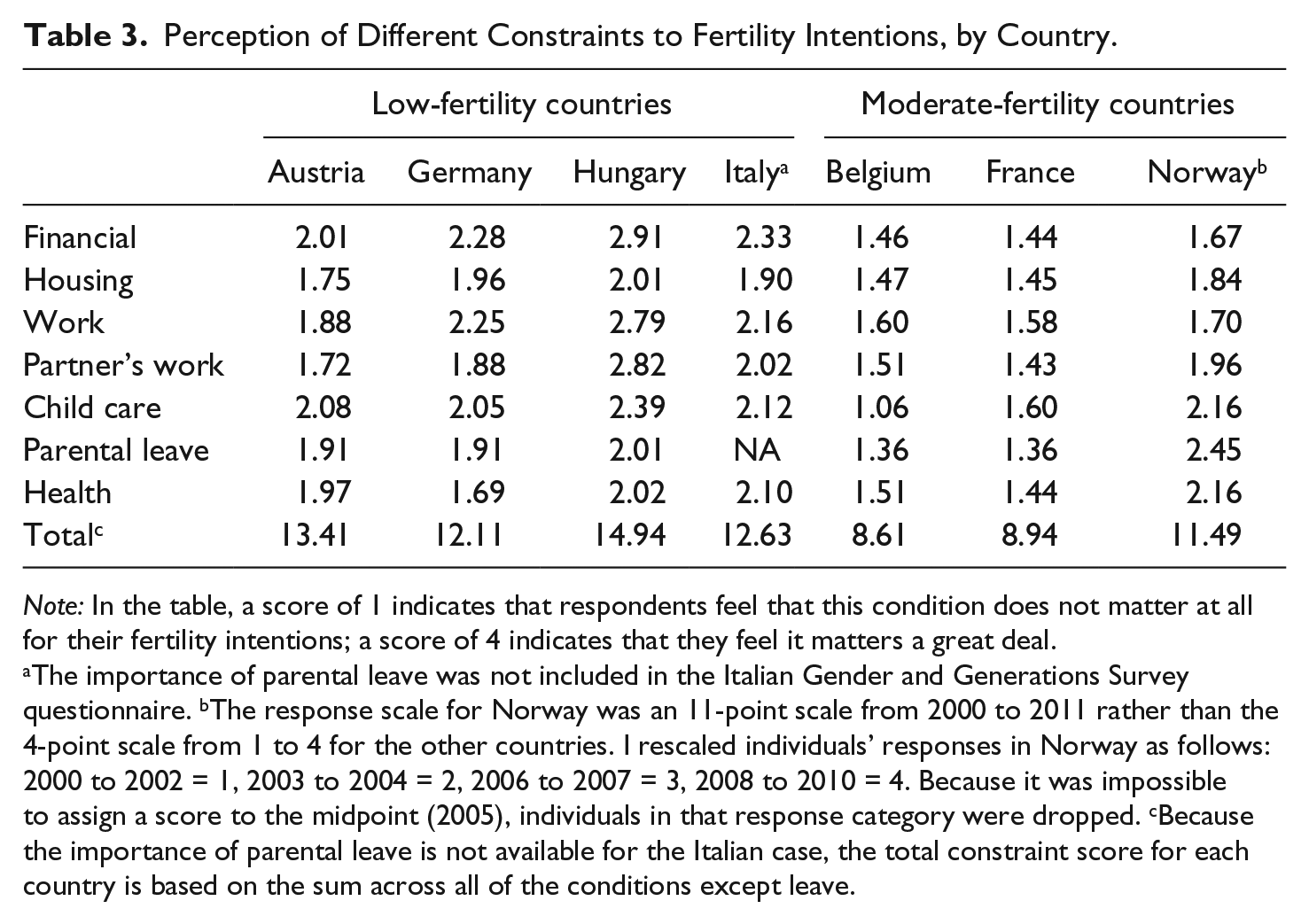
Note: In the table, a score of 1 indicates that respondents feel that this condition does not matter at all for their fertility intentions; a score of 4 indicates that they feel it matters a great deal.
The importance of parental leave was not included in the Italian Gender and Generations Survey questionnaire. bThe response scale for Norway was an 11-point scale from 2000 to 2011 rather than the 4-point scale from 1 to 4 for the other countries. I rescaled individuals’ responses in Norway as follows: 2000 to 2002 = 1, 2003 to 2004 = 2, 2006 to 2007 = 3, 2008 to 2010 = 4. Because it was impossible to assign a score to the midpoint (2005), individuals in that response category were dropped. cBecause the importance of parental leave is not available for the Italian case, the total constraint score for each country is based on the sum across all of the conditions except leave.
Looking across the table, it is evident that in nearly all cases, individuals in the low-fertility societies perceive a higher degree of conditionality for their fertility intentions than individuals in the moderate-fertility societies. Financial constraints weigh considerably more heavily on individuals’ fertility intentions in Austria, Germany, Hungary, and Italy than in the three moderate-fertility societies. So too do housing, work, partner’s work, child care, parental leave, and health, except that for all of these conditions Norwegians’ level of concern is closer to the level of concern in low- than moderate-fertility societies. Even so, the total across the constraints is higher for every low-fertility country than for any of the moderate-fertility countries, including Norway. I also calculated the mean across the low-fertility societies for each condition (financial, housing, etc.) and compared it with the mean across the moderate-fertility societies; for every condition, the difference is statistically different (i.e., the low-fertility societies’ mean is greater than the moderate-fertility societies’ mean). Also as predicted by Hypothesis 2, the condition showing the greatest difference in importance between low- and moderate-fertility societies is one’s financial circumstances.
Norwegians report their own fertility intentions to be particularly related to their concern for child care, parental leave, and health compared with individuals in the other two moderate-fertility societies. In fact, Norwegians’ sensitivity to these conditions generally exceeds the concern shown by individuals in low-fertility societies. This is an interesting and unanticipated finding. As noted at the bottom of Table 3, the response scale for the “conditions” questions in Norway was different than for the other countries, which necessitated rescaling of the responses; this may have affected the absolute values for Norway relative to the other countries. Even so, since this rescaling was done for each condition, it remains striking that child care, parental leave, and health stand out as being of so much greater concern in Norway than in the other countries.
One possibility may be that the institutional and policy environment in Norway is so much more “family friendly” than in the other societies that Norwegians place a greater valence on child care and parental leave when they consider their fertility intentions. I explored this further by looking at responses to a question in the GGS survey that asked respondents to state whether they think that care for preschool-aged children and after-school care for school-aged children are mainly tasks for society or for the family. Responses were on a scale of 1 to 5, with 1 indicating that care is a task for society and 5 indicating that care is a task for the family. This question is an example of a very intriguing query that was unfortunately included in only some of the GGS country questionnaires, making it impossible to compare across all countries. Among the four low-fertility countries discussed in this article, the question appeared only in the Austrian survey.
Table 4 shows the country-level means on these questions. In terms of whether care for preschool-aged children is considered to be mainly a societal or a family responsibility, Norway is indeed the outlier, with the mean value in the other three societies being closer to the point on the scale (5) indicating the importance of the family rather than society. Norway also shows the most “society-oriented” viewpoint for after-school care for school-aged children. France, another moderate-fertility society, is at the other end of the spectrum, with mean values closer to the “family-oriented” end of the attitudinal scale. As for after-school care for older children, Norwegians tend to feel that this is more of a family-based responsibility than care for preschool-aged children; Norway is distinct among the four countries in this respect. Overall, these comparisons across countries as to the relative responsibility of family versus society for the care of children shows that Norwegians are distinct in their view of societal responsibility. This may explain why child care and parental leave provisions are seen as particularly important considerations that “condition” fertility intentions.
Views on Responsibility for Child Care: Austria, Belgium, France, and Norway.
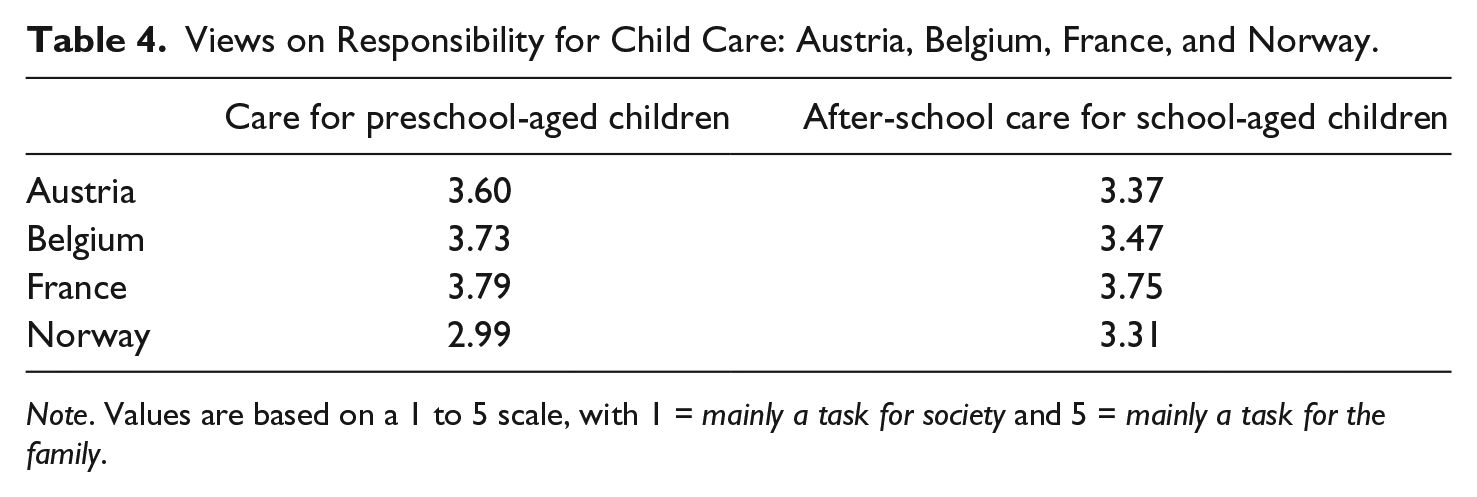
Note. Values are based on a 1 to 5 scale, with 1 = mainly a task for society and 5 = mainly a task for the family.
Strength of Fertility Intentions
To explore the third hypothesis, I look at how the strength of childbearing intentions varies across the seven societies. The GGS question about intentions is phrased as follows: “Do you intend to have a/another child during the next 3 years?” Four response categories are offered: Definitely not, probably not, probably yes, and definitely yes. The third hypothesis suggests that individuals’ fertility intentions will be less definite in gender-essentialist societies, given that the fulfillment of intentions is conditional on meeting stronger normative requirements. Table 5 shows how the responses differ between low- and moderate-fertility societies. The strength of childbearing intentions—both negative (definitely intending not to have a child) and positive (definitely intending to have a child)—is indeed greater in moderate- than low-fertility societies: more individuals (66%) in the former than in the latter (59%) state that they definitely do not intend to have a child in the next 3 years. Conversely, a greater percentage in moderate- (24%) than low-fertility countries (12%) indicate that they definitely do intend to have a child in the next 3 years. In contrast, individuals in low-fertility societies are nearly three times as likely as those in moderate-fertility societies to state uncertain intentions. This suggests greater conditionality of fertility intentions in the gender-essentialist, low-fertility societies. 2
Intention to Have a Child in the Next 3 Years: Low- Versus Moderate-Fertility Countries. a
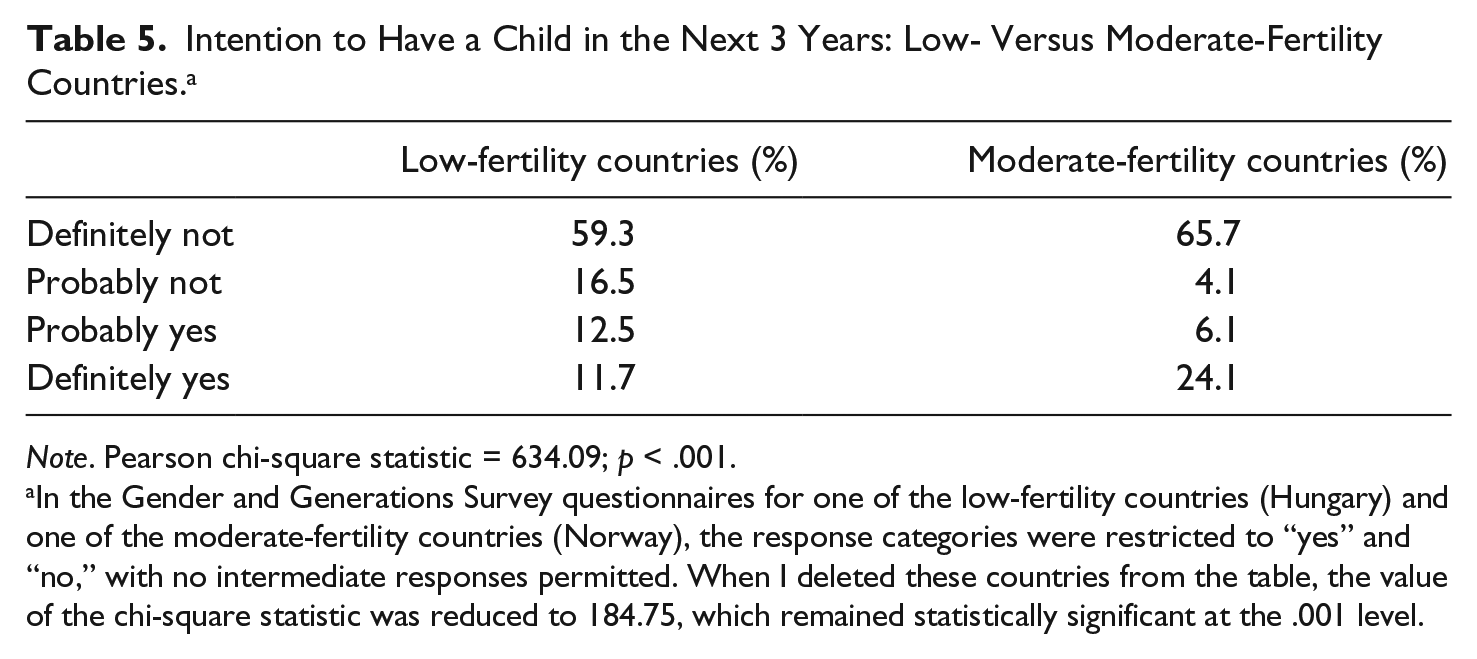
Note. Pearson chi-square statistic = 634.09; p < .001.
In the Gender and Generations Survey questionnaires for one of the low-fertility countries (Hungary) and one of the moderate-fertility countries (Norway), the response categories were restricted to “yes” and “no,” with no intermediate responses permitted. When I deleted these countries from the table, the value of the chi-square statistic was reduced to 184.75, which remained statistically significant at the .001 level.
Gender Differences in Perceived Constraints
Finally, the fourth hypothesis from the gender-essentialist theory of fertility suggests that men’s intentions will be more conditional than women’s in male breadwinner societies. This should be especially the case with regard to financial conditions. Table 6 shows that there is little support for this hypothesis. Only in Germany do men express greater conditionality than women in their fertility intentions. In fact, in both Italy and France, the opposite is true: Women express greater conditionality. Nor is it the case that men express greater reliance on financial considerations when they formulate their fertility intentions. Although not shown here, men’s and women’s reliance on financial considerations for their fertility intentions is equivalent in four of the countries and in the other three, women express greater concern with financial conditions than men. The cross-country patterns are not related to whether countries are gender-essentialist, male breadwinner societies or not.
Mean Level of Perceived Constraints to Fertility Intentions for Married Men and Women, by Country.
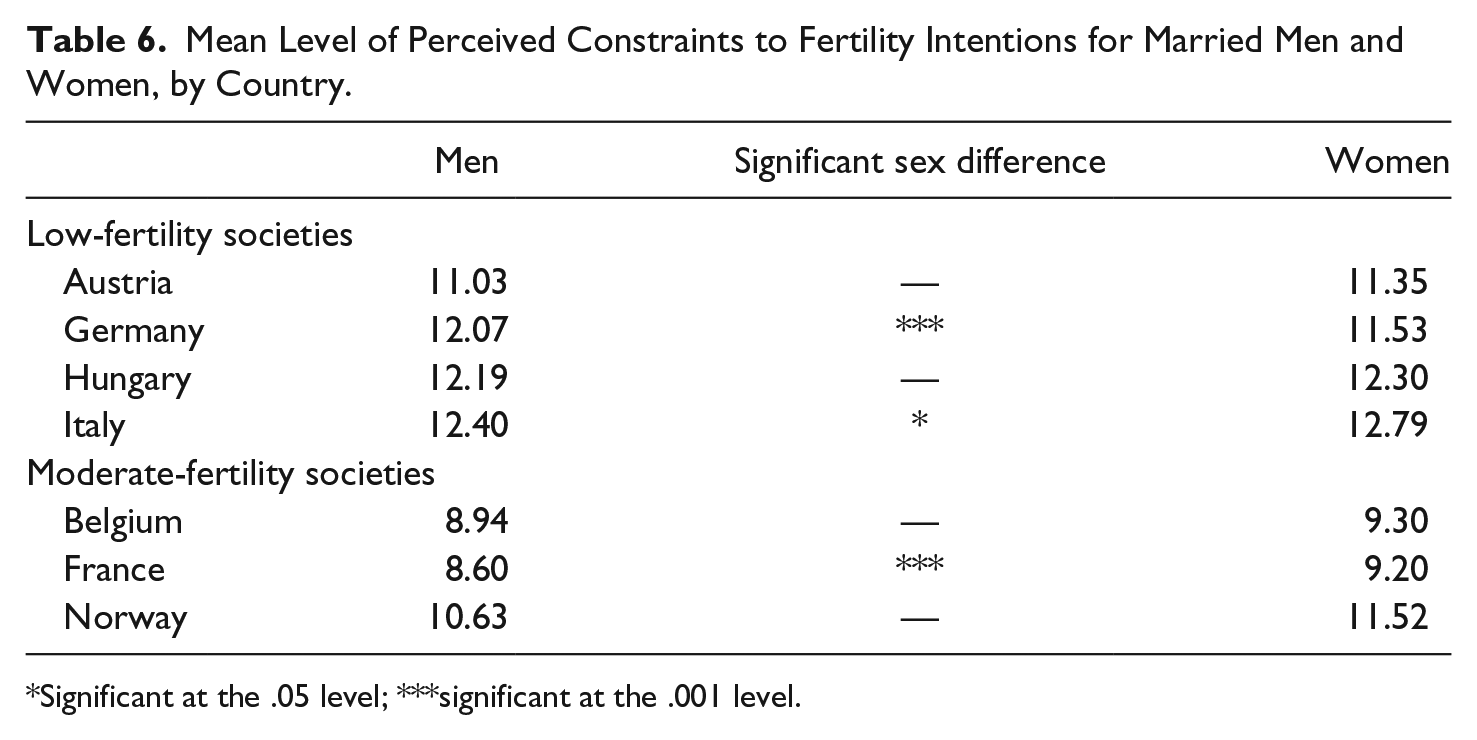
Significant at the .05 level; ***significant at the .001 level.
Conclusion
Intentions link the wished-for (aspirational) to the actual (behavioral). Demographers have shown that when individuals express their intentions about whether to have a child within the next 3 to 5 years, these intentions tend to be highly predictive. Since this is the case, the macro-level puzzle of what has produced very low fertility rates in some postindustrial societies and not others can be usefully approached by theorizing the macro–micro dynamics of how intentions are shaped in different contexts. While the country level is obviously a very broad context within which to theorize macro-level influences on the micro level of individual decisions, the variation across countries in fertility rates is an issue of considerable intellectual and policy concern to social scientists and thus, the attention to the country level is warranted.
This chapter takes the gender equity theory of fertility as its starting point and develops a mechanism-based explanation of postindustrial fertility that prioritizes the salience of gender-role norms. This gender-essentialist theory of postindustrial fertility posits that structural constraints on fertility such as limited labor market opportunities for young men will affect fertility outcomes via the mechanism of gender-role norms. In cultural contexts that valorize the male breadwinner–female caregiver model, individuals’ attention to gender-essentialist norms make it more likely for them to condition their fertility intentions on circumstances that make it possible to fulfill these norms. In this way, norms are a mechanism that filter the effect of structural conditions on childbearing intentions.
Given the macro–micro structure of this theoretical apparatus, the ideal data to use in an empirical examination are multilevel. A recent fertility survey program, the GGP in Europe, has been designed to build up such a database of individual-level survey data and contextual information. However, surveys have been carried out in only a limited number of countries to date, and a key set of questions for this particular inquiry—individuals’ reports of how much various circumstances affect their fertility intentions—has been asked in an even more limited range of countries. The extent of empirical analysis possible is therefore somewhat limited. Nevertheless, this article was able to use data from seven countries that span fertility levels from lowest low to moderate. As predicted, there is a very strong association between very low fertility at the country level and a cultural context that is dominated by traditional gender-role norms. The micro level of intentions is consistent with this; individuals in very low-fertility contexts report a greater degree of contingency for their intentions than individuals in moderate-fertility, more egalitarian contexts. Individuals in low-fertility settings also express fertility intentions that are less certain than individuals in moderate-fertility contexts. The conditionality of men’s intentions is not necessarily greater than women’s; gender differences tend not to be very marked.
Taking up the challenge of a puzzling and important social problem that has emerged in some postindustrial societies and not in others, this article utilized a mechanisms-based approach to theorize how macro-level structural and cultural conditions influence individuals’ intentions to engage in an action (in this case, to proceed to have a child). Thinking in social mechanism terms has provided a way to more deeply theorize and test a theoretical framework (the gender equity theory of fertility) that has heretofore been formulated in the literature as a macro-level theory linking two macro-level phenomena (the top of “Coleman’s boat”). As argued by Coleman and by the editors of the present issue, a theory purporting to explain a macro-level phenomenon by another macro-level phenomenon does not get us to the “nuts and bolts” of social action. In contrast, the gender-essentialist theory posited in this article demonstrates the value of theorizing the mechanisms that bring the macro-level context to bear on the individual level of decision-making. Moreover, the theoretical and empirical exploration described here shows that mechanism-based theorizing need not ignore cultural context. Rather, culture can be used within an explanatory macro–micro framework if theorizing is precise enough to formulate the expected effects of cultural influence. This holds promise for efforts to incorporate cultural norms into the explanation of individual behavior.
Footnotes
Declaration of Conflicting Interests
The author(s) declared no potential conflicts of interest with respect to the research, authorship, and/or publication of this article.
Funding
The author(s) received no financial support for the research, authorship, and/or publication of this article.