



Abstract
Social norms are rules that prescribe and proscribe behavior. The application of norms is conditional. But scholars have little systematic understanding of the factors that affect conditionality. The authors argue that understanding norms requires assessing the costs and benefits of focal and nonfocal behaviors for norm targets, beneficiaries, and enforcers. The authors develop hypotheses about two combinations of these factors; they hypothesize that 1) costs to the norm target of complying with the norm, and 2) behavior by the norm beneficiary that hurts the norm target, weaken the norm. The authors use a vignette experiment to test these hypotheses in the context of bridewealth norms in Africa. The results are consistent with the predictions. The study contributes to the literature on norms by suggesting a systematic approach to understanding norm conditionality.
Social norms are rules that prescribe and proscribe behavior and are socially enforced (Horne 2001; Bendor and Swistak 2001). They have significant implications for behavior. Scholars, particularly sociologists, have long recognized the importance of social norms (e.g., Blake and Davis 1964; Gibbs 1965). Now policy makers are also recognizing their potential, turning to them as tools for producing behavioral change. UNICEF is investing in norms training and norms-driven interventions (e.g., Bicchieri and UNICEF n.d.; UNICEF 2017; United Nations Population Fund and UNICEF n.d.), utility companies use norms to change energy consumption (e.g., Schultz et al. 2007), and universities rely on norms to address behaviors such as student drinking (e.g., Borsari and Carey 2003).
Early attention to norms focused on their relevance for explaining behavior. More recent research seeks to understand norms themselves (e.g., Diekmann, Przepiorka, and Rauhut 2015; Eriksson, Strimling, and Coultas 2015). Much of this work focuses on norm emergence and enforcement (e.g., Diekmann and Przepiorka 2016; Horne 2009; Przepiorka and Berger 2016; Xenitidou and Edmonds 2014). But norms are conditional; they are applied differently in different situations (Edmonds 2014; Hechter and Opp 2001). Therefore, understanding norms requires not only explaining them in the abstract but also how they are applied under different conditions. After all, a norm that is only weakly in force is unlikely to matter much. Research identifies conditions under which norm enforcement varies (e.g., Horne 2001; see also Eriksson and Strimling 2016). For the most part, however, existing research simply provides ad hoc illustrations of the multiplicity of ways in which norms vary (e.g., Caplow [1984] on gift giving, Jasso and Opp [1997] on measuring dimensions along which norms might vary). As a result, scholars have little systematic understanding of factors contributing to conditionality.
In part, this is likely because norms are complex (Edmonds 2014) and their conditionality even more so. Because norms can vary along a multiplicity of dimensions, understanding conditionality poses a challenging problem. We suggest approaching the problem by building on an existing well-tested theory of norms and start with what is arguably the most prominent and well-tested explanation: when a behavior creates harm for others, those others have an interest in discouraging it (e.g., Coleman 1990; see also Heckathorn 1988, 1989; Piskorski and Gorbatâi 2017). The larger the consequences of the behavior and the corresponding benefits of discouraging it, the stronger the norm (e.g., Horne 2008; Yamagishi 1988). The theory has been tested primarily in collective goods situations in the lab. In these situations, norms discourage self-interested behavior and encourage prosocial action (e.g., Fehr and Fischbacher 2004; Horne 2009; Yamagishi 1988). Substantial evidence shows that when an individual’s behavior affects others, norms emerge to regulate that behavior.
But the theory does not only highlight the consequences of an individual’s behavior for potential beneficiaries. It also identifies a wider range of relevant actors and behaviors (Coleman 1990). For the most part, however, researchers have not assessed the implications of these actors and behaviors for the conditionality of norms. We identify three types of actors (targets, beneficiaries, and enforcers) and two kinds of behaviors (focal and nonfocal). Because full development of hypotheses regarding the effects of all of these factors in combination is beyond the scope of a single article, we develop hypotheses about two. First, we move away from the typical focus on the consequences of the focal action for beneficiaries to examine the consequences of that action for the individual engaging in the behavior (Horne 2001). We argue that as costs of compliance increase for the target actor, norms will become weaker. Second, we move beyond the focal behavior of the norm target to look at the nonfocal behavior of norm beneficiaries. We expect that when a beneficiary of a norm engages in a nonfocal behavior that harms the norm target, norms will be weakened.
We test our hypotheses in the context of bridewealth norms that constrain the autonomy of African women in the reproductive domain. We conduct a vignette experiment in the Eastern Region of Ghana. The results are consistent with our hypotheses. Substantively the findings contribute to understanding of factors that weaken bridewealth norms that, in turn, have implications for the reproductive autonomy of African women. Theoretically, the research contributes to understanding of norm conditionality, building on a prominent, well-tested explanation of social norms to highlight the importance of considering multiple relevant actors and behaviors.
Bridewealth Background
Anthropological research describes the main characteristics of the bridewealth transaction. When a man and woman are getting married, the man and his family negotiate a payment to the woman’s family (Aborampah 1999). The man and woman may live together as married and have children, though the payment itself may be made immediately or in installments over time (Allman and Tashjian 2000). Once bridewealth has been paid, the husband gains the rights to the wife’s reproductive and domestic services. Reproduction and sex are closely linked, particularly in Africa, where rates of contraceptive use are the lowest in the world (Tsui, Brown, and Li 2017) and reproductive technologies are relatively new, expensive, and beyond the reach of most (e.g., Giwa-Osagie 2002). Thus traditionally, when the man gains rights to the woman’s reproductive services, he also gains rights to her exclusive sexual services (Fortes 1962).
For our purposes, bridewealth is a useful research arena because payment provides a clear trigger: once bridewealth has been paid, people expect negative social reactions to a wife who contravenes her husband’s wishes (Horne, Dodoo, and Dodoo 2013; Dodoo, Horne, and Biney 2014). That is, in the bridewealth context, it is obvious when the norm applies. One can then explore the factors that affect variability in how the norm is applied. We focus on identifying conditions under which bridewealth norms are stronger or weaker.
Theory and Hypotheses
Norms are rules governing behavior that are enforced through social sanctions (Bendor and Swistak 2001; Horne 2001). They create normative obligations—obligations that are socially mandated. Failure to meet these obligations is socially sanctioned, and people expect such sanctions. Thus, “[c]onsciously or otherwise people decide what to do bearing in mind what they think is acceptable/unacceptable to others around them. . . . individual behavior is constrained by (the individual’s view of) the expectations of others” (Xenitidou and Edmonds 2014:1). When norms are in force, people expect others to disapprove of violations (Bicchieri 2017). Accordingly, for purposes of this article, we treat norms as people’s expectations about how positively or negatively others will react to a behavior.
Norms are conditional: they vary across contexts (Hechter and Opp 2001:405–406; Xenitidou and Edmonds 2014:1). They may apply in some contexts and not others; thus, the content of a norm may vary across situations. And even when a norm applies, it may apply more strongly or weakly (see Winter, Rauhut, and Helbing’s [2012] definition of norms as including both content and strength). Explaining conditionality poses a difficult theoretical problem (Edmonds 2014). Ad hoc studies provide evidence that norms are conditional along multiple dimensions (e.g., Jasso and Opp 1997). But very little work has been done to theoretically specify, in a systematic way, the factors that contribute to conditionality.
The Consequentialist Theory of Norms
We start with what is arguably the most prominent, well-tested theory of norms (henceforth the consequentialist theory). The theory explains norms by arguing that they emerge in response to behavioral externalities. In this view, when a behavior harms others, norms emerge to limit that behavior (Coleman 1990; see also Heckathorn 1988; 1989; Ullmann-Margalit 1977). Similarly, when a behavior benefits others, norms will encourage that behavior. This is because group members have an interest in people behaving in ways that benefit the group. Thus, in situations in which there is a conflict between individual self-interest and the collective good (as in social dilemmas, generalized exchange, and so forth; Takahashi 2000; Yamagishi and Cook 1993), norms can help discourage self-interested behavior and encourage contributions. Because the bridewealth transaction has elements of generalized exchange (Horne et al. 2013; Malinowski 1922), the consequentialist theory applies.
Substantial research provides evidence in support of the consequentialist view (e.g., Piskorski and Gorbatâi 2017). Many lab experiments show that norms discourage free-riding (e.g., Horne 2009; Yamagishi 1988). When an individual’s behavior harms the group, group members punish that behavior. The greater the harm, the more punishment occurs (e.g., Fehr and Gintis 2007; Horne 2009; Yamagishi 1988; see also Simpson and Willer 2015).
But most of this research simply focuses on the consequences of a single behavior for beneficiaries. That is, it tests a “special case” of norms (Coleman 1990:249). Although useful for testing a key piece of the theory, these approaches ignore sources of variation in norm application because they neglect the range of relevant actors and behaviors.
There are three types of relevant actors: the target (“whose actions or potential actions are the focal actions”), the beneficiaries (who experience the consequences of the focal actions), and the potential enforcers (who are in a position to sanction target actors) (Coleman 1990:247; Horne 2001). 1 In some instances (as in most lab studies testing the consequentialist theory of norms), everyone is simultaneously a potential target, beneficiary, and enforcer. Each individual engages in behavior, is affected by the actions of others, and has opportunities to sanction. In such situations, norms are conjoint (Coleman 1990:247). It is relatively straightforward to weigh the costs and benefits of behavior. Norms emerge when benefits of a behavior outweigh the costs. But in other situations (as in many in the wild), the targets, beneficiaries, and enforcers are different people with different interests. With such disjoint norms, “the balancing of positive and negative interests in each actor’s action is no longer straightforward” (Coleman 1990:260). Instead, the consequences of the focal behavior may vary for different types of actors. The distribution of costs and benefits across actors may have implications for how a norm is applied.
There are also two kinds of relevant behaviors. One is the behavior regulated by the norm (the focal behavior). But norms are interdependent (Coleman 1990). Any given norm exists in a larger complex of norms and behaviors (see Mollborn 2017 on norm sets). Even as behaviors by norm targets affect beneficiaries, behaviors by those beneficiaries also affect norm targets. These nonfocal behaviors are potentially relevant (Coleman 1990). Understanding the application of a particular norm may require examination of behaviors that are not subject to the norm but that have implications for relevant actors.
In sum, we expect that norm conditionality reflects the distribution of the costs and benefits of focal and nonfocal actions across norm targets, beneficiaries, and enforcers. Below, we develop predictions regarding two particular combinations of these factors, each of which has implications for the costs experienced by the target actor.
Costs to the Norm Target of Compliance
If norm targets and beneficiaries are different people (i.e., if norms are disjoint; Coleman 1990), behaviors that produce benefits for others may be very costly to the individual performing them. If so, individuals will be reluctant to comply and will likely resent efforts to push them to do so. People may also be unwilling to compel others to comply (Horne 2001).
First, to the extent that people are in an ongoing relationship with the target actor, any costs to the actor will have implications for their relationship. For example, the target actor will have fewer resources with which to exchange. This means that the costs experienced by target actors ripple out to others through interactions. People who experience these ripple effects may be unwilling to demand costly actions.
Second, people may see such imbalances in the cost/benefit ratio across actors as unfair (Homans 1961; see also Marwell and Ames 1979). Research suggests that in social dilemma situations, people prefer a proportionality rule such that the ratio of costs and benefits is similar across actors (van Dijk and Grodzka 1992; van Dijk and Wilke 1993). For example, people who experience greater costs when they contribute tend to contribute less, and group members perceive this outcome as fair (Wit, Wilke, and Oppewal 1992).
For these reasons, even if group members benefit from contributions to the collective good, they may be unwilling to mandate that another member contribute if doing so is excessively costly. The implication is that norms will reflect a balancing of the costs and benefits that are associated with the target behavior, including the costs for the person complying and the benefits others receive because of that compliance (Horne 2001). As the costs of compliance increase, the norm requiring compliance will become weaker.
In the bridewealth context, payment obligates a wife to meet her husband’s reproductive and sexual demands. The wife’s compliance with the husband’s wishes benefits him and his family. And because bridewealth affects social organization (e.g., relationships between families and lineages and dependence relations among men), compliance has implications for the community (see, e.g., Amoateng and Heaton 1989; Anderson 2007; Collier 1988). Accordingly, the consequentialist theory of norms would predict that norms will constrain the wife. But the argument here suggests that as the wife’s costs of complying increase (i.e., when complying with the norm would create a significant burden for her), societal expectations that she meet her husband’s demands will decrease.
Empirically, a number of factors could increase the wife’s costs of compliance. A salient factor in sub-Saharan Africa is the husband’s HIV status. People living in the region are aware of HIV/AIDS and identify sexual transmission as the primary cause (e.g., Mbonu, van den Borne, and De Vries 2009; see also Kharsany and Karim 2016). Because HIV poses a significant threat to health and quality of life, the risk for infection increases potential costs for a wife.
Accordingly, we predict that if the husband is HIV positive (such that the costs of sex for the wife are potentially large), the bridewealth-triggered expectation that the woman must acquiesce to her husband’s reproductive and sexual wishes should diminish. 2 The effect of bridewealth payment on normative expectations that others will disapprove of the wife will be weaker when the husband is HIV positive than when he is not.
Hypothesis 1a: HIV status and bridewealth status will interact such that the positive effect of bridewealth payment on expectations that others will disapprove of the wife will be weaker when the husband is HIV positive than HIV negative.
Metanorms are a particular kind of norm that regulate sanctioning (Axelrod 1986; Ellickson 1991; Horne 2001). Just as norm expectations indicate the presence of norms, metanorm expectations indicate the presence of metanorms. Norms address the first-order problem of ensuring appropriate behavior. Metanorms address the second-order problem of encouraging enforcement of those norms (see Heckathorn 1989 for discussion of first- and second-order cooperation problems). Thus, metanorms regulate how norms are enforced and norms regulate behavior (Figure 1). Research shows that people enforce metanorms: they reward those who punish norm violators and they expect such reactions (Horne 2009).
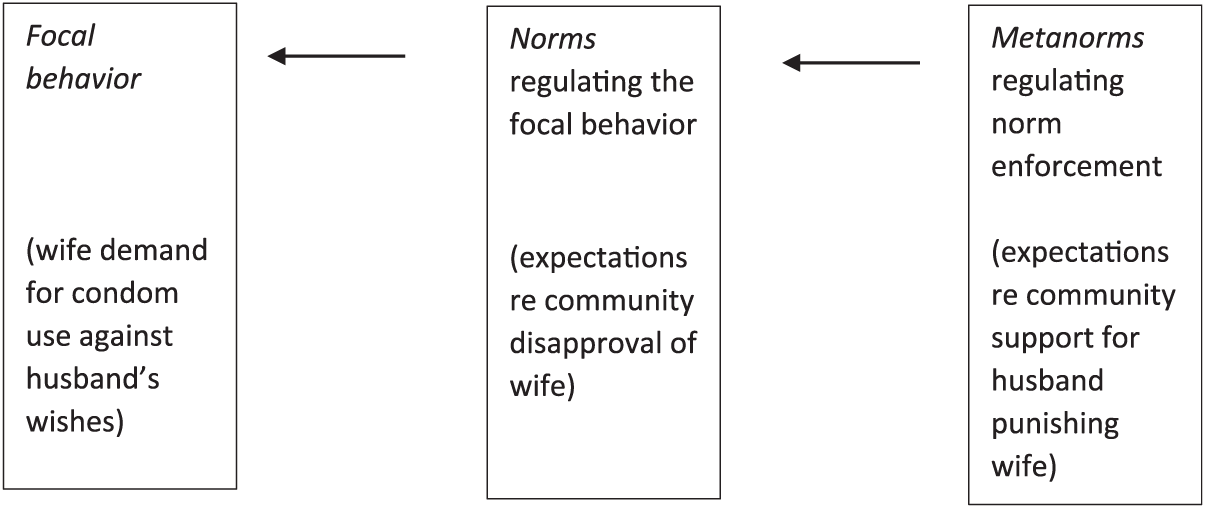
Focal behaviors, norms, and metanorms.
Research also shows that metanorms vary with the consequences of focal behavior for beneficiaries (Horne 2009). The greater the harm caused by a behavior, the more people punish that behavior and the more people reward those who punish it. That is, factors that affect norms also affect metanorms. The implication is that just as people consider both the individual cost and collective benefits in applying norms, so too will they consider both in applying metanorms. If so, bridewealth payment and husband HIV status will affect not just norms but also metanorms, including expectations that the sanctioner will receive social support.
In the Africa context, there are a number of ways people can sanction a wife. A husband is a particularly relevant potential enforcer, as he is able to sanction his wife using a variety of strategies, including beating or leaving her. Women report such sanctions. If they fail to meet the man’s reproductive preferences—for example, by not having a child soon enough after marriage or by having too few children—then the husband’s parents will begin to encourage him to leave her and take another wife (e.g., Bawah et al. 1999). People’s expectations that others will approve of or encourage the husband to leave his wife constitute a metanorm.
Our argument suggests that as the costs to the woman of complying increase, metanorms (expectations that others will support or encourage the man to leave the wife), like norms, will be weakened. Accordingly, we expect that metanorms will be triggered by bridewealth but will be weakened by the husband’s HIV status (and the related costs to the wife of complying).
Hypothesis 1b: HIV status and bridewealth status will interact such that the positive effect of bridewealth on expectations that others will encourage the husband to leave the wife will be weaker when the husband is HIV positive than HIV negative.
Beneficiary Behavior toward the Norm Target
In the wild, people engage in behaviors across multiple domains. The target actor may engage in a focal behavior that affects beneficiaries, and beneficiaries may engage in other kinds of behaviors that affect the norm target. That is, actors can be connected by actions other than the focal behavior (Coleman 1990:255). The implication is that researchers need to assess not only the costs and benefits of the focal behavior across actors, but also the costs and benefits of nonfocal behaviors.
We focus here on the consequences of nonfocal behaviors for the actor who is the target of the norm. If potential norm beneficiaries engage in behaviors that impose costs on norm targets, then the targets may have fewer resources enabling them to comply with norms. And proportionality concerns would suggest that the obligations of the target to norm beneficiaries will be weaker (Adams 1965; Homans 1961). An individual (here the norm beneficiary) who imposes costs on another (here the norm target) should expect that the norm target may impose costs in return. The behaviors by the two actors that impose costs on each other may or may not be in the same domain (see Gouldner’s 1960 discussion of heteromorphic and homeomorphic reciprocity).
In the case of bridewealth, the norm target is the wife. The most immediate beneficiary of her services is the husband. A husband can engage in a range of behaviors that affect the wife. One widespread behavior is the man’s payment of “chop money”: money that the man is culturally obligated to regularly provide to the wife for upkeep of the house, cooking, and so forth. In Africa generally, men are expected to provide for their families (Smith 2017). In Ghana specifically, a husband is expected to provide cash or food to his wife to use in preparing meals (Heintz and Pickbourn 2013). This is true even in very poor families. When a husband provides nothing to his wife, the perception is that he has spent the money on himself (Institute for Development Studies, Ghana Statistical Services, and Associates 2016; Overa 2007; see also Alomele 2006). The wife experiences the costs of his actions. Given these costs to the wife that are caused by the husband, norms requiring her to serve her husband may be seen as unfair. Accordingly, we would expect that the husband’s failure to pay chop money will weaken bridewealth norms constraining the wife.
Hypothesis 2a: Failure of the husband to pay chop money will interact with bridewealth status such that the positive effect of bridewealth on expectations that others will disapprove of the wife will be weaker when the husband fails to pay chop money.
Just as the husband’s behavior affects norms, it will also affect metanorms. When a husband fails to pay chop money, people will expect less support for the husband to punish his wife by leaving her.
Hypothesis 2b: Failure to pay chop money and bridewealth status will interact such that the positive effect of bridewealth on expectations that others will encourage the husband to leave the wife will be weaker when the husband fails to pay chop money.
Methods
We test our hypotheses using a vignette experiment. 3 Vignette experiments are ideal for our purposes because they allow us to manipulate the bridewealth status of a couple, the husband’s HIV status, and the husband’s behavior and then to randomly assign study participants to an experimental condition. This means that we can be reasonably confident in drawing causal inferences about the effects of the experimental conditions on participants’ responses. In addition, vignette studies allow appropriate measures of norms. Although they provide weak evidence of behaviors, they provide good evidence of what is at issue here: people’s expectations about how others are likely to react to a behavior (Bicchieri 2017).
One challenge of testing theoretical arguments using vignettes, rather than more abstract settings in the lab, is that vignettes require translating theoretical concepts into particular substantive contexts. There are always many ways to do this. The theoretical arguments made here could be tested in a variety of substantive situations. We focus on the bridewealth context because bridewealth provides a clear trigger that is often not present for other norms. Similarly, the costs of compliance and the behavior of the norm beneficiary translate into a range of substantive possibilities. We look at only one compliance cost (possible HIV infection) and one behavior of the norm beneficiary (failure to pay chop money). But the theory could (and should) be tested with other alternatives (Lucas 2003).
Sample and Random Assignment
We expect our predictions to hold in contexts in which bridewealth is practiced (see Foschi’s [1997] discussion of scope conditions) though we expect the abstract theoretical predictions to apply more broadly. Accordingly, numerous communities across sub-Saharan Africa would be appropriate for our study. We conducted our research in one such area: the Eastern Region of Ghana. In this region, bridewealth was negotiated in the majority (79 percent) of unions. And in the two relevant ethnic groups, the Guan and Akan, bridewealth was involved in 88 percent and 81 percent of unions (Ghana Statistical Service, Ghana Health Service, and ICF International 2015). Moreover, of those unions in which bridewealth was negotiated, the majority had paid the full bridewealth amount (Ghana Statistical Service et al. 2015). Thus, even in poor households, bridewealth was negotiated and paid. These data indicate the prevalence of bridewealth in the study area and establish the area as an appropriate venue for testing our bridewealth-associated predictions.
We worked with local administrative personnel who helped us identify communities in the Anum (Anum, Boso, and Tosen), Akwamu (Anyasu, Mpakadan, Nnudu, Aboasa, Apeguso, and Akwamufie), and Akwapem Traditional Areas (Apirede, Awukugua, Dawu, Abiriw, Mampong, and Mamfe). The predominant economic activities were farming for men and sales or farming for women. Mean age in the Eastern Region was 24 for men and 26 for women. Mean education level was 7.5 years for women and 8.6 years for men (Ghana Statistical Service 2013). Among women aged 15 to 49 in the Eastern Region, 57.0 percent were currently married; 11.1 percent were in polygamous marriages. Among men in the region aged 15 to 59, 49.4 percent were currently married; 4.8 percent were in polygamous marriages (Ghana Statistical Service et al. 2015).
To sample participants, we identified the center of each community and assigned field workers to walk along randomly selected compass lines, stopping at every other house. We collected our data from midmorning until evening, thus capturing people who returned home from the field in midday to escape the heat, as well as those returning from work at the end of the day. All participants were age 18 or older. For participants in our study, the mean age was 40.6 years (SD = 16.4 years). Fifty-two percent of our sample were women (n = 1,248) and 48 percent were men (n = 1,152). The mean number of years of schooling for women was 6.81 (SD = 3.37) and for men was 8.71 (SD = 2.92). Fifty percent of men (n = 579) and 43 percent of women were living with partners; 2.4 percent of men (n = 29) and 4.3 percent of women (n = 54) were in polygamous relationships.
Although our sample was diverse, it was not a probability sample. For our purposes, this is appropriate because we are not trying to estimate the distribution of bridewealth or norms across a population. Rather, we seek to test a theory about the effects of the experimental conditions. Therefore, for us, the key issues are whether the scope condition of bridewealth practice is met (as discussed above, the Eastern Region of Ghana meets this scope condition) and random assignment to the experimental conditions. Experimental conditions were randomly assigned across field workers and across study participants (see Figure A1 in the Online Appendix on the Sage website for a summary of random assignment steps).
Procedures
Before entering the field, the field workers and the authors reviewed the vignettes and questions in English. Because the local languages are primarily oral (not written), we did not create written materials in those languages. Instead, field workers, graduate student research assistants, and the authors worked collectively until consensus was reached regarding the most accurate oral translations in the relevant languages. To ensure consistency, field workers practiced delivering the vignette and questions in those languages. Before conducting the experiment, we pretested the vignettes and measures. 4
Each participant was interviewed by a field worker who spoke the local language. Field workers had copies of the vignettes as well as the questions to be asked in English but conducted the interview in the local language. They electronically recorded participant responses. Two of the authors accompanied field workers to the research site and were physically present in the communities when interviews were conducted. In the evenings, the research team met to debrief and address any issues that may have arisen during the day.
We told participants that we were conducting a study of family relations. We would be reading some stories and asking questions about them. We would also be asking participants for information about themselves. Once informed consent was obtained, we conducted the study. Interviews took place outside of participants’ homes. In some cases, household and community members stopped to listen out of curiosity; they typically left before we began asking questions.
Each participant heard two vignettes, one testing hypotheses 1a and 1b and the other testing hypotheses 2a and 2b. Participants were first exposed to the chop money vignette and then to the HIV vignette. To ensure that the conditions to which participants were exposed in the first part of the study did not affect their responses in the second, we randomized the experimental conditions so that the HIV conditions (which came second) were randomly distributed across the chop money conditions (which came first). Given local logistical constraints, we did not randomize the order of the two parts of the study. We felt that it was more important that the experimental conditions did not align across studies, and it was not practical to simultaneously randomize on both the order of the vignettes and the distribution of conditions. Given that conditions did not align across the two parts, even if participants took information from the first vignette and imputed that into the second, there could be no consistent effect of exposure to the conditions in the first vignette on responses to the second. When reading the vignettes to the participants, field workers made it clear that the two vignettes described different couples.
Once the vignette data were collected, we asked participants questions about their sociodemographic characteristics. After all interviews in a community had been completed, we distributed small gifts worth about eight Ghana cedis (at that time, the equivalent of about U.S. $2) to the participants.
Part 1: Costs to the Woman
Part 1 tested hypotheses 1a and 1b regarding the effects of compliance costs. It had a 3 × 2 between-subjects design (each participant was exposed to only one experimental condition) crossing bridewealth status (no vs. some vs. complete payment) by the costs of compliance (high vs. low), and blocked on participant gender and lineage, producing 24 cells. There were about 100 participants in each cell for n = 2,396.
Experimental Manipulations
We operationalized compliance costs as the HIV status of the husband in the vignette, because a positive HIV status creates the risk for infection for a wife who engages in unprotected sex. In Africa, the vast majority of HIV infections are contracted through sex (Kharsany and Karim 2016), and people recognize this fact (e.g., Ghana Statistical Service et al. 2015; Mbonu et al. 2009). Most people have not been tested and do not know the HIV status of their partners. Here we had two reasons for being explicit about the husband’s HIV status. First, because vignettes are hypothetical, and responses do not have consequences for participants, manipulations tend to be relatively weak. We wanted the manipulation to be as strong as possible. Second, allowing participants to draw their own conclusions about the man’s HIV status would mean that responses would reflect not only their reactions to the costs of engaging in unprotected sex with an HIV-positive partner but also their perceptions of the prevalence of HIV in their community. Such perceptions might vary in unpredictable ways. To avoid such possible variation, we specified the husband’s HIV status.
We were explicit that the man’s HIV status was not due to bad behavior on his part but to behavior that is widely seen as acceptable: frequent sex before marriage. Many scholars have described the double standard in Africa. Before marriage, men are expected to engage in sexual activity and, even in marriage, it is more acceptable for the husband than the wife to engage in extramarital sex (e.g., Smith 2007). Thus, informing participants that the husband engaged in sex before marriage does not suggest any fault on his part. Furthermore, we said that the wife is demanding that the husband use a condom. As discussed earlier, when using a vignette, the researcher must always translate theoretical concepts into a substantive description. Such descriptions can never capture the full range of possibilities. We expect that the theoretical argument will hold for different operationalizations of the disagreement between the husband and wife. To fully test the applicability of the theory, it should be tested across a range of settings. Here we focus on demand for condom use, a behavior on the part of the wife that we expected to attract widespread disapproval.
The field worker told the participant that she would be telling a story about a man and a woman who had been together for three years. The story stated,
The man has paid [none/some/all] of the bridewealth. They have one child. Before they lived together, the man had sex with lots of women. Since they started living together, the man has not had sex with other women. They recently found out that the woman is HIV negative [but/and] the man is HIV [positive/negative]. The woman is insisting that the man use a condom.
We then asked participants questions designed to assess norms. Then we continued the story.
Now I’m going to tell you the rest of the story. Remember that the man and woman have been living together for three years. The man has paid [none/some/all] of the bridewealth. The man is HIV [positive/negative]. Since they got married he has not had sex with any other women. The woman is demanding that the man use a condom. Even though the man is unhappy about it, the woman keeps on insisting that the man use a condom.
We then asked participants questions to assess metanorms.
Dependent Variable Measures
To measure norms constraining the wife’s behavior, we asked participants about their expectations. To allow for possible differences in expectations about different types of actors, we asked about their expectations regarding a variety of community members: the man’s family, men in the community, the woman’s family, and women in the community. We asked how each type of person would evaluate the rightness or wrongness of the wife’s behavior (i.e., “How right or wrong will [each type of person] say the woman was?”). Field workers had 10 beans participants used to answer the questions. Participants responded by choosing the number of beans that most closely corresponded to their answer (1 = very wrong to 10 = very right). Measures were recoded so that higher numbers indicated more disapproval. Responses for different categories of actors were highly correlated (standardized Cronbach’s α = .93). We averaged them into a single indicator of community norms (see Table A1 in the Online Appendix for means of responses across categories of actors and for the norms measure).
To measure metanorms, we asked how much community members (the man’s family, men in the community, the woman’s family, and women in the community) would encourage the man to leave the woman and marry someone else (“How much will [each category of actor] encourage or discourage the man to leave the woman and marry someone else?”). Again, participants responded using beans (1 = strongly discourage, 10 = strongly encourage). These indicators also were highly correlated (standardized Cronbach’s α = .75). We combined these indicators into a single metanorms measure (see the Table A1 in the Online Appendix for means of responses across categories of actors and for the metanorms measures).
Results
We conducted ordinary least squares (OLS) regressions to look at the effects of the experimental conditions on norms and metanorms. 5 Because our interest is in testing our theoretical predictions, we focus on the effects of the experimental conditions (for analyses including sociodemographic characteristics, see Table A2 in the Online Appendix; the interaction effect of full payment by HIV status persists for both male and female participants and when sociodemographic controls are included).
Our first set of analyses examines norms (Table 1). Model 1 shows that both some and full payment produce expectations of more disapproval than the no payment condition and that the husband’s positive HIV status produces expectations of less disapproval than his negative status. Model 2 tests our prediction that bridewealth payment and husband’s HIV status interact to affect norms (hypothesis 1a). We find that the effects of some and full bridewealth payment on norms are weaker when the man is HIV positive than when he is HIV negative (Table 1, model 2). These results are consistent with our argument that compliance costs weaken bridewealth norms.
Ordinary Least Squares Regression Showing the Effects of Bridewealth Status and Compliance Costs (Husband’s HIV Status) on Norm and Metanorm Expectations (Part 1)

Note: N = 2,394 (Models 1 and 2), N = 2,395 (Models 3 and 4). Variation in sample size is due to missing data. Higher coefficients for the norms analyses indicate more disapproval of the wife. Higher coefficients for the metanorms analyses indicate more support for the husband to leave the wife.
p < .10, *p <. 05, and **p < .001 (two-tailed tests).
This finding suggests that women ought to be able to demand safe sex from an HIV-positive husband. But research shows that many African women do not feel that they can negotiate safe sex even in high-risk situations and for health reasons (e.g., Ankrah and Henry 1994; United Nations Population Fund 2010). In the face of high rates of HIV and other sexually transmitted infections, condom use is rare, particularly in stable, long-term partnerships (e.g., Beksinska, Smit, and Mantell 2012).
On its face, this existing research seems at odds with our results. We find that community norms do not prohibit a woman from demanding safe sex when the husband is HIV positive. To examine this finding, we looked at the percentage of female participants across conditions who expected any level of disapproval from community members. We used 5.5 (the midpoint of the response scale) as a cutoff point. We then counted the number of participants who expected social disapproval to be directed at the women (i.e., participants whose mean norm responses were >5.5). The results show that between 12 percent and 15 percent of female participants expected some level of disapproval to be directed at a woman who asked her HIV-positive husband to use a condom (Table 2). Thus, some participants seem to perceive community norms negatively. In addition, women with these negative perceptions seem to expect little effect of bridewealth payment. These results suggest that some women will report that a wife cannot ask a husband to use a condom, even if he is HIV positive; bridewealth norms do not explain these women’s fear of negotiating safe sex.
Frequency of Expected Disapproving Responses across Experimental Conditions (Part 1)
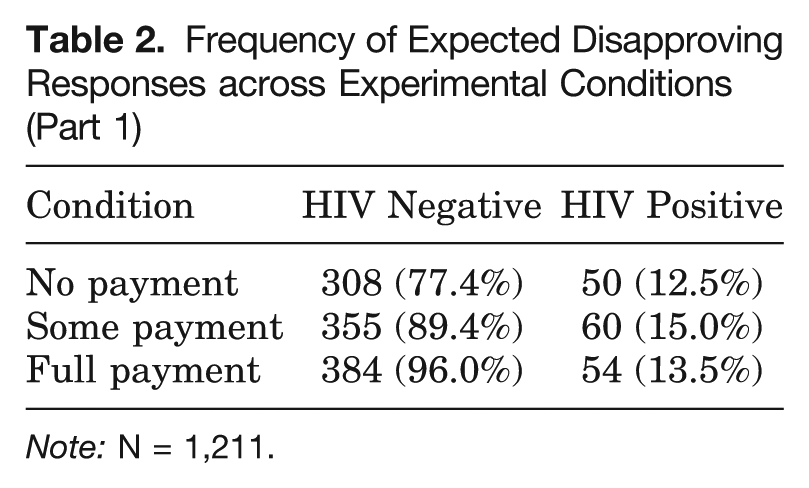
Note: N = 1,211.
Next, we conducted OLS regressions to assess the effects of the experimental conditions on metanorms (see Table 1). Model 3 reports the main effects of the experimental conditions on metanorms. Model 4 tests hypothesis 1b regarding the interaction of bridewealth payment and HIV status. The results show that full bridewealth payment and husband’s HIV status interact such that the positive effect of full bridewealth payment is weaker when the husband is HIV positive than when he is HIV negative (see the statistically significant negative Full × HIV coefficient in Table 1, model 4).
Summary
In sum, the results show that bridewealth norms and metanorms are weakened by the husband’s HIV-positive status. These results are consistent with the argument that norms reflect not only the consequences of a behavior for norm beneficiaries but also compliance costs.
Part 2: Man’s Behavior
Part 2 of the study focused on the effects of bridewealth and the husband’s behavior. It had a 3 × 2 between-subjects design crossing bridewealth (no vs. some vs. full payment) by the man’s behavior (paid chop money vs. did not pay chop money).
Experimental Manipulations
Again, we manipulated the experimental conditions using a vignette. We told participants that the husband either gave or did not give chop money to the wife. Note that although failure to pay chop money harms the wife, it does not change the wife’s costs of complying with her husband’s reproductive demands. Thus, this manipulation does not increase the risks to the woman of engaging in unprotected sex (i.e., chop money is unrelated to risks of pregnancy or sexually transmitted disease). Instead, it describes a behavior by the husband that directly harms the wife.
The man has paid [none/some/all] of the bridewealth. They have one child. The man [always/never] gives chop money to the woman. The woman is insisting that the man use a condom.
At this point, we asked questions designed to assess norms. Then we continued the story.
Now I’m going to tell you the rest of the story. I will tell it to you twice. Remember that the man has paid [none/some/all] of the bridewealth. He [always/never] gives chop money to the woman. The woman is demanding that the man use a condom. Even though the man doesn’t like it, the woman is continuing to demand that the man use a condom.
6
We then asked the metanorms questions.
Dependent Measures
Dependent measures were the same as in part 1. Standardized Cronbach’s α for expectations of how people would react to the woman was .87 and for expectations of how much people would encourage the man to leave the woman was .78. Again, we averaged items to produce a norm and a metanorm measure (mean individual measures and mean norms and metanorms are in Table A3 in the Online Appendix).
Results
We conducted OLS regression analyses to assess the effects of the experimental conditions on norms (Table 3, models 1 and 2; see Table A4 in the Online Appendix for analyses including sociodemographic characteristics. As in part 1, our primary interest is in testing the effects of the experimental conditions; the interaction effect of full payment by HIV status persists for both male and female participants and when sociodemographic controls are included.) 7 Model 1 shows main effects of some and full bridewealth and the husband’s behavior on norms. Model 2 tests hypothesis 2a. We expected that the effects of bridewealth would be weakened by the husband’s failure to pay chop money. The results show that the man’s behavior interacts with bridewealth to affect norms (Table 3, model 2). Bridewealth payment increases expectations that others will disapprove of the wife, but that effect is smaller when the man has failed to pay chop money.
Ordinary Least Squares Regressions Showing the Effects of Bridewealth Status and Husband’s Behavior on Norm and Metanorm Expectations (Part 2)

Note: N = 2,396. Higher coefficients for the norms analyses indicate more disapproval of the wife. Higher coefficients for the metanorms analyses indicate more support for the husband to leave the wife.
p < .10, *p < .05, and **p < .001 (two-tailed tests).
The results also reveal an effect that we did not hypothesize. They show that the effect of the man’s failure to pay chop money is largest in the full bridewealth condition and smallest in the no bridewealth condition. This finding suggests that a couple’s bridewealth status may have implications not only for the woman’s obligations but also for the man’s.
Finally, we conducted OLS regressions to assess the effects of the experimental conditions on metanorms (Table 3). Model 3 shows main effects of full bridewealth payment and the husband’s behavior on metanorms. Model 4 tests hypothesis 2b. We expected that the man’s failure to pay chop money would weaken the effect of bridewealth. The results show that the positive effects of full payment are weaker when the man has not paid than when he has (Table 3, model 4). When the man has paid chop money, full bridewealth payment leads people to expect that others will support his efforts to sanction the woman. When he has not, full payment does not have this effect.
Summary
The results of part 2 support our prediction that a husband’s failure to pay chop money weakens bridewealth norms and metanorms. The findings are consistent with our expectation that behavior on the part of the norm beneficiary that harms the norm target weakens constraints on that target. We also found that the effect of the man’s behavior was different across the bridewealth status of the couple. Although in general, the husband’s failure to pay chop money increased expectations that others would react positively to the wife, this effect was larger when bridewealth was fully paid than when it was not. This finding suggests potential obligations of husbands that have not previously been identified in the bridewealth context. Because bridewealth payment legitimates a marriage, payment may trigger expectations regarding marital duties customarily imposed on husbands.
Discussion
We conducted a vignette study to test predictions about the conditionality of norms. We find that when compliance is costly (because there is a high risk for HIV infection) and when the norm beneficiary has engaged in behavior that hurts the norm target (by not paying chop money), bridewealth norms are weakened. In these conditions, bridewealth payment leads people to expect less disapproval than they would otherwise. Similarly, the costs of compliance for the norm target (the wife) and harmful behavior on the part of the norm beneficiary (the husband) also weaken metanorms, such that people expect less encouragement for the husband to punish his wife by leaving her.
Theoretical Implications
These findings support our approach to norm conditionality. Building on a prominent explanation of social norms, we suggested that predicting how norms are applied requires assessing the distribution of the costs and benefits of focal and nonfocal behavior across norm targets, beneficiaries, and enforcers. We tested two combinations of these factors, providing evidence that the costs of norm compliance for the norm target, as well as nonfocal behavior by norm beneficiaries that impose costs on the norm target, moderate the effects of bridewealth payment. These findings suggest that incorporating benefits and costs for norm beneficiaries and targets, as well as both focal and nonfocal behavior, will improve predictions. Critics of consequentialist explanations point to instances in which harmful behaviors seem to not produce norms discouraging those behaviors (e.g., Elster 1989). Such discrepancies appear to undermine consequentialist arguments. The results here suggest that the presence of other consequences and behaviors also play a role in the application of norms. Thus, only looking at the consequences of behaviors for potential beneficiaries is likely to produce inaccurate predictions.
The findings also have implications for the norm of reciprocity more specifically. This norm can be observed across cultures and time periods but, as our results show, it is not absolute. In our case, the husband’s payment of bridewealth creates rights for him and obligations for the wife. But the extent to which the wife is seen as obligated varies. Her obligation does not demand that she incur excessive costs. And although the husband’s payment grants him rights, those rights are weakened when he fails to provide for the wife. Thus, it appears that the norm of reciprocity does not create a straightforward quid pro quo. Each party has both rights and obligations, and understanding the enforcement of one may require consideration of the others.
We treat norm conditionality as variation in the application of a norm. Our empirical context enables us to distinguish between a norm (triggered by bridewealth payment), and the conditionality of that norm (how strongly the bridewealth norm is applied). In many instances, however, the line between norm emergence and conditionality is ambiguous. Indeed, one might conceptualize variation in application as a component of the norm itself (Winter et al. 2012; see also Homans 1950). We think that our argument applies to either case; full consideration of actors and behaviors may produce better explanations of norm emergence.
Substantive Implications
Our findings show that bridewealth norms are conditional rather than absolute. Bridewealth norms grant men significant control over family-planning decisions. One possible policy response is to include men in family planning (e.g., Bawah 2002; Sternberg and Hubley 2004). Our finding that bridewealth norms are conditional suggests another potential avenue: identifying factors that weaken bridewealth norms. Such efforts may inform policies that strengthen women’s ability to negotiate safe sex and fertility outcomes.
Our findings suggest that the substantive effect of bridewealth payment on norms is weaker than the effect of the man’s HIV status. Because the study relies on vignettes, we cannot assess the substantive size of these effects in the field. Future research should assess the substantive import of the factors identified here.
In addition, our results suggest that although the application of bridewealth norms is affected by the man’s HIV status, at least some women do not feel free to demand safe sex. In our study, more than 12 percent of women expected some level of negative reaction to a wife’s demand that her HIV-positive husband use a condom. These expectations were similar across bridewealth statuses. Thus, bridewealth does not appear to account for their perceptions. Despite community norms that favor condom use under certain conditions, there may be a segment of women who feel particularly vulnerable. These findings contribute to research on challenges women face in negotiating safe sex (e.g., Awusabo-Asare, Anarfi, and Agyeman 1993; Dako-Gyeke 2013).
Finally, we hypothesized that the effects of bridewealth payment would vary depending on whether the husband paid chop money or not. That hypothesis was supported. But we also found that the effects of chop money payment varied depending on the couple’s bridewealth status. The results suggest that when bridewealth had been paid, the husband’s obligation to pay chop money increased. One reason for this may be that bridewealth payment legitimates a marriage (Ardener 1962; Gluckman 1950). This legitimation may trigger obligations on the part of a husband. Future research should assess the implications of bridewealth and marriage not just for norms constraining women, but also for those constraining men.
Limitations
We argue that understanding how norms are applied requires assessing the distribution of the costs and benefits of focal and nonfocal behaviors across norm targets, beneficiaries, and enforcers. Here we test a small subset of possible hypotheses. Future research should test other combinations of factors. In addition, we tested the theory with particular operationalizations of compliance costs and nonfocal behavior. Future research with other operationalizations would increase confidence in the theory. The study was conducted in just one setting in Africa. Although the setting meets the scope conditions for the bridewealth predictions, we cannot be sure that the effects we saw will be observed in other populations. Future research should test the predictions in other populations and settings.
The study also does not assess behavior, for example, a couple’s contraceptive use. There are very few large-scale survey data that include measures of both bridewealth and reproductive practices. One study, using the Uganda Negotiating Reproductive Outcomes Survey (Demographic and Health Surveys and Institute of Statistics and Applied Economics 1995–1996), shows that the wife’s preferences only predict contraceptive use when bridewealth has not been paid; when bridewealth has been paid her preferences are not associated with the couple’s contraceptive use (Dodoo and Dodoo 2017). Those data are limited, however, and do not allow disentangling the mechanisms at work. Our research finds evidence of social psychological mechanisms that are consistent with and could explain patterns of male influence on reproductive decision making found in survey research. But our study does not connect those mechanisms to behavior. Future research should endeavor to do both. In addition, to assess the distribution of the practice of bridewealth and the generalizability of its effects, future Demographic and Health Surveys conducted in Africa should include bridewealth measures.
We argue that if the man engages in behavior that harms the woman, constraints on the woman will be weakened. But we cannot fully distinguish the reason for effects of chop money. Is it because the man’s behavior creates costs for the wife? Or would we expect to see similar effects if the man was creating costs for a third party? In our context, it is not possible to disentangle these effects. Future research in other contexts could assess whether the effect found here is driven by the relationship between the norm beneficiary and norm target, as we suggest, or by the general deservingness of the norm beneficiary. More generally, future research should examine attributions of blameworthiness.
Finally, the present study focuses on bridewealth norms. Substantial research has already established status and power differences between men and women in sub-Saharan Africa. Efforts to improve women’s welfare typically focus on strategies such as increasing girls’ schooling and women’s earnings potential. Such efforts have been less successful than one might hope. For example, fertility rates in sub-Saharan Africa remain high (and higher than one might expect given the effects of such interventions in other regions). Here, we set aside concerns about status and power to focus on the effects of norms in relationships. We do so because bridewealth norms have been neglected by researchers and policy makers. Bridewealth norms matter because even if women increase their status and power, as long as they are embedded in social relationships that mandate particular normative obligations, they are still constrained. Accordingly, we seek here to establish foundational knowledge about norm conditionality and bridewealth norms. A next step is to integrate theories of norm emergence and conditionality with theories of status and power.
Conclusion
Our study finds evidence that two factors, the costs of compliance (due to the husband’s HIV status) and nonfocal behavior of the norm beneficiary (the husband’s failure to pay chop money), weaken bridewealth norms. Substantively, the research contributes to understanding of how bridewealth operates to constrain women’s reproductive autonomy. Theoretically, the study contributes to understanding of norm conditionality. To understand variation in a particular norm, researchers should consider the distribution of the costs and benefits associated with focal and nonfocal behaviors across norm targets, beneficiaries, and enforcers. Incorporating these considerations may help build a systematic theoretical account of causal factors and mechanisms that contribute to norm conditionality.
Footnotes
Funding
This research was funded by Hewlett Foundation Grant 2012-7597.
1
Coleman’s discussion of conjoint and disjoint norms focuses on target actors and beneficiaries and assumes that beneficiaries and potential enforcers are the same actors. Here we consider all three because there may be circumstance in which people who benefit from a norm are not in a position to enforce it, or those who are in a position to enforce do not benefit.
2
HIV infection also has potential consequences for any child coming from the union. The risk of giving birth to an HIV-infected child increases the costs of compliance—costs that may be felt by the child, the wife, and other family members. We focus here on costs to the wife, but costs experienced by group members generally would have the same effects. It may even be that the more dispersed the costs, the more pronounced the effects predicted here.
3
Data are available at Harvard Dataverse.
4
We also conducted manipulation checks. For the HIV vignette, we asked participants if the husband had engaged in extramarital sex after marriage (97 percent correct) and whether the husband was HIV positive or negative (98 percent correct). For the chop money vignette, we asked participants if the husband has been paying or not paying chop money (94 percent correct). We also asked about the couple’s bridewealth status (100 percent correct). We conducted analyses with and without participants who failed the manipulation checks. The results for both are consistent. Here we report the results for the full sample.
5
To account for clustering within interviewers, we also conducted multilevel analyses allowing for random slopes and intercepts. The results are consistent with those presented here.
6
We cannot determine whether participants perceived the wife’s demand for condom use as a response to the man’s chop money behavior or the man’s chop money behavior as a response to the wife’s condom demands. Future research could specify the order of behaviors and whether each is independent or in response to the other.
7
To account for clustering within interviewers, we also conducted multilevel models allowing for random slopes and intercepts. The results are consistent with those reported here.