



Abstract
In this analysis, I evaluate how socioeconomic status (SES) directly shapes the probability that students with similar academic achievements complete key transitions in the U.S. postsecondary system. I develop the concept of institutional reach to illuminate the maintenance of socioeconomic differences across successive forward transitions via institutions of varying selectivity in this postsecondary system. Both low- and high-SES students with high academic achievements display a greater probability of moving forward through the system. However, high-SES students are more likely to do so by attending more selective institutions at entry and, consequently, are more likely to complete a bachelor’s degree at such institutions. In other words, high-SES students have greater institutional reach given similar academic achievements. Greater protection from low achievements and greater boosts from high achievements are both important for maintaining high-SES students’ advantage.
Introduction
The study of socioeconomic differences in educational attainments has been a major preoccupation of the field since the early part of the past century (e.g., Sorokin, 1927). Sociologists’ efforts to understand these differences—particularly in the context of rapidly expanding educational systems—have spawned a number of theories, including that of effectively maintained inequality (EMI; Lucas, 2001). A surprisingly modest body of work tests this theory in the U.S. context, and what literature testing the theory exists mainly focuses on secondary school or postsecondary entry.
In this article, I extend the literature evaluating EMI theory in the U.S. context using postsecondary careers as a case study. I look not only at institutional quality or selectivity at postsecondary entry but in subsequent transitions such as transfer from a 2-year institution to a 4-year institution and completion of a bachelor’s degree. This is an important extension because the U.S. postsecondary system is an institutionally heterogeneous one, and many contemporary students attend multiple institutions of varying quality after entering the system as a result (Choy, 2002). This sort of variability in college attendance patterns has persisted since at least the late 1970s and likely earlier, parallel to the expansion and institutional differentiation of the U.S. postsecondary system (Eckland, 1964; Milesi, 2010).
Such complex attendance patterns in the U.S. postsecondary system have demonstrated effects on completion of a bachelor’s degree. Students who attend a community college will attain a greater number of years of postsecondary schooling as a result but will also have a lower probability of completing a bachelor’s degree (Kane & Rouse, 1999). In contrast, students who attend a selective 4-year college or university are nearly certain to complete a bachelor’s degree (Bowen, Chingos, & McPherson, 2009).
In the following analysis, I specifically consider a subset of forward transitions following high school completion, including postsecondary entry, initial community college transfer to a 4-year institution, and bachelor’s degree completion. These transitions entail the bulk of student movement among postsecondary institutions (author’s calculations, National Education Longitudinal Study of 1988 [NELS:88]) and align closely with emphasis in prior work on nonrepeatable, forward transitions across different institutional types or tracks in an educational system (e.g., Breen & Jonsson, 2000). Following EMI theory, I model how students from different socioeconomic backgrounds are (un)able to leverage subsequent academic achievements and expectations for upward progress in a complex postsecondary institutional hierarchy. I specifically develop the concept of institutional reach, which refers to the distance a student traverses in a given forward transition in a qualitatively differentiated education system. This concept is analogous to that of distance used in occupational mobility studies and highlights the sometimes underappreciated hierarchical structure of U.S. higher education.
I find that, while higher academic achievements serve to shift both low- and high-SES (socioeconomic status) students up the postsecondary institutional hierarchy, high-SES students have higher probabilities of shifting up an additional position in the hierarchy. That is, high-SES students are more likely to make long distance moves in the postsecondary hierarchy given the same academic achievements. This pattern is mainly evident at entry, but this EMI effect at postsecondary entry has important indirect implications for bachelor’s degree completion. Interestingly, high-SES students benefit from both protection from low academic achievements and (larger) premiums from high academic achievements.
Background
EMI theory has been a central focus of the literature on educational inequality for the past decade or so. Still, there are surprisingly few rigorous tests of it in the U.S. context. Lucas (2001), an early application of EMI theory, uses U.S. secondary school course–taking patterns to demonstrate that socioeconomically advantaged students with equivalent academic achievement are more than 50% likely to complete key secondary school transitions than their socioeconomically disadvantaged counterparts. Socioeconomically disadvantaged students are less than 50% likely to complete key secondary school transitions.
The bulk of the small literature evaluating EMI in a U.S. context, however, has focused on postsecondary education. This is arguably the case because, even more than primary or secondary schools, postsecondary institutions in the United States are highly stratified by institutional selectivity (Baker & Velez, 1996). Students can enroll in three basic types of postsecondary academic institutions: community colleges, regular colleges or universities, and selective colleges or universities (see Figure 1). While students can enter some of these institutions without a high school credential, the bulk of students enter a postsecondary institution shortly after receiving a high school credential of some kind. For example, about 88% of students in a recent grade cohort entered a postsecondary institution within 4 months of completing their high school credential (author’s calculations, NELS:88).
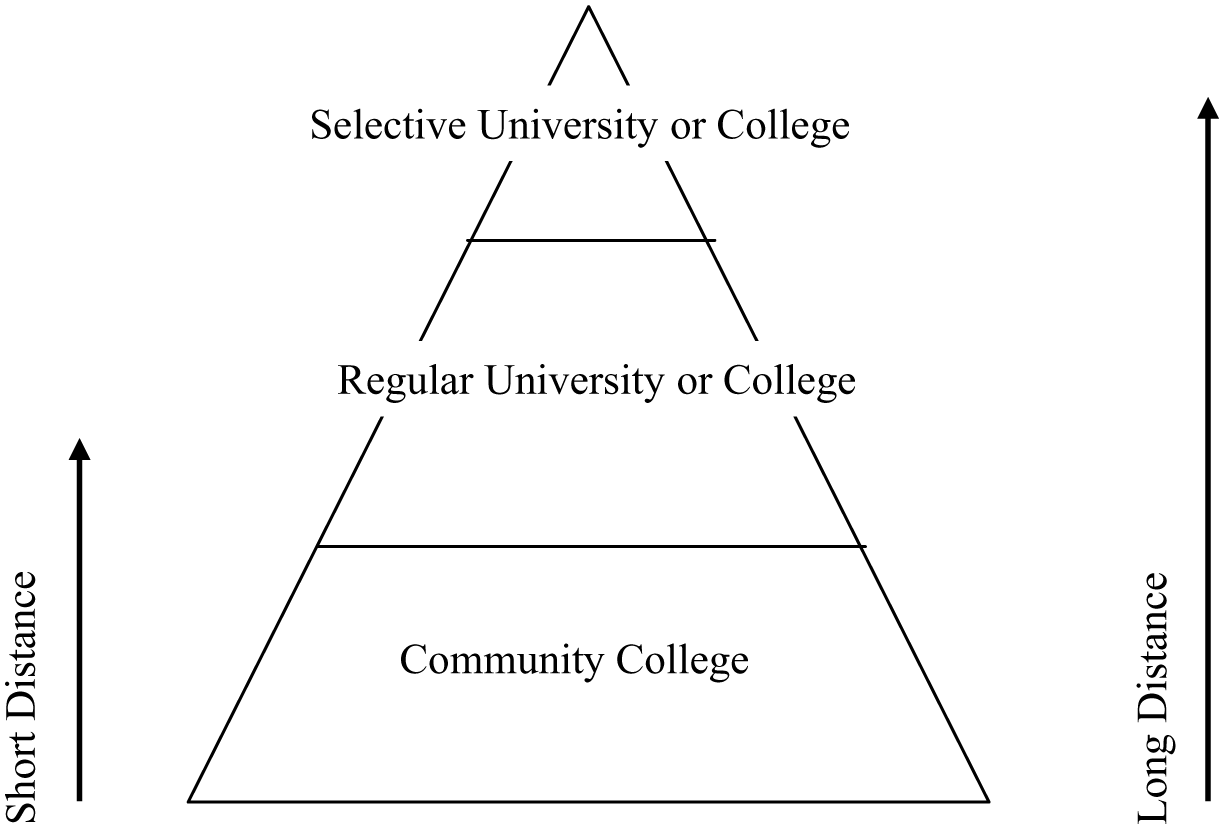
Institutional reach in a hierarchically arranged postsecondary system.
Community colleges are 2-year institutions that admit any students and are of increasing importance in the U.S. postsecondary system. These colleges were first introduced at the beginning of the past century as an alternative to the more traditional 4-year postsecondary university or college and were intended as a stepping-stone to that more traditional institution (Dougherty & Townsend, 2006). Students could attend the less traditional community college, completing general education requirements and the 2-year associate’s degree in advance of attending the 4-year college or university and attaining the 4-year bachelor’s degree. Community colleges now enroll about 40% of all undergraduate students and tend to draw less advantaged students who would not otherwise have attended college because of lower costs of attendance and flexible scheduling (Kane & Rouse, 1999; Snyder, Dillow, & Hoffman, 2009).
Regular or nonselective 4-year institutions require sufficient secondary school grades and standardized test scores for admittance but are more open than selective 4-year institutions. Examples of nonselective 4-year postsecondary institutions include the University of Wisconsin, Eau Claire or California State University, Fullerton. Similar to community colleges, nonselective 4-year institutions have grown markedly as the U.S. postsecondary system has expanded. In fact, enrollments at public universities grew twice as fast as enrollments at community colleges since 2000 (Snyder et al., 2009).
In stark contrast to enrollment growth in community colleges and regular universities and colleges, enrollments in selective 4-year universities and colleges have remained small. As a result, these latter institutions have become more selective over time and increasingly rely on test scores to select a small proportion of applicants (Alon, 2009). Examples of selective 4-year institutions include Harvard University and Miami University (in Ohio).
A small number of authors have evaluated EMI in U.S. students’ transitions in this complex postsecondary system. Roksa, Grodsky, Arum, and Gamoran (2007) examine different types of college entry for three cohorts of U.S. students and find that students from families with higher levels of education are more likely to enter more selective institutions. This relationship is statistically stronger in their most recent cohort, a cohort of students attending college in the 1990s and for which 90% of parents with high income had a college education or higher.
Alon (2009) also explores EMI at entry into the U.S. postsecondary system, evaluating how changing levels of competition for entry into more and less selective postsecondary institutions has lead to isomorphic changes in the selection criteria for entry into these institutions over time. She demonstrates that students’ entry into the most selective institutions increasingly became a function of college entrance exams across three cohorts of college-age students of varying size.
Institutional Reach in a Complex Postsecondary System
The introductory chapter of this volume laid out the main points of EMI theory. However, a few key points are worth repeating here. EMI theory argues that qualitative distinctions in an educational system help maintain socioeconomic differences in students’ probabilities of continuing through an educational system. These differences are largely maintained via so-called “gatekeeping” behaviors. In those instances, socioeconomically advantaged but academically equivalent students have a higher likelihood of progressing whether a given level of education is (nearly) universal in the population (Lucas, 2009). Gatekeeping behaviors include increasing reliance on standardized tests and advanced coursework for entry to the most prestigious institutions, achievement measures that are highly predicated on SES to begin with (Alon, 2009; Fischer et al., 1996). But, elite gatekeeping behaviors can also include tutorial supports, the ability to pay full tuition at selective institutions, and even harder-to-define but still important social skills (e.g., Alon, 2009; Bailey & Dynarski, 2011; Lareau, 2003).
While low- and high-SES students may both have lower (higher) probabilities of completing a given postsecondary transition due to low (high) academic achievements, it is the relative difference between the predicted probabilities that indicates gatekeeping behaviors in EMI. Following this notion of gatekeeping, high-SES students are protected from their low academic achievements because they receive palliative boosts from their socioeconomic advantage given their underwhelming academic performance. An empirical example of this is Bernardi’s (2014) recent finding that high-SES but low-achieving students are less likely to repeat a year in school in a regression discontinuity analysis. High-SES students may also receive premium boosts from high academic achievements above and beyond what low-SES students might receive for similar achievements. An empirical example of this is Radford’s (2013) recent work on rural or otherwise disadvantaged high school valedictorians who elect to attend nonselective postsecondary schools, while their similarly achieved high-SES peers go on to the nation’s most selective postsecondary institutions.
These sorts of palliative and premium boosts are complicated in an institutionally differentiated system such like the U.S. postsecondary system. In that case, socioeconomically advantaged students not only maintain advantage in forward progress through the system but through qualitatively different education as well. Gatekeeping behaviors and associated boosts, be they palliative or premium, can now occur across vertical and horizontal dimensions of educational transitions in a system. This possibility is illustrated in Figure 1 where institutions of different quality or selectivity in the U.S. postsecondary system are represented as a hierarchical system. In this hierarchy, students may make upward moves that differ in the number of institutional quality positions, or the distance, a student traverses. For example, a student may make a short distance transfer from a community college to a regular university or college. Or, the student may make a long distance transfer from a community college to a selective university or college.
The qualitative distance traversed in quantitatively similar transitions can be understood as institutional reach. The concept is analogous to that of social distance in occupational mobility. In that case, individuals who tend to cluster in occupations similar to that of their own parents thus traverse short social distances (Featherman & Hauser, 1978). In the case of postsecondary institutional mobility, the distance, or number of positions, traversed in the postsecondary institutional hierarchy is similarly predicated on an individual’s socioeconomic background: We can expect that a low-SES student will transition to the least selective destination institution. We can similarly expect that a high-SES student will transition to the most selective destination institution.
One particularly salient issue in postsecondary institutional mobility and reach is that of academic achievements and, more broadly, merit. Given its historical and philosophical underpinnings, merit has varied in substantive criteria though not in application in more selective postsecondary institutions in the United States (Karabel, 2005). For example, the most selective American postsecondary institutions apply opaque and sometimes elaborate admission schemes based on character and, increasingly, standardized tests that result in incoming freshman classes of fewer low-income and/or race–ethnic minorities (Alon & Tienda, 2007; Karabel, 2005; Stevens, 2007). Moreover, larger social psychological and socioeconomic issues remain in play. Previous research suggests students formulate educational expectations and agendas depending on their SES early in their careers and do not generally deviate from these early formulations—even in instances of high or low academic achievement (Andrew & Hauser, 2011; Gabay-Egozi et al., 2010; Radford, 2013). This means that while popular understandings of academic merit and postsecondary achievement imply academic achievements and merit will equalize the institutional reach of students from different socioeconomic backgrounds, social science research on the topic does not. It is these residual socioeconomic differences in institutional reach that EMI theory highlights.
Research Questions
Following the arguments laid out above, I ask three research questions:
Data and Method
Data
I estimate models using data from the NELS:88 to illustrate the concept of institutional reach and test key tenets of EMI theory. The NELS:88 began as a national probability sample of 25,000 eighth graders in 1,000 schools in 1988. Data were collected in four waves, following students from the eighth grade when they were about age 14 until 2000 when students were 26 or 27 years of age. Data collection included surveys of students, principals, teachers, and parents as well as high school and postsecondary transcripts. The four-panel sample consists of 12,144 students in total. In the analysis below, I focus on students in the four-panel sample who graduate from high school and who have complete college transcript data with distinguishable attendance patterns—if they attended postsecondary school. I focus on students in the four-panel sample so as to improve imputation models with earlier measures of socioeconomic background characteristics and academic achievements. I exclude Native American students who are too few in number and students who graduated early or late from high school for analytic simplicity. These restrictions leave a total analytic sample of 8,292 students.
I use Monte Carlo Markov Chain (MCMC) imputation for all dependent and independent variables for all students in the NELS:88. The MCMC method assumes nonmonotone missing among observations but does not account for bias in standard errors due to uncertainty in single imputation of estimates. 1 I drop observations that do not meet the above sample restrictions following imputation to minimize bias in imputed values (Horton, Lipsitz, & Parzen, 2003; von Hippel, 2007).
Dependent Variables
I use the postsecondary transcript data to measure a subset of transitions shown schematically in Figure 2. These seven nonrepeatable, forward transitions include initial entry into a community college, regular university, or selective university following high school completion; initial transfer from a community college to a regular or selective university; and completion of a bachelor’s degree from a regular or selective university.
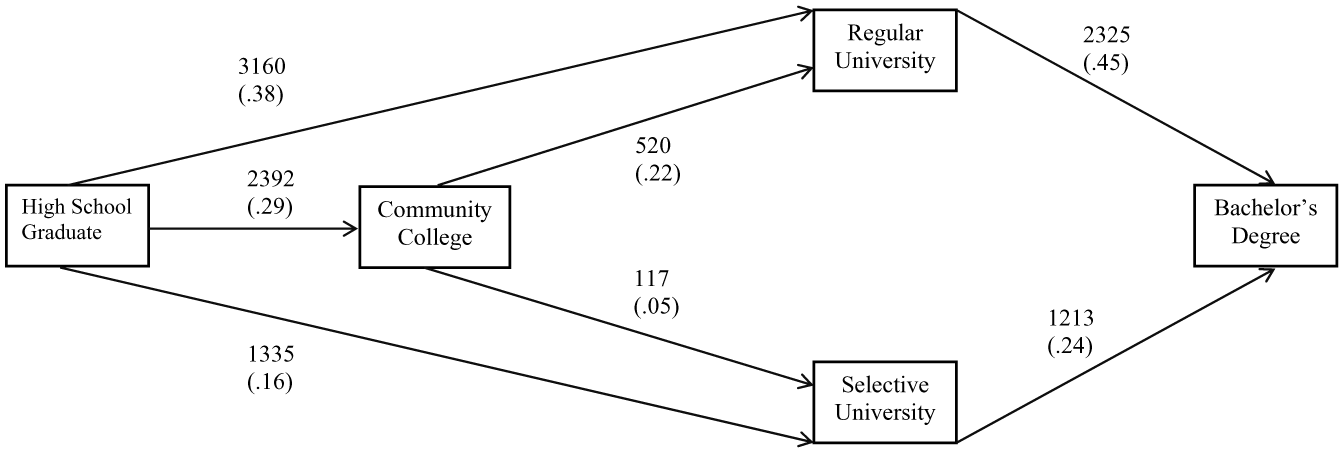
Transition diagram for analytic postsecondary state space, National Education Longitudinal Study of 1988.
Following the literature, I refer to the initial transition from a community college to a regular or selective university as a vertical transfer. A transition matrix with the observed frequency and row or transition probabilities is shown in Table 1 (see also Figure 2).
Transition Matrix for Select Postsecondary Transition by Institutional Type, NELS:88.

Note. NELS:88 = National Education Longitudinal Study of 1988. Unweighted row transition frequencies (probabilities) are shown.
Independent Variables
I control for a number of student demographic characteristics in estimated models. I measure gender as a dummy variable denoting whether the student is female. Similarly, I use dummy measures to denote whether a student is Black, Latino, or Asian with White students serving as the comparison group. One set of variables of primary interest is that measuring socioeconomic background. I measure students’ socioeconomic background using six indicators: father’s years of education, mother’s years of education, logged household income, father’s occupational education, mother’s occupational education, and number of siblings. I also include two dummy variables denoting whether the father or mother is not in the labor force. All measures are taken in 1988 when students are in the eighth grade and about 14 years of age.
I also consider academic achievement and expectations in the high school and postsecondary periods. In the high school period, I measure grade point average (GPA) across all 4 years of high school and standardized test achievement and expected years of education in the 12th grade. The high school GPA measure is based on a traditional 4-point scale and is derived from transcripts recording students’ grades in math, science, English, and social studies. I measure test achievement using a percentile rank score from a standardized test given as part of the NELS:88 study at the end of the 12th grade. 2 Finally, I consider a measure of educational expectations in high school. This measure is based on a survey item with a 10-point answer scale given in the 12th grade. 3 I convert these categories to equivalent years of education.
The postsecondary GPA measure is derived from transcript data similar to the analog high school measure. In contrast to the high school measure, however, postsecondary GPA varies across postentry transitions. The GPA measure for a given postsecondary transition includes information for all tj to ti periods for a transition t, where i indexes an origin state and j indexes a destination state. This transition-varying measure of postsecondary GPA helps distinguish any effects of SES on the expected transition probability from other identifying assumptions of the model (Cameron & Heckman, 1998; Lucas, 2001).
Weighted means and standard deviations are presented in Table 2 for analytic subsamples of students at risk of transitioning from a given state in the postsecondary system depicted in Figure 2.
Weighted Means and Standard Deviations for Imputed Variables by Transition Sample, NELS:88.

Note. NELS:88 = National Education Longitudinal Study of 1988.
Model Specification
I model the transitions depicted in Figure 2 using a multinomial logit. 4 The equation for a standard multinomial logit model can be written as follows:

for j = 1, . . . , j outcomes where b is the base category and its coefficients for vector
I estimate two basic multinomial logit models for each of the three transitions of interest. I begin with a model of students’ socioeconomic background with separate terms describing the effects of each parents’ education and occupational status. Single terms describe family income and number of siblings in the same model. I then estimate a second model that includes these same SES measures as well as students’ academic achievements, including their most recent GPA, a percentile test score, and years of expected schooling. Students’ gender and race are held constant in all models. I treat educational transitions as conditionally independent, estimating multinomial logits separately for college entry, community college transfer, and bachelor’s degree completion. I estimate these models for students who completed the prior transition and are therefore actually at risk of completing the transition in question (see Tables A.1-A.3 in the online appendix, available at http://abs.sagepub.com/content/by/supplemental-data, for average marginal effects from these models).
Following Lucas (2009), I use these models to estimate the predicted probability of completing different transitions for students from low-, high-, and middle-socioeconomic backgrounds. I define low SES as parent education and occupational status and family income at the 25th percentile of the sample distribution. I define high SES as parent education and occupational status and family income at the 75th percentile. Middle SES is defined as parent education and occupational status and family income at the 50th percentile. 5 I specify both the father and the mother as working in the labor force. I hold academic achievements at the 25th, 50th, and 75th percentile for low, middle, and high achievements. I specify demographic and sibship variables so that profiles represent a White female student with two siblings. I only present comparisons across low and high achievements to limit the analysis to a manageable number of comparisons analogous to the theory in question. I further focus on comparisons between low- and high-SES students in my discussion below.
Findings
Table 3 presents predicted transition probabilities for students from varying socioeconomic backgrounds but equivalent academic achievements. 6 The 95% confidence interval for a given predicted probability is presented in brackets. I begin by comparing students from different socioeconomic backgrounds with similarly low levels of academic achievement at college entry (Entry Panel A, Table 3). Low-achieving students have similarly high probabilities of entering the least prestigious of the three archetype institutions in the U.S. postsecondary system, community colleges, regardless of their socioeconomic backgrounds. Yet the probability that a high-SES student still enters a regular or nonselective 4-year college or university despite her or his relatively low academic achievements is (statistically and substantively) much higher than that of a low-SES student. High-SES students’ low academic achievements therefore have consequences for the type of college they initially enter following high school graduation, seen in their similarly high probability of entering a community college. But, they still have greater institutional reach than their lower SES counterparts, enrolling in the more prestigious regular and selective 4-year institutions. In the case of regular 4-year institutions, the average low achieving–high SES student does so even three times as often as that of the average low achieving–low SES student.
Select Predicted Probabilities [95% Confidence Interval] by Socioeconomic Status and Academic Achievements for Postsecondary Transitions, NELS:88.

Note. NELS:88 = National Education Longitudinal Study of 1988; SES = socioeconomic status. Predicted probabilities are for a White female with two siblings and specified socioeconomic and academic achievement characteristics.
The greater institutional reach of high-SES students is also evident in the contrast between high-achieving students from different socioeconomic backgrounds at postsecondary entry. Looking at Panel B for college entry in Table 3, we see that both low- and high-SES students with high academic achievements are most likely to enter a regular university—a single positional shift up in the postsecondary institutional hierarchy from low-achieving students who most often enter community colleges. An upward shift to regular universities and colleges at entry among academically accomplished low- and high-SES students does not mean that high academic achievements necessarily close socioeconomic gaps in college selectivity at entry, however. This is because a much larger proportion of high-SES students with high academic achievements will attend a selective university or college than comparable low-SES students. While the average low-SES student with high academic achievements has just a .14 probability of entering a selective university, the average high-SES student with similarly high achievements has a probability double that. High-achieving, high-SES students therefore have greater institutional reach, leveraging their academic achievements to surpass many similarly achieved low-SES students vis-a-vis their institutional position in the U.S. postsecondary hierarchy.
Notably, the boost that high-socioeconomic students receive for high academic achievements is no larger than the protection that this same group of students receive from low academic achievements. When we consider long-distance upward moves in the institutional hierarchy at entry, the average predicted probability for a long-distance move among high-SES students is 2.3 to 2.6 times larger than that of similarly accomplished low-SES students (.30/.11 = 2.6; .33/.14 = 2.3). High-SES students therefore have greater institutional reach in a hierarchically arranged postsecondary system, but the extent of this reach does not differ by palliative or premium effects of socioeconomic advantage. Both are equally important for securing high-socioeconomic students’ advantage vis-a-vis selective college entry. This difference between low- and high-SES groups at college entry is particularly important in light of the fact that the type of institution one initially attends has major repercussions for the likelihood of completing a bachelor’s degree (Kane & Rouse, 1999).
Table 3 also displays predicted probabilities of transferring from a community college to a regular or selective 4-year institution, conditional on having completed high school and initially entered a community college. Comparing community college students with similarly low levels of academic achievements but different socioeconomic backgrounds (Table 3, vertical transfer), we see that low-achieving students are unlikely to make the transition to a regular 4-year university or college, regardless of their socioeconomic background.
The same general story plays out comparing transfer probabilities among high-achieving students from varying socioeconomic backgrounds: Low- and high-SES students are equally likely to transfer to a regular university or college. This means that EMI does not hold in the vertical transfer from community college to a regular or selective 4-year institution.
To be clear, this is not to say there are no socioeconomic background effects in the transfer from a community college to a 4-year institution. A glance at Table A.2 shows that father’s years of education and family income figure significantly into this postsecondary career transition, even after controlling for a student’s postsecondary GPA in the case of father’s education. Similarly, a large body of research documents notable socioeconomic background differences in community college transfer (e.g., Dougherty & Townsend, 2006). However, EMI theory underscores important remaining socioeconomic differences in educational progress after accounting for differences in academic achievements. In the case of community college transfer, then, a student’s postsecondary GPA and high school test scores and expectations are important equalizers across SES for a conditional sample of community college students.
The final postsecondary transition I consider in Table 3 is that of bachelor’s degree attainment. For this transition, I begin with a model that does not distinguish between university starters and community college transfers or between the type of 4-year institution in which a student began her college career or to which she transferred to from a community college. This means marginal effects of SES and academic achievements are potentially predicated on differences in students’ prior transitions in the postsecondary system. However, previous research demonstrates that community college students who make the transition from a community college to a 4-year institution are markedly similar to students who begin their college career at a 4-year institution, so their previous moves in the system are presumably less important for whether they ultimately complete the bachelor’s degree (Lee, Mackie-Lewis, & Mark, 1993). I also assume students are at risk of completing a bachelor’s degree from a regular or selective 4-year institution regardless of whether they began their postsecondary schooling at or transferred into a regular or selective institution. This is because it remains possible that students may have transferred in and out and between different types of institutions in the period following entry and transfer but leading up to completion of a bachelor’s degree (see Figure 1), ancillary transitions I do not consider in detail here.
Not surprisingly, I find that low-achieving students generally do not complete a bachelor’s degree at a regular 4-year university or college. About .07 of low SES–low achieving students complete a bachelor’s degree at a regular university; about .11 of low achieving–high socioeconomic students do the same. We similarly see few statistical differences by socioeconomic status in the predicted probabilities of selective bachelor’s degree completion among low-achieving students.
High-achieving students are much more likely to complete a bachelor’s degree overall, but apparent stark socioeconomic differences in the probability of attaining a bachelor’s degree remain in the case of high-achieving students. The average low-SES student with high academic achievements has about a 64% chance of completing a bachelor’s degree at a regular university or college compared with a 55% chance for the average high-SES students with similar achievements.
The difference in predicted probabilities of degree completion at a regular university or college among low- and high-SES students is on the cusp of statistical significance and signifies a statistically and, arguably, substantively more important socioeconomic differences in selective bachelor’s degree completion: While the average high achieving–low socioeconomic student has a .17 probability of completing a bachelor’s degree from a selective university or college, the average high achieving–high SES student has a probability double that. It seems high-SES students have greater institutional reach than their low-SES counterparts in attaining degrees from more selective institutions at much greater rates despite similar academic achievements. But, this instance of EMI is seemingly due only to the premium effects for high SES among high academic achievers.
Further parsing this premium EMI effect in degree completion is instructive since it is predicated in part on the type of postsecondary institution a student initially enters. In that vein, I present predicted probabilities for regular or selective university degree completion in Table 4 by the type of postsecondary institution a student initially entered—a community college, a regular university or college, or a selective university or college. I estimate multinomial logits for regular or selective bachelor’s degree completion separately for each of these three samples (see estimated marginal effects in Table A.5, available online at http://abs.sagepub.com/content/by/supplemental-data). As before, I then predict probabilities of regular and selective degree completion for each of the same combinations of SES and academic achievement groups as before.
Select Predicted Probabilities [95% Confidence Interval] by Socioeconomic Status and Academic Achievements for Bachelor’s Degree Completion in Detail, NELS:88.

Note. NELS:88 = National Education Longitudinal Study of 1988; SES = socioeconomic status. Predicted probabilities are for a White female with two siblings and specified socioeconomic and academic achievement characteristics.
The average high-socioeconomic student with equivalent academic achievements is generally more likely to complete a degree at a selective institution than low-SES students—regardless of where they began their postsecondary career. However, these differences are statistically insignificant in models by students’ initial type of postsecondary institution. This means that the greater institutional reach of high achieving–high SES students in bachelor’s degree completion are entirely predicated on their greater institutional reach at postsecondary entry.
In that earlier transition in the postsecondary career, high-SES students were more likely to enter an institution higher in the postsecondary hierarchy than their similarly achieving, low-SES counterparts. For the high achieving–high SES students who received a premium boost for their achievements relative to their low-socioeconomic counterparts, this specifically means that this initial premium and resulting, greater institutional reach lead to significantly greater chances of completing their selective bachelor’s degree. All told, then, greater institutional reach and EMI effects are mainly evident at initial entry into a postsecondary institution and not in subsequent transfer and degree completion transitions. However, premium boosts and greater institutional reach for high-achieving, high-SES students drive subsequent EMI effects in selective bachelor’s degree attainment.
Conclusion
The importance of qualitative distinctions in socioeconomic mobility and reproduction has long been appreciated but remains less understood than quantitative ones. Yet qualitative distinctions can often be of equal, even greater importance than quantitative ones (e.g., Breen & Jonsson, 2000). In this article, I assessed how high-SES postsecondary students receive protection from or premiums for their low and high academic achievements, respectively, that low-SES postsecondary students do not. These patterns are referred to as gatekeeping behaviors in Lucas’s (2001, 2009) EMI theory, the theoretical framework for this issue.
In extending empirical work based on this theory in the U.S. context, I assess these patterns in forward moves in the postsecondary educational career by different types of institutions. Baker and Velez (1996) and others note the hierarchical structure of these different institutions by selectivity, and research elsewhere demonstrates the importance of institutional selectivity for socioeconomic inequalities at college entry (Alon, 2009; Roksa et al., 2007). However, questions remain as to how the U.S. postsecondary hierarchy shapes socioeconomic inequalities throughout the postsecondary career. This is especially important because high-SES students may maintain their advantage vis-a-vis years of completed schooling and/or completion of the college degree across different points in the postsecondary career by moving (further) up the institutional quality hierarchy. The distance a student moves in single transition in such a hierarchy can be thought of as institutional reach, and to the extent that high-socioeconomic students have more or less institutional reach, they attend lower or higher quality institutions with attendant educational and labor market advantages.
Looking at college entry, vertical transfer, and bachelor’s degree completion among a recent cohort of students, I find that both low- and high-SES students benefit from better grades, test scores, and educational expectations. That being said, high-SES students traverse a greater distance in their forward institutional moves through the postsecondary system given the same academic achievements. The greater institutional reach of high-SES students operates mainly at postsecondary entry and mainly entry into regular 4-year institutions for low achieving–high SES students and into selective 4-year institutions for high achieving–high SES students. The initial appearance of greater institutional reach and EMI effects in degree completion among students attending 4-year institutions is largely predicated on students’ initial entry into (selective) institutions following high school graduation.
Somewhat surprisingly, then, the greater institutional reach of high-SES students is the result of both palliative and premium gatekeeping behaviors at college entry. While low achieving–high SES students enter the more selective regular 4-year university of college at higher rates than their low-SES counterparts because of the protection these higher SES students receive from their poor grades, test scores, and expectations at postsecondary entry, high achieving–high SES students also enter the most prestigious selective 4-year universities or colleges at greater rates than their low socioeconomic counterparts in similarly higher relative rates. These relationships hold only at postsecondary entry but nonetheless have important implications for students’ postsecondary progress overall given previous evidence of ties between type of postsecondary entry and mobility patterns and postsecondary degree completion (Goldrick-Rab, 2006; McCormick, 2003; Milesi, 2010).
While this article helps lay the dynamics of socioeconomic inequalities in the institutionally heterogeneous and hierarchical postsecondary system in the United States bare, it does not specifically address the theoretical gatekeeping behaviors driving observed socioeconomic differences in institutional reach. This is an important area for future research since extant evidence suggests that such gatekeeping behaviors are practiced by institutions and/or students. For example, research notes the important role institutions and their agents play in selecting applicants and shaping stark socioeconomic inequalities in selective college and university attendance (e.g., Alon, 2009; Karabel, 2005; Stevens, 2007). But, research also notes the importance of student behaviors in shaping stark socioeconomic inequalities with important noted differences in coursework and college application (Gabay-Egozi et al., 2010; Radford 2013). The models presented in this article can obviously be used to evaluate such institutional and individual behaviors that drive observed socioeconomic differences and extend and refine the notion of “gatekeeping” behaviors. In distinguishing between institutional and individual student or parent behaviors, one can devise better policy interventions. To the extent that institutional behaviors are an important part of the socioeconomic inequality story, policies aimed at limiting such behaviors and practices will be useful. To the extent that student and parent behaviors are more important, policies should duly shift focus.
One could also extend the models presented here to include much earlier academic antecedents of students’ postsecondary careers such as middle school and high school grades and courses. This specification would provide an important link between Lucas’s (2001) work on secondary school course taking and tracking and this and earlier research on socioeconomic inequalities at college entry and across the postsecondary career. It would answer growing questions about the connections across the educational career, not only in the social stratification literature but in education policy circles and in the economic and psychology literatures as well (Cunha, Heckman, & Schennach, 2010; National Center for Public Policy and Higher Education, 2004).
Footnotes
Declaration of Conflicting Interests
The author(s) declared no potential conflicts of interest with respect to the research, authorship, and/or publication of this article.
Funding
The author(s) disclosed receipt of the following financial support for the research, authorship, and/or publication of this article: The research reported herein was supported by the National Institute on Aging (R01 AG-9775, P01-AG21079 and T32-AG00129) and by the Spencer and the Robert Wood Johnson Foundations.