



Abstract
This study builds on the privacy calculus model to revisit the privacy paradox on social media. A two-wave panel data set from Hong Kong and a cross-sectional data set from the United States are used. This study extends the model by incorporating privacy self-efficacy as another privacy-related factor in addition to privacy concerns (i.e., costs) and examines how these factors interact with social capital (i.e., the expected benefit) in influencing different privacy management strategies, including limiting profile visibility, self-disclosure, and friending. This study proposed and found a two-step privacy management strategy in which privacy concerns and privacy self-efficacy prompt users to limit their profile visibility, which in turn enhances their self-disclosing and friending behaviors in both Hong Kong and the United States. Results from the moderated mediation analyses further demonstrate that social capital strengthens the positive–direct effect of privacy self-efficacy on self-disclosure in both places, and it can mitigate the direct effect of privacy concerns on restricting self-disclosure in Hong Kong (the conditional direct effects). Social capital also enhances the indirect effect of privacy self-efficacy on both self-disclosure and friending through limiting profile visibility in Hong Kong (the conditional indirect effects). Implications of the findings are discussed.
Keywords
Social media has become a routine part of daily life. The various social media platforms have continued to integrate different digital affordances to offer new opportunities to expand personal networks, interact with others, and share information. While social media are perceived to provide individuals with benefits from informational, communicative, and entertainment use, they also store rich repositories of personal data that lead to great concern about privacy. The risk of privacy invasion has continued to rise as social media are often accessed via applications (apps) on a mobile phone, where a significant amount of identifiable information is archived, aggregated, and linked across different media platforms.
While privacy risk has been a great concern among social media users, a body of research has documented the phenomenon of privacy paradox, suggesting discrepancies between individuals’ behaviors of disclosing personal information and their concerns about privacy risk. Although people have growing concerns about privacy on social media, they continue to reveal their personal information for a variety of gratifications (Barnes, 2006; Debatin, Lovejoy, Horn, & Hughes, 2009; Taddicken, 2014). While some studies show that people do very little to protect their privacy despite expressing great concern about social media privacy, other studies provide evidence that users are not necessarily naïve in their disclosure practices (e.g., Young & Quan-Haase, 2013). Social media users may adopt different privacy protection strategies to address their concerns and protect their privacy when disclosing personal information.
This study, therefore, revisits the privacy paradox on social media by applying a privacy calculus model, which suggests that the extent to which people exercise privacy practices is based on a cost–benefit trade-off (Culnan & Armstrong, 1999; Dinev & Hart, 2006). This study extends the literature on social media privacy in several ways. First, this study extends the theoretical framework of the privacy calculus model by considering social capital as the benefit factor and privacy concerns as the cost factor in the model. It also integrates privacy self-efficacy as another privacy factor in the privacy calculus model for the theoretical framework (Chen & Chen, 2015; Dienlin & Metzger, 2016). Second, this study proposes three practices for privacy management, including limiting profile visibility, self-disclosure, and friending, and argues that the practices can be a two-step process in which the privacy factors will first encourage users to restrict their profile visibility, followed by a greater personal information disclosing and network expanding.
Third, this study extends the research on social media privacy to the Asian context. Most privacy studies have been conducted in the United States and Western countries, but Hong Kong provides a suitable context for this study as its social media penetration is among the highest in the world (Office of the Communications Authority, 2017). This study also examines the relationship in a cross-national context by including data from both the United States and Hong Kong. Using data from two different cultural backgrounds, this study pursues the critical of testing the external validity of the extended privacy calculus model and examining the similarities and differences in social media privacy between two different cultures. Many studies on the privacy calculus model consist of nonrepresentative student samples, while this study employs cross-sectional representative data in the United States and a two-wave representative panel in Hong Kong to establish generalizability of the results and causality among the relationships.
Privacy Theory and Privacy Management
The definition of privacy has continuously evolved. With the rise of the Internet, the concept of privacy has changed from “the right to be let alone” (Warren & Brandeis, 1890, p. 193) to the right to control personal information (Rosen, 2002). As Fried (1968) stated, “Privacy is not simply an absence of information about us in the minds of others; rather it is the control we have over information about ourselves” (pp. 482-483). As the online environment becomes more interactive and networked, anonymity has become one of the most important practices for individuals to avoid unknown risks. Woo (2006) proposed a new concept of privacy, which is “the right not to be identified” (p. 961). Not only can individuals actively seek anonymity by not providing their personal information but they can also provide false information to conceal their identities and limit their profile visibility when registering to use websites or online services. According to Westin (1967), information privacy is not only “the claim of individuals, groups, or institutions to determine themselves when, how, and to what extent information about them is communicated to others” but also “the voluntary and temporary withdrawal of a person from the general society through physical or psychological means, either in a state of solitude or small-group intimacy or, when among larger groups, in a condition of anonymity or reserve” (p. 7).
Petronio’s (2002) concept of communication privacy management also suggests that the dialectical tension between self-disclosure and self-withdrawal is not a zero-sum game. People who disclose their information may conceal certain information at the same time. For example, people may make some information available to specific groups of friends but not to others. In particular, privacy settings on social media have advanced to allow users to change their privacy settings to allow and limit those who see their information. Instead of focusing on self-disclosure as the major outcome (e.g., Krasnova, Veltri, & Günther, 2012; Trepte & Reinecke, 2011), many studies have investigated other privacy protection strategies, such as untagging and removing photographs and limiting friendship requests (Birnholtz, Burke, & Steele, 2017; Young & Quan-Haase, 2013). It is, therefore, necessary to consider different privacy management strategies for a better understanding of the privacy paradox. For example, Chen and Chen (2015) found that if social media users are limiting their profile visibility and constraining their friending behaviors, it does not necessarily mean they will reduce self-disclosure on social media. They may disclose themselves intensively only to a small group of people given that being selective about whom they friend is a way people can control their information and protect their privacy (Ellison, Vitak, Steinfield, Gray, & Lamp, 2011). This helps highlight the negotiation between navigating privacy and protecting information.
As a result, it is essential to examine not only to what extent people engage in self-disclosure to stay social but also to what extent people withdraw their information (i.e., limiting profile visibility) and set boundaries about with whom they would like to share personal information (i.e., friending) in order to stay private. By examining the ways social media users limit profile visibility, self-disclose, and friend others as the three privacy management strategies, the findings of this study can provide a clearer understanding of the privacy paradox.
The Privacy Paradox and the Privacy Calculus Model: Incorporating Privacy Self-Efficacy
The privacy paradox is the disconnection between privacy concerns and privacy protection. Although people encounter potential threats to privacy, such as unwanted contact, identity theft, and damaged reputation due to improper information sharing online (boyd & Ellison, 2007; Gross, Acquisiti, & Heinz, 2005), they are still willing to disclose their personal information in exchange for benefits of online media, such as different gratifications, in the online environment (Debatin et al., 2009). This phenomenon is particularly prominent on social media (e.g., boyd & Ellison, 2007; Lewis, Kaufman, & Christakis, 2008; Tufekci, 2008).
More recently, the privacy calculus model has been applied to understand the privacy paradox phenomenon in the new media environment (Chen & Chen, 2015; Dienlin & Metzger, 2016; Dinev & Hart, 2006; Krasnova et al., 2012). The privacy calculus model is an extension of typical behavior models such as the theory of planned behavior; however, those models examine the influence of “noncontrary” beliefs on behaviors (Dinev & Hart, 2006). For example, according to the theory of planned behavior, subjective norms, attitude toward behaviors, and perceived behavioral control all “positively” influence behavioral intention, leading to actual behaviors. The privacy calculus model is built on the “contrary” beliefs that some factors have a positive effect (i.e., perceived benefits) and others have a negative effect (i.e., potential risks) on behaviors simultaneously. More specifically, the model suggests that the extent to which people exercise privacy practices is based on a cost–benefit trade-off. People weigh expected benefits and costs regarding the consequences in the future to determine privacy-protecting behaviors. For example, when observed privacy risks such as unauthorized secondary use are outweighed by the perceived benefits of social media such as relationship maintenance or popularity, people are likely to disclose their information (Taddicken, 2014).
Studies on the privacy calculus model have operationalized costs as privacy concerns (e.g., Min & Kim, 2015). Privacy concerns refer to “the degree to which an Internet user is concerned about website practices related to the collection and use of his or her personal information” (Hong & Thong, 2013, p. 276). Privacy concerns have been found to reduce self-disclosure and force users to adopt behaviors to cope with risks from online privacy invasion (Milne & Culnan, 2004). However, reflecting the privacy paradox, it is necessary to include other privacy-related factors and consider the perceived benefit factors in the privacy calculus model to provide a more comprehensive understanding of privacy management on social media. Chen and Chen (2015) proposed the concept of privacy self-efficacy, which is the perception of one’s ability to protect one’s privacy, as another factor in the privacy calculus that influences different privacy management. They found that privacy self-efficacy prompts individuals to limit profile visibility, such as by deleting posts, asking friends to remove identifiable information, and changing privacy settings. While promoting self-withdrawal behaviors, privacy self-efficacy also enhances self-disclosure. They also found that privacy concerns lead users to limit profile visibility, but they do not restrain self-disclosure.
Dienlin and Metzger (2016) integrated privacy self-efficacy into the privacy calculus model to understand privacy on social media. They found that privacy concerns and privacy self-efficacy lead to self-withdrawal (i.e., limiting profile visibility) and that privacy concerns are negatively related to self-disclosure. Taken together, privacy concerns may not always work to limit self-disclosure, and privacy self-efficacy motivates people to simultaneously be social (through self-disclosure) and private (through limiting profile visibility). In light of these findings, the following hypotheses are proposed:
This study also argues a two-step privacy management strategy as the protecting behaviors may not occur at the same time as a result of privacy concerns and privacy self-efficacy. As discussed above, self-disclosure and self-withdrawal represent a negotiation between navigating privacy and protecting information. Therefore, it is possible that limiting profile visibility mediates the direct effect of privacy concerns and privacy self-efficacy on self-disclosure and friending. When people are concerned about their privacy and believe in their ability to manage privacy on social media, they may engage in practices to limit profile visibility first, such as changing profile privacy settings, deleting posts, or untagging photos, then they will be more likely to disclose personal information and expand their social network. The mediating role of limiting profile visibility can help bridge the gap between privacy concerns and self-disclosure in the privacy paradox. The following indirect effects of privacy concerns and privacy self-efficacy on self-disclosure and friending through limiting profile visibility are proposed:
Social Capital as an Expected Benefit in the Privacy Calculus Model
Social capital has received considerable attention in the context of social media due to the many social media features that are explicitly designed to facilitate the formation and maintenance of connections among people (Chen & Li, 2017; Ellison Steinfield, & Lampe, 2007; Ellison, Vitak, et al., 2011). The concept of social capital was originally formulated by sociologists (Bourdieu, 1986; Coleman, 1988) and has been studied in different academic fields such as political science, sociology, economics, and communication (e.g., Adler & Kwon, 2002; Wellman, Hasse, Witte, & Hampton, 2001). Bourdieu (1986) defines social capital as “the aggregate of the actual or potential resources which are linked to possession of a durable network of more or less institutionalized relationships of mutual acquaintance and recognition” (pp. 248-249), while Coleman (1988) highlights the functionality of social capital that helps members of a social network to facilitate certain actions. A number of relevant concepts, including trust, mutual recognition, emotional support, resources, and social networks, have been discussed as core components of social capital in the literature (Adler & Kwon, 2002; Bourdieu, 1986; Coleman, 1988; Lin, 2008; Putnam, 2000; Williams, 2006). Broadly conceived, social capital refers to the accumulated resources embedded in personal relationships within a specific social network that can be accessed or mobilized through ties in the network (Putnam, 2000).
A great deal of research has provided strong empirical support for the positive effect of social media use on social capital benefits (Ellison et al., 2007; Ellison, Steinfield, & Lampe, 2011). However, research to date has not yet incorporated the concept of social capital as the expected benefit in the privacy calculus model to understand the privacy paradox. Studies have found that social capital has a significant relationship with privacy management. For example, people who disclose themselves more on social media gain more social capital (Ellison, Vitak, et al., 2011). Different from considering social capital as an outcome of social media use, Trepte and Reinecke (2013) argue for the role of social capital as an underlying reinforcing mechanism that facilitates self-disclosure on social media. They found a moderating role of social capital in the relationship between social media use and self-disclosure that self-disclosing behaviors are reinforced through social capital within the social media environment. From the standpoint of social capital theory, social capital can serve as the motivation to use and become highly involved in social media. As Putnam (2000) suggests, social capital is a prerequisite for, not a consequence of, effective computer-mediated communication; accordingly, knowing that one has resources within the network on social media (the preexisting level of social capital) should enhance self-disclosure and friending for stronger relationship maintenance and building.
Research on the privacy calculus has examined many variables as the expected benefits that promote people to engage in self-disclosing behaviors, such as enjoyment (Krasnova et al., 2012), trust in members and service providers (Krasnova et al., 2012), maintaining and developing relationships (Min & Kim, 2015), and exchanging information (Choi & Bazarova, 2015). However, social capital has not yet been incorporated into the privacy calculus model. Accordingly, this study conceptualizes social capital as a form of expected benefits in the model. As discussed above, expected benefits play a significant role in counteracting the potential risks in the privacy calculus model. When social media users weigh perceived benefits more than the risks to privacy, they would disclose more information. Thus, this study argues that social capital plays a significant role in the privacy calculus model in influencing privacy management strategies. People with high social capital should engage in more self-disclosure. In addition, when people expect to obtain resources from their social network, they should tend to expand their network through friending behaviors. The following hypothesis is proposed:
To what extent social capital would affect limiting profile visibility, however, is less clear. Dienlin and Metzger (2016) argue that self-disclosure and self-withdrawal (i.e., limiting profile visibility) behaviors are related but distinct. High self-disclosure does not entail low withdrawal. People may disclose a lot of their information (high self-disclosure), but at the same time limit this information to an intended audience (high self-withdrawal). Although they measured expected benefits with different items (i.e., learning new things, making new contacts, and expressing oneself), Dienlin and Metzger (2016) did not find a significant relationship between expected benefits and self-withdrawal behaviors. They argued in accordance with Rogers’ (1975, 1983) protection motivation theory that threat appraisal (i.e., privacy concern) is one of the factors determining self-protective behaviors but positive feelings (i.e., expected benefits) are not. Since social capital has not yet been incorporated into the privacy calculus model as an expected benefit and the relationship between expected benefits and self-withdrawal has not been well-examined, the following research question is proposed:
In addition to the direct effect of social capital on privacy management strategies, social capital has the potential effect to moderate the direct effect of privacy concerns and privacy self-efficacy and the indirect effect of privacy concerns and privacy self-efficacy through limiting profile visibility on self-disclosure and friending. The following research questions are posed:
A conceptual model of the extended privacy calculus is shown in Figure 1.

The conceptual model of extended privacy calculus.
Method
Hong Kong Data and Sample
The Hong Kong data were drawn from a two-wave panel study conducted by Survey Sampling International, a Web survey panel company. Both waves of the survey were administered online. The first wave was conducted for a week in early September 2016. A stratified quota sampling method was used based on census figures for gender, age, and income to proportionally represent the Hong Kong population. The matched sample using census data helps to provide a more accurate representation of the population (Iyengar & Hahn, 2009). The quota sampling process continued until each subgroup (i.e., age, gender, and income) reached its quota. A total of 1,141 participants completed the survey in the first wave. The second wave of data collection took place in mid-October 2016 and lasted for a week. In the second wave, 813 of the original respondents completed the survey questionnaire, yielding a retention rate of 71.3%.
U.S. Data and Sample
The U.S. data were drawn from a cross-sectional survey conducted by Qualtrics, a professional survey company in the United States. The survey was administered online. Employing stratified quota sampling, the age, gender, income, and education quotas were specified so that the sample would match the distribution of these demographic variables as reported by the U.S. Census. The survey was conducted in mid- February 2018 and lasted for 3 weeks. A total of 1,131 respondents completed the survey.
Measurement
Privacy Concerns
Respondents were asked to indicate the extent to which they are concerned about the following when using their social media from 1 (not at all concerned) to 7 (very concerned): (a) “The information I submit on social media could be misused,” (b) “A person can find private information about me on social media,” (c) “Submitting information on social media, because of what others might do with it,” and (d) “Submitting information on social media, because it could be used in a way I did not foresee.” The scores of the four items were averaged to form an index.
Privacy Self-Efficacy
Respondents were asked to indicate on a 7-point scale from 1 (strongly disagree) to 7 (strongly agree) to what extent they agree with the following statements: (a) “I feel confident dealing with the ways that social media collect and use my personal information,” (b) “I feel confident learning skills to protect my privacy on social media,” (c) “I feel confident blocking spam or unwanted content on social media,” (d) “I feel confident adjusting privacy settings on social media,” and (e) “I feel confident managing personal profiles on social media.” The five items were averaged to form an index.
Social Capital
Respondents were asked to indicate on a 7-point scale from 1 (strongly disagree) to 7 (strongly agree) the extent to which they agree with eight items adapted from Williams’ (2006) index of online bridging and bonding capital. The questions specifically ask the respondents to think of the social media they use. Example items include “When I feel lonely there are several people I can talk to,” “If I have severe financial difficulties I know there is someone who can help me,” “Interacting with people makes me curious about things and places outside of my daily life,” and “I am willing to spend time to support general community activities.” The scores of the eight items were averaged to form an index of social capital.
Self-Disclosure
Respondents were asked to indicate the extent to which they agree with the following statements related to social media on a 7-point scale from 1 (strongly disagree) to 7 (strongly agree). The measure includes narrative and identity-related self-disclosure about thoughts and ideas: “I like to share my personal feelings,” “When I have something to say, I like to share it on social media,” “I always find time to keep my profile up-to-date,” “I keep my friends updated about what is going on in my life,” and “I often geotag my location” (Taddicken, 2014). The scores of the five items were averaged to form an index of self-disclosure.
Limiting Profile Visibility
Respondents in the United States were asked about their frequency from never to often of the following activities: (a) deleting something you posted on social media, (b) editing something you posted on social media, (c) avoiding commenting on or liking other people’s posts or pictures, (d) asking someone to remove something that was posted about or related to you on social media, (e) asking someone to untag you from a post, (f) giving inaccurate or misleading information about yourself on social media, and (g) creating different/additional profiles on social media (Birnholtz et al., 2017; Madden, 2012; Young & Quan-Haase, 2013). The first five items were also asked in the Hong Kong survey (with Item 1 and Item 2 combined). The scores were averaged to form an index of limiting profile visibility.
Friending
Following previous literature on social media (Frampton & Child, 2013), items were adapted to measure friending behaviors on social media. Respondents were asked from never to often how often they (a) send friend requests to people they know, (b) send friend requests to people they do not know in person, (c) accept friend requests from people they know, and (d) accept friend requests from people they do not know in person. The four items were averaged to form an index of friending behavior.
Control Variables
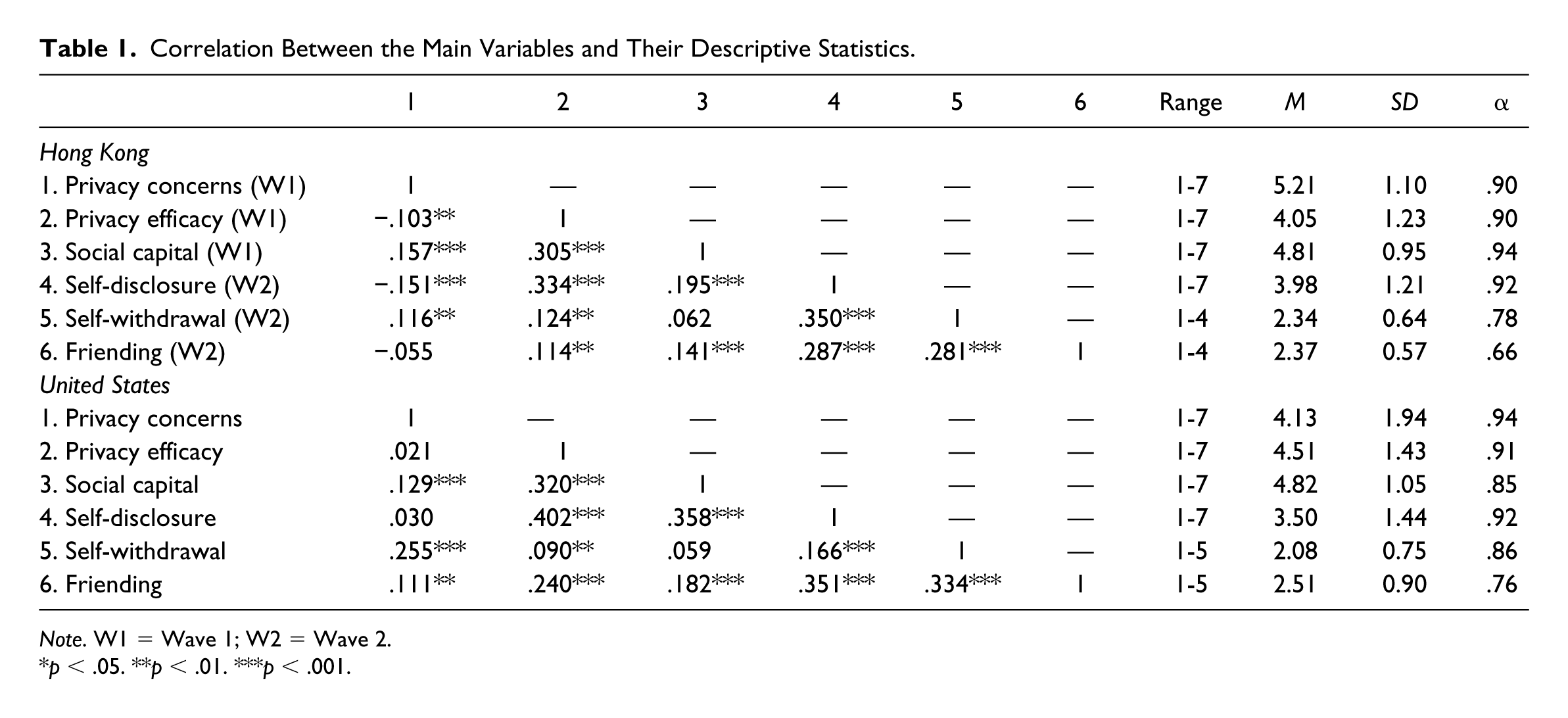
A host of variables are controlled in the analysis, including demographics and news media use. Four demographic control variables were included in the models: gender (Hong Kong: Male = 47%; United States: 44.6%), age (Hong Kong: M = 5.58, SD = 2.36, Mdn = 40-44 years old; United States: M = 4.59, SD = 1.62, Mdn = 45-54 years old), level of education (Hong Kong: M = 5.99, SD = 1.59, Mdn = college degree or professional certificate; United States: M = 3.62, SD = 1.44, Mdn = college degree), and household income (Hong Kong: M = 7.26, SD = 2.47, Mdn = HK$30,000 to HK$39,999 per month; United States: M = 3.46, SD = 1.71, Mdn = US$50,000 to less than US$75,000 per year). For media use, Hong Kong respondents were asked to rate on a 7-point scale (1 = never to 7 = every day) how often they used the following media to get news and information about current events: television, radio, online newspaper, print newspaper, magazine, mobile phone, desktop, tablet, and social media (α = .76, M = 4.86, SD = 1.08). U.S. respondents were asked to rate their frequency of use on a 6-point scale (1 = never to 6 = every day) for the following media: national network news, radio news programs, political talk shows, national newspaper online, national newspaper in print, local news on television, local newspapers online, and local newspaper in print (α = .79, M = 2.65, SD = 1.02). Table 1 shows the correlations between the main variables and their descriptive statistics.
Correlation Between the Main Variables and Their Descriptive Statistics.
Note. W1 = Wave 1; W2 = Wave 2.
p < .05. **p < .01. ***p < .001.
Statistical Analysis
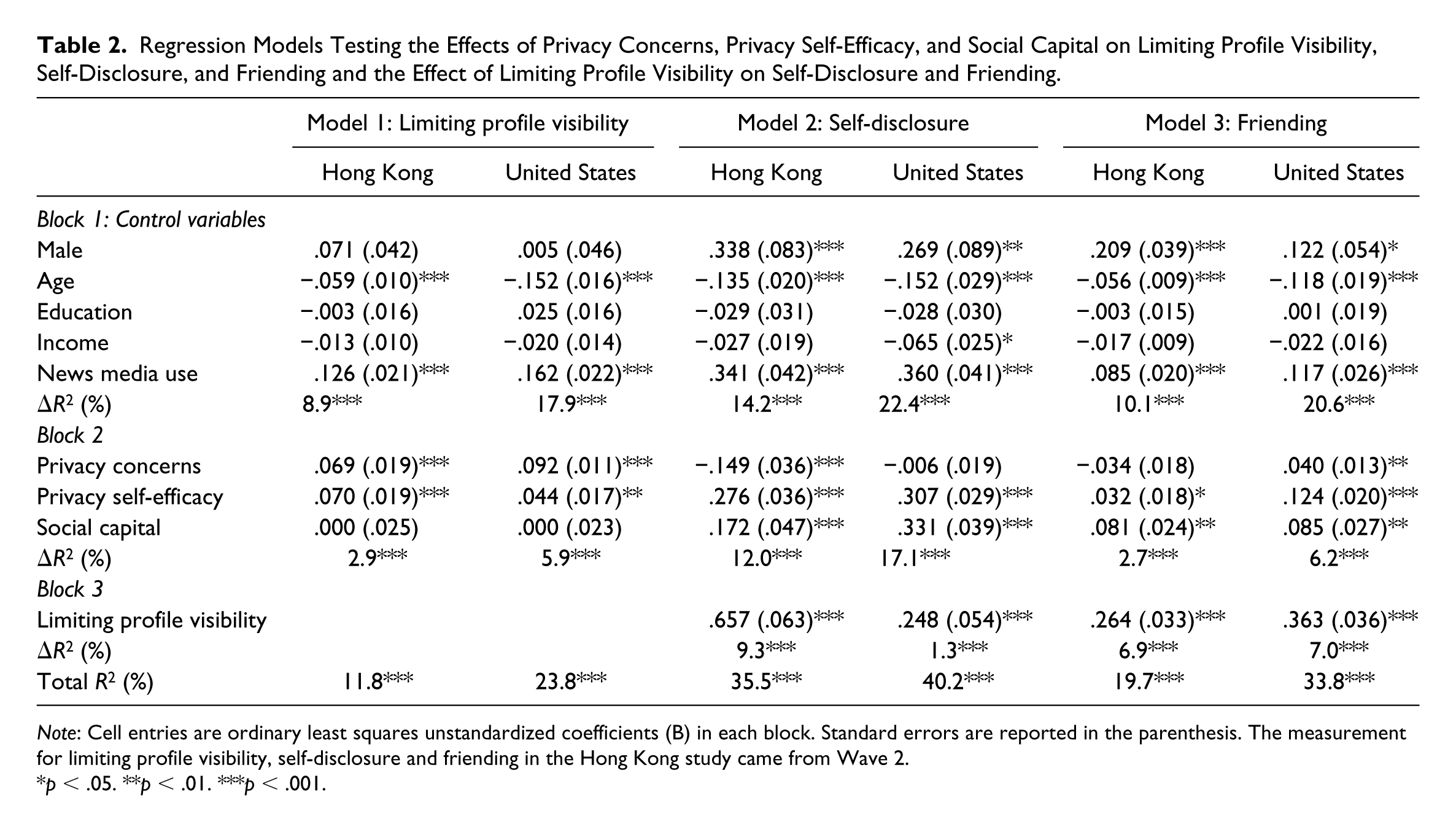
A series of ordinary least squares hierarchical regression models was used to test the direct effects. The first regression equation (Model 1) focuses on predicting limiting profile visibility with privacy concerns (Hypothesis 1a), privacy self-efficacy (Hypothesis 2a), and social capital (Research Question 1). The control variables were entered in Block 1, and the key independent variables were entered in Block 2. The second regression equation (Model 2) focuses on predicting self-disclosure (Hypothesis 1b, Hypothesis 2b, Hypothesis 3a, and Hypothesis 6a), and the third (Model 3) is about predicting friending behaviors (Hypothesis 1c, Hypothesis 2c, Hypothesis 3b, and Hypothesis 6b). In Model 2 and Model 3, variables from Block 1 to Block 2 are identical to those in Model 1. The variable of limiting profile visibility was entered in Block 3, which can detect not only the direct effect of limiting profile visibility on self-disclosure and friending but also the potential mediating role of limiting profile visibility in influencing the direct effect of privacy concerns and privacy self-efficacy on self-disclosure and friending. The indirect and the conditional indirect effects were then examined with Hayes’ (2018) PROCESS macro with 10,000 bias-corrected bootstrap samples and 95% confidence interval (CI). Statistical significance (p < .05) is achieved when lower bound (LL) and upper bound (UL) CI do not include zero. The Model 4 template in the PROCESS macro was employed to examine the mediation relationships (Hypothesis 4 and Hypothesis 5), and the Model 8 template was used to examine the conditional indirect effect (Research Questions 2 and 3). All hypotheses and research questions were examined with Hong Kong and U.S. data. As the Hong Kong data are from a two-wave panel, the control variables, privacy concerns, privacy self-efficacy, and social capital are from Wave 1. The measures of limiting profile visibility, self-disclosure and friending are from Wave 2.
Results
Hypothesis 1 asks whether privacy concerns would affect limiting profile visibility, self-disclosure, and friending. Results from Table 2 show that, in Hong Kong, privacy concerns are positively related to limiting profile visibility (Hypothesis 1a: Β = .069, standard error [SE] = .019, p < .001), but negatively related to self-disclosure (Hypothesis 1b: Β = −.149, SE = .036, p < .001). Privacy concerns are not significantly related to friending behaviors. In the United States, privacy concerns are also positively related to limiting profile visibility (Hypothesis 1a: Β = .092, SE = .011, p < .001), but they are not significantly related to self-disclosure. Interestingly, the direction between privacy concerns and friending is opposite to the proposed hypothesis. Instead of limiting network expanding, privacy concerns promote friending behaviors in the United States (Hypothesis 1c: Β = .040, SE = .013, p < .01). The following mediating analysis on the indirect effect of privacy concerns on friending through limiting profile visibility will help explain this opposite direction of the relationship.
Regression Models Testing the Effects of Privacy Concerns, Privacy Self-Efficacy, and Social Capital on Limiting Profile Visibility, Self-Disclosure, and Friending and the Effect of Limiting Profile Visibility on Self-Disclosure and Friending.
Note: Cell entries are ordinary least squares unstandardized coefficients (B) in each block. Standard errors are reported in the parenthesis. The measurement for limiting profile visibility, self-disclosure and friending in the Hong Kong study came from Wave 2.
p < .05. **p < .01. ***p < .001.
Hypothesis 2 predicts a positive influence of privacy self-efficacy on three different strategies in privacy management. Table 2 shows that privacy self-efficacy has a positive relationship with limiting profile visibility (Hypothesis 2a: Β = .070, SE = .019, p < .001), self-disclosure (Hypothesis 2b: Β = .276, SE = .036, p < .001), and friending (Hypothesis 2c: Β = .032, SE = .018, p < .05) in Hong Kong. Similar results were also found in the United States that privacy self-efficacy is positively related to limiting profile visibility (Hypothesis 2a: Β = .044, SE = .017, p < .01), self-disclosure (Hypothesis 2b: Β = .307, SE = .029, p < .001), and friending (Hypothesis 2c: Β = .124, SE = .020, p < .001).
Hypothesis 3 proposes a positive effect of limiting profile visibility on self-disclosure and friending. The hypothesis was supported in both Hong Kong and the United States that limiting profile visibility is positively related to self-disclosure (Hong Kong: Β = .657, SE = .063, p < .001; United States: Β = .248, SE = .054, p < .001) and friending (Hong Kong: Β = .264, SE = .033, p < .001; United States: Β = .363, SE = .036, p < .001).
Results from the mediation analysis further demonstrate the indirect effect of privacy concerns on self-disclosure and friending through limiting profile visibility as proposed in Hypothesis 4a and Hypothesis 4b. The findings from PROCESS macro Model 4 show that limiting profile visibility significantly mediates the relationship between privacy concerns and self-disclosure in both places (Hong Kong: Β = .045, SE = .015, 95% CI [.018, .076]; United States: B = .023, SE = .007, 95% CI [.011, .037]. Limiting profile visibility also mediates the relationship between privacy concerns and friending (Hong Kong: Β = .018, SE = .006, 95% CI [.006, .031]; United States: Β = .034, SE = .006, 95% CI [.023, .045]. It is worth noting that the significant relationship between privacy concerns and friending in the United States becomes insignificant after adding limiting profile visibility as the mediator (Β = .006, SE = .013, 95% CI [−.020, .032]. 1 This shows the significant role and unique effect of limiting profile visibility in fully mediating the direct effect of privacy concerns on friending, and explains why the results from regression analysis show a positive rather than a negative relationship between privacy concerns and friending. Similar to privacy concerns, privacy self-efficacy indirectly influences self-disclosure through limiting profile visibility (Hypothesis 5a; Hong Kong: Β = .046, SE = .014, 95% CI [.020, .075]; United States: Β = .011, SE = .005, 95% CI [.002, .023]. It also has an indirect effect on friending through limiting profile visibility (Hypothesis 5b; Hong Kong: Β = .018, SE = .006, 95% CI [.008, .03]; United States: Β = .016, SE = .006, 95% CI [.004, .029]. The mediation analysis highlights the significant role of limiting profile visibility in redirecting the negative effect (Hong Kong) or no effect (United States) of privacy concerns on self-disclosure to a positive effect by mediating the indirect effect. Moreover, privacy self-efficacy can enhance self-disclosure and friending behavior directly or indirectly through limiting profile visibility.
Regarding the effects of social capital proposed in Hypothesis 6 and Research Question 1, results from the regression analysis in Table 2 suggest that social capital is not significantly related to limiting profile visibility in both places; however, it is significantly related to self-disclosure (Hong Kong: B = .172, SE = .047, p < .001; United States: Β = .331, SE = .039, p < .001) and friending behaviors (Hong Kong: Β = .081, SE = .024, p < .01; United States: Β = .085, SE = .027, p < .01) in both places.
Research Question 2 proposed a moderated mediation model that social capital will moderate the direct effect and indirect effect of privacy concerns on self-disclosure and friending. Results show that, in Hong Kong, social capital moderates the direct effect of privacy concerns on self-disclosure (Β = .076, SE = .030, p < .05), but not the indirect effect. The interaction effect is plotted in Figure 2. Regarding friending as the outcome, there was no conditional direct and indirect effect found in Hong Kong. There was also no conditional direct and indirect effect of privacy concerns on both self-disclosure and friending in the United States.
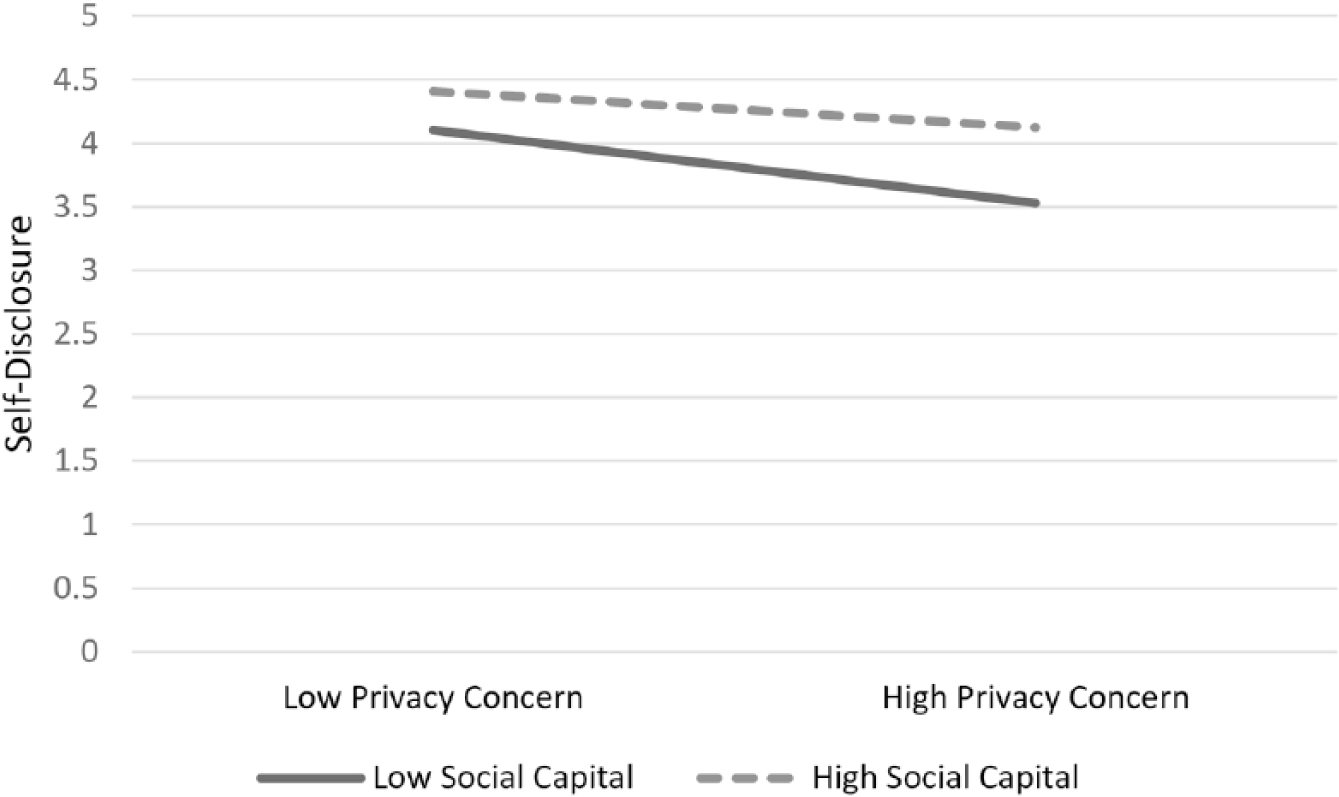
The interactive relationship between privacy concerns and social capital on self-disclosure (Hong Kong).
Research Question 3 examines the same moderated mediation model with privacy self-efficacy as the independent variable. In Hong Kong, results show that social capital moderates the direct effect of privacy self-efficacy on self-disclosure (Β = .113, SE = .030, p < .001; Figure 3). In addition, social capital moderates the indirect effect of privacy self-efficacy through limiting profile visibility (Β = .054, SE = .017, p < .001; Figure 4) on self-disclosure (index of moderated mediation: Β = .034, SE = .013, 95% CI [.007, .058] and friending (index of moderated mediation: Β = .014, SE = .005, 95% CI [.003, .024]. In the United States, the moderated mediation analysis only shows a conditional direct effect of privacy self-efficacy on self-disclosure moderated by social capital (Β = .045, SE = .015, p < .01) and the pattern of the interactive relationship is similar to the one found in Hong Kong. However, the analysis does not find other conditional direct and indirect effects in the United States.

The interactive relationship between privacy self-efficacy and social capital on self-disclosure (Hong Kong).

The interactive relationship between privacy self-efficacy and social capital on limiting profile visibility (Hong Kong).
Discussion
Privacy has been a much-studied topic in social media research. In particular, scholars have strived to understand the privacy paradox—why people are concerned about their privacy on social media but are still willing to engage in disclosing a large amount of sensitive personal data (e.g., Barnes, 2006; Taddicken, 2014; Young & Quan-Haase, 2013). This study revisits the privacy paradox and aims to bridge the gap between privacy concerns and self-disclosure in the literature by proposing two other factors (i.e., privacy self-efficacy and social capital) that influence privacy management strategies (i.e., limiting profile visibility, self-disclosure, and friending. The study also argues a two-step process in managing privacy on social media. More specifically, although social media users disclose their information or friend others, this does not indicate that they do not take action to protect their privacy. When the users have high privacy concerns and privacy self-efficacy, they will first limit their profile visibility to manage to what extent the content they share will be visible to others, which in turn will enhance their self-disclosure and lead them to expand their network. Findings from the current study help explicate the complicated relationship between privacy concerns and privacy practices in the privacy paradox and demonstrate that more self-withdrawal behaviors (i.e., limiting profile visibility) do not necessitate less self-disclosure. They compensate for each other to form a better strategy for privacy management.
Findings from this study show that privacy concerns promote limiting profile visibility in both Hong Kong and the United States. Although privacy concerns discourage self-disclosure in Hong Kong but not in the United States, they have an indirect effect on self-disclosure through limiting profile visibility in both places. Not only does limiting profile visibility bridge (mediate) the insignificant relationship between privacy concerns and self-disclosure in the United States but it also redirects the negative relationship between privacy concerns and self-disclosure in Hong Kong. Privacy concerns do not affect friending behaviors in Hong Kong, and opposite to what was proposed in the hypothesis, these concerns facilitate network expanding in the United States. The insignificant relationship (i.e., Hong Kong) and the opposite direction (i.e., United States) can be explained by the significant role of limiting profile visibility in fully mediating the relationship between privacy concerns and friending. The results also show that privacy self-efficacy has a consistent direct effect in enhancing limiting profile visibility, self-disclosure, and friending in both Hong Kong and the United States, and the direct effects on self-disclosure and friending are mediated by limiting profile visibility. The results highlight a two-step process in protecting privacy. Limiting profile visibility, self-disclosure, and friending may not co-occur. Instead, social media users who are concerned about privacy invasion and believe in their ability to protect their privacy will first limit their profile visibility so that they have greater control over their information and relationships on social media. With greater controllability over their profile, users will be more likely to share personal information and expand their social network on social media.
The moderated mediation analyses further suggest some similarities and differences in Hong Kong and the United States when considering social capital as the moderator in influencing the indirect effect of privacy concerns and privacy self-efficacy on self-disclosure and friending. In the United States, the moderated mediation model only demonstrates a conditional direct effect of privacy self-efficacy on self-disclosure moderated by social capital. When social media users consider resources from their social network and expect to obtain benefits from the network, the positive effect of privacy self-efficacy on self-disclosure is enhanced. This conditional direct effect was also found in the moderated mediation model in Hong Kong. Social capital also mitigates the impact of privacy concerns on restraining self-disclosure in Hong Kong. In addition, there are conditional indirect effects of privacy self-efficacy in enhancing self-disclosure and friending moderated by social capital. Social capital boosts the effect of privacy self-efficacy in limiting profile visibility, which in turn contributes to a greater level of self-disclosure and friending. The moderated mediation model in Hong Kong illustrates competing roles of costs (privacy concerns) and benefits (social capital) in influencing self-disclosure in the privacy calculus because social capital will mitigate the effect of privacy concerns on restricting self-disclosure; however, when considering privacy management as a two-step process and including privacy self-efficacy as another factor in the privacy calculus, social capital does not necessarily override privacy concerns and lead to privacy risk. Social capital can promote the positive effect of privacy self-efficacy on protection practices (i.e., limiting profile visibility). One may argue that social capital should make people engage in less profile-limiting behaviors given that they would like to obtain resources from their social network. However, when people believe in their ability to control their privacy and manage their audience (i.e., high privacy self-efficacy) and if they have high expected benefits (i.e., high social capital), limiting profile visibility helps secure a greater benefit that can be obtained via self-disclosing and friending behaviors from the network they defined while lowering the privacy risk.
The findings, however, cannot be interpreted without limitations. First, although the United States survey is a representative sample, the cross-sectional data limit the causality of the relationship. The Hong Kong data help ease this concern given that they come from a representative sample based on the Hong Kong census and also from a two-wave panel survey. The findings are expected to be generalizable and suggest some causal order. However, the two waves are about 1 month apart, raising some concern about the extent to which we can draw clear causal conclusions. Future research can consider examining the relationship with a two-wave panel that is conducted over a longer time period. However, collecting the data at two closer times helps secure a high retention rate (71.3%), which helps ensure that data are representative and valid. In addition, while this study proposes a two-step process in managing privacy on social media, the privacy management strategies, including limiting profile visibility, self-disclosure, and friending are all measured in the same wave (e.g., all measured in Time 2 in Hong Kong data). The extended privacy calculus model would gain stronger support if privacy concerns, privacy self-efficacy, and social capital were measured at Time 1, limiting profile visibility at Time 2, and self-disclosing and friending at Time 3.
Second, this study did not measure social media use focusing on specific social media platforms given that several different social media are popular in Hong Kong and the United States. Future researchers may consider testing the extended privacy calculus model in specific social media platforms, as each may have unique features for which people weigh the factors and handle their privacy differently.
Despite the limitations, this study extends the privacy literature by considering privacy self-efficacy and social capital as factors in addition to privacy concerns in the privacy calculus model. This study also demonstrates a two-step process in privacy management by which social media users can self-disclose and expand their social network in a way that also protects their privacy when they are concerned about privacy risk and believe in their ability to manage their privacy on social media. Social capital also helps promote self-disclosure and plays a significant role in enhancing the two-step process in privacy management.
Footnotes
Declaration of Conflicting Interests
The author declared no potential conflicts of interest with respect to the research, authorship, and/or publication of this article.
Funding
The author disclosed receipt of the following financial support for the research, authorship, and/or publication of this article: This work was supported by a grant from the Faculty of Social Science, Chinese University of Hong Kong (project no. SS15758).