



Abstract
Informal social support from family and friends has often been highlighted as the key form of support for migrants under different forms of transnational movement, particularly for female migrants. Drawing on the findings from qualitative and quantitative studies on Filipino and Indonesian migrant domestic workers in Hong Kong, this article applies the intersectionality framework to explore how migrant domestic workers approach different forms of support systems based on their multiple identities of gender, ethnicity, and religion. A clear distinction on help-seeking behavior is drawn between approaching formal and informal support systems with migrant domestic workers directly approaching formal support when the problem is employment related but turning to informal support when having emotional needs. Such distinction is found to be related to migrant domestic workers’ perceptions toward gender role and religious practices under transnational movements.
Introduction
With the gradual feminization of labor force, a significant increase in local female work force could be observed in Hong Kong since the 1970s. Migrant domestic workers (MDWs) from Southeast Asian countries have played an important role in caregiving to Hong Kong families, which allowed educated Hong Kong women to continue their employment. In light of the need of hiring MDWs, the Hong Kong government opened its immigration policy in the 1970s to allow MDWs to work in Hong Kong—female MDWs from the Philippines and later from Indonesia came to work in the territory. Among the 386,075 MDWs in 2018, 210,897 were Filipinos and 165,907 were Indonesian. Female MDWs dominate the MDW population, accounting for more than 98%. More than 80% of MDWs are between 20 and 40 years old, and more than half are married but not living with their spouses and families. However, there are significant differences between the Filipino and Indonesian MDWs in terms of religion and education attainment. It is estimated that more than 90% of Filipinos are of Christian background and more than 85% of Indonesians are Muslims.
More than 60% of Filipino MDWs have obtained higher secondary or above education level, whereas more than 60% of Indonesian MDWs have lower secondary education level or below.
MDWs are often subjected to a high degree of work-related exploitations and personal life–related challenges, and they are often less protected than local workers and migrant workers of other job sectors (International Labour Organization, 2019). However, whether an MDW would seek help from existing support systems depends on the knowledge and perceptions an MDW has on the available support. This study deploys intersectionality framework under transnational movement to analyze how different forms of identities of MDWs intersect and construct the specific attributions of MDWs on help seeking through formal and informal support systems.
Situations of Migrant Domestic Workers in Hong Kong
The Hong Kong SAR government has laid out the rights and obligations of MDWs and their employers in the Standard Employment Contract (ID 407), the Employment Ordinance, and the Immigration Ordinance. According to Section 2(4) of the Immigration Ordinance, MDWs are excluded from the entitlement of permanent residency and are placed under the compulsory “live-in policy,” which are specific requirements applicable solely to MDWs but not to other migrant workers. These conditions of stay have been controversial and have been criticized for subjecting MDWs to highly vulnerable conditions of personal safety and job security.
Under Clause 3 of the Standard Employment Contract, MDWs are required to live with the employer in the same premise. Such live-in condition causes MDWs to be under strict control of their living and work conditions by their employers. Apart from long working hours of more than 12 hours work per day; verbal, physical, and sexual abuses by their employers are commonly experienced by MDWs, with 58% reported experiencing verbal abuse, 18% experiencing physical abuse, and 6.5% experiencing different forms of sexual abuse in the premise (Equal Opportunities Commission, 2014; Mission for Migrant Workers, 2013).
MDWs are protected by a minimum wage of HK$4,520 in 2019 set out by the government, and the employer also has to provide suitable accommodation with reasonable privacy, free food (or food allowance in lieu, which is HK$1,037 per month at present), and free passage from the worker’s home country to Hong Kong and return to the home country on termination or expiry of the contract.
However, not only is the level of minimum wage far lower than that of local workers, studies found that MDWs are also subjected to abuses related to overcharging of agency fee and underpaid, which put them under huge financial challenges. According to the legislation, agency fee is capped at 10% of the minimum wage; however, a study conducted with 452 MDWs found that 56% of those interviewed were charged a much higher rate than the stated agency fee, with new workers paying an average of HK$9,013 (Kao, 2018).
The Labour Department and the Immigration Department of the Hong Kong government provide mechanisms, including free consultation and conciliation service, for MDWs to lodge complaints regarding employment abuses and disputes. The two consulates, the Philippines and Indonesia, also received thousands of complaints from their MDW citizens on cases related to physical, verbal, financial, and psychological abuse by their employers (Hung, 2019).
Approaching Formal and Informal Support
Help seeking is defined as a coping strategy aiming at getting support, advice, or assistance in times of stress, which could range from just discussing the problem and situation to requesting specific aid (Gourash, 1978). Scholars usually differentiate help seeking into two dimensions: formal and informal sources of support (Lipman & Longino, 1982; Ullman & Filipas, 2001). Formal source of support refers to services that function under bureaucratic structures and agency; while informal source of support refers to individual social networks, such as family and friends. Due to its bureaucratic and institutional nature, formal support tends to be more task oriented in problem solving through professional knowledge and skills; and thus, service quality is more stable and standardized but could also be criticized as less person-centered and responsive to individual differences (Lipman & Longino, 1982). On the other hand, informal support could be sought in everyday living due to the source of support’s proximity to the one who seeks help. Thus, the response could be more spontaneous and unique to the person’s situation. Rather than focusing on problem solving, informal support tends to provide affective and emotional support nonjudgmentally.
When facing different forms of work-related and personal problems and challenges, migrants’ decision to seek help and of the forms of help to seek depend on a number of personal and interpersonal characteristics and traits, including gender, race, economic status, migration status, access to information, and level of social inclusion (Anyikwa, 2015; Green & Ayalon, 2016; Kaukinen, 2002; Seeberg, 2012).
Help-seeking behaviors are influenced by different levels of interactions among structural, cultural, and situational factors (Bui, 2003). Access to information on formal supportive services also determine what forms of formal support service migrants would seek. In general, migrant workers are given less social protection when compared with local workers due to their restricted citizenship granted by the receiving countries, which limits their avenue for seeking formal help and remedy (Ciobanu & Bolzman, 2015; Dwyer & Papadimitriou, 2006). Social protections for migrant workers have been arbitrary mainly due to their noncitizen and work statuses. Locke et al. (2013) described migrants under two forms of vulnerabilities when approaching social protection—one is “migrant-specific vulnerabilities,” which denote immigration control policies that limit migrant’s social rights entitlement, and the other is “migrant-intensified vulnerabilities,” which arise from migrants’ condition of working in poorly regulated sectors of work.
Transnational migration also has significant impact on migrant workers’ reporting behavior. These factors include low level of social inclusion due to their working environment and lack of proficiency of local language, which limit their access to information and understanding toward formal services, and mistrust toward receiving country’s service provision as they portray their home country’s formal service experiences to the receiving country’s ones, such as Filipino citizens have little trust toward their police, and therefore, they tend to be more reluctant to contact police in other countries (Green & Ayalon, 2016; Santo & Ali, 2005).
Ullman and Filipas (2001) found that ethnic minority women, including migrant women, were more likely to report negative experiences of seeking help from police and to experience negative social reactions such as racial stereotyping and discrimination and victim blaming. This echoes the finding of a study on the usage of allied health services by female migrant workers, which found that the longer the working hours of female migrant workers, the less likely they will proactively approach formal help (Wang & Tang, 2019). The proactiveness was significantly lower for workers working for more than 12 hours per day than those working for no more than 8 hours per day. And the stigmatization associated with female migrant workers using formal help causes lower utilization rate of service usage by female migrant workers to avoid discrimination and social isolation. Green and Ayalon (2016) interviewed 187 Filipino migrant home care workers in Israel and found that the rate of reporting abuse formally and informally was much lower than local workers. The researchers attributed the low rate of formal and informal reports to a number of reasons mentioned above, including the cultural attribution that victims consider experiencing abuse is a kind of disgrace in their culture and a fear of social stigma on their gender and migration status.
Gender is found to be the strongest characteristic in approaching for help. Although social protections have become more gender sensitive, it is believed that they are still failing women’s life cycle needs especially under the ever-evolving roles of women in domestic and productive activities. With the increasing feminization of labor force, which coupled with migration movements, increasing risks and vulnerabilities are experienced by women migrant workers, yet formal social protection programs may not be able to cater to such changing needs (Locke et al., 2013). Informal supports, on the other hand, are also reconstructing with women’s migration status, yet the deep-rooted culture of women’s conventional roles may still hinder women’s help seeking. Women across ethnicities are more frequently to turn to female friends, sisters, and mothers for emotional support—he idea of sisterhood provides some forms of togetherness and relief even though it may not necessarily solve the problem (Anyikwa, 2015; Yoshioka et al., 2003). However, cultural attribution toward the situation may affect the help-seeking preference. Family’s reactions may affect whether an individual would disclose the problem to the family, and sometimes family could even be a hindrance to formal help (Calnan, 1983; Ullman & Filipas, 2001; Yoshioka et al., 2003). A study on migrant women’s help-seeking behavior on sexual assaults found that migrant women were less willing to talk about their abusive situations and seek help from their community members due to the culture of maintaining family honor and were afraid that their sharing of their situations about assaults would spread across the community and even to their relatives in their home countries (Tonsing, 2014).
Framework of This Study
MDWs coming to Hong Kong with backgrounds of particular gender, ethnicities, culture, religion, and nation-states are positioned in the dominant society with the intersection of these identities in different ways. To investigate the intersectional dynamics of these identities in shaping their help-seeking preferences and behaviors in the dominant society of Hong Kong, the conceptual framework developed is to analyze how MDWs are positioned in the empowered/disempowered situations under transnational movement, which subjected them to different forms of formal and informal supports.
Focusing on the intersectional dynamics of MDWs’ multiple identities, the intersectionality framework is employed as an analytical framework for this study. Intersectionality looks into the interconnectivity of multiple forms of oppressions and how they constitute the constructions of new forms of oppression (Bastia, 2014). Rather than solely applying feminist theory and critical race theory that focus on the predomination of a single essential identity constituting oppression, Crenshaw (1991) and other theorists emphasize the complicated and contradictory nature of identities that position individuals in the power structure. As different systems of oppression are interconnected with each other and race and gender are usually seen as quintessentially intersected, intersectionality focuses on identity politics of inter- and intragroup differences through the lens of interlocking multiple identities an individual possesses (Bastia, 2014; Nash, 2008).
Intersectionality positions people into different social identities. These identities could be interdependent and can create experiences that could be oppressive or privileged to those belonging to these identities (Yuval-Davis, 2011). However, the effects of these identities are time- and context-dependent. Intersectionality binds with the sociopolitical economic discourses that structure inequalities that individuals are positioned (Mirza, 2013). Social context is significant in determining the power relationships, and intersectionality knit the fabric of systems of which different social identities are located in this power dynamic (Chan & Erby, 2018). Considering the social context of MDWs, intersectionality of social identities of MDWs are not static in one location but under the influences of transnational systems. According to Vertovec (2004), power relationships surrounding social identities change according to sociopolitical contexts and are subjected to a person’s locality under transnationalism. These changes may include forms of social organizations, activities, and values. Migrants adapt to cross-border contexts, which constantly modify their values and activities of daily lives. Furthermore, migrants build up and retain social relationships that connect the two contexts; these contacts help them sustain their cross-border engagements in both societies (Portes, 1999). To engage in both societies and not being socially excluded, migrants need to access information through these social networks, which prevent them from being isolated, discriminated, and ostracized (Bronstein, 2017).
Aiming to uncover MDWs’ help-seeking behavior toward formal and informal social support, intersectionality of social identities under transnationalism was used as an analytical framework to explore the social positioning and power of MDWs in approaching social supports in both sociopolitical contexts of Hong Kong as the host society and their countries of origin as the home society. Under transnational nature of MDWs, the preference and capacity to seek formal and informal social supports of MDWs depends on their relationships with different social networks in order to access available and suitable supports. The framework of this study thus sought to uncover how the intersection of multiple identities affects MDWs’ relationship and connectivity with the social networks in both the host and home societies, and how these relationship building and retention could affect MDWs’ help-seeking behavior toward formal and informal social support.
Methodology
A between-method triangulation design is used for this study. The purpose of using triangulation is to obtain different forms of data to complement each other to best understand the research problem (Creswell & Clark, 2007). Between-method triangulation is the use of both qualitative and quantitative research methods, so that each method can bring along their strengths and compensate each other’s weaknesses. With the use of between-method triangulation, data collected from both research methods could be compared and validated.
With the objective of this study to uncover the help-seeking behavior of MDWs toward formal and informal social support, the use of between-method triangulation is to provide both statistical and nonstatistical data to the above analytical framework. Covering the same scope of research objectives and within similar time frame on the data collection for both quantitative and qualitative methodologies, data collected through the two methods are covered by two research projects.
Quantitative Methodology
A face-to-face questionnaire survey was conducted with 2,017 Filipino and Indonesian MDWs in Hong Kong through multistage cluster random sampling. Interviewees were randomly selected from 125 MDWs’ gathering spots in 10 districts in Hong Kong during the Sundays of May to September, 2017.
Measures
Citizenship was dichotomously coded (1 = The Philippines, 0 = Indonesia). Support seeking from informal support networks in Hong Kong was evaluated with a series of questions. Participants were asked whether in the past 12 months they have sought support from family members and from friends in Hong Kong for five types of issues (i.e., emotional, financial, housework-related, legal, and health-related). The responses were dichotomously coded (1 = yes). Frequency of contact with informal support network members was measured by questions about the frequency of one-to-one contact with each type of informal social support network, including father, mother, spouse/partner, children, friends in Hong Kong, friends in home country, and friends in other countries. The responses were dichotomously coded, with 1 indicating having weekly contacts, and 0 indicating not having weekly contacts. Support seeking from formal support networks in Hong Kong was evaluated with a series of questions asking whether in the past 12 months participants have sought support from social workers/NGOs (nongovernmental organizations) for five types of issues (i.e., emotional, financial, housework-related, legal, and health-related). The responses were dichotomously coded (1 = yes). Preference for the formal support system for employment contract violations was evaluated with a question, “If there are violations of your employment contract, who do you go first?” Responses included, but were not limited to, the participant’s country consulate, Hong Kong Labour Department, and Employment Agency. The responses for this variable were coded with dummy coding.
Analysis Plan
Univariate analysis was first conducted to understand the sample characteristics. Chi-square analyses were performed to investigate the differences between Filipino domestic workers and Indonesian domestic workers in the following aspects: (1) support seeking from informal support networks in Hong Kong, (2) frequency of contact with informal social support network members, (3) support seeking from formal support networks in Hong Kong, and (4) preference for the formal support system for employment contract violations. An alpha level of .01 was used to indicate the statistical significance.
Qualitative Methodology
The qualitative data draw on a larger research project that examined the help-seeking behavior of Muslim and Christian MDWs on labor rights protection in Hong Kong. A total of seven individual semistructured interviews with officials in the religious institutions and three focused group interviews with Muslim and Christian MDWs were conducted during July 2017 to July 2018. Table 1 gives an overview of the interviewees.
Overview of Interview Participants.
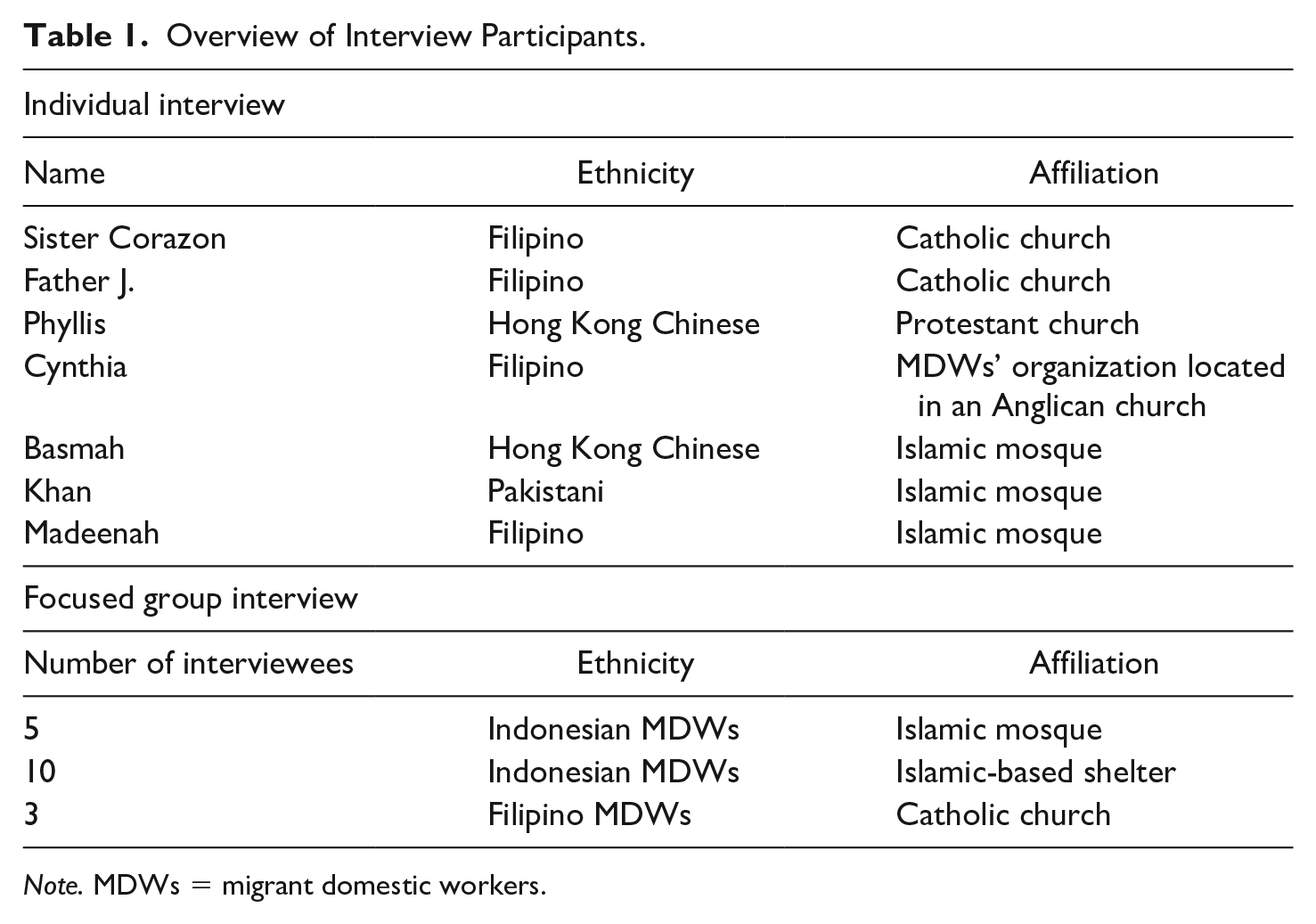
Note. MDWs = migrant domestic workers.
Ethics approval was granted for the interview conduction, and consent forms were signed before the interview. Data were disclosed according to interviewees’ consent. Interviews were conducted in the preferred language of the interviewees, mainly in English and Cantonese, and each interview lasted for 1.5 to 2 hours. Guiding questions were formulated according to the above framework to explore the participation of MDWs in religious practices and faith-based institutions and the impact on their help-seeking behavior on formal and informal social support.
Data were transcribed, and thematic analysis was used to analyze the data. Themes were set according to the framework and the guiding questions. Electronic coding was proceeded after the transcriptions were ready by Nvivo. The codes generated were then gone through manually to countercheck and validate the matching of the themes and transcripts.
Quantitative Findings
Quantitative data illustrate MDWs’ tendency toward seeking different forms of formal and informal supports under the cross-border social contexts. While the tendencies toward seeking informal supports by both Filipino and Indonesian MDWs are similar, the differences between Filipino and Indonesian MDWs in seeking formal support demonstrated the social positioning of MDWs in approaching and confronting authorities in these two contexts of countries of origin.
Table 2 shows the frequencies and proportions for support seeking from informal support network in Hong Kong and chi-square test results of the relationship between citizenship and support seeking from informal support networks. Results indicated that between Filipino and Indonesian MDWs, there were significant differences in the proportion of people seeking emotional support and financial support. A significantly higher proportion of Filipino MDWs (38.9%) sought emotional support from family members in Hong Kong compared with Indonesian MDWs (31.9%; χ2(1) = 7.01, p ≤ .01). Similarly, a significantly higher proportion of Filipino MDWs (34.4%) sought financial support from family members in Hong Kong compared with Indonesian MDWs (26.7%; χ2(1) = 9.23, p ≤ .01). There was no significant difference in seeking housework-related, legal, and health-related supports from family members in Hong Kong between Filipino and Indonesian MDWs.
Frequencies and Proportions for Support Seeking From Informal Support Network in Hong Kong and Chi-Square Test Result.
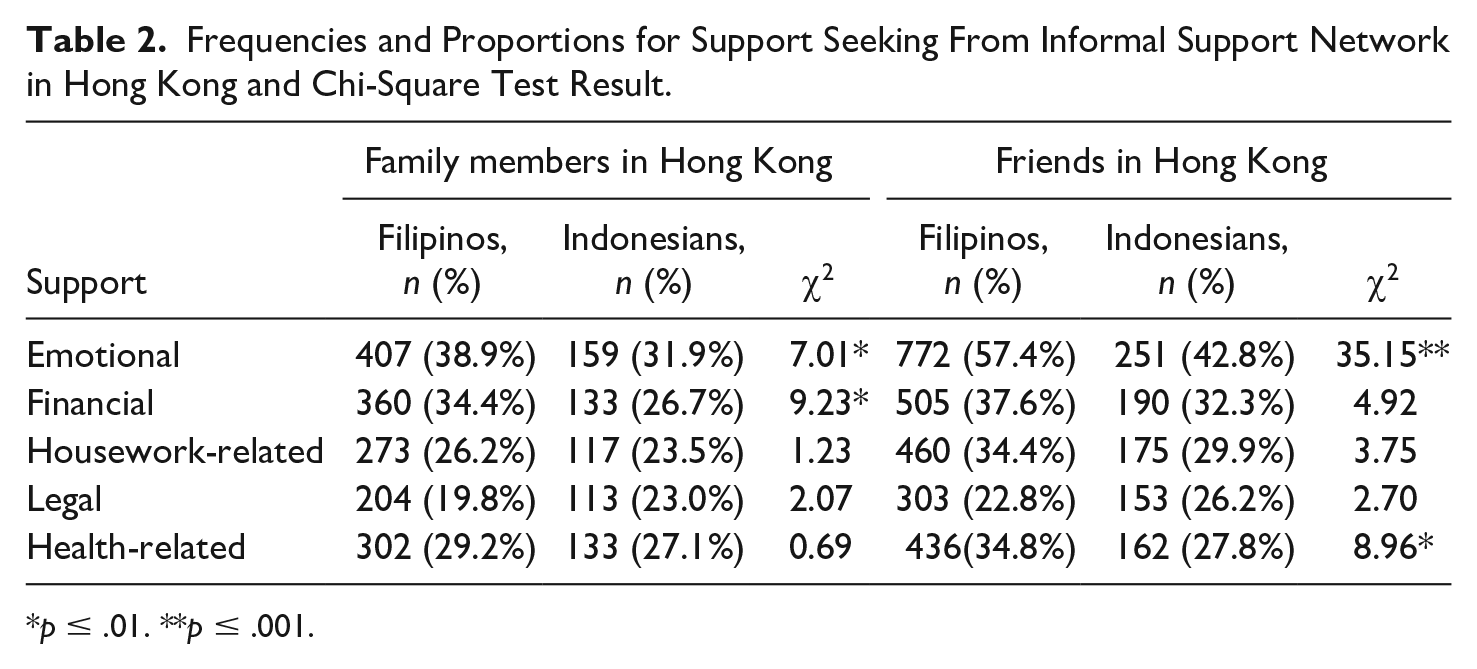
p ≤ .01. **p ≤ .001.
In terms of support seeking from friends in Hong Kong between Filipino and Indonesian groups, there were significant differences in the proportion of MDWs seeking emotional support and health-related support. A significantly higher proportion of Filipino MDWs (57.4%) sought emotional support from friends in Hong Kong than Indonesian MDWs (42.8%; χ2(1) = 35.15, p ≤ .01). A significantly higher proportion of Filipino MDWs (34.8%) sought health-related support from friends in Hong Kong in the past 12 months compared with Indonesian MDWs (27.8%; χ2(1) = 8.96, p ≤ .01). However, there was no significant difference in seeking housework-related, legal, and health-related supports from family members in Hong Kong between Filipino and Indonesian MDWs.
The frequencies and proportions for support seeking from formal support system in Hong Kong and the chi-square test results of the relationship between citizenship and support seeking from the formal support system are presented in Table 3. As indicated, there was no significant difference in seeking emotional, financial, housework-related, legal, and health-related supports from social workers and/or NGOs between Filipino and Indonesian MDWs.
Frequencies and Proportions for Support Seeking From Formal Support System (Social Workers and NGOs) in Hong Kong and Chi-Square Results.

Note. NGOs = nongovernmental organizations.
p ≤ .01. **p ≤ .001.
Table 4 shows the frequencies and proportions of preference for the formal support system for employment contract violations and chi-square test results of the relationship between citizenship and the preference. Since participant’s country consulate, Hong Kong Labour Department, and employment agency were the most commonly preferred formal social support systems, our analyses only focused on these three formal support systems. As indicated in Table 4, Filipino and Indonesian MDWs had different preferences for formal support systems for employment contract violations. The proportion of MDWs indicating that they would first approach their country consulate for their employment contract violation was significantly higher in the Filipino group (47%) than in the Indonesian group (15.4%; χ2(1) = 185.84, p ≤ .000). However, the Indonesian group (45.2%) had a significant higher proportion of people, indicating that they would first approach employment agency for employment contract violation than the Filipino group (18.5%; χ2(1) = 155.46, p ≤ .000). There was no significant difference in the preference for approaching Hong Kong Labour Department between Filipino and Indonesian MDWs.
Frequencies and Proportions of Preference for the Formal Support System for Employment Contract Violation and Chi-Square Results.
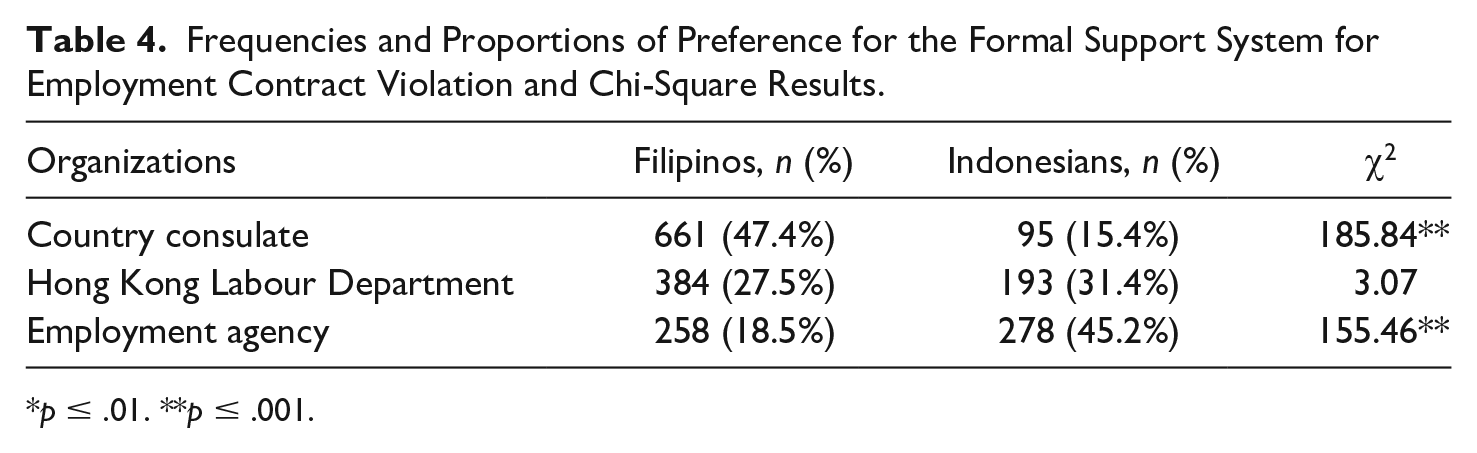
p ≤ .01. **p ≤ .001.
Qualitative Findings
Interconnectivity of Formal and Informal Support Systems
Multiple linkage across different forms of formal and informal support systems could be found. Rather than each support system operating on its own, different levels of help are observed for MDWs on a single problem due to the intertwining relationships within and across formal and informal support systems. Different forms of support are connected when MDWs navigate between the two sociopolitical contexts.
Migrants acquire new information and practices toward the host society so as not to be socially excluded (Bronstein, 2017). Information develops migrants’ coping skills for their physical and psychological needs. The acquisition of these information is usually through social relationships established in both the home and host social contexts. As illustrated by the quantitative data above, personal social support systems, especially friends in Hong Kong, could provide fundamental support to MDWs, and they are also the sources that connect MDWs to available formal support systems. When MDWs staying in the Islamic-based shelter were asked about how they know about the shelter and came to seek refuge there, all of them answered that they came there through their friends who were also MDWs in Hong Kong.
There may not be a clear distinction between formal and informal support systems. Faith-based organizations, such as churches and mosques, and the migrant workers groups, due to their outreaching nature, provide psychological and emotional support to MDWs through different forms of activities. These activities aim to build up kinship and strengthen informal support for MDWs through making friends. On the other hand, these organizations also connect MDWs to other forms of formal support systems for tangible services, including the two country consulates, and teach them how to approach the employment agency and the local government offices.
And I also find the Philippines consulate very accommodating. They also send us clients. Because they have a shelter, but they can accommodate only twelve, errrr ten. So when they have an overflow, they send to us. . . . But they are really very helpful. When we have a problem, we refer to them, and then they will help . . . they will be with us. So we work together. We work together. I find the consulate has very busy people, even visiting the sick in the hospital, even those with accident, even in the prison. We also help in the prison. . . . Then we have something on their rights. Labour rights. So we have, we invite the consulate staff to give them the services. And how they do it, how they can be helped with their cases, with all their needs.
Uh, unless very very necessary, for example cases like, air ticket, and, it is not anymore possible through the Labour Department, we ask the consulate, we go back to church, just we ask the consulate, because, we, we insist that, you should do your responsibility. Because sometimes, a consulate here would wash their hand, “oh they no longer migrant workers.” But they came here as migrant workers and they are your people!
However, differences in strength of connectivity between formal and informal support systems could be observed between ethnicities among different social identities. Echoing with the quantitative findings, Filipino MDWs from Filipino social groups have stronger connection with the consulate and are more willing to approach formal support, while the tendency to seek help from formal social support by Indonesian MDWs is lower and the connection between Indonesian consulate and Indonesian social groups is weaker. Such strength of connectivity between MDWs and formal systems is adapted under transnational sociopolitical contexts. Social protection in the Philippines is slightly better than that of Indonesia (International Organization for Migration, 2010; Pension & Development Network, 2016). For Filipino MDWs, the Philippine Overseas Employment Agency, Department of Labour and Employment, the Overseas Workers Welfare Administration, and the Department of Foreign Affairs closely collaborated to regulate and oversee the welfare of Filipino MDWs abroad. The National Authority for the Placement and Protection of Indonesian Overseas Workers was established in 2006 to regulate and oversee MDW issues. However, the enforcement of social protection by this authority is weak, as many Indonesian MDWs have no information about the unit (International Organization for Migration, 2010). Such pattern of connectivity on social protection is reaffirmed under transnationalism.
Arbitrary Supportive Roles of Informal Support
Previous studies found that informal support systems, such as family members and friends, provide strong social and emotional supports to female migrants (Anyikwa, 2015; Green & Ayalon, 2016). However, our findings show that the form of informal support systems and how they are being approached could be arbitrary. Families in home countries provide strong emotional comfort as they maintain the sense of connectivity and bonding with home; however, MDWs may not always seek emotional support from their family members, especially when facing problems related to work and relationship. Indonesian MDWs in the interviews expressed that as they perceived women should not work due to their understanding of the religion, their family would not be happy with their working status: Because when we talk with the Imam in the Wan Chai mosque, the preacher, the Imam, and he also mention about how Islam view when women going out to work, and some of the sisters are actually not too comfortable as women to work outside because they prefer staying at home, take care of their family, so do they have similar kind of thoughts or, because of the religion, how do they feel about they need to work outside and outside their country as well.
And when their family relationship is the source of discomfort, support would not be sought from the family but from other sources that could provide emotional support.
How can you pray if you have problem with your family, how can you pray if you’re abused by your employer, how can you pray if your husband in the Philippines has another woman.
Friends in Hong Kong serve as daily emotional support, but MDWs are also selective on what to share with their friends as they are afraid that their personal information and happenings would spread around the MDW community since the community in Hong Kong is small and close.
I think that’s more than enough because, sometimes if we just talking with another friends, and, sometimes we have the problem with our friends, because she already know about our problem, sometimes the, the bad friends, talk about our problem with another another friends, cannot trust the all, all people. So, I think just sharing with papa [Imam in mosque] for us is more than enough, because we just want to talk about our problem, we just want to somebody can, listening our problem.
Religious Identity and Belongingness Under Transnational Social Contexts
Religious institutions have a key role in services and support for MDWs since 1980s. Being from religious countries, many migrant workers bring along their religiosity to Hong Kong. During their Sundays off, many migrant workers would gather around places near their religious institutions. Starting from the beginning, Filipino domestic workers congregate at the Central District where a number of churches are situated, including the St. John’s Cathedral. Indonesian migrant workers gather around Causeway Bay area, where the Ammar Mosque is located, and at the Tsim Sha Tsui area near the Kowloon Masjid (Constable, 2007).
Studies showed that engaging in religious prayers and activities is an important form of support for women with religion (Lockhart & White, 1989; Rose et al., 2000). Coming from a religious home country, many MDWs have religion, majority of Filipino MDWs believe in Christianity, and Indonesian MDWs believe in Islam. They maintain their religious beliefs and activities when staying in the host society.
Because it is normal for us Filipinos, because we usually go to church and then because I think 50% of our life we get in front of the church because we have, yeah, the teachings, you know the encouragement and we get in front of the priest in front of our friends.
Religion could serve as an important emotional support, and MDWs perceived God as the most important source that governs their lives. Both Filipino and Indonesian MDWs expressed the faith in God’s support:
Religious makes me feel comfortable, for example if I had, I have a problem encountered, whenever I encounter problems I will go pray so I feel comfortable.
Because we believe that sometimes when you have problems we don’t need friends but God. And then sometimes only God can solve that problem, not by your friends, not by families, like that so we really need church, we really need God for us Catholics.
Religious institutions also serve as sources for connecting other forms of formal support systems; however, findings show that differences could be found between Islamic-based and Christianity-based institutions. Representatives from church and mosque mentioned that they have connections with the consulates. As mentioned above, churches have close relationship with the Philippines Consulate in terms of regular meetings and rendering support. However, mosque’s connection with the Indonesia Consulate is not as close as the churches with the Philippines Consulate. Also, due to resources limitation, the mosque could not provide other forms of support besides Zakat, a form of financial support to those Muslims in need, or refer those MDWs with other needs to the churches and local social service organizations. On the other hand, churches provide different forms of support, from counseling to legal support, which further strengthen their belongingness to the faith identity.
Faith-based organizations not only provide social resources, which connect MDWs to the local social context, but also construct MDWs’ social identity under the intersection of gender, religion, and work status. And such construction of social identity directly affects MDWs help-seeking behavior. Although they state that Islam does not prohibit women to work, officials in the mosque hold strong perception of women’s family role and that women could work when the husbands are not earning enough, while officials in the churches perceive women at work as totally acceptable. The construction of gender and work identity under religious discourse by the officials construct the power structure of MDWs from different religious identities when seeking help from both formal and informal support systems. Muslim MDWs tend to be less willing to seek help as they perceive that the problems they encounter are personal issue, while Christian MDWs are more open to perceive problems they encounter during work as labor rights issues.
Transnational Movements and Social Identities
Different forms of capital of migrants under transnational movement are valued and given meaning according to migrants’ understandings toward their home and host societies’ sociopolitical contexts (Kelly & Lusis, 2006). Although MDWs go to the same places that the local citizens would also go, and even sometimes would attend the same activities, interactions are still minimal.
There are really a lot of Indonesian workers on Sunday coming to pray in the Ladies Hall [inside the mosque], I also afraid to go there, so I understand why the local Muslims would make such complaint [no space to pray]. Yet, space is first come first serve, they [Indonesian MDWs] come earlier, of course can use . . . in fact they would clean up the facilities after use, but the locals may not see it. And we didn’t do much to promote inclusion either.
According to my observation, the interaction is very weak. The locals coming to our church are rather middle class, they maybe are the employers of the workers. That’s why they don’t really concern much about the workers. It is indeed pity to see that people pray together here but could not come together.
MDWs tend to retain their social identities and reconstruct their home society’s context under transnational movements. Although existing in the same space physically with the locals, MDWs do not interact with them as some locals are actually their employers, and the strong power differences across social classes hinder the possibility of interaction. While migrants could acquire new social resources and even identities under transnational movements, it is believed that migrants tend to retain their networks and practices due to intimate and shared experiences (Vertovec, 2004). The retention of social identities under transnational movements constructs a sense of belongingness for MDWs toward their social identities, yet on the other hand, it limits their exposure to wider social network and resources.
Conclusion: Navigating New Context While Retaining Social Identities
The transnational status of MDWs has put them in connection with support systems in both their home and host societies. Quantitative data presented indicate the degree of connectivity toward formal and informal support systems of Filipino and Indonesian MDWs, and the qualitative data provide accounts of the pattern of help-seeking behavior between formal and informal support systems.
Regarding seeking support from informal support systems, proximity is still a crucial factor when MDWs seek support, and the frequent contacts with family and friends indicate a significant importance of informal support systems for MDWs. However, quantitative data show that Filipino MDWs tend to seek more support from family and friends than Indonesian MDWs. Such patterns are also reflected in the qualitative findings that Indonesian MDWs do not strongly acknowledged their work condition as they believe women should be staying in family instead of work; thus, they would be less willing to share their work condition with others.
On the other hand, the level of connectivity between different forms of supportive network also determines whether MDWs would seek support from a particular source of support system. Clear divisions of sources of support were indicated in both quantitative and qualitative findings that MDWs would seek formal support systems for tangible needs and informal support for emotional needs. Yet the sources of formal support to be approached showed a difference between Filipino and Indonesian MDWs; higher proportion of Filipino MDWs would seek the consulate and the local government departments for work-related assistance, but Indonesian MDWs tend to seek agency for work-related problems. Agency is the first contact point for MDWs on their employment, yet if there is legal violation on employment condition, the consulate and the government are the ones that could directly handle the legal violation. However, knowing how to contact the consulate and the government depends on the proximity MDWs have with these units and the know-how on how to contact them. As the other support systems that the Filipino MDWs have in contact, such as the churches and migrant workers groups, are close to the consulate and the government, Filipino MDWs could better connect with these tangible support providers than the Indonesian MDWs.
Transnational practices remain the key pattern of establishing social networks and approaching support systems. The connections with family and friends, as well as MDWs’ religious practices, have caused them to retain these networks in Hong Kong and also serve as major sources of help. On the other hand, low level of social inclusion caused them hard to reach to other sources of formal support, such as the local social service organizations and local social workers. Although there are dedicated social service organizations for MDWs in Hong Kong, these organizations are not as reachable as the networks that retain their life practices from their home countries, the lack of life practice connectivity causes MDWs not to seek their support.
Footnotes
Declaration of Conflicting Interests
The authors declared no potential conflicts of interest with respect to the research, authorship, and/or publication of this article.
Funding
The authors received no financial support for the research, authorship, and/or publication of this article.
