




Abstract
The digital divide limits the flow of potential students through the science, technology, engineering, and mathematics (STEM) pipeline and into STEM careers. The digital divide is a dynamic and constantly evolving concept of digital exclusion that encompasses numerous dimensions and levels. The “usage access gap” and the “second-level divide” both account for differences in how digitally divided people actually use technology. In this study, we employ social cognitive theory as a framework to explore the impact of various kinds of technology usage on predominately minority students’ technology and application self-efficacy. Data were gathered over the course of a large-scale computing intervention that took place in an elementary school district in the southeastern United States. Results indicate that usage access gap activities and second-level divide activities, such as playing games or talking to friends online, may actually help increase students’ technology self-efficacy and computer application self-efficacy. Entertainment and social networking activities provide students with positive direct experiences with technology, which may help close this dimension/level of the digital divide over time. Future computing interventions should consider establishing dedicated “computer recess” time to help digitally divided students increase their technology self-efficacy.
Introduction
Science, technology, engineering, and mathematics (STEM) fields are increasingly important for the United States to remain competitive in a globalized economy (Carnevale et al., 2014). The demand for highly educated and skilled STEM workers continues to rise (Milfort, 2012). Unfortunately, reports estimate that the United States could be short 2.4 million qualified STEM employees by 2028 (Giffi et al., 2018). In particular, certain demographic groups such as minorities are less likely to pursue STEM careers (Beede et al., 2011). There are a myriad both sociological and psychological perspectives that can shed light on minority underrepresentation in STEM fields (e.g., Hicks, 2017; Oldenziel, 1999; Robinson, 2009; Simoni et al., 2016). In particular, some studies indicate that the STEM divide is linked to the various psychological factors associated with the digital divide (Ball et al., 2016; Ball et al., 2018). Differences in minority students’ technology-related self-efficacy beliefs may influence their likelihood to feel comfortable with technology and their attitudes toward pursuing STEM disciplines (Shank & Cotten, 2014; Wilson et al., 2015).
Making STEM fields representative of the racially diverse landscape within the United States is beneficial to the pursuit of STEM-related endeavors as minorities bring unique perspectives that can help solve important research questions (Carnes et al., 2006; Yager et al., 2007). Encouraging minorities to enter into STEM fields can provide numerous individual-level benefits as well. For instance, minorities who pursue STEM careers can earn up to 40% more than their non-STEM counterparts (Beede et al., 2011; Melguizo & Wolniak, 2012). However, various kinds of technological experiences can influence students’ self-efficacy beliefs differently, with potentially important ramifications for both the digital and STEM divides (Huang, Ball, et al., 2015; Shank & Cotten, 2014). In the present study, we examine how varying types of computer activities in the context of a computing intervention influence predominantly minority students’ technology self-efficacy and computer application self-efficacy.
Literature Review
The Digital Divide
Though information and communication technologies (ICTs) are increasingly permeating our society, a digital divide remains. The concept of the digital divide is continuously evolving to capture the multitude of repercussions associated with technological exclusion (Van Deursen & Van Dijk, 2013). The digital divide is conceptualized in two distinct ways. First, the digital divide comprises multiple levels. The first level of the digital divide involves access to the hardware and infrastructure necessary to avoid the negative effects of being digitally divided (Van Dijk, 2005). For example, at the most basic level, students need access to computers and the internet in order to participate fully in digital life. The second level of the digital divide examines how the lack of digital access results in differences in both the skills and uses of ICTs (Hargittai, 2002; Hargittai & Hinnant, 2008). For example, digitally divided students may not be efficient at using computer programs such as word processing software, and they may instead use computers for non-capital-building activities such as watching videos or playing video games. The third level of the digital divide builds off the previous two levels by examining how, even in situations with high levels of ICT access, the divide continues to produce differences between intangible outcomes (Scheerder et al., 2017; Van Deursen et al., 2017; Van Deursen & Helsper, 2015). For example, even if minority students have access to computers and the internet, they may still suffer from social and economic disadvantages due to the differences in usage associated with the second level of the digital divide (Van Deursen & Helsper, 2015).
Second, the digital divide is also conceptualized as being composed of multiple dimensions or “access gaps” (Van Dijk & Hacker, 2003). The first dimension is a material access gap that occurs when there is a lack of access to the hardware necessary for digital inclusion. The material access gap is similar to the first-level conceptualization of the digital divide (Van Dijk, 2005). The second dimension is a skill access gap, which occurs when individuals with different levels of ICT exposure develop different skill levels as a result. For example, digitally divided students may feel like they lack the skills necessary to use computers and various applications/programs effectively. The third dimension is a usage access gap, which occurs when individuals with different levels of ICT experience use ICTs differently (Davison & Cotten, 2003, 2010). For instance, students on the wrong side of the usage access gap may use computers for primarily entertainment-based activities rather than seeking information.
The skill and usage access gaps are similar to the second-level conceptualization of the digital divide (Hargittai, 2002; Hargittai & Hinnant, 2008). Finally, the fourth dimension is a mental access gap, which occurs when individuals with limited ICT experience develop negative emotional responses to ICTs (Van Dijk & Hacker, 2003). For example, digitally divided students might feel anxious or stressed when placed into a situation in which they need to use a computer for a school project (Robinson, 2009). Recently, researchers further identified the third-level digital divide, which refers to the disparities in the returns from internet access that could potentially acerbate the existing off-line inequalities (Scheerder et al., 2017; Van Deursen et al., 2017; Van Deursen & Helsper, 2015). In this study, we are particularly interested in the levels and dimensions of the digital divide associated with technology access, skills access, and usage differences. Specifically, we are interested in how different kinds of direct experiences and uses of technology subsequently influence predominately minority students’ technology-related self-efficacy beliefs and computer application self-efficacy. In other words, we are examining how first-level divide factors (material access) and second-level divide factors (usage access) intermingle to affect minatory students’ self-efficacy (skills access).
Social Cognitive Theory
We draw on social cognitive theory (SCT), one of the most cited social psychological learning theories, to inform our study (Pajares et al., 2009; Potter & Riddle, 2007). The core construct at the heart of SCT is self-efficacy (Bandura, 1971, 1977, 1994, 2004). Self-efficacy is a person’s internal belief concerning their capability to execute a particular task and achieve an anticipated outcome (Bandura, 1994). In general, self-efficacy beliefs affect how individuals feel, think, and behave (Bandura, 1994). High self-efficacy beliefs make relevant behaviors more likely, while low self-efficacy makes relevant behaviors less likely (Peng, 2008). For example, even if a student has regular access to a computer and the internet (material access) but lacks computer-related self-efficacy or application self-efficacy (skills access gap), the student may still be less likely to use a computer for certain capital-building tasks (usage access gap). Computer self-efficacy is one of the most important factors influencing the second level of the digital divide (Wei et al., 2011). Therefore, it is essential that we continue to explore the ways in which we can bolster digitally divided students’ technology-related and application-related self-efficacy beliefs. In this study, technology self-efficacy is conceptualized as students’ self-perceived skill level when using various devices such as computers, laptops, and tablets. Likewise, application self-efficacy is conceptualized as students’ self-perceived skill level when using various computer applications such as Microsoft Word, Excel, and PowerPoint. SCT posits a number of ways to influence individuals’ self-efficacy beliefs. One of the primary means and methods for influencing self-efficacy is known as enactive/direct/mastery experiences (Bandura, 1994, 2004).
According to SCT, direct experiences are opportunities for individuals to practice and experiment with an activity or task directly and are the most powerful way to influence self-efficacy beliefs (Bandura, 2004; Huang, Ball, et al., 2015; Joet et al., 2011; Peng, 2008). During the direct experience process, individuals interpret the results of their experiences, which may either increase or decrease their beliefs in their ability to perform a said task again in the future (Bandura, 1994, 2004). Computer usage inequality would lead to a divergence in internet usage patterns and attitudes internalized by economically disadvantaged individuals, which is manifested in their entertainment use of computers (Robinson, 2009). In other words, students’ direct experience of using computers for various tasks successfully, including informational entertainment and social networking purposes, will be positively related to their self-efficacy in using technologies and applications. Therefore, we propose the following hypotheses:
Besides the direct experience of using computers, environmental factors will affect students’ computer self-efficacy. Previous research showed that students’ computer access and usage at homes and schools also play an important role in shaping their computer self-efficacy (Wei et al., 2011). One more hypothesis is proposed as follows:
Research demonstrates that not all interactions with technologies have the same effect on self-efficacy beliefs (Huang, Ball, et al., 2015; Shank & Cotten, 2014), and not all racial/ethnic groups use technology in the same way and with the same intensity (Jackson et al., 2008). Thus, there is a need to better understand how these personal and environmental factors influence minority students’ technology-related self-efficacy and application-related self-efficacy and whether there is an interaction between the material and usage access gaps. To address the potential interactions between material and usage access, we proposed the following research question:
Data and Method
Data Collection and Sample
The data were from a large-scale computing intervention that took place in an urban, high-poverty, predominantly African American school district in the southeastern United States. The vast majority of the students in the school district were African American (95%), and they received free or reduced-price school lunches (89%; Alabama Department of Education, 2015). The demographic composition of the school district made it an ideal naturalistic environment for a computing intervention.
The overall goal of the intervention was to increase low socioeconomic status minority students’ interest in STEM fields by increasing students’ computer access and usage via a teacher-based computing intervention. In other words, fourth- and fifth-grade teachers participated in various training activities, which helped them integrate computing into their curriculum and classrooms, thus giving their students greater opportunities to use computers in class. The intention of the intervention design was that there would be a “top-down” effect in which the students would benefit from a teacher-based intervention.
The intervention itself was implemented using a three-phase model. During the first phase, participating teachers attended a weeklong teacher institute before the school year began. The teacher institutes included computer training, which helped teachers integrate computing across their curriculum using tools and tasks such as blogging or computer programming. The second phase gave participating teachers an opportunity to apply the skills and techniques they learned to design a computing-based lesson plan for use in their classroom. Finally, the third phase involved teachers actually applying what they learned in the training institutes in their classrooms to promote students’ computer usage and STEM interest.
Data were gathered during the fall of 2012 and spring of 2013. The posttest survey data used in the current study were collected after the intervention, which was at the end of the school year. The fourth- and fifth-grade students who participated in this study completed pencil-and-paper surveys. In total 1,201 students completed the survey, and the overall analytic sample size was reduced to 1,078 once participants with data missing on key variables were removed. Most of the students completed the survey; however, we still conducted tests to see if there were any statistical differences between those who did and did not finish the survey. Results indicated that there were no statistically significant differences between the two groups regarding race, gender, grade, technology self-efficacy, or application self-efficacy. Participation in the study was voluntary, and incentives (2GB flash drives) were dispensed regardless of full completion of the survey. All of the procedures performed in this study were approved and in accordance with the ethical standards of the university’s institutional review board.
Variables
The dependent variables for this study are students’ self-perceived technology self-efficacy and computer application self-efficacy. Students’ technology self-efficacy was measured using a five-item scale (α = .64) with questions asking students how good they were at using various devices such as computers, the internet, and tablets. The moderate reliability for the present scale was considered adequate due to the young age of the respondents and the low number of items within this scale (Carter et al., 2014; Newman & McNeil, 1998). Participants’ scale scores were averaged across the five items, with scores ranging from 0 to 4. The self-efficacy scale used in this study was selected because it can gauge young students’ overall self-efficacy toward a wide range of common technologies, which may be affected by a wide range of computer activities. Furthermore, the scale has been used successfully in previous studies regarding young students’ self-perceived technology self-efficacy and self-efficacy-related experiences (Huang, Ball, et al., 2015).
The application self-efficacy scale was adopted from a nine-item scale used in previous research (Huang, Ball, et al., 2015). The scale includes questions regarding students’ self-perceived self-efficacy in using various computer programs, including Microsoft Word, Microsoft Excel, Microsoft PowerPoint, Kidblog, Comic or Cartoon Maker, Movie Maker (e.g., Xtranormal), Scratch, Prezi, and Wallwisher. The response categories ranged from 0 (not good) to 4 (very good). Participants’ scores were averaged across the nine items, with scores ranging from (α = .79).
The independent variables in this study are (1) computer access and usage variables, (2) entertainment usage, (3) information usage, and (4) social usage. The computer and usage access variables included home computer usage and sharing a computer at school. Home computer usage was measured by asking, “How much do you use computers at home?” and the response options ranged from 0 = none to 2 = a lot, which was later recoded as a binary variable (1 = have computer usage/access at home, 0 = have no computer usage/access at home). Sharing a computer at school was measured by asking, “When you use a computer at school, do you have to share it with other students?” and the response options ranged from 1 = almost never to 3 = almost always, which was later recoded as a binary variable (1 = share a computer at school, 0 = do not share computer at school).
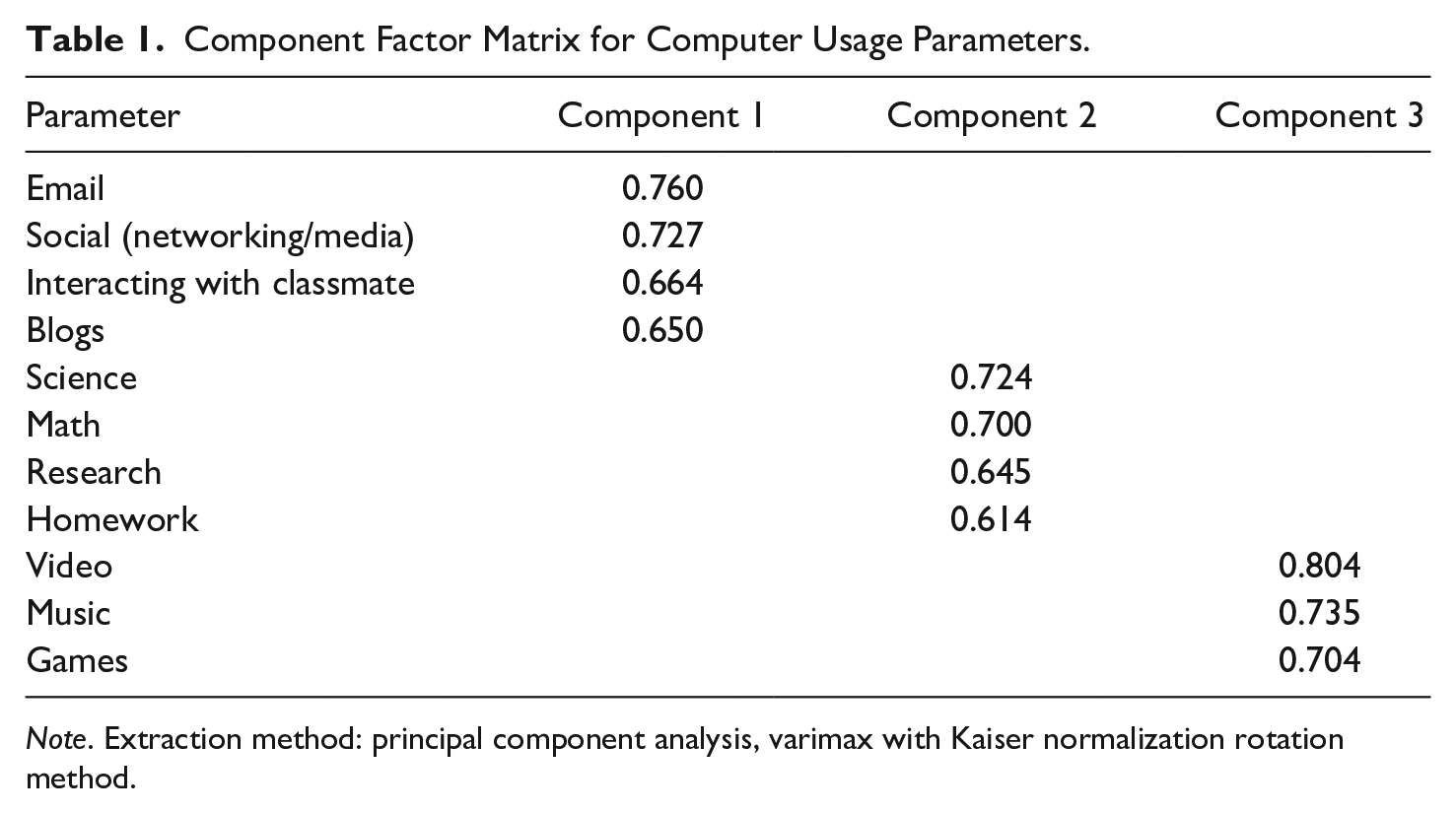
For the computer usage measures, three scales were derived from the Birmingham Youth and Technology Survey (Cotten, 2010), and they were created via an exploratory factor analysis with varimax rotation. All factors presented themselves with strong factor loadings (0.60 or higher) and no significant cross-loadings (less than 0.30). The fitness of the model for the results of the factor analysis was appropriate: The Kaiser–Meyer–Olkin measure of sampling adequacy was 0.719, and the Barlett’s test of sphericity was significant, χ2(45) = 2000.410, p < .001. Table 1 shows the factor matrix.
Component Factor Matrix for Computer Usage Parameters.
Note. Extraction method: principal component analysis, varimax with Kaiser normalization rotation method.
The entertainment usage scale consisted of three recreational-related items with questions such as “How much do you use computers to play games?” The information usage scale consisted of four educational related items such as “How much do you use computers to do research for school?” Finally, the social usage scale consisted of four social networking related items such as “How much do you use computers to go on a social networking site like Facebook, MySpace, Bebo?” All of the scales had 4-point response options (0 = not at all to 3 = a lot). Participants’ scores were created by averaging the included scale items.
A number of control variables were also included in the present analysis, including “hours using a computer,” gender, grade, and race. The “hours using a computer” variable was measured by asking, “How many hours PER DAY at both school and home do you use a computer or laptop?” The response options ranged from 0 = not at all to 4 = 7 or more hours. Gender, race, and grade were all recoded as dichotomous dummy variables (0 = female, 1 = male; 0 = non–African American, 1 = African American; 0 = fourth grade, 1 = fifth grade).
Results
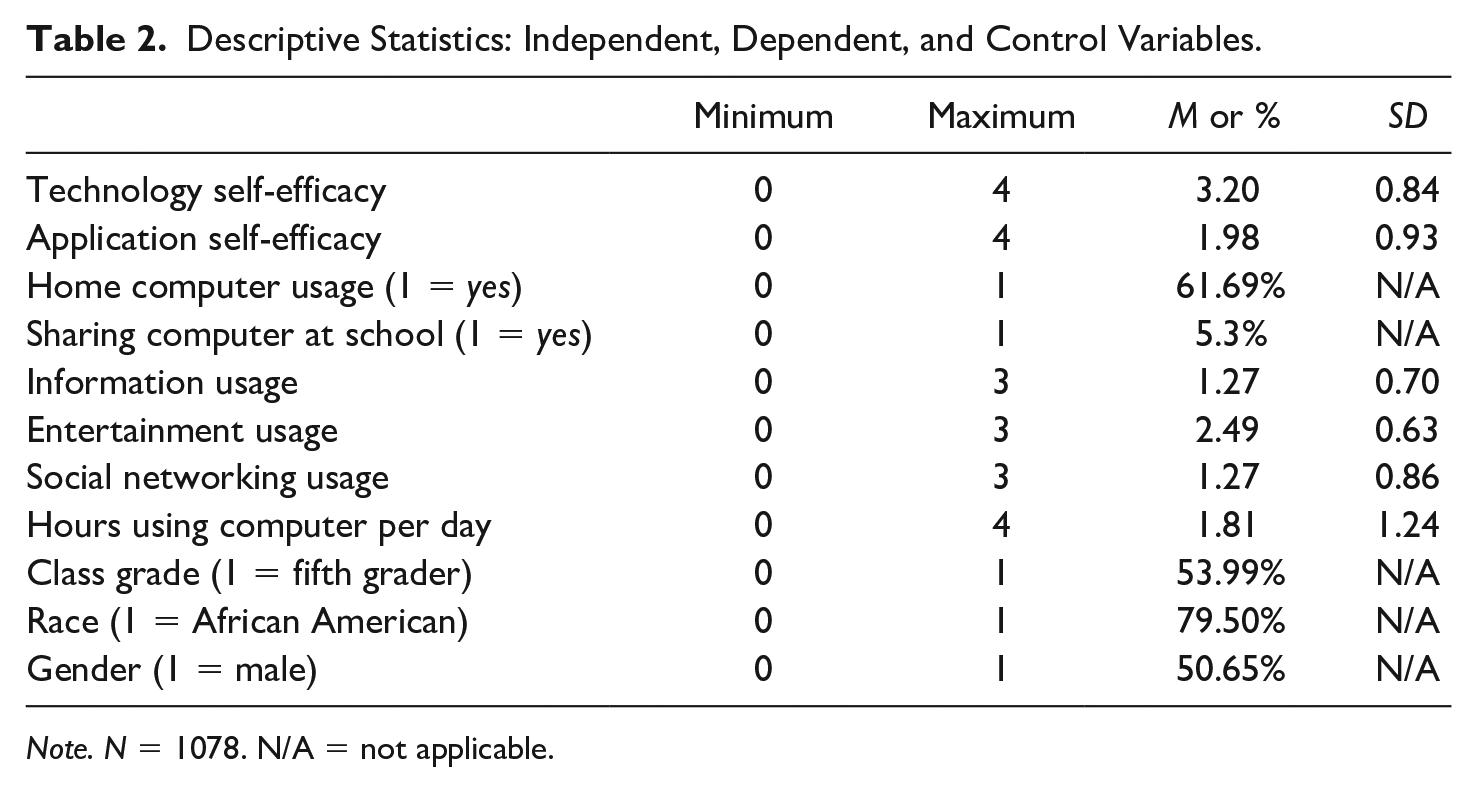
We estimated the descriptive statistics for the variables in the current study (see Table 2). The results suggest that almost 79.50% of our sample were African Americans, 51.56% were males, and 53.99% were in the fifth grade. For the dependent variables, our sample showed a high level of entertainment usage (M = 2.49, SD = 0.63), and medium level of information (M = 1.27, SD = 0.70) and social networking usage (M = 1.27, SD = 0.86). For the computer access and usage variables, most students rarely shared computers at school (94.7%), but 40% of our respondents did not use computers at home. Regarding hours of computer use, students normally used computers between 1 and 4 hours per day, with an average use of 1.8 hours per day. Overall, students had a high level of self-perceived technology efficacy (M = 3.20, SD = 0.84) and medium level of application self-efficacy (M = 1.98, SD = 0.93).
Descriptive Statistics: Independent, Dependent, and Control Variables.
Note. N = 1078. N/A = not applicable.
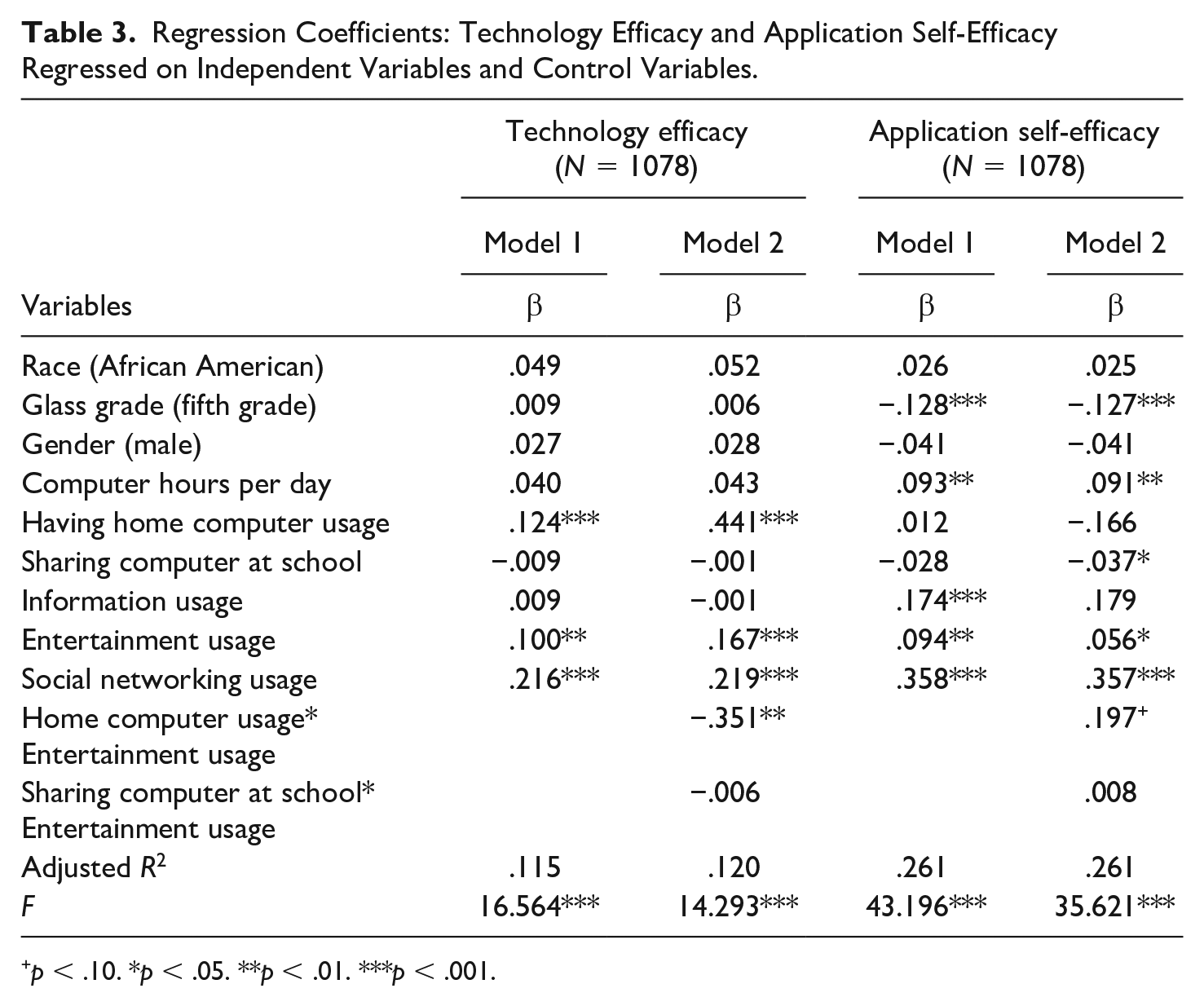
To test the proposed hypotheses, we conducted a series of ordinary least squares regressions. The first models contained our dependent, independent, and control variables, while the second models included interaction terms. 1 The results are presented in Table 3. Regarding information-seeking usage patterns, the first model showed that informational usage of computers was a predictor of application self-efficacy (β = .174, p < .001). However, the relationship between information usage and student’s technology self-efficacy was not significant. In other words, using a computer to seek out information was positively associated with self-perceived application self-efficacy but not technology self-efficacy. Therefore, Hypothesis 1 was partially supported.
Regression Coefficients: Technology Efficacy and Application Self-Efficacy Regressed on Independent Variables and Control Variables.
p < .10. *p < .05. **p < .01. ***p < .001.
Regarding entertainment usage patterns, the first model indicated that entertainment usage of computers was a positive predictor of students’ technology self-efficacy (β = .100, p < .01). Furthermore, entertainment usage was also a positive predictor of students’ application self-efficacy (β = .094, p < .01). In other words, using computers for entertainment purposes such as playing games was associated with higher self-perceived technology self-efficacy and application self-efficacy. Therefore, Hypothesis 2 was supported.
Regarding social networking usage patterns, the first model showed that social networking usage of computers was a positive predictor of students’ technology self-efficacy (β = .216, p < .001). Furthermore, social networking usage was also a significant positive predictor of students’ application self-efficacy (β = .358, p < .001). In other words, using a computer for social networking purposes was associated with higher self-perceived technology efficacy and application self-efficacy. Therefore, Hypothesis 3 was supported. The variables included in the first regression model explained 14.7% of the total variance in students’ perceived technology self-efficacy and 26.1% of the total variance in students’ application self-efficacy.
In the first model, home computer usage/access was a significant predictor of students’ self-perceived technology efficacy (β = .124, p < .001), but not application self-efficacy. In other words, using a computer at home was associated with higher self-perceived technology efficacy. However, sharing a computer with others at school did not have any predictive power on both technology efficacy and application self-efficacy in the first models. Therefore, Hypothesis 4 was also partially supported.
To answer Research Question 1, two moderation terms were included in the second model. Results indicated that home computer access and usage moderate the relationship between entertainment usage and self-perceived technology efficacy (β = −.351, p < .001). To be more specific, the relationship between entertainment usage and technology self-efficacy was stronger among respondents who had limited/no computer access or usage at home. The results of application self-efficacy were also similar: Home computer access and usage moderated the impacts of entertainment usage on students’ application self-efficacy, at a marginally significant level (β = .197, p < .10). However, there were no interaction effects found regarding sharing computers at school. The moderating relationship can be seen in Figure 1 below. Overall, the variables included in the second regression model explained 12.0% of the total variance in students’ self-perceived technology self-efficacy and 26.1% of the total variance in students’ application self-efficacy.
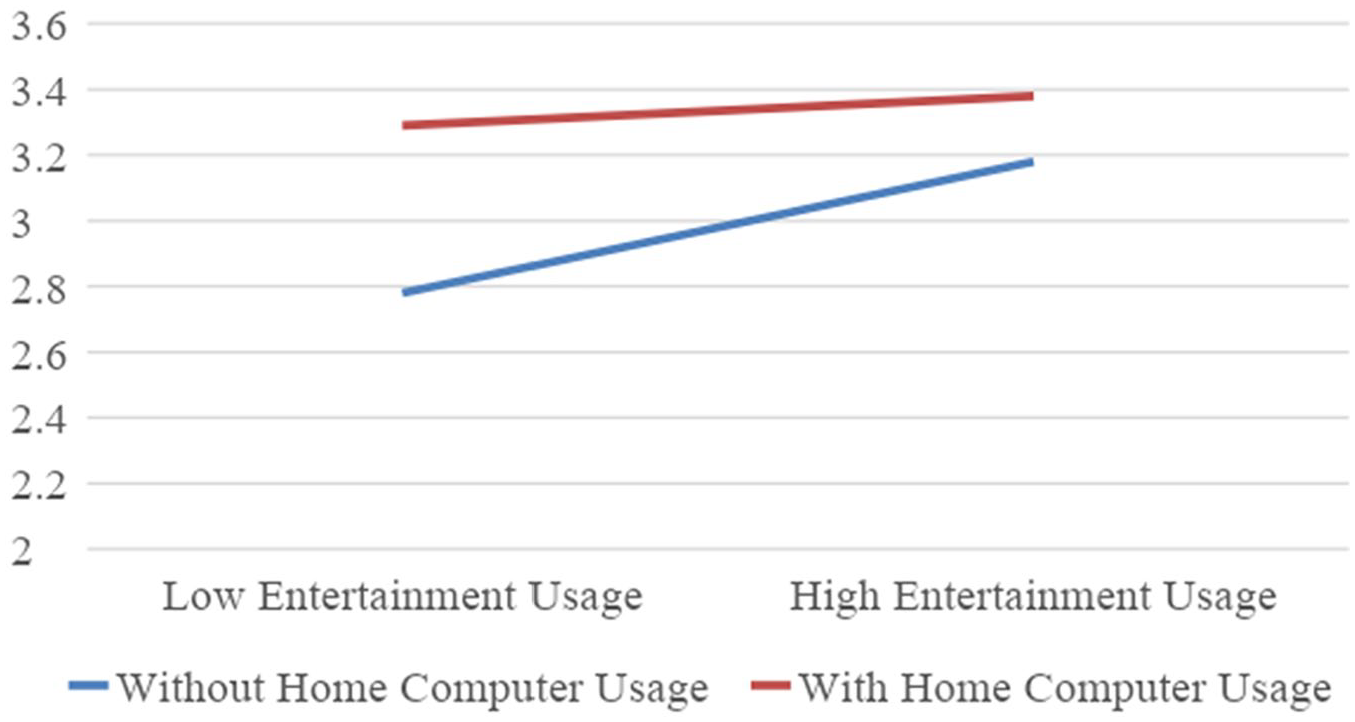
Home computer usage moderates the association between entertainment usage and technology self-efficacy.
Discussion
The purpose of our study was to determine which forms of computer access and computer-based activities had the greatest influence on predominantly minority students’ self-perceived technology-related self-efficacy and computer application–related self-efficacy. Results indicated that using computers for entertainment and social networking purposes were positively related to predominantly minority students’ technology self-efficacy and application self-efficacy. This finding supports previous research that found that using computers at home for leisure activities improved computer self-efficacy (Wei et al., 2011). Interestingly, using computers for information-seeking activities was only positively associated with application self-efficacy and not technology self-efficacy. Our findings make significant contributions to both the STEM and digital divide literature.
First, we demonstrate that the first-level divide factors such as home computer usage/access correlate with an increase in predominantly minority students’ efficacious beliefs in their technical abilities/skills (i.e., second-level divide). This finding is significant because the first- and second-level divides subsequently affect important outcomes (i.e., third-level divide; Scheerder et al., 2017; Van Deursen & Helsper, 2015; Wei et al., 2011). Our findings bolster the argument for the importance of direct experiences with regard to enhancing self-efficacy (Bandura, 2004; Huang, Ball, et al., 2015; Joet et al., 2011; Peng, 2008). Specifically, the more opportunity predominantly minority students have to use and practice with computers, the more capable they feel to subsequently use computers or other forms of technology. These findings echo the effects of the access usage gap (Hargittai, 2002; Hargittai & Hinnant, 2008; Wei et al., 2011), in that regular access allows students the ability to build and hone their skillsets, which in turn will increase their technology self-efficacy.
Second, our results indicate a positive relationship between non-capital-building activities such as playing video games and social networking on predominantly minority students’ technology self-efficacy. The finding supports previous literature illustrating the benefit of a wide array of technology-based activities on students’ technology self-efficacy (Huang, Ball, et al., 2015; Shank & Cotten, 2014; Wei et al., 2011). When predominantly minority students engage in low-stress, non-capital-building activities, such as talking online with their friends or playing games, they engage in a positive direct experience with technology, which is associated with an increase in their technology self-efficacy. The results also reveal that using computers for information-seeking activities such as conducting research for school projects was not associated with students’ technology self-efficacy. We believe this finding demonstrates that certain high-pressure activities, such as working on class projects, result in greater emotional costs, which could make information-seeking experiences less likely to result in improved technology self-efficacy (Huang, Robinson, & Cotten, 2015; Robinson, 2009, 2012).
Third, our results also indicate a positive relationship between informational, entertainment, and social networking uses of computers and predominantly minority students’ self-perceived application self-efficacy. In this case, all three types of computer usage activities contributed to increasing students’ belief in the ability to use computer applications effectively. Therefore, a broader range of computer usage activities constituted positive direct experiences regarding computer application self-efficacy (Bandura, 1994, 2004). A possible explanation for this finding is that application self-efficacy is a much narrower conceptualization (i.e., using computer programs), while technology self-efficacy is a much broader concept (i.e., using many kinds of technologies). Our findings support the idea that not all activities have the same impact on different kinds of self-efficacy (Shank & Cotten, 2014).
Fourth, we found that entertainment-related computer usage was associated with technology self-efficacy and that the effects were moderated by students’ home computer access and usage. Previous qualitative research has shown that computer access and usage limitations affect digitally disadvantaged students’ computer use patterns, resulting in more entertainment activities rather than capital-building activities (Robinson, 2009). Our results suggest that students without computer access at home benefit more from entertainment activities than those who do have computer access at home. Therefore, given adequate material access, the usage access gap may close over time as students become more comfortable with technology by using it for entertainment and social networking purposes.
Limitations
We must acknowledge a number of limitations of this study. First, the data used in this study were derived from a large-scale computing intervention in a high-poverty urban school district located within the southeastern United States, which potentially limits generalizability to students in other regions and socioeconomic statuses. Second, the sample of this study is drawn from primarily elementary-age African American students. While young African American students were the sample of interest in this study, it nevertheless potentially limits the generalizability of our results to other demographic groups. Third, due to the low number of scale items and the young age of the respondents, the reliability for technology self-efficacy scale was low (Carter et al., 2014). However, relatively low reliability when analyzing survey data from young respondents is normal, so we continued with our analysis (Newman & McNeil, 1998). Fourth, although we do measure students’ self-perceived skill related to technology/application use, which has been shown to be a powerful predictor, we do not include a measure related to actual proficiency. Researchers should attempt to address this limitation in the future by measuring students’ actual skill level with technologies/applications.
Last, the computing intervention from which the data were derived for this study did not have a traditional experimental design (i.e., control group). Instead, the data were gathered using a more naturalistic approach, which took advantage of time-sensitive environmental factors such as a district-wide dissemination of computing devices. In other words, this study used an observational study approach due to environmental factors (i.e., computer dissemination), logistical concerns (i.e., school/teacher buy-in), and ethical concerns (i.e., withholding a potentially positive intervention from at-risk youth). Despite the lack of a traditional experimental design, our results should still provide useful insights into young, predominantly minority students’ computer activities and self-efficacy. Previous studies have found that the results derived from observational studies did not differ significantly from the results found in traditional randomized controlled trials (Anglemyer et al., 2014).
Conclusion
This research offers several important theoretical and practical contributions to the literature. Theoretically, our results indicate, that in line with SCT, direct experiences with technology increase predominantly low–socioeconomic minority students’ self-perceived technology self-efficacy and computer application self-efficacy in the context of a computing intervention. Our results also indicate that positive direct experiences with technology can include numerous kinds of activities and these various activities affect technology self-efficacy and application self-efficacy to different degrees. Specifically, using computers for entertainment purposes (e.g., playing video games) or for social purposes (e.g., talking to friends on Facebook) are often regarded as “usage gap” activities. However, our findings indicate that such usage gap activities may actually improve students’ technology self-efficacy and application self-efficacy, which may help close mental access and usage access gaps over time, thereby potentially making STEM careers more appealing and attainable (Ball et al., 2016; Ball et al., 2018). While typical material access and first-level divide factors such as access to a computer at home are important, there appears to be varying types of experiences that can have a positive impact on students’ technology self-efficacy and application self-efficacy. In essence, we found that some usage gap activities may constitute positive direct experiences that can help alleviate skills access gap issues such as low technology self-efficacy and computer application self-efficacy. Future studies should continue to explore other types of experiences with computers that can increase students’ technology self-efficacy.
Practically, the benefits of nonessential or non-capital-building activities should not be neglected or underestimated because they provide a low-anxiety environment for students to increase their technology self-efficacy (Robinson, 2009). Future computing interventions should consider the possibility of allowing their students time to simply “play” with computers and technology. Allowing students an opportunity to pursue and explore their own interests with computers, such as listening to music or playing video games can increase their technology self-efficacy and computer application self-efficacy which may, in turn, influence their STEM interest (Ball et al., 2018). In other words, by affording students opportunities to use computers in ways that interest them, such as entertainment or social networking purposes, we are giving students opportunities for positive direct experiences with technology, thereby increasing their technology self-efficacy and application self-efficacy. We suggest that future computing interventions should include “computer recess” time in their curriculum to make computers, and potentially STEM careers, less intimidating and more empowering for digitally divided students.
Footnotes
Declaration of Conflicting Interests
The authors declared no potential conflicts of interest with respect to the research, authorship, and/or publication of this article.
Funding
The authors disclosed receipt of the following financial support for the research, authorship, and/or publication of this article: This project was funded by a grant from the National Science Foundation (DRL-0918216; Shelia R. Cotten, PI). The views expressed in this manuscript reflect those of the authors and not those of the National Science Foundation.