



Abstract
The Russian–Ukrainian war is transforming world institutions, including NATO. The partnership and cooperative security policy, enshrined in NATO’s previous concept, was defined by a sustainable world order and international law. The war in Ukraine demonstrated the incompetence of major world security institutions and defined the challenges of their rapid transformation to effective reformatting. NATO, which has a new format for the organization’s development after the Ramstein meeting on April 26, 2022, actively joined this process. At the same time, the contemporary resolution of war and peace issues requires a transition from the concept of “peace agenda” to that of peace engineering. NATO’s peacemaking capabilities in resetting the interaction and transformation of U.N. peacekeeping determine the transition from nonsystemic peacemaking activities to the formation of a peace engineering program environment, which consists of the political-military, diplomatic, political and economic, logistical, social and humanitarian, and environmental and technogenic environments.
Introduction
The full-scale military expansion of the Russian autocracy into Ukraine has become a challenge for the North Atlantic Alliance Organization (NATO). This challenge of the world order rebuilding posed a strategic reassessment of NATO’s goals and areas of practice for building an effective security system worldwide. By adopting the new Strategic Concept on June 29, 2022, the organization’s member states declared their political and military preparedness to meet the current threats and new security challenges. True to their fundamental objective of preserving the Alliance as a democratic space of peace and security, NATO members have committed to the collective defense of member nations based on a 360-degree approach in the new concept. It includes three key tasks: deterrence and defense; crisis prevention and management; and cooperative security (NATO, 2022). This systemic, comprehensive definition of NATO’s role and mission in shaping a secure peace architecture for all requires, at the same time, a change in the concept of peace. In Boutros Boutros-Ghali’s previous concept of an “agenda for peace,” NATO often provided peacekeeping, but at the same time, NATO was faced with the need to consolidate peacebuilding measures. The change in modern war, and therefore in the world, makes it relevant to explore the challenges of the contemporary Russian–Ukrainian war on NATO from peacekeeping and peacebuilding to peace engineering.
The Theoretical Framework
The transforming event defines the main challenges to the institutions of the world order. We consider “the Challenge and response” in the context of Arnold Toynbee’s “challenge and response” mechanism of civilizational change (Toynbee, 1987). We are interested in the field of the possible in transformation of world institutions, whose institutionalization is usually the result of international activity after the previous key transforming event.
The basis for the institutionalization of modern international institutions such as the U.N., NATO, and others was represented by the results of World War II and the end of the Cold War.
Russian aggression against independent Ukraine is grounded in revanchist narratives and reconstructed meanings of World War II and the Yalta-Potsdam system, which returns to threats of nuclear escalation, and military expansion of territories. Reducing military action from global to regional conflict, as the 2014 to 2016 “Minsk Agreements” did, is no longer possible. After all, the events of February 2022 are a scalable expansion and justified by ideas of revanchist propaganda involving an armed takeover not only of Ukraine but also of post-Soviet countries and former Warsaw Pact countries, most of which are members of the EU and NATO.
According to its Charter, the U.N. is a global peacekeeping institution and the most representative (193 member states) regulator of the development of the world community. However, the U.N. response to Russia’s military invasion of Ukraine demonstrates the lack of mechanisms to preserve the global security system, the imperfection of international law, and the crisis of the peacekeeping system. Even after the vote of representatives of 141 countries against the Russian aggression in Ukraine at the U.N. General Assembly on March 2, 2022, and the appeal of the U.N. International Court of Justice condemning and demanding an immediate cessation of all Russian military actions in Ukraine, these resolutions were ignored by the aggressor.
As a transformative event, the Russian–Ukrainian war systematically affects many issues of war and peace, global security, and international law in aggravating the relations of global players from both the democratic world and autocratic countries. Therefore, our article considers the impact of the Russian–Ukrainian war on the transformation of NATO in the unity of war and peace to be the main problem.
The rapid dynamics of the events of the Russian–Ukrainian war also reflect the clash of the multidomain concept of war theory (the United States and NATO) and the hybrid concept of war (the Russian Federation). These dynamics determine the need to change the nature of modern warfare and the 7th military revolution, multitrack diplomacy, and their impact on the peacemaking process.
Methodology
The authors explore the major changes of the Russian–Ukrainian war of 2022 as a transformative event shaping the world community and its institutions, especially NATO.
We study the unity of war and peace as the space and place of peacemaking in an escalating global confrontation of global players. In times of war, peacemaking can: (a) be ignored; (b) be delegated to the post-war phase, which after the Cold War corresponds to the logic of “agenda for peace” (Boutros-Ghali, 1992), since preventive diplomacy refers to the peace phase, while peacemaking, peacekeeping, peacebuilding refer to a cease-fire and post-war phase; (c) be implemented as the goal of war—“the world is better than the previous one;” and (d) be implemented simultaneously with military action.
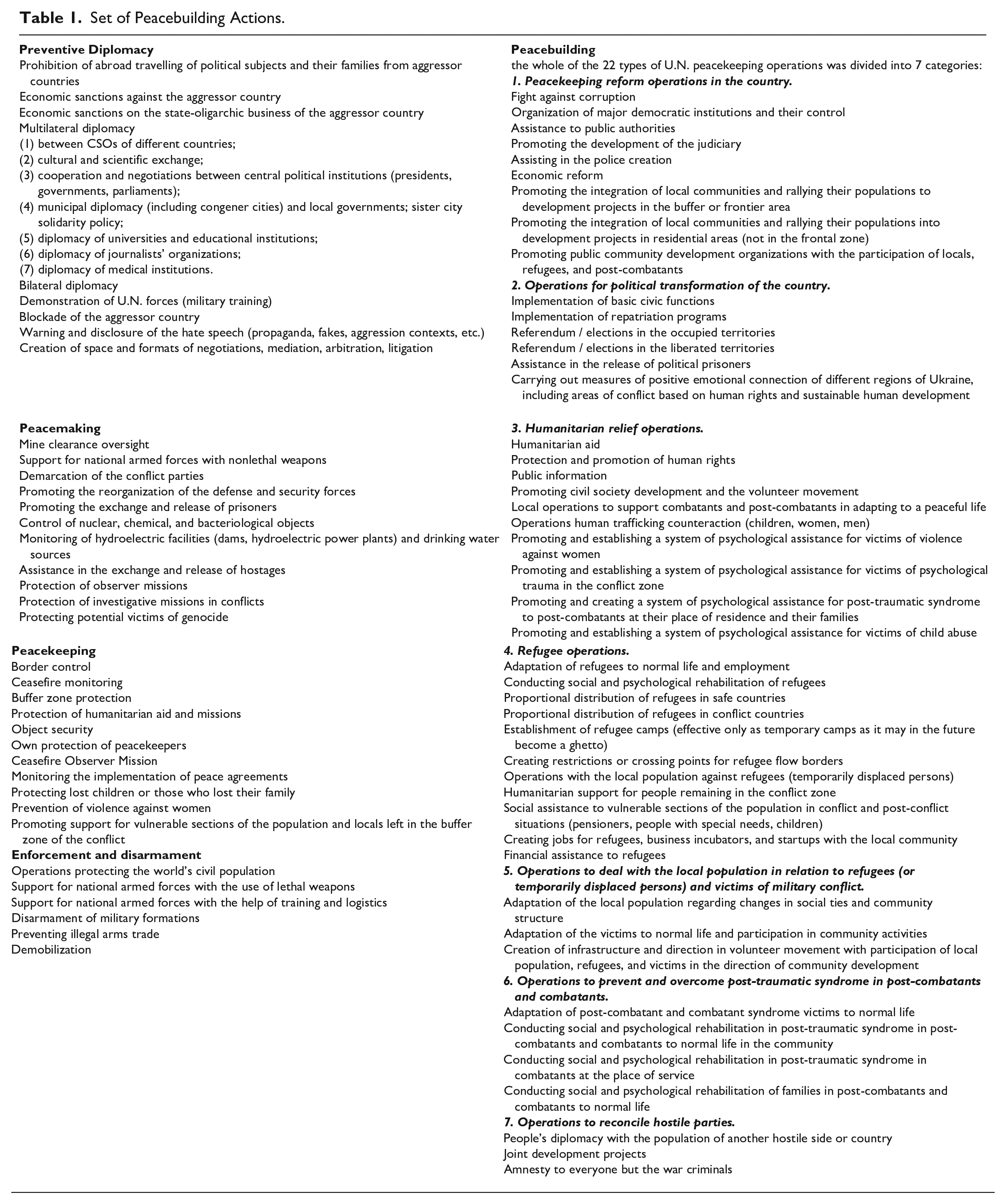
In our research methodology, a special place is occupied by studies of U.N. activities as peacekeeping mandates delegated at various times to NATO or a “coalition of the willing.” Our study of peacekeeping in 2014 to 2019 has developed an operationalization of the main activities of peacekeeping, which is presented in the text in Table 1. Therefore, our article provides a comparative analysis of the “agenda for peace” (operationalization of peacemaking in the sequence of preventive diplomacy, peacemaking, peacekeeping, peacebuilding) to contemporary challenges and the formation of peace engineering.
Set of Peacebuilding Actions.
This article introduces the notion of peace engineering, explores its content, and the possibilities of NATO’s and, hopefully, the U.N.’s contemporary response to the challenges of the Russian–Ukrainian war in improving and developing peace.
Findings
The full-scale, revanchist-motivated invasion of Ukraine by the Russian Federation brought NATO out of stagnation after Donald Trump’s “commercial” approach to the North Atlantic Alliance and led to a proactive U.S. opinion and a transformation of NATO. The Ramstein, as a permanent council of defense ministers, was stimulated by the threat to NATO member states bordering Russia, especially those that were part of the USSR or the Warsaw alliance. This incentive was fueled by escalating conflict with the threat of a nuclear strike, propaganda channels (which the RAND Corporation referred to as the “firehose” (Christopher & Matthews, 2016), and the activities of pro-Russian agents of influence or “useful idiots” (to use the terminology of the pro-Putin media) in both Europe and the United States.
The Russian–Ukrainian war, which began in 2014 with the annexation of Crimea and the creation of the quasi-state formations of the Lugansk People’s Republic (LNR) and Donetsk People’s Republic (DNR), was in a positional phase, regulated by the “appeasement” of the aggressor by the Minsk agreements, meaning the exchange of territories for a shaky truce.
In 2017 Anders Fogh Rasmussen (Secretary General of NATO from 2009 to 2014) noted in an interview for the Polish newspaper Rzeczpospolita: “From the end of the Cold War until February 2014, we believed that Russia was our partner. Thanks to this, we collected what they call “peace dividends” and reduced spending on armaments. Now Putin has created a completely new situation, and we have to increase them” (Haszczyński, 2017). Russia’s treacherous expansion into Ukraine on February 24, 2022, changed everything and finally dashed expectations of what Rasmussen called a “peace dividend.” The invasion of Ukraine posed the problem of NATO decisions: what to do next and what range of assistance the United States and NATO could provide to Ukraine.
Most military experts had publicly admitted that they were wrong in their forecasts in the first phase of the war when “blitzkrieg” scenarios were considered, and Russia faced the well-known trap of the imperial idea of a “small victorious war.” The military model of “blitzkrieg,” developed back in the 19th century by H. Moltke, models of Caucasian wars, and the political model of distraction from internal problems to “a small victorious war”—all of them did not work because they did not take into account the moral-will component, the “will to fight” of the Ukrainian people. The effective use of “kill box” tactics against convoys of Russian troops surprised many military experts. Networked, horizontal warfare with mobile Ukrainian groups, and networked compensation for providing the army with a volunteer movement are characteristic of Ukrainian society and require a separate study.
American experts also made a mistake using the Afghan and Iraq wars as a model. For Ukrainians, the model is their war of liberation against the invader because the war of 2014 and the frozen conflict until early 2022 led to an understanding of the maximum stakes—sovereignty, “the survival of the state and the people.” The courage of the military-political leadership led by Ukrainian President V. Zelensky played a significant role.
The strategy of NATO bursting at the seams required definition in options: appeasement of the aggressor with subsequent potential aggression on NATO member states; tacit support of NATO to Ukraine in the context of “strategic ambiguity”; mobilization of NATO and open support of Ukraine. The choice of NATO mobilization led to a “restart” of the organization in the second phase of the war. War crimes in Bucha, Borodyanka, Gostomel, and other occupied territories raised the question of their fixation and the creation of an effective international tribunal capable of condemning and punishing the criminals.
The second phase of the war by the Russian Federation led to the use of models of the World War II offensive and the destruction of cities on the model of the Syrian campaign. The United States used the model of the Korean War, in which the proxy Korean troops of the North and the South were, in fact, saturated with equipment, technology, and theory of war by the USSR and the United States, with deliveries of heavy military equipment. The only difference is that Ukraine was supported by the United States, Great Britain, and the countries of the Ramstein format (after the first meeting—42, and in the following three—50 countries, including NATO partners). The “operation for Donbas” characterized the second stage. A U.S. lend-lease decision was signed for the first time since World War II. Russian troops, with proxy troops of the DNR and LNR quasi-states, private military companies (PMCs) Wagner, and the defunct PMC Liga used the full range of mobilization capabilities without declaring martial law and general mobilization while maintaining the political model of “special military operations.” The defense of Mariupol and urban fighting in Luhansk and Donetsk regions with mobile defense and fighting of fortified positions of Ukrainian wars determined the slow advance of Russian troops with heavy personnel and equipment losses—this tactic of “slow biting off of territories.”
The interaction of NATO in providing weapons as a deconcentrated (a large number of participants, countries) organization and the centralization of the organization while aligning with the network organization of the Ukrainian resistance posed new challenges at this stage. Artillery rocket attacks on combat territory and civilian population centers are technologies of terror and intimidation. As of this writing, 3,100 medium-range missile strikes in Ukraine are officially known. At this point, the war was over the effectiveness of not only battery and counter-battery warfare but also logistics and its destruction.
The third stage of the war, which begins at the end of July, is defined by the counterattack of ZSU with the supply of heavy weapons to Ukraine and the professional training of The Armed Forces of Ukraine (ZSU) soldiers in the EU and the United Kingdom.
The war in Ukraine is the first war that is reflected in real-time, not only in the media but also in social networks; there is research on the photo and video materials, satellite technologies and mapping of events, which gives impetus to serious simulation and improvement of the open assessment of the events taking place.
Separately, it is worth mentioning international diplomacy, the failure of the U.N. concept of “multilateralism” and diplomatic guarantees, the rapid development of regional alliances and alliances, and the economic war of sanctions and the fight against the supply of “dual-use” goods and sources of war financing have become a key.
In 2014 to 2019 a team of researchers led by one of the authors Prof. M. Lepskiy (Lepskiy, 2019, Lepskiy et al., 2017) conducted a study of peacekeeping as U.N. mandates and a set of activities, and they concluded the specificity of peacekeeping, peacemaking, peacebuilding—see Table 1.
These actions, as U.N. mandates, have been viewed from the perspective of assisting in conflict and post-conflict activities rather than war. The idea of forming peacemakers with the help of NATO or various parties of the conflict encountered significant legal causes and bureaucratic issues, where peacemakers only implemented international conventions to protect civilians, combatants and prisoners of war. International legal acts were ignored by the aggressor country because there are no mechanisms of confrontation and punishment for violations of international acts, and the decisions of international judicial institutions are not binding.
Let us make an intermediate conclusion about the challenges facing the NATO bloc in its transformation:
The world is entering into a confrontation between global world players (vertical confrontation); therefore, the security problems of independent countries bordering aggressive global countries or those that manifest the rhetoric of war are becoming more relevant. Hence the challenge for world security in forming a diagonal mixed security system as the preservation of the sovereignty of countries and participation in international security alliance. China indirectly proposed an alternative vertical system in a speech by Chinese Foreign Minister Wang Yi: “China upholds the basic norms governing international relations. It advocates respect for the purposes and principles of the U.N. Charter as well as sovereignty and territorial integrity of all countries, and opposes putting small and medium-sized countries at the forefront of geopolitics.” (Xinhua, 2022). In other words, China recognizes the norms of international law, but global players should handle the geopolitical games. Autocratic countries promote the vertical autocratic model. The concept of the “arc of autocracies” was introduced by Australian Prime Minister Scott Morrison, who put it this way: “A new arc of autocracy is instinctively aligning to challenge and reset the world order in their own image” (Morrison, 2022).
The organization of effective interaction between NATO countries and partners on one international, value, legal, economic and military basis as a guarantee of security and their implementation.
The change of the logic of political and military interaction from “concern and demonstration” to organizing resistance and eventually becoming a subject of active security. At the same time, possible models are: (a) “rear”—the country under attack must demonstrate the will to win, and the alliance countries act as the rear and organizer of the logistics of ensuring resistance to the war partner (the model of relations to Ukraine); (b) “participation”—the inclusion of all partner countries and NATO members in the combat operations; and (c) “hub”—NATO as a permanent security assembly unit (with a rejection of the logic of “international policeman”).
3. The polycentrism of international security threats raises questions of polycentric and networked logistics in different regions of the world, which are defined by aggressive policies or potential threats of autocracies. Admiral James Stavridis argues that in the new environment of confrontation between global players, the armies of the democratic world need to work together. “In the end, the nation needs to maintain the lighthouse of deterrence shining well away from its shores, where it can have the most effect. And it is on the anvil of those forward deployments that it will forge the most combat-ready force. Together, the anvil of deployment and the lighthouse of deterrence must remain the touchstones of the Navy and Marine Corps team in this turbulent 21st century.” (Stavridis, 2022).
4. The organizing of the balance of the political economy of peace and war, the system and complex of rapid conversion from peace to war and vice versa economies, and forming the policy of peacebuilding in the expansion of importance.
5. The challenges require new tasks in the programs of development of science and scientific thinking, as a scientific competition of the world order model, a better post-conflict arrangement of countries and a better system of guarantees and security (if this is impossible, then at least a better reaction and action against dangers).
6. Forming a unified standard for the NATO arms market in accordance with modern military science, strategy and operational-tactical art, the bundling of rapid reaction forces and military forces of NATO member states.
The Political Economy of Peace and War: Peacebuilding to Peace Engineering
The withdrawal of U.S. troops from Afghanistan and its swift fall to the Taliban is often viewed as an ineffective peacebuilding strategy. At the same time, as Bruce Bueno de Mesquita has shown, often the assessment of a policy-transforming event must take into account the domestic political balance of power and its changes after the withdrawal of U.S. troops. He demonstrated this on the forecasting model of Iraq, where the best solution was to keep a limited contingent of U.S. troops, encourage reform and loyalty of former adversaries (engaging “Revolutionary Guards” to patrol with a financial incentive to bring order to their home) (Bueno de Mesquita, 2009).
British scholar and practitioner Dr. Shima D. Keene describes cooperation between nonstate actors, organized crime, and subversive elements in host countries as a “silent partnership” and explains how these partnerships can undermine military operations (Keene, 2018).
The expansion of tasks from the concept of deterrence transits into the problem of evaluating the outcome of the war, military operations, and the resolution of military conflicts, ultimately to the study of peace better than the previous one. But successfully defeating an enemy in military operations does not mean achieving a better-than-before peace.
The concept of transition from peacekeeping to peacebuilding was first proposed by Secretary-General of the United Nations Boutros Boutros-Ghali in “An agenda for peace: preventive diplomacy, peacemaking and peace-keeping: report of the Secretary-General pursuant to the statement adopted by the Summit Meeting of the Security Council on January 31, 1992.” This conceptualization took place at the end of the Cold War, the adoption of the nuclear arms control and reduction agreements. Boutros Boutros-Ghali noted the positive trend (in 1992) that “since the creation of the United Nations in 1945, more than 100 major conflicts around the world had left some 20 million dead. The Organization had been powerless to deal with many of those crises because of the numerous vetoes cast in the Security Council, which were a vivid expression of the divisions of that period. The Secretary-General observed, however, that with the end of the cold war there had been no such vetoes since May 31, 1990, and demands on the United Nations had surged.” Among these demands, he included the moral expectations of the countries of the world, in the sequence of “to seek to identify at the earliest possible stage situations that could produce conflict.” Hence the demands are “to try through diplomacy to remove the sources of danger before violence resulted; where conflict had erupted, to engage in peacemaking aimed at resolving the issues that had led to conflict; through peacekeeping, to work to preserve peace where fighting had been halted, and to assist in implementing agreements achieved by the peacemakers; to stand ready to assist in peacebuilding in its differing contexts; and to address the deepest causes of conflict: economic despair, social injustice and political oppression.”
His concept of “An agenda for peace” was tried and failed as an effective response to the trials of military conflict and genocide “in Srebrenica” and Rwanda in the 1990s.
A New York Times article written after his death characterized his performance when he left office this way: “a frustrated Mr. Boutros-Ghali, in a farewell rebuke, chided member states for failing to deal with disasters in Somalia, Rwanda and Bosnia. ‘The concept of peacekeeping was turned on its head,’ he said, ‘and worsened by the serious gap between mandates and resources’ (McFadden, 2016). He later wrote about the twists and turns of the U.N. to U.S. relationship in his memoir, “Unvanquished: A U.S. to U.N. Saga” (Boutros-Ghali, 1999). He argued for the limitations of diplomacy. Boutros-Ghali says, “Only the weak rely on diplomacy [which] is perceived by an imperial power as a waste of time and prestige and a sign of weakness” (Boutros-Ghali, 1999, p. 198).
It is important that the concept of an “agenda for peace” as a sequence of preventive diplomacy, peacemaking, peacekeeping, and peacebuilding was formulated 30 years ago. Most mandates in peacekeeping operations refer to one of these phases. Still, most often, it is haphazard, which solves part of the problem but does not have effective results in resolving the conflict or even war. The U.N., likewise NATO, often called upon by the U.N. in security matters, showed itself to be a bureaucratic frozen, conservative structure by the time the full-scale invasion began. At the same time, it is important to note that the context of the “agenda for peace” was maintained, and individual activities were improved. The year 2022 changed a lot: for the first time, the aggressor became a country (Russia) that is a member of the U.N. Security Council, which can veto any of its decisions. There is a situation when: the aggressor country is a security guarantor under the Budapest Memorandum on nuclear disarmament; the aggressor country has deprived the neighboring country of its sovereignty and integrity as a goal of “military operation,” and its propagandists on state channels call for genocide of the neighboring Ukrainian people; the Security Council member country has threatened and threatens NATO with nuclear weapons. In a meeting with U.N. Secretary-General Antonio Guterres, Russian aggression was justified by President Vladimir Putin with the articles of the U.N. Charter, and the Russian Federation refused to comply with the decisions of the U.N. Assembly to withdraw troops from the territory of Ukraine immediately and to cease hostilities. Also, the Geneva agreements on civilians and prisoners of war were not implemented, and the recorded facts of war crimes were concealed and denied. Moreover, during the meeting of A. Guterres with V. Zelensky, a missile strike was made against Kyiv as a kind of blackmail by the Russian Federation.
As Rafiq Dossani argues, U.N. inaction in the first months of the war in Ukraine is a continuation of two decades of the ineffectiveness of global multilateral institutions in addressing the world’s diplomatic, security, and socioeconomic problems. Informal mechanisms (such as the Quadrilateral Security Dialogue and regional agreements are competing forces that weaken international institutions. “Important successes since 1992 include the U.N. Security Council’s pivotal role in resolving the Balkan region conflicts in Bosnia and Herzegovina after the 1992 to 95 Bosnian war and the Kosovo conflict of 1998 to 99; the International Atomic Energy Agency’s role in implementing the October 1994 Agreed Framework on North Korea; the establishment of the World Trade Organization in 1995; and, the World Health Organization’s management of the 2003 severe acute respiratory syndrome pandemic” (Dossani, 2022).
In the beginning of the 2010s, these successes began to wane along with the rising economic and military power of the Russian Federation and China, reflected in the growth of their geopolitical ambitions. “The weakening of multilateralism began with differences over Iraq in 2002 in the U.N. Security Council. The United States, having failed to persuade France and Russia—both permanent members—to authorize the invasion of Iraq, created an ad hoc coalition of the willing for the purpose. In 2013, the United States again failed to gain Security Council approval for a military intervention in Syria, and again created an ad hoc coalition for the purpose.” (Dossani, 2022).
In today’s context, the Secretary-General defends the multilateralism principle mainly regarding consequences (the food crisis of parts of the world) and the resolution of humanitarian issues in war. Concurrently, the autocracy demonstrates complete cynicism and violates every rule of law, up to and including the Decrees suspending the international Geneva Convention. The U.N. in its present state cannot overcome the real threat, the real war and the real blackmail with nuclear weapons in “multilateralism.” This is a terrible blow to peacemaking and a new challenge for the U.N. and NATO.
Even the implementation of individual actions of the humanitarian component as a U.N. “good cause” may not stop the collapse of multilateralism. The rapid unfolding of threats requires speedy decision-making and resource mobilization, so experienced diplomats suggest security alliances and regional alliances as alternatives. Hence, attention is shifting to interest in NATO and functioning regional alliances bound together by the shared values of democracy, openness, justice, against incompetency, bureaucracy and cynicism to international law.
NATO has joined in reforming its structure and is changing its security strategy in Europe and the South Pacific, hence the changes in strategy, logistics, planning, and preparation of the political-military process.
The need to comprehend the lessons of the Russian–Ukrainian war and the challenges to peace and war requires the introduction of essential performance criteria. These lessons mean increasing the level of reform from individual and comprehensive measures of the concept of deterrence—both warfare between the leaders of the global world and the struggle for a better model of post-conflict peace and security.
The procedural model of an “agenda for peace” was not actively implemented until the first decade after the end of the Cold War. The individual actions, mandates, and contexts of this procedural model were implemented until February 2022 and usually ended with cautious peacebuilding, often the fragile architecture of aid to haphazardly chosen programs. What is needed now is not a static architecture but a dynamic field of security and peacemaking. It is necessary to move from a procedural model of an “agenda for peace” to peace engineering, a model of “programmatic peace environment.” Using a programmer’s metaphor is like distinguishing between a single procedural program and a programming environment, a “programming language” that reflects the integrity of war and peace processes.
Indeed, not only the inclusion of preventive diplomacy, peacemaking, peacekeeping, and peacebuilding but also economic, legal, social, and humanitarian processes, which have shown effectiveness, is required. Therefore, let us outline the contours of peace engineering, which includes general, unique, and specific activities depending on the scale of the conflict up to the military action between the global players.
In this programming environment, we see several components of peace engineering:
The Political and Military Environment of Peace Engineering
New characteristics of war related to the nature of war have already been defined (Lepskiy, 2022). The modern Seventh military revolution (Hoffman, 2017–2018) defines qualitative changes in the nature of war, the “crystallizer” of these changes was the war in Ukraine (Roncolato, 2022).
The most important issue for the character of war is the study of the specificity of
The nature of war is also determined by the level of armaments, military science, and art.
The changing nature of war is determined by the transition from simple territorial confrontation to multidimensional warfare, which is reflected as multi-domain warfare (land, maritime, air, space, cyberspace (Feickert, 2021), now still adding logistics and the biosphere), which takes shape in different configurations and their unexpected sequences.
Following S. Pereslegin (this concept is used in the aggressor’s country), wars of Ares (military confrontation on the battlefield), Athena (economic confrontation), and Apollo (psychological and philosophical confrontation) with different spatial and temporal dynamics (Pereslegin et al., 2013) are often considered in the sphere of confrontation. The transition from the wars of Ares (Mars), Athena, and Apollo (recalling that on Olympus they are child gods), to the war of the father gods, characterizing the formation of a new era—to the war of Zeus—the world security system and geopolitical leadership, Poseidon—information-emotional and contextual war for values and morale and the will to fight both within warring nations and among the support of the world community and supranational international institutions, Hades—war of both worldview and subconscious, with its resilience, vulnerability, flexibility, light and shadowy characteristics, wholeness or fragmentation.
Warfare with different configurations of regular and irregular troops in the confrontation of the hierarchical organization (vertical management) with a network-democratic civilian organization (horizontal management) to the formation of their dialectical combination (diagonal management). All of these characteristics are interconnected in the integrity of the changing nature of modern warfare. They also reflect the changing nature of peacemaking diplomacy.
Diplomatic Environment of Peace Engineering
Changes in war nature determine the measure as a limit of transition to the opposite—peace. The private tasks of diplomacy in multitrack negotiations are the solidarity of partners, the efficient organization of interactions, and the maximum reduction of bureaucratic and regulatory activities, which determine the “discords” of the efficiency of the military-political environment.
The moral-will nature of war also determines the moral-will nature of diplomacy. Thus, the destruction of the moral-will basis, equality or asymmetry in weaponry, modern science and military art, exhaustion, and loss of determination, determine the capitulation. Diplomacy, on the other hand, determines negotiation to preserve the country, and its potential for development or reconstruction. Low moral-will spirit, the uncertainty of outcome, fear of consequences, and escalation often determine the policy of appeasement. As W. Churchill accurately put it, “An appeaser is one who feeds a crocodile, hoping it will eat him last (Churchill, 2002, p. 506).” With a similar level of moral-will spirit, negotiations determine the creation of a balance of power and security guarantees.
When morale is high, but weapons are inadequate, negotiations are conducted with partners and allies to enhance military capabilities or with global institutions to stop or prevent war or its escalation.
The multidimensional nature of war requires monitoring, actions and the use of modern artificial intelligence developments, as well as strategizing multidomain space configurations concerning balance of power, security, and war prevention by world institutions. In the absence of capable world institutions concerning peace and ending war, diplomacy forms dual or multichannel arrangements to create configurations of peace, security guarantees, and reinforcing actions to achieve peace.
It is the multidimensional nature of modern warfare that requires multitrack negotiations, a transition (or improvement) from U.N. multilateralism concept after the World War II (as majority involvement or unity of all in solving world problems) to regional alliances.
An important direction is the principle of co-partnership of various partners of improving blocs capable of shaping regional and global military, economic and other kinds of security or balances of power in multidimensional configurations.
The transition to a new era defines the formation of a configuration of war of Zeus (for leadership in the world order), Poseidon (for values and contexts—rules and incentives), Hades (as the domestication of subconscious behavior by morality and working law). This position has been defined by Prime Minister of the United Kingdom Liz Truss (previously British Foreign Secretary) as the legal, economic, sanctional directions of the configuration of war, as determining access to world markets and relations (Truss, 2022).
Multitrack diplomacy must work with state and international bureaucracies and hierarchies and civil network society, shaping and building on universal human values, morality, and law, and diagonal governance to ensure the integrity of the commons.
The complex nature of diplomacy challenges the formation of a new institutional capacity for the world’s actors and organizations. Therefore, the war in Ukraine has raised questions about the effectiveness and the reform of international institutions organized on post-Cold War terms.
The Political-Economic Environment of Peace Engineering
Modern political economy is associated with its positive market formation and profit theories, including its relations with power. This “positivity” is determined by developing the measure of life of both individuals and communities. War defines a negative political economy as the development of the measure of death and the destruction of the measure of life. Weapons do not create surplus value; they destroy people’s lives, infrastructure, and economics and simplify all the institutions of peaceful organizations from functioning and development aiming to survival. At the same time, weapons production, like other products, needs a skilled workforce, production capacity, supplies, modern semiconductors, and microchips. At the same time, the world economy is becoming increasingly interconnected in the international division of labor and markets. Modern autocracies, with few exceptions (North Korea), are not autarkical, self-sufficient industries, and depend on the import–export balance.
Expensive weapons, originally designed to create a sense of security, become obsolete and require costly disposal, creating an incentive for a legal or illegal market of arms and death. Thus the temptation to use them in war or military conflicts, or the temptation to organize them, is formed. The negative political economy after World War II some tried to contain it with geoeconomics. Still, autocracies can make power decisions not only based on economics but also on illusions in politics, including the illusion of force. The power of destruction differs from the power of creation, just as barbarism differs from a culture of development.
Essential factors in negative political economy are crime and corruption. Criminals always create a tax on the use or threat of force. Criminals who created autocracy or came to state power create a negative political economy of development measure of death.
The war in Ukraine, after extreme outrage at the cynical violation of the economy of peace and international law, determined the response of the democratic community in unprecedented sanctions against the aggressor country. A group of researchers led by Jeffrey Sonnenfeld, Professor at Yale School of Management, did a study, “Business Retreats and Sanctions Are Crippling the Russian Economy,” in which they verified distorted Russian statistics and obtained information from other sources (as the research team had 12 languages of study), collected data, and analyzed the impact of sanctions on the Russian economy.
Here are just a few of the most significant conclusions of this study:
“Russia’s strategic positioning as a commodities exporter has irrevocably deteriorated, as it now deals from a position of weakness with the loss of its erstwhile main markets, and faces steep challenges executing a ‘pivot to Asia’ with non-fungible exports such as piped gas. . . Despite some lingering supply chain leakiness, Russian imports have largely collapsed, and the country faces stark challenges securing crucial inputs, parts, and technology from hesitant trade partners, leading to widespread supply shortages within its domestic economy. . . Despite Putin’s delusions of self-sufficiency and import substitution, Russian domestic production has come to a complete standstill with no capacity to replace lost businesses, products and talent; the hollowing out of Russia’s domestic innovation and production base has led to soaring prices and consumer angst. . .” (Sonnenfeld et al., 2022).
In fact, the imports–exports relationship is not only related to “the resource curse” and the “Dutch disease,” which led to the priority of oil and gas exports in the foreign economic war, but also the base of autocracy, where being in government and loyalty in autocracy, stimulated by access to the profit of these export industries or corrupt schemes in the Russian Federation.
“As a result of the business retreat, Russia has lost companies representing ~40% of its GDP, reversing nearly all of three decades’ worth of foreign investment and buttressing unprecedented simultaneous capital and population flight in a mass exodus of Russia’s economic base. . . Russian domestic financial markets, as an indicator of both present conditions and future outlook, are the worst performing markets in the entire world this year despite strict capital controls, and have priced in sustained, persistent weakness within the economy with liquidity and credit contracting—in addition to Russia being substantively cut off from international financial markets, limiting its ability to tap into pools of capital needed for the revitalization of its crippled economy. . .” (Sonnenfeld et al., 2022).
The “Dutch disease” effect and the Rybczynski Theorem characterize the transition to resource-based development, with compression of productive development, increasing imports, functionality and services economies, which determines the vulnerability of economies to “supply chains” and connectedness in the global distribution of production and financial markets.
The world economy as a definition of the sustainability of development and the vulnerability of autocracies with non-autarkic and self-sufficient economy is a serious area of research.
The war in Ukraine raised questions of research not about the sequence “the political economy of peace (pre-war)—the political economy of war (war phase)—the political economy of peace restoration (post-war phase),” but questions about the consideration the possibility of parallel processes, where during the war political economy of war and the political economy of peace work (with military tension and simultaneous economic restoration on relatively calm or liberated territories).
The political economy of war changes the domestic and international structure of arms markets, production, supplies, consumption, and the ratio of pre-war, military, and post-war imports and exports. Sanctions as a weakening of the aggressor’s economy led to the search for partners in the replacement of raw materials, production of exports and imports (especially high-precision production with a high degree of surplus value), and the search for effective alternatives. This creates a rapid dynamic of restructuring and requires a high scientific, innovative potential of the country in a changing environment, as a challenge for the country.
The Logistic Environment of Peace Engineering
Logistics in war is usually considered in the context of the movement and supply of military forces, regarding the production of weapons and ammunition, food, troop deployment, delivery transport, storage depots in the rear and combat zone, and the delivery of the wounded to hospitals. A separate issue is the logistics of returning the dead from the combat zone to the families of the deceased.
The logistics of war are interconnected with and determined by the logistics of peace. Refugee flows can block the movement of troops, as was the case in France in World War II with the German offensive and air strikes when the innovative decision was made to move the French military by cab. Transport’s logistics are defined by its maintenance, refueling, capacity, payload, and speed. Therefore, combat operations can stimulate the development of a specific type of troops and transport. Thus, in the United States and Great Britain, the theory of operations was developed as the basis for maritime and air transport logistics during and after World War II.
The Baltic countries now have a predominantly maritime (international), aviation, and road transport fleet. During the fighting in the blockade of ports in Ukraine, motor transport and rail transport became predominant.
Since early March 2022, in the Russia–Ukraine war, a group of U.S. servicemen and a rotating team of multinational partners known as the EUCOM-Ukraine/International Donor Coordination Center or ECCU/IDCC have settled in Stuttgart, Germany, headquarters of the U.S. European Command (EUCOM) at the U.S. Army Garrison to ensure that equipment from the donor country reaches the threshold of Ukraine.
The Logistics Cell has grown from two separate teams led by the U.S. and British Armed Forces to a joint cell with allies and partners worldwide. The multinational team is a “coalition of the willing” providing transportation, assistance, training resources, or funding in any number or combination.
“From a stifling hot—and air conditioning-free—secure multipurpose space known internally as “the Attic,” dozens of service members from across 26 NATO and non-NATO nations are separated into sections to work on plans, support efforts, communications, movements and operations. A row of foreign liaison officers from rotating nations are also present. A Ukrainian military representative is embedded with the team, identifying the requests coming from Kyiv that are then worked by the Control Center-Ukraine/International Donor Coordination Centre (ECCU/IDCC) team” (Machi, 2022).
It should be noted that the war stage also determines the logistics because the requirements to ensure each stage are different; therefore, the logistics team and its mode of operation also change. This is how Vivienne Machi describes this process: “Ever since the U.S. and U.K. groups merged in March, the cell’s functions have evolved. At the start of the war, the logistics coordination cell largely supported the delivery of small arms munitions and anti-tank equipment, said British Army Brig. Gen. Chris King, chief of the ECCU/IDCC. Then, it began helping transfer Soviet-era equipment that was more complex to move, yet familiar to Ukrainian forces, he added. With the arrival of sophisticated equipment provided by NATO and other allies, the cell is now a “one-stop shop” that not only coordinates and tracks deliveries coming from all over the world to Ukraine, but also organizes the training of its armed forces to operate and sustain the equipment. The challenge is lining up the training schedule with equipment deliveries, Heinz noted. . .. Heinz said his team hasn’t experienced mobility obstacles in getting equipment to Ukraine’s borders. “Security assistance doesn’t stack up here on the continent in a warehouse,” he explained, adding that the longest time a piece of equipment would sit in an airport or train depot would be 12 to 24 hours” (Machi, 2022).
Deliveries of military equipment are changing the balance of power on the battlefield. For example, this ratio has changed significantly from complete dominance in the sky and artillery by the Russian forces to equalization and even superiority after supplies of heavy equipment and training of the The Armed Forces of Ukraine (AFU) troops.
“As of July 21, the ECCU/IDCC team had coordinated the movement of 78,000 tons of military assistance over 1.4 million kilometers (869,920 miles) of airspace and 450,000 kilometers (279,617 miles) of ground distance. A source close to the cell told Defense News the estimated value of materiel donations is difficult to quantify due to several factors, including a lack of information from providers. More than 800 flights have transported equipment to the Ukrainian border as of that date, but officials noted that while the cadence of deliveries to Ukraine remained constant over the past few months, those methods have changed” (Machi, 2022).
For the first time, the NATO multinational headquarters forms a common comprehension and, subsequently, a common standard of action in the real combat mode of war in Ukraine with the Russian army, which has positioned itself as the “second army of the world.” As most often happens, military innovations later enter the innovations of the world economy, probably, innovations in logistics are no exception. As before, the conclusion drawn by Martin van Creveld in his excellent work on logistics, “Supplying War: Logistics from Wallenstein to Patton,” is still relevant: “In practice, there is scant evidence that the task has been attempted by the majority of twentieth-century (not to mention earlier) operational planners. Rather, most armies seem to have prepared their campaigns as best they could on an ad hoc basis, making great, if uncoordinated, efforts to gather together the largest possible number of tactical vehicles, trucks of all descriptions, railway troops, etc., while giving little, if any, thought to the ‘ideal’ combination which, in theory, would have carried them the furthest. Nor, as we saw, were the results of the only comprehensive attempt that was made in this direction particularly encouraging. In spite, or perhaps because, of the fact that the plans for ‘Overlord’ made detailed provisions for the last prepacked unit of fuel, they quickly turned out to be an exercise in conservatism, even pusillanimity, such as has not often been equaled. Not only did the actual development of the campaign have little in common with the plans, but the logistic instrument itself functioned very differently from what had been expected. Consequently, it would hardly be an exaggeration to say that the victories the Allies won in 1944 were due as much to their disregard for the preconceived logistic plans as to their implementation. In the final account, it was the willingness—or lack of it—to override the plans, to improvise and take risks, that determined the outcome” (Creveld van, 1977, p. 236).
Modern developments in artificial intelligence, cryptography, remote communications, and planning are driving improvements in network and system coordination and innovations in the logistics environment. At the same time, the potential South Pacific theater of operations strengthens the network orientation of warehouses and transport with the predominance of aviation and maritime transport, with robotization and the trend of supply development with new types of drones and logistic (or dual-use) orientation.
Moreover, innovativeness, the ability to take responsibility and risk in non-standard war situations by military personnel, to make decisions in cases of time pressure and shortage of time remain.
The Political and Legal Environment of Peace Engineering
The Russian–Ukrainian war changes the understanding of the political-legal environment of peace engineering. Peacebuilding in the political-legal environment is reflected in Table 1 in subtypes of peace engineering activities, such as “(a) Peacekeeping reform operations in the country” and “(b) operations for political transformation of the country.” Peace engineering in this environment includes measures for overcoming the consequences, which can devalue the military-political and diplomatic results of winning the war. Still, they must consist of (and they do) investigations during the war phase.
Thus, in the first months of the war, Ukrainian and international criminologists began investigating the aggressor army’s war crimes in the liberated Kyiv region in Bucha, Irpen, Gostomel, and other settlements. Streams and images from space are being actively investigated.
At the combat operations stage, the identities of criminals and their commanders are established. Genocide calls and genocidal actions, violations of the Geneva agreements on civilians and prisoners, etc., are investigated. At the same time, the U.N. international judicial institutions and the International Criminal Court demonstrate difficulties caused by the bureaucracy and nonbinding nature of their decisions. This has led to a consideration of the formation of a “Nuremberg Court” model during warfare when the aggressor has not been defeated yet on the battlefield. The multilateralism here shows inefficiency in stopping the aggressor by political and legal methods. Therefore, the war in Ukraine is recognized as genocide by some countries, and some of them consider recognizing the Russian Federation as a sponsor of terrorism. Here we see “A coalition of the willing” rather than capable international legal and judicial institutions.
The violation and destruction of international legal norms are determined by the impunity of the aggressor country, which is a permanent member of the Security Council and a guarantor for Ukraine under the terms of the “Budapest Memorandum.” “Military cunning” of the Russian Federation in legal matters as a part of hybrid warfare destroys international law and is conducted in the global information and psychological space.
In the political and legal field, the temporality of the investigation is changing: it is already shifting from the post-war stage to the military stage in conducting investigations in the “present tense” mode, parallel to conducting war crimes. Simultaneously, the hybrid character of the aggressor’s war determines the increase of the field of peace engineering based on the values of democracy, the sovereignty of nation-states, human rights, protection of international law, suppression, and recording of war crimes. The load of the political-legal environment on the internal struggle against the “silent partners” of the military adversary (corruption and political forces engaged by the enemy, informal military formations, organized crime), as well as their potential actions to reduce the possibilities of the political economy of war and peace, and in the post-war period increases.
Social and Humanitarian Environment of Peace Engineering
The social and humanitarian environment has been extensively researched and is described in the table in the “Peacebuilding” column under “(c) Humanitarian relief operations;” “(d) Refugee operations;” “(e) Operations to deal with the local population in relation to refugees (or temporarily displaced persons) and victims of military conflict;” and “(f) Operations to prevent and overcome post-traumatic syndrome in post-combatants and combatants.”
This section primarily considers peacebuilding as a post-war stage in which activities are designed to deal with the damage limitation. The full-scale invasion of the Russian Federation to Ukraine has highlighted other tasks of peace engineering, with a particular emphasis on the following problems: civilian casualties, both primary and secondary; the logistics of refugee movements (the first wave, from the threat of war in the west of Ukraine and abroad; the second wave, the movement of refugees from the war zone and the occupied territories; the third wave, the increased movement of first and second wave refugees following missile attacks throughout Ukraine to other countries; and counter-waves when refugees return to Ukraine); inclusion of refugees not only in humanitarian aid and humanitarian programs but also in the economy, education, legal protection.
Primary civilian losses are deaths and injuries of civilians as a result of an act of aggression in Ukraine (shelling, fighting, etc.). Secondary civilian losses result from not receiving medical care due to the inability to provide medical care to the local population. The aggressor does not know the specifics of medical care in the local government of Ukraine. Primary medicine is available in united territorial communities, secondary—either in large community centers or in cities of district centers. Constant warfare and many wounded do not allow patients with various diseases, including pandemics, to be treated quickly. Destroyed and blocked transport routes, and even more so under fire, create secondary civilian losses. This may include killed and wounded civilians forced to escape from the warfare zones.
Population losses due to migration, primary and secondary losses, and the restructuring of the economy on a war footing determine not only the possibility of military confrontation but also the compression of the human potential of the peace and development economy and the social and economic structure of society.
Ecological and Technogenic Environment of Peace Engineering
As a result of military actions on Ukraine’s territory, there are threats of large-scale man-caused disasters (chemical, biological, nuclear, and water, e.g., related to dams on the Dnipro) as a result of both conscious and random subjective factors. The inability to bury dead civilians and military men can worsen catastrophic phenomena in the situation with potable water and contamination of territories in general.
For example, the situation with the seizure of Europe’s largest Zaporizhzhia Nuclear Power Plant (NPP) by Russian troops was a trigger for the mass migration of people from Zaporizhzhia region. Zaporizhzhia NPP has six nuclear units (the disaster of each of which is equal to Chernobyl), and dry storage of spent nuclear fuel. At Zaporizhzhia NPP Russian troops used weapons and shelling, which is a crime. Now Russian occupants have deployed their ammunition depots and artillery systems on the territory of the NPP and are regularly shelling the city of Nikopol across the Dnipro River. The recent shelling of the seized Zaporizhzhia NPP by Russian troops (while they cynically accuse the Ukrainian army) puts all of humanity in nuclear danger.
Secondary losses can also be associated with the destruction and disasters of infrastructure to supply to civilians, power plants and grids, gas pipelines, etc. All of this requires monitoring, collecting statistical data, introducing security zones and military silence, and controlling U.N. peacekeepers until the conflict is resolved.
Simultaneously, destruction is taking place in ecological and ecological-social systems. An example is the destroyed and occupied Mariupol, where the risk of an epidemic of infectious diseases has increased after the nonfunctioning and unsupported critical infrastructure, primarily due to the lack of clean water and the destruction of the medical care system. Environmental problems are associated with changes in the ecological system; as warfare changes trophic niches, the risk of epizootics (epidemics among animals) and epiphytotics (epidemics among plants) increases.
The environmental and military situation determines the sphere of agriculture, both domestically and internationally. The war in Ukraine declined grain production and determined supply issues to other countries to avoid starvation. These events led to the U.N. and Turkey’s mediation on grain exports from Ukraine through port unblocking.
Conclusion
The world’s transition to a new confrontation of major global players poses the problem of transforming existing international institutions, which in their current state cannot resist the autocracy’s expansionist aggression. The strengthening of the revanchist imperial idea of Russia and the corresponding historical construction of the world order by it are aimed at destroying the sovereignty of nation-states in the assertion of the right of force.
The Russian–Ukrainian war demonstrated the ineffectiveness of U.N. peacekeeping, the “agenda for peace,” and adherence to the Geneva agreements regarding civilians and prisoners of war. Now a new international security system is being formed in the transformation of NATO and the development of regional alliances. The procedural model of the “peace agenda,” which was developed by Boutros Boutros-Ghali, was tested after the Cold War and gradually distorted into a set of separate, non-systematic activities. This led to a crisis in the procedural sequence “preventive diplomacy—peacemaking—peacekeeping—peacebuilding.” The change in the nature of war in multidomain organizations, robotics, and artificial intelligence, and the formation of multitrack and multichannel diplomacy raise several key research questions for researchers.
The first question is whether there is room for peacemaking in an escalating confrontation of global players? We see the answer is in need to leave space for peacemaking; the way out of this problem is through the development of peace technology, from a “peace agenda” with a final stage of peacebuilding to peace engineering.
The second issue is the understanding of peace engineering. We believe it is not “appeasement of the aggressor” but is defined as “will to fight.” Therefore, peace engineering can be carried out in parallel with military action. This approach prevents the military component of the struggle for peace and freedom from being devalued in the post-war phase, as was the case, for example, after the withdrawal of U.S. troops from Afghanistan. “The world is better than the previous one” becomes not only as a “fighting magnet” but also as a technology for achieving the post-war state.
The third question is answered in this article. It lies in the “trap of the political economy of war,” which can reformat the entire economy and fuel spirals of escalation. The result of the political economy of war there will not be the removal of barriers to development (aggression, destruction of international security law, disregard for human rights, etc.) but it is the trap that forms new barriers and destroys the possibilities of a developing economy.
The fourth question is determined by the dynamics and nonlinearity of the challenges and threats to a democratic world that protects human rights, which requires variability, innovation, and speed of decision-making in the program environment of peace engineering: military and political, diplomatic, political and economic, logistical, political and legal, social and humanitarian, and environmental and technogenic.
The fifth question is about the subjects, the actors of peace engineering. NATO and regional alliances of democratic countries could become peace engineering actors if there is no search for a capable environment for peacemaking within the U.N. multilateralism. We also hope the U.N. will transform into a peace engineering actor on the principle of NATO complementarity.
Footnotes
Declaration of Conflicting Interests
The author(s) declared no potential conflicts of interest with respect to the research, authorship, and/or publication of this article.
Funding
The author(s) received no financial support for the research, authorship, and/or publication of this article.
