



Abstract
The study investigates the factors related to Ukrainian nationals’ engagement or disengagement with Russian culture amid Russian-Ukrainian war. It explores the predictors of both continued engagement and reasons for terminating interaction, considering demographic, emotional, and circumstantial factors. A cross-sectional correlational design was used, involving 935 participants (305 continuing and 630 ceasing interaction with Russian culture). Participants completed questionnaires and detailed their engagement with Russian culture across various cultural items. Multiple linear and logistic regressions were conducted for analysis. The study found that factors like spoken language and coping strategies play a significant role in the decision to cut cultural ties. For those continuing interaction, language and emotional attachment were influential, alongside practical necessities like work/study requirements and the absence of Ukrainian alternatives. The study highlights a complex interplay of emotion, language, and age in shaping Ukrainians’ interaction with Russian culture during the war. It suggests future research should include additional sociopolitical and sociocultural factors, and a broader demographic representation to gain more nuanced perspectives.
Introduction
The Russo-Ukrainian war has become a devastating event for Ukrainians and many people worldwide. This war, the most destructive conflict in Europe since World War II (WWII; Cebotari, 2022), has caused extreme problems for the health care system (Armitage, 2022; Awuah et al., 2022), which significantly affected the mental health of Ukrainians within Ukraine (Kurapov, Danyliuk, et al., 2023; Kurapov, Kalaitzaki, et al., 2023; Kurapov, Pavlenko, et al., 2023; Levin et al., 2023; Stieger et al., 2023), as well as refugees who fled Ukraine (Buchcik et al., 2023; Javanbakht, 2022; Kurapov, Danyliuk, et al., 2023). The war has significant negative impacts on the environment in Ukraine and beyond (Pereira et al., 2022; Rawtani et al., 2022), leading to economic consequences for Ukraine and the rest of the world (Mbah & Wasum, 2022), in particular, by increasing prices and threatening food security (Arndt et al., 2023). This conflict renders Ukraine as victim and Russian Federation as aggressor. Such blatant violence from the Russian Federation with devastating consequences could force Ukrainians to cut any cultural ties with the aggressor, even despite strong historical connections between the two states, the bilingual nature of Ukrainians with at least 30% of the population speaking Russian, 18% considering both to be native languages (Sokolova, 2023), and 8.5% of the population identifying themselves as Russians (Synchuk, 2023). Thus, the main aim of our research was to explore what forces or motivates Ukrainians to continue or discontinue their interaction with Russian culture and identify whether we observe an unusual phenomenon of cutting cultural ties in spite of the nations’ relationships spanning over centuries.
Shared History but Divergent Paths
Historical Connections Between Ukraine and Russia
Throughout historical development of relations between Ukraine and Russia, the latter has always considered Ukraine a “zone” of its interest while Ukrainians aspired for independence. From the historical perspective, both nations trace their heritage back to Kievan Rus’, a medieval polity that united East Slavic and Finnic tribes, adopting Byzantine Orthodoxy, with Kyiv as its capital. The decline of Kievan Rus’ began in the 12th century, exacerbated by internal conflicts, nomadic invasions, and the establishment of numerous feudal states: The state ceased to exist after the Mongol invasion in the mid-13th century and was fragmented among the Grand Duchy of Lithuania and the Kingdom of Poland. During that time, the earliest known usage of the name “Ukraina” emerged, the original meaning of which was “borderland.” During the 15th and 16th centuries, the region saw the rise of the Zaporozhian Cossacks, a group of predominantly East Slavic people known for their military prowess and democratic self-government: The Cossacks became a symbol of resistance against foreign rule and were instrumental in the military and cultural affairs of the region. This period can also be marked as the time of the emergence of Ukrainian identity, which was distinct from the broader East Slavic identity encompassed by the Russian and Belarusian peoples, and from Poland where Kyiv and the Zaporizhia had belonged to until 1667. This distinction was fostered by unique linguistic, cultural, and religious characteristics that developed in the region, particularly under the influence of the Polish-Lithuanian Commonwealth and the Orthodox Church (Miller, 2022). The 19th century can be considered a period of rapid establishment of Ukrainian national identity, mainly influenced by intellectual figures such as Taras Shevchenko and Mykola Kostomarov, who drew upon the Cossack legacy and the history of Kievan Rus’ to foster a distinct Ukrainian identity. Figure 1 briefly shows the historical development of Ukraine taking into consideration the geographical impact of neighboring states.
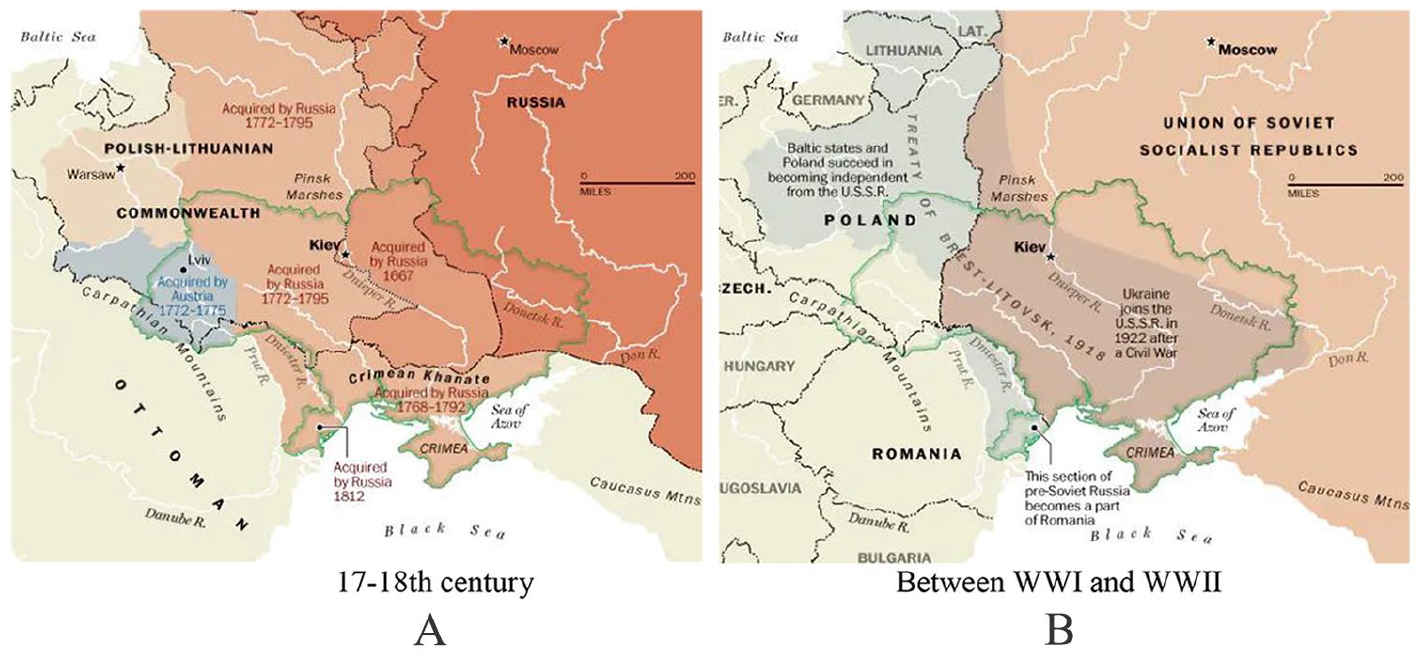
Ukraine’s Fragmented Legacy: Torn Between Eastern (Russia/USSR) and Western (Austro-Hungarian Empire, Poland) Influences: (A) 17th to 18th century and (B) between WWI and WWII
At the same time, Russia has developed pan-Russian (sometimes referred to as pan-Slavic) views, which left no room for a separate Ukrainian nation: Russians expressed their national consciousness through the discourse of imperialism, which was well integrated within national Russian tradition and supported by many social groups and parties (Kuzio, 2022, p. 46). Since mid-19th century and throughout the 20th century, the relationship between Ukraine and Russia remained complex with Russia trying to obtain full control over the entire population residing within the administrative boundaries of the Ukrainian state, thus, openly showing cultural discrimination. However, Ukrainians were not treated by Russians as “savages” (e.g., as was common for indigenous populations of Africa during the colonial rule of Great Britain and France), but rather as inferior “junior” brothers with the Ukrainian language being viewed as a dialect of Russian and Ukrainian culture as a culture of peasants. The situation significantly worsened during “Soviet times”: from 1943 to 1960, the formation of Ukrainian identity was directly influenced by communist ideology, as well as the totalitarian system of government of the USSR, which, formally (constitutionally) giving nations their own cultural development and equal rights within the USSR but implemented a policy of Russian supremacy and elitism (Pochapska, 2022). This was the period when Ukrainian identity merged with Russian/Soviet identity resulting in the creation of an ideologically framed identity with small bits of exceptions in Western Ukraine, probably due to the role of religion, which was formally (constitutionally) banned in the USSR through the atheism policy but remained active in the so-called “underground” activities thus remaining its impact on society. Nevertheless, the collapse of the USSR became a major trigger for the resurrection of Ukrainian identity, even though throughout the post-war period of the Cold War era, Ukraine was one of the key topics in discussions between the West and Russia, which could be one of the reasons for the current acute international crisis (Miller, 2022).
Identity and Language
After the establishment of the Ukrainian administrative borders in 1991, the historical “split” was still noticeable, dividing the country into two major parts: predominantly Ukrainian and predominantly Russian speaking. However, it did not affect people’s identity: Several major studies have been conducted over the years after the independence of Ukraine proving the presence of predominantly Ukrainian identity (see Table 1), with very few Ukrainians identifying themselves as Russians (Lewicka & Iwańczak, 2018).
The Ratio Between Self-Identification and Spoken Language Over the Years of Independence.

Note. The table presents 2006 data from Synchyk (Synchuk, 2023, method—interview, N—not specified); 2017 data from the trilateral project “Bi- and multilingualism between conflict intensification and conflict resolution. Ethno-linguistic conflicts, language politics and contact situations in post-Soviet Ukraine and Russia” No. 90217, carried out at Justus Liebig University Giessen (Germany), The National Academy of Sciences of Ukraine (Ukraine) and Kazan (Volga region) Federal University (Russia) (2016–2017, method—interview, N = 2,007); 2022 data from Sokolova (Sokolova, 2023, method—questionnaires, N = 1,016). Data are presented in percentages (%). Dashes mean no such data were obtained in the study.
As such, bicultural identity, as the simultaneous identification with and integration of two distinct cultures (Benet-Martínez & Haritatos, 2005), was not a case for Ukraine, despite the evident presence of two spoken languages (Yurii, 2022). The division of the country based on the language is displayed in Figure 2: If compared with Figure 1B, it is possible to see a clear-cut pattern that the bordering line of predominantly Ukrainian language ends where the former border of Russian Empire and then USSR was until 1939, with Russian being dominant in urban areas. Similar distribution is common for identity as well with Ukrainian identity weakening from West to East (Lewicka & Iwańczak, 2018).
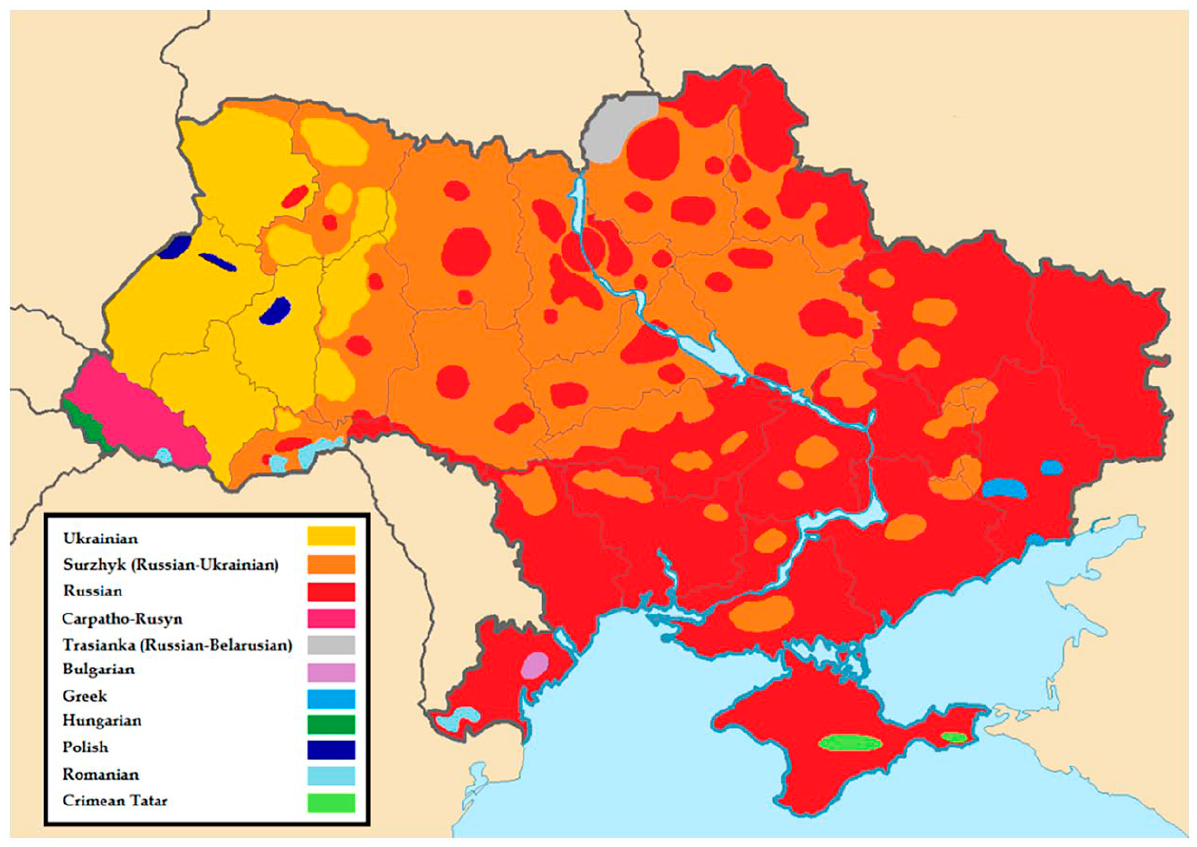
The Languages of Ukraine Between 2001 and 2009.
At the same time, it is seen that central and central-western Ukraine is dominated by Surzhyk, which is a unique Ukrainian linguistic phenomenon, no less important than Ukrainian and Russian in terms of its usage within Ukraine. It is a mixed language variety, combining elements of Ukrainian and Russian languages, mainly divided into five major categories: (a) urbanized peasant Surzhyk, (b) village dialect-Surzhyk, (c) Sovietized-Ukrainian Surzhyk, (d) urban bilinguals’ Surzhyk, and (e) post-independence Surzhyk (Bilaniuk, 2004). We posit that Surzhyk primarily derives from the Ukrainian language, as its phonological and grammatical foundations are Ukrainian in origin, with only its lexicon being predominantly sourced from Russian. As such, Russian influence is significantly reflected in language, however, not as significantly in the identity of Ukrainians. 1
Moving Away From Russia
The last decade of Ukrainian independence has been marked by a clear pro-Western orientation and the worldview shift from East to West, which has happened far before the full-scale invasion (2022) and even earlier than the war in Donbas and annexation of Crimean Peninsula (2014). It might be argued that the first attempt happened in 2004 with the “Orange Revolution,” which could be regarded as a pivotal, peaceful protest movement in Ukraine during late 2004, sparked by widespread public outcry over a rigged presidential election, symbolizing the country’s fight for democratic values and alignment with Western ideals (Karatnycky, 2005). The next pivotal event was Maidan, or “The Revolution of Dignity”: a major uprising in Ukraine during 2013–2014, initiated by public demand for closer European integration and fueled by outrage against government corruption, culminating in a significant shift toward pro-Western policies (Cybriwsky, 2014). It triggered Russia’s annexation of Crimea in 2014 and the subsequent war in Donbas, as Russia sought to counter Ukraine’s pivot toward Europe and NATO, and to protect its strategic interests in the region, particularly its naval base in Crimea. This upheaval also sparked separatist movements in the Donbas region of Eastern Ukraine, leading to ongoing conflict fueled by ethnic, linguistic, and political divisions, and exacerbated by Russian military and logistical support to the separatists (Katchanovski, 2016). These events resulted in a significant strengthening of Ukrainian identity, distinguishing it from Russian (Miller, 2022). As such, despite attempts of Ukrainians to distinguish and defend Ukrainian identity, the Russian Federation still attempted to control over media mainly to maintain significant proportion of the pro-Russian-oriented population within Ukraine.
Penetrating Russian Cultural Dominion
After the collapse of the USSR, Russia spent a tremendous amount of resources to maintain its presence in Ukraine’s culture. Unfortunately, we did not find reliable statistical information about the Russian media consumption in Ukraine after its independence; however, we know that overall tendency concerned the dominating presence of Russian TV channels, newspapers, and popular movie translations up to 2010 simply due to the lack of exclusively Ukrainian programs and media sources. With the emergence and development of social media, Russian content remained dominant. Moreover, the significant portion of Russian bloggers’ audience was Ukrainian.
The official ban of Russian media in Ukraine was released in 2017 resulting into the disappearance of all Russian TV channels in Ukraine. Unfortunately, The National Council of Television and Radio Broadcasting of Ukraine (NCTRB; www.nrada.gov.ua) does not provide any statistical information regarding the broadcast of Russian channels, their popularity, and further diminishment, thus allowing us to research that. In addition, “language quotas” have been established by NCTRB meaning that every TV and/or radio station was required to have at least 20% of its content (music, shows, podcasts, etc.) in Ukrainian. Despite the ongoing events in the east of Ukraine, content in Russian was still popular, even if created by Ukrainians. A similar situation could be observed with music artists: Many Ukrainian artists (e.g., Olha Poliakova, Monatik, Potap & Nastia) have been openly promoting Ukrainian identity (i.e., being separate from the Russians), but in Russian language. As such, 2014 marked the beginning of the war in Donbas, has become a major separation event that allowed Ukrainian identity to thrive, but did not allow the Ukrainian language to dominate in Ukrainian society as a spoken language, even though the administration of the president Poroshenko has implemented the law which forced all governmental institutions (schools, universities, research centers, hospitals, etc.) to use Ukrainian in all forms of communication (written and verbal). What is more, an interesting phenomenon emerged in 2017–2019: Many of the music artists in Ukraine started using Surzhyk in their compositions (e.g., Kurhan & Agregat, Latex Fauna), and they became extremely successful due to being close to the language that the majority of people in Ukraine are using in daily life. Thus, over the years of independence, Ukraine has become an antipode of Russia in the cultural sense.
The Burden of the War: Time to Cut Cultural Ties?
“Colonial” Ties
Even though world history is full of wars of different scales, we believe that in the Russo-Ukrainian war we observe a phenomenon of cutting cultural ties that has not been observed anywhere before. Interestingly, almost no formerly colonized country in the world fully rejected the language of colonizers: English is still an official language in India, Pakistan, and Nigeria; French is the official language in Senegal, Ivory Coast, and Cameroon; Portuguese in Brazil, Angola, and Mozambique; and Spanish in almost entire South America. The language of colonizers remained carved in former colonies even if it is not recognized on the official (constitutional) level (e.g., French in Morocco and Algeria; Spanish in the Philippines; Dutch in Indonesia). Interaction between cultures usually leads to the reduction of cultural distance.
Cultural Distance
Cultural distance is referred to as an extent of dissimilarity or divergence between two cultures in terms of their social, economic, and power dynamics (De Santis et al., 2016). It consists of three major facets: linguistic distance, symbolic distance, and values with their practical manifestations in behavioral scripts (Boski, 2024). Russia and Ukraine can be placed together very closely in terms of cultural distance because of: (a) geographical proximity; (b) sharing the same Cyrillic alphabet with certain semantic asymmetry 2 ; (c) sharing the same religion (Orthodox Christianity); and (d) sharing values and their practical manifestations in behavioral scripts (e.g., everyday culture, importance of family). Such close distance may create an identity threat during a conflict. Nevertheless, it has already been seen that despite having small cultural distance, the identities of Ukrainians and Russians are different (Lewicka & Iwańczak, 2018). Thus, in response to a brutal dehumanizing war, which led to the loss of life and destruction of property, Ukrainians took a challenge of military defense (which is a usual strategy) but also a psychological move of cutting short cultural relations, leading to the dehumanization and infrahumanization (Haslam & Loughnan, 2014) of the enemy. This move is historically unprecedented: Cutting cultural ties is usually not needed, because they have not been existing (e.g., against Nazi Germany during WWII) or are impossible (during civil wars).
Emotional Attachment Versus Dehumanization
Emotions elicited during interactions with cultural objects/artifacts or products can serve as predictors of future behavior: The laws of situational meaning, concern, reality, change, habituation, comparative feeling, and hedonic asymmetry are proposed to describe emotion elicitation (Frijda, 1988). Positive emotions such as joy, interest, or aesthetic appreciation might encourage further engagement with the culture of aggressor, while negative emotions like disgust, anger, or disdain could lead to avoidance or termination of such interactions. However, it might not be applicable to the Russo-Ukrainian war because secure cultural attachment is associated with less out-group threat and more identity inclusiveness, suggesting that emotional attachment to culture does not necessarily lead to cutting cultural ties (Liu et al., 2023). It means that deep emotional bonding with Russian culture may force Ukrainians to continue their engagement.
In the context of dehumanization (Haslam & Loughnan, 2014), emotions can also serve as indicators of underlying attitudes and perceptions. They might be viewed as strong reactions to cultural prejudice or bias, which develop as a result of war and are based on a stark differentiation between “us” and “them,” especially if one is considered a common enemy (Vivian & Brown, 1994). In this case, war plays a critical role in cultural distinction, and parties involved may resort to different coping strategies to overcome cultural differences (Braun-Lewensohn et al., 2010). It means that some Ukrainians were and still are emotionally attached to Russian culture due to various reasons (low cultural distance, “Soviet childhood” with no distinction between Ukrainians and Russians, emotional preferences, and simple appreciation of art) and because solidarity with own nation does not allow them to further interact with Russian culture, they look for ways and mechanisms to convince themselves to interrupt this interaction/engagement or find excuses to continue interaction/engagement, thus experiencing such emotions as shame, guilt, or discomfort. As such, emotions and individual coping strategies are important in situations of cutting cultural ties.
Prejudice
Prejudice among Ukrainian-speaking Ukrainians toward Russian-speaking Ukrainians increased after the Russian invasion of Donbas in 2014, even though their relationships with Russian-speaking friends and relatives did not worsen (Eras, 2023). At the same time, the attitudes toward Russians have worsened as well (Ofitsynskyy, 2023). Concurrently, starting 2014, Russian media derogatorily depicted Ukrainians as “fascists,” “neofascists,” “Nazis,” “nationalists,” and as part of the “Kyiv regime,” reflecting a narrative of betrayal by a “little brother” (Khaldarova, 2021). What is more, despite the evident colonial presence of Russian culture on the modern territory of Ukraine after the independence of the latter, the dominance of Russian culture gradually diminished within the period from 1991 until 2018 (Kuko, 2023), meaning that even though one characteristic of a colonial regimes is the creation of an image of “central” and “peripheral” cultures, where the colonizer’s culture is considered prestigious and the colonized culture is disregarded (Mulcahy, 2017). The latter was common throughout the entire historical relationships between Ukraine and Russia. However, despite Ukrainian culture after 2014 becoming more “trendy” and “fashionable,” Ukraine, as a vividly post-colonial country with historical and cultural ties to Russia, still experiences a strong impact of Russian culture.
Stance for Identity
Today, Ukrainians fight to defend their identity. Current literature brings up several important reasons for the significant resistance of Ukrainians against Russian aggression, in particular: a sharp change in the ideological views of Ukrainian students, resulting in increased patriotic feelings and a strong sense of national identity (Klymenko et al., 2023); the large-scale Russian invasion has significantly affected the daily life and collective identity of Ukrainian citizens, leading to a heightened feeling of solidarity and national self-awareness, as well as a rethinking of values and political views (Stepyko, 2023); and Ukrainian diplomacy has played a crucial role in providing powerful support for Ukraine as a victim of Russian aggression, emphasizing the need for liberation of occupied territories and compensation for destruction caused by Russia (Ofitsynskyy, 2023), which led to the recognition of Ukraine and Ukrainian identity on the international level.
As such, we can obviously see the consequences of a severe conflict: (a) severe political conflict such as war/military invasion triggers a military response of self-defense; (b) acts of barbaric cruelty are acts of dehumanization and the perpetrators are called unhuman beasts; (c) all or almost all ties of international cooperation (economic, tourist, etc.) are severed; (d) cutting cultural ties belongs to this list of war-like steps; and (e) the latter have important psychological coincidences and consequences: costs for cutting habits and changing self-identity. In this regard, we also clearly observe the gradient of conflict during the war: (a) military fighting to destroy the enemy, to kill their soldiers and destroy weapons or catch equipment; (b) civilian, economic object destruction (power plants); (c) cutting public and interpersonal contacts; (d) cutting cultural ties: not having symbolic contact with the enemy; and (e) treating those who do not show solidarity/loyalty as traitors. Thus, in the current study, we aim to assess whether we indeed observe the phenomenon of cutting cultural ties and what may account for that. Thus, we state the following research questions:
Methods and Measures
Participants
The data were collected from August 23, 2022, to September 21, 2022, with Google Forms. Participants were recruited among the students of the faculty of psychology at the Taras Shevchenko National University of Kyiv, through word-of-mouth and different social media channels (Telegram FZ-LLC.) Informed consent was obtained from all participants. The inclusion criteria for the participants were age 18 to 65 and the ability to provide informed consent. The study did not presume any specific exclusion criteria. The total number of participants that fulfilled the criteria was 982, with 60.5% identifying themselves as female (see Supplement A, Table A1 for details). We have checked the data for the presence of outliers (3 standard deviations from mean) on our main outcome “Engagement” and missing values, in total 12 participants have been excluded, bringing the analyzable number of participants to N = 970.
Methods
This research was designed as a cross-sectional correlational study. We measured sociodemographics, coping strategies, and tolerance to uncertainty as independent variables (see below for details). The dependent variables included self-reported maintenance of Contact with Russian culture (continuation vs. termination) presented in the questionnaire item “Do you currently interact with Russian culture (ex. listen to music, watch TV series or movies, TV programs, read/watch bloggers, listen to public lectures, etc.)?” with answer options Yes/No; and Engagement with Russian culture, recorded on 17 subscales for different media sources (a continuous measure based on the amount and type of cultural content that is still being consumed). As such, we differentiate contact as maintenance versus cutting cultural ties and engagement as a measure of ongoing involvement only with Russian culture (as a measure/degree of contact). The sociodemographic questionnaire included questions about gender (Male, Female, Other), age, marital status, current place of residence, and spoken language. Ethnicity was not included in the sociodemographic questionnaire due to the ethnical homogeneity of the Ukrainian sample.
Engagement With Russian Culture
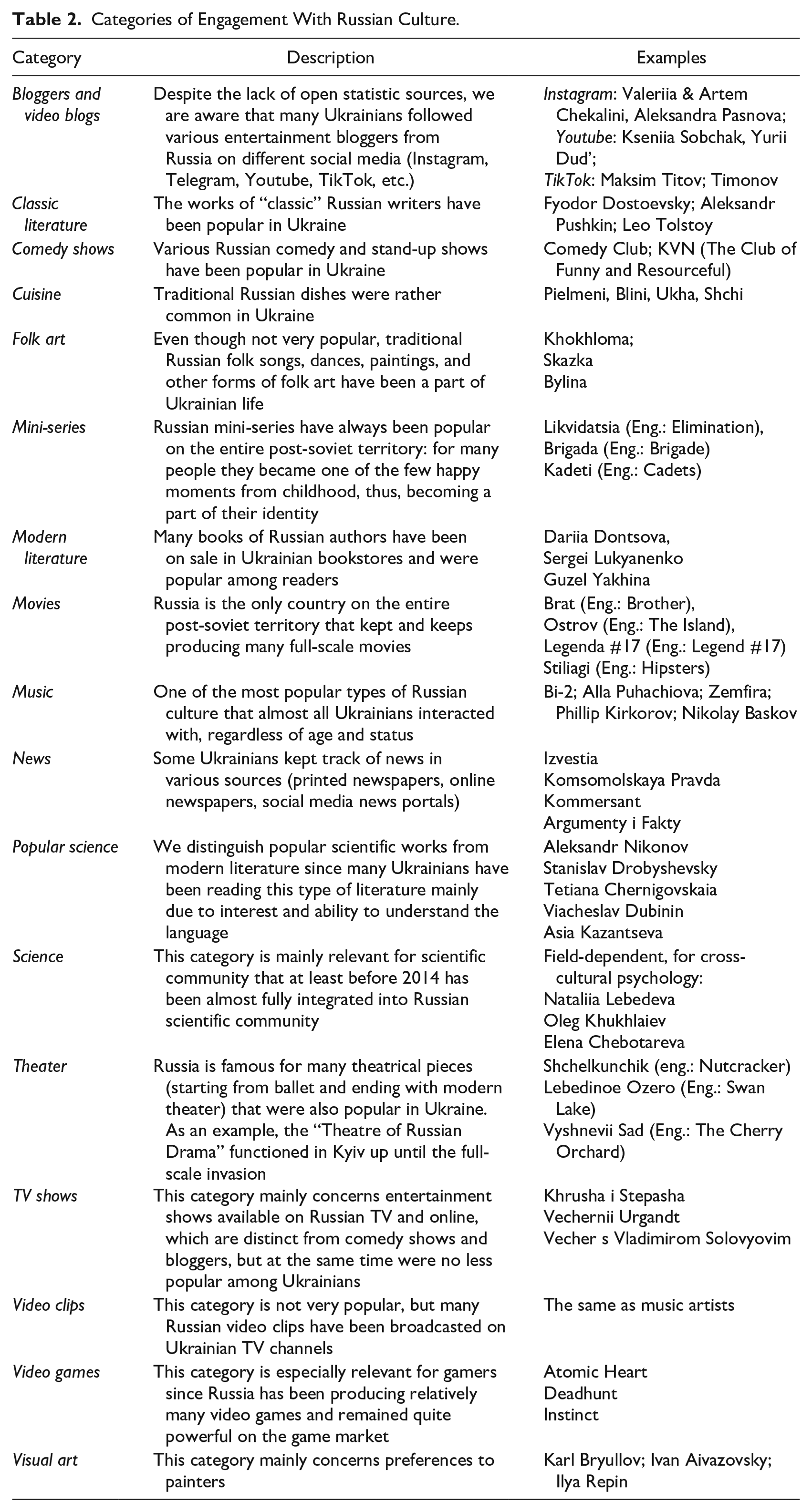
Engagement with Russian culture was assessed through interaction with 17 different cultural and media content categories (see Table 2). Respondents were provided with a list of these categories and could freely select any number on a dichotomized scale. These were summed into the continuous variable “Engagement” for quantifying the engagement with Russian culture.
Categories of Engagement With Russian Culture.
Psychological Variables
Coping strategies were assessed using the Coping Strategies Questionnaire (QSQ) (Harland & Georgieff, 2003); tolerance to uncertainty was measured with the Tolerance to Uncertainty Assessment (TAS) (Furnham & Ribchester, 1995). To ensure the accuracy and cultural relevance of our research instruments, we used forward and backward translation. 3 Final translated versions were included in the disseminated questionnaire. After data collection, the used scales obtained medium to high reliability scores (Cronbach’s alpha, see Supplement B, Table B1): the items that scored below 0.6 were not used in the statistical analysis.
Emotional Attachment and Reactions
Emotions were assessed by asking respondents to select the emotions they experience while interacting (if they continued interaction) or the emotions they would experience if they were interacting (in case when they reported that they no longer interact with Russian culture). It only concerned interactions that happened after the beginning of the war and not before it. The list of emotions included (Izard, 1991) anger, contempt, disgust, fear, guilt, happiness (joy), interest, sadness, shame, and surprise. The list was expanded by context-relevant and more complex emotions (Barrett, 1998): anxiety, calmness, despair, discomfort, disdain, embarrassment, inspiration, longing, nostalgia, and pride. We also added aesthetic appreciation (the feeling of elevation, beauty) and aesthetic disgust (something perceived as ugly, distasteful, or lacking in aesthetic value; Hagman, 2002) to capture the aesthetic emotional aspects of interacting with Russian culture as people tend to experience these emotions while interacting with various forms of art (Silvia, 2005). The items were formulated in the following way: “While interacting with content of Russian culture, 4 which emotions do you experience”: the intensity of emotions was measured on a visual analogue scale from 0 to 10 where participants could choose 0 if no experience of particular emotion at all and 10 if they strongly experienced it.
Compelled Interaction
Compelled interaction (interaction out of necessity) was measured since right after the full-scale invasion, it was impossible to stop using various Russian sources that Ukrainians were accustomed to (plagiarism-checking service in Cyrillic, libraries, forums, technical documentation, etc.). It was measured via subjective reporting item where participants were asked to specify the reasons for the continuation of interaction, and the options included: Work/Study-related reasons, to understand viewpoint of Russian citizens, to experience positive emotions, to experience negative emotions, due to the absence of Ukrainian analogues, other (open section). Participants were not limited to the choice of reasons for interaction.
Statistical Analysis
Statistical analysis was performed in R, version 4.2.2 (R Core Team, 2014). Descriptive statistics was used to answer RQ1; to account for variables related to engagement, we used binary logistic regression (variable contact), Pearson correlation (variable Engagement), and multiple linear regression with Bonferroni and Benjamini–Hochberg corrections (variable Engagement) to answer RQ2; multiple linear regression with Bonferroni and Benjamini–Hochberg corrections (variable Engagement) was used to answer RQ3.
Results
Trends in Cultural Engagement (RQ1)
The mean age of the sample was 27.6 (SD = 7.4). Detailed sociodemographic data are presented in Supplement A, Table A1. In line with RQ1, 630 participants reported that they altogether stopped interacting with Russian culture (67.4%) while 305 reported that they continued interaction (32.6%): Figure 3 shows differences in 17 pre-defined categories between those who stopped (red columns) and those who continue (green columns) interaction with Russian culture. Results of the independent sample t-test prove a significant reduction in global Engagement, t(931) = 8.83, p < .001, between those who used to interact with Russian culture before the war (M = 5.06, SD = 3.01) and those who maintain contact after the beginning of the war (M = 3.3, SD = 2.58).
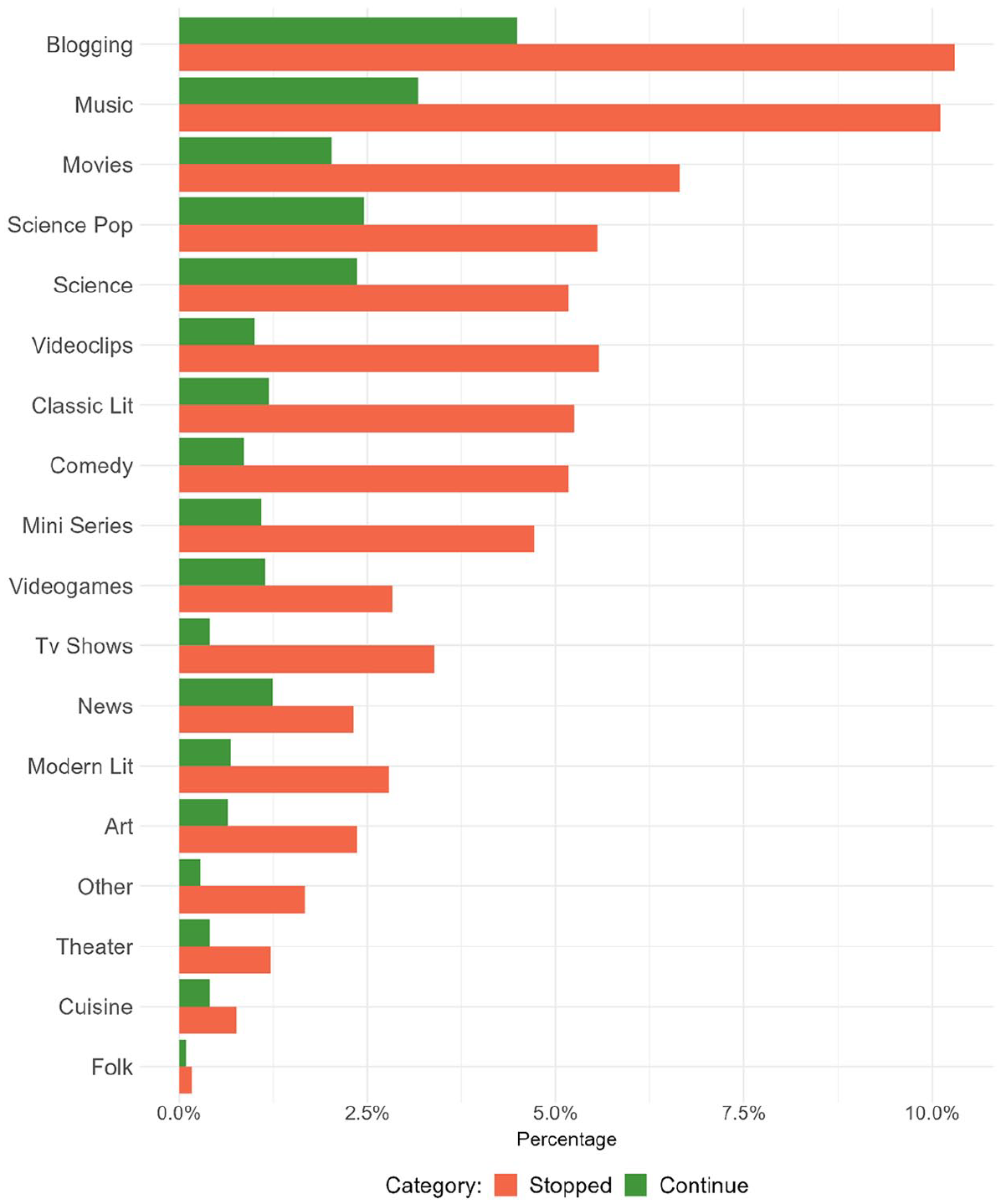
Engagement With Russian Culture: Continuation Versus Termination.
Cutting cultural ties versus continuation of engagement is related to spoken language, coping strategies, and emotions (see Supplement C, Table C2). To distinguish between those who continue and those who terminated engagement with Russian culture, sample was divided into two groups for further analysis (based on the Contact variable). The variable Engagement was used as dependent variable.
Cutting Cultural Ties (RQ2)
Sociodemographics of Disengagement
We did not see any statistically significant differences in cutting cultural ties between males (M = 4.81, SD = 3) and females (M = 5.21, SD = 3.01), t(627) = −1.58; p = .115; among different age groups, F(5,91.3) = 1.69; p = .144; education levels, F(6,54.5) = 1.55; p = .180; and marital status, F(5,15.8) = 0.838; p = .542. Detailed information on frequencies and percentages of participants is presented in Supplement C, Table C1. Spoken language also did not show any effect, F(3,36.6) = 1.67; p = .191.
Can We Explain Cutting Cultural Ties?
To identify what triggers termination, we have used multiple linear regression. The model explained 9.12% of the variance, R2 = .0912; F(23, 606) = 2.645, p < .001, with the coping strategy “Search for Social Support” (p = .003) as the only fixed factor after Bonferroni correction and age (p = .04) after Benjamini–Hochberg correction (see Supplement C, Table C3 5 ), which shows importance of coping strategies for cutting cultural ties.
Continuation of Engagement (RQ3)
Sociodemographics of Engagement
We did not see any statistically significant differences in continuation of engagement between males (M = 3.51, SD = 3) and females (M = 3.11, SD = 2), t(302) = 1.34; p = .154; among different age groups, F(5,36.1) = 0.905; p = .488; education levels, F(6,18.6) = 0.68; p = .688; and marital status, F(5,5.67) = 0.919; p = .530. Detailed information on frequencies and percentages of participants is presented in Supplement C, Table C1.
Severity of Emotional Attachment
Emotions experienced during interaction with Russian culture are positively related to the continuation of engagement, in particular, joy (r = .382, p < .001), interest (r = .307, p < .001), surprise (r = .302, p < .001), aesthetic appreciation (r = .386, p < .001), nostalgia (r = .289, p < .001), longing (r = .158, p < .001), happiness (r = .413, p < .001), calmness (r = .319, p < .001), pride (r = .355, p < .001), and inspiration (r = .418, p < .001). Some emotions are negatively related to the continuation of engagement: anger (r = −.164, p = .004), disgust (r = −.154, p = .007), and discomfort (r = −.155, p = .007).
Can We Explain Continuation of Engagement?
To build a regression model, we have used significant predictors for the variable of contact (see Supplement C, Table C1) together with the self-reported measures for the continuation of engagement. 6 Model explained 47.86% of the variance, R2 = .4786; F(44, 260) = 5.424, p < .001, with the interpersonal intolerance (p = .018) and engagement because of the necessity (work/study-related reasons) (p = .018) as the strongest fixed factors after Bonferroni correction and after Benjamini–Hochberg correction (see Supplement D, Table D1) (Figure 4).
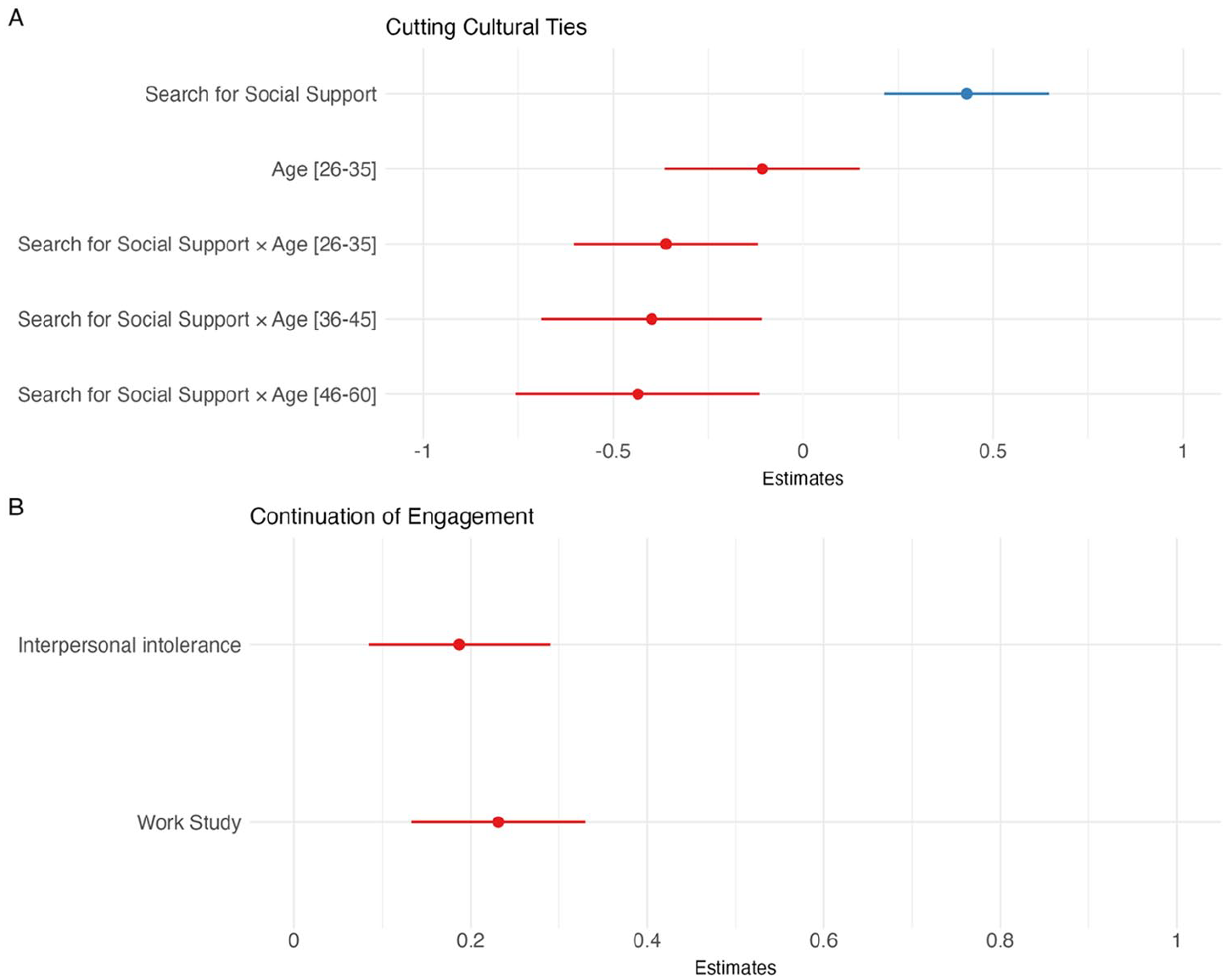
Fixed Effects Accounting for Cutting Cultural Ties and Continuation of Engagement.
Discussion
Cutting Cultural Ties (Disengagement)
To our knowledge, this is the first study delving into attempt to quantify engagement with Russian culture after the beginning of the war, especially considering the absence of open-access statistics on media consumption of Russian sources before and after the war. We believe that if not because of the war, Ukrainians would have continued engagement with Russian culture. Nevertheless, our findings show the evident role of the Russo-Ukrainian war in cutting cultural ties with Russia, despite the low cultural distance and shared history. Majority of Ukrainians report cutting cultural ties, mainly with Russian bloggers, musicians, popular science, science, movies, comedy and TV shows, classic and modern literature, theater, and videogames. Ukrainians terminate engagement with Russian culture regardless of the gender, age, educational level, and even spoken language, meaning that Ukrainian, Surzhyk, or Russian-speaking Ukrainians report termination. As such, the war played a crucial role in forcing Ukrainians to cut cultural ties, especially for younger generation (aged 25–40) and supported by coping strategy of searching for social support, which can be interpreted through the orientation on the external resources to justify the behavior. We have looked into interaction between age and social support because with age the tendency to search for social support increases, especially when it concerns intercultural relations (Mortenson et al., 2009). Our results showed significance of interaction of age with the search for social support, meaning that people resort to searching for external justification to terminate interaction, rather than focus on their internal intentions.
It means that because of the war and its devastating consequences, even if people wish to continue engagement with Russian culture, collective responsibility does not allow them to do so due to the inappropriateness of the action from the perspective of society and they experience corresponding emotions (e.g., shame, discomfort) while interacting with Russian culture. For example, understanding the number of people who died or were injured because of the war, the material damage caused, and that interaction with Russian artists may simply bring funds to the aggressor-state through taxation for the continuation of the war will cause more deaths, injuries, and destructions. The war has also significantly fostered a sense of national solidarity and strengthened collective identity among Ukrainians (Vasiutynskyi, 2022), which may also stipulate cutting cultural ties. What is more, search for social support has been proven to be an efficient strategy for strengthening in-group bonds and solidarity (Piankivska, 2022) and a strategy to be used in cases for justification of cutting cultural ties (Mortenson et al., 2009). As such, we believe that cutting cultural ties is a result of the war and is mainly supported by the solidarity with own nation, culture, and compatriots that sacrificed themselves in the war fighting for Ukrainian identity with “human beasts,” which is mainly common for younger generation, the representatives of which have little to none in common with USSR and Russia due to being raised in the independent Ukraine (Kulyk, 2021; Vasiutynskyi, 2022). Thus, Ukrainians fight to defend their identity and do that not only on the military front, but on cultural front as well.
Refusal to Cut Cultural Ties (Continuation of Engagement)
Nevertheless, our findings show that some Ukrainians continue engagement with Russian culture mainly because of speaking Russian in daily life, due to significant emotional attachment, due to inability to cope with uncertainty, and due to inability to find alternatives to Russian cultural or non-cultural products. Not surprisingly, Russian-speaking Ukrainians continue engagement, which is well aligned with the emotions they experience during interaction. Participants reported experiencing joy, interest, nostalgia, longing, aesthetic appreciation, and even inspiration, which is clearly explained in terms of the perception of art forms in general (Silvia, 2005) and “boosted” by the ability of better comprehension of art and culture in the language that people can understand (Lupyan et al., 2020). What is more, for many Ukrainians, Russian is still considered as a native language, and because native language is embodied (Monaco et al., 2023), it may also serve as an additional factor for the continuation of engagement and increased emotional pleasure because of it, even though anecdotal evidence suggests that there are no Russian-speaking Ukrainians, but rather there are Russified Ukrainians. Interestingly, that language is related to the depth of art appreciation (Geipel et al., 2015) aligns with our findings that Ukrainians who continue engagement experience aesthetic appreciation and may do that because of intolerance to uncertainty. It means that they might search for certain stability in the unstable life because of the war, and engagement with Russian culture (as it was common for them before) allows achieving this, especially considering that this engagement brings positive emotions and allows them to appreciate art in the understandable language.
Nevertheless, our findings show that some Ukrainians report continued engagement because of the need, meaning due to the absence of Ukrainian and/or other alternatives. This interaction is mainly related to work and study needs, as well as the inability to find alternative resources from Ukraine and/or the inability to use resources in other languages (e.g., English). Apparently, Ukrainian scientific and other domains heavily relied on Russian resources and there was no need to develop Ukrainian alternatives.
We believe that the most vivid examples for compelled engagement concern three major spheres: science, technical forums, and domestic/household issues. Ukrainian science has been using Russian resources in various spheres: literature, technical equipment and support, plagiarism-checking services, libraries, publishers, and so on. Because of this, not many Ukrainian alternatives have been developed, especially in terms of literature availability because it was simply irrelevant due to possibility to use alternatives in Russian. Ukrainian psychology especially suffered since during decades psychologists have been using Russian assessment instruments and scales (in the original language), with no necessity to translate and validate them. As such, the necessity to terminate the usage of all Russian-related has caused a crisis in psychology. The second example concerns technical forums that mainly focus on technological maintenance: On these forums, people share their experience with different problems with equipment, vehicles, and machinery, and to our knowledge, no Ukrainian alternatives have ever been developed/created in this domain. Finally, for the resolution of various domestic/household issues, Ukrainians have always been using Russian websites and sources since there was a plethora of them (e.g., adme.media, Russian analog of Pinterest). As such, simply due to the lack of alternatives, many Ukrainians continue compelled engagement.
Obviously, we can observe a phenomenon of cutting cultural ties with some exceptions that make sense. However, how far can it go? Will Ukraine drop Cyrillic alphabet and switch to Latin alphabet to increase cultural distance? Historical examples show that it happened before in Turkey with dropping Arabic script and in Vietnam with dropping Chinese. We believe that switch to Latin alphabet should not occur due to (a) historical significance of Cyrillic alphabet, (b) practical challenges imposed by the change, and (c) this shift would go against the language preservation and will not be supported by the public. However, other means of defending own culture will be used to defend Ukrainian identity equally on the battlefield and in the cultural domain.
Summary
Our findings show that majority of Ukrainians cut cultural ties with Russia. It mainly happens due to the war and its devastating consequences, and due to usage of search for social support as a coping strategy in terms of alignment with group norms (national prohibition of all Russian-related). Ukrainians continue engagement due to spoken language (Russian-speaking Ukrainians continue engagement), emotional attachment (engagement with Russian culture brings positive emotions), and inability to cope with uncertainty. Compelled engagement is a separate category that forces Ukrainians to continue interaction due to the lack of Ukrainian and/or other analogs.
Supplemental Material
sj-docx-1-jcc-10.1177_00220221241256322 – Supplemental material for Cutting Cultural Ties? Reasons Why Ukrainians Terminate or Continue to Interact With Russian Culture Despite the Ongoing Russian-Ukrainian War
Supplemental material, sj-docx-1-jcc-10.1177_00220221241256322 for Cutting Cultural Ties? Reasons Why Ukrainians Terminate or Continue to Interact With Russian Culture Despite the Ongoing Russian-Ukrainian War by Anton Kurapov, Oleksandra Balashevych, Christoph Bamberg and Pawel Boski in Journal of Cross-Cultural Psychology
Footnotes
Author Contributions
AK, OB: conceptualization and methodology of the study. AK, OB: data collection and data proofing. AK, CB: data analysis. AK, OB, PB: manuscript writing. PB, CB: manuscript review, editing, and rewriting. All authors contributed to the article and approved the submitted version.
Data Availability Statement
The datasets generated and analyzed during the current study are included in the submission, alongside the complete R script used for the analysis. These materials are fully available without restriction and can be accessed within the supplementary files of this article.
Declaration of Conflicting Interests
The author(s) declared no potential conflicts of interest with respect to the research, authorship, and/or publication of this article.
Funding
The author(s) received no financial support for the research, authorship, and/or publication of this article.
Ethics Statement
The studies involving human participants were reviewed and approved by the Ethics Committee of the Faculty of Psychology at Taras Shevchenko National University of Kyiv (11-22/9). The patients/participants provided their written informed consent to participate in this study.

Supplemental Material
Supplemental material for this article is available online.
Notes
References
Supplementary Material
Please find the following supplemental material available below.
For Open Access articles published under a Creative Commons License, all supplemental material carries the same license as the article it is associated with.
For non-Open Access articles published, all supplemental material carries a non-exclusive license, and permission requests for re-use of supplemental material or any part of supplemental material shall be sent directly to the copyright owner as specified in the copyright notice associated with the article.
