




Abstract
Past research in both the transitions to adulthood literature and cultural sociology more broadly suggests that the working class relies on traditional cultural models in their construction of identity. In the contemporary post-industrial world, however, traditional life pathways are now much less available to working-class men and women. I draw on 93 interviews with black and white working-class young people in their 20s to 30s and ask, in an era of increasing uncertainty, where traditional markers of adulthood have become tenuous, what kinds of cultural models do working-class young people employ to validate their adult identities? In contrast to previous studies of working-class identity, I found that respondents embraced a model of therapeutic selfhood—that is, an inwardly directed self preoccupied with its own psychic development. I demonstrate that the therapeutic narrative allows working-class men and women to redefine competent adulthood in terms of overcoming a painful family past. Respondents required a witness to validate their performances of adulthood, however, and the inability to find one left many lost in transition.
In the United States, traditional markers of adulthood—leaving home, completing school, achieving financial independence, getting married, and having children—have become increasingly delayed, disorderly, reversible, and even forgone in the latter half of the twentieth century (Berlin, Furstenberg, and Waters 2010). In response to these demographic shifts, scholars have turned their attention to the changing meanings and practices of adulthood from the perspective of young people themselves (e.g., Arnett 2004; Benson and Furstenberg 2007; Blatterer 2007; Côté 2000; Hartmann and Swartz 2007; Shanahan, Porfeli, and Mortimer 2005; Waters et al. 2011). The psychologist Jeffrey Arnett (2004:8) views the transition to adulthood as a self-focused, “age of possibilities” in which young people abandon demographic markers of adulthood in favor of self-exploration and individualistic identity construction. Sociologists, however, have critiqued Arnett’s emerging adulthood paradigm for its lack of attention to existing opportunity structures. That is, although privileged middle-class white youth may have the resources to engage in prolonged periods of self-exploration and identity construction, working-class youths’ limited choices and increased responsibilities keep this luxury out of reach (Benson and Furstenberg 2007; Osgood et al. 2005; Shanahan et al. 2005).
The decline of traditional markers of identity has also been of central concern within the broader sociological literature on changing foundations of selfhood in post-industrial society. Indeed, definitions of adulthood both reflect and operate as cultural models of personhood (Lee 2001). Cultural theorists argue that traditional models of selfhood, structured by external religious, moral, and gender mores of a time past, have been replaced by therapeutic selfhood, which is reflexive, individually negotiated, self-actualizing, and continually reinvented (Bellah et al. 1985; Illouz 2008; Rieff 1987). The therapeutic model of selfhood—inwardly directed and preoccupied with its own psychic and emotional growth—has become a crucial cultural resource for ascribing meaning and order to one’s life amid the flux and uncertainty of a flexible economy and a post-traditional social order (Illouz 2008). Yet constructing a therapeutic narrative may require a particular set of class-based linguistic skills, knowledge, and resources that are accessible only to the professional middle class (Bellah et al. 1985; Cherlin 2009; Giddens 1991; Illouz 2008).
Past research in the transitions to adulthood literature, and cultural sociology more broadly, thus suggests that the working class relies on traditional and specifically nontherapeutic cultural models in their construction of selfhood. Yet traditional life pathways are much less available to working-class men and women in the contemporary post-industrial world. Indeed, as Benson and Furstenberg (2007) argue, the transition to adulthood has become prolonged for working-class youth because traditional role transitions are increasingly difficult to achieve. In light of this contradiction, this article elaborates on the difficulties that working-class young men and women encounter during the transition to adulthood and explores the emerging cultural models they use to construct their adult selves. I draw on 93 interviews with white and black working-class men and women in their 20s to early 30s and ask, in an era of increasing uncertainty and insecurity, where self-evident markers of adulthood have become tenuous, what kinds of narratives do working-class young people employ to propel their biographies into adulthood?
My data reveal that the vast majority of respondents were struggling to come to terms with the disappearance of traditional life pathways. Faced with the insecurity of the service economy and a deep uncertainty surrounding gender expectations and commitments, most respondents—with the exception of men with public sector jobs—could not rely on traditional rites of passage (i.e., leaving home, finding a stable job, and getting married) to construct their adult identities. Contrary to past research, I found that working-class young people increasingly made use of a therapeutic model to narrate their coming of age experiences. The therapeutic narrative enables the post-industrial working class to redefine competent adulthood in terms of overcoming a painful past and reconstructing an independent, transformed, and adult self. I also identified what I call the new requirements of coming of age. In the absence of a normative and socially recognizable transition to adulthood, respondents needed a witness to validate their newfound status, without which they could not fully perceive themselves as adults.
Theoretical Framework
Coming of Age in the Twenty-first Century
During the post-World War II golden age of secure wages, low unemployment, and stable nuclear family structures, coming of age could be characterized as a journey with stable, predictable, and deeply gendered endings (Lee 2001). Since the 1970s, however, stable employment in the manufacturing sector has become increasingly unavailable, leading to declining job security and waning of the family wage, especially for individuals without a college degree (Esping-Andersen 1999). Consequently, working-class young men have experienced sharp declines in available jobs, compensation, access to pensions, and employer-subsidized health insurance, with black men facing the greatest erosion in labor market position (Black 2009; Danziger and Ratner 2010; Wilson 1997). The precariousness of the labor market, combined with the increasing privatization of risks such as unemployment and education, has made leaving home and achieving the status of an independent, adult worker ever more difficult to achieve (Danziger and Ratner 2010).
As industrial capitalism crumbled, the gendered division of labor that was its hallmark became anachronistic, destabilizing the gender and family arrangements upon which traditional definitions of adulthood rested (Hill 2005; Walkerdine, Lucey, and Melody 2001; Weis 1990, 2004). Men’s diminished labor power, alongside the feminist movement and women’s attendant mass entrance into the workforce, sparked a decline in the legitimacy of marriage (Stacey 1998). In turn, rates of marriage fell and rates of divorce and single motherhood rose, particularly among working-class, poor, and African American women (Cherlin 2009; Edin and Kefalas 2005; Goldstein and Kenney 2001). Unlike their parents’ generation, young people’s lives are less determined by external gender, religious, moral, and legal codes. Although they still feel pressure to marry, they do not have to; gay and lesbian relationships are more visible and recognized; children are increasingly born out of wedlock; and divorce is more acceptable than ever before (Beck and Beck-Gernsheim 1995; Bellah et al. 1985; Rosenfeld 2007). The stable employment, social protections, and strictly divided masculine and feminine spheres of life upon which traditional adult milestones depended are dissolving. The days of inheriting one’s father’s place in the assembly line for life, or staying unhappily married until death, are largely gone.
From the Traditional to the Therapeutic Self
A large body of literature chronicles how the massive economic and social transformations of the twentieth century—for example, the disappearance of blue-collar jobs, growth of precarious work, decline of religious authority, and loosening of traditional gender roles and family arrangements—have fundamentally reconfigured dominant narratives of selfhood (Beck and Beck-Gernsheim 1995; Giddens 1991; Sennett 1998; Sennett and Cobb 1972; Wuthnow 1999). In his seminal work on modernity and self-identity, for example, Giddens (1991) argues that in place of clearly defined role transitions structured by external sources of authority (e.g., religion and gender), identity has become an individual, ongoing, and reflexive process of construction. That is, as external markers become uncontrollable, “what the individual becomes is dependent on the reconstructive endeavors in which he or she engages” (Giddens 1991:75).
In light of the cultural imperative for self-construction, therapy—and the therapeutic ethos more generally—has become deeply resonant in American culture (Bellah et al. 1985; Cushman 1996; Davis 2005; Foucault 1979; Furedi 2004; Giddens 1991; Illouz 2003, 2008; Moskowitz 2001; Rieff 1987). As a cultural schema, the therapeutic narrative compels one to identify pathological thoughts and behaviors, to locate the hidden source of these pathologies within one’s family past, to give voice to one’s story of suffering in communication with others, and to triumph over one’s past by reconstructing an emancipated and independent self (Illouz 2003). In conceiving of all suffering as the result of “mismanaged emotions” that can be repaired at the level of the psyche (Illouz 2008:247), the therapeutic narrative gives actors a sense of control over the disruptions and uncertainties inherent in modern day life.
Studies about the transitions to adulthood complement the larger body of work on contemporary selfhood in their focus on the individualization and psychologization of adulthood markers. Indeed, much research on the changing meanings of adulthood (Arnett 2004; Côté 2000) stems from psychologists who emphasize the centrality of individualistic markers—for example, taking responsibility for oneself, separating emotionally from one’s parents, or making decisions on one’s own—in subjective perceptions of adulthood. Sociologists Hartmann and Swartz’s (2007:278) recent qualitative study revealed that young people believe that adulthood “should be a journey toward happiness and fulfillment, meaning and purpose, [and] self-actualization” marked by “continuous development, discovery and growth.” Framing these conclusions within the larger body of scholarship on the changing foundations of selfhood suggests that seemingly personal or psychological markers may be instantiated through a particular cultural form—the therapeutic narrative—that conceives of and measures progress at the level of the psyche.
Working-Class Adulthood in an Age of Uncertainty
The loosening of traditional forms of identity holds enormous emancipatory potential, especially given studies of the industrial working class that depict the stable, deeply gendered endings of adulthood as constrictive, routinized, and demeaning (Rubin [1976] 1992; Sennett and Cobb 1972; Willis 1977). Yet the emancipatory potential of this process cannot be separated from its riskiness: in a market-driven world where little or nothing is guaranteed by tradition, patrimony, or simply one’s place in the world, the ability to reflexively write one’s own biography is an increasingly essential requirement for building a coherent life. Existing literature suggests that successfully creating a therapeutic narrative may require a class-based toolkit of language skills, emotional expression, and material resources. In a groundbreaking line of research, Illouz (2008) suggests that therapeutic language is more accessible to the professional middle class than to the working class, who remain dependent on more traditional, gendered forms of identity. Drawing on Willis’s (1977) seminal ethnographic study of the shop floor, Illouz (2008:234–35) observes that “blue-collar work mobilizes an ethos of bravery, strength, and distrust of words,” while “middle- and upper-middle-class individualism can be characterized as ‘soft psychological individualism,’ emphasizing a sense of uniqueness, individuality, and self-confidence as well as the emotions, needs, and desires of the psychological self.” The absence of therapeutic models among the working class is supported by the transitions to adulthood literature, which finds that whites from advantaged families are more likely than others to embrace self-exploration (Benson and Furstenberg 2007; Osgood et al. 2005), while poor, minority, and working-class youth continue to privilege traditional role transitions.
This research brings to the fore a central question concerning social class, the transition to adulthood, and cultural models of selfhood: Are working-class young men and women, for whom traditional markers of adulthood have become unattainable or undesirable, unable to create alternative coming of age narratives that ascribe meaning, order, and progress onto their coming of age experiences? There are compelling reasons to investigate whether nontraditional, and specifically therapeutic, models of selfhood have taken root in the post-industrial working class. First, much of the older literature on class and selfhood is informed by studies of the white, masculine, and industrial working class (e.g., Illouz draws on Willis’s 1977 study of working-class boys), who may indeed have relied on a more traditional and deeply gendered source of identity. Yet describing the working class in terms of the shop floor does not take into account the drastically altered labor market and vast social transformations across race and gender that have fundamentally reshaped what it means to be working class (Bettie 2003; Black 2009; Lamont 2000; McCall 2001; Walkerdine et al. 2001; Weis 1990, 2004). As Weis (2004:6) elucidates, “a new working class is shaping itself along very particular lines under radically different structural conditions than those that gave rise to the industrial proletariat, both as object and as subject.”
Second, existing literature suggests that therapeutic discourse has become entrenched in a vast array of social institutions that structure working-class young people’s lives, including public school systems, mass media, the medical field, the service economy, the military, alcohol and drug addiction rehabilitation programs, and drug courts (Black 2009; Hochschild 2003; Illouz 2003; Imber 2004; Nolan 1998). 1 Therapeutic language may therefore have become more readily accessible within the post-industrial working class as a way of conceiving of and talking about the self. In the absence of traditional markers of adulthood, have working-class youth adopted a substitute, therapeutic model of selfhood? How might therapeutic discourse shape new kinds of coming of age narratives, and what might its usage portend for the meanings and practices of contemporary working-class adulthood?
Data and Methods
Data for this research consist of 93 in-depth, semi-structured interviews with working-class young people in their mid-20s to 30s. Respondents were between the ages of 24 and 34 years, with a mean age of 26 years. All respondents were born in the United States. Interviews were conducted from October 2008 to February 2010. I originally recruited respondents from two cities, Lowell, Massachusetts, and Richmond, Virginia. These cities embody many of the economic and social forces that frame the disappearance of traditional markers of adulthood: decline of industry, diminishing public funding, and growth of low-paying service sector jobs. 2
In defining the working class, I targeted respondents whose fathers did not have college degrees. Respondents reported fathers who worked as truckers, police officers, firefighters, carpenters, soldiers, landscapers, coal miners, factory workers, grocery store stockers, drycleaners, house painters, postal workers, electricians, mechanics, plumbers, and technicians. They reported mothers who worked as medical and healthcare technicians, hotel maids, secretaries, school bus drivers, food servers, childcare workers, and customer service representatives. I recruited respondents from service sector workplaces, including gas stations, casual dining restaurants, coffee shops, fast food chains, retail chains, daycares, and temporary agencies. I also visited community, regional, and state colleges. Finally, I went to traditionally blue-collar workplaces like fire and police stations and military training sites. Because the aforementioned literature suggests that both race and gender shape coming of age experiences and class trajectories, I stratified by these categories. The sample consists of 19 black women, 17 black men, 29 white women, and 28 white men.
I approached young people and asked if they would like to participate in a study of “what it’s like to grow up today.” Establishing trust was crucial to this undertaking, and I thought carefully about how my own identity (as a white woman working toward a PhD) shaped my interactions with and analysis of my respondents. During my first week of interviewing, the potential difficulties in forging connections across lines of power and identity—whether class, race, gender, or sexual orientation—was thrown into relief by John, a 27-year-old black man who was studying for an accounting exam at a Richmond community college. Halfway through the subsequent two-hour interview, he told me point-blank: “You know the average white woman won’t even look me in the eye. They look away. I was so shocked when you sat down and talked to me and would even look me in the face . . . then I learned that you wanted something from me and it made sense.”
Being close in age to my respondents helped bridge the gap between our disparate social locations. When I shared my own experiences of the prolonged transition to adulthood and of being a first-generation college student, respondents would often visibly relax and respond with stories or even advice of their own. Some, only partially joking, referred to the interview as “free therapy,” seeming to savor the opportunity to communicate their difficult emotions to someone who would listen. Others asked to read my work when it was finished or even friend me on Facebook. Candace, a 24-year-old black woman, sent me a Facebook message following our meeting that read, “Your book is going to speak for so many people without voices.” 3 Another informant asked that I use his real name and thus make his story public. This hunger to find someone to bear witness to their experiences—to be heard—came to be central to my analysis of respondents’ transitions to adulthood.
Interviews were semi-structured and lasted approximately two hours. All but three interviews were conducted in person at a location chosen by the respondent. 4 Interviews were digitally recorded with the permission of the respondent and completely transcribed. During the first round of analysis, I relied on open coding, closely reading interview transcripts line by line to discover trends in the data. I focused on identifying incidents, as recalled by respondents themselves, that marked critical personal junctures in the transition to adulthood (Strauss and Corbin 1998). Examples of patterns of similar incidents include confronting painful past relationships, battling mental illness, following God’s plan, and getting married.
In the final round of coding and analysis, I sought to identify whether these incidents represented traditional or therapeutic approaches to narrating the self. In some cases, respondents clearly invoked one or the other. I identified a respondent’s coming of age narrative as traditional if it emphasized achievement of (or the goal of achieving) demographic or external milestones. Benjy, a 27-year-old white firefighter who described himself as an adult because “I got over the first hump and got married, and now I’m ready to be a parent,” was coded as traditional. On the other hand, if a respondent emphasized psychological wounds and self-growth, I coded her as therapeutic. Kelly, for example, was labeled therapeutic because she told a coming of age narrative of learning to manage her ongoing depression. As she explained, “It’s the ability to look at these things and pick them apart. I’ve been an adult long enough to see patterns emerging. I can kind of see when my thoughts start going in these loops, and when I start feeling helpless, I just have to make a conscious decision to not feel that way.”
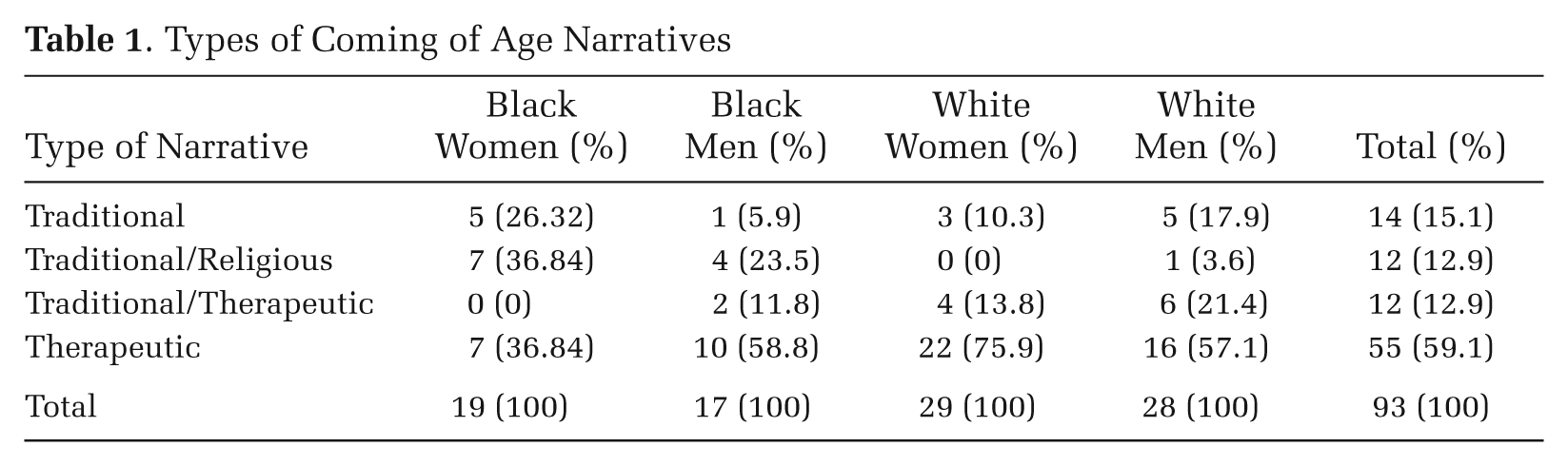
Other respondents drew on both traditional and therapeutic conceptions of selfhood. Indeed, people often mobilize competing or even contradictory logics when making sense of their lives, superimposing new cultural models onto older ones (Illouz 2008; Swidler 2001). I thus allowed for a traditional/therapeutic category (see the example of Cody below). Finally, religion emerged as a salient theme in coming of age narratives among a small group of respondents who understood their delayed transition to adulthood as “God’s plan.” I coded these respondents as traditional/religious. Table 1 presents a typology of narratives. 5
Types of Coming of Age Narratives
Findings
The men and women in my sample embody the disorderliness, reversibility, and delay of traditional markers of adulthood noted by previous researchers (Berlin et al. 2010). Only 12 respondents were employed, married, living with a spouse, and had children. Thirty-five respondents lived with a parent or older family member such as an aunt or grandmother. The vast majority of respondents worked in the service industry as bartenders or servers, medical billers, nannies, security guards, salespersons, cashiers, or customer service representatives, and eight respondents worked in public sector blue-collar jobs like firefighting. 6 Eighteen respondents had military experience, whether active duty or National Guard. 7 Forty-six respondents were single, 28 were dating, 14 were married, and five were divorced. Twenty-five respondents had children. 8
Encountering Tradition
For the vast majority of respondents, the transition to adulthood bore little resemblance to the normalized progression of leaving home, completing school, finding a steady job, getting married, and having children that so clearly demarcated the split between childhood and adulthood in the decades following World War II. On the contrary, traditional markers of adulthood haunted them as unattainable, inadequate, or even undesirable, turning coming of age into a journey with no clear destination in sight.
Rob, for example, was a 26-year-old white man whom I met while recruiting at a National Guard training weekend. Rob told me his story in an empty office at the armory because he was currently “crashing” on his cousin’s couch. When he graduated from vocational high school, he planned to use his training in metals to build a career as a machinist: “Manufacturing technology, working with metal, I loved that stuff,” he recalled longingly. As he attempted to enter the labor market, however, he quickly learned that his newly forged skills were obsolete:
I was the last class at my school to learn to manufacture tools by hand. Now they use CNC [computer numerical controlled] machine programs, so they just draw the part in the computer and plug it into the machine, and the machine cuts it. . . . I haven’t learned to do that, because I was the last class before they implemented that in the program at school, and now if you want to get a job as a machinist without CNC, they want five years experience. My skills are useless.
Over the past five years, Rob has stacked lumber, installed hardwood floors, landscaped, and poured steel at a motorcycle factory. His only steady source of income since high school graduation has been his National Guard pay, and he recently returned from his second 18-month deployment in Afghanistan. Rob expressed a sense of hopelessness toward the future that was shared by over half of the sample:
I am looking for a new place. I don’t have a job. My car is broken. It’s like, what exactly can you do when your car is broken and you have no job, no real source of income, and you are making four or five hundred dollars a month in [military] drills. Where are you going to live, get your car fixed, on 500 a month? I can’t save making 500 bucks a month. That just covers my bills. I have no savings to put down first and last on an apartment, no car to get a job. I find myself being like, oh what the hell? Can’t it just be over? Can’t I just go to Iraq right now? Send me two weeks ago so I got a paycheck already!
When I asked him to identify the “hardest part of growing up,” he replied, “I can’t quite seem to keep my feet under me. I get them under me, and then I slide off to the next thing.” In requiring progress and stable endings, traditional definitions of adulthood have become untenable, leaving respondents with a growing sense of bewilderment and constraint surrounding their identities and futures (see also Lareau 2003).
Economic insecurity has seeped into the institution of family, making respondents uncertain about the viability of marriage and children. Some strived, without success, to superimpose obsolete work and family arrangements onto their own experiences of flux. For straight men with unstable jobs, this often meant forgoing relationships entirely because they could not meet expectations of the traditional provider role. White men in particular articulated idealistic notions of stability and commitment that seemed more nostalgic than realistic given the fragility of the post-industrial working-class family. Kevin, a 25-year-old customer service representative at a grocery store, reflected: “Mainly I’d like stability out of life. It sounds kind of corny but I just want to be one of those pops who sits in the armchair with my wife, watching the Dick van Dyke Show and stuff like that. Growing up, I moved around a lot and I never really had a solid family structure so that is something I have always wanted.” In evoking nostalgic images of white picket fences, the Dick van Dyke Show, and love that lasts forever, white men mourned the loss of their labor power and the nuclear, gendered family (Stacey 1998).
Deeply forged cultural connections between economic viability, manhood, and marriage proved especially devastating for black men who, struggling with long bouts of unemployment in the labor market, often avoided committed relationships altogether (see Pager, Western, and Bonikowski 2009). Brandon, a 34-year-old black man who has managed the night shift at a women’s clothing store for the past 11 years, explained this matter-of-factly: “No woman wants to sit on the couch all the time and watch TV and eat at Burger King. I can only take care of myself now. I am missing out on life but making do with what I have.” Watching marriage and children pass them by triggered feelings of loss, revealing a deep cultural anxiety about the fluidity of adulthood and the uncertainty of the future. Douglas, a 25-year-old black man who lived with his godmother, turned contemplative when I asked him about marriage: “People used to get married at 21. You don’t see that anymore. Trust is gone. The way people used to love is gone.” Knowing they were being evaluated for their earning potential fostered a sense of injustice, one that made marriage morally repugnant: “Nowadays, it seems like more of a hustle, honestly. ‘I need a ring and everything,’ like, you don’t need that really. It’s a hustle,” fumed Nathan, a 25-year-old black man whose night-shift job as a medical biller barely allowed him to pay his rent.
For women, fear of failure—of investing time and emotional energy into a relationship that could ultimately fall apart—prevented many from pursuing romantic relationships. Jillian, a 25-year-old white woman, seemed embarrassed by the fact that she had never had a serious boyfriend. Fighting to keep economic and social insecurity at bay, Jillian has worked 70 hours a week at a local tavern since she graduated from high school, and has thus had little time to date:
Definitely there is a sense of I have no idea what I’m going to be able to do. Working in a restaurant for my life is definitely not where I want to be. But owning a restaurant, I mean that’s so, so far ahead. Because I have no money to start up. So yeah, that is very scary to not have a future planned out yet. And being 25, it’s like okay in a few years I want to start a family. So starting a family around 30 or so, it’s like I have five years to get my life together. Which is definitely not going to happen. So it’s definitely really scary not knowing exactly the path.
For black women in particular, black men’s profound economic disadvantage intensified their struggle to form lasting relationships. Shannon, a 24-year-old black woman who was working toward a degree in education, wrestled with the decision of whether to date men with lower educational and employment credentials than herself: “I don’t know, I feel like I can’t ask for too much because there’s not enough people for me to write everyone off.” 9 Watching restlessly as traditional milestones of adulthood passed her by, Shannon was considering having a child outside of wedlock: “I do want to do it like right, but even in my family there are children out of wedlock and my family is very good at like celebrating the child not necessarily your decision.”
For women who ventured into monogamous relationships, the inevitability of working for pay throughout their adult lives called into question the desirability of traditional marriage. Allie, a 30-year-old white secretary who met me for lunch at an Irish pub on the outskirts of Lowell, launched breathlessly into her coming of age narrative before I could even open my menu. “In your early 20s you think you have it all mapped out already, and then life throws you a curveball, and you start at square one. And it is like, oh no, what do I really want out of life? Where do I want to go, what do I want to do?” Allie was raised with “old-school traditions and values” by parents who married and bought a home in their late teens, had Allie and her brother in their early 20s, and recently celebrated their 35th wedding anniversary. After graduating from high school, Allie earned a two-year administrative degree and then married the son of her parents’ close friends. Yet, following in her parents’ footsteps proved more challenging than she imagined:
He was like, I am ready [to have a baby], and I was still not ready. And I felt like I was a single parent taking care of him anyway because he is messy and I am like, there is no way I can have a baby and work full-time and have the baby and him never home. We were barely scraping by as it was money-wise. So we said okay, another year, and by that time, I was like, I don’t know if I ever really want kids. I mean, you see how your parents’ relationship went—they got married and had kids and bought the house at a young age, and my brother followed that too. It’s a lot of pressure being the black sheep of the family, divorced with no kids.
Allie idealized her parents’ smooth transition from marriage to children to home ownership in their early 20s, but she could not make this path work for herself. Although she undertook a central ritual of adulthood—marriage—her performance felt empty: she could not convince herself of its legitimacy.
(Re)constructing Adulthood in an Age of Uncertainty
I now turn to examine the ways respondents ascribed meaning and order to their coming of age experiences. Just over a quarter of respondents (coded as traditional and traditional/religious) told their coming of age narratives as journeys of having achieved traditional milestones or of hoping to progress toward them. Within this group, five male public sector workers expressed this logic most consistently and coherently. As Joseph, a 27-year-old white man, put it, “being an adult is making it happen, not waiting for it to happen.”
When Joseph was growing up, his father was in and out of prison for selling drugs and his mother struggled to raise their five children. The day after Joseph graduated from high school, he enlisted in the Marines and took his first ever plane ride to boot camp. He married his high school sweetheart at 19, and they had their first child two years later on the military base. Joseph was committed to building a stable nuclear family: when the city eliminated all overtime pay at the start of the recession, he took a second job monitoring a cell phone tower, and his wife ran a daycare out of their home to make ends meet. His adult identity was deeply gendered, founded on being a good father and a good husband: “I had my priorities straight. I’m not going to go sit at a bar and drink with my friends when I got my wife and kids at home.” What separated Joseph and the four other men from the rest of the respondents was, I argue, the fact that they had stable public sector jobs in traditionally masculine fields, thus allowing them to attain the deeply gendered, stable endings of adulthood.
For the remainder of respondents in this category, however, the fit of the tradition-oriented narrative was tenuous. Cory, a 34-year-old white bartender who had been living paycheck to paycheck since he was 16, told his coming of age story as a series of failed attempts at traditional adulthood: he established himself in a career as a mechanic but got laid off; he bought a house but defaulted on the mortgage; and his girlfriend of nine years had a miscarriage, which eventually led to their breaking up. In his mid-30s, Cory’s narrative of progress faltered when I asked him about the risks he faced in building a new life for himself: “If I had like goals, like real live goals, then there could be a lot to let that down. So I am floating. Whatever happens next, happens, and I will deal with it when it happens.”
A subset of respondents (coded as traditional/religious) drew on their religious faith as a strategy for coping with the delay of traditional markers of adulthood. Rachel, a 27-year-old black woman, juggled her 40-hour a week customer service job with National Guard weekend training and raising her 4-year-old son. With 20,000 dollars in debt, she was forced to move in with her mother, who also cared for her son during Rachel’s two year-long deployments in Iraq. With little hope of finding a husband and father for her son, Rachel knew that her only chance at providing a better life for her son required deploying to Iraq yet again to take advantage of the higher combat pay. She mused: “I am kinda happy about it and kinda not. I missed the first two years of my son’s life and now I might have to leave again. It’s just rough. You can’t win.” When I asked Rachel if there had been times when she wanted to give up, she replied:
No matter how hard I try, I take one step forward and get punched back 10 steps. Like no matter what I do, I just can’t seem to get ahead and make things work out for me. I kinda just leave it up to God, you know what I mean, because He has a plan for me and that is what I believe. When He wants me to go a certain direction or be stable or have wealth or whatever He wants me to do, it will come when He wants me to have it and I am just trying to think about that whenever I get down. I do still have days when I want to go to sleep and I don’t wanna get up. . . . God and my son are the only things that are keeping me going.
Within the institutions that framed her transition to adulthood—her family and her church—Rachel learned to put her life in the hands of a higher power: “He has a plan for me and that is what I believe.” In a similar way, Alexandra, a 28-year-old black woman who had been working at a temp agency for six years, explained, “I don’t lose my confidence because I know it will happen in God’s time.”
In contrast to these traditional and religious narratives of adulthood that measured progress through external markers, many young working-class men and women used the therapeutic language of psychological self-growth. More specifically, just under three quarters told their coming of age stories as a struggle to triumph over demons of their pasts, either combining this language with traditional markers (coded as traditional/therapeutic) or eschewing traditional markers all together (coded simply as therapeutic). These demons took three, often overlapping, forms: pain or betrayal in past relationships; emotional, mental, or cognitive disorders (e.g., depression, dyslexia, or anxiety); and addiction to drugs, alcohol, or pornography. Rather than anchor their identities in traditional markers such as work or family roles, these respondents grounded their adult identities in their personal quests to transform their wounded selves.
Monica, a 31-year-old white woman, grew up on a dairy farm where her mother traded milk for doctors’ visits and sometimes hid food stamps from her proud father to get the family through the long winter months. With her short, ruffled hair and plastic rim glasses, Monica exuded a youthful charm that perfectly complemented her plaid shirt and cigarette jeans. But in her own mind, she still felt like the “super shy,” awkward girl from the farm who survived the lonely days of high school only by turning to drugs and alcohol. Monica found her first job in a nearby toy factory, where she packed dolls in boxes before they were shipped out. When that factory closed, she moved to an electric factory, where she spent eight hours a day using tweezers to install tiny springs inside electrical switches. She has since worked as a waitress, a truck driver, a field hand, a telemarketer, and a hospital aide, returning in her late 20s to live with her parents and help her father in his logging business after yet another seemingly long-term relationship fell apart.
Monica never envisioned herself having a future. “There was no five-year plan,” she laughed. “I started using really, really young and really didn’t think I would live to see 30. I was just like, I just want to have fun today, right now.” Monica described one earth-shattering moment when she realized her life was going nowhere, prompting her to get sober:
I definitely had one moment. It was the very end of working for my dad. I was in the truck, and I was at a woodlot, and it was a freezing cold morning, and I was waiting for them to be ready to fill the truck. So I was just sitting, and I was like . . . the radio was off and I was journaling, and I was hung over and I felt horrible. I was just like, what am I doing with my life? It’s such a mess, it’s so unmanageable and I’m a mess and I’m not happy in any way. . . . Working for my parents and been working for my parents for years and it’s just not . . . nothing in my life is working. So I kind of like said a little prayer and asked for help and made a pact with myself that I was going to change something.
Monica found a therapist who diagnosed her with depression, started her on antidepressants, and convinced her to go to an Alcoholics Anonymous meeting. Although she relapsed a few times, and had to stop taking her medication because she could not afford health insurance, Monica continued to attend AA meetings. She challenged herself to see the positive aspect of everything that happened to her, believing that happiness was within her control. Even when her bike (and sole form of transportation) was stolen last spring, she “was like, that’s all right, I needed to get rid of my mountain bike and get a road bike (laughs). You really just have to keep it positive today.”
Unlike her parents, who viewed upward mobility, work, and family as foundational to a worthy life, Monica created a different kind of coming of age narrative, one that did not hinge on any of the traditional (and deeply gendered) markers of adulthood but instead focused on overcoming her addiction and realizing her authentic self through art. Her string of short-term jobs and relationships, and years of constant flux, taught her that depending on traditional markers of adulthood to center her sense of self would leave her constantly seeking. When I asked her if she felt like an adult, she replied, “I think that having more time in sobriety has taught me to grow up in a lot of ways. I mean there’s tons of stuff that I don’t feel proud about that I’ve done, like tons of stuff. But I can’t change that, and I wouldn’t be who I am today if I didn’t go through everything that I did.” Even though she was living with her parents, “just hanging on by a thread all the time financially,” and postponing long-term relationships, she felt accomplished—just as long as she stayed sober: “Because if I don’t, you know, I could drink and that would mean losing everything.”
Justin was a 31-year-old black man who worked as a server at a casual dining chain restaurant. He spent six years at a historically black college, finally earning a degree in finance that he paid for with loans. Upon graduating, Justin found a job as a death claims clerk at an insurance company in central Virginia and fell in love with a male co-worker. After four years, however, the relationship fell apart, dragging Justin into a deep sadness that left him unable to get out of bed for three months. After losing his job and moving in with his sister, Justin (like one other respondent) enrolled in a free drug trial that provided him with antidepressant medication. He moved to Richmond in search of a fresh start. Three years later, he described his situation: “I’m just kinda like at my end’s rope. I’ve been working here so long that I’m just like . . . I’m tired of hearing from my mom and my family like everyone is like, you’ve got a degree, why are you working at [that restaurant]?” Barely breaking even every month, Justin was trapped, unable to move forward in his journey to adulthood through traditional conduits because of fear of losing what little he had.
Justin ascribed meaning, order, and progress onto his life through his struggle to “come out” and claim his true sexuality despite his family’s rejection: “There were a few things that hindered me growing up. One of them was, growing up my family didn’t talk about stuff. Like we’re a very hush, hush family . . . sex, we never talked about sex, never, ever, ever. And then me being gay, first of all I don’t know what sex is. I don’t know how to say sex or talk about sex.” Convinced by his religious upbringing that homosexuality was evil, Justin prayed every night that he would wake up the next morning and “be straight.” After many agonizing years of unanswered prayers, Justin decided it was time to accept his sexuality as an undeniable part of himself: “I had no choice. You can’t. No matter how long you try to repress these feelings. If you’re gay, you’re gay. That’s how I know you’re born this way.” While he struggled to pay the rent on his studio apartment and had yet to find a suitable romantic partner, he “feels like an adult” because he triumphed over a painful upbringing and found the strength to claim his authentic self.
The New Requirements of Coming of Age
Through telling their stories of overcoming difficult pasts, working-class women and men staked a claim to the dignity and respect due adults. This alternative, therapeutic coming of age story ends not with marriage, home ownership, and a career, but with self-realization gleaned from denouncing a painful past and reconstructing an independent, complete self. However, simply constructing this alternative narrative with its individualized markers was not enough to feel like an adult: the very act of telling calls for a witness, a recognizing subject who listens to and validates one’s hard-won but tenuous self. Like traditional adulthood markers that mark the transition from one status to another in a socially recognizable way, therapeutic markers also require the participation of others.
Some respondents found such witnesses in drug and alcohol treatment programs, counseling, or support groups (n = 10). As we stood outside her favorite coffee shop one night, sharing my umbrella to shield us from the heavy rain, Lauren inhaled cigarette after cigarette, shakily recounting her story of addiction and recovery:
I suffered from a lot of depression and social anxiety and . . . just a lot of emotional and mental issues growing up. I saw school psychiatrists and then I turned to drugs. That’s why I didn’t do well in high school, I was too busy smoking pot . . . I did everything. Everything but like free-basing . . . well, actually, I smoked crack so I did free-base. . . . Every day, I spent all my money on it. I was unemployable because of it. I kept trying to get on my feet but I never could. Addiction runs in my family. My mom is an alcoholic, my dad is an alcoholic, and my mom’s brother stuck a shotgun in his mouth and pulled the trigger because of drugs. There’s a lot of addicts in my family and I am one of them.
Lauren realized that she needed to seek help after not eating or sleeping for six days. When a treatment center turned her away because she lacked health insurance, she found Narcotics Anonymous, recalling “the moment I decided to seek help for my addiction was the moment my obstacles became growing experiences.” Lauren has since learned a new language of empowerment through suffering and used it to reconceptualize her sense of self. She declared, “My mom’s an alcoholic, my dad kicked me out of the house . . . it’s not a handicap, it has made me stronger!” Despite the fact that Lauren was unhappy in her job and could not afford to go back to school, she felt she had made great progress in overcoming her addiction and had forged a meaningful identity as a “survivor.” In highly institutionalized settings such as treatment programs, therapy (if respondents had health insurance or could find it for free through social services), or support groups, informants told their stories and could be validated by a witness monthly, weekly, or even daily.
Some young parents (n = 12) viewed their children as the ultimate witnesses to their self-growth (Silva and Pugh 2010). Cody, a 27-year-old white mechanic who was haunted by memories of his childhood, explained, “My father wasn’t around and when he was around, he hit me or he yelled and screamed at me and made me feel like I was this big.” Cody measured his progress and success as an adult based on his ability to relate to his children very differently than his own father related to him:
When I get to that point where I am so mad, and I yell like my father used to yell at me, my stomach turns and I want to throw up. I want to curl up in a ball and cry. One time I yelled at the kids for fighting with each other and they looked at me like they were scared and I just felt sick. There is a tone you can use with your kids and I am only just learning that tone. I am still learning I should say (he laughs). It’s not easy.
With help from a counselor from his young parents’ support group, Cody developed new ways of interacting with his children. He shared proudly: “I am starting a whole new thing so it’s very alien to me and I do the best I can. I’m not a great father, but I think I’m a good father; the little time I do spend with my kids, I do fun things. I read with them. I think the biggest thing is I got my daughter into reading. I read now. And that is only recently, because I never read in school.” Cody developed personal and individual markers of adulthood—namely, not becoming his own father—but his performance was rendered meaningful and authentic only when his children bore witness to it. Although Cody achieved a central demographic marker of adulthood—becoming a father—it was only when he ascribed therapeutic meaning to his parenting that he felt his life had moved forward.
Most respondents were still seeking a witness to their coming of age journeys. A small number of respondents (n = 5) attempted to use writing, blogging, or art to communicate their difficult emotions. More typically, respondents attested that their parents—whether because of their own alcohol or drug addictions, mental illnesses, or simply lack of fluency in therapeutic language—could not provide the kind of recognition they yearned for. To return to the case of Justin, his pride in having found the strength to come out was tempered by the fact that he had to hide his sexual orientation from his conservative religious family. Tragically, Justin believed that his father, who recently passed away from cancer, might have been his only chance for affirmation. He recalled tearfully: “And before he passed away, he actually, I think he was trying to give me a sign that he knew. Because he gave me this big card and it had like a bowl of candy on it, and it said, ‘No matter how sweet you are I will always love you.’” Justin’s transition remained incomplete because he had no one to witness and affirm that his suffering yielded something meaningful: the brave discovery of his authentic, adult self.
Similarly, Vanessa, a 30-year-old white woman who was about to start a job as a nanny after seven months of unemployment, constructed her coming of age narrative around a self-diagnosis of bipolar disorder. During our three-hour interview, she searched her past for signs of her illness, linking the painful events of her life—being bullied at school, fired from jobs for stealing, getting divorced twice, and losing custody of her twins—with the common thread of her disorder. Traditional markers struck her as unsustainable, so understanding her past and breaking free from unhealthy relationships became central to her definition of adulthood: “Since my divorce, I have been on my own for the first time in my life. I have not had anybody controlling me but myself . . . I have only been an adult for six months (sobbing). I have learned a lot along the way.”
Vanessa’s parents—a field machinist and a medical records coder, whom she described as traditional, religious, and Southern—viewed their daughter with a mixture of sadness, bewilderment, and disdain: “They just look at me and say, ‘What is wrong with you? Why can’t you get a job, why aren’t you taking care of your own kids?’ And I am like, you grew me up doing certain things, and this is what has happened because of it, so you can’t blame me.” Her parents—as potential witnesses—did not judge her performance of adulthood as authentic. Unable to afford therapy, she joined an online bipolar support group but soon quit because she felt ignored: “It was all about [the founder of the group], you see, she would take up most of the time to talk. She didn’t think the other people there would need people to talk to as well.” Vanessa continued to search for validation. 10
Discussion and Conclusions
This is a study of what happens when taken-for-granted ways of organizing one’s biography become obsolete, unavailable, or undesirable. As my interview data revealed, working-class youth are trapped between the rigidity of the past and the flexibility of the present. They are haunted by the meanings and rituals of traditional adulthood even though they see this model as unattainable, inadequate, or simply undesirable. Although a few men with stable, public sector jobs were able to perform traditional adulthood and felt like successful adults, the vast majority of respondents found themselves “lost in transition” (Brinton 2010) due to the mismatch between enduring cultural models of adulthood, on the one hand, and evolving opportunity structures on the other.
Some respondents, particularly black women, turned to religion as a strategy for reconciling this mismatch, but others “reorganize[d] taken-for-granted habits and modes of experience” into new rituals that better fit the changing times (Swidler 1986:279). Specifically, telling therapeutic narratives of selfhood served as a substitute transition that allowed working-class young men and women to reconstruct their dislocated experiences of work and family as triumphant narratives of overcoming painful pasts. By enabling them to tell their coming of age stories backward—to start at their present, transformed selves and work backward through the emotional trials they went through to construct their stories—the therapeutic logic allows for the possibility of self-worth, meaning, and progress (Illouz 2008). Highly flexible, therapeutic language can meld with traditional stories of coming of age, as in the case of Cody, or substitute for them all together, as in the case of Monica. For young working-class people who are crippled in the present and wary of the future, the past-centered therapeutic narrative allows them to make sense of disappointment, rupture, and failure at the level of the psyche.
Although past research has depicted the working class as unable to employ therapeutic understandings of the self, my interview data reveal that its discourse is ingrained in the institutions that shape this generation’s lives, including social services, school psychologists, self-help literature, free drug trials, the Internet, and Alcoholics and Narcotics Anonymous. Indeed, these institutions are more prominent than more traditionally oriented ones (such as masculine jobs like firefighting, or religion) in working-class individuals’ everyday lives. This finding sharpens our understanding of how therapeutic language may be used differently among the middle and working classes. Therapeutically oriented institutions anchor working-class lives amid the insecurity of the service sector and the fragility of personal relationships (see Whitley 2008). For Cody, for example, the therapeutic model of suffering and self-transformation was foundational to forging a new relationship with his children. Yet therapeutic ideology may also encourage working-class young people to draw strong boundaries against family members who engage in deviant behaviors such as drinking or using drugs, to embrace unachievable middle-class standards of respectability, and to ultimately take responsibility for their own happiness.
The necessity of the witness underscores that adulthood remains an interactional accomplishment, requiring social recognition for validity and authenticity (Davis 2005). In this vein, my findings suggest a synthesis between psychologists who examine only individualistic and psychological meanings of adulthood and sociologists who insist on its role-oriented nature. That is, rather than engaging in a period of self-exploration and identity construction on the one hand, or privileging traditional role transitions over individualistic ones on the other, working-class youth construct seemingly personal markers of adulthood that are in fact culturally patterned and dependent on social recognition for validation. When witnesses are found in everyday practices, such as parenting, attending weekly Alcoholics Anonymous meetings, or seeing a therapist, respondents legitimate their self-perceptions of adulthood. But for the majority of respondents, attainment of a witness proved difficult and sometimes impossible, whether because they could not afford therapy, faced generational differences in emotional expression, or lacked institutionalized support. Without a witness to legitimate their story, working-class young people became suspended in a narrative of suffering, and the ritual failed to produce a newly adult self. This finding underlines the tenuous nature of therapeutic models of adulthood, especially for individuals who do not have the resources necessary to put them into practice.
These conclusions suggest avenues for future research concerning the relationship among social class inequality, therapeutic markers of adulthood, and sources of social validation. Researchers should examine the role of institutions (e.g., therapy and religion) in shaping coming of age narratives, particularly across race and gender groups. For example, are men with traditionally masculine, public sector jobs like firefighting more likely than women to rely on demographic markers of adulthood? Are black women more likely to turn to religious communities in their transitions? Future work should also examine whether and how middle-class youth rely on therapeutic (rather than simply personal or psychological) markers in defining adulthood. Can middle-class youth find witnesses more successfully than their working-class counterparts? In undertaking such research, scholars can sharpen their understandings of class, race, and gender differences in the meanings and processes of twenty-first-century adulthood.
Footnotes
Acknowledgements
I am especially grateful for thoughtful guidance from Sarah M. Corse, Sharon Hays, Bruce Western, Michele Lamont, Allison Pugh, Robert Zussman, and Leslie McCall. I would also like to thank the editors of ASR and my five anonymous reviewers for their insightful and patient feedback. Ahrum Lee, Matthew Morrison, Dan Finn, Nicole Deterding, Tony Jack, Jeremy Schulz, Josh Pacewicz, and Tristan Bridges each provided useful comments on earlier drafts. This article was presented at the Harvard Culture and Social Analysis Workshop in 2011.
Funding
This research was supported by the Woodrow Wilson Women’s Studies Dissertation Fellowship and the National Science Foundation – American Sociological Association Postdoctoral Fellowship.
Notes
References
Supplementary Material
Please find the following supplemental material available below.
For Open Access articles published under a Creative Commons License, all supplemental material carries the same license as the article it is associated with.
For non-Open Access articles published, all supplemental material carries a non-exclusive license, and permission requests for re-use of supplemental material or any part of supplemental material shall be sent directly to the copyright owner as specified in the copyright notice associated with the article.
