



Abstract
Using a multilevel comparative framework, we propose that politically receptive city contexts facilitate the viability of marginalized neighborhoods. To illustrate this proposition, we examine the relationship between immigrant concentration and neighborhood violence. Drawing on political process and minority incorporation theories, we argue that favorable immigrant political opportunities will strengthen the often-found inverse relationship between immigration and crime at the neighborhood level. Unique data from the National Neighborhood Crime Study (Peterson and Krivo 2010a) provide demographic and violence information for Census tracts in a representative sample of 87 large cities. We append this dataset with city-level measures of immigrant political opportunities, such as the extent of minority political incorporation into elected offices and pro-immigrant legislation. Multilevel instrumental variable analyses reveal that the inverse relationship between immigrant concentration and neighborhood violent crime is generally enhanced in cities with favorable immigrant political opportunities. We speculate that this occurs because favorable political contexts bolster social organization by enhancing trust and public social control within immigrant neighborhoods. Our findings demonstrate that the fate of neighborhoods marginalized across ethnicity and nativity are shaped by the responsiveness of political actors and structures to their concerns.
The Chicago school of sociology revolutionized the understanding of how neighborhood conditions pattern the uneven spatial distribution of social problems. Rather than viewing social problems as the product of the clustering of certain kinds of people, urban sociologists highlighted the costs of social and economic marginalization for neighborhoods’ social organization (Shaw and McKay 1942). According to prevailing perspectives, extensive poverty and other adverse conditions disrupt the ability of marginalized communities to organize around common interests. A focus on the dynamics of neighborhood social organization has proven helpful in explaining such diverse aggregate outcomes as rates of infant mortality, low birth weight, child maltreatment, teenage childbearing, dropping out of high school, suicide, and violence (Brooks-Gunn, Duncan, and Aber 1997a, 1997b; Bursik and Grasmick 1993; Krivo and Peterson 1996; Park and Burgess 1924; Sampson 2010; Sampson, Morenoff, and Gannon-Rowley 2002; Sampson, Raudenbush, and Earls 1997; Shaw and McKay 1942). Yet because the vast majority of research on neighborhoods has been conducted within a given municipality, urban ecology scholarship has been left with an empirical and theoretical blind spot: neighborhoods are not islands unto themselves. Rather, they are nested within cities and city environments shape neighborhood outcomes. How larger structural forces at the city level worsen or ameliorate social problems within marginalized neighborhoods remains under-analyzed and under-theorized.
We move beyond neighborhood boundaries by investigating how city-level political environments influence the distribution of social problems across neighborhoods. Our central thesis is that the fate of neighborhoods marginalized across class, race, ethnicity, and nativity partly depends on the receptivity of local political actors and structures to their needs. Politically receptive cities can engender trust in the political system and thus encourage residents of marginalized neighborhoods to become civically engaged, develop a sense of attachment to and ownership of their neighborhoods, and mobilize on behalf of neighborhood concerns (Williams 1998). Moreover, politically responsive cities can provide resources and opportunities across a myriad of domains—education, jobs, policing, city services, neighborhood festivals, community outreach, political participation, and health—that shore up internal community processes and shape neighborhood viability.
To illustrate the role of city politics in shaping intra-neighborhood dynamics, we chose a politically divisive issue as our case study: the contemporary relationship between neighborhood immigrant concentration and violence. For more than a century, public opinion in the United States has expressed concern over immigration. Public opinion and political officials’ discourse often equate immigrants with a plethora of social problems, especially in regard to deviance and crime (Martinez 2006). Consistent reference to the criminal menace of the immigrant population implies that stricter policies limiting immigration or curbing immigrant access to resources are part and parcel of crime control. Indeed, supporters of recent anti-immigrant policies, including Arizona’s SB 1070, Georgia’s HB 87, and Alabama’s HB 56, argue that such laws will make communities safer (Morse 2011; Redmon 2011).
Decades of sociological research temper these xenophobic fears (Cohen 1931; Martinez 2006; Sampson 2006; Taft 1933). In fact, social science research commonly finds an inverse relationship between immigrant concentration and local violence rates (Desmond and Kubrin 2009; Feldmeyer 2009; Kubrin and Ishizawa 2012; Lee, Martinez, and Rosenfeld 2001; Martinez 2002; Martinez, Lee, and Nielsen 2004; Reid et al. 2005). Scholars most often argue that rather than destabilize neighborhoods, immigrants invigorate local areas and fortify crime control processes.
To investigate how city-level political environments shape the immigration-violence relationship, we reach beyond standard criminological theories by drawing on social movement scholarship on political opportunity structures and political science research on minority incorporation (Browning, Marshall, and Tabb 1984; Meyer 2004). Combining insights from these traditions, we propose the concept of “immigrant political opportunities,” which refers to the political receptivity or vulnerability of cities to meeting the needs and demands of immigrant communities. Cities have open, or favorable, immigrant opportunities when supportive politicians are in office, the broader community is receptive to immigrant issues, cities adopt pro-immigrant legislation, minorities are bureaucratically incorporated into police departments, and the form of government grants immigrants and their allies institutional access to and influence in municipal decision-making. We argue that these city-level factors condition the link between immigrant concentration and neighborhood violence: immigration will be especially helpful in reducing neighborhood violence in cities that are sympathetic to the needs of immigrant communities. We test this multilevel thesis and speculate that favorable immigrant political opportunities bolster social organization by setting in motion a “spiral of trust” (Gay 2002:718; see also Williams 1998) among immigrants and the broader community and enhancing public social control within immigrant neighborhoods. In contrast, city regimes hostile to immigrant needs engender mistrust of civic institutions (Kirk et al. 2012), undercutting the ability of neighborhoods with higher concentrations of immigrants to engage in crime control. City contexts with few immigrant political opportunities should weaken the protective association between immigrant concentration and violence at the neighborhood level.
Little research has linked city contextual factors within a multilevel framework to elucidate the neighborhood-level connection between immigrant concentration and violence. We employ unique data from the National Neighborhood Crime Study (NNCS) that provide, for the first time, large-scale multilevel demographic and violent crime data for 8,931 Census tracts nested within a representative sample of 87 large cities (Peterson and Krivo 2010a). We append this dataset with city-level measures of immigrant political opportunities culled from secondary sources. These multilevel data allow us to assess variation in the association between immigrant concentration and neighborhood violence across a large sample of cities and to test whether the often-found inverse relationship between immigration and violence is indeed enhanced in cities with open immigrant political opportunities.
Immigrant Revitalization and Neighborhood Violence
Whereas studies in a few cities report null or positive relationships between immigrant concentration and violence, the lion’s share of contemporary macro research finds immigrant concentration is inversely associated with violence (Feldmeyer 2009; Kubrin and Ishizawa 2012; Lee et al. 2001; Martinez 2002, 2006; Martinez et al. 2004; Martinez, Rosenfeld, and Mares 2008; Martinez, Stowell, and Lee 2010; Ousey and Kubrin 2009; Reid et al. 2005; Wadsworth 2010). 1 Neighborhoods with large shares of immigrants often have lower levels of violence and drug-related crime than do similarly situated areas with fewer immigrants (Kubrin and Ishizawa 2012; Lee et al. 2001; Martinez et al. 2004; Martinez et al. 2008; Stowell and Martinez 2007). At the municipal level, cities that experienced growth in immigrant concentration saw greater reductions in violence between 1990 and 2000, net of common controls (Stowell et al. 2009; Wadsworth 2010). Despite a number of classic challenges to causal inference relating to endogeneity and selection bias, these results are relatively robust across cross-sectional and longitudinal designs. 2
The predominant explanation as to why immigrant concentration reduces neighborhood violence is known as the “immigrant revitalization perspective” (Feldmeyer 2009; Lee et al. 2001; Martinez 2002; Martinez et al. 2004; Reid et al. 2005). 3 Immigrants’ capacity to revitalize communities stems from at least two factors. First, immigrants help fortify social organization. In particular, intact two-parent families and strong ties among families and neighbors characterize contemporary immigrant communities. Strong ties and family cohesion bolster processes of informal social control and may represent a key mechanism though which immigration benefits social organization (Ebaugh and Curry 2000; Feldmeyer 2009; Ousey and Kubrin 2009). Moreover, an influx of immigrants can expand and strengthen community institutions, including churches, schools, and immigrant-focused agencies (Chinchilla, Hamilton, and Loucky 1993; Ley 2008; Theodore and Martin 2007). Community institutions facilitate crime control efforts and help defend community interests because they organize activities that create networks among residents, provide programming for community youth, connect communities to mainstream individuals and institutions, and help recruit external resources for the community (Ley 2008; Theodore and Martin 2007).
Second, because immigrants typically settle in poorer neighborhoods (Vélez 2009), an influx of recent immigrants in large numbers may invigorate local economies and redevelop urban cores. Specifically, immigration can alleviate or reverse depopulation trends and the withdrawal of business capital (Reid et al. 2005). Research on ethnic enclaves echoes the claim that immigration can stimulate economic revitalization. Ethnic enclaves have extensive ethnic divisions of labor and immigrants with sufficient social capital to create jobs and higher wages (Portes and Zhou 1993). Although many residents in ethnic enclaves may be poor, the majority work and should have greater attachment to the labor market. High neighborhood employment levels signal integration into conventional life that may make crime less lucrative and viable (Martinez 2002).
Immigrant Political Opportunities
Sociologists have long emphasized the importance of local political settings for the well-being of communities with concentrations of marginalized residents. Lieberson (1980), for example, contends that governments played a decisive role in aiding the assimilation of Southern, Central, and Eastern European immigrants across industrial centers in the first half of the twentieth century. Perhaps most important, governments granted voting rights to immigrants and actively recruited them as voters. Likewise, Dahl (1961) suggests that Italian American success in securing local political positions in New Haven, Connecticut assisted the employment of co-ethnics in civil service positions. Other research documents the experience of Black neighborhoods and reveals how hostile political climates can set marginalized neighborhoods on a path of disorder and decline. Local governments played vital roles in creating segregated Black neighborhoods by, for instance, passing ordinances in the early 1900s making it illegal for Blacks to move into White neighborhoods and ignoring widespread racial discrimination in mortgage lending (Farley, Danziger, and Holzer 2002; Hirsch 1998; Massey and Denton 1993). Paralleling this attention to political context, immigration scholars note that policies of the receiving government influence immigrant incorporation patterns (Ellis and Almgren 2009; Portes and Zhou 1993; Winders 2012).
We extend this logic to argue that political contexts of reception shape the ability of neighborhoods with immigrant concentration to control crime. Specifically, we contend that processes of immigrant revitalization should be enhanced in cities with favorable political opportunities, such as Washington, DC, where policies limit local enforcement of immigration laws and minorities have high levels of political representation. In contrast, immigrant revitalization may be attenuated in cities with unfavorable, or closed, political opportunities, such as Phoenix, where the local police department works closely with federal immigration officials embedded in the agency, and the mayor commissioned a new policy in 2008 mandating that police question all arrestees about citizenship status (Hoffmaster et al. 2010; Newton and Kiefer 2008).
To elaborate on our multilevel thesis, we offer the concept of immigrant political opportunities to capture the extent that a city is politically receptive or vulnerable to immigrant demands and concerns. We develop immigrant political opportunities conceptually and operationally by referencing two literatures. First and most directly relevant is political process theory within the study of social movements. Political process theory argues that the broader political environment, termed the political opportunity structure, profoundly shapes social movement mobilization and policy outcomes (for a review, see Meyer 2004). Politically open contexts encourage constituencies to mobilize and facilitate government response to their concerns. 4 Scholars operationalize political opportunities in various ways, including receptivity of elected officials to movement demands (Jenkins, Jacobs, and Agnone 2003; Meyer and Minkoff 2004), the extent that elites have made policy decisions favorable to constituency needs (Costain 1994; McAdam 1982), the presence of institutional aspects of the polity that grant challengers access and influence over policy decisions (Amenta and Poulsen 1996; Eisinger 1973), and amenability of the audience to movement issues (Gamson 1975; McCammon et al. 2001; Santoro 2008).
Second, we employ insights from the racial/ethnic politics literature focusing on the political and bureaucratic incorporation of minorities (Browning, Marshall, and Tabb 1984, 1990; de la Garza 1988; Marrow 2009; Marschall and Ruhil 2007; Mindiola and Gutierrez 1988; Mladenka 1989; San Miguel 1984; Santoro 1995, 1999). The bulk of this work focuses on Black, and to a lesser degree Latino, incorporation and examines the benefits of in-group representation. Specifically, this research examines how minorities, through electoral and protest strategies, have secured elected positions, become a part of governing coalitions, or become incorporated into civil service jobs. This line of work highlights substantive benefits of political incorporation for minority residents, including passage of policies favorable to minorities, like civilian police review boards and affirmative action, as well as appointment of minorities to important public sector jobs (Browning et al. 1984, 1990; de la Garza 1988; Mindiola and Gutierrez 1988; Mladenka 1989; San Miguel 1984; Santoro 1995, 1999). Similarly, minority incorporation into civil service positions, or bureaucratic incorporation, can lead to adoption of a wide range of policies and administrative procedures beneficial to minority residents, including bilingual educational programs, access to health care, and public school curricula emphasizing Latino history (Jones-Correa 2008; Lewis and Ramakrishnan 2007; Marrow 2009; Theobald and Haider-Markel 2008). Minority political and bureaucratic incorporation also can have symbolic value by enhancing minorities’ trust and perceptions of legitimacy in local political actors, law enforcement, and the government more broadly (Gay 2002; Mansbridge 1999; Marschall and Ruhil 2007; Theobald and Haider-Markel 2008). Such social-psychological consequences can increase subsequent levels of minority participation in political affairs (Bobo and Gilliam 1990; Tate 1993).
From these literatures, we conceptualized five dimensions of immigrant political opportunities at the city level. Our models test the extent to which each of these immigrant political opportunities conditions the association between immigration and violence at the neighborhood level.
Latino and Asian American political incorporation
Representation of Latinos and Asian Americans in municipal elected offices represents the political incorporation of immigrant constituents. Among the foreign-born population in 2000, 78 percent were born in Latin American or Asian countries (52 and 26 percent, respectively; Malone et al. 2003). Cities that incorporate these populations into municipal offices should be especially responsive to immigrant needs and demands. A wealth of data show that Latino politicians, for example, are more likely than their Anglo counterparts to advocate for legislation beneficial to constituency concerns (Mindiola and Gutierrez 1988; Mladenka 1989; San Miguel 1984; Santoro 1999). Santoro (1999), for instance, found that Latino politicians were vocal critics of English-only laws and helped defeat their passage.
Minority bureaucratic incorporation
Incorporation of minorities into mainstream public service and bureaucratic institutions reflects another immigrant political opportunity. Compared to elected political officials, civil servants may have more in common with the public, and therefore may be especially responsive to the public’s needs (Kranz 1976; Krislov 1974; Meier, Stewart, and England 1991; Theobald and Haider-Markel 2008). Particularly salient for our analysis of violence, minority incorporation into police departments should institutionalize immigrant-friendly law-enforcement and administrative procedures, and, in turn, improve everyday interactions with residents (Jones-Correa 2008; Lewis and Ramakrishnan 2007; Marrow 2009; Theobald and Haider-Markel 2008). Minority bureaucratic incorporation into the police force helps guard against hostility between the police and minority/immigrant residents. 5
Pro-immigrant legislation
Immigrant-related policy climates vary considerably across cities. Some jurisdictions have sought to enhance the reach of immigration enforcement via 287(g) and “secure communities” legislation and restrict immigrant access to public education, driver’s licenses, health care, and other amenities. Other governments have taken pro-immigrant stances by declaring themselves “sanctuary cities” and limiting cooperation with immigration enforcement efforts (Lewis and Ramakrishnan 2007; National Immigration Law Center 2006). In the latter case, adoption of immigrant-friendly sanctuary policies represents a clear marker of cities with favorable immigrant political opportunities.
Audience receptivity to immigrant issues
The audience, defined as third parties within the relevant political system who are initially uninvolved in a conflict (Santoro 2008; Schattschneider 1960), crucially determines movements’ ability to mobilize and secure policy concessions. A supportive audience creates incentives for elites to respond favorably to challenger claims and encourages a challenging group to mobilize. A number of scholars have measured the presence of a supportive audience for liberal causes by using the electorate’s voting record for liberal politicians (Okamoto and Ebert 2010; Santoro 1999; Santoro and McGuire 1997). Liberal voting patterns suggest a local political ideology relatively amenable to immigrant mobilization and concerns. Okamoto and Ebert (2010), for example, found that immigrants were more likely to organize and protest in cities that cast a greater percentage of votes for the Democratic presidential candidate in 2000.
Governmental structure
Social movement and political science research notes that governmental structure shapes challengers’ access and influence in policymaking decisions (Amenta and Poulsen 1996; Kitschelt 1986). At the municipal level, numerous scholars—including Eisinger (1973), who coined the term political opportunity structure—assert that compared to council-manager forms of government, a mayor-council government grants minorities greater access and influence in local politics. According to this argument, other municipal forms, particularly council-manager governments, tend to “mute the demands” of minorities (Karnig 1975:92) by stressing “professional rather than patronage style(s) of operation” (Slack and Sigelman 1987:674) and therefore are likely to oppose pro-immigrant policies that benefit immigrant constituencies.
Immigrant Political Opportunities, Social Organization, and Violence
Why should favorable city-level immigrant opportunities strengthen the inverse relationship between immigration and crime at the neighborhood level? Although we lack data to test the mechanisms attendant to our multilevel thesis, we discuss them because theoretical propositions should make causal mechanisms clear. With social disorganization as a guiding framework, we argue that cities with open immigrant political opportunities should bolster social organization—the basis for effective crime control—within neighborhoods with concentrations of immigrants. Social organization refers to local neighborhoods’ ability to solve commonly experienced problems and realize common goals, including safety from crime (Bursik 1988). Immigrant political opportunities should enhance neighborhood social organization in two ways. First, cities with open immigrant political opportunities can generate a “spiral of trust” that improves communication between officials and immigrants, promotes legislation protecting immigrant interests, and generates greater system-level trust in government on the part of immigrant groups (Williams 1998). By strengthening the trust that immigrants place in the civic process, receptive places defend against social isolation and cynicism of the legal and political system (Kirk et al. 2012). Research indicates that trust can encourage minorities’ participation in political affairs (Bobo and Gilliam 1990; Tate 1993) and forms a key foundation for collectively efficacious organization against crime (Sampson et al. 1997). Immigrant trust in the political structure can facilitate involvement in social and political life, attachment to and ownership of their neighborhoods, and mobilization on behalf of neighborhood concerns.
Second, favorable political regimes may enhance the capacity of neighborhoods with greater concentrations of immigrants to exert public social control. Public social control refers to residents’ ability to forge ties to local government and economic actors and thereby gain the resources needed to control crime (Bursik 1989; Bursik and Grasmick 1993; Kubrin and Weitzer 2003; Squires and Kubrin 2006; Vélez 2001). Neighborhoods with strong ties to the police and local public officials, for instance, tend to have high levels of informal social control (Silver and Miller 2004), low levels of household and personal victimization (Vélez 2001), and success in collective crime-control efforts (Carr 2005). In cities with open immigrant political opportunities, public officials should be more willing to broker ties with communities containing immigrant concentrations and allocate them resources. Correspondingly, immigrant neighborhoods located in open regimes should be relatively trusting of local politicians and police, view them as more legitimate, and thus be more likely to work with them (Theobald and Haider-Markel 2008).
Case studies provide illustrations of how favorable regimes can enhance immigrants’ trust in public officials and fortify social organization via public social control. Lewis and Ramakrishnan (2007) report that a police department with significant minority police representation, notably a Black police chief, adopted sympathetic policies when interacting with an immigrant community, including mandating cultural diversity training for officers, hiring bilingual officers, and implementing a “don’t ask, don’t tell” strategy for enforcing immigration law. The authors contend that the department’s immigrant-friendly policies sent a message to the immigrant community that law enforcement was responsive to their concerns and thus could be trusted. As such, the immigrant community was more likely to interact and engage in problem solving with local police officers.
In his study of an immigrant neighborhood in Los Angeles, Sandoval (2009) claims it took the election of a Latino mayor and city council-members to convince neighborhood residents they could trust city officials and work with them on local crime-control efforts. For example, only after Latinos became part of the dominant governing coalition were residents willing and able to work with city officials to reduce crime that plagued a neighborhood park. Residents joined forces with the police to enact a community-policing program in which citizens regularly met with police and city bureaucrats to strategize about community crime-control efforts. This stimulated residents’ informal surveillance of the neighborhood park and mobilization of the law when residents spotted illegal behaviors. The result was the park’s transformation from “LA’s violent epicenter of drugs and crime” to a place relatively free of crime (Sandoval 2009:154). 6
Data and Methods
We used unique data from the NNCS (Peterson and Krivo 2010a), the first large-scale dataset that includes crime and sociodemographic information for tracts nested within a representative sample of U.S. cities. The full NNCS dataset includes 91 cities (with populations of more than 100,000 in the year 2000) and 9,593 Census tracts. Missing data on key variables (including spatial lags of violent crime) reduced our analytic sample to 8,931 tracts nested in 87 cities. 7 The large sample of cities generalizes to most large urban places in terms of crime rates, racial/ethnic composition and segregation, and economic disadvantage (Krivo, Peterson, and Kuhl 2009; Peterson and Krivo 2010b). These data also include cities with varied histories of immigrant settlement, including traditional gateway and non-gateway cities (Singer 2004). We supplemented these data with measures of immigrant political opportunities at the city level collected from a variety of secondary sources.
Dependent variables
We examined two forms of violent crime: the number of homicides and the number of robberies reported to police departments between 1999 and 2001 at the tract level. 8 We used multiyear counts to minimize the impact of annual fluctuations, especially for smaller units (Peterson and Krivo 2010a). Homicide is the most serious and reliably reported violent crime and also the focus of much previous immigration-crime research (Graif and Sampson 2009; Martinez 2002; Martinez et al. 2010; Reid et al. 2005; Wadsworth 2010). 9 Although less reliably reported to police, robbery is more common. Ideally, we would also include other types of violence (e.g., assault and rape), but missing data for these crimes in the NNCS warrant limiting our focus to homicide and robbery to maximize the number of cities in our analysis. We present separate models for homicide and robbery in light of the possibility that the nature of the immigration-crime relationship may vary by type of violence (Hagan and Palloni 1999; Stowell 2007; Stowell et al. 2009).
Tract-level covariates
The majority of our tract-level predictors came from the 2000 Census. Our main focus at the tract level is the relationship between immigrant concentration and violence. Previous research measures immigrant concentration in varied ways, typically with some combination of Census indicators of the total foreign-born population, recent foreign born, linguistic isolation, and percentage Latino (Desmond and Kubrin 2009; Graif and Sampson 2009; Kubrin and Ishizawa 2012; Martinez et al. 2010; Ousey and Kubrin 2009; Peterson and Krivo 2010b; Reid et al. 2005; Wadsworth 2010). Following previous research, we gauged immigrant concentration by indexing two measures (average z-scores; α = .92): recent foreign born, which represents the percentage of the population that is foreign born and arrived in the United States since 1990, and linguistic isolation, or the percentage of households where no one age 14 years or older speaks English well. In sensitivity analyses, we explored a variety of single-item measures of immigration (percentage foreign born, recent foreign born, and linguistic isolation) and another multi-item index of immigrant concentration (percentage Latino, recent foreign born, and linguistic isolation). These alternative measures produced very similar patterns of violent crime to those discussed here using our two-component index of immigrant concentration.
We included a number of well-established predictors of neighborhood violence. Concentrated disadvantage is an index (average z-scores) of six items: the poverty rate, extent of joblessness (percentage of persons age 16 to 64 years who were unemployed or out of the labor force), low-wage jobs (percentage of workers in the six occupations with the lowest average incomes), professional jobs (percentage of employed civilian population age 16 years and older in management, professional, and related occupations [reverse coded]), high school graduates (percentage of adults age 25 years and older with at least a high school degree), and percentage of households that were single-mother families (α = .91). We measured racial/ethnic composition of neighborhoods with a set of dummy variables that contrast predominately White (reference group) tracts with Black, Latino, minority (Black and Latino), or integrated tracts. Following Krivo and colleagues (2009), we classified predominately White, Black, or Latino tracts as those where the respective group comprised 70 percent or more of the tract population in 2000. Minority tracts represent areas where Blacks and Latinos combined for 70 percent or more of the population, but neither group alone was more than 70 percent. All other tracts indicate integrated areas, or tracts with relatively more balanced population compositions. We measured residential instability with an index (average z-scores) of the percentage of renter-occupied units and the percentage of residents age 5 years and older who lived in a different dwelling in 1995 (α = .69). We accounted for the percentage of the population that was male and between 15 and 34 years of age to control for the crime-prone population. We also measured population tract size to address issues of over-dispersion in our Poisson models.
Finally, we constructed spatial lags for each of our dependent variables to control for spatial autocorrelation in violence. The spatial lags represent the average of each violent crime count (homicide or robbery) for Census tracts that are geographically adjacent to the immediate tract. We computed spatial lags by multiplying tract characteristic values by a row standardized first-order spatial contiguity matrix that utilized a queen criterion (see Peterson and Krivo 2009, 2010b). The diagonal of the matrix is filled with zeros, indicating that a tract is not a neighbor of itself.
City-level covariates
We used five measures of immigrant political opportunities, each corresponding to one of our five dimensions of the concept. 10 To capture minority political incorporation, we tallied the total number of Latino and Asian elected municipal officials, such as the mayor and members of the city council. These data came from the National Directory of Latino Elected Officials (2000) and the National Asian and Pacific American Political Almanac (2000–01). Because the number of Latino and Asian municipal elected officials in a city is at least partly a function of each group’s population size, we divided the number by the population of Latinos and Asians in the city. Given the resulting small number, we multiplied by 100,000 to represent the rate of elected officials per 100,000 Latinos and Asians. We measured the extent of minority bureaucratic incorporation into the police force by constructing a ratio of the percentage of the police force (sworn officers) that was Hispanic, Black, or Asian and the percentage of the city population that was Hispanic, Black, or Asian. Values below one indicate under-representation in the police force relative to the minority population in the city, whereas values over one represent over-representation. We include Black police officers in our measure because political science research on this topic suggests that representation of Black officers and chiefs sets the stage for tolerance toward other racial/ethnic minorities (Browning et al. 1984, 1990; Lewis and Ramakrishnan 2007; Saltzstein 1989). 11 Data for minority bureaucratic incorporation into the police force came from the Law Enforcement Management and Administrative Statistics (2000).
Drawing from the National Immigration Law Center (NILC 2006), the Congressional Research Service (Seghetti, Vina, and Ester 2004), and related research (Carro 1989), we determined favorable immigrant legislation based on whether a municipality was a sanctuary city due to at least one law or formal resolution limiting local enforcement of immigration laws as of 2001. As one example, in 2000 the San Diego Police Department instituted Procedure 6.18, which states, “officers shall not make an effort to look for violations of immigration law” (NILC 2006:3). The procedure also prohibits officers from releasing undocumented persons to the U.S. Immigration and Naturalization Service (INS) or Border Patrol agents when they are victims or witnesses of crime, involved in traffic violations, or seeking medical treatment. According to a Congressional Research Service report on sanctuary policies, there are “conflicting views as to what constitutes a sanctuary policy” (Kim and Garcia 2008:4). We relied on listings provided by the NILC (2006), Seghetti and colleagues (2004), and Carro (1989) to identify cities with at least one formal sanctuary-level law or resolution as of 2001. Our resulting measure may miss more informal or de facto practices. Our focus on formal policies, however, is consistent with our theoretical framework because formal policies arguably represent the visible face of government.
We measured audience receptivity to immigrant issues with electorate voting records. Specifically, we calculated the percentage of votes cast for the Democratic presidential candidate (Gore) in 2000 to gauge the extent that the broader audience was likely supportive of pro-immigrant and other liberal causes. Data for this measure came from the 2000 County and City Data Book published by the U.S. Census Bureau (2001). 12 Finally, to measure governmental structure, we compared cities with a mayor-council form of government (coded as one) versus a council-manager form of government (coded zero) using data from the Municipal Yearbook (2000). 13
Using 2000 Census data for cities, we controlled for several other city-level characteristics associated with different levels of neighborhood violence: the city-level disadvantage index, measured in a parallel fashion to the neighborhood indicator; residential mobility (percentage of the population age 5 years and older who lived in a different residence in 1995); percentage non-Latino Black; percentage Latino; percentage of the total city population that was foreign born; and percentage of young males age 15 to 34 years. We also included dichotomous variables for South and West regions, with cities in other regions as the referent. We controlled for non-Latino White and non-Latino Black segregation with an index of dissimilarity across Census tracts within a city (Krivo et al. 2009). Table 1 lists means, standard deviations, and minimum and maximum values for all city- and tract-level variables.
Means and Standard Deviations of Dependent and Independent Variables

Analytic Strategy
Given the multilevel structure of our data, we estimated a series of hierarchical generalized linear models (HGLM) that correctly account for the non-independence of observations, with 8,931 tracts (level-one units) nested within 87 cities (level-two units). We grand-mean centered all continuous variables. Because we analyze relatively rare events within small units, we fitted Poisson models with homicide or robbery counts as the outcome. Given Poisson model assumptions, we tested whether the mean and variance of the dependent variables were equal and found that the variance for both homicide and robbery were considerably larger than their means, indicating significant over-dispersion. Hence, we accounted for over-dispersion in the level-one variance. In the HGLM framework, a Poisson model with over-dispersion is analogous to a negative binomial model (Raudenbush and Bryk 2002; Snijders and Bosker 1999). We specified that these counts had variable exposure by tract population and thereby transformed the outcome to violent crimes per capita rates (Osgood 2000).
We explored whether the neighborhood association between immigrant concentration and violence varied substantially across cities by allowing for random variation in the slope of immigrant concentration. We then attempted to account for any random variation in the estimate of immigrant concentration on violent crime with cross-level interactions that assessed the moderating potential of city-level immigrant political opportunities. Following prior work by Peterson and Krivo (Krivo et al. 2009; Peterson and Krivo 2010b), we also let the slope of concentrated disadvantage vary randomly in all models.
Although NNCS data provide unique advantages for studying how city-level opportunities influence local neighborhood processes, the cross-sectional nature of these data poses some challenges to causal inference. Specifically, we acknowledge classic concerns about endogeneity and selectivity when determining the causal effect of immigrant concentration on tract-level violence. For example, selection of immigrants into less violent-prone areas may account for the inverse association between immigration and violence. Furthermore, immigrants’ characteristics, such as criminal propensity, may guide selection into tracts. If this is the case, observed cross-sectional relationships between immigration and violence would be misleading.
We attempted to address endogeneity and selectivity concerns in a number of ways. First, we controlled for prior (i.e., 1990) foreign-born population in sensitivity models to account for the fact that immigrants move into places that already have high immigrant concentration and possibly lower violence rates. Second, we utilized a multilevel instrumental variable approach that attempts to purge our measure of immigrant concentration of endogeneity with violence (see Ebbes, Bockenholt, and Wedel 2004; Wooldridge 2002). This required finding a theoretically justified instrument that is strongly correlated with immigrant concentration yet not correlated with the residuals from our immigration-violent crime models. We followed previous work (MacDonald, Hipp, and Gill forthcoming; see also Card 2001) and used prior levels of immigrant concentration in 1990, specifically an index of the percent of foreign born and percent of linguistically isolated persons, as an instrumental variable for immigrant concentration in 2000. Research clearly indicates that immigrants settle into areas with other immigrants (Alba and Nee 2005; Card 2001), so we have ample reason to suspect that previous immigrant concentration in 1990 will correlate strongly with immigrant concentration in 2000. Indeed, across 8,931 Census tracts the bivariate correlation between the 1990 and 2000 measures is strong and positive (.853). Furthermore, as Table A1 in the Appendix shows, immigrant concentration in 1990 significantly predicts immigrant concentration in 2000, net of the covariates used in our violence models. In contrast, immigrant concentration in 1990 does not correlate with the residuals of our base models in Table 2 for homicide or robbery. It is important to note that we cannot directly test the requirement of exogeneity (i.e., no correlation between the disturbance term and our instrumental variable) because it is an unobservable concept (Wooldridge 2002). However, given that prior immigration was measured a decade prior to our measures of violence, it is a predetermined variable that is exogenous by construction. As such, we can think of no reason to suspect prior levels of immigrant concentration would violate the assumption of exogeneity (MacDonald et al. forthcoming).
Multilevel Poisson Models (with Variable Exposure) of Neighborhood Homicide and Robbery, National Neighborhood Crime Study 2000

Note: SE refers to robust standard errors; tract population 2000 as variable exposure.
Referent = White tract.
Referent = other region.
p < .10; *p < .05; **p < .01; ***p < .001 (two-tailed tests); 2SRI refers to two-stage residual inclusion models.
Selection concerns may arise at the city level as well. If we find that city context moderates the neighborhood relationship between immigration and violence, we must contend with the alternative explanation that immigrant political opportunities guide the selection of immigrants into cities. Our large sample of 87 cities captures varied immigrant realities in terms of immigrant supply and demand and likely mitigates some of the concern about endogeneity and selection at the city level. In all models, we controlled for region to account for the fact that immigrants from various sending countries have unique geographic settlement patterns. We also controlled for overall levels of foreign born because immigrants may select into cities with established co-ethnics. Furthermore, as reported in Table A2 in the Appendix, we found few systematic sociodemographic differences in characteristics of politically open versus closed cities. As one example, sanctuary cities are no more likely to have higher concentrations of foreign-born populations than are cities without sanctuary policies. The lack of systematic differences in structural characteristics across cities by immigrant opportunities decreases the concern that opportunity structures guide the selection of certain kinds of immigrants.
We first show baseline models for homicide and robbery (Table 2). The first model tests their relationship with immigrant concentration, net of controls, with slopes allowed to vary randomly for tract-level immigrant concentration and disadvantage. Subsequent models allow for the possibility that tract immigrant concentration is an endogenous predictor and account for endogeneity via a two-stage residual inclusion (2SRI) process (Terza, Basu, and Rathouz 2008), in which residuals from a first-stage equation are included with the endogenous predictor in second-stage models. For nonlinear models like ours, Terza and colleagues (2008) demonstrate the superior consistency of 2SRI compared to traditional two-stage predictor substitution (2SPS), where predicted values from the first-stage equation replace the endogenous variable in second-stage models. In the first-stage multilevel models (Table A1 in the Appendix), immigrant concentration in 1990 predicts immigrant concentration in 2000 along with other tract- and city-level covariates. In the second stage, we followed Terza and colleagues (2008) and included level-one residuals from the first stage along with the measure of immigrant concentration in 2000. Including residuals in these models adjusts the coefficient of immigrant concentration (purging endogeneity) and provides a Hausman-style test of the significance of endogeneity.
Results
Table 2 presents base-line models of the association between immigrant concentration and homicide and robbery counts. For both outcomes, Model 1 reveals that neighborhoods with greater immigrant concentration had fewer homicides and robberies. This represents the average effect of immigration on homicide and robbery for 8,931 tracts across 87 large cities and is consistent with expectations of the immigrant revitalization hypothesis. Both models also show that the slope for immigrant concentration varies substantially across cities, as evidenced by the significant immigrant concentration variance components (bottom panel of Table 2). The average association across our sample is clearly negative. Yet, the random slope for immigrant concentration indicates that for tracts in some cities, immigrant concentration was inversely associated with violence, whereas for tracts in other cities, immigrant concentration had the opposite (positive) association. The estimated association between immigration and homicide ranged from negative (–.216) to positive (.084) for 95 percent of cities in our sample; for robbery, the variation was greater (from –.369 to .255). 14 In additional analyses not shown, we introduced the percentage of the population that was foreign born in 1990 as a crude control for selection of immigrants into tracts. Controlling for foreign born in the previous decade does little to change the estimate of immigrant concentration on homicide or robbery.
We now address the likelihood that immigrant concentration is an endogenous regressor. As explained earlier, the 2SRI models include residuals from the first-stage equation (Table A1 in the Appendix) along with immigrant concentration. The 2SRI model for homicide allows the slopes for immigrant concentration and disadvantage to vary randomly across cities. Results mimic those presented in Model 1: immigrant concentration was inversely associated with homicide on average, and the slope for immigration varied substantially across cities. Although we caution that our instrumental variable approach cannot provide incontrovertible evidence that immigration causes less homicide on average, consistency across our models, as well as previous research, buttress this claim.
For robbery, the first 2SRI model restricts between-city variation in the slope of immigrant concentration to zero. The coefficient for immigrant concentration in this model is negative and significant. The second 2SRI model for robbery specifies the slope for immigrant concentration to vary randomly across cities. As indicated in the lower panel, the chi-square test of the variance component for immigration is statistically significant and relatively large. In contrast to homicide, after accounting for this substantial variation across cities in the relationship between immigration and robbery, the average point estimate for immigration is negative but no longer significant at traditional levels.
Next, we examined the extent to which city-level immigrant political opportunities moderate the immigrant concentration-violence relationship. Empirically, we did so by testing for cross-level interactions between tract-level immigrant concentration and each of the five measures of city-level immigrant political opportunities. Table 3 presents results for homicide; Table 4 presents results for robbery. 15 In terms of homicide, we found evidence of significant moderating effects in the manner we predicted for all but one of our five indicators of political opportunity. Political incorporation of Asians and Latinos into elected municipal offices (Model 1) and bureaucratic incorporation of minorities into police departments (Model 2) both moderate the immigration-homicide relationship. In particular, the negative association between tract-level immigrant concentration and neighborhood homicide was strengthened in cities with minority incorporation into both elected offices and the police force. In Model 3, the negative interaction between sanctuary cities and tract immigration suggests that the protective association between immigration and homicide is greater in cities with pro-immigrant legislation. This implies that tracts benefit most from immigrant concentration in terms of homicide reduction in cities that limit local enforcement of federal immigration laws. Model 4 reports a negative and significant interaction between the percentage of votes cast in the 2000 general election for Gore and tract-level instrumented immigrant concentration, suggesting that Democratic support enhances the inverse relationship between immigration and homicide. The lone nonsignificant interaction with city-level immigrant political opportunities is found in Model 5: mayor-council governments do not significantly moderate the effect of immigrant concentration on homicide compared to council-manager governments.
Multilevel Poisson 2SRI Models (with Variable Exposure) of Neighborhood Homicide with Cross-Level Interactions, NNCS 2000

Note: SE refers to robust standard errors; tract population 2000 as variable exposure.
Referent = White tract.
Referent = other region.
Tract disadvantage and immigrant concentration specified with random slopes: †p < .10; *p < .05; **p < .01; ***p < .001 (two-tailed tests).
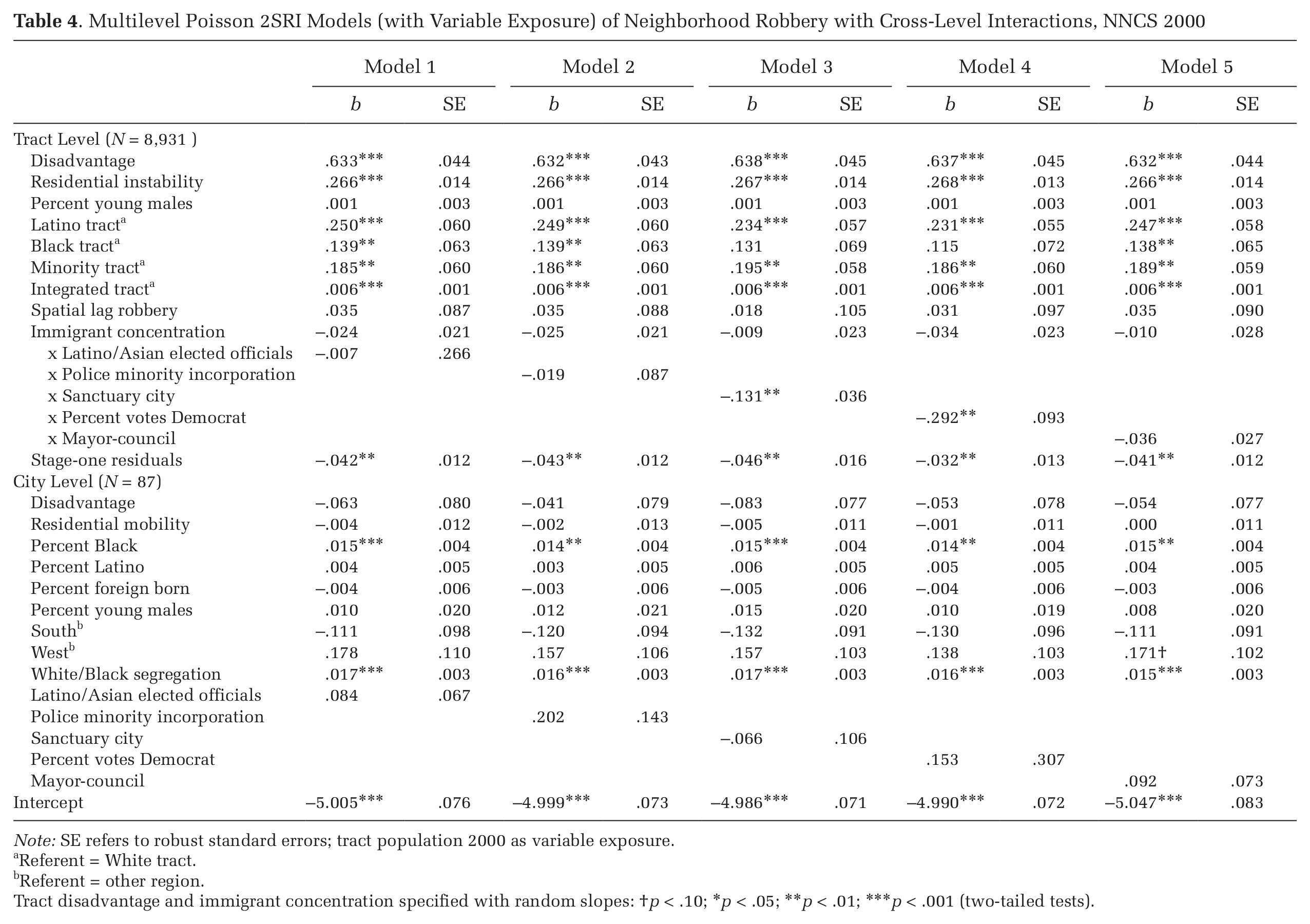
Multilevel Poisson 2SRI Models (with Variable Exposure) of Neighborhood Robbery with Cross-Level Interactions, NNCS 2000
Note: SE refers to robust standard errors; tract population 2000 as variable exposure.
Referent = White tract.
Referent = other region.
Tract disadvantage and immigrant concentration specified with random slopes: †p < .10; *p < .05; **p < .01; ***p < .001 (two-tailed tests).
For illustration, Figure 1 graphs the conditional relationship between immigrant concentration, political incorporation of Asians and Latinos, and homicide. High or low values refer to 1.5 standard deviations above or below the mean (see Table 1). Figure 1 shows that neighborhood homicide decreases as immigrant concentration increases and that this inverse relationship is most notable in cities with greater political incorporation of Asians and Latinos into municipal offices.

Predicted Values for Cross-Level Interaction between Minority Political Incorporation, Neighborhood Immigrant Concentration, and Homicide
How do these patterns for homicide compare to those for robbery? Table 4 presents whether each of the five city-level political contexts moderates the relationship between tract-level instrumented immigrant concentration and robbery counts. The overall pattern of results for robbery is similar to that for homicide in terms of direction of product terms, although only two of the four significant interactions for homicide reach statistical significance for robbery. For robbery, neighborhoods benefit most from immigrant concentration in cities that have sanctuary laws/resolutions (Model 3) and that have a more receptive audience in the form of support for Gore (Model 4).
To illustrate one of these relationships, Figure 2 graphs the conditional association between immigrant concentration, sanctuary city policy, and robbery. High or low values for immigrant concentration refer to 1.5 standard deviations above or below the mean. Figure 2 shows that neighborhood robbery decreases as immigrant concentration increases and that this relationship is most precipitous in cities with formal policies that limit the enforcement of immigration laws (14 percent of our sample).

Predicted Values for Cross-Level Interaction between Sanctuary City Policies, Neighborhood Immigrant Concentration, and Robbery
In contrast with homicide, neither political incorporation of Asians and Latinos into elected offices (Model 1) nor bureaucratic incorporation into the police force (Model 2) moderate the relationship between neighborhood immigration and robbery. The product terms are negative but not significant at traditional levels. As with the homicide models, mayor-council form of government does not interact significantly with immigrant concentration to influence robbery counts (Model 5). Although the nonsignificant moderating effect of mayor-council form of government across both violence outcomes is unexpected, we are not the first to find that mayor-council governments are not significantly more responsive to minority populations (e.g., Santoro 1995). Perhaps some mayor-council governments do indeed allow for immigrant influence, whereas others may be more attuned to an anti-immigrant constituency; the operation of mayor-council governments may thus be inconsistent.
In summary, despite some exceptions, we find overall statistical support that immigrant political opportunities enhance the inverse neighborhood-level association between immigrant concentration and violence, especially for homicide.
Conclusions
Urban research typically focuses on neighborhood outcomes within one or a small number of cities. As a result, researchers rarely adopt a multilevel comparative approach that appreciates the embedded ecology of neighborhoods within varied city contexts. We therefore know little about how larger structural forces at the city level worsen or ameliorate neighborhood dynamics related to the uneven distribution of social problems across neighborhoods. To address this gap, we examined how receptivity of city-level political actors and structures to immigrant concerns shapes the relationship between neighborhood immigrant concentration and violence. Educing insights from social movement and political science literatures, we proposed the concept of immigrant political opportunities to capture the extent that the local political setting is favorable to immigrant concerns. We hypothesized that the protective relationship between neighborhood immigration and violence does not apply to all neighborhoods equally but rather is contingent upon city-level immigrant political opportunities. Specifically, cities that are more receptive to immigrants’ needs and demands should be best able to assist the revitalization faculty of immigrant concentration.
Our multilevel instrumental variable models support the immigrant revitalization hypothesis and a growing number of studies that point to the protective association between immigrant concentration and neighborhood violence. Rather than destabilizing communities and contributing to social disorganization, we found that tract-level immigrant concentration was inversely associated with neighborhood homicide and robbery, on average, across 8,931 Census tracts. Moreover, we found that this average relationship varies significantly across cities and that immigrant political opportunities account for some of this variation. Specifically, cities with immigrant political opportunities enhance the protective association between neighborhood immigrant concentration and violence, particularly for homicide. For homicide, neighborhoods benefit more from immigration when cities have greater political incorporation of Asians and Latinos into city offices and bureaucratic incorporation of minorities into the police force. For both homicide and robbery, pro-immigrant legislation and Democratic electoral strength enhance the inverse relationship between immigration and violence.
To explain these conditional relationships, we proposed that favorable immigrant political opportunities reinforce social organization within immigrant neighborhoods by enhancing the trust immigrants place in civic processes and immigrants’ capacity to exert public social control. That is, political opportunities can reduce immigrants’ marginalization and social isolation and instead encourage their participation in civic life and collective organization around common goals, including safer neighborhoods. In these ways, political opportunities can facilitate the revitalization capacity of immigrant concentration for neighborhoods. In less receptive contexts, however, immigrants may face greater barriers to incorporation and likely greater odds of social and political marginalization. In fact, our results imply that relatively closed regimes may foster processes that disrupt social organization, including immigrant distrust of local government, detachment from neighborhoods, and social isolation.
All macro immigration-crime research confronts methodological challenges in isolating the aggregate effect of immigration on crime rates. Issues of selectivity in immigrant settlement patterns are difficult to dismiss. But the data we used and the analytic strategy we adopted offer considerable leverage. Peterson and Krivo’s (2010a) pioneering work has made available data unparalleled in scope to assess how contexts across 87 large municipalities influenced the correlates of crime for nearly 9,000 neighborhoods. Our models took seriously issues of selectivity by controlling for prior immigrant settlement patterns at the tract level and foreign-born population size at the city level. Our results are also robust to attempts to account for endogeneity with 2SRI instrumental variable models. The most fervent skeptic may remain unconvinced that immigration ameliorates neighborhood criminogenic processes, but our research, in conjunction with a large body of supportive work, challenges nativist fears about the dangers of immigration for community viability. Rather, the vilification of immigrants strikes us as representing symbolic crusades driven by fear and anxiety about the changing racial fabric of our communities (Hagan, Levi, and Dinovitzer 2008; Hagan and Palloni 1999).
We offer four avenues for future research. First, like most macro quantitative research on immigration, we cannot directly observe with our data the mechanisms by which city-level political opportunities influence the neighborhood-level relationship between immigration and violence. A full test of intervening mechanisms would require (1) neighborhood-level indicators of social organization across various cities, including trust in and ties to civic leaders and institutions, mobilization, and civic engagement; and (2) sufficient variation across cities in key dimensions of immigrant political opportunities. To date, no data repository exists to examine these processes related to social organization for the large sample of cities and neighborhoods that we examine with the NNCS. We thus are unable to measure the dimensions of neighborhood social organization that we suggest emanate from favorable immigrant political opportunities at the city level. A comparative ethnographic approach (e.g., Abu-Lughod 1999; Hyra 2008) may present a fruitful design for illuminating how differences in immigrant political opportunities interact with community social organization in shaping crime. Future research, for instance, could compare dynamics related to immigrant concentration, social organization, and crime within a small number of cities with substantively different immigrant political opportunities.
Second, immigrants have considerable heterogeneity in terms of language, home country, and racial background, which likely complicates the immigration-crime relationship. Some scholars suggest addressing this complexity by moving beyond immigrant concentration, a measure of homogeneity that treats all immigrants as a monolithic category, and examining neighborhood levels of language diversity (see, in particular, Graif and Sampson 2009). In addition, other scholars find that criminal justice contact among immigrants differs by country of origin (Nielson and Martinez 2011), perhaps due to different experiences with racialization in the United States (Provine and Doty 2011). Additional research along these lines would provide more nuance to our understanding of the immigration-violence link.
Third, we concentrate on political dimensions of city context. Research should continue to explore the moderating potential of additional cultural, social, and economic contexts of reception. Segmented assimilation theory, for example, emphasizes the role of ethnic enclaves in aiding immigrant economic mobility (Portes and Zhou 1993). Others note that immigrant destinations with long histories of immigrant settlement provide an array of cultural and social arrangements that facilitate immigrant incorporation (Waters and Jimenez 2005). These include the presence of legal-aid bureaus and other immigrant-serving organizations, bilingual and health services, job placement centers, and co-ethnic social organizations. Yet in new places of immigrant settlement, such arrangements are typically less well established (Waters and Jimenez 2005). Recent work provides suggestive evidence of the implications of immigrant settlement patterns for violence at the county (Shihadeh and Barranco 2010), city (Painter-Davis 2012), and tract levels (Ramey 2011; Vélez and Lyons 2012). Shihadeh and Barranco (2010), for example, found that linguistic isolation correlates with reductions in Latino homicide victimizations in traditional immigrant counties but not in new destination counties where immigrants face greater economic marginalization. Our approach suggests that cities with vibrant ethnic enclaves and preexisting immigrant institutional arrangements will condition the presence of social problems within immigrant-concentrated neighborhoods. Exploring these and similar questions acknowledges the multiple levels of urban ecologies that shape neighborhood outcomes. A multilevel analytic framework promises to expand our understanding of urban processes and the fate of marginalized neighborhoods in both scope and scale.
Fourth, although we expect the patterns we uncovered circa 2000 to hold for U.S. cities and neighborhoods in recent years, since 2000 the United States has experienced continued, yet shifting and uneven, patterns of immigration. As recent controversies in Arizona, Georgia, Alabama, and elsewhere suggest, state governments have responded in different ways to the evolving face of immigration. We encourage additional research to examine the implications for crime of changing immigrant concentrations and political contexts of reception. A second wave of the NNCS would enable scholarship to consider the unfolding and interrelated dynamics of political opportunity structures, immigration, and neighborhood violence.
Our theoretical claim that city-level opportunity structures condition neighborhood-level processes should extend beyond the case of immigration and crime. Opportunity structures likely moderate the relationship between other well-established correlates of neighborhood violence. For instance, decades of research has so often noted the strong correlation between minority composition and neighborhood violence that many take the association to be invariant across place. From a social disorganization framework, larger minority proportions may lead to greater rates of violence because of the concentration of economic disadvantages and resulting social isolation associated with minority neighborhoods. Yet, as we have shown, neighborhoods are embedded in city structures that partly shape the well-being of marginalized communities. Cities with greater political, social, and economic opportunities for minorities may be able to counter the social isolation and disorganization faced by minority neighborhoods and therefore attenuate the relationship between racial composition and violence.
In conclusion, contrary to much public opinion and political rhetoric, our research joins a chorus of others in suggesting that immigration generally makes neighborhoods safer. However, the ability of immigration to reduce violence partly depends on the political climate of immigrant reception. Places with favorable immigrant political opportunities seem best able to support the protective association of immigration and crime, presumably because they facilitate revitalization processes. Our results imply that the punitive anti-immigrant policies enacted in many jurisdictions decrease the benefits of immigration for our communities. These exclusionary tendencies can engender mistrust and suspicion on the part of newcomers that erodes involvement in social and political life, attachment to and ownership of neighborhoods, and mobilization on behalf of neighborhood concerns (Aranda and Vaquera 2011). The ability of immigrants to revitalize their communities may depend on how attached immigrants feel toward receiving communities. By marginalizing newcomers, creating political cynicism, and instilling mistrust of the police and local authority, hostile regimes may set in motion the very processes they fear.
Footnotes
Appendix
Descriptives across Political Opportunity Regimes (N = 87)
| Latino/Asian Elected Officials |
Police Minority Incorporation |
Sanctuary City |
||||||||||
|---|---|---|---|---|---|---|---|---|---|---|---|---|
| Below Average |
Above Average |
Below Average |
Above Average |
No |
Yes |
|||||||
| Mean | SD | Mean | SD | Mean | SD | Mean | SD | Mean | SD | Mean | SD | |
| City Level (N = 87 ) | ||||||||||||
| Disadvantage | −.04 | .83 | .19 | 1.10 | −.13 | .89 | .17 | .85 | .02 | .88 | −.07 | .85 |
| Residential mobility | 52.31 | 6.11 | 54.17 | 5.00 | 53.26 | 5.85 | 52.18 | 5.97 | 52.67 | 5.86 | 53.16 | 6.35 |
| Percent Black | 19.70 | 16.50 | 15.93 | 16.96 | 14.96* | 13.58 | 22.99* | 18.56 | 18.46 | 14.94 | 21.20 | 25.32 |
| Percent Hispanic | 16.90* | 16.89 | 29.22* | 20.67 | 18.51 | 16.12 | 19.60 | 21.06 | 18.70 | 19.10 | 21.16 | 15.32 |
| Percent young males | 16.00 | 2.33 | 16.15 | 2.78 | 15.77 | 2.42 | 16.25 | 2.43 | 15.82 | 2.38 | 17.14 | 2.49 |
| Percent foreign born | 14.91 | 11.65 | 17.58 | 14.66 | 15.26 | 9.80 | 15.80 | 14.75 | 15.16 | 12.74 | 17.76 | 9.84 |
| South | .37 | .49 | .30 | .47 | .38 | .49 | .33 | .48 | .37 | .48 | .25 | .45 |
| West | .22 | .42 | .45 | .51 | .31 | .47 | .24 | .43 | .24* | .43 | .50* | .52 |
| White/Black segregation | 49.49 | 18.01 | 41.07 | 17.86 | 40.98* | 15.65 | 54.60* | 18.31 | 45.87 | 17.85 | 58.04 | 17.72 |
| Average tract homicide count | 1.08 | .83 | 1.08 | .91 | .88* | .65 | 1.29* | .98 | 1.27 | 1.98 | 1.96 | 3.20 |
| Average tract robbery count | 32.92 | 20.92 | 35.03 | 22.69 | 25.51* | 16.84 | 41.86* | 22.33 | 39.59 | 43.80 | 53.61 | 56.65 |
| N | 67 | 20 | 45 | 42 | 75 | 12 | ||||||
| Percent Votes for Gore |
Mayor-Council Government |
|||||||||||
| Below Average |
Above Average |
No |
Yes |
|||||||||
| Mean | SD | Mean | SD | Mean | SD | Mean | SD | |||||
| City Level (N = 87 ) | ||||||||||||
| Disadvantage | .19 | .89 | −.13 | .85 | −.18* | .91 | .26* | .77 | ||||
| Residential mobility | 51.19* | 6.49 | 53.94* | 5.14 | 54.58* | 5.54 | 50.37* | 5.54 | ||||
| Percent Black | 24.64* | 19.18 | 14.33* | 12.72 | 14.83* | 13.92 | 24.00* | 18.41 | ||||
| Percent Hispanic | 17.46 | 16.85 | 20.26 | 19.88 | 21.03 | 18.15 | 16.46 | 19.02 | ||||
| Percent young males | 15.97 | 2.32 | 16.03 | 2.52 | 16.13 | 2.58 | 15.84 | 2.23 | ||||
| Percent foreign born | 15.32 | 10.20 | 15.68 | 13.92 | 16.95 | 11.43 | 13.68 | 13.41 | ||||
| South | .24* | .43 | .45* | .50 | .43 | .50 | .26 | .45 | ||||
| West | .29 | .46 | .27 | .45 | .37 | .49 | .16 | .37 | ||||
| White/Black segregation | 51.87 | 17.84 | 44.20 | 17.98 | 40.81* | 18.13 | 56.24* | 14.42 | ||||
| Average tract homicide count | 1.21 | .95 | .98 | .75 | .85* | .68 | 1.38* | .95 | ||||
| Average tract robbery count | 37.45 | 20.40 | 30.26 | 21.52 | 26.89* | 18.64 | 41.80* | 21.63 | ||||
| N | 40 | 47 | 49 | 38 | ||||||||
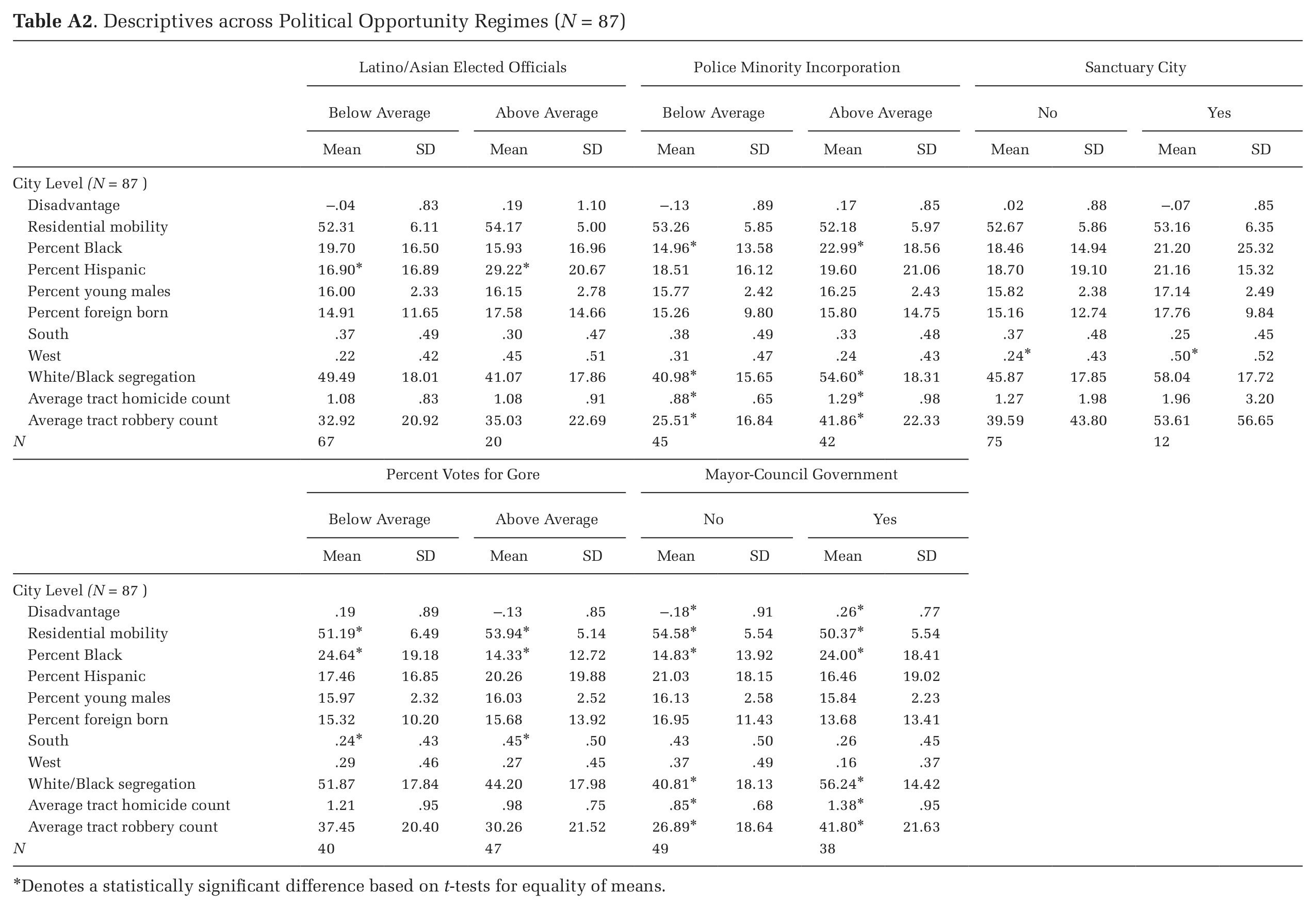
Denotes a statistically significant difference based on t-tests for equality of means.
Acknowledgements
We are very grateful to Ruth Peterson and Lauren Krivo for support and data, David Ramey for data assistance, Blake Boursaw for statistical advice, fellow members of the 2011 Summer Research Institute at The Ohio State University (attended by the second author), Leslie Reid and Rob Greenbaum for constructive comments, and Arlene Santoro.
Notes
References
Supplementary Material
Please find the following supplemental material available below.
For Open Access articles published under a Creative Commons License, all supplemental material carries the same license as the article it is associated with.
For non-Open Access articles published, all supplemental material carries a non-exclusive license, and permission requests for re-use of supplemental material or any part of supplemental material shall be sent directly to the copyright owner as specified in the copyright notice associated with the article.
