




Abstract
We elaborate a cultural framing theory of legal cynicism—previously used to account for neighborhood variation in Chicago homicides—to explain Arab Sunni victimization and insurgent attacks during the U.S. post-invasion occupation of Iraq. Legal cynicism theory has an unrecognized power to explain collective and interpersonal violence in international as well as U.S. settings. We expand on how “double and linked” roles of state and non-state actors can be used to analyze violence against Arab Sunni civilians. Arab Sunnis responded to reports of unnecessary violent attacks by U.S./Coalition soldiers with a legally cynical framing of the U.S./Coalition-led invasion and occupation, the new Shia-dominated Iraqi state, and its military and police. A post-invasion frame amplification of beliefs about state-based illegitimacy, unresponsiveness, and insecurity made it not only possible but predictable that Arab Sunni insurgent attacks would continue against U.S./Coalition forces and transfer to Shia-dominated Iraqi government forces. Violence in Iraq persisted despite U.S. surge efforts to end the Arab Sunni insurgency.
The Sunni insurgency in Iraq resurfaced in 2011 news coverage following the departure of U.S. troops. Politicians and journalists had overlooked pockets of simmering insurgency during the previous period of declining violence. 1 We extend a U.S.-based theory of legal cynicism to explain resilience of the Sunni insurgency from 2007 through 2008. Our application of legal cynicism theory draws on international criminal law and elaborates combined roles of state and non-state actors. We demonstrate how a theory of U.S. homicide applies in an international war zone.
This elaborated theory of legal cynicism, built from cultural framing (Goffman 1974) and social movements (Snow and Benford 1992) research, surmounts problems of earlier ethnic war theory and recent rational-choice institutionalism in the field of international relations—problems that also have plagued subcultural theories in sociological criminology. The cultural frame of legal cynicism can reinvigorate these fields that have developed almost entirely apart.
Subcultures, Ethnic War, and Rational Choice
Early subcultural crime (e.g., Cohen 1950; Wolfgang and Ferracuti 1967) and ethnic war (e.g., Kaplan 1993; Kaufman 1996; cf., Brubaker 2004; Kalyvas and Kocher 2007) theories explain domestic and international violence through deeply entrenched norms and values. Kirk and Papachristos’s (2011:1194) statement on subcultural crime theory also applies to early ethnic war theory: “This approach conceives of culture as something deep inside—a bundle of norms, beliefs, attitudes, and values that provide . . . motive for action (e.g., Parsons 1951).” 2 Kalyvas and Kocher (2007:204) reason this is why violence in ethnically charged civil wars is often called ethnic violence: these “ethnic cleavages are seen as inherently deeper than nonethnic ones.”
A recent move beyond ethnic war theory by rational-choice institutionalism (see, e.g., Katznelsen and Weingast 2005) focuses on how “sticky” resource endowments and investments explain insurgent violence. The metaphor of stickiness signals a continued focus on deeply entrenched causes. For example, Weinstein (2007) argues in Inside Rebellion that insurgent violence flows from initial interactions of leaders with members of rebel organizations. Kalyvas (2007:1148) argues that the resulting path dependency of Weinstein’s theory is so strong that “only initial endowments matter: Once organizations attract a specific type of individual, they can’t change even if their resource endowments change over time.” We control for effects of this predicted stickiness.
Kalyvas (see also Tarrow 2007) goes on to observe that rational-choice institutionalism theories neglect changes in external contingencies—such as the U.S. intervention in Iraq—and dynamic cultural reactions—such as group-linked resentment and rebellion. Weinstein (2007:15) downplays these changes as “only one part of the larger landscape.” Yet as Buhaug, Gates, and Lujala (2009:566) emphasize, a reconfiguration of the study of ethnic conflict through more nuanced temporal and geographic disaggregation can explain when and how groups come into domestic and international conflict. These neglected contingencies in rational-choice theories include actions of powerful states. Interventions by foreign states can ignite and intensify such wars, as targeted regimes are often replaced and reconfigured. As a result, targeted states are prone to a legal cynicism that can lead to insurgent violence.
State-Based Legal Cynicism
Legal cynicism has its roots in Cloward and Ohlin’s (1960) structural theory of social injustice and in Matza’s (1964) symbolic interaction theory of legal injustice. Cloward and Ohlin argue that violent crime is caused by feelings of social injustice produced by limited access to legitimate and illegitimate opportunities. Matza argues that crime stems from a sense of legal injustice produced by interactions with the police and courts, the state-empowered defenders of legalized opportunity structures.
Sampson and Bartusch (1998) incorporate both approaches in their conceptualization of legal cynicism (see also Hagan and Albonetti 1982; Hagan, Shedd, and Payne 2005). They link diminished macro-level neighborhood socioeconomic resources to the micro-level legally cynical framing Matza (1964:101) calls “simmering resentment.” This simmering resentment weakens law’s power and is the cognitive sentiment that Sampson and Bartusch evocatively conceptualize in relation to macro-level neighborhood circumstances.
Legal cynicism has been applied to a range of U.S. social problems, from homicide (Kirk and Papachristos 2011) and biased police arrests (Carr, Napolitano, and Keating 2007; Kirk and Matsuda 2011) to teen births (Sampson 2012). Kirk and Papachristos (2011:1191) further elaborate legal cynicism as a cultural frame in which police law enforcement is viewed—especially in disadvantaged neighborhoods—as illegitimate, unresponsive, and ineffectual in providing security to citizens, and as “ill equipped to ensure public safety.”
Matza (1964:102) notes the role of states in producing this legal cynicism: The common sense of western traditions was well formulated in Augustine’s rhetorical question, “What are states without justice but robber bands enlarged?” The cry of injustice is among the most fateful utterances of which man is capable. . . . It is tantamount to asserting that chaos or tyranny reign instead of order and society.
Sampson and Bartusch (1998:783) follow Matza in emphasizing that state policies and practices are sources of legal cynicism in U.S. settings of racial segregation and concentrated disadvantage, “where inability to influence the structures of power that constrain lives is greatest.” Kirk and Papachristos (2011:1198) highlight the state-based link between financial and human security consequences when they observe that in disadvantaged neighborhoods, “people come to understand that the dominant societal institutions (of which the police and the justice system are emblematic) will offer them little in the way of security, either economic or personal.”
Kirk and Papachristos (2011) conceptualize legal cynicism along three state-linked dimensions of illegitimacy, insecurity, and unresponsiveness. Illegitimacy involves macro-level state authority and responsibility, insecurity reflects micro-level individualized experiences and perceptions, and unresponsiveness involves faulty meso-level mediating mechanisms linking state responsibility to citizen needs.
This double (macro and micro) and linked (through meso) understanding of legal cynicism highlights the theory’s potential to synthesize insights of subfields as separate as criminology and social movements (see also McAdam et al. 2005). This potential is grounded in the frame analysis that forms cultural and structural linkages in social movement theory (Gamson, Fireman, and Rytina 1982; Snow et al. 1986). Kirk and Papachristos (2011) highlight the parallel importance of a framing perspective for explaining violent behavior.
We explain how the motivation and mobilization of collective violence is heightened by a legal cynicism frame in an insurgent, civil-war setting. Kirk and Papachristos (2011) emphasize that when a nation’s laws and law-based institutions are framed in citizens’ minds as just, legitimate, and responsive, individuals are unlikely to deviate from them. We therefore analyze what drives the framing of a nation’s legal order and the consequences that arise when cynicism overtakes this framing.
Mobilization against a nation-state is often driven by a cynical framing of its laws and enforcement tactics (Gamson et al. 1982). When a framing of legally cynical injustice predominates, the likelihood of collective violence can escalate. Kirk and Papachristos (2011) demonstrate this with Chicago homicide rates, and it may also be the case in international contexts of insurgency and civil war—as in Iraq.
Cultural Framing of the Sunni Insurgency in the Context of International Law
In Iraq, the legal cynicism frame involved reports of unnecessary violence by U.S. forces against Arab Sunni civilians. Unnecessary violence against civilians 3 is an important part of the international criminal law of aggressive war. 4 Walzer (2012) notes that although much attention is given to circumstances that initiate war—ad bellum—further work is necessary on what comes next—post bellum—after war begins. “Surely this is the work that must be done,” Walzer (2007:642) insists, “before the [International Criminal Court] can think about prosecuting political leaders for the crime of aggression—or for any lesser crimes.” We argue, as Sutherland (1944) did in this journal for an earlier generation and white-collar crimes, that social science can contribute to finding probable cause evidence of war crimes (see also Hagan and Rymond-Richmond 2008). 5
Legal cynicism among Arab Sunnis was not an instantaneous reaction to the U.S.-led invasion. The challenge is to understand the process through which legal cynicism emerged in response to the violent tactics of the occupation—especially against Arab Sunnis, whose experiences foretold insurgent attacks on U.S. forces. Because the United States rebuilt the Iraqi army and security forces, we hypothesize that subsequent insurgent attacks on Iraqi army and security forces were the product of the transference of legal cynicism about U.S./Coalition forces on to the new Iraqi forces.
Our conceptualization of legal cynicism is grounded in Snow and colleagues’ (1986:469) specification of frame amplification as “the clarification and invigoration of an interpretive frame.” They distinguish values from belief amplification in subcultural and ethnic war theories: “whereas values refer to the goals or end-states . . ., beliefs can be construed as ideational elements that cognitively support . . . action in pursuit of desired values” (Snow et al. 1986:469–70). In Iraq, “belief amplification” emerged from a sense of defeat following the toppling of Saddam’s Sunni-dominated Ba’athist regime.
Sampson and Bartusch (1998) applied the concepts of “defeated” and “defended” neighborhoods in their Chicago research (see also Kapsis 1978; Suttles 1968). Legal cynicism of a defeated group is relevant in Iraq, because this cynicism can amplify group experiences and beliefs about state-organized, counter-insurgent violence into insurgent reprisals. Emergent culturally framed and amplified understandings are tools and mechanisms (Lamont and Small 2008) that can lead groups to form violent responses to the dilemmas imposed by defeats—whether, for example, these defeats follow from concentrated poverty, state repression, or both.
Weber (1919) classically conceptualized the state as a human community that claims the monopoly of the legitimate use of physical force. Following the U.S.-led invasion, presidential envoy Paul Bremer (2006) ordered the “de-Ba’athification” of Iraq’s government and demobilization of its military. This removal of Sunni Ba’athists from state employment banished mid-level Sunni bureaucrats and soldiers along with higher-level Saddam loyalists, undermining Arab Sunnis’ perceptions of the legitimacy of Iraq’s state institutions. During the early occupation, U.S./Coalition forces massively bombarded Fallujah, in the Sunni heartland, further confirming the defeated status of the Arab Sunnis. Most Sunni politicians withdrew from the Iraqi parliament to protest the disproportionality of the attack on Fallujah (Wong 2004).
Hashim (2006:48) explains that the low turnout of Sunnis for the 2005 elections was “symptomatic of their cynicism about and contempt for the entire process.” Failure to meaningfully involve Sunnis in Iraq’s governance was apparent from the U.S. appointment of an Interim Governing Council, with only five Sunni Arabs out of 25 members, and through what Dodge (2012; also Filkens 2014a, 2014b) called the “exclusive elite bargain” that twice (in 2006 and 2010) installed Nouri al-Maliki—a Shia and former member of the de-Ba’athification Commission—as Prime Minister.
Kirk and Papachristos’s (2011) conceptualization of legal cynicism goes beyond illegitimacy to consider unresponsiveness and ineffectiveness in providing safety and security. Benford and Snow (2000:623) emphasize that such “punctuated or accented elements may function in service of the articulation process.” Our thesis is that together, the dimensions of illegitimacy, unresponsiveness, and ineffectiveness in providing security contributed to an Arab Sunni frame amplification, which they used to justify “taking law into their own hands.”
Many Arab Sunnis were especially cynical about the U.S. “surge” strategy. Despite the focus on protection in discussions of the surge (see Kaplan 2013), Dodge (2012:84) reports “the major change in U.S. policy towards Iraq, launched in 2007, was dominated by military campaigns to the exclusion of all else.” Operations Phantom Thunder and Phantom Strike initiated the surge (Dodge 2012; Gordon and Trainor 2012), and U.S. military deaths, Iraqi civilian casualties, and insurgent attacks all spiked (see Cordesman, Mausner, and Derby 2010). During one week in August 2007, U.S. Special Operations forces launched 87 missions in Arab Sunni areas in northern Iraq that killed 59 people and detained 200 (Gordon and Trainor 2012).
Until the Blackwater killings of 17 civilians in Baghdad’s Nisour Square, 6 the massacre of 24 civilians in Haditha was probably the best-known example of U.S.-led violence against Sunni civilians. The Haditha killings resulted in a rare trial and conviction; 400 pages of classified testimony from the military investigation were later discovered (Schmidt 2011). General Johnson, who commanded U.S. forces in Sunni Anbar province, testified that unnecessary violence against civilians “happened all the time” and “I felt that was . . . just a cost of doing business” (Schmidt 2011). U.S. forces were trained for violent combat instead of policing and peacekeeping roles. These counter-insurgent strategies toward Arab Sunnis amplified a defeated cultural frame of legal cynicism toward U.S./Coalition forces and, ultimately, the Iraqi government and armed forces.
Modeling the Legal Cynicism of the Sunni Insurgency
Kirk and Papachristos’s (2011:1201) cultural framing thesis is ecological: “individuals’ own experiential-based perception of the law becomes solidified through a collective process whereby residents develop a shared meaning of . . . the viability of the law to ensure their safety.” Legally cynical cultural meanings become so negatively reinforced that they are collectively amplified into violent “strategies of action.” Chicago neighborhoods characterized by concentrated poverty, including disadvantaged neighborhoods undergoing gentrification, experienced higher legal cynicism and homicide rates. Buhaug and Rod (2006) emphasize that infrastructure deficits often signal spatial patterns of unemployment and poverty. Our thesis is that especially in Arab Sunni areas disadvantaged by poor infrastructure reconstruction, legal cynicism about U.S.-led forces perceived as illegitimate, unresponsive, and ineffective in meeting safety and security needs provoked insurgent collective violence.
Lamont and Small (2008) emphasize that violent “strategies of action” can be creatively framed responses to limited structural possibilities. In Iraq, we argue that the constraints and possibilities were state-created, not only through neglect of community infrastructure, but especially by violence against civilians by U.S./Coalition forces. Arab Sunni communities in particular perceived this violence as unnecessary, which intensified legally cynical attitudes about the U.S.-led invasion, occupation, and resulting insecurity. The new Iraqi regime and armed forces trained by U.S. advisers also became objects of Arab Sunni cynicism. Sunnis felt besieged by the surging U.S. forces and the new U.S.-created Iraqi government, resulting in strategies of violent insurgency, including attacks on U.S./Coalition forces. This is the cultural framing process that we hypothesize created a resilient Sunni insurgency (see Figure 1).
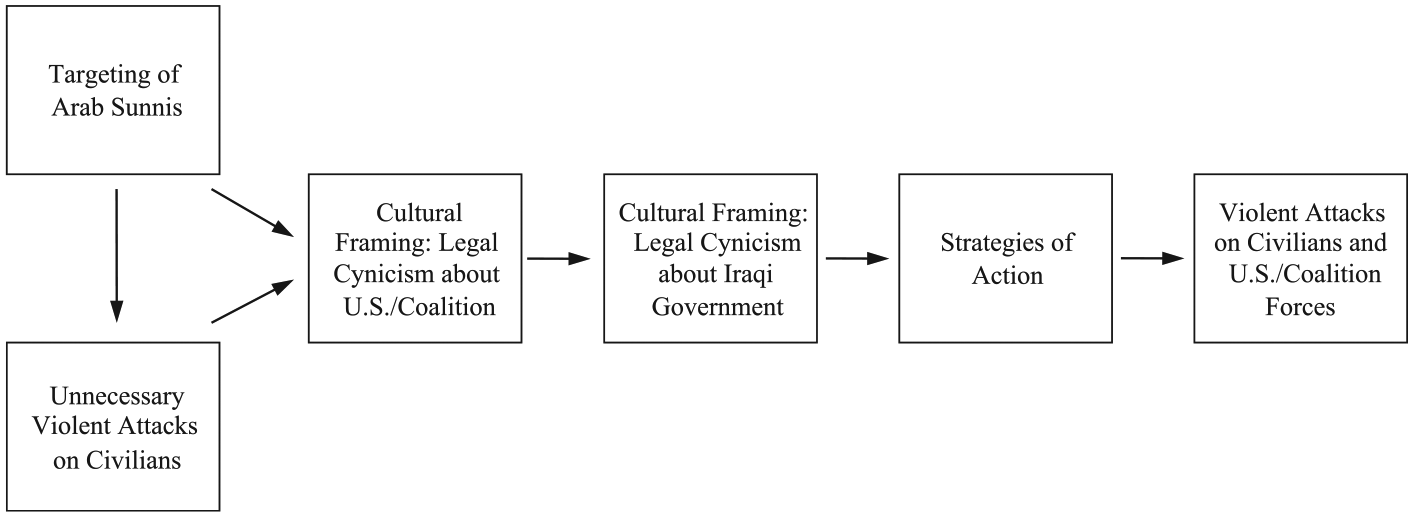
Conceptual Model of the Cultural Framing of Legal Cynicism That Made Attacks on Civilians and U.S./Coalition Forces Acceptable and Possible as a Strategy for Action in Iraq
This model subsumes Black’s (1983) theory of self-help as a response to the failure to establish order, safety, and security (see also Anderson 1999; Hannerz 1969). Of course, the conceptual model presented in Figure 1 does not include all causal forces leading to attacks on U.S. forces. We consider other possible influences in our empirical models. However, the following hypotheses follow from Figure 1:
Hypothesis 1: Unnecessary violence against civilians by U.S./Coalition forces was perceived and reported most often by Arab Sunni individuals in Arab Sunni communities.
Hypothesis 2: A frame amplification of legal cynicism about the U.S./Coalition forces was also most prominent among Arab Sunni individuals in Arab Sunni communities.
Hypothesis 2 builds on Sampson’s (2012) elucidation of the collective force of this kind of frame amplification.
Next we examine whether legal cynicism about U.S./Coalition forces transferred to the new Iraqi institutions created by the U.S. occupation, anticipating the following:
Hypothesis 3: Iraqis who were legally cynical about the legitimacy, responsiveness, and effectiveness of the U.S./Coalition extended this cynicism, albeit initially in reduced degree, to the Iraqi government, military, and police.
Hypothesis 3 likely foreshadows attacks by al-Qaeda in Iraq (AQI) and the Islamic State in Iraq and Syria (ISIS) on the Iraqi government, military, and police that persisted through the surge and beyond.
The next hypothesis is essential to our theoretical approach, because we argue that attacks on U.S./Coalition forces would not have persisted if their actions had been perceived as legitimate, responsive, and protective. Rather, these attacks occurred and persisted because they were framed as responding to an illegitimate U.S.-led invasion that was selectively irresponsible in responding to security needs:
Hypothesis 4: Legal cynicism about U.S./Coalition forces and the Iraqi government and military led to insurgent attacks on these forces in predominately Arab Sunni areas.
The impact of legal cynicism about the U.S. role in Iraq accounted for the persistence of attacks on U.S.-led forces in Arab Sunni areas in 2007 to 2008 and foreshadowed increasing violence.
Kirk and Papachristos (2011) show something similar in Chicago. During the 1990s, when homicides decreased in Chicago (and other U.S. cities), violence nonetheless persisted in specific neighborhoods. They show that legal cynicism continued, which elevated homicide in some areas of concentrated poverty, even when these areas experienced gentrification.
We hypothesize that the theory of legal cynicism can also explain the resilience of Sunni insurgency during an overall decline in violence in Iraq. Our elaboration of this theory emphasizes the double and linked roles of state and non-state actors: the violence of U.S./Coalition forces combined with the amplifying role of legally cynical cultural framing among Arab Sunni citizens who reported attacks by these forces. This combination set the foundation for the persistence of Sunni insurgent attacks on U.S. forces during the surge:
Hypothesis 5: Legal cynicism in Arab Sunni communities predicts the areas where insurgent attacks on U.S. forces persisted or increased, even as these attacks declined elsewhere after the surge of U.S. forces in Iraq.
This hypothesis is particularly important because it reflects how a theory prominently used to explain homicide rates in a U.S. city can be expanded internationally to explain systematically organized insurgent violence. The theory of legal cynicism has broad relevance and potential for theoretical growth.
The Data
Buhaug and Rod (2006) emphasize that an ecological fallacy undermines applications of ethnic war theories using aggregated country-level data. Cederman and Gleditsch (2009) similarly highlight the importance of disaggregated data in revealing temporal and geographic variation in the influence of state interventions in civil conflicts. We use disaggregated data from five sources. First, we drew individual- and community-level data from a probability-based, household National Public Opinion Survey in Iraq (NPOSI) conducted during the 2007 surge (see Tables A1 and A2 in the Appendix). The second data source is a recently declassified, district-level enumeration by U.S./Coalition forces of “enemy-initiated” (i.e., by non-Coalition actors) military incidents, called SIGACTs (“significant activities”), that we analyze through 2008. The third data source is a district-level enumeration by Iraq Body Count (IBC) of civilian casualties, based on reports by media, hospitals, morgues, and other sources, which we analyze through 2008. The final two sources are district-level, structural resource data consisting of 2005 and 2007 reports from the United Nations World Food Programme (WFP) and the 2004 Iraq Living Conditions Survey (ILCS). Descriptive statistics for district-level variables 7 are presented in Table 1.
District-Level Descriptive Statistics, Iraq
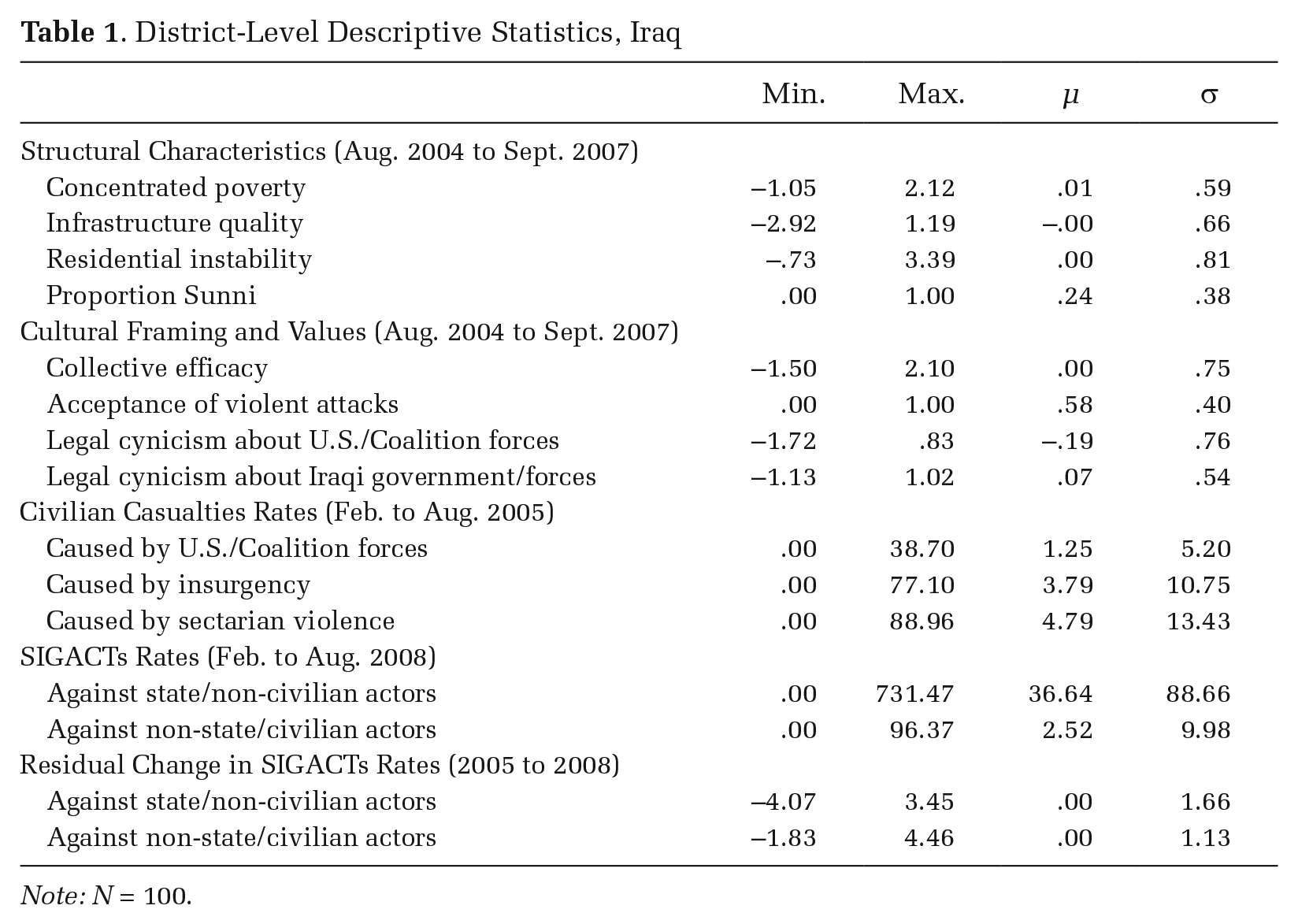
Note: N = 100.
The August 2007 NPOSI was conducted with 2,212 respondents located within 457 representatively sampled neighborhood communities. 8 The survey used sampling points in communities distributed proportionate to population in the 102 districts of the 18 Iraq provinces. Local interviewers administered surveys in Arabic or Kurdish in 62 percent of contacted households.
Although a larger NPOSI sampling may have been ideal, simulations show that four to five sampled households within 457 neighborhood communities is sufficient: acceptable levels of confidence can be achieved with as few as five respondents in 50 groups (Maas and Hox 2005; see also Brown and Draper 2000; Busing 1993; Van der Leeden and Busing 1994). Given a fixed number of individuals sampled, within-group sample size necessarily has an inverse relationship to sample size at the highest level in the hierarchy: as higher-level sample sizes approach the lower-level sample sizes, the within-group sample size declines. However, because error calculations depend on sample size at each level, not within-group sample sizes, it is most important in multilevel models to maximize units at the top level (Maas and Hox 2005). Snijders (2005) notes that organizational research often uses 50 groups, but 30 is normal in educational research and acceptable according to Kreft and De Leeuw (1998); our study considers 100 districts. NPOSI applied an eight-stage, random probability design that sampled districts, then urban and rural areas stratified proportionate to population, and finally community sampling points and households selected randomly within clusters. 9
Iraq was an autocratic, centrally controlled state under Saddam Hussein, but after the invasion it devolved into tribal groupings, sectarian militias, and loosely coordinated political networks, overseen by the United States (Herring and Rangwala 2006). Iraq’s approximately 100 districts vary in size and shape (see note 16) across an area and population similar in size to California.
Perhaps the primary difference compared to the Chicago research involves prioritizing the organization of military/insurgent operations within the larger areas of Iraq’s districts. We include selective community-level measurement where appropriate, but our primary focus is the district level.
Surveying Legal Cynicism in Relation to International Criminal Law
Unplanned Military Policing
In June 2003, U.N. Resolution 1483 declined to authorize the U.S.-led invasion but recognized the United States and United Kingdom as occupying powers, 10 imposing legal responsibilities to provide security and protection for civilians, as mandated by the Geneva Conventions of 1949 and The Hague Regulations of 1907. The United States had not developed a policing and security plan. Robert Perito (2007:1) of the U.S. Institute of Peace warned in an early Defense Department briefing that “[r]eliance on Coalition military forces is not the answer” (see Gordon 2004). He recommended sending 6,663 police advisers to Iraq. The administration instead sent New York City police commissioner Bernie Kerik, who was subsequently removed, convicted of felonies, and sentenced to prison (Sanchez 2008). Reliance on U.S./Coalition forces for policing continued throughout the occupation.
A Gallup survey six months after the invasion found that 90 percent of Baghdad’s citizens feared leaving their home at night (Hagan, Kaiser, Hanson, and Parker 2015). U.S. Colonel Douglas McGregor echoed Perito’s observations about the neglected protection and security obligations and their reliance on soldiers with no knowledge of Arabic or Arab culture (cited in Hashim 2006:326): We arrested people in front of their families, dragging them away in handcuffs with bags over their heads, and then provided no information to the families. . . . Our soldiers killed, maimed and incarcerated thousands of Arabs, 90 percent of whom were not the enemy. But they are now.
The U.S. military developed counter-insurgency tactics with little regard for international law, resulting in war crimes against civilians (see note 3).
The loss of support among the people engendered by this military policing was not simply the sum of the individuals directly affected, but also the collective spillover effect on others who perceived these actions as “collective punishment.” The challenge is to measure this impact with subnational indicators of specific conflict-promoting mechanisms and motivations (see Buhaug and Rod 2006; Cederman and Gleditsch 2009).
Illegitimate, Irresponsible, and Insecure
Social surveys and analyses conducted from 2004 to 2007 reveal a substantial shift from relatively optimistic to legally cynical views about the U.S.-led invasion, occupation, and security situation in Iraq (see news summaries of survey data [BBC News 2007] and analysis by British historian Charles Tripp [2010]). This proliferation of legal cynicism was furthered by the amplification of historically grounded fears and expectations about the U.S. invasion and occupation, leading to unparalleled levels of ethno-sectarian separation in Iraqi communities—which further reinforced the spread of legally cynical framings (Hagan, Kaiser, Hanson, and Rothenberg 2015). Our task in this article is to measure the effect of this frame amplification on the subsequent persistence of violence in a manner consistent with Kirk and Papachristos’s analysis of legal cynicism in Chicago.
We adopt four NPOSI items that in combination parallel Kirk and Papachristos’s focus on legitimacy, responsiveness, and security. All four refer to the U.S./Coalition forces that played the primary policing role (for exact wording, see Table A1 in the Appendix). The first item addresses legitimacy in terms of the rightness/wrongness of the U.S.-led invasion. The second and third items consider legitimacy and responsiveness by asking whether the respondent opposed the presence of U.S./Coalition forces and how well the U.S./Coalition forces carried out their legally mandated protection responsibilities. The final question explicitly asks about the effect of the surge increase in U.S. forces on the security situation. Security is the international law counterpart to order maintenance on U.S. city streets and sidewalks.
We created a separate scale that measures legal cynicism about the Iraqi army, police, and government (see Table A1 in the Appendix). The interviewers asked respondents to indicate the degree to which they had confidence in (1) the national government of Iraq, (2) the Iraqi army, (3) the Iraqi police, and (4) how well the national government had carried out its responsibilities.
The measures for the U.S./Coalition forces were highly correlated and loaded into a single factor ( χ = 3208.90
The U.S. military had an obligation to provide protection and security until confidence could be established in Iraqi institutions. Measures of this confidence loaded into one factor ( χ = 3837.34
Multilevel Causes and Consequences of Legal Cynicism
Individual- and Community-Level Violence against Civilian and State Actors
Among NPOSI respondents, 44 percent reported unnecessary violence by U.S./Coalition forces against nearby civilians—more than from other identified sources. This violence ranged from nighttime raids on homes to heavy artillery and rocket attacks by helicopter gunships. Lower but still notable proportions of Iraqis also reported unnecessary violence against civilians by the Iraqi army (19 percent) and police (21 percent). We analyze the NPOSI measures of nearby unnecessary violence as individual- and community-level variables (see Table A1).
In an NPOSI survey conducted six months earlier, 43 percent of respondents reported unnecessary nearby violence by U.S.-led forces. This similarity suggests reliable reporting, but even if these reports—which are based on perceptions of events—are inaccurate, the Thomas theorem (Merton 1995) holds that Iraqis’ shared beliefs about widespread unnecessary violence by U.S./Coalition forces should have notable effects. As applied here, this theorem asserts that what actors perceive and report as real has real consequences. The U.S. government led the development of victimization surveys that measure public perceptions and reports of violence (Biderman 1967; Hagan 2010; Hagan, Kaiser, and Hanson 2015). High proportions of respondents in the NPOSI survey also perceived and reported nearby bombings, kidnappings, sectarian attacks, and violence between government forces, non-government forces, and militias.
The August 2007 NPOSI survey also includes two items asking whether it is acceptable for attacks to target U.S./Coalition or Iraqi forces. These averaged combined reports show that nearly two thirds (62 percent) of Iraqis regarded attacks on these state actors as acceptable; we analyze this acceptance at the individual and community levels. Future studies may want to add additional cultural measures to isolate the influence of legal cynicism and tolerance of violence compared to other beliefs and attitudes.
Individual-Level Demographic Characteristics
We include seven NPOSI measures of background characteristics. Our measure of sectarian identity is self-designation as Arab Sunni (36 percent) or Shia (45 percent), with Kurdish and other groups (19 percent) as the omitted comparison group. These figures are consistent with estimates that Iraq is about 80 percent Arab Muslim, with the Shia population significantly larger than the Arab Sunni population (see Lipka 2015). The sample is about half male, around 36 years old with some secondary schooling, nearly two thirds are married, and a large minority are employed.
District-Level Characteristics
Table 1 summarizes the 19 aggregate district-level characteristics. We first established the extent to which districts were predominately Sunni: the average across sampling points reporting their district was mostly or completely Sunni was 24 percent. This measure allows us to compare responses from predominately Arab Sunni areas with other areas. 12
In addition to our aggregated measures of legal cynicism and acceptance of attacks, we further include district-level structural and cultural measures previously used in Chicago (Kirk and Papachristos 2011; Sampson and Bartusch 1998). Each measure loaded on one or two factors. We include a concentrated poverty factor based on 2005/2007 WFP measures of household income quintile, average household size, and unemployment rate, along with an ILCS wealth index of household resources ( χ = 145.73, p < .001).
Residential stability is indicated with an ILCS measure of the proportion of houses having renters, along with the proportion of residents surveyed by NPOSI reporting forcible and non-forcible sectarian separation of Sunni and Shia ( χ = 195.61, p < .001). Ethno-religious migration and violent un-mixing of communities peaked during the post-invasion period (Rosen 2010). Instead of immigrant concentration, we use the more relevant NPOSI measure of the proportion of district residents reporting their district was predominantly Sunni.
Collective efficacy is indicated by the ILCS proportion of residents reporting they relied on nearby relatives willing to mediate crime victimization, and the proportion saying they could rely on (i.e., trust) community members for this assistance ( χ = 39.60, p < .001). Future research could benefit from more complete measures of collective efficacy in international contexts.
We include a measure of infrastructure quality to indicate urgent resource constraints faced in many Iraqi communities (Dodge 2012), based on reports of electrical instability, sewer problems, street light malfunction, phone disruption, and poor road quality ( χ = 104.88, p < .001).
District-Level Violence against U.S./Iraqi State Military and Police, and Non-state Civilians
For our final outcome measures of (1) 2008 rates of violence following the surge and (2) persistence of violence rates between 2005 and 2008, we were able to use unique district-level data. We aggregated the NPOSI measures of violence against civilians by U.S./Coalition forces and Iraqi army and police to the community level, because the questions were framed specifically for areas “nearby.” Other surveys in this study measure violence at the district level, because insurgent militia and counter-insurgent military and police forces operate across communities. Because Iraq’s administrative borders were being contested and some shifted, we used two district maps: the Humanitarian Information Center’s (HIC) map of 102 districts, and a map of 104 districts created by the WFP in 2003. 13
Our two outcome measures of district-level violence are based on SIGACTs recorded by U.S./Coalition forces. SIGACTs are defined as “enemy attacks that target Coalition forces, Iraqi forces, civilians, infrastructure, and government” (Berman, Shapiro, and Felter 2011:790). The SIGACTs data consist of attacks against (1) state/non-civilian U.S./coalition and Iraqi military and police targets, and (2) non-state/civilian targets, sometimes including insurgents. Both kinds of SIGACTs were recorded only when U.S./Coalition forces were present, so these data underestimate violent events in Iraq. This measurement approach parallels the officially recorded measures of homicide used by Kirk and Papachristos (2011). Reporting standards changed throughout the war (typically, an event was recorded if there was any return fire or casualties) but became more consistent over time, so we measure SIGACTs only after 2005 (Berman et al. 2011). As an additional check on the validity and reliability of these measures, we also incorporated a different measure of district-level violence from the IBC data (see the next section) and tested each model with multiple combinations of the two measures (see note 15).
SIGACT rates per 100,000 population following the surge (from February to August 2008) are based on monthly estimates from the WFP. Attacks on state/non-civilian targets include roadside and other planted IEDs (improvised explosive devises) undetected before exploding, vehicle-born IEDs (suicide bombs), mortar fire, and direct fire incidents. The majority of SIGACTs recorded were against state/non-civilian targets (average rate of 36.64 per district, compared to 5.25 against civilian targets). 14
District-Level Pre-surge Violence by U.S./Coalition Forces, Insurgents, and Sectarian Groups
We also control for pre-surge violence (February to August 2005), as measured by casualties reported by IBC (Condra and Shapiro 2012) from February through August 2005, as well as violence against U.S./Iraqi state military and police as measured by SIGACTs for this same pre-surge period. The IBC data are divided into three categories according to the party identified as initiating the events resulting in civilian casualties: U.S./Coalition forces (district average rate of 1.25 per 100,000), insurgents (3.79), or other sectarian groups (4.79); the SIGACTS are as measured above in the 2008 period.
The IBC and SIGACTs data complement one another. SIGACTS identify the targets of an attack, but only capture events initiated by non-Coalition actors and witnessed by Coalition actors; they do not differentiate between attacks by insurgent groups (including militias) and more general sectarian violence. IBC data provide a measure of an attack’s initiator and severity (through casualty counts) but not its target. Because each source may include errors, using both sources should reduce measurement bias (see Condra and Shapiro 2012). 15 The pre-surge measures test rational-choice institutionalism’s stickiness thesis, as explained in the following section.
Modeling Legal Cynicism and Violence in Iraq
We first model reported nearby unnecessary violence against civilians by U.S./Coalition forces (Hypothesis 1), consequent legal cynicism about U.S./Coalition forces (Hypothesis 2), and the transfer of this cynicism to the Iraqi government and forces in August 2007 (Hypothesis 3).
We estimate multilevel models (Raudenbush et al. 2004) of reported unnecessary attacks and legal cynicism while accounting for error within and between communities and districts. Each individual-level outcome is modeled as a function of
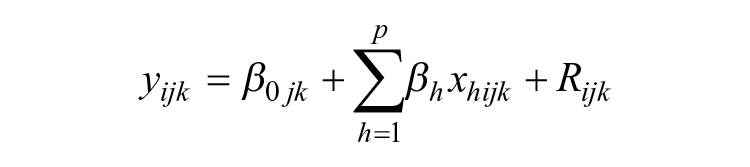
where Yijk represents either reporting of unnecessary U.S. attacks or legal cynicism of person i,
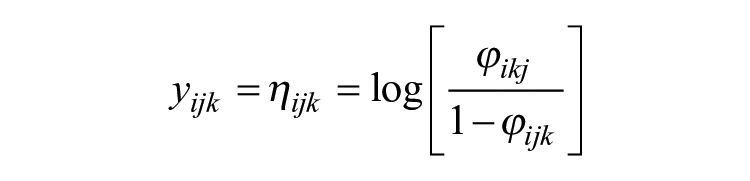
where
At level two, we model the level-one intercept as a function of
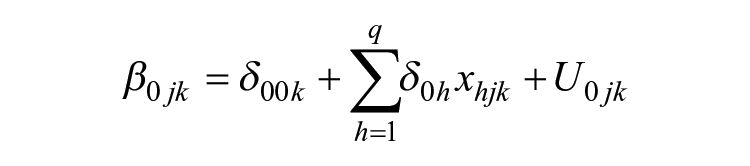
Finally, at level three, we model the level-two intercept, δ00k, as a function of r

These models account for the effects δ0h
The second part of our analysis builds on Kirk and Papachristos’s (2011) finding that legal cynicism predicts and is predicted by area violence—and that legal cynicism is therefore a key predictor of persistence of area violence despite changes in other experiences and structures. This part of the analysis specifically addresses Hypotheses 4 and 5.
The latter hypotheses incorporate a spatial lag, recognizing that violence in one location is influenced by violence in surrounding locations—the problem of spatial autocorrelation (Morenoff, Sampson, and Raudenbush 2001). These models address spatial dependence by adding a regressor representing the weighted average of the lagged variable in immediately surrounding locations. 16 Our models of SIGACT rates take the following form:

where spatially lagged dependent variable
Rates of violence can be extremely skewed and influenced by changes in violence across an entire region (e.g., Chicago or Iraq). Our analysis therefore uses residual estimates of violence produced from Poisson models that are conditional on each district’s population. The resulting empirical Bayes estimates represent each district’s SIGACT rate weighted by the grand mean of SIGACTs across Iraq’s districts.
Our final models assess Hypothesis 5: violence in February through August 2005 (as measured through IBC civilian casualties and SIGACTs), and the 2007 legal cynicism it produced, in turn predict persistence of violence in February through August 2008—the post-surge period when violence declined overall in Iraq. As noted earlier, Kirk and Papachristos found that during the 1990s in Chicago neighborhoods where legal cynicism remained elevated, homicide was also heightened, despite a local and national decline. We test whether legal cynicism in Arab Sunni communities during the 2007 surge in Iraq similarly predicts areas where insurgent attacks on U.S. forces persisted.
Our final outcome measures are empirical Bayes residual change scores of SIGACTs in 2008 generated through Poisson models conditional on district population that control for SIGACT counts in 2005. This score represents each district’s change in rates of violence relative to the expected change—according to levels of violence in other districts and the entire nation, and independent of the initial rate of violence in each district. Put more simply, this empirical Bayes score shows when violence in a district increases (shown by a positive score) or decreases (negative score) more than patterned changes in violence rates would lead us to anticipate.
Because institutional factors are expected to consistently affect both initial and subsequent levels of violence through sticky investments, the frame amplification of legal cynicism is the theoretically salient, predicted link between initial levels and subsequent increases or decreases in violence rates that are unexplained and unexpected by such patterns. Thus, like Kirk and Papachristos, we do not include additional controls for such structural factors or additional cultural factors. The ethnic war and rational-choice institutionalism theories emphasize unchanging—or sticky—antecedents of earlier violence that similarly predict later violence. These predetermining antecedents are held constant in this residual change score analysis.
Finally, we add an instrumental variable analysis to the last models to further assess the causal effect of legal cynicism on subsequent persistence of violence beyond expected levels. An instrument is a variable that has a causal impact on the key explanatory variable but has no impact on the error term when the explanatory variable is held constant; it is therefore a popular method of accounting for omitted confounding variables that influence both outcome and explanatory variables (Wooldridge 2003). In this case, reported unnecessary violence against civilians by U.S./Coalition forces represents a naturally occurring instrumental variable, because it has no expected theoretical impact on subsequent residual changes in levels of violence, except through changes in cultural framings like legal cynicism. This is true because, first, reported unnecessary violence by U.S./Coalition forces can affect subsequent attacks against those forces only at the community level (individual Iraqis who perceive unnecessary violence are unlikely to be the militia members or insurgents who initiate later attacks, who may actually reside in other communities), and second, as we noted earlier, our strategy of measuring unexpected change in subsequent violence accounts, by definition, for any structural impact of prior violence. We use this instrument in two-stage, least squares models as additional evidence of legal cynicism’s causal influence on district-level SIGACTs between 2005 and 2008.
Instrumental variable analysis is especially useful to test causal counterfactuals, such as a putative null effect of legal cynicism. However, Sampson (2008) notes that observational data analyses are better suited to assessing the more fully developed kinds of social causation postulated in the theory of legal cynicism, as well as applications of such a theory to real-world problems such as violence in Chicago and Iraq. Sampson (2008:228) concludes, “social causality has much to offer and does not require an experiment to bestow credibility, although surely experiments and observational knowledge together are better than either alone.” We therefore present instrumental variable analyses as an additional test of a key causal sequence involved in our hypotheses, while primarily relying on Kirk and Papachristos’s methodological approach for our theoretical and comparative purposes and to better elucidate the causal link between state and non-state actors in our elaboration of legal cynicism theory.
Results
Violence in Iraqi communities was low immediately following the 2003 U.S.-led invasion, rose with looting and initial resistance to the occupation by mid-2004, peaked following the 2006 al-Qaeda attack on the Samara shrine, and declined following the 2007 surge—remaining at reduced levels until the withdrawal of U.S. combat troops at the end of 2011. These broad trends are summarized in the Iraq Body Count and U.S. military-collected SIGACT data presented in Figure 2. We focus on the years 2005 to 2008.
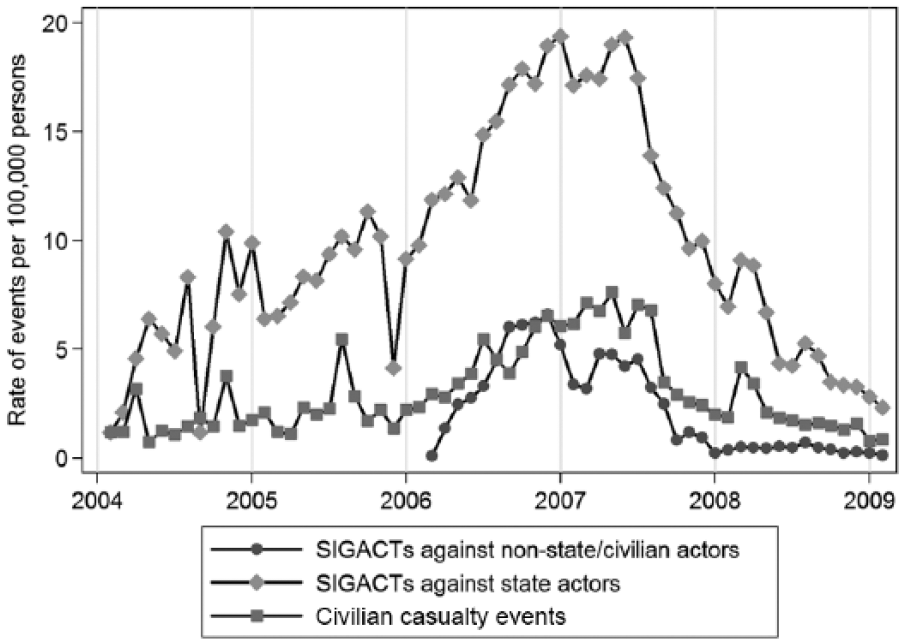
Nationwide Rates of SIGACTs and Civilian Casualty Events, Iraq
We are most concerned with insurgent attacks on U.S.-led forces summarized in the top trend line in Figure 2. However, given the importance of the work of Kirk and Papachristos (2011) in Chicago, we also consider SIGACT reports of violence against non-state/civilian actors, the bottom line. We control for civilian casualty rates reported by Iraq Body Count, indicated by the third trend line.
The three lines indicate an overall national decline in violence beginning in the latter half of 2007. In some areas, however, insurgent attacks on U.S. forces persisted or even increased. We analyze this combination of decline and resilience in three parts. First, we assess our three initial hypotheses by modeling respondents’ reports prior to August 2007 (the beginning of the drawdown in surge troops) of unnecessary violence against civilians by U.S./Coalition forces in or near their communities, and their ensuing feelings in August 2007 of legal cynicism about U.S./Coalition forces and the Iraqi government and forces. Second, we assess our fourth hypothesis, that legal cynicism during the 2007 surge predicts 2008 insurgent attacks on these forces in Arab Sunni communities, net of a control for the spatial lag in violence in surrounding communities. Third, we assess our fifth hypothesis, that legal cynicism predicts the subsequent persistence, measured with residual change scores, in this violence between 2005 and 2008 in the same areas, despite the fact that violence was then declining overall in Iraq—reflecting the resilience of the Sunni insurgency.
Unnecessary Violence against Civilians and Legal Cynicism
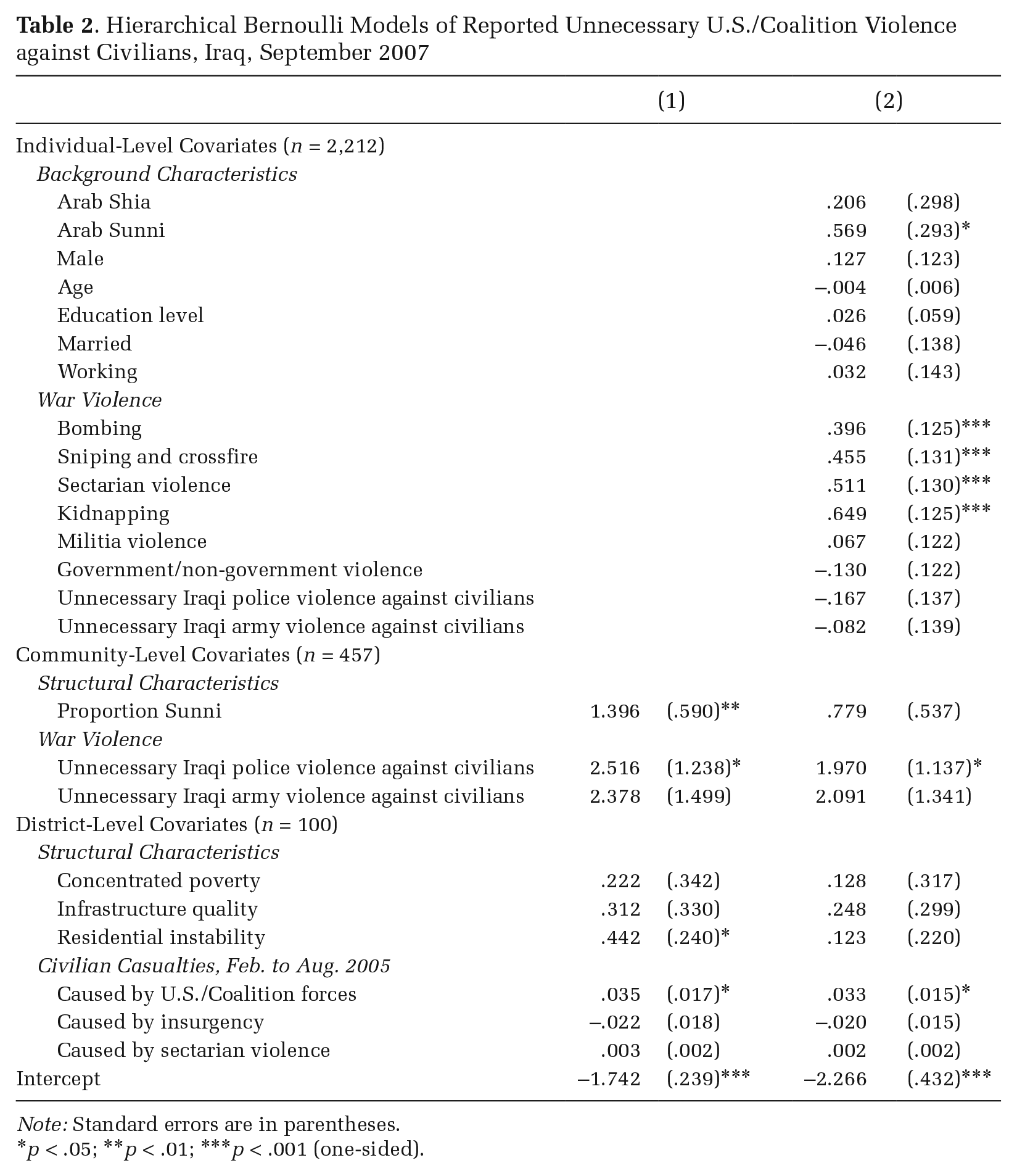
Table 2 presents multilevel Bernoulli models of respondents’ reports of nearby unnecessary U.S./Coalition violence against civilians prior to September 2007. Model 1 includes estimates at the community and district levels of civilian casualties from February to August 2005 reported as caused by U.S./Coalition forces; these estimates significantly predict NPOSI respondent reports of nearby unnecessary violence against civilians. Nearby perceived unnecessary violence by Iraqi police against civilians also significantly predicts nearby reported unnecessary violence by U.S./Coalition forces. Iraqi police were trained and operated alongside U.S./Coalition forces. Residential instability—reflecting sectarian displacement and separation—is also significantly associated with reported unnecessary U.S./Coalition attacks. Most important in terms of Hypothesis 1, the proportion of Sunni residents at the community level significantly predicts nearby reported unnecessary U.S./Coalition violence against civilians.
Hierarchical Bernoulli Models of Reported Unnecessary U.S./Coalition Violence against Civilians, Iraq, September 2007
Note: Standard errors are in parentheses.
p < .05; **p < .01; ***p < .001 (one-sided).
Model 2 introduces individual-level predictors. These results further confirm that Arab Sunni respondents more often reported unnecessary U.S./Coalition violence against nearby civilians than did other ethnic groups, net of other sources of violence.
Furthermore, controlling for these other sources of violence does not notably diminish the predictive influence of the IBC-reported civilian casualties caused by U.S./Coalition forces. The role of unnecessary Iraqi police violence also remains significant. Only residential instability is predictably accounted for by the combined sources of violence against Sunni civilians in Sunni communities.
The first two models presented in Table 3 estimate the impact of this violence—especially the predicted impact in Hypothesis 2 of nearby reported unnecessary U.S./Coalition violence—on legal cynicism about the U.S.-led invasion and occupation. The proportion of Arab Sunni in communities, and the reporting of nearby unnecessary violence by U.S./Coalition forces against civilians, are both highly significant predictors. Note that actual rates of U.S./Coalition violence as measured by IBC casualties are not predictive of legal cynicism about U.S./Coalition forces. Because they are, however, predictive of perceptions of unnecessary violence in Table 2, we can conclude that the effects of actual rates of violence on legal cynicism are mediated by civilians’ perceptions of that violence (a pattern that encourages use of the instrumental variable analysis). Nearby unnecessary attacks by Iraqi police on civilians and concentrated poverty are also significant.
Hierarchical Regression Models of Legal Cynicism, Iraq, September 2007

Note: Standard errors are in parentheses.
p < .05; **p < .01; ***p < .001 (one-sided).
Model 2 introduces individual covariates. These results indicate that Shia as well as Arab Sunnis were more cynical than the comparison group of largely Kurdish Iraqis, and the size of coefficients indicate Arab Sunnis were especially cynical about the U.S. role. The community-level Arab Sunni coefficient is reduced below significance in this model, implying that Arab Sunnis in predominately Arab Sunni communities were most cynical about the U.S.-led role. The inclusion of various sources of violence, including reported nearby unnecessary U.S./Coalition violence, reduces by more than half the Arab Sunni community coefficient, indicating the role of targeting Arab Sunni communities in producing this group’s legal cynicism about the United States.
We now turn to Hypothesis 3: Iraqis who were legally cynical about U.S./Coalition forces extended this legal cynicism to the Iraqi government, military, and police. This hypothesis predicts a transfer effect. Model 3 in Table 3, which includes community- and district-level covariates, lends support for this hypothesis by showing that cynicism about U.S./Coalition forces significantly predicts similar cynicism about the Iraqi government and forces. Reports of unnecessary Iraqi army violence against civilians and predominately Sunni communities are further sources of this legal cynicism about the Iraqi state and its forces.
Model 4 in Table 3 indicates that, although Arab Sunni respondents reported more legal cynicism about the Iraqi government and forces, Arab Shia respondents indicated less cynicism than the comparison group of mainly Sunni Kurds. These individual-level covariates provide further evidence that legal cynicism about the U.S./Coalition (i.e., the robust significance of this coefficient) is the driving force predicting similar cynicism about the new Iraqi state and military.
Explaining the Distribution of Insurgent Attacks on U.S./Coalition Forces and Civilians
Our fourth hypothesis is essential because it predicts that attacks on U.S./Coalition forces would not have been so resilient if these forces’ actions had been more favorably perceived. These attacks proliferated because they were collectively framed as responding to an illegitimate U.S.-led invasion and an unresponsive and ineffectual occupation. Hypothesis 4 thus predicts that amplified cynicism about U.S./Coalition forces and the Iraqi government and military led to insurgent attacks on these forces in predominately Arab Sunni areas.
Table 4 presents results for attacks on state forces. 18 Model 1 reveals that poor infrastructure quality predicts attacks on U.S./Iraqi forces. This parallels the influence in U.S. cities of neighborhood disadvantage (Morenoff et al. 2001; Peterson and Krivo 2012; Sampson 2012). This effect is consistent with the complaint of Arab Sunnis that reconstruction efforts failed to sufficiently improve the infrastructure for essential services. The highly significant measure of predominately Sunni affected communities overshadows the infrastructure effect. The implication is that “defeated” Sunni communities were denied infrastructure improvement, and the resulting frustration was a significant source of attacks on U.S./Coalition and Iraqi forces.
Spatial Lag Regressions of SIGACTs, Iraqi Districts, February to August 2008

Note: N = 100. Standard errors are in parentheses.
p < .05; **p < .01; ***p < .001 (one-sided).
Models 2 and 3 directly test Hypothesis 4 by including separate and highly significant effects of legal cynicism. As predicted, cynicism about U.S./Coalition forces in Model 2 reduces the Sunni community effect on attacks against state forces by more than one third. Inclusion of cynicism about the new Iraqi government and military in Model 3 further reduces the negative effect of infrastructure quality and reduces by more than half and below statistical significance the effect of predominately Sunni communities on attacks against U.S./Coalition/Iraqi forces.
Paralleling Kirk and Papachristos (2011), Model 4 shows non-significant effects of variance (rather than mean) measures of legal cynicism, indicating not that these Sunni communities have unusual heterogeneity in their cynical views, but rather the broadly expressed nature of this cynicism.
Model 4 in Table 4 also brings into the analysis the IBC measures of the sources of prior civilian casualties. Insurgent attacks on U.S./Coalition and Iraqi forces in 2008 are associated with earlier civilian casualties that resulted from insurgency, but not with casualties from violence between sectarian groups. Net of their key role in producing legal cynicism through perceptions of unnecessary violence (Tables 2 and 3), collateral casualties from U.S./Coalition attacks in 2005 are not associated with subsequent insurgent attacks. This suggests that the continuing attacks that plagued U.S./Coalition forces for years were predicted by collateral casualties resulting from prior insurgent attacks in the predominately Sunni communities that U.S./Coalition forces were ineffective in suppressing.
It is useful to note here the absence of effects in these and previous models of the variable measuring acceptance of violent attacks. Legal cynicism may facilitate an acceptance that neutralizes normative constraints and creates possibilities for violence against state actors, but this does not mean there is deeply rooted strong approval or great enthusiasm for this violence, as hypothesized by subcultural violence and ethnic war theories (Kirk and Papachristos 2011).
We turn now to violence affecting non-state civilian actors (see the second half of Table 4). Model 5 again indicates that residential instability (i.e., displacement) is higher in communities where violence against civilians is reported. It further confirms that communities experiencing this violence are predominately Sunni.
We emphasized that the theory of legal cynicism predicts that more vulnerable citizens—such as people in predominately Sunni communities—will reject the legitimacy of governments that are unresponsive and ineffectual in providing security and safety from victimization. The results in Models 6 and 7 further support this expectation. The highly significant association of legal cynicism about U.S./Coalition forces and the new Iraqi government and forces reduces below statistical significance the Sunni community effects of reported attacks on civilians.
Model 8 in Table 4 introduces dispersion measures of legal cynicism to again assess whether respondents with unique and extreme legal cynicism, rather than a more widely distributed legal cynicism, might account for these results. As before, the absence of such heterogeneity effects suggests that the source is collectively shared.
This final model also includes a significant effect of civilian casualty rates designated by IBC as caused by U.S./Coalition forces three years before the 2008 U.S.-military reported SIGACTs against civilians. This is further evidence that civilian casualties resulting from attacks by U.S./Coalition forces were a continuing source of collateral consequences throughout 2005 to 2008—inciting future sectarian violence between Iraqis while failing to suppress persistent insurgency (see the first half of Table 4).
As noted earlier, Prime Minister al-Maliki insisted that the U.S. surge in 2007 target Sunni areas. We earlier saw the role played by U.S./Coalition violence against civilians in predicting legal cynicism about the U.S./Coalition forces and the new Iraqi government and its forces. The effect in the final model of Table 4 of past IBC attacks by the U.S./Coalition forces mediates about 10 percent of the effect of legal cynicism about the Iraqi government/forces on ensuing 2008 attacks. This is consistent with vulnerable civilians seeing—and the al-Maliki government seeing to it—that they were targeted.
Explaining the Persistence of Insurgent Attacks on U.S./Coalition Forces and Civilians
We turn finally to our most conclusive assessment of Hypothesis 5: the role of legal cynicism in predicting the resilience of insurgency in predominately Sunni communities—despite the overall decrease in violence in 2007. As Figure 3 shows, the overall decrease in attacks was not uniform across Iraq.
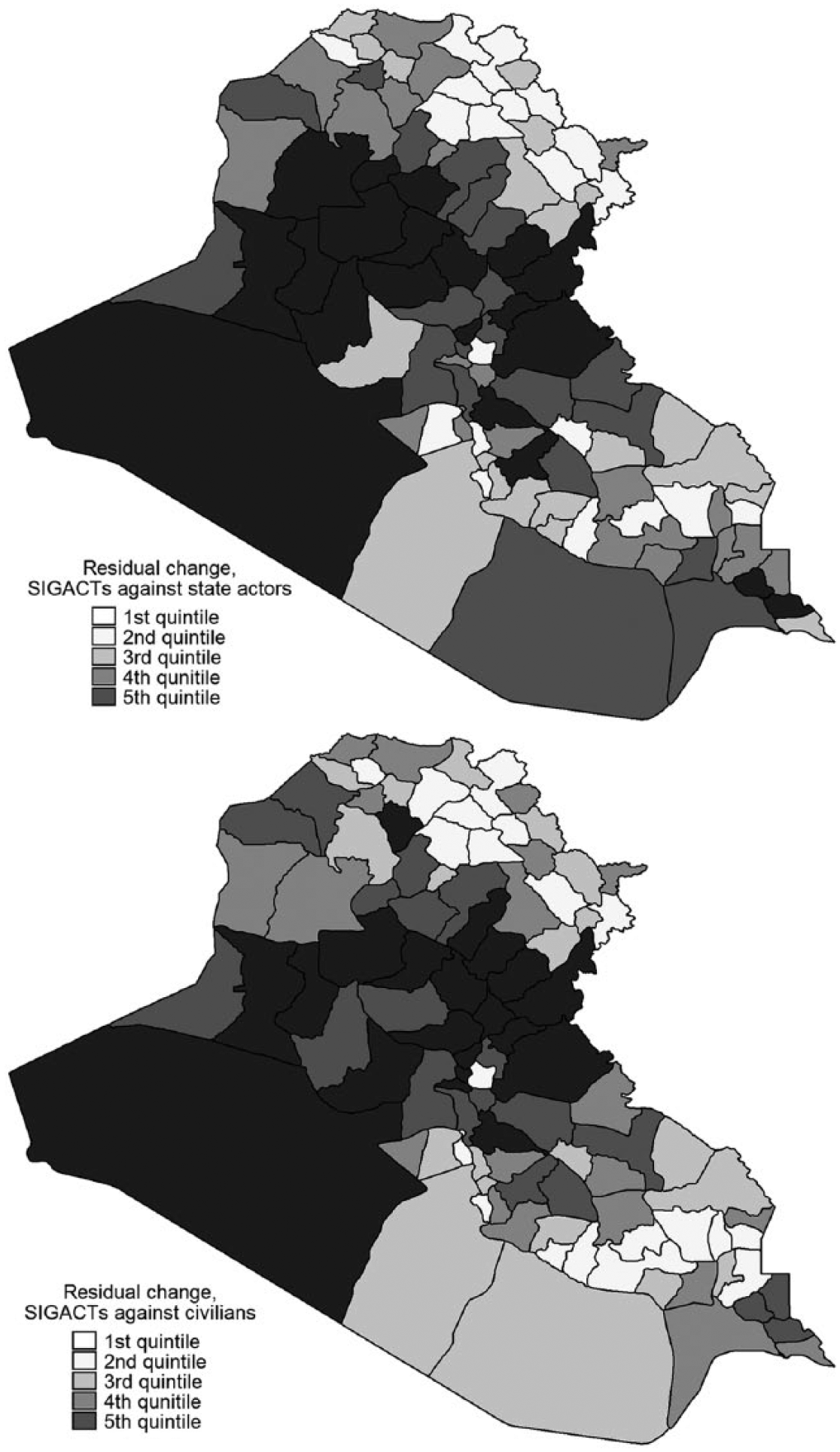
Residual Change in SIGACTs by Quartiles, February–August 2005 to February–August 2008
Figure 3 maps the distribution of change in the rates of attacks reported as SIGACTS by the U.S. military. The first quintile (i.e., shaded white) consists of settings where attacks against civilians (in the lower map) and against U.S./Coalition/Iraqi forces (in the upper map) declined relative to nationwide changes in violence levels from August 2005 through August 2008. Baghdad is centrally located on this map and is shaded white, indicating it is in the first quintile of locations where attacks against civilians and state actors declined more than expected. Baghdad was the site of escalating violence between Shia and Sunni militias in 2005 and 2006, with a steep decline beginning in August 2007.
In contrast, the fifth quintile (i.e., shaded black) consists of settings where attacks against civilians and against U.S./Coalition/Iraqi state forces persisted or increased from 2005 to 2008, even though attacks were declining in Iraq more broadly. Three large areas comprising Iraq’s Sunni heartland are represented to the west, north, and east of Baghdad on the maps, including Anbar (and its contested cities of Fallujah and Ramadi), Salah (including Saddam’s inner-circle tribal home of Tikrit), and Diyala (which came under Sunni control as insurgent groups fled the U.S. surge in Anbar and Salah provinces).
Our fifth hypothesis predicts that heightened levels of legal cynicism explain why attacks did not diminish in these embattled Sunni areas of Iraq. These were areas where the insurgency continued, anticipating the resiliency and later rise in the Sunni insurgency.
Table 5 presents residual change in violent attacks on state forces and non-state civilian actors from February through August of 2005 (as violence peaked nationally) to February through August of 2008. The coefficients in Table 5 are residual change scores that indicate unexpected changes in attacks, with positive residuals indicating where attacks persisted at increased levels or dropped less than expected, and negative residuals indicating where attacks declined more or increased less than expected. Residual change models for attacks on state and civilian actors are presented alongside one another to facilitate comparisons. Models 3 and 6 incorporate the instrumental variable models added in this section.
Spatial Lag and Instrumental Variable Regressions of Residual Change in SIGACTs, Iraqi Districts, February to August 2005 to 2008
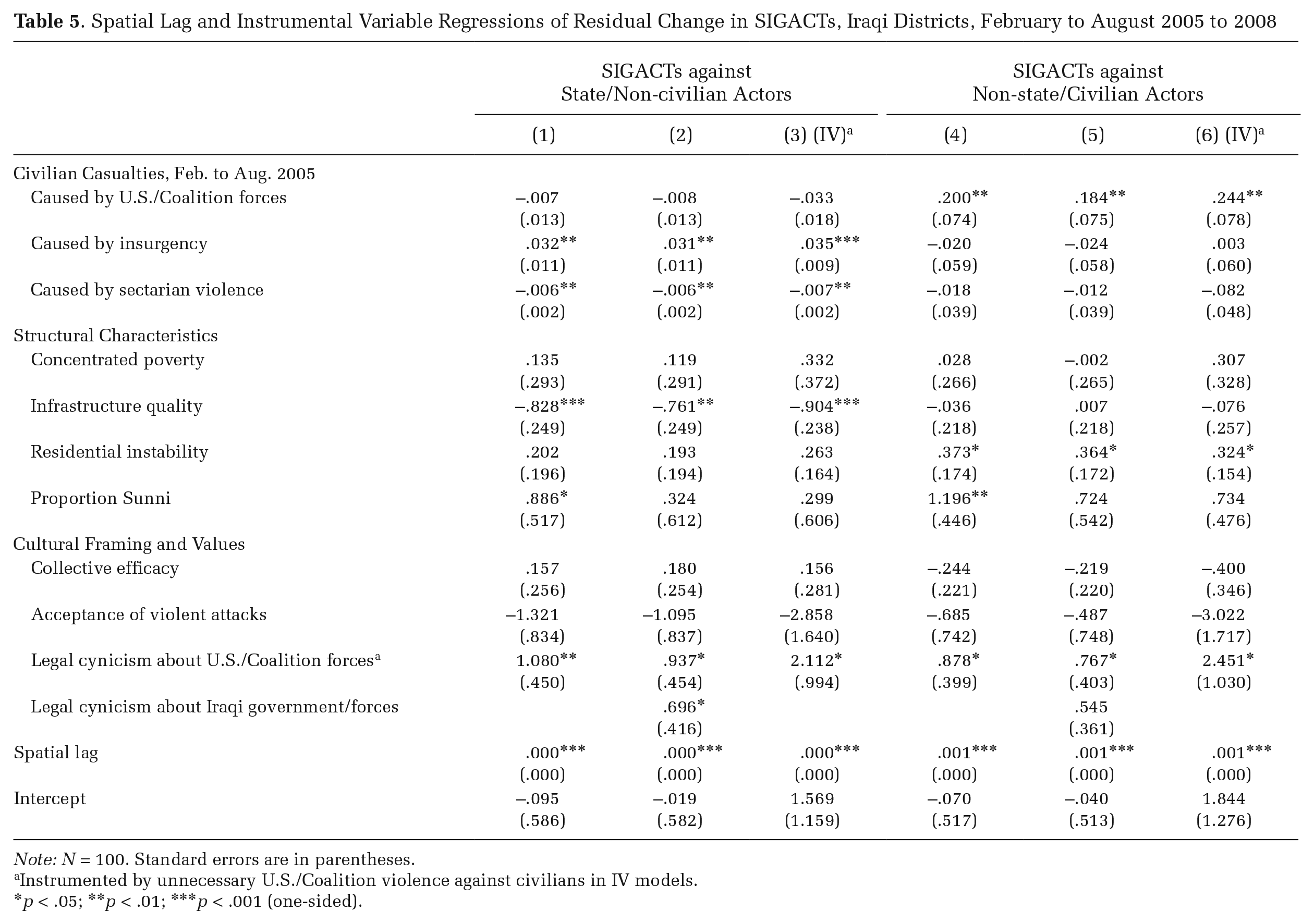
Note: N = 100. Standard errors are in parentheses.
Instrumented by unnecessary U.S./Coalition violence against civilians in IV models.
p < .05; **p < .01; ***p < .001 (one-sided).
The coefficients in the first row of Table 5 indicate SIGACT reports of attacks on civilians were significantly more likely where civilian casualties were reported by IBC as caused by U.S./Coalition forces. These are the kinds of civilian casualties often described as “collateral damage” at the hands of U.S. forces. Casualties caused by U.S./Coalition forces had no significant direct effect on attacks on U.S./Coalition and Iraqi forces, because this influence is fully and indirectly mediated by the amplifying effects of the legally cynical culture frames discussed below. The second and third row IBC coefficients in this table indicate that SIGACT-reported attacks on state forces persisted in areas where the Sunni insurgency was previously active and causing collateral civilian casualties, and not in areas where casualties were simply the result of sectarian violence, as ethnic war theory would predict.
Several structural variables are predictive of the persistence of attacks on U.S./Coalition and Iraqi forces. Areas with poorer infrastructure quality and higher proportions of Arab Sunni population were, as expected, significantly more likely to be areas where attacks on U.S./Coalition forces persisted; areas of residential instability (i.e., displacement) were predictably where attacks on non-state/civilian actors persisted.
As expected, and most important, legal cynicism about both U.S./Coalition and Iraqi government forces are predictive of SIGACT reports of the persistence of attacks against these forces, and the latter cynicism reduces by more than half and below statistical significance the measured effects of the persistence of these attacks in areas with higher proportions of Arab Sunni residents. This is consistent with our essential fifth hypothesis: amplified cynical cultural framing is the motivating force that explains the persistence of attacks on U.S./Coalition and Iraqi forces in Sunni areas. The further explanatory significance of cynicism about Iraqi government forces is highly consistent with a predicted resilience and persistence of an Arab Sunni insurgency that would likely outlast the U.S. forces.
Finally, in Models 3 and 6 of Table 5, we further test these conclusions with instrumental variable models of residual change in violence against state and civilian targets. Using reports of unnecessary U.S./Coalition violence against civilians as an instrument for legal cynicism about U.S./Coalition forces, we find corroborative evidence for a key causal sequence in our hypotheses: reported unnecessary U.S./Coalition violence against civilians, which was disproportionately reported in Arab Sunni areas, has a strong, significant impact through legal cynicism on both persistence of insurgent attacks against U.S./Coalition forces and persistence of attacks against civilian targets. 19 In fact, despite the relatively small sample of 100 districts, these models indicate that legal cynicism about U.S./Coalition forces is more predictive than any other factor of unexpected residual change in violence across districts in Iraq. Still, as noted earlier, our primary focus remains on the kind of social causality that is important to legal cynicism theory and the application of this theory of homicidal violence, developed in a U.S. city, to insurgent collective violence in Iraq.
Discussion
The theory of legal cynicism that guided this article has potentially great conceptual and practical significance for understanding and reacting to interpersonal and collective violence in national and international settings. Cultural frameworks such as legal cynicism change and develop over time, and in relation to surrounding structural circumstances, creating constraints and possibilities for strategies of violent action. In contrast, earlier subcultural theories of U.S. urban violence and ethnic war, alongside more recent rational-choice institutionalism theories of international violence, portray these interpersonal and collective conflicts in more static terms. The earlier subcultural and ethnic war theories attribute violence to little-changing, long-lasting, and path-determining influences of deeply embedded norms and values. Rational-choice institutionalism adopts a static and path-dependent assumption of stickiness in asserting that resource endowments and investments occurring early in the course of a conflict persist in channeling the course and character of the conflict thereafter.
Kalyvas and Kocher (2007) therefore argue that an ethnic war theory of collective violence sees the Iraq conflict as an inexorable product of the deeply held values of Arab Sunni and Shia sectarian groups, and rational-choice institutionalism predicts the future of such a conflict based on resource-related, Arab Sunni choices set in motion in the past. It is not our purpose here to establish that subcultural, ethnic war, or rational-choice institutionalism theories are wrong. We instead seek to demonstrate that the strong, sticky, and static premises of these path-persistent theories neglect the highly significant impact of state-led interventions that channel mediating causal processes, such as legal cynicism, on resulting violence.
The Iraq conflict can be understood with a theory that addresses the impact of U.S./Coalition forces and new Iraqi government policies, including reported unnecessary violence by U.S./Coalition and Iraqi forces, especially against Sunni civilians. We found strong evidence that Sunni civilians were highly cynical about the U.S./Coalition forces and new Iraqi government and military, and this cynicism was a direct and highly significant factor in the cultural context that made possible the subsequent persistence of attacks on these state actors. These policies were grounded in Shia preference and protection, and they led to Arab Sunni vulnerability and victimization, establishing the conditions for a legal cynicism that drove a highly resilient Sunni insurgency. The Arab Sunni insurgency was thus ineffectively suppressed during the surge.
Even controlling for other forms of sectarian violence and the use of spatial lag, the residual change score, and instrumental variable methods, our findings indicate the distinct and direct influence of legal cynicism on the organized occurrence of attacks against the U.S./Coalition and Iraqi state actors. Our analysis emphasizes the importance of the residual change in levels of attacks on U.S./Coalition forces between 2005 and 2008. The sticky and static assumptions of alternative theories indicate that the causes of earlier and later violence are the same. Residual change scores, however, measure increases or declines in violence beyond the expected increase or decline in violence in areas with similar levels of initial violence. Thus, these models measure the effects of legal cynicism on insurgent attacks on U.S./Coalition and Iraqi forces net of the putative causes posited by early ethnic war and recent rational-choice institutionalism theories. Newer approaches emphasizing the disaggregated and changing roles of ethnic groups and states have greater explanatory promise (e.g., Buhaug and Rod 2006; Cederman and Gleditsch 2009; Kalyvas and Kocher 2007).
We purposefully adapted in this analysis much of the conceptualization and methodology of Kirk and Papachristos’s (2011) Chicago research to enable a comparative assessment of legal cynicism theory applied to violence in Iraq. The results—especially with regard to legal cynicism—are quite similar. These results highlight the question of the extent to which coercive government policies—from the militarization of policing to the mass detainment of minorities—are responsible for the influence of legal cynicism on the persistence of violence in national as well as international settings.
The Arab Sunni insurgency neither existed prior to the U.S.-led invasion nor reemerged in a completely new form following the withdrawal of U.S. forces at the end of 2011. Instead, based on our analyses, it appears to be the product of cultural change in the form of legal cynicism about the invasion and occupation; the insurgency’s persistence and resilient reemergence despite the intensified efforts of the U.S.-led Surge was the apparent product of cultural lag and persistence in this legal cynicism. Indeed, we presented evidence that this legal cynicism and resulting insurgent violence against U.S./Coalition forces and the Shia-dominated Iraqi government and armed forces were also the products of earlier reports, especially in predominantly Arab Sunni areas, of reported unnecessary attacks on civilians by U.S.-led forces.
The overarching thesis of this article is that we can explain the resilience of the Sunni insurgency in Iraq by building on the success of the legal cynicism theory in explaining the persistence of criminal homicide in an urban U.S. context. Our elaboration of this theory has made explicit and emphasized the double and linked roles of state and non-state actors. We did this by focusing on the role of U.S./Coalition forces and the Iraqi military and police forces they trained, along with the role of the legally cynical cultural framing of the U.S./Coalition presence by Arab Sunni citizens who reported attacks by these forces.
This interface of state and non-state actors formed the cultural context for continued Sunni insurgent attacks on U.S. forces during the 2007 surge. This, in turn, likely set a foundation, following the withdrawal of U.S. combat troops in late 2011, for the reemergence of the Sunni insurgency and its evolving alliance with the Islamic State forces that swept across the Sunni heartland in 2014.
Footnotes
Appendix
Community-Level Descriptive Statistics, NPOSI Survey, Iraq (Sept 2007)

| Min. | Max. | µ | σ | |
|---|---|---|---|---|
| Structural Characteristics | ||||
| Proportion Sunni | .00 | 1.00 | .29 | .43 |
| War Violence | ||||
| Unnecessary U.S./Coalition violence against civilians | .00 | 1.00 | .44 | .34 |
| Unnecessary Iraqi police violence against civilians | .00 | 1.00 | .20 | .25 |
| Unnecessary Iraqi army violence against civilians | .00 | 1.00 | .19 | .24 |
| Support for U.S. and Iraqi Government/Forces | ||||
| Legal cynicism about U.S./Coalition forces | −1.98 | .83 | −.18 | .73 |
| Legal cynicism about Iraqi government/forces | −1.36 | 1.06 | −.00 | .57 |
Note: N = 457.
Acknowledgements
We are grateful to Bill Murphey as well as the anonymous reviewers for their thoughtful comments and contributions over the course of this research.
Funding
This research was funded by a National Science Foundation (SES-0960871) grant for a study of “Crime, War, and Wealth in Pre- and Post- Invasion Iraq.”
Notes
References
Supplementary Material
Please find the following supplemental material available below.
For Open Access articles published under a Creative Commons License, all supplemental material carries the same license as the article it is associated with.
For non-Open Access articles published, all supplemental material carries a non-exclusive license, and permission requests for re-use of supplemental material or any part of supplemental material shall be sent directly to the copyright owner as specified in the copyright notice associated with the article.
