



Abstract
Women tend to be segregated into different subspecialties than men within male-dominated occupations, but the mechanisms contributing to such intra-occupational gender segregation remain obscure. In this study, I use data from an online recruiting platform and a survey to examine the hiring mechanisms leading to gender segregation within software engineering and development. I find that women are much more prevalent among workers hired in software quality assurance than in other software subspecialties. Importantly, jobs in software quality assurance are lower-paying and perceived as lower status than jobs in other software subspecialties. In examining the origins of this pattern, I find that it stems largely from women being more likely than men to apply for jobs in software quality assurance. Further, such gender differences in job applications are attenuated among candidates with stronger educational credentials, consistent with the idea that relevant accomplishments help mitigate gender differences in self-assessments of competence and belonging in these fields. Demand-side selection processes further contribute to gender segregation, as employers penalize candidates with quality assurance backgrounds, a subspecialty where women are overrepresented, when they apply for jobs in other, higher-status software subspecialties.
Keywords
Men and women tend to work in different jobs. Such gender job segregation has long been of concern to scholars and policymakers, as it contributes substantially to the gender wage gap (Kilbourne et al. 1994; Petersen and Morgan 1995). In the case of male-dominated occupations, a persistent concern is that, when women participate in these occupations, they are often concentrated in a few lower-paying and lower-status occupational subspecialties (Reskin and Roos 1990). This is the case, for example, in medicine, where women are more likely to enter primary care and less likely to enter surgical subspecialties (Ku 2011). It is also the case, to some extent, in law, where women are more likely to enter family law and less likely to enter corporate law (for a review, see Kay and Gorman 2008). Such intra-occupational gender segregation not only contributes to a gender wage gap within the occupation, but it may also reinforce stereotypes about women’s unsuitability for these occupations (Cardador 2017; Kilbourne et al. 1994; Reskin and Roos 1990; Ridgeway 2006).
Previous studies of male-dominated occupations document patterns of gender segregation within these occupations, but we understand less about the mechanisms via which men and women come to occupy jobs in different occupational subspecialties. Such mechanisms are generally classified as either pertaining to the actions of firms (demand side) or to the actions of workers (supply side). One way to make progress in elucidating the role of such mechanisms is to narrow the research focus, examining a single interface where the proximate supply- and demand-side mechanisms that contribute to segregation can be assessed (e.g., Fernandez and Sosa 2005; Fernandez and Weinberg 1997; Reskin 2005).
In this article, I focus on the hiring interface and examine the role of supply- and demand-side mechanisms in contributing to gender segregation within a particular occupation: software engineering and development. Software engineering has grown significantly in recent decades, but it remains among the most persistently male-dominated occupations in the United States (Beckhusen 2016; Chang 2019; Henry-Nickie and Sun 2019). It is therefore particularly relevant to examine how women are distributed across subspecialties within this occupation. Women’s underrepresentation in the occupation as a whole may mask even starker underrepresentation when considering certain higher-paying occupational subspecialties. Furthermore, elucidating the proximate supply- and demand-side mechanisms contributing to segregation can help prioritize policy interventions aimed at addressing biases in firms’ job candidate selection or addressing the factors that may steer women toward certain subspecialties and away from others (Fernandez and Campero 2017).
Extant models of gender segregation distinguish between essentialist and vertical forms of gender job segregation (Charles and Grusky 2004, 2011). Essentialist segregation occurs when men and women are segregated into jobs involving gender-stereotypical tasks. Vertical segregation occurs when men occupy higher-pay, higher-status jobs, independent of the gender association of the tasks involved. This model would suggest that women in software tend to occupy jobs in subspecialties that are more stereotypically feminine (Cardador 2017; Cech 2013; Faulkner 2007) or that are generally lower-paying and lower-status. Importantly, both supply- and demand-side mechanisms can contribute to segregation along these two dimensions (Levanon and Grusky 2016).
On the supply-side, men and women likely differ in the occupational subspecialties they target in their job search (Ku 2011). A number of factors may contribute to such differences, but prior work highlights the fact that cultural beliefs associating competence and belonging in these occupations with masculinity downwardly bias women’s aspirations (e.g., Cech et al. 2011; Correll 2001, 2004). These differences in aspirations likely lead men and women toward different occupational subspecialties, as men are more confident they will belong and succeed in higher-paying/higher-status occupational subspecialties. Further, gender differences in aspirations for high-status occupational work are likely moderated when candidates have more evidence of their competence and belonging in the occupation. In the presence of such evidence, there is less scope for women’s aspirations to be downwardly biased by cultural beliefs that associate competence and belonging in the occupation with masculinity (Correll 2001; Wynn and Correll 2017).
Demand-side mechanisms are also likely to contribute to segregation as the influence of gender on firms’ screening decisions may differ by occupational subspecialty (Neumark, Bank, and Van Nort 1996). Furthermore, status distinctions between subspecialties can reinforce segregation as candidates with backgrounds in lower-status subspecialties—potentially including a disproportionate number of women—are penalized when competing for jobs in higher-status subspecialties (Rider and Tan 2015).
To assess these arguments, I take advantage of an online recruiting setting that allows me to examine workers’ job application choices across software subspecialties, as well as firms’ job candidate selection choices. I further complement these data with a survey of knowledge workers, where I present subjects with job descriptions corresponding to different software engineering subspecialties and subsequently ask them to evaluate the jobs’ pay, status, and alignment with stereotypically male and female skills. These survey data complement the field-based hiring data, shedding further light on the extent to which gender segregation across subspecialties occurs along essentialist or vertical dimensions.
I find considerable gender segregation across subspecialties at the point of hire; most notably, women compose 41.9 percent of workers hired in software quality assurance but only 14.1 percent of workers hired in other software subspecialties. This implies that, even though women are largely underrepresented in software jobs overall, there is substantial variation in the extent of this underrepresentation when comparing across software subspecialties. In examining how different subspecialties are perceived, I find that, compared with other software jobs, software quality assurance is associated with lower pay and lower status, consistent with vertical segregation. However, jobs in quality assurance are also perceived as requiring lower levels of certain stereotypically male and female skills. Thus, women’s concentration in software quality assurance does not seem to be driven by gender essentialist beliefs, as software quality assurance is not perceived as requiring skills more stereotypically associated with femininity. This finding complements prior work that emphasizes the role of gender essentialism in contributing to segregation within engineering occupations (Cardador 2017; Cech 2013; Faulkner 2007).
In examining the origins of this pattern through the hiring process, I find a substantial supply-side component, as women are much more likely than men to apply for jobs in software quality assurance. Consistent with arguments that gender differences in self-assessments of competence and belonging dampen women’s aspirations in these occupations (e.g., Cech et al. 2011; Correll 2001, 2004), women’s tendency to pursue quality assurance is significantly moderated among candidates with stronger educational credentials.
To gain further insights into whether self-assessments of competence or belonging contribute to these gendered job search patterns, I also examine gender sorting of applicants across hierarchical levels. Contrasting gender sorting across subspecialties and across hierarchical levels helps elucidate the role of competence or belonging self-assessments in driving job search patterns. This is because concerns about belonging are more likely to be alleviated by targeting a different subspecialty than by targeting jobs at lower hierarchical levels. Indeed, subspecialties are commonly organized into different organizational units and teams, with potentially different cultural and social environments within each subspecialty. Consistent with self-assessments of belonging being particularly influential, women disproportionately target quality assurance, but they do not target jobs at significantly lower hierarchical levels than men. These findings contribute to a growing line of research showing that women’s less favorable assessments of their fit and belonging in male-dominated engineering occupations are particularly influential in determining women’s aspirations in these occupations (e.g., Alegria 2019; Cech et al. 2011; Wynn and Correll 2017).
On the demand side, I find gender disparities in interview rates whereby women candidates are significantly less likely to be interviewed, but no evidence that these disparities vary by subspecialty. However, candidates with backgrounds in quality assurance are penalized when competing for jobs in other, higher-status subspecialties. Thus, to the extent that women are more likely to enter software quality assurance, they will face added barriers to moving into other software subspecialties on account of their background in a low-status occupational subspecialty. These findings contribute to research on intra-occupational inequality, which has long posited that occupational subspecialties are distinguished in terms of status (e.g., Abbott 1981; Heinz and Laumann 1978; Phillips and Zuckerman 2001). In particular, this study provides direct evidence of how firms’ screening choices contribute to the persistence of an intra-occupational status hierarchy by preventing workers from moving from lower-status to higher-status subspecialties (Heinz and Laumann 1978; Rider and Tan 2015). In this case, these status dynamics reinforce gender disparities within the occupation, as women are more prevalent among workers with backgrounds in low-status subspecialties.
Theory
Intra-occupational Gender Segregation
Gender job segregation is widespread. An extensive literature documents the segregation of men and women into different occupations and the ensuing gender wage gap (Blau and Kahn 2011; Charles and Grusky 2004, 2011; Jacobs 2001). Scholars have also long posited that, even within detailed occupations, men and women tend to be segregated into different jobs (e.g., Bielby and Baron 1986; Reskin and Roos 1990).
In particular, some argue that occupational gender segregation occurs across arbitrarily detailed occupational subcategories (Abbott 2010). This “fractal” perspective is premised on the fact that differences between occupational subspecialties may seem small within the context of the occupational structure as a whole. But, within a particular occupation, such seemingly small differences between subspecialties suffice to induce significant gender segregation. This is because distinctions within the occupation (e.g., in gender-typing, status) are salient to workers and employers, and are therefore influential in the processes driving gender segregation.
Prior case studies in male-dominated occupations such as medicine, law, and engineering document such gender sorting across occupational subspecialties (Cech 2013; Kay and Gorman 2008; Ku 2011). More broadly, Levanon and Grusky (2016) studied the U.S. occupational structure as a whole and found significant levels of gender segregation across occupational subspecialties within detailed occupations. As a result, I expect a pattern of intra-occupational gender segregation among workers hired into software engineering positions.
Hypothesis 1 (intra-occupational segregation): Within software engineering, the gender composition of workers hired differs significantly by occupational subspecialty.
Extant models of gender segregation point to certain dimensions along which such segregation is likely to occur. In particular, Charles and Grusky (2004) distinguish between essentialist (horizontal) and vertical forms of gender segregation. This framework was originally developed to describe cross-occupational segregation, but recently scholars have argued that segregation along these two dimensions also operates within detailed occupations (Levanon and Grusky 2016). Thus, men and women are likely placed in subspecialties that differ in the extent to which they are associated with stereotypically male/female skills and attributes. In engineering occupations, for example, men are more likely to be placed in jobs deemed more “technical” and women in jobs deemed more “social,” given that technical skills are stereotypically associated with masculinity and interpersonal skills with femininity (Cech 2013; Faulkner 2007).
Men and women are also likely to be segregated vertically, whereby men are more prevalent in higher-paying, higher-status subspecialties, independent of the gender association of different subspecialties (Blackburn, Brooks, and Jarman 2001; Blackburn, Jarman, and Brooks 2000; Bridges 2003; Cotter, Hermsen, and Vanneman 2011; Semuonov and Jones 1999). This can be, for instance, because of the influence of male primacy beliefs that men are generally more competent and committed workers (Charles and Grusky 2004, 2011). Thus, workers hired into software engineering jobs are likely to be segregated along these two dimensions.
Hypothesis 2 (essentialist segregation): Within software engineering, women are more prevalent among those hired in subspecialties that are less closely associated with stereotypically male attributes and/or more closely associated with stereotypically female attributes.
Hypothesis 3 (vertical segregation): Within software engineering, women are more prevalent among those hired in lower-paying, lower-status occupational subspecialties independently of the gender association of different subspecialties.
Supply-Side Mechanisms
Segregation along these two dimensions is generally thought to stem from both supply- and demand-side mechanisms. With respect to the supply side, a growing literature highlights the profound influence that supply-side hiring mechanisms can have in contributing to gender segregation. For example, gender sorting of job applicants has been documented across occupations, organizational levels, and industries (e.g., Barbulescu and Bidwell 2013; Fernandez and Campero 2017; Fernandez and Friedrich 2011). Importantly, there is also evidence that supply-side processes contribute to gender sorting across occupational subspecialties in other male-typed occupations. For instance, in medicine, women medical students are more likely than men to select certain subspecialties, such as primary care and obstetrics-gynecology, and less likely to select surgical specialties (Ku 2011). We might thus expect gendered subspecialty choices within software engineering.
Hypothesis 4 (supply side): Within software engineering, men and women apply to jobs in different occupational subspecialties.
Extant literature points to three different factors contributing to gendered patterns of job search: gender differences in the valuation of job rewards, gender differences in identification with different jobs, and gender differences in expectations of succeeding (Barbulescu and Bidwell 2013).
Gender differences in the valuation of job rewards may stem from the unequal gender distribution of household labor, which may lead women to seek jobs allowing them to accommodate greater household responsibilities (Becker 1981, 1985). Different valuations of job rewards can also be the result of gender socialization processes; this can lead men, for example, toward jobs with higher financial rewards, and women toward jobs with a more favorable work–life balance (Konrad et al. 2000; Marini et al. 1996). Gender differences in job identification can also produce gendered choices of jobs as job candidates seek to maintain self-consistency between their different identities, and thus seek jobs they view as consistent with their gender (Faulkner 2000, 2007; Niedenthal, Cantor, and Kihlstrom 1985; Ridgeway and Correll 2000). Finally, gender differences in job choices are also thought to be influenced by workers’ expectations of succeeding in different jobs (Barbulescu and Bidwell 2013; Vroom 1964).
In the case of software engineering and development, expectations of success are likely to be influenced by the occupation’s stereotypically male association (Cech et al. 2011; Cheryan et al. 2017; Correll 2001, 2004). For instance, Correll (2001) found that among high school students who receive the same objective scores in math, men rate their competence in math higher than women, and such biased self-assessments influence their aspirations for careers in math-related fields. Importantly, men do not have higher self-assessments than women in the absence of beliefs that associate competence in the field in question with masculinity (Correll 2001, 2004).
A corollary of these arguments is that gender differences in self-assessments are moderated by performance feedback (Correll 2001). In the presence of more performance feedback, there is less room for women’s self-assessments to be downwardly biased by cultural beliefs that associate competence in the field with masculinity. Indeed, Correll (2001) shows that among high school students, math grades have a stronger positive effect on women’s math self-assessments than on men’s.
At later career stages, gender differences in aspirations are shaped by more complex, occupation-specific assessments, such as assessments of professional expertise and belonging in the occupation (Cech et al. 2011; Wynn and Correll 2017). Women’s self-assessments on these broader dimensions are still likely to be less favorable than men’s, given the prevalence of cultural beliefs that men naturally “fit” and are better at these occupations (Cheryan, Master, and Meltzoff 2015; Faulkner 2007). Furthermore, the extent of such biased self-assessments is likely moderated by the availability of evidence of competence and belonging. Thus, past accomplishments that demonstrate workers’ competence and belonging in software engineering will disproportionately affect women’s aspirations (Wynn and Correll 2017). In the presence of more extensive accomplishments in the occupation, there is less room for women’s self-assessments and aspirations to be downwardly biased by cultural beliefs that associate various aspects of these occupations with masculinity.
Hypothesis 5 (supply-side moderation): Within software engineering, past accomplishments in the occupation have a stronger positive effect on women’s than on men’s propensity to pursue high-paying/high-status subspecialties.
Demand-Side Mechanisms
Demand-side factors may also contribute to gender segregation within software engineering. Correspondence audit studies aimed at measuring the extent of sex-based discrimination in hiring show significant heterogeneity in the size and direction of gender disparities (for a review, see Baert 2018). Part of this heterogeneity stems from the types of jobs pursued; for example, men may be advantaged for stereotypically male jobs whereas women are advantaged for stereotypically female jobs (Riach and Rich 2006).
Such variation in gender disparities in hiring rates has also been observed within detailed occupations. For instance, in a seminal study, Neumark and colleagues (1996) examined hiring for waiter/waitress positions in Philadelphia and showed that women were disadvantaged in competition for jobs in high-priced but not low-priced restaurants. This suggests that, even within an occupation, gender disparities in hiring rates may vary significantly depending on various features of the specific job pursued. Similarly, within software engineering, gender disparities in hiring rates may vary by occupational subspecialty. Screeners may consider women better suited for subspecialties that are less strongly associated with stereotypically male attributes, or they may view women as less competent and committed software engineers generally and thus less well-suited for higher-status subspecialties (Charles and Grusky 2004; Levanon and Grusky 2016). These arguments suggest gender disparities in hiring rates are likely to vary across subspecialties in line with the differential status or gender associations of occupational subspecialties.
Hypothesis 6 (differential selection): Within software engineering, the extent of gender disparities in job candidate screening choices varies by occupational subspecialty.
Aside from the direct effects of gender on screening decisions, demand-side selection processes can also contribute to intra-occupational gender segregation because of how backgrounds in different subspecialties affect workers’ mobility prospects. Work on intra-occupational inequality highlights the fact that occupational subspecialties are often arrayed along a status hierarchy, with certain subspecialties deemed more valuable or more proximate to the core occupational identity (e.g., Abbott 1981; Heinz and Laumann 1978; Phillips and Zuckerman 2001).
Importantly, such status distinctions are generally thought to act as constraints on mobility (e.g., Rider and Tan 2015), implying that workers with backgrounds in low-status specialties have difficulty accessing higher-status specialties. Firms screening candidates for high-status subspecialties may view applicants with backgrounds in low-status subspecialties as having been unsuccessful in pursuing a higher-status subspecialty, implying a negative signal about their skills. Alternatively, if firms infer that the candidate entered a low-status subspecialty by choice, such a choice signals weak commitment to high-status occupational work. In either case, whether due to choice or to necessity, a background in a low-status subspecialty is likely to be interpreted as a negative signal in recruitment.
To the extent that women are more likely to enter such lower-status subspecialties—due to either supply-side sorting or firms’ demand-side selection choices—the mobility constraints imposed by backgrounds in low-status occupational subspecialties are likely to disproportionately affect women.
Hypothesis 7 (intra-occupational status distinctions): Backgrounds in lower-status occupational subspecialties are penalized when competing for jobs in higher-status occupational subspecialties.
Setting
Software Engineering and Development
From the origins of software occupations in the 1940s to the 1980s, women entered these occupations at rates that exceeded the rates at which they were entering the labor force overall (Chang 2019; Donato 1990). However, female representation peaked in the 1980s and has declined somewhat since. Today, only 25 percent of workers in computer occupations (including software engineering) are women, whereas women represent 47 percent of the labor force overall (Beckhusen 2016).
Scholars attribute this trend to the fact that software work was originally considered to resemble clerical work, for which women were thought to be well-suited. As this occupation came to be considered “intellectually demanding,” female representation progressively declined (Donato 1990). The underrepresentation of women in software occupations has received considerable attention given that these occupations have been important contributors to the economic growth and cultural evolution of the United States in recent decades (Chang 2019; Henry-Nickie and Sun 2019). It is thus concerning that people in these influential occupations do not more closely represent the demographic composition of the population at large.
Occupations are social groups formed around a position in the division of labor (Weeden 2002). In many cases, occupational associations are formed to establish and enforce occupational standards, and they act as occupational gatekeepers by certifying credentials or issuing licenses required to practice the occupation (Weeden and Grusky 2005). In software engineering, two prominent occupational associations (the IEEE-CS and the ACM 1 ) participate in accrediting computer science university programs, issuing professional certifications, and developing professional standards and bodies of knowledge (Seidman 2008). These associations define the occupation as encompassing software quality assurance. Software quality assurance is the subject of two of the fifteen knowledge areas codified in the Software Engineering Body of Knowledge produced by the IEEE-CS (https://www.computer.org/education/bodies-of-knowledge/software-engineering/topics).
Software quality assurance is also an integral part of the curriculum recommendations outlined for undergraduate programs in software engineering (Association for Computing Machinery 2005). Quality assurance is integral to software engineering and development, but individuals who specialize in this area generally earn less. According to the U.S. Census, on average, systems software developers earn $110,000, applications software developers earn $103,620, and software quality assurance engineers earn $90,270. 2
With respect to gender composition, prior work suggests software quality assurance is the subspecialty with the highest female representation within software engineering and development (Petrone 2018; Stackoverflow 2019). For example, an analysis of the profiles of software engineers and developers on LinkedIn reports that 29 percent of quality assurance engineers and testers are women (compared with 22 percent in other subspecialties), representing the most gender diversity of any subspecialty in the occupation (Petrone 2018).
I thus focused on the sorting of workers between quality assurance and other software specialties, as this is where there is likely to be the strongest gender sorting. I began by conducting a survey of knowledge workers aimed at elucidating whether and how jobs in quality assurance may be perceived differently from jobs in other software subspecialties. I then examined data from an online recruiting platform to assess the degree to which the men and women hired via this platform are differentially sorted across these subspecialties. These data allow me to examine patterns of job applications across these specialties and patterns of job candidate selection, yielding insights into both supply- and demand-side mechanisms.
Survey Evidence
Sample and Procedures
I surveyed knowledge workers to explore whether and how jobs in software quality assurance are perceived differently from jobs in other software specialties. I recruited the survey sample via the Prime Panels online survey recruitment service (Chandler et al. 2019). In selecting this sample, I attempted to match as closely as possible the profiles of the workers in the online recruiting sample (described below). Thus, I restricted the sample to knowledge workers in the United States who have completed at least a bachelor’s degree. Given that the online recruiting sample is composed mostly of younger workers (i.e., 90 percent of workers have 13 years or less of total work experience), I also restricted the sample to workers age 35 or younger. Although I was unable through this platform to target workers in the software industry exclusively, 39.4 percent of subjects in the sample have some experience in software. Part A of the online supplement lists descriptive statistics for the survey sample.
The survey began with an informed consent statement in which subjects were told that the purpose of the study was to elicit their opinions of different jobs in the software industry. Subjects were then sequentially shown two job descriptions. These were drawn from the O*NET occupational database: 15–1199.01 (Software Quality Assurance Engineers and Testers) and 15–1132.00 (Software Developers, Applications) (Levanon and Grusky 2016; Peterson et al. 1999; U.S. Department of Commerce 2000). Part B of the online supplement shows the text of the job descriptions. The order of presentation of the job descriptions was randomized to mitigate order of presentation effects (Auspurg and Jäckle 2017).
After being presented each job description, participants were asked to rate “how important certain personal traits are for someone in the job of [Software Developer / Software Quality Assurance Engineer]” and shown a list of stereotypically male/female cognitive and personality attributes drawn from Cejka and Eagly (1999). These include eight stereotypically male attributes (four personality attributes: “competitive,” “dominant,” “stands up under pressure,” and “aggressive,” and four cognitive attributes: “analytical,” “good with numbers,” “good at reasoning,” and “good at problem-solving”) and eight stereotypically female attributes (four personality attributes: “warm,” “helpful,” “cooperative,” and “nurturing,” and four cognitive attributes: “imaginative,” “creative,” “perceptive,” and “verbally skilled”).
For each attribute, I asked respondents to rate its importance for the job, using a standard five-point Likert scale ranging from “not at all important” (1) to “essential” (5). The order in which these attributes were shown was also randomized to prevent order of presentation effects (McFarland 1981). Participants were then asked to estimate the salary associated with each of these jobs, how attractive they perceive these jobs to be, and whether they perceive these jobs as more likely to attract men or women. Finally, I collected data on participants’ demographics (age, gender, race), professional experience (occupation, years of professional experience), and whether they had experience in software specifically.
Analysis and Results
I analyzed the survey results estimating OLS models of responses as a function of the subspecialty (QA/generalist) as well as respondent characteristics (as reported in Part A of the online supplement), and clustering standard errors by respondent. I began by analyzing whether respondents perceive jobs in quality assurance and software development as being vertically differentiated in terms of pay and status. In line with past literature, I conceive of status as rooted in the “accumulation of deference behaviors” (Sauder, Lynn, and Podolny 2012:268). Because the term “status” could be unfamiliar to respondents or might come across as overly technical, I avoided asking respondents to evaluate the status of the jobs directly (Krosnick 2018). Rather, I asked them to evaluate how attractive they perceive each job to be. The premise of my approach is that jobs respondents rate as more attractive are those they would like to be associated with. This desire for association is a form of deference that lies at the heart of how status is conferred upon a person or entity (Gould 2002).
Figure 1, Panel a, shows the predicted attractiveness of the software developer and software quality assurance jobs. Respondents rated the software developer job as somewhat more attractive than the software quality assurance job, although the difference is not statistically significant at conventional levels (p = .08). I also asked respondents to estimate the salary for these two positions. As seen in Figure 1, Panel b, respondents perceived software developer jobs as being associated with higher compensation than jobs in software quality assurance (p < .01). Given there is no reason to expect a disconnect between respondents’ perceptions of which jobs pay more and which jobs are higher-status, these results suggest that software developer jobs are considered better-paying and higher-status than jobs in software quality assurance.

Survey Results
Next, I examined whether respondents associate jobs in these two subspecialties with different gendered attributes. In Figure 1, Panel c shows eight different stereotypically male attributes, and Panel d shows eight stereotypically female attributes. In all cases, as explained earlier, these are predicted values of responses based on OLS models. First, looking across these two panels, respondents rated stereotypically male cognitive skills as the most important for both jobs (i.e., being analytical, good at reasoning, good at problem-solving [Cejka and Eagly 1999]). This is consistent with prior work showing software occupations are culturally associated with masculinity, as stereotypically male attributes are deemed most important for success in these occupations (Cheryan et al. 2015; Wynn and Correll 2017). However, there were no differences in the importance assigned to these attributes in the case of software developer jobs compared with software quality assurance jobs.
With respect to other stereotypically male attributes, the only statistically significant difference between these two jobs is in the importance of competitiveness. Competitiveness was rated as significantly more important for software developer jobs than for quality assurance jobs (p < .05). For stereotypically female attributes, Figure 1, Panel d, shows, perhaps surprisingly, that some of these attributes (i.e., cooperativeness, creativity, imaginativeness) were rated as significantly more important for software developer jobs than for quality assurance jobs (in all three cases: p < .01).
On the whole, this analysis provides a mixed picture of the extent of essentialist differentiation between software development and software quality assurance. Jobs in software development are perceived as requiring more competitiveness, a stereotypically male attribute, yet they are also rated as requiring more cooperativeness, creativity, and imaginativeness, all of which are stereotypically female. This is consistent with vertical differentiation, whereby software developer jobs are considered more demanding and thus requiring competency on a broader set of attributes (Levanon and Grusky 2016).
Hiring Mechanisms
Online Recruiting Data
I next examine whether men and women are differentially sorted by software subspecialty, and the processes via which this happens. In particular, I examine job application and hiring patterns on an online recruiting platform used by several hundred U.S.-based high-tech firms concentrated in the San Francisco/Silicon Valley area. The platform allows firms to create job postings, disseminate them online, and subsequently capture and track job applications. The job postings include information about the firm and the position, but no salary information. When candidates apply, they upload their résumé, which is parsed and stored in a database. Candidates also fill out a short job application (e.g., source of application, work authorization status, optional race and gender questions).
I was given access to an anonymized database (except for first names) including candidates’ parsed résumés (work and educational histories, home zip codes), job application responses, and screening outcomes for each application (i.e., whether the application resulted in an interview, job offer, or hire). I coded candidates’ educational histories to obtain their years of education, field, and status of education. Career histories were coded to obtain candidates’ years and type of work experience (as explained below).
In addition to the data on candidates, the database includes data on the hiring firms (name, number of employees) and the jobs posted (title, location). These data were coded to account for various job and firm characteristics (as explained below). Because many firms in the database are technology startups, I supplemented the data with information on firms’ investors and sector using the Thompson Reuters Venture Expert database and on firms’ founders through hand-collection via companies’ websites and founders’ social media profiles. I also gathered information on the number of press mentions firms received using the Factiva News Database. The data include 40,927 applications submitted from March 2008 to March 2012 to 706 software engineer/developer jobs at 198 firms. Part C of the online supplement provides further details of the sample selection procedures.
Job Posting Risk Set
For the supply-side analysis, I followed the case-cohort method to model the probability of applying to a job posting from among a set of possible applications to alternative job postings (Bengtsson and Hsu 2015; Campero and Kacperczyk 2020; Hegde and Tumlinson 2014). I refer to the set of possible job postings that a given candidate was at risk of applying to as the job posting risk set. The main specification considers the risk set to be all other job postings open at the time of application in the same geographic location as the job to which the candidate applied (Part D of the online supplement provides additional details of the risk set construction procedures). For robustness, I considered an additional specification, including in the risk set only job postings at firms in the same technology sector as the firm to which the candidate applied. Regardless of whether a more or less restrictive specification of the risk set is used, the results remain similar, reinforcing my confidence that the findings are not an artifact of the criteria used to specify the risk set (results using the more restrictive risk set specification are available upon request).
Dependent Variables
Application
In supply-side analyses, I measured the probability that a candidate applied to a job posting relative to other job postings that the candidate was at risk of applying to. Accordingly, the dependent variable is coded 1 for a realized application to a job posting, and 0 for the matching “at risk” job postings. Each realized application was matched with an average of 89 possible applications to other job postings, yielding a dataset with 3,629,601 possible applications.
Interviews, offers, hires
In the demand-side analysis, I examined whether—conditional on applying—candidates advance to subsequent stages of the hiring process. I report descriptive results across the interview, offer, and hire stages of the process, but I focused the multivariate analysis on the initial stage of selection of candidates to invite to interview, as this is most likely to be based on candidates’ paper credentials, which were available in the recruiting database (Fernandez and Weinberg 1997). Because I lack information that was incorporated in subsequent screening steps (e.g., details of candidates’ performance on the interviews), predicting subsequent screening outcomes on the basis of résumé information alone poses a greater risk of omitted variable bias. Furthermore, any disparities at the initial screening stage will influence the final hiring outcomes in the same direction (Ewens, Tomlin, and Wang 2014). I coded the dependent variables “interview,” “offer,” and “hired” as 1 if, conditional on applying, a candidate received an interview, a job offer, or was hired, and 0 otherwise. Of the 40,927 applications, 1,788 resulted in an interview (4.4 percent), 401 in an offer (1.0 percent), and 280 in a hire (.7 percent).
Independent Variables
Gender
Of the 40,927 applications, I used candidates’ self-reported gender in 82.8 percent of cases. For the remaining 17.2 percent, I scored the candidate’s first name based on the likelihood of it being a woman’s name using a naming algorithm, the IBM InfoSphere Global Name Management Tool (Botelho and Abraham 2017). This tool takes as its input an individual’s first name and compares that name with its database of 750 million names from around the world (Maguire 2012). Each name is given a probability score corresponding to the likelihood that the individual with that given name is female.
Using this approach, I coded as women applicants with names that had over a 50 percent chance of belonging to a woman according to the algorithm. For 603 applications (1.5 percent of the final sample of 40,927), the candidate’s name was not found in this database (or the name was associated with a 50/50 chance of being of either gender) and therefore gender was coded as missing; I omitted these observations from the analysis. The resulting female share is 24.7 percent in the final sample of 40,927, which is broadly in line with what we expect in this occupation as a whole (e.g., according to the Bureau of Labor Statistics [2018], 19.3 percent of application and systems software developers in the United States are women).
To allay concerns about the sensitivity of subsequent findings to the procedure used to code gender based on first names, Part I of the online supplement replicates the main results of the study on the sample of cases where gender was self-disclosed; all gender effects reported are replicated in this subsample and thus are not sensitive to the gender-coding procedure.
Occupational subspecialty
I used job titles to code the subspecialty corresponding to each job. I coded the variable “quality assurance” as 1 if the job title included the words “quality assurance,” “QA,” “tester,” or various other derivations. I also accounted for other software engineering subspecialties commonly distinguished in the software industry (Petrone 2018; Stackoverflow 2019) and represented in the sample: front-end engineer/developer, back-end engineer/developer, generalist (“full stack”) developer, and mobile engineer/developer. Of the 706 jobs, 109 (15.4 percent) were in software quality assurance, 95 (13.5 percent) were in front-end software development, 341 (48.3 percent) were generalist software developer jobs, 71 (10.1 percent) were mobile developer jobs, and 90 (12.7 percent) were back-end developer jobs. Although average wages by such detailed occupational subspecialties are not available from the census, a survey of the software developer community Stackoverflow provides additional information on wage differences between occupational subspecialties (https://insights.stackoverflow.com/survey/2019#salary). According to their survey, the average wage of a back-end developer is $116,000, a mobile developer $112,000, a generalist (“full stack”) developer $110,000, and a front-end developer $103,000. Note that all these subspecialties earn more than quality assurance engineers or testers, whose average salary in the survey is $99,000. This is consistent with the previously mentioned census data, as well as with survey respondents’ perceptions indicating that software quality assurance engineers earn less than software developers, on average.
Additional Variables
Multivariate models account for heterogeneity at three different levels: the firm, the job, and the applicant. Table 1 reports univariate summary statistics for the controls at these three levels. Parts E and F of the online supplement report bivariate correlation coefficients for candidate characteristics and firm/job characteristics, respectively.
Summary Statistics of Control Variables
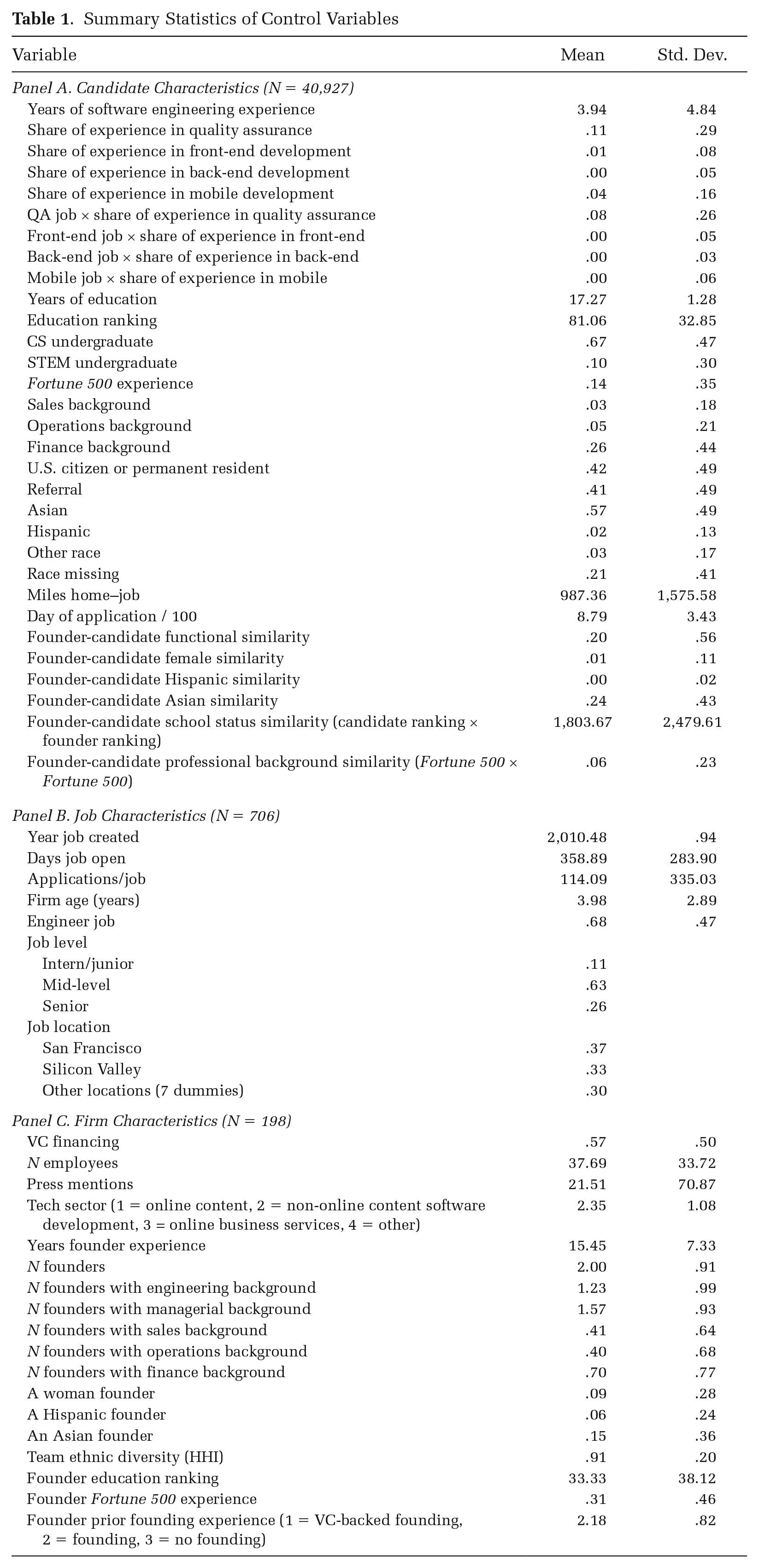
Candidate characteristics
I adjusted for a number of other candidate demographic characteristics likely to influence both candidates’ job application decisions and firms’ screening choices. First, I adjust for candidates’ race and U.S. citizenship status. I used candidates’ home zip code, retained in the parsed résumés, to compute the air-mile distance between a job and the candidate’s home, as spatial factors likely influence application and hiring outcomes (Fernandez and Su 2004; Zenou 2002). With respect to human capital characteristics, I adjusted for candidates’ years of education, status of their educational backgrounds (ranking of highest-ranked university attended according to the national university rankings of US News and World Report 2012), and whether the candidate had a bachelor’s degree in computer science or in a related STEM discipline. I also adjusted for various dimensions of candidates’ experience, including total years of relevant (i.e., software engineering and development) experience, and whether the candidate had worked at a Fortune 500 technology company.
Given my focus on the distribution of applications across occupational subspecialties, I also accounted for the share of a candidate’s total software experience corresponding to each of the occupational subspecialties represented in the data (i.e., quality assurance, front-end, back-end, mobile). This was based on coding of job titles in parsed résumés to capture both overall software engineering/development experience (e.g., job titles including phrases “software engineer,” “software developer,” and various derivations) and experience by subspecialty (e.g., titles including phrases “software quality assurance,” “software QA,” “software tester,” and various derivations coded as quality assurance experience).
Finally, I adjusted for whether candidates had experience in fields outside of software engineering and development (i.e., experience in sales, operations, or finance). Given the possibility of temporal patterns in firms’ recruiting behavior, I adjusted for the day of application (Fernandez and Weinberg 1997). I also adjusted for whether candidates indicated they were applying via a referral. Note that because the name of the person who made the referral was anonymized on the database provided, I have no way of differentiating between employee referrals and external referrals. I use the term “network referral” to capture both (Fernandez and Fernandez-Mateo 2006).
Job and firm characteristics
In addition to occupational subspecialty, I also coded whether the job was a “software engineer” or “software developer” job. I adjusted for the hierarchical level of the job (i.e., whether the title included the words “intern,” “junior,” “senior,” or abbreviations thereof). Finally, I adjusted for the location of the job, the year the job was created, the age of the firm when the job was created, and the total number of applications the job generated over the observation period. With respect to firm characteristics, I adjusted for the size (number of employees) of the firm, its technology sector, and the amount of publicity (press mentions) it had received in the years before and after it began recruiting on the platform.
Given that most firms in the sample were young startups (i.e., 76.7 percent of the 706 jobs were at firms that were five years old or younger when they began recruiting), I also adjusted for a number of factors that are particularly relevant to explaining recruiting outcomes in the startup setting. I adjusted for whether the firm had raised venture capital financing at the time it began recruiting on the platform, as this can be an important signal of firm quality (Stuart, Hoang, and Hybels 1999). I also adjusted for a number of characteristics of firms’ founding teams, including the number of founders, the mean years of founder experience, and founders’ profiles (i.e., gender, ethnicity, ethnic diversity – Herfindahl-Hirschman Index [HHI], prior founding experience, functional backgrounds, and status of educational and professional backgrounds).
Match between candidates’ experience and job subspecialty
One important factor that may account for job candidates’ sorting across occupational subspecialties is the extent to which their prior experience matches a given subspecialty. This match will also likely influence interview screening. Thus, in subsequent models, I included interaction terms of the share of a candidate’s experience in a subspecialty and that subspecialty (e.g., share of quality assurance experience × quality assurance job).
Match between candidates’ profile and firms’ founders’ profiles
Given that most firms in the sample are young startups and that workers may sort into these firms partly on the basis of similarity to the founders (Campero and Kacperczyk 2020; Ruef 2010; Ruef, Aldrich, and Carter 2003), I also adjusted for founder–candidate similarity on several dimensions. First, I adjusted for demographic similarity, which I defined as a dummy variable indicating a match between the candidate’s demographic characteristic (i.e., gender/ethnicity) and at least one founder with the same demographic characteristic. I also control for functional background similarity, defined as a dummy variable equal to 1 if the candidate shares a functional background (i.e., management, sales, operations, finance) with at least one founder (Beckman and Burton 2008). Finally, I control for status similarity (i.e., founders’ education ranking × candidates’ education ranking, founders’ Fortune 500 experience × candidates’ Fortune 500 experience) (Rivera 2012).
Empirical Strategy
I began by examining the descriptive pattern of gender segregation at various points of the hiring process (i.e., applicants, interviews, offers, hires). I then examined supply-side factors by modeling the probability of applying to a particular job, and demand-side factors by modeling the probability of an interview conditional on an application. In both cases, I estimated linear probability models. Given that my hypotheses relate to interaction effects (i.e., female × subspecialty), I followed best practices and estimated marginal effects and their contrasts (Mize 2019). In all models, I clustered standard errors by candidate to account for potential autocorrelation (models clustering standard errors by candidate and firm yield similar results, available upon request).
Analysis and Results
Segregation at the Point of Hire
I began by examining the extent of gender segregation across subspecialties at the point of hire. For simplicity in this initial analysis, I group non-quality-assurance subspecialties, although in subsequent multivariate analyses these are accounted for separately. In line with expectations, Table 2, column 1, shows that women comprise 41.9 percent of workers hired into software quality assurance but just 14.1 percent in other software subspecialties (LR χ2 = 15.1, p < .01). The stark difference in gender composition between quality assurance and other subspecialties of over 20 percentage points provides support for Hypothesis 1: even within detailed occupations there is substantial segregation of men and women into different subspecialties. This result, together with the previously mentioned survey results, suggests this segregation is vertical, as jobs in software quality assurance are less well paid and of lower status than jobs in other software subspecialties (Hypothesis 3). In contrast, the mixed survey findings relating to the extent to which quality assurance may be associated with differentially gendered attributes suggest it is less likely that gender essentialism is driving the pattern (Hypothesis 2).
Percentage of Female Job Applicants by Occupational Subspecialty
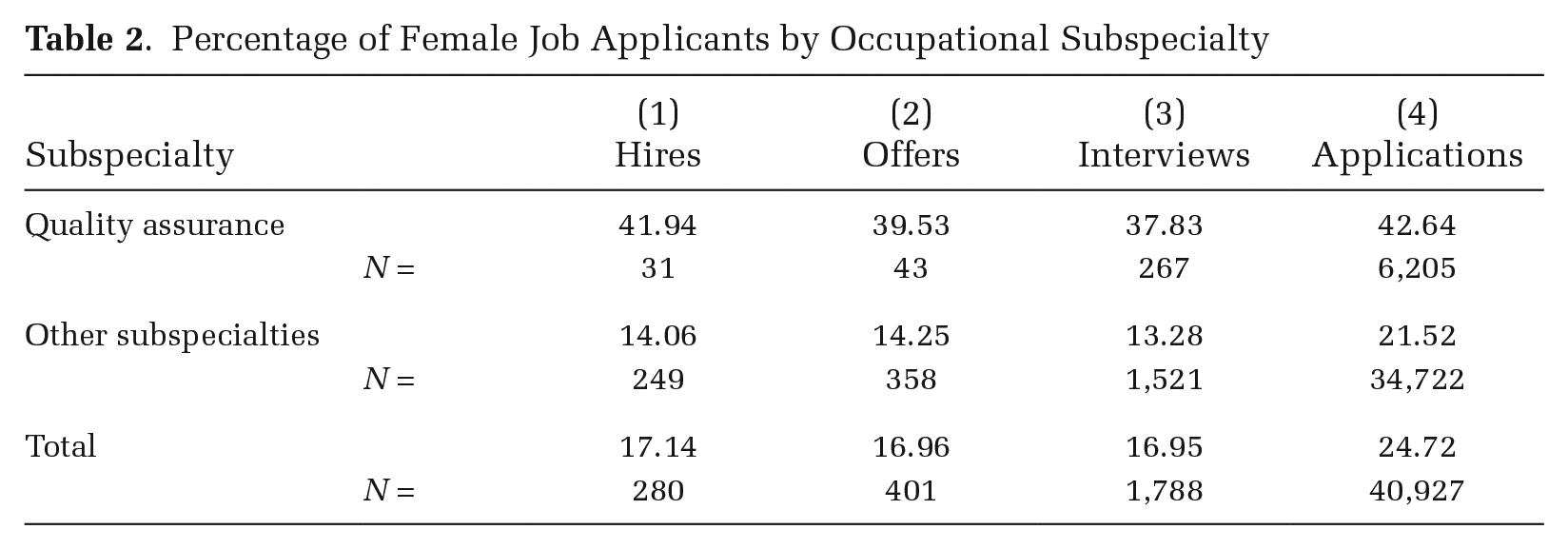
The rest of Table 2 traces the gender composition by subspecialty through prior stages of the hiring process. The gap in female representation between QA and non-QA is 27.9 percent among those hired (41.9–14.1), 25.3 percent among those with job offers (39.5–14.2), 24.6 percent among those interviewed (37.8–13.3), and 21.1 percent among initial applicants (42.6–21.5). At all stages, the difference in gender composition between QA and non-QA jobs is statistically significant. This suggests the gap in gender composition is largely present at the job application stage and is somewhat exacerbated through the screening process, particularly in selection for interviews.
Supply-Side Mechanisms
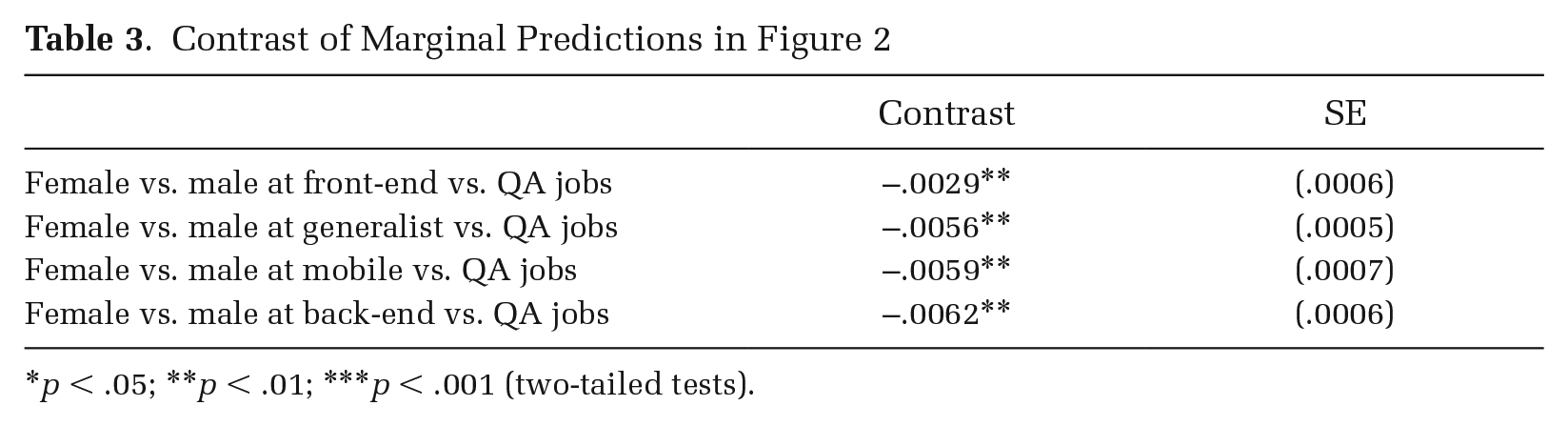
I examined the segregation of job applications across subspecialties in a multivariate framework, modeling the probability of application relative to a risk set of possible applications. Figure 2 reports the probability of application by occupational subspecialty for men and women. 3 Even adjusting for all factors listed in Table 1, women are substantially more likely than men to apply to jobs in quality assurance. They are also somewhat more likely to apply to front-end developer jobs. On the other hand, they are less likely to apply to generalist jobs, or to jobs in back-end or mobile software engineering/development. As shown in Table 3, the contrast of these marginal effects is statistically significant, indicating that women disproportionately sort into quality assurance relative to men.

Predicted Probability of Application by Occupational Subspecialty
Contrast of Marginal Predictions in Figure 2
p < .05; **p < .01; ***p < .001 (two-tailed tests).
To assess the substantive significance of these effects, I multiplied the predicted probabilities of application plotted in Figure 2 by the corresponding number of “at risk” applications by gender and occupational subspecialty, yielding the predicted number of applications by gender and subspecialty. I then computed the predicted gender composition of the applicant pool for each subspecialty. The results indicate that, adjusting for all observables, the predicted female share of the applicant pool is 45.9 percent for jobs in quality assurance, 26.7 percent for front-end jobs, 22.7 percent for generalist jobs, 20.7 percent for mobile jobs, and 20.6 percent for back-end jobs. This suggests the pattern of strong gender sorting into quality assurance observed descriptively largely cannot be accounted for by differences in observables. Consistent with Hypothesis 4, women apply disproportionately to software quality assurance, contributing to gender segregation across subspecialties.
A number of factors can contribute to these gendered job application patterns, but arguments about gender differences in self-assessments in these fields suggest relevant accomplishments will have a more positive effect on the aspirations of women (Correll 2001). I examined this hypothesis (Hypothesis 5) by assessing the extent to which the strength of workers’ educational backgrounds moderates this pattern. Educational backgrounds are relevant in this context because job candidates in the sample are young (i.e., median work experience of three years, 90th-percentile experience of 13 years). Among young adults, postsecondary educational backgrounds (e.g., college selectivity, major) are predictive of their labor-market prospects (for a review, see Zhang 2008). As a result, educational backgrounds associated with better prospects in the occupation are likely to bolster the aspirations of job candidates generally, and even more for female candidates (Hypothesis 5).
Figure 3 shows a set of analyses aimed at assessing these arguments. I considered three measures of the strength of the candidate’s educational credentials: level of education, field of education, and status of educational background. With respect to level of education, I stratified the sample, distinguishing between candidates with education up to a bachelor’s degree and those with post-bachelor’s degrees (master’s, PhD). For field of education, I distinguished between candidates who completed an undergraduate degree in computer science and those lacking an undergraduate degree in the field. Finally, I examined variation in the extent of gender sorting as a function of the status of candidates’ educational backgrounds.

Moderation Analyses
Figure 3, Panels a, b, and c, plot the contrast in predicted probability of applying to quality assurance jobs compared with jobs in other specialties. As in the prior analyses, these results stem from models adjusting for all observables listed in Table 1. Beginning with Panel a, the results show that for men, their level of education has little effect on their propensity to apply to jobs in quality assurance compared with other jobs. For women, however, higher levels of education dampen the propensity to apply to quality assurance jobs relative to other jobs. This is consistent with women’s subspecialty choices being more sensitive than men’s to the strength of their occupational accomplishments (Hypothesis 5).
Panel b shows very similar results concerning the field of education. Men are less likely to pursue quality assurance, and this is the case regardless of whether or not they hold an undergraduate degree in computer science. In contrast, women’s tendency to target jobs in quality assurance is significantly moderated when they have an undergraduate degree in computer science. Finally, Panel c shows similar results for the status of candidates’ educational backgrounds. Among candidates with the most prestigious educational backgrounds, men and women distribute their applications similarly across QA and other subspecialties.
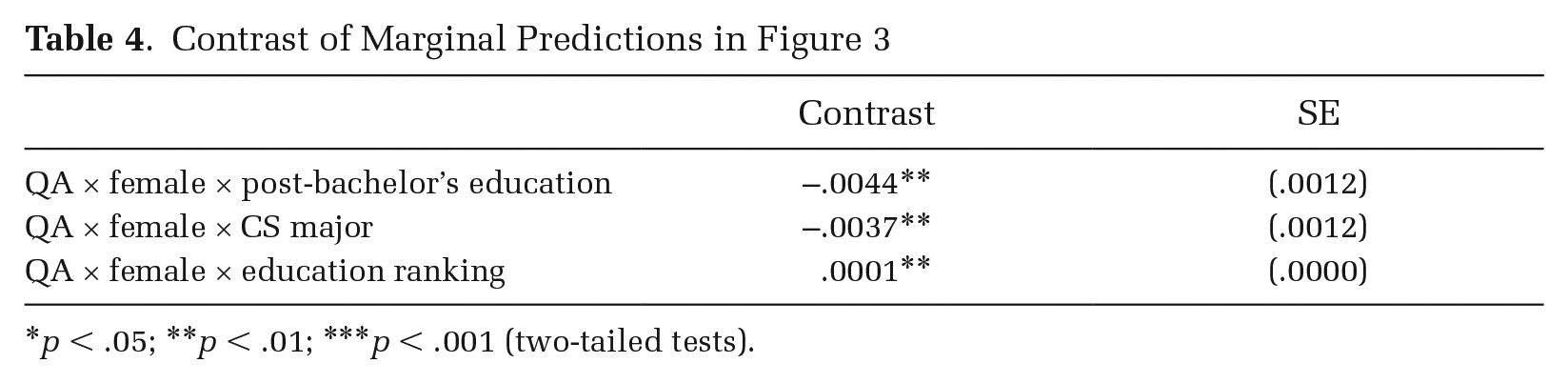
However, as applicants move down in educational status, women’s propensity to apply to QA increases at a much higher rate than men’s. This is again consistent with the argument that accomplishments (e.g., a degree from a prestigious university) have a stronger effect in encouraging women to apply to higher-status/better-paid subspecialties. Table 4 shows the statistical tests of the three-way contrasts (i.e., credentials × gender × quality assurance) displayed in Panels a, b, and c, indicating that in all cases the three-way contrast is statistically significant. Taken together, these results provide support for Hypothesis 5, indicating that gender differences in subspecialty choices are attenuated among candidates with more accomplishments in the occupation.
Contrast of Marginal Predictions in Figure 3
p < .05; **p < .01; ***p < .001 (two-tailed tests).
Demand-Side Mechanisms
Next, I turn to demand-side selection processes, first by assessing the effect of gender on a candidate’s probability of being interviewed for jobs in different software subspecialties. Figure 4, Panel a, reports the predicted probability of interview for men and women candidates to quality assurance and non-quality-assurance jobs, adjusting for all the factors listed in Table 1. 4
Women are less likely than men to be interviewed (p < .01). This difference is somewhat larger in the case of non-quality-assurance jobs. This is consistent with Hypothesis 6, suggesting firms’ demand-side selection choices contribute to intra-occupational segregation. However, the magnitude of the difference is not statistically reliable. Overall, these results suggest that gender disparities in screening may contribute to the underrepresentation of women in software occupations as a whole, but there is no statistically robust evidence that these demand-side processes contribute to an overrepresentation of women in quality assurance jobs (Hypothesis 6).

Predicted Probability of Interview
I further argued that, aside from the direct effect of gender on the screening process, demand-side selection processes could also contribute to gender segregation because of the effect of workers’ subspecialty backgrounds. In particular, if women enter lower-status subspecialties (i.e., quality assurance), they may subsequently face added hurdles in competing for jobs in higher-status subspecialties (Hypothesis 7). I examined this claim, first by verifying the assumption that women job candidates are more likely to have backgrounds in quality assurance. In Table 5, I compare the number of years of experience in quality assurance for men and women candidates. As seen in columns 1 through 3, women are indeed more likely than men to have experience in this subspecialty.
Percent of Applicants by Years of Experience in Quality Assurance
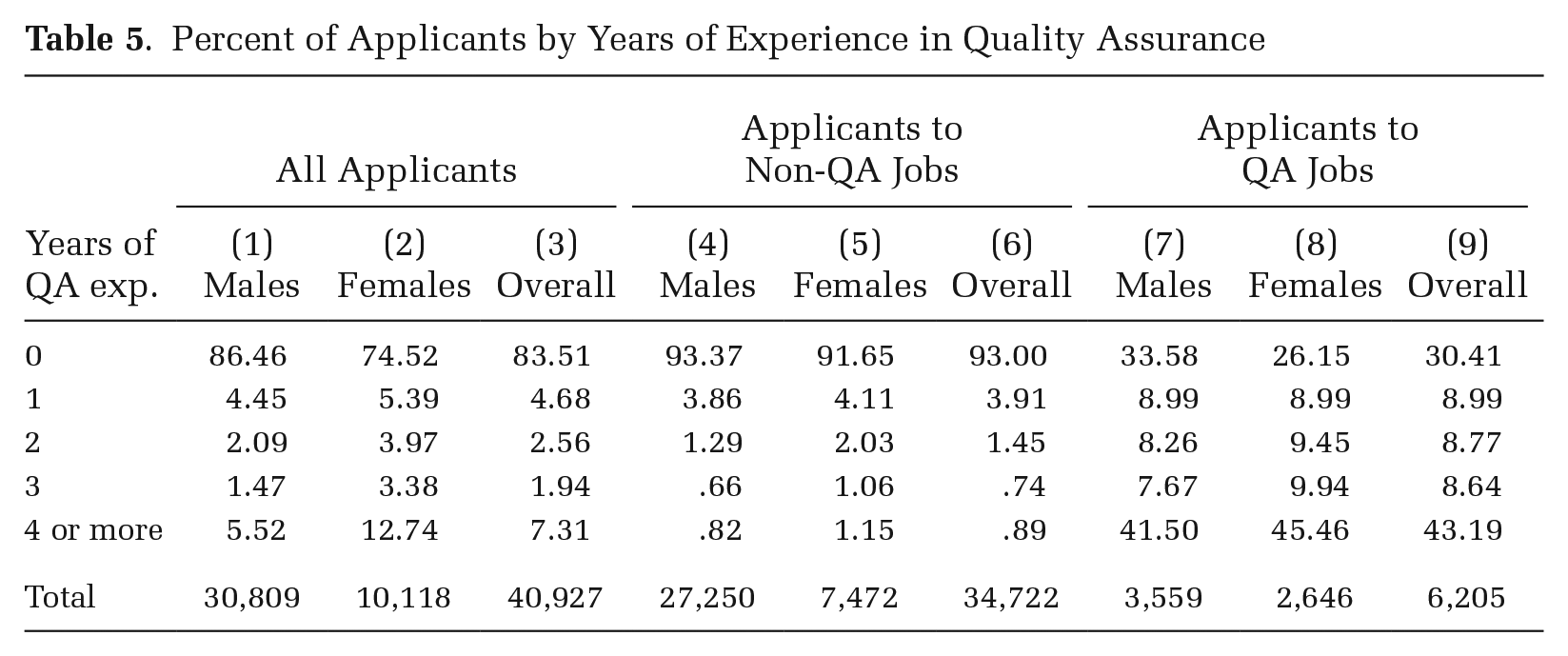
This, however, could simply reflect that women are more prevalent among candidates for quality assurance positions. So, in columns 4 through 9, I show the corresponding distribution for candidates to non-quality-assurance and quality assurance positions, respectively. The results show that among candidates for non-quality-assurance jobs, 6.6 percent of men and 8.3 percent of women have one or more years of experience in quality assurance (LR χ2 = 41.8, p < .01). In the case of quality assurance jobs, 66.4 percent of men and 73.8 percent of women have one or more years of experience in quality assurance (LR χ2 = 44.8, p < .01). Even accounting for the subspecialty pursued, women have more experience in quality assurance than do men.
I argued that because quality assurance is perceived as a lower-status, lower-paying subspecialty, candidates with backgrounds in this subspecialty are likely to be penalized when competing for jobs in higher-status subspecialties (Hypothesis 7). I assessed this claim by examining the effect of years of experience in quality assurance on candidates’ probability of being interviewed for jobs outside quality assurance. To do so, I estimated a model of the probability of interview for jobs outside quality assurance as a function of candidates’ quality assurance experience and adjusted for all other factors listed in Table 1. The resulting marginal effects are shown in Figure 4, Panel b.
Additional years of experience in quality assurance have a negative effect on the probability of interview, net of experience in the focal subspecialty and other factors. This is consistent with experience in quality assurance being interpreted as a negative signal when competing for jobs in other subspecialties. Note that this is the case for men and women (i.e., in unreported analyses I found no evidence that years of experience in quality assurance interact with gender in predicting interviews). Thus, once candidates (disproportionately women) enter quality assurance, their association with this lower-status subspecialty makes it more difficult for them to access jobs in higher-status subspecialties (Hypothesis 7). There is no corresponding penalty for experience in other specialties (e.g., mobile development) when pursuing jobs outside that subspecialty (additional results available upon request). It is experience in quality assurance, rather than experience in any unrelated subspecialty, that is penalized. This is consistent with the low-status association of this subspecialty negatively influencing perceptions of candidates with quality assurance backgrounds.
Extensions and Robustness Checks
Gender segregation across hierarchical levels
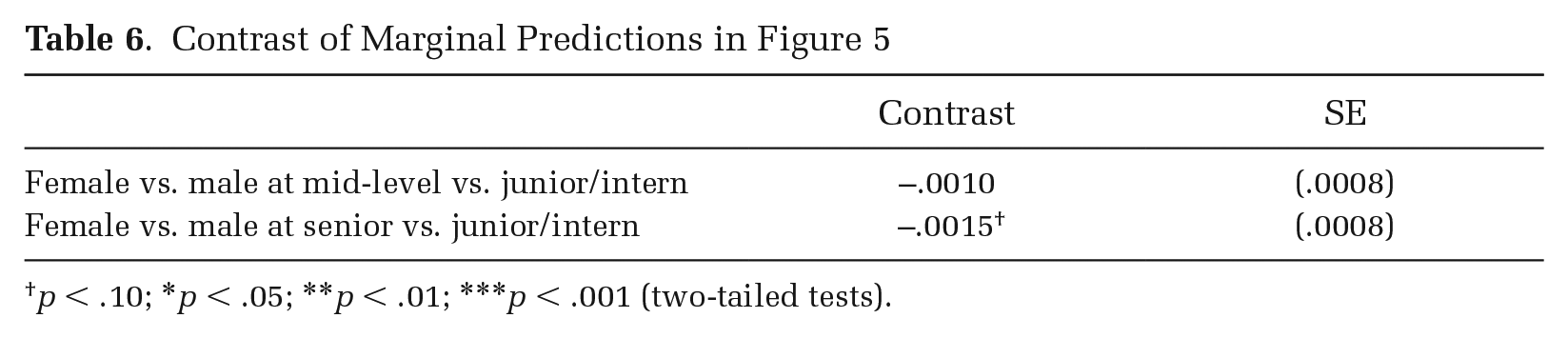
The main supply-side results presented suggest that women disproportionately apply to jobs in software quality assurance, a lower-paying, lower-status subspecialty. It is thus relevant to examine whether women’s propensity to pursue lower-paying, lower-status jobs extends to jobs at lower hierarchical levels. Recall that jobs in the sample are distinguished along three hierarchical levels: “intern/junior,” “mid-level,” and “senior.” I thus assess whether women pursuing jobs in software (outside of quality assurance) are more likely to apply to lower-level jobs than are men. I focus on jobs in subspecialties outside of quality assurance, as in these higher-status subspecialties it is more likely that gender differences in expectations of succeeding will lead women to apply to lower-level jobs (although including quality assurance jobs yields similar results). Specifically, I estimate a model of the probability of application as a function of the interaction between female and job level, adjusting for the subspecialty of the job, and the controls reported in Table 1. Figure 5 shows the resulting probabilities of application by gender and hierarchical level, and Table 6 shows the corresponding contrasts of these marginal effects.

Predicted Probability of Application by Gender and Hierarchical Level
Contrast of Marginal Predictions in Figure 5
p < .10; *p < .05; **p < .01; ***p < .001 (two-tailed tests).
Gender differences in the probability of application increase as you move up hierarchical levels, although the magnitude of the effect is not statistically significant at conventional levels (Table 6). Substantively, the predicted rates of application by level in Figure 5 imply a difference in female representation of only 3.3 percentage points between the junior/intern and senior-level applicant pools. This effect is quite small relative to the strong gender-sorting pattern across subspecialties (i.e., over a 20-percentage-point difference in female representation between QA and non-QA applicant pools). This implies that women disproportionately sort into lower-status subspecialties (i.e., quality assurance) but not into lower-level jobs.
If we consider that different subspecialties are likely to be constituted into different organizational units or teams, with different cultures and social environments, it is more likely that concerns about fit and belonging drive segregation across subspecialties than across organizational levels within a subspecialty. This suggests, in line with prior work (Alegria 2019; Cech et al. 2011; Wynn and Correll 2017), that it is not women’s lower self-assessments of their technical or cognitive skills that drives them to quality assurance, but rather their expectations of being able to fit in with and belong to these groups. If women had biased self-assessments of their technical or cognitive skills, we would expect them to also self-sort into lower-level jobs.
Network-based gender sorting
Network processes may contribute to supply-side gender-sorting across occupational subspecialties (Fernandez and Sosa 2005; Mencken and Winfield 1999; Reskin and Padavic 1994). Recruiting through network referrals can have a number of benefits for a firm (Fernandez, Castilla, and Moore 2000), and such referral-based recruiting may influence the demographic profile of the candidates recruited (Rubineau and Fernandez 2013). For instance, if firms rely on employee-based referrals and employees are more likely to refer to vacancies in their own subspecialties, referral candidates may tend to reflect the demographic profile of the current subspecialty workforce (Fernandez and Sosa 2005; Reskin and Padavic 1994).
To the extent this is the case, the gender composition of referral candidates will be more closely determined by the gender composition of the current workforce than the gender composition of candidates sourced through other means. To assess whether referral processes contribute to the sorting of women into quality assurance, I estimate a model of the probability of women applicants as a function of referral status, occupational subspecialty, and controls. Figure 6 shows the resulting predicted probabilities of applications from women by occupational subspecialty. The distribution of women applicants across subspecialties is very similar for referrals and non-referral applicants. This suggests the differential sorting of women by subspecialty does not stem from a simple referral process.

Predicted Probability of Women Applicants
Intersectionality
Prior work highlights the importance of considering the interactions of gender and race in explaining inequality (Alegria 2019; Browne and Misra 2003; Wingfield 2009). To examine whether there might be different gender dynamics for different racial groups, I replicated the preceding supply-side analyses within different racial groups. I estimated models of the probability of application as a function of gender, occupational subspecialty, and controls separately for white, Asian, and Hispanic candidates, candidates of other races (i.e., African Americans, Native Americans, mixed race), as well as candidates missing race information.
Figure 7 shows the resulting probabilities of application by gender and occupational subspecialty for each group. In the case of white, Asian, and candidates missing race information, women are more likely than men to apply to quality assurance, and less likely than men to apply to generalist, mobile, and back-end positions. In each case, the gender difference in the probability of application between these latter subspecialties and quality assurance is statistically reliable (p < .05). For Hispanic and other race candidates, the results are directionally similar although not statistically significant at conventional levels given that the sample of candidates is quite small. Taken together, these results suggest a similar pattern of supply-side sorting of women into software quality assurance within each racial group.

Predicted Probability of Application by Subspecialty and Race
The influence of experience on gender differences in subspecialty choice
I explored candidates’ years of experience in software as a potential additional factor that may moderate gender differences in subspecialty choice. As women accumulate experience in the occupation, they may become less swayed by cultural beliefs about gender and competence, or more confident about their belonging in the occupation; therefore, their subspecialty choices may progressively converge with men’s (Wynn and Correll 2017).
To examine this claim, I assessed the moderating role of years of experience in software engineering on gender differences in the propensity to apply to jobs in quality assurance. I focused on the subsample of candidates who at the time of application had no experience in quality assurance, as we would not expect experience in quality assurance to increase job candidates’ assessments of their suitability for higher-status/higher-paying subspecialties vis-à-vis jobs in quality assurance. In essence, this analysis sheds light on the probability of attrition from higher-status subspecialties and into quality assurance among workers who until that point had only worked in higher-status subspecialties.
Figure 8 shows the contrast in probability of application to jobs in QA relative to other subspecialties by gender and years of non-QA software engineering experience. For men and women, as they gain experience outside of quality assurance, their probability of applying to jobs in QA decreases. However, the magnitude of the gender gap in propensity to apply for quality assurance jobs remains as years of non-QA experience increase. This suggests that years of experience in higher-status specialties does not moderate gender differences in propensity to pursue quality assurance.
In interpreting this result, it is important to consider other factors that could influence the relationship between years of experience and gender differences in subspecialty choice. First, women may have slower career trajectories in the occupation (Hunt 2016). Thus, in interpreting Figure 8, men and women with the same years of experience may not have accumulated the same number of promotions that could serve as evidence of their competence and belonging. Other factors inducing gender differences in subspecialty choice could also become increasingly salient over time, even as gender differences in self-assessments of competence and belonging decline. Factors such as work–family balance or lack of encouragement and mentoring may become more influential at later career stages, implying that choices of subspecialties remain equally gendered across time, albeit for different reasons (Ku 2011).

Moderation by Experience
Discussion
Summary of the Argument and Results
Gender segregation is pervasive across and within occupations (Cohen 2013; Kilbourne et al. 1994; Petersen and Morgan 1995). Prior research has documented gender segregation across subspecialties within male-dominated occupations (e.g., Cech 2013; Kay and Gorman 2008; Ku 2011), but we understand less about the mechanisms that contribute to such segregation. In this article, I thus focused on elucidating the hiring mechanisms that contribute to gender segregation within software engineering and development.
I showed that women are much more prevalent in software quality assurance than in other software subspecialties at the point of hire. Importantly, software quality assurance is less well paid, and generally perceived as lower status, than other software subspecialties. In tracing the origins of this pattern through the hiring process, I found that it largely derives from gender differences in job applications across subspecialties (i.e., women are much more likely than men to pursue jobs in quality assurance). Furthermore, gender differences in subspecialty choice are smaller among candidates with stronger educational credentials, consistent with the idea that relevant accomplishments moderate gender differences in self-assessments of competence and belonging in the field (Correll 2001; Wynn and Correll 2017).
On the demand side, women are less likely to be interviewed for these positions overall, but gender differences in interview rates do not vary significantly by occupational subspecialty. Also, backgrounds in software quality assurance are penalized when competing for jobs in higher-status subspecialties. This implies that workers who enter jobs in quality assurance—disproportionately women—likely face less favorable screening odds if they subsequently try to move into higher-status subspecialties within software.
Contributions to the Study of Occupational Gender Segregation
These findings make several contributions. First, they document significant gender segregation by subspecialty among workers hired in software engineering. Prior work has documented gender segregation across broader categories of engineering (e.g., “computer engineering” versus “industrial engineering” [Cech 2013]). Here, I considered more fine-grained categories within software engineering and development, and I found a considerable degree of gender segregation across these more detailed occupational categories. This is consistent with the “fractal” perspective on occupational gender segregation, whereby segregation re-emerges even as we look across increasingly fine distinctions between occupational groups (Abbott 2010; Levanon and Grusky 2016).
Contributions to the Study of Gender Inequality in Engineering Occupations
This study contributes fresh, quantitative evidence of how gender segregation is produced within software engineering, an important occupation that has long been of interest to scholars (Cardador 2017; Donato 1990; Wright and Jacobs 1994). Much of the work on intra-occupational gender segregation within engineering occupations emphasizes the important role of gender essentialism in perpetuating gender segregation within these occupations. In particular, prior work highlights the importance of the technical/social dualism within engineering, whereby men tend to dominate jobs perceived as more “technical,” and women tend to be more represented in jobs perceived as more “social” (Cech 2013; Faulkner 2007). This segregation is thought to stem from essentialist beliefs that men are better suited for technical work and women for work that involves more interpersonal competencies. The findings presented here suggest that—in addition to segregation that may stem from these essentialist beliefs—there is also considerable gender segregation at a more detailed level that is not associated with essentialist beliefs.
The form of segregation documented here is particularly important for understanding gender inequality in engineering, as it lacks some of the silver linings of other forms of segregation examined in prior work. Namely, prior work documents that women in engineering are often placed in managerial jobs, as these jobs require more significant social competencies, which are viewed as a better fit for them (Alegria 2019; Cardador 2017). Although this has negative status consequences for women in environments where the technical is more valued, managerial jobs can offer certain benefits, such as higher pay and greater autonomy. Here, I document a form of gender segregation where these benefits are absent, as women are concentrated in lower-paying, lower-status jobs in software quality assurance.
This article took several steps in elucidating the mechanisms that account for this segregation. First, I showed that the overrepresentation of women hired in quality assurance can largely be traced back to patterns of job applications. Women apply to this subspecialty at much higher rates than men. Demand-side selection processes are certainly important in contributing to a reduction in female representation in the occupation overall, as suggested by women’s lower propensity of being selected for interviews. But, demand-side selection processes play a relatively minor role in explaining the overrepresentation of women in quality assurance relative to other software subspecialties.
With respect to the factors that may be contributing to differentially gendered applicant pools, although the present analyses cannot conclusively pinpoint these factors, the moderation analyses suggest fruitful avenues to explore to more closely identify what may be driving women job candidates toward quality assurance. In particular, the moderation analyses findings are consistent with gender differences in self-assessments being important contributors to gender differences in aspirations in these fields (Correll 2001, 2004).
Recent work on this topic highlights the importance of considering broader dimensions of self-assessment that may drive gender differences in aspirations. In particular, prior work suggests it may not be gender differences in self-assessments of cognitive (math) ability that drive gender differences in aspirations beyond high school (Cech et al. 2011). Rather, at later career stages, it is more complex, occupation-specific assessments of one’s fit and belonging to engineering occupations that can be profoundly influential in determining gender differences in aspirations (Alegria 2019; Cech et al. 2011; Wynn and Correll 2017).
In this respect, the lack of a differential gender-sorting pattern of men and women across hierarchical levels (Figure 5) is noteworthy. It suggests women are not more likely to target lower-paying/lower-status jobs generally. Instead, they target jobs that will place them in teams and organizational units (i.e., software quality assurance) that are likely to be separate from core software engineering/development teams. This finding is consistent with this line of work, which suggests it is not women’s lower self-assessments of their cognitive or technical abilities that is driving segregation, but rather women’s less favorable assessments of their fit and belonging in core engineering teams (Alegria 2019).
Contributions to the Study of Intra-occupational Status Processes
This study also contributes to work on intra-occupational status dynamics. Scholars have long argued that status distinctions between subspecialties within occupations are salient, as certain occupational subspecialties are perceived to be more prestigious or proximate to the occupation’s core identity (e.g., Abbott 1981; Heinz and Laumann 1978). However, this study is the first to document a case where such intra-occupational status distinctions impose constraints on mobility via the hiring process.
Related prior work has documented how status distinctions between firms condition labor-market matching (Rider and Tan 2015). By elucidating the hiring mechanisms that underlie subspecialty matching, this study provides direct evidence of how firms’ screening choices contribute to constraining mobility across the status hierarchy. This study also highlights the implications of such status dynamics for gender inequality, as gender segregation that originates from other sources can be further exacerbated by status dynamics that constrain the mobility of workers with low-status backgrounds.
Limitations and Suggestions for Future Research
This article is the first to elucidate the hiring mechanism that contributes to gender segregation within software engineering, but there are scope conditions and limitations due to the study design that suggest fruitful avenues for research. First, the workers in the sample studied are young, largely in the first decade of their careers. The moderating effect of educational background on the gender sorting of job applicants may not extend to more mature workers. Future work could evaluate how other types of accomplishments likely to be salient for more mature workers (e.g., different forms of professional and peer recognition) affect the propensity for men and women to persist in careers in high-status software subspecialties.
Furthermore, the analyses of the effect of gender were limited by the fact that self-disclosed gender information was not available for all candidates. Although I showed that the gender effects are replicated on the subsample of cases where self-disclosed gender was available, and thus are not a function of name-coding of gender for missing cases, it is possible that the gender effects in the main analyses are attenuated due to measurement error on the gender variable. Finally, although the demand-side analyses presented adjust for an unusually rich set of candidate characteristics, I cannot completely rule out the possibility of unmeasured candidate heterogeneity. For example, candidates with backgrounds in quality assurance may also differ in other ways unmeasured in the data and associated with their probability of interview.
Concluding Comments
In summary, this study shows that even in the very male-dominated occupation of software engineering, there is considerable intra-occupational gender segregation, with certain software subspecialties being near gender parity (i.e., software quality assurance). Given that the initial gender composition of applicant pools contributes significantly to this pattern, further examining the factors that steer women to quality assurance should be a high priority in efforts to promote greater gender equality within software engineering. My findings suggest that efforts aimed at enhancing women’s confidence that they will perform, fit in, and belong in higher-status software jobs are likely to be particularly fruitful in yielding a more balanced gender distribution within the occupation.
Supplemental Material
Campero_online_supplement_ – Supplemental material for Hiring and Intra-occupational Gender Segregation in Software Engineering
Supplemental material, Campero_online_supplement_ for Hiring and Intra-occupational Gender Segregation in Software Engineering by Santiago Campero in American Sociological Review
Supplemental Material
statistical_commands – Supplemental material for Hiring and Intra-occupational Gender Segregation in Software Engineering
Supplemental material, statistical_commands for Hiring and Intra-occupational Gender Segregation in Software Engineering by Santiago Campero in American Sociological Review
Footnotes
Acknowledgements
I am extremely grateful for the generous advice of Roberto Fernandez, Olenka Kacperczyk, and Ezra Zuckerman. I am also grateful for the comments of participants in the 2019 People and Organizations Conference at the Wharton School where I presented an earlier version of this study.
Author’s Note
Supplements and statistical commands used in the study are available with the article’s online materials.

Notes
References
Supplementary Material
Please find the following supplemental material available below.
For Open Access articles published under a Creative Commons License, all supplemental material carries the same license as the article it is associated with.
For non-Open Access articles published, all supplemental material carries a non-exclusive license, and permission requests for re-use of supplemental material or any part of supplemental material shall be sent directly to the copyright owner as specified in the copyright notice associated with the article.
