




Abstract

Teaching students how to perform with accurate intonation can be one of the most difficult tasks for any teacher. During our lessons in the private studio or in the classroom, we often tell our students whether a pitch they perform is sharp or flat. However, we cannot be there to assess their pitch accuracy every time they practice. As teachers, we have to show students how to precisely differentiate an in-tune pitch from an out-of-tune pitch and how to adjust it accordingly. Music pedagogues have suggested a variety of strategies to help teach students to perform with accurate intonation. These strategies include performing duets with their students (Kohut 1973, 200), using a piano accompaniment (Green 2010, 58), or accompanying students with chords (Hamann and Gillespie 2019, 117). String pedagogues have also suggested that string teachers instruct students to match a fingered pitch with an adjacent open string as a reference (Hamann and Gillespie 2019, 116). They have also recommended that teachers instruct students how to use a drone accompaniment to help improve intonation (e.g., Erhard 2014; Hopkins 2012; Park 2019). As such, using a drone accompaniment to improve intonation appears to be a common technique used by instrumental music teachers (Scherber 2014, 48–50) and collegiate string musicians (Zabanal 2020).
As music teachers, we must work to teach all new techniques in a sequential manner that students will understand. In fact, pedagogues and researchers have found that sequential instruction produces the most effective teaching (e.g., Allen 2003; Hamann and Gillespie 2019; Price 1985). The purpose of this article is to provide a guideline that I have developed over time to successfully teach my private students how to practice with a drone accompaniment and to improve intonation in a sequential manner. I have also used variations of this guideline in my high school orchestra classes to teach students how to perform with accurate intonation. As such, this suggested guideline can be used in a studio or classroom setting. Although I primarily used this process for students to perform on a bowed string instrument, it may be applied to other instruments as well. However, before I begin describing the process, I will address some important questions.
When Should I Introduce a Drone Accompaniment?
Before introducing how to use a drone accompaniment to string students, they must know how to differentiate between pitches that are sharp or flat. The just noticeable difference between two pitches is ±5 cents (Spiegel and Watson 1984). Therefore, students must be able to tell whether a note is sharp or flat outside of ±5 cents compared to a unison reference pitch. This task is very similar to that of tuning open strings. If the reference pitch A is produced, the students should be able to successfully tune their A string to match the reference pitch. Researchers have found that public school string students can independently tune their strings after an average of 4.5 years of playing experience (Hamann, Frost, and Wieters 2002; Hopkins 2013). Additionally, collegiate string musicians shared that they were introduced to a drone accompaniment after an average of 6.5 years of playing experience, which is two years after establishing independence in tuning open strings (Zabanal 2020). Demonstrating competency of tuning open strings to unison pitches is a prerequisite skill before students are introduced to using a drone accompaniment.
What Should I Use to Produce a Drone Accompaniment?
String pedagogues recommend a wide variety of sources to produce a drone accompaniment including a tuner (Curry 2011; Griswold 1988; Watkins 2004), adjacent open strings (Curry 2011; Hopkins 2012), and tambura drones (Erhard 2014). More recently, researchers found that collegiate string musicians appeared to be using tuning applications on mobile devices—such as TonalEnergy, Tuner Lite, and Cleartune—more frequently than other drone sources. Although tuning applications are being used more frequently by collegiate string musicians, tuner-devices such as Dr. Beat, Korg Tuners, and the Intelli IMT-301 are still widely used (Zabanal 2019).
The question of acoustic versus electronic drone accompaniment sources may arise, and research on reference pitch sources remains rather inconclusive. For example, Hayslett (1990) found that wind instrumentalists who tuned to acoustic sources were significantly more accurate than that of electronic sources. However, Byo and Schlegel (2016) found no significant difference in tuning accuracy score among collegiate wind instrumentalists between reference pitches provided by an acoustic or an electronic source.
More specifically to string performance, Hamann, Lauver, and Asher (2006) found that acoustic or electronic reference pitch sources did not affect tuning accuracy of open strings among middle school string students. Additionally, Alexander (2011) found similar results among high school string students. When it comes to deciding the reference pitch source of a drone accompaniment, it may come down to your personal preference or resources you have at your disposal. Regardless of the source, care must be taken so that the volume of the drone accompaniment does not overpower the students’ instruments and overwhelm their aural sensibility. The students must always be able to hear their performed pitches over any drone accompaniment.
What Tuning Systems Should I Use?
When discussing intonation, it is important to understand that there are multiple tuning temperaments which will then define and determine accurate intonation. Whitcomb (2017) describes three main types of tuning temperaments used by string musicians: just intonation, Pythagorean tuning, and equal temperament. Just intonation is a system of tuning based on the octave, pure fifth, and the pure third (Barbour 1951, x). Pythagorean tuning is similar to just intonation, except it does not have a pure third (Barbour 1951, xi). Historically, many string musicians in the Classic era were opposed to the adoption of any tuning system other than just intonation (Borup 2008; Stowell 1985, 253). However, equal temperament, a system of tuning where the octave is divided into twelve equal parts, gained acceptance in the nineteenth century as keyboard instrument manufacturers standardized their tuning practices and as composers expanded their use of chromaticism, which contributed to their music’s harmonic complexity (Barbour 1951, x; Donahue 2005, 114; Isacoff 2001, 216). Although today, there are a variety of temperaments at our disposal, researchers have found that string musicians tend to prefer scales tuned to Pythagorean tuning, and they tend to perform using an approximation of Pythagorean tuning over other temperaments (e.g., Geringer, Macleod and Ellis 2013; Loosen 1995; Nickerson 1949). Regardless of what tuning system string musicians prefer, violin pedagogue Ivan Galamian (2013, 22) may have said it best when he stated the following: No one system of intonation will suffice alone. A performer has constantly to adjust his intonation to match his accompanying medium. The artist must be extremely sensitive and should have the ability to make instantaneous adjustments in his intonation. An intonation adjustable to the needs of the moment is the only safe answer to the big question of playing in tune.
A drone accompaniment can provide such an accompanying medium in a practice context. It provides an unwavering pitch that will give students a tonal center. After consistent practice with a drone accompaniment, and by rotating through different key signatures, students will have the skills to adjust their intonation to match the pitch of the drone. Perhaps by mastering their adjustments of pitch to a single and stable pitch, they could transfer their skills to more fluid accompaniments found in duets, chamber ensembles, or large ensembles.
Step 1: Matching Pitch in Unisons and Octaves
Once students are capable of tuning their open strings, they can transfer that skill to matching fingered unison pitches and octaves with open strings. An acoustic phenomenon, known as beats, occurs when two sound waves of slightly different frequencies are produced simultaneously (Apel 2003, 92–93). Students can be trained to identify and eliminate beats of fingered pitches when a reference pitch is provided (Watkins 2004). Additionally, a commonly recommended practice for string musicians is to match unison and octave pitches that are similar to those found on an open string (Hamann and Gillespie 2019, 115). By using beat elimination and matching open strings, students can transfer these skills to matching their pitch to a drone accompaniment regardless of interval type—unison or octave.
When I introduce a drone accompaniment to students, I draw a scale using letter names on a sheet of paper. I underline the tonic, draw the distance between the notes using brackets, and I label the intervallic relationships (see Figure 1). Before I have my students perform the scale with a drone accompaniment, I explain to them that they must hold all similar pitches, unison or octaves, until they match the drone accompaniment, which typically sounds the tonic. If they are working on a C-major scale, I ask them to hold every C and match their performed C with the drone C. While my students are holding their pitch, I have them listen carefully to their pitch and adjust the angle of their finger until the beats are eliminated and they are satisfied that their pitch is in tune with the reference pitch. Additionally, I have my students practice picking up a finger and putting it down in the correct place. By practicing this, they learn what it feels like to put the finger down in the correct place the first time. Sometimes it is easier for students to focus on the single task of listening to the pitches instead of two tasks: listening while performing the pitches. As such, I model an in-tune C and compare it to an out-of-tune C on my violin. Additionally, I will encourage my students to adjust their finger out-of-tune on purpose so that they can identify and improve pitch discrepancies in their own performance. I will assign my students scale practice in this manner until I am satisfied that they can perform all unison and octave pitches without pitch discrepancies.
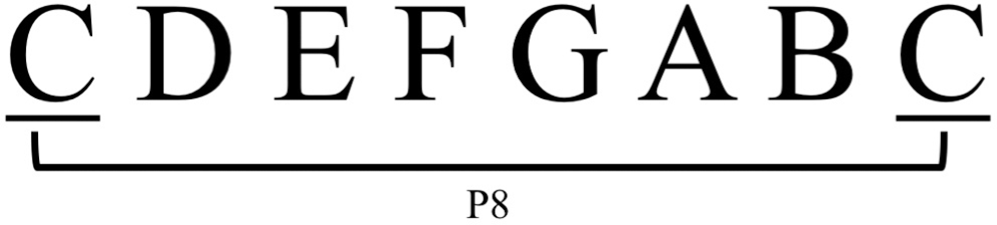
Octave.
Step 2: Matching Perfect Fourths and Fifths
Once a student understands the concept of tuning unison and octave pitches, I go back to my diagram and draw brackets for perfect fourths and perfect fifths (see Figure 2). These two intervals add two more notes in this sequence of tuning with a drone accompaniment. As before, I train my students how to eliminate beats when they perform the fourth and fifth notes of the scale. I also model in-tune and out-of-tune pitches so they can hear the shift in pitch as I adjust my finger around the pitch center.

Perfect fifth and perfect fourth.
As a teacher, you may want to decide which tuning system you want your students to learn. Many string musicians tune their open strings to perfect fifths in accordance with just intonation or Pythagorean tuning. However, others prefer tuning to equal temperament, especially when accompanied by the piano. For example, Whitcomb (2017) suggests tuning open strings to equal temperament so that the strings sound as good as possible in any key. Regardless of which tuning system you prefer to use, be aware that perfect fifth intervals are slightly larger in just intonation compared to equal temperament, while perfect fourth intervals are slightly smaller in just intonation compared to equal temperament.
Step 3: Matching Major and Minor Thirds and Sixths
Tuning intervals of thirds and sixths is a slightly more complicated process than tuning unison, octave, perfect fourth, and perfect fifth intervals. If just intonation is used, beat elimination may continue when tuning intervals in thirds as it uses a pure third. However, if equal temperament is used, students may have to get used to accepting beats. First, I draw additional brackets connecting the tonic with notes that correspond to the minor third, major third, minor sixth, and major sixth intervals (see Figure 3). Then, I have my students perform the scale and pay close attention to their pitches when they approach the third and sixth scale degrees. It is important for students to adjust their finger and experiment between pitches that sound just right or slightly off. I also model these intervals on my violin and ask my students for feedback. I perform my thirds and sixths either slightly sharp or slightly flat and we discuss the subtle differences we hear in the quality of the pitches in an intervallic context (drone plus the performed pitch) or in a melodic context (drone with a performed pitch as we play the ascending or descending scale). Additionally, as suggested by Watkins (2004), I also switch between major and minor thirds and sixths so my students can hear how the sound changes the quality between a major and a minor mode.
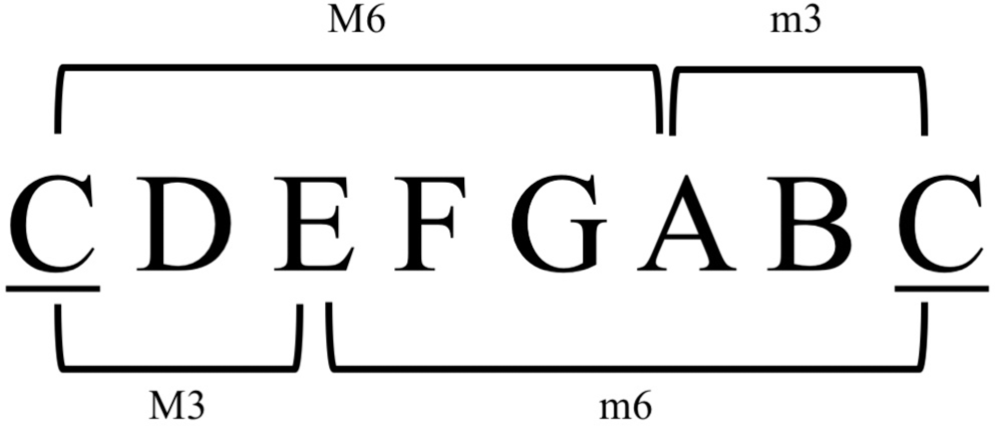
Thirds and sixths.
Similar to teaching students how to tune their fifths and fourths, as the teacher, you have to decide which temperament you will use as a baseline for establishing accurate intonation. For example, if you are going to use just intonation, it is helpful to know that both major third and major sixth intervals are smaller in just intonation than in equal temperament, while minor third and minor sixth intervals are larger in just intonation compared to equal temperament. Again, regardless of which tuning system you decide to use, it must remain consistent until the student is ready to explore multiple tuning systems.
Step 4: Matching Major and Minor Seconds and Sevenths
I tell my students that seconds and sevenths are inherently the most difficult intervals to tune with a drone accompaniment because they are also the closest, or farthest, from the tonic pitch and are just short of the unison or octave intervals (see Figure 4). When my students hear seconds and sevenths performed together, they usually cringe at the inherent dissonance. I try to convince my students to accept dissonant pitches as good by performing dissonant chords on a piano, performing a short excerpt demonstrating dissonance on the violin, or sharing a recording of a piece that demonstrates dissonance. Regardless of how dissonance is introduced to students, it is important that students learn to accept what a dissonant interval sounds like and that they understand that a dissonant pitch usually resolves to a consonant one. For example, Pablo Casals, cellist and conductor, subscribed to an idea he called “expressive intonation” (Blum 1977, 103). Casals stated that the seventh scale degree should be raised higher so that the listener feels the resolution to the tonic. Therefore, the half steps between the leading tone and the tonic are closer together than that of a similar half step in an equal-tempered scale.
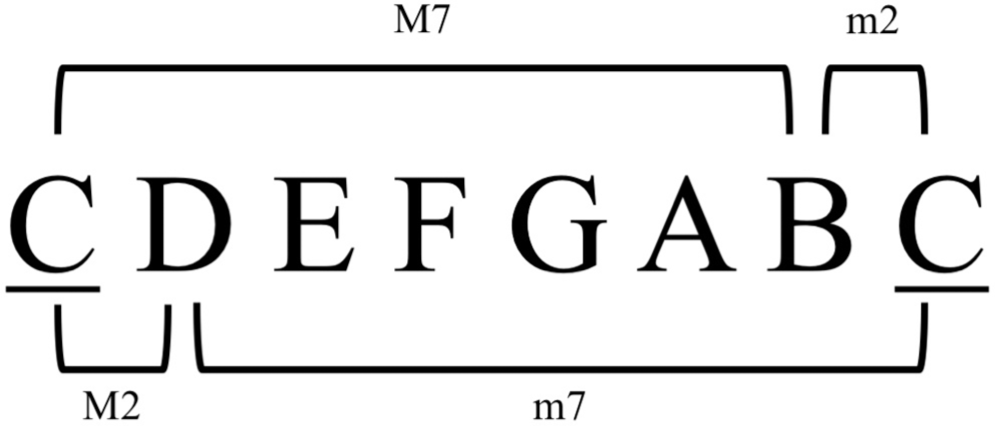
Seconds and sevenths.
Timeline and Routines
Although I have outlined a strategy to introduce drone accompaniments sequentially, there is no specific timeline for how long a student should spend on each step. Once my students have consistently demonstrated mastery on a specific task, I move on to the next step. For example, based on the above outline, I usually do not move to thirds and sixths (Step 3) until I am confident my students can tune perfect intervals (Steps 1 and 2). Subsequently it may take a week before a student is ready to move on to the next step, or it may take one lesson or a whole month.
In addition to purposefully adjusting each note of a scale with a drone accompaniment without rhythm, setting a warm-up routine with a drone accompaniment is also beneficial for daily practice. I usually share my own scale routine with my private and classroom students. First, I activate a tonic drone accompaniment in the background. Then, I perform a scale in half notes with separate bow strokes. Once I complete the scale, I perform the scale in a slur-two quarter-note pattern, then a slur-four eighth-note pattern, and finally, a slur-eight sixteenth-note pattern (see Figure 5). I tell more advanced students who are working on three-octave scales to add quarter-note triplets slurred in groups of three, triplet-eighth notes slurred in groups of six, and triplet-sixteenth notes slurred in groups of twelve. Then, they can tackle thirty-second notes slurred in groups of sixteen (see Figure 6). I usually perform the scale with a separate device producing quarter-note metronome clicks to ensure I keep a study pulse. Although I use the same scale routine with my classroom students, I do not typically use the triplet rhythms unless I feel they are prepared for the additional challenge. Depending on the number of octaves performed, it may also be necessary to include turns at the bottom or top of the scale to facilitate slurring (Galamian and Neumann 1966, 5; Wheeler and Gruselle 2010, 29). Although fingers are moving quickly once eighth notes are approached, the drone accompaniment provides a continuous external pitch center which may help train students to learn how to adjust their fingers rapidly even though they are performing many notes in fast rhythmic patterns.
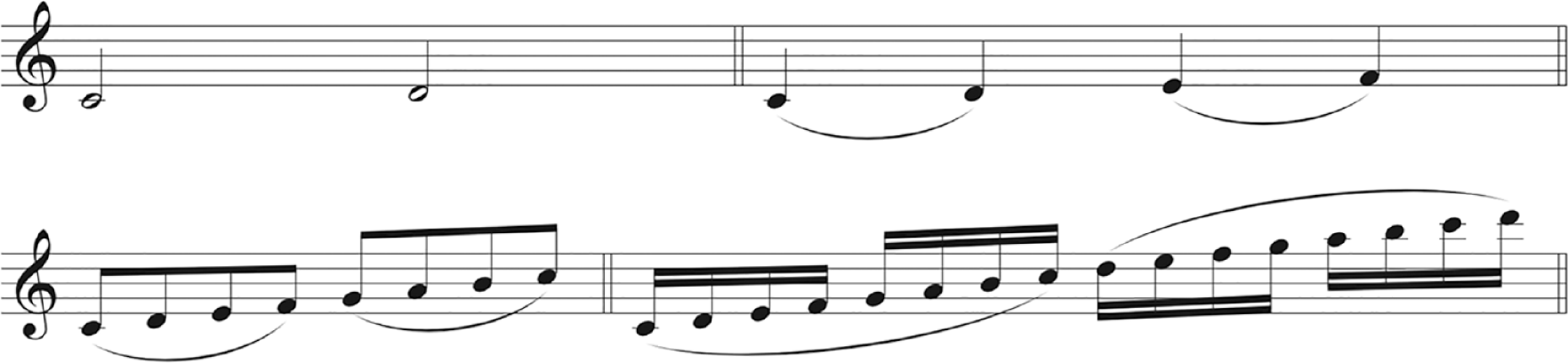
Slurred groups of two, four, and eight.
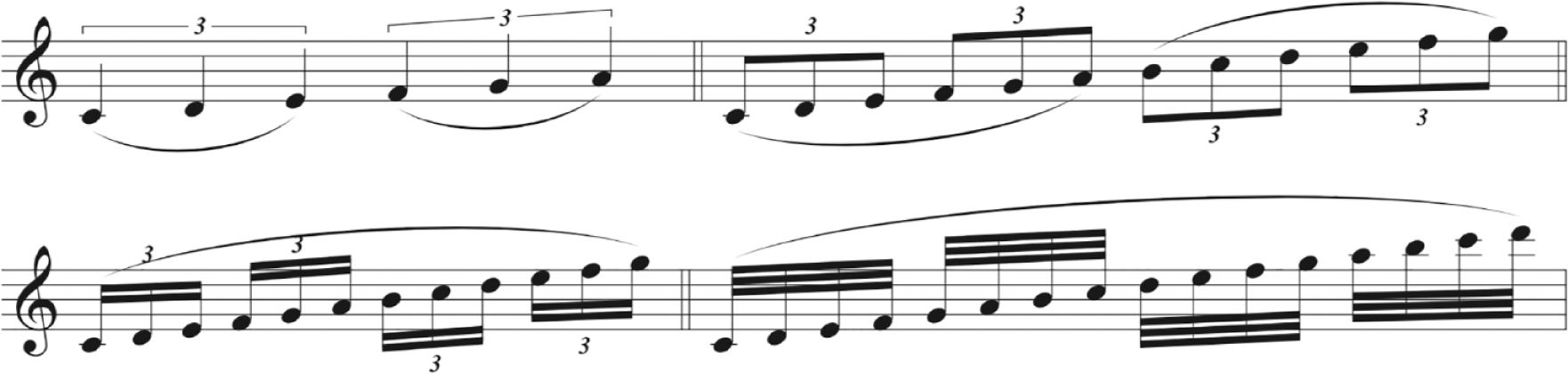
Slurred groups of three, six, twelve, and sixteen.
Final Thoughts
Using a drone accompaniment does not have to be limited to scales. The same process can be applied to arpeggios, etudes, and even repertoire. Regardless of how a drone accompaniment is used, it will help provide a steady accompaniment pitch which will help students develop a more stable tonal center on their instruments. Practicing with a drone accompaniment will also help students become more aware of how their pitches match other instruments in an ensemble. Students will eventually be able to transfer the process of matching a performed pitch to a drone accompaniment to different accompanying mediums, whether it is a piano accompaniment, a chamber ensemble, or a large ensemble.
“Regardless of how a drone accompaniment is used, it will help provide a steady accompaniment pitch which will help students develop a more stable tonal center on their instruments.”
There are a variety of techniques that we as teachers can use to teach students how to perform with more accurate intonation. Additionally, there are many ways to teach students how to practice with a drone accompaniment. Regardless of what technique or methodology we use, it is important to remember that all new concepts must be taught sequentially to ensure our students have the best chance for success.
Footnotes

John-Rine A. Zabanal (