




Abstract

When one listens, they are “giving thoughtfulness to sound” (Merriam-Webster 2022). In today’s busy world, we are surrounded by sounds. The constant bombardment of sound desensitizes your listening rendering it a mindless activity that makes active listening voluntary. To train ourselves and students to think about intonation, we must develop active listening practices (Anderson 2016; McNaughton et al. 2008; Oliveros 2005; Rogers and Farson 1987; Shapiro and Walsh 2003). This article provides student-centered best practices for fundamental intonation development as well as assessment strategies for all levels of orchestra students.
What Is Active Listening?
Helping students develop their capacity to perceive hearing as the “physical means that enable perception” and merit “intelligence” facilitates their increased attention and awareness of intonation (Oliveros 2005). The first step in helping students build awareness and understanding of how to actively listen is to focus their pitches through physical adjustment or recentering.
What Is Student-Centered Pedagogy?
Student participation and “learning by doing” does not meet the fundamental ideology of student-centered pedagogy (Scott 2006, 17). Student-centered pedagogy, on a deeper level, is a constructivist approach to students actively learning while continuously building and shaping musical capacity through reflection and self-assessment. As music educators we should frequently reflect on students’ learning to ascertain knowledge and skills best acquired through student-initiated questioning and problem-solving as opposed to those best acquired through teacher-directed instruction (Scott 2006).
Student-Centered Approaches
The following strategies focus on individual, student-centered approaches to helping students to actively listen by physical and mental focus as well as develop foundational skills of instrument setup and maintenance, body setup and alignment, and fingerboard geography.
Instrument Setup and Maintenance
The process of adjusting pitches, with fine tuners or pegs, can be physically difficult for students. Beginning and intermediate violinists, violists, and cellists benefit from fine tuners on all four strings. Lubricating the threads of difficult-to-turn fine tuners with WD-40 or liquid soap on a cotton swab helps students turn them more easily. If fine tuners are not preferred, investigate several companies that integrate the fine tuner gears integrated into the pegs to prevent slipping.
Body Setup and Alignment
Culprits of body alignment that impact intonation include flat wrists or fingers and improper thumb or elbow alignment in the left hand. Resolving setup and body alignment issues is a prerequisite to listening to and adjusting pitches. Malcolm Gladwell said practicing a skill “10,000 hours is the magic number of greatness” (Gladwell 2008). To obtain that greatness, students’ awareness of correct and relaxed left-hand alignment is necessary. Wrist angle, weight, and position alignment affect intonation. Teachers modeling proper alignment and relaxed posture will help students build self-awareness of their posture. Students could then self- or peer assess by filling out a checklist or rubric while watching their posture via mirrors, selfies, or video reflection.
We all have different finger lengths and hand sizes. Developing students’ finger pattern awareness for whole and half steps are essential for upper string players’ intonation success. To build kinesthetic awareness, students should learn the physical distance of a whole or half step using imagery; for example, the violin spacing for the whole step distance is a mini-size candy bar. Students could create a list or draw pictures to encourage each other to visualize physical finger spacing. In addition, before beginning a piece, teachers can question students about their knowledge of key signatures by asking about finger patterns and positions across all strings to help students make connections as they learn to play in multiple keys and modalities.
How does the right hand contribute to intonation? The bow is the magic and artistry of producing sound on the instrument, and it does, indeed, impact intonation. From the beginning, students need to focus on contact point (where), weight (how much), and speed (distribution of) to avoid cracking pitches and produce, instead, ringing tones for pitch centering. Having students explore pitch changes when using too much weight or playing too close to the bridge while also modeling proper bow technique encourages reflection on the resulting intonation.
Fingerboard Geography
Visual and kinesthetic learners usually appreciate the opportunity to use finger tapes on the fingerboard. Bergonzi’s (1997) study indicated that finger tapes improved intonation. If we use finger tapes, it must be with the understanding that they are only temporary; they are like the training wheels on a beginner’s bicycle. Over time, tapes move and become unreliable. While tapes may provide beginning students with a visual map of fingerboard geography, students must ultimately develop the ability to navigate the fingerboard by listening to themselves and matching the ensemble. For intermediate and advanced players working on shifting, have students notice and model that their fingers must become closer together physically as they shift above the neck on their instrument. Making sure students understand the physical distance is smaller as we play higher pitches is a helpful physical intonation reminder.
Mental Awareness
Building students’ mental awareness of the pitches they hear as they tune, practice individually, rehearse as an ensemble, and perform is essential to their fundamental musicianship. Students should critically listen to various performances and analyze the similarities and differences of pitches throughout the piece or in critical sections. Using an online platform such as Edpuzzle or Playposit to ask questions intermittently during video recordings could help students focus their responses on specific music sections.
Listening and assessing recordings of individual or the ensemble performance is as imperative for the students as for the teacher. Students could record themselves individually or as an ensemble before the concert, listening critically, and develop an action plan for improvement. For long-term progress, have students self- and peer-reflect on individual and group recordings from the beginning, middle, and end of the year. Long-term results ensure students are invested in their own physical and mental responses to intonation and overall concert preparation.
Developmental Applications for Intonation in the Orchestra
Tuning
Tuning “is one of the most fundamental, most important, most serious skills strings players must master” (Fischbach 2003). It takes an average of four and a half years to develop successful tuning practice as there is an ebb and flow to tuning successfully; thus, taking time-to-tune reduces time for instruction (Hopkins 2013). However, if tuning is one of the most fundamental, important, and serious skills to be mastered, is not taking time-to-tune instruction unto itself? Furthermore, it becomes impossible to resolve and build better intonation practices within the ensemble if individual players are not in tune.
There are many tools available to assist with tuning: chromatic tuners (e.g., Korg or Peterson models), pitch sources (e.g., Boss, Dr. Beat, or McAdams models), clip-on models (e.g., Snark or D’Addario models), and online applications (e.g., Tuner Ninja and YouTube drone videos) to help students become independent tuners (Alexander 2008; Frisk 2019; Selby 2012; Zabanal 2020). With any of these tools, the primary strategy is to use something consistently and routinely to practice tuning during class so that it becomes standard classroom procedure.
The tuning process takes time for students to develop at all playing levels. Figure 1 (Beginning), Figure 2 (Intermediate), and Figure 3 (Advanced) show the stages consistent with the concept of taking years to master tuning our instruments. Work to internalize the open string pitches by humming, singing, and audiating as a critical part of the tuning process (Dillon 2003). After students audiate, they wait five seconds so that their ears have time to process the sound until they all begin to tune. Students can correct pitches with or without the bow but should always continue to play while adjusting. Using visual guides, such as a chromatic tuner, for tuning with beginning students may initially help with student success and increased instructional time, but Griswold (1988) states, “after first learning to adjust pitches visually with the tuner, students follow through and learn to adjust pitches aurally, they will be more likely to transfer this newly acquired aural habit of pitch adjustment” within the ensemble (p. 50).

Process for beginning tuning.

Process for intermediate tuning.
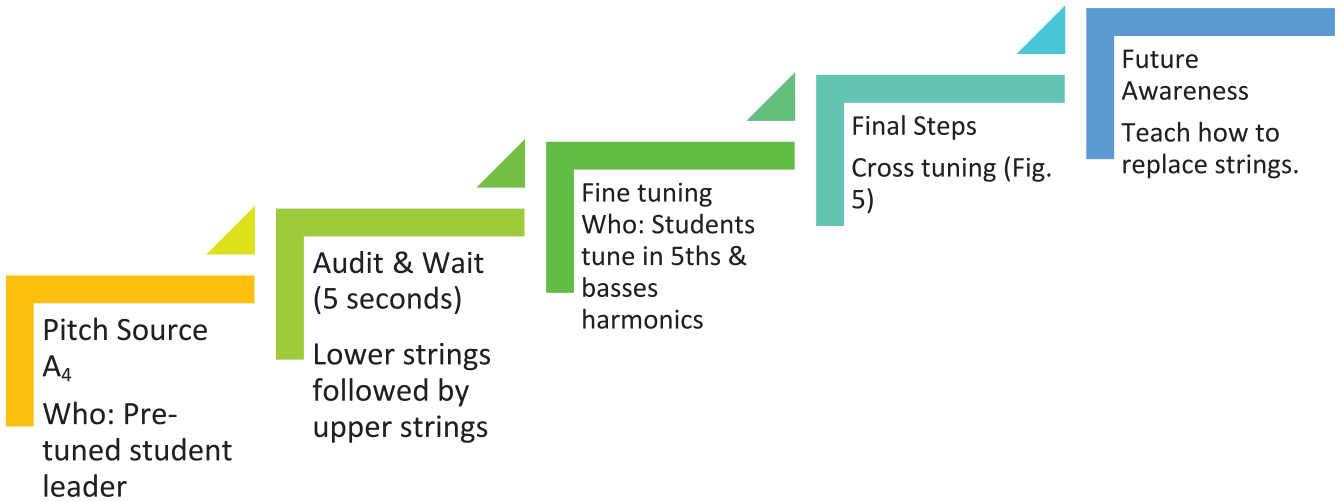
Process for advanced tuning.
Within an intermediate ensemble, have stand partners or nearby peers non-verbally assess correct or incorrect tuning and motion to continue up or down in pitch and when to stop. Asking students to stand up or keep playing if they know they are out of tune or even when they are not sure helps them learn to self-assess. If a student is having trouble discerning if they are out of tune, another helpful strategy while having a drone pitch is to have the student tune two turns down in pitch with the fine tuner or a complete turn for bass and come back up to the pitch. Intentionally making the instrument out of tune helps students listen and adjust to reinforce their aural development. Finally, having students listen and adjust across the section builds strength throughout each section and helps develops awareness of the advanced cross-tuning. Students could start this process by matching to their stand partner or to a person within their section. For more advanced listening, students listen within smaller to larger groups and with a variety of upper or lower strings to achieve awareness of cross-tuning.
Because it is sometimes difficult to hear the lower pitches, the teacher should assist bass players by having them tune individually, not as a section, from the rest of the ensemble. It is critical to take time for bass students to learn to tune accurately to help ensure the orchestra’s foundation of pitch.
The final step in the process of ensemble tuning is cross-tuning, explained in Figure 4, which can be directed by the student leader verbally or non-verbally while students are constantly playing and adjusting.

Process for cross-tuning.
Warm-Ups
In an interview, someone asked Jascha Heifetz, “How do you play in tune?” and his reply was, “I don’t. But I adjust before you noticed it was out of tune in the first place” (Fisher 2008, 1). Musicians cannot be in tune 100 percent of the time, but they learn to fix it quickly through repetition. Intentionally guided and independent practice focused on rudimentary exercises such as scales and arpeggios are fundamental to gain physical mastery of intonation. Ear training warm-ups should include scales that focus on intervallic structures by playing rounds in thirds, sixths, or even fifths or fourths. Consider the use of the Wheel of Names (https://wheelofnames.com/) or roll a dice to randomly choose which interval students will focus on while playing rounds to counteract the monotony of scales. Have different sections drone key centers to focus tonicization and intervallic structures of chords. Whether the piece is tonal, modal, or atonal, this strategy will allow students to assess which pitches are consistently out of tune. In addition, have the drone section assess their peer’s playing. Students’ understanding of the relationships between intervals and tone clusters is necessary to explore before mastering the literature.
To create further independence, model the game of call and response in a particular key center and then rotate individual students to give the call. This a great way to encourage independence and assess individual learning within an ensemble. Even within pieces, students can find call and response patterns in their music for the entire ensemble to play. The violin section might not have the same intervallic leap as the cello section, but this helps the students better understand how to hear across the ensemble.
Within the Literature
Students must continue to adjust pitches throughout the rehearsal, not only while actively listening during a warm-up. When choosing literature for the ensemble, teachers should analyze (1) key(s) or modalities, (2) vertical alignment, (3) scale degrees, and (4) foundations of pitch center to enhance the musicality of the ensemble collectively (Gillespie 2001; Kjelland 2003; Rotjan 2018). When looking at the score ask yourself and students the following questions:
What is the key signature or modality?
Are there any accidentals?
What does the bass line have?
Does the chordal structure support the modality?
Who has the tonic or third of a chord?
Who is doubling octaves?
Who has the 7th as a leading tone?
If there are accidentals, are they outliers to hide or intervallic relationships to strengthen?
To help answer these questions, droning the key center while aligning the outliers could help a section understand its purpose within the greater whole of the chord. Droning also helps with arpeggiated passages. Foundations of pitch center always require matching to the lower octave not just for doubled octaves but octaves that might be doubled three or four octaves away.
Strong intonation instruction should include a design that develops active listening within, across, and between the ensemble sections. Strategies to build a student-centered intonation design include:
It’s all about the bass—The foundation of orchestra is the bass section. Sometimes hearing the lower pitches is difficult, not just for the bass players. Ask students to listen and match to the fundamental of the pitch in the bass section.
Listen to the middle—Have students center their pitch on the second or third row of players within the section. Placing these students in charge of the pitch center promotes listening within the section and gives leadership throughout the section, not just the first stand.
Mix-it-up—Students move around the room and intermingle within sections which help them hear different melodies and harmonies and create independence on their part. Have sections stand or sit in the back or front of the ensemble to benefit vertical alignment of the ensemble.
You know what it isn’t—When students are zoning out of pitch center, ask them intentionally to play the wrong note (i.e., F vs. F#). Not only does this help establish major and minor intervals, but students practice continuously adjusting pitches within the ensemble.
Bull’s Eye—Ask students to center their pitch as an ensemble, by imagining getting closer to a target. Our pitch center might begin with a huge circle, and the goal is to be one small circle of intonation. To help students visualize pitch center, the teacher or student leader can non-verbally show this with their hands by creating a large circle with their arms, gradually moving the hand closer together, and finally making a fist. Students using this non-verbal cue is not only helpful while tuning but also will engage students across sections while working with specific groups on a difficult passage.
Overall, the successful application of these strategies depends on taking the time to actively listen and encourage students’ willingness to adapt and, at times, fail. Building a solid foundation and creating a design of active listening awareness for students is key to growth and continued success.
Assessments
Throughout this article, there are informal assessments that focus on self- and peer-analysis. Creating formal assessments that encourage high standards of individual student achievement helps teachers to measure the outcomes of developmental applications for intonation and work toward the goal of a musical orchestra. The following assessments provide students with data to support growth in their foundations of intonation.
Tuning
We spend a great deal of time teaching students to tune; thus, we should assess their tuning abilities (Figure 5). Students are given a pitch source and cannot use chromatic tuners or advice from others. Each student, chosen randomly, plays all four strings while softly listening to an “A” pitch source. Using the tuning rubric, students have immediate feedback based on the teacher’s request to adjust any of their four strings. This assessment is intended to show students’ overall progress in developing tuning skills. If a student has a lousy tuning day, it does not mean they do not know how to tune, hence the RETAKE until they receive a B or higher. Within a grading period, one or two tuning tests appropriately assess student progress.
“Creating opportunities for students to listen and develop their practice and performance skills actively encourages continued growth in intonation development. Having perfect pitch or being the music theorist is not required to achieve a high level of intonation precision individually or within an orchestra; however, active listening is essential.”
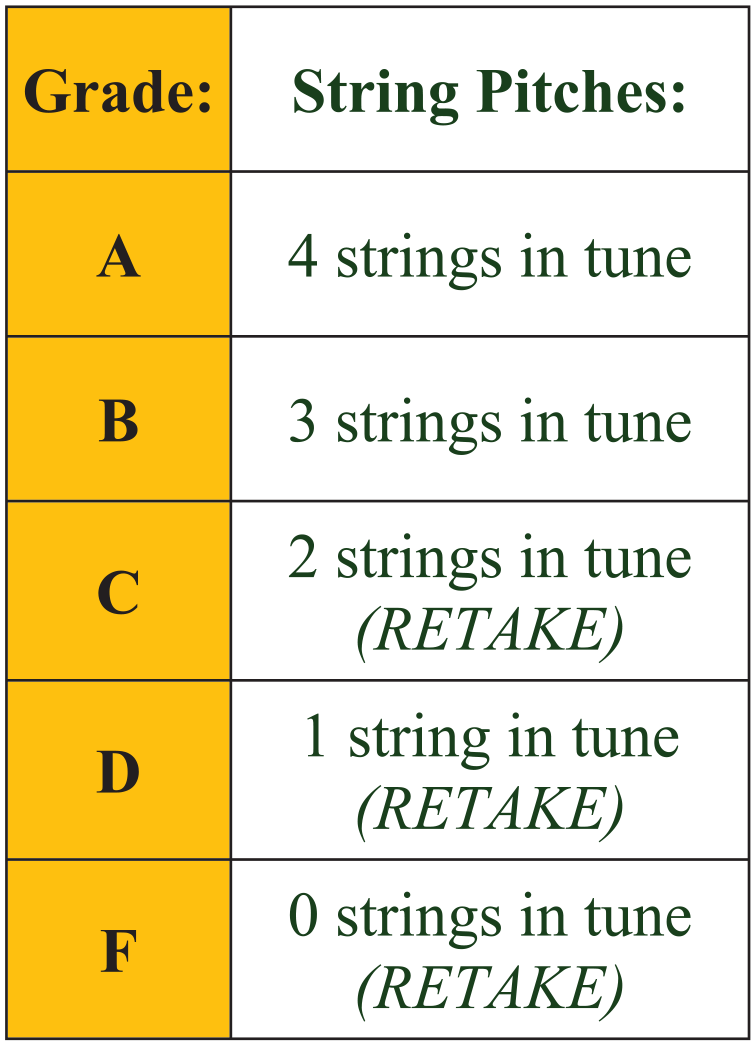
Tuning rubric.
Individual Intonation Awareness
A simple formal assessment strategy for individual scale intonation is to circle out of tune notes from a student’s recorded performance (Figure 6). An arrow up indicates that the pitch center is flat, and an error down indicates sharp. The student could also self-assess their scale and compare it to the teacher’s analysis. Overall, this rubric helps students visually understand which pitch is chronically out of tune and if pitches are centered more on the way up or down the scale.

Scale rubric.
Ensemble Intonation Awareness
When formally assessing ensembles, teachers could use group assessments that apply the reality of a performance-based summative assessment or concert. Although some excerpts might serve better as an individual assessment, for vertical intonation viability, the excerpt should include all sections or at least two sections of the ensemble. Cut and paste sections of the score, copy, and grade directly on the score for feedback to each individual. While the teacher might need to adapt to assessing multiple students at one time, much like a chamber musician, this assessment strategy helps students visualize their complicity in vertical pitch alignment from the marked score by comparing their performance within other sections. While each student receives a separate grade, they perform as an ensemble, and assessments like these also promote independence within their section.
Listening is a vital skill requiring continuous refinement through all stages of music education (Anderson 2016; Rogers and Farson 1987; Todd and Mishra 2013). Creating opportunities for students to listen and develop their practice and performance skills actively encourages continued growth in intonation development. Having perfect pitch or being the best music theorist is not required to achieve a high level of intonation precision individually or within an orchestra; however, active listening is essential. When students become actively engaged in the process of listening, learning, and assessing intonation they collectively answer the question, do you hear what I hear?
Footnotes
Elizabeth A. Reed ( ). Dr. Reed received degrees in music education and studied cello at the University of South Carolina and the Eastman School of Music. As a researcher and clinician, she focuses on music teacher identity, culturally responsive pedagogy, student-centered assessments, and pitch perception.