



Abstract

After I retired in June 2022, I wanted to take a major trip to celebrate. A colleague forwarded a Facebook posting from Daraja Music Initiative (DMI 2022) offering an information meeting for prospective volunteers. DMI’s (n.d.) website described their dual focus on sharing music and sustainability with Tanzanian children. Their conservation efforts focus on planting and sustainable growth of mpingo, the Swahili word for ebony, grenadilla, or African blackwood (Dalbergia melanoxylon), the wood used to make clarinets, oboes, and string fingerboards. Overharvesting by international industries and locals has depleted supplies and interfered with sustainable use by local populations for basic needs like firewood for cooking, shade from the sun, and carbon reduction. DMI’s mission also includes teaching clarinet and strings, so that locals understand one valuable use of mpingo wood. Mature trees also offer economic hope to this impoverished region because the wood can sell for at least $18,000 per cubic meter (Palmer 2021).
After reading the website, I was inspired by DMI’s mission. I attended an information meeting, participated in an interview, and then decided to volunteer for two weeks of the six-week program. An extra hook for the trip was the inclusion of a three-day safari for all volunteers. I knew I would have a life-changing opportunity to work with beginning violin students while learning about day-to-day life and conservation in a Tanzanian community.
Daily Life and Teaching in Tanzania
The DMI board sent excellent instructions for trip preparations and shared what to do upon arrival at the Kilimanjaro airport, so I felt reasonably confident about the thirty-five hours of travel from Arizona to Moshi, Tanzania. After I disembarked from the plane and went through customs, I found Ian, a professional clarinetist and teacher from New York City as well as DMI’s Executive Director, and Goodluck, DMI’s In-Country Operations Coordinator and community partner. After a one-hour drive on sometimes bumpy roads, we arrived at the eight-bedroom house that would be my home for the next two weeks. After a brief tour, I went right to sleep.
The next morning, I met the other volunteers who were there for the week, including Maya, a clarinet performance major from New Mexico; Marie and Allen, a retired couple from Indiana, who were active members of their community clarinet choir; and Michael, a violinist and recent engineering graduate from Dar es Salaam, the capital of Tanzania. We fixed breakfast from supplies on hand which were familiar foods like toast, cereal, yogurt, eggs, or delicious fresh local fruit.
After breakfast, we loaded up the van and went to a school where DMI planted trees several years ago. Due to four years of neglect during the pandemic, the trees at this school needed pruning. The goal was to cut off the crooked branches so that the tree could grow straight. Pruning the trees proved to be challenging work because the wood was so dense and we had limited tools. I quickly learned that I could make the best contribution by hauling cut branches to the trash pile. However, I had to be mindful of the big thorns lining every branch.
“ I knew I would have a life-changing opportunity to work with beginning violin students while learning about day-to-day life and conservation in a Tanzanian community.”
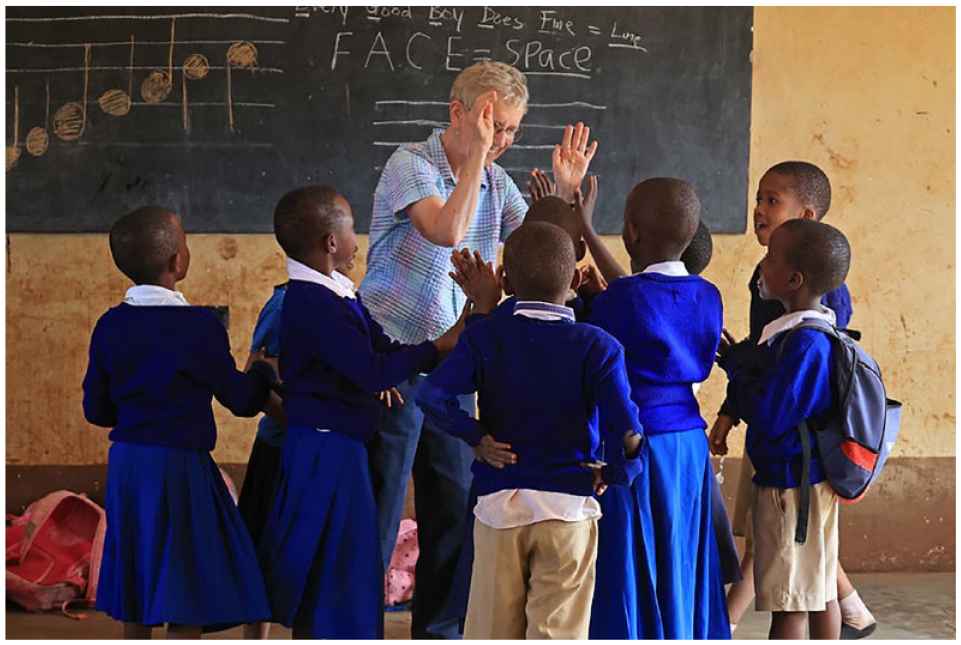
General music class “high-fiving” Marg.
For the first three weeks of the program, the violin class was led by Roselyn, a violin teacher, performer, and DMI board member from the Boston area. She was assisted by two young Tanzanian men: Fraterin, a former student in the DMI program, and Michael, the violinist from Dar Es Salaam I had met at breakfast. Before I left home, Roselyn shared a handbook with me that described the Suzuki-inspired pedagogy she was using, as well as a Google document outlining each day’s lesson plans. She willingly answered my questions, so that I felt reasonably well prepared to help teach the class. Fraterin and Michael taught the class in the week before I arrived. They hoped to learn more about teaching from me, and we were able to work out a good team-teaching approach for the daily classes. In Tanzania, primary school students are instructed in Swahili and do not learn English until secondary school (if their families can afford to send them). The DMI handbook provided some basic Swahili terms useful for teaching which I practiced before I left for Tanzania. Even with a lot of gesturing, I could tell the students did not understand some concepts I was trying to share, so I was very grateful to have Michael and Fraterin explain in Swahili as needed. My goal quickly became to coach them, much the way I coach student teachers, so that they could take over and lead the classes and the final concert performance.
During my two weeks with DMI, most of our mornings were filled with tree pruning or tree planting. The Tanzanian government requires schools to add trees to their grounds to support cleaner air and water retention (Altamont Enterprise 2013). We visited three public secondary schools to prune trees where we had little interaction with the staff and students. We also visited three different schools to plant new trees. People at each school prepared the holes for the trees before we arrived, and students and/or staff assisted with placing the young trees in the holes (Figure 2). We then presented a short program demonstrating the clarinet and violin for the students, so they could understand one of the reasons that preserving the trees was important.
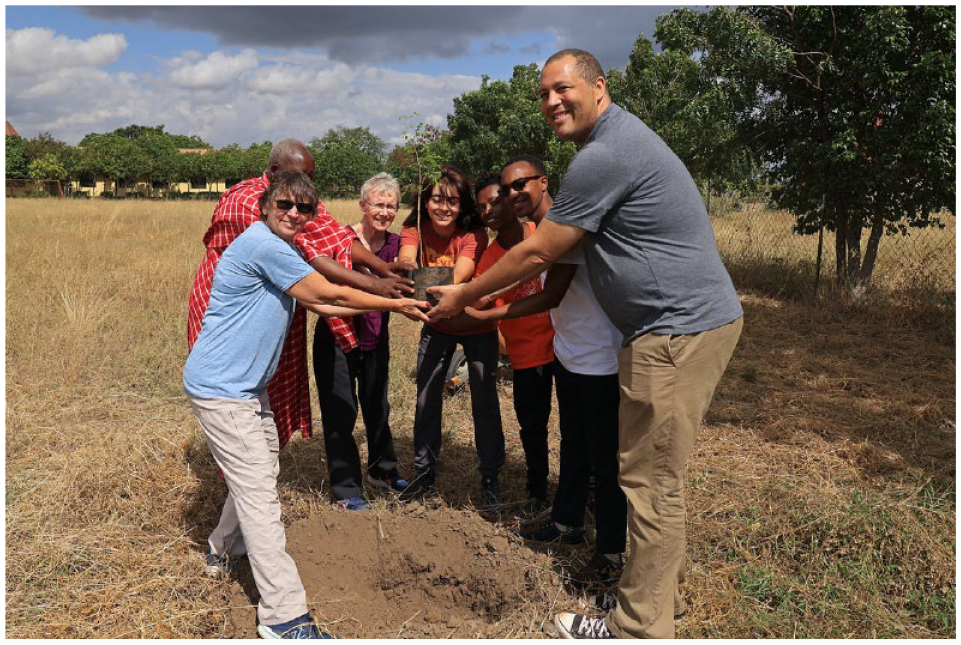
Marie, Maasai chief, Marg, Maya, Fraterin, Michael, and Ian planting a tree.
The three schools where we performed were very different from each other. The first school was a secondary school that focused on preparing students to earn a living through agriculture. The second school was a private school founded by an American for Maasai tribal people far from the city. The third school was on the grounds of the National Police Academy and served the families of police trainees. After we performed at the agriculture school, their school choir of about ten high school students sang a variety of songs in Swahili for us. We also learned from several of their teachers about the students—who all boarded at the school—and the school’s unique technology-based curriculum. Computers seemed to be rare in the public schools we visited. At the Maasai school, we performed for the whole student body, about seven hundred students, and were offered a tour and a delicious lunch. At the Police Academy, we performed outdoors for about forty kindergartners, who eagerly volunteered to carry the trees to the holes. All our performances ended with the Tanzanian national anthem, “Mungu ibariki Afrika,” which I found to be quite beautiful (NationalAnthems.Info, n.d.).
On our free mornings, we could shop or explore the neighborhood, practice, rest, or take care of email or texts. We took turns cooking dinner each evening, using both familiar and unfamiliar food from the local grocery store. We frequented the nearby produce stand, where the owner would ask whether we wanted to eat it “today or the day after today,” and then choose the perfect mango or yam for us. On Tuesday evenings, we had dinner at a local coffee shop before students and their families arrived for an hour-and-a-half-long “open mic night.” The children could volunteer to perform, alone or with a few friends (Figure 3). We teachers also shared a few pieces. It was exciting to see how enthusiastic the students were to share the music they were learning, and each of them received a bottle of soda pop as a reward.
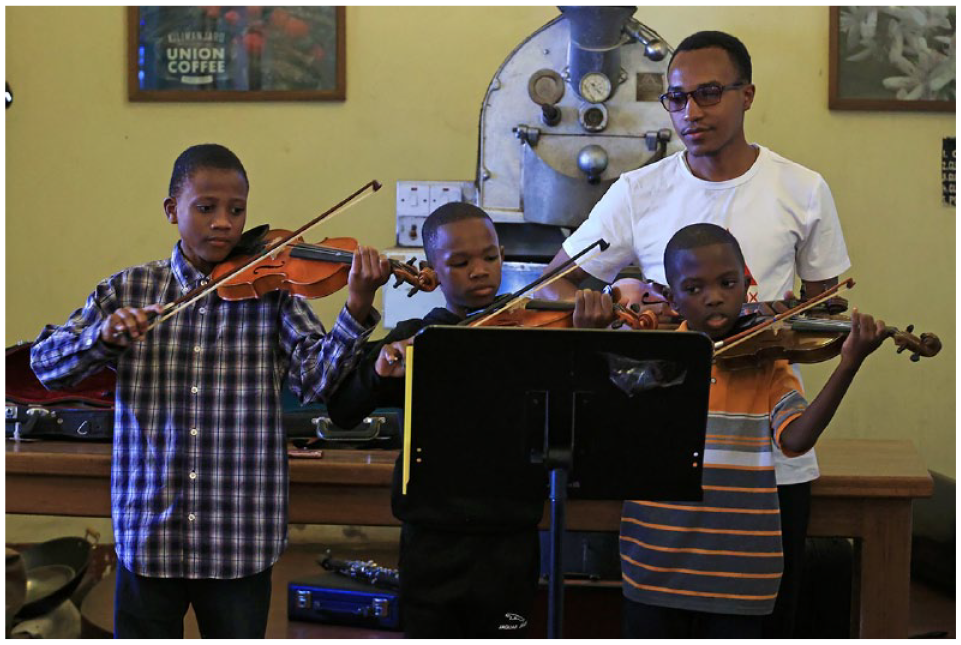
Coffee shop performers coached by Michael.
On Sundays, we teachers went to the Tanganyika Planting Company Club, much like a country club in the United States, located on “the oldest sugar plantation in Tanzania” (Tanganyikan Planting Company, n.d.). The peaceful, beautifully groomed grounds were a different world from Moshi. We performed for brunch at the restaurant frequented mostly by local ex-patriots working in the area. We enjoyed a delicious meal, and performed solos, duets, and trios, which were often observed or visited by monkeys in addition to the patrons.
Additional Opportunities to Learn
Every Wednesday, students had a conservation lesson instead of general music, and on Saturdays, we took them on field trips to learn about their country since very few of them traveled beyond their own neighborhoods. Learning about other nearby areas in their homeland is important, not only so that they could better preserve its natural resources, but so that they could be prepared for the many post-secondary jobs related to environmental and wildlife studies as well as tourism. Coffee is a major export product in Tanzania, and one Saturday trip was to a coffee farm, where the students learned about how coffee is sustainably grown and harvested. They also helped roast the beans over an open fire, grind them with a big wooden stick, and then drink freshly prepared coffee.
A highlight of the trip was our three-day safari. Our wonderful driver and tour guide, Dale, skillfully handled the Toyota Land Cruiser on some rather undeveloped roads. We visited three national parks and saw a large variety of animals, many of which came quite close to our vehicle. Dale seemed happy to stop often to let us observe a group of baboons, a herd of wildebeest, an elephant family, or a lakeshore full of flamingos. My favorite surprise was when we stopped at a pond that appeared to be full of large rocks with birds on their backs—then the rocks moved, and they turned out to be hippos! We learned that the Swahili words for many animals were used as names of characters in the Lion King, such as Simba (lion), Rafiki (friend), and Pumbaa (slow-witted, although I doubt that Pumbaa the warthog appreciates that characterization). The park visitors seemed to be groups of six to eight international tourists in jeeps driven by local guides. Due to government regulations, we were highly supervised by Dale who made sure we stayed only in approved areas. We were sad to learn that few Tanzanians can afford to visit their national parks which made me very grateful for the relative accessibility of national parks in the United States. Each evening, we returned to our hotel, which was built to look like a village of approximately thirty grass-roofed huts. Once I was inside my room, with its comforts familiar to Westerners, I could see that the grass roofs were just for show, perhaps designed to give tourists the impression of a stereotypical “African” experience.
Conserving Mpingo and Pernambuco
While I was in Tanzania, we stopped at a craft shop where men were carving ebony figures that revealed mixed spots of dark black and lighter brown mpingo wood. I learned that this was because a young mpingo tree has light-colored wood in its core (Figure 4), but as it ages, the wood takes in carbon dioxide from the atmosphere, gradually becomes darker and denser until the entire core of the trunk or branch is dark brown or nearly black (Figure 5; Palmer and von Haugg 2018). The trees grow very slowly, taking seventy to one hundred years to reach maturity and produce the valuable dark wood needed for musical instruments (Palmer 2021). This made me curious to learn more about the pernambuco wood from Brazil used for bows (also known as pau brasil or Caesalpinia echinate). I knew pernambuco was similarly overharvested and extremely valuable, but I knew little else. I discovered that pernambuco shares many characteristics with mpingo, including slow growth, with a light wood core which slowly becomes dark red as the tree ages.
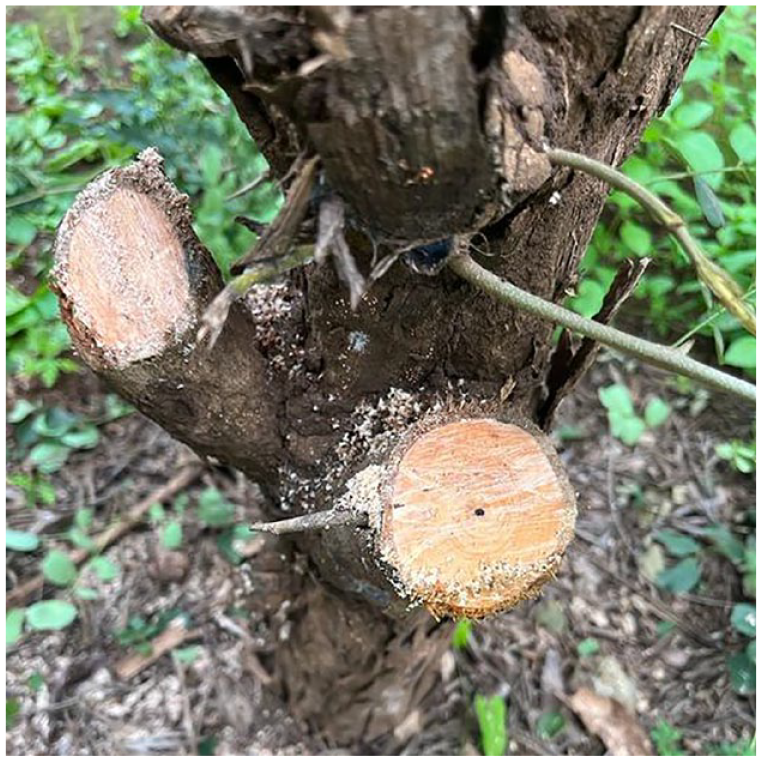
Young mpingo tree.
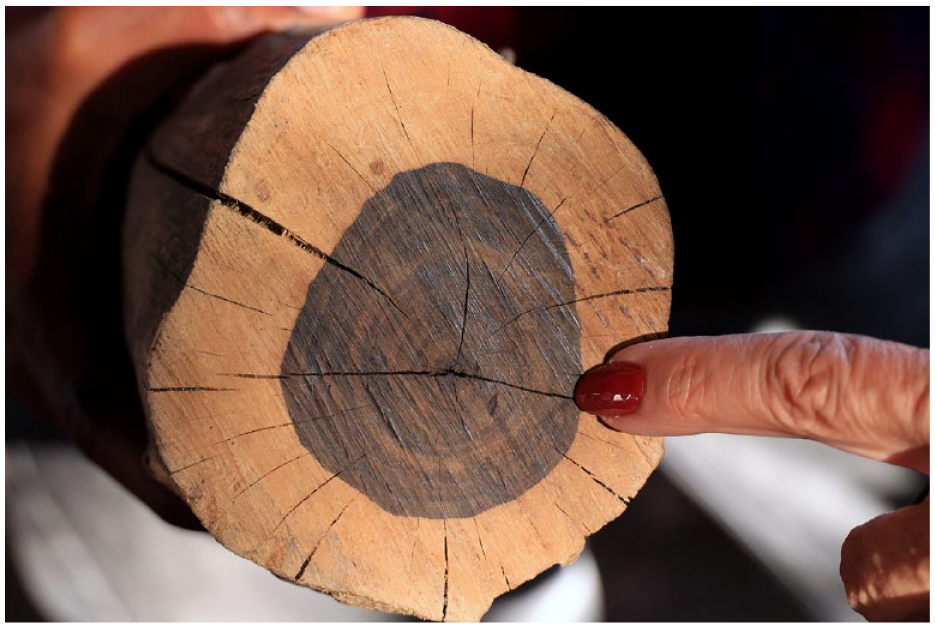
More mature mpingo tree.
I also learned that both Tanzanian mpingo and Brazilian pernambuco are listed as “near threatened” species on the Red List of Threatened Species (World Conservation Union 2023). Many international non-profit, religious, and research groups work alongside the countries’ governments to develop sustainable practices to preserve access to both woods. For example,
A reforestation program in the state of Pernambuco, Brazil, has shown that a properly pruned and cared-for tree will produce heartwood suitable for bow-making in thirty to thirty-five years as opposed to the 80 to 100 years required for a tree in the wild. (International Pernambuco Conservation Initiative, n.d.)
The United Nations Framework Convention on Climate Change (UNFCC, n.d.) oversees implementation of the Paris Agreement, among other conservation concerns, through annual “CoP” meetings. CoP stands for “Conference of Parties,” with “parties” being the nations that sign the UNFCC (2023) climate agreements. You may have heard about the CoP meetings through the media, particularly the recent activism of Greta Thunberg (Connect4Climate 2018, 2019).
Other groups meet under the auspices of the UNFCC to focus on particular aspects of climate change and conservation. The Convention on International Trade in Endangered Species of Wild Flora and Fauna (CITES, n.d.) is an international agreement intended to ensure
that international trade in specimens of wild animals and plants does not threaten the survival of the species . . . Today, [CITES] accords varying degrees of protection to more than 40,000 species of animals and plants, whether they are traded as live specimens, fur coats or dried herbs.
To help string instrument makers and musicians follow decisions by CITES, the League of American Orchestras, in partnership with the American Federation of Musicians, International Alliance of Violin and Bow Makers for Endangered Species, National Association of Music Merchants, and other international music sector partners created a continuously updated online document, “Know Your Bow: Tips for Owners and Users of Pernambuco Bows” (League of American Orchestras 2023a). At a November 2022 meeting of CITES in Panama City, Panama, more than two thousand experts and representatives from the 184 member parties, including the stakeholders represented by the League of American Orchestras (2023b), discussed competing proposals from those who had filed for a total ban on the export of Pernambuco from Brazil and those who wanted to permit restricted use. The total ban could have resulted in no future supplies of pernambuco for bow makers, as well as string performers and teachers being prevented from traveling with their own bows and instruments to and from Brazil. The groups compromised, agreeing to update CITES to require a special permit for all pernambuco—including finished bows—entering or leaving Brazil (CITES 2022). The International Alliance of Violin and Bow Makers for Endangered Species (2022), however, warns that this is only a temporary compromise and, on their website, offers suggestions for getting involved.
With an online search, I was surprised to discover several other non-profit and governmental groups concerned with preserving and conducting research about these endangered woods. Instrument and bow makers are among the many supporters of the African Blackwood Conservation Project (n.d.) and the International Pernambuco Conservation Initiative (n.d.) which focus on similar goals. In Brazil, the government supports research at local universities studying sustainable growth and harvesting of pernambuco, along with educating local communities about the importance of preserving this valuable resource. Several American luthiers, along with the above-mentioned League of American Orchestras, have valuable information on their websites about sustainable use of these woods (e.g., William Harris Lee, n.d.). Bow and instrument makers also continue exploring various ways to synthesize pernambuco and ebony that will produce tone of equal quality to the original woods.
Take-Aways from My Experience
Traveling to Africa to teach students and learn about rare wood gave me a profound sense of gratitude. The classroom teachers we met creatively used their limited resources to provide the best education they could for their students. Parents worked hard to provide the best possible opportunities for their families, also with limited resources. And the children worked very hard for us because they loved having that special opportunity to make music.
I was reminded to remain flexible because events did not always go as planned. The electricity sometimes went out for several hours, which caused us to cook using propane burners and eat dinner by flashlight. The night before the trip to the coffee farm, it rained heavily, and the bus drivers wanted to wait until the roads dried out before leaving. The children were already at school as planned, so we led them in camp games and songs for an hour and a half until the drivers determined we could safely leave. Even then, the buses had to stop about a half mile from our destination due to the mud, so we walked through the trees to the coffee farm. When we did not have the right tool for tree pruning or the right pot for cooking, we improvised. “Hakuna matata,” Swahili for “no worries” or “no trouble,” became our motto.
My two weeks as a volunteer for DMI was a life-changing experience that provided me a new perspective on many things. I am still giving Fraterin and Michael violin lessons via WhatsApp, even though we are sometimes challenged by dropped calls or poor lighting when the electricity or Internet are out. DMI is always looking for volunteer teachers and donations of instruments, so I encourage anyone who is interested to explore their website to learn more about their music- and conservation-focused mission (Daraja Music Initiative, n.d.). At a minimum, I hope this information invites you to learn more about the many groups dedicated to sustainable growth of the trees needed to produce string instruments and bows. I also encourage you to consider volunteering for DMI or another organization if you want a unique summer adventure!
Footnotes

Margaret Schmidt (