



Abstract
Climate change challenges contemporary management practices and ways of organizing. While aspects of this challenge have been long recognized, many pertinent dimensions are less effectively articulated. Based on contemporary literature and insights from articles submitted to this special issue, the guest editors of this special issue highlight some of the challenges posed by climate change to government and business, and indicate the range of options and approaches being adopted to address these challenges.
In May 2011, the International Energy Agency (IEA) announced that global carbon dioxide (CO2) emissions from energy use in 2010 reached its highest in history. At 30.2 Giga tons (Gt), energy-related CO2 emissions rose by 5% from the previous record year in 2008 when emissions reached 29.3 Gt. Moreover, the IEA estimated that 80% of projected emissions from the power sector in 2020 are already locked in, as they will come from power plants that are currently in place or under construction today (International Energy Agency [IEA], 2010).
The notion that climate change poses a difficult challenge for humanity has long been recognized. The first World Climate Conference took place in 1979 and the Intergovernmental Panel on Climate Change (IPCC), an international scientific body to investigate the extent and possible impact of climate change, was established in 1988. The first IPCC report called for a global treaty on climate change, which led to the signing of the United Nations Framework Convention on Climate Change (UNFCCC) in 1992. The industrial country signatories have committed themselves to “the aim of returning individually or jointly to their 1990 levels these anthropogenic emissions of carbon dioxide and other greenhouse gases” (UNFCCC, Article 4, Paragraph 2b). The treaty went into effect in March 1994 and currently has 194 signatories.
The World Business Council for Sustainable Development (WBCSD) in its submission to the Earth Summit in Rio de Janeiro back in 1992 highlighted the difficult and almost paradoxical relationship between business and climate change: industrial activity (mostly driven by business) is the main cause for anthropogenic CO2 emissions, so addressing climate change requires radical adjustment in industrial structure and activity. At the same time, economic development is needed to bolster innovation, clean technology, green investment, adaptation, and ultimately to achieve climate protection. The WBCSD recommendation was for a change in course for businesses and a shift away from the often adversarial relationship between business and government on environmental issues toward a more collaborative approach (Schmidheiny, 1992).
The main message of the figures released by the IEA this year is that global CO2 emissions are almost certain to exceed the 32Gt limit for 2020 set by the most recent IPCC report (Solomon et al., 2007). Given that the global economy will most likely grow over the next 10 years with resultant increase in carbon emissions, there is a real sense that the window is closing on the opportunity to keep the average global temperature rise below 2°C as stipulated in the Copenhagen Accord and Cancun Agreements of the UNFCCC. In other words, nearly 20 years after the global agreement to fight climate change was established, the problem is still proving an extremely challenging task for governments and industry.
Given the international community’s long-standing awareness of the transformative implications of climate change for governments and business, one would have expected the scholarly field of business management to be centrally engaged with analysing the implications for business and ways of organizing. Curiously, though, such engagement has not been the case. It was not until recently that climate change began to filter into mainstream academic management scholarship. As Amanda Goodall shows, some of the premier publications in management including the Academy of Management Journal and Academy of Management Review “did not have any article mentioning climate change or global warming (in title abstract or key word) from 1970 to 2006” (Goodall, 2008, p. 3). Furthermore, out of a total number of 31,000 published articles in the top 30 management journals over that period, “there are just nine articles that refer to climate change or global warming” (Goodall, 2008, p. 3).
In an attempt to address this oversight, guest editors Bettina Wittneben and Chuks Okereke in cooperation with Bobby Banerjee organized the very first subtheme on climate change at the 24th Colloquium of the European Group of Organizational Studies (EGOS) in 2008, which was held under the broad theme “Upsetting Organizations.” They chose the subtheme title Climate change: challenging business and transforming politics, and invited scholars from organization studies and related disciplines to reflect on the various ways in which climate change was challenging contemporary management practices and ways of organizing. The 2008 EGOS subtheme, which the organizers extended in 2009, attracted sufficient scholarly interest and insightful contributions to encourage two of us to produce this special issue on the topic, with the support of Frances Bowen (who was a visiting fellow at the Smith School of Enterprise and Environment at the University of Oxford at the time).
It is good to see that since putting together the first EGOS subtheme on climate change, the topic of organizational response to climate change has become a recurring theme in major management scholars’ conferences and publications. It is particularly notable that the Academy of Management devoted its 2010 conference to the concept of green management and that the Harvard Business Review had in 2007 put together a special issue on climate change. Indeed, since our initial special issue call, Business & Society has published several contributions addressing particular dimensions of the business implications of climate change (see, for example, Busch & Hoffmann, 2011; Linnenluecke & Griffiths, 2010; Nordberg, 2010). All of these studies indicate that, at long last, management scholars and research outlets are beginning to wake up to the enormous practical and academic significance of climate change.
In terms of process, the guest editors received 24 papers in response to our call and, based on double-blind reviewer reports, selected 10 articles to undergo revision and a second round of review. Of the 10 articles that were revised, resubmitted, and reviewed, we picked six for this special issue. The six selected articles all highlight different aspects and types of challenges posed by climate change to government and business. They also indicate the range of options and approaches being adopted to address these challenges. In this introduction, the guest editors set out the broad research questions we posed in our special issue call, and the insights on these questions collated from the articles in this issue. We focus on the challenges of climate change to business and government, and how we believe scholars of strategic management and cognate disciplines such international business, organization theory, international relations, and political economy could help address them.
Why This Special Issue?
Global climate change has become one of the most pressing issues for industry, government, and civil society in the 21st century. However, articulating the enabling institutional and political processes and the specific conditions required to achieve a response has not proved very easy. For example, while the German government, mostly in response to the recent nuclear disaster in Fukushima, Japan, has announced plans to shut down all nuclear power plants by 2022, the former Chief Scientific adviser to the UK Government, Sir David King and his colleagues are strongly encouraging the UK government to build more nuclear plants suggesting that recycling of nuclear waste is a massive economic opportunity that could be worth US$20 billion (Butler et al., 2011). The contradictory perspectives on the role of nuclear energy in climate mitigation and low carbon economy mirror the disagreements in policy discussions and business activity on investment in clean technology, renewable energy, electric vehicles, low carbon housing, green investment banks, and carbon capture and storage (cf. Brown & Chandler, 2008; Shackley, McLachlan, & Gough, 2005).
Literature on the impact of climate change on business and the range of actions taken by industry in response has been on the increase. However, many of these studies have not been very precise in the attempts to capture the dynamic interactions between governments and businesses and the organizational processes by which states and corporations develop strategies to achieve the massive cuts to greenhouse gas emissions called for by scientists.
Increasing awareness of the greenhouse gas emissions implicated in economic activities and the impact of climate change on society have led to growing calls that business has both moral and commercial obligations to take the lead in the effort to combat climate change. The conventional rationale is that harnessing the financial, technological, and organizational resources of business is vital for society to develop effective responses to climate change. In some quarters, there are demands that governments must do more to regulate industries and corporations to promote deep reductions in emissions and foster rapid changes in business practices and culture (Nordberg, 2010). However, amidst this growing call for a change in philosophy, business is being looked on to finance economic growth and meet the rising demand for consumer goods and services worldwide. The pressure to achieve deep emission reductions and economic growth simultaneously poses challenges to business and government, particularly in the context of the current economic crisis and the ever-increasing domestic and global economic competition.
At the same time, the last three decades or so have witnessed profound transformations in the global political economy landscape with deep interconnections between the political and the economic domains.These shifts have blurred the traditional divide between the private and the public as exemplified by the proliferation of unique public and private partnerships (PPP). Thus, it is now somewhat difficult to determine what and how much can be demanded from business actors, who would be best placed to demand such changes, and where exactly the levers for society-wide transformations reside.
Given these trends, and the relative paucity of management research on the interface between climate change, business and government, the guest editors posed three key research questions in our special issue call:
Research Question 1: What are the institutional and organizational challenges posed by climate change to business and government, and to what extent are these challenges transforming relations within and between these entities?
Research Question 2: How do firms seek to navigate, influence, dominate, or transform political processes addressing climate change and what effects does this activity have on the approaches by which states and corporations develop strategies for climate change?
Research Question 3: What insights might be drawn for effective climate mitigation and adaptation actions from understanding the inter actions between corporate actors, policy makers, and civil society?
Our objective in this special issue was to bring together insights from strategic management, organization theory, international relations, and political economy to better understand how climate change is challenging and transforming traditional business models and political approaches. Since firms do not act in isolation, but rather in concert with or as part of public policy and civil society, scholars need to understand business carbon strategy as part of the broad field of climate change policy. This need calls for an exploration of agency and levers for achieving the much-needed transition to low-carbon business models necessary to avert dangerous climate change. The guest editors encouraged contributors to reflect on the roles of individual corporate leaders, organizational culture, competitively valuable capabilities, alternate organizational forms, and sociopolitical regimes in shaping corporate strategies to address climate change.
In the next three sections, the guest editors draw insight from articles in this issue and our own reading of the contemporary climate strategy and politics literatures to answer the three research questions above. We begin by discussing the organizational and institutional challenges posed by climate change, pointing to the impact on organizational capabilities, culture, structure, and processes. We go on to analyze the business responses to climate change outlined in this issue, and derive an integrative framework for categorizing corporate climate change strategies. Finally, we synthesize the recommendations found in this special issue to bring about a transition to a low carbon economy and use them to generate fruitful avenues for future research.
Organizational and Institutional Challenges of Climate Change
Climate change has been variously framed as an environmental threat (Gore, 2006), a market failure (Stern, 2006), a moral dilemma (Hulme, 2009), and a sociopolitical challenge (Giddens, 2009). Climate change is in some sense all of these things, but as Evans and Steven (2009, p. 2) aptly point out, the “challenge is above all one of leadership, coordination and collective action—and hence about institutions.” Since institutions embody a complex web of beliefs, norms, rules, and structure, it is fair to surmise that innovation, changes, and coordination at all of these levels is required to achieve effective response to the challenge. This is an enormous task which is complicated by the uncertainty implicated in the science of climate change, the large number of actors required to deal with the problem (see Pinkse & Kolk, in this issue), and the fact that effective institutions are rarely just designed but tend to evolve organically especially in response to shocks and changes in their external environment (North, 2006; cf. Haigh & Griffiths, in this issue).
Institutions mediate between organizations, society, and the natural environment. Climate change upsets established institutional arrangements through physical and political adjustments and shocks. These challenges affect organizations in different ways. Impacts are dependent on a number of factors such as size, location, and industry-type (Okereke, 2007) and affect organizations on various levels. As an analytical tool, the guest editors developed four strata that are affected by climate change issues. These strata include organizational capabilities, culture, structure, and processes. Contributors to this special issue all highlight different aspects of these challenges. Figure 1 displays the relationships among the strata, Table 1 presents examples.
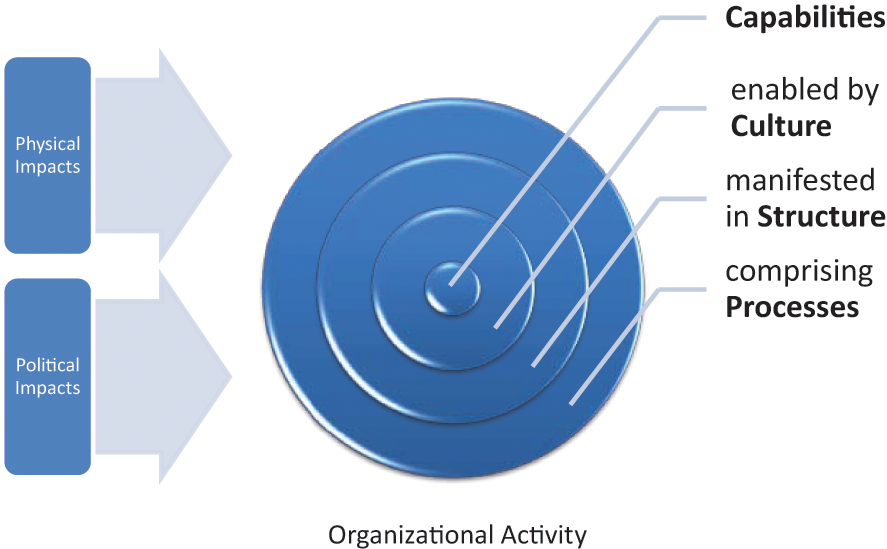
Climate Change Impacts on the Organization
Organizational Challenges of Climate Change
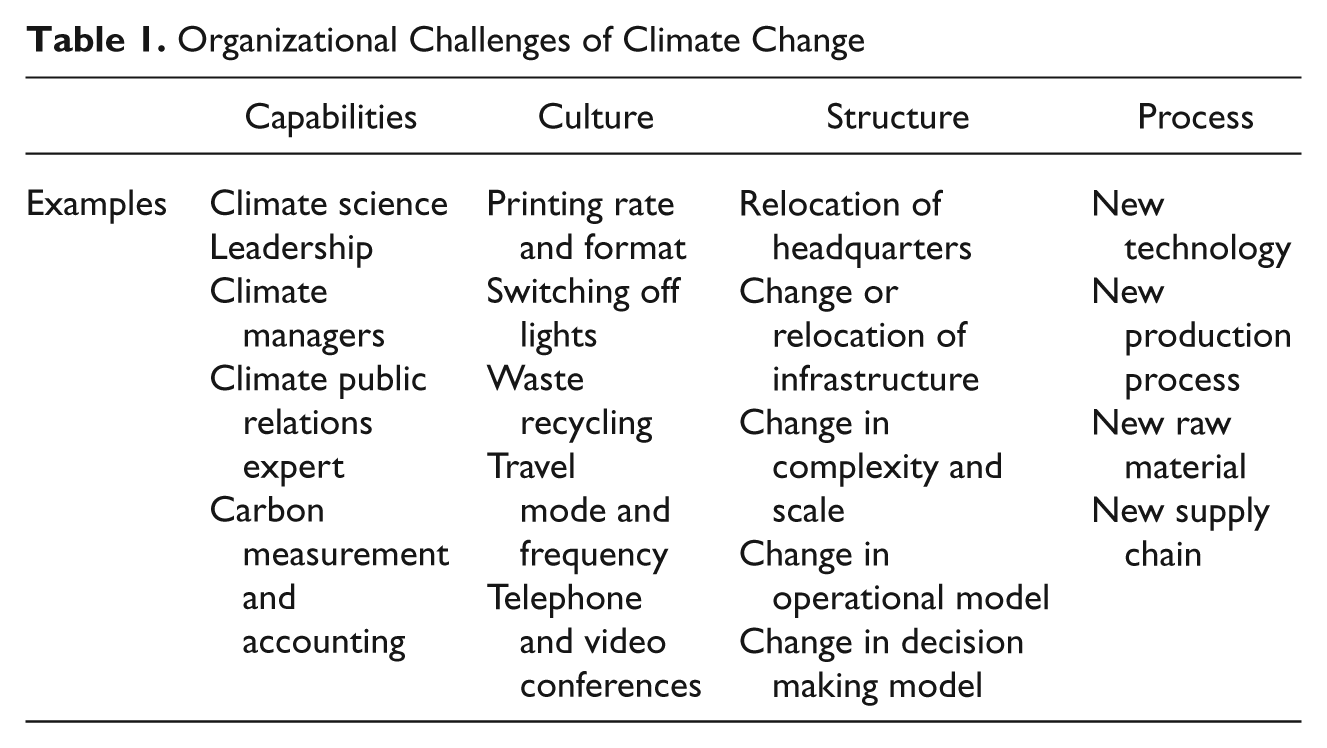
The first, and arguably the most important organizational challenge posed by climate change is the demand for new capabilities throughout the organization (Furrer et al.; Haigh & Griffiths; Rothenberg & Levy; and Thistlethwaite, in this issue). To assess the risks and opportunities associated with climate change and evaluate response options, an organization must necessarily possess or otherwise engage those that have requisite capabilities. Similarly, specific capabilities are required to formulate and implement strategy; and to engage employees and external relations. The capabilities challenge of climate change is particularly formidable because in addition to the high level of uncertainty mentioned, the phenomenon embodies complex technical and multifaceted dimensions ranging from physical science through management to ethics and philosophy (Kelly & Kolstad, 1999; cf. Pinkse & Kolk, in this issue).
Thistlewaite (in this issue), for example, shows that a major obstacle faced by the insurance industry in their attempt to respond to climate change relates to skills and capability difficulties in constructing risk models that incorporate climate change. To evaluate the risk and develop products, he argues, an insurance company must be able to “model or quantify the chances of a weather-related event occurring and the losses associated with this event.” This need means that insurance companies have to use modeling techniques that incorporate future climate change conditions into their premium pricing. The problem, however, is that the prevailing practice in the industry is based on actuarial analysis that models future risks based on the magnitude and frequency of past events. Because the models the industry uses to manage and price risk have been backward looking (based purely on historic data) they are incapable of dealing with the future-oriented uncertainty and increasing weather-related losses. Thistlewaite goes on to note that major insurance companies have responded by developing near-term models that can be used to inform exposure to short-terms risks on an annual basis, but reports that “models that inform rates based on longer term risks associated with climate change represent a significant technical challenge.”
Moreover, the challenge is not simply that of the acquisition of the right set of skills and capabilities (Furrer et al., in this issue), it is also about distilling “truths” and insights for effective strategy from the often competing voices within the corporation or government. Rothenberg and Levy (in this issue) make this point well in their contribution on the role of corporate environmental scientists in shaping corporate perceptions about, and responses to climate change. Through their involvements as “filters,” “institutional interpreters,” “translators,” or the “clearing house for information” on climate change, in-house scientists can often serve as effective “boundary spanners” helping to frame corporate response and strategy. At the same time, they show that the perception and use of science by corporations is a messy and complex process shaped by several factors bordering on organizational structure, history, and culture. Critically, while senior executives attempt to work out a defined strategy and “speak with a single authoritative voice in public,” there are frequently significant internal tensions resulting from differences in level of knowledge, risk exposure, training, background, operational focus, and personal beliefs of managers (see also Haigh & Griffiths, in this issue). Hence the process of organizational sensemaking involves sifting through and balancing these competing opinions, coalitions, and discourses within a firm. This process can present a formidable challenge to companies seeking to design effective response to climate change (Haigh & Griffiths, in this issue).
Consider another example: corporate accountability for carbon emissions, which is increasingly being recognized as vital in combating climate change (Williams & Crawford, in this issue). In 2010, 534 institutional investors representing more than US$64 trillion of assets under management threw their weight behind the eighth Carbon Disclosure Project (CDP) demanding corporate primary climate change data from more than 4,700 of the world’s largest corporations. In response, 82% of Global 500 companies voluntarily reported their carbon emissions, which in total amounts to about 3.4 billion metric tons CO2-e, and represents about 11% of total global emissions.
However, with an increasing level of scrutiny and demand for publicly availability climate information, mainstreaming corporate carbon accounting and increasing quality and rigor present a number of skills and capability challenges. First, carbon accounting relies on company’s ability to measure and report physical carbon dioxide emissions. This is not as straightforward as it may seem since the science of carbon emissions measurement is still developing with a large number of different measurement protocols, emissions factors, estimations, and calculations used. Second, because the most accurate carbon measurement techniques may also be the most expensive to implement, companies may face the choice between increasing accounting accuracy and saving cost. Third, within the overall aim of achieving emission reduction, different decision contexts may require that different measurement features be prioritized. Therefore, to ensure accurate and “fit for purpose” accounting, managers need to decide when to prioritize consistency over accuracy (Bowen & Wittneben, 2011).
In addition to the physical measurement of greenhouse gas molecules, effective carbon accountability requires that corporations develop skills on how to crunch these numbers and integrate them into the balance sheet and other financial statements of the company in a consistent and generally accepted format. Again, this task is not easy as accounting for costs related to natural resources, including water and waste, has always presented unique challenges to traditional methods for corporate financial accounting (Lamberton, 2005). Moreover, since the process of measurement of emissions, disclosure, and target setting is in most cases the outcome of pressure from stakeholder groups and activists (Williams & Crawford, in this issue) managing external relations can also be an important aspect of corporate climate strategy.
Other skills challenges identified by contributors to this volume include the ability to forecast impact, the ability to manage trading exposure effectively (Haigh & Griffiths, in this issue); communication skills, ability to analyze risk profiles for new green technologies, and team management. In fact, after observing the range of capability requirement for banks wishing to engage seriously with climate change, Furrer et al. (in this issue) declare that developing adequate climate response by any company is “likely to change the capability portfolio” of such an organization.
The second broad category of organizational challenge of climate change has to do with the imperative for value and culture shift. Effective response to climate change does not simply require the installation of new and glitzy technologies like smart meters or solar panels; it also demands, in most cases, a lot of basic or fundamental changes in behavior. But organizational cultures are often deeply entrenched and hard to change. Moreover, communicating to achieve climate change behavior change can be particularly difficult for many reasons including controversy in science, improbability between cause and effect, and a sense that individual single effort will not make much of a difference to the overall outcome.
Hence, even though many changes are often described as ‘‘low hanging fruit’’ in that they are relatively easy to implement and often lead to reduction in energy consumption (Hoffman, 2006, p. 16); one finds that getting employees to adopt these new modes of behavior can sometimes prove extremely difficult. Whether one is interested in getting employees to reduce printing rate, print double-sided, recycle waste, switch off lights, substitute travel with video conferencing, or embrace a new low carbon business model, research shows there are often serious value and culture-related factors that can easily impede sources.
Critically, the culture shifts required for combating climate are not always as straightforward as remembering to flick off a power switch or even achievable without the cooperation of a broad spectrum of relevant actors. A number of company workers may have the desire to recycle waste, but achieving this objective may require a set of logistical support and organizational arrangements beyond the remit of the green-minded group of workers. Haigh and Griffiths (in this issue) discuss this challenge in relation to an electricity distributing company that needed to cope with increasing ambient temperatures, heat wave, and rising demand in product. This distributor, as they report it,
became involved in a federal demand management initiative to build management capabilities which had significant cultural implications for the company, because “it is quite non-traditional for the business to think about spending money that way rather than building more poles and wires . . .”
In other words, the company not only had to undergo internal cultural transformation, it needed to secure such a shift in the broader community to ensure the success of their carbon management strategy. This condition is similar to the point made by Rothenberg and Levy (in this issue) that an automobile company may be willing to invest in making electric or smaller more fuel efficient cars, but would require a societal-wide change in culture and willingness to embrace smaller cars to justify such investment.
In addition to, and sometimes because of the skills and culture-based requirements for corporate carbon management, important structural challenges may also arise. These challenges may include the need to restructure to create new teams, units, or lines of responsibility. In other instances, there may be the need to relocate physically offices and infrastructure or to change the organizational or operational model to keep pace with new portfolio or technology. Furthermore, carbon management could also result in changes in the complexity and scale of organizations, changes in decision-making models, or changes in the operational model of aspiring corporations.
A clear example of such fundamental organizational restructuring due to climate change is provided by Haigh and Griffiths (in this issue). They found that after several rounds of paying another plant to generate base load electricity at unusually hot summers to meet its federal mandate, a major electricity transmitting company in Australia had to divide its region into five subregions to “attempt to forecast temperature and demand at a more granular level.” Thistlewaite (in this issue) finds that in response to series of unprecedented severe weather events and huge losses in early 2000, many insurance companies in the United States pulled back from already established markets, with some closing down or significantly rejigging their operational structure as a result. Furrer et al. (in this issue) go further by suggesting that there is a strong and direct correlation between change in the management framework of business and their strategy as well as “their understanding of what constitutes appropriate action.”
In the early 2000s, and under heavy pressure from the public and governments, some major oil companies including Shell and British Petroleum (BP) made significant investments in renewable energy especially wind and solar. However, by 2008 the oil majors divested from most of these projects claiming among other reasons that the investments caused undue stretch on their traditional competences and operational processes. The oil industries were of course heavily criticized for moving away from renewable (Backer & Clark, 2008; Levy, 2009) but it is hard not to be sympathetic with the point made regarding the structural and procedural challenges involved in moving from the extraction and sale of oil to the installation and running of wind and solar farms (see Pinkse & van den Buuse, 2012). Even for a traditional power or utility company, switching from electricity generation through coal or nuclear to say gas or wind cannot be regarded as an easy, unproblematic prospect (cf. Wittneben & Kiyar, 2009).
The fourth and last broad organizational challenge of climate change relates to process. The design and implementation of carbon reduction plans or more ambitiously the integration of carbon management into the strategic priority of business in most cases would require important process-based changes for aspiring organizations. These can be straightforward changes covering new additional measurements, reporting or information provision or more far-reaching and complex adjustments involving changes in production processes based on new technology, alteration of raw materials, and even changes in products. Where carbon response strategy involves changes in production process and products, additional changes in advertising, and marketing strategy and customer relations may yet be required.
Furrer et al. (in this issue) make this argument with regard to the banking industry. They suggest that it is practically impossible for any bank to achieve serious engagement with climate change without far-reaching changes in everyday business processes and practice. In fact, their typology of climate strategy in the banking industry differentiates offsetting and mitigation, which they argue to be mostly symbolic activity warranting no change on process and substantive activities such as equity research, financing, due diligence, advisory services, monitoring, and the development of new investment portfolio, which they argue could not be achieved without radical process-based changes.
The above four broad organizational challenges of climate change have been discussed mainly with focus on business and industry reflecting the bias of the articles received for the special issue; but the points made are equally applicable, if not more so for governments. Pinkse and Kolk (in this issue) are spot on when they observe that one of the main justifications for multistakeholder partnerships for climate change is that they provide platform that help “to effectively cross-leverage resources, knowledge and expertise,” which otherwise reside in different sectors. At the same time, since governments are often larger, more complex, and in many ways differently organized than corporations, the difficulties they face in relation to achieving cultural, structure, and process changes relevant for combating climate change can be far more formidable.
The next section turns to the question on business strategies that address climate change.
Business Strategies for Climate Action and Political Leverage
The second research question the guest editors posed in the call for papers asked contributors to focus on firms’ responses to the climate change challenge: “How do they navigate, influence, dominate, or transform political processes addressing climate change?” Early research efforts classified firms’ corporate climate strategies along a continuum or typology ranging from offensive, reactionary through passive to proactive, analogous to the broader corporate political strategy literature: see, for example, Levy and Kolk’s (2002) application of Gladwin and Walter’s (1980) framework. These typologies were useful in understanding the broad political positions of key multinational companies on climate policy but they did not provide much information regarding the internal strategies adopted by the companies.
Others have promoted more internally focused strategy “classifications such as product versus process oriented, internal versus external, direct versus indirect, radical versus incremental, and innovation versus compensation” (Okereke, 2007, p. 478; cf. Kolk & Pinkse, 2004, 2005). A frequently cited typology developed by Kolk and Pinkse (2005), for example, suggests that companies differ on two important aspects with respect to their climate strategy. The first is strategic intent. This aspect refers to the degree to which a company’s carbon management is focused on innovation through production process and product development as opposed to compensating for its climate impact; say through offset and carbon trading. The second aspect is the form of organization adopted by a company. This aspect refers to the distribution of focus between internal processes, supply chain, or cooperation with other companies. In another example, Hoffman (2006) differentiates corporate internal carbon strategy on the basis of a continuum, from assessing emission profiles to evaluating options to formulating policy strategy.
These new sets of typologies represented significant improvements to the earlier politically oriented schemas. However, they remained weak in providing empirical evidence and examples of specific activities to support these taxonomies and in explaining what drives organizations to take a particular approach. Furthermore they have been criticized for “considering the broader political institutional environment as exogenous mediators and focusing on ‘pure’ market factors in a bid to explain strategy” (Okereke & Russel, 2010, p. 103). The guest editors encouraged our special issue contributors to both flesh out the details of firms’ actions on climate change and to make the connections between climate strategies and transforming the political context.
Based on the contributions to this special issue, we can see two key dimensions of firms’ climate strategies that have so far been relatively neglected in the literature. First, researchers usually focus on how businesses act to address the causes of climate change (i.e., reducing greenhouse gas emissions). Previous literature has tended to focus on mitigation actions and failed to give sufficient attention to companies’ adaptation strategies. In contrast, the articles by Haigh and Griffiths and by Pinkse and Kolk in this special issue are valuable contributions to our understanding of business’ responses to the consequences of climate change. Haigh and Griffiths provide an inductive analysis of the electricity supply industry in Australia, showing how climactic surprises lead businesses to adapt their operations and strategy to the consequences of climate change. Pinkse and Kolk argue that climate change adaptation is particularly important in the developing country context, given that they are “hit much harder by physical impacts than industrialized countries, the low level of development and lack of funds.” Dealing with the consequences of climate change requires different governance arrangements from mitigating its causes. These articles signal the distinctive strategies needed to address climate change mitigation and adaptation (Wittneben & Kiyar, 2009).
A second dimension of corporate climate strategy that emerged from these articles is the system that the corporate activities are intended to influence. Submissions to our special issue demonstrated a fundamental difference between strategies targeted at business’ interactions with biophysical systems (e.g., limiting emissions; modeling climactic changes), and those addressing interactions with politico-economic systems (e.g., changing stakeholder demands, markets, and regulations). Several submissions highlighted how these strategies have become decoupled, with climate change “action” by firms largely focused on signaling within the politico-economic system rather than influencing physical climate change. Pinkse and Kolk’s analysis in the sustainable development context, for example, shows the predominance of policy formulation over policy implementation governance. Multistakeholder partnerships directed at policy formulation can satisfy risk management demands in the politico-economic system, but without having any impact whatsoever on biophysical climate change.
Figure 2 builds on these two dimensions to provide an integrative typology of corporate climate strategies. The vertical axis shows that firms seek to navigate, influence, dominate, or transform either biophysical or politico-economic processes. The horizontal axis captures whether the firms’ actions address challenges arising from the causes or the consequences of climate change. Our contributors do provide examples of strategies to reduce the amount of greenhouse gases, particularly carbon dioxide that is released into the biophysical environment. Such biophysical mitigation strategies (cell 1 in Figure 2) include process changes like energy efficiency measures in banks (Furrer et al., in this issue), product launches like GM’s Volt launched in December 2010 (Rothenberg & Levy, in this issue), and multistakeholder partnerships such as Energy Poverty Action and the Partnership on Sustainable Low Carbon Transport (Pinkse & Kolk, in this issue). Corporate biophysical mitigation strategies are vital to slow the progress of climate change; and yet most of the articles received showed scant evidence of genuine strategies of this type designed to aggressively reduce the amount of greenhouse gases emitted. Furrer et al. pointed out that biophysical mitigation strategies in banks are of such minor importance compared with changing lending practices that they could be classified as “symbolic” climate strategies. And Rothenberg and Levy outline in detail the painful cultural process at GM over 20 years that eventually led to authentic biophysical mitigation activities.
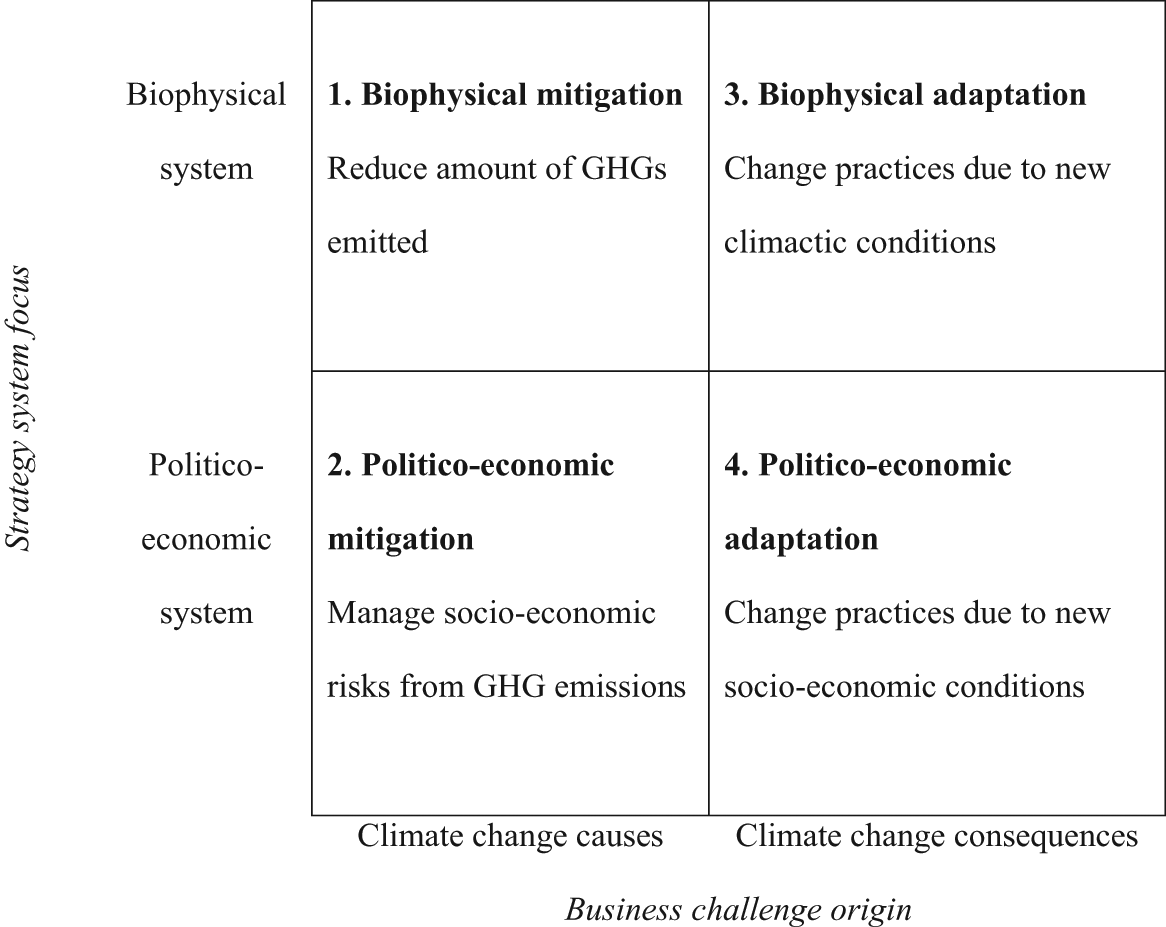
An Integrative Typology of Corporate Climate Strategies
Instead, our contributors focused on corporate activities directed at the politico-economic system. Politico-economic mitigation strategies (cell 2) are based on firms’ activities to manage pressures to reduce greenhouse gas emissions within the institutional, political, economic, and social systems. Rothenberg and Levy, for example, theorize corporate environmental scientists as boundary spanners between the emerging science of the need for carbon emissions mitigation and automobile manufacturers’ strategies. In another example, Williams and Crawford’s article emerges from the corporate political activity (CPA) tradition, positioning corporate climate strategies as “designed to signal their policy position in an attempt to shape shareholders’ and activists’ views, believing that these groups may help, ultimately, shape government policy as well.” Notably, both of these articles highlight how firms use intermediaries within politico-economic mitigation strategies: they focus alternatively on shareholders and activists (Williams & Crawford), and the scientific community (Rothenberg & Levy) as intermediaries between firms and policy makers.
Haigh and Griffiths argue for a shift in perspective from strategies addressing stakeholder management and the politics of carbon mitigation legislation (cell 2) toward strategies addressing biophysical adaptation (cell 3). They argue that business responses to climate change “occur predominantly as a reaction to climatic surprise, rather than a preemptive response to increasing awareness, and perceived uncertainty and risks as suggested by previous studies.” They delineate how rising ambient temperatures, reduced water availability, and increased incidence and intensity of extreme weather events led to operational impacts on electricity supply organizations’ activities. Climactic changes led firms to modify strategy and project development processes, and to enter new trading markets. Notably, climate surprises led electricity supply companies to be less politically oriented in their climate strategies and to change their strategic and operational practices to incorporate the new physical climate realities.
Such biophysical adaptation strategies can be seen in industries as diverse as housing construction, water provision, tourism, agriculture, and health (Berkhout, Hertin, & Gann, 2006; Hoffmann, Sprengel, Ziegler, Kolb, & Abegg, 2009; Wittneben & Kiyar, 2009). Contributions in this volume also highlight politico-economic adaptation strategies (cell 4). Insurance companies and banks do not need strategies to address direct physical threat to their operations, but as Thistlethwaite and Furrer et al. point out in their articles, they need to develop strategies to cope with the physical consequences of climate change in their clients’ operations. The insurance industry’s ClimateWise strategy provides an illustrative example of politico-economic adaptation: “ClimateWise emerged in response to strategic incentives and institutional conditions related to increasing weather-related losses linked with climate change within insurance markets” (Thistlethwaite, in this issue). This self-regulatory strategy is designed to develop the insurance industry’s technical authority on how to model and insure climate-related risks. More importantly, it is also aimed at leveraging the industry’s political authority in governing the physical risks of climate change. Lobbying strategies in cell 4 are more aimed at national and international regulations that price economic behavior exposed to the consequences of climate change, rather than preemptive carbon mitigation (cell 2).
Most of the research literature before this special issue was focused on the left-hand side of Figure 2 (i.e., cells 1 and 2). The guest editors would encourage more research on exploring the form, barriers, enablers, and contingencies of climate change adaptation (i.e., cells 3 and 4). Haigh and Griffiths and Pinkse and Kolk’s articles delineates clearly the threats from the consequences of climate change. A question that is rarely asked, perhaps because it seems distasteful in the light of climate change-related mass migration, health effects, and pressures on basic needs in developing countries, is about the business and political opportunities inherent in climate change adaptation. These opportunities might range from the relatively banal, such as the extension of wine-growing regions in Italy (Jones, White, Cooper, & Storchmann, 2005), to the seriously environmentally consequential, such as opening up the Arctic for offshore oil and gas development. There are tough questions to be asked about who gains commercially and politically from climactic changes. We would encourage more research on how climate change adaptation is shifting the commercial and political landscape so that some industries, firms, and coalitions may be weakly incentivized to address the causes of climate change.
Furthermore, much of the discourse around business and climate change is stuck in the bottom half of Figure 2, asking how firms navigate the reputational, regulatory, and financial risks arising from climate change. Too little management research explicitly connects corporate climate strategies with changes in the biophysical system. There are practical problems with achieving this, of course, such as the accuracy and consistency in carbon emissions data to measure induced changes in the biophysical system (Bowen & Wittneben, 2011). The global scale of GHG emissions and climate changes also makes it impossible to attribute changes in the biophysical system to particular firms. But this reality does not absolve firms, and management researchers who comment on them, of the responsibility to evaluate the eventual ecological impacts of corporate climate strategies.
Insights for Effective Climate Mitigation and Adaptation Actions
Our third broad question related to the key insights for effective climate response based on the more than 20 years of engagement with the issue so far. This is in a sense the most difficult of the three key questions the guest editors posed in the beginning because as stated, available emission statistics and projections do not suggest that either governments or industry have done particularly well so far in decarbonizing the global economy and addressing the threat of climate change.
With respect to governments, regulations are still nonexistent in many political jurisdictions or at best patchy and incoherent. A number of political jurisdictions appear to have embraced emission trading schemes as the main framework for tackling climate change but emission trading has proven to be ineffective as a tool to lower emissions and instead comes at a much greater cost to the economy than more traditional approaches such as carbon taxes (Wittneben, 2009). Only recently in Cancun, parties to the United Nations Framework Convention on Climate Change (UNFCCC) and its Kyoto Protocol decided that all governments should design and implement a low carbon development plan but only few have so far started to act on this decision. Indeed, the entire global climate governance regime stands at a precarious juncture with the future of the Kyoto Protocol looking very uncertain (Rajamani, 2011).
Similarly, with respect to corporations, many are, as noted, undertaking a lot of activities ranging from emission measurement, through reporting to investments in technology. However, for ostensibly the reasons discussed in the previous sections, very few indeed have embraced actions that can be truly described as a radical departure from business as usual. Furrer et al. (in this issue) analyze 114 listed banks around the world and find that most “banks that implement a climate strategy often decouple it from their main value creating process such as lending and investment.” This finding is very much consistent with those of other scholars, which suggest that the business strategy of many corporations, for the most part, consist in shuffling, deferral, hedging, and managing new risks with currently existing approach and capabilities (Lash & Wellington, 2007; Levy & Kolk, 2002; Okereke & Russel, 2010).
Although the general public and governments have been pushing business to take action, regulations have been patchy, public engagement has been mostly shallow, and green consumerism has not been robust enough to drive innovation. Only recently, Google announced that it is pulling the plug on PowerMeter, its home online monitoring tool, because it failed to catch on with consumers and the commercial office sector does not appear to be faring much better in adopting energy monitoring. As Rothenberg and Levy (in this issue) show, neither GM nor Ford felt able to commit significant investment to low carbon automobile design “with gasoline at $1 a gallon, consumers who care little for fuel environment and are hungry for large SUVs.”
That said, it is still possible to glean a few insights for effective climate action from the currently messy landscape. These preconditions for successful engagement apply equally both to governments and corporate organizations.
First and most importantly, effective climate action requires serious engagement and commitment by senior leadership from within governments and corporate organizations. Given as discussed, the multidimensional challenges of climate change and the deep institutional changes required to address these challenges; it is not conceivable that any organization or political jurisdiction can go far in articulating effective response without robust and sustained engagement of the leaders at the highest level of decision making. It is not a surprise, therefore, that the few organizations that have shown leadership in tackling climate change all have proactive senior level managers who have shown personal commitments in driving change (Furrer et al., in this issue; Wittneben, 2009).
An important dimension of leadership that emerged from the contributions to this volume is the role of individual entrepreneurs in facilitating change in both organizations and the wider society. Thistlethwaite (in this issue) highlights the roles of Tessa Tennant and Paul Dickenson, two entrepreneurs working in the UK investment industry in the formation of the now globally important CDP. Furthermore, he argues that the Prince of Wales of the United Kingdom and a few executives in the insurance industry played important roles as institutional entrepreneurs in the development of the ClimateWise Principles. Similarly, Rothenberg and Levy (in this issue) suggests that the leadership shown by GM in the early stages of the automobile industry’s engagement with climate change owes a lot to the activities of corporate scientist Ruth Reck.
Second, effective climate mitigation and adaptation requires the availability of the right mix of technical and institutional capacity (see Haigh & Griffiths; Rothenberg & Levy; and Thistlethwaite, in this issue). Governments and corporations alike need to make informed choices about how their middle and long-term operations may be affected by climate change and the best response options. However, effective design and implementation of strategy requires a menu of high-level skills and expertise. Relying on old and preexisting set of skills and capabilities to handle the new risks and challenges posed by climate change is bound to lead to suboptimal and ineffective response strategy. Although there are notable exceptions, Furrer et al. (in this issue) demonstrate a strong link between substantive climate action of banks with size and the “the capacity to develop the complex resources to implement a systematic and comprehensive strategy.”
The third precondition for successful climate action is proper and consistent engagement and communication with relevant stakeholders—both within and outside the confines of the organization. Effective communication is absolutely essential for the purpose of mobilization; achieving buy-in and agreeing consensus over priorities (see Thistlethwaite and Williams & Crawford, in this issue). This communication is necessary especially because to a greater or lesser degree all climate change response measures involve trade-offs along with their benefits. Hence, a measure of consensus and synergy is required across board; from the board room to the boiler room; and from the federal governments to municipal councils. Although as Pinkse and Kolk (in this issue) show, bringing sectors with different perspectives together can cause some discomfort, such integration is nonetheless absolutely necessary for international education, reducing company level dissonance, and crafting coherent and robust strategy (cf. Rothenberg and Levy, in this issue).
Fourth, there must be willingness by both organizations and governments to abandon old ways of and try new methods for doing things. It is important to recognize that there are no templates for dealing with challenge of climate change. The present generation constitutes quite simply the pioneers, which requires a willingness to learn by doing.
Last, governments and corporations must show greater determination to put their money where their mouths are. There is simply no running away from the fact that addressing climate change will cost money. However, since there is equally a great (or perhaps greater) cost in not taking action, committing the right amount of financial resources toward innovation, research and development, clean technology, capacity building, and achieving value reorientation looks ultimately a wise decision.
Conclusions
Climate change poses new and unprecedented challenges to business and politics. This introduction has highlighted some key aspects of these challenges. While there have been serious activities by many relevant actors—corporations and governments alike—it does appear that most of these are not transformational enough to reverse climate change (cf. Whiteman, Dorsey, & Wittneben, 2010). This special issue attempts to bring together insights from some of the leading scholars in the field to examine the challenges associated with climate change and understand effective responses by both government and industry.
Footnotes
Acknowledgements
The authors would like to thank Duane Windsor, the editor of Business & Society, for supporting this theme for a special issue for this journal and the logistical support he gave us in the production process.
The author(s) declared no potential conflicts of interest with respect to the research, authorship, and/or publication of this article.
The author(s) disclosed receipt of the following financial support for the research, authorship, and/or publication of this article: The authors would like to acknowledge the Smith School of Enterprise and Environment at the University of Oxford for financial support provided through the academic visitors program. Administrative support was partly funded by IRIS (International Resource Industries and Sustainability Centre) at the University of Calgary (SSHRC Grant No. 603-2007-0010).