



Abstract
This article examines the factors that influence the propensity of corporations to engage with NGOs. Drawing from resource dependency theory (RDT) and related theories of social networks and the resource-based view of the firm, the authors develop a series of hypotheses that draw from this conceptual foundation to predict a range of factors that influence firms to collaborate with NGOs. These factors include the level of commitment of the firm to CSR, the strategic fit between the firm’s and the NGO’s resources, the level of trust the firm has in NGOs, the frequency of contact with NGOs, prior level and perception of experience with NGOs, and the level of pressure exerted by NGOs. The authors report on results of a survey of the Top 500 firms in the Netherlands on their interactions with NGOs, finding general support for our hypotheses, and suggest that understanding the motives for firm–NGO interactions can teach us more about firms’ corporate social activities and the way such activities are shaped in the dynamic interplay between firms and their stakeholders. Our findings are relevant for future research on cross-sectoral interactions, for corporations considering future relationships with NGO cohorts, and for broader questions about the role of stakeholders and the role of business in society.
Keywords
Interactions between corporations and nongovernmental organizations (NGOs) 1 have increasingly received attention in the fields of business ethics (Arya & Salk, 2006; Guay, Doh, & Sinclair, 2004; Jamali & Keshishian, 2009) and business and society (de Bakker & den Hond, 2008; Doh & Teegen, 2002; Hendry, 2006; Schepers, 2006). Firms may use their relationship with NGOs to respond to social and political pressures in their competitive environment, to bolster legitimacy and reputation, and to anticipate and forestall negative actions by stakeholders. These interactions are an important means by which firms manage complex and interrelated sets of social expectations, activist pressures, and government regulation that affect the conditions for profitability and performance (Boddewyn, 2003; Burchell & Cook, 2006; Turcotte & Pasquero, 2001). Understanding these interactions is of particular interest in the study of corporate social responsibility (CSR) as NGOs have both a direct and indirect role in defining, shaping, and measuring the social responsibilities of a firm (den Hond, de Bakker, & Neergaard, 2007). Hence, understanding the interplay between firms and NGOs on issues of CSR is highly relevant in understanding “who and what really counts” (Mitchell, Agle, & Wood, 1997) in the interactions among business and society.
Corporation–NGO relations are both strategic and relational, incorporating forms of collaboration and confrontation (den Hond & de Bakker, 2007; Doh, Teegen, & Newburry, 2003; Jamali & Keshishian, 2009; Rivera-Santos & Rufín, 2010; Yaziji & Doh, 2009). If mutual goals can be identified and articulated, corporate–NGO interactions can develop along a cooperative path; if not, NGOs may confront corporations with various forms of advocacy actions, including protests, boycotts, and proxy campaigns (Yaziji & Doh, 2009). In some cases, NGOs may engage in cooperative and confrontational activities concurrently, sometimes in relation to the same company (Yaziji & Doh, 2009). NGOs are therefore influential stakeholders of firms. Hence, relations between corporations and NGOs are increasingly characterized by mutual dependencies (Frooman, 1999). This mutual dependency forces firms and NGOs to adjust their tactics and seek new ways to realize their interests. Understanding the tactical choices of both NGOs and firms in these interactions empirically is therefore important to learn how firms deal with social and political pressures in their competitive environments.
The reasons for NGOs to engage with corporations are becoming more apparent. These reasons include the retreat of government and the growing focus on self-regulation and “soft law” (Vogel, 2008, 2010), the increased attention to and support for CSR (den Hond & de Bakker, 2007; Doh & Guay, 2006; Lambell, Ramia, Nyland, & Michelotti, 2008), and its strategic implications (McWilliams, Siegel, & Wright, 2006) as well as the growing international character of many social and environmental issues NGOs seek to address, making national governments no longer the obvious focal point for their actions (Lambell et al., 2008; Snow & Soule, 2010). These forces have resulted in intensifying dependencies between corporations and NGOs (Pfeffer & Salancik, 1978; Yaziji & Doh, 2009), and even a “blurring” of traditional boundaries among government, private, and civil society sectors (Teegen, Doh, & Vachani, 2004).
There have been a number of important recent contributions that have explored the early stages of firm–NGO interactions as well as the dynamics of firm–NGO interactions over time (Le Ber & Branzei, 2010). A recent Business & Society special issue, published in two parts, included a wide range of these contributions (Dahan, Doh, & Teegen, 2010a, 2010b), while a special issue of the Journal of Business Ethics focused on cross-sector social interactions (Seitanidi & Lindgreen, 2010). In most cases, these contributions used qualitative methods, including in-depth case studies, to explore this important phenomenon, or relied on anecdotal descriptions of a particular process or interaction.
In a few instances, researchers have employed quantitative investigations; however, they were concerned with different aspects of the firm–NGO dynamic. Lucea (2010) focused on cognitive mental maps among participants in cross-sector interactions, while Shumate and O’Connor (2010a, 2010b) investigated the range of communications firms and NGOs use to characterize themselves and their relationships, emphasizing how statements actors make reflect their distinctive characteristics and potential contributions. A forthcoming article from this same author team (O’Connor & Shumate, 2014) compares NGOs with multiple corporate partners to those with single corporate partners. The authors find that there are interesting differences in the focus and nature of these two polls, with the former group more likely to focus on children and be service oriented. Furthermore, federated NGOs were more likely to occupy a central position in the business–NGO cooperative network, and foundations were more likely to have relationships with multiple corporations. In contrast to these previous studies, this article seeks to sample a relatively large number of firms on broad questions related to their motivation to engage with NGOs as part of a research strategy that would allow generalizing results over a population.
Drawing from resource dependency theory (RDT) and related theories of social networks and the resource-based view of the firm, the authors examine the propensity of firms to engage with NGOs. The principal contribution of this article is to isolate factors that appear to prompt firms to collaborate with NGO stakeholders, capturing influences that arise both from the focal corporation and the NGOs, as well as at multiple levels of analysis. To the best of authors’ knowledge, this study is the first to assess quantitatively these motivations and position them within the broader literature on collaboration among firms and between firms and their external, nongovernmental stakeholders. The insights presented help in valuing and positioning the efforts and interests of both firms and NGOs in this growing phenomenon of corporate-NGO engagement.
The article proceeds as follows. The next section develops the conceptual foundation by showing how RDT and related perspectives can be applied to the phenomenon of firm–NGO interactions. Then, a series of hypotheses are developed that draw from this conceptual foundation to predict a range of factors that influence firms to collaborate with NGOs. The subsequent section reports on the results of a survey of the Top 500 firms in the Netherlands on their interactions with NGOs. These include the level of commitment of the firm to CSR, the strategic fit between the firm’s and the NGO’s resources, the level of trust the firm has in NGOs, the frequency of contact with NGOs, prior level and perception of experience with NGOs, and the level of pressure exerted by NGOs. The hypotheses are generally supported. We suggest that understanding the motives for firm–NGO interactions can teach us more about firms’ corporate social activities (Bies, Bartunek, Fort, & Zald, 2007) and the way such activities are shaped in the dynamic interplay between firms and their stakeholders (den Hond & de Bakker, 2007).
Conceptualizing Firm–NGO Interactions as Resource Dependencies—Theory and Hypotheses
To best conceptualize firm–NGO interactions, the authors acknowledge the inherently reciprocal nature of firm–NGO interactions and the increased dependence that firms have on their external stakeholders for reputation, legitimacy, and even their “license to operate.” The degree to which firms are dependent on stakeholder support has been shown to be an important predictor of stakeholder influence over a firm (Frooman, 1999). Moreover, the broad mobilizing conditions for stakeholders (such as characteristics of the focal organization, industry characteristics, or the surrounding stakeholder environment) have also been shown to affect how firms respond to such pressures (Rowley & Berman, 2000). The more NGOs are able to actually put pressure on firms, the more likely it is that firms will respond in a proactive mode to these social and political stakeholders.
Hence we start with an assumption that resource dependencies exist between firms and NGOs. As proposed by resource dependency theorists, firms lacking in essential resources will seek to establish relationships—often through formal and informal collaboration—to acquire such resources (Pfeffer 1981). In a recent review, Hillman, Withers, and Collins (2009, p. 1404) suggested that “RDT recognizes the influence of external factors on organizational behavior and, although constrained by their context, managers can act to reduce environmental uncertainty and dependence” (Hillman et al., 2009, p. 1404). Two different strategies related to this uncertainty reduction are buffering and bridging strategies (cf. Meznar & Nigh, 1995). Buffering can be seen as “the regulation and/or insulation of organizational processes, functions, entities, or individuals from the effects of environmental uncertainty or scarcity” (Lynn, 2005, p. 38), whereas bridging “occurs as firms seek to adapt organizational activities so that they conform with external expectations” (Meznar & Nigh, 1995, p. 976). A firm’s decisions to engage with NGOs, either through bridging or buffering strategies, is partly a function of the nature and past experience of these dependencies, and the perceived value and significance of the resources these NGOs are able to provide (Yaziji & Doh, 2009). Moreover, the internal power dynamics of the firm and the various bases of power within organizations are also expected to influence how firms choose to engage with external stakeholders on whom they may depend (Hillman et al., 2009; Pfeffer & Salancik, 1978). We therefore expect characteristics of the focal organizations and the management within it to influence the degree to which external stakeholders—such as NGOs—are perceived to be important and valuable resource providers. After all, RDT also presumes that firms are motivated by the potential to obtain social worthiness and legitimacy (Pfeffer, 1981, p. 327).
As much of the literature on interorganizational relationships in the business and society context has been influenced by the resource dependency perspective (cf. Frooman, 1999; Hendry, 2005), and the emerging fields of CSR and stakeholder management presume active and frequent interactions—and dependencies—between firms and their stakeholders, the authors select the RDT perspective as our overarching conceptual foundation. Where appropriate, we invoke more specific theoretical perspectives and literatures to examine specific dependency relations and to motivate our particular hypotheses. After all, while recent research on firm–NGO interactions has also adopted alternate theoretical perspectives such as institutional theory (den Hond & de Bakker, 2007; Yaziji & Doh, 2009), cognitive theories (Lucea, 2010), or discursive approaches (Joutsenvirta, 2011), several researchers have gravitated to theories that are either variants or extensions of RDT or provide useful complementary perspectives. For instance, Le Ber and Branzei (2010) relied on several related theoretical perspectives regarding the micro processes of organizational realignment to explore the relational processes that underpin social innovation within strategic cross-sector partnerships. One of the critical variables they uncover, relational attachment, a personalized reciprocal bond between partners,which provides a stabilizing buffer in the face of unexpected contingencies, relates to our RDT view in that it emphasizes the relational dependencies that occur when organizations interact over long periods of time.
From a different angle, to understand the motivations, nature, and communication associated with NGO-corporate alliances, Shumate and O’Connor (2010a, 2010b) and O’Connor and Shumate (2014) introduced a “symbiotic sustainability model” (SMM). Drawing from organizational ecology (Astley, 1985; Hawley & Theodorson, 1982), this SSM defines the relationship between corporations and NGOs as symbiotic (O’Connor & Shumate, 2014; Shumate & O’Connor, 2010a, 2010b). Symbiotic relationships are characterized by mutual dependence among organizations in more than one population (Aldrich & Ruef, 2006), and have benefits that are unique to each partner (Shumate & O’Connor, 2010a, 2010b). These researchers argue that in business–NGO cooperative relationships, communication is part of their resource exchange and that the communication of cross-sector cooperative relationships allows NGOs and businesses to obtain capital that may otherwise be unavailable. This capital is made available by leveraging the functional differences of the cross-sector partners through communication. While drawing from a different tradition (organizational and community ecology), the SSM perspective shares many common insights with RDT, notably the ideas of interorganizational dependencies, the importance of shared but complementary resources in fulfilling organizational goals, and the influence of these relational exchanges on social acceptance, legitimacy, and reputation of the participating organizations. This research signals the applicability of RDT to study this type of interaction but mainly focuses on the specific role of communication.
These different viewpoints provide some possible motivations for firms to engage with NGOs. Yet they do not give an insight in the incidence of these engagements. Drawing from the RDT framework, enhanced by other relational perspectives, we therefore turn to the specific question of what factors determine firms’ propensity to engage with NGOs. This question is answered by developing and testing several related hypotheses about factors that lead firms to engage with NGOs. The factors outlined here are commitment to CSR, resource complementarity, trust, NGOs’ social network positions, past experience, positive benefits, and NGO pressure.
Commitment to CSR
Interactions with external stakeholders can provide a firm with several types of resources: (a) advice, counsel and know-how, (b) legitimacy and reputation, (c) channels for communicating information between external organizations and the firm, and (d) preferential access to commitments or support from important actors outside the firm (Pfeffer & Salancik, 1978). Corporate social responsibility (CSR) initiatives may be one mechanism by which a firm signals its interest in and willingness to engage with external stakeholders, particularly stakeholders that have an interest in the social obligations and contributions of the firm. The firm could reap benefits from these engagements and “these benefits are presumed to offset the higher costs associated with CSR, because resources must be allocated to allow the firm to achieve CSR status” (Siegel & Vitaliano, 2007, p. 774). Following Ghemawat’s (1991) notion of “commitment,” we add that such resource allocation must be persistent over time, requiring consistent and continuing, if not irreversible, resource endowments, to be credible. Only then, the goodwill and positive reputation benefits sometimes argued to be generated by CSR (Brammer & Pavelin, 2006) may be facilitated and strengthened by the acquisition of specialized knowledge (resources) from external stakeholder such as NGOs.
Paradoxically, however, firms may need to demonstrate some degree of CSR commitment first to be viewed as credible partners by those very organizations. Nevertheless, CSR activities are increasingly likely to include an exchange of resources between corporate and nonprofit partners (Smith, 2003), as also suggested in an earlier study on a “green alliance” in which it was argued that NGOs not only can offer environmental, scientific, and legal expertise but also can provide linkages to other societal stakeholders as to support firms’ activities (Stafford, Polonsky, & Hartman, 2000). Or, as Jamali and Keshishian (2009, p. 289) stated, based on an analysis of five partnerships in Lebanon: “through collaborative arrangements, both partners hoped to tackle CSR challenges that they could not have addressed in isolation.”
Firms’ commitment to CSR and related issues is likely to drive them toward a more cooperative stance versus NGOs, even though the conditions under which such collaboration is shaped might have some special characteristics, such as an important role for trust (Rivera-Santos & Rufín, 2010). This element will be taken up later. For now, suffice the suggestion that firms with more commitment to CSR are more likely to seek active forms of collaboration with NGOs. After all, these firms are expected to anticipate, to act proactively and to engage in a more encompassing dialogue with their stakeholders, including NGOs (Werther & Chandler, 2005). A greater commitment to CSR thus is likely to lead to an increase in collaboration with NGOs.
Hypothesis 1 (H1): Firms that demonstrate a stronger commitment to CSR will have a greater propensity to collaborate with NGOs than those with weaker commitment.
Resource Complementarity: Strategic Fit
Next to the level of commitment, the value of resources to be exchanged is important in judging firms’ propensity to collaborate with NGOs. Building from extensions to RDT (Ulrich & Barney, 1984), the resource-based view of the firm (RBV) emphasizes the economic returns to resources that a firm owns, acquires, or develops (cf. Barney, 1991; Lavie, 2006). For resources to be valuable in facilitating the exploitation of an opportunity in the business environment or in neutralizing a threat, they must be scarce or must come together in a unique way as a result of how the firm packages or bundles them. They must also be immobile such as those that are idiosyncratic to the firm, those for which property rights are not well defined, or those that are cospecialized with other assets (Teece, 1986). In addition, they must be difficult to imitate so that the firm can maintain rent-earning status for a period of time. For a firm to be in a position to exploit a valuable and rare resource, it must have a resource position barrier preventing resource substitution and/or imitation by other firms.
Research on alliances and networks among firms in competitive commercial environments can also be seen as a natural extension of RDT. After all, RDT presumes that organizations do not possess sufficient resources for achieving their goals, and therefore benefit when partners bring resources, capabilities, or other assets that cannot be easily attained on their own. These “combinative capabilities” allow the firm to acquire and synthesize resources and build new applications from those resources, generating innovative responses to rapidly evolving environments (Kogut & Zander, 1992). Lavie, for instance, discusses ways in which “an interconnected firm can extract value from resources that are not fully owned or controlled by its internal organization” (Lavie, 2006, p. 639). Other research suggested that to achieve success in China, it is essential that potential partners possessed complementary skills and resources (Luo, 1998), including access to government agencies and local authorities on the ground (Kennedy, 2007). Although other examples in different geographical settings might be given, these examples highlight the idea behind these combinative resources.
Consistent with these examples is the expectation that corporations to be attracted to partners who can add economic and social value, either by recombining valuable resources that partners have access to, or by jointly developing new valuable resources. When firms expect to be able to leverage the complementary resources and capabilities of their partners in such innovative ways, they are more likely to engage with those prospective partners.
As firms pursue CSR in part for strategic reasons, and if CSR activities may improve the firm’s resource base relative to that of its rivals (Mackey, Mackey, & Barney, 2007; McWilliams & Siegel, 2001), they would be expected to seek value, cost reductions, or other direct or indirect benefits by partnering with NGOs. The chance of realizing these benefits will be higher when there is some complementarity between the strategic interests of firms and NGOs. Given their profit-seeking nature, firms will include the degree of complementarity between their own resources and interests and those of their stakeholders in decisions on how and when to engage with NGOs and establish collaborative relations with them. Therefore, the second hypothesis refers to the degree to which the firm perceives or experiences strategic fit with NGOs’ resources and objectives.
Hypothesis 2 (H2): Firms that perceive or experience a stronger strategic fit with NGOs’ resources and objectives will have a greater propensity to collaborate with NGOs than those that perceive or experience a weaker strategic fit.
Trust in NGOs
The firm’s commitment to CSR and its perceived degree of strategic fit with NGO objectives are factors relating to firm–NGO relations. Other factors determining the firm’s propensity to seek collaborations with NGOs concern the nature of firm–NGO relations. A core concept emanating from the study of partner cooperation, including alliances and joint ventures within and across sectoral boundaries, is trust. In one often used definition, trust is the willingness of a party to be vulnerable to the actions of another party based on the expectation that the other will perform a certain action important to the trustor, irrespective of the ability to monitor or control that other party. (Mayer, Davis, & Schoorman, 1995, p. 712)
However, trust need not just constitute a characteristic of the relationship between two parties, but can also be “institutionally based” (Bachmann & Inkpen, 2011). This institutional-based perspective positions trust as perceived confidence in a party honoring its pledges because it is a member of particular category or representative of a broader group or institution. So, for a practical example, the “Edelman Trust Barometer” measures trust by broad members of civil society in institutions such as business, government, NGOs, and among more specific industry sectors and classes of leaders (Edelman, 2011). It is this latter notion of trust that this hypothesis builds, whereas the relational dimension of trust is explored through the angle of “past experience” (Hypothesis 5, below).
Trust is also a basic ingredient of collaborative relations between firms and NGOs, as their cooperation implies a willingness to pursue mutually compatible interests rather than to act opportunistically (Das & Teng, 1998). The establishment of trust reduces risks involved in the sharing of resources and increases the likelihood of realizing positive benefits through NGO interaction. Trust is thus highly important in an organization’s willingness to enter into any relation, even though this trust might not be based on previous experience (Bachmann & Inkpen, 2011; Burchell & Cook, 2006; Sethi & Emelianova, 2006). Rivera-Santos and Rufín (2010) recently argued that in firm–NGO relations, trust-based governance mechanisms are important even though they are difficult to establish. The eventual establishment of trust integrates firm–NGO relations, helps to overcome antagonisms, and allows shared goals to be developed. More specifically, as a company develops greater openness and enthusiasm for collaborations with NGOs in general, it will have a greater tendency to engage with particular NGOs as partners in the future.
Hypothesis 3 (H3): Firms that report to have more trust in NGOs will have a greater propensity to collaborate with NGOs than those that report to have less trust in NGOs.
Social Networks and Frequency of Contacts
As RDT conceptualizes firms as existing within a series of overlapping and interrelated internal and external networks, RDT theorists have suggested that the development of interorganizational ties, such as strategic alliances, result from underlying resource dependencies (Pfeffer & Nowak, 1976). Social network theory extends this perspective by predicting that sharing resources with other organizations that are linked together through a pattern of interrelationships will produce explicit benefits for an organization (Burt, 2000; Wasserman & Faust, 1994). Benefits from network participation are often expressed in terms of instrumental outcomes, such as power and influence, although it is also recognized that benefits may involve expressive outcomes, such as social support as reflected in frequent interaction.
Several studies in the 1960s and 1970s demonstrated that an important reason for ties between human service agencies was their perceived strategic interdependence with each other (for a review, see Oliver, 1990). This research suggested that organizations enter partnerships when they perceive critical strategic interdependence with other organizations in their environment (Schermerhorn, 1975; Whetten, 1977). Later, Gulati (1995) studied how the social context emerging from prior alliances and considerations of strategic interdependence influence new partnership decisions between firms. He found that this social network facilitated new alliances by providing valuable information to firms about the specific capabilities and reliability of potential partners. The role of both direct ties between firms and their overall networks were found to be significant contributors to the propensity to enter a partnership. Gulati (1995) also found that such connected firms would enter alliances more frequently if the firms were interdependent. Following this argumentation it seems logical to expect similar processes to take place in firm–NGO contacts: those firms that indicate a higher frequency of contacts with NGOs are likely to collaborate with these NGOs more and to shape such alliances to share resources as it results in mutual benefits. What exactly constitutes “frequent” contacts is likely to vary among firms.
Hypothesis 4 (H4): Firms that maintain frequent contacts with NGOs will have a greater propensity to collaborate with NGOs than those that have less frequent contacts with NGOs.
Past Experience
RDT presumes that firms’ ability to leverage resources acquired externally emanates from a range of factors. One of these is the experience the firm has acquired in managing its external environment and the outcomes of previous experiences in selectively securing resources on which it depends (Pfeffer & Nowak, 1976). As experience is the primary source of learning, and the development of executive talent does not happen suddenly (McCall, 2004), past experiences with NGOs can help leaders to know how to deal with them, and lead to more successful collaborations.
Although past experience and trust are related concepts, they are not the same. Experience refers to a firm’s direct, immediate interaction with a specific NGO, and may hence contribute to the level of trust held in that particular partner. Institutional-based trust is typically not based on direct, prior experience, but rather on reputation and hearsay. It is future oriented, whereas experience is based on a lived past. On the other hand, a negative previous experience may be compensated by the other party’s promise to do better.
Emden, Yaprak, and Cavusgil (2005) found past experiences to be important in enhancing cross-border alliance performances by easing coordination challenges. Learning from past experiences was found to create superior performance for the firm by facilitating interfirm know-how transfer (Emden et al., 2005). By easing this challenge, past experiences with NGOs can lead to the propensity to collaborate again. In an observational study of an alliance between a U.K. oil company and five of its contractors, trust levels within the alliance were found to rise over 3 years, but overall remained low (Green, 2003). Green (2003) hypothesizes that one reason for the reduced levels of trust could be the experiences inherited from previous relationships. These results show that previous experiences influence future decisions. If past experiences with NGOs were favorable, the firm would be expected to have a higher propensity to collaborate with NGOs in the future. Whereas trust has been determined to be a critical component of successful cross-cultural business to business relationships (Heffernan, 2004), when firms have limited prior experience with each other, uncertain knowledge confuses expectations of the future and delays or reduces the likelihood of trust-building (Perks & Halliday, 2003). Hence, previous experience can eliminate much of this confusion, leading to a higher propensity to partner.
Hypothesis 5 (H5): Firms that have more past experiences interacting with NGOs will have a greater propensity to collaborate with NGOs than those with fewer past experiences interacting with NGOs.
Positive Benefits
The final two hypotheses build on our suggestions that frequency of contact and past experience affect a firm’s propensity to collaborate with NGOs by qualifying the nature of the experience and contact. A growing literature on NGO tactics toward firms is being developed (cf. den Hond & de Bakker, 2007; Spar & La Mure, 2003; Yaziji & Doh, 2009) although there is little research on how the impressions and perceptions left by those tactics on their targets subsequent firm behavior. Here the possibility is discussed that past experience with NGOs may have resulted in positive benefits. The next subsection discusses the firm having been a target of NGO activism. In each instance, the RDT perspective motivates our hypotheses.
The authors expect that prior experience will reinforce the firm’s propensity to engage with NGOs if such experience was (seen as) positive by firms. The RDT adopts a fairly instrumental view of interorganizational collaboration, presuming that firms will engage in interactions with external stakeholders to the degree that they achieve (or at least perceive to achieve) benefits of doing so (Pfeffer & Salancik, 1978). After all, RDT is concerned with the long-term survival of the organization and if earlier experience has contributed to obtaining organizational goals, this is likely to be considered as useful. Such earlier experience may be of different kinds: in terms of the frequency of contacts, in terms of the relationship itself, or in terms of material benefits accruing to the collaboration (cf. Hendry, 2005). Positive benefits thus can also be considered in terms of social capital rather than only in economic terms. Above it was argued that firms with frequent NGO contacts have developed a better knowledge of these NGOs and their objectives, and therefore are in a better position to decide whether or not collaboration is desirable, that is, whether positive benefits are to be expected. Also, it was described how firms that interact more often with NGOs on a regular basis are more likely to collaborate with NGOs.
Finally, there is the dimension of value, or benefit, that firms derive from their dealings with NGOs. As a well-known example such as the Brent-Spar controversy has shown (Grolin, 1998), NGO pressure can greatly affect the conditions for profitability and performance a firm faces. Consequently, there also is an economic dimension to firm–NGO relations that acts as a determinant of the firm’s propensity to establish collaborative relations with NGOs (McWilliams et al., 2006). Thus a firm is more likely to seek collaboration with NGOs when previous contacts with NGOs have yielded positive benefits for the firm.
Hypothesis 6 (H6): Firms that have experienced more positive benefits in their interactions with NGOs will have a greater propensity to collaborate with NGOs than those with less positive benefits in their interactions with NGOs.
NGO Pressure
Citizens expect NGOs to serve in a monitoring and oversight role with respect to corporate behavior and activities, including monitoring corporate social and environmental responsibility. Many specialized NGOs now investigate and report on MNC pledges and actions in the areas of governance, labor practices, human rights, environmental impact, and many others (cf. Levy, Brown, & de Jong, 2010). NGOs are claimed to actively try to influence the development of norms on issues of CSR (den Hond & de Bakker, 2007; Yaziji & Doh, 2009). Some NGOs serve as watchdogs over specific corporations, industries, or even specific projects. These NGO actions may be viewed as a parallel form of regulation that complements, and often go beyond, the basic legal and regulatory requirements placed on firms. Through collective action, NGOs can harness the power of individual interests in a manner that leverages greater pressure, influence, and impact on corporate social and environmental performance. NGOs can also pool resources and capabilities to form broader collectives with other NGOs, governments, and/or private corporations and in so doing, create a broad neoregulatory environment that parallels the core legal and regulatory parameters set by government alone (Doh et al., 2003).
RDT presumes that firms are dependent on their external stakeholders, and, consistent with stakeholder theory, are influenced by those interactions. Indeed, RDT assumes that firms have a desire to neutralize or mitigate external constraints that limit the firm’s potential for growth or other goals. As de Bakker and den Hond (2007) review, researchers have theorized about which firms are at a higher risk of being challenged by stakeholder groups and which risk factors are most salient among these targeted firms (cf. Mitchell et al., 1997). These factors include the degree to which firms are dependent on stakeholder support as an important predictor of stakeholder influence over a firm (Frooman, 1999) as well as the broad mobilizing conditions for stakeholders (such as characteristics of the focal organization, industry characteristics, or the surrounding stakeholder environment; Rowley & Berman, 2000). Thus, when NGOs are better able to actually put pressure on firms, the more likely it is that firms will respond in a proactive mode to these social and political stakeholders. In CSR literature similar hypotheses have been proposed (Spar & La Mure, 2003; Werther & Chandler, 2005). Hence we hypothesize that the more NGOs apply direct pressure in their dealings with firms, the more likely it becomes that firms will try and establish collaborative relations with NGOs.
Hypothesis 7 (H7): Firms faced with greater NGO pressure will have a greater propensity to collaborate with NGOs than those faced with less NGO pressure.
Method
The authors conducted a mail survey of the 500 largest firms, in terms of turnover, in the Netherlands, addressing the vice president (VP) public affairs/corporate communications. The survey contained two main parts: part A contains background information, and part B is on “Perception, Experience, and Satisfaction with NGOs.” Part A included 41 items divided into several subsections relating to information on the organization, the respondent, his or her career experiences, educational background, the organization’s management of social responsibility, and corporate governance, ownership, and current relationships with NGOs. Part B included 50 items, divided into two subsections: “Perceptions and Experience with NGOs” and “Prospects of Working with NGOs in the Future.” The questionnaire deliberately refrained from providing exact definitions of constructs because we wanted to measure respondents’ ideas regarding a specific concept and because we did not want to steer this measurement in a particular direction by providing definitions of variables and then asking for their prevalence.
The REACH database 2 provided contact details of these companies. The response rate on our first mailing was a modest 4.2%. Private responses from a number of the addressees in our first mailing indicate that the number of research requests directed at these large companies in the Top 500 was very large. This made it difficult to realize the desired response rates using direct mail surveys, as also reported in other survey research among large sets of firms (Harzing, 1997; Roth & BeVier, 1998).
Moreover, in our first mailing we used a questionnaire in English to facilitate a comparison with similar studies. To improve the response rate, in the second mailing, the questionnaire was translated into Dutch. Also, the accompanying letter explicitly invited those firms that did not have any active collaborative relationships with NGOs to respond as well. The response to the second mailing was more satisfactory. After the second mailing 87 completed questionnaires were available for analysis. The overall response rate of 17.5% is acceptable given the wide variety in organizations included in the sample. 3
Sample Description
The survey respondents are predominantly male (83.9%) and of middle age (average age in the category of 41-45 years, two thirds of the respondents between 31 and 55 years). Most are responsible as vice president (VP) or director for functions such as Corporate Communication (21.8%), Corporate Social Responsibility (21.8%), and Corporate Affairs (10.3%), or they indicate to be part of top management as CEO/managing director, COO, chairman or CFO (total 21.8%). Half of them have been in their current function for a maximum of 3 years (49.4%); another 34.5% have been in their current function for 4 to 7 years. They have significant experience in their current sector: 48.3% have been employed in it for more than 10 years. Regarding their working experiences outside business, 29.9% indicate they worked previously for a government agency and another 13.8% for an NGO. Most of their companies (79.3%) have installed some formal structure for keeping contact with external parties, such as NGOs and governments; 70.1% of the respondents indicate to be a member of such a commission. On the basis of such respondent characteristics we suggest that they are quite knowledgeable on the topic of our survey.
The appendix contains the items in the survey that were used in the analysis, including the aggregate responses.
Dependent Variable
The dependent variable is the propensity of firms to seek collaborative relations with NGOs. We included an item to ensure that the bulk of the sample did have active collaborations by asking “Does your firm have active relationships with not-for-profit NGOs?” (B37); 70.1% of the respondents answered “yes”). This percentage indicates first, that a majority of our respondents actively engage with NGOs, and second, that there are sufficient respondents to allow for comparison between those respondents who do, and those who do not actively engage with NGOs.
To measure this core construct, the survey included eight items to measure the likelihood that firms entertain collaborative relationships with NGOs. In line with the previous discussion of the literature, firms with a long history of collaboration were expected to demonstrate a higher propensity to engage in firm–NGO collaborations than firms with short term perspectives on these collaborations. Five items therefore had a focus on the long term (A04, A06, A08, A19, A32). For instance, A06 asked “My firm has been engaged in long-lasting relationships with NGOs.” Three items had a focus on temporary, project-based collaboration (A17, A34, A36). We thus expected to find two factors in a factor analysis. However, the factor analysis (Table 1) shows that the three items intended to measure temporary, project-based collaboration were not significantly correlated. Moreover, item A17 showed significant negative correlations with each of the six items in the first factor. We hence recoded this item into its opposite and included it in the first factor. Furthermore, Table 1 shows that item A08 (which was recoded because of the negative formulation) only loaded weakly on the first factor; it was therefore deleted from the first factor. Cronbach’s alpha for the five items retained is fairly high (α = .89). We thus created a scale “COLLAB” for our dependent variable “Collaboration,” based on the mean scores of these five items.
Factor Analysis of Items Intended for Dependent Variable.

Independent Variables
The authors developed seven measures to test our hypotheses. Three items measured CSR commitment: B07, A15, and A16. Given the notions of persistence over time and irreversibility of investment in our use of commitment (Ghemawat, 1991), a firm’s commitment was measured by asking for the degree of active support for CSR and the firm’s relative performance, compared to competitors’ performance on CSR issues. Cronbach’s alpha for these three items is adequate (α = .71). We created a scale “CSRCOM” to measure the firm’s commitment to CSR and used this to test our first hypothesis.
To test the second hypothesis, six items (A09, A25, A30, A31, A35, A38) intended to measure the level of strategic fit between the firm and NGOs. Two items were formulated negatively (A09 and A31) and were hence recoded. Cronbach’s alpha was not very high (α = .64). Reexamining this scale, we decided to remove item A09. This was the only item to measure cultural differences between NGOs and firms. Although cultural differences undoubtedly exist between firms and NGOs, they may be less important to realizing collaborative relationships than differences in material and strategic objectives. After all, instrumentality may be an important motive to engage in CSR (McWilliams & Siegel, 2001), possibly enough to set cultural differences aside, at least temporarily. Removing item A09 from the scale increased the reliability of the scale to α = .71. We thus created a scale “MATCH” based on the mean for the retained five items.
The firm’s level of trust in the category of NGOs was measured by four items (A14, A18, A20, A42). To capture the firm’s level of institutional-based trust (Bachmann & Inkpen, 2011) in the category of NGOs, we asked for a general perception of the trustworthiness of NGOs rather than referring to the level of trust in specific instances of relationships with NGOs. Two items were negatively formulated (A18 and A20) and therefore recoded. Cronbach’s alpha for this scale is .66. We created a scale “TRUST” based on these four items to test Hypothesis 3.
The frequency of contact of the firm with NGOs was measured by three items (A01, A13, A37, Cronbach’s α = .70), asking respondents to indicate how often they, or their company, were in touch with NGOs. To test Hypothesis 4, we created a scale FREQCON based on these three items.
The scale to measure a firm’s prior experience with NGOs consisted of five items (A40, A41, A44, A49, A50), including items such as “NGOs are generally reliable partners.” Two items were recoded as they were formulated negatively (A41 and A49). Cronbach’s alpha of this scale, “EXPERI,” is fairly high at α = .82.
For the sixth hypothesis, items A10, A11 and A21 measure the benefits (real or expected) that accrue to the firm due to collaborative engagements with NGOs. Cronbach’s alpha of this scale is .71. We called this scale “POSBEN.”
Finally, five items (A03, A23, A43, A45, A46) measure the level of NGO pressure on the firm, capturing various types of NGO pressures that firms may be subject to. For example, item A46 (which was recoded) stated “My company has never been subject to boycotts initiated by NGOs.” Of course, boycotts are one particular NGO tactic but one would expect answers to this question to correlate with those on questions like “My Company has been subject to protests by NGOs” (A45). This scale, “TARGET,” indeed showed a high Cronbach’s alpha with α = .88.
Control Variables
Several control variables are often found to correlate with CSR, and hence might be expected to influence positively the firm’s propensity to engage in collaborative relationships with NGOs, as part of the implementation of CSR. First is the self-reported financial performance (B06) because superior financial performance may provide slack resources that enable the firm to invest in CSR (Waddock & Graves, 1997). Part of such investment may be to entertain positive relationships with NGOs. Regarding financial performance, 52.3% report that they perform better than their competitors. 4
The firm’s level of internationalization, as measured by asking for the percentage of turnover realized in foreign markets (B05), is a second control, as for instance Chapple and Moon (2005) found that more internationally operating firms have a higher likelihood of having CSR policies and programs. Controlling for the degree of international orientation therefore is useful. About half of the firms in our sample are mainly oriented on the Dutch market, as they realize less than 25% of their sale in foreign markets. A quarter of the firms in our sample have a very international orientation, indicating to generate more than 75% of their sales in foreign markets.
Firm size is another control variable, as many studies suggest that larger firms are more prone to have developed and implemented CSR policies. Firm size was measured by the firm’s number of employees (B03) and by the change in the number of employees in comparison to the year 2000 (B04). The size of the firms included in our sample is skewed toward the relatively larger firms in the Dutch economy. As in many European countries, the majority of all firms in the Netherlands are classified as belonging to the category of small and medium-sized enterprises (SMEs). SMEs then are defined as firms having less than 500 employees. 5 In our sample, 20% of the firms have less than 300 employees, 35.3% between 300 and 4,200, and the remaining 44.7% had more than 4,200 employees. In terms of change in size (B04), 34.9% report that since the year 2000, their number of employees has decreased, whereas in 43.0% it has increased. One caveat is required: the firms were selected on their financial performance; some of the firms in our Top 500 ranking were holding devices, sometimes employing just one or a few people. This fact needs to be kept in mind when the findings are interpreted.
Finally, the respondents identified the principal industry in which their firms operate (B02). They represent various industries, including retail (15.3%), food production (16.5%), services (25.9%), and chemicals (17.6%), but in total our sample includes responses from 13 different industries. The fairly small numbers of respondents per sector precluded any systematical comparison between sectors. However, the distribution across sectors suggests that the results of the analysis are valid across different industries. As McWilliams and Siegel (2001) argued that advertising intensity affects the firm’s level of CSR engagement, we recoded principal industry into closeness to consumer markets and used it as another control. Sometimes it was difficult to attribute an industry to either business-to-business or business-to-consumer, for example in the case of the food industry. We therefore converted the item into an ordinal scale, distinguishing between a B2B section (1), a mixed section (2), and a B2C section (3).
Results
Testing hypotheses proceeded in several steps. First, we calculated correlations among the dependent and independent variables (Table 2). Second, we used multiple regression analysis (Table 3) to test our hypotheses. Model 1 is the baseline model with the control variables. Model 2 adds the variables with significant correlations in the correlation table (Table 2). Model 2 is significant (R2 = .81, p < .000), with three variables having a significant contribution to explaining the propensity to collaborate with NGOs: FRQCON (β = .465, p = .000), CSRCOM (β = .164, p = .050), and MATCH (β = .194, p = .041). In a third and final step, we addressed the issue of potential multicollinearity and endogeneity among the independent variables (Table 2). A first indicator for multicollinearity is the size of the bivariate β-scores (Table 2). According to Cohen and Cohen (1983), a correlation of greater than 0.7 may be cause of concern. An analysis of bivariate correlations reveals that 26 out of the 28 β-scores in Table 2 have correlations smaller than 0.7. Second, as a general rule it is suggested that multicollinearity is a concern if the tolerances in collinearity tests are below 0.1 (Cohen & Cohen, 1983). We performed a collinearity test in the regression, and found that all IVs have tolerance scores between .544 and .327. These scores therefore fall within accepted ranges. As a third test for multicollinearity, we subjected the three scales that turned out to be significant in the regression to a principal component analysis to see how each item contributed (Table 4), as multicollinearity between them would imply that they load on the same factors. We find that these three variables do not load on each other. Consequently, we suggest that multicollinearity is not seriously affecting our findings. The authors did not conduct additional tests of endogeneity because of limitations in the way the data were collected.
Descriptive Statistics and Correlations.
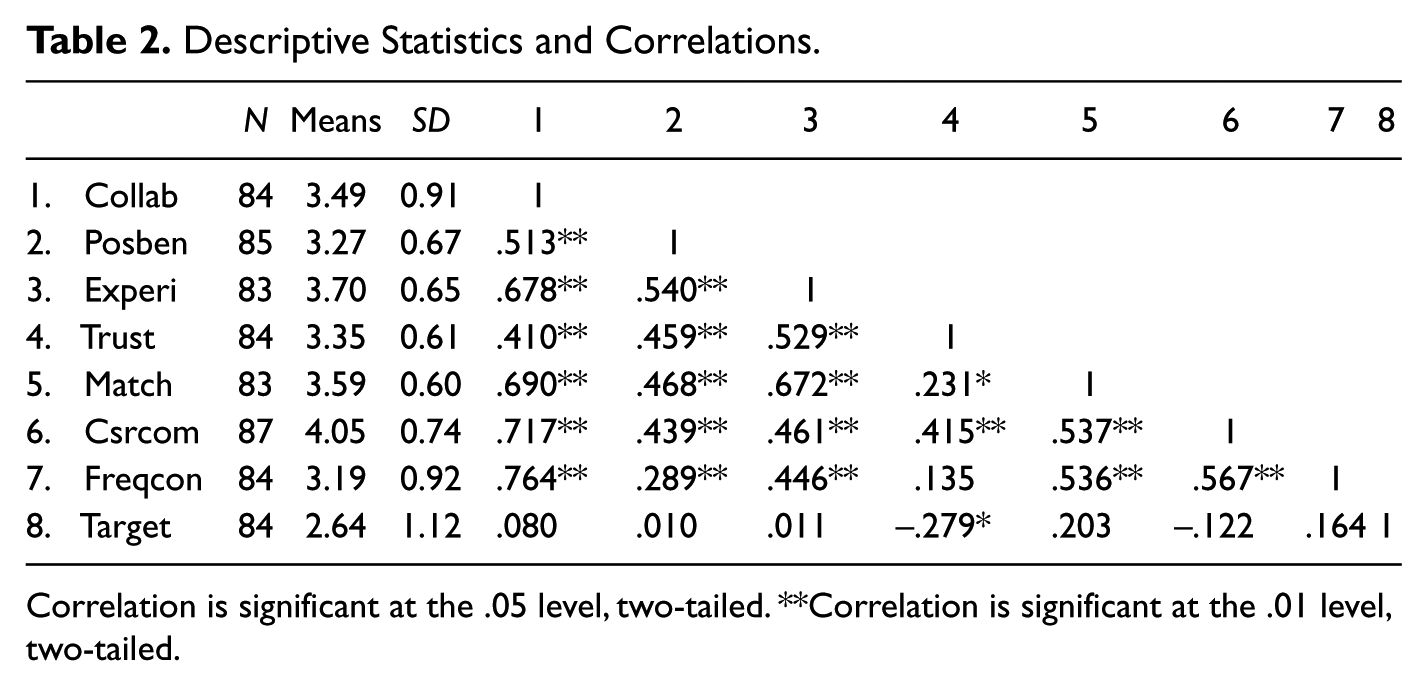
Correlation is significant at the .05 level, two-tailed. **Correlation is significant at the .01 level, two-tailed.
Results of Regression Analysis (Dependent Variable COLLAB-DV).
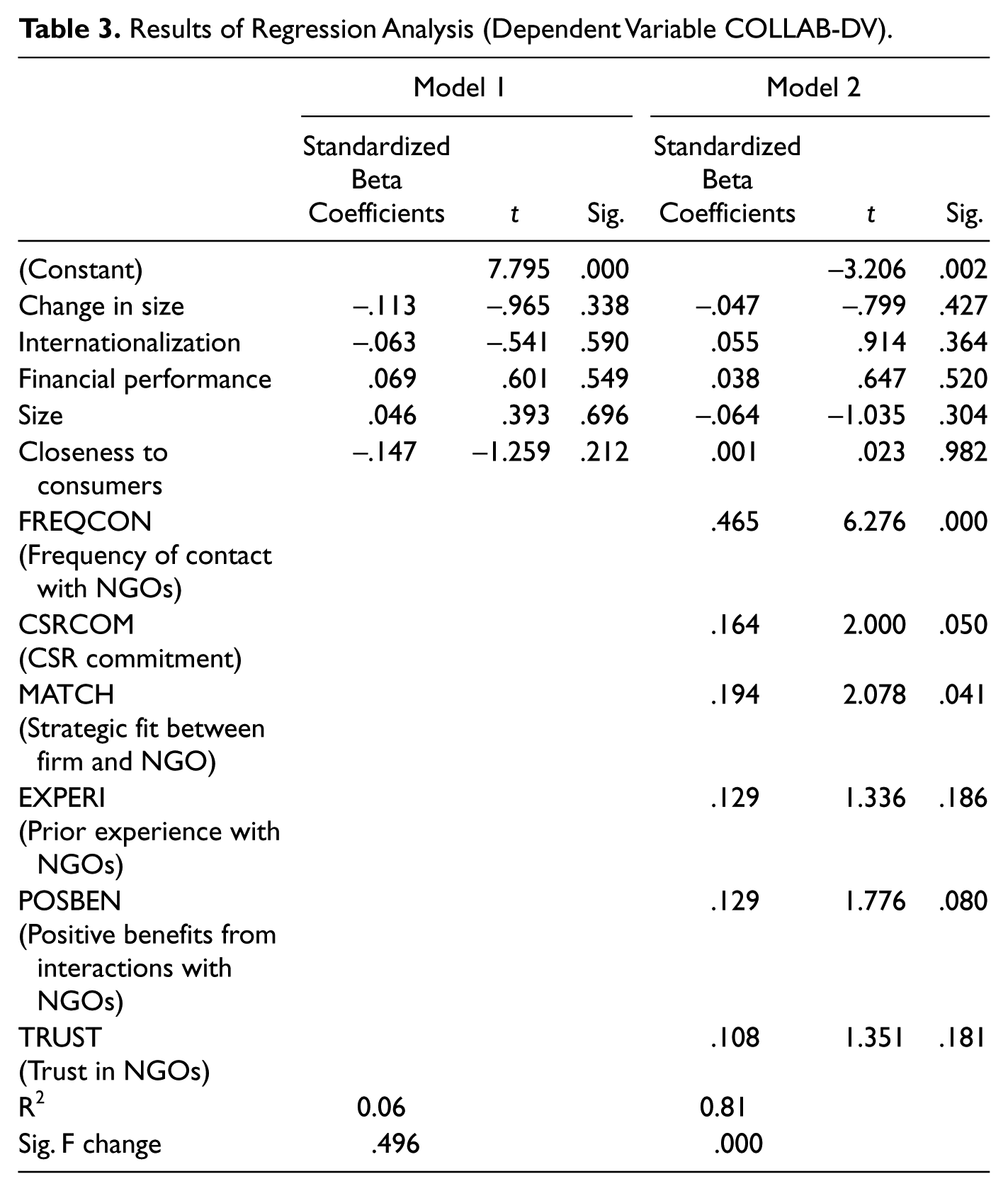
Varimax Rotation Component Matrix of Three Scales.
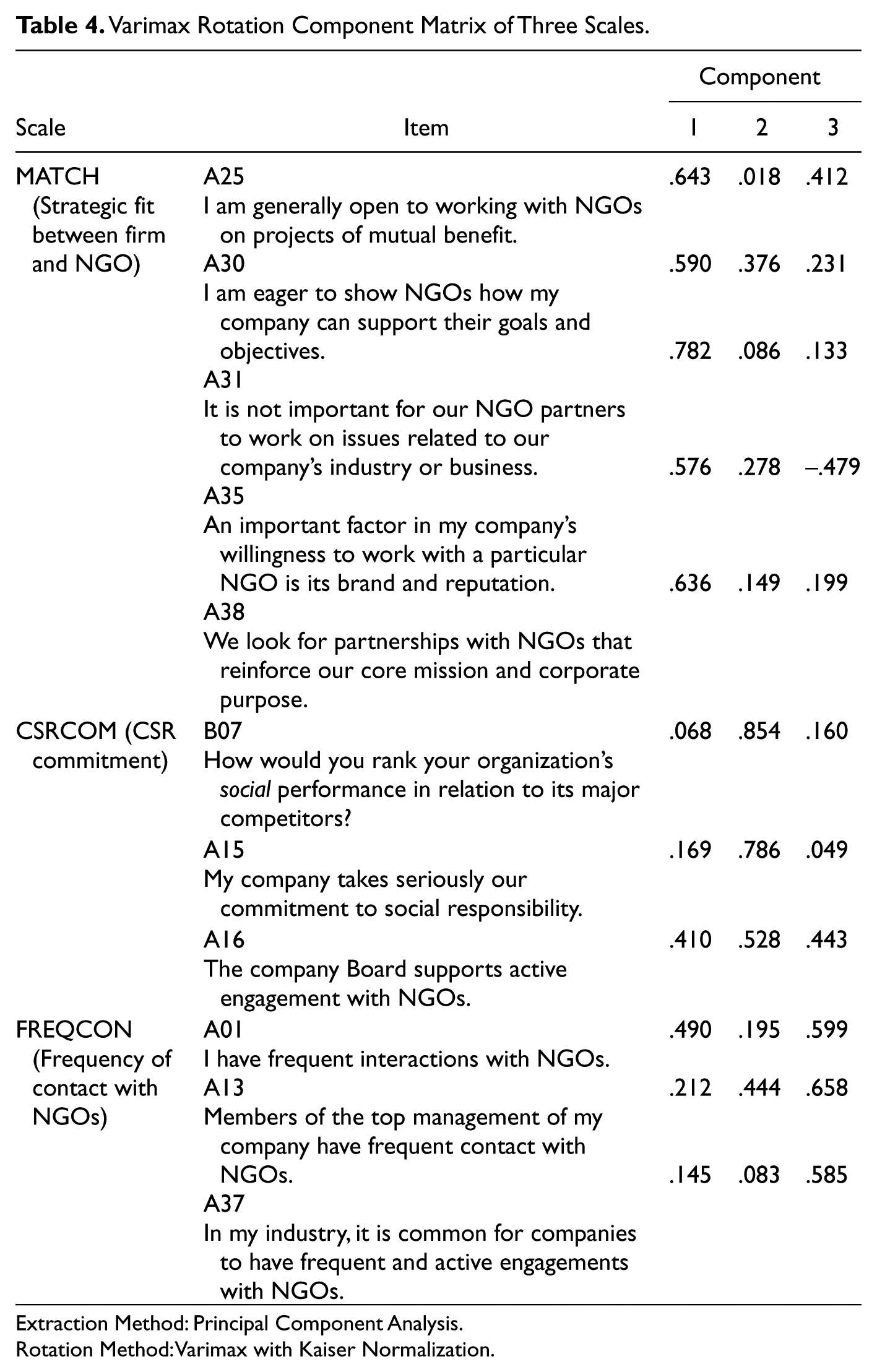
Extraction Method: Principal Component Analysis.
Rotation Method: Varimax with Kaiser Normalization.
Hence, FREQCON, CSRCOM, and MATCH (Hypotheses 1, 2, and 4) predict a firm’s propensity to engage with NGOs. We reject the other Hypotheses 3, 5, 6, and 7 as not predicting EXPERI, POSBEN, TRUST, and TARGET.
The results regarding Hypothesis 7 merit further analysis. The five items for TARGET capture different forms of protest. Interestingly, they are all highly correlated (p < .01, correlation table not shown in article), which suggests that if firms are targeted by NGOs, they usually face a combination of tactics. None of the items shows a significant correlation with the dependent variable. Apparently, having been subjected to protest tactics does not entice firms to collaborate with NGOs. However, the condition does not materially deter firms from collaborating either. This result might be a matter of “data bifurcation”: for some firms having been a target of NGOs leads them to collaborate at a later point in time, for others being targeted leads them to refrain from collaboration at all. To test this potential explanation, we tested whether the quadratic term of TARGET makes a better fit with the dependent variable; however, although slightly better than the linear term, the quadratic term does not have a significant correlation with the dependent variable.
Discussion, Limitations, and Implications for Further Research
How corporations maintain relationships with other actors in their environment is a central issue in corporate social responsibility (CSR), and NGOs are an important category of such actors. Quantitative data on firms’ propensity to engage with NGOs are scarce. Yet these data are relevant to explicate the incidence, scope, and character of such engagements beyond the insights based on anecdotal case studies. Building on RDT, we tested several hypotheses to isolate factors that appear to prompt firms to collaborate with NGOs. In doing so, we found support for several of the hypotheses, while some other hypotheses had to be rejected.
Discussion and Implications
This study shows that three key variables appear to explain the likelihood of firm–NGO collaboration: frequency of contacts, perceived strategic fit, and firms’ commitment to CSR: not a surprising set from a RDT perspective. After all, according to RDT, firms will aim to acquire essential resources it misses out on through relationships. If the resources exchanged in such a relationship are indeed essential, then the strategic fit will be high. Closely related is the issue of CSR commitment: to demonstrate this commitment, a firm is likely to interact with NGOs, whether on its own initiative, selecting those NGOs for collaboration whose resources and objectives fit well with those of the firm, or by being selected by NGOs as a partner in some form of collaboration. Frequency of contacts would imply a routinization of the firm’s engagement with NGOs in its practices and decision making, and thereby increase the firm’s propensity to continue its collaboration with those NGOs whose resources and objectives fit with those of the firm. The relationship with the NGOs then serves a bridging function in terms of RDT (Meznar & Nigh, 1995, p. 976), as “bridging implies that the firm actively tries to meet and exceed regulatory requirements in its industry or that it attempts to quickly identify changing social expectations in order to promote organizational conformance to those expectations.” Frequent contacts support these active attempts. These three variables confirmed the theoretical expectations.
At the same time it is somewhat surprising that other variables are of such limited influence in our model. Trust, past experiences, positive benefits, and straightforward NGO pressure are not very influential, at least not in our data set. The authors had to reject the hypotheses relating to these variables. Still, issues like trust and past experience are, at least at face value, related to one another, while strategic fit might also be thought of as leading to trust. Yet a relationship between trust and past experience was not supported by our data, and trust only had a limited influence on the propensity to collaborate while strategic fit had a more substantial effect. One might wonder whether the constructs have been sufficiently discriminating. Likewise, H5 and H6 could be thought of as being interrelated because a firm has to have had past experiences with NGOs to have had positive benefits with NGOs. 6 In part, this problem could be due to scale construction issues and to the deliberate lack of definitions in our questionnaire. We did not provide exact definitions of constructs because we wanted to measure respondents’ ideas regarding a specific concept and because the authors did not want to steer this measurement in a particular direction. That steering would have been the case if we had provided definitions of variables and then asked for their prevalence. Some of the items we attributed to one scale, and that indeed formed a coherent scale with sufficient correlation rates in our study, might be measuring elements of different variables.
Furthermore, our results suggest that collaborative relations with NGOs are an important component of a company’s overall CSR strategy. Effectively managing stakeholder relations with NGOs may become increasingly important, and possibly more complex, given the increased frequency of contacts. As firms actively engage with NGOs, the firm’s number of stakeholders will grow, while their potential effects on performance and profitability may become larger; NGOs might, for instance, influence market conditions for firms by supplying information (Feddersen & Gilligan, 2001). This again makes it increasingly important for the firm to maintain a corporate network of relations, not only with their rivals and customers but also with NGOs, public authorities, and political regulators (Burris, 2001). Actively engaging with NGOs and developing nonmarket strategies requires firms to realize an effective coordination of these strategies with their market activities (Baron, 2003).
Our results further elaborate the RDT perspective on organizations and their relationships to their environments. Our finding that the regular occurrence of personal interactions between firm and NGO managers—frequency of contacts—influences the firms propensity to collaborate with NGOs, positions individuals within these two organizations as the channels through which dependencies are established, and subsequently manifest in the likelihood of more formal agreements. Similarly, firms and their mangers are concerned with the resource complementarities—that is, fit—between their organizations and potential counterparts, showing the potential limits to these dependencies in the event such fits are not perceived to exist. The firm’s overall commitment to CSR as a motivator for collaboration suggests an extension of RDT in that an organization’s dependencies are directly influenced by not only its strategic outlook but also by its moral and ethical orientation.
Finally, the study findings also contain potential applications to practicing managers. The most direct implication is that firms interested in collaborating with NGOs may benefit from informal interactions prior to formal agreements. Moreover, identification of potential NGO partners that are more likely to have a “strategic fit” with the focal organization may be a productive step before proceeding to discussions and negotiations around an actual agreement. Finally, collaboration with NGOs should be viewed as one part of a broader CSR strategy, a commitment that should precede a specific approach to individual NGOs.
Limitations
Our study, like any, suffers from a number of limitations. First, the overall response rate was relatively low and the sample size was therefore relatively small, posing questions about whether our sample is representative of a larger population. Second, the results were mainly based on responses from large organizations and therefore should be interpreted carefully in terms of generalization: small and medium-sized enterprises were not represented as much in our data set. Third, there might be bias in the data due to self-selection. It cannot be excluded that well-performing firms are overrepresented among the respondents, for example, because poorly performing firms might not have the resources available to complete a survey. We were unable to compare performance data of respondents to those of nonrespondents as we had no access to independent performance data on the firms sampled. Fourth, and regarding the above discussion related to variable definition and measurement, the extent to which our items are sufficiently discriminating is worth further examination, for instance in follow-up research in a different empirical setting. A more elaborated data set might also allow for more advanced statistical procedures than the ones we were able to perform here (cf. logistic regression). Nevertheless, the data set already provides an interesting initial outlook on what prompts (mostly) large companies to collaborate with NGOs, while underlining the need for further research in this direction.
The issue of coordination has not been addressed explicitly in our current research, but it provides a meaningful direction for follow-up research that also links to earlier RDT-work by Meznar and Nigh (1995) on bridging and buffering strategies in U.S. firms’ public affairs activities. We expect that firms that coordinate nonmarket and market activities not only will be more inclined to actively engage with NGOs but also will be able to create more positive benefits from such engagement. This also leads to other avenues for future research, including prioritization of engagements with NGOs and other nonmarket actors and taking a process perspective.
Suggestions for Further Research
A central problem for firms developing social and political activities concerns the question of how to prioritize market and nonmarket interests and translate these into corporate preferences for specific social and political activities (Martin, 1995). Engaging with NGOs and interacting with regulators and/or public authorities sometimes involves complicated processes of corporate decision making in which key decision makers within the firm need to establish consensus and create support among themselves for social and political strategies complementary to the firm’s market activities. The firm’s orientation toward its social and political stakeholders—the way it engages with NGOs and public authorities—is structured by the internal organization of the firm (Rehbein & Schuler, 1999; Schuler & Rehbein, 1997). When dealing with different social and political stakeholders it becomes increasingly difficult for firms to determine which social and political activities will best serve their interests (Blumentritt & Nigh, 2002). The way firms handle this information problem is influenced by the availability of critical resources such as financial means and relational skills (Dahan, 2005). Our analysis of the determinants of the firm’s propensity to establish collaborative relations with its social and political stakeholders thus also leads us to questions of resource specificity in relation to the firm’s ability to develop effective CSR activities. Such resources have not yet been identified in full detail and have not been included in our current study. We need to develop a further understanding of the characteristics of the critical resources and therefore follow-up research should try to get beyond fairly broad variables like “strategic fit” or “positive benefits” and break down these categories in more specific elements. Working with more exact definitions then will be helpful, as will be strengthening the link with recent developments in RDT. Among the directions for further research in this field, Hillman et al. (2009) explicitly mention the strategies of political action. Engagement with NGOs is one promising area to examine in this respect.
Such interactions between firms and NGOs are a continuous process. Firms will differ in the way they manage this process. Examining this process in detail requires a process theoretical approach (Poole, Van de Ven, Dooley, & Holmes, 2000) and a longitudinal research method (Skippari, 2005). Studying longer term developments in social and political activities of firms again raises questions of how and when firms develop specific competences and skills in the social and political domain. Extending the research approach we adopted in this article with a focus on longer term developments within the firm will be helpful to shed light on the reasons for firms to seek active involvement with their social and political stakeholders. This extension would include a focus on the firm’s internal decision-making culture and the processes in which preferences are developed and CSR strategies get made. What shapes corporate preferences for interacting with NGOs? And what determines the reasons that firms have to establish relations with some NGOs rather than others? These questions could also be mirrored towards NGOs as examining the process of interaction requires a balanced view of both sides of the interaction. For instance, it is useful to develop an insight in the different parameters under which firms experience NGO activism. Following Hillman et al. (2009, p. 1419) the authors suggest that incorporating other theoretical angles could be instructive: “Recognizing that dependencies exist with multiple environmental contingencies, or the ‘multiplexity’ of these relationships, also shows potential.” The literature on institutional entrepreneurship is useful to conceptualize the way firms try to cope with environmental uncertainties by coproducing norms with NGOs (think, for instance, of the establishment of ecolabeling schemes such as the Marine Stewardship Council’s program (Cummins, 2004)). Drawing on this literature will also help to differentiate among NGOs and their strategies opposite firms (den Hond & de Bakker, 2007; Yaziji & Doh, 2009), using this to arrive at more detailed outcomes through empirical research. It will also prove helpful in further examining the reasons for firms to engage with NGOs and establish durable or recurrent contacts with these social and political stakeholders. Understanding interactions among firms and NGOs will contribute to greater insight on questions about the appropriate role of business in society and how firms can fulfill their ethical and social obligations via interorganizational connections with NGOs.
Footnotes
Appendix
Questionnaire (Selected Questions)
| Dependent Variable: Propensity to Collaborate (COLLAB-DV) |
|||||||||
|---|---|---|---|---|---|---|---|---|---|
| No | Yes | Missing | |||||||
| B37 | Does your firm have active relationships with not-for-profit NGOs? | 25/28.7% | 61/70.1% | 1/1.1% | |||||
| Strongly disagree | Disagree | Neutral | Agree | Strongly agree | Missing | M | SD | ||
| A04 | My firm has developed close working relationships with a number of NGOs | 9/10.3% | 17/19.5% | 12/13.8% | 28/32.2% | 17/19.5% | 4/4.6% | 3.33 | 1.31 |
| A06 | My firm has been engaged in long-lasting relationships with NGOs | 6/7.1% | 17/19.5% | 10/11.5% | 35/40.2% | 16/18.4% | 3/3.4% | 3.45 | 1.22 |
| A08 | My firm has difficulty developing close working relationships with NGOs | 17/19.5% | 36/41.4% | 23/26.4% | 7/8.0% | 1/1.1% | 3/3.4% | 2.27 | 0.92 |
| A17 | Working relationships between my firm and NGOs are only temporary | 11/12.6% | 37/42.5% | 25/28.7% | 10/11.5% | 1/1.1% | 3/3.4% | 2.44 | 0.91 |
| A19 | My firm has had good relationships with a variety of NGOs | 4/4.6% | 16/18.4% | 16/18.4% | 36/41.4% | 12/13.8% | 3/3.4% | 3.43 | 1.10 |
| A32 | My company is interested in forming long-term relationships with NGOs | 1/1.1% | 6/6.9% | 22/25.3% | 42/48.3% | 12/13.8% | 4/4.6% | 3.70 | 0.85 |
| A34 | My company works with NGOs on short, specific activities | 5/5.7% | 16/18.4% | 31/35.6% | 28/32.2% | 3/3.4% | 4/4.6% | 3.10 | 0.96 |
| A36 | My company prefers to work with a range of different NGOs on various projects rather than as opposed to working with one or two NGOs on a few projects | 3/3.4% | 18/20.7% | 39/44.8% | 18/20.7% | 5/5.7% | 4/4.6% | 3.05 | 0.91 |
| H1 Commitment to CSR (CSRCOM-IV) |
|||||||||
| Above average | On average | Below average | Missing | ||||||
| B07 | How would you rank your organization’s social performance in relation to its major competitors? | 54/62.1% | 32/36.8% | 0/0% | 1/1.1% | ||||
| Strongly disagree | Disagree | Neutral | Agree | Strongly agree | Missing | M | SD | ||
| A15 | My company takes seriously our commitment to social responsibility | 1/1.1% | 2/2.3% | 8/9.2% | 34/39.1% | 42/48.3% | 0/0% | 4.31 | 0.83 |
| A16 | The company Board supports active engagement with NGOs | 3/3.4% | 8/9.2% | 23/26.4% | 35/40.2% | 15/17.2% | 3/3.4% | 3.61 | 1.01 |
| H2 Strategic Fit (MATCH-IV) |
|||||||||
| Strongly disagree | Disagree | Neutral | Agree | Strongly agree | Missing | M | SD | ||
| A09 | The organizational culture of corporations and NGOs is so different that collaboration is difficult. | 11/12.6% | 25/28.7% | 25/28.7% | 18/20.7% | 5/5.7% | 3/3.4% | 2.77 | 1.11 |
| A25 | I am generally open to working with NGOs on projects of mutual benefit. | 1/1.1% | 4/4.6% | 9/10.3% | 47/54.0% | 21/24.1% | 5/5.7% | 4.01 | 0.82 |
| A30 | I am eager to show NGOs how my company can support their goals and objectives. | 2/2.3% | 11/12.6% | 26/29.9% | 34/39.1% | 10/11.5% | 4/4.6% | 3.47 | 0.95 |
| A31 | It is not important for our NGO partners to work on issues related to our company’s industry or business. | 15/17.2% | 32/36.8% | 25/28.7% | 10/11.5% | 1/1.1% | 4/4.6% | 1.40 | 0.96 |
| A35 | An important factor in my company’s willingness to work with a particular NGO is its brand and reputation. | 2/2.3% | 7/8.0% | 18/20.7% | 40/46.0% | 15/17.2% | 5/5.7% | 3.72 | 0.95 |
| A38 | We look for partnerships with NGOs that reinforce our core mission and corporate purpose. | 0/0.0% | 9/10.3% | 19/21.8% | 41/47.1% | 13/14.9% | 5/5.7% | 3.71 | 0.87 |
| H3 Trust in NGOs (TRUST-IV) |
|||||||||
| Strongly disagree | Disagree | Neutral | Agree | Strongly agree | Missing | M | SD | ||
| A14 | I trust NGOs to honor what they say. | 1/1.1% | 9/10.3% | 38/43.7% | 32/36.8% | 4/4.6% | 3/3.4% | 3.35 | 0.78 |
| A18 | I am hesitant to reveal proprietary information to NGOs. | 4/4.6% | 27/31.0% | 32/36.8% | 18/20.7% | 3/3.4% | 3/3.4% | 2.87 | 0.93 |
| A20 | NGOs cannot be trusted. | 27/31.0% | 38/43.7% | 14/16.1% | 5/5.7% | 0/0.0% | 3/3.4% | 0.96 | 0.86 |
| A42 | My colleagues have reported difficulties in their relationships with NGOs. | 2/2.3% | 19/21.8% | 33/37.9% | 24/27.6% | 4/4.6% | 5/5.7% | 2.11 | 0.90 |
| H4 Frequency of Contact (FREQCON-IV) |
|||||||||
| Strongly disagree | Disagree | Neutral | Agree | Strongly agree | Missing | M | SD | ||
| A01 | I have frequent interactions with NGOs. | 9/10.3% | 13/14.9% | 24/27.6% | 21/24.1% | 17/19.5% | 3/3.4% | 3.29 | 1.26 |
| A13 | Members of the top management of my company have frequent contact with NGOs. | 6/6.9% | 21/24.1% | 16/18.4% | 28/32.2% | 13/14.9% | 3/3.4% | 3.25 | 1.20 |
| A37 | In my industry, it is common for companies to have frequent and active engagements with NGOs. | 4/4.6% | 25/28.7% | 23/26.4% | 27/31.0% | 4/4.6% | 4/4.6% | 2.02 | 1.01 |
| H5 Experience with NGOs (EXPERI-IV) |
|||||||||
| Strongly disagree | Disagree | Neutral | Agree | Strongly agree | Missing | M | SD | ||
| A40 | I have found collaboration with NGOs to be personally rewarding. | 2/2.3% | 8/9.2% | 23/26.4% | 40/46.0% | 9/10.3% | 5/5.7% | 3.56 | 0.90 |
| A41 | Working with NGOs is more trouble than it is worth. | 8/9.2% | 44/50.6% | 21/24.1% | 10/11.5% | 0/0.0% | 4/4.6% | 1.40 | 0.83 |
| A44 | My company has worked well with NGOs. | 2/2.3% | 5/5.7% | 18/20.7% | 48/55.2% | 9/10.3% | 5/5.7% | 3.70 | 0.84 |
| A49 | I have never had a positive experience with NGOs leaders. | 30/34.5% | 40/46.0% | 9/10.3% | 3/3.4% | 0/0.0% | 5/5.7% | 1.82 | 0.77 |
| A50 | NGOs are generally reliable partners. | 1/1.1% | 5/5.7% | 29/33.3% | 43/49.9% | 4/4.6% | 5/5.7% | 3.54 | 0.74 |
| H6 Benefits (POSBEN-IV) |
|||||||||
| Strongly disagree | Disagree | Neutral | Agree | Strongly agree | Missing | M | SD | ||
| A10 | NGOs provide valuable resources to their corporate partners | 1/1.1% | 10/11.5% | 31/35.6% | 38/43.7% | 5/5.7% | 2/2.3% | 3.42 | 0.82 |
| A11 | NGOs get more out of collaboration with corporations than vice versa | 3/3.4% | 22/25.3% | 39/44.8% | 17/19.5% | 4/4.6% | 2/2.3% | 1.96 | 0.89 |
| A21 | When my corporation has partnered with NGOs, we have clearly benefited from those relationships | 0/0.0% | 12/13.8% | 35/40.2% | 31/35.6% | 5/5.7% | 4/4.6% | 3.35 | 0.80 |
| H7 NGO Pressure (TARGET-IV) |
|||||||||
| Strongly disagree | Disagree | Neutral | Agree | Strongly agree | Missing | M | SD | ||
| A03 | My firm has been the target of NGO campaigns (boycotts, protests, etc.). | 30/34.5% | 19/21.8% | 8/9.2% | 18/20.7% | 8/9.2% | 4/4.6% | 2.46 | 1.42 |
| A23 | My firm has been subject to criticisms by NGOs. | 15/17.2% | 17/19.5% | 12/13.8% | 31/35.6% | 9/10.3% | 3/3.4% | 3.02 | 1.32 |
| A43 | My company has been subject to legal suits by NGOs. | 26/29.9% | 31/35.6% | 13/14.9% | 6/6.9% | 5/5.7% | 6/6.9% | 2.17 | 1.15 |
| A45 | My company has been subject to protests by NGOs. | 18/20.7% | 20/23.0% | 11/12.6% | 25/28.7% | 8/9.2% | 5/5.7% | 2.82 | 1.34 |
| A46 | My company has never been subject to a boycotts initiated by NGOs. | 23/26.4% | 22/25.3% | 7/8.0% | 16/18.4% | 14/16.1% | 5/5.7% | 2.71 | 1.49 |
| Controls |
|||||||||
| Missing | |||||||||
| B02 | Principal industry | Chemicals—15/17.2% |
Logistics—5/5.7% |
Supermrkts—2/2.3% |
2/2.3% | ||||
| B03 | How many employees (number) did your company have in 2004? | <300 |
300-4,200 |
>4,200 |
2/2.3% | ||||
| B04 | In comparison to the year 2000, the number of employees has . . . | decreased |
remained stable |
increased |
1/1.1% | ||||
| B05 | What percentage of your company’s sales is derived from foreign sales? | 0%-25% |
26%-50% |
51%-75% |
76%-100% |
0/0% | |||
| B06 | How would you rank your organization’s financial performance (as measured by profitability) in relation to its major competitors? | above average |
on average |
below average |
1/1.1% | ||||

Acknowledgements
The authors would like to thank Nicole Driessen for her assistance in data collection and Arnold Wilts for his contribution to the initial stages of this project.
Declaration of Conflicting Interests
The author(s) declared no potential conflicts of interest with respect to the research, authorship, and/or publication of this article.
Funding
The author(s) received no financial support for the research, authorship, and/or publication of this article.
The article was accepted during the editorship of Duane Windsor.