




Abstract
This article examines the role of social context in corporate social responsibility (CSR) research. The authors direct attention to three major perspectives in organization studies—institutional, cultural, and cognitive—that bear on the social context and explore how these perspectives are used in CSR research. These perspectives are framed as representative of the levels at which CSR may be analyzed, and each perspective is associated with a certain level of social context: the institutional perspective relates to the external social context, the cultural perspective relates to the organizational level, and the cognitive perspective relates to the individual level. The authors demonstrate how the CSR field can benefit by combining or integrating multiple perspectives that bear on the social context, and by engaging in more explicit multilevel analysis of the social context within which CSR practicesunfold. Three promising avenues for future CSR research are outlined: social ecology, cross-sector social partnerships, and strategy-as-practice. The authors argue that these avenues transcend levels and perspectives (even allowing for the combination of the three schools) and offer the prospect of more context-sensitive CSR research.
Keywords
Introduction
The literature on corporate social responsibility (CSR) recognizes that implementing CSR depends not only on organizational actors participating in CSR initiatives, but also on the social context within which CSR occurs (Antal, 1992; Lindgreen, Swaen, & Maon, 2009; Morsing & Schultz, 2006; Wood, 1991; Zenisek, 1979). “[O]rganizations evolve in distinct contexts and face different constraints for which reason they need to develop CSR policies and implement CSR activities that fit their organizational culture, business rationale, and strategic goals” (Lindgreen et al., 2009, p. 252). CSR has been called a “moving target” (Morsing & Schultz, 2006, p. 332) because the external contexts within which organizations operate are continuously changing and increasingly complex (Wood, 1991; Zenisek, 1979, p. 363). The CSR principles underpinning corporate social performance (CSP) are “neither universal nor absolute in their meaning; they are time- and culture-bound” and “even within a specific time and culture, such concepts are defined variously by relevant stakeholder groups, that is, according to their own values” (Wood, 1991, p. 700).
The authors argue below that despite this recognition the social context remains poorly represented in much of CSR research. This circumstance is not surprising, considering that the management and organization literature in general tends to underplay the role of this construct: “. . . [T]he social context of decisions [is treated as] ‘background noise’ rather than an essential part of the problem” (Johnson, 1987, pp. 208-209; see also Johns, 2006).
By social context, the authors mean how the individual actor concerned with CSR is embedded within an organization that is in turn embedded within an external social context, and these three levels interact with one another. This meaning is consistent with CSR research which construes the social context in terms of levels (Aguilera, Rupp, Williams, & Ganapathi, 2007; Wood, 1991, 2010). Since “most behavior is closely embedded in networks of interpersonal relations” (Granovetter, 1985, p. 504), what happens at one level cannot be explained without considering the more encompassing, or “higher,” level. Thus, linking embeddedness closely to social context allows better understanding of macro organizational phenomena. For instance, Granovetter (1985, p. 504) explains that small firms can persist in a competitive market setting because of the dense network of social relations connecting those firms, which protects them from being acquired by larger corporations. Meyer, Gaba, and Colwell (2005) go further in a study of organizations embedded in a field undergoing significant nonlinear change (the nanotechnology industry). They found that “a nanotech start-up doesn’t construct an alliance network—the start-up’s alliance network constructs the nascent firm” (Meyer et al., 2005, p. 468, emphasis in original; see also Marquis & Battilana, 2009). Under a similar network logic, each level in the present study is seen as embedded within a “higher” one as well as interacting with the other two; see Figure 1.
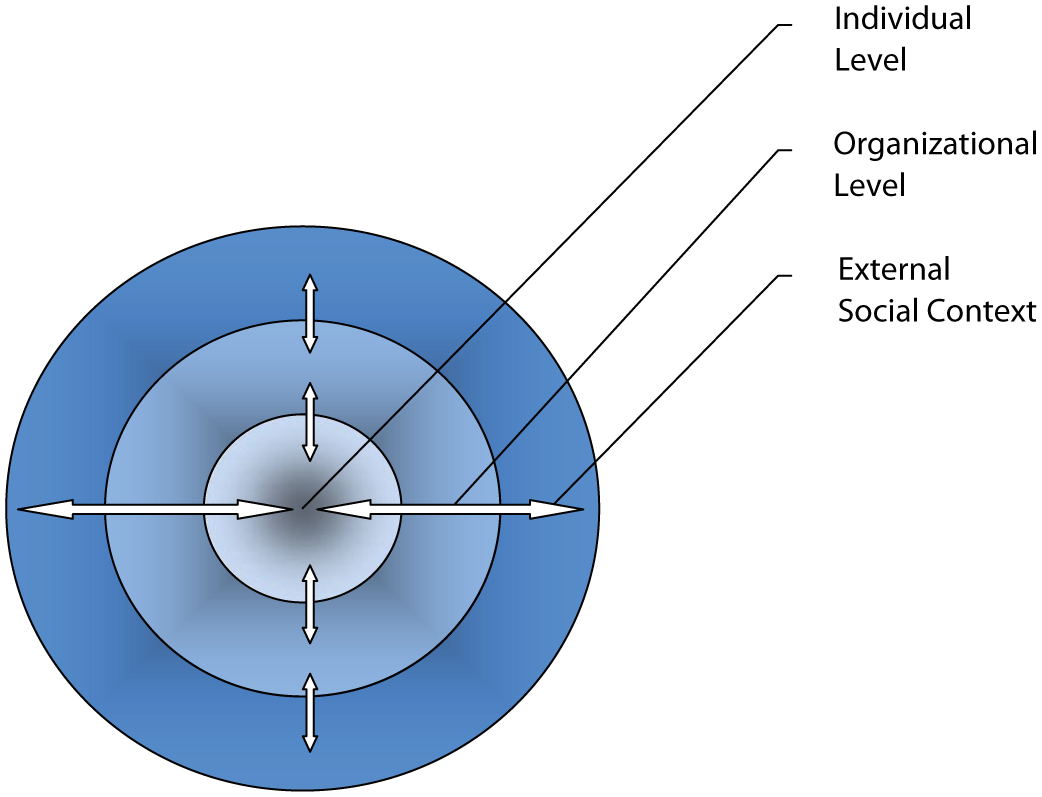
The Social Context of CSR Implementation and the Embeddedness of Levels.
Using embeddedness also allows the individual level to be analyzed as part of the social context, because organizational actors (employees) interact with one another and this interaction shapes the environment within which they act. At the same time, their decisions, choices, and behavior are also shaped by their environment. This conceptualization of the social context at an individual level is not new. For instance, Lawrence (2006) views the social context only at an individual level, focusing on how an individual perceives and associates with other employees who form his/her organizational reference group. Thus, the individual level of analysis has “social” implications and is included as part of the social context in this article.
The purpose of this article is to demonstrate why and how the organizational social context should be more directly considered in CSR studies. This direct consideration is important so that CSR research can better reflect the new organizational reality, which calls for companies to be more deliberate in their efforts to create “shared value” between themselves and the wider society (Porter & Kramer, 2011, p. 64). To that end, the authors of this article analyze how three major social context perspectives have been employed in previous CSR research and suggest how the CSR field might benefit by combining them in multiperspective frameworks and by situating them in multilevel frameworks. The authors also outline three possible avenues for future CSR research using both of these manoeuvres. The analysis contributes to a more holistic understanding of how the organizational social context influences CSR practice, and therefore argues that the social context needs to be incorporated more explicitly in CSR research.
This article is structured as follows. The next section defines CSR and assesses how CSR studies have taken a multiperspective and multilevel approach to the social context. The subsequent section poses the research questions and offers a framework for responding to these questions. Then, the authors use the framework to examine CSR through the lenses of three perspectives (institutional, cultural, and cognitive), each corresponding to a social contextual level (external, organizational and individual, respectively). Two propositions are offered regarding how the CSR field can benefit from greater use of multiple perspectives and from more consideration of the multiple levels of the social context. The authors then illustrate how CSR research may be enriched by using their approach with three promising avenues for CSR research (social ecology, strategy-as-practice and cross-sector social partnerships). The final section articulates the contributions of the study.
CSR and the Social Context of Organizations
This section examines first how CSR is defined and then how the social context is construed within the CSR literature.
Defining CSR
Most scholars would still agree with Carroll’s (1979) categorization of four social responsibilities of business: economic, legal, ethical, and discretionary (see also Carroll, 1991; Swanson, 1995, 1999; Wartick & Cochran, 1985; Wood, 1991, 2010). These responsibilities are fulfilled in various CSR projects, programs and strategies, including “checkbook” and “strategic” philanthropy, cross-sector partnerships, cause-related marketing campaigns, proactive initiatives, and corrections of CSR failures (Selsky & Parker, 2005; Steiner & Steiner, 2009; Yaziji & Doh, 2009). A more restricted conception of CSR has been as a set of “voluntarily adopted” obligations to “constituent groups in society other than stockholders and beyond that prescribed by law or union contract” (Jones, 1980, pp. 59-60; see also Jones, Wicks, & Freeman, 2002; Smith, 2003). This conception excludes economic and legal (including contractual) dimensions of the Carroll framework. Recent definitions emphasize a dynamic and stakeholder-responsive nature, describing CSR as an organizational change process which entails not only “identifying and managing stakeholder expectations” but also “learning over time and the ability to understand the specific context and confluence of stakeholder expectations” (Maon, Lindgreen, & Swaen, 2009, p. 72; see also Heslin & Ochoa, 2008; Waddock & Bodwell, 2004).
Whether CSR is seen as an obligation or as a voluntary process of managing external expectations, stakeholders clearly inhabit and shape the social context of organizations (Post, Preston, & Sachs, 2002). Thus, managers must determine, often in negotiation with their stakeholders, what these obligations or expectations might be. Therefore, the social context can be neither ignored nor treated as an independent construct in CSR studies, because social context is in a mutually influencing relationship with the organization and its behavior, as portrayed in Figure 1.
Organizational environments are seen as highly complex fields filled with conflicting stakeholder demands, market and regulatory failures, intractable “metaproblems” and changes in social values regarding the responsibilities of business (Selsky & Parker, 2005; Waddock, 2009; Yaziji & Doh, 2009). “At the very heart of this complexity is a single critical fact: firms increasingly operate under multiple, inexplicit, incomplete, often conflicting and continually renegotiated social contracts and institutions” (Yaziji & Doh, 2009, p. 33). Essentially the CSR field is grounded in an open-system premise (Maon, Lindgreen, & Swaen, 2008, p. 415; Wood, 2010, p. 51). How managers with CSR agendas might understand the organization-environment relationship, and on that basis, which decisions and actions they might take, has long animated CSR research. Therefore, it is important to understand the role of the social context within which CSR is implemented. Recently, Porter and Kramer (2011, p. 64) suggested that “most companies remain stuck in a ‘social responsibility’ mind-set in which societal issues are at the periphery, not the core.” They stressed that in order to move from an outdated, narrow approach to value creation, companies need to redefine the purpose of business based on the principle of “shared value,” that is, the creation of economic value “in a way that also [emphasis in original] creates value for society by addressing its needs and challenges” (Porter & Kramer, 2011, p. 64). This calls for changes at all levels and has vast implications for CSR. Not only would companies need to redefine their purpose, but managers would need to develop new skills and knowledge, and governments would need to develop new kinds of regulation that allow for shared value to be enacted. This study is situated within the ambit of this emerging imperative.
Thus, the authors define CSR implementation as a dynamic organizational process to introduce or revise organizational policies and practices to respond to the need for more socially responsible business practices. CSR implementation entails interaction with the external environment and may require structural, operational, strategic, and behavioral changes across levels and functions within the organization. As described below, CSR implementation is introduced, developed and continuously adjusted on the basis of a multiplicity of influences both from inside and outside the organization.
The Organizational Social Context of CSR: Multiple Perspectives and Multiple Levels
Organization studies include a number of perspectives or schools that describe and/or employ the social context of organizations; Table 1 includes an indicative list.
Some Schools of Thought on the Social Context of Organizations and Key References.

This school of thought is not the social ecology avenue discussed later in this article. Social ecology and population ecology come from different intellectual traditions.
Theoretical perspective examined in this study.
The authors define the organizational social context as the sum of the “situational opportunities and constraints that affect the occurrence and meaning of organizational behavior as well as functional relationships between variables” (Johns, 2006, p. 386). The organizational behavior of interest in this article is that related to CSR, as manifested in specific projects, programs and strategies. The opportunities and constraints exist at multiple levels, from the interpersonal context of the individual actors to the external environmental context.
For instance, the 2010 British Petroleum (BP) oil spill event in the Gulf of Mexico and the way it was managed could be considered a case of poor or failed CSR (see Balmer, Powell, & Greyser, 2011). Characterized retrospectively as “an accident waiting to happen” (Elkind, Whitford, & Burke, 2011), it is considered a CSR failure in terms of how BP was perceived not to act in a timely manner to minimize the extent of ecological damage, and also in terms of how the company failed to appropriately engage with stakeholders during and after the spill. The accident evoked BP’s social context by bringing into focus its relationships with a broad set of stakeholders and its responsiveness to public expectations. The relationships included those with BP’s business partners (such as Halliburton, which provided BP with oil field services, and Transocean, which operated the drill rig), federal and state regulators, environmental advocacy groups, its employees, shareholders and other stakeholders. BP’s Gulf operations are subject to various opportunities and constraints shaped by its interactions with those stakeholders. When the spill occurred it activated those opportunities and constraints. For instance, weak government oversight and poor coordination, which could be attributed to the conflicting priorities of the different companies operating on the Deepwater Horizon platform, were important factors in the 2010 accident (Sylves & Comfort, 2012, p. 98). The spill also invoked new stakeholders and new roles, such as the $20 billion victim compensation fund that the US federal government extracted from the company. Decision makers in BP, such as then CEO Tony Hayward, were subject to intense pressures to make sense of the unfolding situation in certain ways, and to act accordingly.
Sethi (1979, p. 64) was among the first scholars to acknowledge the context-dependent nature of CSR, noting that “a specific action is more or less socially responsible only within the framework of time, environment, and the nature of the parties involved.” Recent research, both conceptual and empirical, has highlighted the important role of the social context in adopting and implementing CSR practices (see Aguilera et al., 2007; Athanasopoulou, 2007; Brammer & Millington, 2003; Carroll & Shabana, 2010; Collier & Esteban, 2007; Dunphy, Griffiths, & Benn, 2003; Hemingway & Maclagan, 2004; Mirvis & Googins, 2006; Porter & Kramer, 2006; Sen, Bhattacharya, & Korschun, 2006; Vogel, 2005). These studies generally view CSR implementation as the dynamic product of a complex interplay of internal motives and external drivers. For example, in Aguilera et al.’s (2007) theory of organizational social change, multiple actors act across and within multiple levels to push for positive social change and are driven by instrumental, relational, and moral motives. Thus, the social contexts of CSR projects, programs and strategies consist of multiple levels and are complex enough that they need to be studied using multiple perspectives. These approaches are briefly discussed below.
An early example of seeing CSR in a multilevel way was Wood’s (1991, p. 694) corporate social performance model, which identified three CSR principles (legitimacy, public responsibility, and managerial discretion), which operate at three “conceptually distinct though related” levels—institutional, organizational, and individual respectively (see also Wood, 2010). Essentially, Wood (1991) situates CSR as a process embedded within a multilayered social context. Wood’s approach underlies Basu and Palazzo’s (2008, p. 122) three prevailing lines of CSR inquiry: (a) “stakeholder driven,” where CSR is viewed as “a response to the specific demands of largely external stakeholders;” (b) “performance driven,” which emphasizes “the link between external expectations and a firm’s concrete CSR actions;” and (c) “motivation driven,” which examines either “the extrinsic reasons for a firm’s CSR engagement” or the “intrinsic rationales . . . to advance particular notions of its obligations and responsibilities.” Aguilera et al. (2007, p. 837) also adopt a multilevel perspective albeit using a different classification (individual, organizational, national, and transnational levels).
Another approach to incorporating social context considerations in CSR research stems from different perspectives. Some studies focus on a specific social context representation, such as the institutional perspective (e.g., Aguilera et al., 2007; Beliveau, Cottrill, & O’Neill, 1994; Husted & Allen, 2006; Jennings & Zandbergen, 1995; Matten & Moon, 2008; Peloza & Falkenberg, 2009; Rama, Milano, Salas, & Liu, 2009; Seitanidi & Crane, 2009; Yaziji & Doh, 2009). Other studies examine the social context of CSR with respect to a specific organizational function or level, such as human resources or strategy (e.g., Brooks, 2005; Carroll, 2000; Clarkson, 1995; Hanke & Stark, 2009; Lamberti & Lettieri, 2009; Lantos, 2001; McWilliams, Siegel, & Wright, 2006; Porter & Kramer, 2002, 2006; see also Husted & Allen, 2006).
In the above studies CSR is analyzed by including some aspect of the organizational social context. Such inclusion is important, but scattered aspects do not constitute a satisfactorily holistic understanding of the social context of CSR. The authors argue that CSR scholars who seek to incorporate the organizational social context in their studies of the CSR implementation process need to represent it in multiple ways, because those ways can influence how CSR is implemented, and at multiple levels, because the complex interactions of individuals, the organization and its external environment help to coevolve the organization, its CSR program/initiatives and its social context over time. After all, . . . it is of little value to identify the features of responsive corporations as though they were free-floating species, for the main point is their ability to respond to their context. It is therefore essential to link these various foci and levels of analysis [i.e. individuals, organizations, society]. (Antal, 1992, p. 44)
Next a framework to address this need for more context-sensitive CSR research is outlined.
Research Questions and Framework
This study poses two questions:
Research Question 1: How can CSR research take the organizational social context into account in a more deliberate and effective way?
This research question is the gateway to considering multiple levels. And,
Research Question 2: How might a combination of social context approaches enhance our understanding of CSR practices?
This research question is the opening to considering multiple perspectives.
To address these questions the authors follow Wood (1991, 2010) in construing the social context in terms of three levels: external (Wood uses “institutional”), organizational and individual levels. One representative social context theory associated with each level is examined: the institutional perspective relates to the external social context of CSR; the cultural perspective relates to the organizational-level context of CSR, namely, an organization’s cultural terrain; and the cognitive perspective relates to the individual-level context of CSR, namely, the interpersonal infrastructure of sensemaking that influences individuals’ decision making.
Both the institutional and the cognitive perspectives have recently attracted some interest among CSR scholars. Institutional theory has become the predominant perspective in organization studies for explaining the external influences on many kinds of organizational behavior, and it has been used in some CSR research, as described below. Therefore, it makes sense to explore how institutional theory might be used to explain the external context of CSR. The cognitive/sensemaking perspective was selected because of the important role of individual decision makers in CSR. This perspective has also been used in some CSR research, as described below.
The analytical approach adopted here combines levels and perspectives. Specifically, for each level only one perspective is considered, as shown in Table 2. The authors considered this necessary because an exhaustive review of all social context theories at a particular level of analysis, or of all schools in organization studies with social context implications, is well beyond the scope of this study. For instance, although design, political, leadership and other perspectives on the social context exist at the organizational level, the authors chose the cultural perspective for their analysis because culture is the most widely integrated social context approach in CSR studies, and also because it appears as a key component of a multidimensional approach to CSR implementation (see Swanson, 1995). In a later section of this article, the authors offer ways to move beyond this one-level-to-one-perspective combination by suggesting three promising avenues for future research, each of which could be applied to any level (see right column of Table 2).
The Social Context of CSR: Multiple Levels of Analysis, Theoretical Perspectives and Promising Avenues.
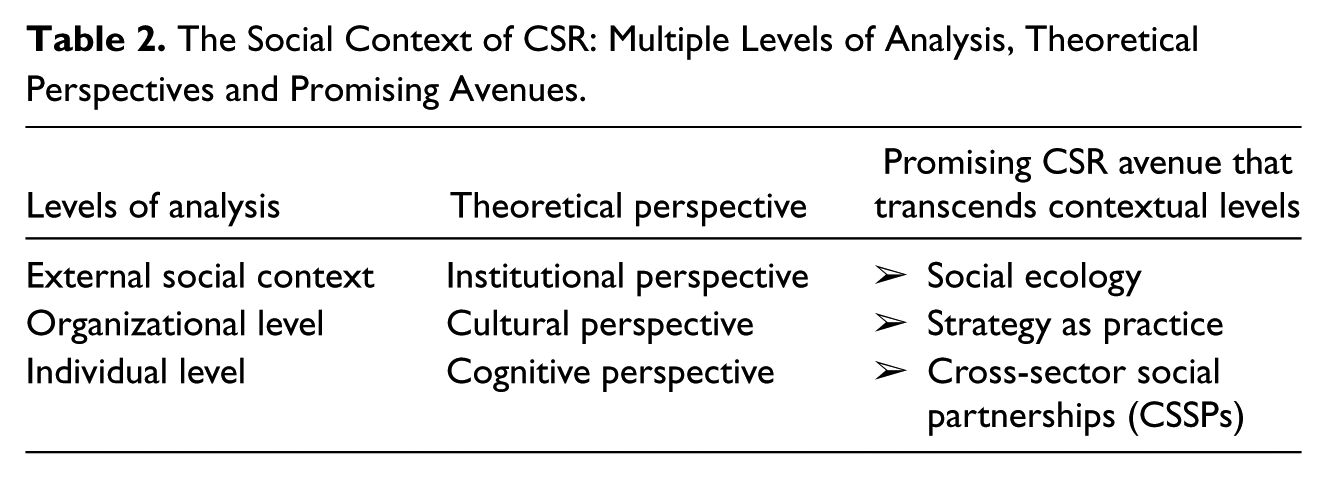
The Social Context inCSR Studies: Three Perspectives
This section reviews three perspectives on the social context (institutional, cultural, and cognitive), which were selected as representative of three social contextual levels (external, organizational, and individual respectively). For each perspective a description of its theoretical underpinnings is followed by a review of its role and usefulness within existing CSR studies.
External Social Context and CSR Studies: The Institutional Perspective
Although there are several variants of institutional theory in organization studies, the two hallmarks of institutional thinking are isomorphism and determinism.
Over time organizations tend to become isomorphic, following a set of “rationalized institutional rules” which function as myths that “organizations incorporate, gaining legitimacy, resources, stability, and enhanced survival prospects” (Meyer & Rowan, 1977, pp. 340-341; see also Di Maggio & Powell, 1983). Through rational decisions, organizational actors build around themselves an environment which constrains their ability for change. Rational actors in the same field use or are subject to one of three isomorphic mechanisms to secure adequate performance and legitimacy: coercive, mimetic, and normative (Meyer & Rowan, 1977, pp. 340-341).
Regarding environmental determinism, early institutional theory acknowledged that despite strong environmental influences, organizational leadership could influence the institutional context (Meyer & Rowan, 1977, pp. 347-348). Later, the “new” institutionalism (Di Maggio & Powell, 1983; Greenwood & Hinings, 1996) pushed the environment’s deterministic power, focusing on macro-contextual issues and aggregate measures at the expense of situated analysis or intraorganizational issues. “New institutionalists tend to emphasize the global diffusion of practices and the adoption of these by organizations, but pay little attention to how such practices are interpreted or ‘translated’ as they travel around the world” (Tempel & Walgenbach, 2007, p. 2). These approaches suggest that because the environment “selects” certain features and behaviors as adaptive to a given situation at hand, organizations in the same field tend to converge to institutionally derived and created templates of organizing rather than express the “uniqueness of individual organizational cultures” (Greenwood & Hinings, 1996, p. 1026).
A recent development in institutional theory is institutional change and entrepreneurship (IC&E; see Hargrave & Van de Ven, 2006; Maguire & Hardy, 2006; Misangyi, Weaver, & Elms, 2008; Van de Ven & Hargrave, 2004; Waddock, 2009). IC&E situates the dynamic and interactive nature of the organizational social context, virtually dormant in previous work, as central to institutional theorizing. IC&E suggests that both exogenous factors (market context and institutional “logics”) and endogenous factors (interests, values, resources, power dependencies, and capacity for action) can precipitate organizational change (Misangyi et al., 2008; see also Greenwood & Hinings, 1996). Clearly, the external environment is an important parameter shaping the social context of organizations, but intraorganizational influences, including individuals (what Waddock, 2009, calls “difference makers”), can shape the social context to such an extent that they can institutionalize new practices in a field (Maguire & Hardy, 2006). For example, organizational actors and institutions can interact to shape the social context in ways that can stimulate the emergence of new global regulatory institutions in a field such as dangerous chemicals which pose potential risks to human health and the environment (Maguire & Hardy, 2006). 1
Power also takes a higher profile in IC&E. Actors holding conflicting views confront each other in a dialectical process and “engage in political behaviors to create and change institutions” (Hargrave & Van de Ven, 2006, p. 864) through dynamic pressures that can change corporate managers’ perceptions and assumptions (Campbell, 2006, p. 935).
Institutional theory has not been applied extensively in CSR research (Husted & Allen, 2006, p. 847). Some CSR studies that use an institutional perspective focus on what CSR is (e.g., Beliveau et al., 1994), as well as why (e.g., Aguilera et al., 2007; Campbell, 2006) and how (e.g., Jennings & Zandbergen, 1995; Waddock, 2009) CSR-related practices are adopted and diffused among organizations. Others explore the contextual differences associated with institutionalizing CSR, such as cross-cultural differences (Matten & Moon, 2008).
IC&E approaches have attracted the attention of some CSR scholars. Waddock (2009, p. 36) describes CSR as a social movement driven by a group of pioneering social entrepreneurs, who lie “at the interstice between business and society, neither fully within business nor fully outside.” Campbell (2006, p. 935) observed that new management practices, such as CSR, do not emerge and become institutionalized automatically in response to functional imperatives or environmental contingencies. They are contested and involve struggle, conflict, negotiation, and the exercise of power [. . .] among contending groups that seek to influence corporate policy.
Today, proactive engagements with specific stakeholder groups seem to be becoming the norm out of the fear of consequences if potentially powerful stakeholders are not engaged in a timely manner. Shell’s 1995 encounter with Greenpeace over the disposition of the Brent Spar oil rig (see Heslin & Ochoa, 2008) is a good example of faulty stakeholder engagement. Proactive engagements are supported by Porter and Kramer’s (2011) call for repurposing the corporation, as discussed above, following from Post et al.’s (2002) call for a strong stakeholder-oriented approach to management. From an institutional perspective this trend centers around the corporation’s pursuit of legitimacy, which depends on its ability to meet its stakeholders’ expectations for responsibly created wealth.
Overall, institutional perspectives offer a helpful theoretical foundation for research into stakeholder engagement models which emphasize the environment-organization fit, and for extending understanding of the macro-influences driving CSR practices. However, institutional perspectives underplay the micro-aspects of the social context, such as the influence of individual attitudes toward CSR. Institutional perspectives also tend to regard companies’ decisions regarding CSR as externally “determined,” in that the environment selects for stakeholder engagements that are “adaptive.” Yet, in practice, organizations and their stakeholders clearly have some discretion in shaping these engagements, such as working voluntarily towards win-win solutions.
Organizational-Level Social Contextand CSR Studies: The Cultural Perspective
Organizational culture is “a set of shared mental assumptions” and beliefs which are “largely tacit” (Ravasi & Schultz, 2006, p. 437) and constitutes a “social or normative glue that holds the organization together” (Smircich, 1983, p. 344). Culture embodies and is the carrier of organizational values, and can strongly influence an organization’s “moral character” (De George, 1990, p. 103; Paine, 1994, p. 109). Different subcultures and cultural groupings may coexist within an organization, produced by and generating fault-lines that may be functional or dysfunctional for organizational performance (Sackmann, 1991).
According to the cultural perspective in organization studies (Allaire & Firsirotu, 1984; Hampden-Turner & Trompenaars, 2000; Hatch, 1993; Hatch & Schultz, 2002; Hofstede, 1983; Martin, 1992; Ravasi & Schultz, 2006; Schein, 1984, 1996, 2004), culture represents the “symbolic context within which interpretations of organizational identity are formed and intentions to influence organizational image are formulated” (Hatch & Schultz, 1997, p. 360). Organizational culture impacts significantly on the way individuals make sense of what happens inside and outside the organization (Hatch & Schultz, 1997, p. 363), “guid[ing] interpretation and action in organizations by defining appropriate behavior for various situations” (Ravasi & Schultz, 2006, p. 437). Culture also serves as “a platform for sensegiving by providing organizational members with a range of cues for reinterpreting and reevaluating the defining attributes of the organization through a retrospective rationalization of the past” (Ravasi & Schultz, 2006, p. 451). Sensegiving is further discussed in the next section.
Culture is an elusive concept, difficult to clearly identify, define or measure in practice. In organizational research it can be treated as a “black box” deployed to explain tacit and hard to describe aspects of the organizational social context. The cultural perspective tends to have a “micro focus” with a consensus in norms, values and orientations assumed among everyone in the organization (Alvesson, 1987, p. 8; but see Martin, 1992). In this way the cultural perspective tends to downplay other important aspects of organizational life, such as an organization’s interaction with its external environment, internal subcultural conflict, and shifting cultural viewpoints (Martin, 1992).
A number of studies explore CSR and its implementation in relation to organizational cultures (e.g., Antal, Dierkes, & Hahner, 1997; Armenakis & Wigand, 2010; Collier & Esteban, 2007; Jones, Felps, & Bigley, 2007; Maon, Lindgreen, & Swaen, 2010). 2 Organizational values and ethics play important roles in CSR practice. Collier and Esteban (2007) found that employee motivation and commitment to CSR depends on the organization’s ethical climate and culture, the extent that CSR is implemented based on compliance versus values, and whether CSR is seen as integral to the business or as an add-on. Similarly, CSR can become strategic if leaders weave CSR into the fabric of corporate culture by clearly expressing their commitment to the company’s CSR initiatives (Heslin & Ochoa, 2008, p. 141).
Corporate culture has also been employed in CSR studies regarding how a company approaches its stakeholders. Companies adopt different kinds of “corporate stakeholder cultures” depending on management’s ethical stance; those cultures appear to condition how stakeholder engagement decisions are made (Jones et al., 2007). Similarly, Maon et al. (2010) integrate moral, cultural and strategic aspects in a CSR development process that moves through distinct cultural phases.
The cultural perspective can be useful in CSR research because it acknowledges that managerial mindsets vary partly due to cultural influences; hence, CSR may be understood and enacted differently across different social contexts, including national cultures. This element is largely missing from other social context perspectives in organization studies. Therefore, how individuals make sense of the need for CSR (and consequently how they give sense to it), and how they craft CSR projects and programs, can be expected to be unique to each organization because of its unique culture and configuration of subcultures. However, the “black box” tendency of culture research could lead researchers to relegate all the tacit and immeasurable aspects of CSR—indeed, any other influence such as organizational politics—to opaque “cultural elements.”
Individual-Level Social Contextand CSR Studies: The Cognitive Perspective
The cognitive perspective (Argyris & Schon, 1978; Gioia & Chittipeddi, 1991; Gioia & Thomas, 1996; Maitlis, 2005; Maitlis & Lawrence, 2007; Thomas, Shankster, & Mathieu, 1994; Weick, 1982; Weick, Sutcliffe, & Obstfeld, 2005) sees organizations as “interpretation systems” (Daft & Weick, 1984, p. 284) where an ongoing struggle for sensemaking and learning takes place. In the cognitive perspective the manager’s role “is not to do the operational work of the organization [but rather] to interpret” (Daft & Weick, 1984, p. 294). In this perspective the organizational context is the product of a “concerted meshing of individual images of self and others, of one’s own activity in the context of collective interaction” (Argyris & Schon, 1978, p. 16) in a continual learning process (Daft & Weick, 1984). This “interpretive environment” (Thomas et al., 1994, p. 1253) functions as a social context for negotiating the meanings that underpin decisions and actions.
Those actors introducing an organizational change first make sense of it for themselves (“sensemaking”) and then for others, supplying a “workable interpretation to those affected” by the new actions (“sensegiving”; Gioia & Chittipeddi, 1991, p. 443; see also Maitlis, 2005; Maitlis & Lawrence, 2007). The notion of sensegiving offers a dynamic and interactive representation of the social context beyond an organization’s boundaries. For instance, Maitlis (2005) found that sensegiving efforts between organizational leaders and external stakeholders combine to shape the processes and outcomes of organizational sensemaking (see also Maitlis & Lawrence, 2007).
A valuable contribution of the cognitive perspective is that personal cognition shapes the social context at the individual level, with potential trickle-up effects at the organizational level and even externally. However, individual cognition is influenced by the social context within which it occurs. For instance, an individual’s understanding of context may be shaped by one’s “community of practice” (Wenger, 1996, 1997; Wenger & Snyder, 2000). Hence, the cognitive perspective stresses the contingent nature of the social context, situating it as the product of top-down and bottom-up, inward and outward exchanges of interpretations and understandings, which then impact on organizational practices.
As discussed earlier, CSR may be defined as a set of voluntarily adopted obligations (Jones, 1980; Jones et al., 2002). Sensemaking of the social context is important here, because leaders must determine, perhaps in negotiation with stakeholders, what these obligations are and towards which stakeholders. Thus, it is no surprise that the sensemaking perspective has been strongly represented in recent CSR studies (see Athanasopoulou, 2007; Basu & Palazzo, 2008; Collier & Esteban, 2007; Cramer, Jonker, & van der Heijden, 2004; Cramer, van der Heijden, & Jonker, 2006; De Wit, Wade, & Schouten, 2006; Maon et al., 2008; Margolis & Walsh, 2003; Morsing & Schultz, 2006; Pater & van Lierop, 2006; Schouten & Remme, 2006; van der Heijden, Driessen, & Cramer, 2010). Sensemaking helps CSR scholars to understand firms’ responses to social issues and their consequences, both for the firm and the society (Cramer et al., 2004; Margolis & Walsh, 2003; see also Pater & van Lierop, 2006). Hence, CSR research from a sensemaking perspective focuses on various issues relating to both internal and external dynamics, including how CSR sensemaking happens within organizations (see Athanasopoulou, 2007; De Wit et al., 2006) and what its consequences are likely to be (Cramer et al., 2004). Other issues include the role of managerial perceptions on CSR development (Athanasopoulou, 2007; Maon et al., 2008), the impact of sensemaking on employee buy-in to CSR (Collier & Esteban, 2007), and the organization’s sensemaking and sensegiving dynamics with its stakeholders (Morsing & Schultz, 2006; Pater & van Lierop, 2006; Schouten & Remme, 2006).
A key strength of the cognitive perspective in CSR research is in highlighting how organizations and their employees make sense of organizational phenomena. A better understanding of the sensemaking/sensegiving processes within an organization is useful because the complexity of CSR stems partly from people making sense of it in different ways. Moreover, empirical work indicates that managers in certain job functions (Maon et al., 2008) or hierarchical levels (Athanasopoulou, 2007) tend to make sense of CSR in a similar way. This inevitably affects their orientation toward the kinds of CSR programs and projects to implement. The concept of sensegiving adds an important new angle to CSR inquiry, focusing on how an organization transmits a particular image of CSR to its stakeholders and vice versa. The notion that an organization and its external stakeholders interact in terms of sensemaking and sensegiving opens up inquiry into the external and internal rationales associated with a company’s CSR engagements. Also, communities of practice may be a useful construct for studying how CSR knowledge is diffused within and across organizations.
Due to space limitations, the above assessment of three key social context theories is necessarily brief and provides only a sketch of what each represents and may contribute to the CSR agenda. In the next section the authors discuss using these sketches in an attempt to enrich CSR theorizing.
Enriching CSR Research WithMultiple Perspectives and Levels
Based on the analysis above this section derives several implications for how the CSR field can benefit from more integration and use of multiple perspectives and from more consideration of the multiple levels of the social context within which CSR occurs.
First, the organizational social context is not independent of CSR practices. Consistent with the open-system premise mentioned earlier, context and corporate practice are in a reciprocal, mutually influencing relationship. Thus, the social context is a critical determinant of organizational success, in that it helps to identify which stakeholders to respond to and which concerns to address, and thus helps to shape an organization’s CSR program. Conversely, CSR practices can influence the social context within which they are implemented via an organization’s relations with its stakeholders and their influence on macro trends. For example, Heslin and Ochoa (2008,p. 128) identified five “key drivers of business prosperity,” which can be positively affected by CSR initiatives.
Second, CSR is fundamentally an organization-level phenomenon or process. Nevertheless, social contextual influences on an organization’s CSR may originate from individuals or interest groups within an organization, from other organizations, from external stakeholders, or from macro-level institutional forces. Because of the embeddedness of organizational behavior (Granovetter, 1985), the linkages between contextual levels must be taken into account. For instance, the recent calls for business and society to connect in ways that can better produce “shared value” may lead corporations toward fundamental redefinitions of their purpose (Porter & Kramer, 2011).
Thus, in response to this study’s first research question, the analysis suggests that
Proposition 1: CSR researchers can take more deliberate account of the organizational social context by incorporating in their studies multiple levels of social context and their interrelations.
Third, the social contexts within which CSR practices unfold are too complex to be contained in a single theoretical perspective. Some perspectives share certain similarities with others and may partially overlap in their treatment of the social context. For example, both the cognitive and cultural perspectives acknowledge the existence of multiple and (inter)subjective interpretations of the social context, but they use different mechanisms—sensemaking/giving in the cognitive perspective and socialization in the cultural perspective. In contrast, the institutional perspective implies that organizations and their employees are constrained by environmental imperatives in developing CSR practices, but employees are also embedded in and driven by cultural and cognitive milieux. Essentially, these three perspectives do not have clear-cut boundaries from each other. This reflects the fact that the parent schools in organization studies are not conceptually distinct in how they treat the social context.
Fourth, the different ways whereby each perspective informs CSR research and practice matter because of how they treat CSR and the social context—often myopically. The institutional perspective addresses primarily the external social context whereas the cognitive perspective addresses primarily the internal social context. As discussed above, some recent developments in both schools, IC&E in institutional theory and sensegiving in the cognitive approach, seek to escape from these silos and have begun to look inwards and outwards respectively (Maguire & Hardy, 2006; Maitlis, 2005; Maitlis & Lawrence, 2007; Waddock, 2009). The cultural perspective, the most widely used social context lens in CSR research, bridges between the internal and external social contexts. These perspectives are not isolated from each other when deployed in practice, but the assessment above shows that CSR research studies tend to treat them that way. Hence, combining two or more of them in the same study might allow researchers to develop more comprehensive frameworks.
Thus, in response to this study’s second research question, the analysis suggests that
Proposition 2: Combinations of social context perspectives can enhance understanding of CSR practices by tapping into the different phenomena they focus on and offering researchers different facets of the social context for use in CSR studies.
Examples of Combinations
There are several possible combinations. Some have been prefigured in CSR literature dating back to the mid 1990s. For instance, in institutional theory one finds examples of CSR studies that combine institutionalism with a variety of other perspectives (or suggest to do so in future research); see some indicative studies in Table 3. These actual multiperspective studies and calls for them invite CSR researchers to open their conceptual lenses wider and develop complementarities among the various social context perspectives, rather than assume they must be used independently.
Multiperspective CSR Studies on the Organizational Social Context: Examples Using Institutional Theories.
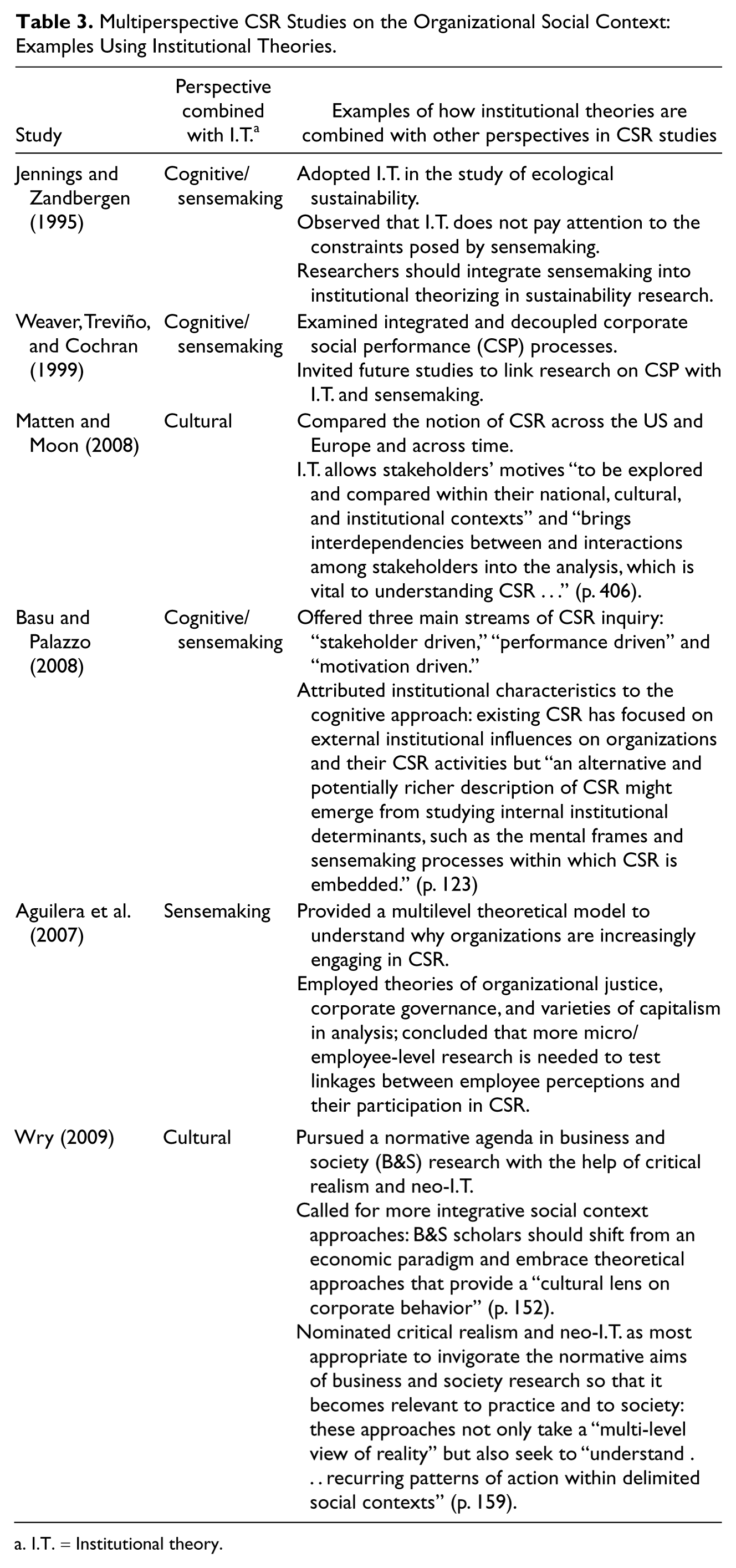
I.T. = Institutional theory.
Although some studies shown in Table 3 have combined multiple perspectives, the authors call for CSR studies which combine both multiperspective and multilevel studies, as in the following two examples.
One such approach is institutional change and entrepreneurship, discussed above. IC&E stems from neo-institutional theory, which takes a “multi-level view of reality that recognizes the complex roots of firm behavior and provide[s] tools for its investigation” (Wry, 2009, p. 159)., IC&E emphasizes the dynamic nature of the social context and acknowledges that social contextual levels influence one another. Recognizing that organization-level (Maguire & Hardy, 2006) or individual-level (Misangyi et al., 2008; Waddock, 2009) influences can effect field-level change can lead to a powerful CSR research perspective. It allows treating the social context as a unique product of changes initiated by individuals (e.g., institutional entrepreneurs or organizational employees) and/or actors at higher levels (e.g., whole organizations, populations or networks of actors in an interorganizational field) (see Hargrave & Van de Ven, 2006; Van de Ven & Hargrave, 2004). For instance, unexpected events such as the recent financial crisis can affect all levels of the social context of organizations: An economic downturn (external social context) may lead to societal austerity measures. Those measures may affect the amount of resources that organizations in that society have available to invest in CSR projects (organization level of the social context). This result, in turn, may affect the individual level of the social context, such as managers’ decisions about which CSR activities can be undertaken, who will be involved in implementing the CSR initiatives that survive, etc.
Equally important is the ability of IC&E to provide room for integrating multiple perspectives in examining the social context of CSR implementation. For example, in assigning more prominence to the role of power than earlier institutional theory (see Campbell, 2006; Hargrave & Van de Ven, 2006), IC&E invite a more political perspective on the organizational social context. This political perspective is important, given the asymmetrical power dynamics that often occur in CSR engagements between large companies and their stakeholders (see Hardy & Phillips, 1998; Parker & Selsky, 2004) and the potential for institutional entrepreneurs to bring about positive social change (see Laasonen, Fougère, & Kourula, 2012; Maguire, Hardy, & Lawrence, 2004; Maguire & Hardy, 2006). Focusing on the social-entrepreneurial “difference makers” who develop new institutions that push the CSR agenda may generate fresh insights into CSR as a social movement (Waddock, 2009). IC&E might be combined with cognitive perspectives to study how novel sensemaking by difference makers in a field may undermine the field’s established organizational routines and practices. Thus, IC&E offers the opportunity to explore how individuals are able to shape cognitions about CSR programs and strategies, alter institutional rules and launch CSR-relevant changes at organizational and institutional levels.
A second approach to combine multiple perspectives and levels in CSR studies draws from sensemaking and sensegiving in the cognitive perspective. Most CSR sensemaking research has focused more on what happens within the organization and less on the sensemaking interactions between organizations and their external environments. In the latter category CSR practices are understood as the product of companies’ sensemaking and sensegiving negotiations with stakeholders rather than as corporate courses of action disjointed from stakeholder expectations. Instead of informing and responding to stakeholders, increasingly management needs to curry stakeholders’ active involvement in the firm’s CSR agenda (Morsing & Schultz, 2006) and think in terms of continual joint sensemaking and sensegiving (Morsing & Schultz, 2006; Pater & van Lierop, 2006; Schouten & Remme, 2006). This interactive understanding of the CSR social context points the way to extend Basu and Palazzo’s process model of CSR sensemaking, which is structured only around “how managers think, discuss, and act with respect to their key stakeholders and the world at large” (Basu & Palazzo, 2008, p. 122), and does not consider how stakeholders’ sensemaking and sensegiving may affect managers’ CSR practices.
When CSR is examined as an interactive sensemaking process, it opens space for a more multilevel approach to CSR. Such an approach could involve exploring the sensemaking links and interactions among the individual, organizational and external stakeholder levels, in that some external stakeholders are likely to be institution-level actors. The reader should see Selsky and Parker’s (2010) notion of cognitive platforms discussed in the next section. Moreover, broadening the scope of CSR sensemaking and sensegiving invites researchers to combine social contextual perspectives. For instance Maon et al. (2008) combined systems thinking with interpretative theories to clarify the underlying processes associated with the emergence, prioritization and integration of CSR issues into organizational goals. Moreover, as discussed above, several CSR studies that adopt the institutional perspective incorporate cognitive considerations in their analysis (see Table 3).
Next, the authors propose three promising avenues for incorporating the organizational social context more fully in CSR research.
Three Promising Avenues for Context-Sensitive CSR Research
This section offers three promising areas of future CSR research using approaches which have not yet been extensively employed. Based on the analysis above, any new avenue for more context-responsive CSR research should ascribe to an open-systems premise, be capable of handling CSR as a cross-level phenomenon, and allow for the combination of different social context perspectives. Three approaches are offered that may be able to meet these criteria: social ecology has hardly been used in the CSR field; cross-sector social partnerships are an application area of growing importance for CSR; and strategy-as-practice holds promise for studying strategic CSR.
Social Ecology
CSR proponents have long embraced the interdependence between organizations and their environments. For example, corporations and the community were understood in “ecological terms” (Eells, 1962, p. 233), with corporations seen as “social organisms” likened to biological organisms (Boulding, 1953, p. xix). Although early CSR research hardly explored this interdependence, the CSR field is grounded in this open-system premise, as noted earlier. This premise can become more explicit in CSR research through a social ecology lens.
Social ecology is a field in organization studies grounded in open systems theory and designed and developed as a multilevel framework (Emery, 1999; Emery & Trist, 1965, 1973; Selsky, Goes, & Babüroğlu, 2007; Trist, 1983). This research avenue focuses on the mutual relations between organizations and environments at three levels: individual (sociopsychological); work group and intraorganizational (sociotechnical); and system-in-environment (socioecological; Trist & Murray, 1990).
Two distinctive features of the social ecology school are relevant. First, Emery and Trist (1965) offered a typology of four ideal-typical “causal textures” of organizational environments. The fourth type, the “turbulent field environment,” is characterized by high complexity and little stability, creating “high relevant uncertainty” in entire fields of organizations. Second, social ecology clearly distinguishes between transactional and contextual environments. The transactional environment refers to the competitive and collaborative relations of an organization with others in its immediate environment, and is constituted by the actions of the actors within it. The contextual environment consists of aggregate, “macro” forces and factors acting on entire fields of organizations, which cannot be influenced directly by individual actors (Ramirez, Selsky, & van der Heijden, 2010). “In socioecological thinking, the choices are about how to shape a shared context in order to influence the conditions that can stabilize or destabilize wider fields of action” (Selsky et al., 2007, p. 89). Values that have an “overriding significance for all members of the field” can provide the foundation for the collaborative endeavors that are needed to shape that shared context and thereby cope with the turbulent environment (Emery & Trist, 1965). CSR may be such a value; Zenisek (1979, pp. 363-364) argued that it can transform the environment to a new, “no longer turbulent and relatively static” state.
The notion of turbulence in the contextual environments of organizations offers a useful approach for understanding CSR and its implementation. Through a social ecology lens one may explore the macro-factors and the micro-aspects associated with CSR practice, thus encompassing the various levels of the social context. A socioecological analysis often entails a reversal of “figure” and “ground” such that the focal organization is downplayed and wider fields of action and their dynamics come into focus. Such an approach helps us to see CSR as a dynamic organizational phenomenon, the product of complex interactions and negotiations among an organization, its changing environments and the wider field of action which envelops all of them.
Social ecology can treat CSR as a way of bridging the stakeholder-organization gap and highlight how organizations and stakeholders can work together to forge a more stable common ground. For example, in a comparative case study the first author used a social ecology approach to examine the role of CSR as a means of stabilizing turbulent environments encountered by two multinational organizations, a multifunction utility and a tobacco company (Athanasopoulou, 2010). This study found that the extent of environmental stabilization depended on how CSR was implemented: CSR contributed to the stabilization of the transactional and contextual environments of the tobacco company, where CSR was integral to its day-to-day business practice. But CSR contributed to destabilizing the transactional environment of the utility, which treated CSR on a project basis only.
The social ecology avenue is capable of combining aspects of the three perspectives (i.e., institutional, cultural, and cognitive) at the three levels discussed above to provide a multilevel and multiperspective representation of the social context. At the external level, social ecology uses the notions of transactional and contextual environments to specify an organization’s links with its external environment (e.g., the stakeholders given attention by a CSR project). Particularly, the recognition of a contextual environment with distinctive dynamics is consistent with the core premises of institutional theory. At the organizational level, social ecology focuses on the social and technical imperatives driving an organization’s behavior, and the tensions arising between those imperatives. Arguably, those imperatives and tensions are worked out in part through an organization’s culture, and then get manifested in the organization’s choices to engage in certain kinds of CSR. At the individual level, social ecology views people’s actions as the product of deep psychodynamic forces that reflect uncertainties in their environments, and explores how actors come to terms with those uncertainties (e.g., individuals’ role and attitudes in the CSR implementation process).
Cognitive Platforms for Cross-Sector Social Partnerships
Cross-sector social partnerships (CSSPs; see Kolk, Dolen, & Vock, 2010; Seitanidi & Crane, 2009; Selsky & Parker, 2005, 2010) are a second promising avenue for CSR research, particularly the concept of cognitive platforms associated with them. CSSPs are project-based collaborative engagements between companies and governments or NGOs. They are an evident application area for CSR (see Seitanidi, & Crane, 2009, p. 414) which respond to the need for multilevel research since they can produce benefits at multiple levels (Selsky & Parker, 2010). Cognitive platforms are “prospective sensemaking devices that help [CSSP] project managers make sense of partnerships by calling attention to certain desired features or downplaying other features” (Selsky & Parker, 2010, p. 21). CSR project managers have a particular platform in mind when they negotiate and implement a CSR project with a stakeholder. For example, a CSR project manager holding a resource-dependence platform would be trying to meet an organizational goal or solve an organizational problem through the partnership. A CSR project manager with a social-issue platform would focus on responding to a social need or promoting a social cause shared by a local partner. A CSR project manager with a societal-sector platform would focus on reconfiguring some part of the social structure that created a social problem that is troubling the company, and/or taking on new sectoral roles (Selsky & Parker, 2010, pp. 26-29). Whether a social partnership is considered successful depends partly on the cognitive platform(s) held by project managers and their stakeholders.
The notion of cognitive platforms can be applied beyond CSSPs to any CSR initiative. The common thread among these platforms is that they concern how resources and efforts are deployed in response to CSR goals. Therefore, as an application area of CSR, CSSPs and the construct of cognitive platforms are able to incorporate multiple levels of analysis. CSSP studies often dwell at the macro or meso levels and assess effectiveness in terms of societal and/or organizational impacts. Yet CSSPs also involve individual interactions among managers in the organizations participating in the partnership project (Kolk et al., 2010, p. 123), and cognitive platforms offer a micro focus. CSSPs and cognitive platforms may be a promising avenue for CSR research because they can embrace the multilevel impact of individual interactions. “[P]artnership effects may ‘trickle down’ (e.g., from management to employees), or ‘trickle up’ (from employees to management) or ‘trickle round’ (e.g., between employees)” (Kolk et al., 2010, p. 123).
Research on CSSPs and cognitive platforms can also be an important new avenue for multiperspective CSR research. Although examination of the cognitive platforms held by managers in CSSPs is clearly aligned with the cognitive perspective, CSSPs also have a strong institutional character since they are about collaborations across sectors. Seitanidi and Crane (2009, pp. 422) link the institutional with the individual level suggesting that “when individuals develop a personal relationship of trust within the partnership then the level of embeddedness of the relationship becomes more evident.” Moreover, CSSPs and cognitive platforms also have a cultural character. When companies engage in social partnerships with nonprofits, an “emergent culture” develops from the continuous negotiation of a workable set of cultural practices among the partnership participants (Parker & Selsky, 2004). This process of negotiation is filtered by the cognitive platforms of the parties involved. Therefore, CSR research that focuses on CSSPs and/or the associated cognitive platforms has institutional, cultural and individual implications.
Strategy-as-Practice
A third promising avenue for more context-sensitive CSR research, which has not yet been employed by the CSR field, is strategy-as-practice. This research avenue concerns the micro-dynamics relating to strategizing (see Jarzabkowski & Spee, 2009; Johnson, Mehn, & Whittington, 2003; Kornberger & Clegg, 2011; Whittington, 1996, 2006) and is much needed because the CSR field tends not to adequately focus on the micro-level. According to Aguinis and Glavas (2012), only 4% of the CSR articles in highly influential journals focus on the individual level of analysis.
In this research avenue, strategy is understood as an ongoing activity which involves micro-processes of strategizing including interactions in strategy meetings, workshops, conversations, and so forth (Kornberger & Clegg, 2011, p. 137). Strategy-as-practice research “sees the practice of management as being embedded, interrelated, entangled and institutionalized within broader business activities and situations” (Elms, Brammer, Harris, & Phillips, 2010, p. 410; see also Jarzabkowski & Spee, 2009). Thus, the strategy-as-practice avenue allows for both multiple levels and multiple perspectives in research frameworks, and also acknowledges the interrelation of levels and perspectives. Jarzabkowski and Spee (2009, p. 71) note there is a growing attempt in strategy-as-practice research to make connections between the micro-phenomena usually examined and macro-phenomena. Those authors produced a framework of nine domains of possible strategy-as-practice research based on different combinations of strategy praxis happening at multiple levels (micro, meso, and macro-praxis) and strategy practitioners (individual actor within the organization, aggregate actor within the organization, and extraorganizational aggregate actor; see also Whittington, 2006).
Besides the potential that strategy-as-practice offers for multilevel CSR research, it also serves as a promising avenue for CSR research that combines multiple perspectives. The strategy-as-practice avenue has implications not just at the level of the individual strategy practitioner but also at the institutional level (Elms et al., 2010). Strategy-as-practice also relates to the cultural perspective because the CSR strategies an organization chooses to implement are also influenced and defined by the organization’s culture. Finally, this research avenue relates to the cognitive perspective because the way strategy is practiced depends upon how organizational actors make sense of the situations for which CSR strategies are designed and implemented (e.g., which stakeholders are more important, which social issues to focus on, etc.).
Although strategy-as-practice is grounded in the micro dynamics of individual organizational actors, their practices have direct impact on the overall organization and its operations vis-à-vis its external environment. In other words, strategy-as-practice integrates the individual with the organizational with the external social context of the organization in different ways by acknowledging that strategic action occurs not only as a result of individuals’ practice but also that of aggregate actors within and outside the organization. Conversely, impacts of strategic action can be at multiple levels. Thus, strategy-as-practice can be used to develop multilevel CSR research, and the authors invite future research on how CSR strategizing is practiced at the individual and aggregate-actor levels and how this shapes an organization’s CSR profile and relations with its stakeholders.
Although strategy-as-practice has not yet attracted the attention of CSR researchers, it is starting to emerge as a promising way to study the relationship between ethics and strategy: “future research in strategy and ethics that takes a great interest in the situational and individual factors that underpin strategy decision-making is likely to generate significant impact” (Elms et al., 2010, p. 410).
In summary, social ecology, CSSPs/cognitive platforms and strategy-as-practice are offered as research avenues that can lead to richer and more context-sensitive CSR research. Each of these three perspectives allows researchers to focus not only on aggregate but also individual action and to explore both the external and internal influences on CSR practice. The authors address practical implications in the Conclusion.
Conclusion
CSR knowledge is in a “continuing state of emergence” (Lockett, Moon, & Visser, 2006, p. 133) with new frameworks and methods constantly being proposed. This article has contributed to that progress by trying to raise the profile of the organizational social context in CSR studies. The CSR field recently has begun to incorporate more social-context intensive research, drawing upon organization studies’ rich pool of social context theorizing. Yet more needs to be done. The authors have offered a path forward by suggesting how the conceptual lenses used in CSR studies might be broadened.
This study makes three contributions. First, it demonstrates how different theoretical perspectives on social context are useful in illuminating certain facets of CSR practices. Any particular perspective might enhance understanding of the organizational reality of CSR in some way, although each has limitations. Three theoretical perspectives were linked to three levels of the social context. The authors emphasized that CSR cannot be studied effectively within conceptual silos. The examples of IC&E and sensemaking/sensegiving show that many social context theories in organization studies offer the opportunity to researchers to conduct more context-sensitive, multilevel, multiperspective CSR studies. The three perspectives examined were situated as representative of schools at a particular social contextual level. Similar analyses might be undertaken with other perspectives.
The authors also identified three approaches which have not yet been employed in CSR studies as promising avenues for CSR research. The authors believe these approaches harbor good potential to change the way CSR is practiced and understood. For example, social ecology captures the mutual influence between organizations and their environments. That is, organizations initiate, design, develop, implement and continually adjust their CSR programs according to needs and expectations in the environment in concert with their own capabilities. In a world where business and society are trying to find accommodation within a turbulent environment of changing societal expectations, it is important for CSR scholars to acknowledge this interaction of contexts in order to develop more sophisticated ways of capturing the complex organizational reality of CSR. It is also important for CSR practitioners to recognize the interaction of contexts as they face the challenge of making their organization’s CSR efforts more effective and more responsive to stakeholders’ and society’s expectations. The social ecology perspective builds on institutional approaches and especially IC&E because it highlights the ongoing meshing or aligning needed among key stakeholders, institutions and organizations that can lead to positive social change.
At a smaller scale, this ongoing alignment process also affects cross-sector social partnerships. Research on CSSPs suggests that the future of CSR lies not in simply engaging with stakeholders, but in making stakeholders partners in a new social reality that requires intersectoral collaboration towards common goals in order to create shared value between business and society (Porter & Kramer, 2011). If institutional entrepreneurs and CSR project managers consider alternative cognitive platforms in their engagements, they may find new ways by which business and society can stand side by side instead of facing each other in confrontation. The strategy-as-practice avenue emphasizes the important role of the micro-processes associated with CSR strategizing and implementation. This avenue builds on the cognitive perspective, in that CSR strategizing is based on how the relevant decision makers make sense of the societal challenges they face and how they use their sensemaking capabilities to address those challenges.
Second, the study demonstrates how CSR scholarship can be enriched through multiperspective and multilevel research, drawing on the existing rich pool of knowledge in the parent discipline of organization studies. The need for multilevel and multiperspective research is now stressed in the CSR literature (see Aguilera et al., 2007; Maon et al., 2010; Wood, 2010). For instance, Wood (2010, p. 76) concludes her updated review of corporate social performance by urging scholars to pursue more interdisciplinary research, “accommodat[ing] the best ideas, methods and results” from a wide array of other domains and disciplines, including organizational behavior, strategy, stakeholder theory, business ethics, and many others. The present article responds to this call by showing how different theoretical lenses could be used by CSR scholars and why this would benefit the CSR field.
Relatedly, the third contribution lies in demonstrating how assembling multiple social context perspectives in more integrative frameworks might elicit more well-rounded understandings of the CSR process and thereby help advance the field. In this regard three possible avenues for future research were proposed, and it was suggested that these avenues might lead to the discovery of new aspects of CSR implementation that have so far remained latent and/or underresearched. Each avenue offers new frameworks and mechanisms for examining CSR practices with more sensitivity to context. In order to showcase the ability of the three avenues for multiperspective research the authors indicated how each of them embraces the institutional, cultural and cognitive social contextual perspectives presented earlier in the article. More generally, the combination of perspectives and levels offers the potential to open the CSR field to understanding the organizational social context as an amalgam of converging and contradictory, implicit and explicit motives and influences drawn from multiple levels and triggered by multiple sources at each level.
This study carries important practical implications. For instance, the authors’ call for more context-sensitive, multilevel and multiperspective CSR research can be directed at encouraging managers with CSR agendas to understand how changes at one social contextual level can have ripple effects at other levels. The three promising avenues might also help managers to learn how to shape the social context so as to improve the quality of CSR implementation or at least identify ways to adjust their CSR practices to the prevailing social contextual terrain. Also, future research might make use of multiple perspectives to test which factors, studied by which perspectives, pose more pervasive influences on which kinds of CSR. This might help to locate which contextual elements influence CSR practice and identify how managers could manage them more effectively.
The analysis in this article has implications for management education. It suggests that CSR needs to be taught in a more context-sensitive way. The implementation of CSR depends on a wide array of influences and interactions of contextual levels. Today’s management students are tomorrow’s organizational leaders. During their working careers they are likely to be called upon to respond to stakeholder expectations and/or societal needs. To deal with such situations they will need to understand how their environment (external, organizational, or interpersonal) and the perspective by which it is analyzed (institutional, cultural, cognitive, or other) shapes their decisions and actions about CSR responses to such expectations and needs, and how these in turn shape the environment they will be creating for themselves, their organization and society at large. The three suggested promising avenues might be used by management educators to rethink CSR and identify new ways by which CSR can meet the challenges of a globalizing world facing a lingering financial crisis and a business world that is called upon to redefine its purpose and adjust to this new reality. This article serves as a call for more in-depth and context-intensive research in a field which has the potential to change the quality of organizational practices in meaningful ways for organizations, their stakeholders and society at large.
Footnotes
Declaration of Conflicting Interests
The author(s) declared no potential conflicts of interest with respect to the research, authorship, and/or publication of this article.
Funding
The author(s) received no financial support for the research, authorship, and/or publication of this article.
The article was accepted during the editorship of Duane Windsor.