



Abstract
This article examines the relationship between an aspect of a firm’s corporate social responsibility (CSR), corporate community programs (CCPs), and the effectiveness of its corporate political activity (CPA). Developing a conceptual model based on resource-based view of the firm, the authors argue that the mechanism linking a firm’s CCP to CPA mechanism is the effect of CCPs on the development of firm level resources. Specifically, the intensity of a firm’s CCPs enhances a firm’s human capital, organizational capital, and geographic resources, which in turn improve the effectiveness of two key aspects of CPA: information and constituency-building political strategies. This linkage of CCPs to CPA effectiveness may be particularly relevant when the firm faces unfavorable political markets.
This study explores the relationship between a firm’s corporate social responsibility (CSR) and its corporate political activity (CPA). Increasingly, scholars are suggesting different ways that CSR may be linked to CPA (Anastasiadis, 2010; Hadani & Coombes, 2012; Richter, 2011; Scherer & Palazzo, 2007, 2011; Valente & Crane, 2010; Wang & Qian, 2011). In one of the first studies to explore this linkage, Hansen and Mitchell (2000, p. 892) state that it may be “theoretically appropriate to treat [CSR] activity as a form of corporate political activity.” The link between CSR and CPA may be internally focused in terms of the firm’s strategy and organizational structure (Anastasiadis, 2010). Oliver and Holzinger (2008) argue a firm’s CSR strategies may work synergistically with its corporate political strategies, which may prove to be profitable for the firm (Richter, 2011). The link between CSR and CPA may also be externally focused in terms of the firm’s relationships with stakeholders outside of the firm. Firms practicing CSR may be able to improve relationships with external stakeholders (Googins, Mirvis, & Rochlin, 2007; Waddock & Graves, 1997), cultivate political allies (Attarça, 2005; Mattingly, 2004; Wang & Qian, 2011), and enhance the firm’s image (Navarro, 1998), each of which is expected to enhance its CPA effectiveness. Peterson and Pfitzer (2009) note that companies use CSR programs to signal to public officials that they are making a difference in the community, in turn fortifying their relationships with these same government officials.
While there is growing interest in this research area, what is largely missing from these studies is the specific mechanism that links CSR and CPA. This study aims to describe this mechanism. The study asks two related research questions concerning (a) how CSR is linked to CPA effectiveness; and (b) when it is most likely to be valuable. The answers to both of these questions center on the development of firm-level resources, which, the authors argue, are the critical linking mechanism. Specifically, the study models conceptually the effect of CSR on the creation and development of firm resources that may prove to be useful and valuable for other firm activities, such as CPA. Drawing on the theory of the resource-based view (RBV) of the firm (Barney, 1991; Peteraf, 1993; Wernerfelt, 1984), CSR may enhance elements of a firm’s human capital, organizational capital, and physical capital resources, which in turn may affect the effectiveness of the firm’s CPA. The article also examines three political market conditions that may influence the value of the linkage between a firm’s CSR and CPA. Under certain political market conditions, such as when the political environment involves an issue with concentrated costs and concentrated benefits, and thus fierce political competition (Bonardi, Hillman, & Keim, 2005), CSR is more likely to become valuable for a company’s political efforts. Another political market condition in which CSR may make it easier for a firm to mobilize politically include issues with diffused benefits and concentrated costs and issues with diffused costs and concentrated benefits. A final political market condition where CSR may improve CPA effectiveness is for election issues that are in the media spotlight (Bonardi, Hillman, & Keim, 2005).
To understand the linkages between CSR and CPA, this study looks at one aspect of a firm’s CSR initiatives: its engagement in corporate community programs (CCPs). CCPs include a firm’s philanthropic, interactive, and intensive partnerships (Austin, 2000; Mirvis & Googins, 2006; Peloza, 2006; Rondinelli & London, 2003) with nonprofit organizations, civic associations, nongovernmental organizations (NGOs), and similar organizations. Since only CCPs are considered, many CSR activities are excluded from this study such as a firm’s internal CSR programs to modify its production methods to mitigate its environmental footprint or its sourcing methods to exclude inputs that fail to meet certain human rights and/or environmental conditions (Schuler & Christmann, 2011). The reason for the authors’ restriction of attention is that CCPs are externally focused and explicitly intended to address a range of social issues, including community poverty, educational deficits, environment, and human health (Peloza & Falkenberg, 2009). CPA entails a number of strategies and tactics to influence public policy such as lobbying, testifying, writing reports on issues, making campaign contributions, conducting grassroots and grasstops activities, finding coalition partners, and others (Baumgartner et al., 2009; Hillman, Keim, & Schuler, 2004; Schuler & Rehbein, 2011). However, for this study, as described below, the authors limit inquiry to two primary political strategies: information and constituency-building strategies (Hillman & Hitt, 1999). The political impact of both of these political strategies can be enhanced by the resources produced through relationships with CCPs. Whereas, a firm’s financial incentives strategy making political contributions is less likely to benefit from these relationships and if it does it will be at a much smaller scale. Thus this article examines how a firm’s CCP enhances the effectiveness of its information and constituency-building political strategies, and the circumstances when this relationship is most likely to be valuable.
The proposed model is likely to be important to researchers and practitioners in several ways. First, scholars and practitioners of CSR may underestimate the benefits that firms accrue from their CSR programs. A great debate in the CSR literature is whether it should be pursued for public benefit or simply for a firm’s private benefit (Barnett, 2007). Our study suggests that CSR may result in additional firm-level resources that improve the effectiveness of CPA, which should lead to private benefits for the firm in excess of its private costs of political investments if favorable public policies are enacted (Hadani & Schuler, 2013). Knowledge about the CSR–CPA linkage may be useful for firms’ managers in organizing CSR for maximum political effectiveness, in addition to pursuing other CSR goals (Anastasiadis, 2010). Second, for scholars of CPA, CSR may be another tactic that should be included in the arsenal of political activities (Hansen & Mitchell, 2000). Our model highlights how CCP complements other political strategies and when CCP is expected to be most effective. Finally, this article adds to recent studies that have applied the resource-based view to better understand CPA (Bonardi, 2011; Capron & Chatain, 2008; Dahan, 2005; Oliver & Holzinger, 2008).
The article proceeds below as follows. Section 2 reviews the spillovers from CCPs to other firm activities and outcomes, including to CPA. Section 3 explains the authors’ model about the mechanism that links CCPs to CPA. The section examines the effects of different intensities of CCPs on three types of firm-level resources: human capital, organizational capital, and geographic (i.e., physical) capital. The section then explains how the firm resources created by CCPs flow to two types of a firm’s CPA: information and constituency-building strategies. In Section 4, the authors consider political marketplace conditions to discern when CCP and CPA linkages are the most politically valuable for the firm. The article concludes with a discussion of our contributions and its limitations.
Spillovers From Corporate Community Programs
The general rationale for a firm’s CCPs has been well documented in the literature (Barnett, 2007; Googins et al., 2007; Peloza & Falkenberg, 2009; Waddock & Graves, 1997). Porter and Kramer (2006) argue that CCPs can be joined with business strategies for competitive advantage. Firms using CCPs may be able to gain critical resources over those firms not using such practices (Frooman & Murrell, 2005; Peloza, 2006). Firms undertaking CCPs are more likely to build up their company’s overall goodwill and reputation (Brammer & Millington, 2005) and enhance their legitimacy in society (Yaziji, 2004), enabling them to conduct a variety of activities more efficiently and effectively than firms that do not actively engage with community groups. A firm’s CCPs may be useful in reducing a variety of risks, such as shareholder activism, boycotts of the firm’s products and services, and negative media coverage (Googins et al., 2007, p. 233).
Since community groups are embedded in social networks with other stakeholders (Jones, 1995; Mitchell, Agle, & Wood, 1997; Rowley, 1997), a firm with positive relations with one stakeholder group is likely to enjoy favor with others (Jones, Felps, & Bigley, 2007). For example, firms with CCPs and other CSR activities have been positively related to employee productivity and retention (Porter & Kramer, 2002), consumer purchases (Creyer & Ross, 1997; Peloza & Falkenberg, 2009), and attraction to social investors (Googins et al., 2007, p. 233). Conversely, firms wish to avoid negative relationships with community groups because this negative behavior might be noticed by other stakeholders who could take action against the firm (Jones et al., 2007). For example, some studies show that consumers punish socially irresponsible firms by requiring a lower price for its products (De Pelsmacker, Driesen, & Rayp, 2005).
Less attention has been paid to the interdependence between CCPs and CPA. A few studies mention the connection, but rather casually. Mattingly (2004) states that firms may cooperate with community groups to garner their support for the firm’s CPA programs. Waddock and Graves (1997) and Googins et al. (2007) claim that companies with good community relations may face less of a regulatory burden. Navarro (1998) posits that a company’s philanthropic activities create a favorable business image that may enhance its overall lobbying effectiveness although his statistical analysis did not reveal a significant relationship between philanthropy and policy outcomes (see Hadani & Coombes, 2012). Hansen and Mitchell (2000) show that a company’s charitable activity is associated with its lobbying and campaign contribution activities. What is missing from these prior studies is an explicit explanation of the mechanism for how CCPs and CPA are joined. This study proposes a model about such a linkage mechanism in the following section, which considers the intensity of the firm’s relationship with community groups via CCPs.
Intensity of CCPs on CPA: The Role of Firm Resources as the Linking Mechanism
In the proposed model, the mechanism joining CCPs and CPA revolves around the impact of CCPs on firm resources. First, firms engage in CCPs, which vary in their intensity. Second, these CCPs affect the creation of a firm’s resources, specifically, based on RBV, its human capital, organizational capital, and physical capital resources (Barney, 1991; Peteraf, 1993; Wernerfelt, 1984). The authors term physical capital as “geographic” because physical capital has a spatial location. Different intensities of CCPs are likely to affect differentially the development of these firm-level resources. Third, these firm-level resources are likely to be useful for improving the effectiveness of a firm’s CPA. Specifically, the information and constituency-building political strategies will benefit from these firm-level resources. Fourth, the characteristics of the political context will dictate when the enhanced political strategies are the most useful. Figure 1 offers a simple schematic of the expected relationships.

The relationship between corporate community programs and the effectiveness of firm political strategies.
Variation in the Intensity of Corporate Community Programs
The types of resource benefits that firms incur will depend on the intensity of their CCPs. Rondinelli and London’s (2003) framework is used to categorize the intensity of CCPs. Those authors distinguish among low, medium, and high intensity.
Occupying low intensity relationships with community groups at one end of the spectrum are companies that engage only in arm’s length relationships, such as philanthropic activities. Firms using philanthropy generally donate either money or time through employee volunteers to the community group with which it has a relationship. Many companies undertake philanthropic relationships with community groups, illustrated by Disney’s one million dollar grant to KaBoom, a NGO devoted to increasing access to playgrounds for all children, to build play spaces and gardens in 10 underserved communities (“Healthy Kids, Healthy Families!” 2010). When firms use low intensity relationships with community groups, they generally involve only a limited number of managers (i.e., a community affairs manager) in coordinating the activity with the community group’s leaders. Additionally, the relationship may be short term, such as a single event.
At the medium intensity relationships level, some firms have what Rondinelli and London (2003) call interactive collaborations with community groups. In medium intensity relationships, firms work closer with community groups than in arm’s length relationships. A good example of a medium intensity relationship is the collaboration between Unilever and the World Wide Fund for Nature (Rondinelli & London, 2003). Their collaboration led to the creation of the Maritime Stewardship Council, which certifies sustainable fisheries and enables firms like Unilever to secure a source of sustainably harvested seafood (Rondinelli & London, 2003, p. 64). Medium intensity relationships generally involve the interactions of more managers from different areas of the company than a low intensity relationship. Medium intensity relationships may also take longer to establish and to execute than low intensity relationships.
At the other end of the spectrum are firms that form high intensity relationships with community groups (Rondinelli & London, 2003, p. 65). In high intensity relationships, firms work closely with their community partners, often exchanging resources back and forth. In high intensity relationships both the firm and the community group have important CCP-related goals. This type of relationship resembles a joint venture, with the firm and its community partner working collaboratively to solve social issues. Rondinelli and London (2003) maintain that firms sometimes use high intensity relationships to address internal environmental and social management problems with its products and production processes. Starbuck’s high intensity relationship with Conservation International was used to develop a reliable and high quality source of coffee that also met social criteria and required the involvement of senior managers from many different units of Starbuck’s organization (Austin, 2000). Through this integrative interaction, Starbucks was able to learn about many of the challenges of producing high quality coffee in a socially responsible way and contribute toward a solution while continuing to purchase the high quality coffees that their customers demanded.
Linking CCP to CPA: The Role of Firm Resources
The principal insight of RBV is that the bundles and configurations of resources within a firm offer the potential for competitive advantage (Barney, 1991). RBV states that firm resources create value for their holder as they become rare and immobile, difficult to imitate, difficult to substitute, and useful for pursuing environmental opportunities or reducing threats (Peteraf, 1993). RBV also states that resources are fungible across multiple firm activities—thus a resource that confers logistical advantage (i.e., in terms of speed of delivery) may also result in marketing advantages (i.e., first-mover into marketplace) and financing advantages (i.e., lower inventory costs that need to be financed vs. competitors’ inventory levels). In this section, the authors explain how the intensity of a firm’s CCPs may affect the development of human capital, organizational capital, and geographic (physical capital) resources that might be leveraged to other activities such as CPA. Table 1 summarizes how the intensity of a firm’s CCPs affects a corporation’s human capital, organizational capital, and geographic resources and subsequently, its CPA. The rest of this section is structured in direct relationship to Table 1. The table combines the intensity spectrum from Rondinelli and London (2003) with the present authors’ distinction among human, organizational, and geographic capital resources.
Intensity Types of Community Programs and Firm Resources.
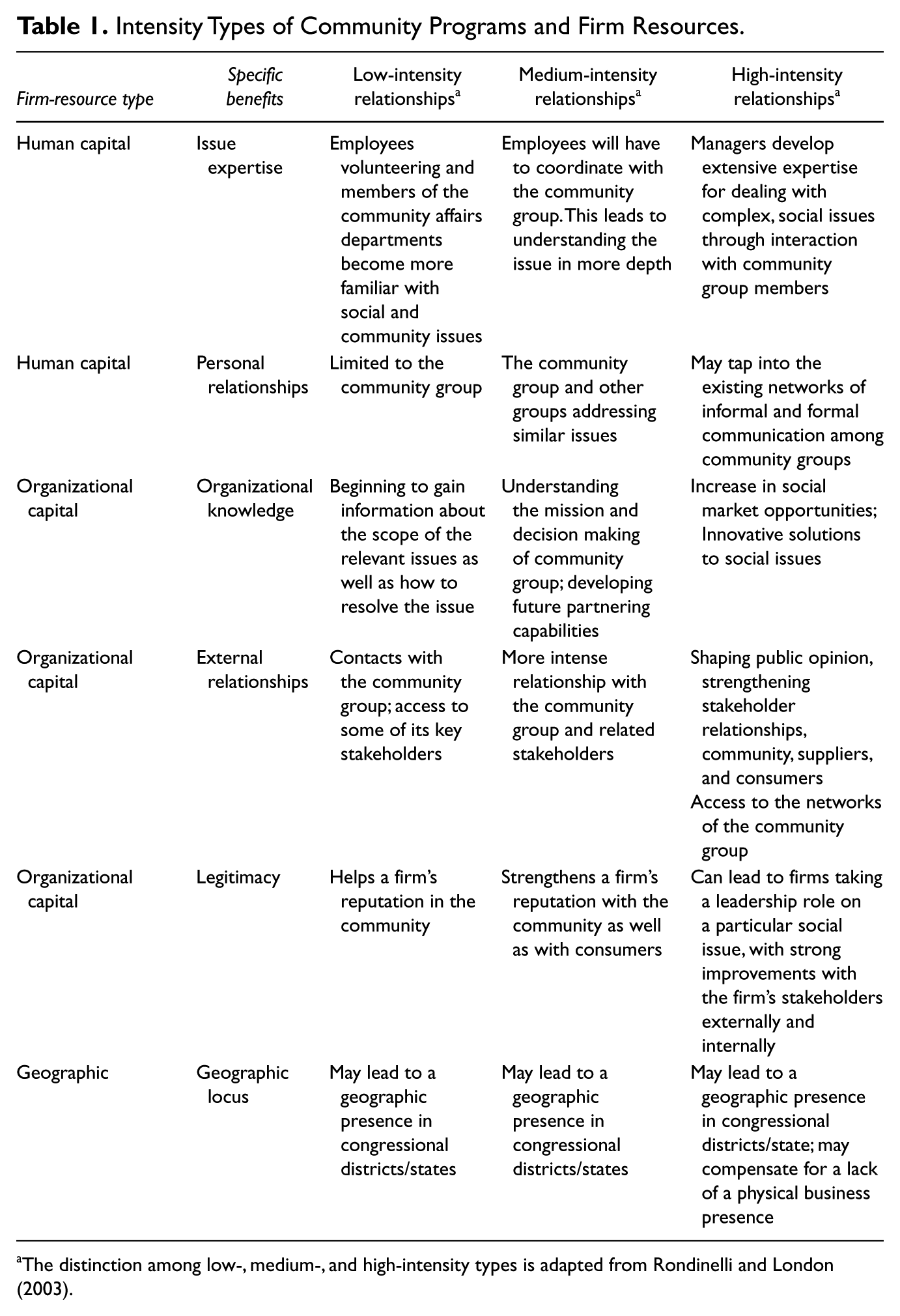
The distinction among low-, medium-, and high-intensity types is adapted from Rondinelli and London (2003).
Human capital resources
Human capital resources include the knowledge and personal relationships of individual managers and employees (Barney, 1991). Companies engaged in CCPs develop certain human capital resources that can be deployed to create value for their CPA. Specifically, human capital resources should help the firm become a more effective political actor by increasing the breadth and depth of information that the firm’s managers and employees possess about social issues, and deepening the interpersonal relations to facilitate CPA.
Issue expertise
Individuals who work in a firm’s community affairs area as well as employees in other areas of the firm who donate their time to activities coordinated by community groups will develop expertise about specific social issues. For example, Whirlpool employees working with Habitat for Humanity learned firsthand about housing issues in low-income neighborhoods (Googins et al., 2007). Issue expertise should rise as the intensity of the firm’s CCP increases. In addition, sometimes firms with medium- and high-intensity relationships will get to know these partners such that they hire someone from the community groups with specific expertise and experience. For example, when Citigroup started negotiating with Rainforest Action Network about the environmental effects of its lending practices, it hired an expert from Greenpeace who was familiar with the culture and decision-making process of international environmental organizations (Baron & Yurday, 2004).
Personal relationships
The social capital literature suggests that social relations represent an important asset that can flow from the dyadic relationships between individuals to third parties (Adler & Kwon, 2002). The firm’s managers and employees who work on corporate community programs expand their social network informally and formally. Informally, managers and employees working with community programs become familiar with the employees of such community groups. With respect to formal contacts about a social issue, managers are often members of professional networks that include professionals from NGOs, government, other companies, trade associations, and academia. As firms create medium- and high-intensity collaborations, they should develop more and deeper personal relations with members of the community groups.
Organizational capital resources
Organizational capital resources include the firm’s organizational structure, its planning, controlling, and coordinating systems as well as informal relations among groups within a firm and between a firm and stakeholders in its environment (Barney, 1991). A firm’s CCPs affect organizational capital resources in ways that augment internal capabilities, enlarge interorganizational networks, and enhance public legitimacy, which should serve to improve the effectiveness of its CPA.
Organizational knowledge
Involvement with community groups enables firms to develop a greater understanding of the issues that those corporations are addressing (Heugens, Van Den Bosch, & Van Riel, 2002). Community groups often possess technical expertise (Yaziji, 2004). When companies form medium- and high-intensity relationships with community groups, the companies learn new skills and acquire specialized knowledge that augments their internal capabilities (Inkpen, 2000) and other competencies (Lado, Boyd, & Wright, 2001). For example, through its partnership with the Environmental Defense Fund, McDonald’s was able to gain substantial knowledge and to improve material usage practices (Rondinelli & London, 2003), which eventually affected its discourse about the public policies over material use and recycling.
External relationships
Firms develop organizational-level relationships through their corporate community programs. The relationships extend beyond the community groups to include others, such as public officials, who often have relationships with those same community groups (Adler & Kwon, 2002). The authors interviewed a senior manager of a large bank about programs to support public health initiatives important in the community of their customers. One public event cosponsored with several community groups included a public gathering with live entertainment, speakers, and large crowds. In this medium-intensity collaboration, the bank and its community group partners invited local, state, and federal politicians to be guests and speakers. Through this event, the bank created a strong network of personal relationships with public officials that it could later use as banking regulatory and legislative policies arise.
Legitimacy
Organizational legitimacy is defined as “a generalized perception or assumption that the actions of an entity are desirable, proper, or appropriate within some socially constructed system of norms, values, beliefs, and definitions” (Suchman, 1995, p. 574). Dahan and Leca (2008, pp. 4-5) define political legitimacy as the general acceptance by the participants of a political process that a certain organization can participate in the debate about an issue. They argue that in general firms suffer from a political legitimacy deficit compared to community groups (Dahan & Leca, 2008, p. 6). Similarly, Yaziji (2004) recounts that polling data in the United States and Europe regularly show that senior managers and spokespersons from NGOs are seen as more credible and legitimate with the public than senior managers and company public relations personnel.
A firm’s CCPs may elevate its legitimacy. Scholars have looked at how a firm’s symbolic and substantive behaviors signal the congruence between the firm’s values and those of the public, giving rise to the firm’s legitimacy (Bonardi et al., 2005; Elsbach, 1994; Rindova, Pollock, & Hayward, 2006). When companies support programs in their communities, they demonstrate congruence between their values and community values. Importantly, the impact from these CCPs extends beyond those targeted community groups to the judgments of stakeholders not immediately affected (Jones, 1995; Wood, 1991). As firms increase the intensity of their CCPs with community organizations, they can raise their legitimacy and more easily mobilize these groups (Suchman, 1995).
Geographic resources
The authors concentrate on the geographic locus of where a firm practices CCPs activities, explaining how it may enhance firm resources. In addition to the other created resources, companies can use their community programs to show that they are making a difference with policy makers’ constituents (Peterson & Pfitzer, 2009, p. 49).
Geographic locus is the physical place where a company’s business activities occur, such as a headquarters office, a store, and a factory. Geographic locus is also important politically because public officials serve a particular geographic area, such as a sovereign territory. For elected public officials, such as in the U.S. Congress, a firm’s employment in a state or congressional district has long been seen as one of the most important determinants of gaining political access (Hojnacki & Kimball, 1998)
A firm’s CCPs are typically rendered in particular geographic locations and can serve to enhance its relationships with members of those communities, including public officials with jurisdiction in those places. In interviews the authors conducted with former Congressional members, it was mentioned that companies need to think about how they can help congressional members get positive and free media exposure. Working with community groups to host local community events and inviting congressional members is one way to provide this kind of service. The public affairs director of a national trade association representing rent-to-own shops told us that they encourage their dealers and coalitions of dealers to sponsor CCPs in districts of key public officials to enhance the quality of the personal relationships with such officials and their staff, to raise their visibility and to improve their legitimacy in that particular community.
CCPs that are rendered in areas outside of where the company normally does business might be useful in developing firm resources. Low involvement CCPs may signal that the firm minimally supports the community. As these CCPs become more intense, they may compensate, in part, for a lack of an employment-based physical presence in the state or district, helping the company to gain access to the elected officials representing such locations. In high-intensity CCPs, local partners may be willing to speak out for their nonlocal corporate partner.
In sum, a firm’s CCPs contribute positively to the development of human capital, organizational capital, and geographic resources. CCPs have the potential to improve a firm’s internal capabilities, expand and deepen interpersonal and interorganizational relationships, raise the firm’s legitimacy, and to become “local” within the community—termed a “geographic resource.” The enhancements to firm-level resources are expected to improve the effectiveness of two of its CPA strategies, as explored in the following subsections.
The Effect of Enhanced Firm Resources on Information Political Strategy
Table 2 outlines how the changes in firm-level resources created by different intensities of a firm’s CCPs impact two elemental political strategies. First, the authors address the effect of the intensity of a firm’s CCPs on its information political strategies defined by Hillman and Hitt (1999, p. 834) as seeking “to affect public policy by providing policy makers specific information about preferences for policy or policy positions and may involve providing information on the costs and benefits of different issue outcomes.” Second, the authors address the effect of the intensity of a firm’s CCPs on its constituency-building strategies drawing again from Hillman and Hitt (1999, p. 834) constituency-building strategies as “attempt[s] to influence public policy by gaining support of individual voters and citizens, who, in turn, express their policy preferences to political decision makers” (Hillman and Hitt, 1999, p. 834).
The Expected Impact of Corporate Community Programs on the Effectiveness of Corporate Political Strategies.

Note. NA indicates the firm’s CCPs are not expected to have a major effect on this aspect of firm-level resources as it affects CPA effectiveness.
When public officials consider an issue, they generally seek information about its content, scope, history, and parties affected (Attarça, 2005; Hillman & Hitt, 1999). Elected officials additionally are interested in the constituent impact and interest in the issue. Companies are generally a leading source of expertise about the issues facing their own business and industry (Dahan, 2005). Some information is proprietary (Oberman, 1993), but other information arises from a firm’s capability to collect, comprehend, and capsulate publicly available information. Many large companies employ experts in government relations as well as in technical and legal areas to collect and disseminate such information to public officials. Dissemination occurs through such activities as private meetings, lobbyists, research reports, testimony at hearings, and newspaper op-ed pieces.
Firms with CCPs are more likely to be informed, connected, legitimate, and “local” than firms without CCPs. First, firms often create superior issue positions and insights when cooperating up front with community groups. CCPs can lead to a firm developing issue positions with wider breadth and increased depth of knowledge and a clearer picture of the benefits and costs than when a company relies solely on its own personnel. When firms face symbiotic interdependencies with stakeholders, they can engage in a process of mutual learning, wherein a solution to an issue is created that incorporates knowledge from each party (Heugens et al., 2002). A senior government affairs manager of Whirlpool Corporation described at a meeting of the Academy of Management how it had joined with environmental groups to develop policy positions on energy and water use for the U.S. Department of Energy and U.S Environmental Protection Agency. (Academy of Management Meetings, Washington, D.C., 2001) Ultimately, firms should be in a better position to provide the pros and cons of pending legislation as well as provide facts, statistics, and arguments to help legislators with bill formulation (Hojnacki & Kimball, 1998). High intensity CCPs are likely to create more human capital expertise and organization knowledge that will propel information strategies.
Second, firms with CCPs are likely to develop human capital personal relationships and organizational capital organizational relationships that might improve the effectiveness of the delivery of information to external parties. The personal relationships made through CCPs may extend to policy communities, including to public officials and their staffs. As these CCPs increase in intensity, the number of personal relationships and the depth of the relationships are likely to strengthen.
Third, a broad, cooperative effort with community groups is likely to be seen as more legitimate politically than a narrow effort. A firm with higher legitimacy appears more attractive to public officials than a firm with lower legitimacy (Attarça, 2005; Dahan, 2005). Elected officials are more comfortable if they are pursuing policies that serve the public interest because the public interest is seen as legitimate, rather than special requests by lobbying firms (Levine, 2009). Elected officials desire to avoid any negative backlash that might emerge if they are perceived as developing policies that benefit only a few political participants. As a company works with community groups through its CCPs, it improves a firm’s relationship in the community so that private and public interests merge. High intensity CCPs are likely to result in the firm creating a broad legitimacy in the issue area.
From the logic above, firms engaging in CCPs will be in a superior position to use information strategies with public officials, compared to the firms that do not. In essence, firms using CCPs may develop issue expertise, personal and organizational relationships, and legitimacy to appeal to public officials. As CCPs increase from low to medium to high intensity, the resources created should translate into more effective information strategies.
Proposition 1a: Firms with CCPs will have more effective information political strategies than firms without CCPs.
Proposition 1b: Firms with higher intensity CCPs will have more effective information political strategies than firms with lower intensity CCPs.
The Effect of Enhanced Firm Resources on Constituency-Building Political Strategy
Constituency building involves mobilizing various stakeholders such as employees, suppliers, customers, shareholders, and others, and can be a very valuable government relations strategy (Hillman & Hitt, 1999). The goal of constituency building is to demonstrate vividly to public officials the impact of policies on various stakeholders, including, for elected officials, his or her constituents. Elected officials value feedback about issues from the constituents in their district or state more highly than other informants such as associations or lobbyists (Fenno, 2003; Lord, 2003). In constituency building, one or more of the stakeholder groups is encouraged to call, send e-mails or letters, or visit public officials and/their staff to deliver the message of the policy’s personal impact on them. Dahan (2005) calls constituency building an “external dimension” of firm political resources in that it involves cultivating the support of nonmanagement stakeholders, often from outside of the firm, to create a political resource for the firm. Well-organized and executed constituency-building strategies can defeat the political efforts of major political participants such as automobile manufacturers (Shaffer & Ostas, 2001) and pharmaceutical companies (Castellblanch, 2003).
While constituency building is a powerful government relations strategy, it is challenging for companies to implement effectively. One, it can be difficult to mobilize employees, suppliers, customers, and societal groups to participate politically on a company’s behalf. Two, even if stakeholders decide to participate politically they may not be effective. AT&T’s attempt to use money to “buy” grassroots support for its position on telecommunications regulations was counterproductive (Lord, 2003, p. 118). Broad-based political support needs to be cultivated over time.
CCPs may enhance the effectiveness of a firm’s constituency-building political strategies. A firm that has already spent time and effort building organizational relationships in the community through its CCPs should have an advantage in constituency building. CCPs allow the sharing of information and the development of trust that might translate more easily into a collective political effort down the road (Heugens et al., 2002). High-intensity CCPs create personal and organizational relationships that may translate into effective constituency-building strategies.
The companies that are active in the community through their CCPs may be seen as legitimate among the public. This perceived legitimacy, in turn, makes it easier to mobilize a successful constituency-building campaign. Legitimacy may confer cost advantages for a firm with CCPs over firms without CCPs that have to establish relationships with these same community groups from scratch (Suchman, 1995, p. 574). A firm’s legitimacy should rise as the intensity of a firm’s CCPs rise.
Finally, a company’s CCPs may create geographic resources that add value to constituency-building campaigns. CCPs with community groups, especially those practiced in areas outside of the firm’s product markets, allow the firm to have relationships with such groups and gather their political support.
Proposition 2a: Firms with CCPs will have more effective constituency-building political strategies than firms without CCPs.
Proposition 2b: Firms with higher intensity CCPs will have more effective constituency-building political strategies than firms with lower intensity CCPs.
Impact of the Political Marketplace
In general, it is beneficial for corporations to cultivate the synergies between their CCPs and CPA. Basically, CCPs improve the effectiveness of a firm’s information provision and constituency political strategies through their effect on firm resources. There are some political contexts where these synergies may become particularly valuable for the firm. Bonardi et al. (2005) examine the context of political markets, particularly the benefits and costs to suppliers (public officials) and demanders (interest groups, including firms). This section presents several arguments that “unattractive” political markets may be opportune for firms using CCPs to differentiate themselves from other political demanders.
Bonardi and his colleagues’ (2005) primary argument is that political markets will be more attractive for a firm when it faces a little political opposition. Generally, this situation occurs when the interest group on the opposition side of the issue does not have an identifiable or large benefit or burden from the public policy, and therefore is unlikely to organize (Olson, 1965; Wilson, 1980). For example, if the burden of a policy favored by a particular company is widely distributed to the public or is scattered in small increments to consumers, it is unlikely that these policy “losers” will rally in opposition to the firm. Under these “favorable demand conditions” a firm is likely to prevail with public officials in terms of its political position (Bonardi et al., 2005).
However, sometimes political markets are unfavorable for firms. Unfavorable scenarios include highly competitive demand, difficult-to-mobilize demand, and issues associated with elections. Corporations face a highly competitive political market when they are dealing with politically divisive issues that produce concentrated costs and benefits such as product liability and trade policy issues. In terms of the second scenario, firms may have trouble mobilizing for political action, overcoming collective action challenges, when the pending political issues lead to diffuse benefits or costs. For example, firms advocating policy issues that improve the environment or product safety are going to have difficulties organizing for political actions because the beneficiaries of these policies are dispersed widely. Election issues such as social security and health care represent another challenging political situation that firms can incur since they tend to polarize constituents. As a result, firms may have trouble pushing their political agenda with politically constrained elected officials.
Highly Competitive: Concentrated Benefits and Concentrated Costs
The most politically competitive scenario will occur when benefits and costs are concentrated, as in Wilson’s (1980) “interest group politics“ conception, because multiple interest groups are motivated to contest their viewpoint. For policy suppliers, such as a legislator, substantial political competition may be desirable because when there are multiple interest groups for a particular public policy, the legislator is able to receive information about it at his or her lowest cost (De Figueiredo, Spiller, & Urbiztondo, 1999). However, the situation of high levels of demand-side competition is undesirable for a firm for three reasons. First, a firm will have to invest more heavily in lobbying and campaign contributions to get its position on the issue heard (Gray & Lowery, 1997; Schuler, Rehbein, & Cramer, 2002). Second, with many interest groups competing for the policy outcome, a firm will have a lower probability of success than when it faces fewer competitors. Third, multiple and competing interests place the public official in the uncomfortable situation of having to choose between opposing and vocal interests (Baumgartner et al., 2009). Thus it is unlikely that the public official will strongly back the firm’s positions, even if there are many merits to the arguments, fearing some sort of retaliation by the opposing interests.
In the circumstance of fierce political competition, a firm’s CCPs may be particularly important for increasing the effectiveness of its information provision strategies. Heinz et al. (1993) argue that, when groups work together to form a policy position on an issue, they reduce the number of divergent interest group voices, which in turn reduces information processing costs for public officials. When the groups working together are different, such as an industrial company and an environmental group, they may be able to create policies that eliminate possible moral hazards in which people do not bear the full consequences of their actions (Baron, 2010). In addition, these cooperative efforts may decrease the information asymmetry effects of information that result from relying on a single source, in this case a single interest group. This circumstance creates the perception that the message is balanced and credible. Firms with CCPs may also build substantively more robust and integrated messages (Heugens et al., 2002) than firms without such programs because of the knowledge and insights that the firm receives from various community groups in crafting a policy position. Bonardi and his colleagues (2005, p. 407) argue that when the demand side is unattractive, a firm should “wait and see” for better circumstances. Cooperation with other interest groups, forged through CCPs, might position the firm (and its partner community group) to be the preferred information supplier in a crowded demand space.
Proposition 3a: The positive impact of corporate community programs on a firm’s information political strategies is more critical in political markets when the pending issue creates concentrated benefits and concentrated costs.
CCPs may also enable constituency-building strategies when there is excessive demand-side competition. Beyond the informational benefits described above, CCPs put company managers in touch with representatives of a myriad of groups, including ones that often oppose the firm on public policy issues. The interpersonal and interorganizational relations developed through CCPs may be particularly important for facilitating the creation of unified public policy positions when companies face substantive political competition. CCPs help the firm mobilize community groups as allies for a constituency-building strategy, making them appear more essential to public officials, especially elected ones. If successful, these unified public policy solutions developed between the firm and community groups can often break the impasse of political competition among opposing interests and allow the firm (as well as the community groups) to become a leader in framing the debate on the policy issue.
Proposition 3b: The positive impact of corporate community programs on a firm’s constituency-building political strategies is more beneficial in political markets when the pending political issue creates concentrated benefits and concentrated costs.
Difficult to Mobilize: Concentrated Costs and Diffused Benefits or Concentrated Benefits and Diffused Costs
Another challenging political scenario is when issues lead to an either concentrated costs and diffused benefits or diffused costs and concentrated benefits (Wilson, 1980) and when the firm supports the diffused benefits (in the first scenario) or the diffused costs (in the second scenario). In both cases, the supporters of the side advocating for diffused benefits (or costs) face an uphill battle because other supporters are difficult to find, costly to mobilize, and the benefits to any one supporter are often quite small, setting up the free rider problem (Jacomet, 2005; Olson, 1965). The supporters of policies offering such diffused benefits (or costs) often fail to garner any other support and generally fail in their political efforts.
The strategy to overcome such a position is for the firm to become a political organizer, termed a “political entrepreneur” (Wilson, 1980). In such a role, the firm attempts to bring together like-minded but diffused beneficiaries of the public policy (Lenway & Rehbein, 1991; Wilson, 1980). The political entrepreneur typically has some advantage in organizing such interests in terms of special private benefits offered and/or reduced costs of organizing (Olson, 1965).
Firms with CCPs may be well-positioned to play the role of political entrepreneur. These firms have a broad base of allies and may be able to overcome the costs of collective action and pursue successful political outcomes. For example, the issue of childhood safety, preventing accidental injuries, creates diffused benefits and concentrated costs (i.e., companies producing products that may cause harm, automobile manufacturers). General Motors ended up working closely with Safe Kids, a nonprofit organization whose mission is to prevent accidental injuries to children (Petersen & Pfitzer, 2009). The objective of their partnership has been to improve the usage of booster seats in cars as well as to increase the number of states that have booster seat laws (Petersen & Pfitzer, 2009). As a result of this partnership, GM has gained a reputation for being an advocate for safety, specifically childhood safety. Firms with CCPs are in a stronger position to overcome the costs of collective action and to become an effective political entrepreneur than firms without such CCPs.
Proposition 4: The positive impact of corporate community programs on a firm’s constituency-building political strategies will be beneficial in political markets when the pending political issue creates either diffused benefits and concentrated costs or diffused costs and concentrated benefits.
Election Issues
Bonardi and his colleagues (2005) maintain that political markets will be less attractive when policies are being discussed during elections. Policies that receive the attention of candidates running for elections (particularly high profile elections like the U.S. presidency) are likely to receive substantial media attention, which lowers the costs for voters and the general public to know about the policies. As a result of this lower cost of information, voters are more likely to hold stronger policy preferences and positions about the issue (Bonardi et al., 2005, p. 402). Keim and Zeithaml (1986) argue that when election issues such as health care, energy, and social security become widely known—the issue is “salient” with the public—and voters are split in their preferences, the politician faces the undesirable task of escaping the situation without alienating too many voters.
One political strategy for a firm under these conditions is to try to convince opposing interests to support its position, or at least, to drop their opposition. Companies with CCPs should be in a better position for garnering political support as well as neutralizing political opponents. CCPs promote interpersonal and interorganizational relationships, which provide a basis for mutual understanding and cooperation between the organizations. Companies with CCPs also may raise their political legitimacy. High intensity CCPs may also create some increased levels of legitimacy for the firm by the general public. As a result, companies with CCPs may be able to develop more creative solutions for public policy problems, which may be particularly useful for policies issues that become election issues.
Proposition 5: The positive impact of corporate community programs on a firm’s information and constituency-building political strategies will be beneficial when a firm is involved with a policy that has become an election issue.
Discussion
This article is the first, to our knowledge, to offer a model of how and when CCPs are most likely to increase the effectiveness of two government relations strategies. This model provides a mechanism for understanding how a firm’s CCPs translate into CPA. Relying on RBV, the authors focus on how a firm’s CCPs and the intensity thereof impact a firm’s human capital, organizational capital, and geographic resources that in turn, may improve the effectiveness of its information and constituency-building political strategies. The interplay between CCPs and CPA leads to political advantages that are unique and difficult to imitate as well as offering value to the recipient public official. Consequently, companies with CCPs should be able to increase the likelihood of achieving political success, especially under certain unfavorable political market conditions. Firms practicing high-intensity CCPs are likely to develop more firm resources and as a result have more political advantages than firms practicing low-intensity CCPs.
The authors think that the consideration of the processes that tie together CCPs and CPA is likely to be fruitful for scholars and managers. These two activities are often lumped together rather sloppily under the banner “non-market strategies” (Baron, 1995). As mentioned previously, there has been a tendency in the management literature to focus on a firm’s political and social efforts separately. CCPs are expected to have a positive societal impact and to improve the welfare of stakeholders that they are targeting. Our model shows that in addition to the positive societal impact, CCPs create firm-level resources that enable other corporate activities, in this case CPA, to become more successful.
Our work also makes a substantial contribution to the CPA literature in terms of evaluating effectiveness. Although scholars have alluded to the fact that a firm’s CSR can increase a corporation’s political visibility and lower barriers to political entry (Wang & Qian, 2011), no scholar has discussed and/or identified how CSR (in this case CCPs) are connected with CPA. By looking at the resources generated by CCPs, this study identifies a possible mechanism for how a firm can become more knowledgeable about issues, improve the breadth and depth of its interpersonal and interorganizational relationships with other stakeholders, increase public legitimacy, and to be seen as more “local” in the eyes of local public officials. The addition of CCPs to typical lobbying and campaign contribution indicators can strengthen future conceptual and empirical models of CPA effectiveness.
This model informs our understanding about political markets. Our model suggests that the way companies interact with groups through their CCPs—predominantly practiced outside the political arena—is likely to have a profound effect on how they interact with these same groups inside the political arena. Political rivalry may not be fixed but be dynamic. CCPs may enable a firm to develop more potent information and constituency-building strategies. Additionally, it is possible that firms may be able to co-opt their political rivals through their community efforts. One possibility is that firms may circumvent or at least shorten any political debate by negotiating a compromised political position with community groups.
For managers, this study shows the importance of considering and connecting community and political initiatives. Surveys show that corporate executives are increasingly aware of the social and public policy implications of their businesses and intend to manage their companies in a socially responsible way (Boston College Center for Corporate Citizenship, 2009). Yet, at the same time, the majority of companies formally separate CCPs (called “corporate citizenship” in the Boston College study) from other parts of the company, such as government affairs (Boston College Center for Corporate Citizenship, 2010, p. 8; Petersen & Pfizer, 2010), limiting cross-functional strategizing. Of the 37% of companies that have a management-level team to coordinate corporate citizenship across functions, only 38% of that subset includes a manager from the government relations area (Boston College Center for Corporate Citizenship, 2010, p. 7). These data indicate that only about one company in six has managers from the CCPs and government relations areas sitting together in a formal setting to develop and implement company practices. In interviews the authors conducted with senior government affairs managers in 2004, we too found that only about 10% of the managers integrated CCPs with their firm’s government relations activities. The authors believed then, and believe now, that absence of integration is a wasted opportunity for firms.
The proposed model is not without weaknesses and limitations. The study only considers the benefits of CCPs. Firms have costs in undertaking CCPs, especially high intensity relationships (Rondinelli & London, 2003). Some community partners may have different goals than the firm, which might undermine the political effectiveness of such alliances. Firms may have additional costs associated with linking their CCPs to CPA. As stated above, the general aim of CCPs is to produce a public benefit. Although firms hope to gain legitimacy and other private benefits from such programs, these benefits might come under attack if it is revealed that firms use such CCPs for private political gains. Future studies might consider both the costs and the benefits of CCPs on CPA effectiveness.
To conclude, while many agree that CCPs can offer value to a firm’s political strategies, few researchers and managers have formally depicted this relationship. The authors believe that one of the reasons is that the mechanisms linking CCPs to CPA have not been well understood or sufficiently specified. Here, this study describes a model that shows how CCPs enhance firm-level human capital, organizational capital, and geographic resources, which in turn aid CPA effectiveness. The intensity of CCPs should matter: high-intensity CCPs should offer more benefits to firms than low-intensity CCPs. Three situations related to political market attractiveness give predictions about when CCPs are most likely to enhance CPA effectiveness.
Footnotes
Authors’ Note
The order of the authorship reflects an equal contribution on this article.
Declaration of Conflicting Interests
The author(s) declared no potential conflicts of interest with respect to the research, authorship, and/or publication of this article.
Funding
The author(s) received no financial support for the research, authorship, and/or publication of this article.