



Abstract
Small businesses in developing countries, as part of global supply chains, are sometimes assumed to respond in a straightforward manner to institutional demands for improved working conditions. This article problematizes this perspective. Drawing upon extensive qualitative data from Tirupur’s knitwear export industry in India, we highlight owner-managers’ agency in avoiding or circumventing these demands. The small businesses here actively engage in irresponsible business practices and “evasion” institutional work to disrupt institutional demands in three ways: undermining assumptions and values, dissociating consequences, and accumulating autonomy and political strength. This “evasion” work is supported by three conditions: void (in labor welfare mechanisms), distance (from institutional monitors), and contradictions (between value systems). Through detailed empirical findings, the article contributes to research on both small business social responsibility and institutional work.
Keywords
Most research on Small Business Social Responsibility (SBSR) 1 focuses on small businesses 2 in developed countries, including the United Kingdom (e.g., Spence, 2007) and the United States (e.g., Burton & Goldsby, 2009). We know little about SBSR in developing countries 3 (Jamali, Lund-Thomsen, & Jeppesen, 2017; Lund-Thomsen, Lindgreen, & Vanhamme, 2016) and in particular about the impact of institutional constellations on SBSR practices (Jamali, Lund-Thomsen, & Jeppesen, 2017). More specifically, our knowledge of how small businesses, embedded in global supply chains, manage institutional demands 4 for improved working conditions 5 —in the form of state regulations and private sustainability standards—is extremely limited (Egels-Zandén, 2017; Jamali, Lund-Thomsen, & Khara, 2017).
Numerous studies focus on substandard working conditions across “global supply chains,” “global production networks” (GPNs), or “global value chains” (GVCs) 6 (Barrientos & Smith, 2007; Locke, Amengual, & Mangla, 2009). But, as Egels-Zandén (2017) puts it, “the scholarly conversation . . . ignores or dismisses the role of small and medium-sized enterprises (SMEs) in GPNs” (p. 1). There is a failure to distinguish between large and small suppliers (with exceptions such as Ciliberti, de Groot, de Haan, & Pontrandolfo, 2009; Jamali, Lund-Thomsen, & Khara, 2017; Luken & Stares, 2005) by using collective terms such as “suppliers” or “sub-contractors” to refer to all types of suppliers in general. In practice, the majority of suppliers in global supply chains located in developing countries are small businesses (Raynard & Forstater, 2002), and small businesses are typically very different from large ones (Barrett & Rainnie, 2002; Spence, 2016; Terziovski, 2010; Wickert, 2016). Other studies have stressed that sustainability standards in global supply chains are “ill-equipped” (Wijen, 2014, p. 302) to deal with the complexity underpinning global supply chains and developing country contexts, where most suppliers are located (Lund-Thomsen & Lindgreen, 2014; Mena & Palazzo, 2012; Soundararajan & Brown, 2016). This results in “decoupling” or “selective coupling” practices by suppliers to deal with such standards (Jamali, Lund-Thomsen, & Khara, 2017; Nadvi, 2008).
From the available literature, we can make two claims: First, institutional pressures to improve working conditions, from both local regulations and sustainability standards, have failed to produce the expected improvements in small businesses in developing countries (Ciliberti et al., 2009); second, these small businesses frequently violate such institutional demands (Jamali, Lund-Thomsen, & Khara, 2015). However, we know little about how owner-managers flout institutional demands, or the conditions that facilitate such behavior. We address this gap by asking two questions: How do small businesses in developing countries, when part of global supply chains, respond to institutional demands for improved working conditions? and What conditions facilitate their responses? We address these questions through an in-depth qualitative study of small businesses in the knitwear export industry in Tirupur, India.
We utilize the theoretical lens of institutional work, defined as “the purposive action of individuals and organizations aimed at creating, maintaining, and disrupting institutions” (Lawrence & Suddaby, 2006, p. 215). This emphasizes “a broader vision of agency in relationship to institutions, one that avoids depicting actors either as ‘cultural dopes’ trapped by institutional arrangements, or as hypermuscular institutional entrepreneurs” (Lawrence, Suddaby, & Leca, 2009, p. 1). Owner-managers possess agency to an extent, but nevertheless remain resource dependent (Jamali, Zanhour, & Keshishian, 2009; Luken & Stares, 2005). The practical ways in which they cope with institutional demands are mostly undramatic, common, and undetectable, and driven as well as constrained by context. The concept of institutional work allows the uncovering of such practices (Lawrence, Suddaby, & Leca, 2011).
We specifically focus on the disrupting element of institutional work—the ways individuals intentionally violate, undermine, avoid, reject, or manipulate institutions (Lawrence & Suddaby, 2006). We describe how resource dependent owner-managers make “disrupting efforts” to reject or avoid the demands of dominant institutional structures, engaging in what we refer to as “evasion” work. Evasion (dictionary meaning—“circumvention” or “dodging”) means appearing to follow the rules while violating the essence of those rules to misdirect the interpretation of others. Owner-managers disrupt institutional demands that are ideologically misaligned with their values, and for which they do not possess the resources to commit, and yet avoid any immediate negative consequences (in the form of, for example, cancellation of a trade agreement by a buyer or fines from the local labor inspectorate). Owner-managers are thus resource dependent or “marginal” (Marti & Mair, 2009), and yet skillful enough to draw out and utilize opportunities provided by their context.
Our contribution is threefold. First, by highlighting the mundane ways in which Tirupur owner-managers evade institutional demands, we address the call for more systematic and critical analyses of the organization of working conditions in small businesses that are part of global supply chains (Egels-Zandén, 2017; Jamali, Lund-Thomsen, & Jeppesen, 2017; Saini & Budhwar, 2008). Through this, we also contribute to research on small business social irresponsibility in developing countries (e.g., Blackman, 2006). Second, by showing how institutional demands for improved working conditions, especially sustainability standards, push owner-managers in Tirupur to engage in “evasion” work to circumvent such demands, we contribute to the ongoing conversation—also known as “critical Corporate Social Responsibility (CSR)” (Idemudia, 2011; Prieto-Carrón, Lund-Thomsen, Chan, Muro, & Bhushan, 2006)—that highlights the inability of CSR programs and sustainability standards to encourage socially and environmentally responsible business practices in global supply chains (Soundararajan & Brown, 2016). Third, we contribute to the field of institutional work by (a) showing how, and under what conditions, resource dependent individuals engage in “evasion” work to disrupt institutional demands, a type of institutional work that is normally attributed to powerful and resourceful actors (Lawrence & Suddaby, 2006; Marti & Mair, 2009); (b) expanding Lawrence and Suddaby’s (2006) categories of potential ways in which individuals can disrupt institutions through “evasion” work; and (c) expanding the focus of institutional work to a relatively unstable and less advanced field, namely, the garment industry in a developing country context, as most research focuses on actors and firms located in stable and advanced fields (Marti & Mair, 2009).
The article is structured as follows. We begin by reviewing literature connecting “small business,” “working conditions,” “developing countries,” and “global supply chains.” This is followed by a discussion of the central theoretical concept of institutional work. We then outline the research setting and the methodology by which the study was conducted. In our findings, we demonstrate (a) the differences between expected and actual situation of working conditions; (b) how owner-managers, as primary decision makers, engage in evasion work to avoid local and international institutional demands for improved working conditions; and (c) the conditions facilitating their engagement in such work. Finally, we discuss the contribution of the article (to research on SBSR and institutional work), its limitations, and future research directions.
Small Business, Working Conditions, Developing Countries, and Global Supply Chains
In developing economies, small businesses are an increasing focus for public policy makers because of their active multifaceted contribution to economic development (R. K. Singh, Garg, & Deshmukh, 2009). However, working conditions within these firms, especially when they are part of global supply chains as Tier 2 or Tier 3 (and further) suppliers, are frequently very poor (Saini & Budhwar, 2008). The International Labour Organization (ILO) reports that small businesses employ at least half the industrial workers of the developing world—especially in labor-intensive garments, leather, toys, food, and jewelry production and exporting industries—and are normally characterized by substandard working conditions (ILO, 2013). Media reports of accidents in small sourcing facilities in Bangladesh, India, Pakistan, and regions of South America substantiate the presence of equivalent conditions in small businesses in a range of developing countries. 7
So, why do regulations, laws, standards, and other voluntary initiatives not fulfill their purpose of improving working conditions in these firms? The literature offers three explanations. First, most small businesses in developing countries are resource dependent and operate in a concentrated and relatively limited territory (Luken & Stares, 2005). They tend to focus on day-to-day survival, rather than investing in expensive activities that do not bestow immediate benefits (Jamali et al., 2009; Saini & Budhwar, 2008). This resource dependency can impose serious constraints on how working conditions are organized (Ogunyomi & Bruning, 2016).
Second, in a range of developing countries, small businesses are excluded—based on numerical thresholds—from certain aspects of labor law, under the premise that this facilitates their growth and promotes entrepreneurship by reducing the costs arising from legal compliance (Ayyagari, Beck, & Demirguc-Kunt, 2007; Fenwick, Howe, Marshall, & Landau, 2007). In Chile, Kenya, Vietnam, India, and South Africa, for example, legal obligations concerning occupational health and safety, collective bargaining, and freedom of association vary according to the size of the enterprise, with smaller or micro-businesses generally not covered. It remains unclear, however, whether this has any positive impact on small businesses or workers. Furthermore, studies suggest that even including them may make little difference, due to the heterogeneity of small businesses and under-resourced and corrupt authorities (Stigzelius & Mark-Herbert, 2009).
Finally, small businesses in developing countries are often caught between trade-related pressures and demands for improved working conditions from lead actors in their chains (i.e., they are stakeholders in other entities’ stakeholder maps Spence, 2016). On one hand, they face pressures to reduce production costs, to increase efficiency and improve quality. On the other, standardized management tools in the form of standards, codes, or certifications require the adoption of measures that sometimes go beyond regulatory requirements regarding working conditions (Amaeshi, Osuji, & Nnodim, 2008; Dawson, Breen, & Satyen, 2002; Lund-Thomsen & Nadvi, 2010). These tools echo the concerns and priorities of consumers and nongovernmental organizations (NGOs) from developed nations and the more powerful firms in the chain (Jamali, Lund-Thomsen, & Jeppesen, 2017). Rarely do they represent either the small firm or the developing country perspective. Some scholars go so far as to criticize these measures as “unjustified attacks” on small businesses (Fassin, 2008) and a reflection of “post-colonial imperialism” (Boje & Khan, 2009). Caught between such conflicting demands, small businesses tend to focus more on trade-related pressures and less on demands unrelated to their day-to-day circumstances, such as complying with sustainability standards (Ciliberti, de Haan, de Groot, & Pontrandolfo, 2011).
There remains a shortage of systematic research on working conditions in developing country small businesses (Saini & Budhwar, 2008), especially in the context of global supply chains (Egels-Zandén, 2017; Jamali, Lund-Thomsen, & Khara, 2017). Demuijnck and Ngnodjom (2013) and Jamali et al. (2009) explore the peculiar attributes of SBSR in developing countries, but do not consider global supply chains. They also concentrate on a broader area of social responsibility and not specifically on working conditions. Ciliberti et al. (2009) and Rahbek Pedersen (2009) consider social responsibility practices of small businesses that are part of global supply chains, but focus on small businesses in developed countries. Likewise, Luken and Stares (2005) explore the practicality of a business case for social responsibility practices of small businesses in developing countries that are part of global supply chains, but again do not specifically deal with working conditions. The issue of working conditions in global supply chains is widely explored in the global supply chains and international development literatures (Barrientos & Smith, 2007; Beschorner & Müller, 2007), but these do not normally take the small business perspective into consideration.
We believe Jamali, Lund-Thomsen, and Khara (2015) are the first to exclusively study working conditions in small businesses that are part of global supply chains. They show how Indian football manufacturing small businesses use “selective coupling” (Pache & Santos, 2013) to manage institutional demands in the form of CSR tools, standards, or certifications. Using critical CSR and institutional theory, they found small businesses using local cluster-based joint initiatives to comply with demands to eradicate child labor, while decoupling or not complying with demands for other human and labor rights issues. We expand these findings by specifically scrutinizing the aspect of decoupling. In addition, although previous studies theorize the agency of owner-managers, they are yet to uncover the practical mundane activities through which owner-managers accomplish such decoupling.
Institutional Work and Resource Dependent and Marginal Individuals
In early work on institutional theory (Meyer & Rowan, 1977; Powell & DiMaggio, 1991), institutions were ascribed agency, rather than individuals (Pache & Santos, 2013). In contrast, recent work on “institutional entrepreneurship” (Garud, Hardy, & Maguire, 2007; Maguire, Hardy, & Lawrence, 2004) has depicted individual actors as possessing heroic powers to influence and change institutions (Battilana, 2006). The concept of “institutional work” has emerged as an alternative to these two rather exaggerated positions (Lawrence, Leca, & Zilber, 2013), drawing on the sociology of practice to help explain the situated actions of individuals as they attempt to deal with and respond to institutional demands. This helps to illuminate the intentional practical activities, often imperceptible and routine rather than heroic, through which institutions are created, maintained, and disrupted (Lawrence et al., 2013).
Our intention is to understand how small businesses violate, “disrupt,” or “reject” (Oliver, 1992, p. 567) institutional demands. According to Lawrence and Suddaby (2006), disruption involves “attacking or undermining the mechanisms that lead members to comply with institutions” (p. 235) or “manipulating the social and symbolic boundaries that constitute institutions” (p. 238), and this requires resources and power that are normally possessed by “elites,” “professionals,” or “professional groups” in an advanced and stable field. Although important insights are emerging into how institutional work occurs (Slager, Gond, & Moon, 2012; Zietsma & Lawrence, 2010), who engages in institutional work (J. Singh & Jayanti, 2013; Suddaby & Viale, 2011), and what constitutes institutional work (Battilana & D’Aunno, 2009; Smets & Jarzabkowski, 2013), there remain two important limitations with respect to the range of context and actors covered (Marti & Mair, 2009). First, studies tend to concentrate only on powerful and resourceful actors, giving less attention to those located on “the margins of industrialized society” (Lawrence et al., 2009, p. 19). Second, the focus is primarily upon developed and stable fields, such as professional organizations and advanced industries in developed countries (Marti & Mair, 2009).
More recent studies have challenged this dominant perspective by shifting the focus from resourceful and powerful actors in the developed world to more marginal actors within the developing world (Karam & Jamali, 2013; Marti & Mair, 2009). Marti and Mair (2009) explore the institutional work of social entrepreneurs in India, Egypt, and Bangladesh to alleviate poverty. Karam and Jamali (2013) show how corporations use CSR as a form of institutional work to disrupt existing gender institutions in the Middle East for positive developmental change. Such studies show that even the “powerless, disenfranchised, and under resourced, who seemingly have no choice other than compliance, are also doing important institutional work” (Marti & Mair, 2009, p. 101). Nevertheless, these studies see disruption work as directed toward positive institutional change, which misses how marginal actors also engage in disruption work to violate or evade institutional demands.
Method
Research Setting
We studied small-scale garment exporters located in Tirupur, in Tamil Nadu, India. According to the Indian Ministry of Textiles (2012), the Tirupur cluster accounts for more than 50% of total knitwear garment exports from India. Small businesses in Tirupur are subcontractors to large organizations or buying agents, usually employ between 25 and 75 workers, and are resource dependent. Owner-managers are the dominant actors—both principals and agents—and ultimately control all business practices. They play a variety of roles: production manager, human resource manager, personal counselor, departmental supervisor, accounting and finance manager, and also production worker whenever needed.
Institutional demands for improved working conditions mainly come from two actors: the Indian government and global buyers. The government’s demands are conveyed through obligatory national and state labor regulations or laws, which total more than 100. Those relevant to the research context are 26 Indian federal laws and four Tamil Nadu state laws. Their violation entails coercive penalties in the form of imprisonment, fines, or both. 8 There are government appointed monitors at different levels. With respect to Tirupur, these are a deputy chief inspector, two inspectors, and four assistant inspectors. Global buyer demands are transmitted through third-party standards such as SA8000, Business Social Compliance Initiative (BSCI), Worldwide Responsible Accredited Production (WRAP), Supplier Ethical Data Exchange (Sedex), and company-specific codes, usually aligned to local government regulations. Global buyers often require compliance to the minimum requirements of these mechanisms as a condition for trade. Figure 1 illustrates how these demands are imposed on small businesses in the research context.
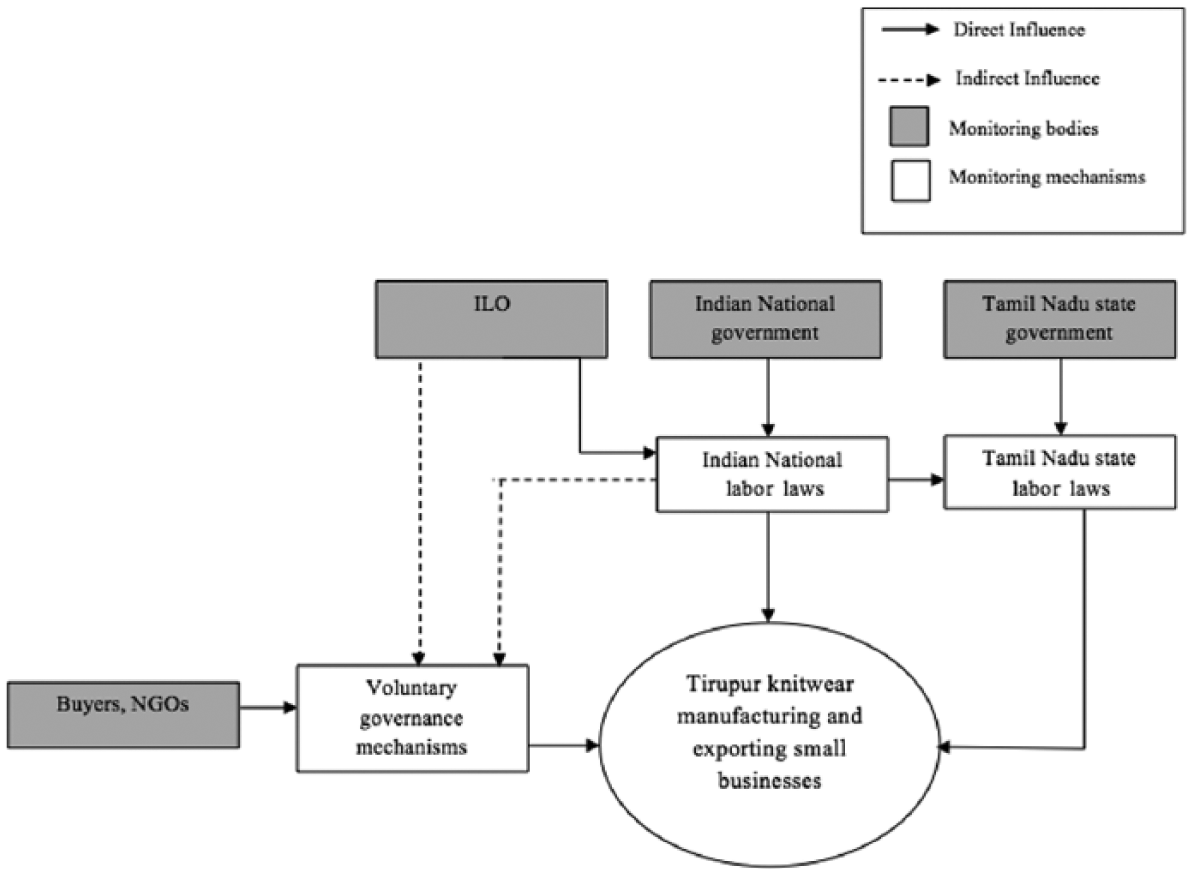
Monitoring bodies and mechanisms related to working conditions.
Data Collection
Qualitative data were collected in two stages, primarily in the form of face-to-face and telephonic in-depth semistructured interviews. During Stage 1, a pilot study was conducted consisting of interviews with two owner-managers, one buying agent, and three workers. The interview schedule and research design were then amended. This was followed by the main data collection phase, consisting of 48 in-depth semistructured interviews: eight owner-managers, 23 workers, five buying agents, two trade union leaders, three NGO leaders (highly active in Tirupur), and seven CSR officers/auditors of a high street clothing brand supplied by this region (see Table 1). These actors were included due to their connection to the Tirupur knitwear cluster, their relevance to the topic, and to facilitate data triangulation. Due to the sensitivity of the topic, numerous techniques were used to gain access to the participants, including access through gatekeepers such as exporters and their associations, personal contacts, and the snowballing method. In addition, supplementary data were collected in the form of documents (Indian Ministry of Textiles annual report, Tirupur district administration report, Tirupur Exporters’ Association report, the ILO’s databases—such as ILOSTAT, NORMLEX, and NATLEX—and Indian labor regulations), informal conversations, and ad hoc nonparticipant observation during frequent factory visits. These small factories are certified with at least one standard such as BSCI, SA8000, or WRAP (i.e., some had more than one) and they supply to multiple brands and/or countries.
The Interview Respondents.
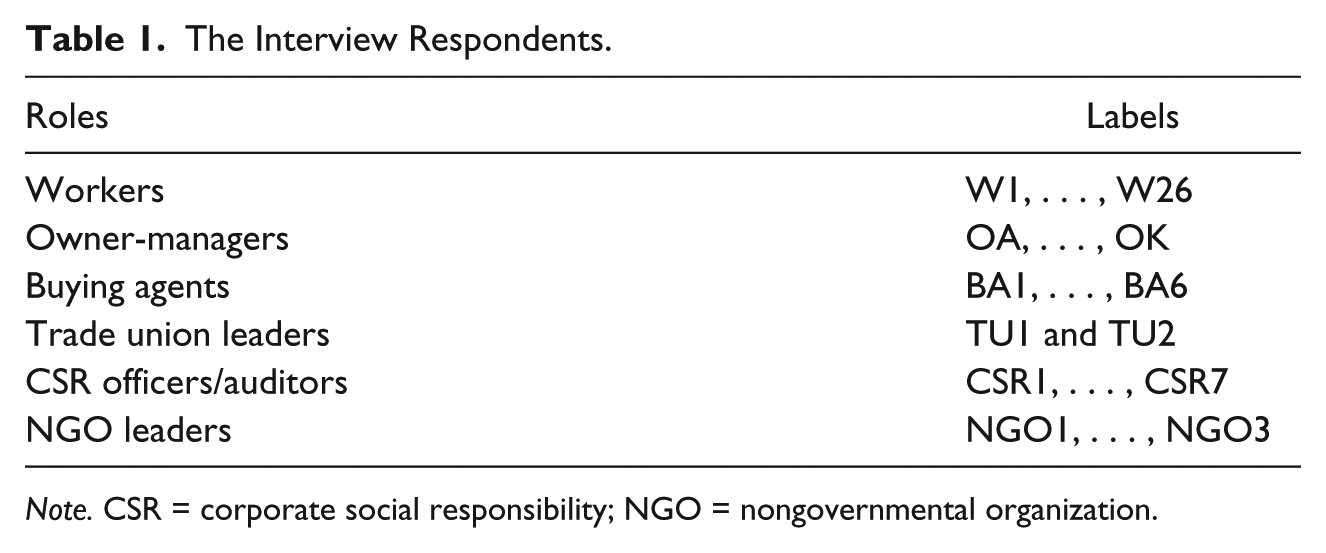
Note. CSR = corporate social responsibility; NGO = nongovernmental organization.
The interviews were digitally recorded and supplemented with interview notes. They were conducted in the region’s primary language, Tamil, to allow participants to easily communicate with the interviewer, who is a native speaker, and then transliterated (not translated) into English, to minimize the potential for data distortion. Hence, the interview data were analyzed in Tamil and only direct quotations were translated into standard English, so as to maintain interviewees’ subjective meanings (see Zimmerman & Szenberg, 2000, for a similar argument about issues with translation).
Data Analysis
Due to the nonstandardized language, the transcribed data were manually analyzed in four stages using Braun and Clarke’s (2006) step-by-step (but flexible) recipe for thematic analysis. In Stage 1, we read our database (the data collected through different methods) multiple times to understand the research setting and gather descriptions of the lifeworld of owner-managers. We used the data collected through the interviews as the main source of evidence, with other data substantiating and reinforcing this.
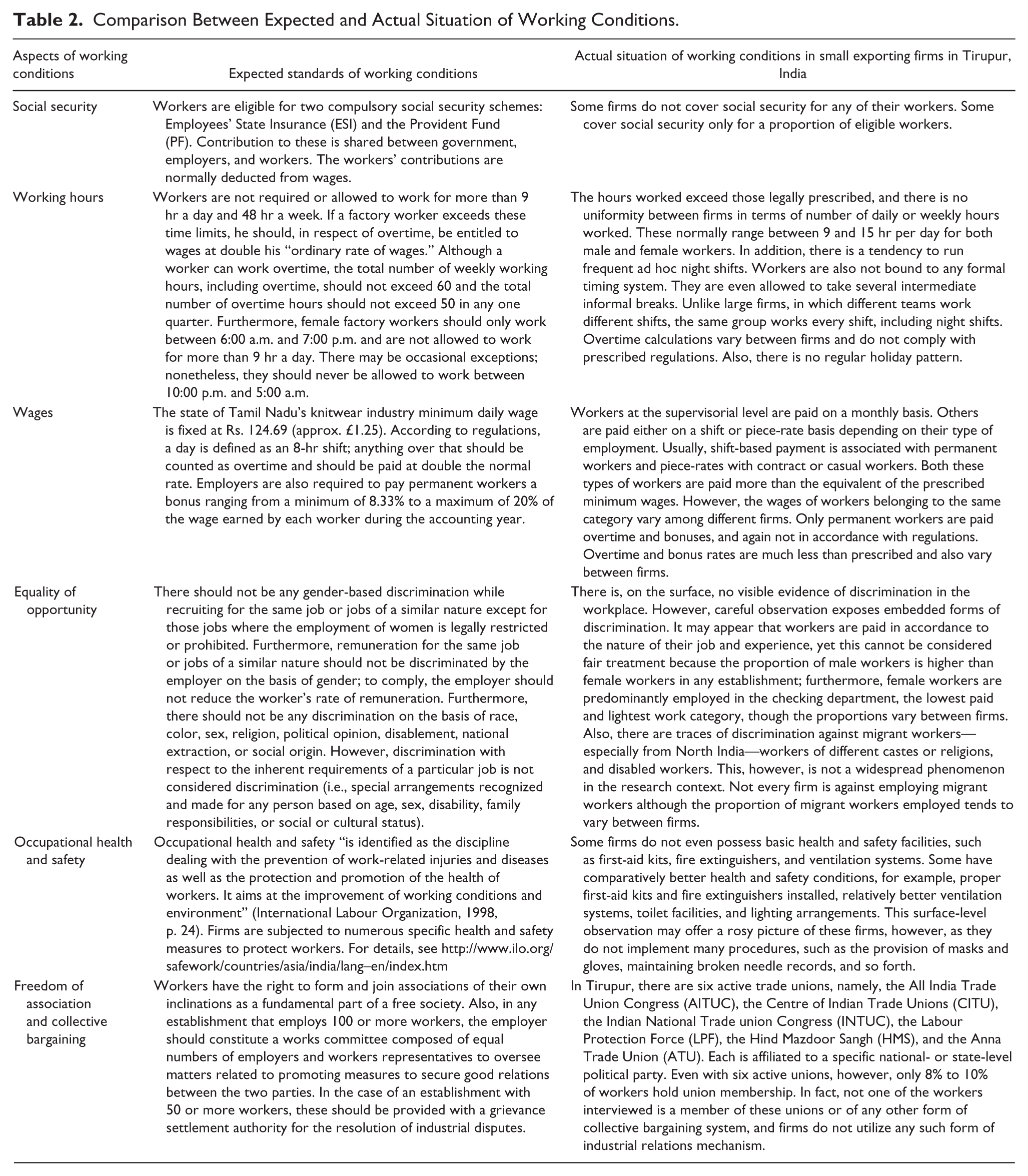
In Stage 2, we attempted to understand working conditions in the selected sample of small businesses, comparing the existing situation (drawn from interviews, observations, and conversations) with the standards (drawn from documents; Table 2). We focused on six aspects of working conditions: working hours; wages; equality of opportunity and treatment; occupational safety and health; freedom of association, collective bargaining, and industrial relations; and social security. These were selected for three reasons. First, they are discussed under different labels: working conditions, employment relations, work organization, industrial relations, people management, work environment, and ethics. Second, during the pilot study, these were the only aspects emphasized by the participants. Third, both ILO conventions and Indian labor regulations imply that improving working conditions requires a focus on these aspects. This stage helped to illuminate owner-managers’ “disrupting” institutional work, which then shaped the next stage of analysis.
Comparison Between Expected and Actual Situation of Working Conditions.
In Stage 3, we attempted to understand owner-managers’ “purposive actions” (Lawrence et al., 2011) aimed at managing institutional demands, using data collected through interviews, observations, and conversations. We searched for incidences of creative responses to demands, which resulted in an initial set of codes. The coded extracts were then interpreted and reorganized to generate first-order codes. Each first-order code was labeled, for example, “corrupt government authorities” and “use intermediaries.” These were then assessed against Patton’s (2002) two criteria for judging categories to confirm (a) they consisted of coherent data (internal homogeneity) and (b) there was a clear distinction between every potential code (external heterogeneity). Internal homogeneity was obtained by rereading the potential first-order codes multiple times to verify their coherence. Unique data extracts were then removed completely or collated with a suitable code. External heterogeneity was obtained by rereading the codes to confirm their distinctiveness from each other. All the transcripts were then reread to check whether any additional data could be collated with the existing first-order codes or whether there were any new emerging first-order codes. The first-order codes were interpreted again and collated together into theoretically relevant categories that described how owner-managers engage in disrupting institutional work to violate institutional demands, that is, “evasion” work.
Studies in institutional work—such as Karam and Jamali (2013), Lawrence and Suddaby (2006), and Marti and Mair (2009)—guided the creation of these categories. Using the same technique, in Stage 4, we analyzed the data again to understand favorable conditions for owner-managers’ “evasion” work. See Figure 2 for an illustration of the data structure. The data analysis resulted in a large amount of data extracts. Consideration was given to the embeddedness of the data extracts within the story, rather than to providing a description and filling the empirical discussions with unnecessary data extracts. To this end, a conscious attempt was made to embed them in such a way as to illustrate the narrative of the research.

Data structure and emerging framework.
Findings
The findings are organized into two sections. First, we compare actual working conditions with expected standards in the sample factories (Table 2). Second, we show how owner-managers engage in “evasion” work in response to institutional demands for improved working conditions. Third, we highlight the conditions that facilitate this work.
We compared actual working conditions with expected standards across six aspects of working conditions, namely, working hours; wages; equality of opportunity and treatment; occupational safety and health; freedom of association, collective bargaining, and industrial relations; and social security (Table 2). We found that despite institutional demands for improved working conditions from the Indian government and global buyers, working conditions in small businesses in Tirupur are rather varied, informal, and detached from institutional demands. Institutional prescriptions do not determine working conditions in the research context (de Neve, 2008), owner-managers do not follow well-defined guidelines, and everyday activities are ad hoc.
“Evasion” Work of Owner-Managers
Our data show that small suppliers attempt to resist or decouple (Jamali, Lund-Thomsen, & Khara, 2017; Meyer & Rowan, 1977; Westphal & Zajac, 2001) institutional demands by engaging in disrupting institutional work, which we refer to as “evasion” work. More often, such work is discursive (Lawrence et al., 2013), but we also found some concrete intentional disruption efforts. We found three types of “evasion” work: undermining values and assumptions, dissociating consequences, and enhancing autonomy and political strength. These types of “evasion” work are not definitive, but are what consistently emerged from the data before reaching saturation point. Moreover, it is not the case that one owner-manager consistently matches one type of work. Rather, these were discourses, identified across the broad range of data, and any single owner-manager can, and did, adopt multiple discourses in providing their accounts.
Undermining assumptions and values
Owner-managers sometimes disrupt institutional demands by undermining associated core assumptions and beliefs through contrary practices, or by employing adroit but superficial or misleading presentations of conformity, designed to create a favorable impression and to avoid any further demands. In the global supply chains literature, this work is referred to as “window-dressing” (Amazeen, 2011; Lin, 2010).
We found that some owner-managers work to corrupt government authorities who are responsible for monitoring labor regulations. Owner-managers attempt to bribe them to stop any further demands. We found corruption to be common in Tirupur. It is also a primary reason for the lack of implementation of appropriate labor standards (Belal, 2008; Olken & Pande, 2012). Owner-managers appear to use corruption as a disruption effort to escape regulative penalties:
The factory inspectors ask for this and that . . . They come and say “This is wrong, the factory is not good, the toilet is not clean . . .” and so on. They stop bothering you once you give them money and whatever else they need . . . (Owner-manager: OK)
In addition, some owner-managers attempt to undermine the foundations of monitoring institutions by grooming the factory and training workers, thus avoiding penalties from government inspectors or social auditors following inspections. Inspections should ideally be unannounced and unexpected, so as to monitor the actual maintenance of working conditions. However, owner-managers are usually informed 1 or 2 days in advance:
No sudden visits. Mostly, they inform one or two days before the visit. So that we keep the factory clean when they arrive. (Owner-manager: OA)
With this information in hand, some owner-managers prepare their workers to appear satisfactory to the inspectors. Interviews with workers are a mandatory component of government inspections and social auditing, and a strong emphasis is placed on workers’ experiences. To avoid being penalized, owner-managers coach workers and at times problematic workers are removed:
We are instructed on what to say and what not to say to the inspectors . . . We would no longer be working for the company if we failed to cooperate. (Worker: W16)
Besides preparing their factories and workers, some owner-managers keep fake records or double records (as owner-managers refer to them)—that is, a falsified record of inspections and the original record for their own purposes—again to escape penalties. For example, inspections of working hours, wages, and social security are based upon information presented in the records, which are normally maintained by owner-managers:
Only 30% of my workers are covered by social security schemes such as ESI and PF . . . So, in order to deceive inspections, I prepare double records . . . (Owner-manager: OB)
Furthermore, some owner-managers attempt to undermine the values and assumptions of monitoring institutions by providing falsified versions of valuation documents that legally define the size of the firm, misrepresenting a larger firm as a small firm. As the definition of small and medium firms in India is based upon investments in plant and machinery, owner-managers tend to exploit variations in real-estate value and resort to corrupt authorities to develop such falsified documents:
I see this every day . . . Factory evaluation documents can be easily tailored. (CSR officer: CSR1)
By appearing, on paper, to be in charge of a small business, an owner-manager can disregard legal obligations only applicable to large firms, and enjoy the benefits associated with running small firms in India.
Some owner-managers also operate multiple units (or firms) registered under different ownerships. Here, the owner-manager is the investor, but registers some units in the names of trusted friends and family members. In this way, some of the units are separated from the owner-managers’ legal obligations, perhaps allowing them to showcase just one unit with better working conditions to attract buyers. For example, it was found that owner-manager OA legally owns a unit certified by Sedex and BSCI but controls another noncertified unit registered in the name of one of his cousins. Although production activities are often swapped between these two units, only the certified one is made known to buyers. Other respondents also confirmed such practices:
There will be multiple factories with different names. Out of these, the owner will only have obtained certifications for one small factory with 50 seats or so. He will show only that factory to the outside world. This is how it is done here . . . (Buying agent: BA2)
In sum, we found owner-managers, to avoid penalties, attempt to disrupt institutional demands by engaging in a variety of practices that undermine the core assumptions and values of those institutions.
Dissociating consequences
In the process of managing standardization demands from monitoring institutions, owner-managers dissociate the consequences of their planned or accomplished actions so as to defend or restrict the harmful effects of disrupting monitoring institutions. This disruption work is often performed by creating a negative image of actors associated with such institutions, or by carefully suppressing the negative aspects and emphasizing the positive aspects of their actions. This eventually results in redirecting the public away from the consequences of owner-mangers’ disruptive actions, thus “lowering in some way the impact of those social controls on non-compliance” (Lawrence & Suddaby, 2006, p. 238).
Some owner-managers work to emphasize the nonoccurrence of harmful effects to dissociate the consequences of their disruptive activities. According to them, their actions are acceptable as long as no one is harmed. For example, health and safety conditions in some firms are clearly substandard. Lighting and ventilation are inadequate. Employees work without shirts because of the heat and to avoid excessive sweating. Owner-managers are aware of such conditions, but are not willing to accept them as improper or immoral, defending them on the basis that no one has so far been harmed. When asked about first-aid facilities, one owner-manager said,
We don’t have first-aid facilities. We have a fire extinguisher but, unlike large units, we do not provide training for handling it . . . We are not prone to big accidents. No accident has happened yet . . . Workers have not asked for anything so far. (Owner-manager: OF)
In addition, owner-managers will create a negative image of actors associated with institutional demands so as to demonize their normative foundations. Some work to demonstrate that they are not in control of their own actions or are often pressurized to engage in certain activities. For example, every owner-manager interviewed stated that while the government tries to behave responsibly toward workers, it behaves irresponsibly toward employers. Owner-managers tend to link their nonconformity to the nature of the government in two ways: first, by stating that the government does not appreciative contemporary changes in the field of garment manufacturing, and that higher production costs mean they cannot spend more on adequate working conditions; and, second, by claiming that government policies do not address the real needs of workers, and investment in working conditions is neither mandatory nor useful. For instance, one owner-manager said,
There is not one politician in India who is concerned with worker welfare . . . We would be willing to do business according to standards, provided the government supported us with the necessary infrastructure. When even they don’t care about this, they just can’t expect us to. (Owner-manager: OF)
Owner-managers also demonize buyers by claiming they are two-faced, showing one face to the public and another to suppliers. They argue that, while attempting to appear publicly as socially responsible—by marketing their responsible sourcing activities, as symbolized by social standard certifications such as BSCI and SA8000—buyers pressurize suppliers to combine prompt delivery, high quality, and low cost. Therefore it is impossible for suppliers to align their business practices with institutional demands:
They [the buyers] don’t understand our situation. They don’t care about anything we say. All they are interested in is that their stuff is delivered on time and with the required quality . . . They don’t compromise on anything. They want us to have all these certifications but, to get them would cost us money, right? So, this would automatically result in an increase in production costs, which they are not willing to pay. They don’t compromise on the price either. So, eventually, I have to rework costing to meet their prices by altering every process . . . This, of course, reflects on what I can provide for my workers. (Owner-manager: OB)
Over time, these negative representations of government and buyers become the norm, such that even genuine development efforts are often met with distrust. In sum, we found owner-managers attempt to disrupt institutions by creating a negative image of associated actors, or by prudently overemphasizing the positive aspects of their actions.
Accumulating autonomy and political strength
Owner-managers’ “evasion” work also entails accumulating autonomy and political strength to simplify disruption efforts, often involving removing troublemakers or adversaries. In doing so, they no longer need to conform to, or be concerned about further, demands regarding the standardization of working conditions.
Some owner-managers remove troublesome workers during social audits. As mentioned, interviewing workers is a mandatory part of the social auditing process. Auditors ask workers about how they are treated and the nature of working conditions. Some are submissive and tend not to speak out against their owner-managers, but, as a precautionary measure, owner-managers will terminate the employment of those whom they perceive might be a threat to a successful audit:
They know that they cannot stop me from opening-up during such audits. That is why I was actually removed from my previous company. They asked me to go back after the audit, but I refused. Now I’m doing contract work . . . This situation is normal in Tirupur. (Worker: W16)
In addition, owner-managers try to get rid of demanding buyers or buying agents. Some buyers and agents stress the need for social standards certifications and/or compliance with codes of conduct, sometimes as a requirement for placing a production order. However, not every buyer or agent does this, so owner-managers will detach themselves from those whom they perceive to be too demanding. They will terminate trade relationships with those buyers or agents who insist on maintaining appropriate working conditions and move to less demanding ones. As a trade union leader noted,
There are numerous options available for them [small suppliers] to work with. They can carefully select the buyers based on the requirements and their capability to meet such requirements. (Trade union leader: TU1)
To further enhance autonomy and political strength, owner-managers form or associate themselves with certain groups based upon attributes associated with their background or with social stratification criteria, such as religion and caste. For example, there is a growing population of workers from North India in Tirupur. Although some owner-managers do not want to employ them, pointing to linguistic differences, others are increasingly in favor of employing them, and take advantage of their perceived passive, detached, and vulnerable nature, thus avoiding pressure from local workers.
In addition, some owner-managers use religious or caste affiliation as a tool to enhance their autonomy. The traditional stratification of Hindu society is a hierarchy of hereditary groups called “castes” or “jatis” (Dirks, 2011). Caste is determined by birth and, historically, each caste is linked to an occupation. In practice, Hindu society includes large numbers of castes, generally of a local or regional nature. Each has its own philosophical agenda, history, values, and customs (Dirks, 2011). Around 90% in Tirupur are Hindus, belonging to a wide array of castes. Some owner-managers prefer to employ workers who belong to their own religion and/or caste to create a group sympathetic to their often business-centric decisions, perceiving these affiliations as a symbol of trustworthiness. Furthermore, in terms of their close circle of workers, they prefer to employ those from their own caste and believe this will help prevent workers from speaking out against them:
Personally, I feel that my close circle of workers should be from my own caste. It is better because I very often meet their families. When I give them some financial freedom, I should be able to feel that I can trust them. If they are from my caste, I know that they will not fail to live up to my trust. (Owner-manager: OB) When it comes to my close circle of workers, I employ only Hindus. I do not employ Christians or Muslims because their way of working is different from ours. Moreover, I want to keep my workers under my control. (Owner-manager: OJ)
Furthermore, intermediaries such as buying agents are used by owner-managers to gain autonomy and political strength. Intermediaries are said to offer “more business opportunities,” a “low-level of risk,” and “require less investment.” Although intermediaries work for both parties, they belong to the context of the owner-managers, providing scope for owner-managers to gain their sympathy and some leeway concerning the maintenance of working conditions:
We source through buying agents. They are like our partners. We can’t do business without them. Even they can’t do business without us. They don’t put a lot of pressure on us for compliance [with respect to demands for working conditions]. They request us to show minimum compliance. But, they will be very strict with quality and time. They will get angry otherwise. (Owner-manager: OD)
In sum, we found owner-managers disrupt institutions by enhancing their power using a variety of elimination strategies.
Favorable Conditions for Owner-Managers’ “Evasion” Work
Having illustrated how owner-managers engage in “evasion” work, we now discuss three conditions that favor such work: void (in labor welfare mechanisms), contradictions (between value systems), and distance (from institutional monitors).
“Void” in labor welfare mechanisms
In Tirupur, regulatory systems and enforcing mechanisms that facilitate improvements in working conditions are either absent, premature, or not functioning as expected because of infrastructural gaps and corruption. Since the 1970s and the growth of subcontracting-based firms, trade unionism has drastically declined. During the recent post-Multi-Fiber Agreement (MFA) era of economic liberalization of the textile and garment sector, freedom of association and collective bargaining have come under further heavy strain. There are six active trade unions: the All India Trade Union Congress (AITUC), the Centre of Indian Trade Unions (CITU), the Indian National Trade Union Congress (INTUC), the Labour Protection Force (LPF), the Hind Mazdoor Sangh (HMS), and the Anna Trade Union (ATU). However, only 8% to 10% of workers are union members. Most workers consider unions to be unnecessary or unhelpful:
I have never visited unions in my life. They don’t have a good image now in Tirupur. 10 to 20 years back, communist unions were really famous. People really believed that communists will bring real changes into the lives of workers. But, nothing changed yet. There are some improvements in how we are treated, but it is not because of them. Now, unions are corrupted. All they want is money . . . money . . . We are tired of such people. Why should we give them money? Instead, we can solve things ourselves. (Worker: W21)
Moreover, unlike large firms, these small exporters do not have any collective bargaining arrangements. In fact, not one of the workers interviewed is a member of a trade union. Workers are fragmented and have no representation or collective voice, and so rely on informal problem solving mechanisms such as direct discussion with owner-managers. This gives owner-managers a high degree of control over their workers and extensive scope to engage in “evasion” work.
“Contradictions” between value systems
Contradictions are evident between the values and beliefs underpinning local ways of organizing working conditions and formal bureaucratic prescriptions. For example, language, gender, and caste play a major role in employment decisions in the research context. These favor those who can speak Tamil and male workers, who are predominantly employed in the highly technical and value-added parts of the production process, whereas migrant and female workers are mostly employed in low paid, simple processes:
Both [male and female workers] are doing [checking] in large units. But when you take small units, only female workers are employed in the checking department. It has been like this since the beginning of knitwear production in Tirupur. (Worker: W19) When you look at it from the outside, there is no discrimination in Tirupur. But, when you go inside and look, you can find differences in the payment systems, interactions, support systems, bonuses, and so on between local and North-Indian workers, between people of different castes, and so on. (CSR officer: CSR1)
These language, gender, and caste-based practices are taken for granted in the research context, reducing the effort required to engage in “evasion” work.
Furthermore, owner-managers’ attitudes toward their workers consist of a mixture of authority and responsibility. The demands and expectations of various actors—government, buyers, workers—are seen as inappropriate or irrelevant, as they believe they are the only ones who completely understand their workers’ needs. They tend to assume the role of a “father figure” (in practice they are all male), and this paternalism increases their resistance to any external intrusion into their relationship with their workers. Employees’ attitudes enhance this, and are closely linked to the philosophy of Nishkam Karma, which advocates working earnestly without worrying about the outcome (Saini & Budhwar, 2008). In addition, workers’ education and skill levels are normally low, and they are financially vulnerable, and are hence inclined to look upon owner-managers as symbols of authority and providers of sustenance.
Under such conditions, it is difficult for workers to act against owner-managers. For example, one worker said,
We get a relatively good salary in Tirupur, and we get continuous work, so I came here . . . The situation here is better than it is at home . . . If I made too many demands, I would have to go back. (Worker: W4)
Owner-managers are aware of this, and will use workers’ emotional and economic dependency to ensure compliance and avoid conflict. Traditional ways of organizing thus act as a cultural-cognitive framework through which individual interests are defined, negotiated, and contested. This is not only a subjective belief system but also a symbolic one perceived to be objective and independent. Local practices encapsulate the local license to practice and can be an objective tool supporting owner-managers and facilitating their “evasion” work.
“Distance” from institutional monitors
The final condition that favors “evasion” work relates to the physical distance between regulators and suppliers, and the size of firms. Exporting firms process small production orders and are located at the bottom of the supply chain. Intermediaries, such as large exporters or agents, who are the main customers of these firms, are not even aware of the final buyers and their expectations. Also, the intermediaries tend not to explicitly declare most of these small firms to their customers—that is, the global buyers—to protect themselves from penalties, thus providing the firms themselves with further scope to avoid scrutiny. Local firms are de facto hidden in the supply chain, and their workers are “hidden hands” in the making of valuable garments. In addition, these firms experience high pressure for timely delivery and quality, and see lower profits, and their main concern is to meet deadlines and quality requirements, rather than maintain adequate working conditions. When asked about the lack of in-house first-aid facilities, one of the workers said “. . . that is how our work is. We have a heavy workload and cannot set them up. We do not have the time to set them up” (Worker: W26). This allows owner-managers to hide discrepancies from their global buyers and consequently avoid sanctions.
Discussion
We have examined how small businesses in developing countries that are part of global supply chains respond to institutional demands for improved working conditions. Our data suggest they do so by engaging in “evasion” institutional work, taking three forms: undermining values and assumptions, dissociating consequences, and enhancing autonomy and political strength. We found three favorable conditions for this work: void (in labor welfare mechanisms), contradictions (between value systems), and distance (from institutional monitors). Through these insights, the article contributes to research on both small business social irresponsibility in developing countries and institutional work.
Small Business Social Irresponsibility in Developing Countries
Our study shows the pertinent issues that arise when standards or regulations developed for large and/or Western firms are considered as benchmarks for effective SBSR initiatives in developing countries. It is a misconception that such frameworks unproblematically help to improve working conditions (Lund-Thomsen & Nadvi, 2010). Moreover, they are often not sector- or firm-oriented and are geared toward dealing with a particular type of issue, resulting in conflicting messages to different types of firms in different sectors. Indian labor regulations, for example, prescribe generalized standards for working conditions for different sectors. There is also a definitional problem in these generalized regulations, which might obstruct their implementation. Indian small businesses are defined in terms of investment in plant and machinery, while regulations differentiate firms based on number of employees. Thus, every type of garment exporter is treated equally. The CSR programs’ standards, which often are based on local regulations, ILO conventions, and Western ideas of responsible business practices, also adopt an oversimplified, nondiscriminatory strategy.
The case of Tirupur small garment exporters illustrates the consequences of such conflicting and inappropriate prescriptions. Institutional demands put small suppliers at a disadvantage as they lack the infrastructure, technology, finance, skills, and resources to implement costly social responsibility initiatives. Such firms are interconnected and influenced by the actions of others in their network (Spence, 2016) and are not always passive respondents to institutional demands, as early institutional theory (Powell & DiMaggio, 1991) posited. They do whatever it takes to survive when they are pressurized, and make skillful use of local contextual facilitators.
The “evasion” work undertaken by owner-managers also highlights a disparity between reported working conditions and their implementation. The mechanized record-based auditing that Bendell (2005) refers to as “positivist” and “tick-box techniques” offers various opportunities for firms to separate their actual from their “showcase” activities. Institutional demands thereby become per se a motive for small suppliers’ conscious and, at times, unintentional involvement in “evasion” work. We need to recognize differences in work organization between small and large firms, and the varying contexts in which they are located. This is widely discussed in the “critical CSR” literature (Idemudia, 2011; Prieto-Carrón et al., 2006), which casts doubt on the appropriateness of generalized and Western socially responsible practices, frameworks, and standards to small businesses in Southern countries.
Our findings also show that although Indian small businesses are not so different from those of developed countries in terms of their organizational structures, contextual influences vary, and the nuances of context are crucial (Jamali, Lund-Thomsen, & Khara, 2017; Matten & Moon, 2008). Corruption, for example, may exist in both contexts, but its intrusion into individuals’ everyday lives will vary. In India, bribes are used in instances ranging from obtaining a birth certificate or a driving license to, literally, getting away with murder. In the research on Western small businesses (Spence, 2007, 2016), paternalistic culture is highlighted as a positive aspect leading to a more harmonious and close-knit family-style environment, and hence to healthier communication, greater flexibility, and lower levels of conflict. In Tirupur small businesses, the notion of paternalism takes the form of mild authoritarianism, where owner-managers attempt to control their workers and take advantage of their resource and emotional dependency. As Ram (2001) argues, the internal dynamics of small businesses are not merely shaped by owner-managers’ entrepreneurialism and social relationships but evolve based on external demands and constraints imposed by the product market, workers, technology, and modes of work organization.
Although our data relate to one part of India, our theoretical contribution has wider applicability. In Figure 2, we identify the particular contextual conditions of gaps in social systems, distance from institutional monitors, and contradictions between standards and local value systems. But we have also shown the power of owner-managers’ agency, and how their seemingly mundane everyday practices can, in the first instance, violate institutional demands for improved working conditions and, more substantively, enable “evasion” work that effectively undermines assumptions and values, disassociates consequences, and enables the accumulation of autonomy and political strength. In short, we have helped to explain the failure of national regulations and CSR standards to improve working conditions in small businesses in developing countries. New tools may be needed, which acknowledge “implicit” (Matten & Moon, 2008) and “informal” (Murillo & Lozano, 2006) social practices, and “a different vocabulary and approach rooted in the empirical reality of the small business context is necessary” (Spence, 2007, p. 534).
One could ask, “Is the ‘evasion work’ of Tirupur owner-managers necessarily always irresponsible or unethical?” Our answer is—arguably, yes. While regulations and standards that impose inappropriate or unrealistic demands may drive Tirupur owner-managers to engage in irresponsible behavior, the most affected party in this interaction is the worker. Perceiving demands as inappropriate or unrealistic cannot be a justification for moral disengagement and the dehumanization of workers.
Institutional Work
The article has introduced a new form of disrupting institutional work called “evasion” work. This is irresponsible or unethical in nature and so deviates from the positive ways in which disrupting institutional work has been portrayed in the literature (Karam & Jamali, 2013; Lawrence & Suddaby, 2006; Marti & Mair, 2009). Furthermore, we expand Lawrence and Suddaby’s (2006) three categories of disrupting institutional work by adding new forms to one of their categories—undermining assumptions and beliefs/values. Lawrence and Suddaby mention two forms—“innovation” and “contrary practice”—through which individuals can undermine assumptions and values. We show that this can also be done through unethical practices such as corruption, fake record-keeping, and so on, aimed at creating a superficial setting depicting compliance. Furthermore, we expand the categories of disrupting work by introducing two new ones—“dissociating consequences” and “accumulating autonomy and political strength.” All these forms of disrupting work, under the umbrella of “evasion” work, are new to research on institutional work in general, which normally focuses on the work of powerful and resourceful actors, as well as to research on resource dependent individuals in particular (Karam & Jamali, 2013; Marti & Mair, 2009), which normally focuses on disrupting work for positive developmental change. In sum, we address Lawrence and Suddaby’s call for more research on the disrupting work of different types of actors within different types of context.
Second, by offering concrete descriptions of Tirupur owner-mangers’ “evasion” work, we generate a rich and detailed addition to the literature on how resource dependent and marginal individuals can and do engage in disrupting institutional work and realize their interests (Karam & Jamali, 2013; Marti & Mair, 2009). We show that owner-managers exploit cracks and loopholes in the institutional structure to construct meaningful selves and achieve some sovereignty when facing institutional demands. Although resource dependent, they still take advantage of voids in institutions, their physical distance from buyers, and local conventions of work organization to realize their interests by using their social, political, and cultural skills instead of more tangible resources. To disrupt existing institutional arrangements, an individual thus does not need to be a powerful, resourceful, centrally positioned, or professional elite, as suggested in the literature (Greenwood & Suddaby, 2006; Suddaby & Viale, 2011). Lacking these attributes can be overcome if an individual is a “skilled actor” (Garud et al., 2007) and makes effective use of contextual conditions.
In arguing, thus, we challenge the traditional characterization of small business owner-managers as resource dependent, and suggest that a wider understanding of “resources” is required. Resources need not always be physical and quantifiable. Owner-managers act upon the “opportunity spaces” (Mair & Marti, 2009) offered by the institutional, social, and political settings on which they depend. To date, there is limited research on the concept of embedded opportunities (Baker, Gedajlovic, & Lubatkin, 2005; Phillips & Tracey, 2007), but given its centrality to small business and entrepreneurship, more research on the connection between embedded opportunities and institutional work is needed (Mair & Marti, 2009). Especially in small business research, there is still a need to adequately understand the multifaceted nature of “resources” and the strategies that individuals use to deploy them.
Finally, while field-level analysis is dominant in institutional theory, most research has focused on stable fields such as professional organizations in the developed world (Marti & Mair, 2009). In contrast, we address the institutional work of resource dependent individuals in the knitwear garment industry in India, a less common, stable, and advanced field of research. This captures new forms of institutional work as well as variations in established forms. We also contribute to broader contemporary institutional theory (Garud et al., 2007; Maguire et al., 2004; Pache & Santos, 2013) by reaffirming that, although institutions and organizations define higher order constraints, they do not always succeed in restricting individual agency by imposing those constraints; instead, at times, they allow the unfolding of the “idiosyncrasies of individual agency” and the deployment of their capabilities (Mutch, 2007).
Limitations and Suggestions for Future Research
This study is not without its limitations. The first concerns the interpretation and presentation of the empirical findings. The list of owner-managers’ “evasion” work and favorable conditions is not definitive. While the empirical findings are based on respondents’ interpretations and subjective meanings, the researcher (here, the first author) was also a part of what was being observed, and his subjective frames of reference will have influenced the data interpretation. There is always scope for future research to expand and/or challenge the responses, approaches, and favorable conditions presented.
A second limitation concerns generalizability. The study concentrates on a specific sector in a well-defined region of the country, and the representativeness of data collected from such a small, concentrated group of participants can be challenged. However, the research aims at achieving rigorous analytical, rather than statistical, generalization. We achieve this through data as well as method triangulation. Nevertheless, future research might expand and/or challenge these findings by examining different sectors and/or geographical contexts.
Likewise, the generalization of the findings across different elements of working conditions can also be challenged. Dutton, Ashford, Lawrence, and Miner-Rubino (2002) argue that the institutional environment might change for different aspects of a particular issue. Accordingly, the level of owner-manager agency and type of institutional work may diverge based on variations in the issue-specific institutional environment. Future research could dig deeper to examine links between issue, institutional environment, agency, and work associated with the organization of social responsibility. It would also be useful to reconsider the role of standards as so much emphasis is put on these as a means to achieve supply chain social responsibility, with rather less attention given to the appropriateness of standards to small suppliers in developing countries.
Concluding Remarks
The article serves to demonstrate that the bias toward research on large Western multinational corporations in the fields of ethics, business, and society leaves important practice and conceptual perspectives unexplored. It deals in somewhat unfashionable scholarly topics—small firms’ internal practices, highly contextualized in a single industry and region, and in a location often dismissed as lacking global relevance. Yet, from an economic, political, and policy standpoint, the attention paid to the Brazil, Russia, India, and China (BRIC countries) as new markets and global powers, with India home for a sixth of the world’s population, could hardly be more relevant. Similarly, it is small firms that are the focus of contemporary debates and government investment in innovation and job creation. The working conditions of the people that manufacture products heavily consumed in the West are a matter of intense public concern although this concern is often outweighed by the desire for cheaper and cheaper goods.
The article has practical implications by showing how the seemingly endless drive for standardization in production practices, although it may represent a genuine desire for positive social impact and provide multinationals with laudable content for their social reports, should not be considered a universal solution. In this regard, our evidence of “evasion” work raises a moral perspective, which goes beyond the scope of this article, but could be further explored elsewhere, particularly in terms of universal and relative ethics. While it is perhaps not news to say that such evasion occurs, we have shown the conditions under which it does so, and we anticipate this will add considerably to scholarly and practical debates on corporate and SBSR in a global context.
Finally, we return to our observation that the role of small businesses has tended to be dismissed as somewhat passive within global supply chains. Our article demonstrates that this leads to a narrow, and ultimately flawed, vision of the processes at play when production is distributed around the world with many and varied tiers of suppliers. Small businesses in developing countries influence the social responsibility of the supply chain in more active and complex ways than has hitherto been understood, and our research hence poses a challenge to researchers in this field: Without understanding the institutional work that takes place in small suppliers in developing countries, we cannot properly understand global supply chains.
Footnotes
Acknowledgements
We thank three anonymous reviewers and coeditor Andrew Crane for extremely useful comments on this article.
Declaration of Conflicting Interests
The authors declared no potential conflicts of interest with respect to the research, authorship, and/or publication of this article.
Funding
The authors received no financial support for the research, authorship, and/or publication of this article.