




Abstract
Based on a study of the oil and gas industry, this article examines how physical impacts of climate change become events that firms notice and interpret in a way that leads to an active response to adapt to these impacts. Theoretically, the study draws on the attention-based view to highlight the potential biases that might occur as a consequence of firms’ preconceptions as well as organizational structure and context. In the empirical analysis, the article derives a model that explains the influence of the attentional process on how awareness and perceived vulnerability lead firms to adopt either routine or non-routine measures to adapt to climate change. The article also explores the relevant underlying factors of awareness and perceived vulnerability. The findings suggest that how firms channel attention to climate events has a distinctive influence on the measures firms take to cope with physical impacts. The article concludes with implications for research, management practice, and policy makers.
While until now the scientific and political discourse on the need to adapt to climate change’s physical impacts has been taking a backseat, with the recent Paris Agreement on climate change of December 2015, adaptation has finally achieved equal footing with the need for mitigation. In the development of the global agreement on climate change, countries no longer just developed plans to reduce greenhouse gas (GHG) emissions but also set out how they would adapt to physical impacts (Mogelgaard, McGray, & Amerasinghe, 2015; United Nations Framework Convention on Climate Change, 2015). Besides affecting countries, physical impacts can also pose major challenges to firms. Such impacts lead to changes in the business environment (Weinhofer & Busch, 2013), leaving firms vulnerable when they are not able to cope with these changes (Busch, 2011; O’Brien, Eriksen, Nygaard, & Schjolden, 2007). Particularly vulnerable are sectors that rely on specific temperatures and seasonal conditions, such as agriculture, forestry, and tourism; have industrial facilities located in climate-sensitive areas, such as coastal areas and floodplains (Intergovernmental Panel on Climate Change [IPCC], 2007); or depend on large-scale infrastructures (IPCC, 2012), such as energy, automotive, and transportation sectors (Winn, Kirchgeorg, Griffiths, Linnenluecke, & Günther, 2011). Vulnerability can be reduced if firms adapt to impacts by implementing anticipatory adjustments or by seeking to absorb and recover from extreme weather and climate events (Linnenluecke, Griffiths, & Winn, 2012).
A perspective considering firms as vulnerable to climate change, instead of responsible for climate change, is still fairly novel (Berkhout, 2012; Linnenluecke & Griffiths, 2010; Tashman, Winn, & Rivera, 2015). As existing research has shown, firms have mainly focused on their role with respect to mitigation in terms of reducing GHG emissions, responding to climate policy, and creating business opportunities related to both (Pinkse & Kolk, 2009). Corporate adaptation to climate change is less well understood, in part because firms have not addressed adaptation to the same extent as policy makers and scientists have (Linnenluecke & Griffiths, 2010; Pinkse & Kolk, 2012; Sussman & Freed, 2008; Tashman et al., 2015). Nonetheless, recent anecdotal evidence suggests that business’ efforts to respond to so-called “adaptation emergencies” that are the result of extreme weather events are increasing rapidly (Caring for Climate, 2015; Hall, Berkhout, & Douglas, 2015). Recently, also a new stream of literature has emerged that sheds light on corporate adaptation strategies through conceptual frameworks based on organization theory (Linnenluecke & Griffiths, 2010; Linnenluecke et al., 2012; Winn et al., 2011) and empirical work within specific industries (Beermann, 2011; Busch, 2011; Galbreath, 2011; Haigh & Griffiths, 2012; Hertin, Berkhout, Gann, & Barlow, 2003; Hoffmann, Sprengel, Ziegler, Kolb, & Abegg, 2009; Linnenluecke, Stathakis, & Griffiths, 2011; Scott & McBoyle, 2007; Tashman & Rivera, 2016; Weinhofer & Busch, 2013). These studies identified factors that influence corporate adaptation strategies, for example, awareness of climate-related physical threats, degree of uncertainty, and risk management capabilities (Busch, 2011; Hertin et al., 2003; Hoffmann et al., 2009; Tashman & Rivera, 2016), and presented models of adaptation strategies (Berkhout, Hertin, & Gann, 2006; Linnenluecke et al., 2012).
As this literature suggests, corporate adaptation is a difficult process for firms to tackle and for scholars to understand (Berkhout, 2012). Not much is known about why firms notice and act upon certain stimuli and ignore others. Part of the problem is that climate stimuli are ubiquitous:
[s]ometimes the stimuli for adaptations are expressed as climate or weather conditions (e.g., annual average precipitation or experienced hourly or daily precipitation), sometimes as the ecological effects or human impacts of the climatic conditions (e.g., drought, crop failure, or income loss), and increasingly as the risks and perceptions of risks associated with climatic stimuli or the opportunities created by changing conditions. (Smit, Burton, Klein, & Wandel, 2000, p. 229)
Moreover, given the business-as-usual nature of many stimuli (e.g., weather conditions), firms will already have organizational processes to deal with (some of) them. What is not clear, therefore, is which stimuli firms notice given the multiplicity of potential impacts (Berkhout, 2012), and whether firms perceive physical climate impacts as a unique problem in need of a tailored solution, or as a business-as-usual problem for which existing practices suffice (Winn et al., 2011).
This article examines the adaptation process and how firms select between alternative stimuli and decide how much effort to spend on developing a response for those stimuli they choose to act on. Insight into this process is important because climate stimuli are notorious for their impact to be underestimated (Hulme, 2009). Consequently, climate change has been referred to as a predictable surprise: “an event or set of events that catch an organization off-guard, despite leaders’ prior awareness of all of the information necessary to anticipate the events and their consequences” (Bazerman, 2006, p. 180). What motivates this article is the question whether a firm’s chance to fall victim to such a surprise can be inferred from how a firm deals with external stimuli for which the potential business impact is still highly uncertain. From a societal point of view, understanding how firms deal with climate-induced physical impacts is relevant as well. If firms fail to adapt, they might no longer be able to provide products and services for society. Neglect of relevant stimuli on their part might thus imperil the functioning of the societies firms serve (Surminski, 2013; Winn & Pogutz, 2013).
As a theoretical foundation, we apply the attention-based view of the firm (ABV) that sheds light on how firms select between stimuli and decide how to respond to the selected stimuli (Kahneman, 1973; Ocasio, 1997, 2011). Attention has been defined as the process of noticing, interpreting, and allocating effort to “stimuli requiring action and the available repertoire which define that action” (Hoffman & Ocasio, 2001, p. 415; Kahneman, 1973; Ocasio, 1997). ABV emphasizes the influence of the organizational structure and context in channeling attention to certain stimuli and not to others (Nigam & Ocasio, 2010; Ocasio, 2011; Rerup, 2009). The attentional process refers to the mechanism of not only noticing and interpreting stimuli to select those that require action but also allocating effort to the selected stimuli to be able to define available responses for subsequent action (Kahneman, 1973; Ocasio, 1997, 2011).
To empirically examine the influence of a firm’s attentional process on adaptation to climate-related physical changes, we focus on the global oil and gas industry. This industry is particularly sensitive to physical changes due to its reliance on natural resources such as water supply, the fact that operations are located in geographic areas exposed to extremes, a high dependence on large-scale infrastructures, and its long-lived and relatively immobile capital assets. Using information from the Carbon Disclosure Project (CDP), we first explore which factors determine whether oil and gas firms notice climate stimuli and build up a state of awareness of physical impacts. We then investigate how firms interpret their vulnerability to these stimuli and subsequently develop a response repertoire of adaptation measures. Based on the analysis, we develop a model on the role of attention in corporate adaptation to climate change. The model explains how the process of noticing and interpreting of climate stimuli changes under the influence of structural and contextual factors, which in turn leads to different levels of effort firms put in developing adaptation measures, that is, either relying on existing practices (routine response) or tailored to the stimuli (non-routine response).
Literature Review
Awareness and Vulnerability Regarding Climate Stimuli
Firms are seen as important actors in mobilizing society to adapt to physical impacts of climate change (Berkhout, 2012). What is not clear, though, is why firms would take on such a role. Up to now, firms have either been known as fairly negligent of adaptation to climate change (Linnenluecke & Griffiths, 2010; Pinkse & Kolk, 2012; Sussman & Freed, 2008), have been taken by surprise by extreme weather events (Haigh & Griffiths, 2012), or have not considered adaptation measures as a specific response to climate change (Galbreath, 2014). Besides, adaptation to climate-induced physical changes could be delicate for firms. Adaptation calls into question firms’ relation with the ecosystems they are embedded in and depend on for (natural) resources (Whiteman, Walker, & Perego, 2013). Adaptation is also highly complex, not only due to the novelty of the issue but also due to the great number of factors related to weather and climate events and their underlying dimensions (e.g., time, magnitude, location, predictability, etc.) that need consideration (Winn et al., 2011). Moreover, the science of climate change has not been accepted unequivocally; the science is still heavily debated between those that seem convinced by scientific findings about climate change and those that remain skeptical (Hoffman, 2011). Even if firms seem overwhelmed by direct climate stimuli from weather-related disasters or indirect stimuli from stakeholder pressure, press coverage, and external suppliers’ difficulties due to climate change (Berkhout et al., 2006; Tashman et al., 2015; Winn et al., 2011), there is no guarantee that they will take note of and act upon these stimuli (Bansal, 2003; Hoffman & Ocasio, 2001).
The corporate adaptation literature has highlighted two factors—awareness and vulnerability—to explain why certain firms respond to climate stimuli while others fail to do so (Tashman et al., 2015). The first factor is the awareness of climate stimuli (Arnell & Delaney, 2006; Berkhout et al., 2006; Bleda & Shackley, 2008; Hertin et al., 2003; Hoffmann et al., 2009). Arnell and Delaney (2006) maintain that “before an organisation embarks on adaptation it must be first aware of the potential threat of climate change, and second concerned about potential impacts on its business” (p. 229). In a study on ski resorts, Hoffmann et al. (2009) found that awareness has a positive impact on corporate adaptation measures. Ski resorts pursue more diverse adaptation measures the more they are aware of physical climate impacts. These findings suggest that awareness affects the scope of adaptation measures. However, firms can only build up awareness when they have the organizational processes in place to notice a broad set of climate stimuli.
The second factor that influences adaptation measures is vulnerability (Hertin et al., 2003; Hoffmann et al., 2009). Vulnerability has been defined as the degree to which firms fail to cope with climate-related disruptions in the natural environment (O’Brien et al., 2007). In a study of Australian firms, Linnenluecke, Griffiths, and Mumby (2015) found, for example, that their perceived vulnerability was an important mediator between managers’ use of scientific information about climate change and their perceived need to take action to adapt to physical impacts. Although there are different understandings of vulnerability, we follow what has been referred to as contextual vulnerability. Contextual vulnerability views the relationship between nature and society as mutually determined, instead of a one-directional impact of the environment on society. As O’Brien and colleagues (2007) explain, “[contextual vulnerability] is considered to be influenced not only by changing biophysical conditions, but by dynamic social, economic, political, institutional and technological structures and processes; i.e. contextual conditions” (p. 76). How firms assess their vulnerability depends not only on objective biophysical features of climate stimuli, such as the frequency of extreme weather events, but also on more subjective socio-economic features (Linnenluecke & Griffiths, 2010). That is, vulnerability depends on how firms perceive the relevant time frame, urgency, and controllability of physical impacts (American Psychological Association, 2009).
An Attentional Perspective on the Corporate Adaptation Process
Although the literature has referred to awareness and vulnerability as key factors for adaptation, how firms achieve awareness and assess vulnerability to climate-induced physical changes is less well understood. In the following, we show how insights from ABV shed light on this process. As explained in the introduction, ABV refers to the attentional process of noticing and interpreting to select which stimuli to take action on and to decide with how much effort to do so (Kahneman, 1973; Ocasio, 1997). What is key to Ocasio’s view on attention is that he refers not only to attention in terms of whether stimuli are being noticed but also to how stimuli are being interpreted because “interpretation of stimuli greatly influences how much attention is devoted to those stimuli” (Cho & Hambrick, 2006, p. 454). So stimuli could be noticed, but still not have any attention devoted to them, if they are not interpreted as having a potential impact. ABV argues that three basic principles determine how firms decide how much attention to devote to stimuli (Ocasio, 1997).
First, firms have a selective focus of attention. Due to resource and time constraints, firms will not be able to notice and interpret a wide set of stimuli on a sustained basis and for that reason fail to see many stimuli as requiring action (Ocasio, 2011; Rerup, 2009). What compounds selective attention is a process of enactment (Hoffman & Ocasio, 2001); that is, firms construct their own meaning of objective characteristics based on certain preconceptions, and in so doing, rearrange or disregard many of these characteristics (Weick, 1988). Due to selective attention, rare events run the risk of being disregarded when firms do not have dedicated structures to notice and interpret such events (Lampel, Shamsie, & Shapira, 2009). In case of unexpected rare events, firms will remain ignorant, if they lack a repertoire of categories available to interpret a weak signal (Levinthal & Rerup, 2006). By extension, many firms might not consider physical climate impacts as relevant stimuli because the impacts are novel, rare, and complex (Winn et al., 2011). A selective bias is partly alleviated by routinization. Stimuli that keep being relevant become part of an automated response (Ocasio, 1997). Due to the nature of climate stimuli, though, developing routines might be a challenge (Winn et al., 2011). In a study on water and construction firms, Berkhout et al. (2006) found that the climate stimuli firms were facing were highly ambiguous and experienced indirectly. As a conseqeunce, firms had difficulties assessing which standard operating routines would be adequate.
Second, attention is situated (Ocasio, 1997). As Ocasio (1997) explains, “What decision-makers focus on, and what they do, depends on the particular context they are located in” (p. 190). Situated attention implies that whether an event is noticed depends not only on the characteristics of individual decision makers but also on the specific situation or context decision makers find themselves in. The same type of event might be noticed by some, but ignored by others, depending on the characteristics of the context. In the case of climate change, situated attention is captured by the proximity of physical climate impacts relative to a firm’s operations. Whether firms will experience and notice potentially disruptive climate stimuli largely depends on the specific location of their operations (Driscoll & Starik, 2004; Galbreath, 2011). For example, a weather event might be perceived as extreme when a firm operates in stable climatic conditions and as normal when a firm operates in highly unstable climatic conditions. So, while climate-related physical impacts might affect many economic sectors, potential adaptation measures are context specific, in line with the location of a firm’s operations (Berkhout, 2012; Winn et al., 2011).
Third, attention depends on the formal and informal organizational structures firms use to allocate effort to stimuli (Barnett, 2008; Ocasio, 1997). That is, the existing organizational structure has a bearing on the issues that firms consider as requiring action. When firms lack the structures to allocate focus toward physical climate impacts, they will either fail to notice or incorrectly interpret which climate stimuli might be relevant for them to act upon (Galbreath, 2011). Fankhauser, Smith, and Tol (1999) argue, for instance, that adaptation measures depend on the availability and access to reliable and detailed information about climate change and the ability to process such information. Busch’s (2011) findings on adaptation practices in Swiss and Austrian electric utilities corroborate this argument. Firms with structures to source and process climate-relevant information are found to be better able to absorb such information and use it to develop specific adaptation measures. As these studies show, dedicated organizational structures enable firms to notice relevant climate-related information and process this information to interpret its value for the firm. A firm’s awareness and vulnerability thus depend not only on organizational structures to collect information but also on those to interpret the information collected.
The three principles of ABV—selective, situated, and structured attention—suggest that the rarity and proximity of physical climate impacts relative to a firm’s operations and the selective bias created by existing organizational structures are important for a firm’s awareness and vulnerability. It is not clear, though, how these factors work together as part of a firm’s attentional process in building up awareness and assessing vulnerability. In the empirical part, we will address first the influence of selective, situated, and structural attention on the process of generating awareness and assessing vulnerability. In other words, which factors determine how firms notice and interpret climate stimuli to create awareness and assess their vulnerability? Also, scholars have argued that a firm’s awareness and vulnerability will together translate into specific adaptation measures (Linnenluecke et al., 2012). What remains unanswered is whether firms consider physical climate impacts as a unique phenomenon or as business as usual. As second issue, we will therefore address how the attentional process affects the repertoire of adaptation measures that firms consider. That is, how much effort do firms put in developing adaptation measures in terms of developing practices tailored to climate-related physical impacts or relying on existing practices?
Data and Method
This article adopts a qualitative approach to gain understanding of how firms notice and interpret climate stimuli, thereby building up awareness and assessing vulnerability, and allocate effort to developing adaptation measures. As our starting point, we took theoretical constructs, such as the role of awareness, vulnerability, uncertainty, and geographic location, which had been identified in the adaptation literature, with the aim to further elaborate them by analyzing qualitative information on corporate adaptation measures through the ABV lens. We seek to develop an empirically grounded model of an attentional view on the corporate adaptation process from the initial noticing and interpreting of climate stimuli all the way through to the decision on how much effort to spend on the implementation of practices to cope with physical climate impacts.
For this article, we used archival information from the CDP, which gathers information on the climate profile of firms. To date, CDP represents the most important source for business’ climate-related responses, in term of risks, climate-related strategies, and carbon accounting from thousands of the world’s largest firms. CDP’s strength is in providing rich qualitative information for a large sample of firms because the questionnaire consists of open-ended questions. As an archival source, we decided to use CDP instead of sustainability reports and corporate websites because the information provided on adaptation to climate change via these other communication channels was far more limited. The climate change sections of these reports and websites still seem to be largely dominated by mitigation activities.
While CDP has been criticized for its lack of accuracy in the quantitative measures of GHG emissions (Kolk, Levy, & Pinkse, 2008), this issue was less relevant for the purpose of our article. We were mainly interested in the qualitative aspects such as the specific themes that firms discussed with regard to their response to the physical impacts of climate change. CDP forms a unique source of information, but to assess the trustworthiness of the information thus obtained, we did an analysis of Financial Times articles that reported on oil firms and the impact of climate change. Besides, we compared our information with the findings of several industry reports that have been published on the topic of corporate adaptation to climate change (Agrawala et al., 2011; Caring for Climate, 2015; Nitkin, Foster, & Medalye, 2009; Sussman & Freed, 2008). Although we could not find an exact match, we were able to corroborate the key findings of our article in terms of how firms perceive and respond to climate events.
For our analysis, we chose the CDP 2010 questionnaire, even though this questionnaire was not the most recent version when the analysis was conducted. We made this choice for the sake of the exploratory nature of our research. In fact, in more recent CDP questionnaires, questions about corporate adaptation had been merged and reduced. In contrast, CDP 2010 has open questions, more adequate for our research objective. CDP 2010 includes information of 1,499 firms. For our analysis, we targeted the oil and gas industry group (energy industry group according to CDP classification). Although this industry was analyzed before on the topic of climate mitigation (Levy & Kolk, 2002; Sæverud & Skjærseth, 2007), adaptation has not yet been investigated. We selected this industry because, as the press coverage suggested, over the past decade, this industry is a regular victim of extreme weather events such as hurricanes and disappearing permafrost that have been attributed to climate change. The industry has experienced such events due to the geographic location of facilities in severe-weather-prone areas, the dependence on drought-sensitive inputs such as water, the ownership of long-lived capital assets, and the reliance on a large-scale infrastructure (IPCC, 2012). Besides, this industry has already suffered from negative impacts of extreme events in terms of physical damages and financial losses, for example, in the hurricane seasons of 2005 and 2008 in the Gulf of Mexico. We considered this industry relevant to our article because we expected a critical mass of firms to have taken measures to cope with climate events, allowing us to trace back, how, and why these firms had decided to do so. As a consequence, the information might suffer from a positive selection bias. One would expect that firms that have already taken measures would be more likely to respond to CDP. Analysis of CDP answers suggested otherwise, though. A sizable number of firms in the sample openly stated that they neither consider the impact of climate change nor see it as important to their business.
In the CDP 2010 questionnaire, 91 firms in the oil and gas industry group responded. Compared with other industries, the response rate is relatively high (68%), recognizing that current and/or anticipated physical impacts of climate change represent significant risks. For the purpose of this article, of the entire questionnaire, we considered a selected number of questions with information about adaptation to climate change. The questions selected contain 444 pages of text. Three firms did not provide answers for the selected questions, thus reducing our final sample to 88 firms. Our sample included firms operating at each stage of the oil and gas supply chain (upstream, midstream, downstream, providers of equipment and services); so firms in the sample did not only have a portfolio of oil and natural gas products, but often also owned assets in coal, chemicals, and renewables. While not all firms in the industry would be as exposed to climate events, because they do not own facilities that face direct physical impacts (e.g., providers of equipment and services), we decided to keep them in because the oil industry tends to set up collaborative projects involving many different firms. As a result, firms that do not face direct impacts might be subject to climate change impacts indirectly.
The CDP answers were coded and analyzed using NVivo. In coding the information, we first conducted an exploratory coding procedure to find the main issues emerging from firms’ statements (Strauss & Corbin, 1998). To get a better understanding of the initial codes, we followed a method whereby we moved from first-order themes, to second-order themes, and to final themes (Gioia, Corley, & Hamilton, 2013). Our analysis was not fully bottom-up, though, as from the start, we were interested in how firms’ awareness and vulnerability would inform their adaptation measures. We tried to trace how these basic concepts were reflected in the firms’ CDP answers on adaptation. We first identified each firm’s state of awareness and vulnerability to then uncover the reasons for why firms would look at climate-related physical changes the way they did. Similarly, we analyzed the types of responses firms were considering or had already implemented to cope with the physical changes.
Figure 1 shows the coding structure used for our analysis. For awareness, many first-order themes revolved around risk and uncertainty about climate change more generally. The extent to which firms seemed to notice climate stimuli depended on their risk perception, that is, whether climate change would have a potentially immediate or delayed impact and whether climate change refers to extreme or more gradual changes. Besides, uncertainty about whether climate-related physical changes would become a reality played a role. Here, we specifically looked at the type of information that firms used to make their assessment, as uncertainty tends to derive from a lack of information. Another factor related to awareness that emerged concerned the experience firms had with dealing with their local ecosystem. Because oil and gas firms have always operated under extreme conditions, many firms emphasized the importance of their pre-existing knowledge and structures to operate in such environments, regardless of the influence of climate change. We then tried to analyze what the influence of such knowledge was on their awareness of climate change. In the case of vulnerability, many of the first-order themes were more concerned with the actual impact of climate change on their business. In line with previous studies (Berkhout et al., 2006; Winn et al., 2011), we coded for whether impacts were of a direct or an indirect nature. In coding for vulnerability, firms’ past experience surfaced again but now in the role of allowing them to assess the severity of impacts in relation to their own business. Because perceived vulnerability depends on whether firms can cope with climate impacts, we coded for the degree of control firms felt that they had over such impacts. Finally, to code the adaptation measures, we partly used categories of existing studies (Berkhout et al., 2006; Hoffmann et al., 2009; Weinhofer & Busch, 2013), but some also emerged from the analysis. To link this theme to others in the follow-up analysis, we classified measures into routine and non-routine responses.
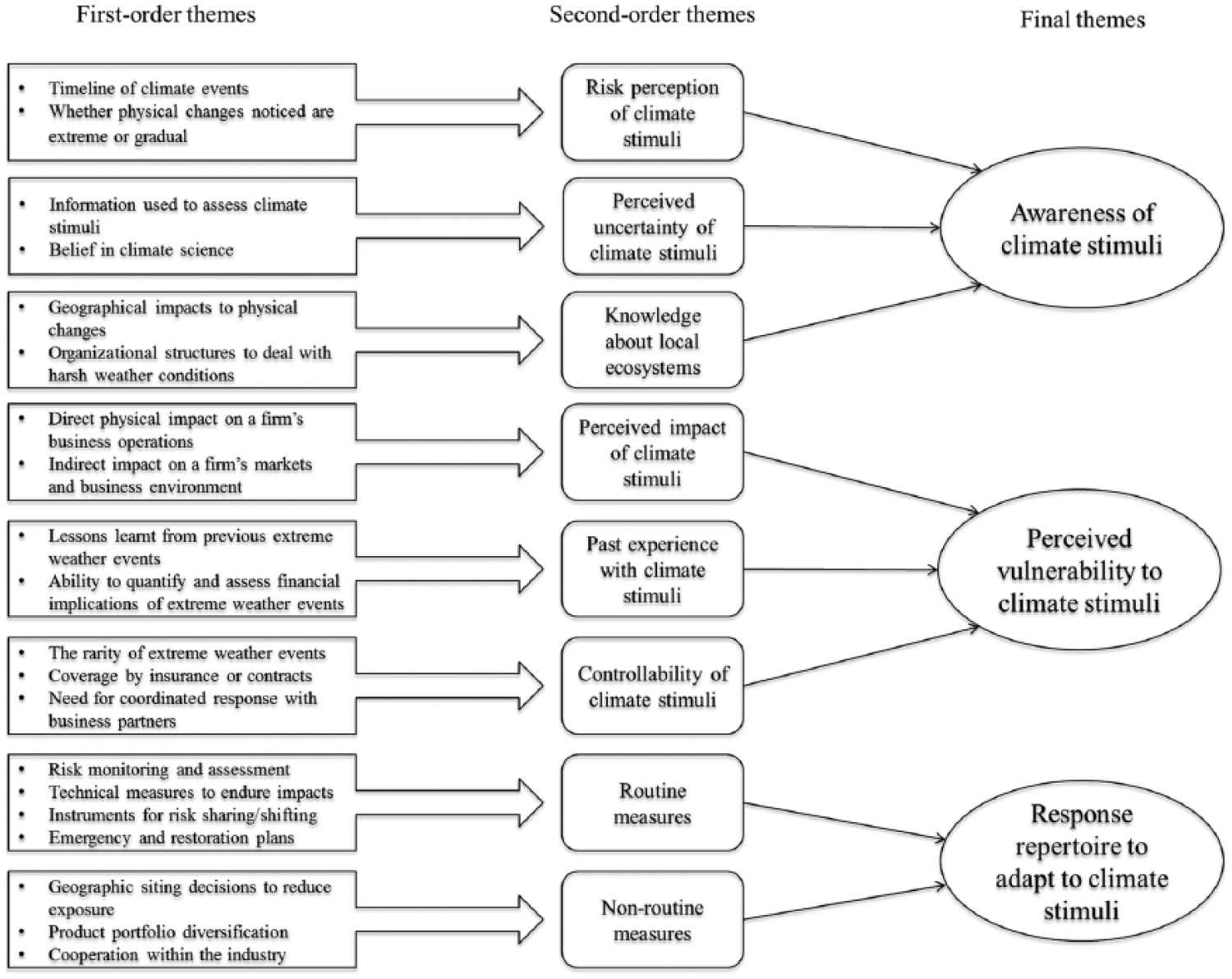
Coding structure.
We used the second-order themes as our main building blocks to theorize how firms moved from the initial noticing of climate events via interpretation to specific measures to cope with these events. To develop our model, we applied insights from ABV to investigate the influence of a firm’s attentional process on adaptation measures. We first analyzed what role the processes of noticing and interpreting played for the creation of awareness and perceived vulnerability, respectively. Subsequently, we analyzed each second-order theme from the perspective of the three ABV principles to assess the influence of the attentional process on corporate adaptation. We investigated how structural and contextual factors create a selection bias and determine the effort firms spend on developing a repertoire of responses for climate stimuli.
In this final stage, we further elaborated our three overarching themes—awareness, perceived vulnerability, and adaptation measures—by assessing how the attentional process guided firms through this sequence. We tried to understand the corporate adaptation process by examining not only the relationships between categories within each final theme but also the relationships between the final themes. For this purpose, we developed a matrix with on one side the dimensions of awareness and perceived vulnerability and on the other side adaptation measures. Such cross-tabulation helped identifying adaptation measures in relation to firms’ awareness and interpretation of perceived vulnerability in relation to direct and indirect climate stimuli. The emerging adaptation measures were interpreted, where possible, by making reference to the existing studies on corporate adaptation strategies and insights from ABV. This final stage resulted in the model that will be presented in the discussion section.
Findings
In this section, we first identify factors that determine how firms notice and interpret climate stimuli, creating awareness and a vulnerability profile with regard to climate-related physical changes. Next, we investigate how the resultant state of awareness and perceived vulnerability lead to specific adaptation measures.
Awareness of Climate Change Stimuli
To analyze factors that lead firms to notice climate stimuli and build up awareness, we first sought to uncover how the oil and gas firms in the sample identify and process information with regard to the main characteristics of climate-induced physical changes. What emerged from the findings is that a firm’s awareness depends on three interdependent factors: (a) risk perception, (b) perceived uncertainty, and (c) knowledge about local ecosystems (see Table 1).
Key Factors Contributing to How Firms Notice and Interpret Climate Stimuli to Create Awareness.
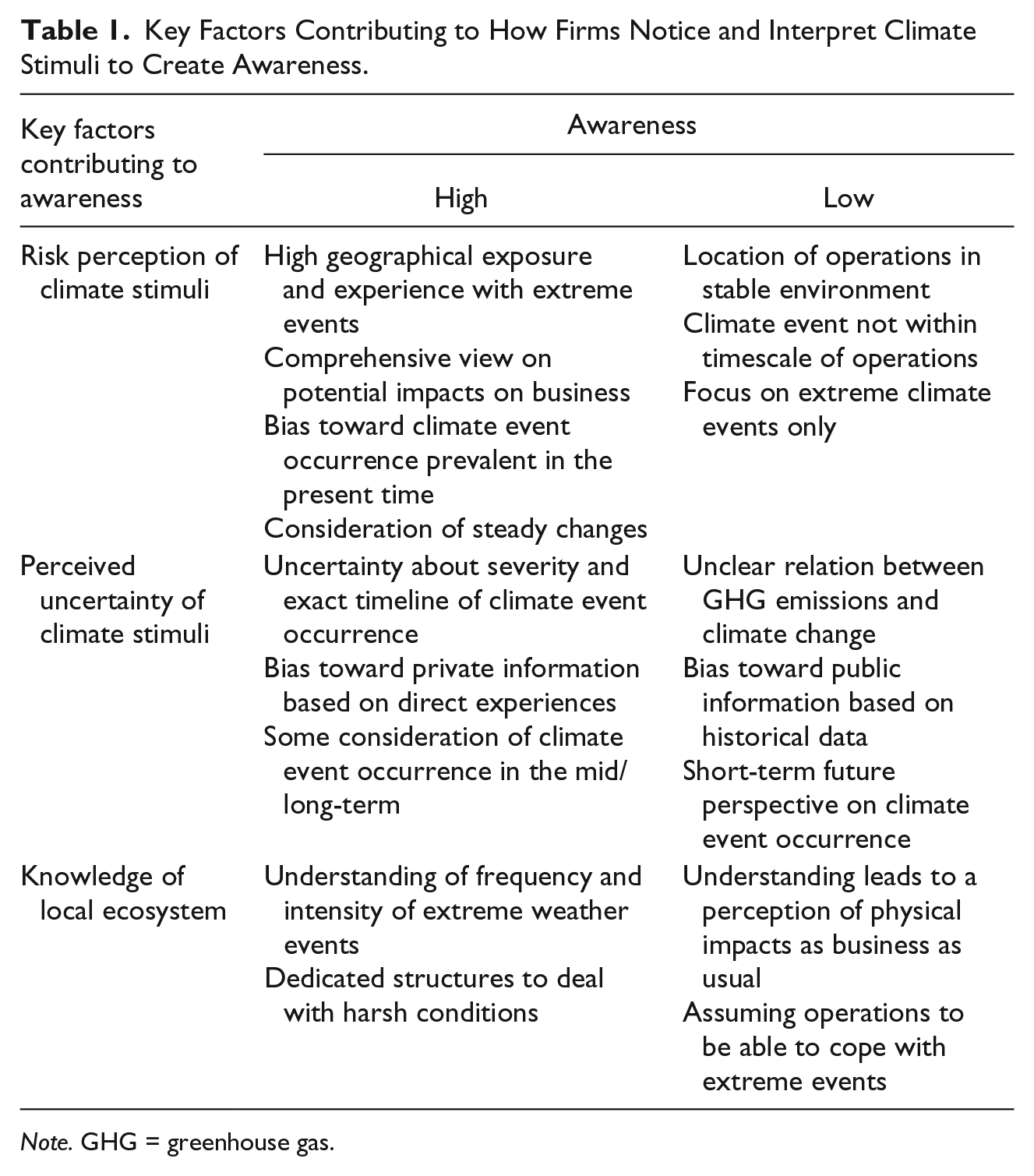
Note. GHG = greenhouse gas.
Our coding of the data suggests that 70 firms in the sample show awareness of climate stimuli, although the degree of awareness differed considerably. A firm’s awareness seems to depend on how decision makers assess the risks as well as the uncertainty of physical climate impacts. Regarding risk perception, the firms in the sample diverge considerably in their assessment of the potential risks of climate events. On one hand, firms with a low risk perception tend not to notice climate events, not because they are ignorant of such events, but because they see potential risks related to climate change as irrelevant to their business. Sometimes, such a low risk perception is based on the type and location of operations, for example, in a relatively stable natural environment. Centennial Coal notes that “[t]he nature of our operations and assets are such that things like extreme weather events, changes in weather patterns or rises in sea level do not pose a significant risk to these physical assets” (Centennial Coal CDP Survey 2010). A low risk perception can also derive from a conviction that physical impacts are not likely to occur within a time window relevant to the business activities. Occidental Petroleum Corporation states, “it is not aware of credible projections that significant changes in weather or climate that could result in immitigable impacts are probable within the anticipated operating life of its facilities” (Occidental Petroleum Corporation CDP Survey 2010).
On the other hand, firms in the sample with a high risk perception notice not only physical changes but also the geographical location of such changes in relation to their assets. One of the main drivers of a high risk perception is that firms have already experienced the impacts of climate-related physical change directly, in particular in the form of extreme weather events. Crisis management and emergency plans were not sufficient to prevent great financial losses. A high risk perception is expressed both in terms of firms noticing a more frequent occurrence of extreme weather events as well as the resulting business impacts such as asset damages, delays and shutdowns of operations, personnel safety, supply chain disruptions, increased competition for supplies and services related to post-event recovery, and reduced demand for products. While firms with a high risk perception tend to focus on extreme climate events, they also consider more steady changes in the ecosystem. Gradual changes in water availability, for example, could have negative consequences by changing the economic preconditions of operations, as exemplified by Penn West:
Penn West’s assets are, to a large extent, established facilities designed and constructed at a time when public and industry awareness of the risks of climate change was not as high as it is today. In many instances the cost of upgrading these facilities to accommodate the need to use less fresh water will be substantial and may exceed that of economic viability, which could lead to decreased production at certain assets. (Penn West CDP Survey 2010)
Interestingly, in terms of the relevant time window for physical impacts to occur, firms with a high risk perception still tend to focus on physical changes that are prevalent in the present time. Nevertheless, the fact that firms have been affected already does induce them to start considering changes in the mid- to long term. Total states, for example, that “the timescales over which these identified physical risks are expected to materialize are: Anytime” (Total CDP Survey 2010).
Perceived uncertainty of climate change is another factor affecting firms’ awareness. When firms perceive high uncertainty, they tend to have a relatively low awareness of climate stimuli. High uncertainty is sometimes based on doubts about the relation between rising GHG emissions and climatic change. Occidental states for example that even though “facilities face these physical risks, the involvement, if any, of GHG emissions or climate change is indeterminate” (Occidental Petroleum Corporation CDP Survey 2010). In addition, although these firms know about the key informational resources to gain insight, such as the IPCC, they seem to take these sources at face value. Because the information is not related directly to their own operations, uncertainty remains as to how their own business would be affected. Low awareness is further aggravated by firms’ reliance on historical data to gain understanding of climate impacts. Also, when firms do look into the future, they hold a rather short-term perspective. Perceived uncertainty is a factor not only for firms that fail to notice climate stimuli, though, but also for some that do. Firms noticing climate stimuli do not face uncertainty about the occurrence of climate events, but instead about the severity and the exact timeline—for example, how extreme physical changes will be and when they occur. To assess the likelihood of occurrence, these firms primarily rely on direct experience of physical changes and damages; however, they also consult information from (inter)national institutes, such as the IPCC, and industry associations. For about one third of the firms, this information is sufficient, as these firms state that they do not see any uncertainty and indicate the timeline of extreme weather and climate events, albeit with considerable variance in these timelines.
Finally, a factor that seems to moderate risk perception and perceived uncertainty is the knowledge firms have of the local ecosystems in which they operate. One third of the firms in the sample explain that they are located in an area subject to extreme natural conditions and have built up extensive knowledge about the local ecosystems. These firms have already implemented measures to deal with increased frequency and intensity of extreme weather events and are used to dealing with weather variations and harsh conditions. These firms have organizational structures to handle local ecosystems, including risk monitoring, assessment, and mitigation, as well as emergency and business continuity plans, and have integrated specific functions or working groups in standard risk management systems to deal with harsh conditions. Next to ongoing anticipatory adjustments to cope with extremes, knowledge about local ecosystems also allows firms to identify new challenges from more steady and gradual changes, such as water availability. Hence, knowledge of local ecosystems helps firms to recognize relevant climate stimuli and thus contributes to creating awareness.
Paradoxically, a well-developed knowledge base about local ecosystems could also hinder awareness creation. Such knowledge does not necessarily translate into noticing climate stimuli because firms consider physical changes as business as usual. Hence, perceived risk and uncertainty about climate change impacts are reduced considerably because firms are prepared to cope with extremes anyway. For example, Cenovus and Encana claim to be able to cope with temperatures ranging between −40 °C and +30 °C. Such knowledgeable firms argue that they have built resilient organizational structures because they understand local ecosystem dynamics, enabling them to anticipate risks, prevent crises, and be prepared for physical changes. Thus, even when firms have the organizational structures to pick up relevant climate stimuli, these structures might induce them not to notice novel stimuli, as they consider their operations to be resilient to any climate events that might occur in the future.
Perceived Vulnerability to Climate Change Stimuli
To analyze factors that affect how firms assess their vulnerability, we identified how the oil and gas firms in the sample interpret climate stimuli in terms of the extent to which these firms can cope with climate events they expect to occur. The analysis shows that perceived vulnerability depends on three interdependent factors: (a) the perceived impact of climate stimuli, (b) past experiences with climate events, and (c) the controllability firms perceive to have over climate impacts (see Table 2).
Key Factors Contributing to How Firms Interpret Climate Stimuli to Assess Their Vulnerability.

Based on an analysis of the types of impact firms identify, 61 firms in the sample perceive their organizations to be fairly vulnerable to climate stimuli. The perceived vulnerability first depends on the interpretation of the perceived impact of climate events, that is, what is considered as an impact of climate change and what is not. Firms in the sample with a fairly low perceived vulnerability focused in particular on the direct physical impacts on their own business operations, such as damages to production facilities or infrastructure. The impacts that firms with a fairly high perceived vulnerability in the sample mention include not only direct physical impacts but also indirect impacts on their markets and their broader business environment. Firms that feel vulnerable tend to stress the financial implications, as climate change could endanger their position in the market due to interrupted or reduced production and lead to lower revenues. While climate events could endanger revenues directly, these firms also consider other, more indirect impacts such as reputational damage from difficulties to supply oil or oil spills, or a deterioration of their relation with local communities. BG Group states, for example, that “[t]here is potential for conflict with local communities near our operations for resources, such as water, when availability of the resources is affected by climate change or where our activities may be perceived to adversely influence local industries” (BG Group CDP Survey 2010). Origin Energy, however, warns for the potential financial implications from “increased government attention and regulations such as greater control on spatial planning, government charges for water in light of droughts, increased energy market regulation etc.” (Origin Energy CDP Survey 2010).
Past experience with extreme climate events comes to the fore as a second factor influencing perceived vulnerability. Past experiences affect how firms interpret climate events because they enable firms to create a repertoire of available categories to make sense of climate stimuli (Ocasio, 1997). The analysis suggests that lessons learned from previous experiences help firms to interpret specific extreme weather events because they have a better understanding of the most likely operational and/or financial impacts. Halliburton states, for example, that it “has adapted its facilities over many years of operations in order to sustain its presence in the Gulf of Mexico. Many facility design lessons have been learned through several hurricane events experienced in the last 10 years” (Halliburton CDP Survey 2010). The fact that firms have already experienced damages enables them to quantify and report financial implications with great accuracy in terms of costs and losses and can therefore make a detailed assessment of their vulnerability. It is not always clear whether a detailed vulnerability assessment informed by past experiences will lead to higher or lower perceived vulnerability.
While the scope of impacts considered and past experiences influence the vulnerability assessment, the analysis suggests that perceived vulnerability depends to a great extent on whether firms see potential climate impacts as controllable or not. That is, firms located in areas subject to harsh natural conditions might still perceive their vulnerability as fairly low because their assumed ability to identify risks and implement corresponding actions to mitigate risks and reduce impacts on the business provides them with a high sense of controllability. Due to the “business-as-usual” character, firms with a high sense of control do not see climate events as rare and thus do not feel the need to make an effort to further analyze potential consequences of such events. Although biophysical changes could still affect production facilities, the fact that these firms have implemented appropriate measures leads them to believe that they are able to withstand expected and unexpected changes. Roc Oil Company argues for instance that “[a]ny weather-related disruptions that may occur at our operations are addressed through our existing management systems, including our emergency response procedures” (Roc Oil Company CDP Survey 2010).
However, a high sense of control is not shared equally among all firms in the sample. One reason why firms have doubts about their ability to cope with climate events is that damages might not be fully covered by insurance and thus require specific agreements with contractors. Controllability also decreases when it concerns more indirect impacts such as a disruption in the supply of products and problems in the supply chain from midstream and downstream operators. These indirect impacts could lead to financial consequences such as increased costs of production, for example, from increasing fuel prices required to operate in abnormally cold weather or to rising commodity prices. The indirect impact seems quite prevalent in the oil industry because the industry has a strong history of collaboration. As a result, perceived vulnerability is the result of damage not only to firms’ own operations but also to operations of collaborators. For example, during hurricane Katrina in 2005, Shell’s Mars platform suffered damages “above water, when massive clamps holding part of the rig’s structure failed under sustained winds of 270 km per hour, while, under water, the anchor of another firm’s mobile drilling unit that had gone adrift cracked the pipeline” (Shell CDP Survey 2010). Coping with such impacts is very complex, as coping requires a coordinated response and the controllability of any individual firm is limited.
The Impact of Awareness and Vulnerability on Adaptation Measures
To examine how awareness and perceived vulnerability lead to specific adaptation measures, we first tried to distinguish the main adaptation measures used by the oil and gas firms in the sample. We could identify the following measures: (a) wait-and-see, (b) risk assessment, (c) technical solutions, (d) reduction of exposure through geographical decisions, (e) shift and share risks, (f) disaster relief and business continuity, (g) portfolio diversification, and (h) cooperation. In part, this list of measures corroborates previous research that makes the distinction between doing nothing, assessing risk, reducing risk, sharing risk, and diversifying (Berkhout, 2012; Berkhout et al., 2006; Hoffmann et al., 2009; Weinhofer & Busch, 2013). We also found that oil and gas firms engage in measures to do disaster relief and ensure business continuity and reduce geographic exposure (Linnenluecke et al., 2011). In addition, we identified new forms of cooperation with competitors and other stakeholders.
Table 3 shows how the different adaptation measures relate to the degree of awareness and vulnerability. Firms that had not created a general awareness and did not perceive themselves as vulnerable to climate events are the ones adopting a wait-and-see strategy (18 firms in the sample). These firms do not pursue any real adaptation measures although they do not always exclude the possibility to change their behavior in the future. Nevertheless, a basic response to climate events that seems unrelated to the degree of awareness or vulnerability is to conduct a risk assessment. A risk assessment is not always a stepping stone to more concrete measures, as SBM Offshore exemplifies:
Besides the insurance activities, SBM does not plan to manage or adapt to the risks identified as physical risks other than keeping a close eye on the developments of the risk (and the identification of possible new risks) through the Risk Management Process. (SBM Offshore CDP Survey 2010)
The Influence of Awareness and Vulnerability on Adaptation Measures.

Overall risk assessment forms a hygiene factor for any firm that has some notion of climate change (25 firms in the sample refer to risk assessments). It generally entails monitoring scientific developments from major research institutes specialized in climate science or keeping track of short-term weather forecasts and longer-term weather scenarios. For example, Premier Oil states that
[m]eteorological and oceanographic studies are carried out for all new projects. These include hindcasting and analysis of data on wind, currents and wave height over 1,000 years. These studies will now include forecasting to include anticipated variations brought about by climate change. (Premier Oil CDP Survey 2010)
Risk assessment thus seems a standard routine in the oil industry which is unaffected by the degree of awareness or perceived vulnerability of a firm.
The many technical measures that firms in the sample mention range from developing standards and respecting mandatory requirements to designing improvements for maintenance, materials, facilities, assets, and process engineering to endure physical impacts (47 firms in the sample refer to some form of technical solutions). Some firms identify operational alternatives to overcome physical impacts such as constructing an all-weather road to access upstream facilities. Sometimes, the objective of an intervention is to reduce the dependency on affected natural resources through consumption reduction, re-use, and recycling, in particular to deal with limited water availability. As long as firms are not in a complete state of negligence, they all engage in at least some of these measures and develop specific technical routines.
Routines that have become quite common as well are measures to share or shift risks (mentioned by 20 firms) and to do disaster relief and ensure business continuity of plants and facilities after weather-related disasters (mentioned by 34 firms). A considerable number of firms rely on insurance instruments to share and shift risks. More elaborate instruments for risk sharing/shifting such as consideration of physical risks in contract negotiations, economic evaluation of new projects, and a more widespread tendency to pass increased costs to consumers were only seen among the firms with high perceived vulnerability. Highly vulnerable firms were also the ones claiming to have put in place emergency, contingency, and restoration plans to secure assets, personnel, and operations and set up crisis management teams to deal with disasters and ensure business continuity. Disaster relief not only comprises reactive measures such as crisis management, though, but also involves more proactive initiatives to make anticipatory adjustments to ensure business continuity. For example, while Shell decided to become “part of a joint industry project to tighten specifications for anchoring mobile drilling rigs during the hurricane season” (Shell CDP Survey 2010), the firm also engaged in developing alternative ways to get the oil from a rig to a refinery to cope in case of damage to pipelines. Interestingly, also firms with low awareness seem to pursue technical, risk-sharing, and disaster relief measures. This finding corroborates Galbreath’s (2014) results that adaptation measures are not always a specific response to climate change but part of more regular routines to minimize the impact of unfavorable physical conditions whether these change or not.
The findings indicate, however, that before firms opt for a non-routine response and take more rigorous measures to reduce geographic exposure (mentioned by 12 firms) or diversify the product portfolio (mentioned by 5 firms), they need to experience a high degree of vulnerability and a lack of control over their operations under current conditions. Only when vulnerability is perceived as really high will this perception affect production volume decisions—for example, when the cost of upgrading facilities exceeds economic viability (e.g., Penn West Energy Trust)—or geographical siting decisions (e.g., Chevron). In fact, reducing exposure through geographical siting decisions is one of the more radical responses that some oil and gas firms have been contemplating or implemented in certain cases and is particularly considered as an option for new investments. Having a well-balanced portfolio from a geographical point of view is considered a risk management strategy. As Anadarko notes, “supply risks generated by extreme weather events and other physical impacts that reduce or cease operation may be mitigated by enhancing production from unaffected regions” (Anadarko CDP Survey 2010). Geographical siting decisions have also been made with regard to older facilities when firms operate in particularly risky areas or after experiencing extreme weather events. Although oil and gas firms may sustain large costs for repairs, sometimes the only possibility seems to write off and decommission assets (e.g., Apache) or to make a strategic repositioning to less risky locations (e.g., Halliburton). A well-diversified portfolio—not only geographically, but also in terms of products and assets—is often mentioned as a way to reduce climate risks. However, we could not find much evidence of firms deliberately diversifying their product portfolio in response to climate events.
Finally, another non-routine response is cooperation, which has occurred at industry, region, and stakeholder levels (mentioned by nine firms). Four firms mention having contributed to developing reference industry plans; Chevron, for example, supported the efforts of the American Petroleum Institute in developing the industry’s plans for storm preparation and return after storms. The objective of this kind of cooperation differs from risk sharing, as it aims at sharing lessons learned as well as resources to prepare for emergencies in case of extreme weather events. Risks related to steady changes such as water availability often lead firms to participate in regional initiatives as well as involvement in policy and regulatory developments (e.g., Hess). Besides, firms collaborate with local industries to reduce impact on local water resources and prevent conflicts with local communities for access to resources (e.g., BG Group). On the whole, firms that seek to cooperate with others appear to be seeing themselves as quite vulnerable and thus unable to cope with climate disruptions singlehandedly.
Toward an Attentional Model of Corporate Climate Change Adaptation
In this article, we studied how the physical impacts of climate change become events that firms notice and interpret in a way that leads to an active response to adapt to these impacts. To guide our empirical research, we formulated two research objectives: The first was to examine the influence of selective, situated, and structured attention on the process of generating awareness and assessing vulnerability and the second was to investigate how the attentional process affects the repertoire of adaptation measures firms consider. As such, we tried to address two key constructs of the literature on adaptation to climate change—awareness and vulnerability—investigating how each plays out in a corporate context. To highlight the peculiarities of firms as actors that engage in adaptation behavior in terms of the potential bias inherent in firm decision making, we decided to draw on ABV. This view explains how the organizational structure and context create a selection bias toward specific stimuli (Nigam & Ocasio, 2010; Ocasio, 2011; Rerup, 2009). Based on our findings, we derived a model (see Figure 2) that provides an attentional perspective on corporate climate change adaptation.
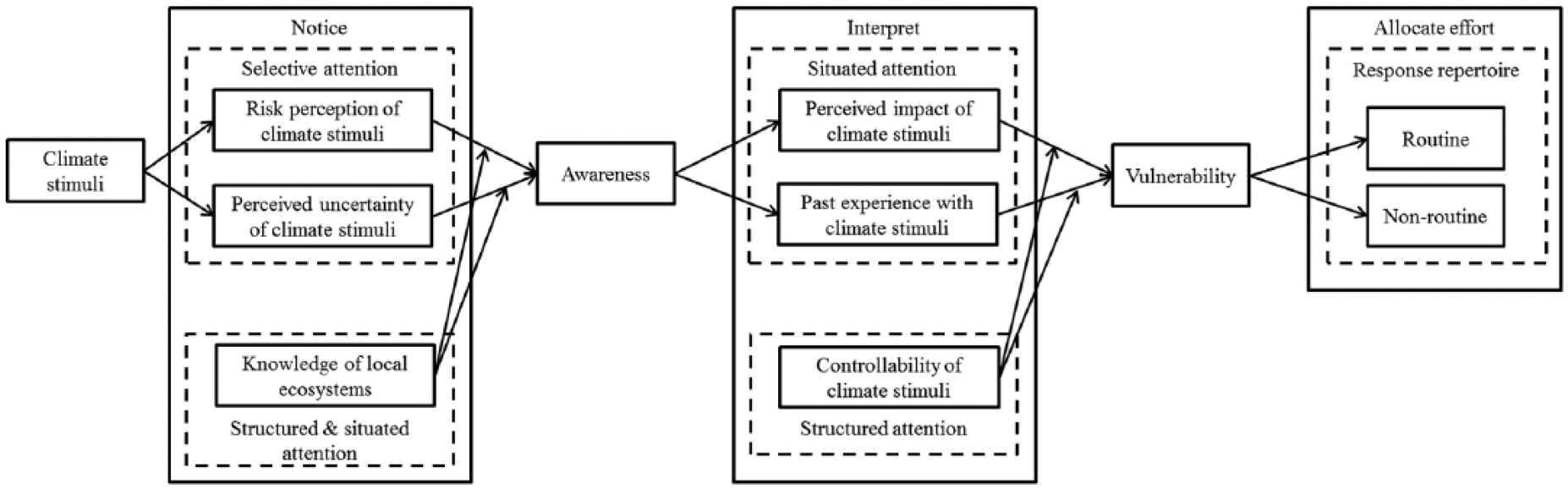
An attentional model of corporate climate change adaptation.
In the model, the adaptation process starts with the creation of awareness. As the findings suggest, firms’ attentional processes affect awareness of climate stimuli. Firms deemed certain stimuli irrelevant based on the preconceptions they had about climate change. The main determinants of this selective attention were firms’ risk perception and perceived uncertainty, which capture whether climate events would form a potential risk and occur within a time frame relevant to typical business decisions, respectively. The oil firms in the sample mainly referred to events with a direct bearing on current business activities, such as hurricanes, water scarcity, and issues with drilling in the Arctic. These firms appear to have a selection bias toward current events and against those materializing in a more distant future (Slawinski, Pinkse, Busch, & Banerjee, 2017). One explanation for this temporal bias is the use of historical data to analyze potential impacts. Historical data lead to an underestimation of impacts because the frequency of impacts is bound to go up in the coming decades (IPCC, 2012). Another explanation is the generic nature of the informational resources consulted. Reports from the IPCC, for example, tend to focus on macro-level trends and thus do not speak to firms directly in how climate change would affect their operations. Even firms with a high risk perception and relatively low perceived uncertainty were showing a selection bias toward short-term climate events. These firms used their own direct experience with physical changes and damages as a yardstick and failed to take note of rare events that might have an impact in the future. These findings further elaborate Linnenluecke et al.’s (2012) model of the adaptation process. In their model, Linnenluecke and colleagues emphasize the objective characteristics of climate events as a determinant of corporate adaptation. Our model instead highlights that such characteristics play a role but only to the extent that they are noticed by firms and are not filtered out by a selection bias.
We expected geographical proximity to indicate to what extent firms would be subject to situated attention. The findings suggest that proximity to physical impacts does not create awareness in and of itself, though. The knowledge firms have of their local ecosystems is a more appropriate geographical indicator for how firms notice climate stimuli but has a surprising influence. Such local knowledge seems to reduce the impact of a high risk perception and make perceived uncertainty of climate events irrelevant. In our model, knowledge of local ecosystems is therefore presented as a moderator of these two factors’ relationship with awareness. Basically, firms with a well-developed knowledge base no longer see climate events as rare and thus fail to notice the novelty of such events (Winn et al., 2011). While knowledge reflects the impact of situated attention, not only the context confines what firms notice but also the organizational structures that firms have built up. Firms claiming to have extensive knowledge were also the ones with the most advanced organizational structures for risk management. This finding raises the question to what extent these risk management structures would make firms more attuned to unusual climate events or, as ABV would argue, disregard such rare events (Lampel et al., 2009; Ocasio, 1997). The information used for this article could not provide a definite answer, and further research should investigate the impact of the risk management systems on the attention to rare climate events. Given the relation between the knowledge of ecosystems and risk management structures, we tentatively refer to such knowledge as exercising influence as a form of structured attention (see Figure 2).
Once firms have created awareness, the question remains to what extent they perceive their business as vulnerable to climate stimuli. As the model shows, firms’ attentional processes affect how firms translate awareness into an assessment of their vulnerability. That is, situated attention shapes firms’ vulnerability assessment because firms’ perception of their context plays a role in this regard. The main determinants of situated attention were firms’ perceived impact of and past experience with climate stimuli. Regarding perceived impact of climate stimuli, those firms that considered their business as relatively more vulnerable were the ones with a more comprehensive perception of the relevant context. In line with the view that vulnerability is an outcome not only of biophysical impacts but also of many other socio-economic impacts (O’Brien et al., 2007), the more vulnerable firms were considering the influence of the socio-economic context beyond direct physical impacts. Firms that assessed their business as relatively vulnerable were those that highlighted the indirect impacts from the market and broader business environment. These firms particularly stressed financial impacts, although they also pointed at potential conflicts with local communities due to more competition over natural resources. The interpretation of climate stimuli was also affected by past experience. As ABV suggests, firms tend to use known categories to interpret what might be unfamiliar events (Levinthal & Rerup, 2006; Ocasio, 2011). Firms learn about climate change based on past experience and use this experience to assess a specific type of extreme event (Berkhout et al., 2006). Past experience thus allows firms to build up a repertoire of available categories and better understand climate stimuli, which helps to assess vulnerability.
Because vulnerability refers to firms’ perceived ability to cope with climate-related disruptions (O’Brien et al., 2007), vulnerability assessment depends not only on the perception of the context and past experience but also on firms’ organizational structures. The findings show that quite a few firms put great trust in their management systems to deal with climate risks. As a consequence of having such organizational structures, firms interpret climate stimuli as controllable. This form of structured attention moderates the influence of firms’ perceived impact and past experience on perceived vulnerability, though. Although firms might consider direct and indirect stimuli, their potential impact is attenuated when firms believe they have adequate coping mechanisms, such as a risk management system or insurance. This sense of control might have an ambiguous effect on how past experience relates to perceived vulnerability. Although past experience creates the repertoire of categories to interpret climate stimuli, a high reliance on existing structures might lead to a misinterpretation of novel climate events (Winn et al., 2011) because firms keep seeing them as familiar (Barr, 1998). Hence, whether existing structures and the sense of control they imbue lead to a correct interpretation of the ability to cope with the events largely depends on the type of events that firms face.
The last part of our model reflects how awareness and perceived vulnerability guide firms in their decision how much effort to allocate to developing a repertoire of adaptation measures. Due to the influence of selective, situated, and structured attention on the process of generating awareness and assessing vulnerability, ABV would predict that firms filter out many stimuli and for the ones remaining develop routines to be able to deal with them. Because noticing and interpreting all stimuli separately would put too much burden on a firm’s informational processing, firms develop routines to reduce the effort to deal with recurring stimuli (Ocasio, 1997). This tendency to opt for a routinized response clearly surfaced in the findings. Although firms tend to implement different adaptation measures, on the whole, most of them tried to leverage existing routines in risk management, insurance, and technical adjustments. This observation corroborates previous findings that firms prefer to rely on existing routines and tend to see climate change adaptation as another form of risk management (Berkhout et al., 2006; Weinhofer & Busch, 2013). Firms in the sample seem to have categorized extreme climate events as familiar, based on the belief that they are used to working under harsh conditions.
Doubts have been raised, though, whether routines which are the outcome of learning to deal with a specific type of extreme event, such as the increased intensity and frequency of hurricanes, can be extended to other climate-related physical changes (Berkhout et al., 2006). Although routines can be developed for known events, other events of a highly uncertain and discontinuous nature could still take firms at a surprise (Winn et al., 2011). However, some firms did perceive climate events as rare and unprecedented, and considered engaging in more non-routine responses (Lampel et al., 2009). A repertoire of non-routine responses included geographic relocation (Linnenluecke et al., 2011), changing the product portfolio away from affected business segments, and regional cooperation to make the whole industry more resistant against physical changes. Only firms that assessed their vulnerability as high were considering non-routine responses, and they particularly emphasized their lack of control to cope with physical changes singlehandedly as a reason for pursuing non-routine responses. Nonetheless, a key question remains as to what extent non-routine measures are a response to physical climate impacts or the outcome of other strategic factors (Galbreath, 2011) that firms do not disclose. Because CDP probed firms specifically on the topic of climate change, we were not able to draw any conclusions regarding this issue.
Conclusion
Based on a qualitative analysis of the oil and gas industry, this article investigates the adaptation process to climate change of how firms select between alternative stimuli and decide how much effort to spend on developing a response for those stimuli they choose to act on. Building on previous research on corporate climate adaptation and drawing on ABV, the article argues that adaptation is the outcome of a process where firms are subject to biases in the process of noticing climate stimuli and interpreting how these will affect their business before they take action. The article identifies the relevant factors that drive awareness, perceived vulnerability, and subsequent adaptation measures, which remained ambiguous in previous research. The findings suggest that firms’ attentional processes—i.e., selective, situated, and structured attention—have a distinctive influence on the repertoire of adaptation measures firms consider for coping with physical impacts. Furthermore, the article shows that adaptation measures often consist of a set of routine measures, rather than non-routine measures, even though the latter would be better aligned with the unprecedented nature of climate events (Winn et al., 2011).
Implications for Research, Practice, and Policy
The article makes several contributions to the literature. First, the emerging corporate adaptation literature has created insight into the adaptation process, focusing on various factors such as awareness, vulnerability, risk, and uncertainty (Busch, 2011; Hertin et al., 2003; Hoffmann et al., 2009). The article contributes to this literature by bringing these different factors together in one model of corporate climate change adaptation. The model suggests how these factors are related to one another in explaining the types of adaptation measures firms take. Our model complements existing models of the corporate adaptation process (Linnenluecke et al., 2012), as the model is grounded in empirical data and uses a theoretical lens (ABV) that has only been used sparsely so far to explain corporate climate adaptation (Galbreath, 2011). Second, adopting ABV as theoretical lens sheds a different light on the adaptation process. The ABV lens highlights the potential bias created by existing organizational structures and perceptions of the context firms are located in with regard to how firms notice and interpret climate events. Although a high degree of awareness and relevant experience with operating under extreme physical conditions tend to be seen as encouraging adaptation measures (Arnell & Delaney, 2006; Hoffmann et al., 2009), the findings of this article suggest that these factors might also lead firms to disregard novel climate stimuli or interpret them incorrectly as familiar events that can be dealt with using existing routines. While the existence of such biases has been hinted at in conceptual studies (Winn et al., 2011), our article provides empirical evidence that firms seem inclined to rely on existing organizational structures and routines (Barr, 1998), even if stimuli might relate to novel climate events.
Regarding implications for management practice, the findings of this article forewarn managers of the impact of biases in managerial decision making on corporate climate adaptation. Because the findings suggest that firms run the risk of disregarding or underestimating the impact of climate change, or using measures that might not be up to the task, the main advice for firms would be to be cognizant of these biases. The model could be a useful tool for firms to identify and understand potential biases, and in light of those reconsider their adaptation measures. For example, to take away the influence of selective attention in noticing climate stimuli, the findings imply that firms might be cautious when using past experiences as a guiding principle to deal with future impacts. Notwithstanding the usefulness of existing routines such as risk management systems, the novelty, rarity, and complexity of climate events suggest firms to consider exploring non-routine practices such as cooperating with local communities or diversifying away from climate change–prone operations. Moreover, although previous research has shown that firms that use scientific information as a source of decision making are more likely to take adaptation action (Linnenluecke et al., 2015), doubts can be raised whether scientific information on physical impacts is indeed useful on an operational level. Because such information tends to be of an aggregate nature, firms seem to have difficulties translating such information for them to have relevance to their operations. It is thus advisable for firms either to collect information that is more relevant to their own operations by conducting internal inquiries or to develop tools that allow a better translation of aggregate scientific data so that the information is understandable on an operational level.
With regard to policy implications, the findings of this article point out that policy makers could aid small- and medium-sized firms that lack the resources to notice relevant stimuli by providing them with information tailored to their situation to make sure that climate events are interpreted in a way that leads to meaningful action. Policy makers could commission studies on climate-induced physical changes, the projected impacts on infrastructure, and the financial implications for particular economic sectors or specific local regions. By the same token, general preconceptions about climate change, often derived from the pressure to contribute to mitigation, should not obscure the attention policy makers have for adaptation, as adaptation concerns a different debate. Although the balance seems to increasingly tilt toward adaptation (Mogelgaard et al., 2015), compared with mitigation, adaptation might still not receive sufficient attention.
Limitations and Future Research
This article is not without limitations. First, as the information from CDP was of a cross-sectional nature, we could only provide a snapshot of the firm perspectives on corporate climate adaptation. Considering the emergent state of the issue, corporate adaptation measures will most likely become more elaborate in the years to come. Second, using CDP as a source of information does not allow interacting directly with the firms involved. Relating adaptation measures to the way firms notice and interpret climate stimuli to create awareness and assess vulnerability was an outcome of our analysis. We were not in the position to ask firms directly whether and/or how this process took place. Third, the oil and gas industry, which we singled out for our analysis, could be a front-runner in implementing adaptation measures, given its particular awareness of climate change being one of the major emitters, its vulnerability and its ability to adapt. Other industries might not have advanced as much and thus show less variety in their adaptation behavior. Besides, due to the position at the start of the supply chain, oil and gas firms tend to experience climate change mostly as direct physical impacts. For firms in other industries, however, physical impacts are experienced in a more indirect manner, for example, when organizations further up in the supply chain are affected (Tashman et al., 2015). The occurrence of indirect physical impacts adds a further level of complexity to the process of noticing and interpreting climate stimuli. In view of the complexity and fragmented nature of global supply chains, it will be very costly for firms to develop the systems to collect information about the physical impacts of climate change. As a result, the same strong belief in existing risk management systems might not be present in other firms.
Although the body of research on corporate adaptation to climate-induced physical impacts is growing (Berkhout, 2012; Linnenluecke, Griffiths, & Winn, 2013), there are still many questions open. In this article, we focused on adaptation behavior of individual firms taking particular note of the influence of awareness and perceived vulnerability. As a follow-up to this article, future studies could take a more systemic perspective on corporate adaptation. As was clear from the findings, knowledge of local ecosystems was an important factor in the adaptation process. However, climate stimuli not only materialize as physical impacts but also as socio-economic impacts. More work is needed to gain more understanding of how firms respond to a more comprehensive set of climate stimuli and how physical stimuli interact with stimuli related to competitive or regulatory forces, or to mitigation. Besides, adaptation often involves working together with other firms within the industry or within the supply chain because climate impacts operate on a system level. It would be interesting to investigate how the knowledge firms have of the supply chain and/or industry as a whole would affect their adaptation behavior. To what extent do firms take a broader perspective on climate change impacts and how would this perspective affect their repertoire of responses? Finally, although our model distinguishes between routine and non-routine measures for conceptual parsimony, it would be interesting to further unpack how measures develop into routines and which competences drive this process. Moreover, research could study the impact of different adaptation routines on firms’ ability to successfully adapt to climate change.
Footnotes
Declaration of Conflicting Interests
The author(s) declared no potential conflicts of interest with respect to the research, authorship, and/or publication of this article.
Funding
The author(s) received no financial support for the research, authorship, and/or publication of this article.