




Abstract
The prevalence and complexity of local sustainable development challenges require coordinated action from multiple actors in the business, public, and civil society sectors. Large multi-stakeholder partnerships that build capacity by developing and leveraging the diverse perspectives and resources of partner organizations are becoming an increasingly popular approach to addressing such challenges. Multi-stakeholder partnerships are designed to address and prioritize a social problem, so it can be challenging to define the value proposition to each specific partner. Using a resource-based view, this study examines partner outcomes from the perspective of the strategic interest of the partner as distinct from the strategic goal of the partnership. Based on 47 interviews with representatives of partner organizations in four Canadian case studies of community sustainability plan implementation, this article details 10 resources partners can gain from engaging in a multi-stakeholder partnership.
Keywords
Cross-sector social partnerships (CSSPs) commonly address complex social issues (Babiak & Thibault, 2009; Selsky & Parker, 2005; Waddock, 1991). Briefly, a CSSP is a voluntary collaboration between organizations from more than one sector to address a mutually prioritized social issue (Parmigiani & Rivera-Santos, 2011). There are two basic kinds of CSSPs: large and small. Large CSSPs, called multi-stakeholder partnerships, have multiple partners from all three sectors, whereas small CSSPs have just two partners (a dyad) or three partners (a triad) from two or three of the different sectors (business, public, or civil society; Rühli, Sachs, Schmitt, & Schneider, 2017). Multi-stakeholder partnerships are emerging as an increasingly popular approach to addressing complex social problems, but they have not yet been well studied.
Multi-stakeholder partnerships have the challenge of managing the diverse interests of multiple partners. In multi-stakeholder partnerships, all stakeholders are welcome and encouraged to participate in the solution (Kihl, Tainsky, Babiak, & Bang, 2014). In contrast, small CSSPs are not inclusive because they have two or three partners that carefully select each other on the basis of fit (Berger, Cunningham, & Drumwright, 2004). The inclusive approach, taken by multi-stakeholder partnerships, potentially creates an opportunity for partners to access more resources such as knowledge of the problem, financial aid, and social capital (Kuenkel & Aitken, 2015).
In multi-stakeholder partnerships, partner engagement is challenging to establish, and even more arduous to sustain (Provan, Veazie, Staten, & Teufel-Shone, 2005). The reason is that where there are large numbers of partners, the partnership process tends to subordinate partner strategic interests to the larger goals of the partnership (Jörby, 2002). This subordination occurs because partner strategic interests are not negotiated when a partner joins the partnership. In contrast, partners in small CSSPs negotiate their strategic interests into the terms of the partnerships (Yaziji & Doh, 2009). Such negotiation is easier where there are only two or three partners. Strategic management researchers have done a considerable amount of work to understand the resources gained by partners in small CSSPs (Branzei & Le Ber, 2014). For instance, research has shown that partners in small CSSPs typically enjoy resources such as legitimacy, access to unique networks, and specialized expertise (Yaziji, 2004). Given the different dynamics between small CSSPs and multi-stakeholder partnerships, it is unclear whether partners in both experience the same resource gains or something different (Butler, 2001).
This research studies partner outcomes in the context of multi-stakeholder partnerships that implement a Local Agenda 21 (or equivalent community sustainability plans). Local Agenda 21 is a United Nations–recommended process for addressing local sustainable development challenges (Clarke, 2014; United Nations Conference on Environment and Development, 1992). Multi-stakeholder partnerships are commonly used to address sustainable development challenges (Worley & Mirvis, 2013). The Local Agenda 21 process suggests that local authorities collaborate with organizational stakeholders to form and implement community sustainability plans (Clarke, 2014). These plans are geographically bounded and include sustainability visions, goals, and action plans (International Council for Local Environmental Initiatives, 2002).
Collaborations that implement plans with defined actions and goals tend to have higher task specificity than collaborations that do not implement plans (Waddell & Brown, 1997). These collaborations are more formal and are structured as partnerships. They are different from networks which have comparatively low-task specificity (Waddell & Brown, 1997). Task specificity is the level of agreement among partners on specific problems and the actions required (Waddell & Brown, 1997). The partnerships studied in this article have high-task specificity because they implement community sustainability plans, and so this article relies on the partnership literature over the network literature to understand the partner experience.
In summary, given the rising phenomenon of more multi-stakeholder partnerships addressing complex social and ecological challenges, and that these large partnerships differ from better understood smaller ones, there is a real need for further understanding of what resources partners gain through engaging in a multi-stakeholder partnership. To this end, this research asks the following question: Based on partner perceptions, what resources can partner organizations gain from their involvement in a multi-stakeholder partnership? Understanding the benefits for partners in multi-stakeholder partnerships is important for two reasons. First, it contributes to what is known about partner resources obtained from large partnerships. Second, it helps to identify how local governments can develop systems that help partners gain resources to attract partners and to maintain their ongoing engagement. Community sustainability plans have longtime horizons (25 years is typical; Clarke & Erfan, 2007), so partnership secretariats desire to understand how to retain partners.
The remainder of this article is structured as follows. First, this article reviews the scope of partner outcomes as they are discussed in the partnership literature. The article uses resource-based view (RBV) theory to situate these outcomes as resources for partner organizations. Second, it summarizes the research methods and introduces four Canadian case studies of community sustainability plan implementation: Whistler2020 (in the province of British Columbia), Hamilton’s Vision 2020 (in the province of Ontario), Montreal Community Sustainable Development Plan 2010-2015 (in the province of Quebec), and Greater Vancouver’s citiesPLUS (In the province of British Columbia). Third, this article summarizes the findings from the case studies, illustrating partners’ perceptions of resources their organizations’ gain from involvement in multi-stakeholder partnerships. The final discussion section examines the implications for researchers and practitioners of the findings from the literature review and case studies.
Theoretical Background
Partner Outcomes of CSSPs
A critical area of research becoming core to the partnership field is on assessing the effectiveness of CSSPs (Kolk, Dolen, & Vock, 2010). The effectiveness of a CSSP is defined by its ability to meet both the social goals of the partnership and the strategic goals of the partners, while operating the partnership efficiently (Selsky & Parker, 2005). Partnership effectiveness is extremely challenging to study because partnerships are constantly changing and evolving, there are no control groups, and there are not consistent measurements and indicators (Kolk et al., 2010). Moreover, the diversity of partnerships types makes it challenging to generalize findings, as outcomes depend partly on the goals of both the partnership and the partners. Despite these challenges, research needs to find a way to assess outcomes and understand their means, so that the implications of partnerships can be better understood (Koontz & Thomas, 2006).
There are three broad categories of outcomes generally discussed in the partnership literature for the community sustainability context: (a) plan outcomes, (b) process outcomes, and (c) partner outcomes (Clarke & Fuller, 2010). Plan outcomes result from working toward the goals outlined in the sustainability plan (Clarke & Fuller, 2010). Examples of plan outcome include reductions in community-wide carbon emissions and improved water quality (Clarke, 2011). Process outcomes emerge during implementation, and can include collective learning, innovative solutions for successful implementation, and strategic budget management (Steijn, Klijn, & Edelenbos, 2011; Waddell & Brown, 1997). Finally partner outcomes are defined as the results experienced by the partners themselves (Bamberger, 1991). Examples of partner outcomes are improved reputation (Huxham, Hibbert, & Hearne, 2008), cost savings (Clemens, 2006), and increased knowledge (Hardy, Phillips, & Lawrence, 2003).
Researchers who examine rent-generating partner outcomes often use resource-oriented theories, such as resource dependency, relational view, or RBV (Branzei & Le Ber, 2014). Rent is generated from a resource when it creates value for the partner (Lavie, 2006). These theories assume that certain partner outcomes are advantageous for partners because they create value for partner organizations (Selsky & Parker, 2005), such outcomes will herein be referred to as partner resources. Past research that has taken a RBV of partner outcomes has focused on small same-sector alliances (Lavie, 2006) or CSSPs with two or three partners (Lin, 2012). In contrast, research that has studied multi-stakeholder partnerships generally focuses on the policy implications of these partnerships (see Bäckstrand, 2006; Kihl et al., 2014; Rühli et al., 2017). The focus of public policy research has not been on partner outcomes, because the analysis resides at the community or societal levels (Hibbert, Huxham, & Ring, 2008). Given that the point of multi-stakeholder partnerships is typically to fill an institutional void, these partnerships are less directly related to the core activity of partners than dyadic configurations (Kolk, van Tulder, & Kostwinder, 2008). Understanding how participating in these partnerships benefit partners is critical to motivating partner engagement, which ultimately builds the capacity of the partnership and enables it to achieve its goals (Worthington, Patton, & Lindley, 2003). This study takes a RBV perspective when considering partner outcomes from multi-stakeholder partnerships.
A RBV of Partner Outcomes
RBV offers a hierarchical classification of partner resources. This hierarchy explains why some resources may be more valuable to partners than others (Hart, 1995); value to the partner is predicated on the rent-generating capacity of certain resources over others. RBV theory posits that a firm is made up of a mix of tangible and intangible resources (Prahalad & Hamel, 1990; Wernerfelt, 1984). In RBV, competitive advantage is possible when organizations have a mix of valuable, rare, and costly to imitate resources that they are organized to capture value from (Barney, 1991). In general, intangible resources are more likely to be challenging for others to replicate and thus more valuable (Hart, 1995). This replication challenge is because intangible resources are often the result of social complexity, or causal ambiguity, than tangible resources (Das & Teng, 2000). Socially complex resources are the result of relationships that are costly or challenging for others to replicate (Barney, 1991). Causally ambiguous resources result from situations or processes that are not easily replicated by others (Hart, 1995). Thus, interconnected relationships and complex processes embedded in partnerships yield important intangible resources that contribute value to the organization (Arya & Lin, 2007).
Understanding what constitutes a resource in RBV continues to evolve. Early versions of RBV identified two categories of resources: physical and human capital (Penrose, 1959). A firm’s physical capital consists of tangible assets such as facilities, equipment, land, natural resources, and raw materials (Penrose, 1959). A firm’s human capital is the readily available skills of staff (Penrose, 1959). Later versions of RBV include organizational and financial capital and expanded definitions for human and physical capital (Barney, 1995). Barney (1995) identifies four categories of resources in RBV: physical (or geographic) capital such as technology, equipment, or the location of the firm; financial capital such as equity or retained earnings; human capital such as intelligence and training; and organizational capital such as formal reporting systems and benefits of relationships between a firm and those in its environment. Others have grouped physical and financial capital together as both are tangible resources that create a temporary advantage for organizations (Hart, 1995).
Extensions of RBV recognize the potential to gain resources through network structures (Arya & Lin, 2007), firm-to-firm alliances (Lavie, 2006), and CSSPs (Lin, 2012; Lin & Darnall, 2014). For instance, Lavie (2006) summarizes a number of important resources found by alliance scholars, such as reputational benefits, sales growth, and higher instances of innovation. Other notable resource contributions from the RBV partnership literature include risk sharing (Eisenhardt & Schoonhoven, 1996) and access to new markets (Arya & Lin, 2007). Furthermore, Lin (2012) argues that firms partnering outside of their sector with another sector gain access to a greater variety of idiosyncratic resources, granting them a stronger competitive advantage.
Partner resources identified in the broader CSSP literature can lend additional insights to the RBV partnership literature. Notable partner resources discussed in the CSSP literature but not considered by partnership researchers using RBV to study partnerships include joint learning (Bryson, Crosby, & Stone, 2006), co-creation of value (Austin & Seitanidi, 2012a), employee retention and attraction (Austin, 2000), and plan goals met (Clarke & Fuller, 2010). Each of these resources has potential to provide rent-generating services for partner organizations.
Joint learning is new knowledge generated during the partnership (Dorado, Giles, & Welch, 2009). This type of learning is generated collaboratively by the partners (Huxham & Hibbert, 2004). For example, such learning might include new knowledge about the partnerships’ social issue, processes, and relationship management (Muñoz-Erickson, Aguilar-González, Loeser, & Sisk, 2010). Co-creation of value is similar to joint learning in that it is not the value that each partner offers separately, but the value created by the partners working together; in other words, the whole is greater than the sum of its parts (Austin & Seitanidi, 2012a). Progress made on the partnership goals refers to the value created when the social or environmental goals of the partnership have progressed (Muñoz-Erickson et al., 2010). Progress made on social and/or environmental goals can create significant value to organizations that have social or environmental aims, such as organizations in the public and civil society sectors (Darnall & Carmin, 2005; Koontz & Thomas, 2012), social enterprises, or companies pursuing shared value (Brugmann & Prahalad, 2007; Porter & Kramer, 2012). Table 1 summarizes partner outcomes identified in the CSSP and RBV partnership literatures, demonstrating areas of convergence and divergence between the two literatures using sample references.
Partner Outcomes From CSSP and RBV Partnership Literatures.
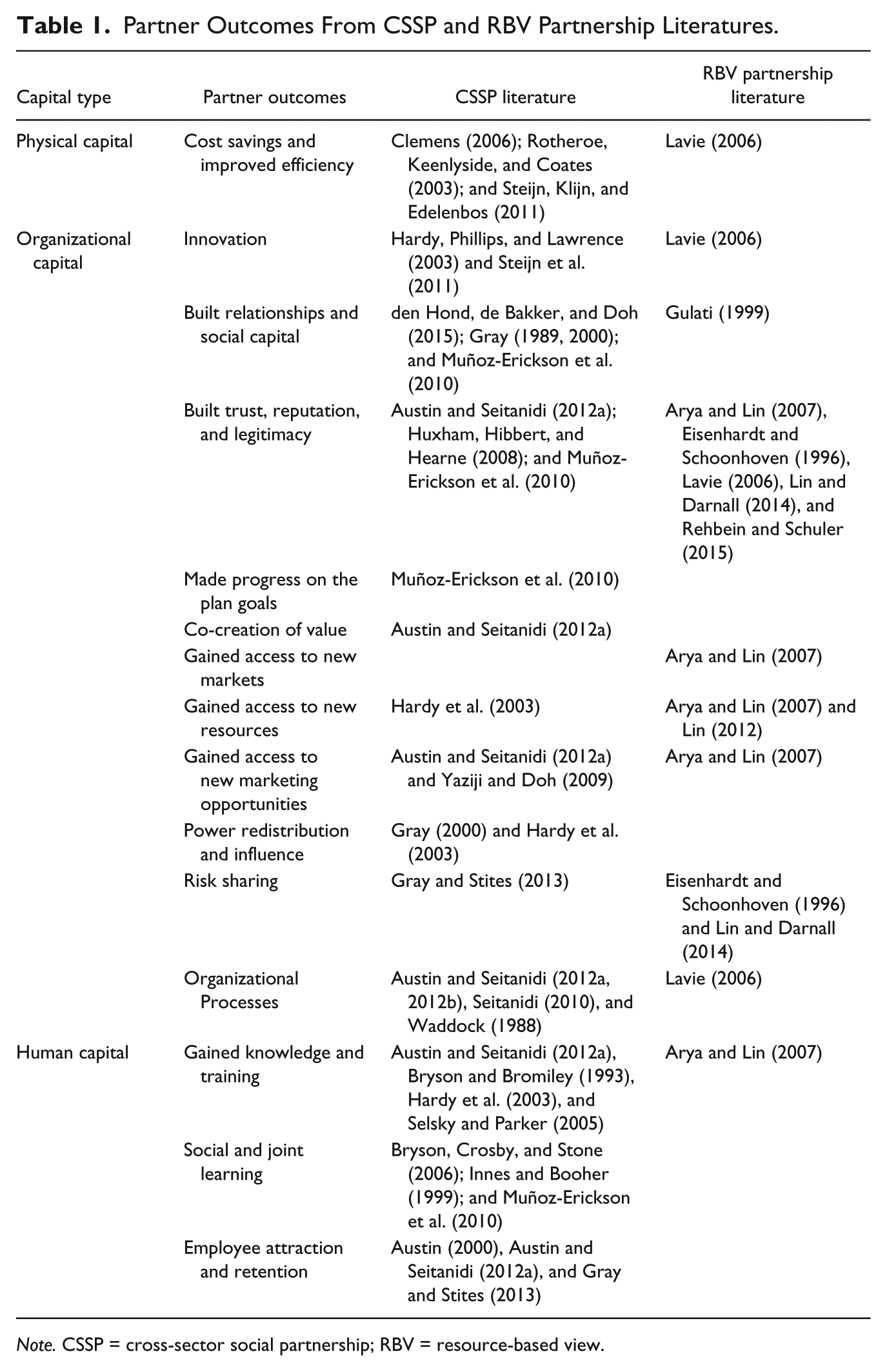
Note. CSSP = cross-sector social partnership; RBV = resource-based view.
In summary, the CSSP literature provides a comprehensive representation of outcomes for partners and is complementary to RBV partnership literature. It expands RBV’s perception of what resources are valuable to partners in CSSPs. As mentioned earlier, to date, the focus of research on partner outcomes has been on small partnerships (Austin, 2000; Berger et al., 2004; Lin, 2012; Rivera-Santos & Rufín, 2010; Seitanidi & Crane, 2009; Selsky & Parker, 2010; Yaziji, 2004). However, there is recent evidence to suggest a steady increase in multi-stakeholder partnerships (Gray & Stites, 2013). This represents an opportunity to make a theoretical contribution to the CSSP literature by examining partner outcomes of multi-stakeholder partnerships. It also represents an empirical contribution to RBV partnership literature by identifying strategic resources gained through multi-stakeholder partnerships.
Method
This study used a qualitative research design (Patton, 2002). The data were collected by interviewing partner organizations involved in four best practice cases in Canada. The selection criteria for determining the best practice cases are listed below. The interviews collected information about the types of resources partners can gain.
Choosing Research Sites
In 2013, there were 113 communities with an integrated community sustainability plan or municipal sustainability plan in a Canadian municipality with a population of more than 5,000 people (University of Alberta, 2013). Not all of these communities use a partnership approach to implement their plans (Clarke & Erfan, 2007). The criteria used to select the appropriate case study sites (Yin, 2003) were as follows: (a) The community had a collaborative community sustainability plan, which involved a multiple organizational stakeholders as partners (more than 10 partners); (b) the plan was considered successful as indicated by winning an international or national award; (c) the plan was adopted long enough ago for there to be a history of implementation (in other words, it was adopted in, or before, 2005); (d) progress on the collaborative strategic plan outcomes had been documented (as indicated by at least two implementation reports); and (e) sufficient information regarding the partnership and partners existed and was accessible in Canada. The resulting cases that fit these criteria are Whistler2020, Montreal’s Community Sustainable Development Plan, Hamilton’s Vision 2020, and Greater Vancouver’s citiesPLUS.
Introduction to the Four Case Sites
Whistler2020
The plan was adopted in 2004. Involved in the Whistler2020 partnership were its secretariat, which is based out of the Whistler Centre for Sustainability, and its more than 100 partner organizations. Partners were involved as board members, task force members, and implementing organizations.
Montreal Community Sustainable Development Plan 2010-2015
This plan has evolved from its first plan, Montreal’s First Strategic Plan for Sustainable Development, which was adopted in 2005. The secretariat for the partnership was run out of the City of Montreal. More than 200 organizations were involved as partners and helped with formulation and implementation.
Hamilton’s Vision 2020
This plan is the oldest sustainable community plan in Canada; it was first adopted in 1992, and has been renewed 3 times, most recently in 2015/2016. The secretariat was run out of the City of Hamilton. Hundreds of organizations were involved in the formulation and in each of the three renewal processes. Partners were also involved in multi-stakeholder committees and entities that were established to help implement the Vision, such as Clean Air Hamilton.
Greater Vancouver’s citiesPLUS
This plan was created in 2003. Hundreds of organizations were involved in its formulation, which was coordinated and funded by a partnership of 17 key business, public, and civil society organizations. The plan was intended to be implemented by the partner organizations.
Table 2 provides more details on the partnership structures and the role of partners in each of the four cases.
Summary of the Partnership Structure and Role of Partners in Each of the Four Cases.

Source. Adapted from Clarke (2011, p. 160).
Data Collection for In-Depth Cases
Based on an initial interview with the person responsible for the plan, and information in the documentation, an initial list of key organizations and potential interviewees was compiled for each case (Marshall, 1996); these lists snowballed to include additional interviewees (Patton, 2002). An invitation email was used, or introductions were made from a previous interviewee (Patton, 2002). Semistructured interviews were conducted in English or French with key informants (Marshall, 1996) ensuring coverage of the formulation and implementation over time. Interviewees included people representing partner organizations; they were drawn from a range of organizational types (such as large businesses, small businesses, business associations, non-governmental organizations (NGOs), municipal departments, universities, etc.). Interviews were conducted in person where feasible, or by phone if not. There were 16 interviewees for Whistler, 14 for Montreal, five for Hamilton, and 12 for Greater Vancouver who commented on partner outcomes, for a total of 47 interviews.
Each interview was with a separate partner organization, and the interviewee was the key representative of that organization in the partnership. All the interviewees represented organizations that were engaged in the decision making of their respective partnership (e.g., secretariat, steering committee, and/or task force). Generally the interviewee was the executive director or CEO (for NGOs, business associations, and small companies), or the sustainability director (for larger companies, universities, and governments). Table 3 details the distribution of interviews across business, public, and civil society sectors. In all four cases, there was representation from all three sectors. In Canada, universities are all public institutions, but also incorporated charities, so are listed separately. Business associations are civil society, but tend to represent the views of business, so are also listed separately.
Interviews per Case.

Analysis
All interviews were recorded, transcribed, and then inductively coded (Patton, 2002; Thomas, 2006). Relevant comments were compiled separately for each case based on organizational type (Thomas, 2006). These comments were then reduced to one bullet per comment, capturing the essence (and language) of the comment (Thomas, 2006). If the same interviewee made the same comment multiple times, then the comment was only noted once. These reduced comments were then aggregated across organizational types and cases, and clustered into categories (Thomas, 2006). Reduction continued until the minimum number of distinct categories were made (Thomas, 2006), resulting in 10 categories that best captured the range of “resource gained” partner outcomes.
From the coded interview transcripts, quotations were selected to provide a richer understanding of the different categories. The interviewee was contacted to confirm the use of the quotation, the exact wording, and that he or she granted permission for the quotation to be attributed to him or her in subsequent publications or presentations. The interviewee was also given the option to grant permission for the use of the quotation, while maintaining anonymity to his or her organization and/or personal identity. All quotations that appear in this article were validated in this way.
Results
Partner resources are obtained by individual partner organizations as a consequence of participating in the partnership. Interviewees were directly asked about the benefits of their organizations’ involvement in the partnership. In addition, some made relevant comments at other points in the interview and these were captured as well.
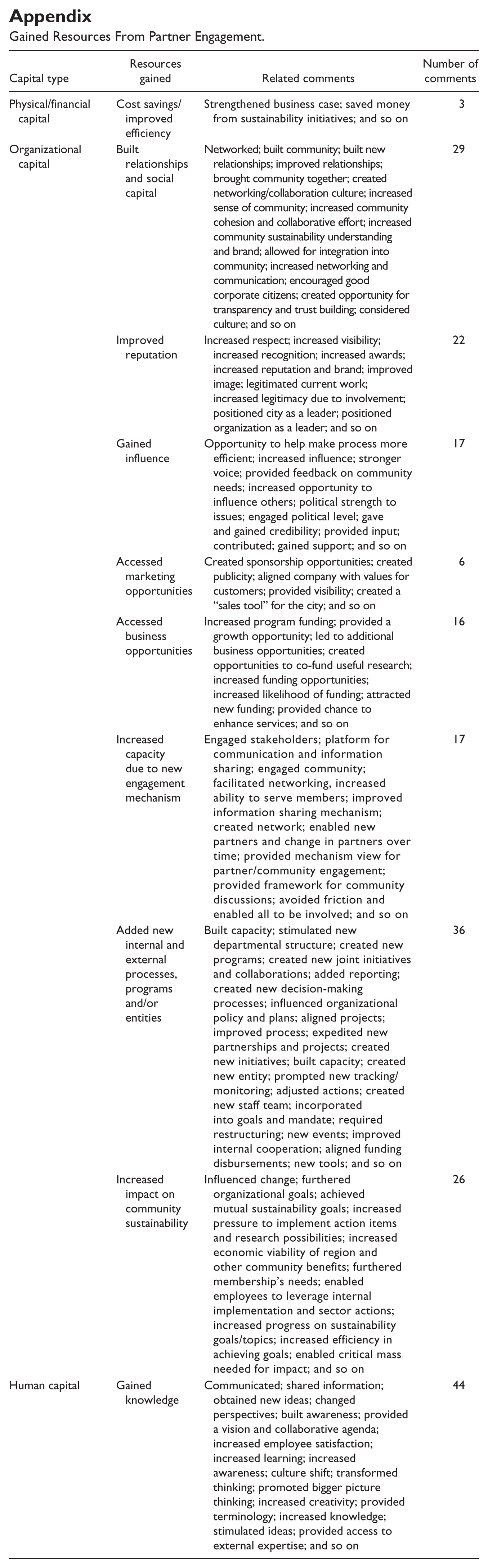
Subsequent clustering of partner outcomes across the four cases resulted in 10 categories. These are categorized as physical/financial, organizational, and human capital, providing a RBV perspective. This section shows the results of this study by providing richer detail about the partner outcomes (resources gained) found.
See the appendix for a summary of the comments organized into the three RBV categories.
Physical/Financial Capital
Cost savings/improved efficiency from sustainability incentives
Savings from internal sustainability initiatives were mentioned in three interviews. Most of the savings discussed were from internal environmental initiatives where organizations reduced energy, waste, and/or water. For example, Arthur Dejong, the Mountain Planning and Environmental Resource Manager at WhistlerBlackcomb estimated a savings of roughly Can$800,000 annually from water and energy conservation initiatives. The cost savings initiatives were conducted as part of implementing Whistler2020.
Organizational Capital
Built relationships and social capital
Partners become part of the common effort and thus gain social capital through helping to achieve the community sustainability goals. Also, they are more networked with new and stronger local relationships. Interviewees identified this theme as one that gave their organization a sense that it was contributing to something larger than itself. Interviewees described the process as bringing them closer to their community through building relationships and as a unifying agent that brought the larger community together by providing the community with goals to collectively work toward.
The interviewee from the NGO Green Venture expressed an appreciation for Hamilton’s Vision 2020 and explained how the strategy provided the community with an overarching initiative rather than the community having several inconsistent small initiatives. An interviewee from WhistlerBlackcomb described Whistler2020 as a tool for bringing the community together, thus providing customers with a holistic Whistler experience, saying, [Whistler2020] brings us together as a resort. As well, it’s not just environmental initiatives. Our guests come into the Valley, they don’t differentiate between how a municipal employee treats them and a WhistlerBlackcomb employee. They look at the overall Whistler experiences, the cumulative effect, and the more that we are around the table expressing our values, driving our values, partnering on them. Understanding each other just makes us stronger as a resort.
The interviewee from the City of Montreal reflected on the benefits of organizations interacting with other organizations, which they were not accustomed to working with. The result, as explained by the City of Montreal participant, was partner organizations forming close networks that are further established through activities such as luncheons and award galas. As an example, the NGO Quebec Association for the Advancement of Education Relating to the Environment (AQPERE) finds the benefit of being involved in Montreal’s partnership is the networking; as Pierre Fardeau, the Director of AQPERE said (English translation; the original French version is in Note 1): “It is a great advantage to have representatives from environmental groups, ministries, businesses, etc., meeting with each other in order to share information on their sustainable development initiatives.” 1
In Greater Vancouver, the building of relationships was also mentioned. Esther Speck, now the director of Sustainability and Community at Mountain Equipment Coop, commented about the citiesPLUS process that people built relationships unlike anything I’ve ever been involved in the region. It was an opportunity for people at different levels to connect and spend time and in a room with others. These connections are important as a means of creating and implementing ideas . . .
Improved reputation
Improved reputation was achieved through increased respect, recognition, legitimacy, and image, which was generated from involvement in the partnership. Some interviewees talked about their involvement improving their reputation in their corresponding city. For instance, an interviewee from McGill University talked about how its involvement improved McGill’s reputation with the francophone community in Montreal, making the relationship more open and amicable. Others found that their organization’s reputation had improved beyond the community.
The City of Hamilton talked about Vision 2020 as a facilitator for improving the city’s reputation with its citizens. A City of Hamilton’s interviewee had this to say about Vision 2020’s role in reshaping the internal image of Hamilton: “[Vision 2020 was integral] to the improvement of the image of Hamilton as a more sustainable city or a greener city, or something other than a steel city.”
Gained influence
Through their involvement in the plan formulation and implementation, organizations have increased their influence. Bruce Sampson, the former vice president of Sustainability, and former head of strategic planning at BC Hydro, commented about citiesPLUS: “Winning the best 100-year plan gave Vancouver more credibility and the people involved in it more credibility for moving things forward.”
Montreal’s Eco-Quartier Nortre-Dame-de-Grace (NDG) spoke about their organization’s involvement in the partnership as providing credibility to their organizational influence, explaining, . . .advantages are certainly the partnerships, also the fact that you are signed on gives you some credibility that you’re an organization that really values [sustainability] and that the City of Montreal can refer back and say oh yes, great they are a partner in the Eco-Quartier they are also a partner in the plan so it’s reinforcing that, we’re definitely implicated.
Frédéric Dumais, a senior analyst with the Chamber of Commerce in Montreal, gave a specific example of increased influence (English translation, original French version in Note 2), “I am convinced of the fact that in taking part in the Plan, this has allowed us to speak more on sustainable urban development for the city, and not solely of urban development.” 2
Accessed marketing opportunities
Partners increased visibility, created sponsorship opportunities, and gained publicity. While mostly this was about marketing for businesses and their products, it was also relevant for civil society organizations and public entities to market their programs. For example, the interviewee from the City of Hamilton discussed the advantages of using the sustainable city premise as a sales tool, from an economic development perspective, to attract talent and business investment.
Accessed business opportunities
Partners increased program funding, and were provided a growth of opportunities. One example of involvement in the partnership leading to business opportunities is the WhistlerCooks Vancouver Olympics story. WhistlerCooks, a small catering company, won a number of catering contracts over many larger catering companies for the Vancouver Olympics. Other catering companies were maintaining the position that the sustainable practices requested by Vancouver Olympics’ organizers were impossible to meet; meanwhile, WhistlerCooks was already engaging in the same sustainability practices, thus winning the small catering company several of the contracts. The interviewee from WhistlerCooks had the following to say about their experience leading up to the Vancouver Olympics: I really believe that a large part of the business that was awarded to us, which is a career contract for us, was because they saw that we were a [Whistler2020] partner. They [the Olympics Committee] signed a mission statement of this is what we are going to produce for a product; and we are going to try to find companies that are going to play ball with us the whole way. And a lot of industries didn’t want to do it; they just wanted to fight them, and catering was one of them. We were just this little company that kept managing to win.
While this theme was commented by the for-profit companies, there are other examples too. For example, Sustainable Concordia was able to access new funding opportunities as a result of being involved in Montreal’s partnership. For the Santé Publique, a government department, being involved in the Montreal partnership allowed it to expand its programming.
Increased capacity due to new engagement mechanism
The partnership provided a new means by which to engage with community stakeholders, a process that is led by the partnership and not by the partner organization. For example, for Victoria Smith, manager of the Aboriginal & Sustainable Communities Sector at BC Hydro, being involved in Whistler2020 is a great opportunity. BC Hydro, a provincial crown corporation that generates and distributes electricity, has taken the lead as an Implementing Organization on some actions. She explained, The process allows BC Hydro to be at the table with regional leaders and to help influence thinking regarding conservation of energy. It also gives BC Hydro a head’s up on plans going forward so we can work together on energy efficiency of design for new developments and manage load requirements effectively.
Also in Whistler, WhistlerBlackcomb—a year round resort and former Intrawest company—attributes the success of its micro-hydro project to the support the company received because of the legitimacy that comes with being a partner in Whistler2020; the interviewee had this to say about the project: I was able to get at the grassroots level clarity, acceptance, support, and drive for this renewable energy project, which up and down the highway here was being contested in other communities. So I find great value in Whistler2020 in that I can get into a room with community influencers to have an objective debate and assessment, and get results; at times get significant results. Because once the committee said “damn it, do it” the politicians have to follow suit, and I had support for it. Whistler2020 can put a lot of objectivity into our drive for sustainability.
In Montreal, the City of Montreal organizes award galas to maintain partner engagement in the Montreal Sustainable Development Plan. An interviewee from the City of Montreal’s Sustainable Development Division had this to say about engaging partners: The City’s environmental staff is now interacting with a number of organizations with whom they were not accustomed to working with. All the partners now form a close network, and we organize a number of regular activities, such as luncheons and an award gala.
For an NGO such as the Community Services Society, which has nine full-time and 12 part-time staff and a mandate that largely overlaps with that of Whistler2020, being involved as a Whistler2020 Task Force member helped it to realize its mandate. Greg McDonnell, Executive Director of Community Service Society, had this to say: . . . helped us build our capacity . . . it has given us ears and eyes and gave us some feedback on community needs, not only internal decisions on what needs are, but community-based feedback on what the social service needs are. One of our most important and successful programs is a result of a Task Force. The community garden, located in a sub-division where members can access a plot 4′ by 8′, is our busiest program with 72 plots, 350 local people, and a wait list of 80 more.
In Hamilton, the engagement mechanism happens during the Vision 2020 renewal cycles. An interviewee from the City of Hamilton has this to say about the process: . . . we wouldn’t be able to do a lot of things that we do without partnerships. I think Vision 2020 has been important in creating experience with collaboration and the culture of collaboration.
Added new internal and external processes, programs, and/or entities
As a result of being in the partnership, partners refocused existing internal resources on building new programs, processes, and/or external entities, thus enabling increased organizational capital in sustainability. Numerous interviewees discussed new initiatives, processes, partnerships, products, and so on, that resulted from their participation in the partnership. An example of the formation of a new entity occurred through Whistler2020 where a new NGO—the Whistler Centre for Sustainability—was formed from the desire to create a secretariat for the plan and a consulting body for other communities to engage. Another example exists in Hamilton where Vision 2020 was the catalyst that resulted in the formation of Clean Air Hamilton, a multi-stakeholder group focused on air quality in Hamilton.
An example of new internal processes was identified in Greater Vancouver where the Sheltair Group changed its approach as a result of being a leading partner in their partnership; Lourette Swanepoel explained that “citiesPLUS has helped shape our company’s approach to sustainability planning and the services we offer to help other communities and regions on their path to sustainability.” In Montreal, partners are asked to focus on forming internal sustainability programs or processes and report on them to show how their internal initiatives have contributed to the overarching goals of the partnership. For instance, the interviewee from McGill says, “what happens is when you do commit to your actions, you need to confirm and report to the city ever year.”
Whistler2020 has 15 to 17 task forces made up of 200 members and managed by the Whistler Centre for Sustainability. The interviewee from the Whistler Centre for Sustainability explained, Between 15-17 task forces, with around 200 members on them would meet annual, and they would action plan so they would receive a current reality update with respect to their strategy area, and they would evaluate that against their descriptions of success, and then they would action plan on how to get there. Essentially those meetings would be daylong meetings.
Increased impact on community sustainability
Partners furthered organizational sustainability goals, furthered mutual sustainability goals, and generally succeeded in improving sustainability in their region on a range of topics such as climate change, transportation, energy, waste, housing, food security, and so on. Through being involved in the partnerships, they were able to leverage more action by their own organization and contribute to a critical mass of actions community-wide. Also, all four cases were documenting their community-wide sustainability progress through indicator reports.
The City of Montreal conducted a survey in 2009 where partners were asked whether participating in the sustainable development plan helped them further their sustainability goals and the majority answered that it had. The City of Montreal’s study participant explained that involvement in the partnership in some cases provided employees with enough credibility to push their administration toward engaging in more sustainable practices.
When David Bodner, director, Community, Aboriginal & Government Relations at Terasen Gas, was asked about the implementation of Greater Vancouver’s citiesPLUS, he responded, If you wish to consider the outcomes of citiesPLUS, you might look at the QUEST [Quality Integrated Energy Systems for Tomorrow] initiative that the CGA [Canadian Gas Association] and Terasen are aggressively moving towards—the concept of integrated energy systems that sees us expanding our gas distribution network to include geo and solar thermal, and harvesting sources of biogas and delivering it into the pipe system . . .
This is just one example of a concrete change that has resulted from one of these plans being implemented. There are thousands of more examples.
Human Capital
Gained knowledge
Partner representatives shared information, learned, obtained new ideas, changed perspectives, built awareness, shifted their culture, and so on. All four partnerships used workshops and networking events as a mechanism to inform and teach partner organizations about sustainability. For the Montreal Metropolitan Chamber of Commerce, one of the outcomes of being involved in Montreal’s partnership is that it allowed that organization to raise awareness on sustainability with its core staff and its members, and also to understand the larger regional initiative.
An interviewee representing McGill University discussed the benefits of the sustainable development training sessions offered for partner organizations as both learning and networking opportunities. The interviewee from the City of Montreal discussed the Montreal training sessions as allowing for a synergistic horizontal exchange of information between partners. And, the study participant from the Whistler Centre for Sustainability described the partner organizations’ appetite to learn more about sustainable development practices as they continue their involvement.
For Wayne Kratz, a business owner of restaurants and coffee shops who was a member of both the Whistler2020 Water Task Force and the Food Task Force, “awareness is the biggest part of it. Sharing of other people’s perspectives helps me make my own decisions. And besides decision making, it is a great way to gather information from other business people involved in the community.”
Other organizations discussed the ability of the partnership to help community actors better understand each other, thus avoiding initiative overlap and unnecessary resource drain. In Montreal, the interviewee from the Eco-Quartier NDG had the following to say: . . . you definitely get to see who the partners are and you get to realize how close your links are because there are some organizations that you may have known that they do x, but you don’t realize that they do x, y, and z. And, so by seeing them as a member of the plan it gives you the opportunity to go forward and say we’re working on this project, can you let me know what project you’re working on? Are there particular steps that you are taking that we might not necessarily be taking? Or, is there a better way that we could collaborate together on a project?
Discussion and Conclusion
Multi-Stakeholder Partnerships: Partner Resources Gained
This study focused on resources gained by partners of multi-stakeholder partnerships, an area that has received minimal attention because studies on partner resources have focused on small CSSPs. Implementing a community sustainability plan is a long-term process that requires the ongoing engagement of partners (Rok & Kuhn, 2012). When it comes to local sustainable development, partners are an essential element of the implementation process both from a resources and buy-in perspective (Rok & Kuhn, 2012). The successful implementation of the plan requires partnership secretariats have a better understanding of how partners can benefit and why they remain involved. This study makes theoretical and empirical contributions to an area not well understood by CSSP researchers, but necessary for multi-stakeholder partnerships if they are to continue as a viable option for addressing complex social challenges.
This article reviews the scope of partner outcomes as they are discussed in the partnership literature. It uses RBV theory to situate these outcomes as resources for partner organizations. The empirical findings indicate that partners can gain physical/financial, human, and organizational resources from participating in multi-stakeholder partnerships. Table 4 summarizes the empirical findings about resources gained in four multi-stakeholder partnerships, the literature about resources gained (from the CSSP literature and RBV partnership literature), and a comparison of the two.
Comparison of the Empirical Findings With the Literature.
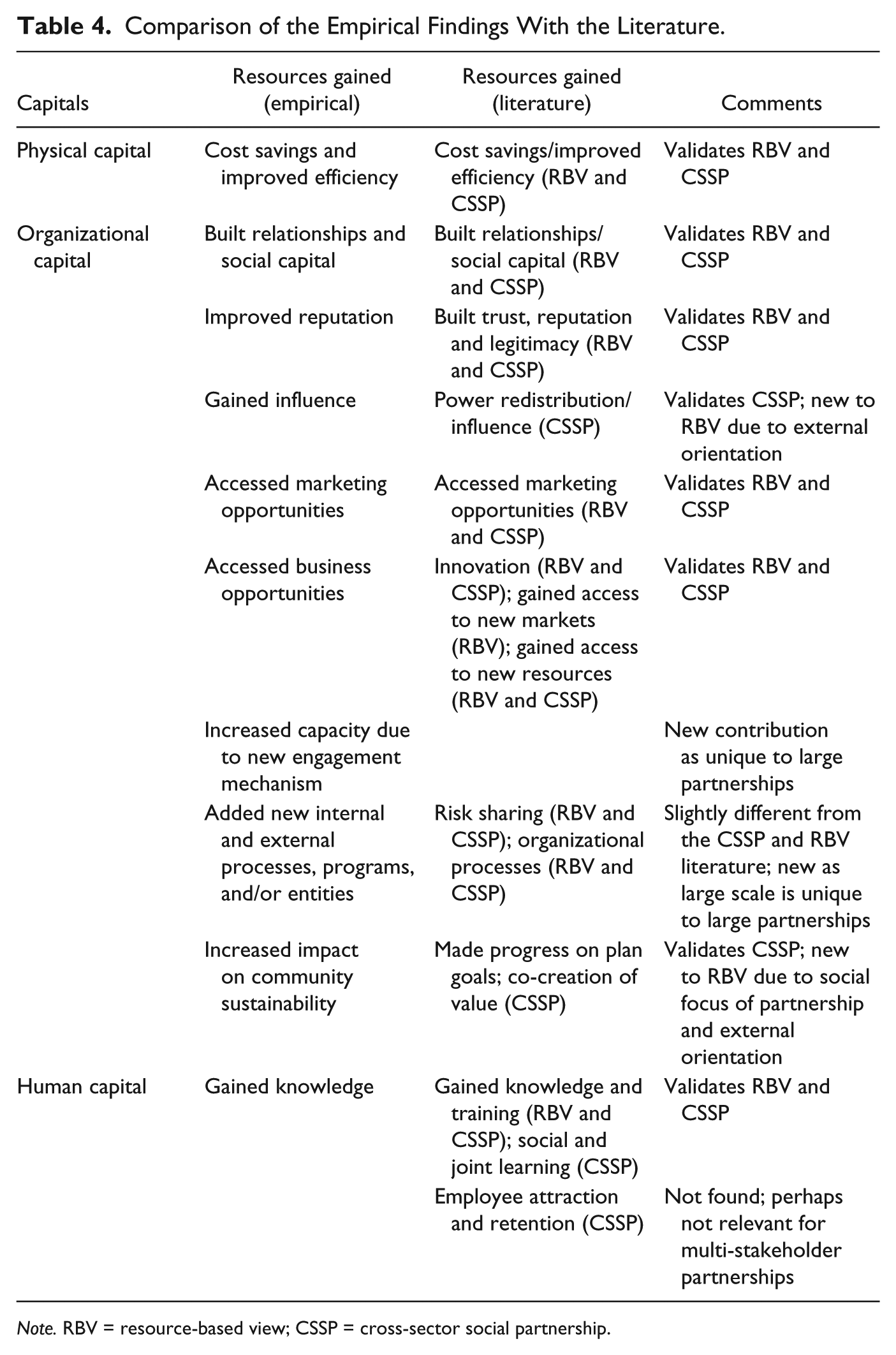
Note. RBV = resource-based view; CSSP = cross-sector social partnership.
Physical/financial capital
This study found that some organizations achieved cost savings or financial capital from implementing internal sustainability into their operations as part of their commitment to the partnership. One partner, WhistlerBlackcomb, when discussing the micro-hydro project made possible by their involvement in Whistler2020, specifically mentioned cost saving due to new technology and equipment. Thus, while a multi-stakeholder partnership can lead to some physical/financial capital, these empirical findings indicate that physical/financial resources gained are limited to cost savings and improved efficiency. Even then, financial capital indicators were only mentioned in three interviews in one case.
Organizational capital
Built relationships, improved reputation, and accessed marketing and business opportunities—resources found in this study—are socially complex and causally ambiguous thus making them valuable according to RBV (Das & Teng, 2000). While the findings, increased influence and impact on community sustainability, have been discussed in the CSSP literature for small CSSPs (Gray, 2000), they have not been identified in the RBV partnership literature. These two resources have an external orientation specifically relevant to CSSPs. This study has grouped them in the organizational capital category because the study uses Barney’s (1995) grouping of resources. However, these two resources indicate that there may be other considerations relevant to social issue of the partnership not captured by RBV categories used in this article. Both are highly relevant for creating social change, a unique aspect of CSSPs and a critical outcome expected by partners (Seitanidi, Koufopoulos, & Palmer, 2010).
Human capital
Partnerships often result in training opportunities, and the lateral exchange of knowledge between organizations. Of the partner outcomes, gained knowledge (or learning) has had considerable attention in both the CSSPs and RBV partnerships literatures (Arya & Lin, 2007; Huxham & Hibbert, 2004). It was the most commented on outcome in all four cases, so it would appear that it deserves this attention. While the different attitudes of the interviewees who gained or shared knowledge were not specifically analyzed in this study, the comments suggest that this knowledge was not the same for all partners but also depends on which issue is considered (Huxham et al., 2008). With this in mind, much of the new knowledge acquired and shared was sustainability related. The implications of this finding is that partners who are using sustainability tactics to achieve strategic ends may benefit most from the type of partnerships studied in this research.
Multi-Stakeholder Partnerships: New Partner Resources Gained
The main contributions are these three findings specific to multi-stakeholder partnerships: (a) partners increase capacity due to a new stakeholder engagement mechanism, (b) partners create new internal processes, and (c) partners develop new external processes, programs, and/or entities.
First, the finding that the partnership is also a stakeholder engagement mechanism for partners is unique to multi-stakeholder partnerships as a partner would not have access to as many stakeholders in a smaller partnership. New engagement mechanisms include task force working groups like the ones used to implement Whistler2020, award galas like the ones held in the City of Montreal to recognize and incentivize internal sustainability progress made by partners, and renewal process committees and town halls, like the ones organized in Hamilton to gain partner input and recommendations. The stakeholder engagement process is led by the partnership, not the partners. This dynamic creates neutral ground on which partners can engage, share information, and build authentic relationships with community stakeholders. Past research has found that firms who use sustainability tactics to gain a strategic advantage are most successful when they engage with stakeholders (Rodriguez-Melo & Mansouri, 2011). In addition, firms that leverage a partnership to engage stakeholders reduce costs related to facilitating stakeholder engagement because these costs are absorbed by the local government or facilitators. This finding has implications for researchers studying business sustainability strategies because it indicates an opportunity for firms to engage in community sustainability partnerships as a strategic tactic.
Second, the finding that partners create new internal processes to implement the sustainability plan makes a contribution to CSSP research. Research on CSSPs and alliances has found that partners create new internal processes to organize partnership activities (Kale, Dyer, & Singh, 2002). For instance, relational view researchers have found that partners will often create new structures inside each organization to facilitate partner learning and relationship building (Schreiner, Kale, & Corsten, 2009). In such instances, the new structure might include creating a new job position or team responsible for partnership activity (Schreiner et al., 2009). This is most applicable where the goals of the partnership overlap with the strategic goals of the partners (Porter & Kramer, 2012). This study found that partners make internal changes to support their own sustainability goals, ultimately contributing to the goals set in the community sustainability plan. In these instances, the new structure might include new jobs or team, but it also frequently involves processes and changes in operations to reflect the partner’s sustainability goals. Being part of the partnership enabled these resources to be gained.
Third, the finding that new external processes, programs, and/or entities developed from the partnership, and the risk sharing that entails, has not been discussed similarly in the CSSP or RBV partnership literatures. Risk sharing through CSSPs and alliances has been discussed (Eisenhardt & Schoonhoven, 1996; Lin & Darnall, 2014), but not in relation to the creation of new programs, processes, and entities. Generally, risk sharing is mentioned in relation to funds and potential for failure. The findings replicate what has been identified in the CSSP literature in that the emergence of external entities was identified, but where this study’s findings diverge is in terms of the scale. For instance, in multi-stakeholder partnerships, new external processes for implementation, joint partner projects such as the task forces identified in the Whistler2020 case, and external entities for implementation such as the Whistler Centre for Sustainability can occur simultaneously. A small CSSP would not have the capacity or need to create various levels and types of external processes and entities. This finding is an important contribution to the CSSP literature because when partners implement the community sustainability plan through new programs, processes, and joint entities, they are leveraging resources to help address the social problem.
Implications for Practice
The results of this research have implications for decision makers and facilitators of multi-stakeholder partnerships. The results indicate that partners can experience positive results from participating in multi-stakeholder partnerships. This is despite the fact that these partnerships do not inherently prioritize the strategic needs of its partners (Bäckstrand, 2006). This finding is important because decision makers and facilitators can use this information to motivate ongoing partner engagement by explaining these benefits to partners (Gray & Stites, 2013). For instance, facilitators could target organizations that use sustainability tactics for strategic ends and discuss the financial and strategic advantages of engaging with other stakeholders through a community-led partnership.
The results of this study also have implications for partners and organizations weighing the costs and benefits of joining a sustainability multi-stakeholder partnership. For partner organizations, these findings indicate that rare and valuable advantages of this type of partnership are the stakeholder engagement opportunities (Schuster & Holtbrügge, 2014). Thus, to get the most out of the partnership, they should prioritize participating in the engagement mechanisms, such as the award galas, workshops, or working groups. For organizations considering joining the partnership, these findings recommend that they determine whether sustainability tactics are part of their strategic direction (McWilliams & Siegel, 2011). If so, they might consider a multi-stakeholder partnership as a tool for developing their capacity to implement internal sustainability tactics informed by stakeholder values and views (Hart, 1995).
Areas for Future Research
This study determines the resources gained by partners of multi-stakeholder partnerships in the context of local sustainable development. The study did not consider the resources lost, or the interactions between resources (gained and/or lost). Research on the negative partner outcomes, and the interactions between resources, could be an area for future study. In addition, a study on outcomes raises questions about measurability; further research could consider this in more depth.
This study does not see notable differences between the resources gained by the business sector, public sector, and civil society sectors. 3 As a result, this article does not explore sector-specific outcomes. The reason for this finding might be the small sample size per partnership, or it might be because all partners have access to the same services. Is this true for all large multi-stakeholder partnerships due to the similarities in roles that each partner plays, or was that finding unique to this context? What this study did notice is that there were differences between the resources gained based on the partnership structure, the size of the partner organization, and level of engagement. A large company had more in common with a university than it did a small company, for example. More research could be done on the importance of structural features (Clarke, 2011) to partner outcomes, and the role of organization size in partner outcomes.
This study focuses on cross-sector partnerships. How transferable are the findings to same-sector large partnerships and/or networks with higher task specificity? Further research would be needed to determine this. A number of the partner outcomes, such as building social capital in the community, gaining influence on policy decisions, the stakeholder engagement mechanism, increased impact on community sustainability, and even some of the gained knowledge likely depend on the cross-sector interactions. Others are likely relevant, with some nuance, to same-sector partnerships. For example, cost savings, business and marketing opportunities, adding processes, programs and/or entities, and gaining knowledge would be possible from an industry network with formal processes for interaction and training opportunities.
The new engagement mechanism that these multi-stakeholder partnerships create is one of the contributions of this article. Further research could be done on how this compares to other stakeholder engagement mechanisms, where the organization leads the process.
Research on Local Agenda 21 partnerships have found that the financial, human, and social capital in a community, as well as political will, can significantly influence the ability of the partnership to achieve its community sustainability goals (Jörby, 2002; Sofroniciu, 2005). It would be interesting to investigate whether such community-wide variables also affect the partner outcomes and thus the partner experience.
Finally, as with any case study research, considering how transferable the findings are to other contexts would allow for additional theory-building and generalizations. Based on feedback received during the dissemination of research findings to practitioners, the results are likely generalizable to other multi-stakeholder partnerships at the local level for other complex topics such as health and crime. Are they also generalizable to multi-stakeholder partners at a difference scale (e.g., globally)? This would need more study as some of the findings might be a result of place-based interactions. Also, most of the partners interviewed for this study only operate at the local scale, so building reputation or gaining influence is bounded by the local level. As noted throughout the discussion, the findings are focused on larger partnerships. How many partners are needed for these new resources to be gained? Is it 10, 20, 50? This would need more research, but antidotal evidence indicates that the line is probably around 10 if the partners are the key local actors. This research also showed that the lead organization can be government, but it can also be a non-profit set up for this purpose. Again antidotal evidence suggests that it is hard for consulting firms and non-profits to lead this unless there is core funding support from the government, as these types of entities are project-funded and thus cannot sustain a lead role for 25 years without guaranteed core funding. A few boundary conditions that likely limit generalizability: These partnerships all had a formal structure, are voluntary not contractual, and have high-task specificity. The task specificity differed for each partner, so the outcomes for each partner may also vary and vary in the amount/value. In general, as has been stated by others (Koontz & Thomas, 2006), there is room for better understanding about outcomes of multi-stakeholder partnerships.
Conclusion
This study explored partner perceptions of resources gained from their involvement in multi-stakeholder partnerships. The findings are based on 47 interviews with partner organizations in four different multi-stakeholder partnerships implementing community sustainability plans: Whistler2020, Hamilton’s Vision 2020, Montreal Community Sustainable Development Plan 2010-2015, and Greater Vancouver’s citiesPLUS. This study contributes to the literature by determining that despite the differences between small CSSPs and large multi-stakeholder partnerships, partners can expect many of the same resources in both types of partnerships. Moreover, partners of multi-stakeholder partnerships may also gain three additional resources not possible from engagement in small CSSPs. The new partner outcomes found are as follows: (a) partners increase capacity due to a new stakeholder engagement mechanism, (b) partners create new internal processes, and (c) partners develop new external processes, programs, and/or entities.
Multi-stakeholder partnerships offer a mode to mobilize the diverse range of stakeholders needed to address local sustainable development challenges (Clarke & Fuller, 2010). The breadth and depth of knowledge accumulated in multi-stakeholder partnerships provides greater capacity to overcome limitations of a single organization or sector (Kuenkel & Aitken, 2015). This research is significant because it provides insight into what may drive partner engagement in multi-stakeholder partnerships, and given the challenges and necessity of widespread partner engagement in community sustainability plan implementation (Portney, 2005), this level of insight is valuable in moving the local sustainable development agenda forward.
Footnotes
Appendix
Gained Resources From Partner Engagement.
| Capital type | Resources gained | Related comments | Number of comments |
|---|---|---|---|
| Physical/financial capital | Cost savings/improved efficiency | Strengthened business case; saved money from sustainability initiatives; and so on | 3 |
| Organizational capital | Built relationships and social capital | Networked; built community; built new relationships; improved relationships; brought community together; created networking/collaboration culture; increased sense of community; increased community cohesion and collaborative effort; increased community sustainability understanding and brand; allowed for integration into community; increased networking and communication; encouraged good corporate citizens; created opportunity for transparency and trust building; considered culture; and so on | 29 |
| Improved reputation | Increased respect; increased visibility; increased recognition; increased awards; increased reputation and brand; improved image; legitimated current work; increased legitimacy due to involvement; positioned city as a leader; positioned organization as a leader; and so on | 22 | |
| Gained influence | Opportunity to help make process more efficient; increased influence; stronger voice; provided feedback on community needs; increased opportunity to influence others; political strength to issues; engaged political level; gave and gained credibility; provided input; contributed; gained support; and so on | 17 | |
| Accessed marketing opportunities | Created sponsorship opportunities; created publicity; aligned company with values for customers; provided visibility; created a “sales tool” for the city; and so on | 6 | |
| Accessed business opportunities | Increased program funding; provided a growth opportunity; led to additional business opportunities; created opportunities to co-fund useful research; increased funding opportunities; increased likelihood of funding; attracted new funding; provided chance to enhance services; and so on | 16 | |
| Increased capacity due to new engagement mechanism | Engaged stakeholders; platform for communication and information sharing; engaged community; facilitated networking, increased ability to serve members; improved information sharing mechanism; created network; enabled new partners and change in partners over time; provided mechanism view for partner/community engagement; provided framework for community discussions; avoided friction and enabled all to be involved; and so on | 17 | |
| Added new internal and external processes, programs and/or entities | Built capacity; stimulated new departmental structure; created new programs; created new joint initiatives and collaborations; added reporting; created new decision-making processes; influenced organizational policy and plans; aligned projects; improved process; expedited new partnerships and projects; created new initiatives; built capacity; created new entity; prompted new tracking/monitoring; adjusted actions; created new staff team; incorporated into goals and mandate; required restructuring; new events; improved internal cooperation; aligned funding disbursements; new tools; and so on | 36 | |
| Increased impact on community sustainability | Influenced change; furthered organizational goals; achieved mutual sustainability goals; increased pressure to implement action items and research possibilities; increased economic viability of region and other community benefits; furthered membership’s needs; enabled employees to leverage internal implementation and sector actions; increased progress on sustainability goals/topics; increased efficiency in achieving goals; enabled critical mass needed for impact; and so on | 26 | |
| Human capital | Gained knowledge | Communicated; shared information; obtained new ideas; changed perspectives; built awareness; provided a vision and collaborative agenda; increased employee satisfaction; increased learning; increased awareness; culture shift; transformed thinking; promoted bigger picture thinking; increased creativity; provided terminology; increased knowledge; stimulated ideas; provided access to external expertise; and so on | 44 |
Acknowledgements
The authors would like to thank May Seitanidi for her insights on large versus small partnerships, Duane Windsor for his excellent work as an editor, and the interviewees for their involvement in this study. Dr. Clarke would like to thank Sustainable Prosperity, the Centre for International Governance Innovation (CIGI), and the Social Sciences and Humanities Research Council of Canada (SSHRC) for financial support toward conducting and disseminating this research.
Declaration of Conflicting Interests
The authors declared no potential conflicts of interest with respect to the research, authorship, and/or publication of this article.
Funding
The authors disclosed receipt of the following financial support for the research, authorship, and/or publication of this article: The research was funded by Sustainable Prosperity, the Centre for International Governance Innovation (CIGI), and the Social Sciences and Humanities Research Council of Canada (SSHRC).