



Abstract
In this study, we investigate, both theoretically and empirically, the impact of language gender marking on gender wage inequality and country income inequality. We find that nations with a higher level of gender marking in their dominant language have a higher wage gap between genders. Using an instrumental variable approach, we also find that gender marking has an indirect impact on country income inequality via gender wage inequality. Furthermore, we find evidence that the income inequality of a society as a whole (Palma ratio and Gini index, interchangeably) is affected by gender wage inequality. Finally, we document that linguistic gender marking outperforms survey-based cultural gender dimensions as a predictor of both gender wage inequality and country income inequality.
One of the most widely documented and pervasive forms of social inequality is inequality between genders. As it pertains to income, gender inequality is present in developed (Fuwa, 2004) and developing (Duflo, 2012) countries alike, and manifests itself in a broad range of social and economic issues. Research has documented the existence of gender inequality in the allocation of household labor (Berniell & Sánchez-Páramo, 2012), access to education, health care, and presence in the labor market (Blau & Kahn, 1996). There are also documented gender inequalities in representation in political institutions (Santacreu-Vasut, Shoham, & Gay, 2013) and legal rights (Htun & Weldon, 2011). Gender inequality matters not only per se but also for functional reasons: It affects women’s well-being and has broader social consequences, lowering development and economic growth rates (Klasen, 2002; Seguino, 2000).
One of the best documented gender inequalities is the wage gap (Blau & Kahn, 1997, 2000). Research on wage inequality between genders focused on the U.S. employment market, as shown by Stanley and Jarrell (1998) in their meta-analysis. A later meta-analysis by Weichselbaumer and Winter-Ebmer (2005) shows that there are also differences in the gender wage gap between countries. The wage gap between genders also correlates with income inequality in a society as a whole (Misra & Murray-Close, 2014).
Piketty (2014) claims that the factors with the strongest influence on societal inequality are exogenous ones, 1 like institutions. The core components of societal culture are exogenous to current economic conditions, and some consider culture an informal institution (Xu & Shenkar, 2002) while others consider it a prior factor that affects institutions (North, 1993). However, culture is also an exogenous factor that affects the degree of gender inequality in a society. Hofstede (1980) and House, Hanges, Javidan, Dorfman, and Gupta (2004) claim that gender roles is one of the basic ways in which societies differ. For example, Ahmad (2014) documents the impact of different cultures in regard to females and female roles in the workplace. Fuwa (2004) finds that countries with a more highly egalitarian culture have lower inequality between genders. In this article, we use language as a measure of culture, based on previous literature that documents the critical impact of language on gender roles, and the position or rank of females in the organizations (Sheridan, 2007), and on gender and social identity (Palomares, 2009). We use a novel approach based on the grammatical structures of languages. Research suggests that grammatical, sex-based distinctions arose from evolutionary pressures concerning specialization, reproduction, and the division of labor, suggesting that the use of gender in language acts as a cultural marker for historical gender norms (Johansson, 2005). There are also linguists who argue that grammatical gender is a representation of sexual distinctions between the genders, and even claim that this is a mechanism for perpetuating these distinctions (D. E. Baron, 1986). A growing body of literature is exploring linguistic impacts on society (Chen, 2013; Ladd, Roberts, & Dediu, 2015; Lupyan & Dale, 2010; Nettle, 2012). Recent cognitive experiments document that language affects how people process information, thereby affecting their behavior (Boroditsky & Gaby, 2010; Boroditsky, Schmidt, & Phillips, 2003; Vitevitch, Sereno, Jongman, & Goldstein, 2013). In brief, language reflects ancestral culture 2 and is reinforced by the cognitive effects.
Current literature on inequality does not explain large parts of the inequality variance within societies, and between societies. Therefore, the innovative idea that grammatical gender marking affects gender wage inequality and indirectly affects the society income inequality can potentially make a significant contribution to the field. Capturing and understanding the impact of language on gender wage gaps and society income inequality are important to businesses and society alike. Because grammatical gender is stable and unchanging over time, it reveals a society’s long-term tendency toward inequality by highlighting fundamental characteristics such as cultural acceptance of inequality in general and between genders in particular. Major inequality in a society has a mostly negative impact on business (Bapuji & Neville, 2015), making it important for mangers and organizations to understand the “undercurrents” that affect and create inequality. Moreover, businesses, organizations, and policy makers in a society can/should be change agents for more gender equality, and our research is important for this purpose. Without understanding the causes of inequality, inequality cannot be reduced.
To measure the presence and intensity of gender in a language, we use the gender intensity index (GII) based on all four grammatical structures explicitly related to gender in the World Atlas of Linguistic Structures (WALS; Dryer & Haspelmath, 2011). This study finds that the GII affects gender wage inequality. We are also innovative in employing the instrumental variable (IV) approach to show the causal relations that the GII has on country income inequality via gender wage inequality. Furthermore, we find evidence that the income inequality of a society as a whole (Palma ratio and Gini index, interchangeably) is also affected by gender wage inequality. Moreover, we find that the GII provides much better results than the survey-based cultural dimensions such as those of Hofstede (1980) and House and colleagues (2004).
The remainder of this article is organized as follows. The next section explains the motivation and reviews the literature on inequality, gender, and language, and then sets out our hypotheses. Following that, we describe the construction of the grammatical indices for analyzing inequality. The following sections present the empirical strategy, data, and regression results. The final sections include our analysis, conclusions, and implications of the study.
Literature Review and Hypotheses
There is a large body of literature on the impact of culture on inequality between females and males in different societies and nations. For example, Colclough, Rose, and Tembon (2000) investigate poverty in two African countries. They claim that the gendered underenrollment in school is an outcome of “cultural practice” and that gender inequalities are not related to income. Antecol (2000, 2001) used immigrants living in the United States to capture cross-country gaps in gender labor force participation rates and the gap in wages between genders. The main finding of both articles is that a significant part of the gender gap in wage and labor force participation is associated with the home countries’ environment. He suggests that home country culture, which is not an “observed human capital measure,” has a major effect on female labor force participation and wage gap between genders of immigrants even in their new country.
Language is an integral part of culture capturing ancestral culture. When the Global Leadership & Organizational Behavior Effectiveness (GLOBE) study (House et al., 2004) created a definition for “societal culture,” the authors claimed that culture consists of commonly shared experiences, and the first presented is language. Charles Darwin is among those enlisted to bolster the view that language is a form of memory that stores information in a genome-like mode:
If we possessed a perfect pedigree of mankind, a genealogical arrangement of the races of man would afford the best classification of the languages now spoken around the world; and if all extinct languages, and all intermediate and slowly changing dialect, were to be included, such an arrangement would be the only possible one. (Darwin, 1859, p. 422)
North (1993) in his Nobel Prize lecture argues that collective learning, as defined by Hayek, consists of experiences that have passed the test of time and are embodied in “our language.” Falck, Heblich, Lameli, and Suedekum (2012) hold that language is probably the best measurable indicator of cultural differences, and provide empirical evidence that dialects portray culture in a way that is persistent over time, and has a causal effect on economic behavior. Sampson, Gill, and Trudgill (2009) identify a new group of linguists who view languages as institutions that develop as part of societies’ cultural heritages, and hence differing and evolving in their levels of complexity, similar to other cultural institutions. Languages’ impact on organizations, businesses, and economic outcomes is the subject of increasing attention. In particular, language is being understood as an important aspect that permeates the life of individuals and organizations (see Brannen, Piekkari, & Tietze, 2014, for a review of language’s impact on multinationals and international business).
Descriptive linguistics is one of the dominant approaches, both theoretical and practical, used by linguists to describe the impact of language on a society (Sampson et al., 2009). It was inspired by the “father of American anthropology,” Franz Boas, who discovered an enormous diversity of linguistic structures and categories when studying new languages. Boas’s approach influenced many scholars and schools of thought including the Sapir–Whorf, Claude Lévi-Strauss and French structural theories, and sociolinguistics. All of the above approaches and schools of thought support the massive impact of language on individual users and societies.
The principle of linguistic relativity, commonly known as the Sapir–Whorf hypothesis, states that the structure of a language affects the way in which its speakers are able to conceptualize their world (Hoijer, 1954). Moreover, it contends that language shapes a person’s view of the world (Sapir, 1929; Whorf, 1956). Indeed, Whorf (1959) wrote,
We are inclined to think of language simply as a technique of expression, and not to realize that language first of all is a classification and arrangement of the stream of sensory experience which results in a certain world-order, a certain segment of the world that is easily expressible by the type of symbolic means that language employs. (p. 55)
Moreover, Lévi-Strauss, the “father of structural anthropology,” claims that language is composed of hidden rules that affect the behavior of its users. What makes cultures unique and different from one another are the hidden rules participants understand but are unable to articulate (Lévi-Strauss, 1973). In “Language and the Analysis of Social Law,” Lévi-Strauss (1951) explains why language is a social phenomenon that can be easily studied in a scientific manner. He adds that language consists of “systems of behavior” and “socialized thought . . . which regulate the unconscious activities of the mind.”(p. 158)
Sociolinguistics, which focuses on language’s effect on society, is a leading school within descriptive linguistics (Labov, 1972). In recent years, it has influenced business research that focuses on the impact language has on companies (Bordia & Bordia, 2014; Śliwa & Johansson, 2014). The pioneers of sociolinguistics, like Hymes (1974), grounded their theories in the Sapirian tradition of linguistic relativity (Johnstone & Marcellino, 2010).
The above literature leads to the conclusion, “linguists and non-linguists alike agree in seeing human language as the clearest mirror we have of the activities of the human mind, and a specially important component of human culture, because it underpins most of the other components” (Sampson et al., 2009, p. 1).
Recent cognitive experiments suggest that grammar influences speakers’ perceptions and mental representation of the world (Boroditsky & Gaby, 2010). For example, Boroditsky and colleagues (2003) find that grammatical gender influences the way speakers of different languages think about inanimate objects. Elsewhere, Boroditsky (2010) contends,
Patterns in language offer a window on a culture’s dispositions and priorities. New research shows us that the languages we speak not only reflect or express our thoughts, but also shape the very thoughts we wish to express. As we uncover how languages and their speakers differ from one another, we discover that human nature too can differ dramatically, depending on the languages we speak.
Gender is a very stable feature of grammar, inherited from distant past and unaltered for millennia (Wichmann & Holman, 2009), so language can be seen as a vehicle transmitting our ancestors’ culture and potentially influencing socio-economic outcomes through cultural values inherited from long ago. Grammatical gender, therefore, allows us to capture ancestral gender-related cultural values that have not changed over time. Ancient culture is then reinforced by the cognitive framework language creates for speakers, meaning that the centuries separating the creation of languages’ structure and current socio-economic traits (e.g., national inequality) rule out the possibility of reverse causality.
The stability of grammatical features is unsurprising and might be related to how networks affect technology adoption. Indeed, language can be considered a technology characterized by its network, because the value of mastering a language increases with the number of its speakers. Linguistic evolution can thus be seen as a type of technological adaption. If the technology does not have sponsors, the current technology has a strategic advantage and is likely to dominate. Because a language is not owned or sponsored, there is no entity that has property rights to the technology, and hence is willing to make investments to promote a change (Katz & Shapiro, 1986).
Current research in linguistics and socioeconomics has begun using the grammatical structure of language as an empirical tool for understanding social and economic outcomes (Ladd et al., 2015). For example, Licht, Goldschmidt, and Schwartz (2007) use the grammar of pronouns as an IV to study how countries that tilt further in favor of autonomy, egalitarianism, and mastery exhibit a higher rule of law, less corruption, and more democratic accountability. They argue that languages requiring the explicit use of “I” or “you” signal that the person is highlighted, and autonomy is valued. Chen (2013) uses future time reference marking in languages to investigate the impact of future-oriented decisions and outcomes such as saving, debt, and health-related behavior. Tabellini (2008) and Licht, Goldschmidt, and Schwartz (2005) use the grammar of pronouns to control for the possibility of reverse causality and identify the causal impact of values on institutional outcomes.
An early study by Guiora, Beit-Hallahmi, Fried, and Yoder (1982) found that higher “gender loading” in the grammar of a language is associated with stronger gender identity in young children. Some recent articles relate grammatical gender marking to gender roles in a society. Santacreu-Vasut and colleagues (2013) use grammatical gender structures to investigate women’s participation in the political arena. They use a cross country sample and find a strong relationship between gender marking and female representation in parliaments by quotas.
Santacreu-Vasut, Shenkar, and Shoham (2014) demonstrate that grammatical gender marking has a negative effect on the participation of females on corporate boards of directors and in the management of large teams. They also show that the staffing of subsidiaries’ boards in multinational companies is influenced by grammatical gender marking in the language of the home country. Givati and Troiano (2012) found that the number of gender-differentiated personal pronouns in a nation’s dominant language has a negative effect on the length of maternity leave, and conclude that this method can be used as a proxy for attitudes of gender-based discrimination.
Gay, Santacreu-Vasut, and Shoham (2013) show that a higher level marking of gender in the grammatical structure of a national language has significant negative impact on females’ labor participation, access to land, and credit. They also show its impact on the adoption of political quotas for females and the occupations of females.
Hicks, Santacreu-Vasut, and Shoham (2015) studied immigrants to the United States who speak different languages, having diverse intensities of gender marking, and find that females who speak languages with a higher level of gender marking do many more household chores than those who speak languages with lower levels of gender marking. This result is so strong that it is even significant in single-person households. L. Davis and Reynolds (2016) show that grammatical gender marking has an impact on the educational attainment between genders. Van der Velde, Tyrowicz, and Siwinska (2015) report that grammatical gender marking has a positive correlation with the gender wage gap.
Based on the literature above, we hypothesize as follows:
Gender equality/inequality affects society’s levels of poverty and the total inequality (N. Jones, Holmes, & Espey, 2008; Kilgour, 2013). Fields (2003) presents a method for studying inequality in earnings. The empirical research to test the method resulted in gender being one of the three explanatory variables that explain the inequality. Darity and Mason (2004) claim that gender disparity in the American economy is an outcome of discriminatory treatment in the labor market. Chantreuil and Lebon (2015) use a sample of wages from France to decompose inequality using the Shapley value method. They conclude that gender can shed additional light on the nature of income inequality. Larraz (2015) uses a new decomposition to analyze gender and income inequality in Spain. He found that 50% of the total inequality in Spain can be contributed to inequality between men and women. Moreover, the inequality between genders is responsible for two thirds of the inequality between subpopulations, and this figure rises to more than 80% when earnings per hour are used. Campos-Vázquez, Esquivel, and Lustig (2014) show that female wages in Mexico is one of the explanatory variables for income inequality there.
Based on an intensive review of literature on gender wage gaps, Misra and Murray-Close (2014) conclude that income inequality in a society grows relative to inequality between genders. They also suggest that research on the gender wage gap could complement research on economic restructuring and social inequality “In addition, analyses of the gender wage gap contribute to understandings of increasing inequality by providing important evidence of the growing differences among women and by identifying the role of institutional and country contexts in shaping wage gaps” (Misra & Murray-Close, 2014, p. 1282). Grotti and Scherer (2016) conducted a comparative study of gender inequality at the household level in Denmark, Germany, Italy, the United Kingdom, and the United States over two decades. Their main conclusion is “that increased gender equality did not come with increased inequality. Rather, women’s employment can be an important equalizer especially in those societies characterized by rather high levels of economic inequality” (Grotti & Scherer, 2016, p. 21).
McCall (2000) argues that ignoring gender’s role in inequality has the potential to underestimate or misunderstand societal wage inequality in today’s environment. Based on this logic, we hypothesize as follows:
Drawing on the strong literature that leads to Hypotheses 1 and 2, we argue that stronger gender roles in a society (as captured by linguistic gender marking) have a negative impact on gender wage gap. Subsequently, we propose that a wider gender wage gap has a negative impact on the overall social equality. However, there might be some concern about causal relationships between grammatical gender marking, gender wage gap, and country income inequality. For instance, it could be claimed that the impact of gender wage inequality on country income inequality might be driven by omitted, unobservable factors that affect the gender wage gap and country income inequality at the same time. Other critics might suggest that gender wage inequality correlates with country income inequality but does not cause it. Recently, Roberts and Winters (2013) also claim that finding correlations between language and social outcomes can be misleading, and provide a list of unexpected correlations on the cross-country level, including linguistic diversity and traffic accidents, language tone and growing acacia trees, and Siestas and morphological complexity. These correlations are likely significant due to a third behavioral variable that has been omitted but which mediates between the other variables.
In response to these possible criticisms, we further hypothesize that grammatical gender marking affects a country’s income inequality through its effect on gender wage inequality. In other words, we argue that gender wage inequality functions as a mediator variable through which grammatical gender marking can influence country income inequality. This argument is based on the strong relations of culture and cross-national inequality and related topics like poverty. Malul, Shoham, and Zolotoy (2010) found a positive relationship between poverty rate and the level of cultural discrimination against females in a society. Their findings suggest that countries that experience a high degree of gender differentiation will also have a higher portion of the population below the poverty line. They claim that adding cultural variables into inequality and poverty analysis will significantly improve the ability to explain inequality and poverty between countries. Wilkinson (1996, 1999) and Kennedy, Kawachi, Lochner, Jones, and Prothrow-Stith (1997) also found a relationship between culture and a society inequality. Kawachi, Kennedy, Gupta, and Prothrow-Stith (1999) claim that the cultural status of females should explain the level of societal inequality. The literature claiming a cultural effect on inequality provides the foundation for using language as a variable affecting inequality. Further to the literature leading to Hypotheses 1 and 2, we argue that the linguistic gender marking will have an indirect effect via the wage inequality between genders:
Language and Gender: The GII
The GII is based on the intensity of the gender marking in a language. Grammatical structure has been validated as an empirical tool in prior studies (Hicks et al., 2015; Santacreu-Vasut et al., 2014). Here, we provide a short description of the GII; a more detailed explanation, quoted from Gay et al. (2013) may be found in Appendix A. WALS includes four structures related to gender; GII incorporates all of them in one measure. Therefore, GII includes all the available information on gender marking in grammatical structures. Additional justifications for using all four structures and the correlation between the structures may be found in Appendix A, which includes maps showing the presence (absence) of each structure in countries’ dominant language.
The first structure relates to sex-based (SB) gender (Corbett, 2011b [WALS Chapter 31]), which captures whether the gender system is linked to biological sex. A language’s gender system can be based on biological sex or another trait. There are various types of gender systems where biological sex is not the semantic core. These are all based on some notion of animacy, like the distinction between human and nonhuman, as in Fulfulde, a member of the Niger-Congo linguistic family. Other languages with a non-SB gender system are Zulu, Swedish, and Danish that distinguish between animate and inanimate objects, and there are others. The GII method creates a dummy variable that equals one for languages with a biological SB gender system and zero for languages without.
The second structure is the number of genders (NG; Corbett, 2011a [WALS Chapter 30]), which captures the number of genders present in a language, meaning how many noun types have different agreements. Gender derives from the Latin genus and originally meant “kind” or “sort.” In other words, how many genders does the language have? A language with two genders, like French and Spanish, they are typically “feminine” versus “masculine,” while a language with three or more genders may include neuter as the third gender, as in German and English, or the genders are related to biological sex. Some languages have many more genders, like Nigerian Fula, which has 20. The GII method uses a dummy variable that equals one for languages with two genders (only male and female) and zero for other languages, regardless of whether they have fewer genders or more.
The third structure is gender assignment (GA; Corbett, 2011c [WALS Chapter 32]), which captures how a speaker assigns nouns to the genders defined by the gender system of the language. A GA system provides a set of rules to help the speaker make appropriate agreements. Assignment can depend on the meaning (semantic) or the form of the noun. For example, a “table” is neuter in English because it assigns gender only on semantic grounds. (Linguists define “neuter” as lacking a sex distinction.) However, it is feminine in French, which assigns gender to even nouns that do not have a biological gender. Spanish uses semantic and formal assignment rules. The GII method creates a dummy variable that equals one for languages whose GA system is both semantic and formal (e.g., French and Spanish) and zero otherwise (English).
The fourth structure is gender pronouns (GP; Siewierska, 2013 [WALS Chapter 44]), which captures gender distinctions in independent personal pronouns. There are languages with no gender distinction in pronouns, gender distinction in third-person pronouns only, and gender distinctions in the third-person and in first and/or second person pronouns. For example, English distinguishes gender only in third-person pronouns (“she,” “he,” and “it”). Some languages do not have SB pronouns but have an SB gender system; they use a neuter pronoun (“it”) but vary noun forms (e.g., poet/ess) to indicate sex by changing nouns’ morphology. The GP equals one for languages with gender distinction in third-person pronouns and in first and/or second person pronouns, and equals zero otherwise (English, which distinguishes gender in third-person pronouns only).

GII is open to criticism for assuming a linearity effect when summing the individual gender markings to create the index, so we construct two additional gender-based language indices. The Conditional GII is created by interacting SB with the sum of NG, GA, and GP. In addition, we conducted a principal component factor analysis of the four individual language indices (NG, GA, GP, and SB) to form a single GII factor. As shown in Table 1, all four individual language factors upload positively on the GII factor, and exhibit very high correlations with it, suggesting that the GII factor describes the commonality among all four individual language indices well.
Principal Component Factor Analysis.
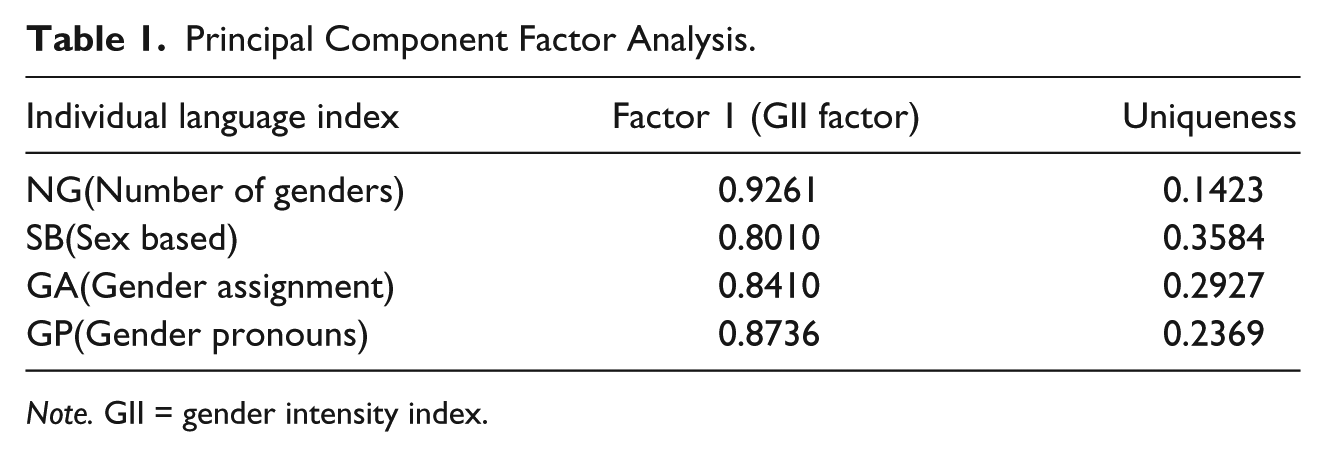
Note. GII = gender intensity index.
Method
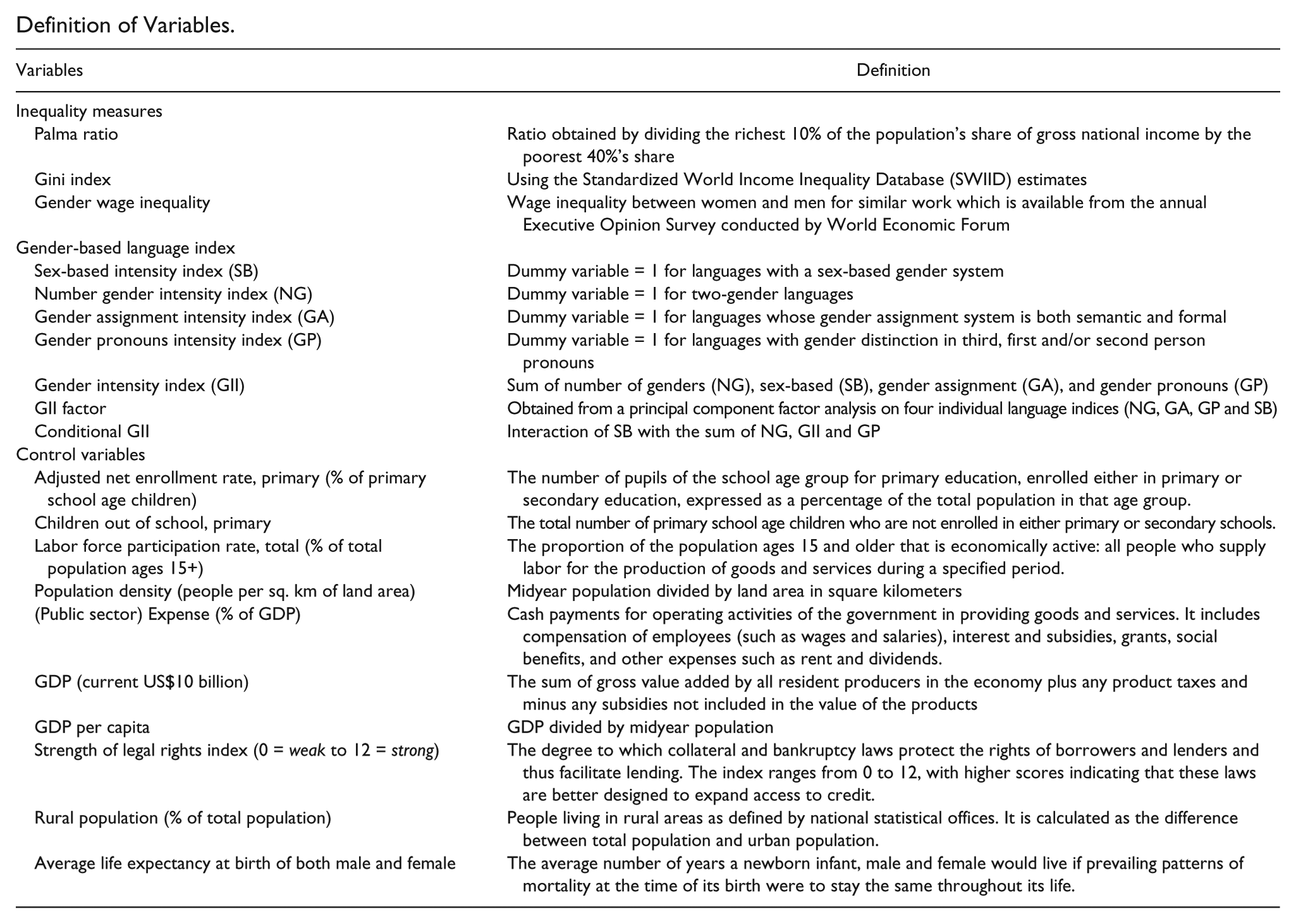
The sample contains data from 163 countries (listed in Appendix B with their GII score) for 9 years, from 2006 to 2014. The wide variance in the key research variables provides us with a perfect environment for testing associations among gender in language, gender wage inequality, and country income inequality. To assess gender wage inequality, we use the female-over-male ratio of wage for similar work that is available from the annual Executive Opinion Survey conducted by World Economic Forum. As proxies for country income inequality, we use Palma ratio, which is the ratio obtained by dividing the richest 10% of the population’s share of gross national income by the share of the poorest 40%, and the Gini index, 4 which represents income distribution within the population, ranging from zero (perfect income equality) to 1 (maximal income inequality) interchangeably. For Gini index, we use the Standardized World Income Inequality Database (SWIID) estimates in our analyses. Both Palma ratio and Gini index are constructed to have higher values as country income inequality increases. As shown in Table 2, GII scores range from 0 to 4, suggesting that grammatical gender marking differs substantially across countries. The gender wage inequality shows that the average wages of female workers are less than two thirds of what their male colleagues earn, and they can be as low as 39% in some countries. This implies that gender wage inequality is still prevalent and severe, across countries and over the years. In terms of country income inequality, both the Palma ratio and the Gini index exhibit wide variation across countries during our sample period. Table 2 summarizes the descriptive statistics. Appendix C presents a detailed definition of the variables.
Descriptive Statistics.
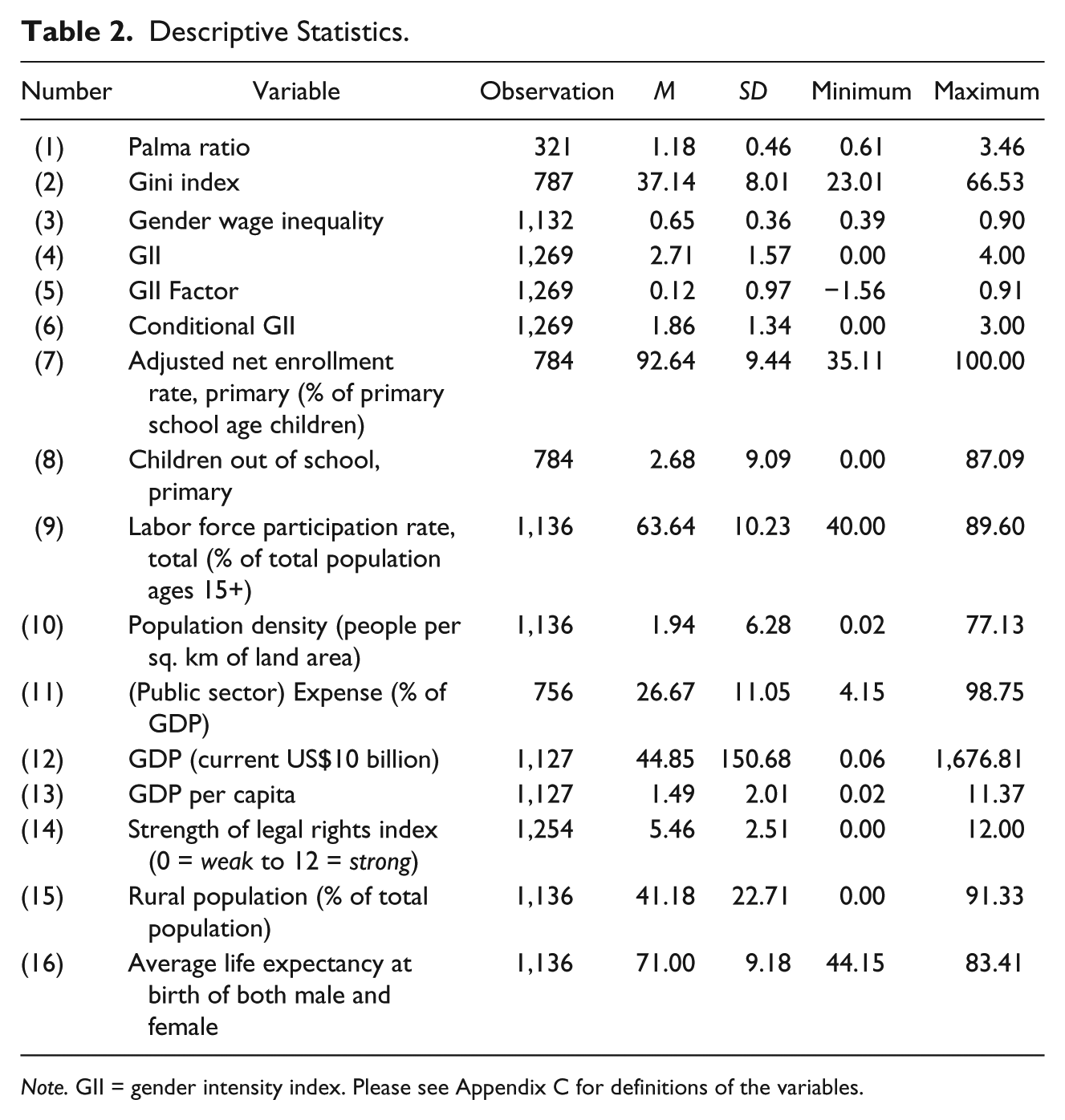
Note. GII = gender intensity index. Please see Appendix C for definitions of the variables.
Prior literature claims that several factors can affect distribution of income and economic inequality among participants within a particular country, and we control for these factors. Given that education is one of the most powerful instruments for reducing poverty and inequality, and for laying a foundation for sustained economic growth in a country, we use adjusted net enrollment rate, primary (% of primary school age children), which is available from the World Bank and serves as a proxy for the level of education. 5 Other control variables used in the study include labor force participation rate, total (% of total population ages 15), population density 6 (people per sq. km of land area), public sector expenses (% of GDP), GDP, GDP per capita, 7 rural population 8 (% of total population), strength of legal rights index, and average life expectancy at birth for both males and females. Correlations among these variables of interest are shown in Table 3.
Correlations Among Variables of Interest.
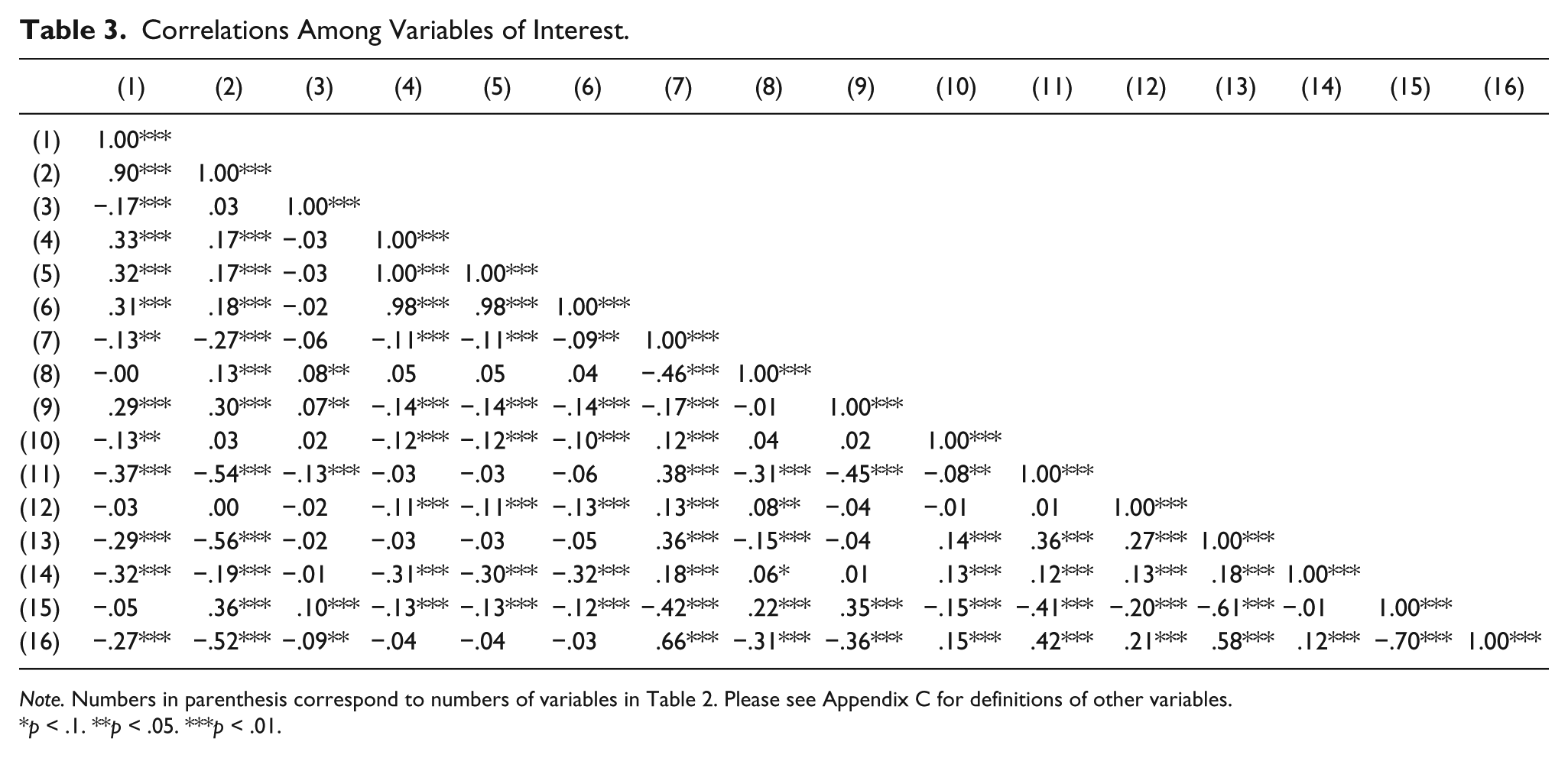
Note. Numbers in parenthesis correspond to numbers of variables in Table 2. Please see Appendix C for definitions of other variables.
p < .1. **p < .05. ***p < .01.
Results
To assess the impact of grammatical gender marking on gender wage inequality, we first employ the multivariate ordinary least squares (OLS) regression models expressed in the equation below. We use the gender wage inequality as a dependent variable while the gender-based language index is an explanatory variable, along with the control variables. All regressions include year dummies. The standard errors clustered at the country level are used to cope with the possibility that observations within each country are correlated with each other to some degree.

Table 4 shows results of the multivariate OLS regressions. Model 1 presents the impact of GII on gender wage inequality. GII has a significantly negative impact on gender wage inequality, suggesting that gender wage inequality gets worse as gender distinction in language intensifies. In other words, the strong presence of grammatical gender marking in a language leads to inferior wage equality for women. For example, a one-unit increase in the GII lowers the female-to-male wage ratio by about 1.3 percentage points. As shown in Models 2 and 3, the results remain robust when GII is replaced by either the GII factor or the Conditional GII. In addition, we assess how well our gender-based language index works for explaining gender wage inequality by establishing and comparing a baseline Model 4 using only the control variables. Taking these findings together is strong support for Hypothesis 1.
OLS Regressions: Effect of the Grammatical Gender Marking on Gender Wage Inequality.
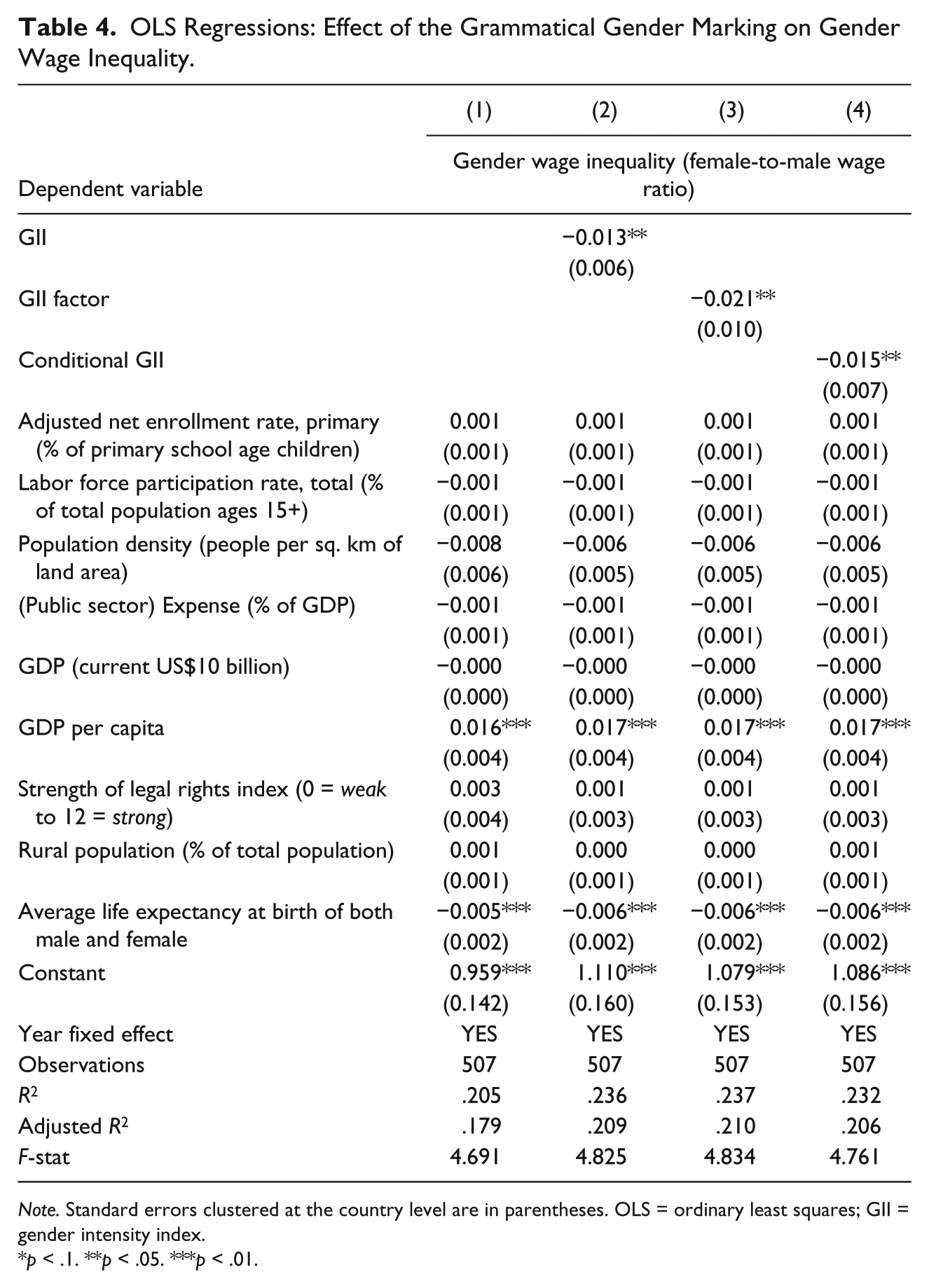
Note. Standard errors clustered at the country level are in parentheses. OLS = ordinary least squares; GII = gender intensity index.
p < .1. **p < .05. ***p < .01.
Next, we examine possible relationship between gender wage inequality and country income inequality using the equation below:

As a dependent variable, we first use the Palma ratio in Model 1. We also include Gini index as an alternative measure of country income inequality in Model 2. We use the same control variables as in the multivariate OLS regressions in Table 4. As reported in Table 5, we find that country income inequality is negatively affected by gender wage inequality. In other words, country income inequality tends to improve as gender wage gap narrows, supporting Hypothesis 2. In addition, we evaluate the results and find the independent effect of gender wage inequality in explaining country income inequality by comparing a baseline Model 4 with Models 1 and 2. As suggested by the relatively smaller adjusted R-squared in Model 4, our Models 1 and 2 using gender wage inequality as an additional explanatory variable fit the data better.
Ordinary Least Squares (OLS) Regressions: Effect of Gender Wage Inequality on Income Inequality.
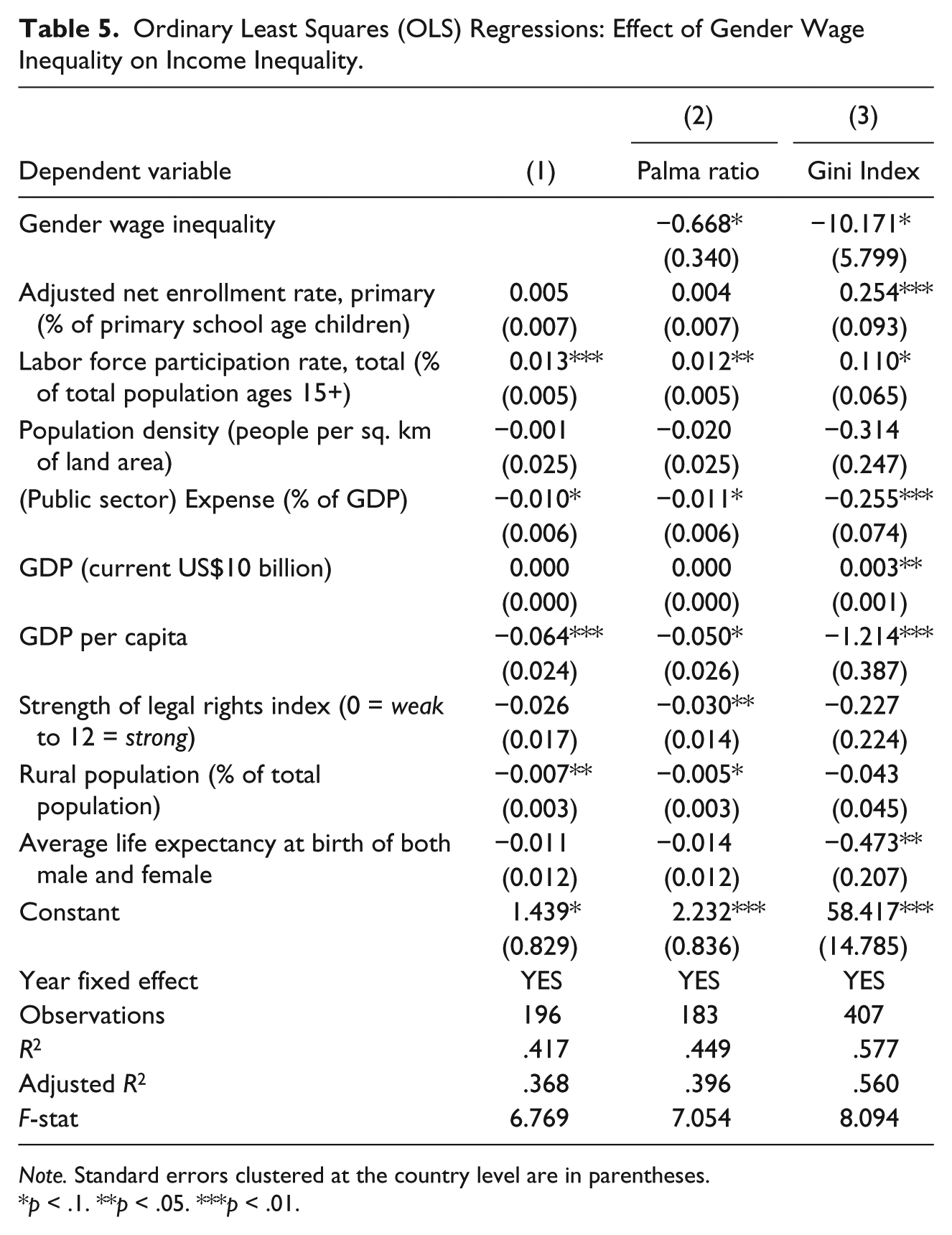
Note. Standard errors clustered at the country level are in parentheses.
p < .1. **p < .05. ***p < .01.
To test the indirect effect of the linguistic gender marking on country income inequality via the gender wage gap and to reduce the concern 9 that our findings in Table 5 actually reflect a spurious relationship between country income inequality and gender wage inequality, we employ an IV estimation 10 where we choose the gender-based language index as a relevant IV. 11 In the IV regressions, we use the gender wage inequality predicted from the OLS regressions in Table 4 as explanatory variables of interest. Panel A of Table 6 reports results 12 of the IV regressions where the Palma ratio is the dependent variable. The results of the IV regressions using the Gini 13 index as a dependent variable are presented in Panel B of Table 6. As shown in Model 4, the gender wage inequality predicted using GII continues to exhibit a significantly negative association with the Palma ratio in Panel A, and with the Gini index in Panel B. As shown in Models 1 and 2 in both Panels A and B, the results remain robust when the gender wage inequality is instrumented using either GII factor or Conditional GII. These findings do not only support gender wage inequality as a key determinant of country income inequality across countries over time, even after controlling for the possible endogeneity problems, but also imply that gender in a language can affect country income inequality through its impact on gender wage inequality, supporting Hypothesis 3 that grammatical gender marking exerts indirect influence on country income inequality via gender wage inequality. Furthermore, compared with results in Table 5, coefficients on the predicted gender wage inequality get statistically stronger, providing strong reinforcing evidence 14 supporting Hypothesis 2.
IV Regressions: Grammatical Gender Markings as IVs.
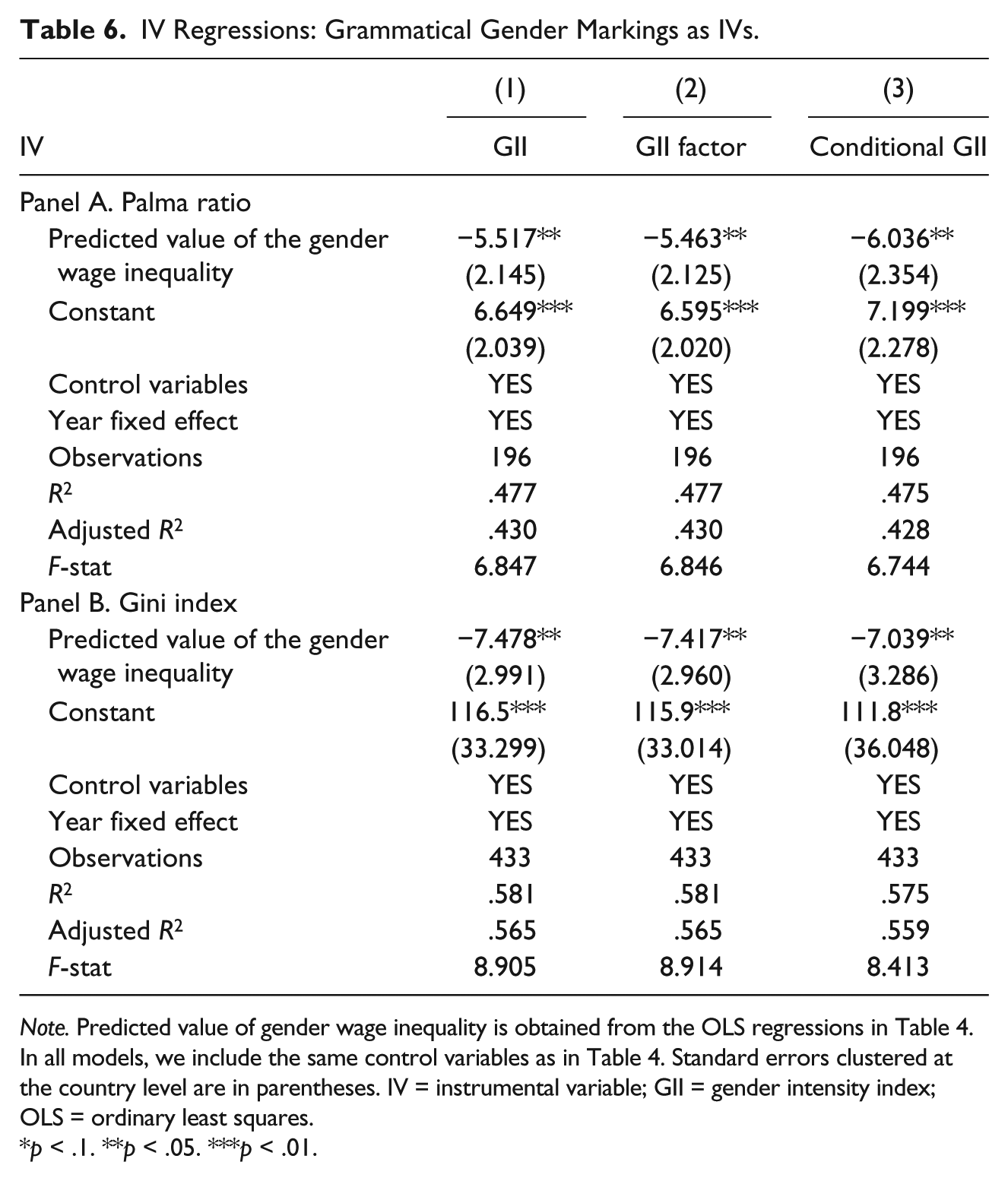
Note. Predicted value of gender wage inequality is obtained from the OLS regressions in Table 4. In all models, we include the same control variables as in Table 4. Standard errors clustered at the country level are in parentheses. IV = instrumental variable; GII = gender intensity index; OLS = ordinary least squares.
p < .1. **p < .05. ***p < .01.
Robustness Checks
We also investigate empirically whether language provides a superior explanation than the commonly used survey-based cultural dimensions as a predictor for gender wage inequality. As proxies for cultural dimensions, we use GLOBE (House et al., 2004) gender egalitarianism (GE) as an “as is” dimension and the new masculinity (MAS) scores of Hofstede, Hofstede, and Minkov (2010). As shown in Panel A of Table 7, none of the cultural dimensions exhibit any significant association with gender wage inequality, suggesting that grammatical gender marking will be a better predictor for gender wage inequality than survey-based cultural dimensions. We also find that grammatical gender marking is a better IV than cultural dimensions. We test the same IV regressions using each cultural dimension as an alternative IV in Table 7. As seen in Panel B, we do not find that country income inequality is statistically affected by gender wage inequality when using survey-based measures as IVs in the regressions. This finding shows that grammatical gender marking is a better predictor for both gender wage inequality and country income inequality than cultural difference across countries.
Cultural Dimensions as Alternative IVs.
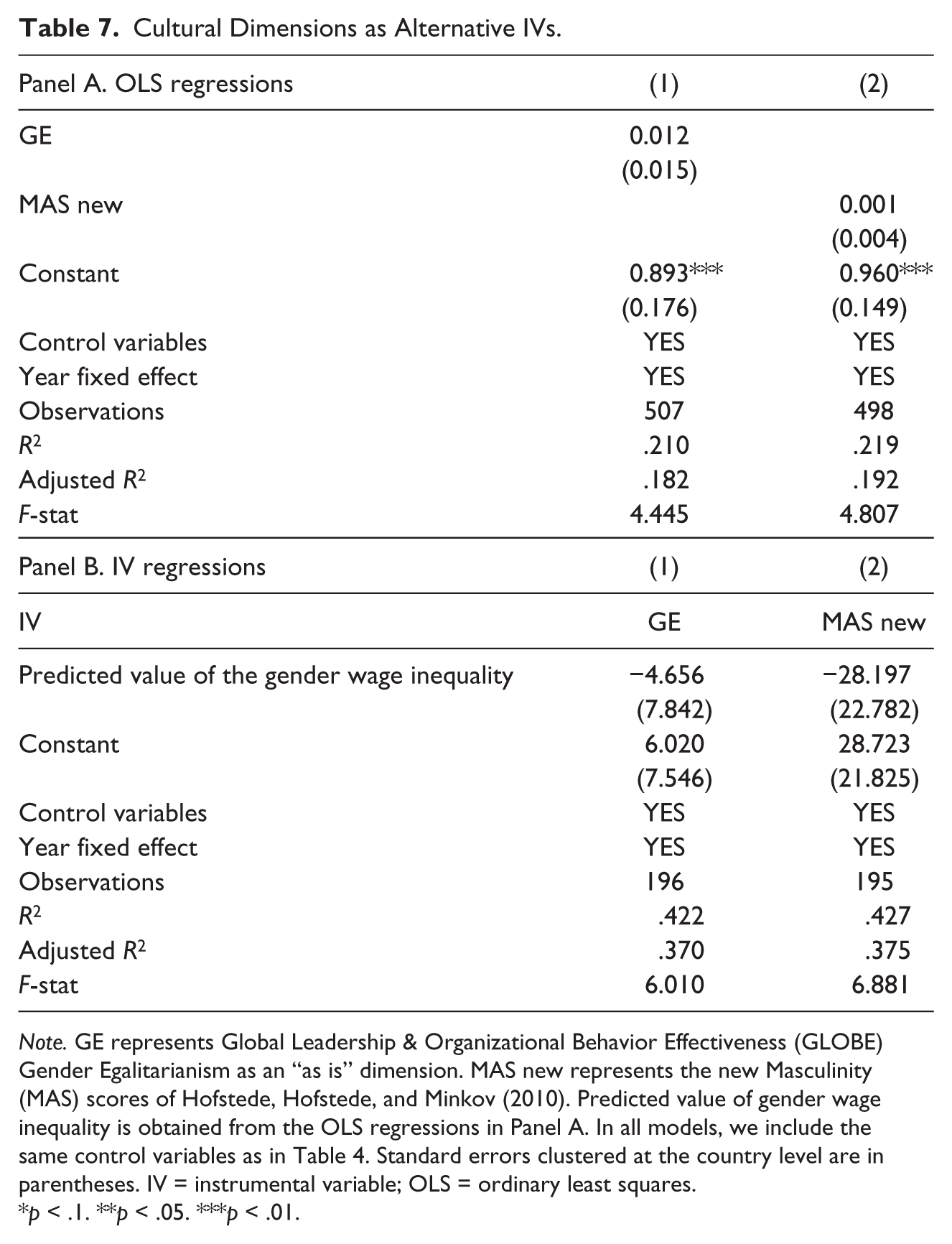
Note. GE represents Global Leadership & Organizational Behavior Effectiveness (GLOBE) Gender Egalitarianism as an “as is” dimension. MAS new represents the new Masculinity (MAS) scores of Hofstede, Hofstede, and Minkov (2010). Predicted value of gender wage inequality is obtained from the OLS regressions in Panel A. In all models, we include the same control variables as in Table 4. Standard errors clustered at the country level are in parentheses. IV = instrumental variable; OLS = ordinary least squares.
p < .1. **p < .05. ***p < .01.
Discussion
Understanding inequality is of major importance today, because inequality has increased to its highest levels in decades. Understanding the increase in inequality and its sources is not merely an academic exercise; rather it affects the lives of millions, if not billions, of individuals. Our study contributes to the recently growing research on inequality that is being conducted by management and business scholars (Beal & Astakhova, 2015; T. Jones et al., 2016). The understanding of inequality is very important because high levels of inequality are bad for society and business alike (Bapuji & Neville, 2015). The inequality field is dominated by scholars from economics and sociology (Beal & Astakhova, 2015) but large parts of the inequality variance are not explained by current research. Therefore, there is room for new ideas, scholars, and fields to contribute to understanding the important and interesting phenomena of inequality within societies and between societies. As Cobb (2015) writes,
Income inequality is a complex phenomenon with many factors likely playing a role in its rise, and as such, opportunities exist for developing new ideas that can explain cross-national rates of income inequality complementing and extending our current perspectives of the phenomenon. (p. 325)
On one hand, management literature contains new ideas and research showing the impact of social inequality on organizations and their management and strategy (Bapuji, 2015; Bapuji & Neville, 2015). On the other hand, there are articles showing how organizations contribute to the income inequality of the total society. For example, Cobb’s (2015) theory article on employer’s decisions and their impact on wages is one recent attempt to explain cross-national differences in income inequality based on management and organizational theory. G. F. Davis and Cobb (2010) also show how concentrated employment markets affect inequality.
Our research adds to the understanding of one of the major challenges in the literature, and helps to explain the differences in the gender inequality and income inequality between societies. We use the linguistic method, as in the international business tradition of explaining differences between countries based on culture and institutions (Bapuji, 2015; DiPrete, 2007). In his seminal work, Piketty (2014) shows that the current increase in inequality is based on higher returns to capital than the real growth rate but also states that exogenous factors such as institutions probably have the largest impact on societal inequality.
In most analyses of the gender wage gap and country income inequality, cultural factors have been given less attention than warranted. This is especially true in the case of fundamental distinctions between societies such as the grammar markings in language, which anthropologists and sociolinguists argue reflect underlying social rules about the relationships between men and women that are manifest in many social institutions.
Based on that understanding, we can claim that the history and background of a nation will lead to a better understanding of economic outcomes such as wage differences and income inequality. This article contributes to the understanding of how historical and deep cultural factors regarding females affect today’s “rules of the game” in different societies. It helps to explain why in some nations, wage gaps between genders are much higher than others. The cross-national differences in inequality are partly explained by the tolerance of a society to gender inequality based on ancestral culture transmitted via linguistic structures that are reinforced by cognition. Malul et al. (2010) show that cultural difference between countries is a significant, explanatory variable for inequality and poverty differences between countries.
Our article also sheds light on a question for future research raised by Bapuji and Neville (2015), and by Beal and Astakhova (2015). Bapuji and Neville (2015) write, “future research may want to think about income inequality relates to these other forms of inequality . . . researchers may consider the ways in which pay dispersion amplifies or attenuates income inequality at the societal level” (p. 6). This current article shows that gender linguistic inequality affects female wages, which in turn affects total society income inequality. This outcome and type of research can also be part of the “competing causal narrative” research that Beal and Astakhova (2015) suggest as one of the four streams of management contribution to the inequality research. We also provide hypotheses and empirical results to the concern that Beal and Astakhova (2015) raise regarding the gap in the management literature that does not differentiate between different incomes. In our case, we focused on the wage gap between females and males.
The results also show that the GII provides better empirical outcome than today’s mainstream survey-based instruments. 15 This measure of culture is an additional methodological contribution of this article, because its linguistic method can be used in future research regarding family structure, kin obligations, and in other cultural traits of various societies.
One of the most important exogenous factors is culture. Hofstede (1991) defined culture as “the collective programming of the mind which distinguishes the members of one group or category of people from another.”(p. 180) Culture is either an informal institution (Xu & Shenkar, 2002) or the motivator that affects institutions (North, 1993). In either case, culture is an exogenous factor to the current environment that affects the level of wage gaps between genders and societal inequality, both directly and indirectly. Therefore, it is very important to capture “pure” measurements of culture that are unaffected by current socio-economic activity. Accordingly, as culture research evolves, it should seek methods that are less affected by current socio-economic conditions. The grammatical structures of language meet the criteria of being exogenous to the current environment. Language captures cultural values inherited from ancestors and reinforces the cognitive framework that it creates in speakers.
Research that uses grammatical gender marking as a cultural variable has advantages over the traditional survey-based instruments used to capture culture in general and gender attitudes in particular. Culture can manifest in two distinct ways. On one side are psychological attributes such as language, ethnic heritage, and history of the society; on the other, “observed and reported practices” such as economic systems and legal structures (House et al., 2004, p. 15). The former is the “sticky” core of a culture, which tends not to change, like grammatical gender markings that are stable and unaltered for millennia. The latter is the changing component of culture that is affected by the current environment. Tang and Koveos (2008) claim that while changes in economic conditions are the source of cultural dynamics, language provides the foundation for cultural stability. Survey-based dimensions of culture variables in general and regarding gender role intensity are obtained by asking individuals direct questions, so they can be influenced by current economic, social, and environmental conditions.
The preliminary results presented by Santacreu-Vasut and colleagues (2014) show that grammatical gender marking measures provide better empirical results than the Hofstede and GLOBE gender dimensions, supporting the idea that language has a strong cognitive effect on speakers. They propose explaining their results with reference to the very stable nature of language-based gender distinctions, inherited from the distant past, and the direct influence of language on cognition via the shaping of mental representation.
Grammatical gender marking has two additional advantages over survey-based tools. First, grammatical structure can be studied at the individual level without assuming a single cultural score for all the individuals in a country. For example, Hofstede has one Masculinity dimension for Nigeria, but Nigeria is a heterogeneous country, particularly regarding gender. By using grammatical structures, we can capture the high gender roles of the Hausa and compare them with the low gender roles of the Yoruba. Hicks and colleagues (2015) use the language spoken by individuals to capture gender roles in their household without needing to make a homogeneity assumption for all the individuals from the same country. Second, WALS contains information on the structures of several hundred languages, allowing researchers to use more observations with a higher diversity than the survey-based cultural dimensions that are available for a much smaller number of societies/nations (e.g., GLOBE has 62 societies).
Conclusion
Prior literature has thoroughly documented that one of the major inequalities in most societies and countries is gender inequality, and among gender inequalities, the most prominent is the wage gap. Furthermore, gender inequality has an impact on societal inequality in general.
Using data for 2006 to 2014 from 163 countries, we first document that both gender wage inequality and country income inequality are still prevalent and severe across countries throughout the research period. Second, by using the GII, constructed to measure the presence and intensity of gender in the dominant language of a nation, we are the first to show that language is one of the direct determinants of the well-documented gender wage inequality. We also provide evidence that country income inequality improves as gender wage gap lessens. However, this relationship between gender wage inequality and country income inequality could be driven by reverse causation or an omitted variable bias. Using an IV approach to mitigate this endogeneity issue, we further find that language has an indirect impact on country income inequality via gender wage inequality within a society and country income inequality is directly driven by gender wage inequality.
The results of this article may be important in helping policy makers better understand the environment that influences inequality in general and inequality between genders in particular. This understanding is valuable when leaders develop fiscal and other policies that might influence the level of inequality (Malul, Shapira, & Shoham, 2013; Piketty, 2014). The most important outcome of this research is the understanding that market forces will reduce gender inequality very slowly, if at all, in countries with high gender marking (see the list in Appendix B). In these cases, regulations enforced by policy makers could be very effective. For example, quotas could be imposed requiring female representation on board of directors. An additional policy that could be considered for dealing with the way language generates gender inequality is changing how policy makers (such as government agencies) and corporations communicate, and making a conscious effort to change how language is used in their reports to more female-friendly forms, especially in countries that speak languages with high gender marking, such as Spanish and Arabic. For example, consciously using gender-neutral expressions (“chairperson,” instead of “chairman” or “chairwoman”) might counteract the effect of gender markers in the long run. Inequality cannot be understood without first understanding the exogenous factors that create the rules of the game in which inequality evolves.
Footnotes
Appendix A
The source of this appendix is Gay, Santacreu-Vasut, and Shoham (2013). The maps in Figure A1 show the gender structure distribution for each country’s dominant language.
Table A1 presents a dataset extract that includes the five indices.
Appendix B
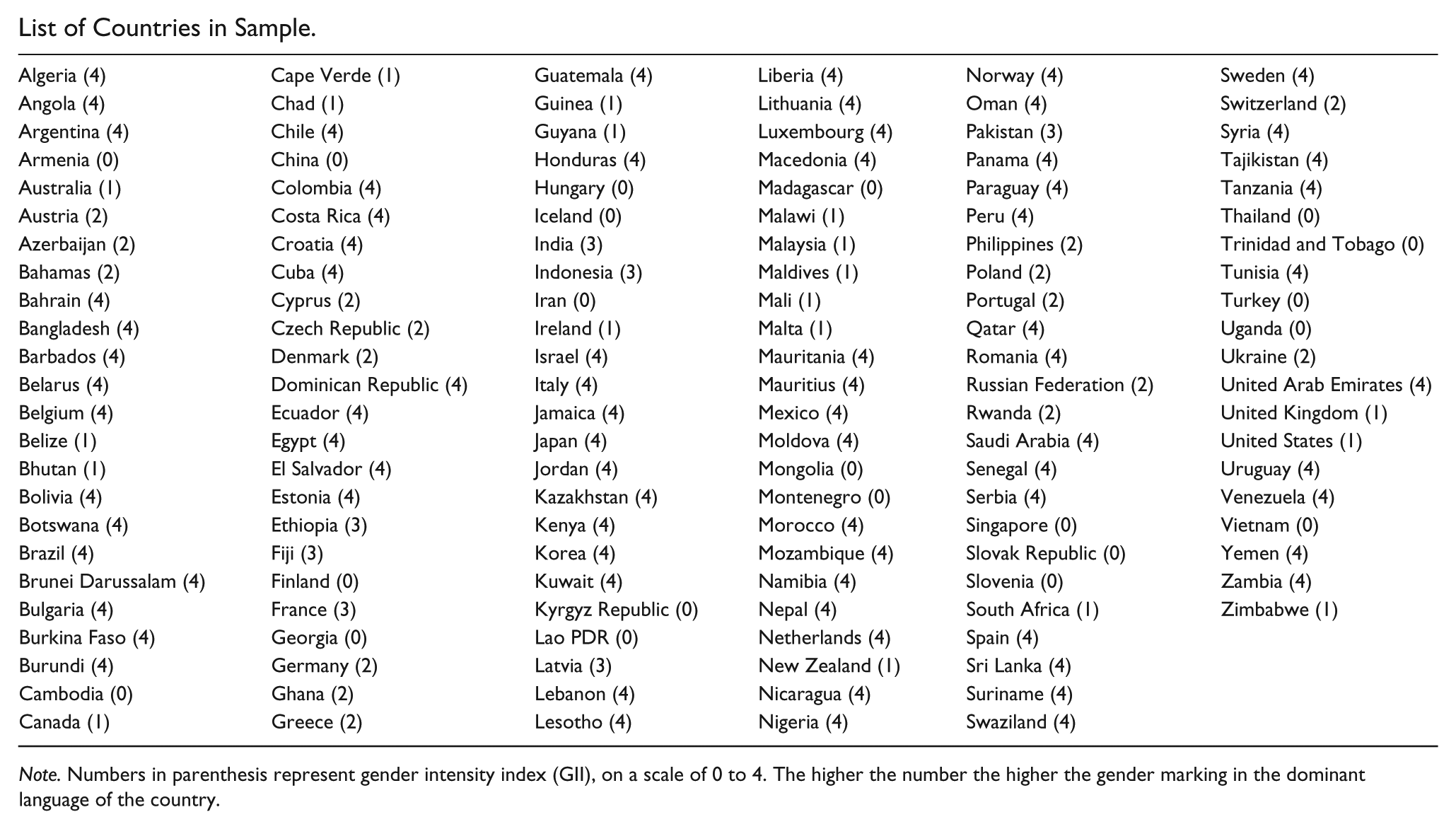
List of Countries in Sample.
| Algeria (4) | Cape Verde (1) | Guatemala (4) | Liberia (4) | Norway (4) | Sweden (4) |
| Angola (4) | Chad (1) | Guinea (1) | Lithuania (4) | Oman (4) | Switzerland (2) |
| Argentina (4) | Chile (4) | Guyana (1) | Luxembourg (4) | Pakistan (3) | Syria (4) |
| Armenia (0) | China (0) | Honduras (4) | Macedonia (4) | Panama (4) | Tajikistan (4) |
| Australia (1) | Colombia (4) | Hungary (0) | Madagascar (0) | Paraguay (4) | Tanzania (4) |
| Austria (2) | Costa Rica (4) | Iceland (0) | Malawi (1) | Peru (4) | Thailand (0) |
| Azerbaijan (2) | Croatia (4) | India (3) | Malaysia (1) | Philippines (2) | Trinidad and Tobago (0) |
| Bahamas (2) | Cuba (4) | Indonesia (3) | Maldives (1) | Poland (2) | Tunisia (4) |
| Bahrain (4) | Cyprus (2) | Iran (0) | Mali (1) | Portugal (2) | Turkey (0) |
| Bangladesh (4) | Czech Republic (2) | Ireland (1) | Malta (1) | Qatar (4) | Uganda (0) |
| Barbados (4) | Denmark (2) | Israel (4) | Mauritania (4) | Romania (4) | Ukraine (2) |
| Belarus (4) | Dominican Republic (4) | Italy (4) | Mauritius (4) | Russian Federation (2) | United Arab Emirates (4) |
| Belgium (4) | Ecuador (4) | Jamaica (4) | Mexico (4) | Rwanda (2) | United Kingdom (1) |
| Belize (1) | Egypt (4) | Japan (4) | Moldova (4) | Saudi Arabia (4) | United States (1) |
| Bhutan (1) | El Salvador (4) | Jordan (4) | Mongolia (0) | Senegal (4) | Uruguay (4) |
| Bolivia (4) | Estonia (4) | Kazakhstan (4) | Montenegro (0) | Serbia (4) | Venezuela (4) |
| Botswana (4) | Ethiopia (3) | Kenya (4) | Morocco (4) | Singapore (0) | Vietnam (0) |
| Brazil (4) | Fiji (3) | Korea (4) | Mozambique (4) | Slovak Republic (0) | Yemen (4) |
| Brunei Darussalam (4) | Finland (0) | Kuwait (4) | Namibia (4) | Slovenia (0) | Zambia (4) |
| Bulgaria (4) | France (3) | Kyrgyz Republic (0) | Nepal (4) | South Africa (1) | Zimbabwe (1) |
| Burkina Faso (4) | Georgia (0) | Lao PDR (0) | Netherlands (4) | Spain (4) | |
| Burundi (4) | Germany (2) | Latvia (3) | New Zealand (1) | Sri Lanka (4) | |
| Cambodia (0) | Ghana (2) | Lebanon (4) | Nicaragua (4) | Suriname (4) | |
| Canada (1) | Greece (2) | Lesotho (4) | Nigeria (4) | Swaziland (4) |
Note. Numbers in parenthesis represent gender intensity index (GII), on a scale of 0 to 4. The higher the number the higher the gender marking in the dominant language of the country.
Appendix C
Definition of Variables.
| Variables | Definition |
|---|---|
| Inequality measures | |
| Palma ratio | Ratio obtained by dividing the richest 10% of the population’s share of gross national income by the poorest 40%’s share |
| Gini index | Using the Standardized World Income Inequality Database (SWIID) estimates |
| Gender wage inequality | Wage inequality between women and men for similar work which is available from the annual Executive Opinion Survey conducted by World Economic Forum |
| Gender-based language index | |
| Sex-based intensity index (SB) | Dummy variable = 1 for languages with a sex-based gender system |
| Number gender intensity index (NG) | Dummy variable = 1 for two-gender languages |
| Gender assignment intensity index (GA) | Dummy variable = 1 for languages whose gender assignment system is both semantic and formal |
| Gender pronouns intensity index (GP) | Dummy variable = 1 for languages with gender distinction in third, first and/or second person pronouns |
| Gender intensity index (GII) | Sum of number of genders (NG), sex-based (SB), gender assignment (GA), and gender pronouns (GP) |
| GII factor | Obtained from a principal component factor analysis on four individual language indices (NG, GA, GP and SB) |
| Conditional GII | Interaction of SB with the sum of NG, GII and GP |
| Control variables | |
| Adjusted net enrollment rate, primary (% of primary school age children) | The number of pupils of the school age group for primary education, enrolled either in primary or secondary education, expressed as a percentage of the total population in that age group. |
| Children out of school, primary | The total number of primary school age children who are not enrolled in either primary or secondary schools. |
| Labor force participation rate, total (% of total population ages 15+) | The proportion of the population ages 15 and older that is economically active: all people who supply labor for the production of goods and services during a specified period. |
| Population density (people per sq. km of land area) | Midyear population divided by land area in square kilometers |
| (Public sector) Expense (% of GDP) | Cash payments for operating activities of the government in providing goods and services. It includes compensation of employees (such as wages and salaries), interest and subsidies, grants, social benefits, and other expenses such as rent and dividends. |
| GDP (current US$10 billion) | The sum of gross value added by all resident producers in the economy plus any product taxes and minus any subsidies not included in the value of the products |
| GDP per capita | GDP divided by midyear population |
| Strength of legal rights index (0 = weak to 12 = strong) | The degree to which collateral and bankruptcy laws protect the rights of borrowers and lenders and thus facilitate lending. The index ranges from 0 to 12, with higher scores indicating that these laws are better designed to expand access to credit. |
| Rural population (% of total population) | People living in rural areas as defined by national statistical offices. It is calculated as the difference between total population and urban population. |
| Average life expectancy at birth of both male and female | The average number of years a newborn infant, male and female would live if prevailing patterns of mortality at the time of its birth were to stay the same throughout its life. |
Acknowledgements
The authors thank Vicky Magginas for her research assistant. They also thank Temple University Center for International Business Education and Research (CIBER) grant that supported this research.
Declaration of Conflicting Interests
The authors declared no potential conflicts of interest with respect to the research, authorship, and/or publication of this article.
Funding
The authors disclosed receipt of the following financial support for the research, authorship, and/or publication of this article: This research was supported by funding from the Temple University Center for International Business Education and Research (CIBER) grant.