




Abstract
Cross-sector social partnerships (CSSPs) are relevant units of analysis for understanding sustainable business models (SBMs). This research examines how organizations value their motivations to participate in large sustainability-focused partnerships, how they perceive the value captured, and their structures implemented to address sustainability partnerships. Two hundred and twenty-four organizations partnering within four large sustainability CSSPs were surveyed using an augmented resource-based view (RBV) theoretical framework. Results show that partners were motivated by and captured value related to sustainability-, organizational-, and human-oriented resources, and that organizations prefer more informal than formal structural elements to implement their partnerships’ sustainability strategies. Contributions to SBM and CSSP fields are revealed. SBM thinking is a provocation toward seeking integrated sustainable value creation, helping show the value of large CSSPs. Conversely, by conceiving of large, pluralistic CSSPs as “collaborative SBMs,” we extend the idea of the “business model” to the societal level, exploring how value is captured in partnership.
Keywords
Sustainable business models (SBMs) entail a logic of not only creating economic value for organizations, but also social and ecological value for society and the natural environment (Abdelkafi & Täuscher, 2016; Schaltegger, Hansen, & Lüdeke-Freund, 2016). Although business models define the way a business creates a product or service to satisfy its customers’ needs and the way profit will be received through the value chain (Teece, 2010), SBMs go farther by articulating ecological and societal value-creation strategies (Lüdeke-Freund et al., 2016). SBMs describe how value is created, delivered and captured, while maintaining or regenerating natural, social, and/or economic capital beyond the boundaries of a single firm (Schaltegger, Lüdeke-Freund, & Hansen, 2016), with sustainability as a central concern to their strategic decision-making processes (Stubbs & Cocklin, 2008). Review studies aimed at constructing archetypes (Bocken et al., 2014) and robust taxonomies (Lüdeke-Freund et al., 2018) of the value-creation potential for various kinds of SBMs have revealed that the least well-developed is the “integrative” type: that which builds economic, social, and environmental value simultaneously. SBMs are most often articulated at the level of the organization, however, integrative value creation depends critically on collaboration across sectors (e.g., for-profit, nonprofit, social enterprise, or government/public) with competing value logics (Laasch, 2018; Randles & Laasch, 2016). To extend our understanding of integrative value creation, it is therefore essential to connect SBM thinking to the study of partnerships for sustainability.
Cross-sector social partnerships (CSSPs) in particular have become increasingly popular for addressing sustainability challenges (Gray & Stites, 2013) as issues such as climate change and economic development are too large and complex to be addressed by any organization alone (Bryson et al., 2006; Waddock, 1991). As a result, it has become essential that organizations from across sectors engage in CSSPs with the purpose of achieving sustainability goals (Crane & Seitanidi, 2014; Selsky & Parker, 2005). In particular, large multiparty, multi-sector partnerships hold great potential for addressing complex sustainability challenges (Clarke & MacDonald, 2019; Worley & Mirvis, 2013), yet these CSSPs remain under-examined, likely due to their complex nature. Large partnerships also hold potential to inform conceptions of integrative value creation, and to extend the application of SBM concepts to the partnership level. By their very nature, large partnerships provide a forum to combine contrasting value logics from different sectors of society. They more closely approximate the rich plurality of motivations and values in broad society, well beyond what is captured in small cross-sector partnerships of just a few organizations with well-defined goals. How valuable are drivers for organizations to join such partnerships, what kind of value do they feel is created and captured as outcomes, and which are their most implemented structures?
In this study we empirically examine four large cross-sector partnerships for sustainability, each in a different national context with between 99 and 328 active partners, in an effort to understand the perceived value of drivers and outcomes to the participating organizations, as well as their implemented structural features. From a strategic perspective, scholars assert that organizations join partnerships to gain resources (Ansell & Gash, 2008; Vurro et al., 2010) that would improve their strategic positions (Eisenhardt & Schoonhoven, 1996; Selsky & Parker, 2005) and competitive advantage (Lavie, 2006; Lotia & Hardy, 2008). The resource-based view (RBV) has been largely used to study what organizations achieve from partnering (Gray & Stites, 2013), focusing on financial, physical, organizational, and human resources (Barney, 1991, 1995). However, resources focused on sustainability, which are central to SBMs (Stubbs & Cocklin, 2008), have only been considered under the RBV in a limited way (Barney et al., 2011; Hart, 1995). Here we ground our data collection and analysis in the RBV, with a clear additional focus on sustainability drivers and outcomes to tie to concepts in the SBM literature. This research aims to answer three questions that will extend the application of SBMs to CSSPs: (a) How do organizations value the resources that drive them to engage in CSSPs? (b) What structural features do organizations implement when engaged in CSSPs? and (c) How do organizations value the resources they obtain from partnering in CSSPs? SBM research typically centers the locus of value capture at the organization level; here the intra-organizational partnership is taken as the conceptual scale for the business model. Many such partnerships are built on formal agreements, with independent governance structures, and so can be considered as relevant units of analysis for SBM research. This study frames CSSPs as the collaborative SBM, with organizations partnering in the CSSP as the unit of analysis. At the partnership level, SBMs are defined as creating, delivering, and capturing positive ecological, social, and economic value for all its stakeholders through its entire value network (Kurucz et al., 2017). Through extending the conception of SBMs to the partnership level, this research expands the integrative dimension of sustainable value creation (Dyllick & Hockerts, 2002; Lüdeke-Freund et al., 2018; Schaltegger & Burritt, 2005). We elaborate on this in the discussion. Understanding how organizations value their drivers to partner for community sustainability, how they structure to address sustainability challenges, and how valuable are the outcomes they obtain from partnering for sustainability, helps us to recognize and value “system-level” resources available through collaborative SBMs that are not typically captured at the organizational level.
This article proceeds as follows: we begin with a theoretical background on CSSPs, organizational resources and structural features to set up our research hypotheses. We then describe the research sites, and data collection and analysis procedures. Results follow, along with a discussion on the implications for the CSSP and SBM literatures. Limitations and further areas of research are presented in the conclusion.
Theoretical Background
CSSPs for Sustainability
Partnerships are a key component of sustainable development involving stakeholders in decision-making processes for shaping sustainability conditions (Koontz, 2006). A CSSP is a coordinating configuration of stakeholders from different sectors of society, which is mostly non-hierarchical and voluntary (Glasbergen, 2007; Pinkse & Kolk, 2012), working for the achievement of common sustainability goals (Glasbergen, 2007; Waddock, 1988).
CSSPs have flourished all over the world as societal interactions have become more complex and society faces increasing turbulence (Gray & Stites, 2013; MacDonald et al., 2018). Thus, CSSPs have become fundamental to addressing sustainability challenges (Clarke & Fuller, 2010; Crane & Seitanidi, 2014) gathering organizations from all sectors with a focus on sustainability issues of common concern (Crane & Seitanidi, 2014; Selsky & Parker, 2005) such as unemployment, economic development, education (Selsky & Parker, 2005; Waddock, 1991), health, poverty, climate change (Clarke & Ordonez-Ponce, 2017), corruption, organized crime (Crane & Seitanidi, 2014), waste, energy, land use, transportation, and housing (MacDonald et al., 2018). These are interrelated complex problems (Bryson et al., 2006; Gray & Stites, 2013), which are commonly addressed through large CSSPs (Clarke & MacDonald, 2019).
CSSPs follow a collaborative strategic management process that starts with the formation of the partnerships and the identification of partners, the formulation of joint sustainability plans, and their implementation at the partnership and partner levels, all of which lead to the achievement of different outcomes (Clarke & Fuller, 2010; Ordonez-Ponce & Clarke, 2020). The role partners play in the collaborative process is fundamental not only for the partnership in implementing the joint sustainability plan (Crane & Seitanidi, 2014; Gray, 1989) but also for the success of their own strategies (Lin & Darnall, 2015; Wassmer et al., 2014).
CSSPs require not only that partners share information, resources, activities, and skills (Bryson et al., 2006), but also commitments (Gray & Stites, 2013; Waddock, 1988) to jointly achieve outcomes (Bryson et al., 2006; Gray, 1989). As CSSPs focus on sustainability issues, they position partner organizations in the public arena, requiring their active involvement through the commitment of resources as well as in the planning, organizing, evaluating, and implementation of activities necessary for the success of the partnership (Waddock, 1988, 1991). Furthermore, the types of partners and their relationships are key to the success of a partnership (Glasbergen, 2007), being more likely to succeed if they are focused on areas interdependent for the partners, so that they would all gain something that is larger than the costs of participating (Gray, 1985; Waddock, 1991).
Organizations form partnerships when an issue emerges that affects something they depend on, they perceive beneficial to address, and they consider it to be relevant to their interests (Gray, 1985; Waddock, 1988). However, while scholars argue that organizations partner for strategic reasons (Lin & Darnall, 2015; Ordonez-Ponce & Clarke, 2020; Selsky & Parker, 2005) and that addressing sustainability is a strategic opportunity (Fiksel et al., 2014; Wassmer et al., 2017), it is not clear how valuable the resources that drive organizations to partner are, nor the value for those they obtain from partnering. Furthermore, for organizations to survive and succeed in complex environments such as those presented by sustainability challenges (George et al., 2016), they must adapt their business models and strategies according to the dynamics of their context (Andrews, 1980; Mintzberg, 1978). The way they are structured is important for strategy implementation (Mintzberg, 1978), and in the context of large CSSPs, this is poorly studied.
As strategy requires the implementation of determined structures (Andrews, 1980; Hofer & Schendel, 1978) to transform strategic goals into outcomes (Mintzberg, 1978), three main elements can be identified as key for understanding a collaborative SBM: goals that drive organizations to join sustainability partnerships, organizational structures implemented to achieve goals, and outcomes as the strategic results obtained from partnering for sustainability. Through understanding these variables of organizations partnering for sustainability, partnership-level SBMs can be better understood.
Resources and Partnerships
One of the views for studying the involvement of organizations in partnerships is from a resource perspective (Gray & Stites, 2013; Selsky & Parker, 2005), arguing that an organization’s main purpose is to “organize the use of its ‘own’ resources together with other resources acquired from outside” to survive (Penrose, 1959, p. 31). Consequently, RBV scholars, who focus on strategic resources for achieving competitive advantage, define resources as “anything which could be thought of as a strength or weakness” (Wernerfelt, 1984, p. 172) in the formulation and implementation of a strategy (Barney, 1991), which organizations use to relate with the environment (Penrose, 1959).
RBV assumes that firms are heterogeneous entities that achieve competitive advantage by possessing a bundle of resources such as technical know-how, management skills, capital, and reputation (Barney, 1991), partnering for reducing uncertainty from their environment and gaining competitive advantage through acquiring critical resources (Lotia & Hardy, 2008). This rationale is based on the assumption that resources are not mobile among organizations, giving them advantages and positioning them better due to the resources they control (Barney, 1991). RBV classifies resources into tangible and intangible (Wernerfelt, 1984) clustering them into four types of capitals: physical (e.g., technology, machines, facilities), human (e.g., experience, knowledge, training, wisdom), organizational (e.g., relationships, trust, culture), and financial capitals (e.g., debt, equity, earnings), as resources organizations aim to obtain (Barney, 1991, 1995).
RBV has been largely used to study the reasons organizations partner and what they gain from partnering (Arya & Lin, 2007; Barrutia & Echebarria, 2015; Branzei & Le Ber, 2014; Clarke & MacDonald, 2019; Eisenhardt & Schoonhoven, 1996; Lavie, 2006). From an RBV perspective, organizations join partnerships either when they are in vulnerable strategic positions so they need additional resources that can be gained thanks to partnerships, or when they are in good positions to engage and attract other partners (Eisenhardt & Schoonhoven, 1996). Similarly, RBV is one of the most common approaches used to understand partner-centric outcomes (Branzei & Le Ber, 2014), identifying cost savings, funding, improved efficiency, accessing new markets, and risks sharing as physical/financial outcomes; building relationships, social capital, improved reputation and influence, having access to marketing opportunities and increasing impact on community sustainability as organizational outcomes; and gained knowledge and learning as human outcomes (Arya & Lin, 2007; Clarke & MacDonald, 2019; Eisenhardt & Schoonhoven, 1996; Hardy et al., 2003; Lavie, 2006; Seitanidi & Crane, 2009; Selsky & Parker, 2005). However, RBV does not traditionally consider resources related to sustainability issues (Barney et al., 2011; Hart, 1995), which are at the core of CSSPs and SBMs (Stubbs & Cocklin, 2008), a limitation to be addressed in this research.
The inherent complexity of CSSPs can also give rise to emergent (i.e., unplanned) sources of strategic advantage that only exist in relationship, for example, from social learning that occurs when worldviews collide and assumptions on value creation are challenged and changed, and that are only recognized as valuable post hoc—a key element of the RBV (Colbert, 2004). Complex RBV suggests that partnerships are a fertile ground for developing the kind of system-level, complex resources appropriate to addressing societal-level sustainability problems (Colbert, 2004). Our data collection strategy of gathering participant perceptions of the value created via partnerships allows for consideration of such system-level, often more intangible complex resources.
Resources that drive organizations to partner and those obtained from partnering
Organizations partner when they need resources (Ansell & Gash, 2008; Lotia & Hardy, 2008), and to improve their strategic positions (Eisenhardt & Schoonhoven, 1996; Gray & Stites, 2013). They partner due to uncertainty (Gray, 1989; Gray & Wood, 1991) pursuing knowledge and prospects for sharing ideas (Butler, 2001), to acquire competencies they cannot develop (Selsky & Parker, 2005), to respond to socio-environmental pressures (Lin & Darnall, 2015; Wassmer et al., 2014), or to solve problems (Glasbergen, 2007; Huxham, 1993) in search for competitive advantage (Lavie, 2006; Lotia & Hardy, 2008). Organizations also partner to create real change for society and the environment (Koontz, 2006), to address collective social and environmental problems (Clarke & Fuller, 2010; Waddock, 1988), and to improve the sustainability of society (Gray & Stites, 2013; Kolk et al., 2010).
Similar to the types of capitals proposed by RBV, Gray and Stites (2013), through a systematic literature review of sustainability partnerships, found four groups of reasons for organizations to partner, classifying them into legitimacy-, competency-, resource-, and society-oriented. Legitimacy-oriented reasons to partner refer to those for gaining social acceptance, building reputation, image and social license; competency-oriented include gaining knowledge, skills and capabilities; resource-oriented motivations are about having access to networks, sharing risks, and gaining financial and social capital; and society-oriented reasons denote the interest of organizations in making changes in society, including addressing sustainability challenges (Gray & Stites, 2013). By comparing RBV’s and Gray and Stites’ groups it can be noted that organizational capitals refer to legitimacy-oriented, human capitals are competency-oriented, and financial and physical capitals are resource-oriented (Barney, 1995; Gray & Stites, 2013), with society-oriented resources not being clearly identified by RBV (Barney et al., 2011; Hart, 1995). Furthermore, while RBV-oriented resources refer to traditional business models in search for competitive advantage, society-oriented resources are critical for SBMs focused on the creation of sustainability value. While Gray and Stites (2013) used the term society-oriented, this study uses sustainability-oriented to better depict its relevance to social, environmental, and economic value.
Sustainability-oriented resources refer to motivations to “make changes to how society deals with issues of sustainability” (Gray & Stites, 2013, p. 32). In particular, sustainability-oriented drivers relate to the motivation of addressing sustainability issues and respond to stakeholders with respect to local issues, influencing social and environmental change, building public awareness, and contributing to a better world by solving societal problems (Gray & Stites, 2013). Sustainability-oriented resources focus on social and environmental problems that are common to different organizations (Clarke & Fuller, 2010), the constraints and challenges that nature places on organizations, how organizations benefit from interacting with the environment (Barney et al., 2011; Hart, 1995), and the sustainability of society (Kolk et al., 2010). These represent sustainability concerns for organizations from every sector (Darnall & Carmin, 2005; Koontz & Thomas, 2012; Porter & Kramer, 2011). While SBMs, through their very nature, assume sustainability-oriented resources would be drivers, CSSP literature on partner-level outcomes has been more focused on traditional RBV thinking.
RBV has been considered for this research to assess drivers and outcomes because it is one of the most powerful and commonly used theories for understanding organizations and competitive advantage (Barney et al., 2011; Hart, 1995), it groups resources in a useful and clear manner, and it is an organizational-management perspective that focuses on competitive advantage as the main purpose, fitting well with the business model literature (DaSilva & Trkman, 2014). However, as RBV does not consider the understanding of resources that contribute to addressing sustainability problems (Barney et al., 2011; Hart, 1995), this research includes Gray and Stites’ (2013) sustainability-oriented resources as part of its categories of analysis, which is an expansion of the natural RBV proposed by Hart in 1995. Although research on large CSSPs focusing on sustainability challenges has increased through the years (Clarke & MacDonald, 2019; Gray & Stites, 2013), what remains unclear is which types of drivers and outcomes are the most valuable for organizations engaged in large partnerships.
Based on the CSSP literature, most scholars have focused on resources that would improve organizations’ strategic position and competitive advantage, which fits well with RBV capitals and most of Gray and Stites’s (2013) categories, with limited focus on sustainability-oriented resources. In addition, in the case of large partnerships (i.e., 100+ participants) where there may be less emphasis on direct quid pro quo exchange agreements, we conjecture that human and organizational resources (e.g., those related to individual and social learning) would be valued more highly than financial and physical resources when partnering for sustainability. Thus, the following hypotheses are presented:
Just like with drivers, RBV has been largely used to understand partner outcomes in small partnerships (Branzei & Le Ber, 2014) providing some insights into what outcomes organizations achieve through partnerships by clustering them into physical, financial, human, and organizational capitals (Clarke & MacDonald, 2019). Again, most of the outcomes found by researchers are RBV-oriented resources, especially organizational and human, rather than sustainability-oriented. Thus, based on the existing research, it can be inferred that organizations value RBV- more than sustainability-oriented outcomes, and that organizational and human outcomes are more valuable than financial and physical outcomes. Therefore, the following hypotheses are presented:
Structural Features for Partnering for Sustainability
Structures are arrangements of continuing activities, including the implementation of regular roles, procedures, and norms for interaction (Bryson et al., 2006; Ranson et al., 1980) necessary for organizations to succeed in complex environments (Mintzberg, 1980). Organizational structures are composed of two main streams. While formal structural features refer to hierarchy, staff, contracts, and infrastructure for achieving explicit objectives (Prell et al., 2010; Weber, 1964), informal structural features are about practice that regulates relations (Casson et al., 2010; Prell et al., 2010), providing a more flexible approach necessary to complement formal processes (Casson et al., 2010; Ranson et al., 1980).
Research on formal structural features highlights the relevance of having a responsible and accountable leader who would shape the organization’s environment through working with stakeholders (Clarke, 2011; Gray & Stites, 2013). This literature also identifies highly elaborated and relatively stable roles as important, which should be explicitly defined to be clearly understood by everyone (Prell et al., 2010), allowing organizations to deal with the environment in a coordinated manner (Casson et al., 2010). Organizations should focus on activities and not on individuals so they can continue if individuals are replaced, reassigned, or refuse to perform them (March & Simon, 1966; Pfeffer & Salancik, 1978). Monitoring and reporting systems should also be adopted to assess the organization’s sustainability, its contribution to community sustainability, and its activities, to reduce uncertainty, and focus on what matters (Clarke, 2011).
In the context of sustainability partnerships, Gray and Stites (2013) highlight as relevant informal organizational and cultural considerations that influence processes and outcomes affecting the dynamics of the partnerships, time expectations to manage the involvement of organizations in collaborative processes, and goals and a vision aligned with those of the partners. Structures must follow norms and management processes, allowing organizations to contribute to the achievement of the partnership’s goals, following accountability criteria for progress assessment, and having processes that consider open participation rules, transparency and consensus criteria in decision-making processes (Gray & Stites, 2013). The adaptation of organizational policies, practices, performance measurements, information systems, and incentives are also relevant structural features (Worley & Mirvis, 2013).
Structural features for organizations implementing collaborative sustainability plans include refocusing “internal resources on building new programs, processes, and/or external entities” (Clarke & MacDonald, 2019, p. 314), having someone implementing environmental policies (Clarke, 2011), and developing new components to approach the demands of the partnership such as job positions, infrastructure, and processes for addressing the collaborative sustainability goals (MacDonald et al., 2019).
Thus, structural features can be separated into what organizations possess or control as formal features (e.g., positions, budget, and infrastructure), and practices that organizations develop and implement such as being transparent, open, and flexible, and with plans and policies considered as informal structural features. Whereas formal features are more static and traditional, informal features are more dynamic and flexible, capable of adapting to environmental changes more quickly than formal features. Formal and informal structural features complement each other with the former being potentially implemented through the latter (Casson et al., 2010; North, 1990). However, for purposes of this research they have been assessed separately.
Organizations partnering for sustainability are part of a context in which they have interests and with which they engage for resources to survive through the implementation of structures aimed at matching their needs (Lawrence & Lorsch, 1967; Scott, 2003). From a contingency perspective, it can be expected that organizations facing certain situations such as the market and technical–economic environments address them through formal structures, while those facing complex and unpredictable challenges such as sustainability (Rittel & Webber, 1973; Rühli et al., 2017), would address these through informal structures (Lawrence & Lorsch, 1967). However, it is still unknown which of these two streams of structures are implemented more by organizations in the context of sustainability partnerships and collaborative SBM. We would suspect that informal structural features are more relevant than formal structural features when addressing sustainability challenges because complex phenomena require the adoption of more flexible rather than rigid structures, leading to the following hypothesis:
These three hypotheses, which are related to the drivers, outcomes, and organizational structures, provide insights into the potential of large CSSPs as collaborative SBMs, which would be a new type of integrated SBM (Lüdeke-Freund et al., 2018). The integrated zone is the least developed part of Lüdeke-Freund and colleagues’ (2018) SBM pattern map, so better understanding large CSSPs as a pattern will help further SBM theory. Knowing more about large CSSPs also contributes to the CSSP literature, which has predominately focused on small partnerships (Branzei & Le Ber, 2014). The SBM framing also brings the sustainability-oriented drivers and outcomes to the forefront.
Method
A quantitative approach was used to study organizations and extrapolate results to understanding collaborative SBM. Organizational drivers and outcomes were organized according to RBV’s four types of capitals: human, organizational, financial, and physical (Barney, 1991, 1995), plus sustainability-oriented resources based on Gray and Stites’s (2013) society-oriented resources.
The selection of partnerships started with an assessment of 111 international CSSPs implementing community sustainability plans, which were surveyed through a larger project, of which this study forms a part. The CSSPs initially selected were those from similar 1 developed countries 2 who declared in a previous survey as having at least 100 partner organizations. They were contacted and after confirming their number of partners, they were asked (a) if their partners were from across sectors, (b) the length of their plan time horizons, (c) the population sizes of the communities they impacted, and (d) the level of engagement of their partners. The rationale for the criteria was that (a) large CSSPs are still understudied (Branzei & Le Ber, 2014), have increased in numbers (Clarke & MacDonald, 2019), and are key for achieving sustainability (Worley & Mirvis, 2013; b) long-term CSSPs permit examination of the relationship between drivers and outcomes; (c) partnerships are from comparable communities in terms of population; and (d) partner organizations are actively committed to the sustainability of their cities (Waddock, 1988, 1991). Partnerships from developed countries were selected because they have larger budgets for addressing sustainability priorities (Hawkins et al., 2016). Finally, four CSSPs complying with the criteria were selected, consisting of 860 partner organizations from across sectors, out of which 224 voluntarily responded to the survey (Table 1). These partnerships not only comply with the proposed criteria to be included, but have been also recognized for their work toward achieving their sustainability goals (European Commission, 2016a, 2016b; European Union External Action, 2017; ICLEI—Local Governments for Sustainability, 2018) setting an ideal context for this study.
Participating Cross-Sector Partnerships.
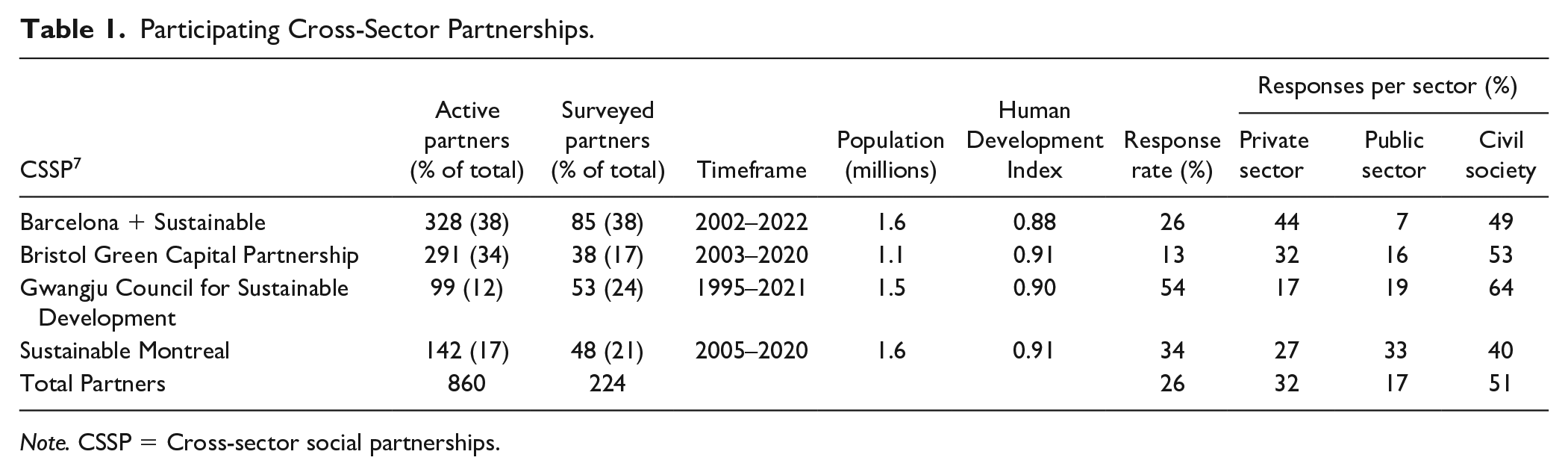
Note. CSSP = Cross-sector social partnerships.
A cross-sectional survey was implemented for collecting data from the partners. The survey was designed in English and translated into French, Korean, and Spanish through a source-to-target language protocol to reduce problems of translation bias (Smith, 2010). Survey validity was assessed through an organized review of its content by experts on the subject matter, who had piloted a similar survey in English and French, examining how well the survey fits with the literature (Bohrnstedt, 2010; Litwin, 1995). In addition, and considering that the survey was translated into three languages from English, the translated contents were checked by the secretariats at the respective CSSPs, all knowledgeable of their partnerships, community sustainability strategies, as well as their partners, so that questions wordings and their local adaptations would achieve functional equivalence across communities (Smith, 2010). Once translations were accurate, the translated versions were uploaded to the online survey platform and tested by the research team and the partnerships’ secretariats.
The survey’s first section focused on general information about the partner organizations, the second asked them to value drivers to join the partnerships, the third about their implemented structural features, and the fourth section about how they value the outcomes obtained from partnering. Lists with 31 drivers and outcomes identified from the literature (Appendix A) were presented according to the five categories (sustainability, human, organizational, financial, and physical), and a 5-point Likert-type scale was used to value them. Similarly, a list of 14 structural features was identified from the literature (Appendix B) and grouped into two categories, formal and informal, as proposed by contingency theory. Appendix C shows the lists of drivers, structural features and outcomes including the questions asked to the respondents highlighting different times in the collaboration process. To reduce a potential priming effect caused by the order of the questions on drivers and outcomes, the section on structural features was included in between the two, acting as a buffer so the likelihood of priming was reduced (Schwartz & Schuman, 1997; Sgroi et al., 2010; Sudman et al., 1996). Furthermore, introductory texts were incorporated in every section inviting respondents to think of drivers at the moment of joining the partnerships, and to think about outcomes from the whole period of partnering, providing a way to focus on the particular sections independently (Organisation for Economic Co-Operation and Development [OECD], 2013). The time spent responding to the survey was on average 30 min and the scales used for drivers/outcomes and structural features questions were different, which is another measure recommended for preventing respondents to remember their previous responses, reducing a priming effect (Sgroi et al., 2010).
As the total number of active partner organizations was 860, the determined sample size was 246 (Cochran, 1977) 3 . However, as the sample size is larger than 5% of the total number of organizations, the corrected sample size formula by Cochran (1977) 4 was used to calculate the final sample size equalling to 191 organizations (Bartlett et al., 2001). As 224 organizations were surveyed, representing a response rate of 26%, results can be generalizable.
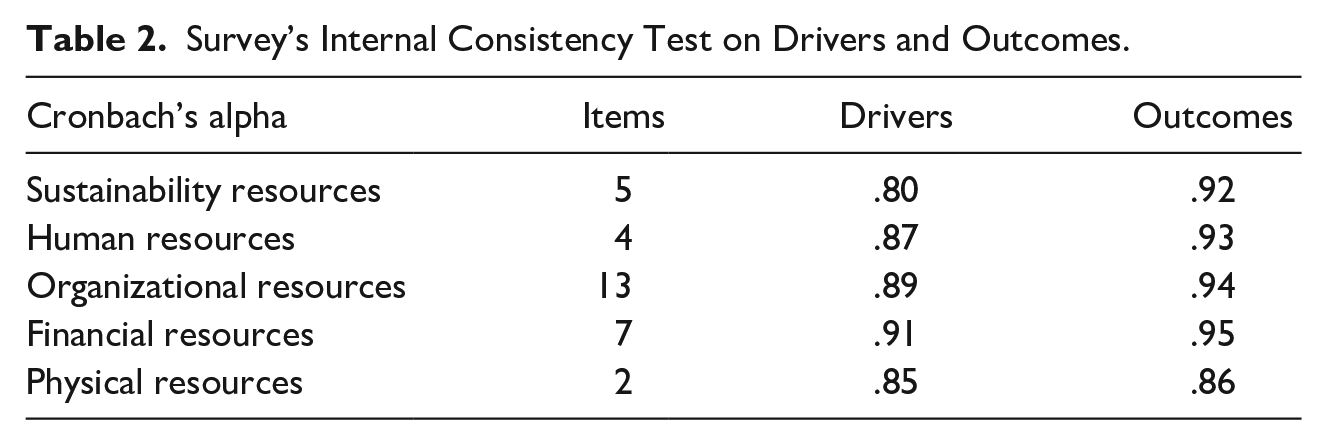
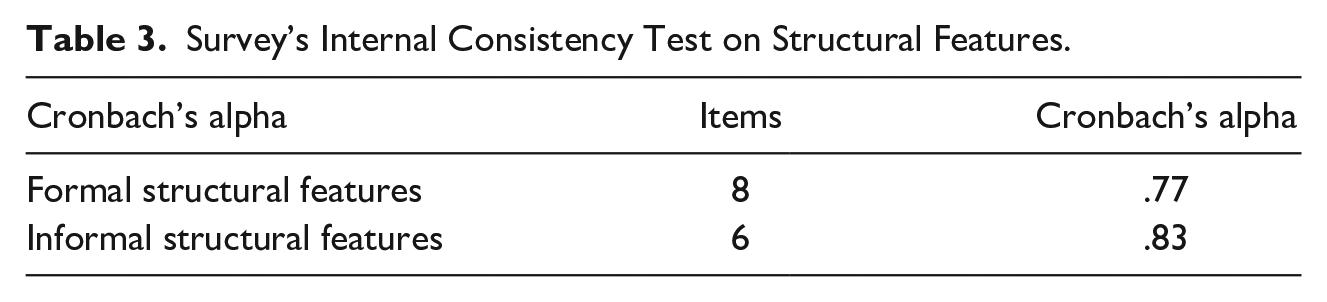
Data were collected mostly online (83%) between June 2015 and June 2017. No response bias was found through wave analysis methods (Levene’s test: p > .05) by comparing 15% of organizations who responded first (early respondents) with 15% who responded last (late respondents) on key questions on drivers, structural features, and outcomes (Lewis et al., 2013). The same method was used to determine the existence of response bias among partnerships considering that the distribution of responses is not equal (Table 1). Results show that variances can be assumed to be equal among partnerships (Levene’s test: p ≥ .05). Then, when testing for equality of means, it was confirmed that there are not statistically significant differences among the partnerships (p ≥ .04), with a significance level set at .01. Similarly, response bias was tested among types of organizations as responses are not homogeneously distributed (Table 1). Results from random samples of 15% of organizations per type show no statistically significant differences among respondents from civil society, private and public sector organizations on drivers, nor outcomes (p > .05). Internal consistency was determined through Cronbach’s alpha coefficients on every construct, all reaching over 70%, which is considered a threshold for good reliability (Cronbach, 1951; Litwin, 1995; Tables 2 and 3). Methods suggested by scholars to reduce social desirability response bias such as eliminating the interviewer, offering anonymity (Krosnick & Presser, 2010), self-administration, and a private interview setting (Tourangeau & Yan, 2007) were all used in this research.
Survey’s Internal Consistency Test on Drivers and Outcomes.
Survey’s Internal Consistency Test on Structural Features.
The units of analysis were the partner organizations, 65% of which are very small organizations (1–50 employees), 3% are small (51–99 employees), 12% medium-sized (100–499 employees), and 20% large (500+ employees); 20% have partnered for more than 10 years, 25% between 5 year and 10 years, 46% more than 1 year and less than 5 years, and 9% less than 1 year; and most of them partner voluntarily (88%). Those who responded to the survey were mostly at the senior level 5 (51%), middle managers (26%), or junior staff (9%) 6 . The data collection process included an initial stage of sending a web link to all the partners inviting them to respond to the survey online. Then, with the aim of improving the response rates and reducing nonresponse error (Dillman et al., 2009), an onsite process was implemented through surveyors trained to follow procedure, reducing potential influence on respondents (Smith, 2010). The data set with the responses was coded, and means were considered for categories of drivers, outcomes, and structural features, assigning the same weight to every question.
Measures
The hypotheses consist of one independent variable (partnerships) and three dependent variables (drivers, outcomes, and structures). Control variables were also included (organizational sectors: civil society, private sector, and public sector; organizational size measured through number of employees; partnering time referencing to the time organizations have been partnering in their respective CSSPs).
For testing H1a, value means of RBV- and sustainability-oriented drivers were calculated to create two composite indexes. For testing H1b, value means were calculated on human and organizational capitals, and financial and physical capitals, creating two composite indexes. Similarly, composite indexes were created for H2a and H2b. H3 was tested through composite indexes for implemented informal and formal structural features. Codes were used for statistical purposes as shown in Appendix C.
Then, control variables were included. MANCOVA test was used to estimate the effect of partnerships on drivers, outcomes, and structures, and then ANCOVA test was used to determine the effect of partnerships on each dependent variable while controlling for sectors, organizations’ size, and time partnering (Henriques & Sadorsky, 1999). Tests were run on IBM® SPSS®.
Results
Results responding to each hypothesis are presented in Tables 4 to 6 after the following section. Then, the effects of control variables are explained and presented in Table 7.
Drivers Under the Types of Values Assigned as Resources.
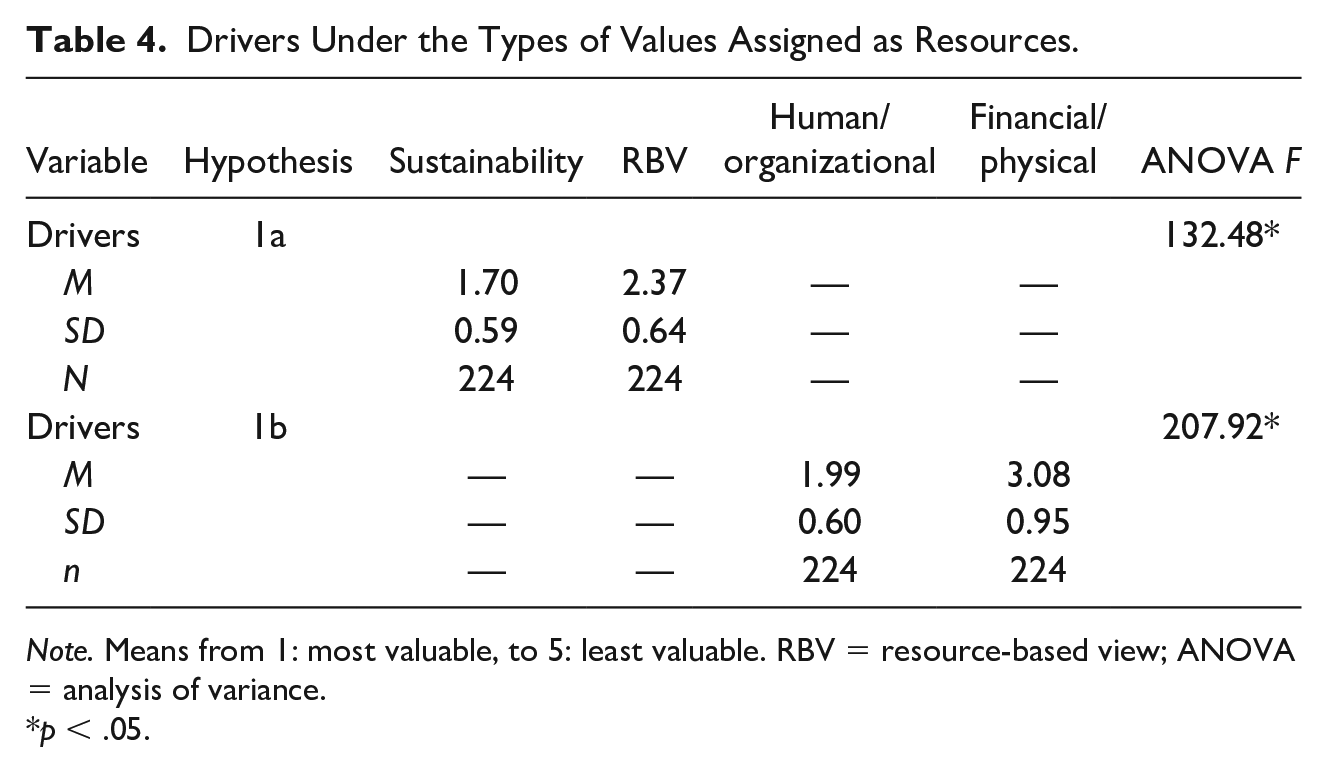
Note. Means from 1: most valuable, to 5: least valuable. RBV = resource-based view; ANOVA = analysis of variance.
p < .05.
Outcomes Under the Types of Values Assigned as Resources.

Note. Means from 1: most valuable, to 5: least valuable. RBV = resource-based view; ANOVA = analysis of variance.
p < .05.
Implemented Structural Features.
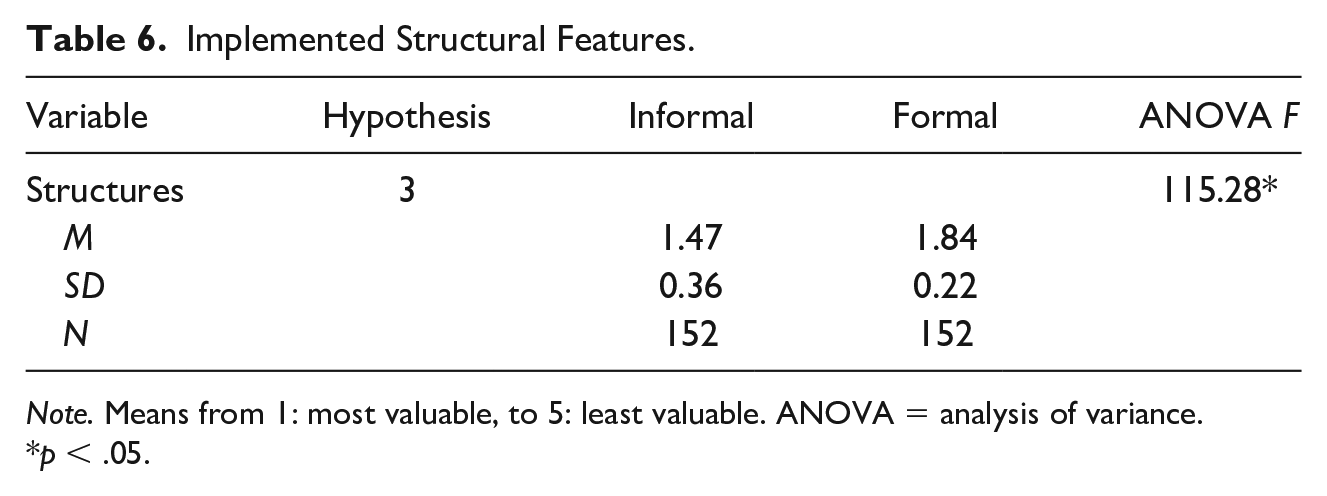
Note. Means from 1: most valuable, to 5: least valuable. ANOVA = analysis of variance.
p < .05.
Implemented Structural Features.

Note. CSSP = cross-sector social partnership.
p < .05. **p < .001.
Drivers to Partner
ANOVA F is significant for all organizations (p < .05) as shown in Table 4. H1a, which argues that RBV-oriented drivers are more valuable for organizations than sustainability-oriented drivers, is rejected showing a difference of the means statistically significant in favor of sustainability-oriented drivers (i.e., those that would contribute to SBM and the creation of sustainability value). H1b is not rejected, showing strong evidence to support the hypothesis that human/organizational drivers are more valuable than financial/physical drivers, with a statistically significant difference of the means. Descriptive results show sustainability drivers (M = 1.70, SD = 0.58) as the most valuable for organizations to join partnerships, followed by human (M = 1.90, SD = 0.88), organizational (M = 2.02, SD = 1.02), physical (M = 3.01, SD = 1.20), and financial drivers (M = 3.09, SD = 1.27; Appendix D). ANOVA test shows statistically significant differences among drivers, F(4, 26) = 24.25, p < .05, with post hoc comparisons (Tukey honestly significant difference [HSD] test) showing sustainability-oriented resources not significantly different from human- nor organizational-oriented resources, but significantly different from physical- and financial-oriented resources. Similarly, the mean score for human-oriented resources was not significantly different from organizational-oriented resources, while physical- and financial-oriented resources were not found to be statistically different. These results are consistent across sectors; private: F(4, 26) = 28.14, p < .05, public: F(4, 26) = 14.88, p < .05, civil: F(4, 26) = 21.03, p < .05; with statistically significant differences also found between sustainability-, human- and organizational-oriented resources, and financial- and physical-oriented resources, but not among sustainability-, human- nor organizational-, nor between financial- and physical-oriented resources (p < .05).
Outcomes From Partnering
With respect to hypotheses about outcomes, Table 5 shows through ANOVA F tests that organizations value sustainability-oriented outcomes more than RBV-oriented outcomes, with a difference of the means statistically significant, rejecting the H2a (p < .05). Similarly, it was found that all organizations value human/organizational outcomes more than financial/physical outcomes, supporting the H2b through strong evidence, with a statistically significant difference of the means (p < .05). Detailed results show sustainability-oriented outcomes as the most valuable for organizations (M = 2.16, SD = 0.86), followed by human- (M = 2.16, SD = 0.18), organizational- (M = 2.37, SD = 0.33), physical- (M = 3.24, SD = 0.12), and financial-oriented outcomes (M = 3.37, SD = 0.11; Appendix E). ANOVA test shows statistically significant differences among outcomes; F(4, 26) = 26.05, p < .05; with post hoc comparisons (Tukey HSD test) showing sustainability- and human-oriented resources not significantly different from organizational-oriented resources, but significantly different from the mean score for physical- and financial-oriented resources. Similar results were found across sectors; private: F(4, 26) = 34.42, p < .05, public: F(4, 26) = 13.43, p < .07, civil: F(4, 26) = 23.60, p < .05; with statistically significant differences found between sustainability-, human- and organizational-oriented resources, and financial- and physical-oriented resources.
Organizational Structural Features
Results show strong evidence to support H3 for organizations (i.e., informal structural features; M = 1.47, SD = 0.36) are implemented more than formal structural features (M = 1.84, SD = 0.22) when implementing collaborative strategies as partners of large CSSPs for local sustainability, with a difference of the means statistically significant between the groups; F(1, 12) = 44.12, p < .05; Table 6). Similarly, Appendix F shows informal structural features as the most implemented for organizations from any of the three sectors, with statistically significant differences; private: F(1, 12) = 93.39, p < .05, public: F(1, 12) = 27.69, p < .05, civil: F(1, 12) = 25.63, p < .05.
Results Including Control Variables
Results from the ANCOVA and MANCOVA tests on drivers, outcomes and structures, which tested the effect of partnerships after the effects of sectors, organizational size, and time partnering were removed, are presented in Table 7. The results of the MANCOVA for drivers, outcomes and structures were significant (p < .001), with the overall model (including controls) accounting for 51% (1–λ) of the variance in the dependent variables, and the net effect of organizations after the control variables were introduced was also significant, accounting for 40% (1–λ) of the variance. The ANCOVA results show that partnerships are significant for drivers and structures after accounting for controls, but not for outcomes (i.e., the difference of the means for outcomes; ANOVA Table 5) was not sustained when introducing the control variables. Results also show that organizations’ size, represented through number of employees, has a significant effect on implemented structures, and organizational sector a significant effect on outcomes and implemented structures.
Discussion
Four main findings can be highlighted from this research: (a) The resources rated most valuable for organizations to join a large sustainability partnership are sustainability-, human- and organizational-oriented resources such as contributing positively to environmental challenges and to community sustainability, engaging with the community, building new relationships, and sharing their experiences. Financial- and physical-oriented drivers are rated the least valuable. (b) The most valuable outcomes obtained from partnering for local sustainability are rated as those related to sustainability-, human-, and organizational-oriented resources, such as having contributed positively to environmental challenges, built new relationships, shared their experiences, contributed to community sustainability, and engaged with the community. Conversely, financial and physical outcomes are the least valuable resources. (c) Organizations indicated they implement more informal structural features when furthering the achievement of a collaborative sustainability plan, adding practices such as collaborating with other organizations; implementing plans, policies, reporting and monitoring; adding controlling activities; and having a cross-functional team. These are invoked more than formal features such as creating positions, assigning budget, having an office, or assigning infrastructure or equipment. (d) Organizations from the private, public, and civil society sectors have similar experiences regarding drivers and outcomes, and with respect to implementing informal structural features, with no statistically significant differences.
By framing these findings at the nexus of SBM and CSSP research, we reveal contributions to both fields. SBM thinking is essentially a provocation toward seeking integrated value creation, which can be obtained through large, multi-organizational CSSPs. For the CSSP literature, the SBM thinking helps explain why sustainability-oriented resources were rated as the most valuable drivers and outcomes for partners. CSSP literature, grounded in an RBV perspective, tends to focus on human, organizational, financial, and physical capitals that are gained (Clarke & MacDonald, 2019). Yet, H1a and H2a were not found to be true in the context of large CSSPs, which was unexpected when taking a traditional business approach to strategic partnering and if the traditional RBV literature is considered. The traditional RBV-oriented drivers and outcomes were not found to be more significant than sustainability-oriented drivers and outcomes. Instead, sustainability-oriented resources were found to be similar in value to organizational and human resources, but not to financial nor physical capitals. It seems to be the context presented to organizations—large partnerships with partners from across sectors who collaborate to address common sustainability issues—that contributes to highlight resources other than those traditionally assessed by RBV. RBV has been largely used in the context of partnerships evolving from a firm-focused view to an organizational theory (Barney et al., 2011; Barrutia & Echebarria, 2015) and it works on small partnerships that are short-term (Clarke & MacDonald, 2019). However, it is a theory used to study organizational relationships and the search for competitive advantage (Barney et al., 2011). The CSSPs studied here are different in size, duration, and focus so more than trying to achieve a competitive advantage, partner organizations collaborate toward a common goal that would benefit them all. Sustainability seems to be part of the glue that brings and keeps diverse organizations partnering to reach such common concern. Despite the other drivers and outcomes identified as valuable for all types of organizations, which are shorter term goals, it is sustainability-oriented resources that place them in a collaborative space where SBM can create integrated value. Certainly, integrated value-creation processes would take longer than having access to new markets, networking or learning, which may explain the long-term engagement of the partners driven by and valuing sustainability-oriented resources that need a collaborative approach to be achieved. Important is to note that 62% of the partners have been members of these CSSPs for more than 5 years (19% more than 10 years), which is a long-term commitment not usually seen in more traditional and formal collaborations. Furthermore, more than half of the surveyed organizations are from the civil society and 17% from the public sector, so again formal approaches do not necessarily fit with them. These empirical findings reinforce the need for RBV as an organizational theory to be extended to include sustainability-oriented resources (Gray & Stites, 2013) and natural capital (Hart, 1995). This required update will align its focus with the new challenges organizations from different sectors are currently facing, including the climate emergency, and the health and migrant crises, which are again not those traditionally addressed by organizations (Ordonez-Ponce & Khare, 2021).
In addition, the use of contingency theory to consider the structuration of partner-level structures for implementing a collaborative (partnership-level) strategy is novel. Yet the findings reinforce that contingency theory holds true in this context as well. While it is the sustainability focus of the partnerships what drives partner organizations to structure informally as sustainability challenges are wicked grand challenges (Ferraro et al., 2015; Rühli et al., 2017), it is also the influence of large partnerships that are formed by many smaller partnerships (Ordonez-Ponce & Clarke, 2020), so formal approaches may not be the most suitable way to interact with others, which is reinforced by the diversity of partners (65% have less than 50 employees and 20% more than 500, with 51% from the civil society and 32% from the private sector). By considering larger CSSPs, and better understanding the partner-level practices, this offers new empirical insights on how partners are structured when engaged in large cross-sector partnerships.
In terms of the contribution to SBM literature, by conceiving of large, multi-organizational CSSPs as “collaborative SBMs,” we extend the idea of the “business model” to the societal level, exploring how value is created, delivered, and captured in partnership. SBMs are about the creation of not only economic value, as with traditional business models, but also of social and ecological (i.e., sustainability, value; Schaltegger, Hansen, & Lüdeke-Freund, 2016). Lüdeke-Freund and colleagues (2018) mapped 45 patterns of SBM into a taxonomy of 11 groups, each located on an adaptation of Kleine and von Hauff’s (2009) sustainability triangle, representing the degree of contribution to social, ecological, and economic value. The least developed (and arguably most important) area on the map is the “integrative” zone at the center (Dyllick & Hockerts, 2002; McDonough & Braungart, 2002; Schaltegger & Burritt, 2005). The Community Platform Patterns located there are those that “substitute resource or product ownership with community-based access to resources and products,” contributing to all three forms of value creation through the redefinition and redelivery of value propositions, with “sharing business” as a sole model in this pattern (Lüdeke-Freund et al., 2018, p. 153).
Taken together, the findings from this study suggest that the participating organizations are seeking a space outside the limitations of their own organizational contexts, and the attendant institutional value logics that define them, to construct more integrative models. The business model construct is predominantly anchored at the firm level, yet problems in sustainability are manifest at the societal level, across organizations, sectors, and ecosystems. This misalignment of problem and response is an inherent limitation to SBM thinking that must be overcome, and so CSSPs are a necessary form of integrated SBM. A primary barrier to transitioning to more sustainable systems is the conceptual and functional gap between societal-level problems, and organizational/institutional-level responses (Kurucz et al., 2013). Collective, highly integrated, complex challenges such as climate change and ecosystem degradation are inadequately addressed through siloed sectors of society with incongruent “institutional logics” (Laasch, 2018; Thornton et al., 2012). Capital-based business enterprise is designed to maximize profit, often while “externalizing” social and environmental costs. Governments, driven by various ideological leanings, can constrain or encourage particular actions by business through regulation or investment, with the overriding imperative to obtain and maintain power over a 4-year cycle. Civil society movements (e.g., nonprofits, activist collectives) form and develop to act as “humanity’s immune response to toxins like political corruption, economic disease, and ecological degradation” (Hawken, 2007, p. 142).
Large cross-sector partnerships with a sustainability focus provide space for blending these institutionalized value logics, moving closer to the “integrative” terrain of the SBM taxonomy triangle where the focus is on simultaneous economic, social and environmental value creation (Lüdeke-Freund et al., 2018). The large partnership inherently contains pluralistic value logics (Randles & Laasch, 2016), and values integration is the default objective. Our study findings reveal that partnering organizations most value sustainability-related drivers and outcomes that contribute to the sustainability (i.e., societal-level) objectives of the partnership (in addition to the organization-oriented and human-oriented resources that help enable more sustainable societal gains). This can serve a dual purpose for the participating organizations. First, the partnership is seen as a place to get outside of the confines of their respective organizational logic and serves as a search mechanism to explore ways they can participate more fully in social and environmental value creation. This effectively brings SBM thinking to the collaborative level. A business model for sustainability approach “tries to address externalities by acknowledging a company’s efforts towards social and environmental value creation” (Lüdeke-Freund et al., 2016, p. 24). Second, this can help to shift the business model thinking at the organization level toward SBM thinking. Jay (2013) found that an organization’s efforts to navigate plural institutional logics (here practiced in the partnership) can often have the effect of shifting the organization’s own operating logic. Our finding that organizations deploy more informal than formal internal structures to navigate their role in such partnerships fits with the process of re-defining the organizational logic by confronting paradoxes between external provocations toward more sustainable value creation, and the institutionalized structural elements existing in the organization (Jay, 2013). Seeking to create social and environmental value is legitimized, and past empirical analyses of reasons for sustainability activities show that securing organizational legitimacy is a more important driver than maximizing profits (Aragón-Correa et al., 2016; Schaltegger et al., 2019).
The contribution of these findings to SBM research is to extend the concept of a SBM to the partnership level, in other words, a collaborative SBM. Most of the sustainability, human, and organizational resources valued by respondents are only generated within the relationships among partners (i.e., they are not attainable outside the partnership). Such “system-level” resources have been identified as critical within the RBV to building strategic advantage: “How does a firm encourage alignment of resources to strategy, and how does it continually build human and organizational (i.e., system-level) resources to fuel competitive advantage?” (Colbert, 2004, pp. 353–354). We suggest that by considering deliberate, structured CSSPs as a type of integrative SBMs, unique system-level resources and value-creation outcomes are admitted into the conversation, and our understanding of the vital integrative zone of the SBM pattern map is expanded.
Conclusion
Large sustainability-focused cross-sector partnerships are effective vehicles for engaging a broad spectrum of societal actors (e.g., businesses, governments, civil society organizations, and universities) in collaborative efforts toward confronting sustainability challenges both globally and locally. Our findings here suggest that the value of these partnerships to participant organizations is primarily to build intangible sustainability, human, and organizational resources toward learning and contributing to society’s sustainability progress. Large CSSPs offer a ground to integrate and challenge institutionalized value logics; and applying SBM thinking toward the work on large CSSPs (i.e., inviting questions to provoke conversation on whether and how economic, social and environmental value is being created, delivered, and captured at the societal level) can help to accelerate the process of evolving the organizational logics of participating members.
Limitations and Areas of Future Research
This study focuses on large local sustainability cross-sector partnerships, and thus careful consideration is needed before generalizing to other partnerships of different sizes, and different scales. Further research could be conducted into different partnerships to see if and how it changes the value assigned to drivers and outcomes, and the implemented structural features of the partners, and thus impacts the collaborative business model. We would expect the most valuable drivers to remain sustainability-oriented, given that these are entities formed for that purpose, but the mix of other resources gained by partners might shift depending on the size and scale. In addition, further research could look at the relationship between the sustainability partnership design and the value for partners within a collaborative SBM.
This study combined the partners of various sectors. Further study could be done on the potential differences existing between organizations of different sizes, economic sectors, and between large corporations and small and medium enterprises, although our control variables shed some light into that direction. Finally, it would be interesting to deepen the analysis of the sustainability resources identified in this research, as they open another area of discussion, beyond that of offering green/ethical products or services, but on the importance of building and improving relationships with societal stakeholders.
In conclusion, the study aimed to understand the perceived value of large cross-sector sustainability partnerships to participating organizations, through empirically researching drivers, outcomes, and new structural features that resulted from implementing the partnership’s collaborative strategic plan. In doing so, the findings: (a) reinforce the need to extend RBV to including sustainability-oriented resources; (b) validate contingency theory in a new context; (c) offer a deeper understanding of large CSSPs (especially in relation to partner outcomes and partner-level structures); and (d) extend integrative type SBM to include a collaborative SBM.
Footnotes
Appendix A
Resources Identified in the Literature Organized According to RBV and Gray and Stites (2013) Categories.
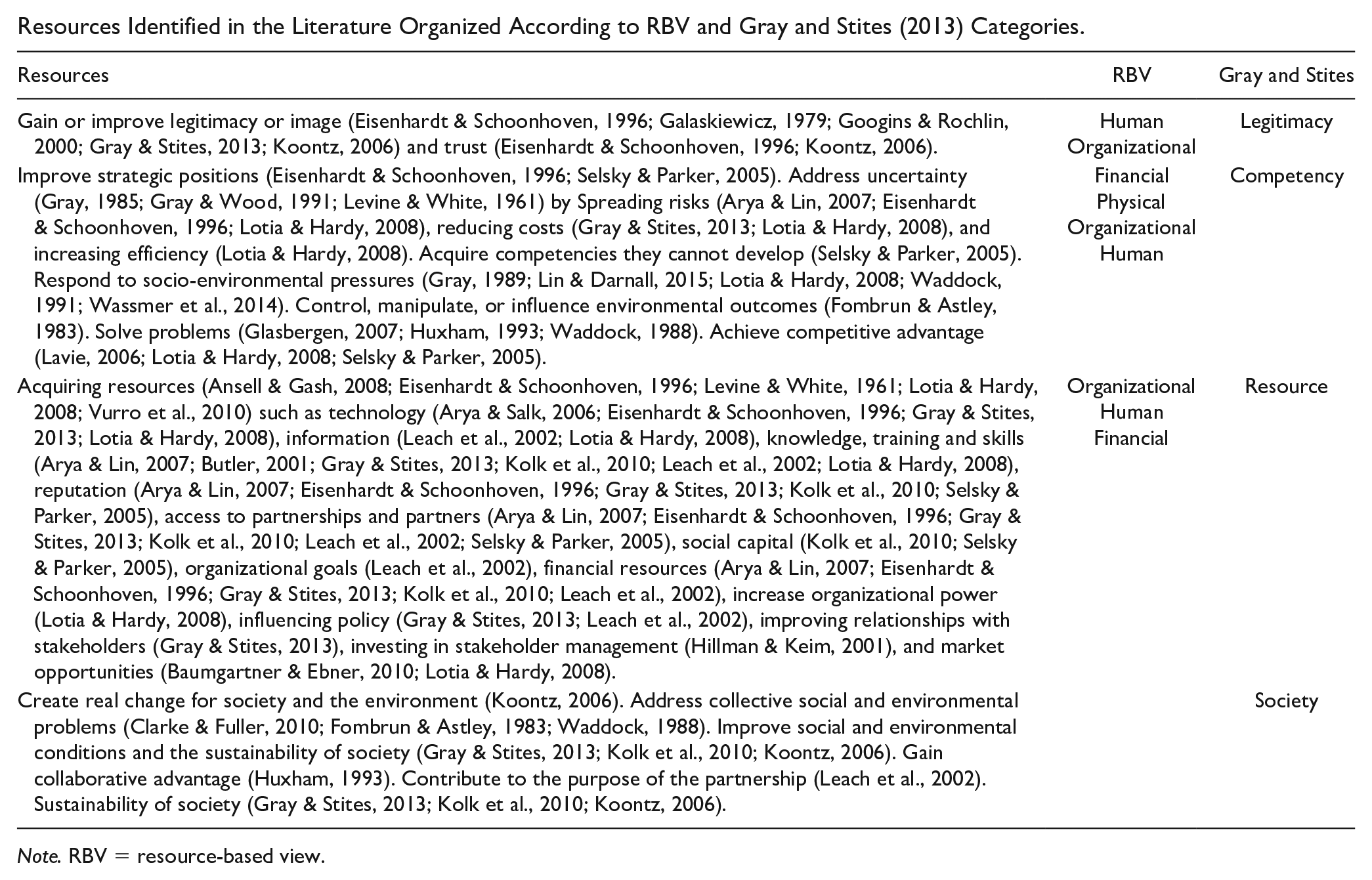
Note. RBV = resource-based view.
Appendix B
Structural Features Identified in the Literature Organized According to Contingency Theory.
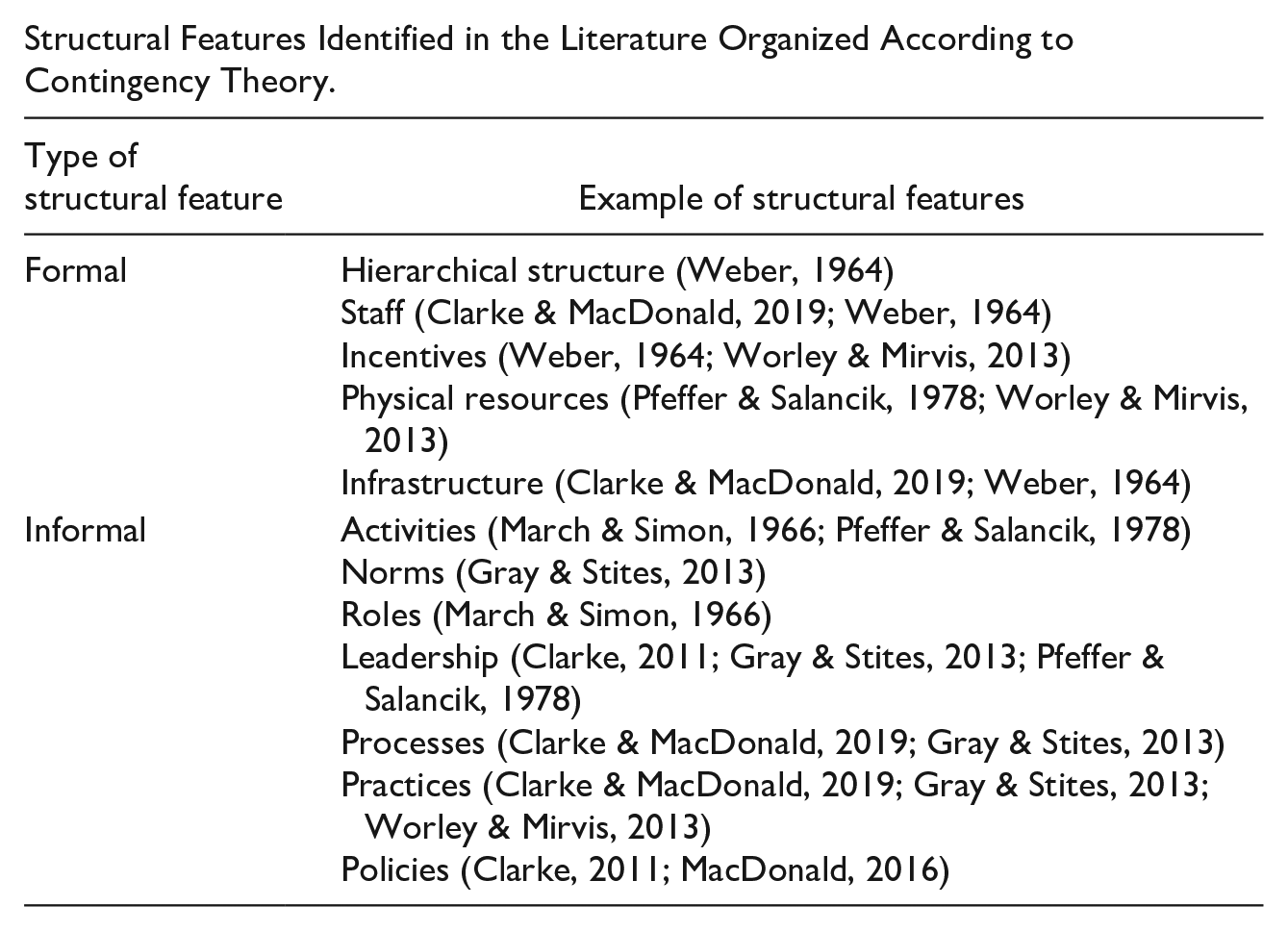
| Type of structural feature | Example of structural features |
|---|---|
| Formal | Hierarchical structure (Weber, 1964) Staff (Clarke & MacDonald, 2019; Weber, 1964) Incentives (Weber, 1964; Worley & Mirvis, 2013) Physical resources (Pfeffer & Salancik, 1978; Worley & Mirvis, 2013) Infrastructure (Clarke & MacDonald, 2019; Weber, 1964) |
| Informal | Activities (March & Simon, 1966; Pfeffer & Salancik, 1978) Norms (Gray & Stites, 2013) Roles (March & Simon, 1966) Leadership (Clarke, 2011; Gray & Stites, 2013; Pfeffer & Salancik, 1978) Processes (Clarke & MacDonald, 2019; Gray & Stites, 2013) Practices (Clarke & MacDonald, 2019; Gray & Stites, 2013; Worley & Mirvis, 2013) Policies (Clarke, 2011; MacDonald, 2016) |
Appendix C
Appendix D
Average Values Assigned by Organizations From Across Sectors to Drivers.

| Organizations | Private | Public | Civil | |||||
|---|---|---|---|---|---|---|---|---|
| Drivers | M | SD | M | SD | M | SD | M | SD |
| Sustainability | 1.70 | 0.59 | 1.74 | 0.29 | 1.62 | 0.35 | 1.70 | 0.41 |
| Human | 1.90 | 0.88 | 1.96 | 0.17 | 1.84 | 0.23 | 1.88 | 0.22 |
| Organizational | 2.02 | 1.02 | 2.01 | 0.30 | 1.99 | 0.44 | 2.03 | 0.40 |
| Physical | 3.01 | 1.20 | 3.08 | 0.10 | 2.80 | 0.32 | 3.04 | 0.19 |
| Financial | 3.09 | 1.27 | 3.01 | 0.21 | 2.99 | 0.27 | 3.18 | 0.22 |
Note. Means from 1: most valuable, to 5: least valuable.
Appendix E
Average Values Assigned by Organizations from Across Sectors to Outcomes.

| Organizations | Private | Public | Civil | |||||
|---|---|---|---|---|---|---|---|---|
| Outcomes | M | SD | M | SD | M | SD | M | SD |
| Sustainability | 2.16 | 0.86 | 2.90 | 0.27 | 2.09 | 0.30 | 2.10 | 0.35 |
| Human | 2.16 | 0.18 | 2.19 | 0.20 | 1.98 | 0.20 | 2.21 | 0.17 |
| Organizational | 2.37 | 0.33 | 2.41 | 0.28 | 2.18 | 0.42 | 2.41 | 0.35 |
| Physical | 3.24 | 0.12 | 3.37 | 0.11 | 2.880 | 0.30 | 3.29 | 0.07 |
| Financial | 3.37 | 0.11 | 3.46 | 0.13 | 3.11 | 0.17 | 3.40 | 0.09 |
Note. Means from 1: most valuable, to 5: least valuable.
Appendix F
Average Values Assigned by Organizations from Across Sectors to Structural Features.

| Structural Features | Organizations | Private | Public | Civil | ||||
|---|---|---|---|---|---|---|---|---|
| M | SD | M | SD | M | SD | M | SD | |
| Formal | 1.84 | 0.22 | 1.87 | 0.34 | 1.78 | 0.42 | 1.86 | 0.34 |
| Informal | 1.47 | 0.36 | 1.46 | 0.50 | 1.41 | 0.49 | 1.52 | 0.50 |
Note. Means from 1: most valuable, to 5: least valuable.
Acknowledgements
We acknowledge the contributions made by the reviewers and editor to improve this article.
Declaration of Conflicting Interests
The authors declared no potential conflicts of interest with respect to the research, authorship, and/or publication of this article.
Funding
The authors disclosed receipt of the following financial support for the research, authorship, and/or publication of this article: This work was supported by the Social Sciences and Humanities Research Council of Canada (Grant Number 435-2014-1250); Mitacs (Reference Number IT06408); ICLEI Canada; and the University of Waterloo.
