



Abstract
We advance research on how businesses engage with the complex social problems currently known as Grand Challenges. We study the concepts that preceded the term Grand Challenges, the connected ontologies that ground them, and the diversity of perspectives they offered. We construct a knowledge map that includes well-researched obstacles, such as governance obstacles hindering engagement and sensemaking obstacles limiting the ideation of novel and creative efforts. But we also build on prior research to identify curation obstacles, which precede engagement and define which problems receive social attention, and adaptation obstacles, which create uncertainty over workable solutions and bias the momentum of social systems toward the status quo. Our broader view on the obstacles defining Grand Challenges opens new pathways and identifies underexplored levers by which to understand and influence business engagement with complex social problems.
Keywords
Management scholars have long discussed how businesses ought to (Matten & Crane, 2005)—or can—advance socially desirable goals (Margolis & Walsh, 2003). Recent scholarship has focused on questions about how organizations tackle complex social problems (Dorado & Ventresca, 2013; Ebrahim et al., 2014; Gray & Purdy, 2018; Le Ber & Branzei, 2010; Levy & Kaplan, 2008; Mair, 2020; Mair & Seelos, 2021; Smith & Besharov, 2019; York et al., 2016) sometimes without fully considering how they apply to businesses. Comprehensive reviews of this literature showcase a richness of perspectives (Cajaiba-Santana, 2014), but also highlight the “terminological ‘Babel’ization” of the field (Have & van der Rubalcaba, 2016; Edwards-Schachter, 2016; Edwards-Schachter & Wallace, 2017), a symptom of the need for theoretical development and for research on the specific role of businesses. This need does not arise from lack of attention, since the role of businesses in complex social problems has been part of the management research agenda for decades (Gray, 1985; Kanter, 1994; Trist, 1983). Rather, it arises from a lack of theoretical scaffolding to connect prior and current streams of discovery and contributions. We help create this scaffolding by constructing a comprehensive knowledge map of the obstacles defining business engagement with Grand Challenges. We build on the sometimes forgotten insights of scholarly giants who offered pioneering concepts of engagement with complex societal problems. Our focus is on seminal articles which we connect with current definitions (Ferraro et al., 2015; George et al., 2016; Larson et al., 2011) and research agendas (Dentoni, Pinkse, & Lubberink, 2021; Dorado & Ventresca, 2013; Ferraro et al., 2015; George et al., 2016; Schad & Bansal, 2018; van Wijk et al., 2019; Westley et al., 2007) of the management communities of inquiry on this topic. We identify, examine, and retrace the genealogy and ontology of this work to yield new insights about how businesses partake in the processes and structures that define Grand Challenges.
Scholars have advanced a variety of definitions for Grand Challenges (Ferraro et al., 2015; George et al., 2016; Munir, 2021; Westley et al., 2007). From among these, we build upon George et al.’s (2016) which associates Grand Challenges with the “specific critical barrier(s) that, if removed, would help solve an important societal problem with a high likelihood of global impact through widespread implementation” (George et al., 2016, p. 1881). This definition focuses on how organizations attempt to tackle Grand Challenges, but our analysis shows that earlier concepts attended to barriers that it overlooks, specifically those associated with the processes and structures that define which problems get social attention (Blumer, 1986), and those generated by the complex adaptive nature of social systems (Emery & Trist, 1965). We thus complement George et al.’s definition by situating the barriers they offer in their definition within a knowledge map inclusive of barriers identified in the definitions of complex social problems that precede the emergence of the Grand Challenges concept.
Figure 1 provides a graphic summary of our knowledge map. The map starts with the concepts offered in the seminal articles we identified: Hardin’s (1968) and E. Ostrom’s (1990) tragedy of the commons, Blumer’s (1986) social problems, Rittel and Webber’s (1973) wicked problems, and Trist’s (1983) metaproblems. It then identifies their underlying ontologies, which describe how each concept depicts the link between ideation, action, and outcomes. The technical rationality ontology (Schön, 1982) offers a linear-ordered link (George et al., 2016). Pragmatism (Dewey, 1930; James, 1975) professes an iterative connection (Ferraro et al., 2015). The adaptive systems ontology (Ackoff, 1974; Meadows, 2008) linked with pragmatism via James’ “radical empiricism” (Heft, 2001) offers an uncertainty framing. The knowledge map also includes a critical theory ontology, foreshadowed in Blumer’s social problems and Rittel and Webber’s wicked problems and linked to pragmatism. This ontology brings awareness to the social structures of dominance that frame knowing and acting. Finally, the map includes four sets of obstacles: curation, governance, sensemaking, and adaptation. Curation obstacles are those associated with the processes and structures affecting whether, how, and when social situations become worthy of attention as Grand Challenges. Governance and sensemaking obstacles are those contemplated in current definitions of Grand Challenges, namely those associated with the processes and structures related to organizations’ direct engagement in tackling Grand Challenges. Governance obstacles affect social organization and coordination around complex social problems, while sensemaking obstacles affect the potential for innovative and creative approaches to them. Finally, adaptation obstacles recognize the contextual factors that influence curation, governance, and sensemaking obstacles. They include the complex, nested, system dynamics that connect the processes and structures associated with these obstacles to the macro socio-ecological structures within which they exist (Mair & Seelos, 2021; Westley et al., 2007).

Knowledge map of the obstacles that define business engagement in grand challenges.
The knowledge map furthers efforts to provide theoretical rigor to the concept of Grand Challenges (Ferraro et al., 2015; George et al., 2016; Westley et al., 2007). This research has sharpened our understanding of the obstacles (governance and sensemaking) that define business engagement in tackling Grand Challenges (Ferraro et al., 2015; George et al., 2016). We further this research agenda and make two specific contributions. First, we resurface the processes and structures associated with curation obstacles as central arenas to understand and influence how businesses perceive and engage with Grand Challenges. Second, we include obstacles identified by scholarship in the adaptive system dynamics that overlie and frame how businesses partake in the making, identifying, and tackling Grand Challenges. The expanded view of the obstacles defining business engagement in Grand Challenges offered by our knowledge map opens new pathways and identifies underexplored levers by which to understand and influence business engagement with complex social problems.
Methods
Knowledge mapping is an approach favored in emergent areas of research to build theoretical scaffolding (Jabareen, 2004). When scholars from multiple fields come together without a prior clear agreement regarding core terminologies and concepts (Jabareen, 2004), they look for patterns and discover connections (Jabareen, 2009). Despite management scholars’ emerging preference for the term Grand Challenges, divergent definitions combined with dedicated study occurring across multiple disciplines warrant the knowledge mapping approach. Knowledge mapping efforts typically utilize expert knowledge and rely on snowball procedures to identify relevant contributions (Yoon et al., 2010). Further methodological tools used to develop knowledge maps include the review of connected articles, textbooks, and reports (Pritchard, 1969) and, more recently, “mathematical and statistical methods” that analyze “citations, authors, titles, indices, and so on” (Kolk et al., 2014; Yoon et al., 2010, p. 806). Researchers have also engaged in “text mining” (Yoon et al., 2010, p. 803) and developed “co-word maps, citation maps, and co-authorship maps” (Yoon et al., 2010, p. 806). Many of these techniques have been used in the growing body of research on Grand Challenges to expand the diversity of our insights (Edwards-Schachter, 2016; Edwards-Schachter & Wallace, 2017), but thus far, they have not been used to create a “comprehensive representation” (Jabareen, 2004, p. 638) of the decades of literature on Grand Challenges.
Our analysis started with a discussion among the authors who, together, have expertise in multiple areas of management research closely associated with Grand Challenges, including social entrepreneurship, social innovation, environmental sustainability, and cross-sector partnerships. We identified prior concepts that were relevant to our own research, and we also sought concepts that other scholars identified as relevant, collecting them from academic gatherings such as the EGOS 2018 subtheme on Institutions, Innovation, & Impact (see Dorado et al., 2018) and from highly cited articles such as Ferraro et al. (2015), George et al. (2016), and Westley et al. (2007). These conversations yielded a list of seven concepts: problem domains (Emery & Trist, 1965), tragedy of the commons (Hardin, 1968), social problems (Blumer, 1971), wicked problems (Rittel & Webber, 1973), messes (Ackoff, 1974), metaproblems (Trist, 1983), and ill-defined problems (Simon, 2019).
Our next step was to search management scholarship to assess the validity of our initial list of concepts via a citation count. Initially, we approached this task with a search of concepts (in the title, abstract, and keywords) using the Scopus database and the Australian Business Deans Council (ABDC) list of journals. The approach was helpful to identify articles citing the distinctive phrases wicked problems and tragedy of the commons, but yielded many irrelevant cites for more general terms like social problems, problem domains, messes, and metaproblems. Many articles used the terms without links to the foundational concepts that we sought to understand in relation to the development of the knowledge map.
To address this limitation, we focused on the seminal articles for each concept, which we identified by tracing citations to identify those articles that had offered the most widely accepted definitions of each conceptual term. Because the seminal works were widely cited across many fields of inquiry, we then conducted a narrower citation count focused on articles specifically related to Grand Challenges. We selected 31 keywords (such as societal grand challenges, HIV, sustainability, income inequality, and wicked problems) from keywords associated with the seminal articles in Scopus to focus our search on the Grand Challenges literature. Table 1 shows the citation counts for both the full concept search and the seminal article citation search with keywords.
Citations of Seminal Articles.
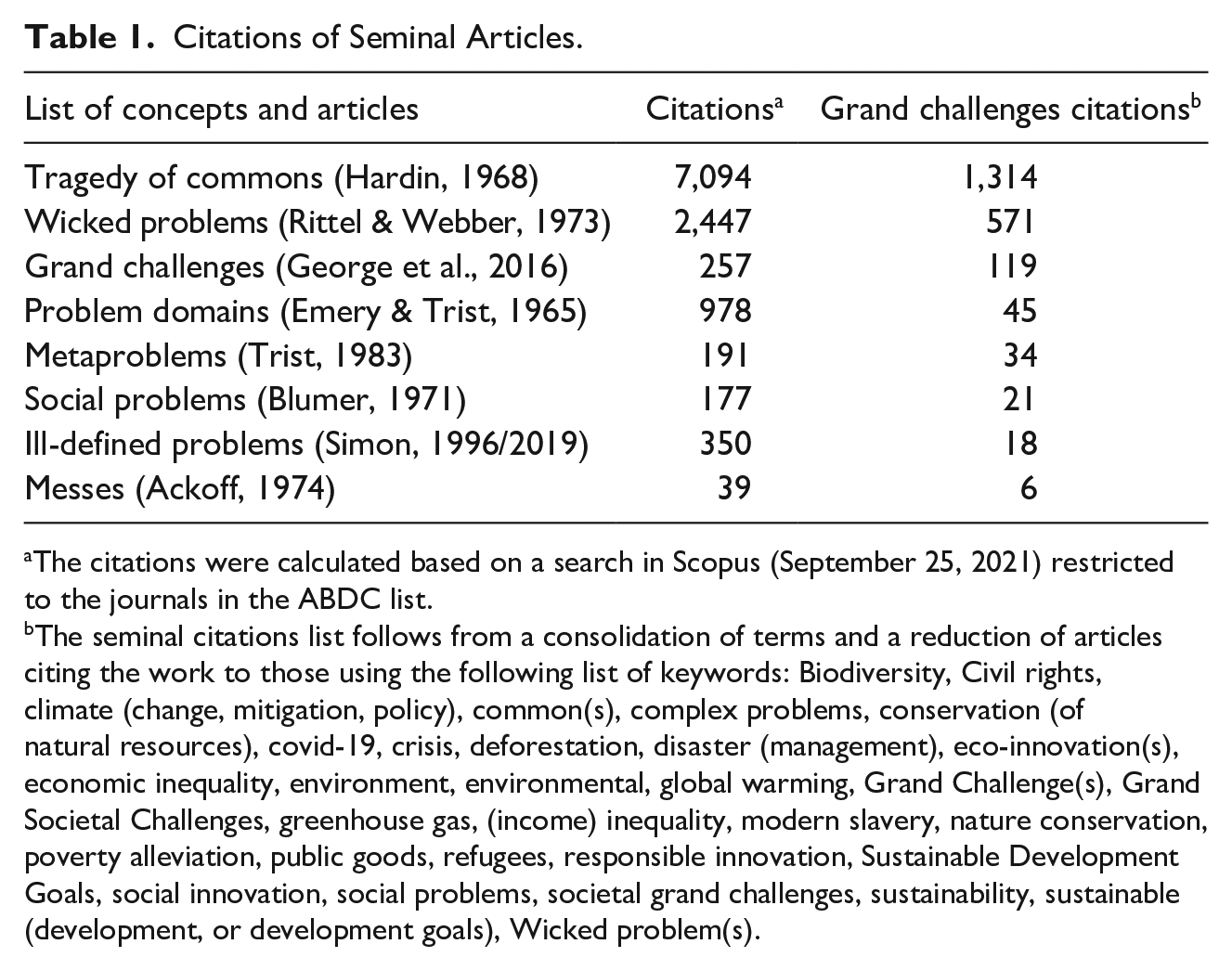
The citations were calculated based on a search in Scopus (September 25, 2021) restricted to the journals in the ABDC list.
The seminal citations list follows from a consolidation of terms and a reduction of articles citing the work to those using the following list of keywords: Biodiversity, Civil rights, climate (change, mitigation, policy), common(s), complex problems, conservation (of natural resources), covid-19, crisis, deforestation, disaster (management), eco-innovation(s), economic inequality, environment, environmental, global warming, Grand Challenge(s), Grand Societal Challenges, greenhouse gas, (income) inequality, modern slavery, nature conservation, poverty alleviation, public goods, refugees, responsible innovation, Sustainable Development Goals, social innovation, social problems, societal grand challenges, sustainability, sustainable (development, or development goals), Wicked problem(s).
The next step was to refine our initial identification of concepts foundational to the Grand Challenges literature by studying the articles resulting from the narrower search. Our review considered two criteria: (1) the number of citations that an article had received and (2) the uniqueness of the perspective offered. This analysis yielded three significant refinements to our list of concepts. First, we decided to drop the concepts of messes and ill-defined problems, whose seminal articles had received just 18 and 6 citations, respectively. Second, although the seminal article associated with social problems (Blumer, 1971) yielded only 21 citations, we retained it because of its unique perspective, which focuses on the visibility and attention required for actors to engage in the diagnosis and resolution of Grand Challenges. Third, the seminal articles for the terms problem domain and metaproblem (with 45 and 32 citations, respectively) are both authored by Eric Trist and offer related perspectives. While we counted citations for both terms, we decided to group them under the label metaproblems, the more recent of the two terms.
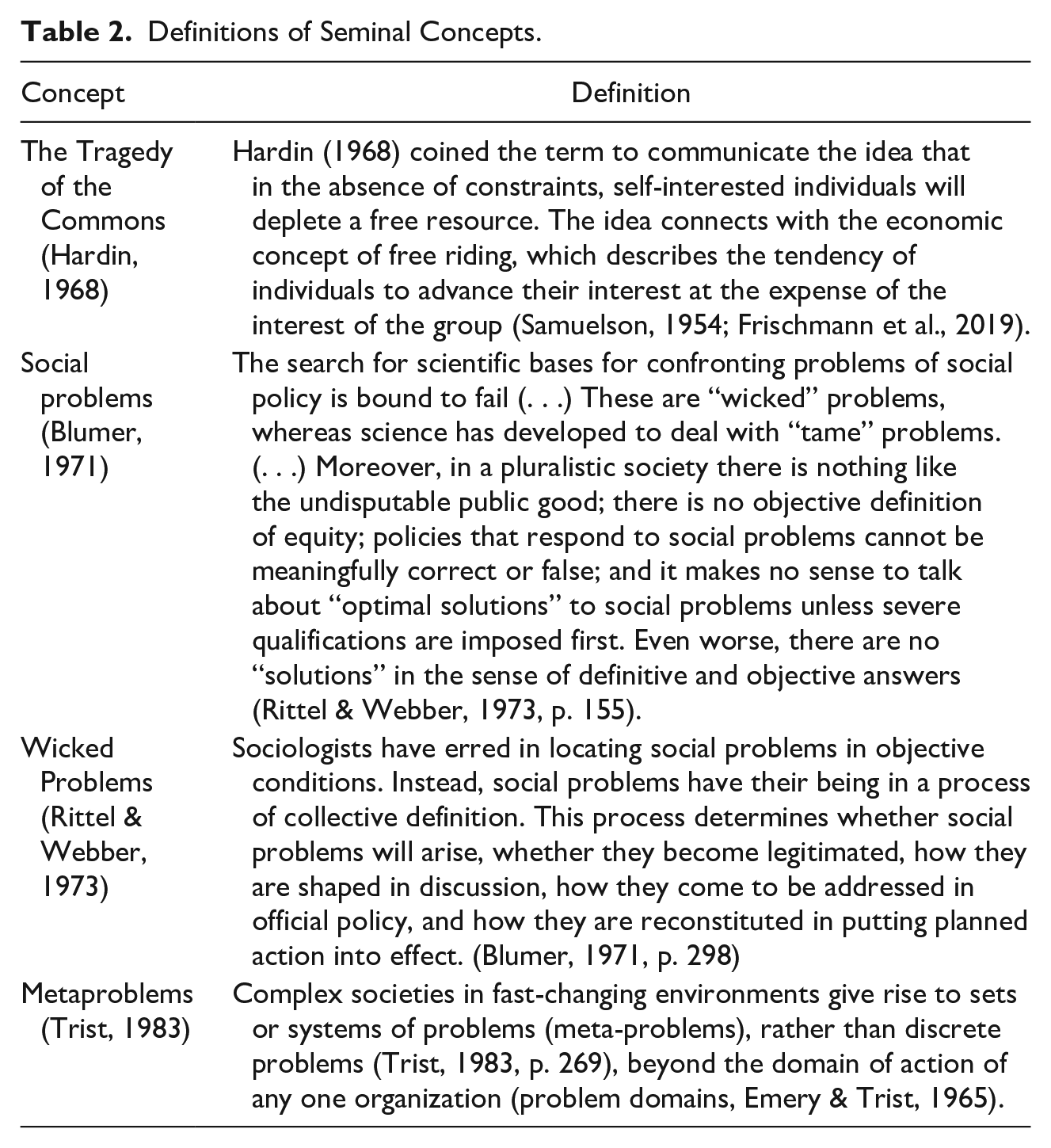
Table 2 offers definitions for the reduced set of four foundational concepts, ordered by year of publication of the seminal article that introduced the concept to the literature: tragedy of the commons, wicked problems, social problems, and metaproblems. Figure 2 provides the frequency counts of seminal article citations for the reduced list of concepts organized temporally, as well as a count of the citations of the Grand Challenges article by George and colleagues (2016). While other scholars have offered alternative definitions of Grand Challenges, George and colleagues (2016) is the most cited article. As shown in the figure, the term is rapidly acquiring favor as the preferred term for complex social problems.
Definitions of Seminal Concepts.
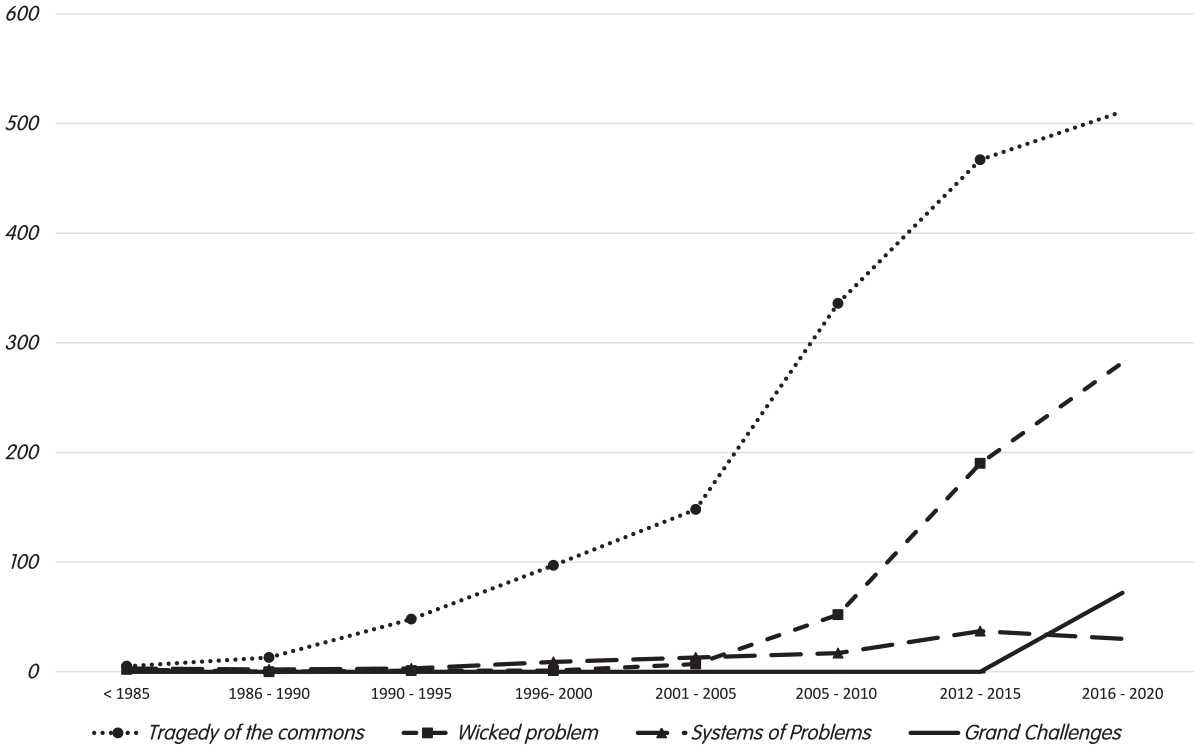
Cumulative citations of seminal articles in grand challenges literature.
The last step in our analysis was an in-depth study of both the seminal articles and the articles that have cited them. Using methodological practices from scholarship on the history of ideas (Boucher, 2012; Boxenbaum & Rouleau, 2011), we explored how “concepts and their meanings are contextual, situated and socially constructed” (Bothello & Salles-Djelic, 2018, p. 97). We also considered literature reviews (Edwards-Schachter & Wallace, 2017), case studies (Schön, 1982), and the work of biographers (Skaburskis, 2008). This close reading revealed shared roots as well as different insights offered by the scholarship associated with each concept. In the next section, we discuss the knowledge map derived from the study (see Figure 1). The map includes four seminal concepts (tragedy of the commons, wicked problems, social problems, and metaproblems) and the ontologies that ground them. It also includes the obstacles framing business engagement with Grand Challenges that emerge from our analysis.
The Concepts
Tragedy of the Commons
William Forster Lloyd, a British economist, introduced the term tragedy of the commons in an 1833 essay, but the term reached management and organization scholars via the work of economic ecologist Garret Hardin (1968), and Nobel prize winner Elinor Ostrom (E. Ostrom, 1990) in collaboration with her colleagues at the Indiana University’s Workshop in Political Theory and Policy Analysis (V. Ostrom, 1999; V. Ostrom et al., 2012). The concept communicates that, in the absence of constraints, self-interested actors will deplete a free resource. The idea connects Grand Challenges to definitions of complex problems as market failures (Have & van der Rubalcaba, 2016), central concepts in economics (see Santos, 2012). The concept also connects with the economic concept of free riding, which describes the tendency of individuals to advance their interests at the expense of the interests of the collective (Frischmann et al., 2019; Samuelson, 1954).
Hardin’s definition of tragedy of the commons has long been part of the vernacular in the management literature on complex social problems. In Hardin’s (1968) formulation, the problems of commons stem from governance obstacles, namely the barriers associated with the governance of natural resources and human activity. As an extension of economic theory, the definition of these barriers is top-down and derived through a thought experiment (Feeny et al., 1990) that builds on Hardin’s controversial and pessimistic view of the world and the welfare state. Hardin’s seminal article on the tragedy of the commons was the most frequently cited of all the articles we studied.
Hardin’s work is highly influential, yet another public policy scholar was the first to explore the tragedy of the commons. Elinor Ostrom explored the concept in her dissertation work, which she completed 3 years before the publication of Hardin’s article (Ostrom, 1965). She approached the question rather differently and offered an alternative perspective. In contrast to Hardin’s theoretical approach, Ostrom drew from extensive fieldwork on communities engaged in diagnosing and tackling commons problems, namely the availability of water and the distribution of water usage rights in Southern California. She also considered the fieldwork of other scholars. Subsequent research in collaboration with her husband Vincent Ostrom and colleagues from Indiana University (Dietz et al., 2003) brought about a redefinition of the commons problem dissociated from the neoliberal economic theories that had influenced Hardin’s thinking. This work situates the commons problem within the interdisciplinary research on collective action (Olson, 1965), connecting our understanding of governance obstacles with the iterative, nonlinear social dynamics defining how communities think about and organize to share resources (V. Ostrom, 1999), receive services (E. Ostrom, 1996), and tackle problems associated with common-pool resources, including climate change (E. Ostrom et al., 2012). Thus, the framing of governance offered by these authors is not narrowly associated with the concepts of corporate governance that draw on agency theory (Jensen & Meckling, 1976). Instead, it is a wider framing that includes the challenges to coordination, collaboration, and participatory action described in the public policy arena:
an arrangement of governing beyond-the-state (but often with the explicit inclusion of parts of the state apparatus) . . . organized as [apparently] horizontal associational networks of private (market), civil society (usually NGO) and state actors. (McCann, 2017, p. 314; Swyngedouw, 2005)
We found a total of 7,094 articles in journals on the ABDC list have cited Hardin’s (1968) article and our keyword search identified that at least 1,314 of these articles discuss Grand Challenges (see Table 1). A review of these articles shows that the vast majority focus on environmental sustainability. Other articles embrace the concept to study social problems in other arenas, including the arts (Borchi, 2018), migrant workers (Clibborn, 2019), intellectual property rights (Lambrecht, 2017), technological innovation (Allen et al., 2020), and market institutions that serve the interests of the poor (Gatignon & Capron, 2021). Finally, a few articles discuss topics associated with the psychology of cooperative behavior (see Weber et al., 2004, for a review) (see Appendix A).
Social Problems
Blumer (1971) provides a perspective on Grand Challenges that is focused not on tackling them directly, but on the social structures and processes that precede tackling efforts. He offers a social constructivist perspective (Berger & Luckmann, 1991) which suggests that social situations are identified as social problems through processes of collective definition “instead of existing independently as a set of objective social arrangements with an intrinsic makeup” (Blumer, 1971, p. 295). This perspective emphasizes the barriers influencing the type of social attention that Grand Challenges may receive (Holstein & Miller, 2006; Spector & Kitsuse, 1987). We label these barriers curation obstacles and define them as the processes influencing who comes to pay attention to which social problems when. The term is drawn analogically from the context of museums, where a curator decides what is worth collecting and displaying as well as how visitors experience the collection. Similarly, in the context of social problems, different actors (e.g., donors, multilateral organizations, governments, the media, researchers) summon and sustain our problem-solving attention by identifying some situations and not others as Grand Challenges. In their insightful 1988 article on attention to social problems, Hilgartner and Bosk (1988, p. 54) pondered,
[w]hy, for instance, does the plight of the indigenous people of South America (who are suffering from the rapid destruction of their cultures, and who in some cases are being killed off in large numbers) receive less public attention than the plight of laboratory animals used in scientific research? Why are conditions and events in the Third World that affect the life chances of millions of people, both abroad and in the United States, the object of only the most cursory and superficial public attention except during “crises”? Why do toxic chemical wastes in landfills receive more public discussion than dangerous chemicals in America’s work-places? Why do so few weep for the dying rain forest?
Our Scopus search for cites of Blumer’s seminal article yielded only 21 articles, and of these, only a few received a sizable number of citations themselves (see Table 1). Moreover, two articles were not focused on the identification of complex social problems and had instead adopted definitions of Grand Challenges associated with either tragedy of the commons or wicked problems (see Appendix B). With these caveats, we retained Blumer’s (1971) perspective because attention to curation obstacles brings to the forefront of the research agenda the antecedent processes that prefigure social problems before they are labeled as Grand Challenges. These processes may, for example, frame hunger either as an inequality problem or a poverty problem, which may compel different sets of actors and actions.
Wicked Problems
The term wicked problem focuses on diagnosis and resolution, highlighting the artificiality of the distinction between these two connected processes. The term is attributed to Rittel and Weber (1973) who sought to emphasize the distinction between social problems for which there is a linear path from ideation, to action, to outcome and social problems for which there is not. Linear science-based approaches are effective only when dealing with “tame” problems. Figure 3 includes the bottom-up definition of the concept provided in this landmark article. Following this definition, “wicked” problems defy neat description but include certain attributes. For example, consensus on diagnosis is impossible: In a pluralistic society, there is nothing like the undisputable public good (e.g., there is no objective definition of equity). Accordingly, policies that respond to social problems cannot be meaningfully correct or false. It makes no sense to talk about optimal solutions to social problems unless, or until, severe qualifications are imposed first to predefine the arena. There are also no solutions if solutions are understood as definitive and objective answers (Rittel & Webber, 1973, p. 155). Instead, as wicked problems, Grand Challenges are re-solved repeatedly.
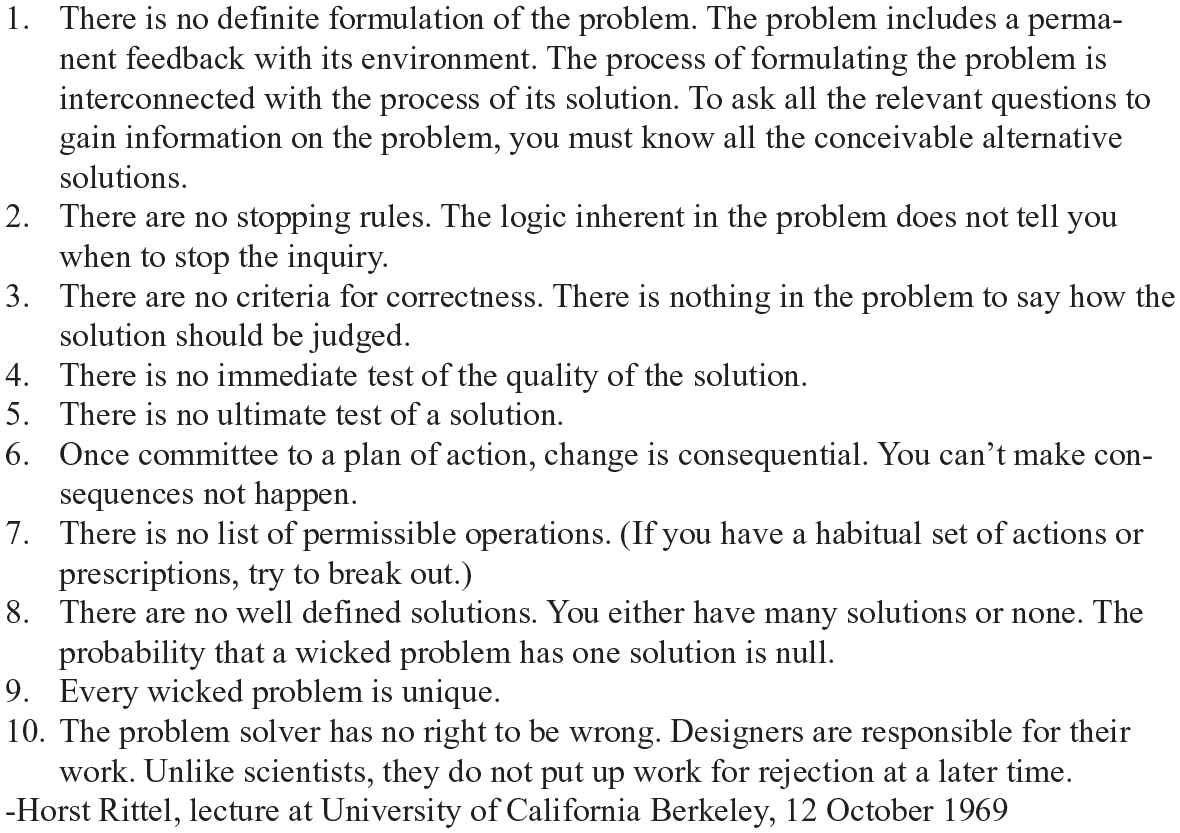
Characteristics of wicked problems.
Skaburskis (2008) gives us an insiders’ view into the origin story of this bottom-up definition of wicked problems. He dates the term to 1967, during a workshop organized by C.W. Churchman at the University of California Berkeley. In the workshop, Horst Rittel offered the list of attributes included in Figure 3. Skaburskis (2008) credits Churchman with offering the label “wicked.” At the urging of his coauthor Melvin M. Webber, Rittel later fully developed and published the concept in an article. Professor Churchman was also involved in his role as editor of the Management Science journal, where the concept first appeared in print. There Churchman used the definition of wicked problem that we adopt here (see Table 2):
. . . a class of social system problems which are ill-formulated, where the in-formation is confusing, where there are many clients and decision makers with conflicting values, and where the ramifications in the whole system are thoroughly confusing. The adjective “wicked” is supposed to describe the mischievous and even evil quality of these problems, where proposed “solutions” often turn out to be worse than the symptoms. (Churchman, 1967, p. 141)
Our search for citations of Rittel and Weber’s article yielded 2,447 articles published in journals on the ABDC list of which 571 had keywords that identified them as discussing Grand Challenges (see Table 1). Most of these articles embrace the concept in its original formulation (Brook et al., 2016; Dentoni, Bitzer, & Pascucci, 2016; Dentoni, Bitzer, & Schouten, 2018; Dorado & Ventresca, 2013; Reinecke & Ansari, 2016; van Tulder & Keen, 2018). Scholars have leveraged the term Wicked Problem to describe Grand Challenges in domains as diverse and dramatic as modern slavery (Caruana et al., 2021), cataract-induced blindness (see Dorado & Ventresca, 2013), and the COVID-19 pandemic (Moon, 2020; Sahin et al., 2020). Many of these highlight the differences between wicked and tame problems. Several of the most cited articles (see Appendix C) address public policy and sustainability issues, focusing on the governance obstacles that we have associated with the tragedy of the commons or, as discussed later, the adaptation obstacles brought forward by the metaproblems concept (Emery & Trist, 1965; Trist, 1983).
Metaproblems
The concept of metaproblems describes “sets or systems of problems (meta-problems), rather than discrete problems” (Trist, 1983, p. 269) that are beyond the domain of action of any one organization (problem domains, Emery & Trist, 1965). We trace the origin of this research to the work of Tavistock Institute members in a number of consulting engagements capturing challenges in a world that was changing and becoming rapidly interconnected (Trist & Murray, 1990). Eric Trist was the institute’s founder and director for many years. The center worked with scholars in other locations and the concepts of interest to us here follow from these fertile partnerships as participants like Russell Ackoff shared the concepts that they were learning and developing. 1
Of the 978 articles we found in the ABDC list of journals, only 73 2 included the keywords associated with Grand Challenges (see Table 1). In our review, we find that these articles were concerned with two sets of obstacles. The first set dovetails with the scholarship discussing governance obstacles. These articles discuss a plurality of complex social problems exploring issues related to cooperation and collaboration among organizations from the public, business, and civic sectors of society (Brown, 1991; Brown & Ashman, 1996; Gray, 1985; Gray & Purdy, 2018; Lawrence & Hardy, 1999; Trist, 1983). The second set of articles leverages research in ecology exploring human societies within the plural, overlapping, and connected socio-ecological systems that define planetary life (Dentoni, Pinkse, & Lubberink, 2021; Schad & Bansal, 2018; Westley, 2013) and is associated with systems theory (Lewin, 1936, 1943) (see Appendix D).
The Ontologies
Our knowledge map also highlights the different ontologies, or beliefs about the nature of social reality (Bryman, 2016), associated with the four concepts studied. These are technical rationality, pragmatism, critical theory, and complex adaptive systems. These ontological approaches yield different research agendas regarding the role of businesses as they interact with the obstacles that we have associated with each of the concepts reviewed.
Technical rationality connects with the Enlightenment tradition (Gladwin et al., 1995) and offers a possibilistic perspective which suggests that all complex social problems are amenable to human action, if not now, in a future soon to arrive with the help of technological advancements. It focuses on parsing problems into discrete chunks that can be analyzed and addressed in a linear fashion, thereby distinguishing problems from solutions and means from ends. This ontology is core to Hardin’s formulation of the tragedy of the commons. From it, the role of business in Grand Challenges is centered on the neoliberal understanding of why businesses would partake in tackling them. Following this thinking, their participation is guided by governance norms that call for the prioritization of the interests of shareholders.
Pragmatism, rooted in the writings of James (1907), Peirce (1878, 1931), and Dewey (1930), rejects the separation of ends and means, perception and implementation, and thus the problem diagnosis and resolution focus offered by technical rationality (Schön, 1982; Von Hippel & Von Krogh, 2016). In Dewey’s formulation, “[t]here is not at first a situation and a problem, much less just a problem and no situation.” p. 140). While this ontology is most directly associated with wicked problems, it is also linked to the concept of social problems as well as to Ostrom’s conceptualization of the tragedy of the commons (Aligica, 2013).
Management research from a critical theory perspective is also grounded in pragmatism (Spicer et al., 2009), but we feature it here to highlight its distinctive ontological position. Critical theory espouses that, in the context of complex social problems, the techno-rational linear connection between ideation, action, and outcome, which is “ubiquitous in much of today’s approaches to solving grand challenges” (Etzion & Ferraro, 2010; Grimes & Vogus, 2021, p. 2), is not only artificial but potentially harmful (Ackoff, 1974; Ferraro et al., 2015; Parks et al., 1981; Rittel & Webber, 1973). Both Blumer’s social problems and Rittel and Weber’s wicked problems foreshadow critical theory’s concerns with power and managerialism. Critical theory alerts us to the framing role of incumbent hegemonic structures which shape the views and actions of actors, even the best intentioned, that influence them to replicate past structures supporting the interests of the incumbents who benefit (at least in the short term) from the status quo (Khan et al., 2007; Levy & Kaplan, 2008; Levy et al., 2016).
Finally, the complex adaptive systems ontology is most closely linked to the metaproblems concept, and emphasizes the dynamic interrelatedness of multilevel systems that tend toward self-replication and homeostasis (Ackoff, 1974). However, more recent work by Ostrom and colleagues also links it with tragedy of the commons (E. Ostrom et al., 2012). This ontological stance draws from pragmatism’s iterative link between ideation, action, and outcome which is not surprising considering the connection with pragmatism via James’ “radical empiricism” (Heft, 2001). Most prominently, the complex adaptive systems ontology is informed by, the empirical ecological research on how natural systems replicate and change as conceptualized by Holling (1973), and by scholars associated with the Resilience Alliance, a consortium of scientists promoting “socio-ecological resilience” (Folke, 2006; Walker et al., 2004), and the Stockholm Resilience Center, “a major think tank promoting social-ecological resilience policy-making to state and intergovernmental organizations” (Bothello & Salles-Djelic, 2018, p. 110).
The complex adaptive systems ontology offers an uncertainty framing of the connection between ideation, action, and outcomes. The degree of uncertainty is causally dependent on the resilience of social systems (Holling, 2001). The concept derives from empirical research on how ecological systems self-replicate, change, and may collapse. Westley and colleagues (Westley et al., 2007, 2013) have enriched this ontology by articulating the connection between resilience and institutional theory-related concepts on the evolution of social systems, particularly isomorphism (DiMaggio & Powell, 1983), structuration (Giddens, 1984), and institutional entrepreneurship (Dorado, 2005). Significant here is the change in perspective, abandoning a focus on either the actors involved or the systems that frame their efforts, to consider the alignment, or lack thereof, between actors’ efforts and the forward momentum of the system. Forward momentum describes the vectors of directionality of a system amid the context of the plural, overlapping micro and macro systems within which it exists. Efforts that are aligned with this forward momentum advance and can bring about change. At times, they can bring catastrophic change when they reinforce dynamics that deplete the resources available. Those which are not aligned fail to become incorporated into the vectors fueling the self-replication of the system.
In summary, the seminal concepts we explored are associated with different ontologies that are distinguished by their different proposed connections between ideation, action, and outcomes. The technical rational ontology offers a linear temporal link, while the pragmatic ontology offers an iterative link. The critical theory ontology emphasizes the framing impact of hegemonic structures, and the complex adaptive systems ontology highlights the uncertainty created by the resilience dynamics defining the alignment of actors’ efforts within complex, nested, multilayered systems (Westley et al., 2007).
The Obstacles
Here we consider management research linked to the obstacles revealed by our study of concepts and ontologies and included in the knowledge map (see Figure 1). We begin with the processes and structures associated with curation obstacles which precede engagement in problem diagnosis and resolution. We then consider governance and sensemaking obstacles both separately and in relation to one another. We end with a discussion of research on the adaptation obstacles that influence the processes and structures affecting the three preceding obstacles.
Curation Obstacles
We identified curation obstacles in our reading of Blumer’s pragmatism-based conceptualization of social problems. These obstacles include the social structures and processes framing the why, who, and when of selecting, organizing, and presenting specific areas of social action as Grand Challenges (Blumer, 1971). Two separate streams of inquiry in organization studies and management have explored the social processes and structures we identified. One stream is interested in actors who can deliberately reorient collective attention to an alternative formulation. This research considers the role of social entrepreneurial movements, such as Hands Across America (see Waddock & Post, 1991) or the Life Aid global concert organized by Bob Geldof (Westley, 1991). The focus has been on organizations, with any profile, but businesses with socially oriented founders, such as Patagonia, have also played a role in these structures and processes (Ryan, 2021). Most directly, they can engage in entrepreneurial efforts that generate attention toward specific social problems (Waddock & Post, 1991; Westley, 1991). In addition, several authors in this stream document the role of storytelling and storytellers in eliciting and maintaining collective attention to complex social problems (Hoffman, 2020, 2021; Waddock, 2008, 2015).
The second stream of research draws from the critical management tradition (Alvesson & Willmott, 1992) and articulates the role of incumbent structures of power in creating the frames (Goffman, 1974) that actors use. These frames define how complex social problems receive attention in ways which are more likely to reinforce than undermine the incumbent structures for the continued benefit of those in power (Khan et al., 2007; Levy & Kaplan, 2008; Levy et al., 2016). This stream cautions that businesses engagements are more likely to reinforce than to erode the hegemonic structures that benefit them. For example, Khan and colleagues (2007) explored how media attention to the engagement of children in the production of soccer balls in Sialkot Pakistan brought about a diagnosis of the problem by the companies involved that ended by making the situation worse for the children involved. Specifically, they identified the problem as production practices that allowed for work at home. The result was the elimination of this practice and, with it, the elimination of job opportunities for the stay-at-home mothers who had been using this work to supplement the family income.
There are many other illustrations of how the engagement of businesses directs attention to some social problems and away from others such as the role of large multinational companies (e.g., Nike or Adidas), which are very active in drawing attention to the social challenges with impact on their bottom line, namely the infringement of copyrights by lobbying for the inclusion of certain markets that sell counterfeit identical replicas of their products in the United States Department of State list of notorious markets. 3 Inclusion on this list makes these markets subject to raids by local police enforcement. In contrast, these same large corporations remain idle when it comes to the policing of the sweatshops where many sellers of these counterfeit products work and, in this way, get hold of their designs. These places where subcontractors manufacture their products, typically pay very low salaries, have poor working conditions and, in extreme cases, engage in modern slavery (Crane, 2013). Other examples of businesses partaking in curation processes include how large multinationals hid knowledge of the harmful effects of their products from public view to avoid or at least delay social efforts to limit these harms such as tobacco (Velicer & Glantz, 2015), oil companies such as ExxonMobil (Supran & Oreskes, 2017), and internet giants, such as Facebook (Mac & Kang, 2021).
Governance Obstacles
Governance obstacles are the focus of scholarship associated with both the tragedy of the commons (E. Ostrom, 1996; E. Ostrom et al., 2012; V. Ostrom, 1999; Parks et al., 1981) and metaproblems (Gray & Purdy, 2018; Trist, 1983). Scholarship considering governance obstacles to business engagement in Grand Challenges has largely been grounded in either a technical rationality ontology or a pragmatic one, each advancing separately. Scholarship in the technical rationality tradition has been centered on the neoliberal understanding of why businesses would engage with Grand Challenges. Following this thinking, businesses engagements are driven by governance concerns associated with the need to prioritize the interests of shareholders. These governance concerns include the market-based structures associated with the literature on shared value (Porter & Kramer, 2002) and nonmarket strategies (Dorobantu et al., 2017). This research has emphasized the potential for, and the need to search for, win-win situations. They also include the historically and geographically bounded corporate governance norms (Aguilera & Jackson, 2010) that guide business leaders’ attention and the targeted state regulations defining their legal responsiblities. For example, Reid and Toffel (2009) have discussed the role of businesses in tackling climate change exploring the role of shareholder resolutions and targeted state regulations. Scholars have also considered obstacles deriving from the social norms and institutional structures that hinder collaborative arrangements (Kanter, 1994, 2010), including the polycentric structures advocated by Ostrom and colleagues (Dietz et al., 2003; E. Ostrom et al., 2012).
Drawing from Trist’s concept of metaproblems, research on governance obstacles using a pragmatic ontology has explored collaborative arrangements between businesses and civic society (Brown, 1991; Brown & Ashman, 1996; Gray, 1985; Gray & Purdy, 2018; Kanter, 1994, 2010; Westley & Vredenburg, 1997; Zietsma & Lawrence, 2010). This research has shown how these arrangements present opportunities to reveal and repair divisions in accountability and responsibility between businesses and civic society, or those conflictual or collaborative processes that may foster businesses’ willingness to embrace responsibilities beyond those associated with their organizational purposes including, for example, the preservation of biodiversity (Westley & Vredenburg, 1997), or old-growth forests (Cashore et al., 2007; Zietsma & Lawrence, 2010).
In short, research on governance obstacles as it applies to businesses is divided in its ontological focus. Scholarship with a technical rationality ontology focuses on topics associated with corporate governance, while that with a pragmatic ontology focuses on the impact of participation in collaborative arrangements with civic society–based organizations. The two bodies of work overlap in considering how the assumptions and structures that govern the actions of business leaders guide how they engage in efforts to address complex social problems.
Sensemaking Obstacles
Sensemaking obstacles connect, most directly, with scholars embracing concepts drawing on Rittel and Weber’s wicked problems. This scholarship has focused on exploring the topic without a specific focus on businesses. Scholars have advanced this research agenda by debunking hero-centered narratives on how to tackle complex social problems (Bacq et al., 2016; Dorado, 2005; Dorado & Ventresca, 2013; Ferraro et al., 2015; Lawrence & Suddaby, 2006; Schad & Bansal, 2018). They have also advanced our understanding of both the difficulties in advancing “bold ideas” and “less conventional approaches to tackling large, unresolved problems” (Colquitt & George, 2011, p. 432), and the role that processes such as design thinking (Buchanan, 1992; Gruber et al., 2015) can play in tackling these barriers to the discovery of novel approaches. Design thinking describes methods for actors to engage in fieldwork and develop thought experiments to loosen “the grip of pre-existing assumptions and paradigms” (Grimes & Vogus, 2021, p. 2).
More relevant for considering the specificity of businesses is attending to views of sensemaking obstacles, which consistent with Wicked Problems’ pragmatic foundation, see these obstacles as irremediably intertwined with governance obstacles (Ferraro et al., 2015). Drawing from this connection, we can reflect on their interplay. For example, we can consider how businesses’ sensemaking expectations regarding the time frame of an engagement has the potential to define the governance norms they are likely to accept (Kim et al., 2019). For example, in the context of the COVID-19 pandemic, businesses have been willing to give autonomy to other stakeholders, such as allowing workers to work from home, or to coordinate with them, such as partnering with government agencies in relation to vaccine mandates. These governance arrangements may have been motivated by assumptions about the temporary or short-term nature of these engagements (Kim et al., 2019). Interestingly, considering the longer-than-expected period of the pandemic, these engagements could have a lasting impact on the governance norms defining these relations in ways which will only become clear at later date.
Another avenue for reflection includes research exploring the increased likelihood of new bold approaches to Grand Challenges emerging from collaborative governance structures. With time, these structures can redefine participants’ sensemaking, increasing their willingness to embrace ideas they once considered undesirable (Dorado, 2013). Dorado and Ventresca (2013) offer an example. Their study showcases how a collaborative governance structure created the conditions for the unlikely emergent out-of-the-box approaches to the tackling of complex social problems, building on Hirschman’s idea of the hiding hand (Hirschman, 1967). Hirschman’s hiding hand explains the emergence of these out-of-the box engagements revealing the influence of evolving conditions in the ground. Dorado and Ventresca illustrate the role of the hiding hand with an example drawn from a case study (written by Marseille, 1994) on how SEVA, a U.S.-based nonprofit partnered with Aravind, a well-known social enterprise (Rangan, 2009), found itself financing and co-owning Aurolab, an intraocular lens manufacturing plant in India. SEVA’s involvement in this venture runs counter to its founding purpose, which instructed them to support low-cost, technologically modest solutions. However, as described by Marseille (1994), SEVA’s involvement in Aurolab emerged as an inevitable response within the chain of interactions grounding the years-long relationship between its leaders and Aravind’s founder. The case describes a nonprofit. However, the dynamics of the hidden hand (in yielding out-of-the box involvements) are relevant to explain why corporations may ever advance initiatives that deviate from their commercial aims.
In short, research on sensemaking obstacles reveals how the framing of problems and solutions affects actors’ approaches to tackling Grand Challenges. In considering the role of businesses, we highlight the interplay between sensemaking and governance obstacles (consistent with the pragmatic ontology framing research in sensemaking). Heeding this interplay allows explaining business actions beyond what is expected when considering separately the sensemaking or the governance obstacles framing their engagement. It also reveals, as the COVID-19 example illustrates, how sensemaking structures may motivate businesses to embrace governance norms they may have never considered. Or how, via Hirschman’s hidden hand, businesses may unexpectedly embrace bold out-of-the-box ideas that break away from the dominant governance norms guiding their leaders’ decision making.
Adaptation Obstacles
Finally, adaptation obstacles connect with the concept of metaproblems. These obstacles address the same processes and structures associated with curation, governance, and sensemaking obstacles. Yet they do so from the complex adaptive ontological perspective. This perspective provides an uncertainty framing highlighting that the outcomes of actors’ efforts depend on their alignment with the adaptive, plural, overlapping, and connected socio-ecological systems that define planetary life (Dentoni, Pinkse, & Lubberink, 2021; Schad & Bansal, 2018; Westley, 2013). Research on adaptation obstacles is the least developed (Mair & Seelos, 2021). It has thus far focused on exploring social innovation processes associated with Grand Challenges (van Wijk et al., 2019) without a distinct concern for the specific circumstances of businesses.
With a focus on these circumstances, we argue that a consideration of adaptation obstacles emphasizes the need to consider businesses actions within a long historical durée (Braudel, 1958). Only with the benefit of history, it is possible to appreciate the alignment, or lack thereof, of any action within the forward evolutionary momentum of the systems of which they are a part (see Westley et al., 2017). It is only with this long-term perspective then that we can capture that the outcomes of business actions may depend not only on the moral enlightenment of their leaders but also on the reinforcing evolutionary adaptive dynamics defining their actions. Dorado (2021) offers an example on the impact of these evolutionary dynamics in her study of the 200-year history of sheltered workshops in the United States. In it, she describes the dramatic changes in social formulations surrounding the engagement of people with disabilities in the labor force as a Grand Challenge. A recognition for people with disabilities as workers as a complex problem emerged after the Industrial Revolution. It was only then that that concerns for worker productivity brought about the idea of people with disabilities as unemployable and a societal burden, borne by families in the private sphere. Starting in the 20th century, social views on disability changed. This shift followed social trends, including the growing number of soldiers returning from war conflicts with a disability and a newfound faith in science to address all sorts of social ills. This reframed the desirability and potential of individuals with disabilities as workers with the right technical intervention (medical advances, rehabilitation, accommodations). Another dramatic shift followed the social movements of the 1960s, redefining the presence of people with disabilities in the labor force as a human rights issue. Finally, we are now witnessing the emergence of still another redefinition associated with changing social views about the role of unpaid labor, such as child and family care, which are not included in a country’s GDP. This shift on our understanding of the need to integrate people with disabilities into the labor force is likely to have a still to be seen impact. As shown in this example, social changes and trends at a wider societal scale have been curating the same social situation—the employment of people with disability—as different problems over time: a private problem in the nineteen-hundreds, a technical one after the world wars, and a human right since the 1960s. These obstacles are analytically distinct from curation obstacles and only visible in macro cross-country comparisons and longue durée studies (Braudel, 1958).
We can also observe the impact of evolutionary dynamics via the example of TOMS shoes, whose founder’s creative approach to philanthropy involved alleviating poverty by giving away a pair of shoes for every pair they sold. A focus on the governance and sensemaking obstacles that frame direct engagement would have us considering the origin of this creative idea and the potential role of the processes and structures associated with these obstacles. From an adaptation obstacles perspective, the focus shifts toward the unintended consequence of this well-intentioned effort, which ended by flooding markets with free shoes and depressing the demand for locally produced products. TOMS’ buy-one-give-one model of engagement was well aligned, and hence was supported by the global market evolutionary dynamics favoring philanthropic merchandizing (Griskevicius et al., 2010). It connected these dominant global market dynamics with vulnerable local ones in ways that undermined the self-reinforcement and growth of the latter.
These examples convey the distinct nature of the adaptation obstacles. They show the relevance of considering the business engagement in Grand Challenges taking into account how efforts align with the multiple overlaying systems over time. They also underscore the dramatic difference between the original and the long durée dynamics of interest in the scholarship associated with research on the resilience of socio-ecological systems (Allison & Hobbs, 2004; Folke, 2006; Gunderson & Holling, 2001; Holling, 2001; Levin et al., 1998; Walker et al., 2004).
Discussion
In this article, we have built a knowledge map for Grand Challenges by tracing the genealogical and ontological roots of pioneering concepts. The map is inclusive of diverse perspectives, yet nuanced in specifying core assumptions and approaches. Figure 4 provides a graphical summary. It includes the four different sets of obstacles that we have analytically derived atop the pioneering concepts and ontologies that ground them. Each of these four obstacles affords a unique vantage point to think about the role of businesses in Grand Challenges.
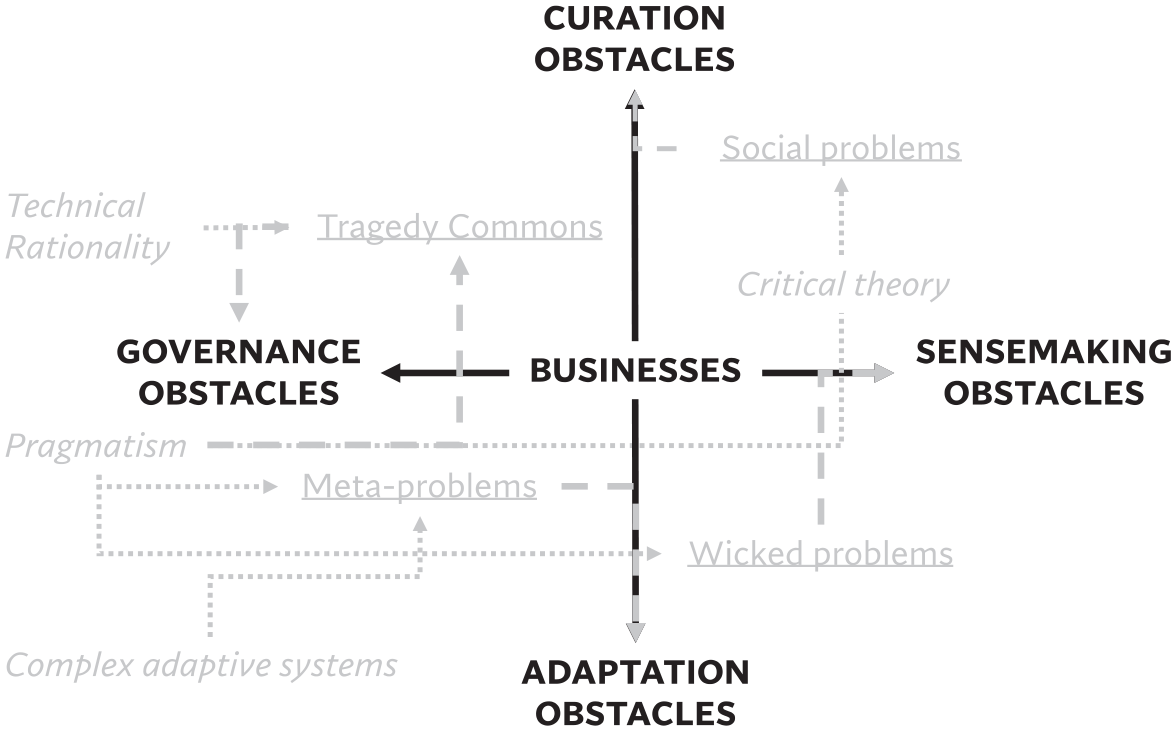
Knowledge map of the obstacles that define business engagement in grand challenges overlayed on top of the concepts and ontologies that ground it.
The knowledge map complements current efforts to bring theoretical rigor to our understanding of Grand Challenges (Etzion et al., 2017; Schad & Bansal, 2018). Specifically, the map offers a platform—built on the shoulders of giants—to advance research on the role of businesses in Grand Challenges beyond the primary focus on business actors engaged in tackling them through linear processes of problem diagnosis and resolution. The growing expectations for the role that businesses can play in Grand Challenges neither begins nor ends with “tackling.” Our knowledge map supports discerning the variety of ways in which businesses’ actions frame, reinforce, modify, or alleviate the obstacles that define Grand Challenges. By recognizing and organizing around the four sets of obstacles included in the map, we provide a guide both for research on business engagement and for actors who seek to contest and influence business engagement.
We have highlighted the importance of curation obstacles as foundational to understanding business engagement with Grand Challenges. We advocate for reconnecting with prior and ongoing research which has identified the social structures and processes that define curation processes and structures as separate from those involved in tackling Grand Challenges. Although there might be overlap, the separation provides analytical leverage to further specify the drivers, and the actions of businesses in influencing curation processes. Further research is needed on business participation in revealing or hiding information, fomenting interest, or skirting responsibility. Fruitful arenas include lobbying efforts, as well as public relations campaigns, and collective initiatives such as the Business Roundtable 4 or the Davos’ World Economic Forums. 5
With respect to the governance and sensemaking obstacles that influence engagement, we have provided a comprehensive review of the rich insights offered by management scholars. Using a pragmatic lens that views these obstacles as intertwined, we have reflected on how our understanding of business engagement will benefit from research that considers the role of sensemaking in influencing not only the discovery of novel approaches to Grand Challenges but also drivers, such as expectations of temporality, that affect businesses’ willingness to redefine the governance norms that guide how they coordinate and collaborate with their stakeholders. Accordingly, management research on time and temporality associated with processes of social change (Kim et al., 2019; Lawrence et al., 2002) readily emerges as a relevant addition to our knowledge map on Grand Challenges. Our analytical engagement with the interplay of sensemaking and governance obstacles also motivates the further study of moments of reversal (where obstacles become opportunities, or vice versa).
We have also made the case for longitudinal studies that allow capturing the dynamics of Hirschman’s hiding hand. For example, research on governance obstacles that focuses on how, in the shadow of governance structures, individuals develop a shared history of interactions and become involved in path-dependent sensemaking processes so that approaches that outside of this path appear to be unwarranted “emerge within it as judicious next steps in a stream of decision-making.” (Dorado, 2013, p. 535). As the example of Aurolab illustrated, these path-dependent histories of interactions can bring about out-of-the-box ideas that may have businesses taking decisions that deviate from the governance imperatives of profit-making.
Finally, our incorporation of adaptation obstacles broadens the empirical focus of Grand Challenges research by reclaiming the uncertainty frame germane to complex adaptive systems. An emerging body of research incorporating this ontology considers how it redefines our thinking on governance (Dentoni, Pinkse, & Lubberink, 2021), sensemaking (Mair & Seelos, 2021), and actor engagement in Grand Challenges (Schad & Bansal, 2018; Westley et al., 2007). We contribute to this research by calling for studies on the curation processes framing the formulation of specific social situations as Grand Challenges. The example of the multiple framings used to conceptualize the employment of people with disabilities over the last two centuries illustrates the relevance of this research. It also points to the empirical value of historical studies over long time periods. These studies are needed to observe how the engagement of businesses in Grand Challenges is defined not only by curation, governance, and sensemaking obstacles, but also by the plural, overlapping, and connected socio-ecological systems that frame these three sets of obstacles.
Limitations and Further Research
The approach that we have followed to build our knowledge map has, of course, the limitations associated with its methodology. We embraced this methodology because while building on a foundation of expert knowledge, it allowed us to incorporate diverse perspectives. However, our efforts would benefit from complementary systematic reviews of the literature following alternative methodologies geared to understanding the directionality of our common research efforts (Yoon et al., 2010). Two paths appear particularly fruitful. First, our efforts can be complemented with research on whether alignments exist between certain categories of Grand Challenges (e.g., climate change or poverty) and particular sets of obstacles. We found in our analysis evidence to suggest such relationships but did not fully explore them. For example, interest in governance obstacles appears to dominate Grand Challenges research exploring climate change. Crucial to understanding such alignments is answering questions regarding the origin of these relationships. It could be that some of the obstacles are more salient to some topical grand challenges than others. But it could also be that such relationships are evidence of the intellectual fads associated with the life cycle of ideas (McCarney, 1987).
A second fruitful path would be systematic reviews that consider the chronology of citations presented in Figure 2, and the likelihood of scholars citing one article or another. Particularly intriguing would be studies that show a continuation of the growing preference for the term Grand Challenges. In this regard, it would be interesting to notice whether the preference of this term also reflects a preference for the definition provided by George et al., which is focused on barriers that define the processes and structures associated with tackling Grand Challenges. Such a preference would either confirm or challenge the assertions of this article around the need for attention to the role of businesses in curation processes. It would also substantiate or undermine our call for research specifically directed to considering the impact of the multilevel dynamics that define curation, governance, and sensemaking obstacles.
Finally, one other limitation of our study is our focus on the past which could be complemented with efforts to consider what new concepts are emerging that should be incorporated into our knowledge map. In considering this limitation, we offer that possible obstacles worth attention are those associated with the emotions that may entice the leaders of businesses to modify their own behavior or their business’s role in tackling grand challenges (Kim et al., 2019; Zietsma & Toubiana, 2018, 2019). This research agenda could follow current research that has identified the role of emotions in encouraging reflexivity (Zietsma & Toubiana, 2018) and prompting actors to devote time, energy, and resources to efforts beyond their own private interests (Voronov & Vince, 2012). Similarly, research could further explore how business leaders become connected to social problems (Goodwin et al., 2001), and how they are influenced by those with the skills and resources to engage in tackling Grand Challenges (Miller et al., 2012).
Theoretical development is crucial for accumulating knowledge. In this article, we have analyzed decades of literature linked to Grand Challenges to construct a knowledge map that brings order to a domain that appeared riddled with fragmentation and a welter of seemingly related yet distinct terms. By turning our attention to the past, we found connections across concepts and ontologies but also valuable diversity that contributes to advancing instead of hindering theoretical development. Our knowledge map offers a platform for new research agendas for the next 60 years of Business & Society to further knowledge and frame activism on business engagement with Grand Challenges.
Footnotes
Appendix
Top Ten Articles Citing Trist’s (1983) and Emery and Trist’s (1965) Metaproblems Concept.
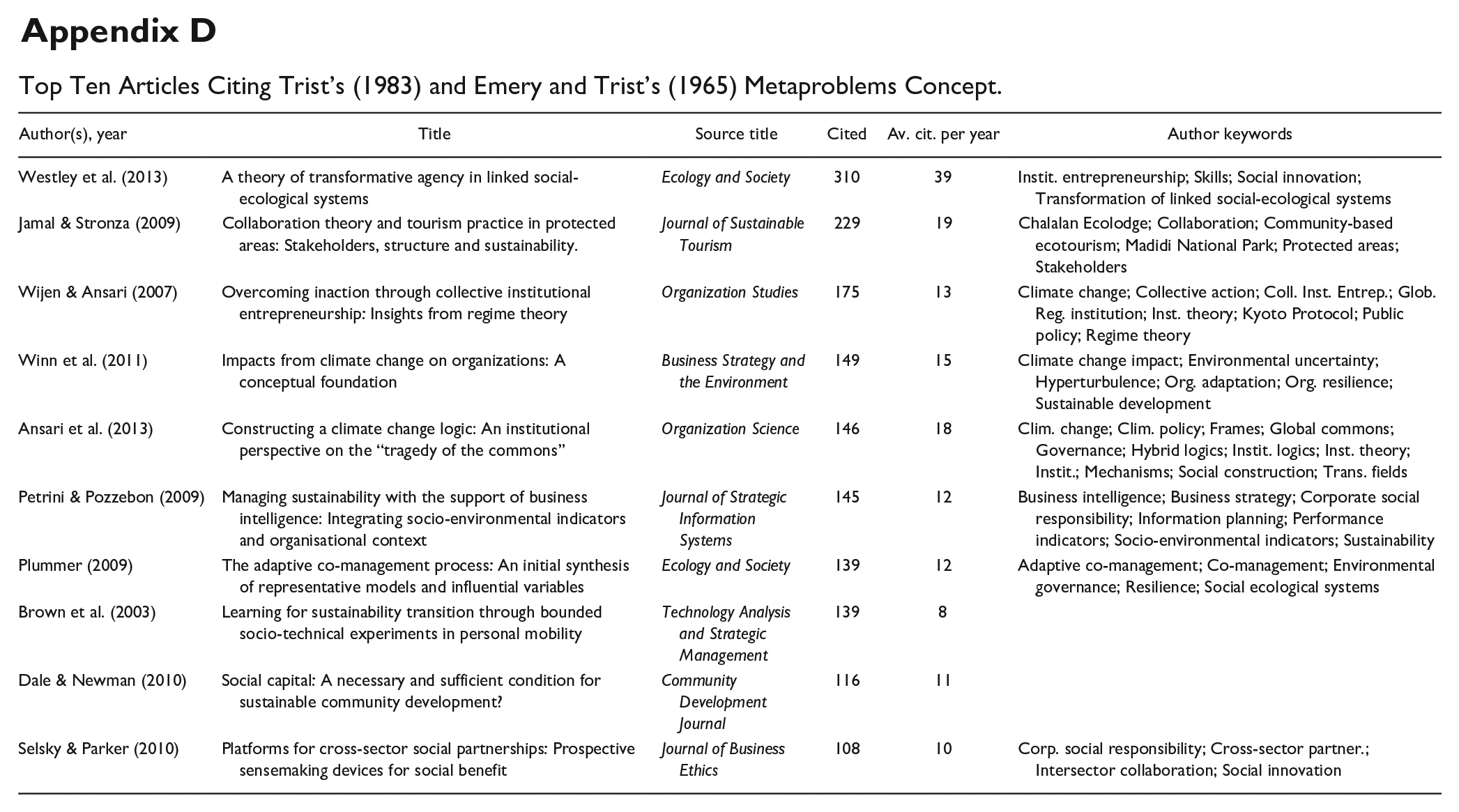
| Author(s), year | Title | Source title | Cited | Av. cit. per year | Author keywords |
|---|---|---|---|---|---|
| Westley et al. (2013) | A theory of transformative agency in linked social-ecological systems | Ecology and Society | 310 | 39 | Instit. entrepreneurship; Skills; Social innovation; Transformation of linked social-ecological systems |
| Jamal & Stronza (2009) | Collaboration theory and tourism practice in protected areas: Stakeholders, structure and sustainability. | Journal of Sustainable Tourism | 229 | 19 | Chalalan Ecolodge; Collaboration; Community-based ecotourism; Madidi National Park; Protected areas; Stakeholders |
| Wijen & Ansari (2007) | Overcoming inaction through collective institutional entrepreneurship: Insights from regime theory | Organization Studies | 175 | 13 | Climate change; Collective action; Coll. Inst. Entrep.; Glob. Reg. institution; Inst. theory; Kyoto Protocol; Public policy; Regime theory |
| Winn et al. (2011) | Impacts from climate change on organizations: A conceptual foundation | Business Strategy and the Environment | 149 | 15 | Climate change impact; Environmental uncertainty; Hyperturbulence; Org. adaptation; Org. resilience; Sustainable development |
| Ansari et al. (2013) | Constructing a climate change logic: An institutional perspective on the “tragedy of the commons” | Organization Science | 146 | 18 | Clim. change; Clim. policy; Frames; Global commons; Governance; Hybrid logics; Instit. logics; Inst. theory; Instit.; Mechanisms; Social construction; Trans. fields |
| Petrini & Pozzebon (2009) | Managing sustainability with the support of business intelligence: Integrating socio-environmental indicators and organisational context | Journal of Strategic Information Systems | 145 | 12 | Business intelligence; Business strategy; Corporate social responsibility; Information planning; Performance indicators; Socio-environmental indicators; Sustainability |
| Plummer (2009) | The adaptive co-management process: An initial synthesis of representative models and influential variables | Ecology and Society | 139 | 12 | Adaptive co-management; Co-management; Environmental governance; Resilience; Social ecological systems |
| Brown et al. (2003) | Learning for sustainability transition through bounded socio-technical experiments in personal mobility | Technology Analysis and Strategic Management | 139 | 8 | |
| Dale & Newman (2010) | Social capital: A necessary and sufficient condition for sustainable community development? | Community Development Journal | 116 | 11 | |
| Selsky & Parker (2010) | Platforms for cross-sector social partnerships: Prospective sensemaking devices for social benefit | Journal of Business Ethics | 108 | 10 | Corp. social responsibility; Cross-sector partner.; Intersector collaboration; Social innovation |
Acknowledgements
First and foremost, we thank Andrew Spicer for his skillful editorial stewardship and inspiring commitment to excellence. We also thank the three anonymous reviewers and Matthew Grimes, Emily Heaphy, Gorgi Krlev, and Frances Westley. The article also benefited from comments by participants at the International Association of Business and Society; European Group of Organization Studies; International Social Innovation Research Conference; Social Entrepreneurship Conference; and the Sustainability, Ethics and Entrepreneurship Conference. We also acknowledge the helpful comments by participants at the Organization and Social Change (University of Massachusetts, Boston). In addition, Silvia Dorado thanks the Waterloo Institute for Social Innovation and Resilience for hosting her during a sabbatical year at the University of Waterloo.
Declaration of Conflicting Interests
The authors declared no potential conflicts of interest with respect to the research, authorship, and/or publication of this article.
Funding
The authors received no financial support for the research, authorship, and/or publication of this article.
