



Abstract
Deliberation has faced criticism with regard to its application to business, on the basis that it can be misused to disseminate an ideology, divert attention from genuine debates, or strengthen the power of certain people. We suggest that Aristotle’s notion of deliberation can mitigate these ethical risks and help companies strengthen their deliberative practices. A comprehensive perspective based on Aristotelian deliberation reveals the relevance of (a) individual and collective deliberation, promoting a virtuous and meaningful reflection, free from ideological conditioning; (b) deliberation on ends and means that facilitates a transcendental and rooted reflection, thereby avoiding artificial debates; and (c) deliberation that is decisive and cooperative and thus prevents instrumentalization of deliberation by the strongest. We contribute to the discussion of the relationship between business and society by identifying the different steps in the deliberative process and promoting a dynamic perspective on deliberation.
The concept of deliberation—in its broadest sense understood as “debate and discussion aimed at producing reasonable, well-informed opinions in which participants are willing to revise preferences in light of discussion, new information, and claims made by fellow participants” (Chambers, 2003, p. 309)—has received considerable attention in management research over the years. It has, for example, been considered a desirable normative basis and decision-making protocol for multi-stakeholder initiatives and global governance (Baur & Arenas, 2014; Gilbert & Rasche, 2007; Mena & Palazzo, 2012), political corporate social responsibility (CSR; Scherer et al., 2014; Scherer & Palazzo, 2007), corporate governance and shareholder engagement (Goodman & Arenas, 2015; Moriarty, 2014; Scherer et al., 2013; Stansbury, 2009), and leadership (Fryer, 2012; Raelin, 2012; Voegtlin, 2011).
Despite this attention, the notion of deliberation has faced criticism for both its inner logic and functioning (for a response to some of the critical points raised against deliberation, see Curato et al., 2017) and its applicability to business (Hussain & Moriarty, 2018; Sabadoz & Singer, 2017). While the emergence of empirical research in political science could address some of the points (Carpini et al., 2004; Steiner, 2012; D. F. Thompson, 2008), relevant criticism remains. First, deliberation is vulnerable to ideological conditioning. Indeed, business’s still-prevailing neoliberal ideology means deliberation could be used as a space for the confrontation of individual interests, rather than as a means for a collective to develop a shared understanding (Bal & Dóci, 2018; Zizek, 1989). Second, deliberation can be misused to encourage false debates (i.e., artificial debates disconnected from morally higher ends and from the reality of work; Curato et al., 2017; Sabadoz & Singer, 2017). Third, it can be instrumentalized by the most powerful people—not necessarily the most competent or visionary—to control peer action and exercise a relationship of domination (Sabadoz & Singer, 2017). These limitations pose a paradoxical challenge to deliberation in business: While deliberation presumably contributes to more well-informed and legitimate decisions regarding good business practices, its pathologies can produce the opposite result by furthering solely personal interests or business goals (for similar discussions about the challenges that labor unions face when deliberating with business see Evans et al., 2012; Harvey et al., 2017; P. Thompson, 2003).
In addition to addressing these three matters, our article responds to criticism that research in management tends to focus on deliberative interactions between firms, rather than on the internal levers of deliberation within firms (Felicetti, 2018). Addressing this concern is especially relevant as business practice experiments with liberating structures and management approaches that try to introduce deliberation (Getz, 2009; Sferrazzo & Ruffini, 2019). Thus, the question we want to address in this article is, “How can organizations concerned with engaging their employees as active citizens overcome these difficulties by implementing ethics of deliberation?”
To that end, we propose that an Aristotelian perspective on deliberation can help to address these challenges, which hinder its contribution to good business practices. We rely on Aristotle’s works not only because he provided an in-depth reflection on deliberation, particularly in Nicomachean Ethics (Aristotle, 2002), but also because the Aristotelian corpus is a foundation of the common good perspective, which may offer novel ways of thinking about and practicing deliberation in business organizations.
Embracing an Aristotelian perspective provides a complementary view to recent discussions on deliberation in business and may help to address the critical points mentioned above by revealing the relevance of both individual and collective deliberation, deliberation on the ends and the means, and both decisive and cooperative deliberation. We argue that this Aristotelian ethics of deliberation is a safeguard against the risks of ideological conditioning, false debates, and instrumentalization of power by the strongest people.
We contribute to theories on and practices of deliberation in business organizations by suggesting criteria for the quality of deliberation that complement findings from the analysis of political systems (Dryzek, 2009; Dryzek & Pickering, 2017), in which a system reaps the benefits of deliberation when it develops capacities for authentic, inclusive, and consequential deliberation. Focusing on business-related issues, we outline how organizations can implement practices that allow for virtuous, meaningful, transcendental, rooted, effective, and integrative deliberation. Our approach therefore not only engages with questions about the best conditions for deliberation—a major concern of deliberation scholars—but also addresses questions related to what can be done before and after collective deliberation, and questions about what it is worth deliberating about: questions that are rarely addressed in deliberation research but which are important for ethics of deliberation.
The article is structured as follows. First, we introduce deliberation as it is applied to business and discuss its limitations. Second, we provide (through Aristotelian writings on deliberation and recent academic studies on the common good, which are an extension of Aristotelian thought) an approach that offers novel ways of thinking about widespread challenges to deliberation in business organizations. Third, we emphasize the implications of the Aristotelian perspective for business practice. Finally, we discuss the theoretical and practical contributions thereof.
What Are the Criticisms Against Deliberation as Applied to Business?
In our article, we focus on the ethics of deliberation in business. Deliberation refers to modes of communication that enable those affected by decisions to participate in a fair and open discourse (Habermas, 1996, 1998). Communication and reflection are crucial, as deliberation aims to form and alter preferences through dialogue (Dryzek, 2010, p. 3). Deliberation, to reveal its legitimizing normative force, should therefore be open to all potentially affected parties and be based on a power-free exchange of information and opinions. Dryzek (2009) notes, “Communications are deliberative to the degree that they are noncoercive, are capable of inducing reflection about the preferences that individuals hold, and able to relate the particular interests of individuals and groups to more universal principles” (p. 1381).
While Habermas (1996) originally proposed a rational exchange whereby participants are willing to concede to the better argument and to revise standpoints with the ultimate outcome of consensus, in his later works he relaxed some of these assumptions (Habermas, 1998). This more flexible approach has become widely supported by recent theorizing and empirical evidence (Carpini et al., 2004; Ryfe, 2005; Steiner, 2012; D. F. Thompson, 2008). For instance, one argument, which empirical observations are beginning to confirm, is that offering arenas for discourse and providing participants with an opportunity to voice their opinions already increases their willingness to cooperate, independent of the outcome (Carpini et al., 2004). Thus, the outcome of deliberation does not need to be restricted to consensus, as different forms of agreement, developing a sensitivity for opposing views, and learning about relevant issues can be considered important steps toward fostering understanding among participants (Carpini et al., 2004; Ryfe, 2005; D. F. Thompson, 2008). Similarly, including narratives of life stories as support for one’s argument has been considered a relevant addition to a purely rational exchange of arguments and an important part of successful deliberation (Ryfe, 2005; Steiner, 2012). Empirical research on deliberative polls has shown that deliberation increases learning among participants, leads to changes in preferences, and that these changes are information-driven (i.e., contingent on the information that participants share; Fishkin & Luskin, 2005). It has also been shown that more balanced deliberation in terms of exchanging pro- and counter-arguments promotes more balanced learning (Fishkin & Luskin, 2005).
In order for an institution to benefit from deliberation, it has to invest in deliberative capacities (i.e., structures that allow for authentic, inclusive, and consequential deliberation; Dryzek, 2009; see also Scherer & Voegtlin, 2020 with regard to corporate governance). Deliberation is authentic to the extent that it allows for communication on an egalitarian basis and encourages reflection, inclusive when it allows for those potentially affected to participate, and consequential when it has an effect on policy making (Dryzek, 2009; Dryzek & Pickering, 2017). Deliberative structures vary along three dimensions (Fung, 2006): who participates, how participants communicate with each other, and how influential the discussions are. The continuum of participation ranges from the selection of participants for deliberation by an institution (e.g., based on their expertise) to participants’ self-selection. The communication between participants can be limited to the exchanges of arguments or extend to the direct involvement of participants in collective decision-making processes. The influence of deliberation hinges on the power that participants or the deliberative forums have on the implementation of decisions (e.g., in the form of changing public policy or lawmaking) (Fung, 2006).
Because deliberation can foster understanding and agreement and provide legitimacy, it has been considered a relevant means for coping with complex business ethics problems (Stansbury, 2009). In addition—and most prominently introduced into the management and business literature by scholars of political CSR (Scherer et al., 2016; Scherer & Palazzo, 2007)—deliberation is considered a way to steer the observable political engagement of corporations toward legitimate exchanges with state and nonstate actors on issues of global governance and the provision of public goods and services (Rasche & Esser, 2006; Scherer et al., 2006). These forms of corporate political engagement become especially relevant in cases of state failure and global self-regulation. Consequently, most of the discussion has been focused on the deliberation of business organizations with their multiple stakeholders. However, increasingly, it is being argued and demonstrated that internal organizational structures, corporate governance, and leadership can also benefit from deliberative capacities (Fryer, 2012; Scherer & Voegtlin, 2020; Schneider & Scherer, 2015; Stansbury, 2009).
However, the benefit of applying deliberation to business organizations is not uncontested. Critical voices have questioned whether business organizations are the right place for deliberation (Hussain & Moriarty, 2018; Sabadoz & Singer, 2017). One of the main criticisms is that the hierarchical structure of businesses and the economic logic of the market do not allow for deliberation because they cannot guarantee a power-free and egalitarian discourse, and it is very difficult for managers to transcend self-interested motivation and a bargaining logic of decision-making (Sabadoz & Singer, 2017). Our focus is on deliberation in business in general, acknowledging the additional complications that might arise from different governance and organizational structures (e.g., the difficulties of including subsidiaries or franchisees in deliberations of relevance for all employees of a corporation), as well as the size of the organization that for instance correlates with the number of hierarchical levels in the organization. We relate to some of these points when discussing the practical implications of our suggestions.
Thus, while we believe in the merits of deliberation, we also consider that the challenges of deliberation in business organizations are far from trivial and a long way from being resolved. In the following sections, we focus on three prominent challenges that reflect the main criticisms of deliberation in business organizations (Bal & Dóci, 2018; Curato et al., 2017; Sabadoz & Singer, 2017; Zizek, 1989): ideological conditioning, emergence of false debates, and instrumentalization of deliberation by the powerful.
Ideological Conditioning
Deliberative decision-making is vulnerable to the influence of nonrational, ideological voices that divert from the ideal of reaching understanding among diverse participants (Curato et al., 2017; Sunstein, 2000). In particular, neoliberalism—sometimes called American corporate capitalism (J. M. George, 2014) or managerialism (Clegg, 2014)—has developed in most Western democracies (Bal & Dóci, 2018) and promotes the autonomization and responsibilization of individuals who are able to act out of self-interest, earn a living, and consume, according to their desires (Fleming, 2017). It generates a new elitist class of employees that Liu (2021) calls the “professional managerial class,” who participate in and benefit greatly from a system centered around production and consumption (which tends to produce social inequality) although they claim to fight for social justice. In fact, the only value that neoliberalism sets as supreme is individual freedom. Employees are freer to organize their careers and their time, but they are forced to become entrepreneurs (Fleming, 2014, 2017; i.e., to focus on their professional and social success). As Bal and Dóci (2018) observed, “if the individual fails to succeed, it is their personal failure” (p. 541). In other words, neoliberalism does not promote a genuine freedom for individuals to choose the purpose of their work activities and to give meaning to their work but rather an illusory freedom associated with the cult of professional and individual success (Shymko & Frémeaux, 2021; Zizek, 1989). Some managers go so far as to practice “neo-normative” control, which means allowing the expression of individuality and transforming a constraining job into a seemingly fun activity to push individuals to accept the managerial pressure (Fleming & Sturdy, 2009). New liberation-based management methods reinforce this ideological conditioning by using the process of reciprocity: In exchange for autonomy and responsibility, employees are encouraged to be more committed and to exercise increasing responsibility that can lead to professional exhaustion. Focused on their professional success, employees can hardly create or participate in deliberation without being tempted to use it for the purpose of personal advantage. This focus on individual career success hinders meaningful deliberation about fair and equitable business practices or the broader responsibility of business to address societal concerns.
Emergence of False Debates
Another problem faced by deliberation in businesses is that the boundaries for deliberation are seldom clear (Patzer et al., 2018). While Habermas (1987) originally considered deliberation as the legitimating mechanism to discuss issues of the “lifeworld”—the space that comprises the informal, unregulated, and un-marketized domains of social life and which refers to the common practices that provide meaning and guidance for social action—it has been applied to seemingly any kind of discussion. Especially in business organizations, it seems to be heralded as a means of successful stakeholder engagement, no matter the issue at stake. In this context, deliberation can be used to initiate false debates about issues unrelated to greater societal concerns, or issues only relevant to business profit, and as a means to conceal dissension or a lack of vision (Curato et al., 2017; Sabadoz & Singer, 2017). In particular, business organizations may be tempted to deliberate on strategic issues that are contrary to the needs of society rather than on issues that are compatible with those needs (Sabadoz & Singer, 2017). It is therefore relevant to identify exactly what is worth deliberating. Justice and fairness in the workplace, but also grand challenges concerning the sustainability of people and the planet (G. George et al., 2016), provide an orientation and a sense of urgency in that regard.
Within the organization, false debates can also emerge when deliberative spaces become arenas for discussions disconnected from work. For example, in liberated companies in France (Frémeaux & Taskin, 2019), deliberation sometimes tends to focus on interpersonal issues, such as relational conflicts, rather than on improving work experiences or proposals for collective solutions to organizing. Similarly, false debates can emerge around sustainability-related issues when managers fall into one or other of two traps: either considering these issues as a means to foster economic profit or regarding them as ideals disconnected from the reality of work. Therefore, all discussions relating to secondary or derisory changes, or actions that are out of line with actual work practices, may constitute artificial deliberation or false debates.
Instrumentalization of Deliberation by the Powerful
Deliberation has been criticized for its naiveté and idealism in assuming that people will put aside status and power as a means to influence discourses toward self-interested outcomes (Curato et al., 2017; Shapiro, 1999; Stansbury, 2009). It does not help that the concept of deliberation has been critiqued as a Western-culture concept that overly relies on the participants being educated (i.e., being able to engage in an exchange of well-reasoned arguments, relying on reason, and being willing to revise their opinions; Stansbury, 2009; Tugendhat, 1993). For instance, Sabadoz and Singer (2017) argue that it is “exclusionary, because it favors those who are better trained and better prepared for such forms of deliberation, thereby further marginalizing the already marginalized” (p. 199). Business organizations, with their hierarchical structures, are especially prone to the distortion of deliberation by powerful individuals or professional “elites,” reflecting Thrasymachus’s definition of justice in Plato’s Republic: nothing but the advantage of the stronger. With the introduction of the neoliberal agenda and related new practices of work mentioned above, the risk is no longer limited to an excessive hierarchical control but extends toward permanent social peer control. Deliberation can be used as a form of censorship by the strongest employees because the democratization of companies can be accompanied by a strengthening of peer control. Even supposing that the participants can express themselves by freeing themselves from the control exercised by their peers or by elites, an additional difficulty lies in the fact that decisions are often disconnected from the spaces of deliberation. Those with hierarchical power have already decided matters, and deliberative arenas are used as a mere facade to legitimize decisions.
Thus, while suggestions have been put forward with regard to designing structures that help to balance power in deliberation (Raelin, 2012; Stansbury, 2009), not much thought has been given to making deliberation in business organizations consequential or even decisive. However, putting the decision-making power into the hand of a deliberative forum (before even considering how to balance power within the forum) and making deliberations truly decisive can help to engage and motivate individuals to participate and can lead to more legitimate outcomes.
We now turn to the Aristotelian-based common good perspective on deliberation because it offers complementary ways of approaching the three risks—ideological conditioning, false debates, and instrumentalization of power—and of applying deliberation in the particular context of business organizations.
How Does the Aristotelian Perspective on Deliberation Respond to These Criticisms?
There are several reasons why engaging with the Aristotelian corpus is relevant for addressing the risks inherent to deliberation. First, deliberation is explicitly mentioned in Aristotle’s works, especially in Nicomachean Ethics (NE) and in Rhetoric (Aristotle, 1941, 2002) as an important concept of practical philosophy (action) that necessarily precedes a choice or decision. Deliberation does not concern all issues requiring collective reflection but the decisions that need to be taken. From this point of view, our approach to deliberation is resolutely ethical: It applies to decision-making arenas in general and not exclusively to political arenas. In this sense, it is focused not on the nature and organization of political debates (Chambers, 2009, 2017; O’Neill, 2002; Yack, 2006) but on the practical reasoning that any individual can apply to participate on an ad hoc basis in forms of deliberation emerging within the organization in which they work. In this Aristotelian approach, deliberation is not reduced to a collective debate, and even less to a characteristic of a system, but rather constitutes an ethical experience that can be practiced by any participant in a collective decision within organizations.
Second, the Aristotelian ethics of deliberation has underpinned the common good perspective, which is discussed in the context of organizations as a means to limit the risks induced by neoliberalism (Akrivou & Sison, 2016; Arjoon et al., 2018; Audi, 2012; Barrera, 2001; Frémeaux & Michelson, 2017; Hartman, 2008, 2010; Kim, 2016; Koehn, 1995, 2017; Melé, 2002, 2009; Moore, 2005, 2015; Sison, 2017; Sison et al., 2012, 2016; Sison & Fontrodona, 2012; for early roots of the common good perspective, see Hutchins & Adler, 1970). The common good perspective can be used to think about the modern economy (Frémeaux & Michelson, 2017) or diversity theory (Frémeaux, 2020), and it can help the individual to act ethically by taking part in deliberations that emerge in the workplace (Sison & Fontrodona, 2012). This corpus is all the more appropriate for understanding corporate deliberation as it frees individuals from an excessive focus on the outcomes of work by providing very concrete recommendations on how they can deliberate.
However, so far, the Aristotelian-based common good perspective is not used to its full extent with regard to its potential to offer answers to the challenges of deliberation in business. Indicative of this is the fact that it is barely mentioned in literature on CSR (for notable exceptions to the latter points Argandona, 1998; Pies et al., 2014; Sinnicks, 2020). Most scientific developments on (political) CSR are rooted in stakeholder theory (Crane et al., 2004), Habermasian theory (Scherer et al., 2006), institutional theory (Ungericht & Hirt, 2010), or Rawlsian theory (Mäkinen & Kourula, 2012). The mapping of CSR theories by Garriga and Melé (2004) attempted to provide a broader view of CSR theories and to recognize the importance of values-based approaches. Yet, based on a survey and content analysis of 146 peer-reviewed academic articles from 18 journals over the period 2000–2013, Frynas and Stephens (2015) offer an exhaustive synthesis of the theories mobilized in the literature on political CSR but make no reference to the common good perspective. As observed by Argandona (2018), “it is a pity that the contributions made by Aristotle, Thomas Aquinas, and many other social philosophers to the common good are lost” (p. 495). This remark echoes regrets expressed in the past, especially during the postwar period, and earlier aspirations of being able to live together by deliberating about the common good (Hutchins & Adler, 1970).
The Aristotelian-based common good perspective has received some attention in management research more generally, which we will discuss below. As we will argue, the Aristotelian ethics of deliberation and, by extension, the common good perspective, can help us address the criticisms against deliberation as it enables us to think about both individual and collective deliberation, helps us define the ends and deliberate on the means, and allows for deliberation that is decisive and cooperative.
The Dynamic of Individual and Collective Deliberation
Individual and collective deliberation in Aristotle’s work
Aristotle’s work is structured around the notions of individual and collective deliberation. Individual deliberation consists of weighing up the pro- and counter-arguments for a decision to be taken and echoes the inner dialogue to which Plato referred in the Theaetetus (section 189e). Archer’s (2003) analysis uses the term “internal conversation” for this practical reflection. Meanwhile, collective deliberation is a relationship of alternating discursive exchanges, where individuals are informed of the arguments of their interlocutors in an assembly which, before acting, must make a decision. In the Aristotelian approach, individual and collective deliberations are not strictly separated. Aristotle connects these two forms of deliberation by using the same term to identify them: “bouleusis,” a term that initially referred to deliberation in assemblies.
Individual deliberation is an opportunity to carry out introspective work to develop one’s best judgment and to adopt virtuous habits by pursuing noble causes (NE, II, 4, 1106a). However, Aristotle himself asserts that this individual deliberation is not sufficient to make important decisions. He also advocates collective deliberation, stressing that “we call in others to aid us in deliberation on important questions, distrusting ourselves as not being equal to deciding” (NE, III, 3, 1112b). Thus, collective deliberation is part of the continuity of individual deliberation, which can be defined as a reasoning carried out by sagacity (i.e., by the rational part of the soul, which is connected to intellectual virtue).
Individual and collective deliberation in the common good perspective
The concept of the common good does not only refer to the production of goods and services to satisfy society’s needs but also to an opportunity to develop virtues and meaning (Frémeaux & Michelson, 2017; Sison & Fontrodona, 2012, 2013). Individual deliberation helps employees to acquire virtues (i.e., interior strengths that encourage them to act according to the noblest human capacities; Melé, 2009; Newstead et al., 2018) and to rediscover the meaning behind their activity by rereading their past personal and professional experiences (Bailey & Madden, 2016; Frémeaux & Pavageau, 2020; Ricoeur, 1992). This individual deliberation may involve asking questions like: Who am I as an employee? What did I receive from the other employees? What is the meaning of working? Such questions create unity from events and reveal the true identity of the employee. The development of virtue and meaning during an individual’s deliberation, as reflected in the Aristotelian-based common good perspective, can enable them to be better prepared to participate in collective deliberation.
This deliberative work in search of virtue and meaning may be the best defense against ideological conditioning, in particular the ideology of professional success, and thus constitutes a strong lever for an ethical and collective deliberation.
The Dynamic of Deliberation on Ends and Means
Definition of ends and deliberation on means in Aristotle’s work
According to Aristotle, deliberation is an action-oriented reflection as it constitutes a necessary and preliminary step to action. In examining the relevance of deliberation, the philosopher raises the following question: “Do we deliberate about everything, and is everything a possible subject of deliberation, or is deliberation impossible about some things?” (NE, III, 3, 1112a). Aristotle provides several insights, showing that deliberation necessarily constitutes a practical reflection.
First, he excludes from the scope of deliberation that which is eternal, such as the cosmic order or a mathematical truth. Deliberation is useless for things that will remain as they are, whatever our actions may be. Deliberation can concern neither things whose movement is eternal (astronomical phenomena) nor natural events such as droughts, on which humanity could have no impact at that time. Deliberation necessarily has as its object that which is contingent, that is to say, what may or may not be. Consequently, deliberation necessarily focuses on issues that are within our control. By specifying that “we deliberate about things that are in our power and can be done” (NE, III, 3, 1112a), Aristotle demonstrates that deliberation presupposes identifying what is within our power and ignoring that which is not. As the philosopher states, “we do not deliberate even about all human affairs; for instance, no Spartan deliberates about the best constitution for the Scythians” (NE, III, 3, 1112a).
Second, Aristotle specifies the purpose of the deliberation by stating that “we deliberate not on the ends themselves, but on the means to achieve the ends” (NE, III, 3, 1112b). He also says that “deliberation seeks to determine not ends but the means to ends (i.e., what it is most useful to do”; Rhetoric, I, 6). The example chosen by the philosopher is that of the doctor who does not deliberate to determine whether to treat the patient but only to choose the right treatment. This focus on means may seem awkward at first sight, but it must be understood that Aristotle was addressing Ancient Greeks, presumed to be already accustomed to the notion of virtue through the regular practice of good deeds. In Aristotelian thought, it is inconceivable that individuals could knowingly choose to pursue an unethical goal (Cammack, 2013; Kolnai, 2001). The choice of a positive end precedes the deliberation on the means. In other words, what the philosopher calls “deliberative desire” (NE, III, 3, 1113a) leads us to define the end judged to be good in accordance with moral virtue and to deliberate on the means by relying on intellectual virtue. It thus makes individuals strive for a clear idea about the end intended and for deliberation about the means used.
Third, Aristotle distinguishes between deliberation about the instruments and deliberation about their use: “The subject of investigation is sometimes the instruments, sometimes the use of them; and similarly in the other cases—sometimes the means, sometimes the mode of using it or the means of bringing it about” (NE, III, 3, 1112b). He therefore invites us not only to consider the best means to reach the end judged morally virtuous but also to identify the best way to implement these means.
Thus, in the Aristotelian approach, deliberation presupposes the moral character of the intended purpose, the discernment of the most appropriate means, and even a suitable length for deliberation, neither too long nor too short (NE, VI, 10, 1142b). Deliberation is defined as “rightness with regard to the expedient—rightness in respect both of the end, the manner, and the time” (NE, VI, 1142b).
Practical deliberation on ends and means in the common good perspective
Echoing Aristotle’s ethics of deliberation on the end, the manner, and the time, recent scholars refer to practical wisdom in promoting the ability to develop excellent habits of deliberation (Sison et al., 2012). According to Beabout (2012), practical wisdom presupposes a habit of mind, consisting initially of considering which goals are worth pursuing and subsequently in finding fitting means to accomplish the objective pursued. Therefore, deliberation on ends and means is not about using a set of static values, rules, and principles that apply to all people, but about practicing a way of thinking and acting, which in turn encourages us to answer major societal questions as a priority and to examine the best means of implementation in concrete terms.
Based on Aristotelian thought, the common good perspective supports a practical reflection on ends and means (Argandona, 1998; Costa & Ramus, 2012; Frémeaux et al., 2018; Melé, 2009, 2012; O’Brien, 2009; Sison et al., 2016; Sison & Fontrodona, 2012, 2013). First, deliberation aims to identify what constitutes an end and what constitutes a mean. Some scholars invite employees to participate in the production of goods (and services) compatible with human development and improvement, namely, “excellent” and not “foundational” goods (Alford & Naughton, 2002) and, as Kennedy (2006) further states, “real” and not merely “apparent” goods. In other words, the pursuit of real goods in response to societal needs, that is, goods with a positive environmental or social impact that meet exclusively genuine needs, should be considered as transcendental objectives for organizations. Some apparent goods, such as money, property, and power, should only serve as means to achieve these transcendental objectives (Melé, 2009; Sison & Fontrodona, 2012). Sison and Fontrodona (2012) specify that the common good perspective helps to challenge the neoliberal approach and to restore a hierarchy of human activities by considering profit, capital, or technological development not as objectives but as necessary means allowing human development. Also, from the common good perspective, deliberation invites us to focus on practical issues and not on ones that are secondary or outside our field of action. As the common good is “intrinsic, social, and practical” (Sison & Fontrodona, 2013, p. 612), deliberation in pursuit of the common good focuses on practical aspects of work that free us from ideological or artificial questions (Frémeaux & Michelson, 2017).
Hence, this Aristotelian-based common good approach to deliberation evokes a practical reflection allowing the realization of a free and useful choice, turned toward a potentially effective action. In business practice, this deliberation leads to the clarification of the intended ethical purpose and then to the choice of the ethical means that can be used, promoting the emergence of transcendental and rooted discussions and actions. Deliberation is both a transcendental approach, capable of achieving higher and more comprehensive objectives, and a rooted approach, capable of embracing the concrete reality of work. Deliberation thus conceived cannot give rise to false debates intended to conceal dissension and a lack of vision; on the contrary, it can encourage debates on societal, social, and environmental goals of business and concrete work practices.
The Dynamic of Decisive and Cooperative Deliberation
Decisive and cooperative deliberation in Aristotle’s work
Deliberation is a particularly action-oriented kind of discourse, in that the deliberative discourse differs from the epideictic and judicial. The epideictic discourse is turned toward the present and praises that which is noble; the judicial discourse is turned toward the past and advocates that which is just; the deliberative discourse is more forward-looking, weighing up the pros and cons to allow for a position to be taken (Rhetoric, I): “to each of these a special time is appropriate: to the deliberative the future, for the speaker, whether he exhorts or dissuades, always advises about things to come” (Rhetoric, I, 3, 1358b). Aristotle evokes a concern for the future, revealing that all deliberation must be effective and oriented toward decision. The strength of Aristotelian thought lies in the idea that participants, through deliberation, can have an impact on social reality. Indeed, the risk of deliberation is to give individuals the power to participate in debates without granting them the power to participate in decisions. The Aristotelian perspective helps to limit this risk: By deliberation, the Greek philosopher does not mean the fact that a larger group of individuals participates in a discussion but the fact that some individuals are capable of deliberating to reach a decision.
This approach, according to which there is no deliberation without decision, promotes cooperation between participants and thus the possibility for them to change their minds after hearing a certain number of speeches. Undoubtedly, deliberation that is both discursive and decisive can lead the participants to change their opinions with a view to making a decision, instead of hiding behind their preferences and usual arguments. Rather than leaving decision-making power to the strongest and reducing deliberation to a discussion ignored by the decision makers, decisive and cooperative deliberation has the advantage of empowering participants to choose and act.
Decisive and cooperative deliberation in the common good perspective
Oriented toward the decision to be taken, deliberation is an opportunity not only to discuss but also (and above all) to cooperate (i.e., to contribute to the achievement of a common project). It can thus enable participants to observe that there are various views of the common good and, in terms of the decision to be taken, to become aware of the practical complementarity of the different ways of acting ethically. Through analyzing two humanistic movements, Conscious Capitalism and the Economy of Communion, Frémeaux and Michelson (2017) reveal different ways of linking community good and personal good and emphasize that there are different means of pursuing the common good for organizations. These scholars explain this plurality in pathways toward the common good by differences in size, cultures, and organizational characteristics as well as the choice of stakeholders. For example, in both movements examined in this study, shareholders, managers, employees, suppliers, customers, and even competitors are considered to be the key stakeholders, but most of the Economy of Communion organizations also regard and integrate the most deprived members of society as relevant stakeholders, using new and particular forms of deliberation and cooperation. Therefore, in practice, the means of pursuing the common good are not mutually exclusive; they can complement each other, enter into synergy, or at least be used as part of a multistage action program. Decisive deliberation helps to move away from using arguments based on established preferences to a more practical sense that is capable of integrating multiple ways of acting ethically. Hence, from the common good perspective, deliberation is both effective, focused on decision and action, and integrative, combining different ways of pursuing the common good.
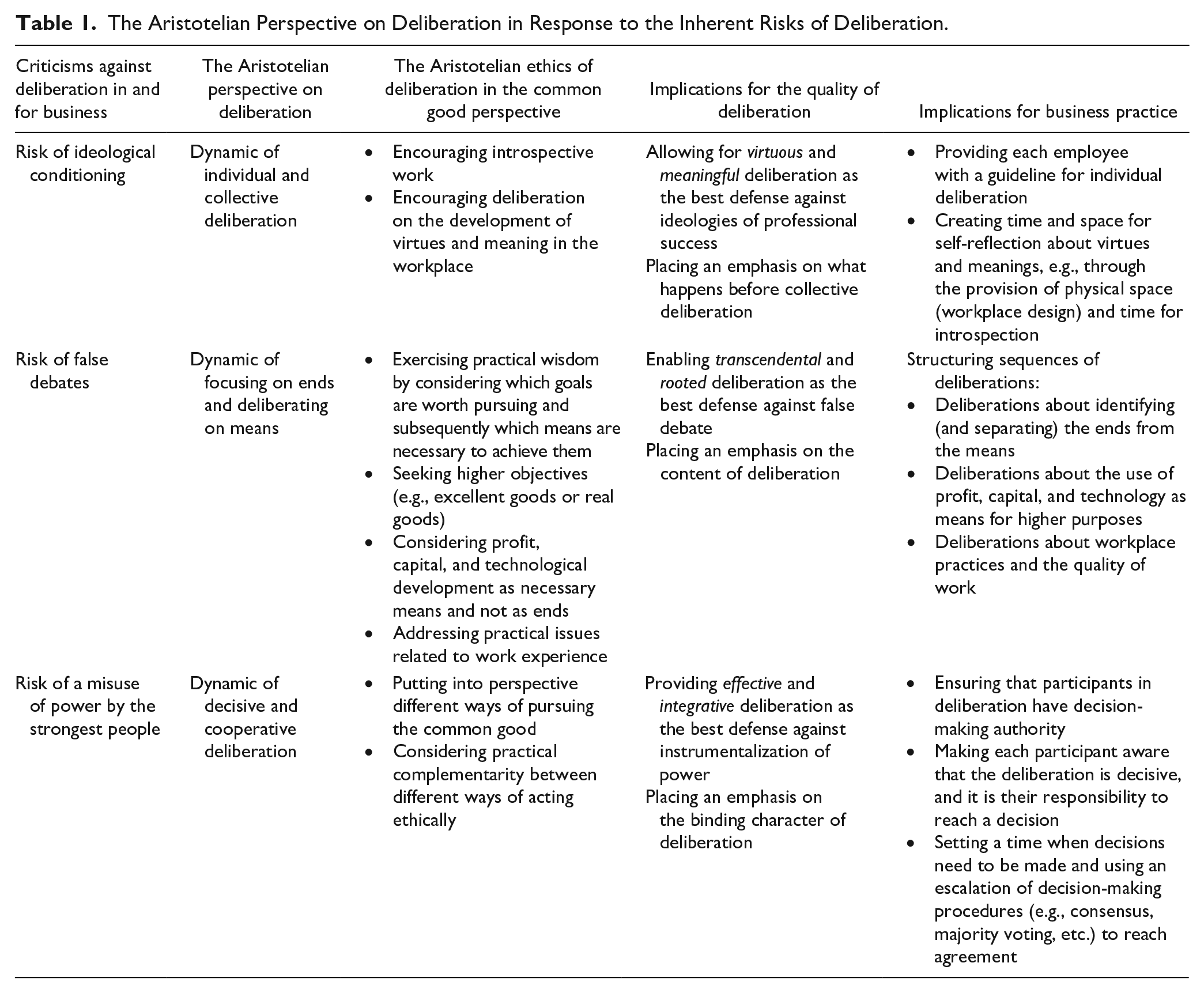
Therefore, thinking about deliberation in Aristotelian terms allows us to suggest a perspective of deliberation that addresses the criticisms mentioned above. Indeed, this perspective is based on (a) both individual and collective deliberation, fostering virtuous and meaningful discussions, and actions that resist ideological conditioning; (b) a deliberative desire addressing both ends and means, which, instead of false debates, encourages actual debates about transcendental objectives and the rooted experience of work; and (c) deliberation that is both decisive and cooperative, making possible an effective and integrative choice (i.e., one that is capable of combining different ways of participating in the common good).
Embracing an Aristotelian perspective allows us to develop a dynamic vision of deliberation by showing the different steps in the deliberative process: Reflection on higher objectives and the means to reach them may not be conceivable without an introspective individual deliberation, and decisive and cooperative deliberation may only be appropriate if the participants agree in advance on a quest for the common good and on transcendental objectives.
Table 1 summarizes the Aristotelian-based approach to deliberation. It also points out its relevance and implications for business practice, a discussion we will turn to in the following section.
The Aristotelian Perspective on Deliberation in Response to the Inherent Risks of Deliberation.
Implications for Business Practice
We have just observed that the Aristotelian perspective highlights the characteristics of deliberation, the stages in the deliberative process, and the power conferred to participants in deliberation. The Aristotelian approach therefore helps us to confront the following three questions that are crucial to business practice: First, which practices would facilitate an ethics of deliberation? Second, what would be helpful in implementing these practices? Third, who is to implement these practices?
What to Do: Reflecting on Conducive Practices
The Aristotelian-based common good perspective on deliberation enriches research on deliberation in business as it provides insights into what organizations can do to foster an ethics of deliberation that helps to protect against the risks of manipulation, artificialization, and instrumentalization of democratic debate. Moreover, it highlights neglected aspects in the debate about deliberative processes in that it puts the focus on what comes before collective deliberation, is concerned about the content to be deliberated, and places an emphasis on the binding character of deliberation.
First, to mitigate the risk of ideological manipulation related to the dissemination of neoliberalism that promotes the spirit of competition and the cult of professional success, organizations can pay attention to the possible development of virtues, to different meanings given to work, and to individual aspirations, giving their members the opportunity to express them. Thus, by encouraging individual deliberation, organizations assist members to prepare for collective deliberation that respects everyone’s perceptions and aspirations. In turn, collective deliberation can enrich individual’s viewpoints and lead to further individual deliberation.
Second, in order for deliberative mechanisms to promote serious and useful debates—not artificial, secondary, or sterile discussions—organizations can clarify higher objectives and create a “unity of end or purpose” (Sison & Fontrodona, 2012, p. 227) that makes a fruitful deliberation on the means that could be implemented possible, in particular on the use of profit, capital, and technology for higher purposes. Organizations can also make the quality of real work an object of deliberation for all and welcome different ways of achieving the objectives.
Third, organizations can fight against an instrumentalization of deliberation by the most powerful by putting in place decisive deliberation which, by definition, does not push the power of decision out of the realm of deliberation and does not reserve it for the most influential. Concretely, for businesses this means providing the structures that facilitate such deliberation: physical space; time for introspection and reflection; organization of meetings dedicated to organizational objectives and workplace practices; identification of issues on which decisions need to be made; and attention devoted to the different ways of doing good.
The Aristotelian responses to the difficulties inherent to deliberation can help to build deliberative capacity not only by providing the structures for authentic, consequential, and inclusive deliberation, identified as the quality criteria by deliberation scholars (Dryzek, 2009, 2010) but also, as we demonstrate in this article, by fostering virtuous, meaningful, transcendental, rooted, effective, and integrative deliberation. The interrelation between individual and collective deliberation increases virtue and meaning as it encourages deeper and more reflective contributions to collective deliberation from individuals who have first thought about their virtuous and meaningful reasons for taking a certain ethical viewpoint. It is also conducive to changing preferences through deliberation, as participants’ more reflective (and more personal) contributions are better able to convince others. Based on the Aristotelian approach to deliberation, we argue that the pursuit of higher societal, social, and environmental objectives promotes deliberation that is both transcendental and rooted because it helps employees to give meaning to their actual practice of work. Finally, encouraging decisive and cooperative deliberation is the best lever for the development of both effective and integrative discussions, as decision-oriented deliberation supports a broader and practical review of different ways to contribute to the common good.
How to Do It: A Simplified Guideline
The Aristotelian principle of decisive deliberation, focused on identifying the best means to achieve previously chosen ethical goals, can justify the introduction of a two-step protocol in deliberative forums, consisting of the following set of questions:
1) Which goals is the organization supposed to pursue? What are the higher, transcendent purposes for which the organization is supposed to exist? What are organizational expectations that are promoted as goals that, on reflection, turn out to be more like means? What are the most effective and virtuous means to achieve the goals? What are the means, other than the means promoted by the organization, that would allow the achievement of the goals? What are the different ways to achieve quality work to reach the objectives?
2) On which issues can the deliberation be made decisive? What are the different possible action plans that seek the common good? What approaches to the common good are mobilized in reaching these plans? Are these approaches compatible or contradictory? Can alternative actions be designed that would reconcile or combine these different approaches to the common good?
These questions can structure both individual and collective deliberation: Each of the participants, in fact, should have all the information they need for a certain period of time before collective deliberation to practice internal deliberation on these different questions.
To explain these implications in more detail, we will use a concrete example, illustrating how the Aristotelian perspective on deliberation can enrich business practices: An organization decides to engage in deliberation with its employees to define a new vision and strategic direction for the coming years. In order for such deliberation to avoid the pitfalls we outline above, an Aristotelian perspective suggests allowing and enabling employees to engage in individual deliberation, to reflect on the ends of organizing (i.e., the purpose of the business organization), and finally to make these deliberations decisive. Some aspects that might be envisioned to facilitate such deliberation are, first, giving each employee a guideline for how to engage in individual deliberation and formulate their own idea of the common good, posing questions like those we include above, for instance; second, structuring sequences of deliberations that comprise those about identifying (and separating) the ends from the means and those about the means, interspersed with spaces for individual reflection; and third, making deliberations decisive by making it clear to participants from the beginning that they are responsible for the outcome and will have to make a decision in the end. Decision-making in the end can be facilitated through various means (e.g., by setting a time when decisions need to be made and using an escalation of decision-making procedures that can start with aiming for consensus), and if that is not possible, majority voting or other means of reaching an agreement that would be acceptable to participants of the deliberation. A fourth step that might facilitate deliberation would be securing accountability for the implementation of decisions reached through these deliberations and, at the same time, allowing for ongoing deliberation about the progress and the achievements related to the new strategic direction, including the possibility of revising strategic objectives if they no longer seem feasible (Table 1).
Who to Do It: Dealing With the Questions of Power and Incentives
Overall, we propose that the Aristotelian perspective we outline carries with it implications for several actors with regard to ensuring the implementation of such deliberations. These actors are interlinked, and actions taken by one actor may influence and reflect back on other actors. In its ideal, it becomes a virtuous cycle in a literary sense, in that virtuous individuals help to create virtuous structures, which in turn, help make individuals more virtuous. This positive spiral would essentially be based on the joint exercise of the virtue of practical wisdom as a way of arbitrating between the possible choices to achieve the goal concerned in a virtuous way; it might also rely on auxiliary virtues to practical wisdom, including the spirit of concord, justice, and moderation. Of course, this process is not simple, needs time, and is subject to many contingencies. We believe that the concept of subsidiarity can help structure the discussion and provide relevant insights. Rooted in the Aristotelian concept of society being formed of hierarchically interlocking groups, subsidiarity is a principle that holds “that a central authority should have a subsidiary function, performing only those tasks which cannot be performed effectively at a more immediate or local level” (Oxford English Dictionary, 2021). It also implies that, if local coordination does not work, higher-level institutions should intervene. Following this logic, we will reflect first on the role of management, before turning to organizational stakeholders and government.
Management in business organizations is primarily responsible for the search of the structural means and practices to facilitate such deliberations. The practical usefulness for managers of our reflection lies in a double awareness. First, it allows managers to admit that democratization mechanisms based on deliberation are often artificial, sometimes even imaginary, for example, when they consist of keeping chairs empty in corporate meetings to symbolically represent the interests of customers and employees (Meisenzahl, 2021). Deliberation is factitious when the participants are invited to voice their opinions while being deprived of a clear and transcendental purpose or the capacity for decision-making. In addition, our reflection promotes an awareness of the possible benefits of certain spontaneous deliberations that do not distance discussions from the fundamental objectives of the corporation but focus on how to better accomplish them.
We add that the determination of managers to promote deliberation is largely linked to the ethical training they received during their education and professional development. The ethics of deliberation could for instance permeate what academics (Berti et al., 2021; De Los Reyes et al., 2017) call “experiential learning” in business ethics education, which would—for Aristotle—consist of getting into the habit of internal deliberation before speaking, of clarifying ends before identifying means, and of discussing to reach a decision. Based on Aristotle’s ethics of deliberation, business ethics cases would not be addressed by future managers with the sole objective of giving a good image, making money, or developing job satisfaction, and thus, participating in the “Professional Managerial Class” whose sham Liu (2021) denounces. Case studies could be opportunities for managers to reiterate experiences of individual and collective deliberation that allow them to participate in the common good.
Enlightened managers can become the custodians of good deliberation, as they can use their power to initiate and moderate deliberations and to make them decisive (Patzer et al., 2018). Indeed, the clarification of higher purposes by management is likely to help the various members of an organization to make useful and coherent choices and to renounce fruitless or superfluous tasks. Moreover, the power of decisive deliberation entrusted to certain members of the organization is likely to allow managers to share some of their responsibility without relinquishing their (positional) power. By seeking a “shared responsibility” and not exclusively a “disempowerment” that exonerates them, managers can retain legitimacy while avoiding isolation.
It is likely that this awareness (and even education) is not sufficient to convince managers who may refuse to put in place the conditions favorable to the deliberation that we have outlined. However, deliberation as defined in this article is not the sole responsibility of management. Given the capitalist system and the resulting incentive structure, relying on management alone would not be sufficient. Even if managers were fully convinced of the benefits of deliberation and concerned with fostering its development, their actions would remain subordinate to the actions of each member of the organization and, even more so, to the implementation of organizational, legal, and political principles.
Indeed, the Aristotelian perspective suggests that each individual has a responsibility to engage with deliberation in an ethical way. Enlightened stakeholders inside and outside the organization can make a difference in pushing management in the right direction by reminding it of the mission for which the organization exists. These individual actions can support collective actions. For instance, trade union participation can be a powerful way to foster dynamic deliberation at the floor and the top-management level to represent, learn about, and accommodate employees’ interests and aspirations (Dawkins, 2016; Harvey et al., 2017).
Deliberation as described in this article presupposes the respect and consideration of legal rules. As such, deliberation cannot ignore fundamental principles of law such as democratic principles, human rights, equal protection, and equal benefit of the law (Arbour, 2012). Inoculating good habits and virtues to agents, the law thus conceived in a positive way is part of the common good (Argandona, 1998; O’Brien, 2009), “but the common good is much more than the sum of all these partial goods” (Argandona, 1998, p. 1095). Thus, deliberation is embedded in a body of rules that includes not only the rights and obligations that emanate from legal authorities, but also a spontaneous order of norms whose dynamics are linked to a shared desire to seek the common good.
Deliberation also presupposes a political environment that is capable of implementing the principle of subsidiarity (Frémeaux, 2020; Melé, 2005; Sison & Fontrodona, 2012). According to this principle, states are not only capable of intervening to sanction or prohibit abusive behavior by employers that infringes the rights of employees or damages the environment but also capable of encouraging companies to take initiatives to respond to societal needs. We argue that governments can incentivize a business to adopt appropriate practices (e.g., by allowing for specific legal forms of organizing, like purpose-driven organizations; by encouraging businesses to experiment with liberating structures; by providing financial support for collective actions or for companies that have a strong societal utility). These regulatory incentives are not necessarily sufficient to transform the economic landscape and establish an ethics of deliberation. Other, more binding policy measures, could consist of imposing better representation of employees and greater consideration of social and ecological issues within governing bodies (possible corporate and labor law reforms could include: the creation of mixed governing bodies representing both capital and labor; an increase in the minimum number of labor representatives and other stakeholders in governing bodies; elected managers within these bodies and supervisory bodies being more representative of employees and other stakeholders).
When a political subsidiarity within the society is established, an organizational subsidiarity within companies, consisting of managers recognizing the deliberative skills of their employees with regard to certain operational issues, becomes possible. Managers can deliberate at their level of responsibility and allow their employees to deliberate in turn on certain issues that fall within their own levels of responsibility. Thus, deliberation may be easier to experience in subsidiarity-conscious organizations, in which the various participants share a higher common mission—expressed and respected—and have deliberative forums in which they can make decisions related to the work they perform.
Discussion
Our article responds to Felicetti’s (2018) criticism that research in management tends to be focused on deliberative interactions between firms rather than on the internal levers of deliberation. Based on Aristotelian ethics, we highlight internal practices of deliberation that are individual and collective, that pursue higher and more transcendental objectives while relating to the different ways of working, and that identify the decision to be made by taking into account the different ways of achieving the common good. Indeed, these practices of deliberation constitute prerequisites for the development of collective deliberation in and for business. As such, we contribute to the discussion on deliberation not only in business but also in organizations more generally (Sabadoz & Singer, 2017; Scherer et al., 2016; Stansbury, 2009).
We take the example of the new working conditions created by the Covid-19 health crisis to illustrate our contribution because they are, on the one hand, proving to be an aggravating factor for the pathologies of deliberation; on the other hand, they present an opportunity to overcome them. Concerning the first limitation we identified, the prevalence of working from home, resulting from the Covid-19 pandemic, is increasing the risks of ideological conditioning and the risk of considering human interchangeability as possible or even inevitable (Husain, 2021). To reduce the time spent in front of screens and the feeling of increased tension between their professional and personal life, employees may indeed be tempted to focus on productivity and privilege the most objective tasks for the sole purpose of performance and success, with that motivation dominating their engagement in deliberation (Hoff, 2021; Nguyen, 2021; Organisation for Economic Co-operation and Development [OECD], 2020). In response to this risk, a push toward individual and collective deliberation could help employees consider which tasks they genuinely hope to accomplish and raise those ambitions in collective discussions. By taking the time to do this introspective work, employees can avoid the trap of excessive objectivization of their work. From this point of view, working from home could then become an opportunity for distancing oneself from purely mechanical tasks and for rethinking critical aspects of one’s work (for the dangers of not engaging employees in more substantial reflection and meaningful work, see the discussion of employees stealthily taking on two full-time remote jobs due to the reduction of work to repetitive operations in Feintzeig, 2021).
Concerning the second pathology of deliberation, which relates to deliberation being co-opted by individuals to discuss problems disconnected from the main (or real) activity of the organization (e.g., discussing interpersonal relationships at work or micro-managing technical tasks), the spread of remote work during the Covid-19 pandemic has accentuated the emphasis on technical constraints and solutions. Also, working from home affects concentration (Manavis, 2020), interferes with one’s personal life (Hennekam & Shymko, 2020), and makes collaboration more difficult (Nguyen, 2021), leading employees to forget, or at least neglect, the mission, values, or broader purpose pursued by the organization (Spicer, 2020). In response to this risk, deliberation about ends and means helps to avoid the excessive focus on technical tasks, which can only be instruments in the service of higher purposes. Rather than exhausting employees’ motivation in debates that concentrate exclusively on technical aspects, management could use deliberation to discuss how small tasks and the use of specific tools or technology link to the bigger picture.
As for the third limitation, the excessive power exercised by a few individuals, who use deliberation as a facade to legitimize their own decisions, the physical and relational distancing induced by the pandemic may lead such individuals to avoid open debates and to conduct surveys among their employees, designed to justify decisions already made or in the process of being made. In response to this risk of disconnection between deliberation and decision, having deliberative structures in place that are both decisive and cooperative can help to prevent the circumvention of debate and be a means of encouraging the various members of an organization to make choices that are more in line with their values and the societal needs identified at their level of responsibility. Rather than limiting the voice of employees within the restrictive framework of surveys, our approach invites them to experience collective decisions to improve the quality of their work, which will also allow managers to share a part of their responsibility.
Apart from the general contribution to deliberation in business, our article also informs theories on political CSR (Frynas & Stephens, 2015; Matten & Crane, 2005; Scherer et al., 2016; Scherer & Palazzo, 2007). The interconnection between individual and collective deliberation, between a focus on ends and the appropriate means, and between decisive and cooperative deliberation in business proposed in this article can be extended to deliberation with business (e.g., on global governance issues in Rasche, 2012). The focus therefore shifts to the dialectic between company internal reflection and external deliberation with stakeholders. As such, it could be a way to engage with the challenges that have been identified for a political CSR 2.0 (Scherer et al., 2016), especially those related to the sociopolitical context. Among these are the polarization of society toward nationalistic and fundamentalist ideologies and the weakening of democratic institutions and civic liberties. These developments aggravate the risks of deliberation that we have discussed (those of ideological conditioning, false debates, and instrumentalization by the powerful; Dryzek, 2009). Deliberation within companies before engaging in collective deliberation in multistakeholder initiatives could lead to more informed business attitudes toward aspirations for the common good. Meanwhile, the questioning of ends could, for instance, encourage an ethical debate on values and fundamental principles in global governance discussions. We would again refer to the principle of subsidiarity to facilitate such deliberation; governmental agencies or international organizations can encourage the orchestration of deliberation when business firms and their stakeholders are not able or willing to deliberate. Future research could investigate the relation between soft- and hard-law, the role of international agreements (e.g., on human rights), or the associated power dynamics and how those dynamics foster or hinder attempts to introduce an ethics of deliberation.
These recommendations, based on the Aristotelian perspective of deliberation, can also contribute to a more general reflection on deliberative democracy in the political sphere (Bohmann & Rehg, 1997; Curato et al., 2017; Dryzek, 2009, 2010). Democratic political deliberations are not only based on the recognition of rights of expression or argumentation but also imply time and space dedicated to reflection on one’s own moral responsibility, which could be consolidated by one’s efforts to be better informed, to question oneself about one’s own aspirations and opinions, to pursue higher objectives beyond personal interests, and to welcome different visions of the common good for decision-making purposes. The question arises as to whether instances of deliberative democracy concerned with implementing the principles of deliberation highlighted in this study—both individual and collective deliberation, a focus on both ends and means, and decisive and cooperative deliberation—would be better able to overcome health, economic, social, and environmental difficulties and to make decisions for the common good. In light of the Covid-19 pandemic: Individual deliberation could infuse public deliberation with better considered viewpoints and arguments about what we as individuals and as society value; a clear focus on the ends could help to prioritize and direct limited resources; and deliberation that is decisive and cooperative could direct attention to practical solutions that at the same time take into account various viewpoints of the common good.
Therefore, in this common good perspective, deliberation is no longer solely understood as “debate and discussion aimed at producing reasonable, well-informed opinions” (Chambers, 2003, p. 309), but rather as a form of practical reasoning, the purpose of which is not so much to persuade others through debate, but rather to prepare for action. In many ways, this approach is in line with the concept of deliberation derived from Habermas’s philosophy. In particular, it shares its concern for truth, sincerity, and inclusiveness, the search for a result, and exposure to the confrontation of opinions. However, it responds to the particular difficulties of deliberation in modern organizational forms by inviting everyone—speakers, listeners, and all stakeholders—to experience an inner conversation, to rely on practical wisdom, and to welcome different perceptions of the common good. The complementary aspects between the Aristotelian ethics of deliberation and the Habermasian ethics lie in the fact that deliberation is considered to be more than collective exchanges between individuals: It is both an intimate reflection and a decision-making process. Although common good thinking is sometimes misunderstood as idealistic or excessively demanding, we argue that the Aristotelian perspective is particularly realistic and effective because it respects everyone’s skills and perspectives while encouraging decisive deliberation. We do not advocate an ethics of deliberation based on a substantive and unique concept of the common good, but we argue that it is possible to adopt a practical approach that integrates individuals’ personal experiences (the lessons of life), that respects the hierarchy of ends and means, and that includes the multiplicity of interpretations of the common good.
The approach we propose is not without limitations. There is a risk that the development of deliberation within organizations could trigger a flood of good intentions exclusively based on emotions, the construction of purely intellectual ideas, or the proliferation of arguments based solely on instrumental reason, which would then be disconnected from reality of work. Yet, prior individual deliberation, the distinction between the higher purpose—the excellence of the goods pursued—and the means, and the attention paid to human plurality and the diversity of ethical opinions, could encourage an attitude that is not only emotional, intellectual, or rational, but also practical. Collective deliberation within organizations could then provide space in which employees pay attention to their own and others’ aspirations, to the needs of society and the ways in which employees can contribute to them, and to the resulting differences, complementarities, and synergies among the ways of doing good, with a view to answering a question and making a concrete decision.
Certainly, the pursuit of the common good may not be shared by all and Aristotelian deliberation may not be possible in an environment in which individuals do not seek to flourish by becoming virtuous. We therefore emphasize that the qualities of the deliberation outlined in this article—virtuous, meaningful, transcendental, rooted, effective, and integrative deliberation—should be encouraged by corporate governance, whose essential function is to exercise virtuous authority (Arjoon, 2012; that is, “to assure the unity of action of a plurality of [people] in the pursuit of their common good,” Simon, 2011, p. 51). Deliberation in the Aristotelian sense is certainly easier to implement in small-sized organizations. Not only is the compartmentalization of tasks less pronounced, allowing for a better mutual understanding of the work done, but it may also be easier to develop a spirit of concord. However, our approach highlights that within large organizations, and in accordance with the subsidiarity principle, spontaneous communities can emerge. These communities might be even more adept at deliberation because they are both small and open to others.
From this perspective, and with the principle of subsidiarity in mind, future empirical studies could build on this approach to deliberation to examine under which conditions individual and collective deliberation, deliberation on ends and on means, and decisive and cooperative deliberation could effectively promote a stronger ethics of deliberation and foster business sustainability. Our approach was purposefully broad to highlight the benefits of Aristotelian deliberation and to discuss its potential to inform practices in organizations. This provides ample future research opportunities to investigate specific practices (e.g., individual deliberation) and the dynamic interplay between those (e.g., between individual and collective deliberation). While we pointed out relevant aspects, future research might shed further light on the conditions that enable and hinder Aristotelian deliberation and investigate the influence of the context in which deliberation takes place.
Conclusion
In the context of organizations, deliberation is challenging because of the profit-generating logic and associated ideologies that prevail in business. Thus, while deliberation can be a powerful means to foster good business practices, there is a danger that deliberation could be co-opted to foster personal interests. However, if those with authority have sincere intentions to pursue the common good and to facilitate a truly power-free discourse about relevant organizational, social, and environmental topics, deliberation might prove to be a powerful means to address wider sustainability challenges and make business more ethical. Aristotelian ethics can be a strong practical and realistic complement that could guide those who wish to exercise virtuous authority. If we can infuse managers with virtuous thinking and encourage individual and collective deliberation—for instance, through business-school education or public debate—it could provide a way to navigate the paradox of deliberation toward more ethical business.
Footnotes
Declaration of Conflicting Interests
The authors declared no potential conflicts of interest with respect to the research, authorship, and/or publication of this article.
Funding
The authors received no financial support for the research, authorship, and/or publication of this article.
