



Abstract
External regulatory and normative pressures from both the Chinese central environmental protection inspection (CEPI) program and public participation can act together to influence corporate environmental governance behavior. This research uses the multiperiod Difference-In-Differences method to test the compound impact of CEPI and public participation on corporate environmental governance strategies and investigate the underlying influence mechanisms. The results show that CEPI and public participation have a positive compound effect on the corporate “source-control” strategy. A reasonable reduction in pollution charges and increased environmental subsidies are essential to stimulate the green innovation potential of heavily polluting firms. Our research helps clarify the game relationship between the central and the local governments and analyzes how the relationship between the government, the public, and corporates affects environmental governance, thereby advancing principal-agent theory and expanding the current research on institutional pressures and corporate environmental governance.
Keywords
Increasingly serious corporate pollution issues, such as releasing toxic substances and emissions that exacerbate global warming, have attracted widespread attention from the government and the public (Berrone et al., 2013). Various measures taken by governments worldwide are seen as effective measures to address adverse environmental consequences, such as formulating strict environmental regulations (Chang, 2011), setting mandatory emission reduction targets (Gao, 2009; Tang et al., 2016), and adjusting industrial policies (Berrone et al., 2013; Flammer et al., 2019). China is an authoritarian state that enforces environmental policies formulated by the central government; thus, its environmental governance differs from that of other countries. However, the widespread principal-agent problems between the central government and the local governments significantly affect the implementation of the central development concept and environmental policies in local areas (Beyer, 2006; B. Zhang & Cao, 2015). As with other principal-agent problems, gathering information on the environmental governance performance of local governments, including bottom-up public opinion gathering and top-down administrative gathering, is crucial for oversight by the central government. These two channels can exert formal and informal institutional pressure on corporates, respectively. However, it remains unclear whether the two different forms of institutional pressure can effectively synergize and how they will affect corporate environmental behavior.
The two critical channels through which the central government collects local information can ensure smooth information flow (Anderson et al., 2019) and encourage firms to adopt specific environmental governance strategies by putting formal institutional pressure on them (Chen & Xu, 2017; B. Zhang et al., 2018). The central environmental protection inspection (CEPI) program has become an important channel for the central government to collect local environmental governance information from top to bottom in recent years (Li et al., 2020; H. Wang et al., 2021), while public participation in environmental protection is a typical channel for bottom-up information collection. Beginning with a pilot inspection in Hebei Province in early 2016, the Chinese Communist Party Central Committee and the State Council launched the CEPI by successively dispatching inspection teams led by high-ranking central officials to the province to inspect the local environmental governance conditions (Jia & Chen, 2019). Most studies on CEPI only considered the direct policy impact on microfirms, such as promoting pollutant emission reduction, improving performance through innovative compensation mechanisms, and improving environmental information disclosure (Kostka & Goron, 2021; Tan & Mao, 2021; Tian et al., 2019). In fact, the CEPI inspection team also has in-depth interactions with the public, including public participation and supervision in the inspection process. However, few studies have considered the pressure on firms and local governments resulting from the interaction between CEPI and public participation.
Public participation, as an informal institution, imposes normative pressure on corporates via environmental activism or the filing of citizen lawsuits (X. Liu et al., 2010). Existing research on the advantages of public participation mainly focuses on the macro-levels, such as reducing pollutant emissions of which the public has a strong intuitive perception, promoting environmental policy formulation, and slowing the deterioration of overall environmental quality (Clark, 1995; Devas & Grant, 2003). Moreover, previous studies have pointed out that public participation affects corporates by exerting direct pressure on them, supervising the government and improving its governance efficiency, and acting as supplementary policy tools for informal environmental regulation. However, most previous studies have examined the impact of a single type of institutional pressure, namely, regulatory or normative pressure, on corporate environmental governance (Berrone et al., 2013; Daddi et al., 2016; Lin, 2019; Walker, 2012). The lack of consideration of the institutional pressure generated by the joint model of the government and the public ignores the important role of multi-party collaborative governance in environmental governance. To fill this gap, we examine the effects and mechanisms of the interaction of formal and informal institutional pressures, namely, the interaction of CEPI and public participation, on corporate environmental governance strategies.
The highly polluting production methods of heavily polluting firms make them the monitoring focus of the public and CEPI. Their environmental governance strategies reflect local governments’ efforts in regulating and rectifying local environmental conditions. Therefore, we select heavily polluting firms as the primary research object and divide their environmental governance strategies into “end-treatment” and “source-control” strategies according to the governance effect. Drawing on insights from principal-agent theory and institutional theory, we argue that the interaction of regulatory pressure (from CEPI) and normative pressure (from the public) has a positive compound effect on corporate environmental governance strategies. We test our arguments using longitudinal data (2013–2018) on listed firms from heavily polluting industries in China. Overall, the results support our contentions. The interactive effect of CEPI and public participation prompts corporates to adopt “source-control” strategies. The pressure of public participation leads firms to adopt “source-control” strategies by reducing government penalties, whereas the compound effect encourages firms by increasing government guidance. Further analysis shows that firms with state-owned property rights, those in the eastern region, and those in the region whose local governments have more financial resources are more inclined to adopt “source-control” strategies.
Our study makes the following contributions. First, our work extends research on central government regulation and public participation (Knox & Janenova, 2018; Konisky & Teodoro, 2016). While previous studies have explored how CEPI improves environmental quality or the advantages of public participation in environmental governance, we focus on their interactive effects on corporate environmental behavior. We argue that firms are more inclined to choose “source-control” strategies. In addition, by deconstructing several different subjects in the environmental governance system (i.e., the central government, local governments, the public, and firms) based on theoretical analysis of the agency problems between the central and local governments, we identify the inherent transmission mechanism of local government behavior between public participation, central environmental policy, and corporate environmental governance. Our results demonstrate that the key to solving environmental pollution problems is to develop an environmental governance system designed and operated by the government, the public, and firms. This research identifies the internal mechanism and root cause of poor local environmental governance, which has not been addressed in the literature to date.
Second, our work expands the growing literature on the influencing factors of corporate environmental governance strategies. Although works in this field study the role of environmental regulation (Farzin & Kort, 2000; Ge et al., 2020; M. Liu et al., 2017), firms’ choice tendency among different strategies has received little attention. Yet, we know from several corporate environmental behavior studies that firms would take different measures to deal with different external pressures (Rugman & Verbeke, 1998; H. Wang et al., 2021), and these measures can be divided into reactive and proactive environmental strategies (Stadtler & Lin, 2017; Sun et al., 2019; Yang et al., 2018). The strategies are mainly divided from the perspective of pollutant generation and removal. However, the final pollution control effect of corporates may be affected by objective factors such as corporate output, energy utilization efficiency, and the specific effects of waste treatment facilities; this causes the measurement of corporate environmental governance behavior to be biased. Therefore, we divide the corporate environmental governance strategies into “source-control” and “end-treatment” strategies from the perspective of pollution control investment. Unlike existing literature that only considered a single environmental governance strategy, we focus on the firms’ strategy choices for different types and levels of external pressure.
Background
The role of institutional pressure in corporate environmental governance practice has been extensively discussed in the extant literature, particularly concerning the regulatory and normative pressures that drive firms to implement voluntary environmental governance strategies (Darnall et al., 2010; Delmas & Toffel, 2004; Q. Zhu et al., 2013). Several scholars have investigated regulatory pressures from formal institutions as drivers for firms to adopt environmental strategies (Daddi et al., 2014; Dean & Brown, 1995). Empirical evidence suggests that regulatory pressures come from government mandates (Bruton et al., 2010). Government legislation and enforcement actions are also considered some of the most critical factors influencing corporate environmental decisions (Henriques & Sadorsky, 1996). Government influence manifests itself in various ways, including signaling desired behaviors (Marquis & Qian, 2014) and the enforcement of regulations (Delmas & Montes-Sancho, 2011; Russo, 1992). The government can send clear messages to encourage firms to take positive environmental actions by offering some incentives or announcing in advance the mandatory environmental requirements for the next phase (X. Liu et al., 2010). Berrone and colleagues (2013) argued that government regulatory pressure usually comes from the implementation of standards and regulations rather than the standards and regulations themselves. CEPI, as a policy enacted to supervise the strength and efficiency of the enforcement of environmental standards and regulations by local governments, imposes strict regulatory pressure on corporates while strengthening the intensity of government enforcement.
Other scholars have turned their research attention to the influence of normative pressures from informal institutions on corporates’ positive environmental protection activities (Hyatt & Berente, 2017; Walker, 2012). Normative pressures mainly include values and norms, which are similar to social morality or normative expectations, from the public and other professional organizations. Public participation imposes normative pressure on corporates via environmental activism or the filing of citizen lawsuits (X. Liu et al., 2010). Environmental nongovernmental organizations (ENGOs) play a key role in implementing environmental standards and norms. Numerous studies have shown that although ENGOs are external stakeholders and not necessarily part of a formal channel, they can influence corporate environmental decisions (King, 2008; Weber et al., 2009). In addition, ENGOs play a supportive role in the environmental governance process of the government (R. Wang et al., 2018) and reduce pressure on the government by educating civil society on environmental issues (Brooker et al., 2019; Spires, 2011). Therefore, normative pressure is an important institutional pressure that drives corporate environmental governance strategies, similar to regulatory pressure. Although these previous studies have fully demonstrated the driving role of regulatory or normative pressure in corporate environmental governance, they treated their influence on corporate environmental practice as monolithic, consisting of an independent and consistent set of expectations (Berrone et al., 2013; Daddi et al., 2016; Lin, 2019; Walker, 2012), without considering the forces that can arise from the combination of the two pressures.
External regulatory and normative pressures can evoke corporate heterogeneity in environmental governance strategies (Hyatt & Berente, 2017; van Halderen et al., 2016; Wolf, 2013). Existing research has divided these strategies according to their different responses. Despite having different names, corporate environmental governance strategies can be divided into reactive (pollution control or compliance) and proactive (pollution prevention or voluntary) strategies (Stadtler & Lin, 2017; Sun et al., 2019; Yang et al., 2018). Reactive environmental strategies refer to the use of terminal pollution control methods in response to government regulations or stakeholder pressure (Aragón-Correa & Sharma, 2003; Buysse & Verbeke, 2003). Proactive environmental strategies aim first to change processes or products to avoid pollution and achieve sustainable development (Lin, 2012). Regarding the measurement of the two strategies, some studies consider the pollutant emissions of corporates; for example, M. Liu et al. (2018) broadly divide the strategies into two categories, namely, “end-of-pipe” and “changes in process” strategies. “End-of-pipe” refers to technologies used at the end of the production process that aim to reduce the amount of pollution released into the environment by removing the pollutants that have already been generated, such as reducing SO2 emissions by installing flue gas desulfurization equipment. “Changes in process” refers to technologies used in the production process that aim to reduce the amount of pollution generated by replacing production equipment, such as installing more efficient boilers. Other scholars have conducted measurements in terms of corporate capital investment, using the total expenditure of firms on environmental governance to measure reactive environmental strategies and using total research and development (R&D) investment as a proxy variable for proactive environmental strategies (Yang et al., 2018). The distinction between reactive and proactive environmental strategies has become an established model for empirical research on corporate environmental management and sustainable development (Aragón-Correa & Sharma, 2003; Menguc et al., 2010; Stadtler & Lin, 2017).
Therefore, we divide corporate environmental governance strategies into “end-treatment” and “source-control” strategies according to different governance effects. “End-treatment” strategies are those environmental protection measures that firms can implement quickly in response to external pressure. Firms invest funds to purchase environmental protection facilities and improve environmental protection technology and systems. These measures have short-term effects (Clarkson et al., 2004). On the contrary, “source-control” strategies reflect the long-term environmental governance stimulated by environmental pressure and violation risk. Green innovation conveys that firms actively comply with environmental regulations and meet green needs (Berrone et al., 2013), facilitating access to key resources for growth. Therefore, “source-control” strategies help firms achieve long-term governance. Different from Yang and colleagues’ (2018) method of using the total R&D investment, we use the number of green patents to represent the “source-control” strategies. It is difficult for the total R&D investment to accurately reflect the investment in environmental governance and the actual pollution prevention effect. In contrast, the number of green patents reflects the R&D output of the corporate (i.e., the output of the portion of the capital investment actually used for pollution prevention and control).
Conceptual Framework and Hypothesis Development
Institutional Pressure From the Government and the Public
Policymakers and implementers of national environmental policies are often separate entities. Decision-makers are often obsessed with principal-agent relationships, which makes it difficult to fully understand the implementation of policies (Malesky et al., 2014; Teets, 2018), resulting in “government-firm collusion” and local environmental governance failures. The extensive principal-agent relationships between the central and the local governments may result in two types of problems, namely, adverse selection and moral hazard, thus causing incomplete implementation of environmental policies and hindering the improvement of the local environment. Specifically, local governments deliberately conceal local governance and performance information, which exacerbates the difficulty in obtaining information and the degree of information asymmetry for the central government (H. Jin et al., 2005). Local governments may deliberately bypass central regulations and do nothing to shelter local polluting enterprises for their performance claims (B. Zhang & Cao, 2015). When profitable firms exhibit environmentally damaging behaviors, local governments often avoid measures to achieve environmental compliance at the expense of local employment and tax revenue (Morduch & Sicular, 2002; Shi & Zhang, 2006).
Second, local governments may exploit their information advantages and dominance to take actions that deliberately violate the requirements of the central government and the public, tending to “cut corners” in formalism in environmental governance (Dimitrov, 2015; Lorentzen, 2013). The implementation of environmental policies is often reduced to a tool that benefits local employment, increases fiscal revenue, and promotes the career development of local officials (Qi et al., 2008; Zheng et al., 2015). Therefore, to avoid the self-interested behavior of local governments and realize the effectiveness of environmental governance, the central government must overcome information asymmetry and fully collect relevant information, including the implementation of local government policies and the actual situation of pollution by local corporates, thereby effectively supervising local environmental governance activities (Chen & Xu, 2017). It is generally believed that top-down administrative information collection and bottom-up public opinion collection are considered the two typical channels by which the central government collects information.
CEPI is an important top-down channel for the central government to collect information on local environmental governance, while bottom-up information collection relies mainly on public participation (Li et al., 2020; M. Wang, 2021). In fact, both channels can exert external institutional pressure on polluting firms. According to institutional theory, institutions can restrict and influence organizational behavior. Institutional pressure can be divided into regulatory pressure, normative pressure, and imitation pressure (Scott, 2005), all of which affect corporates’ management decisions and practices (DiMaggio & Powell, 1983). In terms of environmental management, most studies agree that regulatory and normative pressures are critical for firms (Brammer et al., 2012; Colwell & Joshi, 2013; Kassinis & Vafeas, 2006). Regulatory pressure mainly comes from government constraints and regulations (i.e., most formal institutions; Bruton et al., 2010). This pressure usually comes from implementing the standards and regulations rather than the standards and regulations themselves (Berrone et al., 2013). For example, CEPI inspects the implementation and effectiveness of local environmental standards and regulations, thereby exerting regulatory pressure on local governments and firms. Normative pressure comes from the supervision of the public (i.e., informal institutional pressure). Firms need to maintain contact with the public when conducting business, and the public can define the appropriate standards, norms, and behaviors for firms (Roxas & Coetzer, 2012). To seek and maintain legitimacy, firms consciously compare themselves with the demands of society and do their best to operate following common standards, norms, and societal expectations in the institutional realm (Berrone et al., 2013; Hyatt & Berente, 2017).
All in all, these two information collection channels constitute the information base of the central government in supervising and motivating local governments and simultaneously exert formal regulatory pressure and informal normative pressure on corporate environmental governance.
Top-Down CEPI, Bottom-Up Public Participation, and Corporate Environmental Strategies
CEPI and public participation are typical of formal and informal institutions, respectively, and their interaction provides us with a good scenario for combining formal and informal institutions. CEPI is an essential top-down approach for the central government to gather information on local environmental governance (Li et al., 2020; M. Wang, 2021). Comprehensive and special inspections have significantly increased the level of disclosure of environmental information in various regions and have extensively mobilized public participation. The inspection teams have implemented a 24-hour reporting hotline and post office boxes in different regions using Weibo and WeChat. The inspection teams also require local governments to rectify problems, deal with public opinion in each case (Jia & Chen, 2019), and publish the information in the inspection column of newspapers, TV stations, and government websites. These practices have substantially increased the disclosure level of environmental information by local governments. For local polluting firms, the regulatory pressure of CEPI can affect corporate environmental governance practices through penalties and incentives (DiMaggio & Powell, 1983). Under the penalty mechanism, each firm unconditionally complies with environmental standards and regulations (Berrone et al., 2013; Deephouse, 1996). Given the superior powers of the government, failure to comply with regulations can lead to high costs for firms. Under the incentive system, by complying with standards and regulations, firms have the opportunity to obtain multiple incentives, such as subsidies, tax breaks and access to scarce, and necessary resources (DiMaggio & Powell, 1983). Therefore, firms are leaning toward active environmental governance strategies given the threats and opportunities of regulatory pressure.
An important source of information for CEPI is the petitions and reports of the public. Public participation enables the inspection team to quickly understand the details that are difficult to grasp through regular surveys and fully understand the local governments’ environmental governance efforts. Therefore, bottom-up information gathering primarily relies on environmental public participation, including two types of individual and organized. Most existing studies show that organized public participation improves the effectiveness and sustainability of environmental governance. For instance, Wu and colleagues (2020) found that the participation of ENGOs resulted in better environmental quality than individual participation. The reason is that public participation requires a matching institutional environment (Ho, 2001), and individuals require sufficient organizational power (Meligrana et al., 2011). Specifically, organized public participation in environmental governance has the following advantages:
First, organized public participation utilizes natural advantages and motivation to report firms and create public opinion pressure, forcing firms to attach importance to environmental protection during production and operation (González & Pazó, 2008). It is essential for firms to maintain contact with the public when conducting business. The normative pressure from the public has formed standards, norms, and behaviors in the business process of firms (Roxas & Coetzer, 2012). If firms do not comply with these environmental standards and norms, succumb to normative pressures, or implement environmental governance strategies, they will be subject to boycotts, isolation, and social protest. Instead, compliance with standards and norms brings a good reputation to the firms and increases the probability of their long-term survival and profitability (Colwell & Joshi, 2013).
Second, organized public participation promotes the disclosure of government environmental information, thereby effectively supervising “government-firm collusion” and forcing local governments to increase the environmental regulations of firms and increase environmental information disclosure within their jurisdictions. An example is the report of the Pollution Information Transparency Index published by the Institute of Public and Environmental Affairs (IPE). For many years, the IPE has promoted environmental governance in China through information disclosure. It incorporates public opinion into environmental supervision to promote environmental information disclosure and improve environmental governance mechanisms (Anderson et al., 2019).
Third, as an informal form of environmental regulation, organized public participation is a useful complement to formal environmental regulation such as government policy tools (Fu & Geng, 2019; Morgan, 2012). Public participation can facilitate local implementation of environmental governance policies by the central government, especially in developing countries where formal environmental regulation is generally less effective (Blackman, 2010). In addition, CEPI encourages grassroots governments to respond positively to the environmental demands of the public (Li et al., 2020) and ensures proper channels for public participation in environmental governance and fairness of their participation in the process (M. Wang, 2021). These actions promote public participation and indirectly encourage firms to minimize pollution. Some scholars have pointed out that the incentive effect of CEPI on public participation is the result of three interactive strengthening mechanisms, namely, political mobilization, the demonstration of national regulatory capacity, and social learning. The top-down inspections consistently encourage public participation in bottom-up supervision. Instead of ending after previous inspections (Tian et al., 2016), this incentive effect may remove institutional barriers and ensure that public participation becomes a long-term environmental governance mechanism, thus affecting government and corporate environmental governance strategies (Jia & Chen, 2019).
In general, top-down CEPI and bottom-up public participation exert external institutional pressures on corporates, namely, regulatory and normative pressure. The two institutions can promote and complement each other in environmental practice and act together to influence corporate environmental governance behavior. The compound external pressure forces firms to increase their environmental protection initiative and adopt environmental governance strategies such as green innovation or increasing environmental protection investment to avoid the adverse impact of pollution incidents on their social reputation. Based on this analysis, the following is hypothesized:
Research Design
Sample and Data
The unique model of environmental decentralization, the complex organizational structure of the government, and the multilevel administrative hierarchy in China provide a good setting for our research (Chang & Wu, 2014; Child et al., 2007; Luo et al., 2017). We choose the IPE, an ENGO, and CEPI to start our research. They provide a rare opportunity to weigh and supplement the current theoretical and empirical literature. First, the similarities between ENGOs and the CEPI are that they encourage local governments to disclose environmental information, exert pressure on polluting firms, and promote the interaction of public participation and central government oversight. Therefore, we identify corporate environmental governance strategies under the dual pressure of public supervision and CEPI from a policy perspective. Second, ENGOs and CEPI represent different environmental participants (i.e., the public and the central government; L. Liu et al., 2012), which helps to deconstruct different subjects in the environmental governance system. This setting allows us to examine the specific mechanism of government behavior from two aspects: government penalties and government guidance.
Specifically, we construct our sample of Chinese listed heavily polluting firms from 2013 to 2018 with various data sources. The industry distribution and detailed information of the heavily polluting sample firms are reported in Table A1 in the appendix. To measure corporate environmental governance strategies, we use data from the China Stock Market and Accounting Research (CSMAR) database and the Chinese Research Data Services (CNRDS), which provide detailed information on green patents and environmental investment. The CEPI information comes from the “Central Environmental Protection Inspection” column published on the Ministry of Ecology and Environment of the People’s Republic of China website. The public participation data are retrieved from the report of the Pollution Information Transparency Index issued jointly by the IPE. We also obtain relevant data from the CSMAR database, “China Environmental Statistical Yearbook,” and “China City Statistical Yearbook.” As the second round of CEPI started in September 2019, we set the year 2018 as the ending point of the sample interval. After a routine screening process for deleting missing data, financial and insurance firms, and delisting firms in our sample interval, we obtain a preliminary sample containing 1,505 firm-year observations.
Variable
Corporate environmental governance strategies
We divide the corporate environmental governance strategies into “end-treatment” and “source-control” strategies according to different governance effects. What needs to be explained is that the two are not opposites but rather can be used together by firms. We select the firm’s environmental investment scale Invest as the proxy variable of the corporate “end-treatment” strategy. We also include the greening and emission costs in the “management cost” category of the heavily polluting firm’s profit statement. The average total assets are used to standardize this variable. In addition, we manually filter the environmental protection investment data and exclude items related to corporate green R&D investment, such as “new low-carbon products and new technology R&D expenditures,” “technological research and development,” and “energy savings and consumption reduction R&D investment.” Therefore, our environmental investment data can accurately capture the corporate “end-treatment” strategy. We then select green innovation (Green) as the proxy variable of the corporate “source-control” strategy and use the natural logarithm after adding 1 to the number of green patent applications.
Public participation and CEPI
Public participation is measured by the city group dummy variable Public Participation (Pub) of the report of the Pollution Information Transparency Index published by the IPE every year. Pub equals 1 for firms located in the IPE reporting target city and 0 otherwise. The report evaluation indicators include four categories: environmental regulatory information, interactive response information, corporate emissions data information, and environmental impact assessment information. The focus of IPE on environmental governance and information disclosure in different cities represents the power of public participation, which encourages local governments to disclose pollution information affecting firms. It is expected that public participation can force governments to improve the local environment and put pressure on firms. Therefore, following H. Zhang et al. (2022), we use the report of the Pollution Information Transparency Index as an exogenous shock to examine the impact of public participation represented by ENGOs on corporates.
The central environmental protection inspection program started with a pilot inspection in Hebei Province in January 2016, and the first round of the CEPI officially started in July of the same year. Four batches of inspection teams were stationed in the provinces to perform inspection work (as shown in Table A2 in the appendix). As we consider annual corporate environmental strategies, we regard the pilot, first, and second batches of the CEPI as CEPI Phase 1 (2016) and the third and fourth batches as CEPI Phase 2 (2017). We use PostCEPI, a dummy variable that equals 1 for firm-year observations in the years after the city where a firm is located is inspected by the CEPI team, and 0 otherwise.
Control variables
To isolate the effects of the explained variables on the corporate environmental governance strategies, we control for firms’ characteristics and regional characteristics that were considered essential determinants of green innovation by previous studies (Amore & Bennedsen, 2016; Li et al., 2020). We first control for potential economies of scale in green innovation or environmental investment by including the variable firm size (Size), measured as the logarithm of total assets. We also control for operating income growth (Growth) to capture the firms’ growth opportunities and capital density (Density) to capture the potential fixed effect. Firms’ cash flow (Cash) is measured by net cash flow from operating activities divided by total assets to avoid the effect of cash flow with a scale effect. Firms’ past performance (Performance) is added to account for the potential effect of operating profitability. We use the natural logarithm of the ratio of sales revenue to operating costs (Market) to proxy for firms’ market power. To control the effects of the firms’ property rights, we also introduce a dummy variable that equals 1 for state-owned enterprises and 0 otherwise (SOE) into the control variables. Finally, we use the natural logarithm of the per capita GDP (GDP) and the natural logarithm of the expenditure in the local fiscal budget (Expenditure) of the city where a firm is located to control regional differences. We winsorize all variables at their 1st and 99th percentile values and provide detailed definitions of the variables in Table A3 in the appendix.
Model
We construct Model 1 following Gilje and Taillard (2016) to test the compound impact of public participation and CEPI on corporate environmental strategies after the exogenous policy shock of CEPI:

where i indices firms, j indices cities, and t indices years.
Main Results
Summary Statistics
Table 1 provides the summary statistics of the main variables. The average value of the firms’ green innovation is 1.188, the 10% quantile is 0, the median is 0.693, and the 90% quantile is 3.045. The average value of the firms’ environmental investment is 0.183, the 10% quantile is 0, the median is 0, and the 90% quantile is 0.440. The green innovation level and environmental investment expenditure differ substantially for different firms.
Summary Statistics.
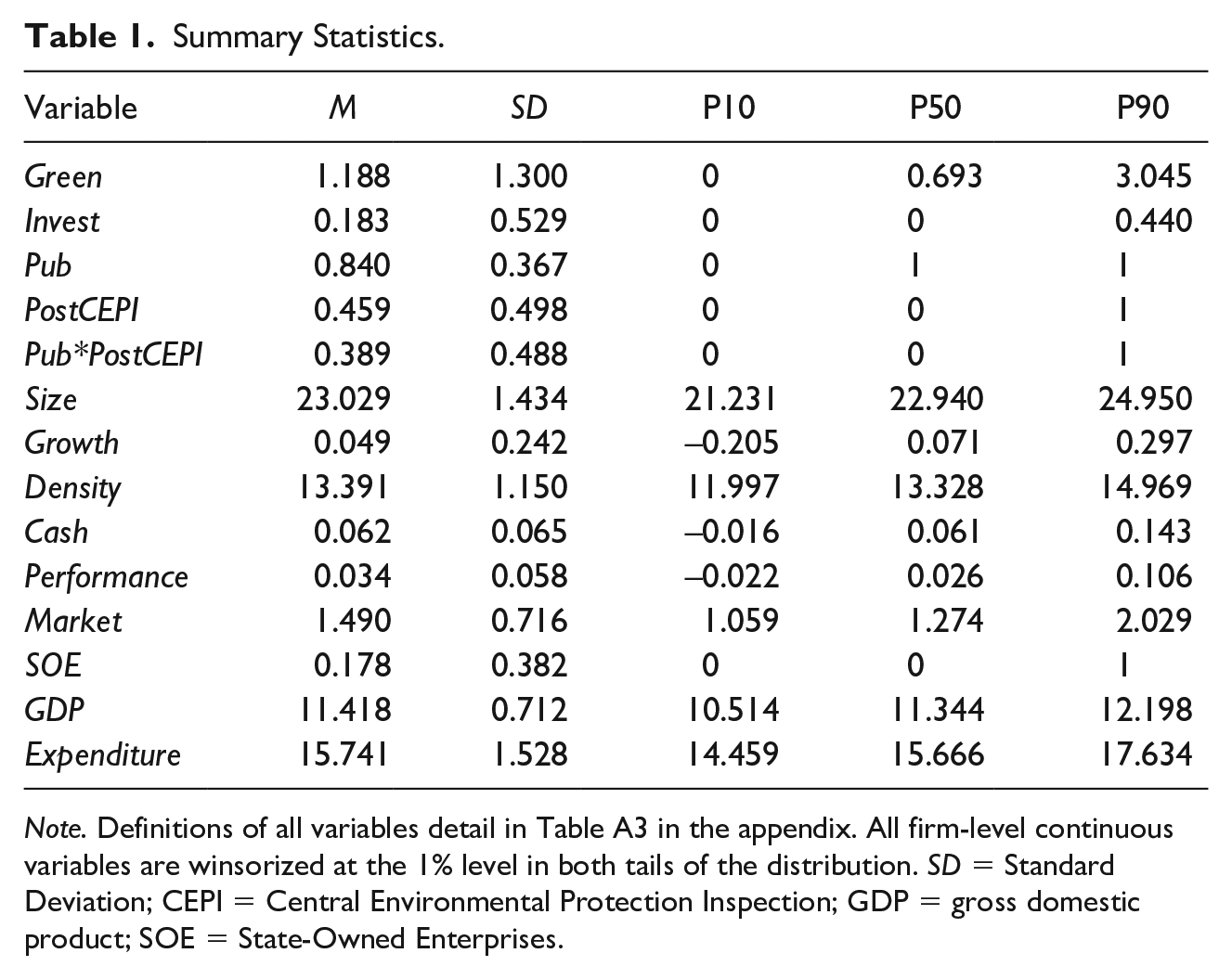
Note. Definitions of all variables detail in Table A3 in the appendix. All firm-level continuous variables are winsorized at the 1% level in both tails of the distribution. SD = Standard Deviation; CEPI = Central Environmental Protection Inspection; GDP = gross domestic product; SOE = State-Owned Enterprises.
Main Findings
A critical assumption for using the multiperiod Difference-In-Differences method is the satisfaction of a parallel trend hypothesis. If the treatment group is not subject to policy intervention, its time trend should be the same as that of the control group. We employ the event study method to conduct parallel trend testing, and we use the first period before the policy shock as the base period (as shown in Table A4 in the appendix). The results show that when the explained variable is Green or Invest, the dummy variable coefficients of each period before the policy shock are not significantly different from 0, indicating that the parallel trend hypothesis is satisfied.
Before testing Hypothesis 1, it is necessary to examine the impact of public participation (as shown in Table 2). Columns 1 and 4 show that the green innovation of firms located in cities belonging to the evaluation subject of the IPE is significantly higher than that of other firms; however, there is no significant difference in environmental investment between these firms and other firms. Because it takes time to apply for a green patent, the green innovation levels of the firm in the subsequent two phases are taken as explained variables to test the relationship between them and the explanatory variable. Table 2 shows that the results of the subsequent two phases of green innovation are consistent with the above results, indicating that public participation has a long-term impact on the future green innovation of firms.
Public Participation and Corporate Environmental Governance Strategies.
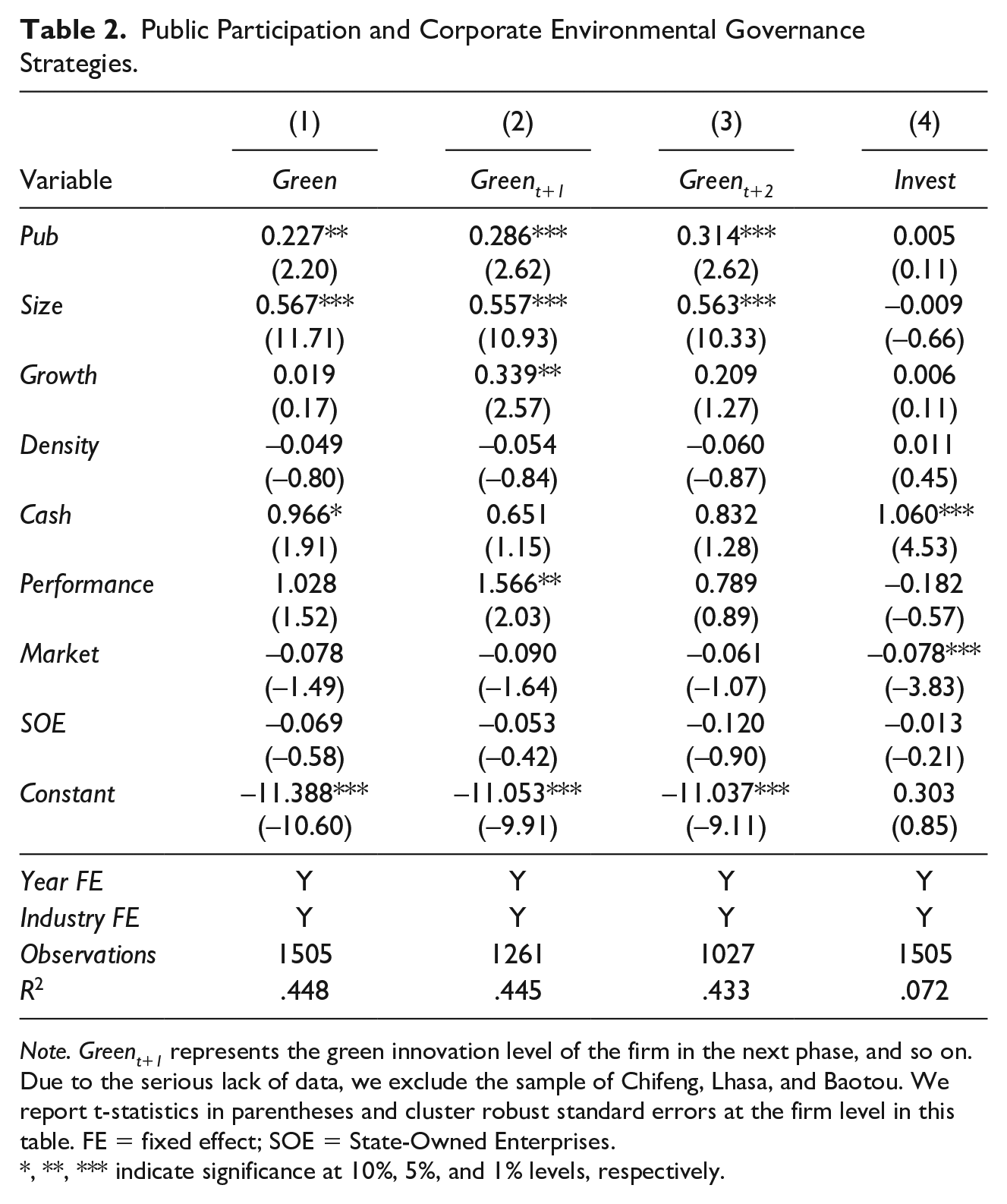
Note. Greent+1 represents the green innovation level of the firm in the next phase, and so on. Due to the serious lack of data, we exclude the sample of Chifeng, Lhasa, and Baotou. We report t-statistics in parentheses and cluster robust standard errors at the firm level in this table. FE = fixed effect; SOE = State-Owned Enterprises.
, **, *** indicate significance at 10%, 5%, and 1% levels, respectively.
Furthermore, we test whether CEPI further affects corporate environmental strategies with Model (1). As shown in Table 3, the interaction term (Pub*PostCEPI) coefficient of public participation and CEPI is significantly positive when the explanatory variable is the next phase of green innovation and the current environmental investment. The coefficient is still positive after adding the single variable PostCEPI, showing that the policy impact of CEPI caused public participation to affect corporate environmental governance strategy further. In other words, public participation and CEPI have a compound impact on corporate environmental strategies, encouraging firms to adopt green innovation and increase environmental investment. A comparison of the sum of the two coefficients indicates that firms are more inclined to adopt “source-control” strategies after the implementation of CEPI.
Public Participation, CEPI, and Corporate Environmental Governance Strategies.
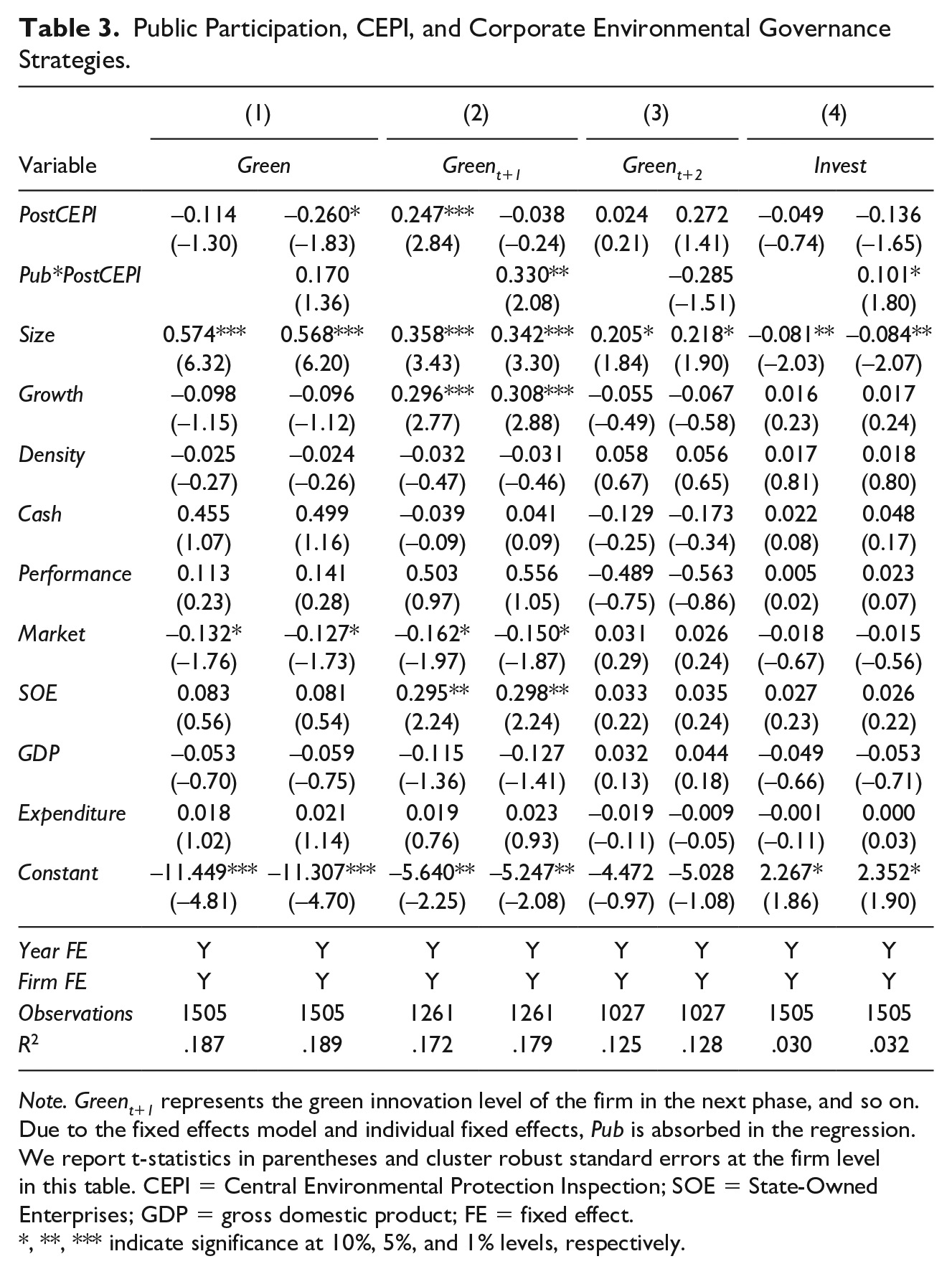
Note. Greent+1 represents the green innovation level of the firm in the next phase, and so on. Due to the fixed effects model and individual fixed effects, Pub is absorbed in the regression. We report t-statistics in parentheses and cluster robust standard errors at the firm level in this table. CEPI = Central Environmental Protection Inspection; SOE = State-Owned Enterprises; GDP = gross domestic product; FE = fixed effect.
, **, *** indicate significance at 10%, 5%, and 1% levels, respectively.
Endogeneity and Robustness Checks
Endogeneity checks: Correlation analysis between public participation and CEPI
The possible reverse causality between public participation and CEPI may affect our results. The report of the Pollution Information Transparency Index issued by IPE every year can directly reflect the transparency of environmental information in each city and the environmental governance capabilities of local governments, which may affect the CEPI teams in their selection of cities to be inspected. To alleviate this concern, we conduct a correlation analysis of the explanatory variables and the explained variables (as shown in Table A5 in the appendix). The upper triangle is the Spearman correlation test, whereas the lower triangle is the Pearson correlation test. The correlation coefficient between Pub and PostCEPI is 0.021 (0.022) and not significant, indicating no correlation between organized public participation and CEPI. Apparently, the cities evaluated by IPE have been determined long before the implementation of CEPI and have not changed for many years. Public participation does not affect the implementation or scope of CEPI, and CEPI does not affect the degree of environmental protection participation of ENGOs, enabling us to deconstruct the different roles of the public and the central government in environmental governance. The results support the main findings.
Endogeneity checks: PSM approach
To make the treatment and control groups regarding CEPI more comparable, we use the propensity score matching method (PSM) to test our results. Specifically, we use firm size (Size), firm growth (Growth), market power (Market), and regional per capita GDP (GDP) as screening indicators to match the radius of the two types of firms. The matching results (not shown) demonstrate that the standard deviation (%bias) of each variable is less than 5%, and the t-statistic of each variable is not significant, indicating that the PSM sample is adequately balanced after matching. Then, we re-estimate Model (1) with the PSM sample. The results are entirely consistent with the main findings (as shown in Table A6 in the appendix).
Robustness checks: Replacing the research model
To ensure the reliability of the previous results, we refer to the multiple policy composite effect evaluation model of Gray and colleagues (2014) and construct Model 2 based on data from 2006 to 2012 as follows:
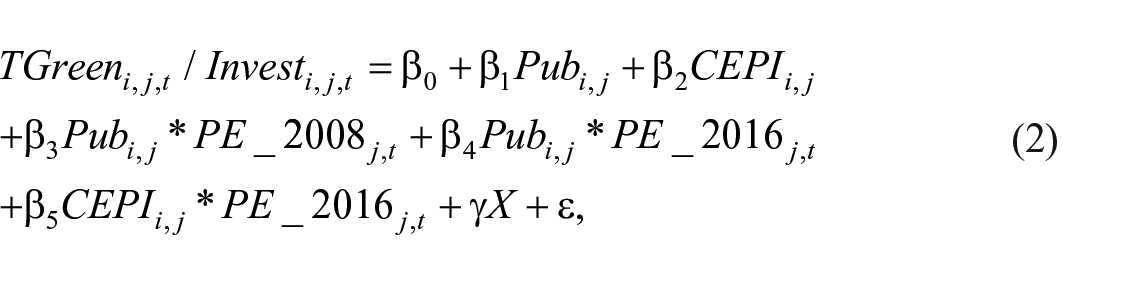
where i indices firms, j indices cities, and t indices years.
Robustness checks: Excluding other competing explanations
As the different natural environmental conditions in the cities may affect the environmental governance strategies of local firms, we further adopt the method of increasing the control variables following Zeng and colleagues (2022), including urban industrial wastewater emissions (Environment1), urban industrial dust emissions (Environment2), urban industrial sulfur dioxide emissions (Environment3), and urban industrial solid waste comprehensive utilization (Environment4) in the robustness test. We collect the data of these variables from the CSMAR database, and a natural logarithm is adopted for these four variables to eliminate the dimensional effects of different variances. The results are shown in Table A8 in the appendix. The coefficient of Pub*PostCEPI is still significantly positive in Column 2. The sum of the coefficients of the univariate PostCEPI is greater than 0, which is consistent with the primary regression results.
Other robustness checks
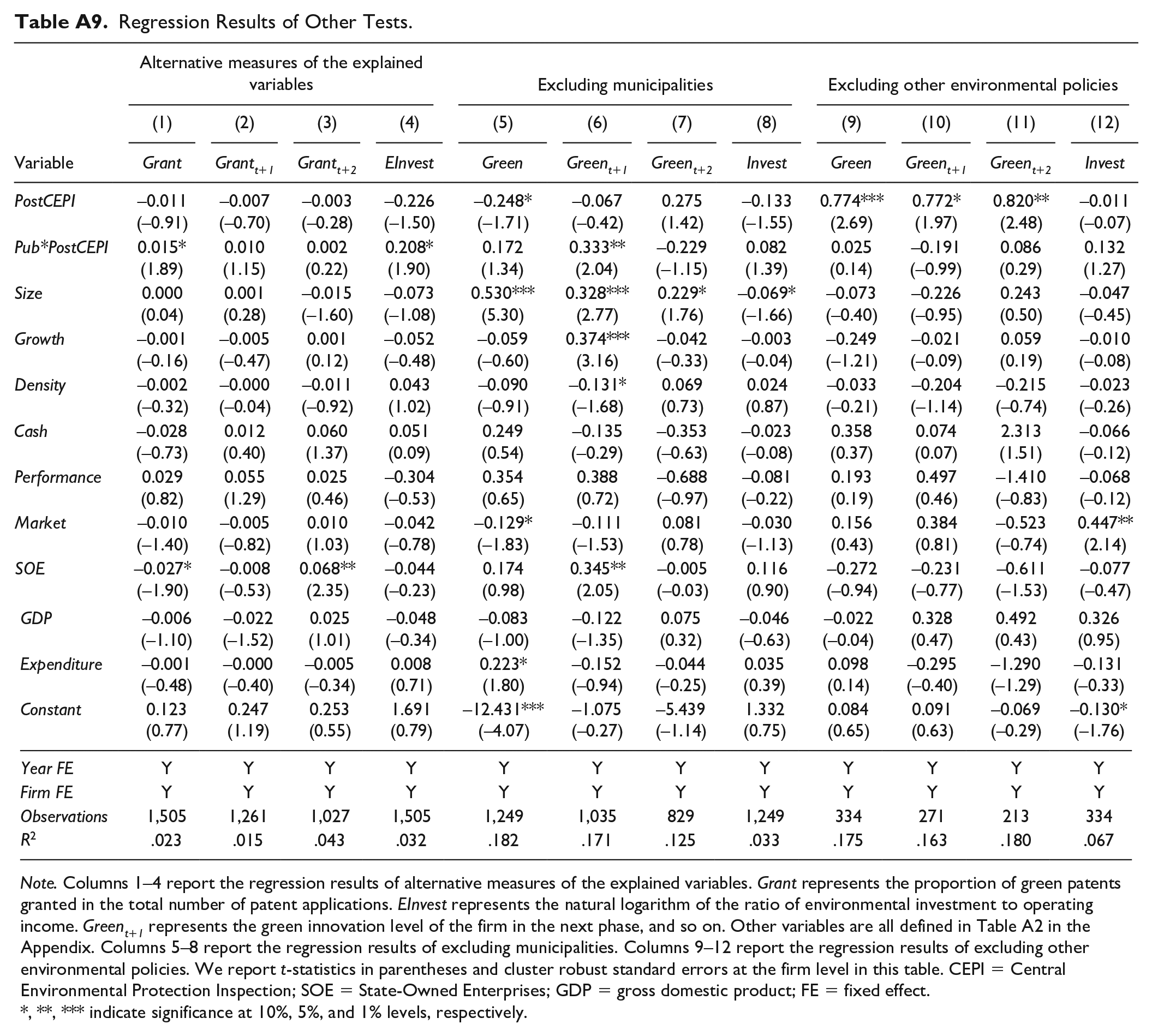
To exclude the influence of other unobservable factors on our estimation results, we conduct the following tests. The explanatory variables are green innovation Green and environmental investment Invest, and Green is treated in advance for one and two periods. The results are shown in Table A9 in the appendix:
Alternative measures of the explained variables. Other measurements are used to define the explained variables and retest Model 2. The proportion of green patents granted by firms in the total number of patent applications (Grant) is used to measure corporate green innovation, and operating income is used to standardize environmental investment (EInvest). The regression results are still consistent with the previous results.
Remove the municipalities. As the administrative levels of municipalities and prefecture-level cities differ, there may be a significant gap in their economic development, resource endowment, and innovation ability, which may impact our results. Therefore, we remove the relevant data of municipalities (Beijing, Tianjin, Shanghai, and Chongqing) based on the original sample and re-tested the results. The regression results are still consistent with the previous results.
Exclude the influence of other environmental policies. Other national environmental policies may influence our results during the sample period. Therefore, we use a sample of heavily polluting firms in other cities that are not affected by CEPI as a placebo sample and conduct falsification tests. It is found that the coefficient estimates of the interaction term Pub*PostCEPI are not significant, and the placebo sample does not result in the same corporate environmental governance strategies as the firms in cities inspected by CEPI. Our results show that heavily polluting firms in the inspected cities are affected by CEPI rather than other national environmental policies during the same period.
Mechanism Analysis
Our results show that public participation promotes green innovation, that public participation and CEPI have a compound impact on corporate environmental governance strategies, and that firms are more inclined to adopt “source-control” strategies. What is the specific mechanism? Is there a new mechanism for the model of joint influence of public and central environmental policy on corporate environmental strategies?
Good local environmental governance requires the joint participation of local governments, the public, and firms. Local governments must respect public opinion and perform their duties as is the active response of firms to public demands (Anderson et al., 2019; Fu & Geng, 2019). Therefore, public participation in environmental governance usually requires local governments to act as a bridge to influence firms’ environmental behavior. The IPE, as an ENGO, can regulate corporate behavior and promote the transformation of corporate environmental protection. In addition to the oversight of corporate pollution information disclosure and the evaluation of environmental behaviors, the IPE also exerts pressure on local firms by monitoring the strength of local governments in implementing environmental policies (Konisky & Teodoro, 2016).
However, local governments are often responsible for failures of environmental regulations due to fiscal decentralization, financial openness, and competition (Beyer, 2006; X. Jin & Yu, 2018; Xu, 2011; X. Zhu, 2014). In the operating mode of CEPI, higher-level governments can learn from the public about local environmental complaints and appeals and policy implementation. Thus, higher-level governments put pressure on the low-level or grassroots governments to increase policy implementation and improve working efficiency (Li et al., 2020). At the same time, CEPI couples political pressure and environmental regulations, which influences the relationship between the government and firms by changing local assessment risk factors and resource allocation methods (B. Zhang et al., 2018). Whether it is the direct interaction between the public and the local governments or by influencing higher-level governments to pass on to local governments, both will exert pressure on local governments. Local government behavior can affect the innovation investment of local firms (Fernando et al., 2019; Horbach, 2008). Although the profit-maximization goals of firms usually come at the expense of the environment, firms’ responsibility and economic activities are not necessarily mutually exclusive, and firms can become an important force in environmental governance (L. Liu et al., 2012). It is crucial for local governments to take effective measures to stimulate firms’ environmental governance motives.
The essence of Chinese environmental governance is to balance economic development and environmental protection (Teets, 2018), which is why local governments need to balance economic development benefits and pollution control costs in environmental governance. When local governments face the pressure of public participation and CEPI simultaneously, on the one hand, they may impose punitive measures on firms, such as levying pollution fees and fines. This punitive effect reflects the local governments’ oversight of environmental pollution (Clarkson et al., 2004), internalizes the negative external effects of polluting firms into the firms’ costs, and reduces the possibility of passing on adverse effects to the public (Palmer et al., 1995; Petroni et al., 2018). In this way, local governments can also raise funds for environmental protection and governance. On the contrary, local governments may actively adopt guidance and incentives for firms, such as issuing government subsidies and offering tax incentives. The guiding effect can send positive signals to firms and the market, supplement the environmental governance resources that firms lack, reduce the marginal cost and uncertainty of their green innovation efforts, and diversify the risks of innovation activities (Hussinger, 2008; Lach, 2002). Therefore, we comprehensively examine the mechanism of government behavior in public participation and CEPI affecting corporate environmental strategies from two aspects: government penalties and government guidance.
Government Penalties
Public participation and the combination of public and environmental policies may affect corporate environmental strategies through government penalties, encouraging firms to adopt “source-control” strategies. Faced with pressure from the public and higher-level governments, local governments must improve their environmental governance efficiency and implement appropriate penalties for local polluting firms to urge them to strengthen pollution control, such as pollution charges, project restrictions, water and power outages, and other means. To verify the effectiveness of penalties as a transmission mechanism, we select the pollution charge (Charge) as a proxy variable and use the operating income for standardization. Although pollution charges are part of a firm’s costs and reduce profit, they can encourage managers to reflect on the firm’s green development shortcomings. Thus, penalties compensate for the inherent shortcomings of the firms’ environmental governance mechanism and the inability of the organization to implement changes (Ambec & Barla, 2002). Eventually, pollution charges cause firms to adopt “source-control” strategies such as green innovation.
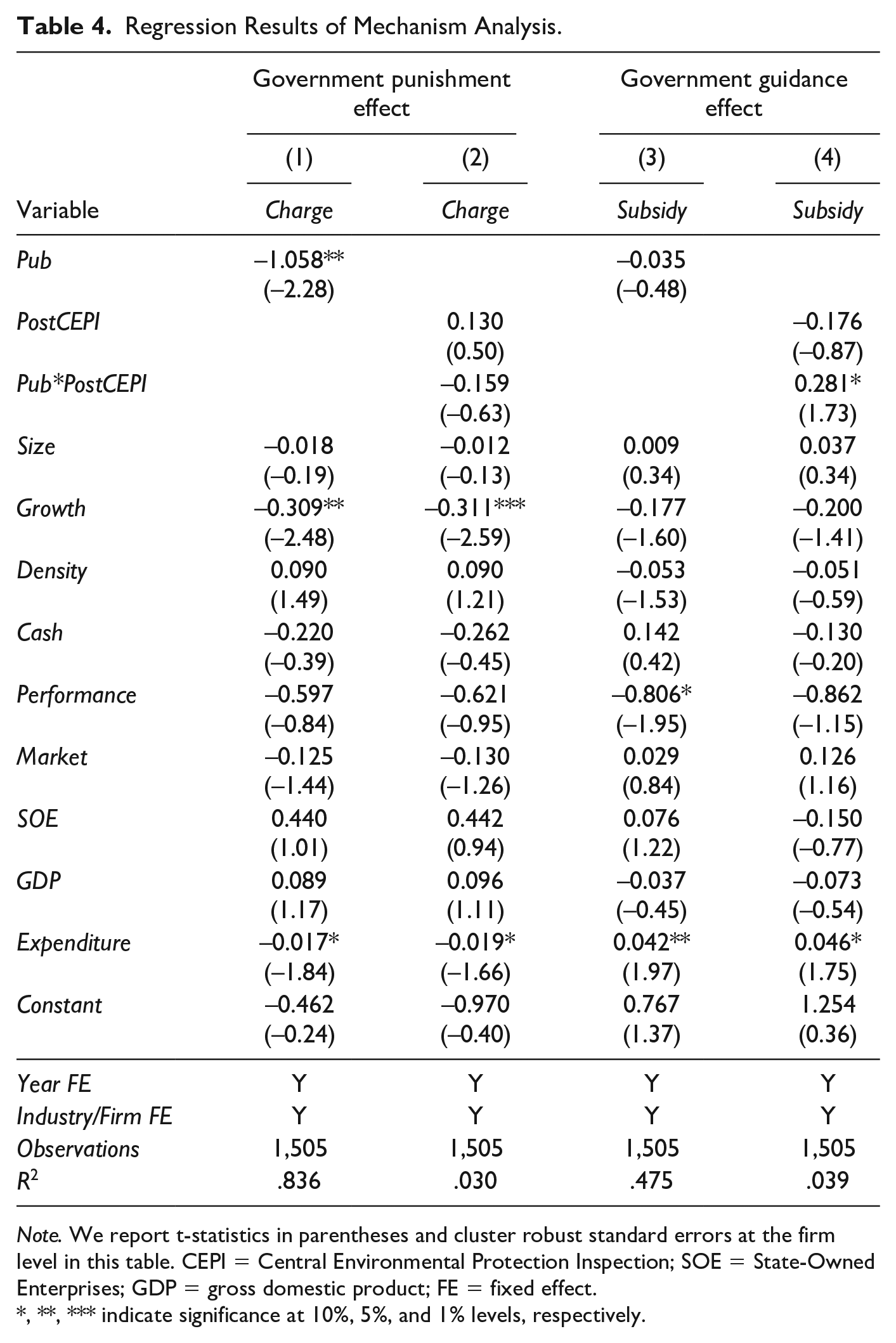
Table 4 reports the regression results of the mechanism analysis. As presented in Column 1, the coefficient of public participation Pub is significantly negative. The coefficient of Pub*PostCEPI in Column 2 is not significant, indicating that the compound effect of public participation and CEPI on corporate environmental strategies is not affected by the governments’ penalties.
Regression Results of Mechanism Analysis.
Note. We report t-statistics in parentheses and cluster robust standard errors at the firm level in this table. CEPI = Central Environmental Protection Inspection; SOE = State-Owned Enterprises; GDP = gross domestic product; FE = fixed effect.
, **, *** indicate significance at 10%, 5%, and 1% levels, respectively.
Government Guidance
Public participation and the combination of public and environmental policies may affect corporate environmental strategies through government guidance, encouraging firms to adopt “source-control” strategies. Shleifer and Vishny (1994) found that government officials tried to influence firms through subsidies. Studies have shown that government guidance based on subsidies and other forms can encourage firms to implement environmental governance measures. On one hand, government guidance can provide financial support for firms to purchase new technology and equipment (Montmartin & Herrera, 2015), and environmental protection subsidies can directly support firms’ green innovation. On the other hand, government guidance can substantially reduce firms’ risks during innovation (Stiglitz, 2015). Firms use green innovation to carry out long-term environmental governance; thus, they face unknown challenges, such as market fluctuations, financial crises, and technical shortcomings. Government subsidies can send a positive signal in this case (Manso, 2011).
To test whether the transmission mechanism is effective, we select the government environmental protection subsidy (Subsidy) as the proxy variable of government guidance in the regression and use the operating income for standardization. The coefficient of Pub in Column 3 in Table 4 is not significant, indicating that public participation does not promote green innovation by increasing government environmental protection subsidies.
Heterogeneity Analysis
Test of the Policy Timeliness of CEPI
The first round of CEPI (including the pilot) is divided into five batches, with a time span of 2 years. The pressure may show an attenuation trend. Thus, policy deterrents may weaken over time (Jia & Chen, 2019). The subsequent groups of inspected firms may be less willing to adopt a “source-control” strategy due to the imitation effect (Popp, 2010). Therefore, we divide the sample into 2016 and 2017 for another analysis; the results are shown in Table 5.
Regression Results of Heterogeneity Tests.
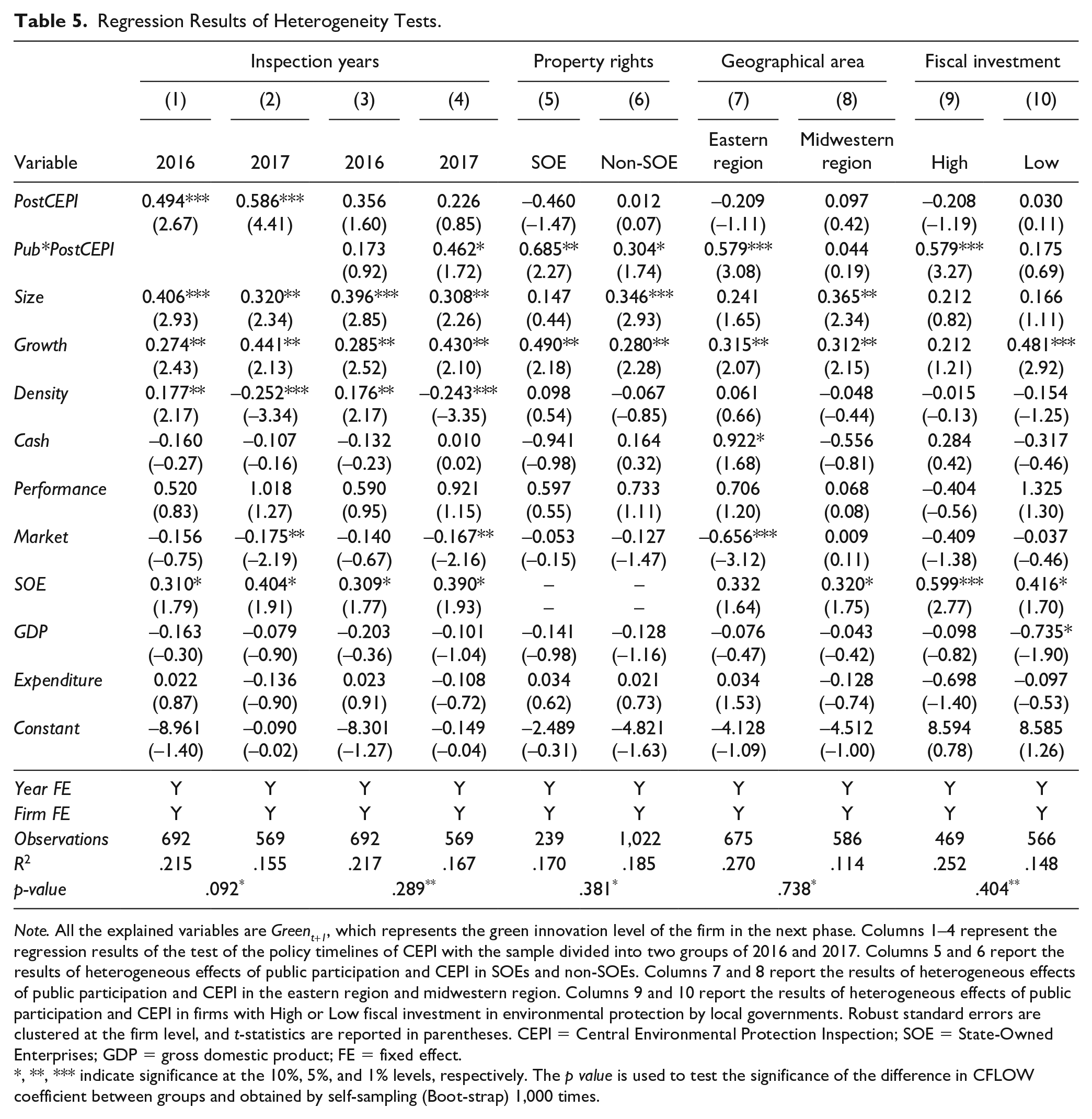
Note. All the explained variables are Greent+1, which represents the green innovation level of the firm in the next phase. Columns 1–4 represent the regression results of the test of the policy timelines of CEPI with the sample divided into two groups of 2016 and 2017. Columns 5 and 6 report the results of heterogeneous effects of public participation and CEPI in SOEs and non-SOEs. Columns 7 and 8 report the results of heterogeneous effects of public participation and CEPI in the eastern region and midwestern region. Columns 9 and 10 report the results of heterogeneous effects of public participation and CEPI in firms with High or Low fiscal investment in environmental protection by local governments. Robust standard errors are clustered at the firm level, and t-statistics are reported in parentheses. CEPI = Central Environmental Protection Inspection; SOE = State-Owned Enterprises; GDP = gross domestic product; FE = fixed effect.
, **, *** indicate significance at the 10%, 5%, and 1% levels, respectively. The p value is used to test the significance of the difference in CFLOW coefficient between groups and obtained by self-sampling (Boot-strap) 1,000 times.
The coefficient of PostCEPI indicates that inspection has a significantly positive impact on corporate green innovation in 2016 and 2017, and the coefficient in 2017 is slightly larger than that in 2016. The coefficient of Pub*PostCEPI is significantly positive in 2017, demonstrating that CEPI only had a significant positive impact on firms inspected in 2017. Therefore, there is no imitation effect of the policy. The policy deterrent of CEPI is maintained for a long time, continuously affecting corporate environmental governance strategies and promoting green innovation.
Heterogeneity of Property Rights: SOEs Versus Non-SOEs
We must consider the impact of corporate property rights on environmental governance under the unique institutional background of China. SOEs and non-SOEs may respond differently to environmental strategy decisions in the face of public participation and CEPI. Therefore, we divide the sample into SOEs and non-SOEs. The results are listed in Table 5. Columns 5 and 6 show that green innovation is significantly higher for SOEs than non-SOEs after the CEPI. A possible explanation is that CEPI focuses on “inspecting the government” and encourages local governments to reduce their environmental responsibilities (Li et al., 2020). Compared with non-SOEs, SOEs have a political foundation and are more active in adopting green innovation pressured by public participation and CEPI (Gan et al., 2018; i.e., they adopt “source-control” strategies to meet the requirements of government policies).
Heterogeneity of Economic Conditions: Eastern Region Versus Mid-Western Region
Differences in economic conditions and resource endowments exist in different regions; therefore, firms may make different choices in environmental governance strategies. We divide the sample into the eastern and mid-western regions. As shown in Table 5, the coefficient of Pub*PostCEPI is significantly positive for the sample of the eastern region, indicating that public participation and CEPI have a significant compound impact on corporate environmental governance strategies. However, no significant impact is found in the sample of the mid-Western region. The eastern region has a higher level of economic development than the mid-Western region and has significant environmental problems. Therefore, firms in this region are more likely to adopt “source-control” strategies under the dual pressure of public participation and CEPI. However, firms in the midwestern region may be less regulated due to a greater need for economic development (Chen et al., 2016; B. Zhang & Cao, 2015; B. Zhang et al., 2018).
Heterogeneity of Fiscal Investment in Environmental Protection
Local governments in different cities have different levels of enthusiasm for environmental governance, resulting in differences in annual financial investments for energy conservation and environmental protection. To test whether these differences affect corporate environmental governance strategies, we use the median “energy-saving and environmental protection expenditure” of each city as the threshold. Moreover, we divide the sample into high and low environmental protection expenditures (excluding the sample in municipalities). The results show that the coefficient of Pub*PostCEPI is significantly positive in areas with a high level of financial investment in environmental protection and not significant in areas with low levels of financial investment in environmental protection (as shown in Table 5). When the financial investment in environmental protection is high, local governments are more focused on the environmental governance of firms in their jurisdictions. Therefore, local governments are more likely to encourage local firms to achieve environmental governance goals and adopt a long-term “source-control” strategy to continuously improve green innovation.
Discussion
Discussion of Hypothesis Tests
In this study, principle-agent theory, as well as institution theory and its derivations, are drawn upon to conceptualize and test an integrated model by examining the impact of the interaction between CEPI and public participation on corporate environmental governance strategies. We also investigate the underlying mechanism and conduct a heterogeneity analysis.
The results empirically support Hypothesis 1 that the interaction between CEPI and public participation has a positive compound effect on the corporate “source-control” strategy. Before testing Hypothesis 1, we examine the impact of public participation. Our findings indicate that public participation encourages firms to adopt “source-control” strategies (i.e., increase their green patent research investment). The IPE has released the report of the Pollution Information Transparency Index of relevant cities every year since 2008, indicating that public participation in the oversight of urban environmental governance and corporate pollution discharge behavior has been continuous. Only by adopting long-term green innovation can firms meet their sustainable development requirements. Based on Table 3, the reasons why the interaction between CEPI and public participation enhances green innovation in firms may be as follows: (a) CEPI protects the public’s right to report the environmental governance of firms, thereby deterring firms from committing environmental violations; and (b) CEPI has a trend of standardization and normalization, which can produce long-term positive policy effects that improve environmental performance by overcoming fundamental problems in the environmental governance system (Jia & Chen, 2019). Therefore, the adoption of long-term “source-control” strategies by firms is more in line with the requirements of long-term inspections.
Furthermore, we investigate the underlying mechanism of the two aspects: government penalties and government guidance. The results reveal that the pressure of public participation causes firms to improve their green innovation by reducing government penalties, and the compound effect of CEPI and public participation encourages firms to adopt “source-control” strategies due to government guidance. The possible explanation is that firms may not have sufficient funds and capabilities to compensate for their environmental governance when faced with huge fines and charges. However, the potential penalties may cause managers to consider the green development shortcomings of firms. It is also difficult to adopt “source-control” strategies without sufficient funds. Therefore, due to public pressure, local governments lower the pollution charges imposed on firms to have sufficient funds to carry out long-term environmental governance and continuously improve green innovation. However, after the enactment of CEPI, the government may appropriately increase pollution discharge charges for heavily polluting firms, which explains why the compound effect is not affected by the government’s penalties. As firms have faced intense inspection pressure after CEPI, it has been difficult for local governments to achieve pollution control by only reducing the pollution charges of firms. Therefore, local governments are more willing to encourage and guide heavily polluting firms to adopt environmental governance strategies through environmental protection subsidies. Due to the injection of government funds, firms have sufficient capital for green innovation.
Implications for Theory
Our research makes the following contributions to theory. First, we have advanced principal-agent theory by focusing on implementing policies at different government administrative levels to provide the following insights: Two critical channels for the central government to collect local information can ensure smooth information flow and ease the principal-agent problems between the central and local governments. While researchers have recognized the central role of the government in environmental governance, they have viewed the government as a single entity and have rarely considered principal-agent issues, assuming they operate across hierarchies in a consistent and coordinated manner (Delmas & Toffel, 2008; Sharma & Henriques, 2005). However, due to environmental decentralization, local governments have their own development agendas and rarely keep pace with the central government in environmental governance (Child et al., 2007). Hence, it is vital to identify the channels for solving the intergovernmental principal-agent problems and analyze their action mechanism. Our results reveal that top-down CEPI improves the environmental information disclosure of local governments through a series of measures, and bottom-up public participation forces local governments to strengthen the environmental supervision of firms and increase environmental information disclosure within their jurisdictions. The combination of the two channels not only helps the entrusting party (the central government) monitor the entrusted party (the local government) but also supervises the wrongdoing of the firm as a third party. Therefore, our research helps to clarify the game relationship between the central government and the local governments and reveals how the supervision and the supervised relationship between the government, the public, and enterprises affect environmental governance, thus advancing principal-agent theory.
Second, we demonstrate empirical support for the compound influence mechanism of different forms of institutional pressure acting on corporate environmental governance decisions, thereby expanding institutional theory. In terms of environmental management, regulatory and normative pressures are theoretically critical for firms (Brammer et al., 2012; Colwell & Joshi, 2013; Kassinis & Vafeas, 2006) and have been the focus of recent research. However, most previous studies have examined the impact of a particular institutional pressure (regulatory or normative pressure) on corporate environmental governance (Berrone et al., 2013; Daddi et al., 2016; Lin, 2019; Walker, 2012). In fact, CEPI and public participation, as typical formal and informal institutions, respectively, are complementary to each other. Top-down inspections continue to encourage public participation in bottom-up regulation, and public participation also provides CEPI with an important source of information. Therefore, the combination of the two may generate greater power, and their effects are mutually reinforcing, which has not been fully explored in the extant literature. In addition, the government remains a key driver of corporate environmental practice (Delmas & Toffel, 2004; Marquis & Qian, 2014). Good environmental governance requires government leadership, public assistance, and positive responses from firms. Thus, the compound effect mechanism of CEPI and public participation is that local governments increase their guidance, such as by issuing government subsidies and tax incentives. In short, we have extended the current research on institutional pressures and corporate environmental governance by arguing that the interaction of CEPI and public participation promotes the corporate adoption of environmental governance strategies and by identifying their influence mechanisms.
Implications for Practice
Our results also provide some practical implications as follows. First, our results demonstrate that government regulation and public participation could play a better role in environmental governance, especially when the central government and local governments have principal-agent problems in a decentralized model. Environmental governance requires the full mobilization of all parties and the multiparty cooperation of the government, the public, and firms (Pinkse & Kolk, 2012). This finding is not only applicable to environmental governance in China but also has practical value in addressing environmental challenges on a global scale, especially in federal states with high levels of local autonomy, such as Germany and the United States (R. Wang et al., 2018).
Second, the compliance issues arising from centralized policy-making and local decentralized implementation are core impediments to good governance worldwide (Malesky et al., 2014). The central government should further unblock public opinion expression mechanisms to smooth the local information collection channels, especially to broaden the environmental appeals and complaint channels of the public. In addition, the central government should adhere to environmental policies and ensure that local environmental governance information is obtained from top to bottom. Moreover, governments should reduce pollution charges, fines, and other penalties related to environmental governance and should adopt more diversified incentives and guidance methods, such as environmental protection subsidies and environmental protection financial investment. The green innovation activities of local firms should be supported to ensure environmental “source governance.”
Third, good environmental governance involves the public. Implementing the central environmental policy requires the active cooperation of local governments and the public; therefore, the third-party oversight of public participation must be included in environmental regulations. Moreover, the concept of ecological civilization should be firmly established. The public should increase their awareness of environmental protection and cultivate ecological ethics and behavior. The implementation of policies requires the interaction of environmental protection behaviors and a wide range of encouragement of public participation. Only in this way can we improve the environmental governance system designed and operated by governments, firms, and the public to achieve “multi-subject synergy” (L. Liu et al., 2012).
Finally, firms should be aware that government inspection and public supervision are continuous. Only by attaching importance to environmental governance and pollution prevention can firms achieve sustainable development. Green innovation is the “source-control” strategy that creates a trade-off between economic and ecological developments, which enables firms to gain unique competitive advantages while trying their best to reduce negative external economic activities. Therefore, it is wise for firms to adopt green innovation strategies to comply with local environmental regulations and boost green growth in the long term.
Conclusion
Good environmental governance is the result of concerted efforts of the government, firms, and the public. It is necessary to investigate the impact and mechanism of public participation and local government on corporate environmental governance strategies. Our research finds that public participation encourages firms to adopt a “source-control” strategy. The policy impact of CEPI stimulates public participation, which further affects corporate environmental governance strategy, and firms are more inclined to adopt a “source-control” strategy. Further analysis shows that the pressure of public participation causes firms to improve green innovation by reducing government penalties, whereas no compound effect of public participation and CEPI is observed. Nevertheless, the compound effect encourages firms to adopt “source-control” strategies due to government guidance. In addition, the policy deterrence of CEPI affects corporate environmental governance strategies for a long time. Firms with state-owned property rights and those in the eastern region are more inclined to adopt “source-control” strategies. The more abundant the environmental protection financial resources of the local government, the more likely it is that local firms are encouraged to achieve environmental governance goals and adopt long-term strategies.
Footnotes
Appendix
Regression Results of Other Tests.
| Variable | Alternative measures of the explained variables | Excluding municipalities | Excluding other environmental policies | |||||||||
|---|---|---|---|---|---|---|---|---|---|---|---|---|
| (1) | (2) | (3) | (4) | (5) | (6) | (7) | (8) | (9) | (10) | (11) | (12) | |
| Grant | Grantt+1 | Grantt+2 | EInvest | Green | Greent+1 | Greent+2 | Invest | Green | Greent+1 | Greent+2 | Invest | |
| PostCEPI | –0.011 (–0.91) |
–0.007 (–0.70) |
–0.003 (–0.28) |
–0.226 (–1.50) |
–0.248*
(–1.71) |
–0.067 (–0.42) |
0.275 (1.42) |
–0.133 (–1.55) |
0.774***
(2.69) |
0.772*
(1.97) |
0.820**
(2.48) |
–0.011 (–0.07) |
| Pub*PostCEPI | 0.015*
(1.89) |
0.010 (1.15) |
0.002 (0.22) |
0.208*
(1.90) |
0.172 (1.34) |
0.333**
(2.04) |
–0.229 (–1.15) |
0.082 (1.39) |
0.025 (0.14) |
–0.191 (–0.99) |
0.086 (0.29) |
0.132 (1.27) |
| Size | 0.000 (0.04) |
0.001 (0.28) |
–0.015 (–1.60) |
–0.073 (–1.08) |
0.530***
(5.30) |
0.328***
(2.77) |
0.229*
(1.76) |
–0.069*
(–1.66) |
–0.073 (–0.40) |
–0.226 (–0.95) |
0.243 (0.50) |
–0.047 (–0.45) |
| Growth | –0.001 (–0.16) |
–0.005 (–0.47) |
0.001 (0.12) |
–0.052 (–0.48) |
–0.059 (–0.60) |
0.374***
(3.16) |
–0.042 (–0.33) |
–0.003 (–0.04) |
–0.249 (–1.21) |
–0.021 (–0.09) |
0.059 (0.19) |
–0.010 (–0.08) |
| Density | –0.002 (–0.32) |
–0.000 (–0.04) |
–0.011 (–0.92) |
0.043 (1.02) |
–0.090 (–0.91) |
–0.131*
(–1.68) |
0.069 (0.73) |
0.024 (0.87) |
–0.033 (–0.21) |
–0.204 (–1.14) |
–0.215 (–0.74) |
–0.023 (–0.26) |
| Cash | –0.028 (–0.73) |
0.012 (0.40) |
0.060 (1.37) |
0.051 (0.09) |
0.249 (0.54) |
–0.135 (–0.29) |
–0.353 (–0.63) |
–0.023 (–0.08) |
0.358 (0.37) |
0.074 (0.07) |
2.313 (1.51) |
–0.066 (–0.12) |
| Performance | 0.029 (0.82) |
0.055 (1.29) |
0.025 (0.46) |
–0.304 (–0.53) |
0.354 (0.65) |
0.388 (0.72) |
–0.688 (–0.97) |
–0.081 (–0.22) |
0.193 (0.19) |
0.497 (0.46) |
–1.410 (–0.83) |
–0.068 (–0.12) |
| Market | –0.010 (–1.40) |
–0.005 (–0.82) |
0.010 (1.03) |
–0.042 (–0.78) |
–0.129*
(–1.83) |
–0.111 (–1.53) |
0.081 (0.78) |
–0.030 (–1.13) |
0.156 (0.43) |
0.384 (0.81) |
–0.523 (–0.74) |
0.447**
(2.14) |
| SOE | –0.027*
(–1.90) |
–0.008 (–0.53) |
0.068**
(2.35) |
–0.044 (–0.23) |
0.174 (0.98) |
0.345**
(2.05) |
–0.005 (–0.03) |
0.116 (0.90) |
–0.272 (–0.94) |
–0.231 (–0.77) |
–0.611 (–1.53) |
–0.077 (–0.47) |
| GDP | –0.006 (–1.10) |
–0.022 (–1.52) |
0.025 (1.01) |
–0.048 (–0.34) |
–0.083 (–1.00) |
–0.122 (–1.35) |
0.075 (0.32) |
–0.046 (–0.63) |
–0.022 (–0.04) |
0.328 (0.47) |
0.492 (0.43) |
0.326 (0.95) |
| Expenditure | –0.001 (–0.48) |
–0.000 (–0.40) |
–0.005 (–0.34) |
0.008 (0.71) |
0.223*
(1.80) |
–0.152 (–0.94) |
–0.044 (–0.25) |
0.035 (0.39) |
0.098 (0.14) |
–0.295 (–0.40) |
–1.290 (–1.29) |
–0.131 (–0.33) |
| Constant | 0.123 (0.77) |
0.247 (1.19) |
0.253 (0.55) |
1.691 (0.79) |
–12.431***
(–4.07) |
–1.075 (–0.27) |
–5.439 (–1.14) |
1.332 (0.75) |
0.084 (0.65) |
0.091 (0.63) |
–0.069 (–0.29) |
–0.130*
(–1.76) |
| Year FE | Y | Y | Y | Y | Y | Y | Y | Y | Y | Y | Y | Y |
| Firm FE | Y | Y | Y | Y | Y | Y | Y | Y | Y | Y | Y | Y |
| Observations | 1,505 | 1,261 | 1,027 | 1,505 | 1,249 | 1,035 | 829 | 1,249 | 334 | 271 | 213 | 334 |
| R 2 | .023 | .015 | .043 | .032 | .182 | .171 | .125 | .033 | .175 | .163 | .180 | .067 |
Note. Columns 1–4 report the regression results of alternative measures of the explained variables. Grant represents the proportion of green patents granted in the total number of patent applications. EInvest represents the natural logarithm of the ratio of environmental investment to operating income. Greent+1 represents the green innovation level of the firm in the next phase, and so on. Other variables are all defined in Table A2 in the Appendix. Columns 5–8 report the regression results of excluding municipalities. Columns 9–12 report the regression results of excluding other environmental policies. We report t-statistics in parentheses and cluster robust standard errors at the firm level in this table. CEPI = Central Environmental Protection Inspection; SOE = State-Owned Enterprises; GDP = gross domestic product; FE = fixed effect.
, **, *** indicate significance at 10%, 5%, and 1% levels, respectively.
Acknowledgements
The authors thank the Associate Editor, Prof. Ivan Montiel, and the three anonymous reviewers for their time and the valuable comments that helped improve the quality of this research. Furthermore, they also thank the seminar participants at Central South University for their constructive comments and suggestions.
Declaration of Conflicting Interests
The authors declared no potential conflicts of interest with respect to the research, authorship, and/or publication of this article.
Funding
The authors disclosed receipt of the following financial support for the research, authorship, and/or publication of this article: For financial support, we thank the Youth Project for National Nature Science Foundation of China No. 71904208, the Project of Basic Science Center for the National Natural Science Foundation of China No. 72088101, the Project of Social Science Achievement Evaluation Committee of Hunan Province No. XSP21YBZ168 and No. XSP22YBZ160, and the Youth Project for Nature Science Foundation of Hunan Province No. 2021JJ40796 and No. 2022JJ40644.
