



Abstract
In the traditional offline context, the mental health industry suffers from poor local demand and a lack of trustworthy supply. Emerging digital platforms can solve this problem to a large extent by building network effects. How to build network effects is a primary issue for mental health platforms. This article explores this problem by investigating two cases from China. Platform firms can design mechanisms to increase user scale, multiply user roles, facilitate user engagement, and enhance user trust on platforms. The pioneer platform and the later entrant can implement different strategies for building network effects.
Although the potential market size is promising, the traditional mental health market is fragmented and stagnant due to the issues on both the demand and supply sides. On the demand side, mental health conditions used to be comforted, relieved, or cured in local hospitals or institutes (e.g., institutes in schools or operated by licensed counselors who own their own practices). Because of stigma and issues of individual privacy, many individuals afflicted with mental health disorders do not like to confess or let others know about their conditions and therefore reject or delay counseling or therapy. 5 The suppressed demand causes counselors to have limited appointments and hinders the development of the mental health market. On the supply side, mental health counselors usually receive fewer referrals compared with other specialists and face severe professional burnout, as well as low income 6 ; in addition, the local market often lacks well-educated mental health providers. 7 The poor conditions of mental health counselors cannot effectively meet consumers’ demand and in turn hinder the development of the mental health market. The above unfavorable factors on the two sides have interacted with each other and brought the mental health industry into negative feedback loops, which impairs individual benefits, organizational interests, and social welfare. Companies, including hospitals and professional institutes, should figure out how to create a virtuous cycle in the mental health market.
Digital technologies offer new possibilities for companies to develop online platforms that make behavioral health care more accessible and efficient. 8 Online platforms for mental health (OPMHs) link consumers with health professionals, medical counseling institutes, or insurance companies. Consumers have more freedom with regard to service options on OPMHs, including a repository of counselors and various methods of counseling (including audio, video, and face-to-face), without concerns about physical presence at hospitals or institutes. By joining OPMHs, counselors or institutes can expand their services beyond local areas and increase their sources of revenue. Examples of OPMHs include BetterHelp (www.betterhelp.com) and GoodTherapy (www.goodtherapy.org) in the United States and YiXinLi (www.xinli001.com) and JianDanXinLi (www.jiandanxinli.com) in China. These OPMHs acting as intermediaries have provided different stakeholders (e.g., especially consumers and counselors on the consumption/provision sides) benefits and convenience. Especially during the COVID-19 outbreak, online mental health services can support people with psychological burdens and mental health conditions by providing access to online interventions, heralding a bright future for the online health industry. OPMHs can help the mental health industry release consumers’ suppressed demands, improve counselors’ rewards, scale the market by gathering consumers and counselors from different places, and facilitate their interactions and transactions. To realize these benefits, OPMHs have to build network effects.
To start and operate a two-sided platform, a platform firm has to solve the problem of getting the two sides on board. Network effects are the nature of two-sided markets, and leveraging network effects can help overcome the problem. 9 OPMHs are multi-sided market platforms that feature both indirect and direct network effects. Direct network effects mean that the benefit of a consumer (a counselor) joining an OPMH increases with the number of other consumers joining the OPMH. Indirect network effects mean that the benefit of a consumer joining an OPMH increases with the number of counselors (consumers) joining the OPMH. With network effects, a platform firm can attract more consumers and counselors with existing consumers and counselors. Network effects will increase the value of a platform almost exponentially rather than linearly due to the self-reinforcement feedback loop, which is the power of network effects. 10
This challenge of building network effects is formidable, especially in an industry in which demand is inhibited and in regions where social trust is scarce. 11 Specifically, OPMHs face the following challenges in building network effects. The first challenge is to expand the size of the user base. Customer bases can be valuable resources for an organization, and a platform with a large user base can deliver greater value. 12 To survive in a platform market, OPMHs must reach a critical mass of two-sided users to ignite network effects. 13 The second challenge is to improve network structure. Network effects involve not only the size of a network, but also the network’s structure and its users’ conduct. 14 Network structure refers to the roles of network members and the relationships among these members, and the heterogeneity and relative characteristics of the members and their relationships. 15 In addition to developing large installed user bases, a platform must facilitate value-creating interactions between platform participants. Co-creating value for stakeholders can help platforms turn an inactive user base into a connected and active user network. We highlight two elements of network structure in the context of OPMHs: user roles and user engagement. Resource orchestration is one of the key tasks faced by platforms. 16 Diversifying user roles and facilitating user engagement are ways for a platform to orchestrate its user resources.
The third challenge is to build trust in OPMHs. The mental health industry in the traditional offline market suffers from the issues of cultural stigma and untrustworthiness. As a result, many clients do not visit counselors, and their demands in turn are hindered. A digital shift for the mental health industry is beneficial for patients to alleviate their feeling of stigma, as patients do not need to physically appear in hospitals or institutes. However, the issue of untrustworthiness is still outstanding in OPMHs, as evidenced by the fact that the most frequently asked questions in our cases are about the credibility of counselors and OPMHs on social media. Clients’ vulnerability, a critical characteristic of mental health services, is even more crucial in online environments. On the platform side, OPMHs are emerging in online applications that usually do not have a well-established reputation like physical hospitals and institutes, and they need systematic mechanisms to build initial trust with partners to scale their platforms. 17 On the OPMH consumer side, many people have limited knowledge about mental health and counseling services. They may still worry about their privacy and be afraid of vulnerability in the process of obtaining counseling services. Consumers may know little about which products or services are suitable for them and which counselors are best suited for their conditions. On the counselor side, many people doubt whether online counseling services are ethical and question their actual effects on clients’ conditions. 18 Even if some of them choose to adopt OPMHs, counselors may worry about issues such as proper matching with clients, financial exploitation by platforms, or potential information leaks.
This article aims to explain what strategies/tactics are effective for building network effects on OPMHs by exploring the abovementioned three challenges. We have analyzed two Chinese OPMH cases and have examined how they design and deploy various mechanisms to address these three challenges in building network effects. OPMHs are a type of hybrid platform, a mixture of transaction platforms and community platforms. Transaction platforms highlight indirect network effects between different groups, while community platforms emphasize direct network effects within the same group. The two types of network effects are interrelated on a hybrid platform. Extant literature studies what network effects are, why they matter, and how they work. 19 We show how a platform firm can design mechanisms for products/services so as to enhance network effects and develop a robust platform in a highly regulated traditional industry.
Research Method
Online Healthcare in a Regulated Industry
The boom in online healthcare requires the participation of two parties, including both consumers and doctors in hospitals. This requirement is especially remarkable in China, where hospitals dominate most health resources. However, doctors and hospitals in China were not allowed to provide online health services in the past. The health industry regulations began to relax in 2015 due to the “Internet Plus” initiative by the Chinese government that aims to use digital technologies to accelerate the development of traditional industries. In 2018, the National Health Commission of the People’s Republic of China issued its revised regulations for Internet-based health services and, for the first time, encouraged hospitals to explore innovative online health services. According to the new regulations, doctors in hospitals can prescribe medicine online to existing patients who suffer from common or chronic diseases but cannot prescribe medicine online to new patients nor prescribe narcotic and psychotropic medicine online. Relaxing regulations on online healthcare is an incentive for the mental health industry.
The history of mental health care in China is not very long. 20 The Chinese government did not recognize mental health conditions as a type of disease until 1976. After that point, some hospitals in major cities such as Beijing, Shanghai, and Guangzhou began to provide mental health services. While most hospitals—including all community hospitals—do not yet provide mental health services, the demand for mental health services is increasing. Along with the economic and societal development since 1978 due to China’s reform and opening-up policy, more Chinese people are enduring economic and social pressures and experiencing confusion and mental health issues. The rising middle-class and well-educated groups in China began to learn about psychology and psychiatry from western countries to conduct self-management activities. The population’s underserved mental health needs and the opportunity to learn from western countries have caused a phenomenon named the “Psycho-Boom,” which refers to enthusiasm about psychology knowledge and counseling. The Psycho-Boom phenomenon has promoted the popularity of psychological knowledge and counseling services in China. The counseling market in China has developed first in the offline context. The online counseling market has emerged since online delivery of mental health-related behavioral interventions (like counseling) has become legal in the country.
Cases Incorporated and Data Collection
We adopted the case study approach and selected the two most popular OPMHs in China because they are leaders that aim to provide high-quality services in the Chinese online mental health market. The first OPMH is YiXinLi, which was founded in July 2011 by a native counselor. YiXinLi received its angel investment in July 2011, Round A venture capital investment in September 2014, Round A plus venture capital investment in January 2016, and Round B venture capital investment in July 2019. YiXinLi provides various services via its official website and app and now has about 20 million registered users and 600 certified counselors. The second OPMH is JianDanXinLi, which was founded in May 2014 by a woman who received graduate education in the United Kingdom. JianDanXinLi received its angel investment in April 2014, Round Pre-A venture capital investment in September 2014, and Round A venture capital investment from a Silicon Valley company in June 2016. JianDanXinLi provides various services via its official website and app and now has about six million registered users and 800 certified counselors. Table 1 shows more specific information on the performance of the two cases.
Basic Information about the Online Platforms for Mental Health.
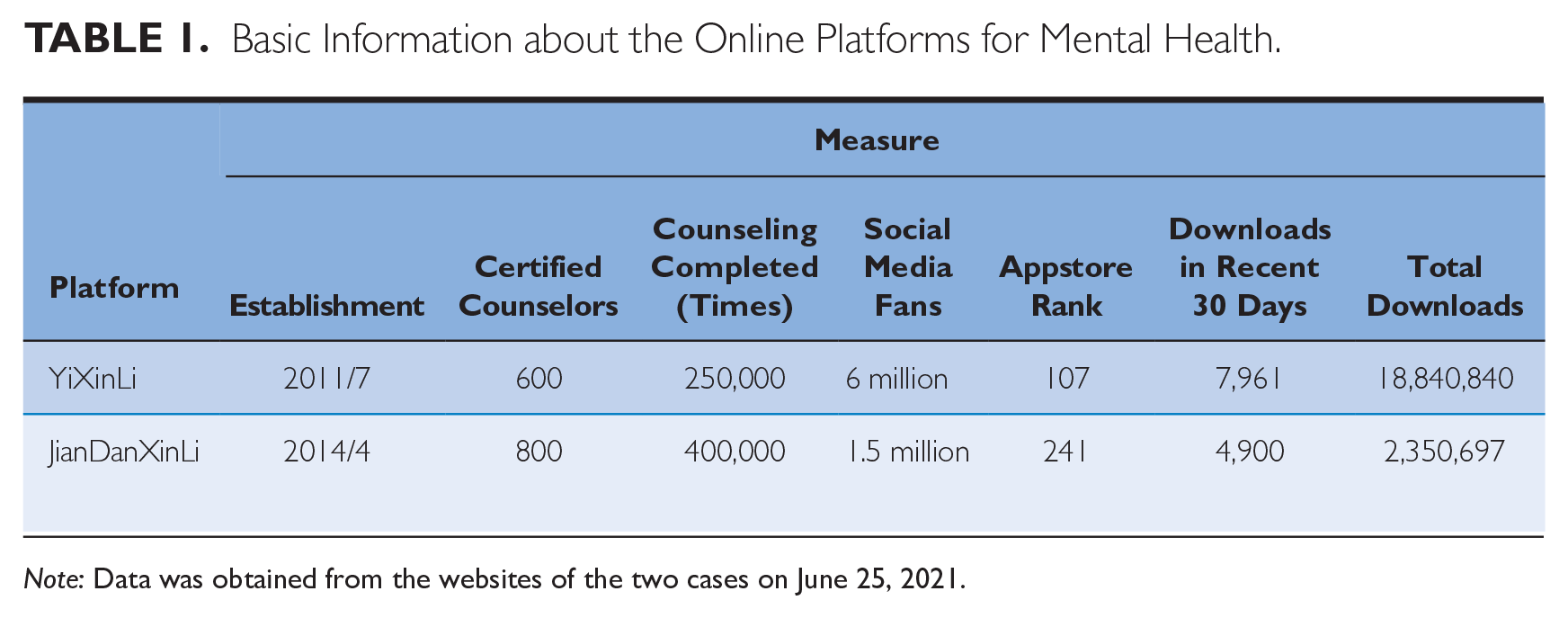
Note: Data was obtained from the websites of the two cases on June 25, 2021.
YiXinLi and JianDanXinLi do not have their own counselors but act as intermediary platforms that connect consumers with counselors. Counseling services, the core service on both OPMHs, are provided only by certified counselors that YiXinLi and JianDanXinLi select with strict criteria. Table 2 shows the specific requirements of the two cases for new applicants who want to be recognized by the two OPMHs.
Requirements on Applicants of the Two Online Platforms for Mental Health.
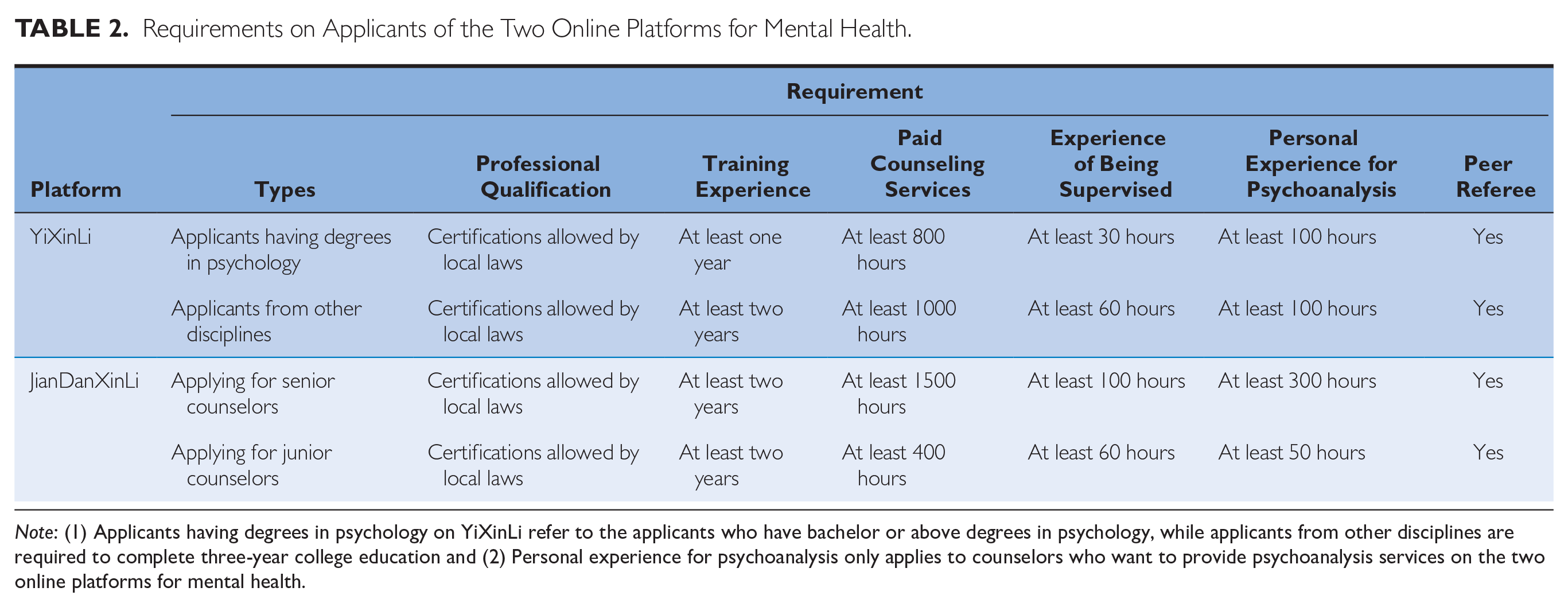
Note: (1) Applicants having degrees in psychology on YiXinLi refer to the applicants who have bachelor or above degrees in psychology, while applicants from other disciplines are required to complete three-year college education and (2) Personal experience for psychoanalysis only applies to counselors who want to provide psychoanalysis services on the two online platforms for mental health.
For those applicants who meet the abovementioned criteria in Table 2, the two OPMHs will organize a third-party interview. The two cases will recruit three established counselors to interview the applicants and re-check the applicants from a comprehensive perspective. According to the self-introductions by the two OPMHs, the pass rate of YiXinLi is about 2%, and JianDanXinLi promises that it only recognizes the top 1% of counselors in China. The two OPMHs aim to set the criteria of the online counseling industry, adopt these strict requirements to select high-rank counselors and provide high-quality counseling services, and in turn lead this emerging market in a promising direction.
In our qualitative empirical study, we collected data from four sources. First, we collected data from public media that reported news on the two platforms. Typical materials include news about industry trends, investments, crucial events, and reports. Second, we had eight in-person interviews with former key employees from the two OPMHs and industrial practitioners (e.g., former senior managers, key opinion leaders on online mental health services, and professional counselors), with every interview lasting more than an hour. Typical materials include their comments on the industry and the two cases. Third, we collected self-report data from the two cases. Typical materials include their self-introductions as well as opinions and presentations made by the top managers of the two OPMHs. Fourth, we collected secondary data from the two cases. Typical materials include the data generated by registered users’ online behaviors and comments. We collected data until September 2020.
We identified those materials and incorporated them according to the cross-check rule and our research aims. First, the two authors cross-checked the materials independently to avoid subjective errors. Second, we cross-checked the materials on the same event or topic from different sources to avoid biased reports. Third, we complemented the direct self-reported data from the two cases with secondary data we examined to develop a complete and precise image of the two cases. The two authors worked collaboratively and iteratively revised the results of the data analysis.
Services, Mechanisms, and Network Effects on OPMHs
Services on the Two OPMHs
We present the services provided on the two OPMHs in Table 3. As shown in Table 3, the two platforms provide similar services. The service scope covers both free services and paid services, and some services are even available without requiring registration, which are important to increase user scale. Furthermore, services on the two platforms target both consumers with mental health conditions and counselors or want-to-be counselors, which means that the two platforms not only attract the demand and the supply side, but also are dedicated to cultivating the supply side by themselves.
Services on the Two Online Platforms for Mental Health.
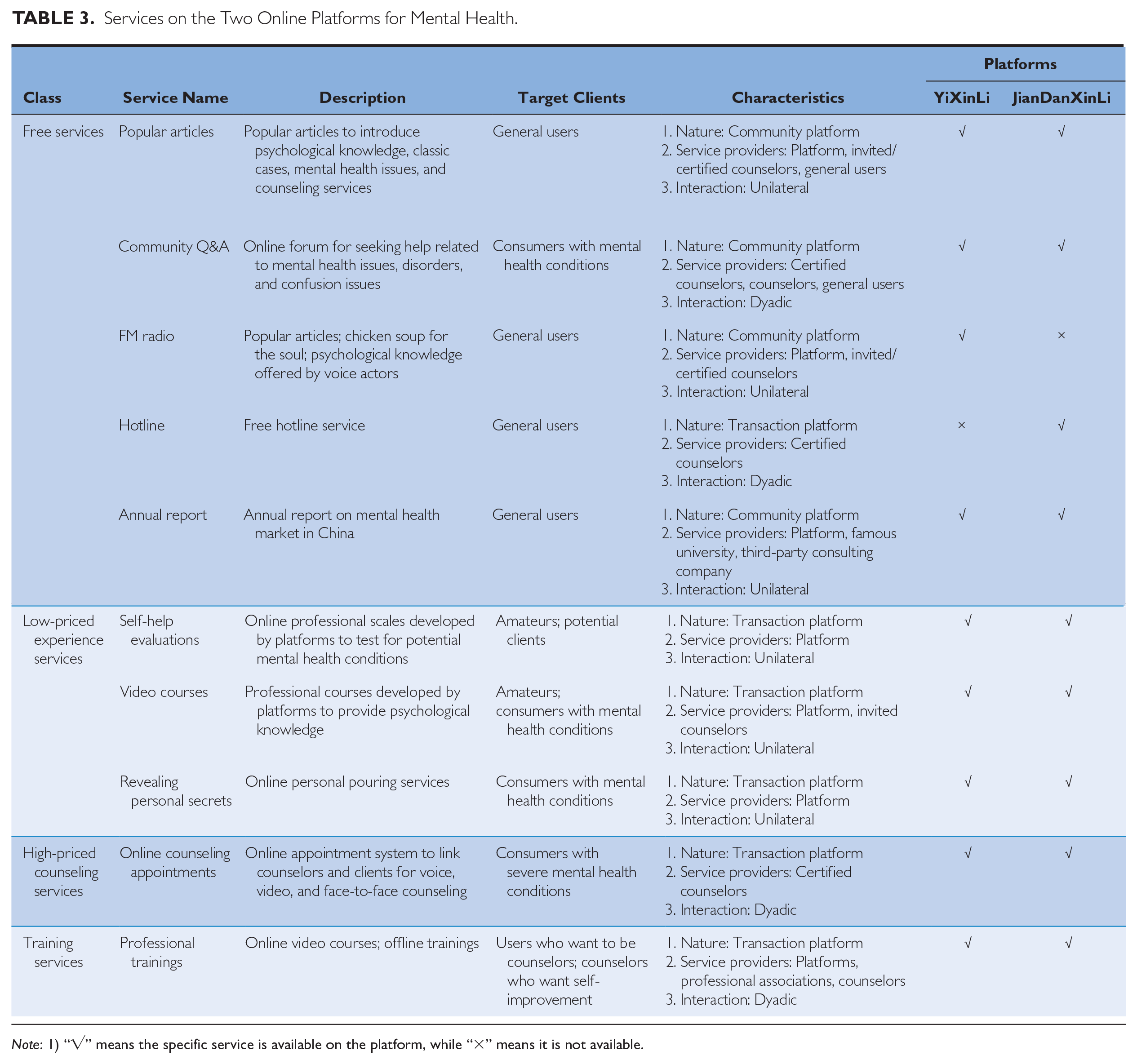
Note: 1) “√” means the specific service is available on the platform, while “×” means it is not available.
Free services
Free services on YiXinLi and JianDanXinLi include popular articles, community question-and-answer (Q&A), FM radio, a hotline, and an annual report. Most of them can be accessed without registration. As described in Table 3, OPMHs aim to provide users with high-quality knowledge on psychology, typical psychological cases, mental health issues, and counseling services. These free services are designed to educate the public and registered users.
Low-priced experience services
Both YiXinLi and JianDanXinLi provide low-priced services, such as self-help evaluations, video courses, and revealing personal secrets. These services are cheap (usually $3-20). As described in Table 3, OPMHs aim to provide registered users with affordable professional services and support them in self-evaluating their mental health state, taking professional courses, and engaging in talk therapy.
High-priced counseling services
Paid professional counseling services are the core service of OPMHs. There are three types of counseling services on OPMHs (i.e., voice, video, and face-to-face services) that can be provided online. The price is relatively expensive (usually $70-400 per hour). A session of counseling for a specific issue might be composed of six to 12 counseling appointments, depending on the severity of mental health conditions.
Training services
Training services are for professional career development. Unlike the aforementioned three types of services, those online or offline courses are designed for professional counselors or users who aim to be professional counselors.
Three Mechanisms of the Two OPMHs
YiXinLi and JianDanXinLi have taken various measures to manage their services. We have summarized them into six classes that include 33 specific mechanisms (see Table 4).
Mechanisms of the Two Online Platforms for Mental Health.
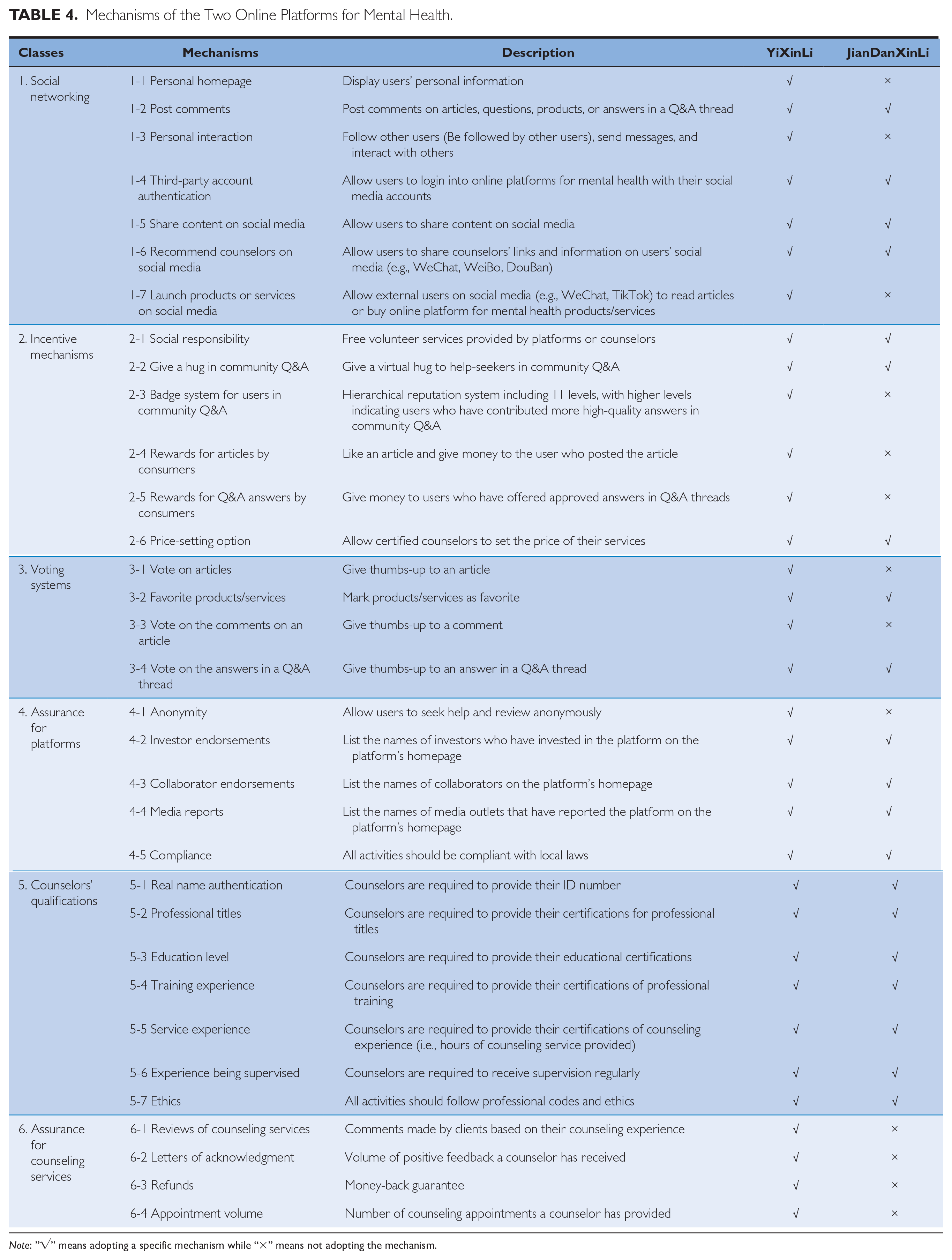
Note: ”√” means adopting a specific mechanism while “×” means not adopting the mechanism.
Social networking
The class “social networking” refers to mechanisms used to build and enhance social ties among different OPMH users or facilitate interaction between OPMHs and external social media. As shown in Table 4, three social networking mechanisms allow registered users to display their personal information by creating personal homepages, interact with OPMH resources by posting comments, and interact with other users through personal interaction features. Four social networking mechanisms broaden the scope of social networking by leveraging external social media. These four mechanisms can be directed from external social media to an OPMH (the mechanism of 1-4) or from an OPMH to external social media (the mechanism of 1-5 and 1-6) or can function totally within external social media (the mechanism of 1-7).
Both YiXinLi and JianDanXinLi highlight the role of social networking. YiXinLi has designed more social networking mechanisms than JianDanXinLi. For example, YiXinLi encourages its users to create personal homepages and conduct personal interactions, and the platform launches products/services on external social media (e.g., TikTok). Mechanism 1-1 and Mechanism 1-3 are beneficial for users to establish new social ties and interact with others and in turn promote user engagement and trust on online platforms. 21 Mechanism 1-7 enables YiXinLi to better leverage external social media to market its products/services.
Incentive mechanisms
The class “incentive mechanisms” includes intrinsic and extrinsic incentives employed to facilitate user engagement on OPMHs, especially in activities involving user-generated content (UGC). 22 As shown in Table 4, we have summarized three intrinsic incentives (i.e., social responsibility, giving a hug, and the badge system in the community Q&A) that motivate counselors or general users to provide content or services, and three extrinsic incentives (i.e., rewards for articles by consumers, rewards for Q&A answers by consumers, and a price-setting option for counselors) on the two OPMHs.
While both platforms emphasize incentive mechanisms, YiXinLi designs its incentive mechanisms for both counselors and consumers, while JianDanXinLi focuses more on counselors and aims to motivate counselors to provide quality counseling services. For example, YiXinLi has designed a reputation system to demonstrate users’ capabilities and provides monetary rewards for their contributions to the platform. The reputation system and monetary rewards are open to both counselors and consumers. In this way, YiXinLi reuses its consumer resources.
Voting systems
The class “voting systems” refers to evaluation mechanisms to recognize the quality of products/services or UGC on OPMHs. As shown in Table 4, we have summarized four voting system mechanisms on the two OPMHs. The voting behaviors are performed by independent users, and the relevant results are available to everyone, which signals to platform visitors and registered users that the content and services on the platform are trustworthy. 23 Furthermore, the voting systems can facilitate user involvement and engagement, which features self-reinforcement effects, that is, previous voting behaviors will bring more future voting behaviors. With the systems, a platform firm can not only activate users, but also enhance users’ trust.
Assurance for platforms
The class “assurance for platforms” refers to designing effective signals to enhance users’ confidence in OPMHs. Confidence is important as the competition among OPMHs is getting intensified in China. We have identified five mechanisms that can indicate that OPMHs have the ability to protect users’ privacy, gain recognition from collaborators, and obey local laws. The assurance mechanisms on the two platforms are very similar. Additionally, YiXinLi supports general users in asking for help or reviewing anonymously, which is beneficial for users’ free expression and self-protection. 24
Counselors’ qualifications
The class “counselors’ qualifications” refers to designing effective signals to indicate a counselor’s qualifications. As shown in Table 4, we have summarized seven specific mechanisms that signify a counselor’s qualifications. As the providers of core services on OPMHs, professional counselors are crucial to the quality of counseling services. Users’ trust in platforms or platform products/services often comes from their trust in counselors’ qualifications. Responsible and capable counselors can develop their reputation, which may produce positive spillover effects on other counselors on the same platform. The two platforms have the same mechanisms for verifying counselors’ qualifications.
Assurance for counseling services
The class “assurance for counseling services” refers to using effective signals to indicate the quality of counseling services. As shown in Table 4, YiXinLi has incorporated four review mechanisms commonly adopted in e-commerce and allows clients to give feedback on their actual experiences. JianDanXinLi, in contrast, does not have any mechanism to provide assurance for counseling services but relies completely on the assurance of the quality of the platform and counselors. Online health services are experience goods whose quality can only be truly confirmed by consuming or experiencing them. 25 As signals about the quality of counseling services might be helpful in attracting more clients and breeding trust, 26 it is worth considering whether online health platforms should incorporate such mechanisms as refunding.
Based on the abovementioned information, we have summarized a significant difference between YiXinLi and JianDanXinLi. As a pioneer, YiXinLi relies more on the mechanisms popular in e-commerce (e.g., personal home page, personal interaction, voting on services and comments, consumer reviews of counseling services, letters of acknowledgment, refunds, and appointment volume). It seems that YiXinLi wants to provide visitors and registered users with a familiar online setting and use these third-party signals to demonstrate that products/services on YiXinLi are credible. As a later entrant, JianDanXinLi focuses on mechanisms regarding the supply side. It seems that JianDanXinLi keeps persuading its visitors or registered users that JianDanXinLi only provides high-quality professional services and is trustworthy.
As shown in Table 4, there are significant differences between the two platforms that YiXinLi has designed several mechanisms (note: 1-1, 1-3, 1-7, 2-3, 2-4, 2-5, 3-1, 3-3, and 4-1 in Table 4) for common users while JianDanXinLi does not. The common characteristics of these mechanisms are that they are designed to activate users on YiXinLi. Namely, YiXinLi invests its resources into both counselors and users, while JianDanXinLi invests its resources mainly into counselors. Motivating which party (i.e., either providers or consumers, or both providers and consumers) is crucial for platforms to build cross-side effects. Startup platforms need to decide which party they should preferentially attract, especially when they want to efficiently use their limited resources to ignite network effects. This issue also applies to the two platforms in this study.
YiXinLi and JianDanXinLi faced different situations when they began their entrepreneurship. When YiXinLi started to provide online counseling in 2011, online counseling was nascent for both counselors and consumers. YiXinLi had to invest its resources into both counselors and consumers (e.g., using free or low-priced services to attract consumers and educating them on how online counseling is actionable and reliable). When JianDanXinLi began to provide online counseling in 2015, users in the online health market had been educated for several years and were more mature than the users four years earlier. A better strategy for JianDanXinLi to build cross-side effects is that the firm can focus more on the supply side and provide more high-quality services to attract consumers.
Deploying Mechanisms to Build Different Dimensions of Network Effects
Building network effects is crucial for OPMHs. In this section, we have summarized how YiXinLi and JianDanXinLi apply various mechanisms (see Table 4) to manage their platform services (see Table 3) and therefore build network effects (see Table 5). The logic behind Table 5 is that OPMHs can use different mechanisms to manage their products/services and thus achieve different dimensions of network effects. As noted in the introduction, network effects do not only involve size, but are also related to structure and conduct. 27 We include four dimensions (user scale, user roles, user engagement, and user trust) to describe network effects. 28 User scale represents the size of network effects; user roles and user engagement represent network diversity and intensity, respectively (two important indicators of the structure of network effects); and trust represents user conduct involved in network effects.
Mechanisms in Platform Services to Enhance Network Effects.
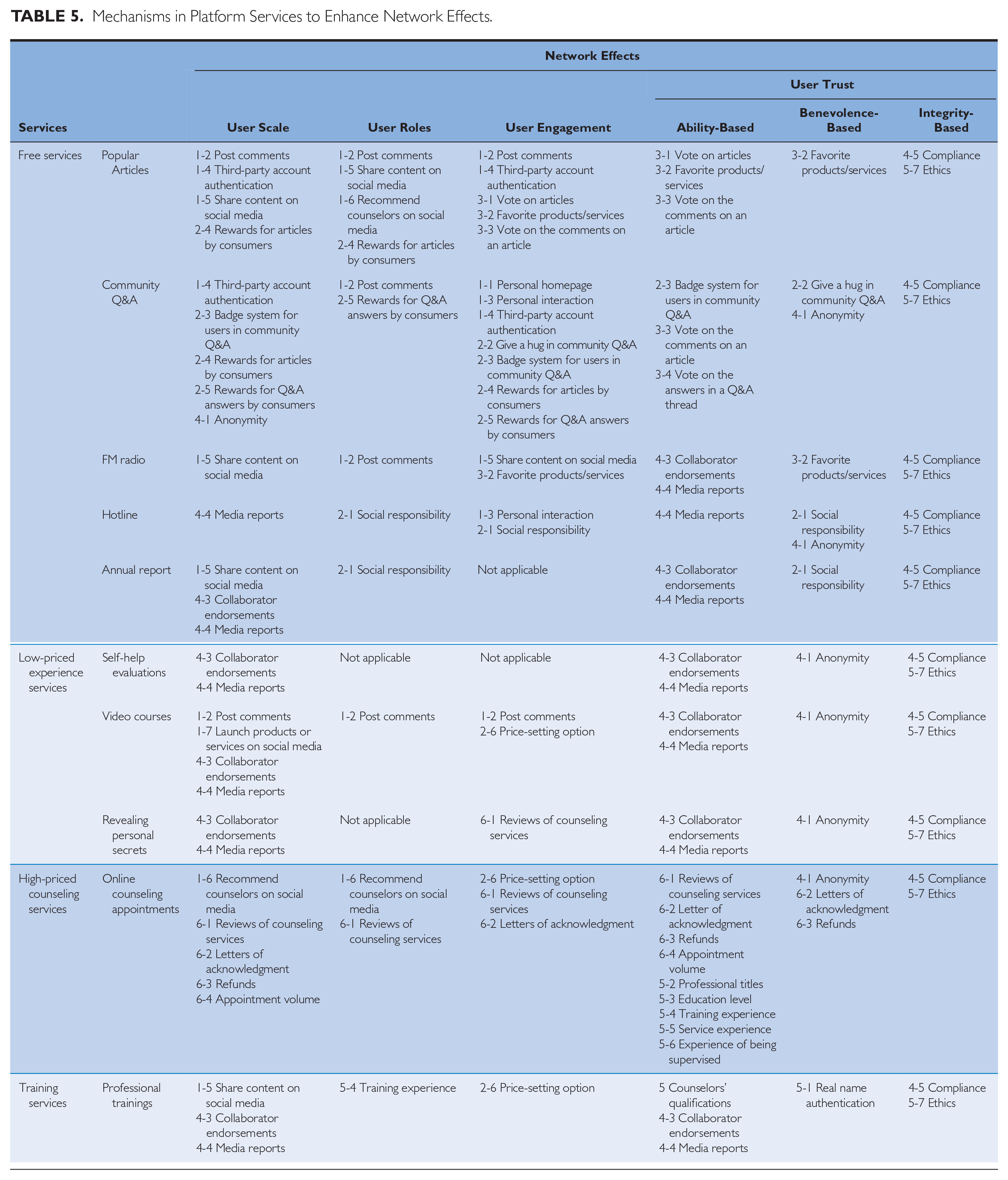
User scale represents the size of a platform’s demand-side and supply-side users. 29 OPMHs are hubs that link mental health-related resources and users. It is the nature of user interaction and the resources offered by user interaction that sustain online platforms. 30 Social networking is crucial for OPMHs to scale their users. As shown in Table 4, social networking is composed of the mechanisms both within (1-2, 1-3, 1-4) and outside a platform (1-5, 1-6, 1-7). Platforms can design monetary or non-monetary incentives to motivate potential users to become registered users. For example, visitors may become registered users if they have an interest in a specific OPMH product/service or are intrinsically motivated to answer a question, while professional counselors may register with an OPMH to build their online reputation and gain more clients. Assurance regarding platforms and counselors is beneficial for OPMHs to build positive images, which could help OPMHs build initial trust and attract more potential users. Assurance regarding counseling services delivers a powerful signal that the quality of service on OPMHs is high, reliable, and consistent.
We identified some interesting findings about the user scale of YiXinLi and JianDanXinLi. First, YiXinLi’s app boasts an installed base of about 20 million users, much larger than that of JianDanXinLi’s app (about six million users). However, the appointment volume of core services on YiXinLi is much smaller than that on JianDanXinLi. Second, YiXinLi has more fans on mass-market social networking apps such as Weibo and TikTok, while JianDanXinLi has more fans on niche-market social networking apps such as ZhiHu (an app similar to Quora in the United States). Mass-market social networking apps have much larger user scales than niche-market ones, which explains why YiXinLi has a large registered user scale. As mass-market social networking apps target all Internet users while niche-market ones (e.g., ZhiHu) usually focus on middle-class and well-educated customers, YiXinLi can grow its user scale in the whole market while JianDanXinLi grows its user scale within a market segment.
The number of user roles on an online platform represents the platform’s network diversity. 31 Users themselves are an important resource in platform-based markets. 32 They can play different roles with regard to different products or services on a platform. For example, a knowledge contributor in the community Q&A could also be a consumer of another service, like online courses, or a reviewer who comments on the platform’s content or services. The more roles a user has, the more links that user has with different resources or other users. Users with different roles therefore form diverse activity networks. For a platform, when users act with multiple roles, the platform has more opportunities to reuse its user resources to promote its various products or services at a lower cost.
User engagement represents the network intensity of an OPMH. User engagement can enhance the strength of ties among platform users, retain users on a platform, and lead to potential transactions. 33 In order to promote user engagement, the two OPMHs have adopted various mechanisms, such as providing social networking features, extrinsic incentives, and intrinsic incentives (see Table 5 for specific mechanisms). These mechanisms can facilitate user engagement by enabling or empowering users to implement social responsibility, make new social ties, help others, and earn monetary rewards. The above process tends to form a positive feedback loop between product/service providers and consumers. More specifically, high-quality content or products/services on OPMHs will cause first-order user engagement—that is, users will comment, review or vote on the products/services or share them on social media. In addition, OPMHs design mechanisms to assist user interactions, including social networking, incentives, voting systems, and assurance regarding counseling services. These mechanisms will produce second-order user engagement: Users will respond to comments, reviews, or votes on products and services. Good mechanism design can lead to the self-reinforcement of user engagement.
By comparing users’ roles and engagement on platforms, we find that although the two platforms have similar products/services, they manage these products/services with different mechanisms. YiXinLi employs more mechanisms to increase user roles and facilitate user engagement. For example, both platforms have a community Q&A, but their rules are quite different. YiXinLi allows both counselors and consumers to respond to questions asked by consumers, while JianDanXinLi allows only counselors to answer questions. The former also allows consumers to express their ideas and feelings on an article or a question, such as commenting on an article and marking a question as a “favorite.” Additionally, on YiXinLi, question-askers are encouraged to set monetary rewards for potential good answers that are evaluated based on votes, which is not an option on JianDanXinLi. Therefore, there are more knowledge contributors on YiXinLi, and the gap has become larger since December 16, 2018, when YiXinLi implemented the monetary reward mechanism (see Figure 1).
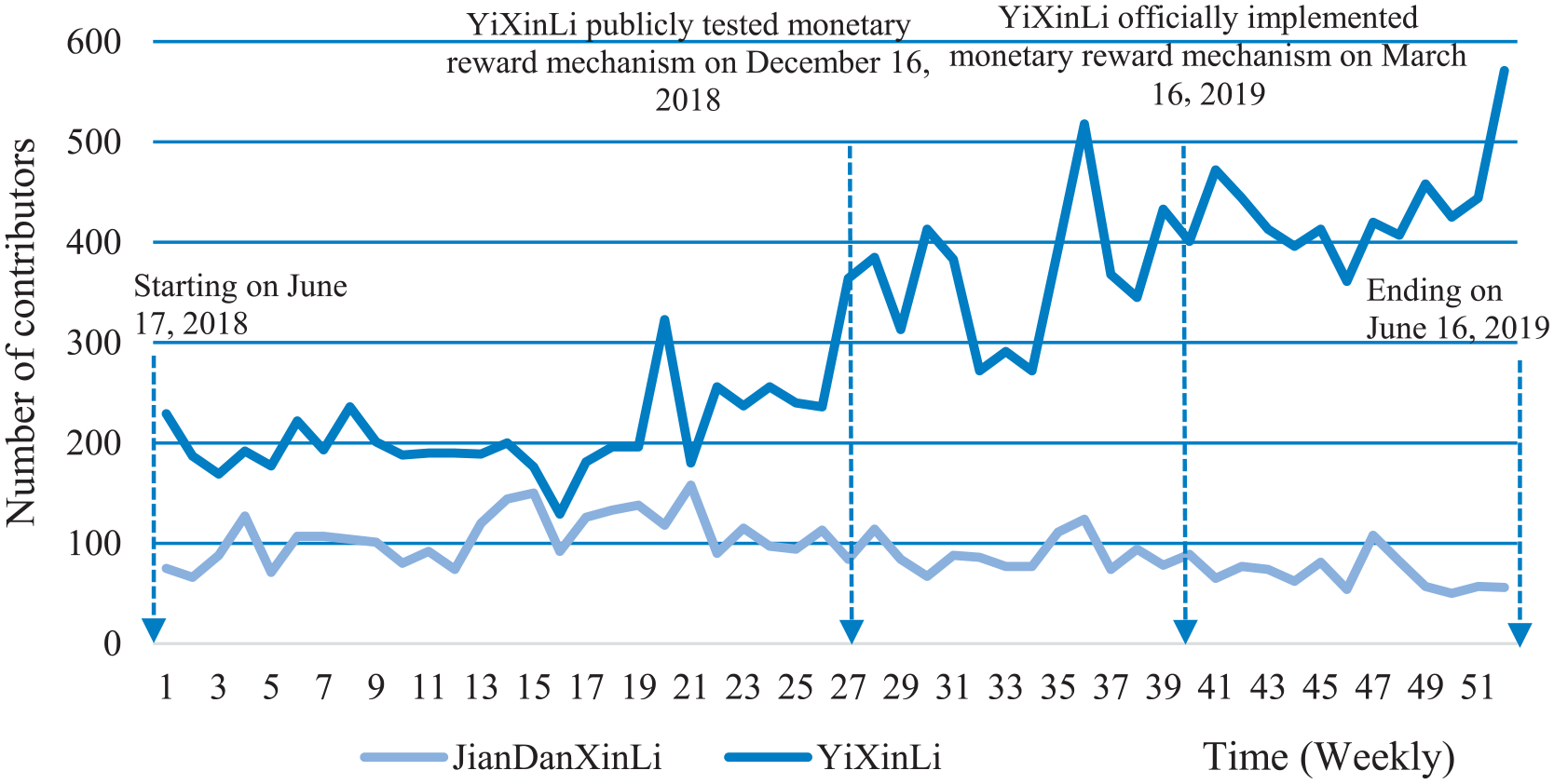
Number of contributors on YiXinLi and JianDanXinLi.
Besides monetary incentives, YiXinLi also motivates interactions using non-monetary incentives, including a badge system and virtual hugs. Meanwhile, the YiXinLi platform recommends consumers questions similar to the question they are viewing and sets a button for consumers to make a reservation with a counselor if a counselor answers a question. As shown in Table 4, YiXinLi adopts more mechanisms to facilitate interactions not only in Q&A, but also in counseling services. In this way, YiXinLi creates more scenarios for user interaction within one product/service, and connects one product/service with other products/services. For example, the Badge system for users in community Q&A, mechanism 2-3, allows consumers to see users’ reputations. Consumers are likely to directly ask a user with a high reputation a question, which creates user interaction within one service, or even consult a user with a high reputation if he/she is a counselor, which connects one service with other services.
Trust refers to making a trustor exposed in a vulnerable position that is under the control of a trustee with the belief that the trustee will not harm the trustor. 34 Vulnerability is the key characteristic of patients who reveal their personal information in order to seek health services. OPMHs need to take measures to promote user trust on the platform itself and with service providers because trust is a crucial antecedent to users’ online purchasing behaviors and is beneficial for platforms in monetizing network effects. 35 Like trust in traditional contexts, users’ trust in OPMHs is based on three dimensions of a trustee: ability, benevolence, and integrity. 36
At the platform level, the two OPMHs have adopted similar mechanisms for building trust. The two OPMHs have indicated their collaborators’ endorsements and media reports on their websites to show they are trustworthy. The two OPMHs have listed their courses, specific mental health symptoms, the school of counseling to which a counselor belongs, training experience, service price, and counselors’ fields of expertise to help users find the most suitable products/services. The two OPMHs also have demonstrated their benevolence by providing free products/services and respecting consumers’ privacy. Furthermore, the two OPMHs have indicated on their websites that the OPMHs themselves conform to local laws. For example, a counselor cannot provide online medical therapy according to local laws. The OPMHs clearly tell their potential consumers that both the platforms and their counselors provide counseling services instead of therapy. All the aforementioned mechanisms are helpful for users to build trust in OPMHs based on ability, benevolence, and integrity.
At the counselor level, the two OPMHs have adopted various mechanisms to regulate their counselors. In order to persuade consumers that counselors are trustworthy in terms of their capabilities, the two OPMHs clarify the specific process of how a counselor becomes certified. For example, the two OPMHs clearly tell their general users that all counselors have passed real-name authentication and that their professional titles, education level, training experience, service experience, and experience of being supervised have been verified.
However, the two platforms have different orientations in building trust. JianDanXinLi highlights supply-side credibility. For example, it displays a name card for every counselor on the counseling service interface and highlights its focus on high-quality counseling services on its “About Us” webpage. JianDanXinLi is a partner with the Faculty of Psychology of Beijing Normal University, the best psychology department in China, which directly endorses the firm and enhances the trustworthiness of its counselors. YiXinLi, on the other hand, tries to achieve a balance between third-party verification and supply-side qualification. In addition to supply-side qualification, YiXinLi has designed a review system that allows OPMH consumers to review platform products or counseling services and write counselors letters of acknowledgment. Via this third-party review system, YiXinLi supports its registered users in commenting on and communicating about nearly all its products/services. Future consumers on YiXinLi can therefore understand previous users’ actual counseling experiences and build ability-based trust in counselors. However, this third-party review system is not available on JianDanXinLi.
Building Network Effects in Different Ways
YiXinLi and JianDanXinLi have different positions in the online mental health market. YiXinLi aims at the whole market, including general consumers who may not have conditions but are interested in mental health knowledge and want mental growth. JianDanXinLi focuses on consumers with conditions. In comparison with general consumers, the population of consumers with conditions is small, but their desire for high-quality counseling is stronger.
The difference in market positions determines that the two firms give priority to different services. Although both firms provide free services, low-priced experience services, high-priced counseling services, and training services, the priorities of these services are different for the two firms. To serve the whole market, YiXinLi emphasizes free and low-priced experience services, which help to educate consumers. With free services, YiXinLi can attract a large number of consumers who pay attention to personal mental health. These consumers may not have mental health conditions, but they want to learn knowledge about mental health for themselves, relatives, or friends. With low-priced experienced services, consumers can have self-help evaluations, learn psychology courses online, and release negative emotions, which are suitable for users without conditions or with mild conditions. To better serve consumers with conditions and build a professional profile, JianDanXinLi focuses on maintaining a group of top-tier counselors and providing consumers with high-quality counseling services.
To develop different services, OPMHs should give priority to different dimensions of network effects. For example, free services highlight user scale, role, and engagement dimensions of network effects. Free services are not “free” as consumers have to spend time on these services. Users’ time and attention are scarce resources in the digital era. The more users adopt and use free services, the more valuable these free services are. A user can play the role of either a consumer or a producer in free services, which increases the supply and consumption of free services. User engagement with free services facilitates user interaction and may bring additional value to the platforms, for example, turning free users into paid users. Therefore, YiXinLi emphasizes that free services have to pay attention to user scale, roles, and engagement. High-priced counseling services highlight the trust dimension of network effects. Users are not willing to pay for counseling services if they doubt the ability, benevolence, and integrity of counselors. JianDanXinLi focuses on high-priced counseling services and must make more effort to build consumer trust.
Different dimensions of network effects can be built by different mechanism designs. Therefore, we present a logic chain from market positions, to platform services, to dimensions of network effects, and to mechanisms designed by the two OPMHs. The two firms have built network effects and designed mechanisms in different ways, which produces different outcomes for themselves and interested parties. Generally, YiXinLi has designed more mechanisms in terms of the classes of social networking, incentive, and voting systems, and therefore embraces a broader societal involvement. The platform has built resources around an online community by leveraging these mechanisms and then makes revenues from community users through selling content and services to consumers. YiXinLi has developed unique competences in organizing and operating an online community and transforming community users into consumers that purchase content and services. In comparison with YiXinLi’s great impact on the demand side, JianDanXinLi has a larger impact on the supply side. It has provided much more high-priced counseling services than YiXinLi. This shows that JianDanXinLi focuses more on core professional services and serves more consumers with conditions. As the two firms adopt different ways to build network effects, they monetize network effects in different ways. YiXinLi relies more on cashing in on consumers who have an interest in mental health and desire mental growth. In contrast, JianDanXinLi depends more on cashing in on consumers with conditions who demand high-quality counseling.
Managerial Implications
In the emerging online health care market, the primary issue is breaking the ice and scaling users on online health platforms. The healthcare industry is highly regulated worldwide, including regulations on the qualification of doctors and medical institutions, and the permission and business scope of online health services provided by hospitals. Stringent regulations reduce resource availability and mobility in an industry. Platforms cannot be built in a vacuum. The strength of multi-sided platforms is to attract different groups of users and orchestrate external resources. How to solve the problem of attracting and leveraging external resources is fundamental for establishing platforms in a highly regulated industry. Online platforms can gain some advantages over brick-and-mortar organizations in the mental health market that suffers from poor local demand and a lack of quality supply.
When building network effects in online healthcare platforms, platform firms have to think about three critical matters. The first matter for a platform firm is about how to position itself in a platform-based market. Just like a traditional firm in an industry, a platform firm should give priority to its position in a market. The position matter is even more remarkable as network effects may lead to the situation of winner-take-the-most. Finding a market segment where a platform firm can build its network effects is of primary importance, as it determines target customers and influences how to build network effects around the target customers. The second one is what service to provide. Platform services not only offer value for customers, but also provide scenarios for user interaction and engagement. In this line, platform services offer contexts where platform mechanisms play their roles. The third one is about the mechanisms designed in platform services. To build network effects based on platform services, platform firms should design mechanisms in light of users’ psychology and behavior. Meanwhile, the choice of mechanisms should be subject to position decisions. Mechanisms can increase user scale, improve network structure, and facilitate user trust.
Our research has managerial implications for these three matters.
First, where should an online health platform position itself? A distinct position is a prerequisite for an online health platform to scale its users in the emerging online health market. Because many hospitals and consumers still have doubts about online health services, pioneers in this emerging market need to pay attention to consumer education and cultivate their habits of using online health services. A pioneer platform firm can position itself as a comprehensive platform by targeting different market segments and providing diversified health services. To build and maintain their advantage, pioneer platforms can enhance their users’ loyalty by increasing the intensity and diversity of users’ networks, while later entrants should try to differentiate themselves from first-comers. For example, later entrants can establish an image of providing high-quality professional health services, focus on well-educated users, and promote themselves in a niche market.
Second, what services can an online health platform provide? Consulting with health professionals online will become the new normal due to the impacts of COVID-19. Companies, hospitals, health professionals, and consumers have to positively address the challenge of how to shift certain health-related services from offline to online. Specifically, health platforms and hospitals need to figure out which services they should provide online. They can learn from the actions of the two OPMHs, which provide core health services, low-priced experience services, and free professional services. Diversified services can satisfy different demands and be conducive to building network effects. For example, although free services cannot directly create revenue for online platforms or counselors, they help build a large installed base of consumers and solve the “chicken-and-egg” problem. 37
Third, what mechanisms can an online health platform design, and how can the platform use these mechanisms to operate its services? Online health platforms should understand that not only online health services, but also their mechanisms matter for building network effects. Designing and implementing appropriate mechanisms is crucial for entrepreneurs and managers to operate their online services. As the two OPMHs did, online health platforms should consider mechanisms such as social networking, incentive mechanisms, voting systems, assurance for platforms, counselors’ qualifications, and assurance for counseling services when they design and operate their online platforms.
Platform firms should think about the pros and cons of a specific mechanism when putting it into practice. For example, reviews of counseling services can be a double-edged sword. Although comments can sometimes enhance customers’ trust, they can also sometimes hurt customers’ trust if there are several negative comments, or they can lead customers to question the trustworthiness of the comments if there are few negative comments. It is difficult to judge the actual impact of reviews of counseling services on building network effects. In fact, we can see that JianDanXinLi has not adopted the mechanism of assurance regarding counselors’ services and has achieved more appointments than YiXinLi, which has adopted the mechanism.
Conclusion
Digital platforms provide possibilities for delivering mental health services online, which is especially useful in light of the COVID-19 pandemic’s impacts on traditional offline health services. However, as a type of emerging online market, online health platforms like OPMHs must confront the challenge of scaling their users and building network effects. Generally, OPMHs should carefully design and evolve their products/services to meet users’ various needs. Online health platforms also need to design different mechanisms to operate their products/services and therefore increase user scale, enrich user roles, enhance user engagement, and facilitate user trust in platforms and counselors. They can provide free products/services and use social networking and incentive mechanisms to spread professional health knowledge and increase user engagement with platform services and activities. Online health platforms like OPMHs should adopt various mechanisms to assure the quality of their products/services and lead more potential consumers to pay for products/services. In addition to products/services for consumers, OPMHs should play their roles as intermediaries in linking various counselors and organize their certified counselors to provide other counselors (especially junior counselors) with professional training. Due to the reputation and resources of OPMHs, these training services are helpful in attracting more counselors, helping them to improve their professional competence, and improving the quality of their counseling services in the future. Advancing counselors’ qualifications and careers can in turn facilitate the increase in consumers on the other side.
Footnotes
Funding
The author(s) received financial support for the research, authorship, and/or publication of this article: This work was supported by the National Social Science Foundation of China (Grant No. 21BGL033), Qing Lan Project for University Scholars of Jiangsu Province, Coordinated Innovation Base of Jiangsu Grass-root Social Governance Research, Guangdong Provincial Science and Technology Research Project (Grant No. 2019A101002110 and 2020ST079), Special Projects in Key Areas of Guangdong Provincial Department of Education (2021ZDZX3002), Open Foundation of STU Research Institute for Guangdong-Taiwan Business Cooperation, and STU Scientific Research Initiation Grant (Grant No. STF18011).
Notes
Author Biographies
Junjie Zhou is an associate professor of School of Business and a member of The Guangdong Provincial Institute for Xi Jinping Thought on Socialism with Chinese Characteristics for a New Era, both at Shantou University. (
Xing Wan is a professor of School of Business Administration at Nanjing University of Finance and Economics. He is also the corresponding author of this article. (