




Abstract
With the exception of few comparative case studies, the literature on regulatory reform and regulatory impact analysis (RIA) tends to focus on internal political actors, activities, and processes. Furthermore, empirical analyses of new public management have overlooked the dynamics of communications among networks of administrative reformers. This article fills these gaps, presenting results of an event history analysis on the diffusion of RIA. It probes rationales for the origin of RIA and administrative capacity explanations in combination with variables referring to international and transnational communication channels of administrative reforms. A hypothesis based on legal origin is also tested. The findings show that the decision to adopt RIA rests on transnational networks as well as administrative variables such as government expenditure and legal origin.
Many Western and European countries have introduced regulatory impact analysis (RIA), an administrative procedure requiring an economic appraisal of regulatory proposals according to their predictable effects. It has also become the cornerstone of better regulation initiatives and an integral part of the Lisbon Agenda for growth and jobs (Radaelli, 2007). As other impact assessments, RIA has been considered as “one of the major innovations in policy making and administration of the twentieth century” (Bartlett, 1989, p. 1), and its diffusion has followed an S-shaped pattern. Examining Figure 1, the adopter distribution rises slowly between 1971, when RIA was first adopted by the United States, and the mid-1990s: 9 out of the 38 members of the EU and the Organisation for Economic Co-operation and Development (OECD) sampled in this study adopted RIA. 1 The most rapid increases in the frequency of adoption occurred in two time intervals, that is, 1995–1999 and 2003–2006, in concomitance with the 1995 OECD recommendations on regulatory reform signed by ministers responsible for public administration (OECD, 1995) and the 2002 European Commission’s launch of the Integrated Impact Assessment system (European Commission, 2002). At the end of 2006, the last year of observation, only Cyprus, Luxembourg, and Malta had not adopted such an administrative requirement.
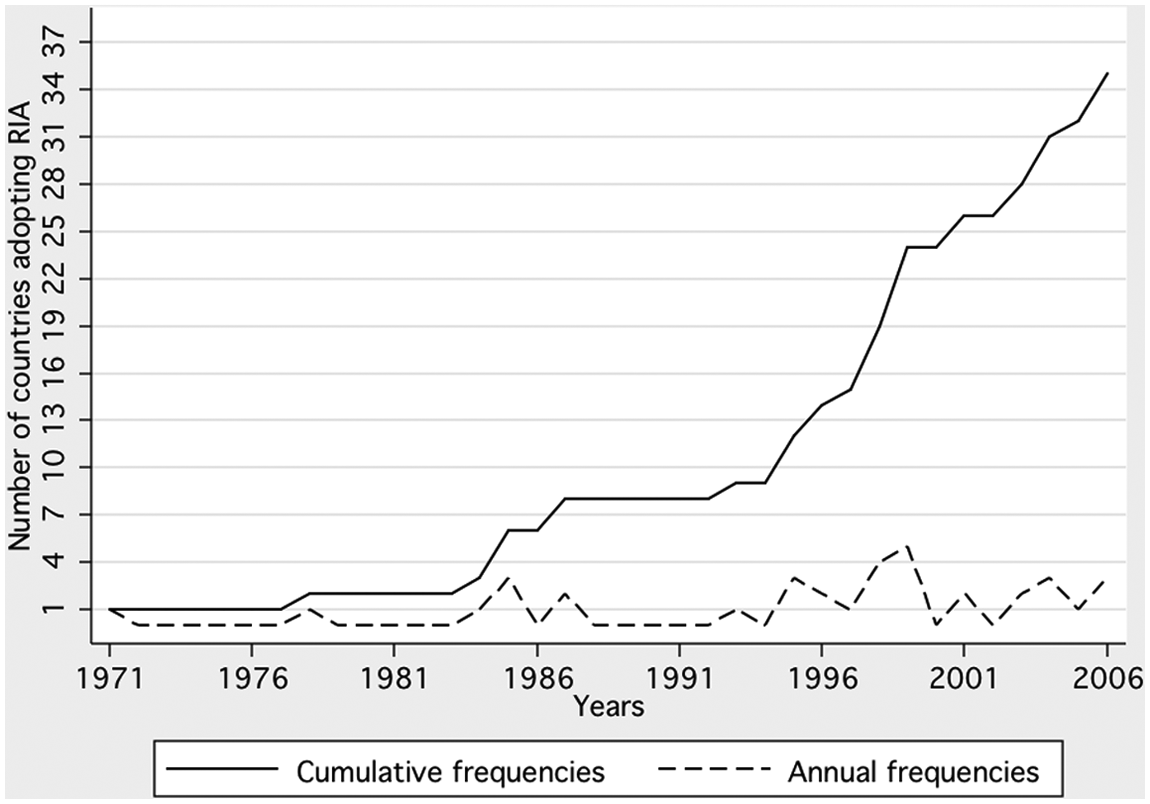
Cumulative and annual frequencies of regulatory impact analysis adoption
Notwithstanding its diffusion, there are only a handful of small-N case comparative studies on RIA (Radaelli, 2001; Renda, 2006; Weiner, 2006). Only recently, economists working at the OECD have attempted to systematize the available data on RIA systems, providing the first interesting patterns of the extent of implementation according to specific clusters of countries (Jacobzone, Bounds, Choi, & Miguet, 2007; Jacobzone, Choi, & Miguet, 2007; OECD Regulatory Policy Committee, 2009). On the other hand, there is relevant American academic literature explaining the emergence of the “cost–benefit state” (McGarity, 1991; Sunstein, 2002) and empirically testing the effect of RIA on the decision-making process (Johnston, 2002; Posner, 2001; Shapiro, 2005).
A recent study has associated better regulation and its different but overlapping agendas for enhancing business competitiveness as well as accountability and legitimacy of regulatory state with new public management (NPM; Radaelli & Meuwese, 2009), stressing the common purpose of increasing economic rationality by reforming the modes of administrative governance. 2 This connection of research strands allows scholars to appreciate that comparative analysis of RIA is still underdeveloped. Indeed, in comparison to the NPM literature, which has reached the stage of locating “the comparative analysis of public management policy within a relatively orthodox political science policy-process framework” (Hood & Peters, 2004, p. 268) also through the identification of paradoxes and surprises in administrative reform (Christensen & Lægreid, 2001; Hesse, Hood, & Peters, 2003), comparative analyses of RIA are still focusing on cross-national implementation differences.
But even research on the NPM movement has been able to conceptualize only the different causes for the processes of convergence, divergence, and differentiation. Despite the fact that the globalization of administrative reforms provides a great opportunity for deeply analytical comparisons, Lynn (2001) lamented that such research “too often consists of the accumulation of descriptive studies without an underlying analytic structure” (p. 204). Indeed, few empirical analyses have been conducted on the global spread of administrative reform (Bennett, 1997; Drori, Jang, & Meyer, 2006; Grigorescu, 2003; Lee & Strang, 2006; Peters, 1997). Relying on a theoretical framework that discerns how administrative innovations are communicated, this article assesses whether and how political control, rationality, and legitimacy of regulators are transformed, assuming different meanings in a context of a diffused administrative innovation. March and Olson (1983) exhorted the consideration of rational management reforms and political control of bureaucracy as two different rhetorics that are embedded in a broader environment. The “diffusion environment” of administrative reforms is nested inside an international communication system where reforms are communicated and ideas are contaminated via ideational transfer processes, or simply via catalysts such as communities of consultants and international organizations (Jones & Kettl, 2003; Radaelli & Meuwese, 2009; Sahlin-Andersson, 2001).
This article attempts to bridge the explanations of the origins of RIA with the theoretical approach that focuses on how reforms are communicated, transformed, and interpreted. The remainder of this article is structured as follows. The second section discusses the premises for the diffusion of RIA by summarizing strands of literature on administrative reform. The third section focuses on the different ways of communicating administrative reform, detailing the models of horizontal and vertical diffusion. The fourth section provides hypotheses for each level of analysis. The fifth section summarizes the empirical findings, and the sixth section concludes.
The State of the Art in the Literature of Administrative Reform and New Public Management
Because of their considerable size and hierarchical structure, public administrations are stable organizations, not easily permeated by environmental pressures. However, since the 1970s, administrative reforms among Western governments have become a constant, autonomous, and planned policy (Cassese, 2003, p. 128; Lynn, 2001) and have gained a prominent position on the political agenda (Cassese & Savino, 2005, p. 3; also see March & Olson, 1983, on the evolution of administrative reorganizations in the United States). Institutionalized in a specific department or ministry, neoliberal political agendas have imposed market discipline on administrative agencies and enhanced direct participation or representation of citizens in decision making (Ansell & Gingrich, 2003, p. 164). Financial crisis, dissatisfaction with public sector’s performance, and technological and managerial innovations are the main drivers of administrative reform (Cassese, 2003, p. 130). The combination of these change factors originated a new “professional paradigm” (Gow & Dufour, 2000, p. 583). The NPM movement encompasses management activities but also a new established discipline, constructed against the traditional Weberian public administration (Gow & Dufour, 2000, p. 578). NPM is composed of several elements or techniques for introducing market logic into public organizations, for example, agencification, process reengineering, value for money, result-oriented budget, privatization, public–private partnership, contracting out, and customer orientation (Cassese, 2003, pp. 131-132; Gow & Dufour, 2000, p. 579, citing Osborne & Gaebler, 1993). This new mode of public management has now become a “global innovation” (Karmack, 2004), a “global trend” (Sahlin-Andersson, 2001, p. 43; also see Ansell & Gingrich, 2003, on the diffusion of administrative reform among OECD member states), and “the gold standard” for administrative reforms (Peters, 1997, p. 71).
Scholars have disputed on the results of the global spread of administrative reform and NPM. On one hand, scholars (especially administrative lawyers and scholars of public policy and public management) tend to agree that internal characteristics of public administrations explain the persistence of the different modalities of adoption and implementation (Cassese, 2003; Page, 2003; Peters, 1997; Pollitt & Bouckaert, 2004). The initial conditions of reformers are different in terms of efficiency, legal and constitutional frameworks (Cassese, 2003, p. 135), and administrative culture—identified by families of nations or state traditions (Peters, 1997). Administrative reforms and innovations are composed of several programs, interlinked and integrated with other reforms (Cassese, 2003, p. 135). Accordingly, administrative change is more probable in those countries (especially members of the OECD) that have already developed patterns of administrative reforms (Drori et al., 2006, p. 219).
Other institutionalist scholars, on the other hand, have emphasized the strengths of external sources and institutions affecting public organizations and leading to homogenization. Change is explained through the national linkages to the “world society” (Meyer, Boli, Thomas, & Ramirez, 1997). In particular, the worldwide spread of reforms aimed at rationalizing administrative governance, although through different and divergent patterns, has been proved to be related to economic and trade openness, transnational institutional linkages, and the extent of scientification (Drori et al., 2006). These global trends are embedded in management ideologies such as standardization and accountability, facilitated by various global players—such as professional groups, businesses, civil society organizations, and world powers—over time and across countries (Sahlin-Andersson & Engwall, 2002). Administrative reforms are often edited in more logically coherent modalities and packaged together by international organizations to facilitate their adoption (Hironaka, 2002, p. 67; Sahlin-Andersson, 2001; Strang & Meyer, 1993). Government agencies may be more vulnerable to isomorphic pressures than private profit and nonprofit organizations, and coercive and normative pressures can even further reinforce the “reinventing government” movement (Frumkin & Galaskiewicz, 2004, p. 304). Aspects of elite socialization have also emerged within international organizations, affecting national government decision processes and outcomes (Bearce & Bondanella, 2007).
Overall, national differences still persist notwithstanding the global and institutional pressures. An administrative culture prevents the transfer of administrative reform, limiting the extent of organizational learning (Peters, 1997). Moreover, even in the context of Europeanization, there is evidence that the transfer of administrative reform follows decision-based patterns, such as lesson drawing and “polydiffusion,” rather than coercion and imitation of models that are imported whole cloth, denoting nonchoice behaviors (Page, 2003, p. 175). 3 Accordingly, scholars have attempted to combine internal determinants and diffusion explanations in their analysis of the spread of administrative reforms.
American scholars were the first to analyze such phenomena among municipalities and states. Tolbert and Zucker (1983) tested different internal determinants of civil service innovations among American councils, within a time span between 1880 and 1935, split into four different periods. Internal organizational factors explained adoption of administrative reforms at the beginning of the diffusion process, whereas they assumed that external and legitimacy factors were impetus for the later adopters (Tolbert & Zucker, 1983, p. 35). Knoke (1982), on the other hand, emphasized how the neighboring model, together with the poor economic conditions of cities, affected the adoption of municipal commission and managerial structures between 1900 and the Second World War. He remarked that a better diffusion model encompassing communication flows among networks as well as the professionalization of municipal administrations was necessary (Knoke, 1982, p. 1337). In the same vein, Berry (1994) found evidence of the impact of neighbor effects on the diffusion of strategic planning among American states. The probability of adoption depended on the level of resource slack, the size of government, and increases in the first year of the incumbent governor. Berry concluded by remarking on the difference between policy innovations and administrative innovations. In the latter, bureaucrats enjoy more freedom in the decision to adopt an innovation. Accordingly, models of administrative innovation, rather than focusing on spatial influences, should account for managers’ attributes and attitudes, and, consequently, an analysis of the interaction and communication among state officials across national networks is deemed essential (Berry, 1994, p. 328).
More recently, studies on the global spread of administrative reform have emerged. Combining soft statistical analyses and qualitative evidence, Bennett (1997) argued that prerequisites and diffusion explanations of freedom of information acts (FOIA), ombudsmen, and data protection legislation were related to peculiar elements of each administrative innovation. To explain the pattern of adoption, one needs to discern how a specific innovation is communicated and to assess the motivations for learning and emulating (Bennett, 1997, p. 229). Grigorescu (2003) explained instead the diffusion of FOIA through measures of the “interconnectivity” between international organizations and the domestic civil society. He found that a surge of information from international organizations alters the incentive structure of domestic policy makers and increases the probability that a national government will strengthen transparency. Scientific communities and international organizations have also legitimized and endorsed the adoption of environment appraisal system (Hironaka, 2002, p. 71). Through a sophisticated analysis, Lee and Strang (2006) linked spatial models and economic interactions with diffusion causal mechanisms (emulation, competition, and learning) for the downsizing of public sector among OECD member states. They found that external influences were particularly strong between neighbors and countries that trade extensively as well as among trading partners of the United States, suggesting process of emulation linked to information flow and cultural similarity, but little evidence was found of competitively driven influence between trade rivals and vicarious learning (Lee & Strang, 2006, p. 903). Their research went further, indicating that contagion effects appeared only for downsizing initiatives since proximity to upsizers does not promote upsizing. Lee and Strang explained such asymmetry through the neoliberal policy discourse dominant in the 1980s and 1990s. They argued that socially legitimated innovations are highly contagious because diffusion mechanisms such as learning and emulation are theory driven.
An Integrated Model of Global Administrative Reform
The research agenda identified by Knoke, Berry, Bennett, and Lee and Strang draws attention to the dynamics of communication among networks of administrative reformers. Policy diffusion appears to be driven not by a process of blind imitation but by a professionally driven dynamic in which policy experts select and codify best practices, models, and templates of administrative reform (Lee & Strang, 2006, p. 905). Before moving to these aspects, it is worth noting that theoretical frameworks have been proposed to enhance comparative analyses on administrative changes and reforms.
Welch and Wong (2001) presented a model for accounting interactions between the external forces for and the internal forces against administrative reforms. External pressures are exerted by formal and informal global institutions and complement the already-mentioned common and global economic and political pressures. The domestic economic, political, and social environments mediate such global pressures. This distinction, however, should not be overemphasized. Organizations tend to create internal institutions, structural components within organizations that mediate the relationship between organizations and their environment (Dobbin, Edelman, Meyer, Scott, & Swidler, 1988, pp. 77-78). Such a governance structure is an intervening variable in the analysis of administrative change inasmuch it is shaped by both organizational and environmental forces. Checkel (1999, p. 88), for instance, modulated diffusion in four different modes according to the organizational structure. International norms and institutional forces are channeled through nonstate actors, policy networks, and the state-above-society structure, where elite learning is necessary if international norms are to be empowered domestically. 4 Between these two extremes, there are middle-ground mechanisms of diffusion: the so-called “corporatist domestic structure,” in which the societal pressure on elites is primary and the learning is secondary, and the “statist structure,” featuring predominant elite learning and complementary societal pressures.
Furthermore, as March and Olson (1983) emphasized, rational management and political control, the predominant rationales for adopting administrative reorganization, are different but not mutually exclusive rhetorics—forming overlapping agendas (Ansell & Gingrich, 2003). Symbols, legitimacy values, interpretations, and construction of meanings as well as decision making and efficient allocation of resources are heavily intertwined, and a discussion of explanatory primacy may obscure the reality (March & Olson, 1983, p. 292).
These two theoretical insights (mediation of global pressures through domestic institutions and the construction of meanings associated with administrative reform) have been exploited by Sahlin-Andersson (2001) in her framework for accounting the diffusion of NPM. Starting from the consideration that NPM-style administrative reforms have spread globally, she argues that the problem with the actual literature is its focus on either external sources or domestic contexts of administrative using a single case approach or a limited set of countries. In other words, what is still missing is the recognition of whether administrative reform in a country is part of a global trend and interdependent to prior choices of other countries (Sahlin-Andersson, 2001, pp. 44-45). She has identified three modalities of forming global trends, that is, nationally, internationally, and transnationally, which are likely to be combined, albeit with varying emphases, making it difficult to distinguish them empirically (Sahlin-Andersson, 2001, p. 46). 5 This section has already reviewed the nationally formed trend. Hence, the following section focuses on the international and transnational trends.
Internationally and Transnationally Formed Trends
International and transnational explanations of global trends are based on flows of information about administrative innovations and reforms. Environmental uncertainty is faced by organizations and governments through a process of imitation (DiMaggio & Powell, 1983) that relies on cognitive shortcuts since there is no universal model of administrative reform and homogenization. Administrative innovations are introduced thanks to their technological and operational elements rather than their theoretical paradigm (Power, 1997; Sahlin-Andersson, 2001, p. 52), and, as a consequence, institutional conditions for diffusion (Strang & Meyer, 1993) are absent (Gow & Dufour, 2000; Hood, 1995). Indeed, RIA is not a precise model but an administrative principle based on different methodological approaches: from a full cost–benefit analysis, comprehensive of risk analysis, to a more limited compliance cost assessment; from an appraisal of administrative burdens to a simple checklist for regulators.
In a manner similar to March and Olson (1983), Sahlin-Andersson (2001) highlights the fact that “what is spreading is not practice as such, but accounts of this practice” (p. 54). As a consequence, rhetorics, symbols, and interpretations of administrative reform matter. “The distance between the supposed source of the model and the imitating actor provides scope for translating, filling in or editing the model in various ways” (Sahlin-Andersson, 2001, p. 54). Specifically, such an editing process leads to discharging the contextual (in terms of political ideology, administrative connotations, and economic and cultural aspects) and time dimensions with the intent to generalize and usefully implement the innovators’ experiences in every country. The logic and rationale behind the origin of innovation “may acquire a more rationalistic flavor. Causes and effects tend to be clarified, effects are presented as resulting from identifiable activities, and processes are often described as following a problem-solving logic” (Sahlin-Andersson, 2001, p. 56).
Administrative reforms are communicated and presented from one source to another in different manners. The internationally formed trend refers to the interconnectedness of governments and among national reformers (Sahlin-Andersson, 2001). The idea is straightforward: Governments and their elites communicate and interact, exchanging ideas, solutions, and experiences. Such a communication process relies on cues such as the geographical proximity to previous adopters, the extent of trade openness of a given country, and the economic influence of the pioneer. Thus, there may be predictable patterns of diffusion.
The transnationally formed public management reforms concern the presence and role of change agents and mediators such as international organizations, consultants, and epistemic communities. International organizations are important editors of ideas and experiences. They collect data to compare and benchmark member states. The peculiar contexts and experience of administrative reforms are inserted into broader theoretical frameworks with the aim of putting forward normative accounts and recommendations (Sahlin-Andersson, 2001, p. 61). In particular, the OECD has mediative and inquisitive functions (Mahon & McBride, 2009). Mediative functions refer to those activities that facilitate the construction of policy discussion among experts on the best policy solutions. Throughout their networks, international organizations are particularly capable of attracting the attention of national policy makers to administrative innovations through a process of packaging, theorization, and positive feedback. Inquisitive functions involve monitoring of policy choices and outcomes through benchmarking and peer review, which allow the auditing, comparison, and ranking of member states (Mahon & McBride, 2009, p. 89). Accordingly, reform initiatives are promoted by designing and disseminating templates and prototypes of innovations and reforms.
This theoretical model is comprehensive and integrates internal and external determinants of reform as well as the horizontal and vertical dimensions of diffusion. Following Berry and Knoke’s recommendations, it takes into account policy networks. Empirically, however, this model has rarely been tested either in qualitative or quantitative analyses. The challenge of this theoretical model in a large-N comparative analysis is to operationalize the different typologies of global trends, relying also on qualitative evidence for reconstructing the process of communication and interaction among international and transnational networks.
Hypotheses of RIA Adoption and Levels of Analysis
To capture the diffusion patterns of RIA, Sahlin-Andersson’s framework with three layers of explanation is appropriate. 6 Starting from the internal determinants, several hypotheses can be formulated. The first hypothesis concerns the adopter’s rationality and institutional capacity. Adopting innovation is a process developed from a public organization’s accumulated stock of knowledge and skills (Boyne, Gould-Williams, Law, & Walker, 2005, p. 423). This rationalist and functionalist perspective regards innovations as interconnected, contingent, and complementary, following predictable patterns of adoption. “Past experience and the cumulative stream of innovation will aid the process of innovation adoption” (Boyne et al., 2005, p. 423). Accordingly, RIA may be predicted to be adopted only after other administrative innovations, such as environmental impact assessment (EIA) and FOIA, considered as prerequisites for the adoption of RIA.
Hypothesis 1: Previous adoptions of EIA and FOIA increase the likelihood of adopting RIA.
The second hypothesis regarding a nationally formed trend refers to the concept of administrative and economic complexity. As Bennett (1997) put it, the increasing complexity of modern systems requires a rational administrative system so as to enhance capacity and efficiency. To do so, administrative management needs to be based on supervision and control and the standardization of procedures. RIA is an instrument of information that facilitates the political control of the bureaucracy. The greater the complexity and size of economy and government, the greater the necessity to enhance the flows of information and strengthen the political control, solving all sorts of problems that involve transaction costs.
Hypothesis 2: The greater the economic wealth and the size of government, the higher the likelihood of RIA adoption.
Finally, the third national-level hypothesis is about the extent of a government’s accountability since the main purpose of administrative law is to strengthen the development of liberal democracy. Accordingly, new control mechanisms are necessary to keep the expanded executive institutions accountable to citizens and parliaments. Peters (1992, p. 212) argues that administrative culture and state tradition “play a role in defining the way in which administration is conducted, and the receptivity of the administrative system to change” (p. 78). How can one conceive external accountability and administrative culture? Regulators’ external accountability refers to the regulatory review process. There are different modalities in which government regulations are scrutinized for their quality and lawfulness. For instance, in the United States and South Korea, administrative procedure acts empower courts to review rule making. In common law countries, on the other hand, the control on delegated legislation is conducted directly by dedicated parliamentary committees. Civil law countries rely instead on the consultation of independent constitutional body such as the council of state. In Germany, there is a minimal ex post regulatory review. One may expect that the type and the extent of external accountability have an impact on the likelihood of adopting RIA. Because of the lack of data on the all sample countries regarding the different modalities of regulatory review, the categorical variable of “legal origin”—used by La Porta, de Silanes, Shleifer, and Vishny (1999) as a determinant of countries’ economic performance—would probe the hypothesis of common administrative culture.
Hypothesis 3: English and Scandinavian legal origin countries are more likely to adopt RIA than French and German legal origin countries.
Turning to the international formed explanations and modalities of horizontal, country-to-country information exchange, an operationalization is necessary to appreciate whether the idea of RIA has traveled from the United States, the pioneer country. Adversarial modes of policy formulation are composed of complex transparency and disclosure requirements such as public notice and comment, open hearing, ex parte contacts, evidentiary standards, and formal response to interest group arguments (Kagan, 1991, p. 374). Kelemen and Sibbitt (2004, pp. 104-105) have argued that U.S. law firms played a significant catalytic role by exporting American approaches to law and regulation to foreign jurisdictions. They showed that between 1985 and 1999, the number of offices of American law firms in Western Europe more than doubled, benefitting also from the EU’s single market service liberalization (Kelemen, 2010). 7 This surge was mainly driven by the presence of American multinational firms in Europe (Kelemen & Sibbitt, 2004, p. 113), which have also directly hired U.S. lawyers (DeLisle, 1999, p. 207). A one-year lag (to take into account problems of endogeneity) of the stock of U.S. foreign direct investment (FDI) is used here as a broader measure of the extent of influence from the United States in a given country to import RIA as an American-style administrative requirement.
Hypothesis 4: The higher the stock of FDI from the United States in a given country, the higher the likelihood of adopting RIA.
Another horizontal diffusion explanation is based on economic internationalization (Garrett, 1995, 1998), which compels national policy makers to react to the global conditions of markets rather than consciously assessing policy options (Dobbin, Simmons, & Garrett, 2007). Specifically, the impact of the increased trade competition on national policies is reflected in deregulatory initiatives. Regulatory costs related to unnecessary and unduly costly regulations are implicit taxes on producers decreasing the overall competitiveness of a country. RIA is interpreted by national reformers as an instrument to curb the excessive burdens on firms. A one-year lag of trade openness captures the country’s position within international trade networks (Drori et al., 2006, p. 214) and indicates the extent of international pressures for rationalizing regulatory governance.
Hypothesis 5: The higher the trade openness of a country, the higher the likelihood of adopting RIA.
A spatial diffusion perspective would reveal that the probability of adoption decreases with the distance away from the previous adopters. Specifically, such a remoteness would cause smaller volumes of information and weaker awareness of the innovation, and, consequently, its later adoption (Meir, 1989, pp. 57-58). As Gleditsch and Ward (2001) put it, “Distance is widely acknowledged to be a primary force shaping the opportunity for interaction among states in the international system” (p. 739). The opportunity to interact declines the greater the distance between countries. In other words, geographical proximity may be a substantial variable for linking countries “by using the value of their dependent variable as an independent variable for the focus country” (Jahn, 2006, pp. 410-411). Furthermore, the inclusion of spatial variables in a fully specified model allows one to isolate purely spatial explanations from the other informational influences (Simmons & Elkins, 2004, p. 181). The distances among capital cities constitute the most appropriate measure for reformers’ interaction. Accordingly, a symmetric connectivity matrix of distances weights the adoption of countries with closer capitals more heavily than countries with more distant capitals. Each value of the connectivity matrix has been inverted and row standardized for deriving a spatial lag, which is the product of the one-year lagged dichotomic variable of the existence of RIA and the standardized connectivity matrix for each year.
Hypothesis 6: The closer a given country is to previous adopter, the higher the likelihood of adopting RIA.
Finally, the transnationally formed hypotheses refer to mediators and editors of reforms, such as the OECD, which since 1995 has been active in the promotion and dissemination of RIA and better regulation tools. 8 The OECD has a series of mechanisms to promote the adoption of administrative innovations, that is, technical assistance, reports on institutional framework, and training. The first hypothesis to test is the role of the OECD in transferring knowledge on administrative reform, also beyond its members (Mahon & McBride, 2009). SIGMA is a partnership project between the OECD and the European Commission that provides funds to the new EU member states. It was launched in 1992 to help countries in Central and Eastern Europe modernize their public governance, but it was extended to support EU candidate administrations as well as European Neighbors and Partners. Since 1996, this project has been promoting RIA (OECD, 1997a, 1997b, 1997c). Networks of national experts have also been active within the European Union. A group of Directors and Experts on Better Regulation (DEBR) was established in 1999 with “[t]he overall mandate . . . to promote and monitor progress on Better Regulation amongst Member States and to share experience and best practice (with the new Member States in particular)” (Allio, 2008, p. 53). The DEBR meets twice a year and is usually chaired by the state holding the entering presidency of the EU.
Hypothesis 7: Since 1995, the longer a country participates in one of the OECD, EU, or SIGMA networks of experts on regulatory reform, the higher the likelihood of adoption of RIA.
The OECD and SIGMA have published peer-review reports on countries’ progress in this specific political economy. The process is a naming-and-shaming mechanism, even if the report is approved by the member state under review. One can predict that a member state, to be considered smart, innovative, and legitimate among its peers, will adopt RIA in the 3 years immediately before and after the publication of the report.
Hypothesis 8: An OECD or SIGMA member state is more likely to adopt RIA 3 years before and after the publication of the OECD’s regulatory reform report.
Table 1 summarizes the models with variables associated with each hypothesis that have been tested via an event history analysis (EHA) as well as the descriptive statistics and data sources.
Models of Diffusion of RIA, Descriptive Statistics, and Data Sources
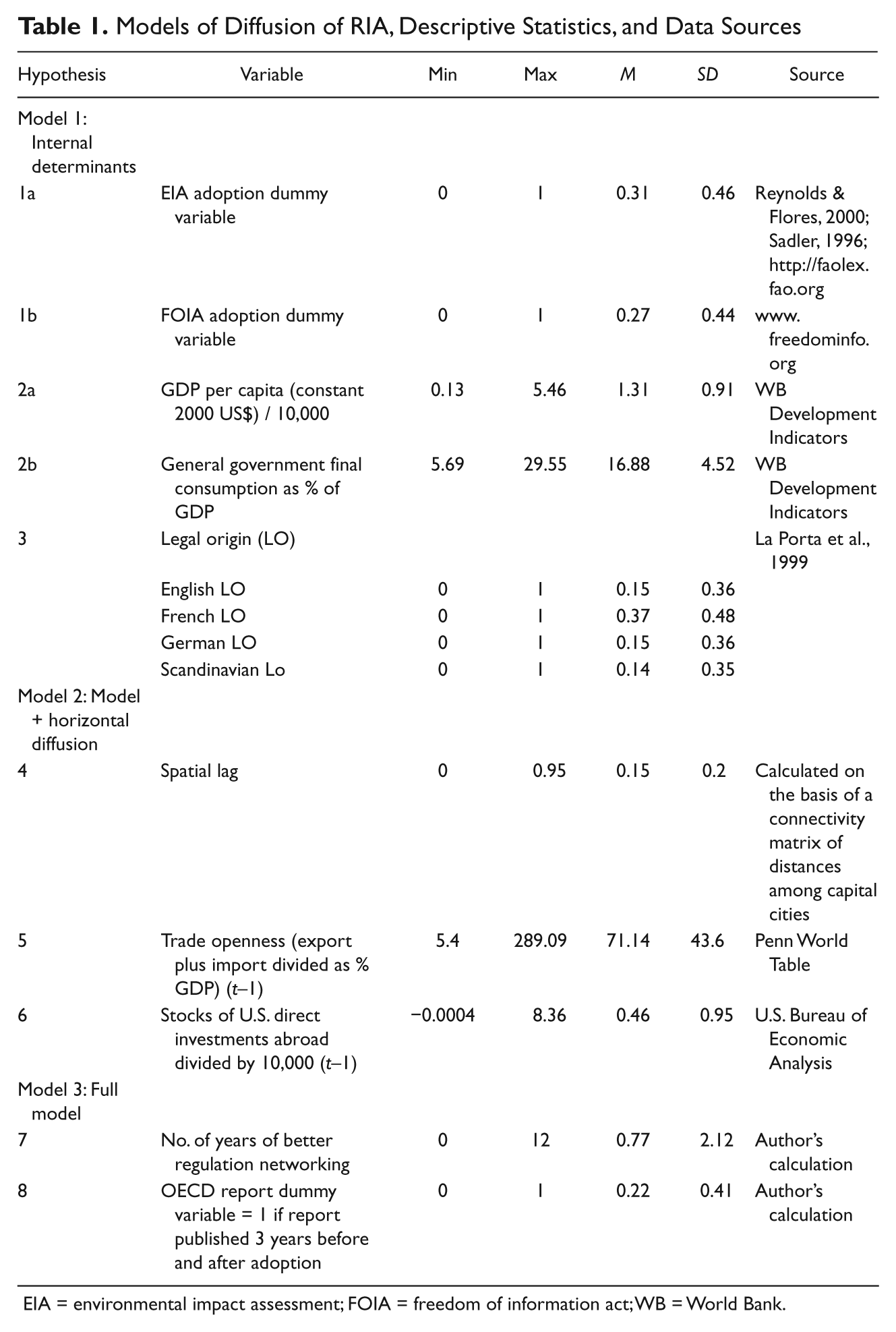
EIA = environmental impact assessment; FOIA = freedom of information act; WB = World Bank.
Event History Analysis and Its Results
Since Berry and Berry (1990), the application of EHA has became established among policy innovation studies. The data set covers 38 countries and starts in 1968, 3 years before the first adoption in the United States. Such a choice is coherent with the internal determinant model. A further specification is necessary for the choice of the EHA model. The logit model allows for flexibility in the analysis (Langner, Bender, Lenz-Tonjes, Kuchenhoff, & Blettner, 2003, p. 1). It can accommodate the complication related to the late entry of a country in the risk set because of its later independence (e.g., the Central and Eastern European countries; Beck, Katz, & Tucker, 1998, pp. 1272-1273).
There are also two specific warnings or specification issues related to logit model (Buckley & Westerland, 2004). The first one is related to the likelihood that the observations are temporally dependent (Buckley & Westerland, 2004; Mooney, 2001). To consider “time seriously” (Beck et al., 1998), I have inserted three time variables, t, t2/10, t3/100, in the discrete EHA (Carter & Signorino, 2010). The second issue concerns the selection of an appropriate functional form in the analysis of “rare events” (King & Zeng, 2001) that should be guided by appropriate substantive and statistical theory (Buckley & Westerland, 2004). The issue here has to do with the underlying distributional assumption within a logit model that the maximum marginal effect occurs at the value π = .5. A robustness check has been performed by testing the models through complementary loglog regression that does not vary significantly from the logit model.
Table 2 presents logistic regression coefficients for the three models. The administrative prerequisites and legal origin model fits significantly better than an empty model. 9 However, the model contributes only marginally to predict the events of adoption (the percentage of adjusted correct predictions is 5.7%) because of the extremely high percentage of cases in the modal category.
Discrete Event History Analysis of RIA Adoption: Standardized Logistic Regression Coefficients with Robust Standard Errors (clustering by countries: 38 in Model 1, 37 in the others)

EIA = environmental impact assessment; FOIA = freedom of information act; LO = legal origin.
p < .10. *p < .05. **p < .01. ***p < .001.
Three variables are statistically significant predictors of RIA adoption: French legal origin at the level of p < .001, FOIA at the level of p < .005, and Scandinavian legal origin at the level of p < .01. Two other variables are marginally significant at the level of p < .1, that is, EIA and government expenditure. The logit regression results can be interpreted using discrete change of predicted probabilities when these dichotomic predictors change their values from zero to one (see Table 3). With all other variables held constant at the mean, the discrete changes of predicted probability associated with the prior adoption of FOIA and EIA are 0.0234 and 0.0115. The discrete changes of predicted probabilities related to French and Scandinavian legal origin are both negative, −0.0233 and −0.0117, respectively. The marginal effect, the change in the predicted probability because of an infinitesimal change in the value of the predictor of the government expenditure, is equal to 0.001.
Summary of Statistical Significant Predictors: Discrete Change in Predicted Probabilities (PPs) of Dummy Variables and Marginal Effects (MEs) for Continuous Variables and Their Confidence Intervals at 95% (other variables held constant at their mean)

EIA = environmental impact assessment; FOIA = freedom of information act; LO = legal origin.
The relevant predictors of the first model are the French legal origin (LO) and the previous adoption of FOIA. These findings strongly support the hypothesis of administrative capacity and rationality: Governments do not adopt RIA without previously adopting complementary innovations, in this case FOIA. It is important to note that the high level of significance of FOIA overshadows the other tested innovation, EIA, which, as expected, has a positive relationship with RIA adoption. 10 Belonging to a specific LO cluster based on common administrative tradition explains the delay in adopting RIA, although unexpectedly the German countries are closer to common law countries and quicker to innovate than the Scandinavians.
Turning to the second model, three other independent variables have been added to the first model, that is, stocks of American direct investments abroad, the extent of trade openness, and the spatial lag. Although there is a relevant reduction in the percentage of adjusted correct predictions to the level of 0%, the overall fit of the model is reasonable. There are improvements in the Wald χ2, log likelihood, and pseudo-R2. The Hosmer–Lemeshow χ2 (2.66, p = .9537) also indicates a relatively good fit. Through a Wald test on the restriction that the added variable coefficients are zero, we can observe that neither trade openness nor U.S. FDI mattered for the adoption of RIA, rejecting the hypotheses of countries’ interconnectedness with the United States and economic internationalization. Among the horizontal diffusion variables, only the spatial distance is a relevant predictor (p < .01), as evidenced by the marginal effect of 0.03, the most significant among all predictors.
Analyzing the internal determinants, the significant predictors are FOIA (with a discrete change in predicted probabilities of 0.015, p < .05) and government expenditure (with a marginal effect equal to 0.001, p < .01). 11 The level of significance and the change in predicted probabilities of French and Scandinavian LO variables drops significantly because of the combined effect of US FDI and spatial lags. Indeed, excluding both variables results in French and Scandinavian LOs maintaining their significance at the levels of the previous model.
In the last comprehensive model, two variables are added to the previous model, that is, network and OECD report. Network measures the length of time of a given country’s participation in the OECD, SIGMA, and EU networks on regulatory reform. The counting starts in 1995 for the OECD network, in 1996 for the SIGMA network, and in 2002 for the EU network. For several countries, membership in the OECD, SIGMA, and EU overlapped, but the network–years are not cumulative. The model fits the data fairly well. The Wald χ2 and the pseudo-R2 are higher than those for the previous models. This is also reflected in the percentage of adjusted correct predictions attested at the level of 6.25% as well as the Hosmer–Lemeshow χ2 (4.68, p = .79).
Government expenditure and English LO are the statistically significant internal determinants. The former keeps the same extent of marginal effect (0.0012) attested in the previous models; the latter has the most relevant change of predicted probability (0.0192). The significance of English LO is related to years of networking: Excluding the latter predictor from the model, this variable is not statistically significant. In a different manner, FOIA loses its significance level for the effect of the network years. Excluding the latter, FOIA keeps its significance at the level of p = .026.
Among the diffusion variables, the network coefficient is significant only at the level of p < .1, with a marginal effect of 0.0029. Contrarly, despite the larger of marginal effect (0.0065), the spatial lag variable is not statistically significant. These two diffusion variables are highly correlated (χ2 = 0.806, p < .001) because of the limited geographical distance among the majority of the OECD members that are situated in Europe. The high standard error of the spatial lag and the tolerances (0.1352 for the spatial lag, 0.1161 for the network years) and the variance inflation factors (7.40 for the spatial lag, 8.61 for the network years) for both variables detect a marginal multicollinearity problem. Dropping from the model each variable in turn, one can observe that the model with network years performs better than the one with the spatial lag, in terms of adjusted correct predictions, Wald χ2, and pseudo-R2. Furthermore, in the model with only the network years, the magnitude of coefficients as well as their standard errors and levels of significance are very similar to the ones of the comprehensive model. In a different manner, in the model with only the spatial lag the coefficients vary significantly. The spatial coefficient itself is almost 3.5 times bigger. This means that the network years variable is a more stable predictor than the spatial lag. In addition, the model with the network clarifies the mode of communication behind the adoption of RIA and the role of the OECD, which has been effective in reducing governments’ uncertainty about such an administrative innovation. The spatial model, instead, relies on the strong assumption that each adopting unit has the same capacity to receive the communication about an innovation, communication that is modulated only by the distance from the previous adopters.
Overall, this comprehensive model stresses the importance of the transnational networks for the transfer of administrative innovations. The role of the OECD is, however, limited to its mediative function. Regulatory reform inquiries on OECD member states’ regulatory management capacity do not affect the probability of adopting RIA. Together with the lack of a unique model of RIA and more broadly the absence of a global paradigm of administrative reform, these results demonstrate that adoption is, in this case, driven by the extent of governments’ interaction with the OECD and EU networks. The latter are “facilitators” of good lessons rather than “norm teachers” (Finnemore, 1993). The predicted direction of government expenditure and its constant marginal effects throughout the three models probe the hypothesis of political control of bureaucracy driven by the rise of complexity in the public administration.
Conclusions
This article has provided evidence for the diffusion of RIA among EU and OECD countries. The hypotheses rely on a threefold explanatory model to capture the null hypothesis as well as internationally and transnationally formed patterns of diffusion. Following the literature on diffusion of administrative reform, internal determinants and administrative tradition have been tested together with geographical proximity and interconnectiveness. The latter aspect has been captured through specific measures of horizontal and vertical modes of diffusion. Being a U.S. commercial partner and open to international trade did not have any effect on a given country’s probability of adopting RIA. The role of the OECD as a promoter of administrative reform has been instead confirmed by assessing countries’ years of participation in networks of regulatory reform with a comprehensive model that also included the spatial explanations. Normative pressures of peer-review mechanisms for enhancing regulatory reform did not have a major impact on the governments’ choice to adopt RIA.
The results show a not completely clear picture with regard to the results associated with the internal determinants of adoption. The administrative capacity and innovation relationship (Mahajan & Peterson, 1985) has been a relevant explanation in the internal and horizontal models. On the other hand, government expenditure strengthens as a predictor in the last two models, probing the political control hypothesis. The LO variables set to capture the administrative tradition matter only in the first and more marginally in the third model. Overall, the explanatory framework holds reasonably well, also considering the complexity, as mentioned by Sahlin-Andersson (2001), of discerning and associating each specific measure to one of the three levels of explanation. The major finding is that the transnational networks have provided governments, which were already aware of the necessity to overview their regulatory process, with cognitive shortcuts—set up by activities of promotion and theorization of regulatory reform—for taking the decision to adopt RIA.
Further analysis should improve these empirical findings with regard to two arrangements. First, a better operationalization is deemed necessary, especially at the level of the transnationally formed trend. Detailed information about the composition, activities, and engagement of each government within the OECD network could better specify which type of causal mechanism is associated with the international organization’s role. Second, an analysis of what has been adopted and implemented and ultimately whether and how RIA has been evaluated and whether and what governments have learned from this regulatory governance innovation could feed back the alternative explanations of diffusion.
Footnotes
Acknowledgements
I am grateful to Fabrizio Gilardi, Oliver James, Lucas Leemann, Claudio M. Radaelli, Fabio Wasserfallen, Wim Woermans, and two anonymous referees for providing me with constructive comments and suggestions. Earlier versions of this article were presented in 2009 at the Public Administration Committee Conference, University of Glamorgan, and at the Advanced Colloquium on Better Regulation, University of Exeter.
Declaration of Conflicting Interests
The author declared no potential conflicts of interest with respect to the research, authorship, and/or publication of this article.
Funding
The author disclosed receipt of the following financial support for the research, authorship, and/or publication of this article: This research was supported by the European Commission’s Marie Curie Intra-European Fellowships for Career Development. Data were collected during the author’s research visit at the John W. Kluge centre at the Library of Congress, Washington, D.C., funded by the AHRC-ESRC Library of Congress scholarship scheme.