




Abstract
Ideological labels are theoretically useful tools with which individuals comprehend, discuss, and engage in politics. Their actual significance, however, varies. We assess how select individual and contextual factors systematically affect individuals’ use and understandings of the classic left–right dimension in Latin America. Using data from the 2010 AmericasBarometer survey, we show that although education, political interest, and political sophistication help citizens place themselves on the ideological continuum, context also matters such that polarization (positively), fragmentation (negatively), and volatility (negatively) affect left–right response. Our analyses further demonstrate that, generally speaking, placements on the left–right scale are linked to individuals’ stances on economic, democratic, religious, and social issues, but context matters in important ways here as well. In short, ideological labels in Latin America hold important potential for orienting citizens within the political arena, but their utility is constrained in important ways at both the individual and contextual levels.
Left–right semantics theoretically can facilitate political communication and connections, but the actual significance of the terms left and right varies in general (e.g., Inglehart & Klingemann, 1976; Jou, 2011; Knutsen, 1997; Nathan & Shi, 1996) and in the particular region of the world that we examine, Latin America (e.g., Zechmeister, 2006b). Existing theoretical perspectives identify the relevance of both individual and contextual factors to explaining this variation. Thus, conventional wisdom offered by scholars of U.S. politics states that many people are largely “innocent of ideology” (Kinder & Sears, 1985; also see Converse, 1964) and that at the individual level those who most need ideological labels are least likely to make use of them (Sniderman, Brody, & Tetlock, 1991). Other research indicates that the left–right semantics are affected by contextual factors that influence the extent to which ideological labels are packaged in coherent forms (e.g., Dalton, 2008; Inglehart & Klingemann, 1976). But how do individual and contextual factors shape the use and meaning of left–right placements in Latin America?
We address this question by considering and assessing factors that constrain (or facilitate) the ability of the mass public in Latin America to effectively use the left–right semantics. Although the scant existing research on ideological labels among mass publics in the region tends to examine a single or limited set of countries, we assess national survey data from 18 Latin American countries collected as part of the AmericasBarometer survey by the Latin American Public Opinion Project (LAPOP). We examine, first, variables that predict response (vs. nonresponse) to the left–right self-placement question. We find, as expected, that those who are less educated, less interested in politics, and less politically knowledgeable are less likely to place themselves on the left–right scale. But individual-level variables alone do not explain significant cross-national variation in placement on the left–right scale. Rather, institutional context matters. Our analyses show that polarization positively affects the significance of the left–right semantics, in accord with previous scholarship focused on advanced industrialized countries. In contrast to that line of literature, however, the greater the number of parties, the less likely Latin Americans are to place themselves on the left–right scale. We anticipate this result given that in Latin America fragmentation is associated with relatively young political parties whose reputations, ideological or otherwise, are comparatively underdeveloped. We also test the influence of a third contextual factor, electoral volatility, and find that this measure of political instability has the negative association we expect with respect to placement on the left–right scale.
Second, we consider the relationship between left–right placements and issue stances. Here we first test a naïve model, which shows that, on average across the region, the left–right labels are related to individuals’ positions on a variety of issues, with some variation in the strength of different issues as predictors. Of importance, we then introduce evidence that, again, context matters. Cross-national differences in the substantive meaning of left and right are systematically related to polarization, fragmentation, and volatility such that more robust and meaningful issue-based conceptions of the left–right semantics tend to exist in contexts where political options are more polarized, fewer in number, and more stable.
The Left–Right Scale and the Latin American Public
Ideological labels are important objects of study because they have the potential to serve at least two interrelated purposes. First, ideological labels provide a means of efficient communication among political actors. Whether exchanging information is made difficult because the political environment is intractable or because individuals lack interest and/or sophistication, 1 ideological labels help to overcome these impediments by providing a shorthand for political communication (Fuchs & Klingemann, 1990; Thomassen & Schmitt, 1997). Second, ideological labels help to tame an often unwieldy political wilderness, for example by reducing a multidimensional space into a single dimension defined on each end by an ideological label (Hinich & Munger, 1994/1996). 2 Fuchs and Klingemann (1990, p. 205) summarize the utility of ideological labels in the following manner: “We view the left–right schema as a mechanism for the reduction of complexity, which serves primarily to provide an orientation function for individuals and a communications function for the political system.” In short, given the state of the average voter as relatively uninformed, an ideological schema in theory provides a “crutch” with which the individual can more easily and effectively maneuver through the political space. But to what degree do individuals in the Latin American region make use of the left–right scale?
Figure 1 depicts, for 18 countries in 2010, the percentage of survey respondents who provided an ideological self-placement. 3 The data reveal that the majority of individuals in every country is able and willing to place on the left–right scale. However, there exists substantial variation across countries in the region, with statistically significant differences between most of them. Countries such as Venezuela, El Salvador, and Uruguay display the highest levels of response to this question. In these three countries the percentage falls between 90% and 95%. At the other extreme we find in sharp contrast Costa Rica, with only 62% of respondents providing a response. The rest of the countries show response levels in the 70% to 80% range.
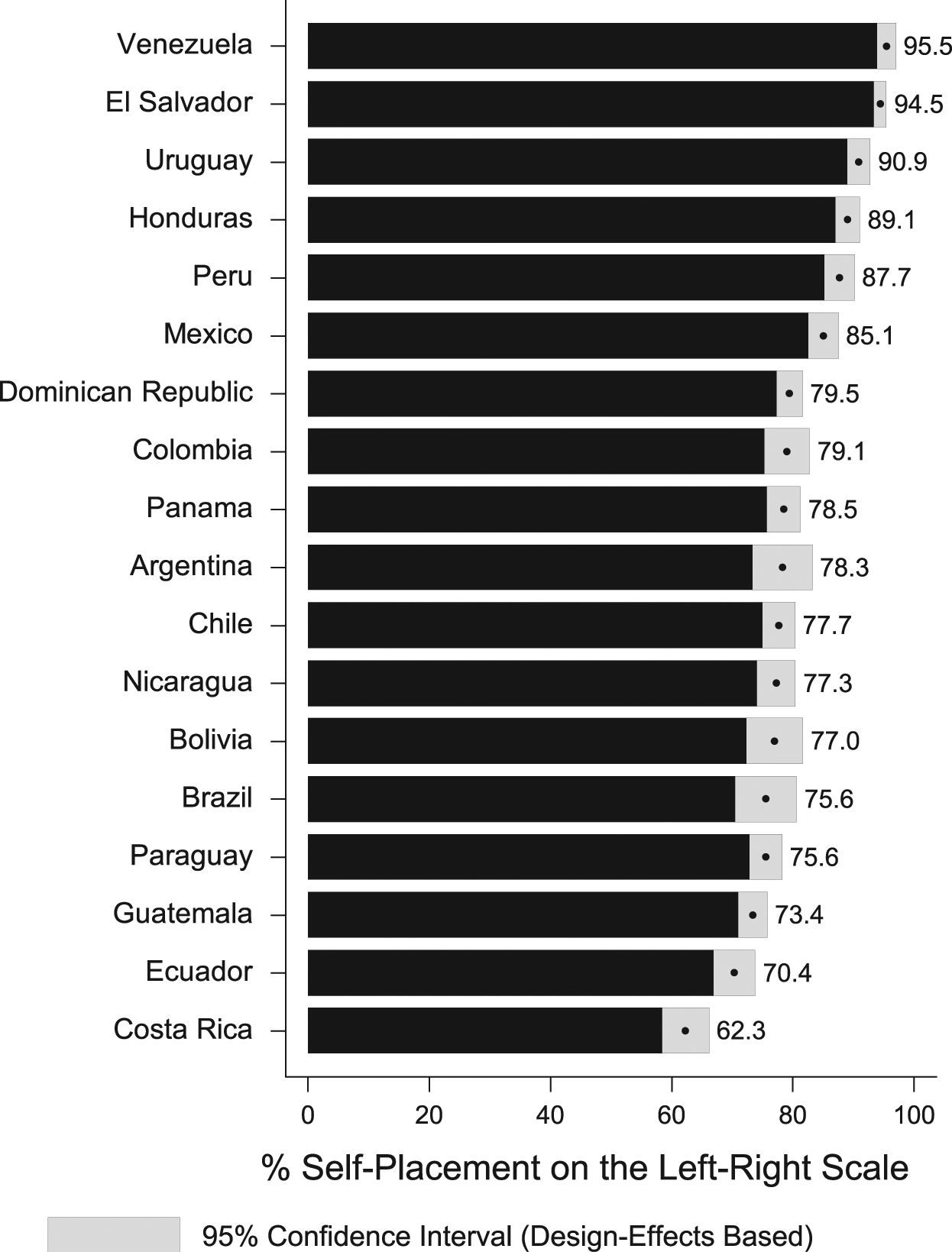
Percentage of individuals who self-place on the left–right scale, 2010
We can improve our understanding of these placement levels by making comparisons across regions. Mair (2010) presents data on the proportion of respondents to the left–right self-placement query in national polls of European countries. In 2004, for example, the mean nonresponse level was 12.1% in Western Europe and 22.8% in Eastern Europe. The data in Figure 1 show a mean nonresponse rate of 19.5% for the 18 countries we consider, 4 which places Latin Americans closer on average to Eastern Europeans to the degree that there are generally lower levels of response; but, of course, such a general statistic masks important variation across countries. In the next section we present a theoretical perspective on individual and, especially, contextual factors that help explain variation in propensities to place on the left–right scale and in the meanings associated with those placements.
Explaining Variation in the Use and Meaning of the Left–Right Semantics
Despite the theoretical value of ideological labels, there exists much evidence that many individuals do not use such terms effectively or conceive of them in substantively rich manners. Converse (1964) notes that many individuals simply do not use ideological markers when discussing politics. Kinder and Sears (1985) report that, to the extent ideological labels are used at all by citizens, they tend to refer to political groups rather than policies; as others put it, the partisan component tends to outweigh the issue component (Evans & Whitefield, 1998; Inglehart & Klingemann, 1976; but also see Huber, 1989, Knutsen, 1997). At the same time, however, an extensive body of scholarship argues that individuals’ familiarity with, understandings of, and use of ideological labels in politics vary by both individual and contextual factors. In this section, we present expectations regarding key predictors of, first, the tendency for individuals in Latin America to use the left–right semantics to identify their political leanings and, second, the locations selected by those who place themselves on the left–right scale.
Individual and Contextual Factors as Predictors of the Use of the Left–Right Semantics
We begin with a focus on factors that explain the variation we presented in Figure 1, that is, with respect to tendencies for individuals to use the left–right semantics to locate themselves in a political space. We consider the relevance of both individual and contextual factors. With respect to the latter, we extend existing scholarship to consider not only polarization but also a different perspective on fragmentation and, as well, electoral volatility.
At the individual level, the factors that seem to carry the most weight and produce the most consistent results across studies are those that measure individuals’ capacity to understand, and their interest in understanding, politics. In short, if individuals have the means (e.g., education) and the motive (e.g., interest) to absorb and process political information, then—all else equal—they should be more likely to use ideological labels. In accord with that expectation, scholars have argued and shown that the more educated and/or politically sophisticated an individual, the more likely he or she is to recognize relevant ideological schema and assign meaning to these (Evans, Heath, & Lalljee, 1996; Fuchs & Klingemann, 1990; Jacoby, 2002; Kitschelt & Hellemans, 1990; Klingemann, 1979; Sniderman et al., 1991).
Contextual factors, however, matter above and beyond individual characteristics, in large part because they provide (or fail to provide) the opportunity for individuals to learn how to effectively use ideological labels with robust and shared content. In prior research, mostly focused on advanced industrialized countries, two factors that have received significant attention are, respectively, the degree of polarization and the extent of fragmentation in a party system (but also see Harbers, de Vries, & Steenbergen, 2012). With respect to the former, polarization may clarify politics by presenting distinct political extremes to individuals, therefore allowing them to clearly link these to ideological semantics. More radical parties may be more likely to advertise using ideological labels and therefore increase the recognition, understanding, and use of left–right labels within a context. And, in fact, Inglehart and Klingemann (1976) and Huber (1989) find the degree of polarization affects the meaning of left–right semantics across national contexts in Europe. Dalton (2008) presents similar evidence; in a multicountry study of the correlation between the strength of left–right placements and vote choice, on one hand, and polarization, on the other, he finds a strong, positive relationship. Furthermore, Ames and Smith (2010) demonstrate that candidate polarization is positively related to placement on the left–right scale in Brazil.
With respect to fragmentation, some have reasoned that the more parties in a system, the more likely ideological labels will be meaningful and significant. In theory, in multiparty systems, individuals have greater need for terms such as left and right to distinguish among different parties in the political space. A number of scholars assert that, in multiparty systems, parties have more at stake in establishing a brand name for themselves, and therefore will make more of an effort to claim space along the left–right continuum (Cox, 1990; Kitschelt & Markowski, n.d.; Kitschelt & Smyth, n.d.; Shepsle, 1991). Yet despite arguably strong theory, the evidence on the relevance of the number of parties to the use and significance of ideological labels is mixed. Inglehart and Klingemann (1976), Huber (1989), and Knutsen (1997) find that the effective number of parties positively affects the meaning of left–right semantics across national contexts in Europe. However, Dalton (2008) finds no relationship between fragmentation and the strength of the left–right attitudes as predictors of voter choice.
In Latin America, fragmented party systems tend not to be stable multiparty systems but, rather, systems in which new political parties have appeared in recent times (often as the result of the partial or complete breakdown of the existing party system). As one would then expect, there is a significant, negative relationship between age of the party system and effective number of parties in Latin America. 5 In these systems, parties have not necessarily had time to develop clear reputations on the left–right dimension and therefore, if anything, we might expect that higher numbers of parties will negatively associate with placement on the left–right scale. To the degree that we find evidence in this regard, existing theoretical perspectives should be revised to acknowledge that the effect of fragmentation varies across contexts such that, in a region replete with young democracies, high numbers of parties will tend to be associated with weaker manifestations of the left–right semantics.
In addition to these two contextual characteristics, we suggest that theoretical understandings of the contextual factors that matter for the left–right semantics should be expanded to include electoral volatility. 6 In comparison, for example, to Western Europe, modern Latin American politics have been characterized by much less stability (see, e.g., Roberts & Wibbels, 1999), and in ways that have significance for use and understandings of the left–right dimension. Scholars have indeed argued that consistency over time is critical to the establishment of a well-developed ideology (Hinich & Munger, 1994/1996, p. 15). One commonly used measure of political stability is electoral volatility, or the extent to which parties’ representation in Congress remains constant from election to election, and we expect this measure of political instability to be associated with less useful ideological markers.
Issues, Context, and Placement on the Left–Right Dimension
Assessing not only tendencies to use the left–right semantics but also predictors of placements on the left–right dimension among those who use the labels is important because it gives us a sense of the meanings that individuals apply to these terms. Existing research demonstrates that the content assigned to the left–right semantics can vary across individuals and countries in Latin America (e.g., Zechmeister, 2006a, 2006b; Zechmeister & Corral, 2011; on countries outside of Latin America, see, e.g., Dalton, 2006, 2009, among others). And, moreover, even in advanced industrialized countries, substantive (issue) components of ideological semantics are generally weaker than those related to parties or other political groups (e.g., Inglehart & Klingemann, 1976; Kinder & Sears, 1985). But is there nonetheless some shared content to the left–right semantics in the region that matches expectations regarding the ways in which issues are conventionally linked to ideological labels? And, furthermore, does the robustness of this shared content vary systematically by the same contextual factors we identified previously? 7
With respect to the first question, our expectation is that economic issues will be linked in a comparatively robust way to the left–right semantics. We base this expectation on the fact that, first, scholarship suggests that this is the dominant dimension structuring party competition in Latin America in recent times (see Kitschelt, Hawkins, Luna, Rosas, & Zechmeister, 2010) and evidence exists that party elites in Latin America, generally speaking and in contrast to other types of issues, make the strongest connections between economic issues and the left–right dimension (see Alcántara Sáez, 2004; Alcántara Sáez & Rivas, 2007; Kitschelt et al., 2010). Zechmeister (2006b), drawing on work by other scholars, argues that the meanings assigned to the left–right semantics by citizens vary according to elite understandings and use of the terms. Thus, given the comparatively strong connection between economic policy stances and the left–right terms at the elite level, we expect such issues to be comparatively strong predictors of left–right placement among the Latin America public (see also Wiesehomeier & Doyle, 2012).
In addition, we test for the relationship between three other arguably important issue bundles and left–right placements: democracy, religion, and gay rights (see, e.g., Alcántara Sáez, 2008; Dalton, 2009; Inglehart, 1990, 1997). We expect all three to be less important than economic issues, but nonetheless keep open the possibility that each of these three has some relationship to the left–right semantics among the Latin American public. On one hand, the authoritarian regimes of the past have been connected to the term right in many countries (e.g., see Power, 2000), thus providing citizens with some mapping of these issues onto the left–right dimension; moreover, Moreno (1999) shows evidence suggesting that although the overall salience of this cleavage had diminished by the turn of the century, the authoritarian–democracy divide may persist at least among some at a level that sustains a relationship between policy preferences in this realm and the left–right semantics. Like the regime divide, the religious divide is one that was stronger and exerted a larger impact on Latin American politics in days gone by; but, as well, religious issues continue on occasion to surface in politics and as defining elements of political divides (see, e.g., chap. 8 in Kitschelt et al., 2010; also see Alcántara Sáez, 2008). Finally, issues related to gay rights have gained salience in a number of countries in recent years (see Lodola & Corral, 2010) and therefore may be mapped to the left–right semantics to at least some degree in current times. This divide has some but not an overwhelming relationship to the religion dimension (the correlation between the two measures we describe below is −.25) and captures, to some extent, a postmodern set of issues (see, e.g., Inglehart & Welzel, 2005).
The second question raised above, with respect to the connections between issues and placement on the left–right dimension, is whether these indications of shared understandings vary across countries according to contextual factors. For the same reasons posited earlier in our discussion of polarization, fragmentation, and electoral volatility, we expect these factors to shape the degree to which the left–right semantics carry robust policy meanings. That is, these factors that either clarify and structure or, on the other hand, obfuscate the political arena should not only affect tendencies to place oneself on the left–right scale but also affect the degree to which those who do place themselves on the scale connect that placement to issues in a coherent, shared manner. In short, when considering the case of Latin America, we expect that the relationships between the issue dimensions we identified above and left–right self-placement will be greater in systems that are more polarized, less fragmented, and less politically volatile.
Data and Operationalizations of Key Variables
Our principal data are taken from surveys of 18 Latin American countries conducted as part of the 2010 wave of the AmericasBarometer by LAPOP. 8 The surveys share a common multistaged, stratified probabilistic national sample design, with approximately 1,500 voting-age respondents in each country. 9 Given our dual objectives in this article, we have two dependent variables with variance we seek to explain: placement (or nonplacement) on the classic left–right continuum and locations on the left–right scale among those who place. Thus, our first dependent variable is a dummy variable, which takes a value of 1 for those who responded to the ideology question and 0 for those who did not respond (combining those who offered no response at all and those who stated they do not know). The second dependent variable measures placements on a 1 (left) to 10 (right) scale, recoded here to run 0 to 1.
In predicting response to the left–right question, we include indicators of individual-level capacity and motivation. Thus, we include measures of an individual’s level of education, political interest, and political knowledge. 10 We also control for age and gender. At the contextual level, we test the effects of three national-level variables: polarization, effective number of parties, and electoral volatility (see Appendix A for details on their construction). 11
In considering factors that predict left–right placements, we include measures capturing four issue dimensions that, for reasons we noted above, are relevant to Latin American politics: state-market relations, authoritarian versus democracy, religion, and gay rights. With respect to the first dimension, we examine factors related to the role of the state and free trade. Six questions from the 2010 AmericasBarometer survey (the ROS series) tap preferences over the role of the state with respect to owning important industries, ensuring citizen well-being, creating jobs, reducing income inequality, providing retirement pensions, and providing health care services. These questions combine to yield high scale reliability, and so we combine them into single additive variable, (limited) role of the state (ROS). 12 In addition, the survey asked about the extent to which free trade agreements help the national economy; in a principal factors analysis, this variable, free trade, does not load onto the same factor as the role of state variables, and so we consider it separately. 13 All the economic variables were initially asked on 7-point scales, rescaled here to run from 0 to 1, and coded so that higher values mean a promarket position. In general terms, a leftist position should correspond to preferences for large state involvement in the economy and a rightist position to preferences for a free economy with little interference from the government (also see Fuchs & Klingemann, 1990; Inglehart, 1990; Mair, 2010).
The additional three dimensions we consider, respectively, tap preferences over democracy, religion, and gay rights. With respect to the democracy dimension, support for coups is an index based on questions about the conditions under which one might support a military coup. Religion is an index based on two variables, capturing religious attendance and the importance of religion. Gay rights is an index based on two questions about support for the rights of homosexuals to run for office and to marry. Details on question wording and index construction for all noneconomic attitudinal variables are found in Appendix B. For ease of interpretation, all variables have been recoded to scales that run from 0 to 1. Generally speaking, we expect those who are less democratic, more religious, and more opposed to gay rights place themselves more to the right; furthermore, for reasons noted earlier, we expect the strength of the predictive power of these variables to be less when compared to the economic dimension. 14 In addition to assessing the general relationship between issues and left–right placements, we extend our analysis to take into account the moderating effects of country context; for this analysis, we use a series of interaction terms.
Results I: Predicting Response to the Left–Right Placement Question
Our first objective is to assess factors that predict whether or not an individual places himself or herself on the left–right self-placement scale. We test the three contextual factors as predictors of left–right self-placement in separate models, and in each we also include our individual-level predictors. 15 Given that we consider both individual and contextual factors, we use a mixed-effects logistic analysis that takes into account the hierarchical structure of the data. At the level of our contextual variables, the number of cases is low (18 at the maximum), and this low number of observations should be kept in mind when interpreting the standard errors. 16
As we see in Table 1, and as expected, the more educated, more politically interested, and more politically knowledgeable are more likely to offer a response to the left–right question. All three variables are statistically significant in the expected direction; political interest, followed by education, has the comparatively largest effect of these variables on the probability of providing a response to the ideology question. We also observe that being older and being female are negatively related to offering a response.
Predicting Response to the Left–Right Placement Question.
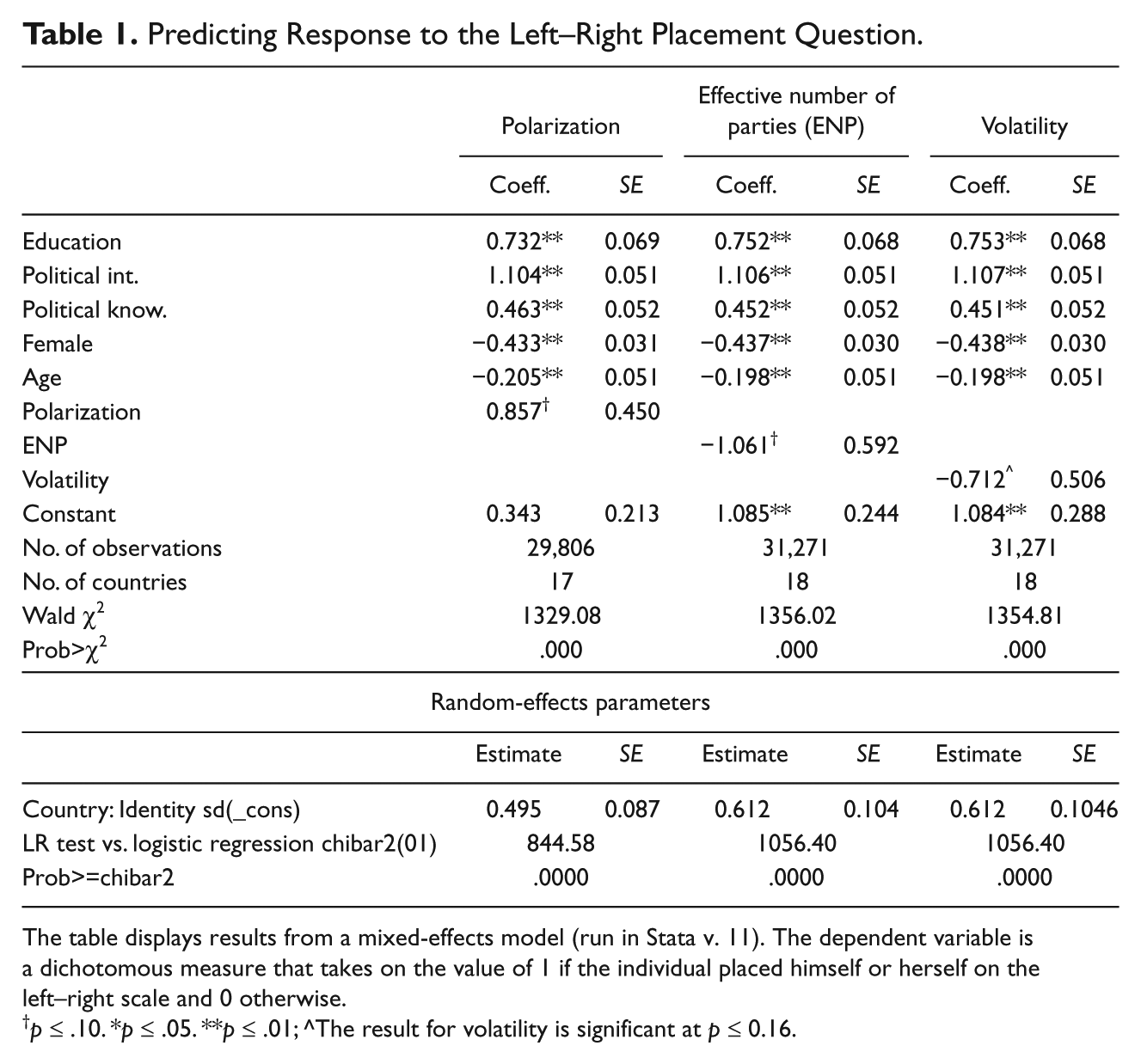
The table displays results from a mixed-effects model (run in Stata v. 11). The dependent variable is a dichotomous measure that takes on the value of 1 if the individual placed himself or herself on the left–right scale and 0 otherwise.
p ≤ .10. *p ≤ .05. **p ≤ .01; ^The result for volatility is significant at p ≤ 0.16.
Regarding the contextual variables, as the results in Table 1 show, polarization and effective number of parties are significant at p ≤ .06 and p ≤ .08 (two-tailed), respectively; the p value for the coefficient on volatility is .16 (two-tailed). Moreover, if we consider the size of the coefficients, and recall that all variables are recoded to the same 0–1 scale, we see that all three of the contextual variables rival or trump the individual variables with respect to their substantive importance. 17 Thus, in keeping with extant literature, we find that when polarization is greater, Latin Americans are more likely to identify themselves with an ideological position. On the contrary, fragmentation, which has been found to have either weak positive effects on the left–right semantics or none in analyses that include countries outside the region, here has a negative effect on the probability of providing a response to the left–right question. Finally, electoral volatility also has a negative effect. Party system instability, as we expected, makes citizens less likely to offer a placement on the left–right scale.
Results II: Predicting Placement on the Left–Right Placement Question
Our second objective is to assess the substantive determinants of ideological self-placement, and the moderating influence of context in this regard. This analysis includes variables related to perceptions and attitudes toward the economy, democracy, religion, and gay rights, all ideological dimensions that have been identified elsewhere as relevant substantive policy divides and for which, above, we noted expectations for the Latin American region. We also include sociodemographic controls for gender, education, and age. Finally, given that the nature of left–right placements varies across countries, we include dummy variables for each country in our naïve model, and in a second set of analyses, we substitute in our contextual variables and interactions between them and the issue dimensions. 18
Table 2 first shows the results of what we call the naïve model, in which we assess the general relationship, across all cases, between the issue variables and left–right placement. As we expected, respondents who believe that the state should have a more limited role in the economy and that free trade agreements are helpful for the economy tend to place themselves toward the right end of the ideological continuum. Of these two variables, support for free trade agreements has a larger impact on self-placement than the role of the state, as we see from the magnitude of the coefficients. In the case of free trade, moving from a position of least to most inclined toward perceiving such policies as beneficial results in a move of roughly one tenth of a unit on the 0 to 1 scale onto which all variables are coded. In addition, citizens who would be more inclined to support a military coup are more likely to place themselves on the right. 19 Surprisingly, the substantive effect of this variable is comparable in size to that capturing the relationship between attitudes concerning the role of the state and ideological self-placement. Religion is also linked to ideological labels in Latin America. Respondents who attend religious services frequently and who consider that religion is important in their lives are more often found on the right on the left–right continuum; the substantive effect of this variable is marginally greater than that found for the democracy and role of state measures, but weaker (by about half) than that found for free trade. Finally, those in favor of gay rights more often identify themselves with the left; of all the issue results, this is the weakest, a finding that is consistent with our contention that gay rights is an emergent dimension in Latin American politics, and therefore just beginning to be linked to general ideological terms. 20
Predicting Left-Right Placement, Naïve Issue Model.
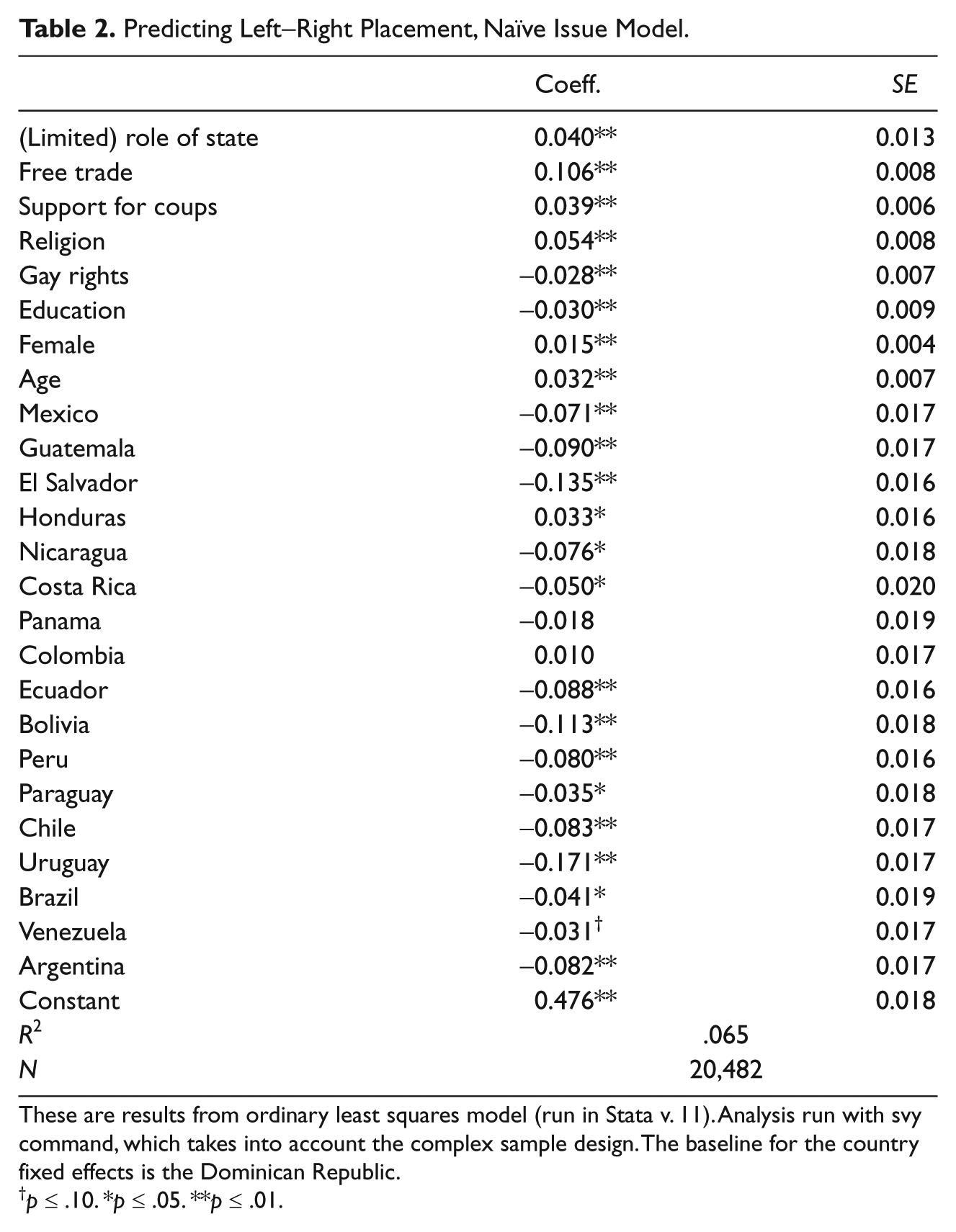
These are results from ordinary least squares model (run in Stata v. 11). Analysis run with svy command, which takes into account the complex sample design. The baseline for the country fixed effects is the Dominican Republic.
p ≤ .10. *p ≤ .05. **p ≤ .01.
Although these results are noteworthy in that they inform us about the substantive meaning of the left–right semantics at the aggregate in the Latin American region, they obscure what we have argued should be substantial cross-national variation in these meanings. Specifically, we have argued that contextual factors matter, not only for whether or not an individual places himself or herself on the left–right scale, but also with respect to the relationship between issue dimensions and left–right placement. Thus, in a final set of analyses we examine the moderating influence of context on the ability of issues to predict left–right placement. For the same theoretical reasons we posited earlier, we expect polarization, fewer parties, and stability will positively predict the robustness of the policy content individuals link to the left–right semantics.
To assess these expectations, we introduce a series of variables to the model shown in Table 2, which interact the contextual variables (rescaled into dummy variables by splitting the measures at their mean) with each of the issue measures. The results, again presented as three separate models, are presented in Table 3. Because each contextual measure is a dummy variable, the results can be fairly easily assessed. Specifically, the effect of the issue dimension when the contextual variable is at the minimum value (0) is shown by the coefficient on the issue variable; the effect of the issue when the contextual variable takes on its maximum value (1) is assessed by adding the coefficient on the issue variable to the coefficient on the interaction term.
Predicting Left-Right Placement With Context Moderating the Effects of Issues.

These are results from a mixed-effects model (run in Stata v. 11). Context refers to the measure identified in the column heading.
p < .10. *p < .05. **p < .01.
However, to aid in the interpretation of these results, we use Figure 2 to graphically depict how polarization, fragmentation, and volatility condition the relationship between issues and the left–right semantics. Figure 2 shows clearly that when there is high polarization, a limited role of the state is associated with rightist positions; on the contrary, in context of low polarization, it is linked to the left. In other words, where the political context is made clearer by the existence of clearly demarcated political poles, individuals associate classic economic stances with the left–right terms; and, in contrast, where the political context is more muddled, individuals actually show a puzzling tendency to relate role of the state preferences to the left–right semantics in a form that is opposite classic conceptions. With respect to free trade, we see that there is little difference across the two contexts in terms of how individuals connect the issue to the left–right semantics; in both contexts, free trade preferences are associated with the political right, and although the effect appears marginally greater in the low polarization context, the result shown in Table 3 for this interaction term confirms this difference is not statistically significant. The results for the democracy measure are striking. In cases marked by high polarization, citizens who justify coups under certain circumstances tend toward the right, whereas there is essentially no relationship (if anything, though, a negative relationship) between these two measures in contexts of low polarization. The results for religion and gay rights mirror those for free trade, where there is no statistically detectable difference across these types of contexts. In short, in more polarized contexts, ideological labels contain more shared policy content, and in ways that are in accord with classic conceptions, compared to in less polarized contexts.

Predicted influence of issue variables on left–right placement by low and high levels of polarization, effective number of parties, and volatility.
We find similar results when we examine the moderating effects of fragmentation. In this case, the interaction is again significant for the same two out of the five issue variables: role of the state and support for coups. In this case, when fragmentation is low, these two factors are linked to ideological labels in the expected direction, but when fragmentation is high, role of the state preferences are again linked to the left–right semantics in a way counter to expectations and democracy attitudes are unrelated (or, if anything, negatively related, which is also counter to expectations). Thus, fragmentation predicts the substantive meaningfulness of the left–right semantics in Latin America in much the same way as does polarization and in a way consistent with our earlier finding; in the Latin American region, a greater effective numbers of parties is associated with less evidence of coherent understandings of the left–right semantics.
Finally, volatility has a statistically significant impact on the relationship between the left–right semantics and four of the issue variables. In three of these cases, the effect of the issue measure—role of the state, support for coups, and religion—is in the expected direction but only of actual consequence in contexts where volatility is low. Of interest, in systems with high volatility support of gay rights is associated with rightist positions whereas, as one would expect for this issue, it is linked to leftist positions in low volatility contexts. In short, political stability—as measured by electoral volatility—matters significantly for the substantive meanings associated with left–right labels by the mass publics in Latin America. Overall, the results show that contextual variables significantly influence the extent to which citizens understand ideological labels in substantively rich and expected manners. These results add further support to our argument that context matters, not only with respect to the ability of individuals to effectively use the left–right semantics to place themselves in politics but also with respect to their ability to associate multiple relevant issue bundles, in expected ways, with these terms. 21
Conclusion
In theory, left–right semantics provide a valuable tool for members of the mass public, facilitating their comprehension of and engagement in politics. Our analyses show, in fact, that considering Latin America as a whole, there exists some shared meaning to the left–right terms. Although research has pointed to weaknesses in and varying conceptions of the substantive content of these terms across individuals and countries, our analysis of the relationship between various issues and the left–right semantics shows the potential these terms hold for assisting the average citizen in the political world. In reality, however, this tool is not available to all individuals.
Rather, across Latin America, tendencies to effectively use the left–right semantics in substantively rich ways vary. At the individual level, we confirm that those who are most in need of political direction are least likely to use the left–right semantics. That is, as others (e.g., Lau & Redlawsk, 2001) have found to be the case with respect to other cognitive shortcuts, those who are least capable of understanding politics and/or least tuned in are less likely to make use of these potentially useful heuristic aids. At the contextual level, our study extends research on the left–right semantics by demonstrating the fact that parties may clarify politics to the extent they take distinct stances; but, as well, in a region such as Latin America they may complicate the use of ideological labels to the extent that individuals are faced with too many alternatives. Our analyses further speak to the destructive effect that political instability, as measured by electoral volatility, can have on citizens’ abilities to form coherent political schema with which to approach and process politics. Simply put, context matters. As we have shown, it affects both the use and the meaning of the left–right semantics across Latin America.
Footnotes
Appendix A
Appendix B
Acknowledgements
We thank Rosario Aguilar, Noam Lupu, Jay McCann, Amy Erica Smith, and Zeynep Somer-Topcu for their comments on earlier versions of this project as well as attendees of the George J. Graham Memorial Graduate Student Symposium at Vanderbilt. A prior version of this article was presented at the 29th International Congress of the Latin American Studies Association, Toronto, Canada, October 6–9, 2010. Any errors and omissions are of course our responsibility alone.
Declaration of Conflicting Interests
The author(s) declared no potential conflicts of interest with respect to the research, authorship, and/or publication of this article.
Funding
The author(s) received no financial support for the research, authorship, and/or publication of this article.