




Abstract
How do the labels left and right take on meaning in new democracies? Existing explanations point to the universality of the left–right scheme or, reversely, emphasize regionally dominant social cleavages. We propose an alternative legacy-focused theory based on two observations: Dictatorships are not ideologically neutral and are negatively evaluated by most citizens and elites after democratization. These premises lead us to expect that when the authoritarian regime is associated with the left (right), the citizens of a new democracy will display an antileft (antiright) bias in their left–right self-identification. We test this hypothesis across Latin American and European new democracies. We find significant bias, which in the case of new democracies following left-wing regimes is concealed due to intercohort heterogeneity. Although older cohorts denote a positive bias, cohorts born after Stalin’s era denote negative bias against the left. Consistent with our expectations, repression exacerbates this bias whereas indoctrination mitigates it. Finally, we look at how these biases apply to party preferences. The findings have important implications for understanding authoritarian legacies and party system development in new democracies.
Party competition is almost unthinkable without a spatial representation of both voters and parties along an ideological dimension (Brady, 2011). Ideological classifications such as “left” and “right” help political parties to brand (Lupu, 2013) and package (Zechmeister, 2006) policy proposals and allow voters to cope with political issues in the context of imperfect information (Downs, 1957), form political identities (Claassen, Tucker, & Smith, 2015; Devine, 2015), and make political choices with limited awareness of the actual party policy positions (Adams, Ezrow, & Somer-Topcu, 2011). But, whereas parties’ long-run trajectories shape the symbolic meaning of these ideological labels in established democracies (Arian & Shamir, 1983; Knutsen, 1995), little is known about how these terms are understood in new democracies. Existing explanations focus either on the role of preexisting social cleavages (Evans & Whitefield, 1995; Kitschelt, 1995, 1999; Tucker, 2002; Whitefield, 2002) or on factors that have emerged after the democratic transition: elite coordination (Zechmeister, 2006), party system structuration (Harbers, de Vries, & Steenbergen, 2013), and trust in political institutions (Doyle, 2011).
We take a different route. We draw on a distinguishing feature of these countries, namely the ideological connotations of their authoritarian past. The labels left and right are not a monopoly of democratic party competition; on the contrary, the left–right (LR) scheme has played a central role for the nondemocratic regimes of the 20th century. Even though fascism—a leading ideology of the interwar period—lost significance after World War II (WWII), the Cold War provided an unambiguous ideological context, leaving nondemocratic regimes of the post-WWII period to orient themselves into pro- and anticommunist camps. These dynamics are not captured by the existing democratization literature, which has mainly focused on how the institutional features of nondemocratic regimes conditioned their transition to democracy (e.g., Boix & Stokes, 2003; Brownlee, 2007; Gandhi, 2008; Gandhi & Przeworski, 2007; Geddes, 1999; Hadenius & Teorell, 2007; Przeworski, 2000; Remmer, 1985; Svolik, 2012). Few studies have looked at the ideological connotations of nondemocratic regimes (Gentile, 2013; Levitsky & Way, 2013; Linz, 2000) and even fewer look at their legacies after democratization (but see Pop-Eleches & Tucker, 2017; Torcal & Mainwaring, 2003). This lacuna is surprising given the resources dictators dedicate to controlling political language and disseminating the regime ideology. In this article, we directly address this gap by examining whether and how the ideological connotations of autocracies color the meaning of “left” and “right” in third-wave democracies in Latin America, Eastern Europe, and Southern Europe. In doing so, we propose a new way of integrating the macrolevel understanding of regime types and the microlevel understanding of the formation of LR self-identification.
We argue that, in new democracies, people’s willingness to classify themselves as left-wing (LW) or right-wing (RW) is shaped by a general reluctance to identify with the ideological label associated with the past authoritarian regime. As a result, people in new democracies will place themselves further away from the end of LR ideological spectrum associated with the prior regime than they would have otherwise. We call this tendency antidictator bias. If the past regime was LW as in the case of Eastern Europe, people will display an antileft bias, and if the prior regime was RW as in the cases of Latin America and Southern Europe, people will display an antiright bias.
We test our expectations with a harmonized data set which covers 50 countries, 950 country-years, and 2 million individuals. We contrast both post-LW and post-RW new democracies against the ideological benchmark provided by established democracies. We find evidence for persistent antidictator bias in post-RW democracies and among the younger cohorts of post-LW democracies. We also try to shed some light on the mechanisms, by examining within-regime heterogeneity in the magnitude of the effects, conditional on two key characteristics of authoritarian regimes: repression and indoctrination. Our results highlight the importance of prior regime indoctrination for explaining the strength of these biases. Communist indoctrination in Eastern Europe had mitigating effects on antileft biases among older generations. Finally, shifting our attention from ideological self-placement to party preferences, we find that in democracies following right-wing regimes, right-wing parties are additionally “penalized” by opposing voters. In Eastern Europe, we find that voters dislike all opposing parties equally, and do not additionally penalize left-wing communist successor parties.
Our article makes contributions in three areas. First, we provide a parsimonious explanation for the cross-sectional variation in LR self-identification in Europe and Latin America today. With respect to Europe, which experienced both right- and left-wing dictatorships, our explanation goes a long way in helping us understand cross-country variation in LR self-placement, as depicted in Figure 1, which shows the average LR self-placement for each country from the 2008 European Values Survey (EVS). Second, we introduce ideological connotations of autocracies, as well as the modifying impact of regime characteristics, such as repression and indoctrination, as new variables for understanding the source of LR self-identification and party competition in third-wave new democracies. Finally, we contribute to the growing understanding of the malleability of attachments to political “brands” (Lupu, 2013) and the symbolic functions of ideological labels both as a short-cut for political choices and as a source of group identities. The article makes a novel contribution to this extensive research by moving our focus beyond political parties as the primary objects of “left” and “right” labels to the consideration of entire political regimes.

An ideological map of Europe.
Antidictator Bias
The logic of antidictator bias rests on two principles. First, autocracies are not ideologically neutral. Rather, they have either a LW or RW association of which their own citizens, posttransition elites, and the world at large are aware of. Not all citizens have to be aware of this link but a significant proportion need to for the argument to work. Second, on the whole, repressive regimes are assessed negatively after the transition to democracy. We do not preclude the possibility of antidictator bias extending beyond the labels to the content of labels, for example, the policies, ideologies, and associated parties, but within the scope of this article, we concern ourselves with self-classifications using the ideological labels as the first step to understanding the roots and dynamics of antidictator bias.
We start with the link between autocracies and the ideological labels left and right. Although the political LR spectrum is a simple dyadic distinction, its power as a meaningful set of categories lies in its relativity—in other words, its ability to acquire new meanings based on changing historical and intellectual contexts (see Bobbio, 1996). In the 20th century, the conflicts between liberal democracy and antiliberalism (fascism, communism, corporatism) followed by the Cold War conflict between communism and capitalism helped to provide a grand context that facilitated the attachment of meaning to the dyadic categories of left and right.
The inevitable potential for an association between communist regimes of Eastern Europe and the “left” end of the ideological spectrum can be taken as a given; Lenin (1920) himself used the term “left-wing” in association with the communist parties of Europe. The terms “left” and “right” were integral parts of the Marxist–Leninist political discourse, and average citizens would be well aware of how their “left-wing” regimes are in conflict with the “bourgeois right” and “reactionary rightist” regimes around the world (Robinson, 1995). The ruling communist parties—all members of the International—had full control of the state and used their resources to spread a Marxist–Leninist worldview throughout their societies, thus reinforcing a consistent political vocabulary (Meyer, 1966).
The authoritarian regimes of Southern Europe and Latin America reflected a greater variety of motivating ideas, including nationalism, corporatism, fascism, populism, and later neoliberalism, thus making their classification on the LR spectrum less straightforward than that of communist regimes (Freeden, Sargent, & Stears, 2013; Linz, 2000). However, anticommunism provided a unifying RW identity for the diverse political factions that underpinned regimes in Southern Europe and Latin America. In the case of Francoist Spain, the theme of anticommunism endured to the regime’s very end, culminating in the controversy surrounding the legalization of the Spanish Communist Party in 1977 (Linz & Stepan, 1996, p. 96). Likewise, anticommunism was a central unifying, motivating, and legitimizing element for Salazar’s Estado Novo in Portugal (Pinto & Rezola, 2007) and for the Greek Junta (Kornetis, 2013).
The centrality of anticommunism to regime “mentalities” is particularly apparent in Cold War Latin America (Brands, 2010, pp. 241-242). Most of the Latin American regimes arose to prevent a pro-Soviet government from taking power or to fight LW insurgencies and were thus viewed as “right-wing” by virtue of playing an anticommunist role (see Online Appendix B for the ideological orientations of Latin American regimes). 1 Brands (2010) goes even so far as to claim that the post–Cold War “destruction of the Left . . . robbed these governments of their reason for being” leading to the collapse of the Latin American authoritarian regimes. The strong association between military coups and the right is even apparent in regime classifications that combine the two elements creating a distinct category of “right-wing authoritarianism” (e.g., Alvarez, Cheibub, Limongi, & Przeworski, 1996).
If citizens are aware of the ideological orientation of the preceding regime, how will they evaluate the ideological label associated with old regime? We argue that there are at least three reasons as to why people in the posttransition period may not be willing to identify themselves with the prior regime’s tainted brand. First, with the demise of an authoritarian regime, we expect the various mechanisms that generated compliance and support to cease functioning, thus leaving only the negative memories of the repressive aspects. Second, people who had kept their true preferences concealed through preference falsification (Kuran, 1997; Lohmann, 1994) now have incentives to openly display their dislike for past regime. Third, new social and political pressures can stigmatize support for the old regime’s brand. These pressures include the new political discourse driven by political elites striving to bolster their legitimacy by emphasizing their break from the past, as well as the newly open statement of preferences by the segments of society that had not supported the regime before. We presume that this constellation of social and political forces can tip the balance far enough to render identifying with the old regime’s brand and associated parties socially unacceptable and even trigger new forms of preference falsification whereby supporters of the old regime conceal their preferences in the new environment and are reluctant to self-identify with the brand of the old regime. In future research, these individual mechanisms can be unpacked, but in this article, we focus on the overall effect that they have on LR placement in the posttransition period.
But what about the legacies of genuine support for the old authoritarian regime? Of course, there is a distribution of preferences in any given society, which means that some sections of the population did sincerely support the authoritarian regimes. Furthermore, authoritarian regimes had various means of building popular support, for example, through co-optation (Magaloni, 2006), economic goods provision (Desai, Olofsgård, & Yousef, 2009), and propaganda (Chen & Xu, 2017) among others. However, after democratization, these mechanisms cease to operate leading to a collapse in prior levels of support. One could still expect a lagged effect if specific authoritarian regimes were better at economic goods provision than the democratic governments that replaced them. But on the whole, we would expect a considerable portion of the population to lean against the authoritarian regime.
Repression, on the other hand, may gain compliance (Kuran, 1997) but is counterproductive in terms of gaining sincere popular support (Gerschewski, 2018; Guriev & Treisman, n.d.). Indeed, the literature on authoritarian nostalgia suggests there has been and continues to be very little support for the purely repressive aspects of authoritarianism. Even in postcommunist countries, where the phenomenon of “communist nostalgia” (Ekman & Linde, 2005; Gherghina & Klymenko, 2012), as well as critical attitudes toward democracy are well documented (Neundorf, 2010; Pop-Eleches & Tucker, 2017), it is clear few citizens yearn for the purely authoritarian aspects of the communist form of government (Mishler & Rose, 1996; White, 2010). Mishler and Rose (1996, p. 43) find that only a minority, about 3%, endorsed all five “authoritarian” elements of a government type, and the most favored “authoritarian” element was a technocratic management of the economy by economists. Overall, “communist nostalgia” appears to combine a yearning economic benefits of communism (White, 2010) with a cultural identity as a communist citizen (Bartmanski, 2011; Gherghina & Klymenko, 2012). Likewise, in Latin America, where various accounts stress a latent cultural predisposition toward authoritarianism (see Tiano, 1986, for a review), public opinion seems to be largely in favor of democracy both before the start (Geddes & Zaller, 1989) and after the end of the authoritarian regimes (Carlin & Singer, 2011, p. 1509). Extensive survey evidence from Latin America has challenged the perception of an authoritarian culture, portraying a citizenry with pro-democratic values (Booth & Seligson, 1984; Tiano, 1986) and across at least eight countries, Latin Americans prefer elected democracy to an unelected strongman by a ratio of about five to one (Booth & Seligson, 2009). Even allowing for variation in support for democracy and nostalgia across and within these countries, there are grounds for some degree of rejection of the authoritarian past.
The tendency to disassociate from the ideological “brand” of the prior illiberal regime is clearly apparent in the behavior of party elites in new democracies. In the postcommunist context, former communist parties were largely discredited and shunned by other parties (Ishiyama, 1995; Mahr & Nagle, 1995). The instances of “success” are attributed to their ability to either rebrand themselves as social democratic parties (Grzymala-Busse, 2002), obfuscate their links through “ideological flexibility” (Pop-Eleches, 2008), or rely on the historical weakness of the anticommunist opposition (Spirova, 2008). To protect their anticommunist reputation, several ex-communist parties have implemented economic liberalization despite their promises to the contrary in party manifestos (Tavits & Letki, 2009) and some of them even initiated lustration policies (Letki, 2002). Insofar as elite behavior carries some reflection of popular demand, we can infer that in postcommunist countries, the communist brand was penalized to some extent by voters.
In Latin America, political elites have shown a reluctance to be labeled “right-wing.” Studies of Brazilian political elites have recorded a long-term tendency toward what has been known as the direita envergohada (“ashamed right”): politicians place themselves to the left of their actual positions and they refuse to label themselves as “right-wing” (Pierucci, 1987; Power & Zucco, 2009). The reluctance of political elites to label themselves RW may explain the high level of confusion in LR self-placement among latent “rightists” in the Brazilian electorate (Ames & Smith, 2010). By the same token, PSR, the main RW party in Portugal, has avoided using a name that would link it to any common party family of the right. Rather it opted to call itself “social democratic.” Some studies have argued that Spain and Portugal had until recently been rendered immune to far-right populist parties precisely because of their experience of four decades of RW authoritarianism (González-Enríquez, 2017). Likewise, the Greek socialist party has traditionally exploited memories of the turbulent and polarized period that led to the 1967 RW military coup in its campaign strategy (Dinas, 2017).
To conclude, for antidictator bias to appear in the postdemocratization period, it is enough that a nontrivial proportion of the population associated the old regime with either the left or the right and did not sincerely support the old regime—and this group that is likely to be present as authoritarian regimes do not need support from everyone to survive (Kuran, 1997). At the very least, we would expect a new and cross-cutting cleavage between old and new regime supporters in the new party system (Torcal & Mainwaring, 2003; Tucker, 2006). Combining the two parts of our argumentation leads us to our main hypothesis:
This hypothesis can be further decomposed, according to the ideological label of the illiberal regime:
Apart from testing these hypotheses, we try to validate our argument by exploring sources of variation in the resulting degree of antidictator bias. We propose that the two main characteristics of autocracies will underlie this variation: the intensity of the repression and indoctrination used by the old regime. A particularly brutal and memorable record of repression that violates basic human rights, which are seen as integral to democracy, is likely to fuel the regime’s bad reputation. Hard repression (Levitsky & Way, 2010) is more likely to undermine legitimacy than subtler forms (Escribà-Folch, 2013), increase opposition (Davenport, 2007), and the demand for transitional justice after democratization (O’Donnell & Schmitter, 2013). Thus, repression is likely to increase the proportion of people who lack sincere support for the old regime and fuel the antidictator political discourse. Indoctrination by the old regime, on the contrary, should mitigate antidictator bias. Successful inculcation of the population with the regime’s guiding idea (Brandenberger, 2014) helps people rationalize the need for repression (Adler, 2012) and creates a religious-like devotion to the regime (Gentile, 2013). Indoctrination has particularly durable effects due to its reliance on education (Alesina & Reich, 2013) targeted at the impressionable young as well as due to the creation of new social identities (Fitzpatrick & Ludtke, 2009). We thus expect the legacies of indoctrination and repression to modify the overall level of antidictator bias in countervailing directions.
Data and Research Design
We understand antidictator bias as the tendency of people to place themselves further away from either end of the LR continuum than they would without negative associations with the old regime’s ideological side. In other words, the ideology of the old regime, in the sense of an association with the ideological label “left” or “right,” serves as the treatment (Right for RW and Left for LW), which determines peoples’ self-placement on the LR scale: following a RW regime, people will place themselves to the left, and following a LW regime, to right. However, to test for the presence of antidictator bias, we need a benchmark against which to judge what is more “left” or “right.”
To address this challenge, we use established democracies as the comparison group. We define established democracies as countries that had uninterrupted democratic rule since WWII. We assume that in these countries there exists no antidictator bias by the time our first surveys are available (early 1970s). We do not assume that established democracies do not display LW or RW tendencies but rather that the ideological “brand” of the predemocratic regime has no effect. All these first-wave democracies democratized slowly, reaching full democracy well before WWII (Huntington, 1993), and while some experienced a brief authoritarian interlude (i.e., Nazi occupation), it was sufficiently short and far in the past to have a neutral effect on LR self-placement. 2
Using established democracies as the benchmark has two further advantages. First, established democracies can be used as the point of comparison for both LW and RW regime types facilitating a comparison between the two latter groups. Second, the use of established democracies as the comparison group accounts for period effects such as general swings in public opinion that affect people cross-nationally.
We pool several cross-national surveys that include a LR self-placement item: the World Values Survey (WVS), the European Social Survey (ESS), the European Election Study the Latinobarometer, the Eurobarometer, and the Central and Eastern European (CEE) Barometer surveys. In total, our surveys cover 50 countries in the period from 1970 to 2012. This results into 950 country years and about 2 million individuals. 3
The scatter plots in Figure 2 summarize the data by showing the average LR self-placement in each survey for the three groups of countries: new democracies following LW and RW regimes and established democracies. Each dot represents an equally weighted country-year survey. Local smoothing functions summarize the overtime trajectory suggesting that people in new democracies which followed RW regimes are the most LW—more LW than people in post-communist countries and established democracies. Also, people in both groups of new democracies show trends toward more RW placements as time passes since the transitions, but this trend stabilizes in post-RW democracies.
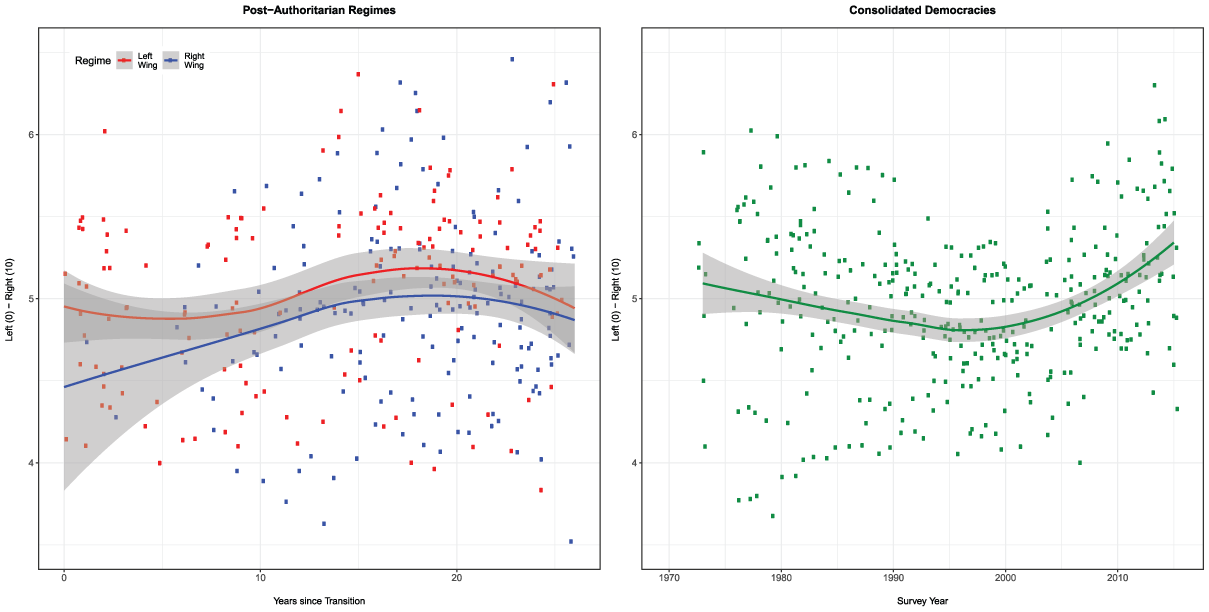
Descriptive statistics.
However, Figure 2 also illustrates the difficulties arising from direct comparisons between post-LW and post-RW new democracies. As the timing of the transition varies between countries, all surveys from postauthoritarian countries (first panel of the graph) are sorted according to the year of fieldwork relative to the year of regime change. This variation makes a direct comparison of the two curves for the new democracies problematic—in doing so, period effects would be ignored. This problem illustrates why established democracies are needed as the common point of comparison.
To further clarify how we construct this comparison between the “treated” new democracies and untreated established democracies, we present the main equation used in our analysis. Assuming that the authoritarian regime of a country j ends at year

where
The problem is we cannot readily estimate LR self-placement at year
We extend this estimation in various ways. First, we add a series of time polynomials to better capture the effect of time since regime end. Second, we add various pretreatment covariates: Gross Domestic Product (GDP) per capita, infant mortality, the rate of urban population, education inequality, and colonial status. 4 For the RW countries, we use the average between 1990 and 1920. This information is not always available for some of the LW regimes and thus we take the average for the period 1925-1935. All data come from the Varieties of Democracy (V-Dem) data set (Coppedge et al., 2017). Finally, in some specifications, we also include individual-level controls (gender age with two polynomials, education and level of religiosity, fully factorized) and posttreatment country characteristics: unemployment, inflation, growth, and inequality during the time of the survey (International Monetary Fund: World Economic Outlook Database, 2018; Solt, 2016).
Moreover, we explore the presence of moderator effects, by looking at the role of time and cohorts. Taking into consideration the full time span after democratization helps us to gauge the longevity of antidictator bias. We do this by interacting

where
Next, we look into cohort-specific effects. The rationale behind this exercise is that we should not expect all respondents to have been equally affected by the ideological label of the authoritarian past. At the very least, we expect some difference between people who experienced the regime and people who did not. We extend Equation 1, to account for between-cohort differences. To identify cohort effects against period and aging effects, we apply an augmented difference-in-differences design, as suggested by Dinas and Stoker (2014). Instead of comparing different cohorts within the same group of countries, we compare the same cohorts across different groups of countries: post-LW democracies and post-RW democracies against established democracies. We also include four time polynomials, interacted with both

where
Finally, we try to tap into two possible modifiers of antidictator bias, namely the role of repression and indoctrination. We explore variation in both of these components within each regime. Making use of the V-Dem indicators, we employ a ready measure of repression and construct an index of indoctrination. With regard to the former, we use the Civil Liberties Scale (
To measure indoctrination, we have created an index using individual V-Dem indicators to capture the key elements/tools of indoctrination: (a) the monopolization of the public discourse and exclusion of alternative views, (b) the presence of a clear ideology, (c) the control and exclusion of organizations that could provide alternative views, and (d) the presence of regime-controlled institutions that have mass penetration of society such as mass-membership organizations and a developed education system (see Appendix C of the Online Appendix for full details). 5 As with repression, we take the average level of indoctrination over the duration of each regime.
Results
Table 1 shows the results from equation 1. The first row denotes new democracies following RW regimes whereas the second row denotes democracies following LW regimes, that is postcommunist Eastern Europe and Nicaragua. Respondents from established democracies are the reference category. Going across the columns, we gradually increase the number of various controls included in the model: first survey-fixed effects and a time trend (1), then we add “pre-treatment” controls (2), followed by “post-treatment” controls such as individual level demographics and post-transition economic conditions.
Main Results.
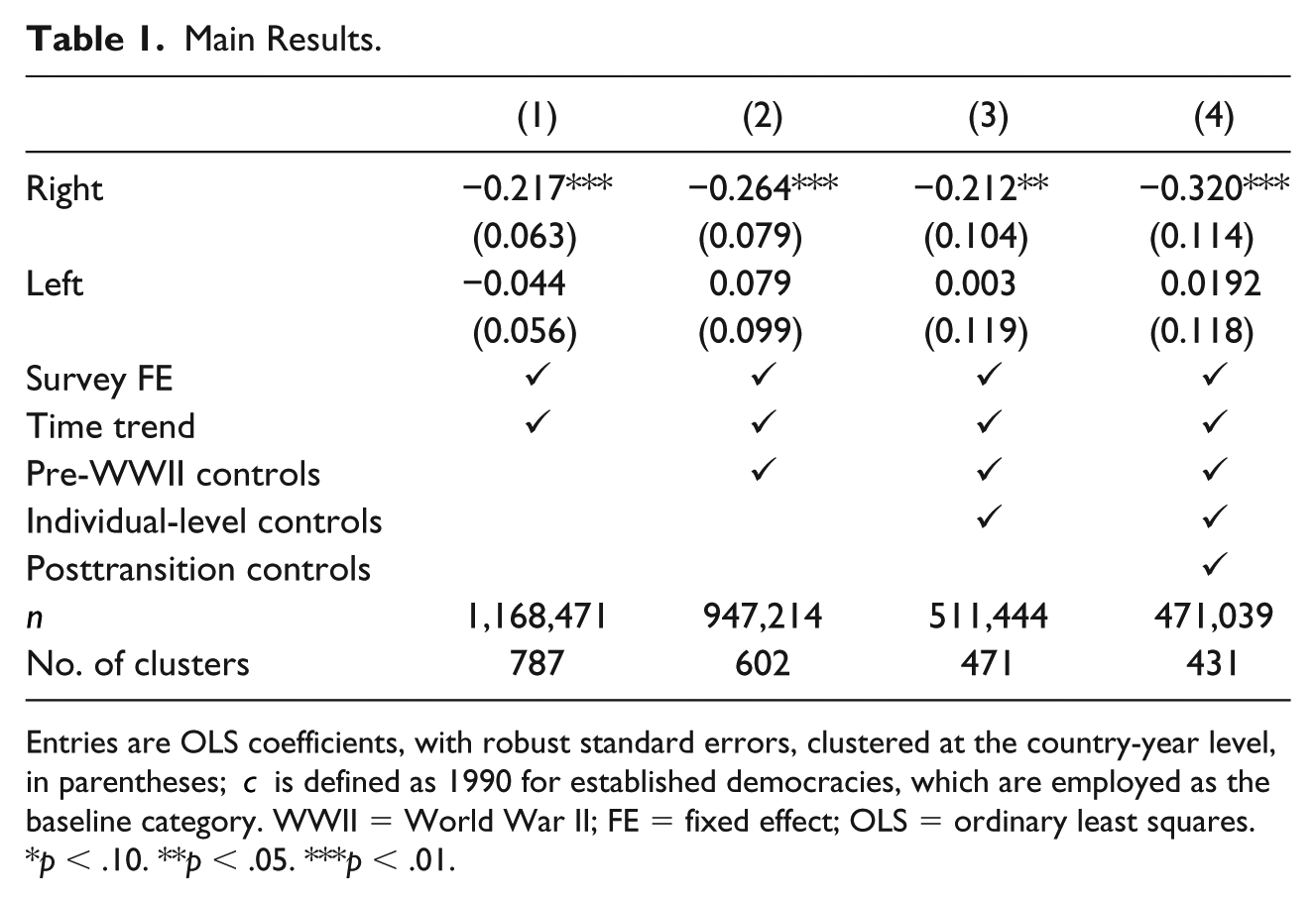
Entries are OLS coefficients, with robust standard errors, clustered at the country-year level, in parentheses;
p < .10. **p < .05. ***p < .01.
Looking at the RW dictatorships, we find that across all columns of Table 1, respondents are on average more LW than respondents of both LW dictatorships and those of established democracies. The effect amounts to an approximately 0.3 increase in a 0 to 10 scale. Given that the average LR self-placement in established democracies during this period is 4.81, the effect amounts to a 6% decline in LR self-placement. Although this seems a modest effect, it is equivalent to the difference between secondary and tertiary education in an analysis using survey data from Germany (Barberá, Bauer, Ackermann, & Venetz, 2017) and is approximately half of the effect of having a parent leaning to the left (Rico & Jennings, 2016). The effect seems robust across all model specifications.
To what extent are these results driven by over time heterogeneity? We address this question by estimating Equation 2. The results are summarized in Figure 3. We find an interesting temporal trend. 6 Although there seems to be an antidictator bias throughout the first two decades after the authoritarian rule, this bias decreases with time as the new democracies consolidate. At least two explanations can be given for this pattern: learning and generational replacement. Democratic learning implies that the accumulated experience of the new political regime and its actors will challenge, qualify, or contradict the ideological biases related to the previous regime. Generational replacement implies that the new cohorts replacing the older ones are less distinct from those in established democracies. These two explanations can of course work in parallel and reinforce one another.

Overtime trajectory of LR self-placement, comparing left- and right-wing dictatorships with established democracies.
Before moving to the post-LW democracies, it is important to assess the robustness of these results. To do so, we perform a series of tests. First, we add up to four time polynomials in Equation 1, but all results remain substantively identical (Table D.2 of the Online Appendix). Second, to ensure that we are not capitalizing on a potential RW shift in industrialized democracies after the end of the cold war, we employ alternative starting years for these countries: 1975, 1980, and 1985. The results are very similar to those obtained when using 1990 as the starting point for old democracies (Tables D.3-D.5, Figures D1.-D.3 in Online Appendix). Third, the results remain robust when we exclude Austria, Italy, and Germany from the group of control countries or code them as RW regimes (Figures D.4 and D.5). Fourth, we implement the analysis at the country × year level, averaging LR self-placements for each survey year in each country. The results are substantively identical to those presented here (Table D.6, Figure D.6 in the Online Appendix). Fifth, we repeat the analysis using only a binary indicator denoting RW respondents (coded as those above five in the [0-10] LR scale).
7
The results, shown in the Online Appendix (Tables D.7-D.10, Figure D.7), remain very similar to those presented here. Sixth, focusing on the over time trajectory of the bias, we examine whether we still observe convergence when allowing for a very flexible specification of time. We use year dummies, which we interact with the indicators of RW regimes. The results are shown in the Online Appendix (Figure D.8) and largely confirm the pattern of convergence found in the main analysis. Seventh, to enhance the cultural and historical similarity between RW dictatorships and the control group used as the benchmark, we use as a comparison unit a Latin America country, which did not encounter a RW military regime, namely Costa Rica. We use the same
We now turn to post-LW new democracies. We see that people in postcommunist Eastern Europe on the whole are not significantly different in their LR self-placement compared with established democracies. The magnitude of the effects is 5 to 10 times smaller than for post-RW democracies. It never achieves conventional levels of statistical significance and changes sign across specifications. When decomposing these effects over time, the findings remain ambiguous, as shown in Figure 3: In the first model, people in Eastern Europe appear to be slightly more LW in the early transition period, but this effect quickly ceases to be statistically significant at the 5% level. Moreover, the pattern seems to change remarkably when posttreatment controls are included. Yet, differences remain nonsignificant throughout the analysis. 8
No Antidictator Bias for the Left?
So why is there clear evidence of antidictator bias (antiright) in democracies following RW regimes but no discernible antidictator bias following LW communist regimes? We believe this difference is the result of communist regimes being better at indoctrination than military regimes and having successfully built lasting LW identities and preferences among their citizens. Communist regimes were more efficient at indoctrination for two reasons: they possessed a highly developed ideology rather than vague “mentality” (Linz, 2000) and an institutional structure that facilitated indoctrination.
First, a developed ideology is easier to teach in mass education (Kenez, 1985; Zajda, 1988), it enables psychological and emotional identification with the regime and is more appealing to intellectuals and the youth (Arendt, 1973; Fitzpatrick & Ludtke, 2009). Furthermore, communist ideology was underpinned by a body of widely accessible Marxist–Leninist literature further facilitating consistency in teaching and policy making. Military regimes, on the contrary, mainly justified their existence based on some external threat, as manifested by the declarations of regime principles issued after coups (examples include Papadopoulos’s “Our Creed” in Greece or Pinochet’s “Declaration of Principles” in Chile). A vague guiding aim had the advantage of blunting cleavages in the coalition backing the regime, but at the same time, it severely limited the capacity to socialize the masses into supporting the regime.
Second, the presence of a single mass-membership party not only increased regime longevity (Geddes, 1999; Smith, 2005; Levitsky & Way, 2013) but also maximized penetration and control of society by fostering unified group identity across all state, social, and economic institutions (e.g., schools, universities, youth groups, and workplaces). Military-authoritarian regimes, on the contrary, were limited by the military-civilian divide: even if officer training could serve as means of indoctrination (as in the case of the teaching of “New Professionalism” in Brazilian military academies), it operated only within the military sphere. Also RW regimes relied on the Catholic Church to assist with education and indoctrination in the early 20th century. However, following the Second Vatican Council in 1958, the Church officially supported the cause of democracy curtailing any unequivocal support of authoritarian regimes (Philpott, 2004). 9
There is no doubt that long-lived illiberal regimes experienced fluctuations in levels of indoctrination and repression (Pop-Eleches & Tucker, 2013, 2014). However, we can expect communist regimes to be on average more effective at indoctrination than RW regimes. Also, it has already been shown that increased exposure to Communism significantly reinforces pro-left self-placement (Pop-Eleches & Tucker, 2017).
To test this argument, we first try to gauge the level of repression and indoctrination across different regimes. Figure 4 shows that levels of indoctrination among communist regimes were higher than for RW regimes and established democracies (the latter two being statistically indistinguishable). This pattern suggests that the moderating effects of indoctrination would have been felt much more strongly among LW regimes, thus explaining why in these countries, among the older cohorts, we see positive (pro-left) rather than negative bias (antileft) toward the ideological label of the old regime. Of course, this reasoning assumes that indoctrination and repression are not perfectly related. The second panel of Figure 4 confirms this assumption: while the levels of repression between LW and RW regimes are practically indistinguishable, the levels of indoctrination are much higher for LW than RW regimes.

Repression and indoctrination across different types of regimes.
Although suggestive and based on imperfect measures, the pattern shown in Figure 4 indicates that there is indeed some variation in the intentions of the two types of regimes. The next question is whether this difference in indoctrination intensity leaves any imprint on attitudes. Although we cannot provide direct evidence about the link between past indoctrination and contemporary LR self-placement, we can offer indirect evidence, by looking at between-cohort heterogeneity. If indoctrination matters, it should matter for those who directly experienced it because indoctrination ends or changes direction after the end of the authoritarian regime. We should thus find differences between cohorts that experienced the regime directly and those that did not.
To see whether this is the case, we estimate Equation 3. The results are shown in Figure 5. In this figure, we show predicted difference in LR self-placement between cohorts in new democracies and established democracies while controlling for the various pretreatment effects. We see that in new democracies following RW regimes, there is no discernible between cohort heterogeneity and all cohorts tend to be more LW. However, if we look at post-LW new democracies, we find clear cohort heterogeneity that remains constant. People born between 1930 and 1950, and who not only experienced the most intense periods of communist indoctrination but were also exposed to it for the longest period, are more LW than younger cohorts—in other words the experience of indoctrination has pulled these cohorts to the left. The younger cohorts born from 1950 onward that missed the earlier phases of intense communist indoctrination are RW as expected. Thus, we can see that the absence of overall antidictator bias is driven by the more pro-left older cohorts balancing out the younger RW cohorts. Thus, for cohorts entering political life after the Stalinist era, we find significant antileft bias.

Between-cohort differences.
Next, we combine the time and cohort effects to look at how cohorts behave over time. The results are summarized in Figure 6. Again, we see an absence of cohort heterogeneity for most of the time in post-RW democracies (the initial heterogeneity fades quickly). But, what we do see is that all cohorts become less LW over time thus displaying gradual convergence. But in post-LW new democracies, we see that the cohort heterogeneity remains present over the two decades since democratization. The old cohorts who were exposed to communist indoctrination remain pro-left whereas the younger cohorts are all RW.

The over time trajectory of cohort effects.
A Direct Look at Repression and Indoctrination
The previous section presented indirect evidence about the role of indoctrination, but it would be even better to have more direct evidence as to how indoctrination and repression can modify the level of antidictator bias posttransition. Providing such evidence is difficult not only because the measures are far from perfect but also because they cannot apply to established democracies, which democratized too long ago. Essentially, therefore, the analysis has to be made within authoritarian regimes. We try to do this by leveraging the variation in terms of the degree of repression and indoctrination within each ideological group, that is, within LW and RW dictatorships. We thus regress LR self-placement on the level of indoctrination and repression within each group of countries. We include the pretreatment controls as well as controls for regime performance. 10 The results are shown in Table 2. The first two columns of the table present the results for democracies following RW dictatorships whereas the last two present the results for democracies following LW dictatorships. Within each group, we use both the binary outcome—the probability of denoting RW self-placement—and the continuous LR self-placement scale. Both sets of results lend support to our expectations. In the case of new democracies following RW dictatorships, we see that higher levels of past repression drive people more to the left whereas higher levels of past indoctrination translate into more RW self-placements. For democracies following LW dictatorships, we find the opposite pattern: higher levels of past repression induce RW placements, whereas higher levels of past indoctrination bring people more to the left of the political spectrum. 11
Ideological Side Bias in Party Preferences.
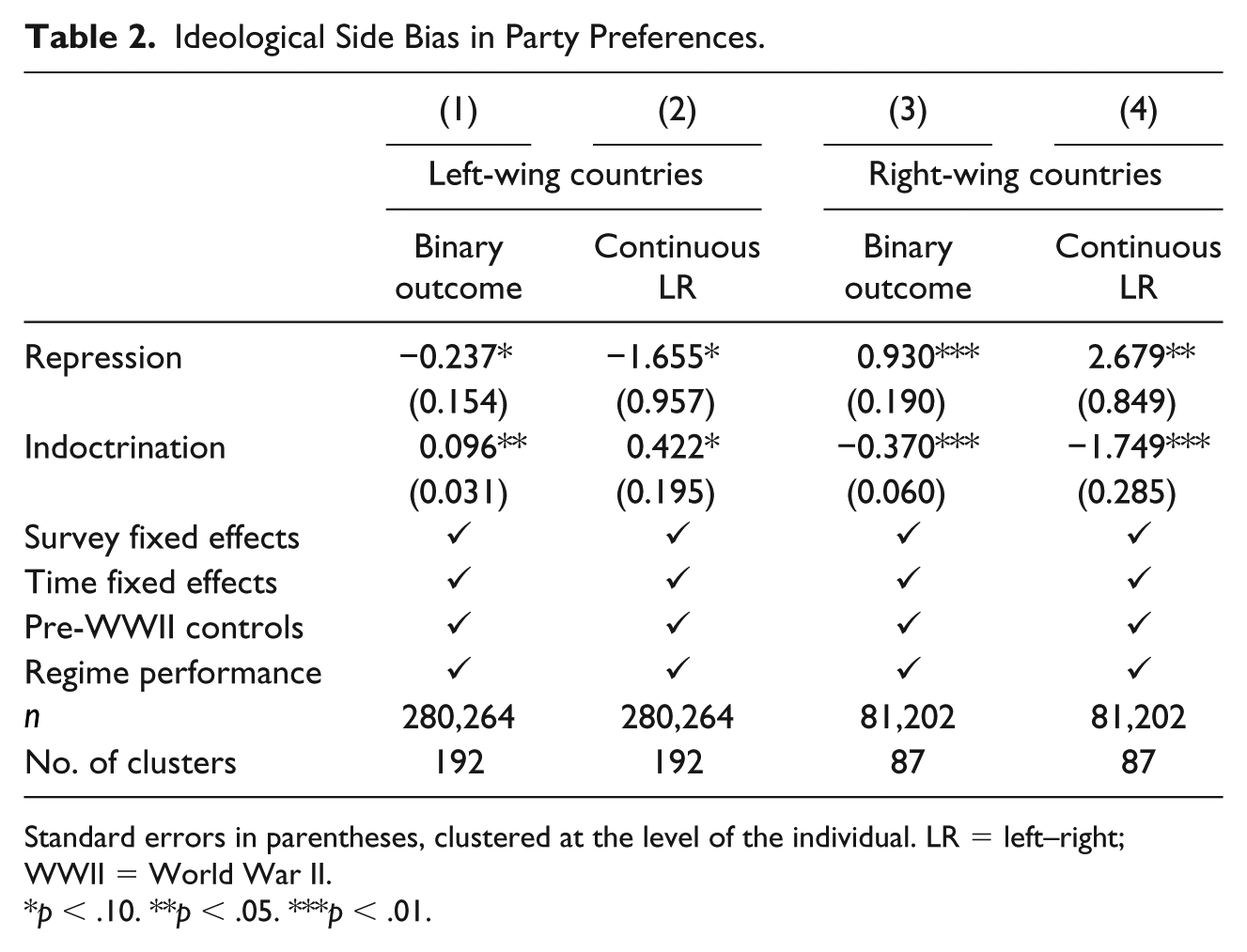
Standard errors in parentheses, clustered at the level of the individual. LR = left–right; WWII = World War II.
p < .10. **p < .05. ***p < .01.
A potential criticism to this analysis could be that repression and indoctrination are already endogenous to prior ideological leanings. This is mainly a concern for RW dictatorships of the WWII, which were largely framed as a solution to the communist threat. Thus, it might be that support for the left, prior to the authoritarian rule, explains both the intensity of repression and indoctrination as well as future leanings to the left. To see whether this is the case, we collect data on the vote share of the left in the last election prior to the authoritarian rule. 12 We implement two sets of analyses. First, we examine whether prior support for the left predicts either repression or indoctrination afterward. We find no evidence for this, as also illustrated graphically in Figure D.20 of the Online Appendix. Second, we include this variable as an additional control in the analysis for the right; results are shown in Table D.7 of the Online Appendix. All effects remain robust to the inclusion of the covariate.
Implications: Antidictator Bias in Party Evaluations
Finally, we attempt to test the theory by looking at an additional observable implication that it leads to. In particular, we shift our attention from ideological predispositions to party evaluations. Recent developments in spatial voting literature give pride of place to the role of group categorization: people, according to this line of research, tend to evaluate objects such as parties more favorably if they perceive them to be in the same in-group as the individual and more negatively if not. Importantly, both the premium for being on the same ideological side and the penalty for being on the opposite side hold independently from the ideological distance between party and individual (Bølstad & Dinas, 2017; Vegetti & Širinic, 2019). Put differently, a LW (RW) voter prefers a LW (RW) party over a RW (LW) party, even if her ideal point is equidistant to both parties.
We expect antidictator bias to accentuate this mechanism. Parties that get categorized into the category on the opposite side of LR continuum to the voter will be more disliked if the opposing end of the LR spectrum is associated with the old regime. Being at the opposite side of the voter should incur a penalty in party preference. This penalty, however, should be even higher if opposite side means also the side of the dictator. This implies that although opposite side should decrease party preferences in both RW and LW regimes, it should do so more when it means the party is RW (LW) in countries with RW (LW) dictator. Thus, voters add an additional “penalty” to opposing parties if those parties are associated with the ideological “brand” of the deposed dictator.
To test these expectations, we need to combine information about voters and parties. We do this by using Modules 1 through 4 of the Comparative Study of Electoral Systems (CSES). 13 The CSES measures party preferences via a 0 (strongly dislike) to 10 (strongly like) scale, which is used as the dependent variable in this analysis. Importantly, CSES also includes an “expert” placement of each party in the 0 to 10 LR scale. We use this information to categorize the party as LW or RW. We regress party preference on (a) proximity between voters’ own LR self-placement and the expert placement of the given parties, (b) whether or not the party falls in the same or opposite binary LR category as the voter, and (c) on the interaction between sides and the ideological label of the party, that is, whether the party in the same or opposite category to the voter with whether it is LW or RW (according the expert placement). We also include individual-fixed effects, thus looking at within-voter variation across parties. As it becomes evident, this test complements our analysis not only theoretically but also methodologically. It is based not on between-regime differences but on differences within the same regime, country, and individual. All that varies is the parties within the country in a given election.
Table 3 presents the full results while Figure 7 visualizes the main effects. Three points require highlighting. First, all-else-equal, in post-RW democracies, RW parties are disadvantaged, whereas LW parties enjoy a premium in party preference. This handicap for RW parties is much smaller in post-LW democracies. Second, in both regimes, controlling for perceived ideological proximity between party and individual parties that are on the same side as the respondent enjoy an additional increase in party preference, whereas parties on the opposite side suffer a penalty. This finding simply confirms the conclusions by Bølstad and Dinas (2017). What is more important is to see whether this side-effect varies according to whether the party in question carries the ideological label of the dictator, that is, being on the right in post-RW democracies and on the left in post-LW democracies. Does being on the opposite side carry a differential penalty for RW (LW) parties in post-RW (LW) democracies? As we see in the first column of the table, in post-RW new democracies being on the opposite side is costly for the party only if this means being on the right. 14 When being opposite to the respondent means being on the left of the ideological spectrum, the opposite-side effect diminishes. This is shown in the second column, which illustrates how the penalty for being on the opposite side is halved for LW parties. These effects are confined to post-RW new democracies. We can discern no additional “penalty” for parties associated with the left in post-communist countries.
Ideological Side Bias in Party Preferences.
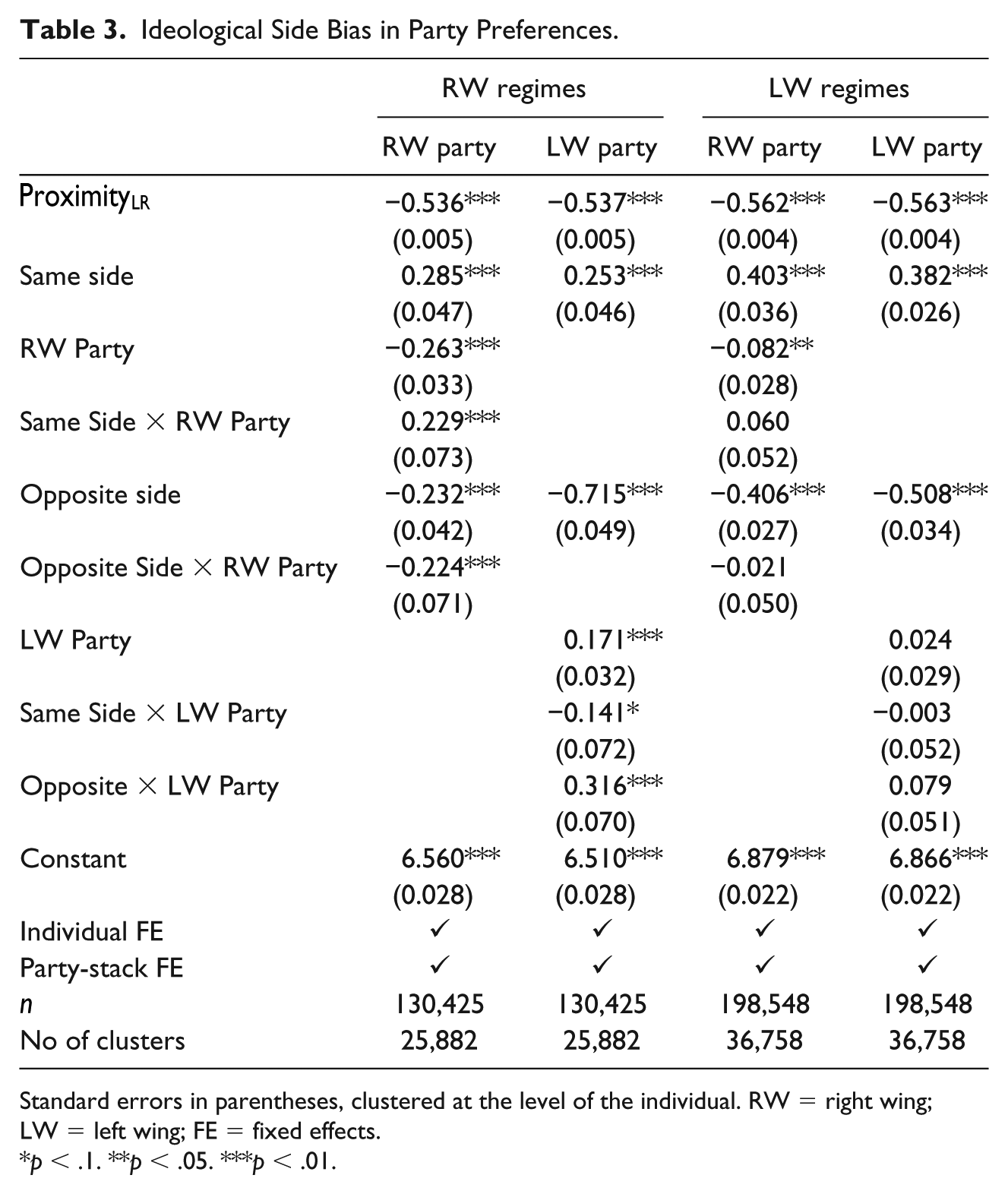
Standard errors in parentheses, clustered at the level of the individual. RW = right wing; LW = left wing; FE = fixed effects.
p < .1. **p < .05. ***p < .01.
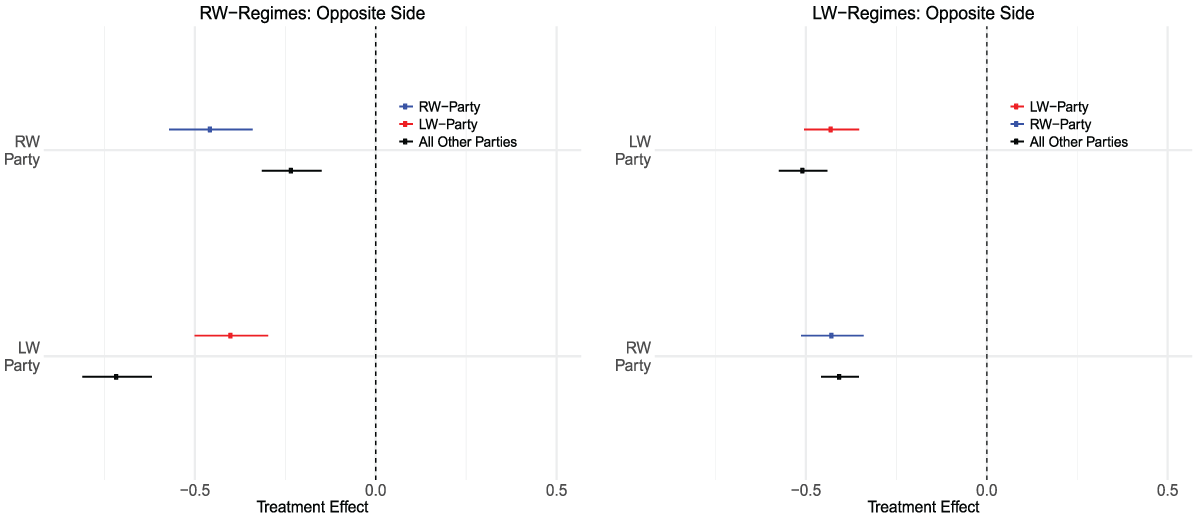
Decomposing opposite-side effects according to party ideology.
Discussion
Political competition in new democracies has been examined from many angles—social cleavages, party system institutionalization, and the effects of the transition itself on the formation of individual preferences, among others—but little attention has been devoted to the overarching legacies of authoritarian ideologies. We tried to provide theory and evidence as to why authoritarian ideology can affect public opinion and party competition after the democratic transition. The link between ideological sides and authoritarian regimes can generate a bias against these sides, hence skewing citizens’ LR self-placement in a newly democratized polity. Importantly, these effects can endure throughout the party consolidation process and can also impact people’s party preferences. Consistent with our line of argument, repression intensifies this bias, while indoctrination ameliorates it.
Apart from shedding light on individual LR self-placement in new democracies, the phenomenon of antidictator bias has at least five more general implications. First, from the supply-side perspective, the dynamics of party competition in new democracies must be examined considering the ideological “brand” of the old regime. To the extent antidictator bias is present, parties might significantly vary policy priorities to match the ideological profile supposedly favored by the voters. And to the degree that persuasion effects are important in new democracies (Lenz, 2012), this process might change the public’s understanding of what policy principles the labels “left” and “right” represent; for example, communist successor parties pursued free market policies in the 1990s (Tavits & Letki, 2009). This pattern might generate a cycle whereby the historical past continues to inform the meaning of “left” and “right” labels years, if not decades, after democratization.
Second, on the demand-side, this antidictator bias can also explain country-level differences not only in LR placement, but in more specific issues in so far as they come to symbolize either pole of the LR continuum. For example, using ESS data from 2002 to 2012, Rueda (2018) examines the determinants of support for redistribution among 14 countries. Figure 1 of this study decomposes national averages into two groups, the poor and the rich. The three countries the highest support for redistribution among the rich are Greece, Portugal, and Spain. By the same token, Bansak, Hainmueller, and Hangartner (2016) ran a comparative survey across 15 European countries after the refugee crisis and found that the country with most pro-asylum seekers attitudes was Spain, whereas the country with lowest percentage wanting more asylum seekers in their own country being Czechia. In other words, policies that fall into the ideological category favored by the voters are also favored, whereas policies that are associated with the opposing category are disliked. Although nonsystematic, this evidence is at least indicative of the potential spill over of antidictator bias on newly salient policy issues.
Third, the findings highlight the influence of authoritarian indoctrination on individual LR self-identification and preferences. Where indoctrination has been successful, mainly in postcommunist countries, the contrast between the tainted ideological brand of the old regime and the public preferences for some elements of the authoritarian ideology implies powerful contradictory pressures on party competition. Under these conditions, parties try to choose between emphasizing a break with the past that can boost their credibility and capitalizing on pro-left sentiments among older generations in the case of Eastern Europe. Taking this idea further is impossible without more systematic knowledge about how indoctrination played out in these regimes. In a way, the findings from this study showcase the importance of better understanding how authoritarian indoctrination works and how its mechanisms breakdown after democratization. This understanding is key to enhancing our knowledge about how political memory travels across generations. Even for the well-studied Eastern European countries, we know very little about the extent a pro-left parental influence on new generations is counterbalanced by posttransition influences such as the anticommunist political discourse. Adding indoctrination into the analysis sheds light on seemingly paradoxical phenomena, such as “communist nostalgia,” which combines support for the communist aim of social equality with democratic human rights and freedoms (White, 2007).
Fourth, the presence of history-driven bias in LR self-placement has important implications for party positioning in new democracies. The main party representing the ideological side of the old regime is likely to receive support from sympathizers or those who make no connections between political ideology and the old regime. However, this party is also likely to suffer contrast effects. In the presence of antidictator bias, the party associated with the dictator is placed more toward the disliked end of the ideological spectrum not because of its actual issue positions but because people dislike the party for its associations with the authoritarian regime. This pattern may explain why the RW parties of Greece, Portugal, and Spain have been constantly treated by their electorates as the most RW in Europe, despite these parties holding relatively moderate RW positions according to their manifestos (Dinas, 2017).
Finally, the presence of antidictator bias may influence the pattern of party system fragmentation in postauthoritarian regimes. Political elites may adjust their behavior to either confront or take advantage of the perceptual distortions generated by the bias against the ideological “brand” of the old regime. This means that we should see more political actors embracing the opposite side of the LR continuum. Accordingly, one would expect asymmetric levels of party system fragmentation, with fewer parties located on the dictator’s ideological side. Following the public opinion dynamics, this asymmetry is likely to decline along the process of party system institutionalization. Further research into the supply-side implications of antidictator bias could thus shed light on these multidimensional facets of antiauthoritarian bias.
Supplemental Material
CPS-18-0166.R1_OnlineAppendix – Supplemental material for The Ideological Shadow of Authoritarianism
Supplemental material, CPS-18-0166.R1_OnlineAppendix for The Ideological Shadow of Authoritarianism by Elias Dinas and Ksenia Northmore-Ball in Comparative Political Studies
Footnotes
Declaration of Conflicting Interests
The authors declared no potential conflicts of interest with respect to the research, authorship, and/or publication of this article.
Funding
The authors disclosed receipt of the following financial support for the research, authorship, and/or publication of this article: Dinas acknowledges support from the John Fell Fund, University of Oxford. Title of the Project: The Ideological Shadow of Authoritarianism, JFF CTD12990. Ksenia Northmore-Ball acknowledges support by the British Academy, through the British Academy Post-Doctoral Fellowship.

Notes
Author Biographies
References
Supplementary Material
Please find the following supplemental material available below.
For Open Access articles published under a Creative Commons License, all supplemental material carries the same license as the article it is associated with.
For non-Open Access articles published, all supplemental material carries a non-exclusive license, and permission requests for re-use of supplemental material or any part of supplemental material shall be sent directly to the copyright owner as specified in the copyright notice associated with the article.
