



Abstract
A considerable debate precludes drawing conclusions about oil’s effect on democracy. This article challenges this stalemate by significantly expanding the scope of the previous research and using meta-regression analysis to examine the integrated results of extant scholarship. While the results suggest a nontrivial negative association between oil and democracy across the globe, they also indicate a notable variation in this relationship across world regions and institutional contexts. A conditioning effect of institutions may lie more in a broader set of economic and political institutions, less so in previous political regime, but not in institutions associated with British colonial past. Finally, while oil does not seem to impede democracy by retarding two key channels of modernization—income and urbanization—it may have an indirect negative effect on democracy through its adverse impact on education.
A growing body of work in political science offers contrasting views on the apparent correlation between abundance in oil and democracy. While some argue that oil wealth sustains autocracy and erodes democracy, others challenge this argument’s validity. This article integrates the existing scholarship using meta-regression analysis (MRA) and shows that once we isolate methodological factors behind this impasse, we can draw several solid conclusions about the relationship between oil and political regime.
Drawing on the rentier-state theory, the “political resource curse” literature argues that oil wealth entrenches autocracy and hinders democracy (Anderson, 1987; Beblawi & Luciani, 1987; Jensen & Wantchekon, 2004; Ross, 2001). Its critics contend that this negative association is far from conclusive. Some claim that it is circumscribed to specific instances or geographic areas, such as the Middle East and North Africa (Herb, 2005). Others argue that oil may not hinder democracy and can even be a blessing in other geographic regions, such as Latin America (Dunning, 2008; Smith & Kraus, 2005), or across regions (Gurses, 2009; Haber & Menaldo, 2011). Yet, others find that political regime dynamics are determined by factors other than the oil wealth (Horiuchi & Wagle, 2008).
While the interest in this phenomenon originated in single case studies and the qualitative comparisons of Middle Eastern states, later scholarship took advantage of the accumulation of data and development of statistic techniques to examine it using crossnational time-series or panel design. Beginning with the work of Barro (1999) and Ross (2001), empirical studies investigated the effect of oil on democracy or included oil variables as controls. I identify 29 such studies that in total report 246 empirical estimates. These estimates, however, are not unequivocal, as they range from negative through no association to positive. While 86% of statistically significant findings report negative coefficients, 14% find a positive link. Twenty-one percent do not find any statistically significant relationship. Such diversity reflects numerous differences among studies in terms of their data coverage and methodological choices. The debate cannot be resolved based on “vote counting,” as it would ignore, rather than incorporate, these usually substantiated decisions and sampling errors across the literature and can be affected by publication bias (Borenstein, Hedges, Higgins, & Rothstein, 2009).
This study aims to facilitate the resolution of this debate in a novel way—that is, by considerably expanding the scope of the previous research and examining the integrated results of all 29 studies after reducing the effects of sampling error and removing these effects from empirical findings through statistic meta-analysis (Borenstein et al., 2009; Hunter & Schmidt, 2004). If in the population of countries oil-regime effects have one parameter value or several values distributed within a certain range, then we should be able to approximate this value or distribution once we isolate the study findings from their artifacts and sampling error. Furthermore, by employing MRA, this article investigates the sources of heterogeneity across estimates, assesses the impact of confounders on the relationship between oil and political regime, and evaluates one of the causal mechanisms through which this relationship is hypothesized to occur.
Once the tools of meta-analysis are applied to oil-political regime estimates collected across all publicly available quantitative studies on the topic, the results show that the crossnational association between oil and democracy is neither inconclusive, nor positive—it is negative, small in meta-analytic terms yet nontrivial, and robust. The results are also broadly relevant to a nascent movement toward conditional theories of the resource curse as they indicate a notable variation in the oil–democracy relationship across geographic regions and institutional contexts. There is strong evidence for the “Latin American exceptionalism,” which holds that in Latin America, oil wealth fostered, rather than undermined, democracy (Dunning, 2008). This article also contributes to the study of causal mechanisms in that it finds evidence that oil may indirectly impede democracy through its negative impact on education while not affecting political regime through the income per capita and urbanization. Finally, I identify specific research-design choices that have influenced the results of existing scholarship.
Thus, this article places the oil–democracy relationship in the context of temporal, geographic, structural, and institutional factors synthesized from across the extant scholarship and in the context of our theoretical and methodological choices. It casts a new light on, and contributes to, streamlining the debate on the “political resource curse” by hypothesizing and showing empirically how our theoretical constructs, their operational equivalents, and corresponding methodological choices shape our findings. By conjecturing, identifying, and assessing factors in our theorizing and modeling on which the estimated average effects of oil on democracy depend on, it provides empirical as well as theoretical grounding for building nuanced conditional theories of the “political resource curse” aimed to understand ultimate, not only average, effects of oil (Dunning, 2008; Ross, 2009).
The “Political Resource Curse”
The rentier-state theory maintains that high rents from natural resource production lead to unfavorable political and economic outcomes. According to Mahdavy (1970), countries that continuously receive considerable amounts of externally generated rents are rentier-states. Drawing on the body of literature on the role taxation played in the emergence of representative institutions in Western societies (Tilly & Ardant, 1975), Skocpol (1982), Beblawi and Luciani (1987), and Anderson (1987) argue that oil revenues in particular significantly reduce the state’s accountability to its citizens as the rents accrue from foreign sources directly to government coffers. This weakens the state’s need to appropriate domestic surplus, thus relieving it of the pressure to represent citizen interests.
Large oil and nonfuel mineral rents can help the state elites to reward loyalty and preclude the formation of autonomous social groups by buying off populations through increasing public spending and distributing spoils (Skocpol, 1982). Oil and mineral wealth can also allow governments to suppress dissent effectively (Bellin, 2004; Skocpol, 1982). As their findings are based mostly on the experience of Middle East and North Africa (MENA), however, external validity is a key natural limitation of these studies.
Subsequent work put these arguments to test through crossnational time-series or panel analysis. Among other things, Barro (1999) examines the effect of being a major oil exporter on electoral rights and finds a strong negative link. Ross (2001) finds strong evidence that oil dependence impedes democracy. He also explicitly examines the causal mechanisms through which this relationship is hypothesized to work in the rentier-state literature—that is, by reducing the need for domestic taxation, increasing government expenditures (“the rentier effect”), and empowering internal security agencies (the “repression effect”). 1 His findings lend credence to these hypotheses. He also finds partial support to a “modernization effect,” which takes place when “growth based on the export of oil and minerals fails to bring about the social and cultural changes that tend to produce democratic government” (Ross, 2001, pp. 327–328).
Several other studies put forth similar, but subtly different, arguments. A study of 46 African states finds that regardless of the existing political regime, mineral and metal exports’ dependence makes political regimes more authoritarian because of incumbency advantage and executive discretion over allocating resource rents (Jensen & Wantchekon, 2004). Ulfelder (2007), on the other hand, separates survival of authoritarianism from survival of democracy and finds strong evidence that oil wealth helps autocracies endure. Ross (2009) also finds that oil wealth impedes democratic transitions in autocracies. His reassessment lends credence only to one of the causal mechanisms tested by Ross (2001)—that is, the “rentier effect.”
It is unclear whether the detrimental effect of nontax revenues on political institutions is limited to oil rents. Oil enjoys inelastic demand, its rents accrue directly to state coffers, and its extraction requires a relatively smaller labor input than in agriculture and coal, copper, and diamonds mining. As a result, its political, economic, and social effects can be more profound than those of the other types of rent. Ross (2001) finds that oil exporters are on average more authoritarian than mineral exporters. Ulfelder (2007), on the other hand, shows that while oil revenues promote authoritarian survival, income from nonfuel mineral resources and forest resources does not affect it. Other nontax revenues, such as foreign aid, may have the same positive effect on regime stability (Morrison, 2009) and even bigger negative effect on democracy (Djankov, Montalvo, & Reynal-Querol, 2008).
Despite acknowledging the possibility of regional and conditional effects, early studies interpreted the crossnational association between oil and democracy in broad terms. While subnational units in established democracies, such as the United States, can also experience elements of “political resource curse” (Goldberg, Wibbels, & Mvukiyehe, 2008), the negative effect of oil on political regime is now believed to depend on initial conditions, with developing countries more likely to be affected, for example, because of the relative lack of accountability of their states. The interesting question then is, how general is the “political resource curse”?
As some critics argue, the negative link may not be a crossnational and crossregional phenomenon, but rather circumscribed to specific instances or geographic areas, such as the MENA (Herb, 2005). There can also be a temporal variation in the strength and direction of this relationship (Oskarsson & Ottosen, 2010). Extending the analysis back to the 19th century, applying time-series centric techniques and using specified counterfactuals, Haber and Menaldo (2011) fail to find any evidence that in crossnational perspective, natural resource wealth in general and oil abundance in particular have an adverse effect on democracy. At the extreme, the relationship between oil and democracy may be spurious (Horiuchi & Wagle, 2008).
Alternatively, oil may be seen as hindering democracy in some contexts but being a “blessing” in others. Several oil-rich countries in Latin America and Africa have, arguably, sustained democracy despite their oil wealth (Smith & Kraus, 2005). Dunning (2008) takes this argument further and shows that oil wealth may be a blessing, depending on the level of private income inequality. While he finds some support to his argument using crossregional evidence, his argument is strongly grounded in an in-depth analysis of Latin American cases. Conditional effects, however, may not be limited to income inequality and Latin America. Some evidence suggests that in the oil-rich former Soviet republics, development outcomes are explained by ownership structures over oil sectors (Jones Luong & Weinthal, 2011). Gurses (2009) and Haber and Menaldo (2011), however, maintain that resource wealth and oil abundance can be a blessing regardless of world region.
What can we conclude from these conflicting results? Undertaking a reassessment using either new or similar sets of data, specification, and estimation techniques may or may not dissolve the confusion due to our theoretical preferences, data limitations, and methodological choices. The meta-analytic framework and strategy applied below, on the other hand, capitalizes on the existence of sufficient amount of scholarship that enables careful integration and systematic examination within this integrated framework of the link between oil and democracy, confounders that affect it, and causal mechanisms, if any, through which this link works.
Data and Design
Meta-analysis is a set of statistical techniques that enable summarizing research findings, evaluating between-study differences, and explaining these differences rigorously and systematically. It does so by integrating results from different studies after isolating study results from study artifacts (e.g., between-study data, specification, and estimation differences), thus broadening their base and often deriving a more precise estimate and yielding a more powerful test of the effect than any single study alone could achieve (Borenstein et al., 2009, p. 358). MRA explicitly estimates the effects of study characteristics on study results and is particularly useful in examining the indirect effects and confounder impact. 2
Data
Our data represent the results and features of estimates of the relationship between oil and democracy collected from the publicly available studies of political resource curse and democracy. First, I identified 120 such studies in English through a comprehensive survey of ISI Web of Knowledge, Google Scholar and ProQuest dissertation and theses database and personal communication with the scholars of oil and democracy.
Next, I selected studies that can be meaningfully analyzed using the tools of meta-analysis. First, all studies that are journal articles, working papers, books, and dissertations were included. Following Rothstein, Sutton, and Borenstein (2005) and Borenstein et al. (2009), I explicitly included gray and unpublished literature, cited and noncited, from across social sciences to ameliorate potential publication bias and associated dissemination biases and to assess the differences between published and unpublished work empirically.
Second, I included studies that employ statistical methods. Although findings from qualitative studies may be included in basic quantitative meta-analysis by converting some of their results into quantitative measures, many other features of these studies, including the idiographic nature of most qualitative studies on the topic, preclude their use in the MRA. Studies using statistical methods offer a variety of angles on the topic and focusing on them does not truncate the sample.
Third, I included studies that use country as a unit of analysis. Some of the excellent work (e.g., Goldberg et al., 2008) examines the topic on subnational level. However, such studies are excluded from the meta-analysis to ensure homogeneity in the studied units of analysis.
Fourth, to ensure homogeneity of measured outcomes and sufficient observations in each category to allow meaningful analysis, I included studies that measure political regime using Polity scale, Gastil index, or dichotomous regime variable. While most studies on this topic have adopted these measures, a few chose other dependent variables. Goldberg et al. (2008), for example, use electoral competition and Ulfelder (2007) and Ross (2009) separate survival of authoritarianism from survival of democracy. These produce results conceptually different from most other studies that measure regime on a democracy–autocracy continuum. Therefore, I excluded Ulfelder (2007) and several regressions in Ross (2009) with such dependent variables.
Fifth, I included only those estimates for which all necessary results, such as coefficients and standard errors, are reported.
Finally, I excluded disfavored estimates as these represent the results of models that the authors deem flawed. However, unless a study displays an evident measurement error or design issue, we do not discard it based on an a priori judgment of its quality. While the standards of analysis have risen considerably over the past several decades, statistical analysis in this area encompasses slightly more than one decade, thereby making the congruence of the used methods to accepted standards less of an issue, as would be the case if the statistical research on this topic spanned for three decades. Following Glass, McGaw, and Smith (1981), I treat “the impact of study quality on findings as an empirical a-posteriori question,” rather than “an a-priori matter of opinion” (p. 22).
Thus, I derived 246 estimates from 29 quantitative studies, including 19 journal articles, 2 books, 1 doctoral thesis, and 7 working papers. Next, two coders constructed a database that records the characteristics of each study and each estimate by coding around 30 characteristics for each estimate that capture regional composition in the sample used to derive the estimate, period coverage, measurement, estimation, specification differences, and epistemic effects. The intercoder agreement was high at 94% given that almost all coded characteristics were explicit or reported by primary studies. The remaining characteristics were agreed upon. The resulting database can be treated as two data sets: all-set (n = 246)—all regression estimates and best-set (n = 29)—one favored estimate per study. 3
Deriving Partial Correlations
Next, I converted each empirical estimate of the effect size into a partial correlation—standardized measures comparable across studies—using the formula 4

where, for each estimate i, ε is the partial correlation between oil and political regime, t is the t-statistic, and df is degrees of freedom.
The resulting correlations run from 0 to 1. Once the sign of correlation is changed to negative if the original partial regression coefficient is negative, partial correlations run from −1 to 1, from strong negative association to strong positive. Then I calculated a cumulative cross-study estimate of the oil–democracy relationship, that is, mean partial correlations, using different weights, as follows:
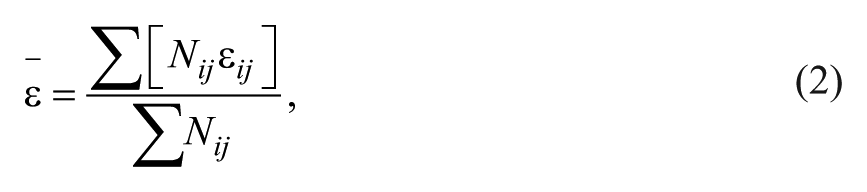
where
The resulting measure is the best estimate of the extant empirical scholarship on the effect of oil on political regime. The effect is regarded small, medium, or large if the absolute value of
Once
Examining Heterogeneity
We then proceed to exploring the heterogeneity in the reported results. Studies can arrive at divergent results because of the real-world factors, the research process, or both. Real-world factors include country, region, and period specificities. The differences in the research process may stem from researchers’ human capital, the data they use, and the methodology they choose to apply to analyze the data, such as model specification, estimation techniques, and common knowledge (Doucouliagos & Ulubaşoğlu, 2008). An MRA allows answering these questions by estimating the partial effects of the study characteristics on partial correlations. I estimated several versions of the following basic model:

where εi denotes the partial correlation between oil and political regime from regression i,
There are two kinds of models meta-analysis: FE model and RE model (Equation 3). The FE (common-effect) model 6 assumes that there is only one true oil–democracy effect size across studies integrated through meta-analysis. Therefore, the differences in observed effects are interpreted as stemming solely from sampling error and methodological differences across studies, not from real-world differences. The RE model, on the other hand, allows the true effect, that is, population parameter value, to vary across studies (Borenstein et al., 2009; Hunter & Schmidt, 2004). 7
Hypotheses and Moderator Variables
The characteristics of studies that we hypothesize to have an effect on the partial correlations are moderator variables (Table 1) and MRA examines their impact on the effect size.
Covariates in the Meta-Regression Analysis of Oil-Regime Effects.

Note. BV = binary variable; MENA = Middle East and North Africa; FSU = former Soviet Union; OECD = Organisation for Economic Co-Operation and Development; SD = standard deviation.
Because country composition in the samples used by the researchers of oil-regime effects is not reported, I used regional composition of the samples. We examine whether and how the inclusion of specific world regions—Latin America, MENA, Sub-Saharan Africa, Eastern Europe and former Soviet Union, and East and South Asia—affects the research results (Dunning, 2008; Herb, 2005). Many studies use data for several regions, therefore the region variables used here are not indicator variables derived from one categorical variable, but dichotomous variables indicating whether the sample used to derive an estimate contained a given region.
Similarly, we include dichotomous variables for each decade to measure whether the data used to derive an estimate included a 10-year period in 1960s–2000s. Each 10-year period roughly coincides with major developments in the global political economy of oil and these periods may entail differences in oil–democracy association (Andersen & Ross, in press; Oskarsson & Ottosen, 2010).
Different measures of key variables can influence the study results. There is an ongoing debate on the most valid measure of oil and whether oil wealth or oil dependence should be treated as the explanatory variable (Dunning, 2008; Humphreys, 2005; Ross, 2009). Three dummies capture how oil is measured in different studies—oil exports as percentage of GDP (oil dependence), oil rents per person (oil wealth), and oil country dummy. A measurement of fuel, mineral, and metal exports is used as the base.
Similarly, I coded three dummy variables for each measure of political regime used—Polity scale, Gastil index, or dichotomous political regime measure. Because our interest lies in the effects of two prevalent measures—Polity and Gastil—the latter is treated as the base.
Key estimation differences are captured by two variables. The first is whether the estimate was derived through pooled OLS regression, which may be biased in this context (Aslaksen, 2010). The second is whether country fixed effects were used to ensure that the hypothesized effect of oil is not due to country-specific factors (Haber & Menaldo, 2011).
To measure epistemic influences, I included a dummy variable that takes the value of 1 if the authors declare receiving feedback from scholars studying the same topic. As concepts, assumptions, and methods coming from U.S. versus non-U.S. traditions in political science may influence the study results (Schmitter, 2002), I constructed a dummy that takes the value of 1 if the first author of the study is affiliated with a U.S. institution. Finally, we use a dummy published to capture potential associations between publication and partial correlations.
We examine two groups of specification differences: confounders and causal mechanisms. By including another independent predictor of democracy into analysis and measuring its impact on partial correlations, MRA can be useful in two ways. First, it can help determine whether oil–democracy relationship is robust to the inclusion of another independent variable across the entire pool of findings. Second, if the oil–democracy partial correlation does change, MRA may be informing us on potential role of this predictor as an effect modifier for the oil–democracy relationship.
Lipset (1959) suggests that democracy originates and is consolidated in countries with a higher level of “modernization.” Per capita income is found to be a strong predictor of democracy or democratization (Londregan & Poole, 1996; Przeworski, Alvarez, Cheibub, & Limongi, 2000; but see Acemoglu, Johnson, Robinson, & Yared, 2008). I use a dummy initial income to capture the potential effect of including an initial income variable on the oil–democracy effect size.
To estimate the potential effect of controlling for institutions on oil–democracy effect size, I use three variables. Lagged regime measures whether the oil–democracy estimate was derived after controlling for previous political regime—a strong predictor of current regime (Epstein, Bates, Goldstone, Kristensen, & O’Halloran, 2006). Organisation for Economic Co-Operation and Development (OECD) dummy measures whether a variable controlling for OECD membership was used in deriving the oil–democracy estimate. Finally, British colony measures whether the specification contained a control for a country’s British colonial past.
Some evidence suggests that Islam affects the likelihood of democracy (Barro, 1999; Potrafke, 2010). The impact of this variable is important to disentangle in the context of the mostly Muslim oil-rich MENA. The Islam dummy measures whether the Islam variable was included in the original model.
Some scholars find that inequality can harm democratization or democratic consolidation (Acemoglu & Robinson, 2005; Boix, 2003). Inequality dummy measures whether the oil-regime effect estimate was derived after controlling for inequality.
While some authors argue that ethnic diversity impedes democracy (e.g., Lijphart, 1977), others find little evidence to support this claim (e.g., Fish & Brooks, 2004). Ethnic captures the potential effect of including the measure of ethnic diversity.
Finally, minerals and aid dummies capture whether the regression from which the effect size was derived controlled for other forms of rents.
Available data also allow examining one of the causal mechanisms—“modernization effect”—by constructing three dummies: income per capita, education, and urbanization. Following Doucouliagos and Ulubaşoğlu (2008), we estimate the indirect effects of oil on democracy working through these three channels as follows. Consider two simplified specifications to estimate oil’s impact on democracy:


If we estimate Equation 4, α oil is the estimate of the total effect of oil on democracy. But if we estimate Equation 5, β oil is the estimate of the direct effect of oil, with an additional indirect effect through its impact on urbanization, estimated by β urban . Each equation will yield a different partial correlation between oil and democracy. Once an MRA model includes a variable that shows whether an urbanization measure was used in the original study, its coefficient will show the effect of including it on the relationship between oil and democracy. This coefficient can be considered the existing literature’s average indirect effect of oil on political regime working through urbanization channel and its sign indicates the direction of the relationship between oil and urbanization, assuming the relationship between urbanization and democracy is known. 8
Findings: Oil Impedes Democracy, Conditionally
Mean Oil–Democracy Effects
Figure 1 shows the distribution of partial correlations (represented by circles) plotted against their standard errors. 9 Estimates converge toward one underlying effect size below zero (the solid vertical line), which is a summary FE estimate at around −0.06. As the estimates become less precise, they become more dispersed. A relatively large number of estimates lie outside the funnel, confirming high heterogeneity and justifying the use of RE models. If they were homogeneous, we would expect 95% of estimates to lie within confidence bounds (dashed lines).
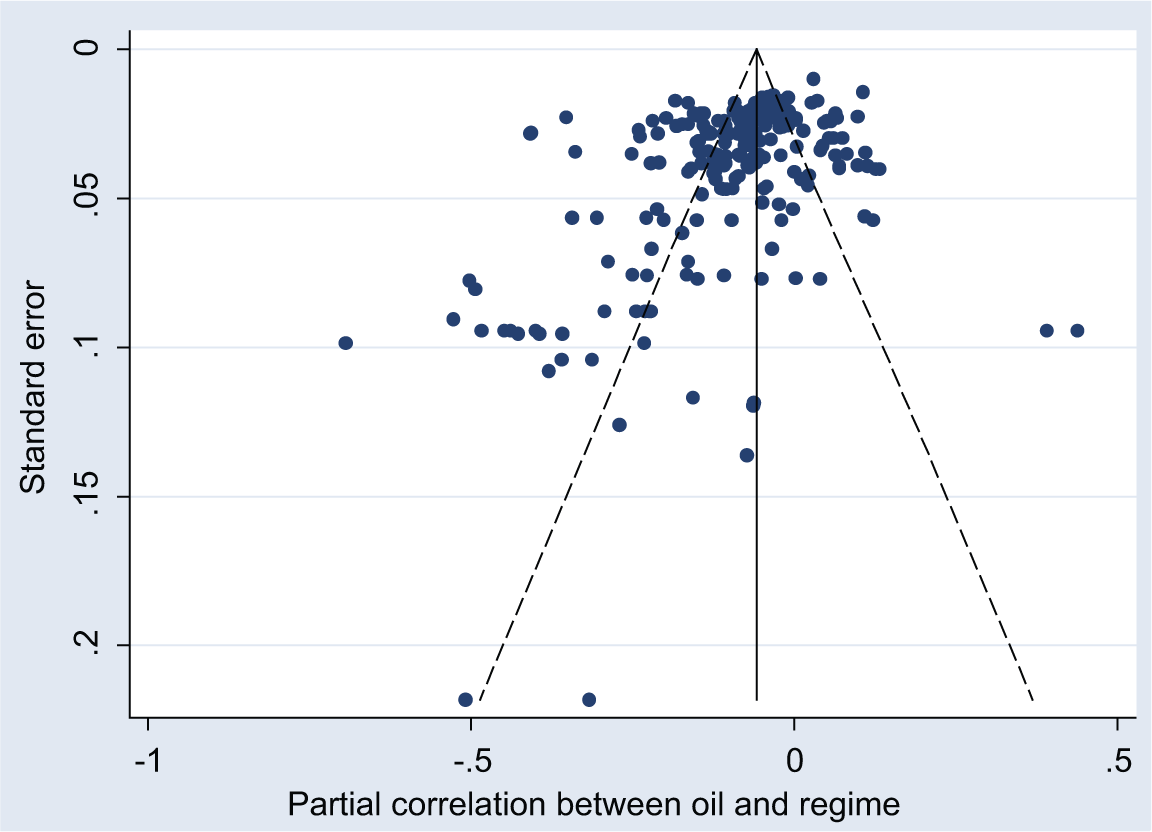
Funnel plot of standard error by partial correlation, all-set (n = 246).
The funnel plot’s slight asymmetry may suggest the presence of publication and other dissemination biases (Rothstein et al., 2005). In the absence of such biases, the estimates would be distributed symmetrically about the mean effect size, as the sampling error is random. The presence of such biases would make the plot asymmetrical, with more estimates missing toward one side at the bottom. In our plot, the right-side gap may indicate where other studies would have been if we were able to locate them.
Since the funnel plot interpretation is largely subjective (Borenstein et al., 2009), I run two formal tests for publication bias. 10 Egger’s test quantifies and tests the relationship between sample size and effect size (Egger, Smith, Schneider, & Minder, 1997). It results in a statistically significant coefficient for potential bias when we take all 246 estimates. However, all-set includes all observations and treats each observation as independent—yet, the observations from the same study cannot be independent. Egger’s test on best-set renders a coefficient for bias, which is statistically not significant at any conventional level. Yet, this test may also have low power and tells us only whether there is any evidence of bias (Borenstein et al., 2009). Even if there is some evidence that asymmetry indicates the presence of bias, its impact on effect size may be trivial. A more important question is what would be the impact of bias on our conclusions.
Therefore, I run trim and fill analysis, a nonparametric method for estimating the effect size in the absence of bias (Duval & Tweedie, 2000). Because there is almost no shift in the adjusted effect size—(−0.06) for FE and (−0.09) for RE—after the imputed studies are incorporated to derive new average effect sizes, we can be confident that the reported effect is valid. If the asymmetry is due to bias, our analysis suggest that the adjusted effect would fall between −0.065 and −0.058 (FE), or −0.098 and −0.074 (RE), very close to the originals. The results are similar with the best-set. Therefore, if the plot asymmetry is due to biases, their impact on oil–democracy partial correlations are trivial and do not undermine our conclusions about the average effect size. They also do not hinder using MRA, which can be biased if there is a publication bias (Stanley & Doucouliagos, 2012). 11
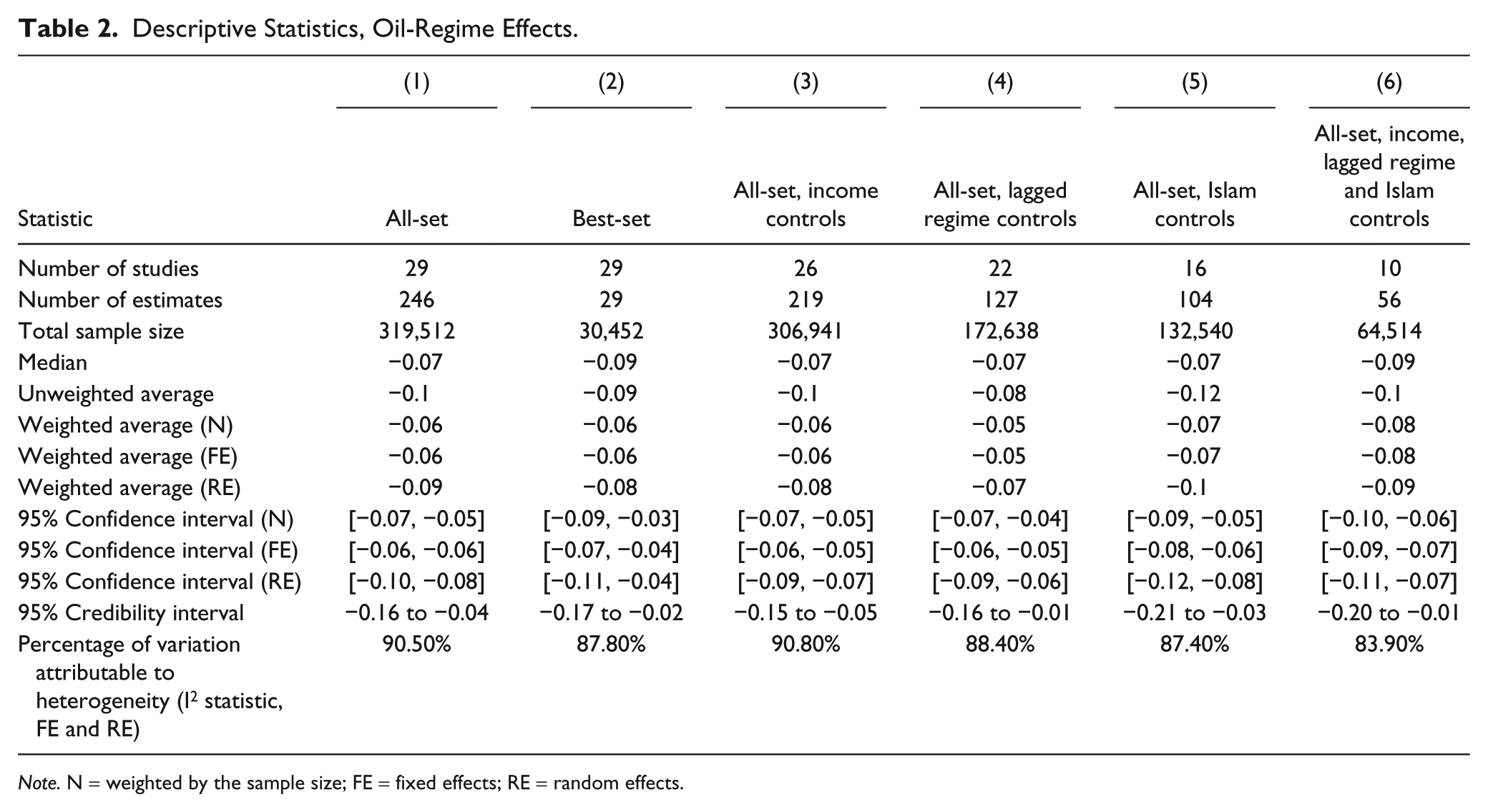
Table 2 presents summary statistics. The first two columns display descriptive statistics for all-set and best-set. The averages and confidence intervals are weighted by the sample size, FE model, and RE model.
Descriptive Statistics, Oil-Regime Effects.
Note. N = weighted by the sample size; FE = fixed effects; RE = random effects.
Summing up available empirical evidence, all means indicate that there is a negative effect of oil on political regime. This effect is small in meta-analytic terms, but not trivial—it varies around −0.09. 12 Confidence and credibility intervals confirm this nontrivial, negative partial correlation and also rule out the possibility of a positive and no association.
Columns 3 to 6 report descriptive statistics for the groups of estimates derived after controlling for the effect of three key confounders—income, lagged regime, and Islam. The results remain similar, indicating that the oil–democracy effect remains negative when the effects of income, previous regime characteristics, and Islam are taken into account.
Finally, Table 2 reports the I2 statistic for FE and RE models (rendering identical results in this case), which measures the percentage of variation attributable to heterogeneity. A value of around 0% would indicate no observed heterogeneity, suggesting that the observed variance is spurious and there is nothing to explain. Larger values attest for increasing heterogeneity. I2 values between 25% and 50% are tentatively considered low, between 50% and 75%, moderate, and more than 75%, high (Higgins, Thompson, Deeks, & Altman, 2003). Here, the values are higher than 75%, calling for explanations about reasons behind this variance and applications of techniques such as meta-regression to explain it.
Heterogeneity
Regions, measurement, and estimation drive heterogeneity
If integrating existing studies points at the negative relationship between oil and democracy, why is the literature reporting different findings? What effect do confounders have on the partial correlations? Finally, does oil affect democracy through retarding modernization?
Table 3 reports several models that estimate the impact of moderator variables on the effect size. Multiple methods are used for sensitivity analysis and to ensure the robustness of findings. All models are estimated using all-set rather than best-set to take a full advantage of all results in the literature and avoid low degrees of freedom. Column 1 reports the estimates from a restricted maximum-likelihood RE model. Column 2 presents the results of the weighted least squares FE model to deal with heteroscedasticity (Stanley & Doucouliagos, 2012). Because the estimates grouped in all-set are not statistically independent, Doucouliagos and Ulubaşoğlu (2005) suggests using the bootstrap method for statistical dependence problem. A more natural solution could be to treat the data set as a multilevel structure or a panel and cluster the estimates accordingly (Nelson & Kennedy, 2009). Column 3 reports a maximum-likelihood RE model results with robust standard errors clustered by the study. Column 4 presents the estimates from an RE model fitted using feasible generalized least squares where studies were treated as panels. Columns 5 to 8 present more parsimonious models where variables that were statistically not significant were dropped until the remaining variables had a z score or t-statistic of at least 1. All models, except weighted least squares (WLS), were estimated using precision as weights. In WLS models, following Stanley and Doucouliagos (2012), I use precision squared (1/SE2) as weights.
Meta-Regression Analysis, Oil and Political Regime Effects.

Note. Standard errors in parentheses for ReML and fGLS; robust standards errors for WLS; robust standards errors clustered by study for ML. ReML = restricted maximum likelihood; ML = maximum likelihood; fGLS = feasible Generalized Least Squares; WLS = weighted least squares; OECD = Organisation for Economic Co-Operation and Development; FSU = former Soviet Union.
p < .1. **p < .05. ***p < .01.
Three related reasons warrant favoring the RE model. First, although some research domains can be homogeneous in terms of substantive population parameters (allowing the application of the FE model), for crossnational time-series research on the relationship between oil and political regime, such assumption of homogeneity would be unrealistic—the presence of substantive, not only methodological, factors that explain different effect sizes is more plausible (Borenstein et al., 2009). Second, moderator variables can capture some of the variation among size effects, but usually not all (Borenstein et al., 2009). Third, even in the absence of significant variation in population parameters, across-study differences in reliability of measurement, range variation, or dichotomization of continuous variables can entail differences in study population parameters (Hunter & Schmidt, 2004). Given their estimation of RE models, treatment of studies as panels and deriving cluster-robust standard errors, my preferred results are in columns 3 and 7. Table 3 reveals some robust findings.
Regional differences
Latin America, Sub-Saharan Africa, and MENA have significant impacts on partial correlations, while the inclusion of countries in East and South Asia and Eastern Europe and former Soviet Union (FSU) does not change the results. This underscores regional differences in how oil affects political regime. The coefficient of MENA is negative, indicating that when estimates are derived using data that cover this region, the results tend to be more negative. While this is not surprising, the detrimental effect of oil on democracy is not circumscribed to this region—the coefficient of Sub-Saharan Africa is also negative and statistically significant at 5% level.
The coefficient of Latin America, on the other hand, is positive. The substantive effect of Latin America is larger than the individual effects of MENA and Sub-Saharan Africa. While these variables pull partial correlations in different directions, Latin America’s positive effect is substantively larger, controlling for other factors.
Period effects
There is mixed evidence that oil has had different effects in different time periods since the 1960s, when many new independent oil producing countries emerged and oil gradually came to dominate world markets as a key source of energy and accrue larger rents to states than before since mid-1970s. There has been a statistically significant positive sign in the 1960s in three specifications, implying the possibility that in the 1960s the relationship between oil and democracy was globally positive. Conversely, the inclusion of data covering 2000s has a negative effect on partial correlations, implying that in this period the oil had more negative effect on democracy. However, these results are not robust to different estimations. None of the other period dummies are statistically significant. 13
Measurement effects
When oil is measured as the ratio of oil exports to GDP, the results tend to be more negative as opposed to when they are measured broadly as fuel, mineral, and metal exports. This is in contrast to the arguably less biased measure of oil rents per capita and using an oil country dummy, which do not entail statistically significant changes in partial correlations.
Polity has a significant negative sign—when the estimates are derived using the Polity index as opposed to using a dichotomous political regime measure, the oil–democracy partial correlations tend to be negative. Gastil also has a negative sign, which is not surprising given that Polity and Gastil measures are on average strongly correlated; however, its effect is not statistically significant. 14
Estimation effects
Results suggest that studies using pooled OLS do not produce results that are significantly different from those using other methods. 15 Using country fixed effects has a strong positive effect, increasing the partial correlation by an average of 12%. This implies that controlling for country-specific factors can significantly detract the negative effect of oil on political regime.
Knowledge and publication effects
Epistemic influences and country-institutional affiliations of the first author do not affect the study results. However, published studies may be more likely to contain positive results, controlling for other factors. On one hand, it may indicate a bias—studies reporting smaller negative or more positive oil–democracy effects being more likely to be published. On the other hand, published and unpublished work may differ in ways that are not captured by the moderator variables in this article. Given that my preferred estimation method (columns 3 and 7) does not find strong evidence for such effects, I treat this result cautiously.
Oil–Democracy Effects Can Be Conditioned by the Institutional Context
Estimates derived after controlling for the previous political regime tend to be more positive. This suggests that in regressions, without such controls, the oil variable may be picking up the bad effect of the previous political institutions. 16 British Colony, on the other hand, is not statistically significant.
OECD is a robust predictor of the effect size. Once a broader set of institutions associated with OECD membership is controlled for, the negative effect of oil on political regime gets significantly weaker. This can imply that in regressions, without OECD control, the oil variable may be picking up the effect of bad institutions because many oil-rich developing countries also have had such institutions. However, it can also imply that the oil’s effect on political regime is conditioned by institutions. 17
Other potential confounders—initial income, Islam, ethnic diversity, minerals, and foreign aid—have a nonsignificant effect on partial correlations, except inequality, which is significant at 10% level in some specifications.
(Lack of) Modernization Is a Weak Causal Mechanism
Little evidence was found that two hypothesized variables for the “modernization effect”—income per capita and urbanization—have statistically significant effects on partial correlations. Thus, oil is unlikely to hinder democracy by affecting urbanization and income per capita.
However, I find consistent evidence that including a measure of education into regressions has a statistically significant negative impact on oil–democracy partial correlations. The coefficient of education is the existing literature’s average indirect effect of oil on political regime working through education channels and its negative sign indicates the direction of the relationship between oil and education, assuming that the relationship between education and democracy is positive (Barro, 1999; Glaeser, Ponzetto, & Shleifer, 2007; but see Acemoglu, Johnson, Robinson, & Yared, 2005). The MRA suggests that oil leads to lower education and, hence, less democracy.
Discussion and Conclusion
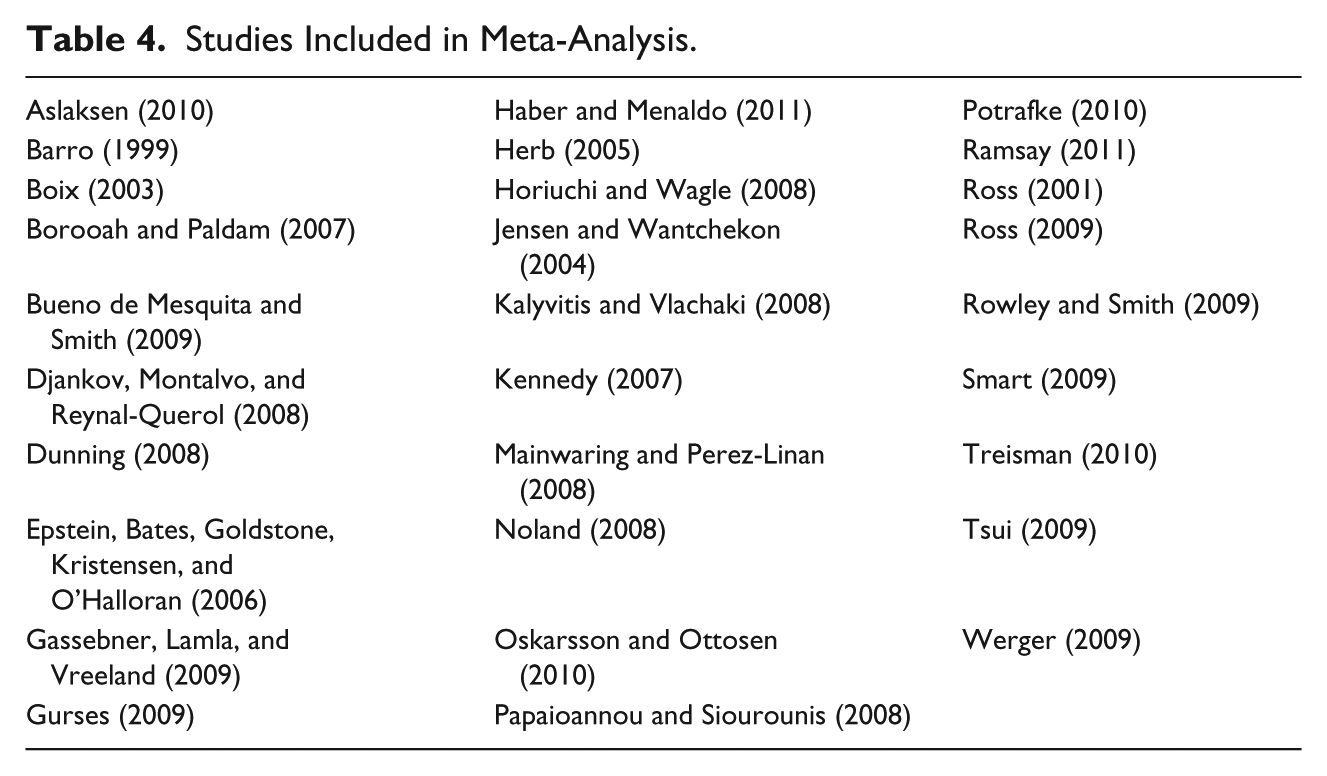
With a data set and methodology that carefully integrate the findings and features of all the existing crossnational statistical studies on the topic (see Table 4), this article considerably expanded the scope of previous research and found that there is a small, in meta-analytic terms, but nontrivial negative association between oil and democracy across the globe. This confirms the findings of the rentier-state theorists and scholars who arrived at the same conclusion through empirical tests (Aslaksen, 2010; Jensen & Wantchekon, 2004; Ross, 2001, 2009; Ulfelder, 2007). This negative average effect holds when we control for key potential confounders—previous political regime, income, and Islam.
Studies Included in Meta-Analysis.
Critically, however, it found consistent evidence of notable variation in the oil–democracy relationship across geographic regions and institutional contexts. First, while MENA is found to be strongly characterized by a negative relationship between oil and democracy, Latin America consistently displays a reverse pattern confirming that in this region, oil wealth fostered rather than undermined democracy (Dunning, 2008). The results also show that the negative oil–democracy link is not circumscribed to MENA, but characterizes Sub-Saharan Africa as well (Jensen & Wantchekon, 2004; Ross, 2001). While these results lend credence to the claim of regional variation in oil-regime dynamics (Dunning, 2008; Herb, 2005), they reject the notion of MENA’s “exceptionalism.”
Second, MRA results suggest that institutional contexts alter the oil–democracy link, thus circumscribing the negative effect of oil on democracy to developing countries. These results speak to an emerging debate that puts institutions at the forefront of explaining why resource curse takes place in some countries but not others. While there is a growing effort to understand how institutions affect the economic aspect of the resource curse (Mehlum, Moene, & Torvik, 2006; Robinson, Torvik, & Verdier, 2006), there is relatively scarce literature to explain how institutions condition the “political resource curse” (Dunning, 2008; Smith, 2007). While our results are largely suggestive because of data and methodological limitations, they nonetheless indicate that a conditioning effect of institutions may lie more in a broader set of political and economic institutions associated with OECD membership, less so in previous political regime, but not institutions associated with British colonial past.
The results also indicate that oil does not hinder democracy by affecting income per capita and urbanization, thereby confirming the findings of Ross (2009). However, oil can negatively affect democracy indirectly through its impact on education. If we assume that education is positively related to democracy (Barro, 1999; Glaeser et al., 2007; Lipset, 1959), then these findings suggest that oil is negatively related to education.
Critical effects of measurement differences pertain to how oil and political regime are measured. MRA suggests that adopting a measure of oil exports to GDP, which is a measure of oil dependence rather than oil wealth and may be biased (Humphreys, 2005), results in more negative partial correlations. This underscores the importance of distinguishing wealth from dependence and strengthening efforts to adopt the most valid measure (Dunning, 2008; Humphreys, 2005; Ross, 2009). Similarly, the choice of political regime measure also has a significant effect on the resulting estimates. If the Polity index is a relatively better measure of political regime than others used in this body of literature, on issues of conceptualization, measurement, and aggregation (Munck & Verkuilen, 2002), then the actual relationship between oil and democracy is likely to be more negative. If some measurement or estimation choices are more justified than others—for example, because of the latest improvements in measurement or estimation techniques—then the knowledge of their different effects on study outcomes should help us in approximating the effect of oil on democracy more precisely and provide a better guidance for future studies in this and other fields of inquiry.
Future research should be directed toward further identifying and empirically examining the role of specific structural features and institutions (such as in Dunning, 2008; Smith, 2007) that may have conditioning effects on the oil–democracy linkage, to enable us to tell the story of ultimate rather than average effects (Dunning, 2008; Ross, 2009). In doing so, scholars may wish to consider using multiplicative interaction models and give explicit attention to the interaction between causal mechanisms and context to increase the credibility of our causal explanations (Falleti & Lynch, 2009). Practical efforts to counter the “resource curse” in general and “political resource curse” in particular, if at all feasible, would be helped if the knowledge of average crossnational patterns is combined with a better understanding of how oil interacts with context in producing different outcomes.
Footnotes
Acknowledgements
I would like to thank Jim Hughes, Mike Seiferling, participants of the Nuffield Politics Seminar at Oxford University and Political Science and Political Economy (PSPE) seminar at the London School of Economics and Political Science, and the anonymous referees of this journal for useful feedback.
Declaration of Conflicting Interests
The author(s) declared no potential conflicts of interest with respect to the research, authorship, and/or publication of this article.
Funding
The author(s) received no financial support for the research, authorship, and/or publication of this article.