




Abstract
Many scholars have examined the durability of parliamentary versus presidential regimes in democracies, but the process by which authoritarian leaders are (nominally) elected is generally assumed to be irrelevant. However, even if the electoral outcome is not in doubt, the executive selection process may affect outcomes such as regime durability. I argue that, when opposition parties are allowed to participate in the executive selection process, a Parliament-based election system increases authoritarian regime durability by creating incentives for ruling party elites to work cooperatively for mutual gain. In this article, I identify dictatorships by executive selection system and find that regimes with a multiparty Parliament-based system are more durable than those with a multiparty Presidential system or an Unelected (or single party) system if the party, relative to the ruler and the military, is an important power center.
(W)hen are authoritarian elections regime-sustaining and when are they regime-subverting? What makes them now instruments of power, now levers for the opposition? Why do they sometimes keep authoritarian rulers in the saddle, and at other times lift them right out of their stirrups?
Why some political regimes fail while others endure is among the most studied questions in political science. Part of the answer is economic factors: strong economic performance and oil revenues are often found to facilitate survival of both democratic and authoritarian regimes. Another set of answers focuses on political institutions. Party-based authoritarian regimes, and dictators with power-sharing institutions such as legislatures, appear to be more durable than other types of authoritarian regimes (Boix & Svolik, 2013; Brownlee, 2007; Geddes, 2003; Magaloni, 2008). However, scholars find that allowing opposition parties to participate in multiparty legislatures and elections does not promote, and perhaps undermines, survival (Brownlee, 2007; Gandhi, 2008; Magaloni, 2008).
In this article, I consider the effect of executive selection systems on authoritarian regime survival, a topic that has not, to my knowledge, been considered. 1 Whereas the effect of presidential versus parliamentary systems on democratic regime durability has been studied extensively (see Cheibub and Limongi, 2002, for a review), executive selection systems are not mentioned in a recent review of the literature on elections in authoritarian regimes (Gandhi & Lust-Okar, 2009). Including executive selection system in the analysis reveals new insights into the relationship between regime type, multiparty elections, and regime durability: The regime durability advantage of party-based authoritarian regimes presents primarily when the executive is elected in an indirect multiparty process, and multiparty elections can promote authoritarian regime durability when those elections are used by civilian or party-based regimes to indirectly select the executive.
I argue that a “Parliament-based” executive selection system (defined as a system in which formal rules require the executive to be elected or confirmed by an assembly of politicians elected in a multiparty process) promotes power sharing, and thereby authoritarian regime durability, relative to alternative systems for a number of reasons. 2 A multiparty system helps political elites constrain the executive from engaging in rapacious behavior by providing a legal right to join opposition parties. The executive’s reliance on selection by elected party members increases interdependence among party members and encourages intra-party cooperation for mutual benefit. The importance of the legislature in a Parliament-based system increases the likelihood that policy decisions and rent distributions will occur in that chamber (rather than channels more directly controlled by the dictator), thus enhancing the benefits of multiparty legislatures such as greater economic growth. Finally, relying on many small electoral victories (for party members) rather than one large victory (for the president) facilitates a variety of electoral and co-optative tactics to maintain power, reducing the need for higher risk tactics such as violence and fraud that may trigger violent overthrow.
According to Wintrobe (1998), “the fundamental truth about dictatorship (is that the) absence of a legitimate, regularized procedure for the dictator’s removal from office makes him or her relatively insecure in it” (pp. 38-39). However, an increasingly large number of dictators do submit themselves (under domestic or international pressure) to a regularized procedure that, in theory if not in practice, enables voters to remove him from office in a multiparty Presidential or Parliament-based system (see Figure 1). Offering voters a choice with regard to the executive introduces an additional risk to a dictatorship, which is why elections have been called “the death of dictatorship” (Huntington, 1991, p. 174). However, if elections for the executive encourage power sharing between the executive and other political elites, such power sharing may promote regime survival (Boix & Svolik, 2013).
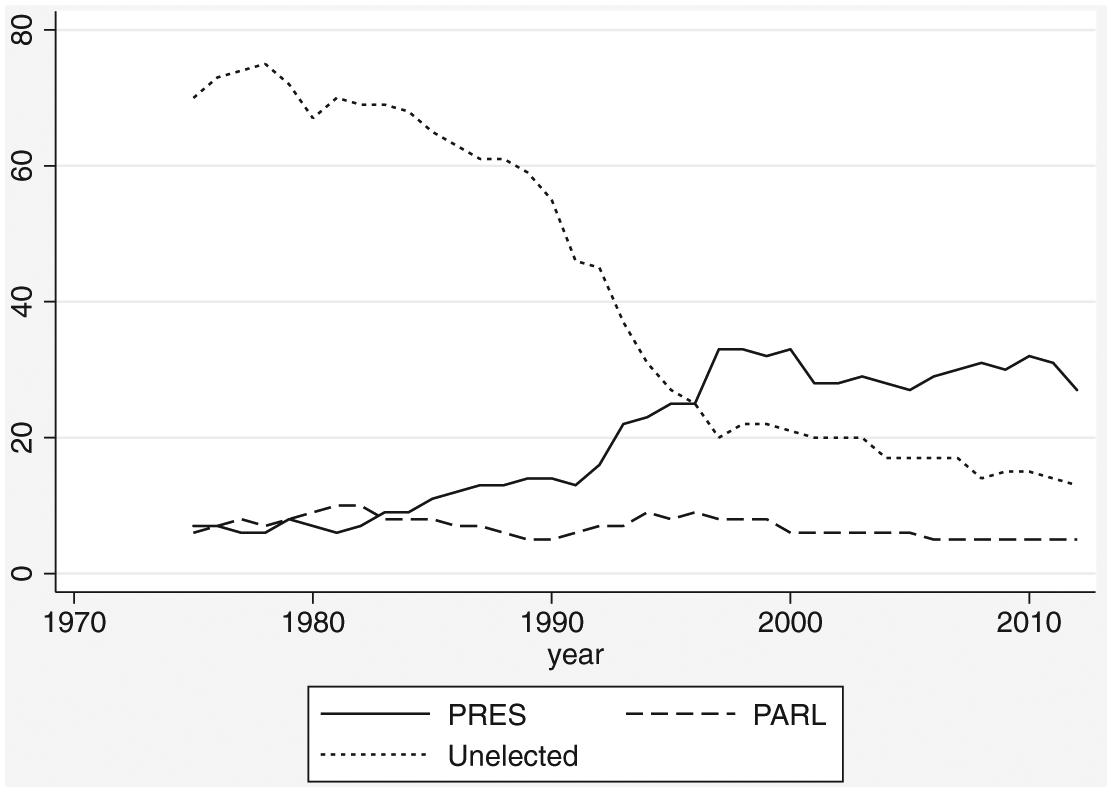
Frequency of non-monarchy authoritarian regimes with Unelected (including single party) and multiparty Elected (Parliament-based and Presidential) executive selection systems, 1975-2012.
As authoritarian regimes are often defined by the inability of voters to remove the executive (Geddes, Wright, & Frantz [GWF], 2014; Przeworski, Alvarez, Cheibub, & Limongi, 2000), formal rules regarding the “election” of the executive are generally assumed to be irrelevant. However, even when the de facto ability of voters to remove the executive is negligible, the law-based process of executive selection affects the incentives and behaviors of the executive and other elites. The impact of the law-based executive selection system on regime durability is conditional on how much power resides in the institutional political party, with members that compete in elections, versus non-party groups such as the military or the dictator’s clique.
In regimes where power is dispersed among members of the ruling party, the party generates incentives for members to work together to retain hegemonic control of the government. An executive selection system that requires confirmation of the leader by elected party members amplifies the cooperative dynamics of such a regime, and thereby regime survival. I therefore expect party-based regimes with a “Parliament-based” system to be more durable than other regimes.
In other authoritarian regimes, power resides primarily in the hands of the dictator or the military. Personalistic or military rulers, especially when they have access to “unearned income” such as oil revenues or foreign aid, are unlikely to adopt constraining institutions such as a political party or legislature, and when such institutions are adopted, the alternative power center limits the efficacy of these institutions (Boix & Svolik, 2013; Wright, 2008). I therefore expect Parliament-based systems to be less common in personalist and military regimes, and to have little effect on the durability of such regimes.
Because my goal is to understand whether elections for the executive are regime-sustaining, this analysis does not define a dictatorship with contested authoritarian elections as a regime type. Instead, I treat such elections as a tool that ruling elites of a given regime can manipulate in their efforts to maintain power. The conventional view is that the nominal electoral process for the executive in authoritarian regimes is irrelevant because the election results are predetermined. For this reason, when categorizing regimes based on executive selection, some scholars differentiate among democratic regimes but not among dictatorships. 3 However, the fact that dictatorships do tinker with the executive selection system suggests they believe such systems do make a difference. For example, the military regime in South Korea pre-1988 cycled through direct presidential elections, election of the president by an elected assembly, an electoral college system, and periods in which elections were suspended. “The frequent changes of electoral system are largely attributable to the political interests of the president in office, who changed tactics for every election in the face of domestic political pressure and shrinking voter support” (Croissant, 2002, p. 237).
In the rest of the article, I explain my argument in more detail, define Parliament-based and Presidential dictatorships, and then test the argument first by comparing failure rates by regime type and executive selection system, and then with more rigorous statistical tests with domestic and international controls in an appropriately specified multivariate analysis. These tests, including a robustness test using an alternative measure of regime type, support the argument: among non-monarchy authoritarian regimes, those with a Parliament-based system fail less frequently than regimes with an Unelected or a Presidential system when power is centered in the political party. 4
A challenge when analyzing the effect of authoritarian institutions generally is that such institutions are endogenous (Pepinsky, 2014). For example, if political elites that successfully share power are more likely to retain power and also more likely to organize themselves as a party-based regime with a Parliament-based system, then those institutions may be epiphenomenal rather than exogenous causes of regime durability. I address this challenge in a number of ways. In the “Data” section, I provide sketches of regimes that endured when using a Parliament-based system, transitioned to a Presidential or Unelected system, and subsequently failed in a way that can, to varying degrees, be connected to the executive selection system. In the Robustness Tests section, I demonstrate that regimes with Parliament-based systems are more durable than those with Presidential systems in regimes where the executive selection system changes (indicating the system is indeed endogenous) and in those without change (suggesting the system may be, for that regime, relatively fixed).
I also test the exogenous effect of the executive selection system using a matching technique. Countries where the government can rely less on power sharing (because of internal factors, such as an underdeveloped economy or a personalistic power structure, or external factors, such as foreign aid or oil revenues) are less likely to adopt or retain a Parliament-based system. I test the effect of executive selection system on a sample in which the treatment group (those with a Parliament-based system) are similar to the control group (those without a Parliament-based system) using Coarsened Exact Matching (CEM). The evidence still supports the argument that a Parliament-based system enhances regime durability when power is held by a ruling party rather than an individual or the military. In short, the Parliament-based system is most attractive to political elites who need to share power with one another, and, once that system is in place, it successfully amplifies the regime-sustaining effects of elite-coordination.
In the final section of the article, I provide some preliminary evidence regarding mechanisms for the durability of party-based regimes with a Parliament-based executive selection system. I argue that in a Parliament-based system, power resides to a greater degree with party members in the legislature, which constrains the executive and incentivizes cooperation, whereas in a Presidential system, power resides to a greater degree in the office of the president. Elite cooperation and constraint of the executive encourages investment and thereby economic growth, and reduces necessity for political violence. I therefore expect party-based regimes with a Parliament-based system to have, on average, more constraints on the executive, less frequent major cabinet changes, more effective legislatures, higher economic growth, and fewer military coups than regimes with a Presidential system. I present evidence supporting all of these expectations.
Argument
I argue that although the law-based rules of executive selection in authoritarian regimes do not (successfully) empower voters to remove the executive, as is the case in democracies, these formal rules interact with the power-based rules of executive selection to influence elites’ behavior and thereby regime durability. Specifically, I argue that regimes with the law-based rules of a Parliament-based executive election system tend to be particularly durable in regimes whose power-based rules are centered on a ruling party rather than a person or the military. The Parliament-based system increases the interdependence between the executive and other elite party members, which amplifies the durability-promoting cohesiveness of political parties. This follows the argument that parliamentary systems promote party cohesion in democracies (Cheibub & Limongi, 2002; Samuels & Shugart, 2010). In regimes where the power-based rules are centered on a person or a military, however, willingness to share power with a large set of party elites is reduced, and therefore a Parliament-based system is less likely to be effectively utilized.
In the rest of this section, I define the terms used in my argument, explain the logic of the argument in more detail, and then summarize the main predictions from the argument.
A political regime can be defined as “sets of formal and informal rules and procedures for selecting national leaders and policies” (Geddes, 2003, p. 70). In this article, I differentiate between the formal (or law-based) rules, which I refer to as the executive selection system, and the power-based regime type, in which informal rules may trump formal rules. For example, following a military coup in 1972, the Republic of Benin (formerly Dahomey) was ruled for 3 years by a military junta, and then a single party was created in 1975 to take over the government, first without elections and then with plebiscites. Real power, however, was held throughout this period by Matthieu (later Ahmed) Kerekou, who was an unelected president during the military period, then founded a ruling party (over which he served as party president) that regularly confirmed him as president of Benin until he stepped down in 1991. Geddes therefore categorizes the regime for the entire period as personalist. Kerekou, in coordination with other elites, changed the formal structure to achieve the leadership’s goals. By defining regime using power-based rather than formal rules, the Geddes categorization scheme does not misleadingly suggest that Kerekou and his cohorts lost power when a ruling party replaced the military as the formal governing organization.
Geddes (2003) argues that the nature and distribution of power in the ruling group lead to differences in inter-elite dynamics and thereby regime durability. In regimes where power is dispersed among members of the ruling party, which is “the creature of the politicians” (Aldrich, 1995, p. 4), the leader is constrained from taking personal control over policy and personnel decisions. The party generates incentives for members to work together to retain hegemonic control of the government.
By offering a sustainable system for members to settle disputes and exert influence, ruling parties generate and maintain a cohesive leadership cadre . . . When parties harness elites together, they provide collective security, a sense among power holders that their immediate and long-term interest are best served by remaining within the party organization. (Brownlee, 2007, p. 39)
In times of crisis, such as economic downturn, ruling parties often respond to public discontent by expanding political rights, which can include multiparty elections (Geddes, 2003).
In other authoritarian regimes, power is more concentrated in the hands of the dictator. Such rulers, particularly when they have access to “unearned income” such as oil revenues or foreign aid, are unlikely to adopt constraining institutions such as a political party or legislature, and when these are adopted, the personalization of power limits their efficacy (Boix & Svolik, 2013; Wright, 2008). In times of economic crisis, personalist leaders respond by cutting out peripheral supporters to conserve spoils for loyalists (Geddes, 2003).
In a third category of regimes, power is held collectively by the military leadership. In a professionalized military, the survival and efficacy of the military as an organization is more important for the majority of members than the perks of political office (Geddes, 2003). Furthermore, the military has a comparative advantage in repression but a comparative disadvantage in mass politics (Wintrobe, 1998). Military-led governments therefore tend to respond to public discontent by relinquishing political power and returning to the barracks, where the military can continue to protect its interests through the threat of future coups.
I consider the law-based executive selection system to be a tool used by political elites to address hazards and hold on to power. For example, consider the regime in Egypt that began with Gamal Abdel Nasser’s coup in 1952 and ended recently in the Arab Spring. In the beginning, a military council ruled, until Nasser established the National Union (successor to the Liberation Rally) to play the role of a single party, and in 1956 began holding plebiscites for voters to affirm the president. After Nasser died, his vice president, Anwar Sadat, had the constitution amended to give the legislature the power to elect the president (with a two-thirds majority, followed by confirmation in a national referendum; Meital, 2006). In 1976, Sadat divided the single party into three party-like “platforms” in response to divergent policy demands from party factions; the center “platform” was made up by Sadat’s insiders and controlled the media and bureaucracy (Brownlee, 2007, p. 91). In 2005, as President Hosni Mubarak (formerly Sadat’s vice president) groomed his son Gamal for the presidency, shifting the center of power further from the military and party and more to his own family, the constitution was changed again, this time to adopt direct multiparty elections for the presidency (Brownlee, 2007). Thus, although the formal rules changed over this time period, the elites who held power remained relatively constant, so the Nasser–Sadat–Mubarak period is considered to be a single regime that adopted different executive selection systems at different times, to address the leadership’s evolving goals and challenges. 5
Once the government is in power, it has a variety of tools at its disposal. Wintrobe (1998) argues that the strategies available to the dictator to remain in power can be grouped into two classes: repression and loyalty. Bueno de Mesquita et al. (2003) identify two tools to maintain loyalty: the distribution of public goods (which have broad effects) and of private goods (consumed by individuals). Similarly, in Gandhi and Przeworski’s (2007) model, the ruler decides on a level of policy concessions (public goods) and sharing of rents (private goods), and resorts to repression when faced with rebellion. The most efficient strategy depends in part on the regime type; military regimes have a comparative advantage in repression; party-based regimes have a comparative advantage in broad distribution of benefits; personalist regimes, with a narrower power base, rely more on targeting of benefits.
The leadership of the regime is also faced with the decision of what formal rules to establish and maintain to hold power. Building on previous models of institutional choice in authoritarian regimes (Boix & Svolik, 2013; Bueno de Mesquita & Smith, 2009; Gandhi & Przeworski, 2007), I assume an authoritarian leader prefers, all else equal, to be free of institutional constraints (whether from voters, a party, a military council, or the legislature) to maximize his consumption or other goals. The leader will accept power-sharing institutions if political elites outside his personal clique control a significant share of economic or political resources such that they pose a credible threat to the leader’s survival, or can hide economic assets from the leader’s expropriating reach (Gehlbach & Keefer, 2011).
One institutional decision is whether to submit the executive to contested elections, in which more than one party can legally compete for the office of the (nominal) chief executive of the government. Legalization of opposition parties lowers barriers to entry for political challengers who can overthrow the dictator by drawing away key coalition members. Multiparty elections therefore enhance the constraining power of an institutionalized ruling party vis-à-vis the executive, by providing members with “a credible exit option—a peaceful avenue to challenge the dictator” (Magaloni, 2008, p. 728). Opposition parties do not necessarily need to come within striking distance of a majority to influence the dictator. Because “dictators aspire to win supermajorities . . . to project an image of invincibility and strength” (Magaloni, 2008, p. 729), even incremental gains by opposition parties can help constrain the dictator.
The leader is therefore more likely to allow multiparty contestation for the executive office if there is diversity of preferences with regard to public policy and other public goods, if the government has difficulty maintaining control through repression, if the government relies on the cooperation of its populace for economic production, and if there are external influences for liberalization. Low diversity (e.g., if citizens are all poor farmers or dedicated Islamists) means low demand for multiple parties. Low costs to the use of force (e.g., because of rule by a professionalized military) makes repression more attractive relative to sharing public and private goods. Low economic dependence on the population (because, for example, government revenues are primarily oil or foreign aid) enables the government to disengage from society rather than respond to demands. And if democracies are relatively scarce in the international community, there is little expectation or pressure, internally and externally, to allow opposition parties to compete.
If the leadership decides to allow contested elections for the executive, it must decide upon an election system: either direct, with the leader on the ballot, or indirect, with voters electing members to an assembled body (usually a legislature) that elects the executive (see Figure 2). Although both approaches require the development of a party (or something like a party, such as a “movement”) to mobilize voters, and both approaches include the distribution of public and private goods, the relative importance of the party and the manner of distribution is influenced by the election system.
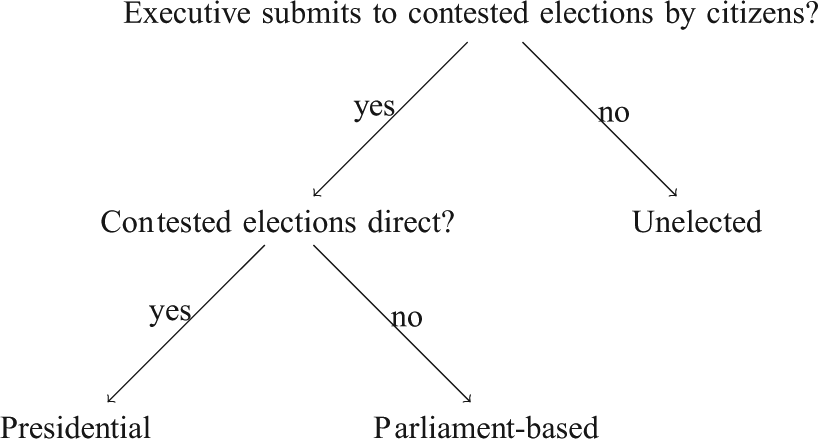
Classification of executive selection systems.
In a Presidential system, the executive is elected directly by voters. This separate origin from the legislature makes the president relatively independent of fellow party members in the legislature and thus “hinders parties’ organization development” in electoral dictatorships, as in democracies (Samuels & Shugart, 2010, p. 13). The party can help the president win office, but with his name on the ballot, the president can also use tactics such as personal charisma and cult of personality, as well as oppression. Winning office through personal appeal enhances the president’s personal power relative to other political elites, and winning office by suppressing the opposition enhances the political power of the security apparatus relative to party elites. Finally, because the president relies less on the support of elected delegates, he has greater discretion to direct distribution of private goods through his cabinet, which he can shuffle with relative ease, rather than the legislature (Samuels & Shugart, 2010), which is populated by party elites elected to office. Gandhi (2008) emphasizes the use of legislatures to distribute benefits and negotiate policy, but Arriola (2009) emphasizes the importance of cabinets for distributing private goods to opportunistically coopt support in (often personalistic) sub-Saharan Africa, thus rendering the legislature less relevant. “Interbranch accountability” between the legislature and the president may be effective in democracies, but is less likely in dictatorships, particularly those of the personalist or military varieties.
In a Parliament-based system, however, the formal institutional rules reinforce the mutual dependence and cooperation that is the source of party-based regime durability (Boix & Svolik, 2013; Brownlee, 2007; Geddes, 2003; Magaloni, 2008). Fused origin of the legislature and executive in a multiparty system creates collective risk of losing power to opposition parties, encouraging intra-party power sharing; party members in both the legislature and the executive work cooperatively for collective survival. Without a presidential candidate on the ballot, there is an increased need to create a brand for the party, which can encourage the emphasis of policies or other public goods, including policies that facilitate economic growth, which then promotes regime stability. If the executive relies on confirmation from the legislature to hold his office, the legislature is a more effective body to constrain the executive, which promotes investment and thereby economic growth (Wright, 2008), particularly when the presence of multiple parties facilitates information flow and signals policy stability to firms (Gandhi, 2008). For example, the United Malays National Organization (UMNO) attained political prominence by establishing a reputation as a “nonviolent, moderate political movement,” in contrast to the Malayan Communist Party (MCP; Brownlee, 2007, p. 60). This reputation attracted an alliance with the Malaya Chinese Association (MCA), comprised of “Chinese capitalists who disdained the MCP” (Brownlee, 2007, p. 61). The MCA’s membership in the ruling front constrains the Malay prime minister (who relies on future votes won by Chinese party members to keep his post) from expropriating their wealth, thus encouraging investment and thereby growth.
The indirect election system also enables manipulation of legislative electoral rules to protect the executive from the ballot box. Whereas direct presidential elections are nationwide, parliamentary elections are often by district, providing opportunities for malapportionment in single-member plurality districts or in multimember districts with party block vote, which can translate marginal voting victories into dominant control of the legislature that then selects or confirms the (nominal) executive. For example, according to data in the Data of Political Institutions (DPI; Beck, Clarke, Groff, Keefer, & Walsh, 2001), Botswana’s ruling party won 77% of the legislative seats with 52% of the vote in 2004 and South Africa’s ruling party won 74% of seats with 52% of the vote in 1987. The ruling party in nearly all party-based regimes with a Parliament-based system successfully captures a majority of legislative seats, in contrast to democratic parliamentary regimes, where roughly one in three governments, according to Strom (1984) are led by minority parties. 6
In military and personalist regimes with multiparty elections, however, the government’s party often has fewer than 50% of seats, suggesting that control of the legislature may be a relatively lower priority for such regimes because even when the executive’s party does not control a majority, the legislature is unlikely to check the executive. 7 If deadlock from the executive’s party’s lack of control over the legislature poses a risk to democratic regimes (Mainwaring, 1993), such a threat does not seem present in authoritarian regimes, where either the ruling party generally controls the majority of seats, or the party is less important for policymaking than are other institutions.
The Parliament-based system also provides more opportunities to share power with elites of allied groups, relative to the Presidential system. Only one person can be president, but many can be in the coalition that chooses the prime minister or assembly-elected president. Governments in Parliament-based systems use a number of strategies. Singapore’s People’s Action Party (PAP), which has ruled since 1959, provided access to non-Chinese groups within the party in 1988, when the legislative electoral system added multimember winner-take-all Group Representation Constituencies (GRCs) and a rule that each party slate must include minority candidates (Means, 1996). In Malaysia, however, the UMNO has ruled since independence in 1957 by creating multiparty fronts (first the Alliance, then the National Front) with allied parties representing non-Malay ethnic groups. Each of these strategies regularly enables dominant control of the legislature.
If the ruling party falls short among voters, a Parliament-based system provides a second chance to assemble the desired dominant majority through inter-party power sharing. For example, when the ruling party in Mongolia won a strong majority but non-dominant share of seats in the 1990 election, the party co-opted members of two opposition parties as vice prime ministers to achieve dominant control (Fritz, 2008). In Cambodia, when Prime Minister Hun Sen’s party lost the election in 1993 to Prince Norodom Rannariddh’s party, he convinced the Prince to be co-prime minister with him, providing the coalition with a dominant share of legislative seats. Presidential candidates who lose elections, however, must either step down or use fraud, violence, or other combustible strategies to hold on to power.
To summarize, I expect regimes with a Parliament-based system to be more durable than regimes with other executive selection systems because the Parliament-based system facilitates intra-party power sharing and also enables the regime to win elections with the help of coalition-building or electoral rules rather than more volatile tactics such as violence and fraud, which can lead to political violence, including military coups. I expect the regime-sustaining effects of the Parliament-based system to be relevant specifically in regimes where power is concentrated in the ruling party.
In the next section, I describe in more detail how authoritarian regimes are categorized as Presidential or Parliament-based, with some illustrative examples.
Data
Regime failure and (power-based or de facto) regime type are coded using data from Geddes et al. (2014). 8 The (law-based or de jure) executive selection system is coded using data from the updated DPI (Beck et al., 2001).
Authoritarian regime failure, the main dependent variable in this article, is indicated by GWF when the incumbent or his designated successor is removed from office via elections or violent means such as a coup or rebellion, or when the ruling group markedly changes the formal or informal rules for choosing leaders, such as when the military ends the practice of banning major opposition parties (Geddes et al., 2014). 9
The GWF data set divides regimes into four main categories: monarchy, military, party-based, and personalist. 10 This article focuses on non-monarchy regimes, because the executive in a monarchy is never elected. 11
The executive selection system is coded, using the DPI’s system and executive index of electoral competitiveness (EIEC) variables (Beck et al., 2001), as Presidential, Parliament-based, or Unelected according to the following rules: (a) Presidential if the executive is directly elected and multiple parties are allowed to compete, (b) Parliament-based if an elected collective body (usually a legislature) elects the executive and multiple parties are allowed to compete, and (c) Unelected if the constitutional executive selection system is not based on elections, or the elections are single- or non-party elections. 12 In most cases coded as Parliament-based (three of four country-years), the legislature has the constitutional authority to remove the executive with a majority vote at any time. In others, the “Assembly-elected president” only needs support from the elected body at the start of each term.
If the elected body that selects the executive is a standing body with a policymaking role, the system is coded as Parliament-based; if it is an electoral college whose sole function is to elect the president, the system is coded as Presidential. For example, in South Korea’s 1972 Constitution, the National Conference of Unification (NCU) served as an electoral college to select the presidency and “also had the mandate to act as the supreme deliberative organ of the nation” (Kim, 1999, p. 166). South Korea’s system is therefore coded as “Parliament-based” under those rules. The 1980 Constitution replaced the NCU with an electoral college that immediately dissolved after selecting the president (Peaslee, 1985). South Korea’s system is therefore coded as Presidential from 1982 until the regime’s end in 1987. 13
Note that whereas the executive selection system is based on the formal rules to choose the nominal executive, the regime type is based on formal as well as informal rules to choose the effective executive. In nearly all cases with multiparty elections, the nominal executive is also the effective executive, with rare exceptions. In Panama (1985-1989), for example, most observers agree that (unelected) Gen. Manuel Noriega was the effective leader, and in Iran (1979-present), the (unelected) spiritual leader has the most power, but in both cases multiparty (or multi-faction) elections were held for the post of president.
Occasionally, the executive selection system changes during the process of regime failure. I examined cases where the system changes within 3 years of regime failure to assess whether the change was a symptom (rather than a contributing cause) of regime failure. If so, I code the executive selection system as continuing until regime failure. 14
In three cases (Bangladesh 1975, Mongolia 1993, and Serbia and Montenegro 2000), transition from Parliament-based to either a Presidential or Unelected system is followed in the same calendar year by regime failure, and the change in executive selection system is a direct cause of regime failure, so I code the regime’s last year with the system under which failure occurred. Many details of these cases illustrate the arguments in this article. In Bangladesh, an executive with personalist power replaced the Parliament-based system with an Unelected system that concentrated power to himself in a power-grab that prompted a violent military coup. In Mongolia and the Federation of Serbia and Montenegro, the ruling party successfully controlled the executive under Parliament-based rules, but lost power immediately in the first direct election after adopting a Presidential system.
In Bangladesh, Prime Minister Sheikh (Mujib) Mujibur Rahman retained his post when his party, the Bangladesh Awami League (BAL), won 73% of the 1973 vote, which majoritarian electoral rules converted into 98% of seats. In January 1975, the parliament amended the constitution to provide for one-party presidential rule, after which the BAL and the parliament “were reduced to functioning as Mujib’s personal institutions” (Ahmed, 2003). Mujib began implementing plans to create and expand a BAL-based National Security Force, while freezing recruitment for the regular army and purging regular army officers (Maniruzzaman, 1976). In August, the army responded by overthrowing Mujib’s government and executing him and most of his family in a bloody coup. I code Bangladesh 1975 as having an Unelected system, because this was the system in place when the regime ended, and the transition to single-party rule apparently triggered the regime failure.
In Mongolia, the Mongolian People’s Revolutionary Party (MPRP) ruled as a single party since the 1920s, with support (military and foreign aid) from the Soviet Union (Fritz, 2008). Withdrawal of Soviet support in 1986 and revolutions in Eastern Europe in 1989 inspired the Mongolian opposition to demand multiparty elections. In the first contested legislative elections in 1990, the MPRP won a strong majority of seats, particularly in the upper house with majoritarian electoral rules, enabling the party to select party members for both prime minister and president. A new constitution was adopted in 1992, introducing direct elections for president and a unicameral legislature with majoritarian electoral rules. In the 1992 legislative election, those rules converted a 57% vote victory into more than 90% of seats for the MPRP. However, the MPRP presidential candidate lost the direct 1993 presidential election, triggering transition to democracy. I code 1993 as Presidential because the regime failed that year under the Presidential system. If selection of the executive had remained in the parliament’s hands, the MPRP, with more than 90% of seats, would have extended its hold on the executive office.
In Serbia and Montenegro (also known as the Federal Republic of Yugoslavia), the 1992 Constitution assigned selection of the Federation President to the federal parliament. In 1997, the parliament elected Slobodan Milosevic as Federation President. 15 In July 2000, Milosevic pushed amendments through the parliament in a constitutional “coup” to make the Federation presidency directly elected “to enhance the legitimacy and visibility of the post” (Ramet & Pavlakovic, 2005, p. 62). He then lost the direct election in September 2000, triggering transition to democracy. I therefore code the system as Parliament-based until 1999 and Presidential in 2000. The effort by Milosevic and his party to increase his power and extend his rule for an additional 8 years by adopting a Presidential system led to, or at the very least hastened, his downfall and the associated authoritarian regime failure.
In the next section, I use the data described above to test my argument using statistical analysis with appropriate controls, including (natural log of) real GDP per capita and annual growth of real GDP per capita, calculated using data from the most recent version of Penn World Tables (Feenstra, Inklaar, & Timmer, 2013), the natural log of “unearned income” per capita, calculated as the value of oil and gas exports per capita (Ross, 2013) plus net aid transfers per capita (Roodman, 2005), each in constant U.S. dollars, and the share of foreign countries that are democratic. In the multivariate analysis, some observations missing economic data drop from the analysis.
Empirical Analysis
In this section, I test the predictions of the argument using the data described above.
To recap, I argue that multiparty elections to select the executive are used when the ruling group is unable to repress the opposition and/or relies on the opposition’s cooperation economically. The choice of formal executive selection rules depends, in part, upon the distribution of power between the executive and other political elites, and, in turn, influences power dynamics in the ruling group. When the ruling group is centered in the military, with its comparative disadvantage in accumulating political loyalty, multiparty elections for the executive will be rare and have little effect on regime durability. When a personalist ruler is obliged to allow multiparty elections, the Presidential system is preferred, to retain the ruler’s discretion to exploit and exclude other political elites, at the cost of undermining the willingness of those elites to help him stay in power. In cases where political power is dispersed among members of an institutionalized political party, the executive has less discretion to exploit or exclude fellow party members, which constrains his ability to satisfy his appetites, and promotes cooperative efforts by party members to keep the party in power. The Parliament-based executive selection system, which formalizes the leader’s dependence on other party elites, amplifies the cooperative dynamics of the party-based regime, resulting in maximum regime durability.
Table 1 summarizes the frequency and failure rate of the three different executive selection systems, by regime type. 16 The Unelected system is most common in all non-monarchy regime types, especially in military regimes; nearly all personalist dictatorships that allow multiparty elections for the executive use a Presidential system; and the Parliament-based system, although less common than the Presidential system generally, is more common in party regimes than in other regime types. These frequency patterns conform to my argument.
Frequency and Regime Failure Rate of Executive Selection Systems, by Regime Type Category, 1975-2012.
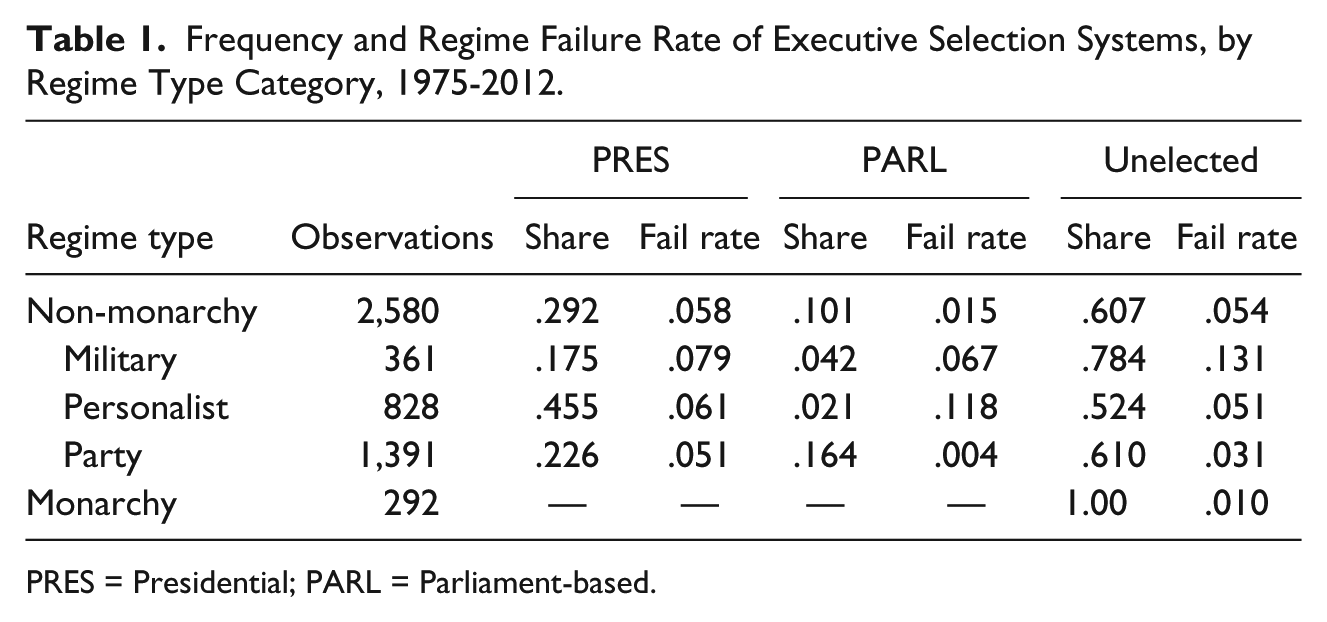
PRES = Presidential; PARL = Parliament-based.
The pattern of regime failure rates in non-monarchy regimes, by executive selection system, also supports my argument. Military regimes are least durable, particularly those with an Unelected executive system, with an average of 13 regime failures per 100 country-years. Party-based regimes are more durable than other non-monarchy regime types generally, and are most durable with a Parliament-based executive selection system, averaging less than one regime failure per 100 country-years.
Although this evidence supports the argument that the Parliament-based system enhances regime durability in party-based regimes, there may be alternative explanations for the pattern. For example, perhaps economically successful countries tend to be Parliament-based, and that economic success is the reason for durability in these regimes. The analysis should control for omitted variables and other sources of bias.
Following previous work (Brownlee, 2007; Wright, 2009), I model regime failure using a binary logistic model with cubic time polynomials to account for duration dependence (Carter & Signorino, 2010). The dependent variable is regime failure, which takes the value of 1 if the regime fails in that year and 0 if the regime survives. Thus, positive coefficients indicate a higher probability of regime failure and negative coefficients indicate greater regime stability. To control for unit heterogeneity among countries beyond what is included in the variables mentioned below, the model controls for random effects. 17
To estimate the effect of the executive selection system, I include dummies for Parliament-based and Presidential system. Unelected is the omitted category. A positive coefficient indicates that regimes with that executive selection system are more likely to fail than a regime with an Unelected executive system; a negative coefficient indicates the reverse.
To control for other factors that may affect regime durability, I include controls for (log) income level, economic growth, and (log) unearned income (foreign aid and oil and gas export revenues) per capita, each of which is expected to have a negative effect on regime failure, and share of foreign countries that are democratic, indicating international pressure, which may have a positive effect on regime failure. In Model 4, I also control for regions.
Model 1 in Table 2 shows the results for the base model. The negative and statistically significant coefficient for Parliament-based indicates that, controlling for income level, growth, oil, foreign aid, the prevalence of democracies abroad, and regime age, regimes with a Parliament-based system are less likely to fail in a given year than those with an Unelected executive system. The statistically insignificant coefficient for Presidential indicates that regimes with a Presidential system have a similar failure rate to those with an Unelected system. As expected, economic growth and unearned income per capita decreases the probability of failure at a statistically significant level of confidence. In Model 2, I include dummies for party-based and personalist regimes (military is the omitted category). Replicating previous research, party-based regimes are least likely to fail, and personalist regimes are less likely to fail than are military regimes. Parliament-based system remains statistically significant.
Effect of Executive Selection Systems on Non-Monarchy Authoritarian Regime Failure, 1975-2012.
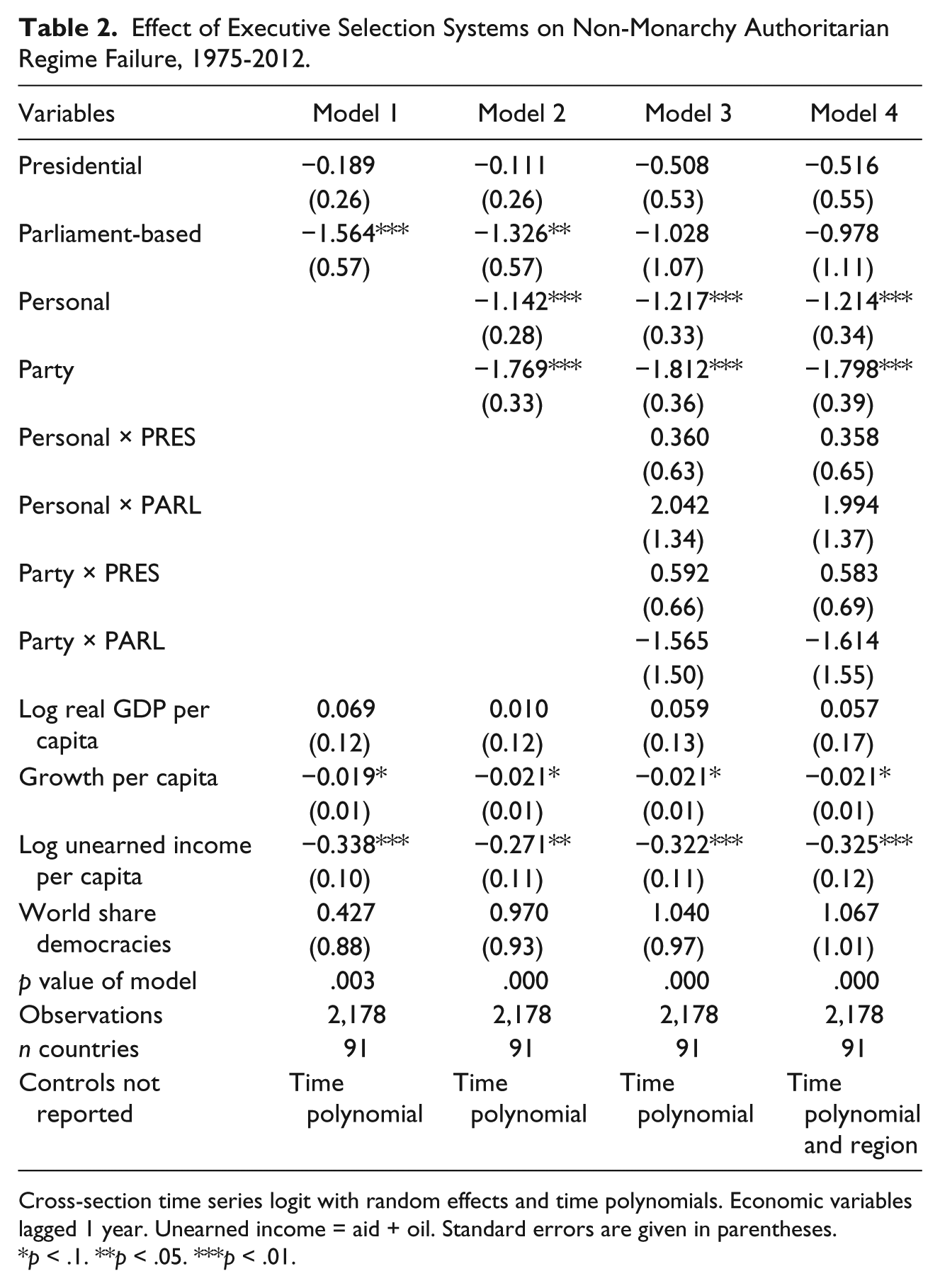
Cross-section time series logit with random effects and time polynomials. Economic variables lagged 1 year. Unearned income = aid + oil. Standard errors are given in parentheses.
p < .1. **p < .05. ***p < .01.
In Models 3 and 4, I include interaction terms for each regime type with Presidential and Parliament-based systems to differentiate the effect of executive selection system in personal versus party-based regimes, relative to military regimes. To facilitate interpretation of the interaction terms, I use the estimates from Model 4 to predict the probability of regime failure for each combination of regime type and executive election system, with 90% confidence intervals (see Figure 3). 18 Regimes with a Parliament-based executive selection system are estimated to have significantly lower failure rates in party-based regimes. 19 Executive selection system has no clear effect, however, in personalist or military regimes. 20 These findings support the arguments made in this article; Parliament-based executive election systems increase regime durability in systems where power is centered in the ruling party rather than in the military or the personal networks of the ruler. Furthermore, these findings suggest that previous findings of the durability of party-based regimes (Brownlee, 2007; Geddes, 2003) may be driven by those party-based regimes with a Parliament-based system, and that the ineffectiveness of multiparty legislatures or elections to prolong authoritarian regime durability (Brownlee, 2007; Gandhi, 2008; Magaloni, 2008) is driven by cases with a Presidential system.
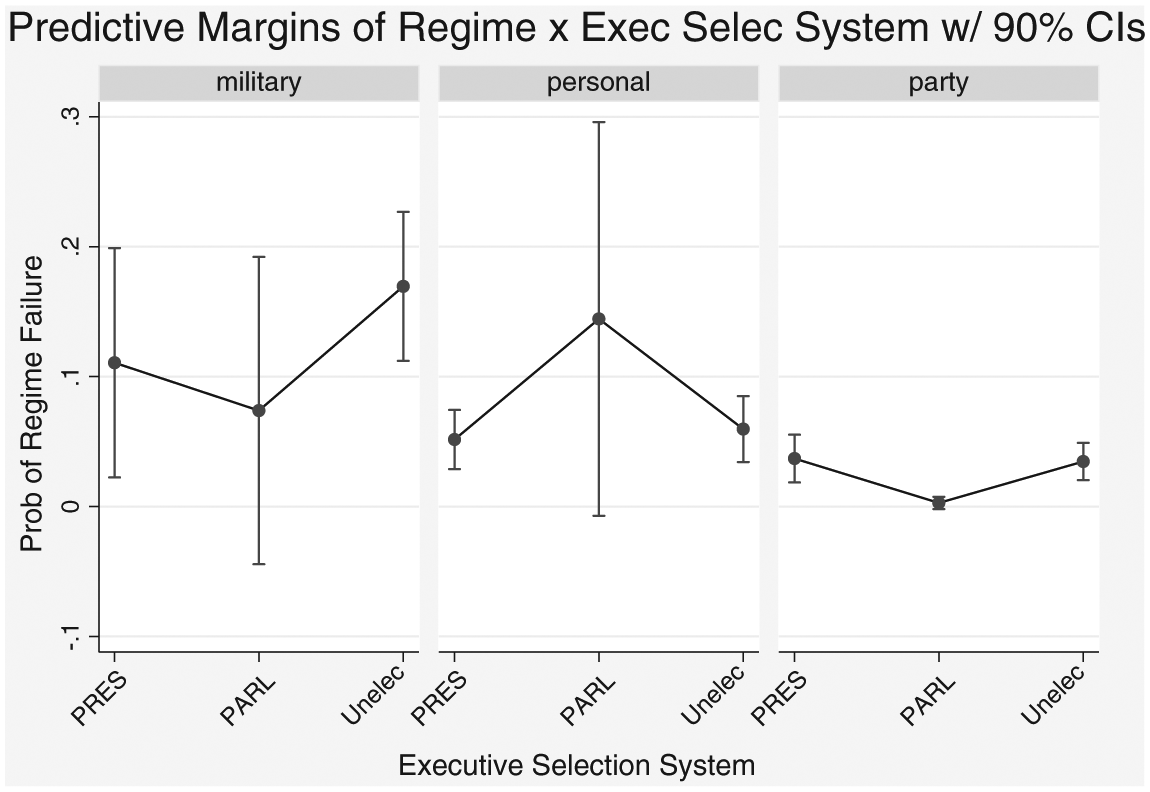
Predicted probability of failure for non-monarchy authoritarian regimes with Unelected and Elected (Parliament-based and Presidential) executive selection systems, conditional on regime type, 1975-2012.
Robustness Checks
The analysis above indicates that authoritarian regimes centered on a ruling party rather than the military or a personalist ruler tend to be more durable when a Parliament-based executive selection system is in place. However, it is possible that the Parliament-based system is not having a causal effect on durability, but is the system most likely to be adopted by regimes likely to endure, with no independent effect on survival.
I first consider regional tendencies. Perhaps the Presidential system primarily emerges in unstable regions and the Parliament-based system emerges in stable regions. Table 3 shows the frequency and failure rates of the three executive selection systems, by region. In Latin America, authoritarian regimes that allow multiparty competition for the executive always use direct elections. In the four regions with cases for all three systems (Sub-Saharan Africa, Middle East and North Africa, Asia, and Europe and Central Asia), regimes with a Parliament-based system always have the lowest failure rates.
Frequency of Executive Election System and Probability of Regime Failure in Non-Monarchy Authoritarian Regimes, by Region.
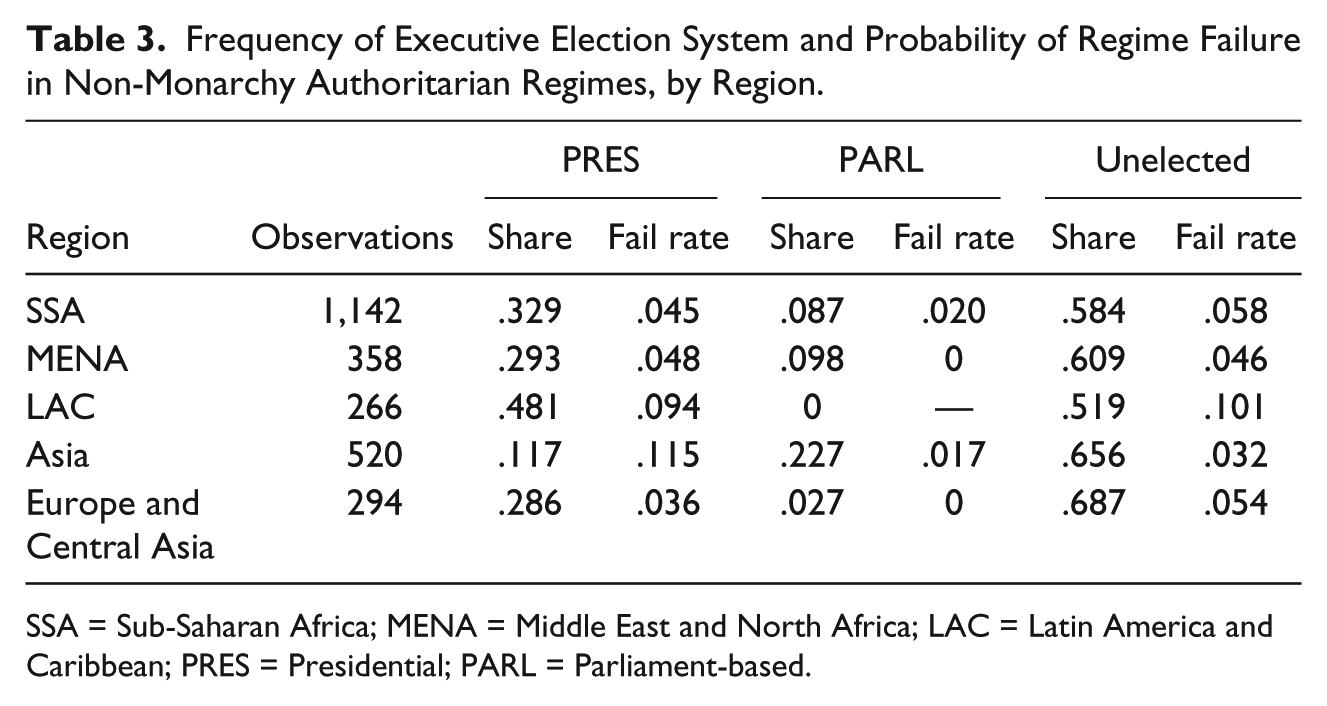
SSA = Sub-Saharan Africa; MENA = Middle East and North Africa; LAC = Latin America and Caribbean; PRES = Presidential; PARL = Parliament-based.
I next examine regime failure rates between and within regimes. In regimes where the executive system remains constant, there may be a stronger case for considering the system to be exogenous; in regimes where the executive selection system changes over the course of a regime, the system is more clearly endogenous. In Table 4, I separate regimes without system changes from regimes with system changes. In regimes where the system remains constant, those without a Parliament-based system have failure rates three times higher than those with a Parliament-based system (six vs. two failures per 100 country-years).
Regime Failure Rate by Executive Selection Systems for Regimes With and Without Executive Selection System Changes, 1975-2012.
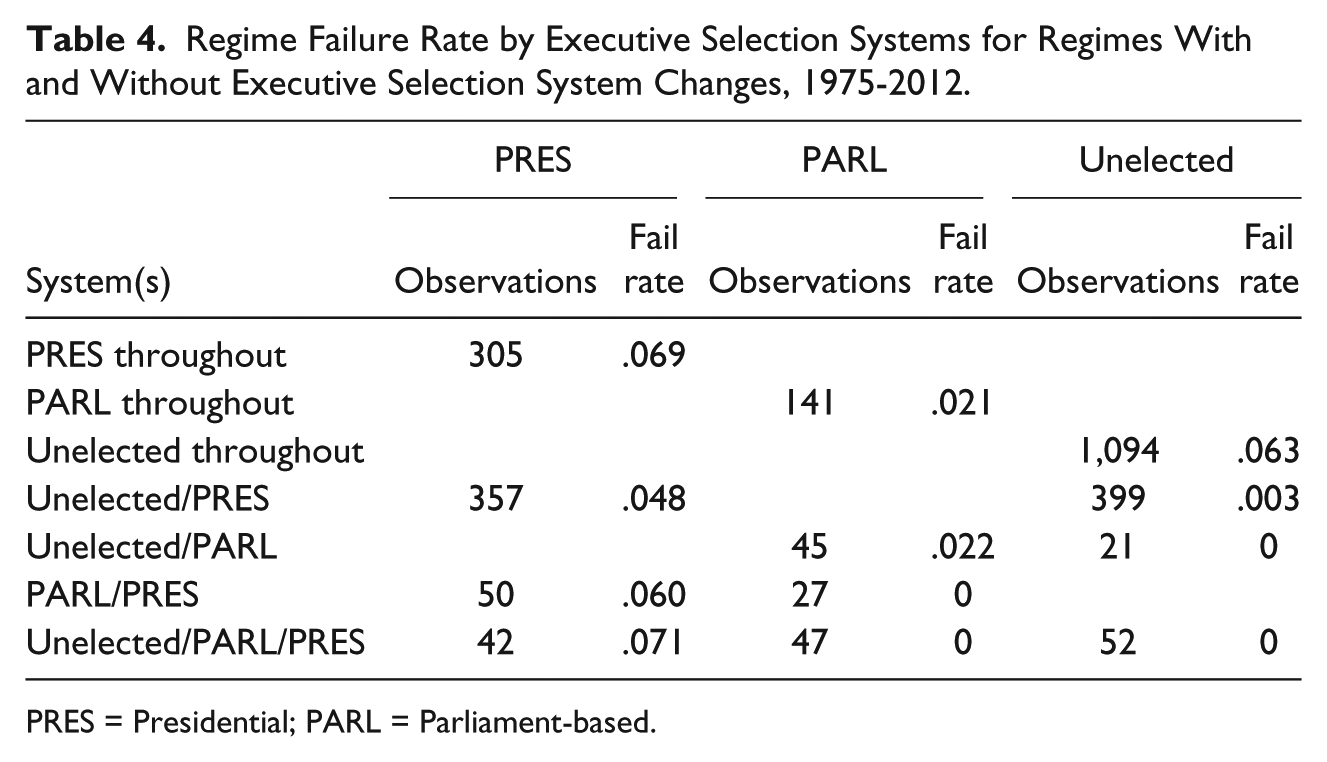
PRES = Presidential; PARL = Parliament-based.
Most changes in executive selection system in ongoing regimes are from Unelected to either Presidential or to Parliament-based (with occasional shifts back to an Unelected system). The majority of these shifts took place after the end of the Cold War, as pressures for multiparty elections increased, so the failure rate of these regimes under Unelected is essentially zero. Those who shifted to a Presidential rather than a Parliament-based system were more than twice as likely to fail, suggesting that, for regimes who adopt multiparty elections for the executive, the Parliament-based system poses a lower threat to regime survival. 21
The last two rows of Table 4 summarize four regimes that shifted, during the time of study, from Parliament-based to Presidential (Gambia 1965-1994, Serbia and Montenegro 1991-2000, Sri Lanka 1978-1994, and Zimbabwe 1980-present) and five that shifted among Unelected, Parliament-based, and Presidential (Egypt 1952-2011, Mongolia 1921-1993, South Korea 1961-1987, Togo 1963-present, and Yemen 1978-present). 22 All regime failures in these cases occurred during a Presidential system, and the failure rate for these cases was higher under the adopted Presidential system than regimes that maintained a Parliament-based system, suggesting that the shift from Parliament-based to Presidential increased the risk of regime failure. Zimbabwe, the regime that has survived longest with a Presidential system after shifting from a Parliament-based one, relied on brutal military intimidation to shift to the Presidential system and to “win” elections under that system (Cheeseman & Tendi, 2010).
Table 4 suggests that, whereas regimes failures under a Presidential system may frequently take the form of electoral overthrow or a military coup, a frequent failure path for regimes under a Parliament-based system is to first transition to a Presidential system, and then experience regime failure. The effect of executive selection system on how (not just whether) failure occurs is a question worth addressing in future research.
Finally, to test the effect of executive electoral system separately from the dynamics that determine in which regimes each system is present, I begin by modeling the determinants of executive selection system, to understand what attributes correspond with each system. As described in the “Argument” section, I expect that authoritarian regimes are less likely to adopt power-sharing institutions such as multiparty elections and legislatures if they are less economically developed, have greater access to unearned income such as oil revenues and foreign aid, and are led by a military or personalist leader (Boix & Svolik, 2013; Gandhi, 2008; Wright, 2008). Similarly, I expect these factors to reduce the likelihood of a Parliament-based system, which empowers the legislature (or similar elected body) to elect the executive.
The predicted probabilities for executive selection system from a multinomial logistical analysis, with standard errors clustered by country, including lagged explanatory variables for regime type, income level, unearned income, interactions between regime type and the economic variables, region dummies, and the share of foreign countries that are democratic, are graphed in Figure 4 by regime type and income level, and in Figure 5 by regime type and unearned income. 23 As expected, countries with low income levels and with high levels of unearned income are less likely to hold contested elections for the executive, especially in military regimes. The Parliament-based system, relatively rare in general, is most likely in wealthy party-based dictatorships with little unearned income, whereas the Presidential system is most likely in high-income personalist dictatorships with little unearned income. 24
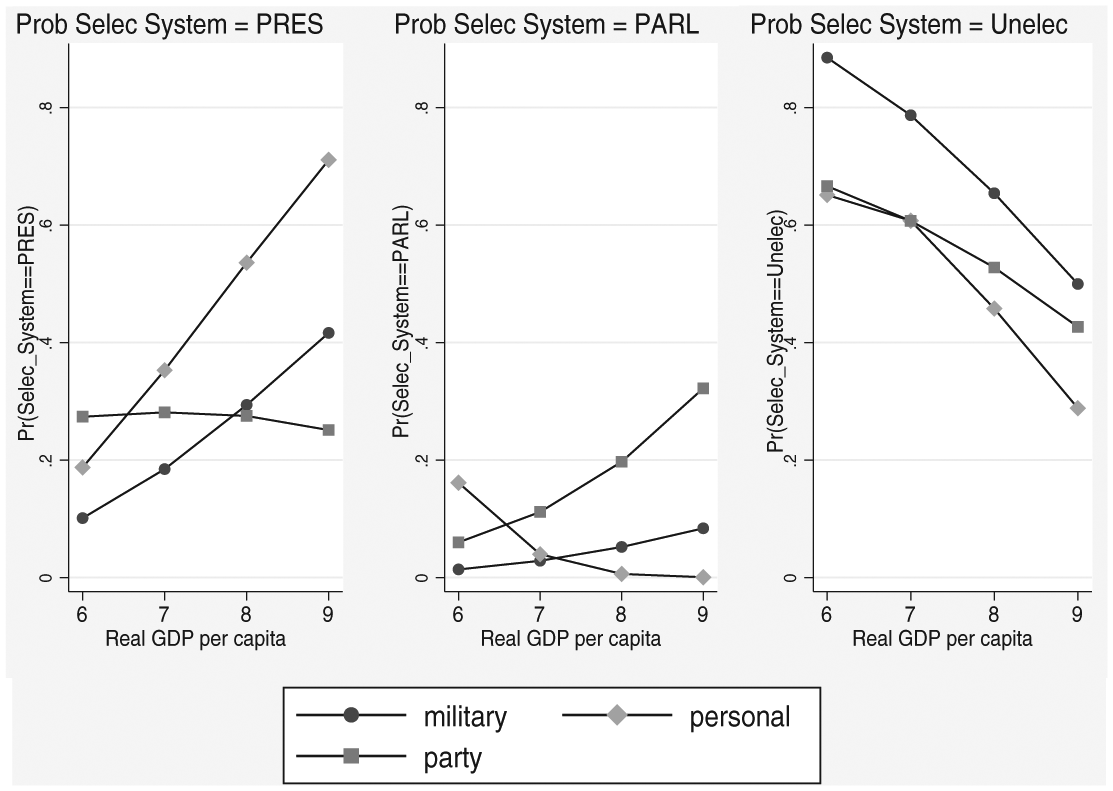
Predicted probability of Elected (Presidential and Parliament-based) and Unelected executive selection systems, conditional on regime type and (log) income level, 1975-2012.
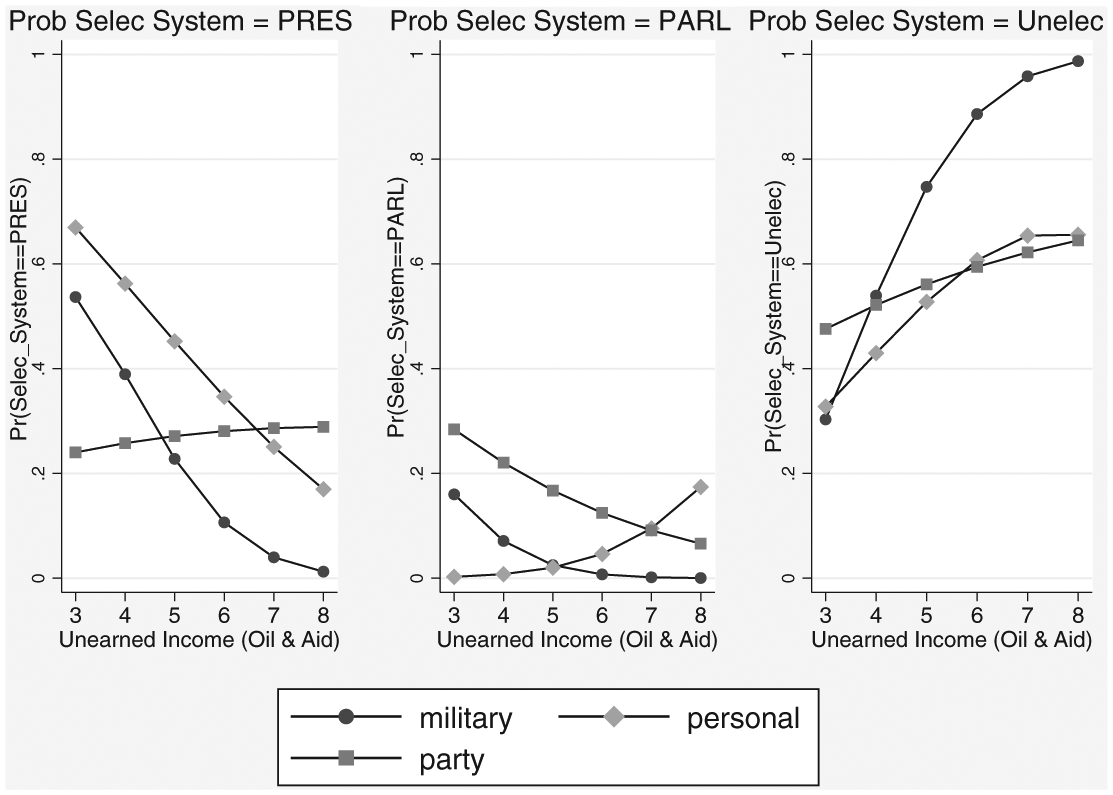
Predicted probability of Elected (Presidential and Parliament-based) and Unelected executive selection systems, conditional on regime type and (log) unearned income (oil + aid) per capita, 1975-2012.
As shown in Figure 1 (and confirmed in the multinomial logit analysis), the Unelected system is most likely during the Cold War, when relatively few countries in the world were democratic; as countries around the world transitioned to democracy with the end of the Cold War, authoritarian regimes became more likely to use a Presidential system.
To test the effect of executive selection systems among cases where political elites are equally likely to share power (based on relevant observable data), I use CEM to put each country-year observation into bins based on their GDP per capita quartile, unearned income quartile, regime type category, and two periods for share of foreign countries that are democratic, which correspond to during– and post–Cold War. Bins that do not include both Parliament-based and non-Parliament-based systems are eliminated (i.e., a Parliament-based system is defined as the “treatment,” and bins without both treated and control observations are dropped). As shown in Table 5, the matching process results in groups with and without a Parliament-based system that are more similar than was the case for the full sample. For the 1,203 matched observations, GDP per capita and the share of regimes with personal and party-based regimes are more similar for all three executive selection systems. However, regimes with a Parliament-based system remain wealthier and less dependent on unearned income, on average. To balance the number of controlled and treated observations in each bin, regimes with Parliament-based systems in bins where such systems were relatively infrequent (or frequent) were assigned more (or less) weight for the multivariate logit analysis, which also retained the controls used in the earlier analysis. 25
Selected Descriptive Statistics, Before and After Coarsened Matching, by Executive Selection System.
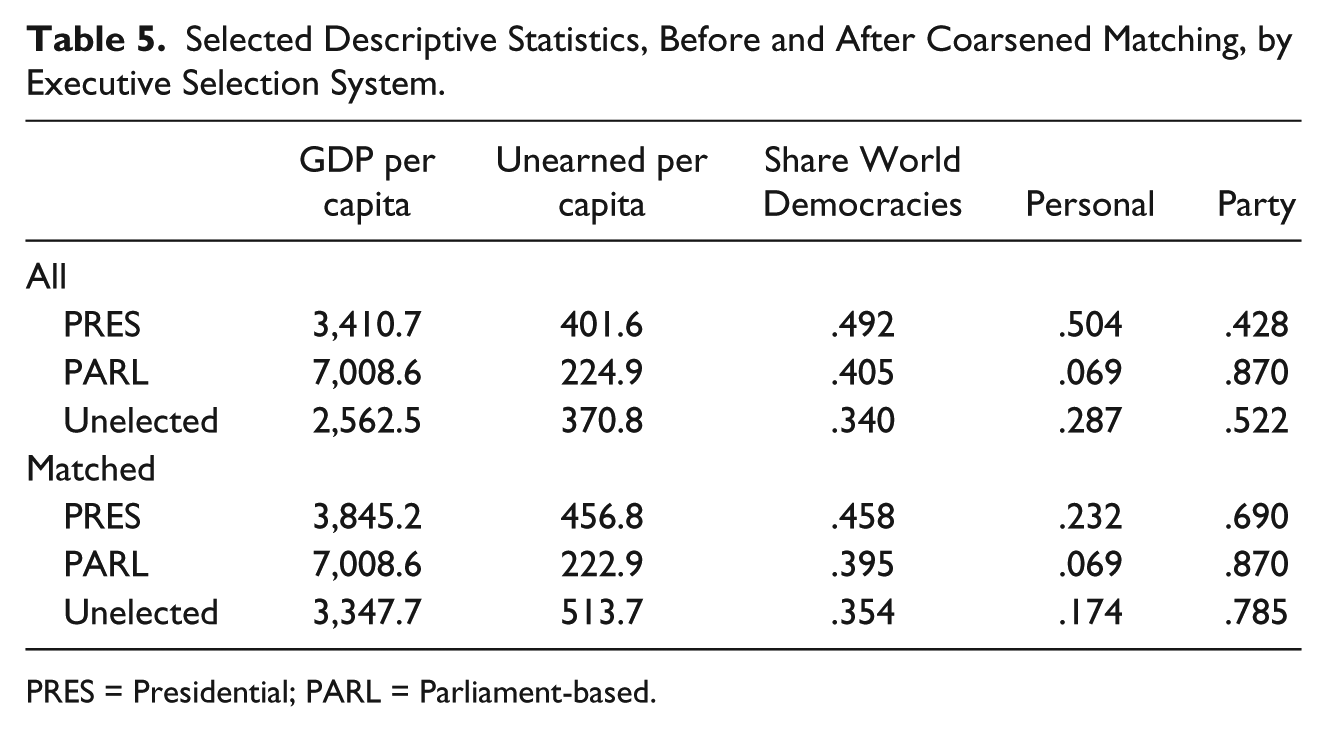
PRES = Presidential; PARL = Parliament-based.
This analysis also reveals the importance of unearned income for the survival of military regimes. When military regimes with high levels of gas and oil revenues or foreign aid transfers are dropped from the analysis (because there are no such cases with a Parliament-based system “treatment”), military regime failure rates are estimated to be substantially higher than in the basic analysis.
Predicted probabilities of regime failure with the matched sample are presented in Figure 6. Among authoritarian regimes that are otherwise similar, a Parliament-based system reduces the probability of regime failure in party-based dictatorships. 26
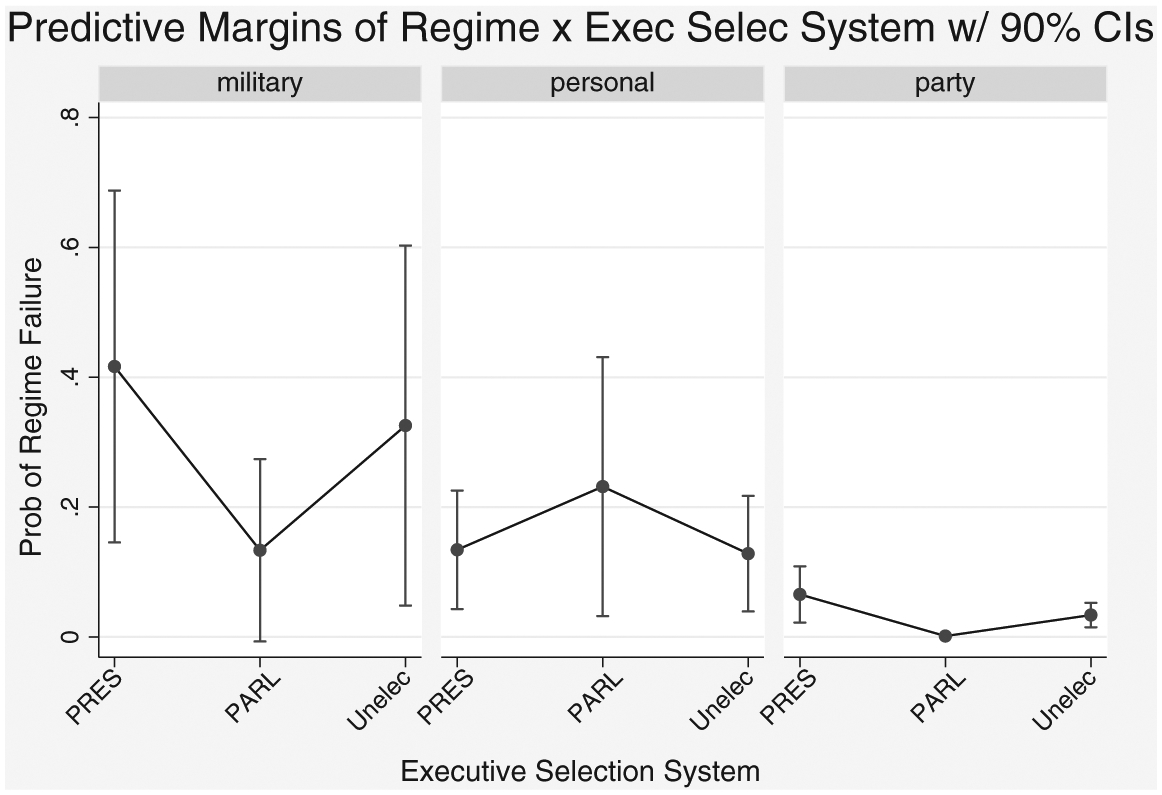
Predicted probability of failure for non-monarchy authoritarian regimes by executive selection system and regime type, with coarsened exact matching for Parliament-based “treatment” on real GDP per capita, unearned income (oil + aid) per capita, regime type, and Share World Democracies, 1975-2012.
Finally, I repeat the basic analysis using alternative data for regime type and regime failure from Cheibub, Gandhi, and Vreeland (CGV; 2010). The CGV data categorize dictators as civilian, military, or monarch. Military dictators include resigned officers, because the authors argue that “the shedding of a uniform is not necessarily enough to indicate the civilian character of a leader.” The CGV data have no personalist category, but civilian dictators are considered to rely more heavily on political parties; “ . . . military rulers can take advantage of the hierarchy and norms of the armed forces. Civilian dictatorships, without a ready-made organization, must resort to regime parties” (Gandhi, 2008, p. 41). I code regime failure when either the regime transitions to democracy, or when a military dictator is replaced by a civilian dictator or vice versa. Predicted probability of regime failure using CGV data, using the same model specification as Table 2 Model 4, is presented in Figure 7. The results conform with my argument; authoritarian regimes led by civilians are least likely to transition to democracy or to be replaced by a military-led government if a Parliament-based executive selection system is in place. 27
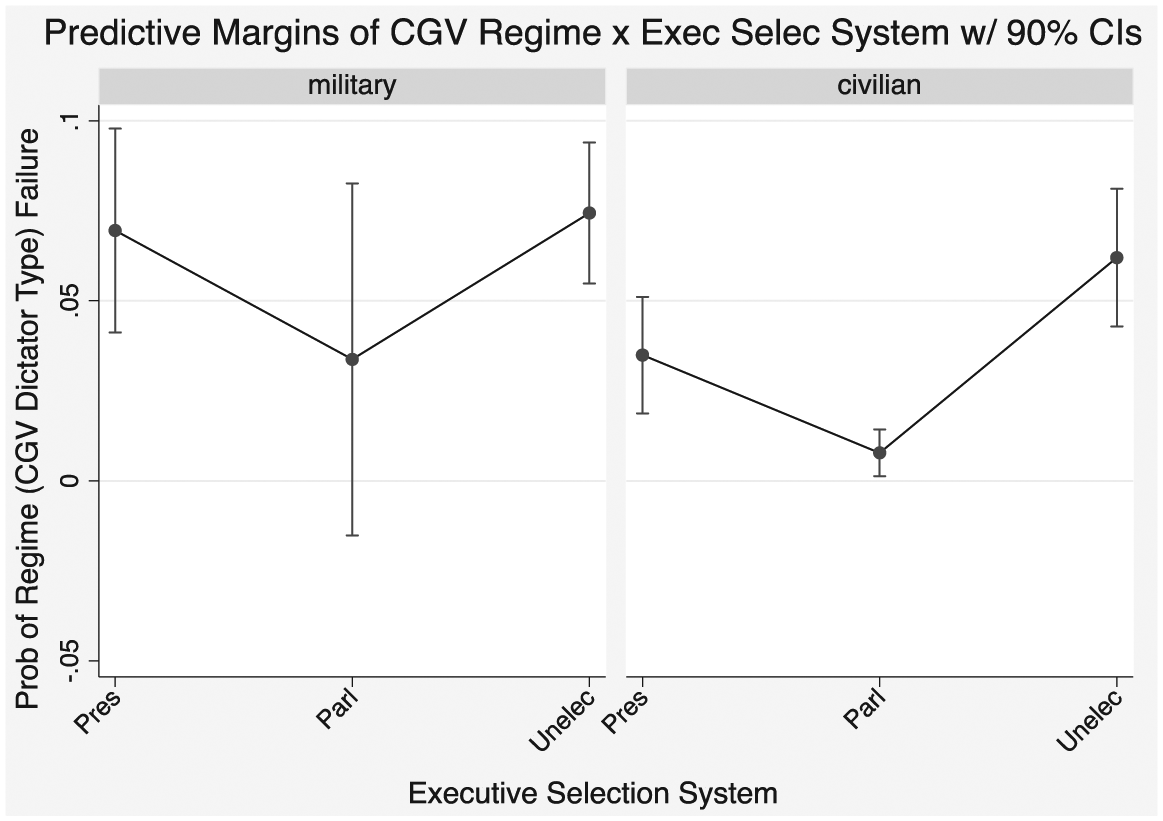
Predicted probability of failure for non-monarch dictator-type spells by executive selection systems and CGV dictator type, 1975-2009.
Mechanisms
In this section, I briefly explore some predictions from the argument regarding the mechanisms by which Parliament-based executive selection systems promote regime survival where the ruling party is the key power center (see Table 6). To conserve space, I focus on the most frequent regime cases with multiparty election-based executive selection systems, and identify whether the difference of means are statistically significant between personal versus party-based regimes with a Presidential system, and between Presidential versus Parliament-based systems with a party-based system.
Descriptive Statistics Relating to Mechanisms.
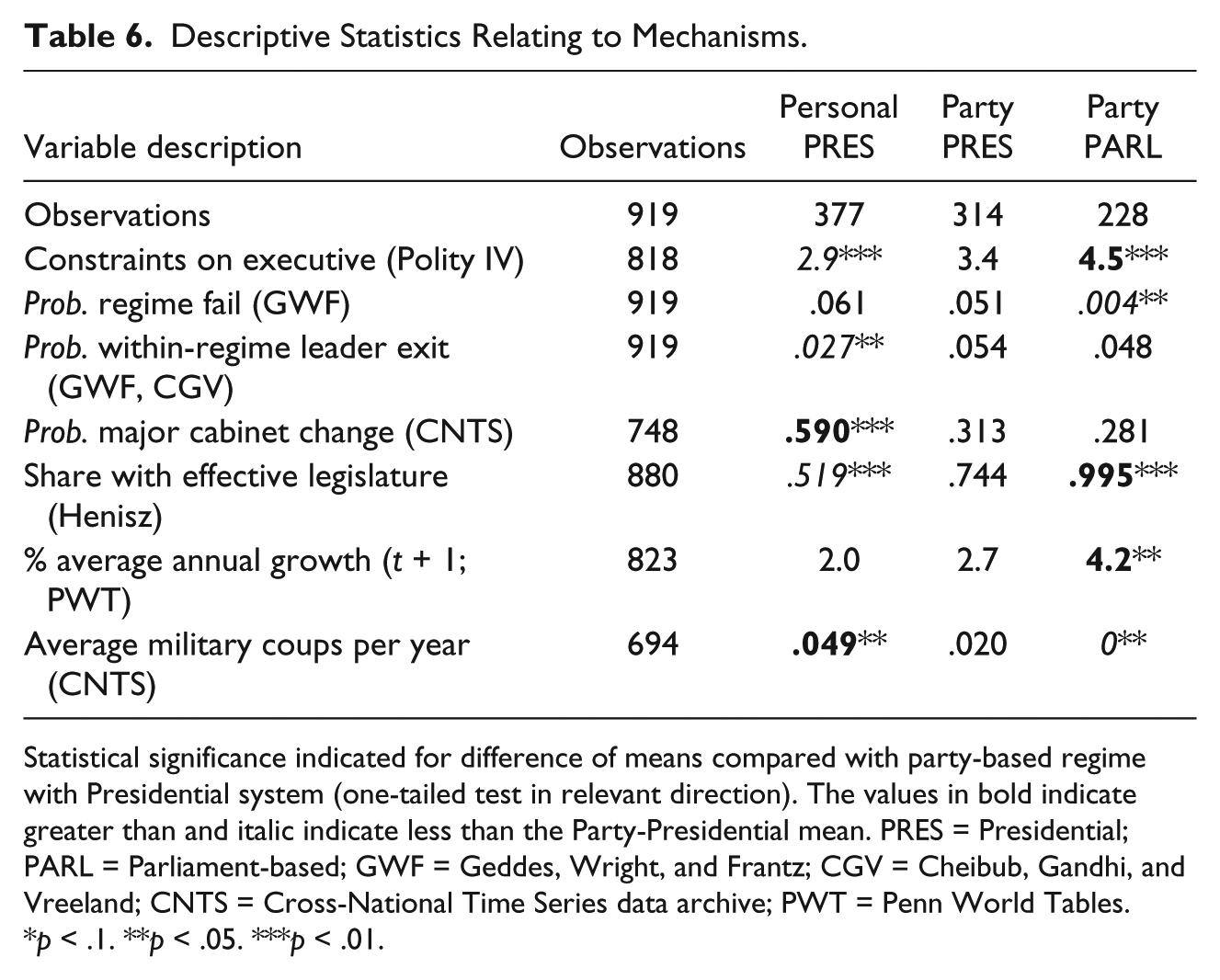
Statistical significance indicated for difference of means compared with party-based regime with Presidential system (one-tailed test in relevant direction). The values in bold indicate greater than and italic indicate less than the Party-Presidential mean. PRES = Presidential; PARL = Parliament-based; GWF = Geddes, Wright, and Frantz; CGV = Cheibub, Gandhi, and Vreeland; CNTS = Cross-National Time Series data archive; PWT = Penn World Tables.
p < .1. **p < .05. ***p < .01.
The argument begins with the assumption that multiparty elections constrain the executive, particularly when political parties hold effective power and the executive depends on election by an elected assembly, such as a Parliament. A common measure of constraints on the executive is the 7-point index from Polity IV (Marshall, Jaggers, & Gurr, 2002). As argued, regimes with a multiparty elected executive selection system have more constraints on the executive than do regimes with an unelected leader, where the constraint measure averages 2.0 (not shown), indicating little more than a “consultative assembly.” 28 Among regimes with an electoral executive selection system, executives are more constrained in a party-based than in a personalist regime, especially if the executive selection system is Parliament-based rather than Presidential, as argued in this article. Regimes with a Presidential system average around 3 on the 7-point scale, indicating “real but limited restraints on the executive,” whereas party-based regimes with a Parliament-based system approach 5 on the 7-point scale, indicating “substantial constraints” such as a legislature that “often modifies or defeats executive proposals” and “sometimes refuses funds to the executive.”
If the Parliament-based system facilitates regime survival by constraining the executive, then the effective leader in such a system should be at relatively greater risk of within-regime removal compared with regime failure, whereas the leadership in a Presidential system should be at relatively greater risk of regime failure. As shown in Table 6, whereas a Parliament-based system reduces the risk of regime failure 10-fold relative to a Presidential system, it does not increase job security for the leader in years when the regime survives; the probability of non-death exit in years without regime failure is not statistically different between the Presidential and Parliament-based systems in party-based regimes. 29 Thus, the Parliament-based system increases the security of the ruling coalition (as shown in the low regime failure rate) relative to Presidential system, but does not increase the security of the leader during the lifetime of the regime. In a personalist regime, however, the leader of a Presidential system is relatively safe from removal as long as the regime survives.
If a Presidential system increases the discretion of the executive to exclude and exploit other party elites, the frequency of major cabinet shuffles should be higher in regimes with a Presidential system than is the case in regimes with a Parliament-based system. As shown in Table 6, major cabinet changes occur twice as often in personalist regimes with a Presidential system compared with party regimes with a Parliament-based system. 30 The average in party-based regimes is also higher for Presidential systems than for Parliament-based systems, but the difference is not statistically significant.
If the Parliament-based system empowers an elected body, such as the legislature, to select or confirm the executive, then legislatures in regimes with a Parliament-based system should tend to be more effective than in regimes with a Presidential system. Supporting this prediction, 99% of party regimes with a Parliament-based system have an effective legislature (per Henisz, 2000), versus 74% in party regimes with a Presidential system and 52% in personalist regimes with a Presidential system. 31
If, in a party-based regime with a Parliament-based system, the legislature is more able to constrain the executive’s confiscatory behavior, this should encourage investment and thereby economic growth (Wright, 2008). The economic growth should in turn promote regime durability. This implies that party-based regimes with a Parliament-based system should have higher economic growth than regimes with a Presidential system. As shown in Table 6, economic growth in party regimes with a Parliament-based system averages more than 4%, versus below 3% in regimes with a Presidential system, a statistically significant difference.
Finally, if Parliament-based systems increase opportunities for access and power sharing for potentially excluded groups and reduce the need for repression and fraud, there should be fewer politically violent events such as military coups. Supporting this prediction, no party-based regimes with a Parliament-based system experienced a military coup, whereas military coups occurred with a 5% probability per country-year in personalist regimes with a Presidential system and 2% probability in party-based regimes with a Presidential system.
Conclusion
During the Cold War period, most authoritarian regimes had an unelected executive. During that time, only a handful of authoritarian regimes consistently allowed opposition parties to participate in the executive selection process. Since the end of the Cold War, however, most authoritarian regimes allow opposition parties to compete in executive (direct or indirect) elections. In some cases, the incumbent party eventually lost an election and the regime transitioned to democracy. In many cases, however, the incumbent party has retained control of the executive in spite of legalizing multiparty elections for the highest office.
Previous research has shown that authoritarian institutions that share power across political elites increases regime durability. These studies have focused on ruling parties and legislatures. The manner by which the executive is selected has generally been considered irrelevant. In this article, I argue that formal rules regarding executive selection can matter in authoritarian regimes. In a Parliament-based executive election system, in which the executive is selected or confirmed by a body elected in multiparty elections, that executive bears the costs of power sharing (such as reduced personal rents and the risk of removal by party members) while all party elites enjoy the benefits, including greater regime stability. Multivariate analysis, for the entire sample and for a matched sample, provides support for this argument. In preliminary exploration of possible mechanisms, some that merit further investigation include the effect of the Parliament-based executive selection system (which constrains the executive) to promote economic growth and reduced reliance on rent-distribution.
Footnotes
Acknowledgements
I am grateful for suggestions made at the meetings of the Midwest Political Science Association and the American Political Science Association, as well as those from anonymous reviewers, the editors, Kim Dionne, Barbara Geddes, Erica Frantz, Elizabeth Stein, Milan Svolik, Michael Wahman, and Joseph Wright.
Author’s Note

Declaration of Conflicting Interests
The author declared no potential conflicts of interest with respect to the research, authorship, and/or publication of this article.
Funding
The author received no financial support for the research, authorship, and/or publication of this article.