



Abstract
A key dilemma facing a military which considers democratization is whether it is confident that civilians will protect its interests. A military’s confidence is a function of three factors: preference alignment with parties (trust), an expectation that allied parties will survive the transition (party institutionalization), and an expectation that allied parties can win power to protect it (party strength). When parties which the military trusts are institutionalized and strong, the military is confident that democratization will not endanger its interests. When these factors are absent, the military seeks to generate credible commitments through bounded democratization—a strategy of setting parameters on open contestation and popular sovereignty to constrain civilians. I test this argument using an original dataset on 525 regime transitions and a novel measure of bounded democratization. I find that when the institutionalization and strength of trusted parties decrease, the military proactively sets constraints on the developing political system.
Keywords
The path out of military rule is fraught with uncertainty for a military’s interests. 1 Democratization reduces the military’s ability to secure its own interests and may re-expose it to the dangers that initially enticed it out of the barracks. If democratization puts the military’s interests at risk, why do some militaries support democratization while others do not?
Militaries 2 support democratization when there are credible commitments that parties will not restructure the military’s hierarchy, budget, and other core prerogatives. If the military is unwilling to accept some terms of democracy, it uses its powers to set parameters on political and electoral institutions and/or actors to constrain political contestation and popular sovereignty to create credible commitments.
I argue that the military’s confidence in parties is a function of three factors: trust of parties, incumbent party institutionalization, and incumbent party strength. These three factors affect how military and party preferences align (trust), whether trusted parties will survive the transition (institutionalization), and whether trusted parties will win power (strength). When the military’s confidence is low, it sets the terms of electoral and political contestation to prevent opposition parties from gaining too much power. This may include banning parties, allowing (retired) officers in elections, or designing specific electoral and political institutions to benefit political allies. Alternatively, when the military has an allied party that it can trust, that it expects to survive the transition, and that it believes will be strong enough to defend the military, the military can return to the barracks confident in civilian rule.
I test the theory with a new dataset developed to measure how militaries shape political institutions during transitions. Using data on 525 transitions drawn from four datasets, I construct a measure which I call Bounded Democracy—or the extent to which militaries set parameters on electoral contestation and popular sovereignty. With this data I show that as the institutionalization and strength of trusted parties decreases, the military more proactively shapes the development of political and electoral institutions.
The case of contemporary Myanmar illustrates the logic of the argument. After decades of praetorian rule, the military devised the 2008 constitution which allowed for free and fair elections but protected its power with a reserve of seats in the legislature that could prevent any changes to the constitution, along with guaranteed portfolios in the cabinet. This arrangement endured for more than a decade even though the military distrusted the National League for Democracy (NLD). After the military linked-USDP suffered three consecutive embarrassing electoral losses to the NLD, the military retook power via a coup in February of 2021.
The case of Myanmar demonstrates that military rule, and its effect on democratic development, remains relevant today. Understanding why a military use its power to shape political institutions is key to explaining variation in democratic development throughout much of the world.
In addition to Myanmar, attention to military-led democratization is necessary given the number of competitive authoritarian or democratic systems that have emerged from military rule. As can be seen in Figure 1, military rule comprised a quarter to half of all authoritarian regimes during the Cold War. With the Third Wave of Democracy, 46–58% of these regimes transitioned to either a competitive non-democratic, or democratic system, with the military often playing a major role in developing political institutions that can survive decades. Frequency of military rule.
In this paper I highlight how the military is a major actor which influences democratization. A key contribution that differs from previous work is that I focus on the strategic interaction between the military and authoritarian incumbent parties to explain variation in how militaries influence the development of political institutions.
This paper proceeds as follows. In the next section, I justify an analysis of military-led democratization with a narrow focus on military-party relations. After outlining the theoretical mechanisms which explain bounded democratization, I introduce the research design. The following section provides an empirical test of the theory before concluding with a discussion about how future research can further prove the dynamic relationships between parties and militaries during and after democratization.
Bounded Democratization
There is a well-developed literature on civilian-military relations (CMRs) which focuses on the military during democratic transitions and consolidation. Often, this literature focuses on how militaries seek protections for prerogatives within the military’s own traditional sphere—such as the budget, mission, and discipline (Agüero, 1998; Hunter, 1997; Loveman, 1994; O’Donnell et al., 1986; Stepan, 2015). There is also work on post-authoritarian CMR which highlights the development of democratic civilian control of the military as a core piece of democratic consolidation (Pion-Berlin & Martínez, 2017; Trinkunas, 2011). This work shows how civilians expand civilian control and marginalize the military after military rule. Yet it is also important to understand how the conditions of the transition shape the role the military plays in affecting the development of the emerging system (Valenzuela, 1990).
To better understand how the military influences democratic development, some scholars focus on the characteristics of the military itself and how this affects its capacity to control transitions. For example, Karl (1987) and Norden (1996) highlight how divided militaries are in a weakened position vis-à-vis civilians. When militaries are factionalized, they lose control of the transition. This results in civilians either exerting control of the transition or bargaining over pacts from a position of strength. Arceneaux (2001) builds on these theories to show that military unity is just one part of the story. In addition to cohesion, the extent of coordination between civilian incumbents and the military affects where the military can set bounds on economic and political programs. Thus, this vein in the CMR literature demonstrates that the institutional strength of the military shapes the paths out of military rule.
While the characteristics of the military certainly matter, the military is only one actor participating in the emerging system. To build on this past work, I bring in the more recent literature on party-led democratization, which highlights the role strong or institutionalized parties play in democratic transitions (Riedl et al., 2020). I show that the characteristics of the parties, and the military’s relationship with these parties, also shapes the military’s behavior.
Because democratization requires the de-politicization of the military, civilians may see the military as the greatest threat to democratic rule and may act to weaken the military (Norden, 1990). Without credible commitments, the military faces the potential threat of civilians weakening the military. Under these circumstances, the military may act to constrain civilians. Yet we should not expect the military to act aggressively if existing institutions ensure that its interests will be protected after democratization.
I contribute to the work on transitions out of military rule by creating an analytical framework that explains how political institutions generate credible commitments which facilitate transitions out of military rule. Furthermore, this framework helps explain why only some militaries actively shape political institutions. To create a framework to explain how the military affects institutional development during democratization, I develop a concept I call bounded democratization.
Bounded democratization is a transition towards a more competitive system wherein the military sets parameters on electoral and political institutions or actors to constrain open contestation and popular sovereignty. For a transition to qualify, there must be a shift towards a competitive system in which elections are used to select those in power and where there is at least nominal decentralization of power between a legislature and the chief executive. This definition qualifies fully democratic transitions, but also transitions to systems which may be considered competitive or electoral authoritarian regimes.
Conceptualizing democratization this way is useful because, despite the military’s potential influence on regime transitions, bounded systems can still qualify as democratic. Under procedural definitions, a political system will qualify as democratic if contestation for office happens through free and fair elections with limited restrictions on citizens’ participation (Dahl, 1973; Przeworski et al., 2000; Schumpeter, 2010). Thus, if the military imposes conditions on political or electoral institutions, the system may be nominally democratic, even if the military’s actions narrow the range of possible institutions that civilians would otherwise design without military interference.
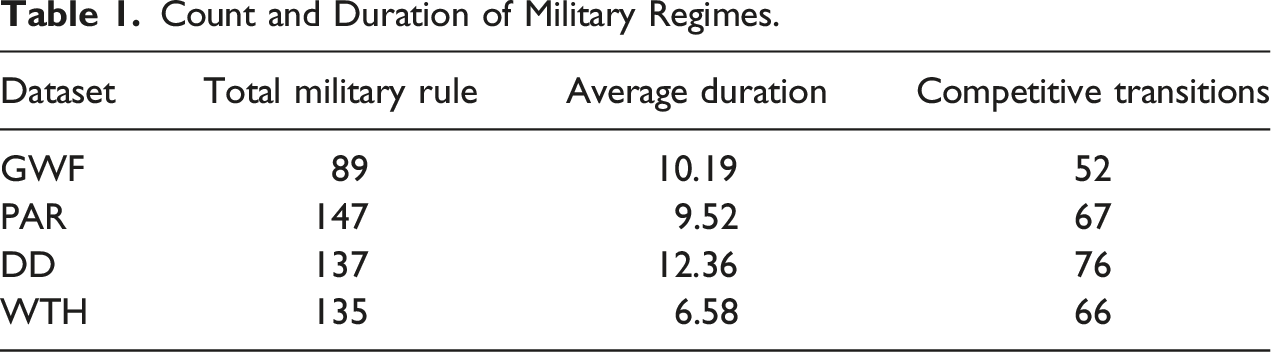
Count and Duration of Military Regimes.
Bounded Democratization and Transitology
Bounded democratization is conceptually distinct from other types of transitions. The concept of “pacted” transitions evolved from the debate on strategic transitions towards democratization (Linz & Stepan, 1996; O’Donnell et al., 1986; Stepan, 1997, p. 8). These transitions are characterized by an explicit agreement between regime insiders and their opponents over the conditions of a transition but differs from the recent literature on authoritarian-led democratization (Riedl et al., 2020).
Bounded democratization is also similar to, but distinct from, protected or tutelary democracy. Loveman (1994) conceptualizes protected democracy as a system where there are free and fair elections, but where elected civilians are not free to govern independently. Tutelary democracy and bounded democratization differ primarily on procedural aspects regarding how the military uses its power to influence civilian politicians. Under tutelary democracy, the military uses threats to coerce civilians to govern in a way that aligns with the military’s interests.
Under bounded democratization, the military uses its power to shape institutions to bias the procedures used to select those in power and how power is shared. Rather than directly influencing the decisions of civilians, the military sets parameters on who can contest elections, the institutions which are used to select political officials, and how power is shared following elections, to indirectly shape civilian’s behavior and thereby secure its interests.
Bounded democratization is a broader concept that may overlap or co-exists with tutelary democracy. It may be that the military uses its power to guarantee that civilians do not alter the bounded system. Bounded democratization may also have a more lasting effect than tutelary democracy if the institutions remain in place well after the military has ceded power.
The role of a military acting as a guarantor while also binding democracy can be seen in Chile. Pinochet used the threat of re-politicizing the military should civilians deviate too far from his desires. Pinochet eventually retired and civilians gained autonomy from the military, but the bounds on formal institutions set by the military persisted until a new constitution was developed after the 2020 referendum.
Democratization and the Military
Given the military’s coercive power, we should consider why militaries use this power to affect the development of electoral, legislative, and executive institutions in some cases but not others (Feaver, 1999; Finer, 1962). Under authoritarian rule militaries often act overtly to influence these institutions, and significant work has already been done analyzing the military’s behavior in these regimes and regime transitions (Bellin, 2004, p. 1; Gandhi, 2008; Geddes, 1999; Geddes et al., 2018; Linz & Stepan, 1996; Stepan, 1989; Svolik, 2012). This literature has helped explain patterns of military rule and we know that military regimes are more likely to fail (Geddes, 1999).
While Geddes (1999) argued that military regimes were less durable, she did not explore whether these regimes were more likely to democratize at that time. One of the most notable works on democratization that took a specific look at post-praetorian democratization is O’Donnell et al. (1986), which argued that democratization often occurs when there is a pact established between incumbent and opposition moderates. Alternatively, Agüero (1995) argued that democratization was more likely when the military was in a position of strength and could insulate itself from being punished for human rights abuses or protect its prerogatives.
In between these two approaches, Stepan (1988) argued that democratization was untenable when there is significant contestation over military prerogatives. Diverging from these works, Bratton and Van de Walle (1994) found that democracies frequently emerged from failed military regimes in Sub-Saharan Africa, characterized by the presence of mass mobilization against the incumbents, rather than there being some elite pact or incumbent-led transitions. This literature often considers the military’s strategic decisions independent of the characteristics of civilian parties that constitute subsequent democracies. When military-backed authoritarian rule fails, militaries often engage with parties over the terms of demobilization and the conditions of returning to civilian rule.
I frame the problem concerning the path out of military rule in terms of the military’s strategic partnership with political parties. While some faction of the officer corps may be more democratic than others, democracy is difficult to sustain if reformist officers lack capable civilian allies which can manage democratization without the military having to resort to its coercive capacity. Furthermore, even if officers intervene in politics and justify their actions by claiming to be champions of democracy, they may adroitly manipulate the political development of a system by binding democracy to get democracy on the military’s terms. Ultimately, a key question facing the military when considering democratization is whether parties will protect or violate the military’s interests.
Military Interests and Political Parties
My central innovation relative to the existing literature is to consider the military’s strategic behavior as dependent upon the characteristics of political parties. While I focus on the characteristics of the parties, the characteristics of the military itself also matters. As is the case with political parties, the degree of unity within the officer corps varies.
While there are several militaries in the Global South that are poorly institutionalized and which lack a coherent set of interests, there are a large number of regimes that were stabilized by a well-institutionalized military - such as Indonesia from 1965 to 1997 or Brazil from 1964 to 1984. From 1942 to 2010, there were 216 cases of authoritarian rule. Of these 216, 89—or 41% of all regimes—held some form of military rule, with 45 transitioning to democracy (Geddes et al., 2014). Seven others became more competitive but fell short of the minimal threshold of democracy. The typical case in this universe is a more stable transition, where the military was fairly well-institutionalized and played a major role in the transition, such as South Korea in 1987.
This is not to say that the officer corps is wholly unified on a set of interests that represent the entire military. Indeed, authoritarian rule often generates factionalism because the military expands its interests to include political and policy spheres. Some officers seek a return to the military’s traditional mission while others continue to seek political or economic rents. This factionalism often weakens the regime and opens the door to a transition. Furthermore, these dynamics may influence which institutional arrangements the commanding officers seek. Ultimately, the extent to which the military acts as a unitary actor varies, with some militaries backing the incumbent junta or ruler, while other officers lack the military’s support.
Outside this universe of cases are instances where the transition results n another authoritarian regime—often through a coup or a breakdown into open conflict. In these cases, militaries are poorly institutionalized and transition to another form of military rule due to extreme factionalism—such as Benin in the 1960s and 1970s—or face rebel forces that challenge the incumbents—such as Liberia in 1989. When factionalism within the officer corps is so strong, it is unlikely that the military could manage a transition. Such cases lie outside the scope of my argument.
As a final note, others who have analyzed the military and its role in political transitions often focus on the military’s desire for autonomy from civilians (Agüero, 2001; Pion-Berlin, 1992, 2003; Stepan, 1988, 2015). In this article, I relax the assumption that the military emphasizes autonomy. These other analyses are rooted in the experience of militaries in Latin America’s Southern Cone, where militaries lacked civilian allies during the transition. Expanding the sample of cases beyond the Southern Cone demonstrates that the relationship between the military and civilian parties affects the strategic decisions of the military to seek autonomy. When the military has trusted allies in power, there is not a trade-off between autonomy and the military’s prerogatives. As the military’s confidence in parties which may come to power decreases, autonomy becomes a greater concern.
Democratization and Credible Commitments
One of the key problems regarding democratization is that the military no longer wields control over institutions and policy—meaning the military must delegate power to civilians. Thus, a key question is: how does a military identify or generate credible commitments when the military’s interests diverge from parties, even if the two actors are generally aligned?
We can turn to why many militaries take power to understand how political institutions affect whether civilian commitments are credible. Militaries often take power when civilian governments present a threat to the military or are incapable of ruling. Militaries will be wary of civilian rule if it means returning to the system that presented the problems which drew the military out of the barracks.
Further exacerbating the problem, democracy itself cannot generate credible commitments because of the uncertainty concerning electoral and political outcomes. Although there is relatively more uncertainty within democratic systems than authoritarian, the institutional framework and the resources actors have within a democratic system generate some certainty about the range of possible outcomes (Przeworski, 1991).
If there are already strong parties in the system, there will be little uncertainty. In these cases, the military may fear democratization if these popular parties are opponents. Thus, either uncertainty over who will win elections, or certainty that opponents will, drives the military to fear democratization. When militaries fear democratization, they wield their power to set parameters on the emerging system to create more credible commitments and secure their interests.
To explain why militaries bind democratization, I focus on three key factors which shape whether civilian commitments are credible; the degree of trust the military has with a given political party, the degree of institutionalization of the authoritarian incumbent party, and the electoral and political strength of the incumbent party. Combined, these three factors influence the military’s confidence in civilian parties and its expectations of who will win power.
For the military to have confidence in civilian rule it must trust some of the parties in the system. By trust I mean that the military expects that a party will act on the its behalf. Militaries are more likely to trust parties that share their interests, an ethnic identity, or ideology. Most important for trust is a developed relationship over repeated interaction. If the incumbent party, or other parties, hold the military’s trust, the military is confident that these parties will govern in a way that protects the military’s interests.
I treat trust and confidence distinctly, as trust is simply one component of the military’s confidence. There can be parties the military trusts, meaning it believes that the party would protect it, but whether the military is confident that a given party can protect it is conditional on the party’s institutionalization and strength.
The incumbent party’s institutionalization is critical because it helps the military know whether the incoming party system will include an ally. I focus the discussion on the incumbent party because these parties often come to power with the military through some shared struggle and then rule together. I define an institutionalized party as one that has a stable and durable organization (Huntington, 1962; Panebianco, 1988), with routinized procedures (Levitsky, 2003), organizational autonomy (Meng, 2021), and the capacity for national level mobilization (Riedl et al., 2020).
Party institutionalization shapes the military’s confidence because it affects the ability of the incumbent party to survive a transition and subsequent electoral cycles. Party institutionalization also affects how the party will look in the future, how cohesively it will act in power, and influences the development of the subsequent party system. Institutionalized parties are more likely to survive the end of the regime than parties which were personalist vehicles (Meng, 2021).
While the incumbent party’s institutionalization affects its permanence, it does not endow the party with the capacity to win and exercise power. Thus, the strength of the party also matters. By strength I mean the scope of the party’s hold on sub-national and national political office and ability to govern independently.
As a party’s strength increases, its hold on more seats of power insulates the military from threats to its interests. Even if the party does not win the presidency or a majority of seats, it can still protect the military should it hold a sufficient number of seats to block the military’s opponents.
When trust, institutionalization, or strength are low, a military binds democratization because civilians lack credible commitments that the military’s interests will be secure. Another way of thinking about this dilemma is to consider the military a principal and the parties as potential agents. When commitments are weak, the military has many tools at its disposal to reduce agency slack. To reduce agency slack, the military can use threats of reentry into politics as a credible sanction. Indeed, much of the literature on tutelary democracy sees the military using explicit threats to keep civilians in line.
Another issue for the military deals with monitoring and mechanisms of control. Should the military lack confidence in parties, it needs a way to identify and constrain the parties themselves. In the run up to democratization, officers often retire en masse to enter parties and the state while running for political office. By doing so, these officers penetrate these institutions and work to align them with the military. In circumstances where the military expects commitments to be weak, the military may also seek explicit and formal concessions in addition to using the other tools available to it.
Because transitions often take place in the context of elite coalition breakdowns, economic contraction, or popular unrest, the military looks for factors which boost its confidence. The volatility of a transition means that there is no guarantee that the constraints the military imposes will be enforceable, but binding democratization is a strategic decision the military makes to attempt to make commitments credible.
This is not to say that the military faces no potential costs for its decisions. Commanding officers must weigh the costs of various strategies, ranging from violent repression to yielding to civilians. Each decision the military makes carries some cost, but binding democratization is a strategy it pursues when the costs of using repression or retreating are both high and when it can reasonably expect to secure its interests in a more competitive system.
I visualize the theory in Figure 2 below. On the left are the three background conditions which affect the military’s confidence in civilian rule. Together, these factors influence the likelihood the military uses its power to influence the regime transition, with the possibility of either a bounded or unbounded transition. Military confidence in civilian parties.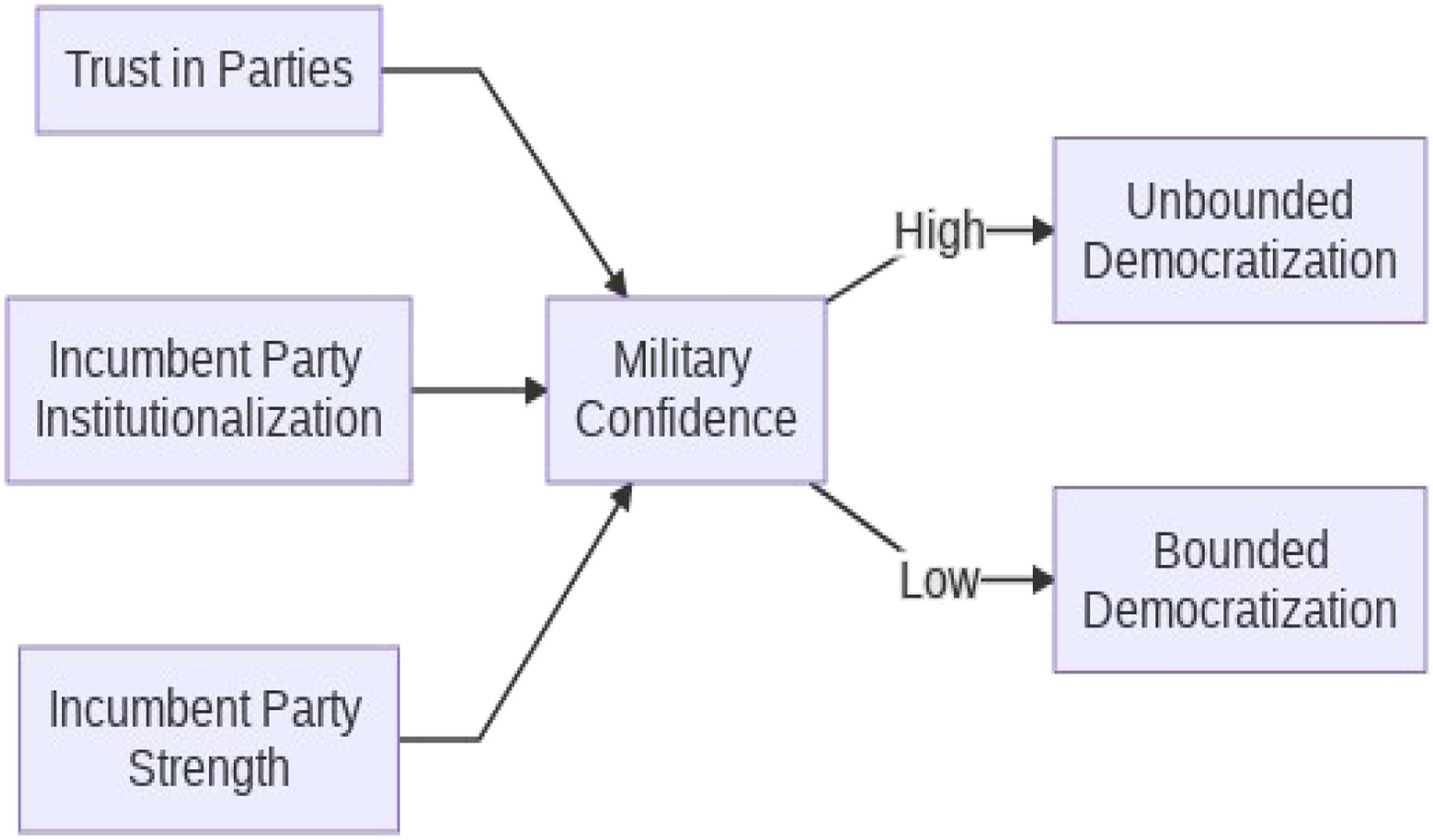
It is certainly the case that the military’s behavior is also a function of internal dynamics and likely to change depending on which set of officers are in control. The goal of the outgoing military leadership is to participate in a system wherein their interests are secured, which does not necessarily require a less democratic system. Instead, officers can be comfortable with the idea of a democratic system if they are confident their interests are not at risk. Also, officers may want to “professionalize” the military and remove it from politics as a way to protect the institution itself. For example, prior to democratization a majority of Paraguayan officers wanted to distance the military from politics because they saw Stroessner’s regime as a threat to its institutional integrity (Riquelme, 1992). Following democratization, officers backed civilian-initiated reforms and institutions because they wanted to maintain a professionalized officer corps. 3
It may also be that the command hierarchy breaks down and junior officers rebel, or that there is significant factionalism within the officer corps. These circumstances often lead to political instability and are more likely to result in closed regimes, rather than orderly political transitions, which also fall outside my scope of inquiry (Harkness, 2018).
I have argued that the military directly shapes the development of political institutions when civilian commitments are not credible. It may do this by creating barriers that prevent civilians from making changes to the system following the transition (Bennett et al., 2021). Thus, the military may support transitions to presidential systems as a way to introduce more veto players. Yet almost all post-military systems result in presidentialism.
The ubiquity of presidentialism in post-military systems is not likely due to the military embedding more veto players. Instead, as Cheibub et al. (2007) argues, the prevalence of presidentialism is likely an historical artifact. Military rule mostly emerges in systems that already had presidential institutions and these militaries were prone to adopt the same institutions that emerged with independence. Thus, the presence of presidentialism is not necessarily a way to weaken civilian allies, but instead is a sign of continued support of the national project.
Data and Methods
Much of the quantitative analysis on democratization is linked to the modernization (Boix & Stokes, 2003; Lipset, 1959; Przeworski et al., 2000) or distributional consequences hypothesis (Acemoglu & Robinson, 2006; Ansell & Samuels, 2014; Boix, 2003). Despite the strengths of these works, one shortcoming in this literature is the generalizability of these theories. As Haggard and Kaufman (2018) point out, several instances of democratization are primarily elite or incumbent driven, even when there may be distributional or modernization factors present.
I bring attention to this literature to demonstrate how conceptualizations and explanations of regime transitions would benefit from narrowing the scope of inquiry. I argue that the traditional approach in the democratization literature overlooks certain strategies pursued by incumbents, such as the military, during transitions which has prevented us from developing situationally appropriate concepts.
By including cases of military-led democratization, the literature includes cases where the distribution of economic goods was not a concern to the military, nor was development a factor in driving the military towards liberalizing. Instead, issues of the military’s interests were primary factors during these transitions (O’Donnell et al., 1986; Stepan, 1988). I address this issue by focusing my analysis on cases of military-led democratization, where the primary concern of the military should be securing its interests. By restricting the scope to military-led transitions, I provide a more precise understanding of the dynamics affecting democratic development when emerging from military rule, rather than making any broad claims about democratization more generally.
Another area where I build on the traditional approach is the conceptualization and operationalization of democratization away from either the quality or robustness of democratic institutions, procedures, and liberalism. Widely used measures of democracy range from measuring strict procedural terms, to a more normative approach that accounts for inclusivity and rights (Coppedge et al., 2011). The variation in conceptualizations has thus produced minimalist measures of democracy (Przeworski et al., 2000), to continuous measures which try to capture various dimensions of democratic quality (Coppedge et al., 2020; House, 2014; Marshall et al., 2002).
While conceptualizing democracy around its quality or robustness is certainly appropriate in most circumstances, doing so results in measures which fail to capture certain features of military-led democratization. Current measures of democracy, with their focus on contestation, participation, political rights, and civil liberties, do not account for how the military may shape these very factors. Because the military may design institutions that are more competitive than what was found in the previous regime, both binary and continuous measures would capture a discrete shift towards democracy. In turn, these measures fail to account for how the system may be biased in favor of the military’s allies or capture institutional constraints on democratic competition, even though these constraints do not violate certain thresholds of democracy measured by traditional indicators. It may be that the officers create a new system, that is considered democratic under traditional measures of democracy, but which is actually more restrictive, or biased towards allies, than a system that would be developed without the military’s influence.
For example, under coding schemes such as Polity IV or Varieties of Democratization, Chile was considered highly democratic after Pinochet stepped down, even though he and the military bound democracy by ensuring the over-representation of conservatives in the legislature. Pinochet and the military designed an open system, with free and fair elections, as well as specific protections of liberal rights. How they bound the system, however, ensured that the results of democratic electoral procedures would not produce a government dominated by leftists, which the military feared. Because previously developed measures of democracy are ill-suited to account for how the military can set parameters on democracy, even when the emerging system is democratic, I developed the concept of bounded democratization with a corresponding measure. Thus, a key contribution I make to the literature on democratization is to provide a more nuanced measure of democracy, which captures political liberalization but also measures the restrictions that the military sets on the emerging democratic system.
Classifying Military Regimes
To test my theory, I construct a global sample of military regimes drawn from the post-WWII period. There is debate as to what constitutes a military regime. For some, an authoritarian regime does not qualify unless the military controls access to political office or policy as a corporate entity (Geddes et al., 2014). Under this more conservative conceptualization, the officer corps must act cohesively to control politics without delegating too much power to the regime leader. Thus, any regime where the regime leader emerged from the officer corps, but who garners sufficient power to control access to political office independently, is no longer considered a military regime. Others offer a more inclusive conceptualization of military rule, where an authoritarian regime is considered to qualify as military rule had the effective regime leader ever been a career officer (Cheibub et al., 2010). Still, others take a position of military rule in the middle, considering the difference between corporate military rule, personalist military rule, or indirect military rule, or requiring that the regime leader have worn the uniform immediately prior to taking power (Svolik, 2012; Wahman et al., 2013).
I do not arbitrate amongst these various approaches, nor do I formulate my own conceptualization of military rule. To ensure that my findings do not depend on any single conceptualization of military rule, I use different samples of military regimes. I not only use the various datasets to test the robustness of the results, but also to exploit their differences to demonstrate that, when coding for stricter measures of institutionalized military rule, the institutional military’s behavior is dependent upon the characteristics of political parties. I expect to find that bounded democratization decreases with a corresponding increase in party strength and institutionalization—when the data codes for institutionalized military rule. Alternatively, when using data where regimes are coded as military rule, even if it is just a former officer in power, I expect to find no correlation between the military’s confidence and bounded democracy. If there is no correlation when using the latter data, the null results provide evidence that it is the military as an institution which acts to protect its interests during a transition.
To construct the various samples of military regimes I use four widely used datasets which code authoritarian regimes and whether the regime qualified as military rule. The first dataset is Geddes et al. (2014). GWF uses a conservative conceptualization of military rule, where the military must act as an institution to restrict access to political office or control policy. In this sense, it is best suited to test my theory, which centers around a military acting to secure its interests. While GWF uses a conservative definition of military rule, there are considerable benefits to using GWF. One benefit of GWF is that the authors code for hybrid regimes, where the military rules alongside either/or a personalist ruler and/or party.
In addition to GWF, I also use Cheibub et al. (2010). DD conceptualizes military rule more inclusively, with a regime considered to be military rule had the effective regime leader ever worn a military uniform. The presence of observations where the military may have not played a substantive political role should attenuate any estimate because civilian incumbents already control politics independent of the strength or degree of institutionalization of the ruling party. Should I find no significant correlation between the characteristics of incumbent parties and the likelihood of bounded democratization using this data, or null results, I will conclude that framework of bounded democratization is appropriate to explain political development where the military, as an institution, ruled.
I also use the dataset developed by Svolik (2012) (Hereafter PAR). PAR differs from others because it codes components (ruling party, military, etc.) of an authoritarian regime independently. Should the military feature a military component, PAR then accounts for whether it was personalist, corporate, or indirect. PAR also differs from DD in that it is more conservative in what it qualifies as a military leader. For PAR, the military is considered to be part of the regime if the head of the regime is a professional solider who was active directly leading to them coming to power. Another strength of PAR is it accounts for regime transitions even should the regime leader remain in power, or if the military remains in control by coding for nominal shifts in the power of the executive. Thus, PAR captures regime transitions from corporate military rule, where the junta held executive power, to where an officer captures significant personal power and marginalizes the junta.
The last dataset I use to sample military regimes is Wahman et al. (2013) (Hereafter WTH). WTH centers its conceptualization of regime types around the party system. Thus, WTH codes a regime depending on the degree to which the party system is constrained. When the regime is authoritarian, WTH codes the regime as military when the military exercises power either directly or indirectly. One way that WTH addresses the issue of a regime leader with a military background is by coding cases where the regime leader was an officer, but was selected by open elections without military interference, as non-military. Thus, WTH differs slightly from DD and PAR, with a narrower focus on the mechanisms to select the regime leader that provides an additional robustness check of the theory.
As a final note on the classification of military regimes, I highlight that the observed sample of military regimes which become more competitive is non-random and caution should be taken in the interpretation of any results from quantitative analysis using these samples. As can be seen in Table 1, the proportion of military regimes which transition to more competitive regimes ranges from 46% to 58%. That only about half of all military regimes shift to more competitive regimes suggests that there are factors which affect whether these transitions result in more competitive regimes.
In circumstances of military-led transitions, there may be an alternative logic for the military and whether it even chooses to pursue a more competitive regime. The theory I have outlined highlights three factors that affect the military’s behavior—given the military’s decision to support a transition to a competitive regime. Whether the military even tolerates the idea of competitive elections is significant as it denotes a substantial shift away from military rule. For example, the South Korean military regime resisted pressure to democratize for much of the 1980s, often suppressing pro-democratic movements, only to relent in 1987. In addition to pressure from civil-society, factionalism within the retired and active officer corps created the conditions which moved the military away from its position to uphold the status-quo (Sung-Joo, 1988). Thus, there may be endogenous factors which explain the military’s support for a transition. While this may be the case, the theory provided herein helps explain the military’s behavior once the decision to move to a competitive system has been made. One reason why the military could accept democratization in South Korea is because it was closely allied with the Democratic Justice Party and was able to obtain an institutional structure to its liking.
It may also be the case that the military does not support the idea of a transition to a competitive regime, even with a strong and/or well-institutionalized party that it trusts. There are numerous instances of single-party regimes which emerged or fused with military rule in which a junta gave way to either single-party or personalist rule. One of these cases can be found in Burundi, which cycled through various dictators who came to power via coups, despite the central role of the UPRONA party in sustaining authoritarian rule.
Because there are various factors which influence whether a military supports any transition away from closed authoritarian rule, the findings which come as a result of the subsequent analysis should be interpreted with the caveat that the specified theoretical mechanisms—trust, party institutionalization, and party strength—matter for bounded democratization, given that the military has already made the decision to allow political liberalization.
Operationalizing Bounded Democratization
Component Variables of Bounded Democratization.
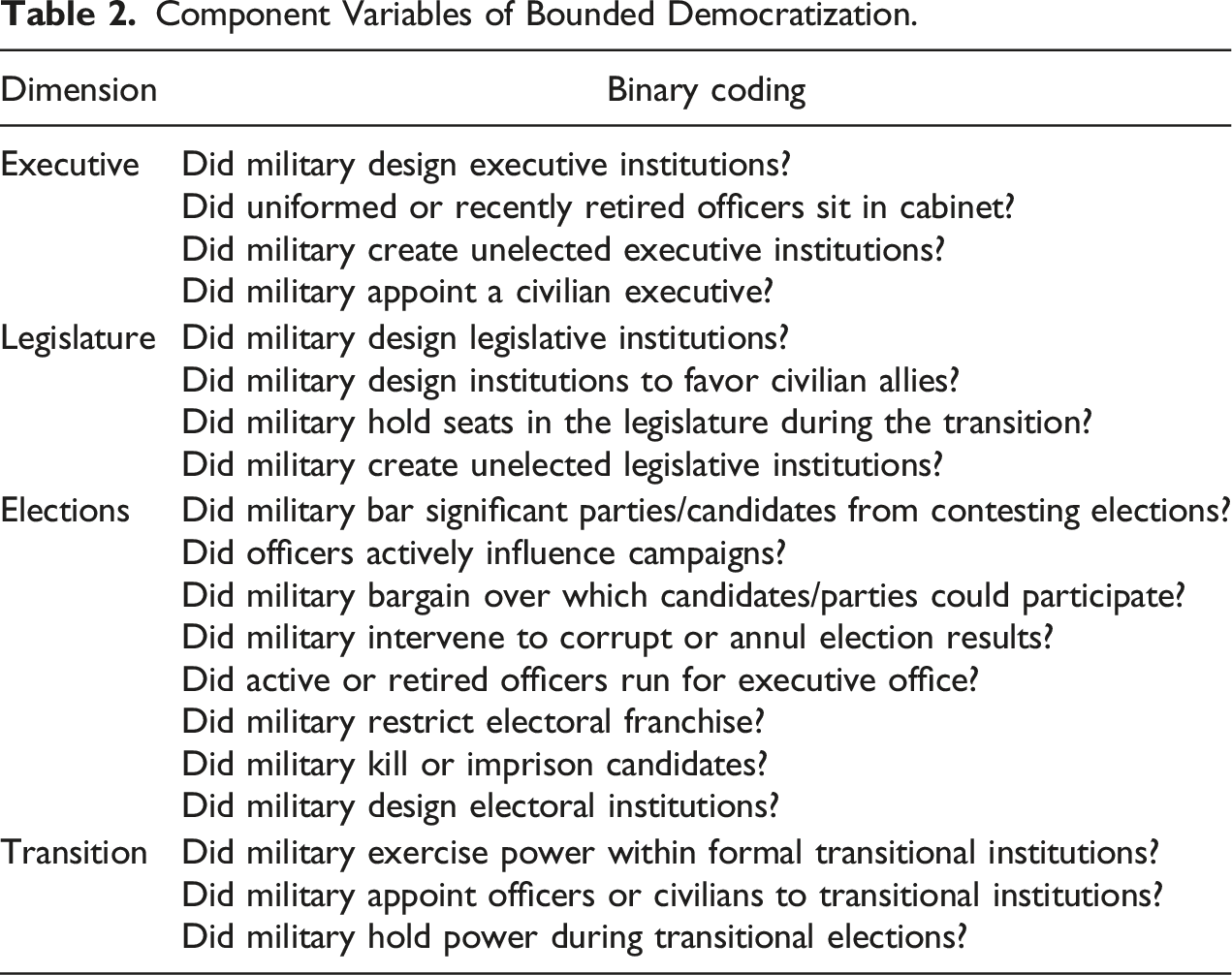
A challenge to coding bounded democratization is defining when a transition begins and when it ends. There is agreement within the literature over what constitutes a transition and how to identify its end. Broadly defined, a transition is a discrete shift in the rules which determine how those in power come to be and how they are then allowed to govern (Bratton & Van de Walle, 1997; Geddes et al., 2014). In their work on democratic transitions, Linz and Stepan (1996) state that a democratic transition is complete when there is general agreement on most political procedures, when a free and fair election is used to select the government, and the government effectively controls policy-making bodies.
Even with a consensus regarding what constitutes a transition, there is less clarity on how to identify its beginning. The events which spark political transitions vary widely. From mass-protests to breakdowns in elite coalitions, there is considerable difficulty in conceptualizing the initiation of a political transition. Do we consider the start of a transition when mass-protests begin, with the resignation or forced removal of the incumbent president, or some other event? The problem with focusing on events in determining the start of a transition, is that the events may trigger a transition, but do not constitute the beginning of the transition itself.
To operationalize a political transition, I build off of the intuition found in the literature. Specifically, Bratton and Van de Walle (1997) argue that a political transition is when there is significant uncertainty and debate regarding the rules of the game. I identify a transition as the period where it is clear that elite decision makers are considering a new set of rules to govern elections and political contestation. Thus, if the incumbents begin a process to develop a new system, I consider their behavior as qualifying the start of a transition. Unlike Bratton and Van de Walle (1997), there does not need to be debate between incumbents and their opposition, as the incumbents may be the primary drivers of the transition.
Defining transitions in this way also means that popular demands for a political transition are neither necessary nor sufficient for a transition. For example, when considering the case of the democratic transition in South Korea, the military faced significant pressure to democratize, both in terms of mass popular demonstrations for democratization, as well as well-organized behavior of opposition parties. Despite these demands, the military refused to consider a shift in the rules until the late 1980s. Thus, when coding the South Korean case, I ignore the military’s oppressive and intransigent behavior during most of the 1980s, instead focusing on how the military behaved when it was considering changes to the constitution openly in national political institutions.
I note that I do not narrowly focus on full democratic transitions which end with meaningful free and fair elections. I instead focus on all shifts to more competitive systems which include full democratization but also shifts toward competitive authoritarian regimes. Thus, I code the behavior of the military during periods in which there is uncertainty and debate regarding the rules of game, regardless of whether the shift in rules results in a regime which meets minimalist definitions of democratization.
Measuring Bounded Democratization
Components of Bounded Democracy and Cronbach’s α.
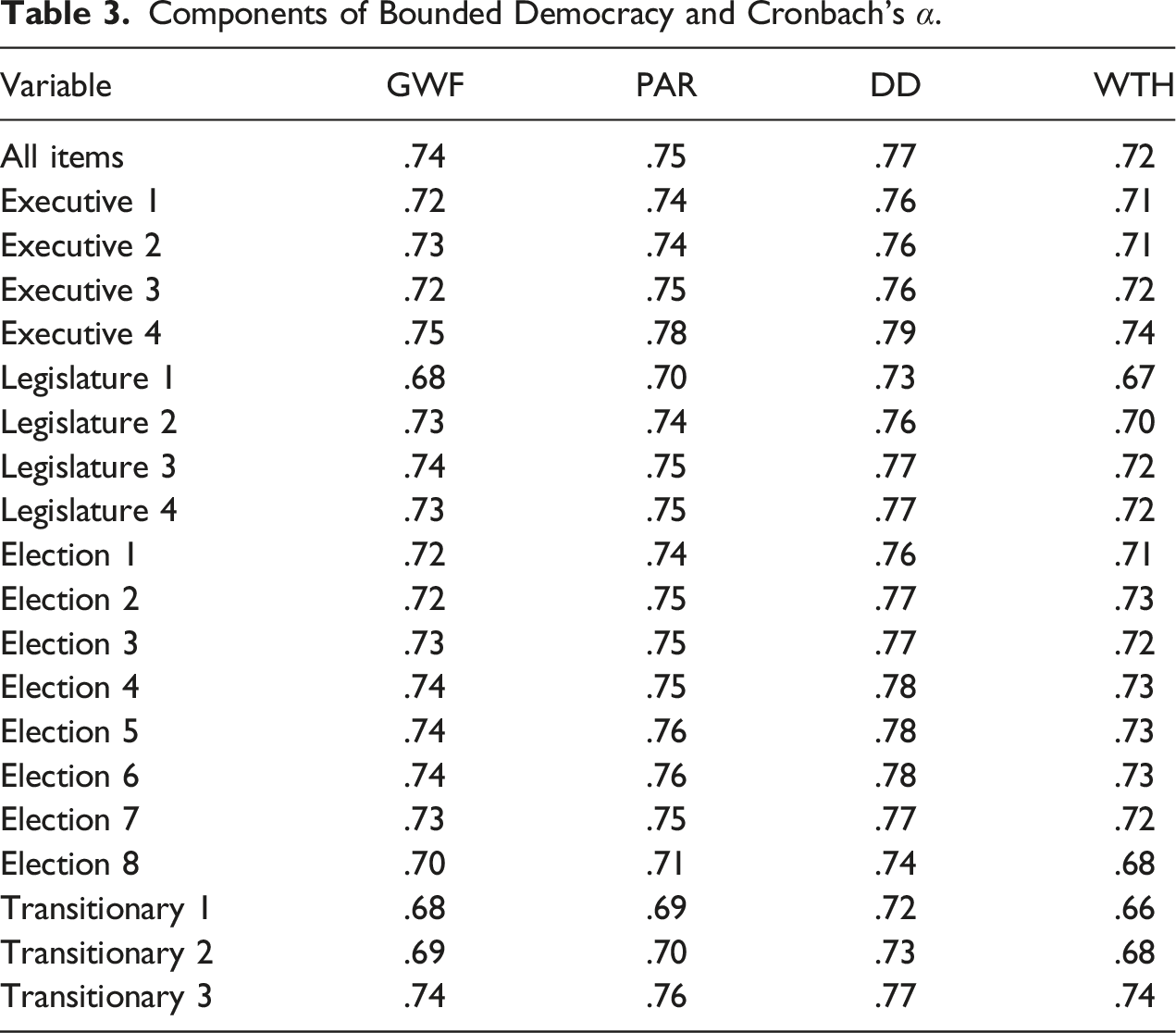
For example, the measure codes for the transition in Paraguay in 1993 to be low on Bounded Democracy. This is appropriate considering the military played a very minor role in the democratic transition and largely deferred to the incumbent party. This approach scores the Thai 2007 transition as the highest level of Bounded Democracy which is also appropriate given that the military created an appointed senate while banning prominent politicians from the previous democratically elected government. Other cases, such as Indonesia’s 1999–2004 or Brazil’s transition in the mid-1980s fall in the mid-range of the index.
Operationalizing Military Confidence
I argue that a military is less likely to bind democratic transitions when its confidence in civilian allies’ capacity to defend their interests is high. The military’s confidence is a function of trust, incumbent party institutionalization and party strength. To measure the military’s confidence, I select incumbent parties and then create variables that measure the degree of party institutionalization and strength of those parties prior to a transition.
I select the incumbent party for two reasons. First, we lack a direct quantitative measure of trust between a military and political parties. Future research may create some measure of what constitutes trust (e.g., shared interests, ideology, ethnicity) between parties and militaries, but such measures are not currently available. Thus, I select incumbent parties because these are the parties most trusted by militaries and their presence functions as a proxy of trust. These parties may form independently and share power with the military or may be a direct creation of the military or the regime leader (e.g., Golkar in Indonesia, USDP in Myanmar, or the NDC in Ghana). Given that militaries either share power or defer to these parties during authoritarian rule, we can assume a sufficiently high degree of trust between the two. In instances when the military does not share power with a party, but allows parties to remain organized, we can assume that the military, at the very least, tolerates these parties and is confident that they will not unilaterally undermine the military’s interests. For example, the Paraguayan regime under Stroessner allowed multi-party elections and allowed some parties to form, but banned parties it deemed too radical, such as the communist party, from organizing and participating in elections.
To measure party institutionalization, I identify the incumbent party or parties and use data developed by the Varieties of Democracy Project (V-Dem) on institutional features of individual parties from the V-Party sub-project. V-Party codes several dimensions pertinent to party politics, ranging from a party’s position on social issues to the organizational features of the party. V-Party collects data on parties by surveying country experts. These country experts were asked to code several factors relevant to parties. Each indicator is derived from a measurement model that maps coders’ scores into a continuous latent variable using a Bayesian IRT model (Pemstein et al., 2018).
To measure party institutionalization, I select three components from V-Party’s battery of questions on individual parties. Each of these three components are features of the party’s institution. I include measures on the degree to which the party maintains permanent local offices (stability), the degree of the party’s control over candidate nomination (autonomy), and to what extent the party is linked to prominent social organizations (national level mobilization), which are widely accepted components of party institutionalization in the literature (Meng, 2021; Randall & Svåsand, 2002; Riedl et al., 2020). 5 With these three components I pair each party in the V-Party dataset with the ruling party from a regime by the four datasets used in the analysis. After sub-setting by each dataset and pairing the parties, I use Factor Analysis to create a continuous normally distributed measure of party institutionalization that ranges from 0 to 1.
An issue with this approach is that a portion of military regimes do not feature a ruling or support party. Should there be no incumbent party, I measure the average party institutionalization of the parties in the system at the time of the transition by using data developed by Bizzarro et al. (2017). Like the measure of party institutionalization which I developed for this analysis, Bizzarro et al. (2017) used V-Dem data to develop a measure of party institutionalization. The key difference, however, is that their data measures party institutionalization at the party system level, rather than the individual party level.
While less ideal than having a measure of individual parties that may be formally allied with the military, this strategy rests on the plausible assumption that the military tolerates existing parties. Should the military fear any parties, it would likely ban them, which is common under military rule. Thus, any parties the military does not tolerate are excluded from the party system, and their strength and institutionalization will not be measured. Alternatively, should the military see a stable and professionalized set of parties that it tolerates, its confidence increases that civilian rule will not pose a substantive threat to its interests.
In addition to measuring party institutionalization, I also account for the political and electoral strength of the incumbent party as a proxy for the military’s confidence. Unlike the measure of the features of a party’s institutionalization, this measure captures the state of a party’s power. I measure the strength of the party, again using V-Party data and Factor Analysis, using the percentage of vote captured in the most recent election, the percentage of seats held in the legislature after the most recent election, and the degree to which a single-party controls sub-national office. By using these measures, I measure the extent to which an incumbent party garners large shares of votes, captures seats, and controls sub-national office. As a party’s strength increases, the military’s need to interfere in politics should decrease because it can rely on a strong party it trusts to act on its behalf.
Party strength and institutionalization are correlated but distinct concepts and measures. Parties may become stronger if they are able to rely on a well-developed party organization, but that organization does not necessarily endow a party with strength. 6 Each measure was also scrutinized and passed a face-validity check to match with a qualitative understanding of the cases. For example, Indonesia’s Golkar is rated highly on institutionalization due to it having a stable, well-developed party organization. Golkar, however is rated lower on party strength because opposition parties were able to garner offices at the national and sub-national despite Golkar’s favored position in the regime.
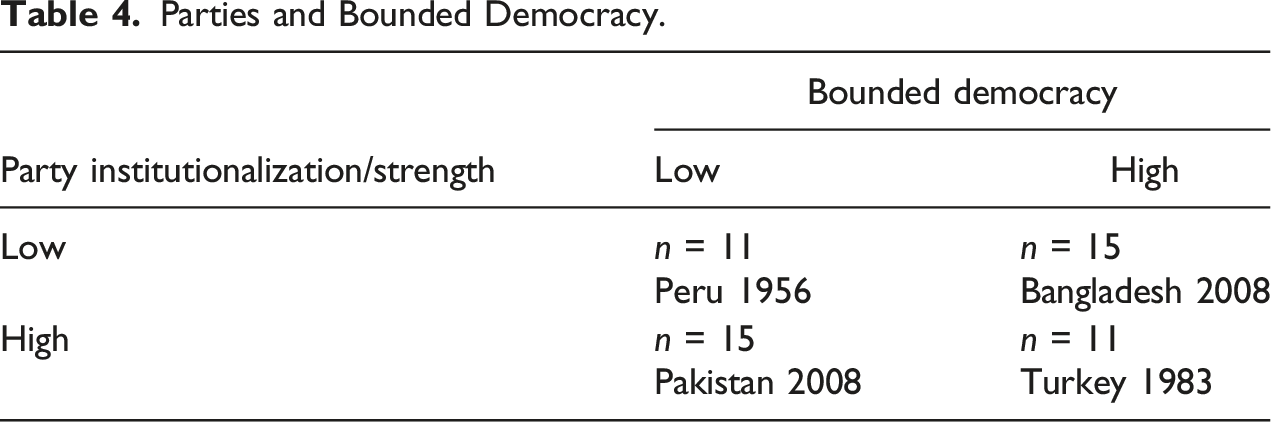
Using this data I present the breakdown of cases for data drawn from Geddes et al. (2014). I organize the table in a 2 × 2 where party institutionalization or strength is below (low) or above (high) the median score and place this relative to whether the boundedness of the transition was below (low) or above (high) the median score of bounded democratization. I also include examples of transitions that fall within those dimensions to help situate the data in a more qualitative understanding of the historical record (Table 4).
Parties and Bounded Democracy.
Control Variables
Because I am using an observational approach I must address potential confounding bias in the models. I attempt to reduce confounding bias by controlling for factors that may produce party institutionalization or strength but also be correlated with bounded democratization. I also include controls that are typically included in the literature on democratization. Among these, I include controls for income and land inequality. Land and income inequality may produce the structural conditions for party building which could plausibly act as a backdoor path to bounded democratization but are also found to correlate with the emergence of democratic systems. I measure income inequality using Babones and Alvarez-Rivadulla (2007) which was one of the primary measures of inequality used in Ansell and Samuels (2014). Ansell and Samuels also devised a measure of land inequality by adjusting for the number of family farms by the degree of urbanization. From Ansell and Samuels, I also draw data on whether the country had a Muslim majority.
I also control for the status of the military in the political system. Using the Correlates of War National Material Capabilities data,(Singer et al., 1972, V5.0) I construct a measure of the military’s status with data on military expenditures. If military spending is high, it would likely increase the military’s desire to lock-in its budget. The data is taken from the CoW NMC dataset and then standardized to the 2000 U.S. dollar. I then divide expenditures by the total population to capture when military receive a disproportionally high budget, and then log the data. I also account for the repressive nature of the incumbent government by including a measure of human rights abuses (Fariss et al., 2020).
From the CoW NMC dataset I also control for the level of urbanization, which could plausibly produce conditions for mass mobilization and party building (Wallace, 2013). Lastly I use data from V-Dem to control for the GDP per capita (logged), as development may also result in the conditions of mass mobilization and the development of party politics. From this same dataset, I control for the level of education, as modernization could also plausible affect the development of parties. Again, using this same data, I also control for oil and resource wealth, as greater wealth could enable greater coercive capacity for the incumbents to restrict the path of democratization. Lastly, I control for the political region because there could be spillover effects, as militaries learn from, and behave similarly to their neighbors.
There are certainly other factors that could affect the relationship the military has with a party and its view of whether democracy brings with it credible commitments. For example, the role the military has previously played in politics or the duration of the antecedent regime may affect whether the military builds relationships with parties. The military may also be warier of civilian rule if the country has experienced regular regime breakdowns. Lastly, social structure also may play a role in shaping the party system, and ultimately the relationship the military has with society itself. I control for these additional factors by including the previous regime’s duration, the number of coups conducted in the past, the number of regimes in the country’s history, as well as a measure of ethnic fractionalization from Drazanova (2019). In Supplement Appendix C, I also include alternative models where I exclude transitions towards a competitive system but where the transition falls short of democracy.
Results
To model how the military’s confidence affects regime transitions, I use Bounded Democracy as the dependent variable and examine all regimes that have a military component and which transitioned to a more competitive system. I then create a cross-section of data for the year of a regime transition. Because Bounded Democracy is a continuous variable ranging from 0 to 1, I use OLS with robust standard errors to estimate the correlation between a military’s confidence and the degree of Bounded Democracy.
I begin by using a sample drawn from GWF and note there should be an observed negative correlation between an increase in the military’s confidence and bounded democratization which would provide evidence that the military acts to protect its interests during a regime transition. I model the relationship between bounded democratization and institutionalization and strength independently because the two variables are strongly correlated—ranging from .53 to .68. I also model institutionalization and strength separately because I do not have any theoretical prior concerning whether the relationship between the two would be additive or multiplicative. Instead, I model each independently and then provide results of models which include both an additive and multiplicative specification in Supplement Appendix D.
I first model the relationship between Bounded Democracy and Institutionalization of the incumbent party—assuming that the incumbent party is trusted by the military, given that they ruled together. Thus, the explanatory variable, Institutionalization, captures the components of trust and institutionalization together.
I use three models to measure the relationship between Institutionalization and Bounded Democracy. The first model is a bivariate regression of Bounded Democracy on Institutionalization. In the second model, Base, I include the control variables outlined above. In the third model, Inequality, I include these same control variables, but also include income and land inequality. I exclude land and income inequality in the first models, because by including these two variables I lose some observations from the early post-WWII era where there is no data. I present the results of two models in Figure 3.
7
Bounded democracy and party institutionalization—GWF.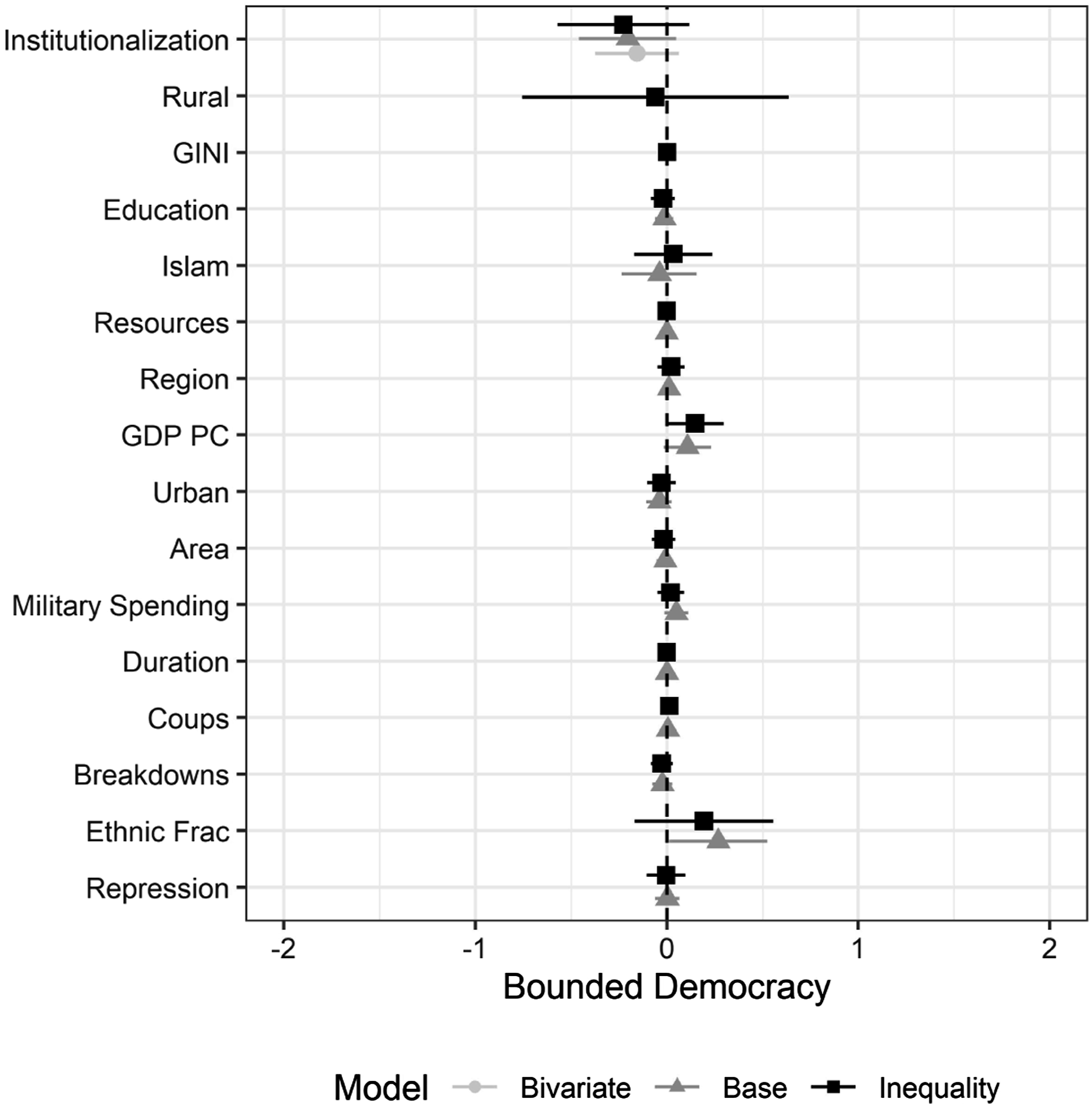
These models show that as the incumbent party becomes more institutionalized, the probability of bounded democracy decreases. While these results are not statistically significant, using robust standard errors at the 95% level, each model is directionally consistent with my theory.
While party institutionalization of trusted parties is essential for the military’s confidence, it is only one component of confidence. Thus, I also model the relationship between Bounded Democracy and the Strength of the incumbent party and present the results in Figure 4. As with Institutionalization, I structure the models into three separate models. We should expect to observe that as Strength increases, Bounded Democracy decreases. Bounded democratization and party strength—GWF.
The findings presented in Figure 4 affirm support the theory. I find that as a party’s strength increases, the degree of bounded democracy decreases. Unlike in the Institutionalization models, the results are statistically significant for both the Base and Inequality models.
Because OLS coefficients represent a variance-weighted estimate for the entire sample (Aronow & Samii, 2016), I also demonstrate that the negative relationship between the military’s confidence and Bounded Democracy holds for the range of the values of the explanatory variables. To do so, I plot the predicted values of Bounded Democracy by Institutionalization and Strength. These plots for GWF and all other datasets can be found in Supplement Appendix A. By plotting the predicted values, I find that the trend line shows a clear negative relationship between Institutionalization and Bounded Democracy for the entire range of values.
Using predicted values, I can also interpret the substantive changes in bounded democratization based on changes in party institutionalization or strength. When considering values of Institutionalization in the lower quartile, a range from 0 to .43, the expected degree of Bounded Democracy is near .77. In real world terms, this is like the 1988 Pakistan transition where the military set conditions on civilian rule, stacked the senate, backed certain candidates in elections, and where the incoming Prime Minister, Benazir Bhutto, had to accept conditions to come to power (Hoffman, 2011; Shiekh, 2010; Wilkinson, 2000). When Institutionalization shifts to the third quartile, or a range between .54 and .77, there is less binding, such as in the South Korean 1987 transition where the constitution was drafted by civilians and approved by referendum, but where retired General Roh Tae-woo won the presidential election along with a substantial presence of retired military in the cabinet and National Assembly (Croissant, 2004; Kim, 2013; Sung-Joo, 1988).
The story is similar when looking at Strength. When Strength is in the lowest quartile, ranging from 0 to .43, the result is a system like the Thai 2007 transition where the military designed the new system, including a substantial portion of unelected seats, along with a direct ban on Thaksin Shinawatra and his party, for 5 years (Hicken & Kasuya, 2003). When Strength is high, such as the third quartile, there is less binding, such as in the Uruguayan 1984 transition, where the military negotiated a pact regarding military prerogatives with the incoming parties, but did little in terms of institutional engineering (Agüero, 1998).
To test the robustness of these findings I replicate the same analysis with different samples. I begin by using the same models, but using the PAR dataset. PAR is more inclusive than GWF by including more personalist military regimes. Thus, it should still serve as a test of the military acting institutionally to protect its interests. I plot the results for both Institutionalization and Strength in Figure 5. The results using PAR provide some support for what I found using GWF. Bounded democracy and military confidence—PAR.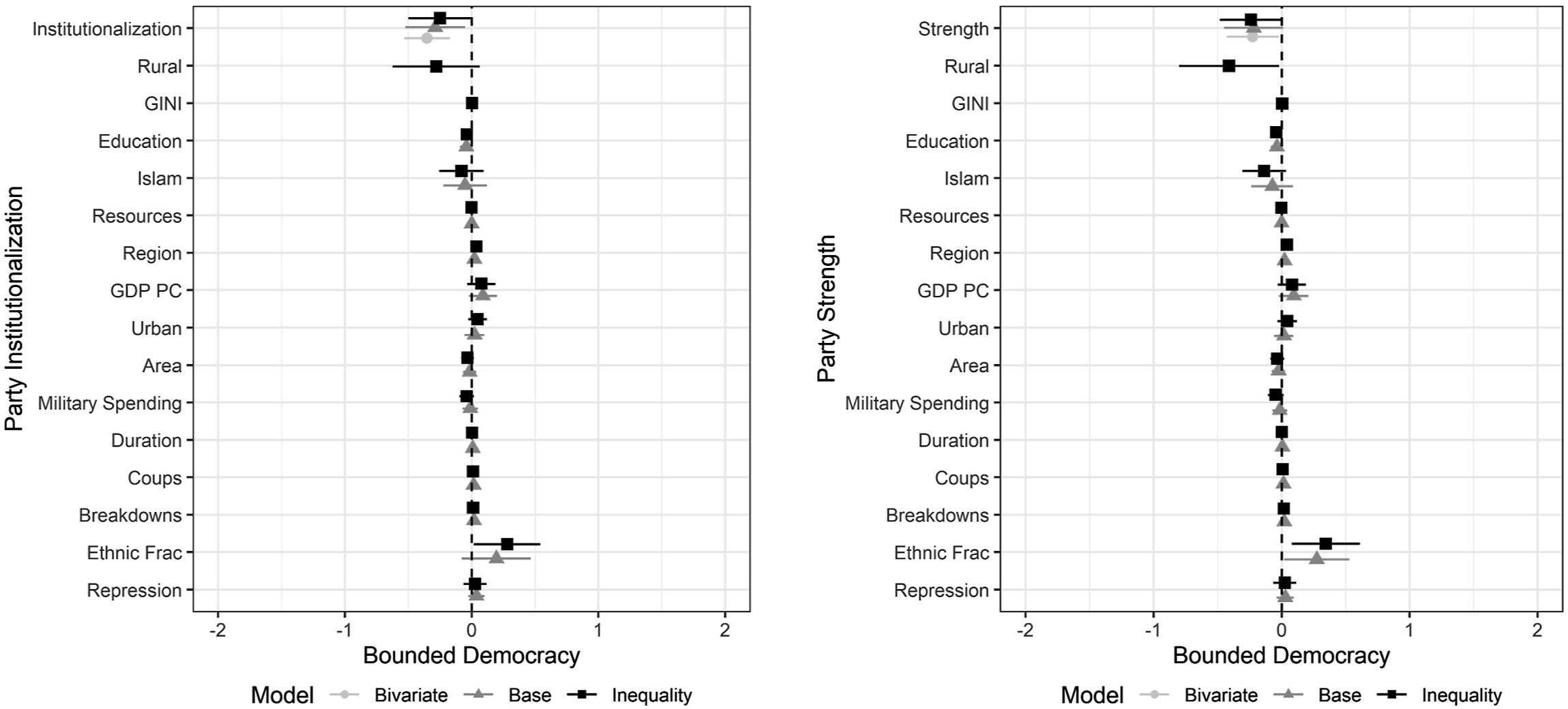
Using PAR, I find a statistically significant negative relationship between party strength and institutionalization and bounded democracy. PAR also allows the researcher to distinguish between indirect, personal, and corporate military rule—allowing a more direct test of the proposition that bounded democratization is more likely to occur when the institutional military rules. When selecting solely on corporate cases, the coefficients are larger in support of the hypothesis. Alternatively, when selecting solely on cases of personal rule I find null results which is consistent with the argument that bounded democratization occurs when the military as an institution acts to protect its interests. 8
As another robustness check I replicate the same models as GWF and PAR, but use WTH to construct the sample of military rule. As with the GWF and PAR, I use three models to estimate the relationship of Bounded Democracy and the military’s confidence and I present the results in Figure 6. Bounded democracy and military confidence—WTH.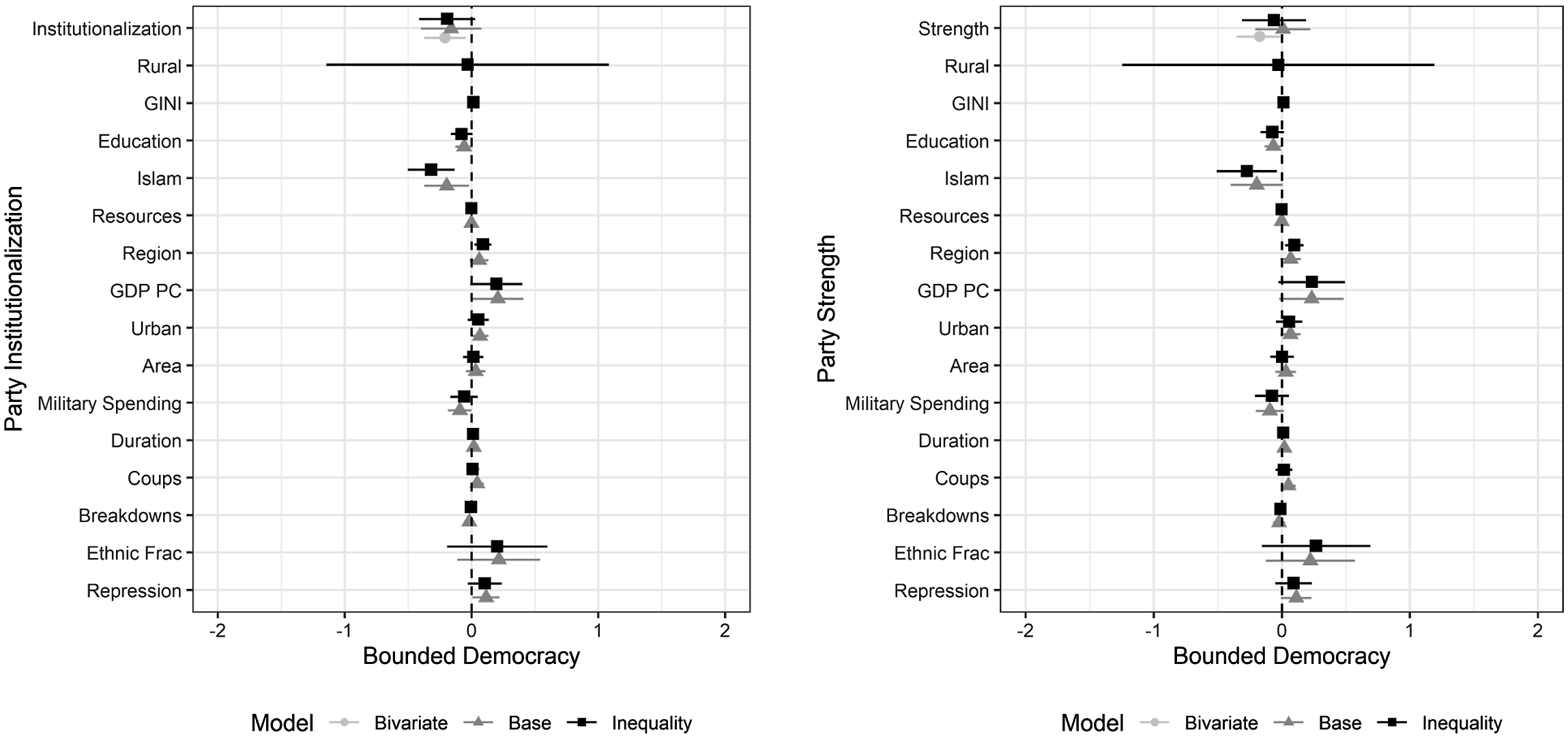
Using WTH produces moderate support for the main hypothesis. As can be seen in Figure 6, the coefficients for Institutionalization and Strength are significant in the Bivariate models, and directionally consistent with the hypothesis and is close to the 95% confidence threshold for the base model. Because the coefficients are directionally consistent using GWF, PAR, and WTH, there is sufficient evidence to infer that as the military’s confidence increases, bounded democratization decreases.
I conduct a final robustness check using DD. Given that DD is more permissive with its definition of military rule, I should expect to find no relationship between bounded democracy and the measures of a military’s confidence. DD codes a regime as having a military component solely if the regime leader had, at any time, been an officer. Thus, former officers that rose to power solely through civilian mechanisms are still considered to be a military regime.
For example, DD codes Tunisia under Ben Ali as military rule. Ben Ali had served in the Tunisia military, rising to the rank of Brigadier General, but retired and served in several civilian executive positions before becoming president in 1987. During his rule, the military did not play a major political role, nor did Ali rely heavily on the military to stay in power (Brooks, 2016).
In Figure 7 we can see that there is not a statistical difference between Institutionalization for any of the three models. Specifically, the coefficients are effectively zero. When modeling the relationship between party strength and bounded democratization, there is a small negative correlation in the Base model and directionally consistent in the Bivariate and Inequality model. Bounded democracy and military confidence—DD.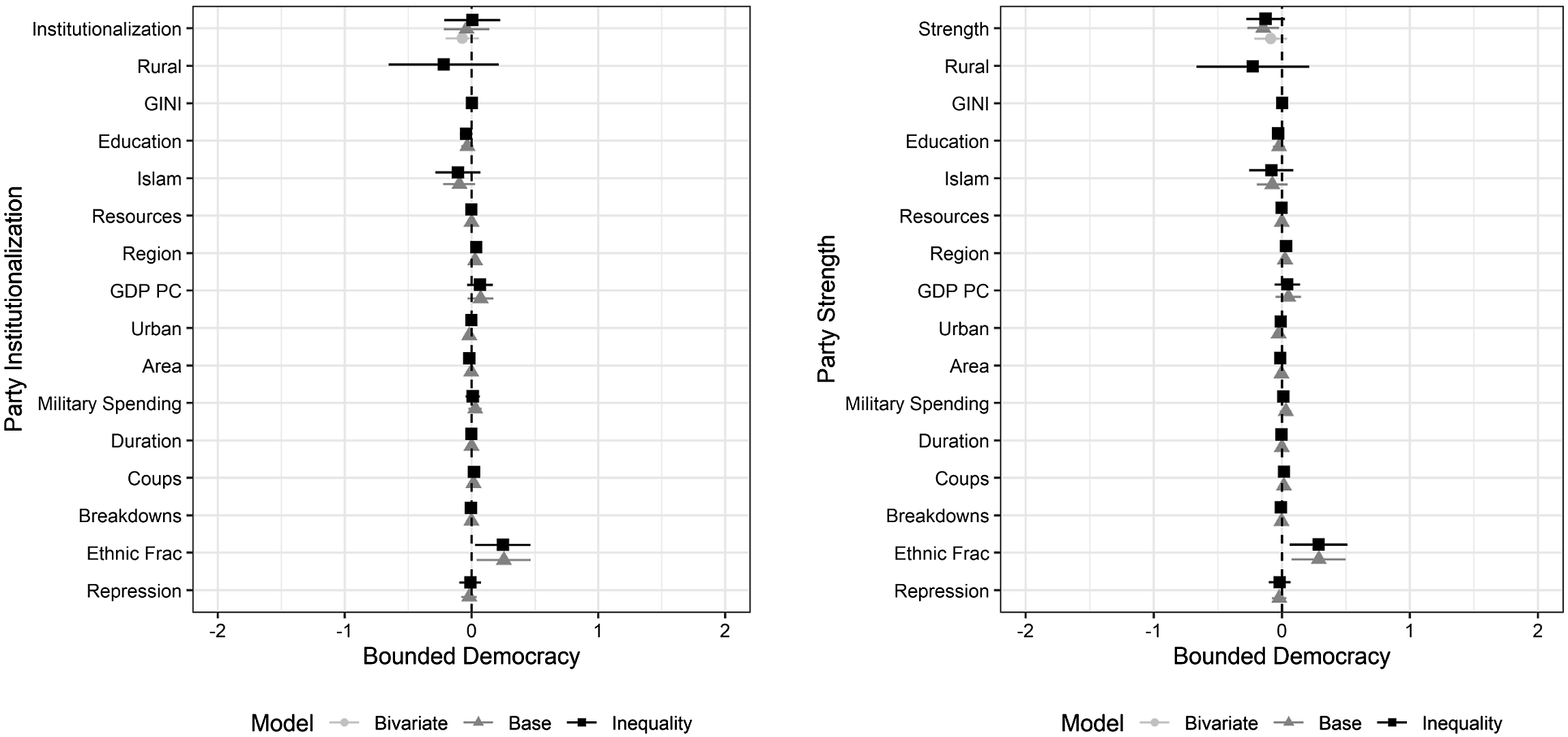
While using DD does not identify a negative relationship between the military’s confidence and bounded democratization, these results are still meaningful. The results using DD help reinforce the findings from GWF and PAR that bounded democratization is more likely to occur when the military, as an institution, rules. This is consistent with the theoretical logic, which relies on the assumption that officers use the coercive capacity of the military to influence the development of political and electoral institutions as an attempt to secure their interests. When authoritarian rule is characterized by a strong personal leader who has a military background, on the other hand, we do not see the military act politically to bind democratization.
Conclusion
In this paper I tested whether militaries are more likely to bind democratization when they lack confidence in civilian parties’ capacity or willingness to protect the military’s interests. To do so, I developed an original dataset on militaries’ behavior during political transitions. The new measure of bounded democratization I developed allows researchers to measure the degree to which a military interferes in the development of political institutions and will be useful beyond the scope of this analysis. With this data, I found that as either the party institutionalization or strength of the incumbent party increase, the degree of bounded democratization decreases. These results were robust to different model specifications and samples, with some caveats.
These caveats should not undermine confidence in the theory but should do the opposite. Where the models reported no consistent coefficients is where there were differences in what has been considered military rule. Using different samples, I found that the results were robust when using samples where military rule was more institutionalized. These results demonstrate that bounded democratization is more likely to occur when the military acts as a cohesive unit. When authoritarian rule is more personalized, the military is less involved in the development of competitive institutions.
The goal of this exercise is not to provide any causal estimate of the military’s confidence on bounded democratization. Instead, it is to establish that there is a pattern between a military’s confidence and whether a military sets parameters on political transitions. While there may certainly be extenuating circumstances that produce different results, on average, militaries set parameters on political and electoral institutions/actors when they are not confident that their interests are secure.
The theory and findings herein can help explain the democratic development in numerous cases such as Brazil, Indonesia, Paraguay, and Greece. Militaries set stronger parameters on democratization when conservative pro-military parties are weaker. The theory and findings can also help explain failed democratization in cases such as Algeria, Egypt, Myanmar, and Thailand. In these cases, the military lacked a well-institutionalized and strong allied party. Thus, the militaries set strict parameters on democracy which ultimately failed to fully protect the military.
Future research should build on these findings with the understanding that the military’s support for democracy is conditioned on the characteristics and behavior of political parties. Myanmar’s bounded democracy survived for 12 years but was insufficient to keep the military at bay. This motivates further questions such as what conditions allow the military to retreat to the barracks permanently, what forms of bounded democratization are likely to lead to failed democracies, or are some institutional arrangements under bounded democratization more successful than others? Furthermore, future research may also examine the effects of bounded democratization on long term political development. Do bounded transitions eventually lead to greater liberalization? How does bounded democratization affect the development of political parties or executive power?
Overall, the concept, theory, and findings presented herein not only provide a rich opportunity to investigate post-praetorian authoritarian rule but also to extend the concept of bounded democratization to non-military authoritarian actors. Do strong authoritarian incumbent parties or executives bind democratization? If so, how does that differ from the military and how does it affect political development? While the world faces a rise in illiberalism and autocratization, it may be fruitful to return to the origins of these democracies to determine whether the arrangement out of authoritarian rule is at the root of democratic backsliding.
Supplemental Material
Supplemental Material—Bounded Democratization: How Military-Party Relations Shape Military-Led Democratization
Supplemental Material for Bounded Democratization: How Military-Party Relations Shape Military-Led Democratization by Darin Sanders Self in Comparative Political Studies
Footnotes
Declaration of Conflicting Interests
The author(s) declared no potential conflicts of interest with respect to the research, authorship, and/or publication of this article.
Funding
The author(s) disclosed receipt of the following financial support for the research, authorship, and/or publication of this article: This work was supported by the Fulbright Association and Henry Luce Foundation Research Grant.

Supplemental Material
Supplemental material for this article is available online.
Notes
Author Biography
References
Supplementary Material
Please find the following supplemental material available below.
For Open Access articles published under a Creative Commons License, all supplemental material carries the same license as the article it is associated with.
For non-Open Access articles published, all supplemental material carries a non-exclusive license, and permission requests for re-use of supplemental material or any part of supplemental material shall be sent directly to the copyright owner as specified in the copyright notice associated with the article.
