




Abstract
What determines the attitude of citizens toward international trade in advanced industrialized nations? The question raises an intriguing paradox for low-income citizens in developed economies. Increasing imports pose the most severe threat to job security for low-income citizens, who, on the other hand, reap the greatest benefits from cheaper imports as consumers. This article considers the role of dual identities that citizens have as both income-earners and consumers, and investigates how attitudes toward trade differ depending on which aspect of respondents’ lives—that is, work versus consumption—is activated. The results of an originally designed survey experiment conducted in Japan during the recession suggest that the activation of a consumer perspective is associated with much higher support for free trade. In particular, those respondents who have lower levels of job security are the ones who, with consumer-priming, increase their support for foreign imports.
Introduction
What determines the attitude of citizens toward free trade in advanced industrialized nations? The question raises an intriguing paradox for low-income citizens in developed economies. Increasing imports pose the most severe threat to job security for low-income and low-skilled citizens in advanced industrialized countries (Autor et al., 2013; Hiscox, 2006; Scheve & Slaughter, 2001). However, as Engel’s Law suggests (i.e., the budget share of food is inversely related to household income), low-income citizens are the prime beneficiaries of free trade as consumers because it substantially lowers the costs of food and clothing (i.e., see Broda, Leibtag, & Weinstein, 2009; Hamilton, 2001; Houthakker, 1957; Nakamura, 1996). 1 Are low-income citizens torn between conflicting attitudes toward trade, depending on which aspect of their lives they weigh more heavily—that is, occupational interests (“protectionism”) or consumption interests (“free trade”)? 2 And if so, how do they weigh these conflicting interests when forming opinions on trade policy?
This article seeks to answer these questions by considering the role of citizens’ dual identities as income-earners and consumers. We argue that activation of the consumer identity should mobilize higher support for free trade among the low-income citizens who are the highest beneficiaries of cheap imports and who face the highest threat of job loss due to free trade. We test this “torn between the duality of interests” argument with an originally designed survey experiment implemented in Japan during the 2007-2009 recession. The experiment randomly assigns visual images that activate respondents’ identification with producer or consumer interests and tests how attitudes toward foreign trade differ depending on which aspect of respondents’ lives is activated. We further test whether elite messages activating consumer interests can mobilize support for free trade by leveraging the 2009 Lower-House election campaigns in Japan.
The results suggest that consumer-priming can raise support for free trade by as much as 9 percentage points compared with a group that receives no priming, and 13 percentage points compared with a group that receives producer-priming. Moreover, subgroup analyses lend strong support to our “torn between the duality of interests” argument: Consumer-priming is especially effective in mobilizing support for free trade among those who reap the highest consumer benefits and face the highest threat to job security from an open economy. The respondents in the low-income bracket showed 13 points higher support for free trade relative to the control group. Similarly, the respondents with shopping habits to purchase cheap goods showed 12 points higher support for free trade compared with the control group.
Moreover, we find that elite campaigns can tilt this duality of interests toward consumer interests. We leveraged the Lower-House electoral campaigns leading up to the 2009 election in Japan, where the top two parties campaigned for “creation of jobs” versus “improving citizens’ quality of lives,” respectively. Our experiment during this campaign period demonstrates that respondents who were exposed to “improving citizens’ quality of lives” messages by the Democratic Party of Japan (DPJ) were more sensitive to the consumer-priming and increased their support for free trade by 12% compared with the control group. The supporters of the Liberal Democratic Party (LDP), who had been exposed to “creation of jobs” messages, did not increase their support with the consumer-priming. In sum, the consumer-priming had heterogeneous effects between top two party supporters in mobilizing support for free trade.
In sum, our experimental results during the recession suggest that when the marginal consumer benefits that low-income respondents derive from additional liberalization (i.e., lower prices) are large, as is the case for Japan (high consumer prices), consumer interests can serve as a vehicle for resisting protectionism even during hard economic times, such as the 2007-2009 financial crisis (Gourevitch, 1986).
Our findings contribute to an emerging research on citizen attitudes toward trade in three ways. First, we consider citizens’ economic interests in two dimensions where they are both income-earners and consumers in the global economy, and ask how their attitudes differ when they think of trade from an occupational versus a consumer perspective. Our focus on this duality of citizen interests differs from the existing studies of trade attitudes, which tended to focus on occupational interests. Our “duality of interests” approach also improves on Andy Baker’s path-breaking studies on consumer interests as the determinants of trade attitudes, which consider citizen interests on a single, consumption dimension. Empirically, our survey directly measures respondents’ consumer tastes and shopping habits that might not be proxied with their income (see Baker, 2009). Our approach, however, differs from the sociotropic argument put forth by Mansfield and Mutz (2009) in that our argument is squarely based on individual, self-interests, as opposed to societal, collective interests.
Second, the findings advance a research program on individual attitudes toward trade, which paid scant attention to the process by which elites and citizens interact to shape public opinion (Kuo & Naoi, 2014). Although in reality, elected officials rarely discuss consumer benefits to mobilize mass support for free trade, our results suggest that such elite messages can mobilize more than 10% higher support for free trade, and this effect is mediated by partisanship.
Finally, our findings push forward a long-standing line of research on “embedded liberalism,” which shows how social policies for vulnerable workers can stabilize mass support for an open economy even during hard economic times (Hays, 2009; Rudra, 2008; Ruggie, 1982; Scheve & Slaughter, 2007). According to this view, countries without generous social programs and with majoritarian electoral institutions, such as Japan and the United States, would be the most susceptible to a backlash against globalization among the masses. Yet, the majoritarian institutions also empower consumers over producers through lower prices (Rogowski & Kayser, 2002; Rosenbluth & Thies, 2010). Using the country case of Japan with small welfare programs, we provide an alternative, consumer-based account for why mass support for free trade was stable even during the worldwide financial crisis (Pew Research Center, 2009): 3 Low-income citizens, who were expected to turn against free trade because of their occupational standing, did not do so because of the consumer benefits they derived from the global economy. Growing consumer interests within the duality of interests might have prevented a protectionist backlash during the crisis in Japan and elsewhere.
The Puzzle: Producer, Consumer, and Individual Support for Free Trade
When low-income citizens are torn between conflicting attitudes toward trade as income-earners versus consumers, 4 how do they weigh these attitudes when forming opinions on trade policy? Despite the proliferation of research on individual attitudes toward globalization, few studies have asked how citizens assess the effect of trade from the multifaceted perspective of both income-earners and consumers (Goldstein, Margalit, & Rivers, 2008; Naoi and Kume 2011). Trade theories (Heckscher–Ohlin and Ricardo–Viner) predict the effect of trade expansion on both wages (“jobs”) and prices (“consumption”; Baker, 2005; Helpman, 2011); yet, the majority of studies on trade attitudes measure respondents’ trade interests with how they earn money (e.g., skill levels and sectors of employment), not how they spend money. 5
Exceptions are a series of studies done by Baker (2003, 2005, 2009), which have shown that consumers of imported and import-competing goods favor free trade and that this is why trade reforms were popular among Latin American citizens. 6 A paradox for advanced industrialized nations is that low-income citizens’ opinions toward trade can be torn between the duality of interests they have as both income-earners (“protectionist”) and consumers (“free trade”), as discussed previously.
Whether citizens think of trade from a producer or consumer perspective can have a profound effect on the levels of support for free trade. Figure 1 makes this point cross-nationally with survey data from 17 countries conducted by International Social Survey Program (ISSP) in 2003. Depending on whether the question wording justifies trade policy as protecting the national economy or providing consumer benefits, respondents show diverging support for free trade. The ISSP’s first trade question asks whether a respondent agrees with the following statement: “[Respondent’s country] should limit the import of foreign products in order to protect its national economy.” The second question highlights the respondents’ assessment of the consumer benefits to free trade by asking whether they agree with the following statement: “Free trade leads to better products becoming available in [Respondent’s country].” 7
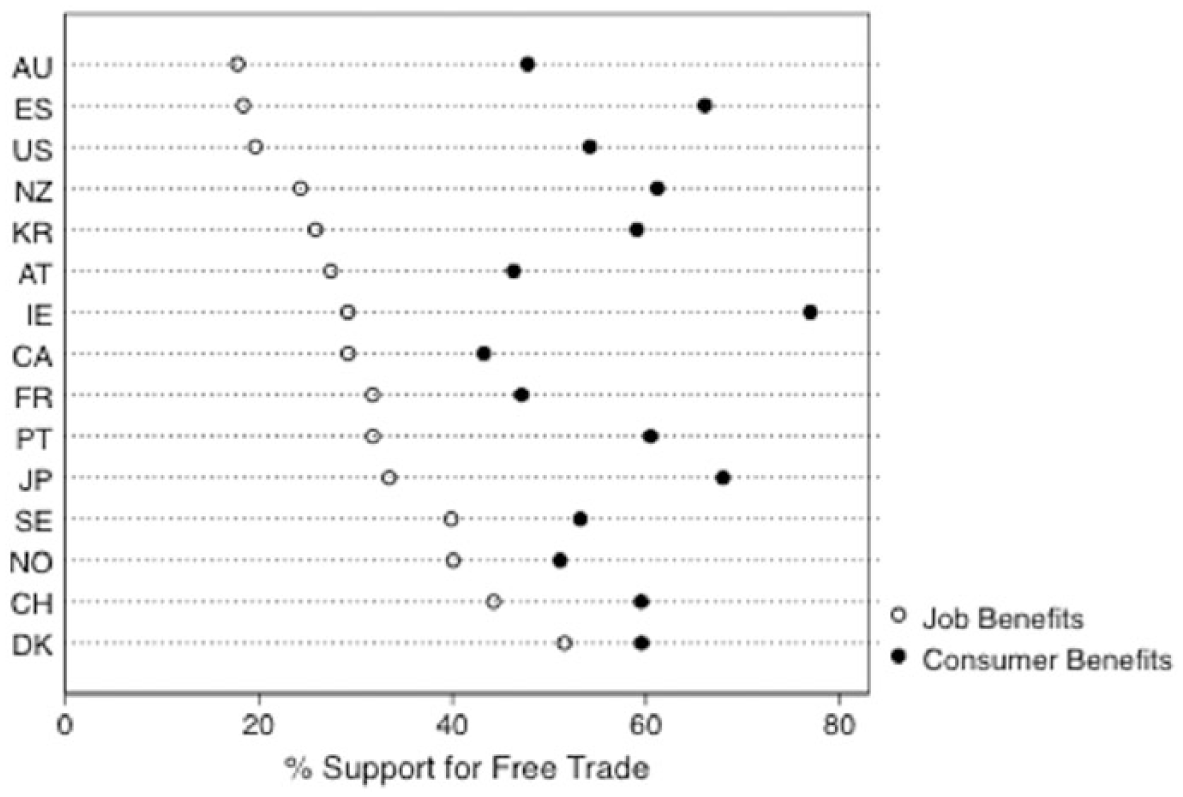
The gap between % support for free trade in job versus consumption dimensions.
For each country, we calculate the proportion of pro-trade responses. Figure 1 shows the magnitude of divergence among the same group of respondents with respect to their levels of support for free trade, when they are asked about “protecting the national economy” (more emphasis on jobs and employment) versus when they are asked about consumer benefits. The average difference is 31.9% among the selected Organisation for Economic Co-operation and Development (OECD) countries with vast cross-national differences ranging from 0.45% in Finland, 47% in Japan, and 55% in Spain.
The vast difference among the same respondents’ attitudes toward trade suggests that we need to move beyond asking whether producer interests matter more than consumer interests in the policy-making process, as is the conventional focus in the literature (Grossman & Helpman, 1994; Peltzman, 1976; Rogowski & Kayser, 2002; Schattschneider, 1935; Stigler, 1971). Instead, we need to investigate how citizen support for an open economy may differ when they think of it from different perspectives. This question calls for an experimental research design that randomly primes citizens to think about trade through either a producer or consumer lens.
Consumer Interests in a New World Economy: Why Low-Income Citizens Are Torn
Although empirical tests of Engle’s Law have established that low-income citizens will be the highest beneficiaries of cheaper consumer goods, new research suggests that their consumer benefits from free trade have grown even larger since China’s entry into the world economy and the spread of big-box retail stores, such as Walmart that sells cheaper, imported goods. Broda et al. (2009) find that during the “stagnant” years of the 2000s in the United States (Broda et al., 2009; Broda & Weinstein, 2006), food budget shares of American citizens have declined, demonstrating a more robust income growth than was officially portrayed from the income statistics alone. 8 Handbury and Weinstein (2014) use barcode data on citizens’ purchase transactions from 49 U.S. cities and show that the food price is lower in large cities where the majority of the poor reside. These studies challenge the seminal work by a sociologist, David Caplovitz’s The Poor Pay More (1967), which demonstrated that the American poor paid higher prices for the same goods and services than the rich due to the lack of access to cheaper options in inner cities as well as “buy now, pay later” deals that had many hidden costs.
Yet, the consumer benefits for low-income citizens also come at a cost. Bernard, Jensen, and Schott (2006) used manufacturing plant-level data in the United States to show that plants that faced more import competition from developing economies grew slower and were more likely to exit from the market. Using labor market data of commuting zones in the United States, Author et al. (2013) estimated that import competition from China has contributed to a 25% employment decline in the United States’ manufacturing sector and increased the government’s transfers to the poor (disability and income assistant transfers, etc.). Similarly, using plant-level data for Japanese manufacturing industries, Mayda, Nakane, Steinberg, and Yamada (2012) demonstrated that the rise of Chinese imports contributed to lower productivity and lower survival rates of manufacturing plants.
In sum, we expect that when low-income citizens in advanced industrial nations view the rise of imports from a consumer perspective, they are more likely to support free trade than when they view the rise of imports from a worker’s perspective.
A Survey Experiment: Priming Without Framing
To test this “torn between the duality of interests” hypothesis, we conducted an online survey experiment with Japanese citizens during the midst of the 2007-2009 recession (December, 2008). Two characteristics make Japan an ideal case to explore the duality of citizen interests in the global economy: (a) Increasing volatility in the labor market since the 2000s have made low-income Japanese citizens especially torn and conflicted over free trade, 9 and (b) the majoritarian electoral institutions, adopted since the 1996 election, should magnify both citizens’ protectionist backlash against free trade from an occupational perspective (Hays, 2009) and empower the voice of consumers over producers (Iversen & Soskice, 2010; Rogowski & Kayser, 2002). 10 Moreover, the recession provided an ideal testing ground for our argument, because the crisis put enormous stress on the duality of interests that citizens have as both income-earners and consumers through layoffs and pay-cuts (Margalit, 2013).
The survey experiment in Japan was conducted with a sample of 1,200 respondents between the ages of 20 and 65 during the first week of December, 2008, when media coverage of the world financial crisis and the rise of unemployment among the temporary workers was extensive. 11 The survey was administered by Yahoo! Japan, and participants were recruited from its 2.5 million registered monitors by an opt-in method. 12 The respondents were blocked before randomization so that each experimental group’s gender, age, income, and prefecture of residence closely matched a nationally representative sample based on the 2005 National Census. The experiment consisted of two groups that received the producer or consumer treatment and a third group that did not receive any stimulus (“control group,” 400 respondents each). 13
The producer-priming group was shown three photographs—a typical white-collar office, a car factory, and a rice field. The images were chosen so that they represent three major sectors of the economy (service, manufacturing, and agriculture) to activate respondents’ consciousness as producers (or, their occupational interests). We chose images of typical workplaces with both male and female workers present, except for the car factory image where all the workers appear to be male.
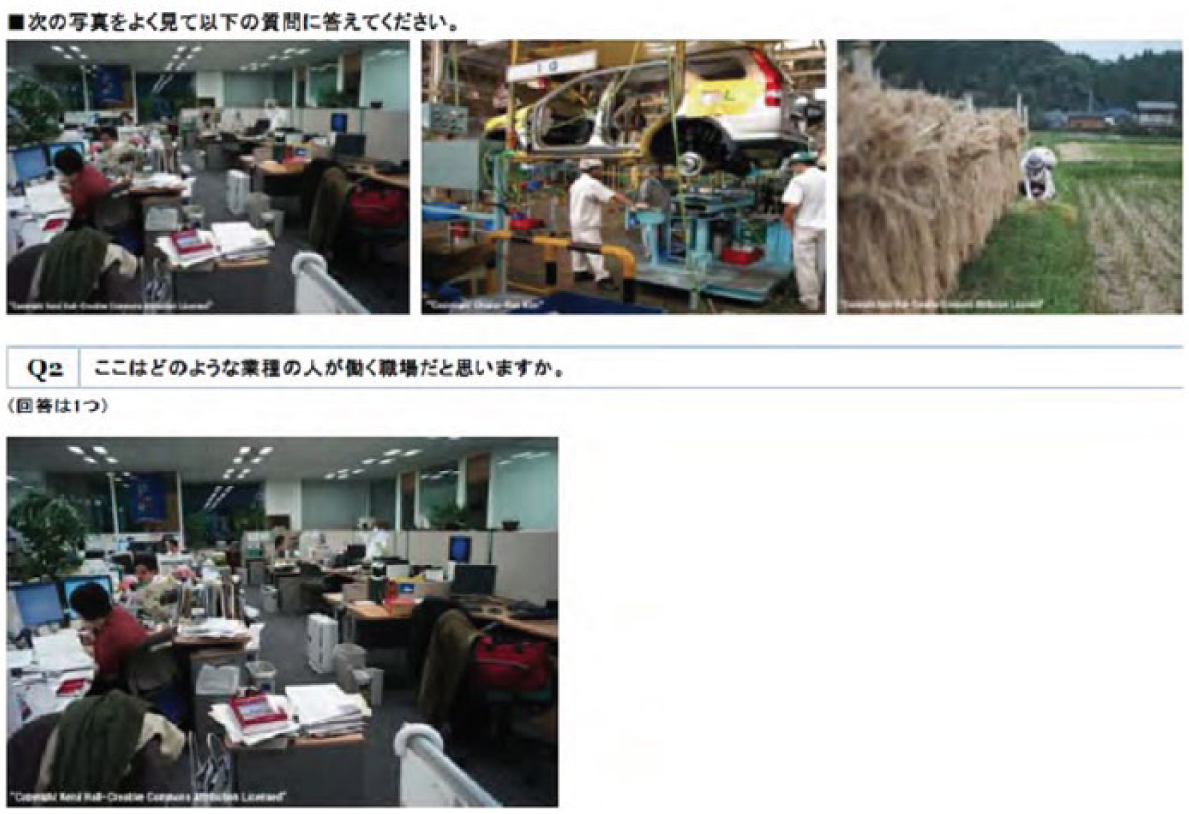
Producer-priming (Pictures 1, 2, and 3).
The consumer-priming group was shown three photographs—a supermarket with food, a consumer electronics retail store, and a large-scale casual clothing store. These images encompass three areas of basic consumer goods that citizens purchase regularly regardless of their income, gender, family status, or age. 14 These visual stimuli were intended to activate respondents’ consciousness as consumers. The control group received no stimulus. The treatment groups and a control group were balanced in their key demographic characteristics such as age, gender, income, and self-reported skill specificity as shown in the Supporting Information (hereafter SI) Table SI-2.

Consumer-priming (Pictures 4, 5, and 6).
Using images to prime respondents has two advantages over framing experiments, which supply respondents with opinions about how free trade affects consumers and producers. 15 First, priming differs from framing in that the former makes some issues more salient than others and thus influences “the standards by which governments, presidents, policies, and candidates for public office are judged,” 16 whereas framing characterizes issues negatively or positively. 17 This characteristic of priming allows us to manipulate respondents’ own “standards” by which trade policy is judged (i.e., producer vs. consumer interests) without imposing any outside perspectives on them (i.e., trade is good or bad for producers/consumers). This is critical for the purpose of our study, as we do not yet know whether activation of a consumer perspective uniformly leads to lower or higher support for free trade.
The existing research, for instance, suggests that there are various parameters beyond price sensitivity that make some consumers more protectionist than others: the type of consumption basket (Baker, 2005, 2009), safety and quality concerns (Kono, 2006; Vogel, 1999), ethical concerns (Ehrlich, 2010; Maclachlan, 2001), the love of variety (Broda & Weinstein, 2004; Krugman, 1980), and community and family concerns (Goldstein, Margalit, & Rivers, 2008). Instead, the visual stimuli simply prime respondents to think of production versus consumption.
Second, our visual stimuli do not explicitly convey information about either trade or globalization. This is appropriate for the purpose of our study, as not all production and consumption activities are linked, either in reality or in citizens’ minds, to trade. 18 After the treatment, we proceeded to ask attitudinal questions about trade. 19 The survey instruments are described in the “Results” section below, and manipulation checks are described in Naoi and Kume (2011).
Results (1): The Aggregate Effects of Priming
Producer and Consumer Interests in Trade
Figure 2 summarizes the distribution of responses for the following question: “Imports from foreign countries have been increasing in the past. What is your opinion on this?” We chose to ask about imports, rather than trade in general, because protectionist sentiments generally emerge over imports, not over exports. Respondents answered using a 5-point scale (very good, good, can’t say one way or the other, bad, and very bad), and we categorized these responses into increasing imports as either “Good” (which includes “very good” and “good” responses), “Bad” (which includes “very bad” and “bad” responses), or “Neutral” (which includes “can’t say one or the other”). Columns 1 to 3 in Figure 2 show mean estimates for each of the response categories by treatment category and the standard errors of the estimates in parentheses. Columns 4 and 5 report difference-in-means tests (t test) between the control group and each of the treatment groups and the standard errors in parentheses. Positive values indicate that support for free trade is higher with a given treatment, whereas negative values indicate that the support is lower with a given treatment, compared with the control group.

Estimated effect of producer- and consumer-priming on support for free trade.
The consumer-priming increased the pro-trade responses by 9.5 percentage points and lowered the opposition to trade by 13 percentage points. These differences are statistically significant at the 1% level. 20 The producer-priming, on the other hand, reduced the pro-trade responses by 3.8 percentage points (significant at 5% level), but it did not systematically increase the proportion of protectionist responses (the increase was 4 percentage points over the control group; however, the difference is not statistically significant). 21 Overall, the results suggest that Japanese citizens are much more supportive of free trade when they assess their positions on trade from a consumer perspective.
It is important to note that the weak effects of producer-priming suggest that respondents were already exposed to the protectionist discourse linking trade with job losses, and hence the producer-priming did not mobilize additional protectionist sentiments from the control group. By contrast, the existing political discourse rarely links the benefits of trade with consumer benefits. Yet, the powerful effects of the consumer-priming, even with a subtle image manipulation without mentioning “trade,” suggest that citizens’ day-to-day experience with consumption can serve as a grassroots foundation for their support for an open economy. We further explore this interpretation using the case of 2009 Lower-House election in Japan later. The next section will discuss the heterogeneity of treatment effects among the subgroups, which lends further support to our “torn between the duality of interests” argument.
Results (2): Subgroup Analyses—Whose Support for Free Trade Was Mobilized?
The subgroup analyses lend strong support to our “torn between the duality of interests” argument. Overall, the consumer treatment mobilizes support for free trade among those who reap the highest benefits from cheaper imported goods and whose job security was the most affected by the financial crisis: low-income citizens and respondents with consumer tastes for cheap goods. We will discuss the specific results below. SI’s Section 6 summarizes the results from regressions controlling for potential imbalances within subgroups. 22
Figure 3 summarizes the treatment effects for respondents by income group. The left figure summarizes the results of difference-in-means tests (t tests) of the percentage pro-trade responses (those who chose increasing imports is “good” or “very good”) between producer-priming and the control group. The middle figure summarizes the results of difference-in-means tests between consumer-priming and the control group. The right figure shows the benchmark levels (%) of support for each subgroup in the control group. For the left two figures, the X-axis indicates the percentage point change in support for free trade, where the point zero (black vertical line) indicates the levels of support for free trade for each of the subgroups in the control group. Negative values indicate a reduction in support compared with the control group, and positive values indicate an increase in support. For the right figure (control group), the X-axis indicates the levels of support for free trade (% of pro-responses). The black solid dot indicates point estimates of mean levels of support for each of the subgroups, and the black horizontal line indicates a 95% confidence interval. Table SI-5 summarizes these estimates.

Treatment effects by income group.
We start off with the results for the control group (right figure). Consistent with the predictions of the Heckscher–Ohlin trade theorem, low-income respondents had much lower levels of support for free trade (5% support) than either the middle- or high-income respondents (12% and 14%, respectively) within the control group. The producer-priming (left figure) has no additive or reductive effects on low-income respondents’ support for free trade. Together with the results for the control group, the lack of producer-priming effects is consistent with the conventional wisdom that low-income citizens view international trade as a threat to their job security by default.
The consumer-priming (middle figure), however, reverses the Heckscher–Ohlin patterns of trade attitudes in the control group. Consistent with Engel’s Law, the viewing of the consumption images increased support for free trade among those who reap the highest consumer benefits from a global economy, that is, low-income citizens. 23 The increase is substantial—the low-income class increased their support by 12 points and the middle-income class respondents increased their support by 9 points compared with the control group. The increase for the high-income class was statistically insignificant.
Instead of using respondents’ income as a measure of their consumer interests, we also conduct subgroup analysis with more direct measures of respondents’ consumer tastes. Cheap Shoppers takes a value of one if respondents reported that they do not own any of the commonly owned luxury brand items from the following list (Armani, Brooks Brothers, Chanel, Gucci, Louis Vuitton, Tumi, Ralph Lauren, and Rolex) and zero otherwise. Forty-eight percent of the respondents reported that they did not own any of these items and thus are Cheap Shoppers, and 52% are Luxury Shoppers who reportedly own at least one of the above items. 24 Figure 4 summarizes the treatment effects by the respondents’ shopping habits. The consumer treatment mobilizes support for free trade among Cheap Shoppers by a 12.5 percentage points compared with the control group. The consumer treatment increased support among Luxury Shoppers by 6 percentage points, although this effect is only significant at the 10% level. These results are robust to controlling for respondents’ levels of education, income, and gender (see SI-6).
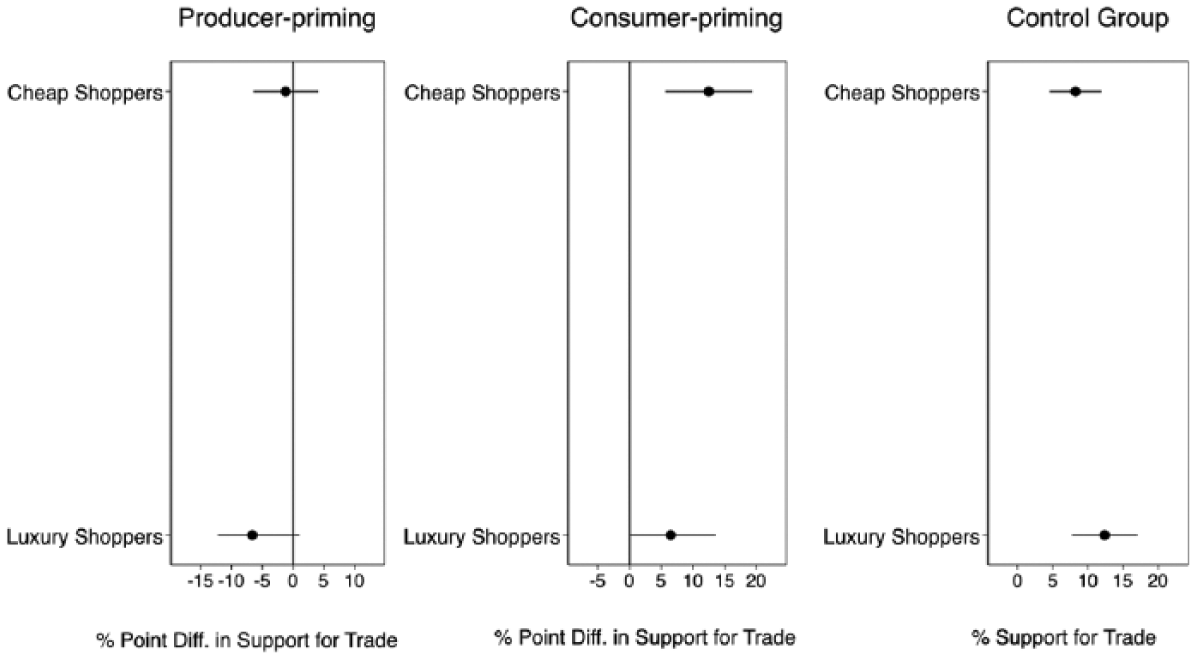
Treatment effects by shopping habits.
The powerful effects of the consumer-priming on low-income and cheap-shopping respondents imply that these respondents do not think of the consumer benefits of international trade by default (i.e., the results from the control and producer-priming groups). Yet, they are susceptible to the consumer-priming perhaps due to their day-to-day experience as consumers, and because the photo images of retail and grocery stores provoked such experience. These results indicate that citizens whose job security and income were the most vulnerable in the financial crisis also had the most to gain from free trade as consumers.
The Real World Example: The 2009 Lower-House Election
The results from the survey experiment discussed above suggest that simple photo images of consumption can activate citizens’ identity as consumers and, hence, influence their trade attitudes. In the real world, however, elite discourse predominantly links trade with its threat to domestic jobs, and rarely with its consumer benefits to low-income citizens. However, what if citizens are exposed to competing frames from elites that link international trade with producer versus consumer interests? In this section, we leverage the case of Japan’s Lower-House election campaign leading up to 2009 to probe this question, where the top two parties competed with different appeals to producer versus consumer interests: the creation of jobs (the LDP) versus improving the quality of citizens’ lives (the DPJ). We test whether respondents’ real world exposure to such partisan messages affected their sensitivity to our treatments.
Election campaigns for the Lower-House election of 2009 were held in the midst of a financial crisis (2008-August 30, 2009), when the survey experiment was conducted. 25 The major opposition party, the DPJ, pledged to “prioritize citizens’ quality of lives” and campaigned on granting child support for families with young children and “promoting negotiation” to sign a U.S.–Japan Free Trade Agreement, which was expected to substantially lower food prices. The LDP’s campaign appeals focused on protecting and creating jobs by expansionary fiscal and monetary policy. Indeed, our own legislator survey conducted after the 2009 election suggests that 26% of DPJ legislators who responded to our survey agreed that “Increasing imports from abroad is a good thing because it allows low-income consumers to purchase necessities with cheaper prices,” whereas only 10% of the LDP legislators agreed with the statement. 26 This partisan distribution of trade attitudes among legislators closely matched those of voters. We conducted a corresponding survey with the exact same questionnaires as our legislator survey with 16,000 voters in February of 2010 (2 months after the legislator survey) with Yahoo! Research. Thirty-eight percent of DPJ supporters agreed with the consumer benefit statement above, whereas 28% of LDP supporters agreed. The 10 percentage point difference is statistically significant at the 1% level.
Given the two parties’ campaigns and the DPJ voters’ higher sympathy for the consumer benefits of trade, we expect that the consumer-priming would have been likely to mobilize higher support for free trade among the DPJ supporters, but not among the LDP supporters. 27 Figure 5 summarizes the results. The supporters of the DPJ, the party that campaigned for improving the quality of citizens’ lives, increased their support for trade with the viewing of the consumption images by 12 percentage points relative to the control group. The consumer-priming did not have systematic effects on the LDP supporters, who had been exposed to the “creation of jobs” campaign messages. Non-partisans, which constituted 50% of our sample, also showed the higher support for free trade by 8 percentage points with the viewing of consumer images compared with the control group. The results are robust to controlling for respondents’ income, education, and gender (see SI-6) and ruling out two potential sources of endogeneity. Models 6 and 7 in Table SI-6 show that the partisanship interacted with the treatmentand affected trade attitudes even after controlling for respondents’ socio economic attributes. We further ruled out two potential sources of endogeneity between respondents’ socioeconomic attributes, their party support, and trade attitudes. First, we analyzed whether respondents with high job insecurity were more likely to support DPJ (i.e., DPJ support being a spurious cause of the local treatment effect). The analysis restricted to the control group suggests that this was not the case, except for respondents above the age of 50 (who were more likely to support the DPJ). Female respondents were less likely to support the DPJ. Second, our treatments might have affected the respondents’ attitudes by changing their party support (i.e., party support being a mediation variable)—see Imai, Keele, and Yamamoto (2010). We tested for this possibility (by conducting difference-in-means tests in party support across the three experimental groups) and found that in aggregate, there were no treatment effects on the respondents’ support for DPJ or LDP.
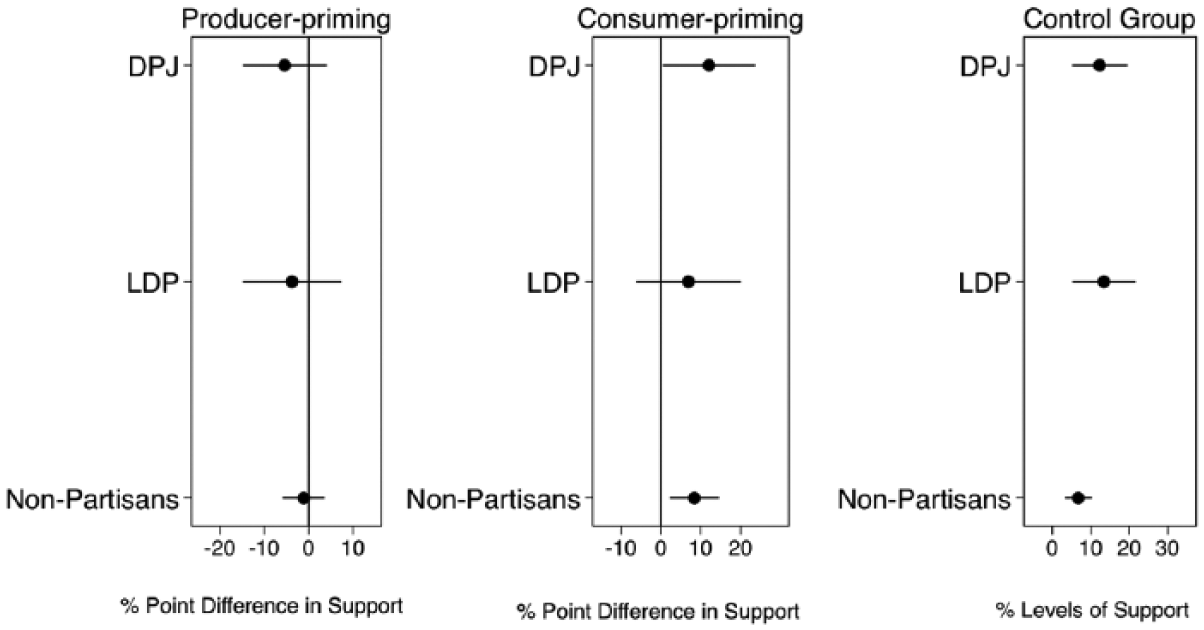
Priming effects by partisanship.
The results suggest that the DPJ’s unusual campaigns appealing to consumer interests might have contributed to the large priming effects of the consumer treatment among the DPJ supporters. The finding implies that elite messages linking international trade with consumer benefits can mobilize mass support for free trade especially in countries with high consumer price such as Japan. 28 Growing consumer interests within the duality of citizens interests might have allowed the DPJ government (2009-2012) to resist protectionist temptation and commit to free trade during the crisis in Japan.
Beyond Japan and Beyond Hard Times: Putting Bounds on the Generalizability
To what extent are our experimental findings generalizable beyond the Japanese case and beyond the 2007-2009 recession? We believe that the two conditions that are present in the Japanese case (small welfare programs and high food prices) account for why, in our survey experiment, the consumer-priming mobilized substantial, additional support for free trade among low-income respondents. This is because the marginal benefits that low-income respondents derive from additional liberalization (i.e., lower prices) are larger on the consumer dimension in countries with higher consumer prices.
Accordingly, we expect that countries with small welfare programs and low food prices (i.e., liberal market economies such as the United States and Australia—see Iversen & Soskice, 2010) will show an opposite pattern of priming effects, namely, that consumer-priming would not mobilize much additional support for an open economy (because the price is already low; and additional liberalization does not lower the price much more), whereas producer-priming would increase the likelihood of a backlash against globalization. This prediction indeed is consistent with the findings in Michael Hiscox’s (2006) framing experiment in the United States, which demonstrated that job threat framing mobilized additional protectionist responses, whereas consumer-benefit framing did not mobilize additional support for free trade in the aggregate.29
By contrast, for countries with large welfare programs and high food prices, such as the Northern European welfare states, we expect that consumer-priming would also mobilize support for free trade, just as in Japan, and that producer-priming would be less likely to contribute to any protectionist backlash because vulnerable workers are shielded by the government’s programs.
Finally, we expect that economic downturns such as that seen in 2007-2009 will tilt workers’ concerns toward job security rather than consumer interests. This means that the effect of consumer-priming would be larger during good times. Testing these predictions is beyond the scope of this article, however.
Conclusion
This article has made three contributions. First, our research has elucidated the duality of interests that citizens have as both income-earners and consumers, and its importance for building support for free trade. In particular, we found that citizens who are most likely to oppose trade in advanced industrialized nations, that is, low-income citizens, are more likely to raise their support for free trade when they think of trade from a consumer perspective. This finding calls on scholars to expand the scope of “self-interests” to the consumption dimension.
Second, we demonstrated that this duality of interests can manifest in national politics through the two-party competition under majoritarian electoral systems. In particular, we have shown that the respondents’ exposure to partisan messages appealing to producer versus consumer interests substantially mediated the effect of consumer-priming on their support for free trade. This finding is counter-intuitive in light of research that emphasizes decreasing partisan differences over trade policy in the postwar period (Hiscox, 2002; Milner & Judkins, 2004) and the low political salience of trade issues in general (Guisinger, 2009). Our findings suggest that partisan differences do exist on trade, but that this divide can be mobilized (or rendered latent) along a worker versus consumer dimension, which cross-cuts the conventional class divide. We have also shown that even when the link between consumption and trade policy is not direct or apparent in citizens’ minds (e.g., subtle manipulation of visual images), consumer-priming can mobilize support for an open economy, and the partisanship can be the source of why the consumer-priming works on some citizens, but not others. This forces us to revisit the ways in which we have gauged the political salience of trade. It might simply be that we need to expand the scope of trade issues to consumption, the day-to-day activities that citizens engage in. An obvious next step for research is thus to further investigate the link between various elites’ strategies to activate consumer or producer awareness and mass attitudes toward trade.
Third, our findings provide a potential, alternative account for why the 2007-2009 recession did not lead to a protectionist backlash, as predicted by the occupation-based theories. The findings of this article suggest that citizens’ attitudes toward an open economy might have been relatively stable in the face of the global recession due to the expansion and globalization of consumption activities. More than 20 years ago, Milner (1988) had shown that increasing production activities across borders allowed governments facing recession to resist the “protectionist temptation.” This article has shown that consumers, who have vested interests in the global economy, can be another vehicle for resisting such protectionist temptations.
Footnotes
Acknowledgements
We thank JSPS Grants-in-Aid for Scientific Research (A20243009: Globalization and Domestic Politics, 2008-2012) for financial support and Kiichiro Arai, Yoshitaka Nishizawa, Masahiko Tatebayashi, Masaru Kohno, Kengo Soga, Hiroki Mori, Yoshiko Kojo for their comments and suggestions through the formulation and execution of this project and Kazumi Shimizu and Motoki Watanabe for being generous with their expertise on survey experiments. Ben Ansell, Christina Davis, Peter Gourevitch, Miles Kahler, Gordon Hansen, Steph Haggard, Bob Keohane, Saori Katada, David Lake, Ed Mansfield, Peter Rosendorff, Nita Rudra, Roger Schoenman and Bob Uriu provided helpful comments. Naoi thanks the SSRC/Abe fellowship for financial support and the Department of Politics and Economics at Waseda University for graciously hosting her sabbatical when this research was conducted. Kenji Hall and Kim Chang-Ran provided several photographs that were used as visual stimuli. Celeste Raymond Beesley, Maya Duru, Jason Kuo, Yusaku Narita and Abby Vaughn provided excellent research assistance.
Declaration of Conflicting Interests
The authors declared no potential conflicts of interest with respect to the research, authorship, and/or publication of this article.
Funding
The author(s) disclosed receipt of the following financial support for the research, authorship, and/or publication of this article: We thank JSPS Grants-in-Aid for Scientific Research (A20243009: Globalization and Domestic Politics, 2008-2012) for financial support.
Supplemental Data
The supporting information materials are available at http://cps.sagepub.com/supplemental and Harvard Dataverse:  .
.
Notes
Author Biographies
References
Supplementary Material
Please find the following supplemental material available below.
For Open Access articles published under a Creative Commons License, all supplemental material carries the same license as the article it is associated with.
For non-Open Access articles published, all supplemental material carries a non-exclusive license, and permission requests for re-use of supplemental material or any part of supplemental material shall be sent directly to the copyright owner as specified in the copyright notice associated with the article.
