




Abstract
This article examines how parties use clientelism in competitive and uncompetitive electoral environments. It argues that parties enjoy wide discretion to target clientelistic payoffs to inexpensive voters in their strongholds, but that head-to-head competition compels them to bid for more expensive voters. Empirically, it uses a list experiment embedded in a postelection survey to study electoral clientelism in Lebanon, a country with a mix of competitive and uncompetitive electoral districts. It finds respondents underreport clientelistic transactions by a factor of two. Proxies for the cost of a vote explain payoff targeting decisions in party strongholds, but lose their explanatory power in the competitive districts.
Introduction
Do clientelistic parties target different types of voters in competitive and uncompetitive elections? Patron–client relationships link politicians and voters in many parts of the developing world, yet they use these linkages in a wide variety of electoral settings (Hicken, 2011; Kitschelt & Wilkinson, 2007; Stokes, 2007). Democracies may hold competitive elections in the aggregate, but some contests are highly uncertain affairs whereas others leave little doubt about the eventual outcome (e.g., Wantchekon, 2003; Weitz-Shapiro, 2014). Even electoral autocracies vary in their degree of competitiveness, with some areas completely dominated by the ruling party and others heavily contested by the opposition (e.g., Blaydes, 2011; Masoud, 2014). We should not expect parties facing a close contest, and parties facing no contest, to deploy their clientelistic resources in the same way.
This article argues that parties use clientelism to target different types of voters when they do, and do not, face electoral competition. All else equal, parties prefer to use material inducements on voters who demand only modest payoffs to change their electoral behavior—turning out or staying home when they would otherwise do the opposite, or switching their votes from one party to another (Gans-Morse, Mazzuca, & Nichter, 2014; Stokes, 2005). Parties enjoy wide discretion in their strongholds where, sheltered from competition, they can restrict their clientelistic transactions to relatively inexpensive and easily swayed voters. In highly contested areas, however, competitive pressures oblige parties to bid for less moveable voters lest the latter tip the election in favor of opponents. In short, parties are better able to target clients based on cost in their strongholds than when they compete head-to-head.
Empirically, this article draws on data from the 2009 parliamentary elections in Lebanon, a middle-income democracy with a long history of clientelism in its electoral politics. As with other clientelism-prone countries in the developing world, Lebanon has weak governing institutions and high levels of income inequality and social diversity; less commonly, foreign funding gave both incumbents and challengers sizable resources with which to patronize voters. More importantly, although the election was extremely competitive in the aggregate, it varied substantially at the subnational level. Only a handful of votes separated the two electoral alliances in some districts, while others were so uncompetitive that one alliance or the other did not even bother to field candidates there.
In light of well-founded concerns about underreporting due to social desirability bias, this article uses a list experiment embedded in a postelection survey to measure people’s participation in clientelistic exchanges during the electoral campaign (Gonzalez-Ocantos, de Jonge, Meléndez, Osorio, & Nickerson, 2012). When asked directly, roughly a quarter of respondents acknowledged that payoffs affected their electoral behavior—a large figure, to be sure, but one that doubles when asking people indirectly via the list. Consistent with expectations, the data suggest that parties targeted payoffs to poor voters in their strongholds, but that poverty loses its explanatory power in the competitive districts. Analogously, the data also suggest that the parties focused on politically disinterested and weakly committed voters in their strongholds, but expanded into more strongly committed partisans in the competitive areas.
This article makes several contributions that advance our understanding of electoral clientelism and vote buying. Theoretically, it develops an account of how competition affects how and why parties use clientelistic inducements to win votes. Existing studies of clientelism rarely make explicit comparisons between different competitive environments. Some adopt the “single-machine assumption” that only one party uses clientelism (Gans-Morse et al., 2014; Stokes, 2009), others posit dueling machines engaged in “competitive clientelism” (Lust, 2009), but few seek out or exploit variation in competitive environments (Cammett, 2014; Wantchekon, 2003; Weitz-Shapiro, 2014). This implicit pooling of different kinds of contests may contribute to the mixed empirical findings about party preferences for poor clients, core and swing voters, and turnout- versus vote buying (Hicken, 2011).
Last, the article’s list experiment explicitly accommodates social desirability bias to avoid “misunderestimating clientelism” (Kraay & Murrell, 2013). First, evidence from direct questions underestimates the pervasiveness of the practice by a factor of two. Although recent studies confirm suspicions that sensitivity reduces self-reports of vote buying (Gonzalez-Ocantos et al., 2012), existing work focuses more on aggregate outcomes and less on explaining the variation within them. Second, evidence from direct questions causes us to misestimate the dynamics of clientelism in nonsensical and sometimes misleading ways. Data contaminated by social desirability bias indicate that parties use material inducements least in the most competitive contests and prefer richer voters to the poor. Ultimately, this article shows that, if we wish to understand exchange on the electoral black market, we must accommodate people’s reticence to discuss their illicit transactions.
Competitive and Uncompetitive Clientelism
Clientelism links politicians to constituents throughout the developing world, where party programs are frequently noncredible or nonexistent (Keefer, 2007; Kitschelt & Wilkinson, 2007). Rather than rely on ideology or policy platforms to attract voters, many parties derive their popular backing from clientelistic transactions: the contingent, direct exchange of material rewards for the quid pro quo of political support (Hicken, 2011; Stokes, 2007). Payoffs typically include cash, consumer goods, subsidized school and medical fees, government licenses, and public sector jobs (Blaydes, 2011; Calvo & Murillo, 2004; Magaloni, 2006).
Parties use clientelism in between elections to build and maintain their support bases, elicit public displays of loyalty such as attending rallies, or to compensate members for costly activities such as recruiting or serving in militias (Cammett, 2014; Szwarcberg, 2015). But they also use electoral clientelism during the campaign season to influence voter behavior: to turn out, to stay home, or to change their vote choices (Larreguy, Marshall, & Querubín, 2016; Nichter, 2008; Stokes, 2005). Turnout and abstention buying are easier to police, but vote buying represents a lucrative two-vote swing; so, a party’s mix of strategies depends on its monitoring capabilities and voters’ reservation prices (Gans-Morse et al., 2014).
Parties lack infinite resources to distribute, so budget constraints compel them to privilege voters who are most receptive to changing their behavior in exchange for modest material rewards. Existing research identifies a number of factors that make voters attractive targets. Some focus on variation in the costs of voting or the benefits of the payoff, as with works that examine the distance to the polls or poverty (Larreguy et al., 2016; Masoud, 2014; Weitz-Shapiro, 2014). Others highlight voters’ democratic commitments, interest in politics, and ideological distance from the parties, which influence the amount of compensation required to override their default behavior (Bratton, 2008; Carlin & Moseley, 2015; Stokes, 2005).
The “poor voter” proposition dates back to the classic studies of clientelism and remains a mainstay of the literature. All else equal, it holds that parties prefer poor constituents over wealthier ones because the former demand smaller payoffs than the latter. Commonly cited mechanisms for this claim are the declining marginal utility of income, higher discount rates for the poor, and democratic scruples as a luxury good (Bratton, 2008; Dixit & Londregan, 1996; Stokes, 2007). Although the proposition is straightforward, the empirical record is surprisingly mixed (Hicken, 2011). Some studies confirm it (Calvo & Murillo, 2004; Masoud, 2014), but others find either no evidence of income effects or that parties target middle class constituencies, too (Cammett, 2014; Gonzalez-Ocantos et al., 2012).
Research also suggests that parties focus their election-time transactions on politically disengaged and weakly committed voters. Stylized, expressive voting models posit that people require larger payoffs to change their voting behavior the further they are in ideological distance from a party (Gans-Morse et al., 2014; Stokes, 2005). Strong partisans are already highly likely to turn out and vote for their preferred party, making it prohibitively expensive to get them to stay home or switch parties. 1 In contrast, weakly committed, “near-median” voters are more rewards elastic in their electoral behavior (Dekel, Jackson, & Wolinsky, 2008; Kitschelt & Wilkinson, 2007). Parties can therefore buy turnout from marginal supporters who might otherwise stay home, and abstentions or votes from marginal opponents—and have incentives to mix these strategies to target the least expensive voters (Gans-Morse et al., 2014).
Theory suggests that parties prefer to use material inducements on poor and easily swayed voters, who require only modest payoffs to change their electoral behavior. Yet some of the evidence is mixed; parties may not always be able to restrict their transactions to these voters. Why? With a few notable exceptions (e.g., Gonzalez-Ocantos et al., 2012; Wantchekon, 2003; Weitz-Shapiro, 2014), most studies overlook a key source of contextual variation that conditions party leeway to target: How competitive are the elections (Corstange, 2016)?
Much of the existing literature adopts a variant of the “single machine assumption”—that only one party operates with the resources and capacity to engage in clientelistic transactions, possibly in competition with an ideological opponent (Gans-Morse et al., 2014; Magaloni, 2006; Stokes, 2005, 2009). This assumption offers a useful simplification of the electoral environment found in many autocracies and unconsolidated democracies in which a ruling party can distribute state resources for its electoral efforts, but parties out of power cannot. The absence of a competing buyer enables the machine to focus on poor and politically disinterested voters whose low reservation prices make them most likely to change their electoral behavior in exchange for modest payoffs.
The lack of competitive pressure in its strongholds gives an ideal type machine considerable flexibility in choosing which voters to patronize. Not all electoral environments are so sheltered, however. In contrast to the single machine assumption, parties with comparable machines battle each other directly for votes in settings of “competitive clientelism” (Lust, 2009). Each party may prefer to patronize low-cost voters, but pressure from rivals drawing from the same pool compels each to bid for voters with higher reservation prices lest their opponents secure the unbought votes and tip the election.
Hence, despite a cost-based preference for the poor, electoral competition encourages parties to patronize better-off citizens as well. Similarly, politically disinterested voters may be attractive clients by virtue of their low asking prices, but competition encourages parties to pursue constituents with stronger partisan commitments. But material inducements may have only modest effects on the latter’s electoral behavior, which means that parties buy only fractions of a vote in expectations: converting their own partisans from “likely” to “very likely” voters and demobilizing opponents from “likely” to “unlikely.”
In legislative elections, competitive districts offer parties the greatest opportunity to increase their seat shares via clientelistic campaigning. Indeed, there would be little reason to allocate scarce resources to hold safe seats in stronghold districts in the context of a truly single-shot election (Stokes, 2005). In practice, however, forward-looking parties have reason to value votes beyond their mechanical translation into seats. High popular vote totals help to signal party strength, providing a symbolic resource for party elites when negotiating coalition agreements or government policy (Cammett, 2014). More importantly, high turnout and supermajorities help parties maintain dominance in their strongholds by cultivating an “aura of invincibility” to deter elite splits, candidate entry, and client defections. Parties may therefore engage in prophylactic spending in the current period to forestall more expensive competition in future elections (Blaydes, 2011; Magaloni, 2006; Szwarcberg, 2015).
The above arguments suggest that how parties use clientelism during election campaigns, and which voters they target, should vary according to the competitive environment within which they operate. All else equal, parties prefer to patronize voters whose electoral behavior is responsive to modest material inducements. In their strongholds, parties have the opportunity to restrict their transactions to clients with low reservation prices. In head-to-head contests with other parties, however, electoral pressures oblige them to pursue voters with higher asking prices. Hence, reservation prices should explain targeting decisions strongly in uncompetitive contests but only weakly in competitive elections. More precisely, we should see parties focus on poor and weakly committed voters in their strongholds, but expand to target the nonpoor and more committed voters in competitive areas.
Electoral Clientelism in Lebanon
Lebanon held its 2009 parliamentary elections against a backdrop of a tense and occasionally violent conflict between two rival alliances. Although electoral rhetoric focused on Lebanon’s regional alignments and threats to its democratic practices, the parties relied heavily on material inducements to mobilize and sway the electorate. Indeed, clientelism pervades Lebanese politics (Cammett, 2014; Corstange, 2016; el Khazen, 2000, 2002), as it does in other developing world countries that share its characteristics: middling income levels, Latin American levels of income inequality, African levels of communal diversity, and fragile governing institutions (cf. Kitschelt & Kselman, 2013; Kitschelt & Wilkinson, 2007). 2
As described below, Lebanon does have some less common features, such as its power-sharing arrangements and the large quantities of foreign funds flowing to the parties. The former, however, induced the alliances to run ethnically balanced tickets, whereas the latter softened their budget constraints and enabled both sides to use clientelistic appeals on a wide scale. More important for this article were the venues within which the parties deployed their material inducements. Although the election was extremely close at the national level, some electoral districts were far more competitive than others. We can use this subnational variation to compare clientelistic transactions in party strongholds and competitive areas.
Clientelism in Practice
Consistent with observations in other developing countries, Lebanese elections are not, in the main, programmatic affairs (cf. Keefer, 2007). Notwithstanding some ideological blandishments and appeals to valence issues in the campaign rhetoric, parties rarely issue detailed platforms, and most local observers dismiss policy programs as irrelevant. Scholars describe the lack of a coherent party system; MPs acknowledge that “there are practically no issue politics here” with “no concept of left, right, and center,” and many voters hold the parties—and partisanship—in contempt. 3
Local observers indict “political money,” to use the Lebanese euphemism, for emptying the elections of their programmatic content. Accordingly, “services and money” drive most people’s voting behavior in place of “issues and principles.” Indeed, MPs grumble about the constant inflow of constituent requests for jobs, hospital beds, school supplies, intercessions with the police, and so on. Ultimately, much of the electorate seeks to profit from what Lebanese election monitors call the “season for money” to extract targeted benefits from politicians in exchange for their support. Local observers describe the campaigns as “free-for-alls” and allege that the candidates typically buy half or more of the votes. 4
Although some of the parties engage in “bricks-and-mortar clientelism” to service their constituencies between elections (Cammett, 2014), they complement these “wholesale” purchases with individualized, “retail” transactions during the campaign season through the use of “personal services”—the blanket euphemism for clientelistic payoffs. Payoffs include small “gifts” such as food baskets targeted at the poor and extend up to better-off citizens with subsidized medical care, scholarships, and government jobs. 5 To cover the costs of these services, politicians draw on state assets, personal fortunes, and foreign funding. Indeed, the parties likely had softer budget constraints in 2009 than the norm due to regional rivalries for influence in Lebanon, with Iran and some of the Gulf states allegedly funneling tens of millions of dollars or more to either alliance in the run-up to the elections (Corstange, 2010).
The parties relied on machines and brokers to deliver services to constituents and monitor their electoral behavior. Turnout and abstention are easy to police, and the parties did, indeed, pay supporters to show up and opponents to stay home—the former a variant on the classic “ride to the polls,” and the latter by “renting” voter identification cards on election day. In addition, local observers stressed that the parties, although not infallible, had high capacity to monitor vote choice across the country, whether in competitive or uncompetitive contests. Specific features of the electoral system, including the lack of preprinted ballots, the widespread use of party-distributed ballots, the assignment of voters to ballot boxes by extended family, and the public display of ballots during counting, greatly simplified the task of matching ballots to voters. With these features in place, election monitors claimed that parties could know, within a few people, how entire extended families voted. 6
Clientelism in Strongholds and Battlegrounds
More generally, the electoral system is one of the components of Lebanon’s consociational power-sharing arrangements. The electoral laws define multimember districts with plurality voting rules, but with the twist that the seats are allocated by sect. As such, only cosectarian candidates compete for a given seat, but all voters cast ballots for all seats, regardless of their own sect. In principle, the law encourages moderation by subjecting candidates to votes from outside their own community. Politicians and parties typically ally to form electoral lists within districts and encourage their supporters to vote a straight ballot. In effect, the system compels the alliances to form ethnically balanced tickets to attract votes. 7
Although the basic contours of the electoral system are set, the districts are not. Lebanon’s postcivil war elections have been run according to a series of “one time only” laws that changed the number, size, and composition of the districts, and the 2009 districts differed substantially from the ones of the previous election (Abd al-Khaliq, 2006; Corstange, 2010; el Khazen, 2000). The 2009 law was part of a package deal that included a unity government and the appointment of a consensus interior minister for the express purpose of running a clean and fair election. The law nearly doubled the number of districts, splitting up larger ones that had combined more and less competitive constituencies (see Online Appendix A).
The rival alliances were closely matched in support bases and resources going into the campaign season. Most Lebanese expected the election to reproduce a similar balance of seats in the parliament and, campaign rhetoric notwithstanding, anticipated another unity government after the elections. Hence, the alliances not only fought for seats but also for the right to name the government formateur and for leverage in negotiating the composition of the cabinet.
As expected, the results were close: Less than a percentage point of the popular vote separated the two blocs, their seat shares remained virtually unchanged, and they did, in fact, go on to form a unity government. Although the aggregate returns showed an extremely competitive race, subnational competition varied dramatically. Leading into the campaign season, the coalitions geared up for pitched electoral battles in what election monitors, nongovernmental organization (NGO) officials, and alliance representatives called the “hot” districts. In contrast, a third of the districts were so dominated by one faction or another that the opposing coalition did not even bother to field candidates there—a decision locked in after the candidate registration period closed months ahead of election day (see Online Appendix A4 for composition). 8
Both coalitions made heavy use of clientelistic campaigning and bought a mix of turnout, abstentions, and vote switches (cf. Gans-Morse et al., 2014). Yet, rather than concentrate solely on the competitive districts that would determine the parliamentary majority, they also deployed significant funds where their seats were safe. As a result, average turnout between the competitive and uncompetitive districts barely differed, even though voters in the latter knew with certainty that their votes could not influence the distribution of seats.
9
Although a curious allocation of funds when viewed from the perspective of a single-shot election, Lebanese observers stressed that these choices followed from a forward-looking strategy on the part of the alliances. According to Lebanese election monitors,
Where you know the results beforehand, you need to buy votes to ensure turnout so that your stats are safe. In a hot district, you spend money in a different way to ensure that you get more votes than the other guy. (Interviews, senior LADE officials, Beirut, July 2008, emphasis added)
As such, the parties competed for votes not only to translate them into seats, but also for their own sake. The popular vote was a bargaining chip for negotiating the composition of the unity government and its ministerial statement. This metric took on added symbolic weight in Lebanon’s consociational, antimajoritarian system, and constant appeals to who spoke for the “real majority” peppered campaign rhetoric. But they also campaigned prophylactically to deter potential rivals from entering, and constituents from defecting, in the future.
Measuring Electoral Clientelism
Electoral clientelism is difficult to study because clientelistic transactions are sensitive. Although enforcement varies, electoral laws almost always prohibit vote trafficking. Moreover, social desirability biases motivate candidates and voters to underreport transactions. Parties wishing to demonstrate the strength of their popular support have incentives to portray their partisans as sincere supporters rather than mercenaries. Voters, in turn, face social disincentives to report illicit behavior. Not only is selling one’s vote a widely condemned violation of democratic norms (Carlin & Moseley, 2015; Stokes, 2005, 2007), but it also carries the stigma of poverty with it (Cammett, 2014; Gonzalez-Ocantos et al., 2012).
The sensitivity of electoral clientelism poses a serious challenge for data collection. Surveys routinely uncover much lower levels of the practice than qualitative accounts would lead us to expect, because people are “understandably reluctant to admit that they had been approached with a forbidden offer, especially if they . . . complied with its terms” (Bratton, 2008, p. 624). Social desirability bias has motivated some scholars to eschew individual self-reports entirely in favor of aggregate administrative data (e.g., Larreguy et al., 2016). Those using survey data apply work-arounds such as sanitizing questions, using multiple questions of varying degrees of directness, and asking what friends and neighbors have done (e.g., Bratton, 2008; Brusco, Nazareno, & Stokes, 2004; Wantchekon, 2003). Optimistically, these questions might provide a lower bound on aggregate rates of clientelistic transactions. More likely, nonrandom measurement error contaminates the answers they elicit, and these systematic errors cause us to draw misleading inferences from the data (Gonzalez-Ocantos et al., 2012).
This article gathers data on electoral clientelism in Lebanon with a nationally representative survey conducted shortly after the 2009 elections. 10 Given the social desirability challenges just cited, it uses a survey technique designed specifically to elicit truthful answers to sensitive questions: the list experiment, a question format that encourages candor by making responses transparently anonymous. Scholars have previously used this technique to study sensitive material such as racism, sexism, voting rights, political violence, corruption, and vote buying (Blair & Imai, 2012; Corstange, 2009; Glynn, 2013; Gonzalez-Ocantos et al., 2012).
After splitting the sample randomly into control and treatment groups (see Online Appendix B1 for balance checks), all respondents heard the following introductory prompt:
Peopled decided who to vote for based on a lot of different reasons. I’ll read you some of the reasons people have told us: please tell me if they influenced your decision to vote or your decision over who to vote for.
I designed an inclusive prompt to accommodate the varied nature of the bargains that parties and voters struck during the elections. Vote, turnout, and abstention buying were all widespread during the elections, but most Lebanese lumped them together under the catch-all term “vote buying” (shira’ al-aswat). The wording of the introductory prompts—your decision to vote or . . . who to vote for—attempts to be consistent with Lebanese use of the term and to capture vote, turnout, and abstention buying with a single question.
After the prompt, respondents heard a list of common influences on voting behavior:
You read newspaper coverage of the campaign regularly
You read the candidates’ campaign platforms thoroughly
Someone offered you or a relative “personal services,” a job, or something similar
You and your friends discussed the election campaign and the candidates.
Three of the items—newspapers, platforms, and friends—tapped routine aspects of the campaign season and helped deemphasize the use of the list format. The ultimate item of interest is the one invoking “personal services,” which is an imperfect English gloss of the local, catch-all euphemism (al-khidamat al-shakhsiyya) used to describe targeting payoffs received in exchange for political support. One scholar of Lebanese parties and elections, himself an MP, notes that the most common reasons for vote choices “are the personal services and benefits provided by candidates in exchange for loyalty. In the Lebanese dictionary, this is known as ‘services’ [al-khidamat]” (el Khazen, 2000, p. 130). Interestingly, Dixit and Londregan (1996, p. 1147) cite the same euphemism for U.S. political machines.
Control group respondents answered each of the list items directly. Treatment group respondents received additional instructions to answer with a count of the list items that influenced their vote choice, and not which ones. 11 Answering with a count provides respondents with transparent anonymity about their answers to the sensitive item. For example, answering two out of the four does not reveal whether “personal services” was or was not part of the count; see Online Appendix B3 for a discussion of floor and ceiling effects (answers of zero or four).
Responses to this question provide an indicator of clientelistic exchange that mitigates measurement error due to social desirability bias. These data therefore provide an opportunity to assess both the pervasiveness and sensitivity of clientelism. We can also map variation in these responses to variation in the competitive environment and in voter characteristics.
Pervasiveness of Electoral Clientelism
Table 1 reports the aggregate results from the direct question and the list count. When asked directly, 26% of the former group acknowledged that “personal services” swayed their votes—roughly in line with the upper range found in previous studies that relied on direct questions. Answers derived from the list count indicate that the practice is much more pervasive, however. As detailed in Online Appendix B2, the difference in list count means between the control and treatment groups (1.29 and 1.84 items) is .55, from which we can infer that material inducements swayed an estimated 55% of Lebanese voters.
Electoral Clientelism by District Type (95% Confidence Intervals).
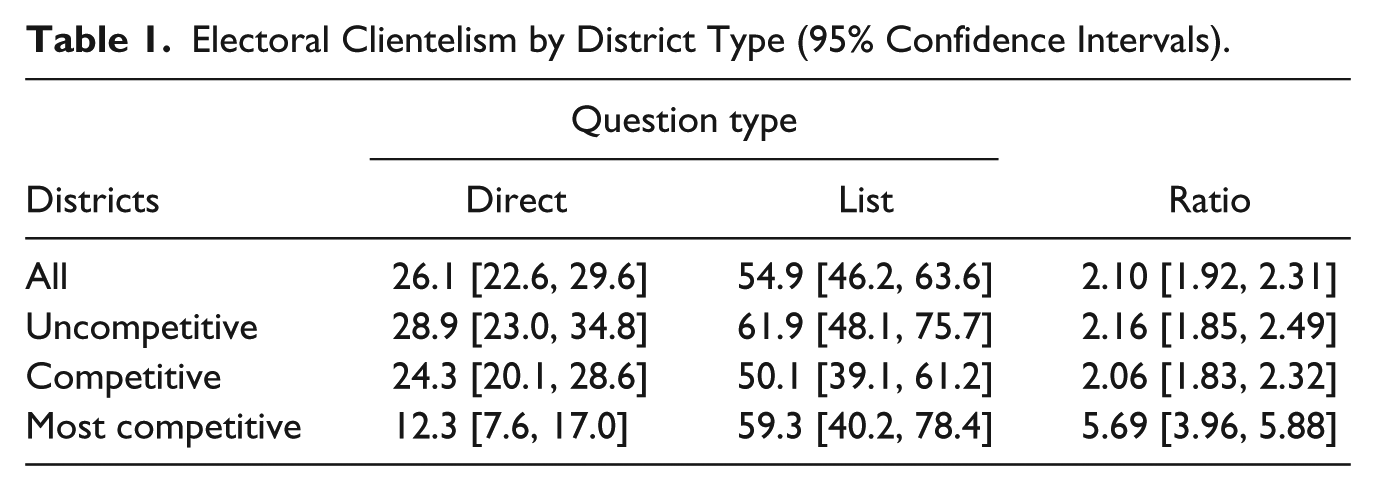
The list count finding indicates that electoral clientelism is endemic in Lebanese elections. The 55% estimate is, of course, uncomfortably high from a normative perspective. It is, however, much more consistent with qualitative accounts than is its direct question counterpart. Indeed, knowledgeable local observers describe the practice as an “epidemic” and a “free-for-all,” and estimate that between 40% and 70% of the votes are bought in any given election—and the 55% figure falls directly in the middle of this range. 12
In addition to high rates of electoral clientelism in the least competitive areas—where the outcome was assured ahead of time, so people had few reasons to turn out without an inducement—Table 1 also shows high rates in the most competitive areas as well. Some theory implies that parties might use less clientelism in competitive contests where the practice becomes increasingly expensive (e.g., Robinson & Torvik, 2009). These data, however, suggest that the Lebanese parties continued to devote substantial resources to the only districts that could realistically affect the balance of seats in the parliament—aided, no doubt, by generous foreign funding and correspondingly soft budget constraints.
In addition to its pervasiveness, these data also demonstrate that electoral clientelism is highly sensitive among Lebanese voters. Table 1 shows that the list count estimate is more than double that of the direct question in the full sample, a ratio that is similar in magnitude across the competitive and uncompetitive districts. Yet, this ratio balloons in the most competitive, “hot” districts due to the sharp drop in the direct question estimate. In short, sensitivity was most intense—and the direct question evidence least reliable—in precisely those contests that had the largest bearing on the balance of seats in parliament.
Transactions by Level of Competition
Theoretically, we should expect parties to target payoffs to different kinds of voters when operating in different kinds of electoral environments. In particular, we should observe them focusing on cheaper clients when sheltered from competitive pressures, but bidding for more expensive voters when compelled to do so by strong rivals. Put another way, we should see parties targeting easily swayed voters everywhere and pursuing less responsive voters when they must. Here, I examine how competition conditions two commonly theorized sources of variation in clientelistic outcomes: poverty and partisan commitment. Although the poor and uncommitted may have attractively low reservation prices, competition may compel parties to reach out to better-off, and more committed, voters as well.
Indicators
The electoral environments within which parties and voters engage in clientelistic transactions vary in their competitiveness. We need preelection measures of the districts, however: The electoral returns themselves are, effectively, “post-treatment” measures that reflect the use of clientelism during the campaign. Preelection polling data do not exist, and redistricting changed the constituencies so much in number and composition as to preclude using prior electoral returns (see Online Appendix A).
Instead, I use a measure of ex ante competition that distinguishes districts in which both alliances fielded candidates from districts in which only one alliance did—that is, elections that could and could not be lost (cf. Hyde & Marinov, 2012). These decisions were locked in at the start of the 2-month campaign period when candidate registration closed. By this reckoning, eight of the 26 districts, within which 37% of registered voters lived, were uncompetitive. As expected, this preelectoral measure correlates strongly with district-level electoral returns (Pearson’s r = .77) and survey respondents’ postelection perceptions of competitiveness (polychoric r = .66). 13 In Online Appendix C, I expand on this minimal measure with an additional category for the elite-identified “hot” districts; results with the trichotomous and dichotomous measures yield similar inferences.
Theories of clientelism suggest that parties prefer to target poor people rather than rich people because the former demand lower payoffs than do the latter. If competitive pressures force parties to bid for more expensive voters, however, differences in material well-being should have more explanatory power in uncompetitive environments than in competitive ones. Material deprivation can be difficult to measure in low- and middle-income countries, however, due to varied access to cash incomes, high rates of casual and seasonal labor, and sensitivity to the stigma attached to poverty. Accordingly, scholars supplement income measures with indicators based on needs assessments, housing quality, and household amenities. 14
Consistent with prior behavioral research in Lebanon, income questions are difficult to use due to high item nonresponse rates and concerns about measurement error. Instead, I complement household income with a measure of housing quality, proxied by electrification, and self-assessed social class. Here, I identify poor respondents as those who fall in the sample’s bottom quartile on any of household income, hours of electricity per day, or class. Based on this inclusive operationalization, some 42% of the sample is poor. 15
Although scholars of clientelism largely agree on the poor voter proposition, they hold diverging expectations on whether parties patronize swing voters, core supporters, or both. Notwithstanding some ambiguity about which voters fall into which categories, the mixed empirical evidence suggests that each of these claims may be correct in different contexts. When pursuing the short-term goals of electoral clientelism—victory in the current election—one might expect parties to concentrate their resources on weakly committed voters rather than strongly committed partisans whose vote choices and likelihood of turning out are relatively certain. Again, however, electoral competition should compel parties to pursue less responsive voters in addition to their weakly committed peers.
Measuring partisan attachments is challenging due to Lebanon’s history of shifting alliances between nonideological parties. The main indicator is a composite measure that combines self-identification and political engagement to distinguish strong commitments from weaker rhetorical support. Accordingly, committed partisans are habitual, politically engaged voters with strong attachments to one of the alliances—18% of the sample. I also decompose the indicator into its components for further analysis: consistent voters and people who are interested in politics. 16 Finally, Online Appendix C2 probes robustness with an alternative measure based on government employment, which yields broadly similar results.
List Question Results
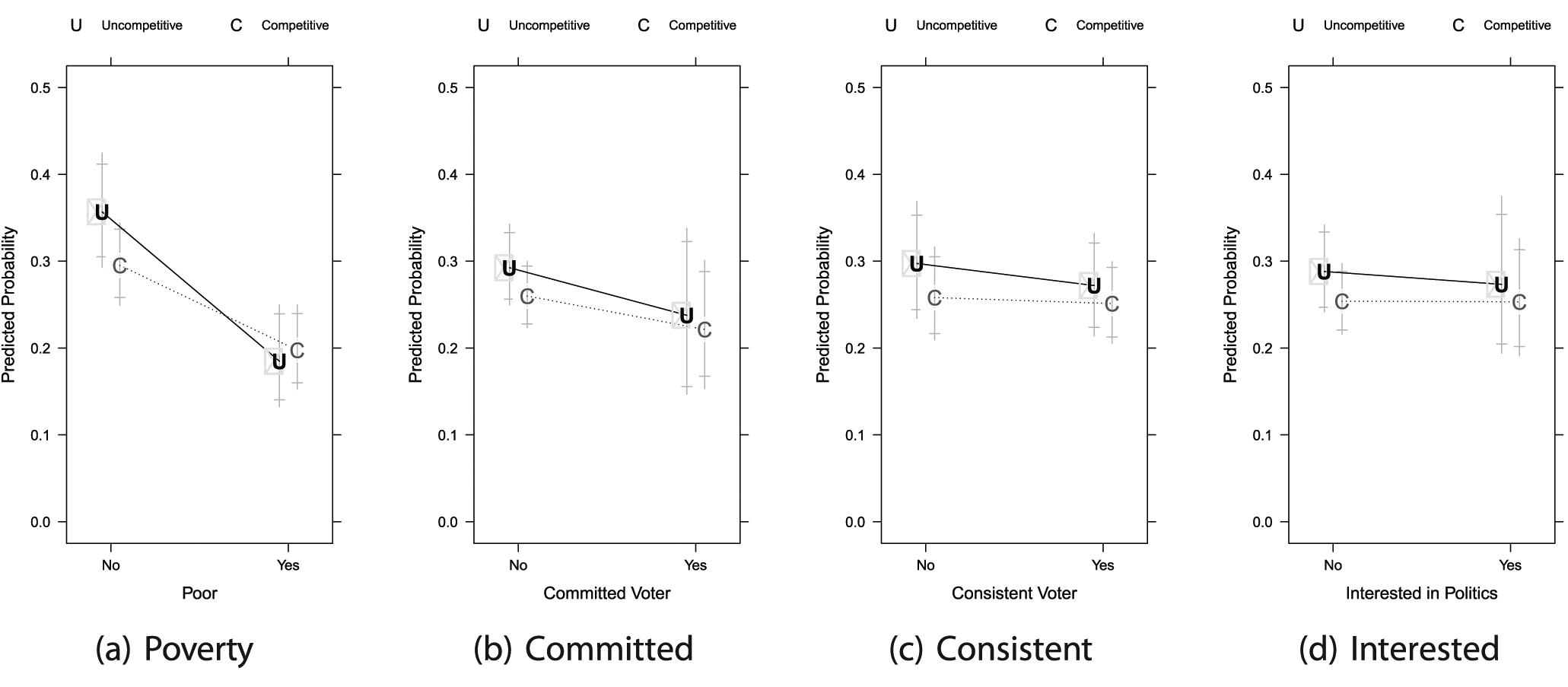
With the list count outcome, I model variation in electoral clientelism as a function of material deprivation (poor) and partisan commitment (committed), each conditional on district competitiveness. I use a binary version of competition for simplicity and clarity, but provide, in Online Appendix C, results based on the three-category measure of district competitiveness that offer additional nuance. I guard against confounds with a set of basic demographic controls, which include age, a trichotomous education indicator, female, rural, and an indicator for Christian respondents because their community split its votes between the alliances. Table 2 reports model estimates from the LISTIT estimator, 17 while Figure 1 graphs the key results as predicted probabilities.
Model Results, List Question (Binary Competitiveness).
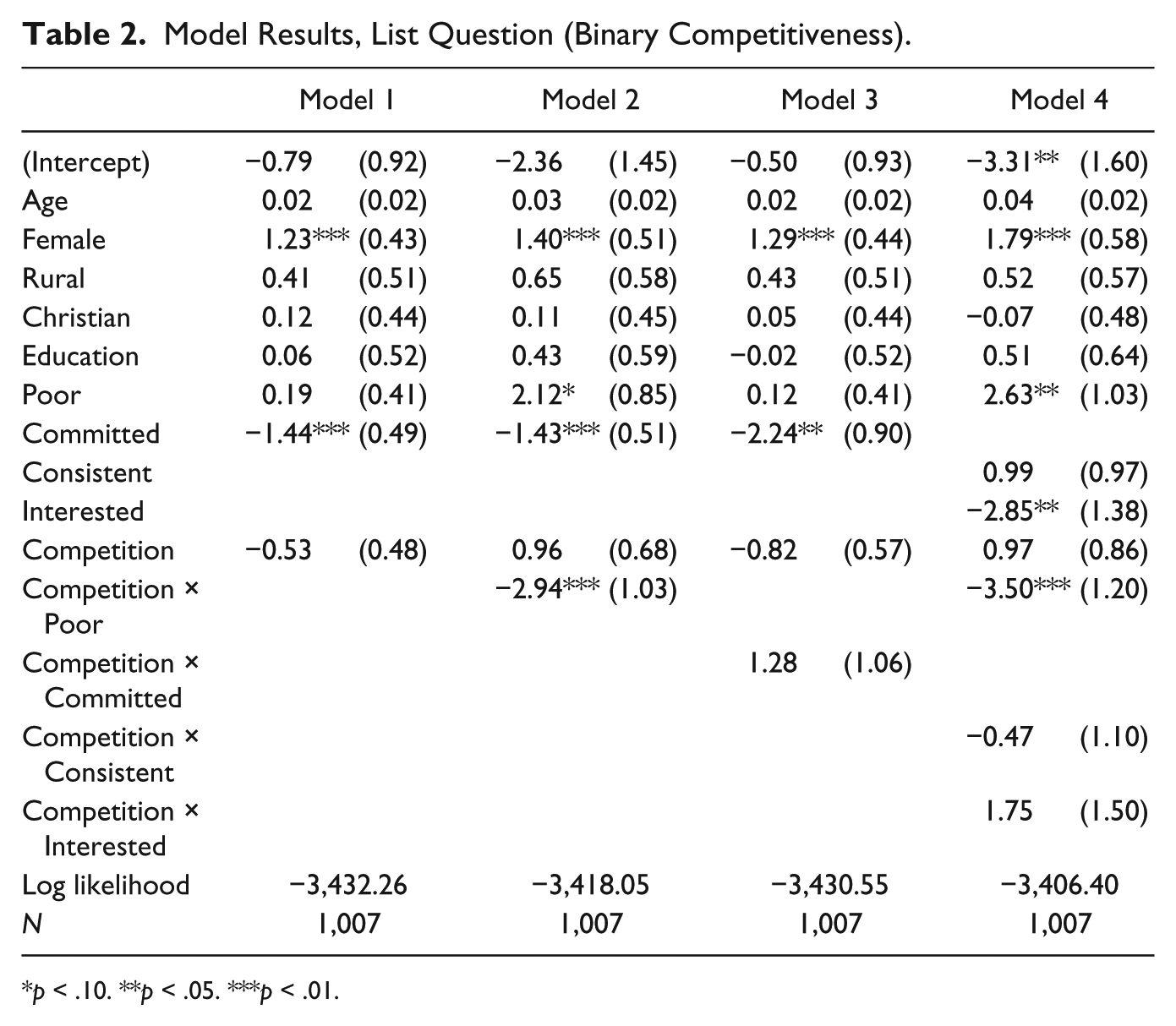
p < .10. **p < .05. ***p < .01.
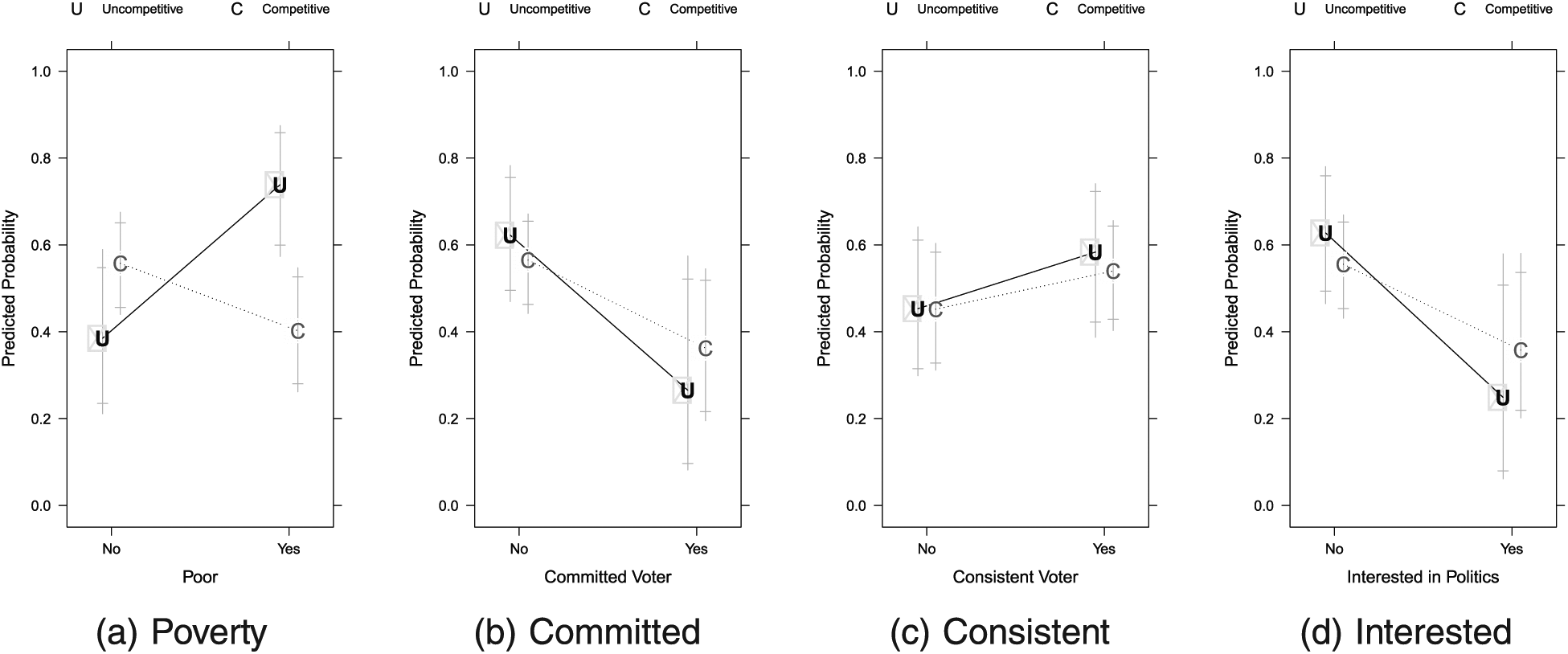
Predicted probability of clientelistic transactions, list question.
As expected, the effect of material deprivation is much stronger in uncompetitive contests than in competitive ones. The sharp, upward slope in Figure 1a shows that nearly twice as many poor voters in the uncompetitive districts engage in clientelistic transactions than do their wealthier counterparts. That difference disappears in the competitive districts, where the estimated slope is, in fact, mildly negative but where poor and nonpoor voters are statistically indistinguishable from each other. Together, these results suggest that parties prefer to target the poor when sheltered from competitive pressures, but that electoral competition compels them to court more expensive voters as well.
Likewise, the effect of partisan commitment varies with the degree of electoral competition. Figure 1b indicates that committed partisans engage in fewer clientelistic transactions than their weakly committed peers in general. The differing slopes, however, suggest that the difference is widest in the uncompetitive contests and narrows with competition. In relative terms, the weakly committed are an estimated 2.4 times as likely as their strongly committed counterparts to engage in clientelism in the uncompetitive districts—a difference that shrinks to some 1.6 times under competitive pressures. 18
Last, I reestimate the model after decomposing the committed partisan indicator into its two components: consistent voters (strong self-identifiers that always vote) and people who are interested in politics. As Figures 1c and 1d demonstrate, political engagement, rather than simple consistency in voting, accounts for the previously described difference between committed and uncommitted voters (Figure 1b). These latter findings suggest that the parties prefer to use clientelistic inducements on disinterested voters, who are unlikely to be mobilized by other appeals and for whom the parties are more likely to be interchangeable.
Misunderestimating Clientelism—Direct Question Results
Electoral clientelism is a sensitive matter for many people, ordinarily causing us to underestimate its pervasiveness. In addition to this level effect, however, a comparison of the list and direct question data shows that sensitivity causes us to misestimate the dynamics of clientelism as well. To demonstrate this inferential problem, I reestimate the same interactive models on the direct question outcome (Table 3). Figure 2 graphs the predicted probabilities of clientelistic transactions for each of the key covariates; compare these results to Figure 1, which reports the same based on the list question.
Model Results, Direct Question (Binary Competitiveness).
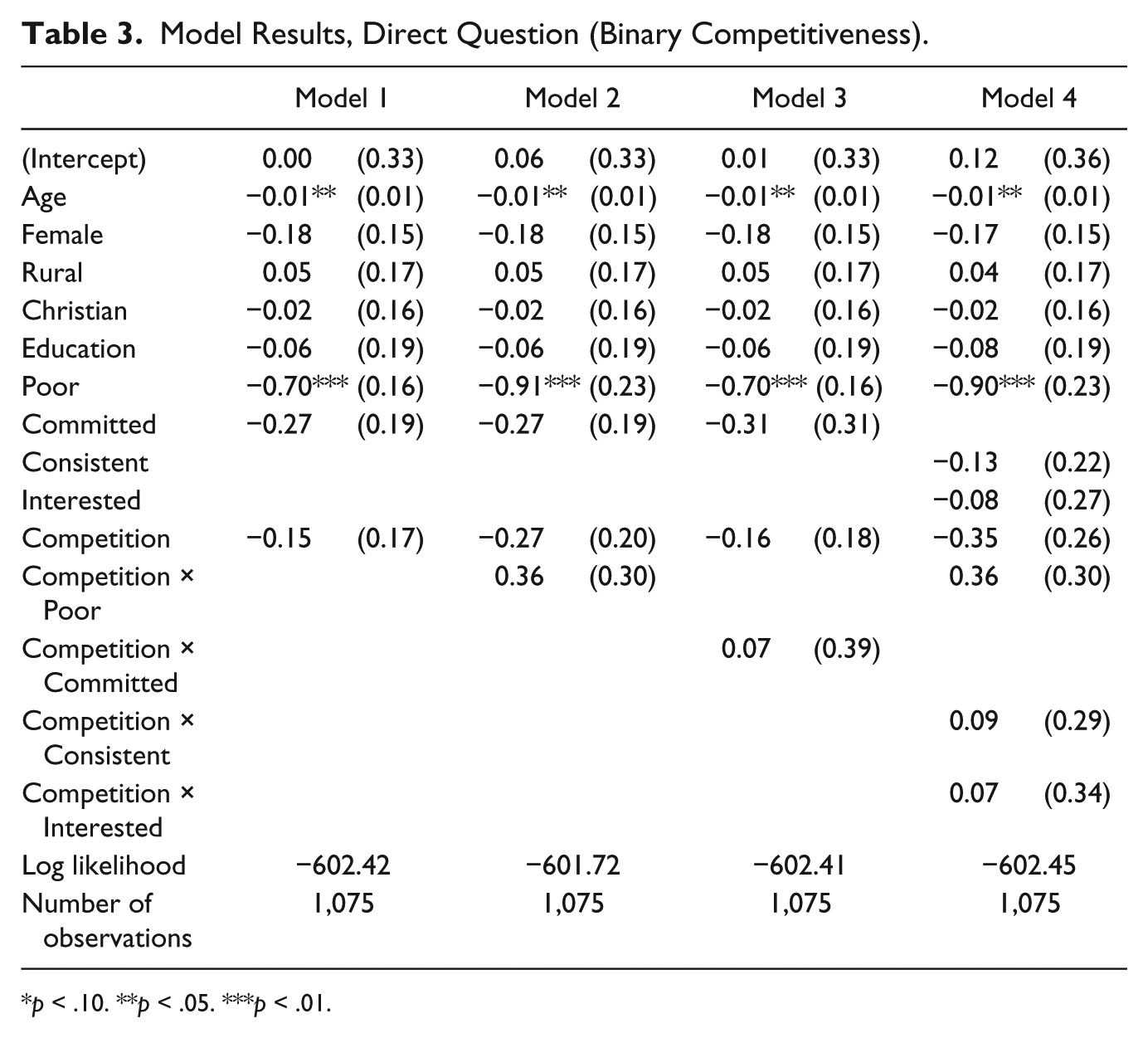
p < .10. **p < .05. ***p < .01.
Predicted probability of clientelistic transactions, direct question.
Inferences drawn from the direct question evidence differ dramatically from inferences drawn from the list question. First, they turn the “poor voter” finding on its head: signs reverse such that poor voters engage in less clientelism, not more, than their wealthier peers (Figure 1a vs. Figure 2a). This finding runs counter to well-grounded theory about clientelistic transactions. Second, the effect of partisan commitment flatlines. The direct question results show no detectable differences between strong and weakly committed voters, or between competitive and uncompetitive districts. These nondifferences persist, moreover, even after decomposing the committed partisan indicator into its consistent voter and interested voter components.
Discussion
In short, these results support the article’s contentions about how parties use clientelism in competitive and uncompetitive contests. Theoretically, we should expect parties to begin by targeting easily swayed voters with low reservation prices but move on to more expensive voters if competitive pressures compel them to do so. Evidence from the list experiment conforms to these expectations, with attention focused on poor and weakly committed voters in the uncompetitive districts and a broader mix of targets in the competitive areas.
The contrast with the direct question findings is instructive, and highlights the difficulty of studying sensitive topics such as electoral clientelism. In the aggregate, far fewer people were willing to admit that clientelistic payoffs affected their votes when responding to the direct question compared with the list. Yet, the problem is not just the levels but also the gradients. Data contaminated by social desirability bias can yield nonsensical inferences, as with the direct question finding that parties target more payoffs to rich voters than to the poor. These data demonstrate that it is not enough to note that direct questions underestimate the prevalence of sensitive behavior, and therefore, provide a lower bound. Instead, they imply that variation in sensitivity complicates even this modest mental adjustment and can lead us astray in theory testing if we wrongly suppose that sensitivity only affects the levels.
More broadly, these data offer a snapshot of a single election, but can only hint at the intertemporal dynamics within which parties embed their short-term strategies. Put differently, parties care about more than just a single election, but the data have less to say about their longer term goals. How, then, should we interpret this snapshot in time?
This article has argued that parties condition their targeting strategies on the level of competition they face. One potential concern with such a claim is endogeneity. Why are some areas more competitive than others in the first place? Could it not be the case that prior use of clientelism caused some districts to be more or less competitive?
A detailed answer for why some districts are competitive or not is, unfortunately, beyond the scope of this article and would, at any rate, require different kinds of data to establish. In the Lebanese case, a combination of communally defined constituencies and historical events that eliminated within-group competition in some sects but not others helps to explain why some districts were competitive but not others (Corstange, 2016). More broadly, we might expect ethnic demography to account for varying levels of competitiveness in diverse societies and class or ideological cleavages to affect it in other settings.
Alternatively, we might also expect massive imbalances in resources to favor one party over another, as when ruling parties in electoral autocracies buy their way to hegemony when opposition parties cannot access state resources. In the Lebanese case, however, members of both alliances had access to state largesse at various points in the past, as well as large amounts of foreign funding. The parties used these resources for decades, so clientelism, by itself, cannot explain why some areas ended up competitive or not.
Regardless of how it reached that point, however, once a party has attained dominance in an area, it has strong incentives to maintain that dominance. Without this intertemporal consideration, it would be hard to explain why parties would devote resources to safe seats rather than to the competitive areas where they could affect the outcome of the election. As others have argued, dominant parties try to cultivate “auras of invincibility” by racking up high turnout rates and huge margins of victory (Blaydes, 2011; Magaloni, 2006). Doing so helps to deter elite splits in the party, defections by its constituents, and candidate entry among potential opponents. Spending to maintain dominance in the current period may ultimately be more cost-effective than fighting a competitive electoral battle in the next one.
Based on the above discussion, it is not surprising that preexisting partisan dominance helps to explain the alliances’ decisions on where to field candidates in the 2009 elections. Each alliance reasoned that some districts were lost causes because its opponent had a strong machine whereas it did not. Nonetheless, this article’s focus is not the long-term, intertemporal dynamics, but rather, the short-term considerations: Given different levels of competition, how do parties deploy their clientelistic resources? Its answer is that they target different types of voters—buying cheap when they can and dear when they must.
Conclusion
This article examined the conditioning effects of electoral competition on how parties use electoral clientelism. It argued that, in low competition environments, parties can restrict their transactions to voters whose turnout and balloting decisions are most easily swayed by modest material inducements. In closely contested environments, however, competitive pressures oblige parties to patronize more expensive voters as well. Evidence from Lebanon supports these contentions. In particular, proxies for vote cost and partisan commitment help to explain targeting decisions in party strongholds but offer much less explanatory leverage in the most competitive districts.
The arguments in this article, alongside the list experiment, add context to some of the debates in the literature. Consistent with standing theory about their low reservation prices, the list data affirm party predilections for poor voters—at least in some environments. Yet, the data also imply that electoral competition obliges parties to patronize a wider range of incomes, with the “poor voter” proposition receiving empirical support in party strongholds but performing poorly in contested areas. These findings suggest not that prior work was collectively wrong about the poor, but rather that we need to consider the strategic context within which parties make their targeting decisions to understand to whom the patronage flows (Calvo & Murillo, 2004; Magaloni, 2006; Masoud, 2014; Weitz-Shapiro, 2014).
This article also adds context to the question of when parties target swing voters with weak partisan commitments or core supporters with stronger commitments. The data suggest that, although short-term considerations might lead parties to easily swayed voters, competition compels them to reach out to inelastic voters as well—consistent with work showing that parties adjust their targeting as necessary and embed their actions in longer term strategies stretching across multiple elections (Cammett, 2014; Gans-Morse et al., 2014; Magaloni, 2006). These findings do not offer a definitive resolution to the core versus swing voter debate, but rather demonstrate that contextual variation in electoral competition pushes parties to prefer one type over another.
How generalizable are these findings? Lebanon, like other developing world countries, has high levels of income inequality and social diversity, as well as weak and corruptible governing institutions—conditions under which clientelistic politics are widespread. Although its power-sharing arrangements are more elaborate than the developing world norm, the electoral system pits candidates against each other for cosectarian votes in homogeneous areas and encourages cross-sect alliances in mixed districts—analogous in spirit to the “ethnically balanced ticket” adopted by machines elsewhere (Hicken, 2011; Stokes, 2007). The electoral rules may differ in detail, but not in ways that obviously alter party incentives to target different kinds of voters (Corstange, 2016, Chapter 3).
Beyond its power-sharing arrangements, Lebanon’s history of international intervention in its domestic disputes makes it uncommon, but hardly unique—One estimate suggests that the United States and Russia alone have intervened in one out of every nine national elections worldwide in the post–World War II era (Levin, 2016). As it affects how parties use clientelism, foreign backers of both alliances injected large amounts of funds into the contest to enable the latter to pay for the material inducements they were offering to voters. As a result of this influx of funding, the Lebanese parties enjoyed softer budget constraints than many of their counterparts elsewhere in the developing world, save, perhaps, the ruling parties in autocratic states that can dip into state resources with impunity.
Access to large amounts of foreign funding likely enabled the parties to make bids for more expensive voters that they might otherwise have ignored. With fewer resources on which to draw, we likely would have seen lower levels of electoral clientelism, less generous payoffs, and greater need for the parties to discriminate between swayable and inelastic voters. In other words, parties with tight budget constraints would need to be even more, rather than less, efficient in how they use their funds than the Lebanese parties were able to be in this election. Future research can examine how the severity of budget constraints alters parties’ allocation decisions across and within competitive and uncompetitive districts.
Although this article has demonstrated meaningful variation in the use of clientelism across competitive environments, many other contextual aspects remain unexplored. Presidential, parliamentary, and municipal elections surely provide different structural incentives for parties to use clientelism, but the current literature pools them together without much comment. One potentially relevant distinction is single- versus multidistrict contests—whether parties must simply get out the most votes wherever they are or must decide how to allocate resources between districts. Another key element is the electoral stakes in both material and symbolic terms—the presidential mansion is surely a bigger prize than a municipal council seat, and we might expect parties to treat it accordingly. Hence, how parties use clientelism may differ in qualitatively important ways across these different types of elections, and exploiting this variation can help us understand the dynamics of clientelistic exchange.
Why should we care about how parties deploy clientelistic inducements at all? There is now a large and ever-growing body of social scientific research on clientelism, but one might worry that, as our work matures, it risks becoming disconnected with the ordinary people at the center of these exchanges. Yet, the aggregate consequences of these individual transactions can have profound ramifications for social welfare and political accountability.
First, clientelistic politics are generally associated with underdevelopment (Hicken, 2011; Keefer, 2007). The funds that parties use to pay off clients must come from somewhere, obliging politicians to shift state resources away from public goods or to dip into public revenues to compensate themselves for their electoral outlays. These misallocations of resources through corruption and the undersupply of productive public goods and services may depress aggregate outcomes such as GDP per capita but also manifest in more tangible ways such as the crumbling roads, poor sanitation, and teacher absenteeism with which regular people must contend on a daily basis. Clientelism may also contribute to poverty traps: Parties that rely on it for their votes have perverse incentives to keep their clients poor and dependent on party largesse (Magaloni, 2006). Paying off supporters piecemeal provide politicians with more opportunities to enforce clientelistic quids pro quo than does pursuing propoor social policies, the outputs of which may be nonexcludable. Moreover, these sorts of transactions may also perpetuate regional inequalities and pockets of poverty—most plausibly centered in party strongholds, where politicians can offer modest payoffs with relative impunity.
Clientelism can also distort political accountability mechanisms. It inverts the relationship between politicians and voters by making the latter answerable to the former—a dynamic Stokes (2005) famously described as “perverse accountability.” Moreover, the conclusion of these transactions implicitly limits parties’ obligations to their constituents and contributes to the adverse selection of unscrupulous politicians.
Yet, if not to their clients, to whom are the parties accountable? First, we might expect them to cater to the interests of the financiers who bankroll their operations—and whose policy preferences presumably diverge from the poorer voters that the party targets. Second, we might also expect them to put disproportionate weight on preference outliers in the mass electorate. To the degree that the politically disinterested and ideologically uncommitted are both attractive clients and otherwise centrist voters, clientelistic campaigning can hollow out the middle of the electorate. Without the restraining influence of moderate voters, however, we might expect parties to campaign to the extremes in their choices of rhetoric and symbolic issues—contributing to political polarization (Corstange, 2012).
Clientelism can therefore have adverse impacts on a number of other political dynamics about which we care, including economic development, the provision of public goods, government accountability, and possibly even political polarization. Hence, understanding how parties use clientelistic inducements, and how contextual factors affect these decisions, can help us understand processes that affect the daily lives of the ordinary people who participate in these unequal exchanges.
Footnotes
Declaration of Conflicting Interests
The author declared no potential conflicts of interest with respect to the research, authorship, and/or publication of this article.
Funding
The author(s) disclosed receipt of the following financial support for the research, authorship and/or publication of this article: For funding the survey, the author thanks the MacMillan Center and the Institution for Social and Policy Studies at Yale University, and the Center for International Development and Conflict Management, the Department of Government and Politics, and the Designated Research Initiative Fund at the University of Maryland.
Notes
Author Biography
References
Supplementary Material
Please find the following supplemental material available below.
For Open Access articles published under a Creative Commons License, all supplemental material carries the same license as the article it is associated with.
For non-Open Access articles published, all supplemental material carries a non-exclusive license, and permission requests for re-use of supplemental material or any part of supplemental material shall be sent directly to the copyright owner as specified in the copyright notice associated with the article.
