




Abstract
How does the salience of clientelism in politics impact voter support for women legislative candidates? Existing research finds little bias against women legislative candidates in survey experiments. Where bias exists, it is due to “role congruity,” where voters penalize women because of a perceived lack of specific traits or issue preferences suitable for the position. Building on existing work, I theorize that the ability to deliver patronage is a “role” voters might find stereotypically incongruous with women. Using two waves of a nationally representative survey in Vietnam, I generate preregistered predictions about the impact of a clientelism prime on bias against women legislative candidates. I then test the prediction, with results showing that when clientelism is primed, bias against women candidates increases. These results provide evidence that clientelism has gendered effects on political representation. It also theorizes an additional “role” that could penalize women at the polls.
In many contexts, the ability of candidates to deliver patronage drives legislative elections. 1 The tendency for patronage rather than policy to dominate elections is seen as perhaps the primary defining feature of electoral politics in contexts as diverse as Senegal (Beck, 2003), Argentina (Szwarcberg, 2015), Egypt (Blaydes, 2010), the Philippines (Cruz et al., 2017) and Vietnam (Malesky & Schuler, 2020). This paper asks how clientelistic politics impact women legislative candidates. Do expectations of patronage heighten voter demand for male candidates and decrease willingness to vote for women?
Understanding the roots of gender bias in elections could provide insights into the dynamics of women’s underrepresentation in legislatures (Paxton & Hughes, 2014). Although the links between voter bias and representation are complex, studies show that women’s underrepresentation is more pronounced in economically underdeveloped contexts, where clientelism tends to be more prevalent (Escobar-Lemmon and Talyor-Robinson 2005; Högström, 2015). Additionally, recent research suggests that clientelistic politics can hinder women’s representation (Benstead, 2016; Benstead, Jamal and Lust 2015; Bjarnegård, 2013; Daby, 2020; Mufti & Jalalzai, 2021; Shalaby & Barnett, 2021). This paper considers whether clientelism could play a role in driving women’s underrepresentation.
Much of the existing research on the gendered effects of clientelism focuses on its impact on party recruitment strategies or constituency service to women (Benstead, 2016; Bjarnegård, 2013; Daby, 2020). By contrast, my theory focuses on voter demand. My theoretical predictions build on role congruity theory, which suggests that while voters may not express outright antipathy against women, voters may still stereotype women as not having the qualities necessary for specific positions (Anzia & Bernhard, 2022; Bauer, 2020; Benstead, Jamal and Lust 2015; Eagly & Karau, 2002; Huddy & Terkildsen, 1993; Teele et al., 2018). Evidence shows that for executive positions in particular, voter perceptions that women lack “agentic traits” or stereotypically male policy competencies can penalize women in elections (Huddy & Terkildsen, 1993). I extend “role congruity” theory to propose that voters might doubt the ability of women to deliver patronage. If recent work is correct, voters may perceive that women have less access to clientelistic networks (Aspinall et al., 2021; Benstead, 2016; Benstead, Jamal and Lust 2015; Bjarnegård, 2013; Clayton & Zetterberg, 2021; Daby, 2020; Mufti & Jalalzai, 2021; Shalaby & Barnett, 2021). In turn, this assumption could drive voters to bias against women candidates in elections driven by clientelism.
I test the theory using a preregistered, nested, candidate-choice conjoint survey experiment from a nationally representative sample of more than 14,000 respondents in Vietnam. Vietnam is an appropriate location to test the argument as it as a context where patronage plays an important role in resource distribution (Do et al., 2017; Gainsborough, 2007). My preregistered predictions are based on results, which I show, from two waves of a survey in Vietnam showing that voters who prefer clientelism over transparency are more likely to prefer male legislative candidates. 2 Using this analysis, I design a conjoint experiment nested within a priming experiment increasing the salience of clientelism. While this design does not replicate an actual campaign, particularly the hostility faced by women candidates and officials (Clayton, Robinson, et al., 2020; Håkansson, 2021), it adds a modicum of realism to the conjoint by manipulating the degree to which different issues or candidate traits are emphasized when voters decide.
The results show that consistent with existing literature, in the abstract, voter bias against women legislative candidates is minimal. In three waves of the conjoint, voters show little preference for men over women legislative candidates. Consistent with previous conjoint experiments from Vietnam, party membership and education level drive candidate preferences for the Vietnam National Assembly (Malesky & Schuler, 2020). However, consistent with expectations, when primed with importance of clientelism, respondents are 3.3% points more likely to choose a male candidate over a woman candidate for the Vietnamese legislature. This is compared to a less than .5 percentage point difference at baseline. Although the preregistered model specification falls just shy of conventional levels of significance, when compared to gender bias estimates from other conjoint experiments globally, the point estimate of the clientelism treatment leads to gender bias that would be among the top decile of countries with the highest level of pro-male gender bias in legislative elections (Schwarz and Coppock 2022). While some readers may interpret these results more skeptically, I interpret the evidence as suggestive of the gendered impacts of clientelism. In short, it more likely than not that the treatment had the predicted effect.
The theory and findings advance our understanding of political gender bias in several ways. First, it adds context to research from other conjoint experiments showing that women do not face bias in legislative elections (Schwarz and Coppock 2022). As some have cautioned, conjoint experiments may fail to uncover the true challenges women face in running for election if they do not replicate the real-world conditions of electoral campaigns (Clayton, Robinson, et al., 2020). The nested experiment in this study adds an important element of context—the framing of the election as about clientelism.
The evidence also suggests an important cost of clientelism, often overlooked in reviews of the literature on clientelism. 3 While important research has focused attention on gendered costs of clientelism, the large survey articles on the topic tend to overlook the gender implications of clientelism. This paper, along with the other burgeoning research in this area, suggests that the gendered impacts of clientelism should gain more widespread attention.
Finally, these findings might also provide some explanation for why women candidates disproportionately benefit from being linked to family legacies (Folke et al., 2021; Mufti & Jalalzai, 2021; Schwindt-Bayer, Vallejo and Cantu 2022). If being connected to a prominent family network signals the ability to deliver patronage, that signal could be more beneficial for women, who may face greater concerns on this front. As such, a legacy status could disproportionately benefit women, compared to men, who do not need the family linkages to reassure voters about their ability to deliver patronage.
Why Focus on Voter Bias Against Women?
In assessing women’s underrepresentation, research has turned away from voter bias as an explanation for women’s underrepresentation and towards the explanations centering on party recruitment or candidate supply (Hinojosa, 2012; Krook, 2010; Murray, 2010; Bjarnegård, 2013; Bjarnegård & Kenny, 2016; Aspinall et al., 2021). This shift is based on findings showing that direct gender bias against women candidates is low, particularly when measured through survey experiments (Schwarz and Coppock 2022). In the context of the US, Brooks (2013) argues that if women candidates run, they win. Why, then, focus on bias against women amongst voters?
Research on voter bias remains important because existing observational work may fail to fully account for the bias that exists. Studies showing low disparities in male and female vote shares amongst candidates may fail to adequately control for differences in the quality of male and female candidates that emerge in general elections (Anzia & Berry, 2011; Fulton, 2012). An analysis using close nomination results to generate as-if randomization shows that Republican women in the US winning close nomination contests perform worse than Republican men winning close contests (Bucchianeri, 2018). As such, bias may remain despite a wealth of correlations that point in the opposite direction.
A more important challenge to voter-side explanations come from Schwarz and Coppock’s (2022) meta-analysis of 67 conjoint experiments of hypothetical elections, which shows that voters may express a subtle preference for women candidates. This carefully conducted, meta-analysis suggests that in the abstract, voters are not hostile towards women candidates. While compelling, it is possible that bias could remain in many contexts. The meta-analysis, reflecting the literature, is heavily weighted towards samples from the US and the Europe. In the sample, three of the five cases showing bias against women were Afghanistan (Bermeo & Bhatia, 2017), Jordan (Kao & Benstead, 2021), and Vietnam (Schwarz & Coppock, 2022). While Clayton et al. (2020) in Malawi find that in the hypothetical setting of a conjoint experiment, voters preferred women, it is still possible that a meta-analysis of countries where clientelistic practices predominate could lead to different results than a sample heavily weighted toward the US and Europe.
A final concern is whether survey experiments can teach us anything about real-world conditions faced by women candidates, particularly in developing countries. Clayton et al. (2020) find qualitative evidence that gendered campaigns could hinder the candidacies of women in ways that would not appear in conjoint experiments. They argue that survey experiments overlook gendered attacks that women face on the campaign trail (Clayton, et al., 2020; McDonald, 2020). Others express concern that conjoint analyses do not reveal the true percentage of respondents preferring women to men. Rather, they reveal the percentage for whom gender is more salient than other features rather than those that who prefer men to women or vice versa (Abramson et al., 2022).
The research design and theory in this paper attempt to address these concerns. In terms of context, I conduct the analysis in a country where clientelism is salient. Conceptually, the theory does not depend on finding an aggregate preference for male versus female candidates. Rather, it predicts that increasing the salience of clientelism could increase the preference for male candidates. That is, even if women are preferred, I may still find that increasing the salience of clientelism could reduce that advantage. In this case, clientelism could still undermine support for women in ways that should be important for explaining patterns of women’s representation regardless of whether voters support men more than women in aggregate. Finally, the research design adds realism to the experiment by nesting the conjoint experiment within a priming experiment that increases the salience of clientelism. While this is more abstract than an actual campaign, it does introduce a potential narrative candidates could face on the campaign trail.
Theory: Clientelism and Role Congruity
Theoretically, why might the salience of clientelism damage the candidacies of women for legislative office? I build the theory on role congruity theory. Role congruity theory argues that women face bias in holding certain positions because voters prefer candidates to have issue preferences or traits that are stereotypically associated with men (Bauer, 2020; Benstead, Jamal and Lust 2015; Eagly & Karau, 2002; Teele et al., 2018). Scholars using this framework focus on two roles in particular: the traits voters expect the candidates to have (agentic vs. communal) and the policy expertise they expect them to hold (masculine vs. feminine) (Bauer, 2020; Eagly & Karau, 2002; Huddy & Terkildsen, 1993).
In terms of evidence, literature shows that campaign strategies that adopt messages to compensate for perceived role incongruities can be effective in increasing support for women candidates (Bauer, 2020; Blackman & Jackson, 2021; Jones, 2016). There is evidence that when considering executive positions, voters expect occupants to hold stereotypically masculine traits and policy preferences and perceive women as less likely to have those traits (Huddy & Terkildsen, 1993; Sanbonmatsu, 2002).
In a developing context, however, clientelism could be an important role that leads to voter bias against women (Benstead, Jamal and Lust 2015). If voters (1) expect patronage from their candidates and (2) perceive women as less able to deliver such patronage, this could lead voters to shy away from women candidates. Furthermore, consistent with role congruity theory, they could turn away from women candidates not because the candidates are women, but instead because they perceive women as unable to deliver patronage.
Why might women be perceived as less able to deliver patronage? At least two mechanisms are possible. One mechanism is homosocial capital (Benstead, 2016; Bjarnegård, 2013). Homosocial capital is a stock of trust between two people, which is theorized to be greater between people of the same gender (hence “homosociality”). This trust could result from homophily, where individuals prefer to interact with members of the same sex. It could also be because it is easier for men and women to engage in friendships with members of their own gender due to compatibilities and social norms. As Benstead argues, “[m]en and woman often prefer friendships and collaborations with others of the same gender due to greater ease of relating (e.g., similar behavior and interests, fewer conflicts and sexual harassment and infidelity concerns).” (2016,188). Another possibility is that there may be a gendered division of labor in the party where women party members serve less powerful clients, such as children (Daby, 2020). If women politicians serve these less powerful groups, they will have less power (i.e., homosocial capital) because they lack a powerful support base.
Such capital is important in a clientelistic setting, where many of the practices involved in securing resources operate in a gray area of legality, thus driving officials to cooperate more closely with those with whom they feel comfortable. As such, in systems rife with clientelism, men will be particularly compelled cooperate with men, and women with women. If men inside and outside of politics have more financial and political resources, voters may believe that male candidates are more likely to have greater access to those resources than women, and therefore prefer them at the ballot box (Bjarnegård, 2013). Research from Pakistan, Thailand, Morocco, and Algeria provides evidence for this mechanism (Benstead, 2016; Bjarnegård, 2013; Mufti & Jalalzai, 2021).
Using the homosocial capital mechanism as the main mechanism, I derive the main hypothesis, which I test experimentally. Building on the theoretical discussion above, I predict that voters primed to consider the degree to which a candidate is networked will be more likely to prefer male candidates than female candidates for elected positions:
Voters primed to consider a candidate’s integration into patronage networks will increase their support for men candidates over women candidates.
In addition to the homosocial capital mechanism, another possible mechanism consistent with role congruity is that voters may perceive women as incompatible with corruption either because they are more honest or possibly because they are more risk averse (Barnes and Beaulieu 2014, 2019; Esarey & Chirillo, 2013). I call this the “candidate traits” mechanism. Some research suggests the possibility that the homosocial capital and honesty mechanisms operate (Esarey & Schwindt-Bayer, 2019). In this paper, while I focus on the homosocial capital mechanism, I present some tests to assess the traits mechanism as well.
The Case of Vietnam
I test the theory using survey data from Vietnam. Research on Vietnam suggests that clientelism plays an important role in determining the distribution of resources within the regime. For example, Party Congresses, where promotion decisions are made, are theorized to primarily center on patronage rather than policy (Gainsborough, 2007). One carefully conducted study shows that having high ranking officials from one’s locality leads to greater resources from the state, further emphasizing the importance of patronage (Do et al., 2017). Importantly for this project, research suggests that voters internalize the importance of patronage in their selection process and are more likely to vote for party members than independent candidates due to the perceived ability of party members to access state resources (Malesky & Schuler, 2020).
Vietnam is also a useful location to study this question because despite its status as a single-party regime, Vietnam has competitive elections for some positions, including the National Assembly (Vietnam’s national legislature). This means that voters matter to some degree. Similar to Jordan, where opposition parties cannot win (Lust-Okar 2006), candidates within the party still compete with each other, though not on programmatic issues (Schuler, 2021). Vietnam, for example, only allows members of the Vietnam Communist Party (VCP) to compete in elections. The only non-party members allowed to compete are “independents,” who must nonetheless be vetted by the party. Unlike Cuba, each district has more candidates than seats. A typical district has five candidates for three seats with voters having as many votes as there are seats in the district.
In this setup, voters in Vietnamese elections may prioritize patronage for several reasons. First, these elections share similarities with other electoral contexts that generate intraparty competition (Carey & Soberg Shugart, 1995), which may cause voters and candidates emphasize clientelism and particularism to win seats. Second, as Lust-Okar (2006) emphasizes, when candidates are not allowed to debate policy issues, the “limited space for policy making… means that elections are more frequently contests over access to state resources” (468). An important arena for resource distribution in Vietnam are district-level governments (called District People’s Committees), which control the distribution of funds for infrastructure projects to communes and villages. Research from Vietnam shows that district-level governments funnel resources to communes that have strong connections to members of the national-level Vietnam Communist Party Central Committee (Do et al., 2017). Connecting this with research on gender and clientelism, homosocial capital between legislators and national-level party members could play an important role in facilitating this resource distribution, by using connections to exert influence over district-level officials.
Before proceeding, it is important to stress that while clientelism is prevalent, vote buying is minimal in Vietnam. This is important because it structures the types of clientelism likely to prevail. Because of time limits on campaigns and the extreme top-down nature of the nomination process, the VCP ensures that candidates do not compete publicly with each other. The party limits competition by constraining the campaign period to 30 days and prohibiting candidates from using personal funds to mobilize voters (Schuler, 2021, pp. 64–66). This limits the ability of candidates to promote themselves and buy votes. For that reason, the experimental manipulation in this paper primes connections to other government officials and not vote buying, like in other papers (Kao, Lust and Rakner 2017). With that said, connections are an important component of clientelism. Conditioning resource distribution to localities based on their connections to higher ranking officials means resource allocation is contingent, particularistic, and hierarchical, which fits the standard definition of clientelism (Hicken, 2011).
Candidate recruitment is also an important concern for how we interpret the results of the findings below. Given the top-down nature of the nomination process and the fact that very few candidates successfully self-nominate and win seats on the ballot, it is possible that voters will presume that all candidates—women or men—have connections, otherwise they would not have won the nomination (Bjarnegård, 2013). If true, this would bias against finding a relationship between the gender of the candidate and the impact of a clientelistic prime. With that said, research suggests that the VCP wants actual competition to gain information on citizen preferences (Trinh, 2022). To generate compeition, the VCP frequently nominates “sacrificial lamb” candidates to compete against the regime’s preferred candidates (Schuler, 2021). Often these candidates differ precisely in their lower capacity to deliver clientelism. As such, voters may look for cues such as gender, party membership or seniority to determine which candidate is best able to deliver patronage (Malesky & Schuler, 2020).
Women’s Representation in Politics in Vietnam.
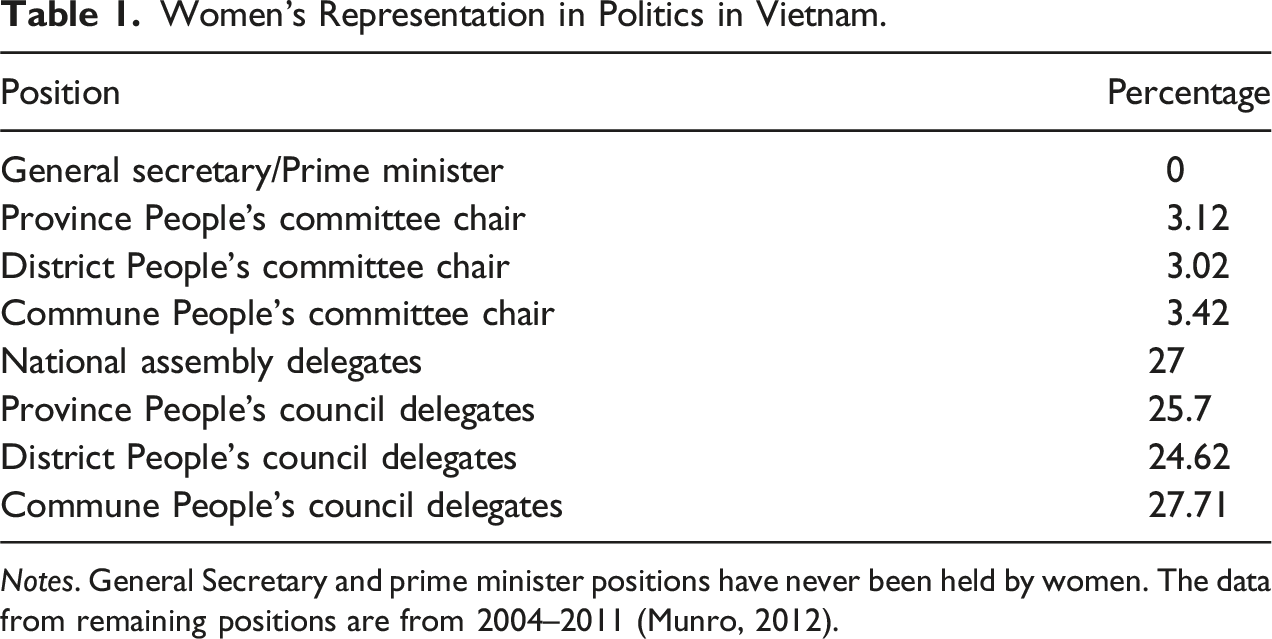
Notes. General Secretary and prime minister positions have never been held by women. The data from remaining positions are from 2004–2011 (Munro, 2012).
Foundation for Preregistered Predictions
Before getting to the survey experiment, this section presents results from two waves of the Vietnam Provincial Public Performance and Governance Index survey (PAPI) (CECODES, VFF-CRT, RTA, and UNDP 2020) to (1) show that preference for clientelism is plausibly linked to support for male candidates and to (2) justify the predictions made in the preregistered study assessed below. The PAPI survey is an annual, face-to-face survey of a large sample of more than 13,000 respondents each year. The survey is nationally representative with enumerators from a civil society organization and the UNDP visiting villages and neighborhoods to conduct the tablet-based survey. This section establishes the logic of how I derived predictions for the main survey experiment below. Furthermore, it adds additional data points in support of the theory. Finally, and most important, it provides support for the operationalization of the key construct – clientelism.
The justification for the experimental treatment and the preregistered hypotheses come from a battery embedded in the 2020 and 2021 surveys assessing the degree of bias against women holding different legislative positions in Vietnam. The positions included district People’s Council, Provincial People’s Council, and National Assembly Delegate. 4 To address the degree to which respondents are biased against women, the survey asked: “Who do you think would make a better legislator? A man, a woman, or it makes no difference?”
Importantly for this paper, the survey asked a follow-up question about the roots of bias. It asked about range of qualities that respondents would prefer the occupant of those positions to hold, including the ability of the candidate to deliver patronage. Due to time constraints in the survey, rather than asking the respondents separately about each different trait they preferred the legislators to have, the survey asked them to compare whether they preferred the candidates to have certain traits instead of others. One pair of traits compared to each other included “clientelistic qualities” compared to “transparency qualities.”
Qualities Preferred in Gender Bias Questions.

Notes. Table 2 includes the qualities respondents were asked to compare. One quality from Panel A was randomly presented compared to one randomly selected quality from Panel B.
What follows is similar to the analysis Dolan (2014) conducts to assess the impact of voter gender stereotypes on preference for women candidates. In my analysis, the dependent variable is male preference, which is 1 if the respondent prefers a man in that position or zero otherwise. Because so few respondents prefer women to hold any of those positions (<2%), I code those preferring women over men as zero along with the respondents who have no preference for a man or a woman. However, the substantive findings do not change if I create a tripartite ordinal dependent variable, where male preference is coded as 2 for those preferring men, 1 for those with no preference, and zero for those preferring women. As such, I run the following OLS model separately for 2020 and 2021:
where
Tables A.1 and A.2 in Appendix A show descriptive statistics for each of these variables. As it shows, in 2020 7.4% of respondents preferred a male legislator as compared to no preference or a woman official. In 2021 that number was 6.2%. For the clientelism variable, a remarkably stable 19.2% of respondents preferred candidates with clientelistic qualities over transparency in both 2020 and 2021. This suggests that most voters preferred honesty and transparency when asked directly, though this could potentially reflect social desirability bias.
Determinants of Preference for Male Officials.
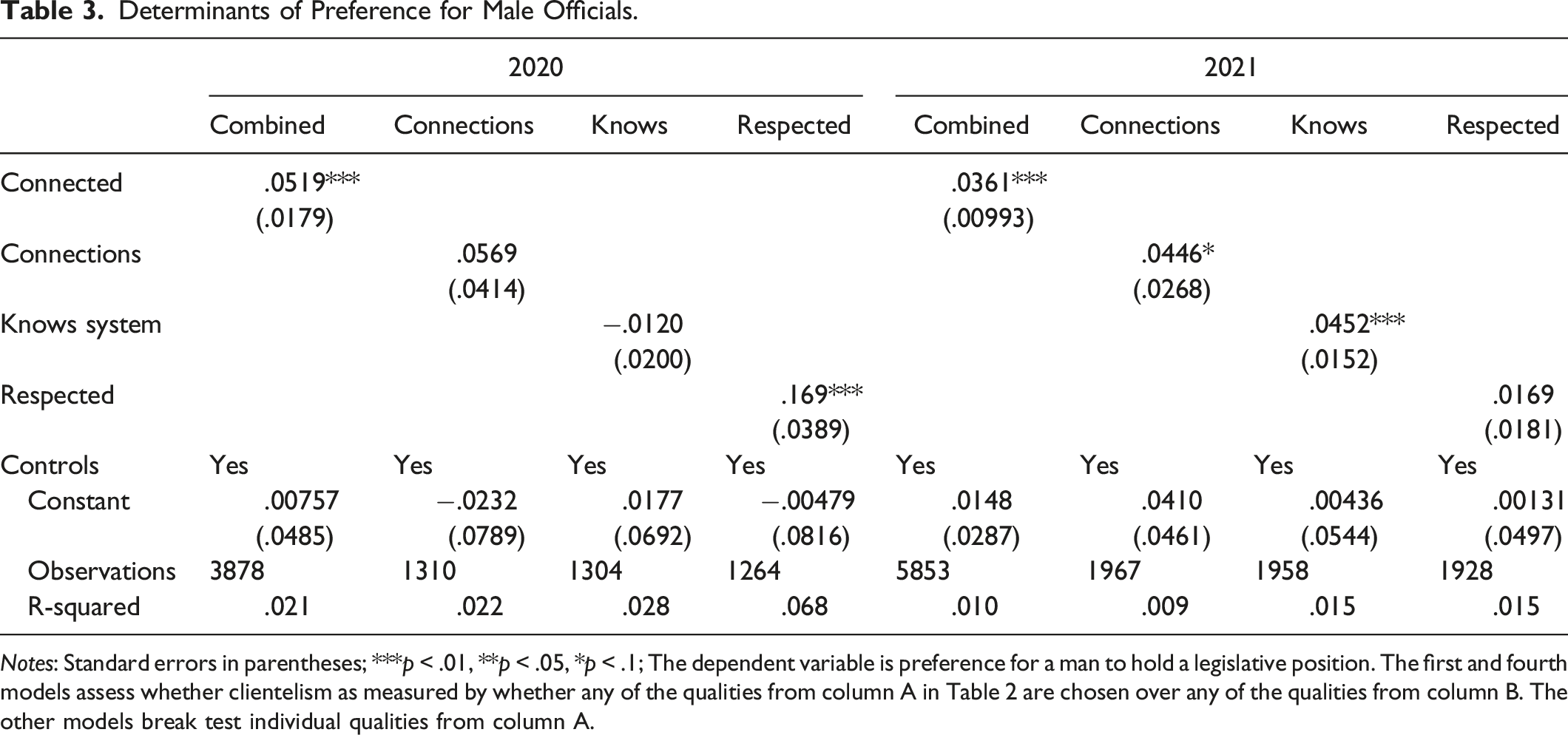
Notes: Standard errors in parentheses; ***p < .01, **p < .05, *p < .1; The dependent variable is preference for a man to hold a legislative position. The first and fourth models assess whether clientelism as measured by whether any of the qualities from column A in Table 2 are chosen over any of the qualities from column B. The other models break test individual qualities from column A.
Box 1: Conjoint Survey Experiment Design
Candidate-Choice Experiment
Imagine two candidates for
The first candidate is a
The second candidate is a
Which candidate would you vote for? Please look at the candidate’s profile on the screen.
Who would you vote for? • Candidate 1 • Candidate 2
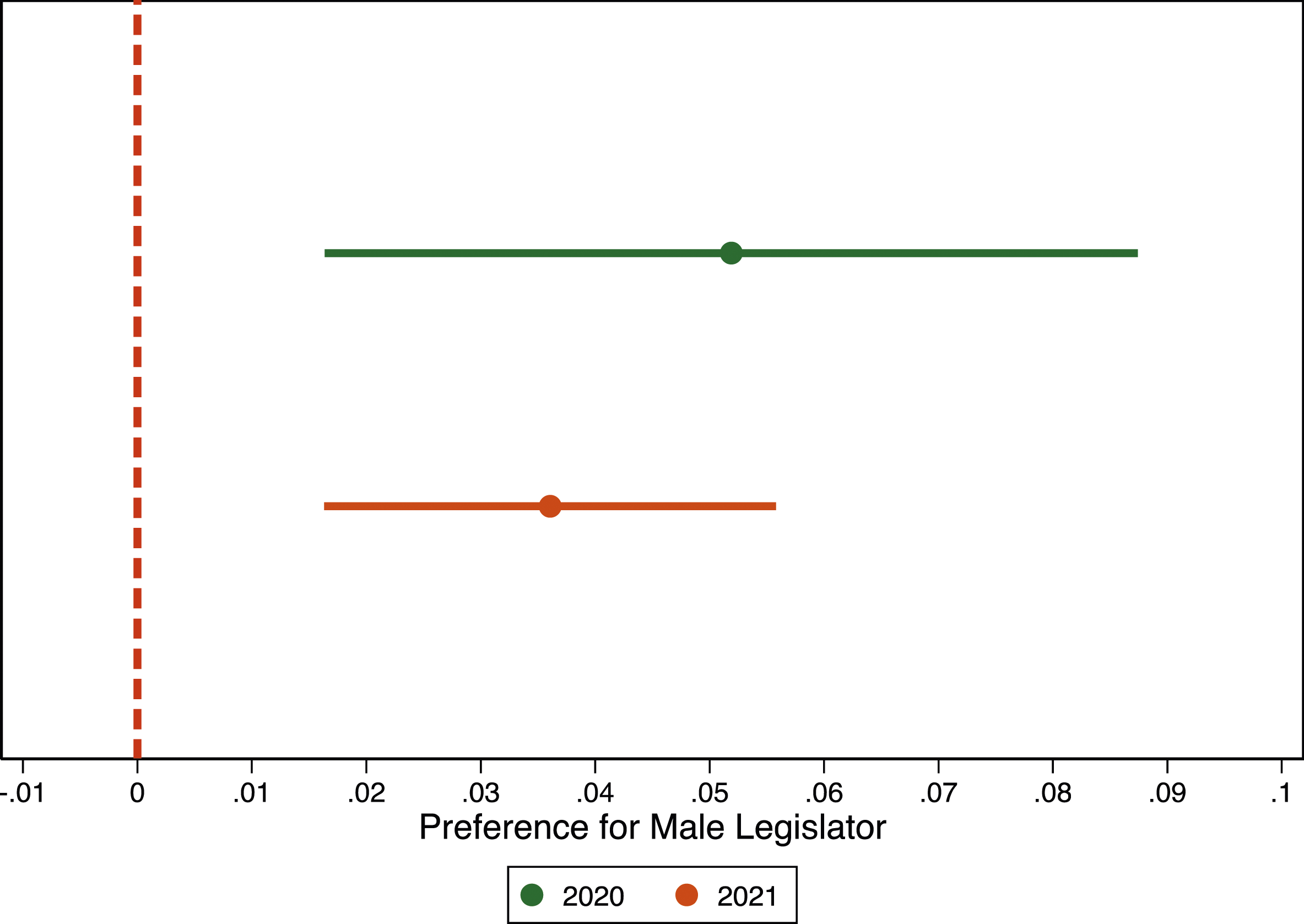
Impact of Preference for Clientelism on Preference for Male Legislator. Notes: The marginal effects from Figure 1 are derived from models 1 and 5 from Table 3. The estimates are preference for the relationship between preference clientelism and preference for a male legislator (compared to a woman legislator). The independent variable is whether the respondent prefers the occupant of the position to have clientelistic qualities or transparency-related qualities.
Probing the individual qualities within column A of Table 2, the results show that each of the items correlates with male preference, with the partial exception of knowing the system. When respondents were specifically asked whether they wanted a legislator with connections compared to any of the transparency qualities, they were 5.6 percentage points more likely to prefer a male legislator in 2020 (though not at conventional levels of significance) and 4.15 percentage points more likely in 2021. Knowing the system oscillated between 2020, where it had an estimated negative correlation, though close to null, and 2021, where it was correlated with a 3.73% point increase in support for male legislators. Being respected had a large correlation in 2020 at 16.9% and dropped to 3% in 2021. These findings provide suggestive evidence of the relationship between clientelism and male preference. Thus, they form the basis for the preregistered hypotheses.
At the same time, these findings have limitations. One can surmise from these findings that those who prefer patronage are more likely to prefer male legislators. However, we do not know whether it is the preference for patronage or other unobserved factors correlated with a preference for clientelism that drive preference for male legislators. While I control for many of the factors that could correlate with both, such as the gender of the respondent, rural residency, and traditional values, it is possible that other unmeasured qualities of the individual drive bias. For that reason, I need to randomize the salience of clientelism to the respondents to assess the causality of its impact on the preference for male candidates.
Research Design
To generate a causally identified estimate of the impact of clientelism on gender bias, I turn to what is now a standard tool in research on voter preferences—a candidate-choice conjoint survey experiment on two hypothetical candidates for the Vietnamese National Assembly. Box 1 shows the conjoint survey instrument. As with existing conjoint survey experiments, it varies several candidate traits, including age, education, and other items of interest to the UNDP including family network and the beneficiary of the candidates’ actions. Importantly for this paper, the conjoint varies the gender of the candidate – man or woman. Consistent with other work, my interest is in the average marginal component effect (AMCE) of the gender on voter preference (Hainmueller et al., 2014).
Conjoint experiments have been used in a wide range of studies examining voter bias against women candidates (e.g., Schwarz & Coppock 2022; Ono & Burden 2019; Teele et al., 2018). Consistent with best practices, I use a limited number of traits to avoid “satisficing,” whereby respondents use cognitive shortcuts to complete complex survey instruments (Berinsky et al., 2014). Using a relatively low number of items reduces such concerns. At the same time, using fewer items generates the risk of “information equivalence,” where telling a respondent that a candidate is woman, for example, could signal party membership, education level, or political ideology, leading to what some call the “satisficing-masking tradeoff” (Dafoe et al., 2018). I am confident that I avoid masking. Given that conjoint has been asked in Vietnam for several years, I can identify the “core attributes” that most strongly impact a respondent’s choice on these questions (Malesky & Schuler, 2020). These attributes are party membership and education. Because those measures are included, research suggests masking should not be a major concern as results on core traits tend to be stable even with the inclusion of additional, less-critical traits (Bansak, et al., 2021).
Because the interest of this paper is assessing the impact of salience of clientelism on preference for women candidates, I embed the conjoint within a priming experiment, where I randomly assign respondents to two groups: a control group (50%) and a clientelism group (50%). The control group receives no priming question ahead of the conjoint. The clientelism group receives the following question ahead of the conjoint: “How important is it for elected officials to have connections to other government leaders? Important (2), Somewhat important (1), Unimportant (0).” 7
I chose the specific wording of the prime to match the quality in Table 2 in previous waves of the survey. As shown in Table 3, having connections with other government leaders is associated with a greater preference for male legislators. Conceptually, the connections prime corresponds to the homosociality mechanism, whereby lack of connections to others inside or outside government, who are primarily men, could undermine the ability to deliver patronage and rise within the system. Importantly, the prime does not cue clientelism, but instead connections—a necessary component for the homosocial capital mechanism. I was constrained from directly priming voters to think about the use of informal connections to provide benefits to the village. This would have been a sensitive question in a single-party context. Nonetheless, because having connections to other government officials is a necessary condition for patronage, priming connections should cue respondents to consider the ability of legislators to provide clientelistic resources.
To validate that the connections prime corresponds to clientelism, I examine the determinants of respondent preference for an official with connections. If the connections prime activates concern for clientelism, we should see the factors that theoretically determine preference for clientelism predict preference for candidates with connections. While research is somewhat mixed on voter demand for clientelism (Kao, Lust and Rakner 2017), canonical theories suggest that poor and less educated citizens should be more likely to prefer patronage over policy (Kitschelt, 2000). If the prime cues clientelism, we should expect to see these groups prefer a leader with connections compared to a candidate that is honest. Figure 2 shows that this is the case. Education and income are negatively associated with preference for a leader with connections. Taken together, this provides some evidence the prime makes clientelism salient. Determinants of Preference for Leaders with Connections versus Honesty. Note: The graph shows the marginal effects of demographic variables on preference for a leader with connections compared to qualities involving honesty and transparency. The results are from an OLS regression using clustered standard errors. Other control variables not included in the graph include party membership, ethnicity, and the gender identity of the village leader. Whiskers are 95% confidence intervals.
In terms of the prime, the primary interest in asking the question is not to know the answer. 8 Instead, the purpose of this question is to prime clientelism before respondents answer the conjoint. Priming experiments test the impact of stimuli by making the quality or concept more cognitively “accessible” to a respondent (Chong & Druckman, 2007). In other words, the prime puts the concept at the top of the respondent’s mind. As such, when they evaluate the candidate-choice experiment, the ability of the candidate to provide patronage should be more likely to impact their judgment than for those in the control group. Given that the prime is randomized, any difference in the impact of the candidate gender on the vote choice between the treatment and control group should be due to the clientelism role congruity mechanism.
In addition to being causally identified, this design addresses the issue of realism in the conjoint experiment. While there are limits on the degree to which one can design a survey experiment to match reality, the prime should add reality to the experiment by introducing at least one potential issue that could be made salient in a campaign.
With this in mind, I test the following models. First, I test the impact of gender on the control group to assess the baseline level of bias against women candidates using the basic OLS setup in equation (2). For both the control and treatment group, I conduct separate regressions using the following model:
The formal, preregistered test of the argument is equation (3), which combines the treatment and control group into a single model and interacts the treatment group with the woman trait. The model is as follows:
This is the same as equation (2), with the addition of Client, which is whether or not the respondent received the clientelism prime (compared to only the control), and the interaction of W and Client. This effect of clientelism is therefore captured in the
Results
This section presents the results graphically, with the full regression results in Appendix B. Looking first at the impact of gender in the control group (see Figure 3), consistent with existing research, when running the conjoint experiment for the control group, as in previous waves of the PAPI survey, respondents show little direct bias against women holding legislative positions. The coefficient for a woman candidate is nearly zero (see Model 1 in Appendix B). As Appendix C shows, this is consistent with previous years. Since 2019, the UNDP has conducted variations on the conjoint experiment, where other features have changed, but the gender of the candidates is one of the attributes. For 2021, the effect of being a woman candidate is statistically indistinguishable from zero. For 2020, the effect was an estimated 1.2% point bias, but well below statistical significance. Only 2019 saw a penalty for women, though the substantive effect was 2.1% points. In short, the 2021 results show no effect of gender on vote choice is consistent with previous years. AMCE of Candidate Attributes on Vote Choice.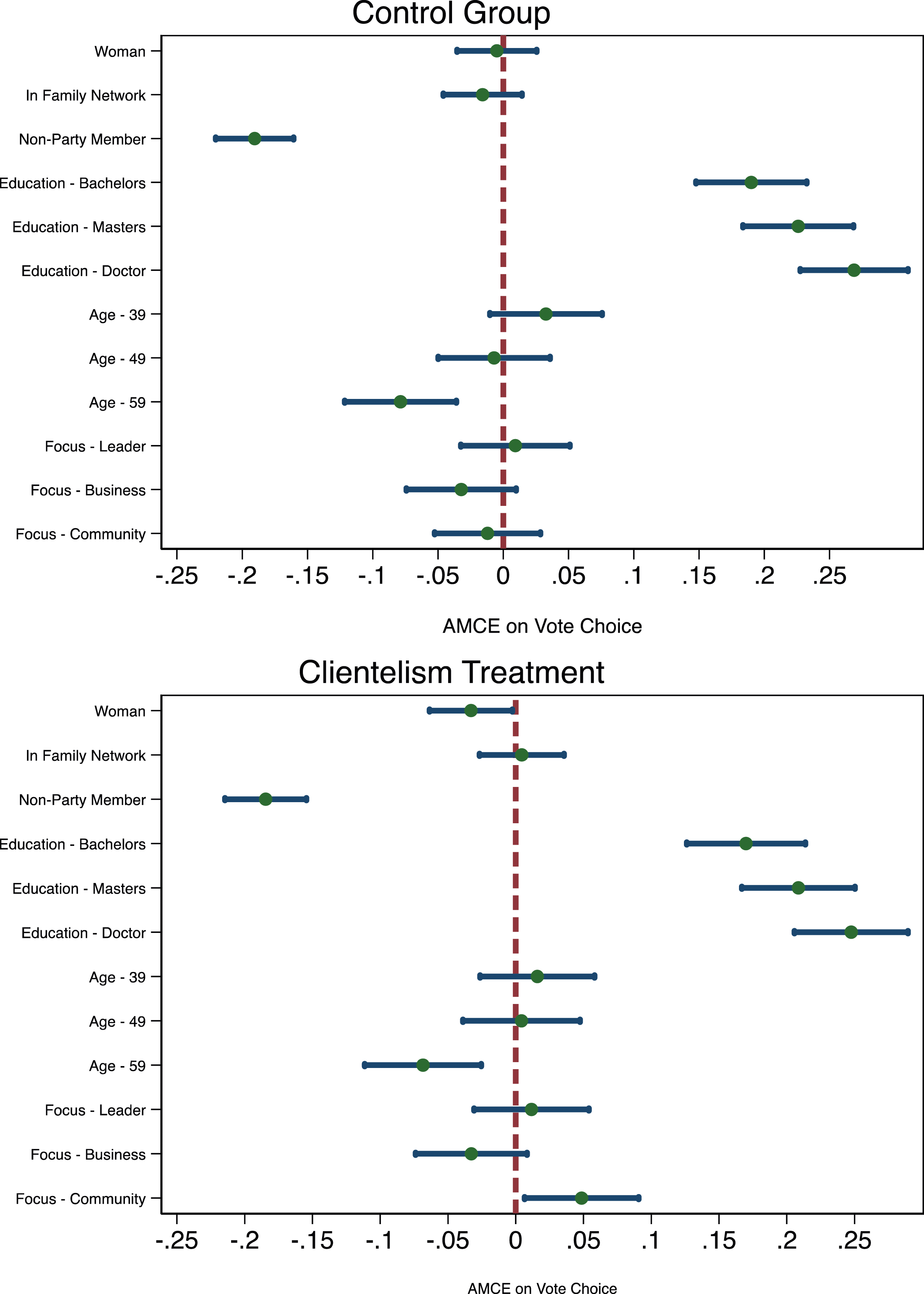
Turning to the treatment group, the second panel shows the effect of gender for the conjoint for those receiving the clientelism prime. The results are consistent with expectations. As the second panel in Figure 3 shows, respondents who received the clientelism treatment were 3.3% less likely to vote for the female candidate compared to the male candidates (see Model 2 in Appendix B). Compared to 2021 and 2020, which used basically the same setup as the control group, the clientelism treatment was the only subgroup for which the effect of gender was statistically significant. Furthermore, even when compared to 2019, where the effect of gender was significant, the effect was only 2.1% points, meaning the clientelism treatment was nearly 1.8 percentage points greater. To put this in context, with an estimated effect of 3.3% points, this would put the findings in the top 5 largest effect sizes out of the 67 conjoint experiments analyzed by Schwarz and Coppock (2022).
For ease of observation, Figure 4 shows the relative impact of gender based on the predictions when pooling the data and interacting the woman coefficient with the treatment group. As Figure 4 shows, consistent with expectations, the clientelism treatment group leads respondents to bias most heavily against women candidates. Women candidates are selected an average of 48% of the time compared to 52% for male candidates. The difference is statistically significant within that subgroup. By contrast, the control group and the honesty treatment, the differences between male and female candidates are not statistically distinguishable. Predicted Vote Share for Men and Women Candidates by Treatment Status.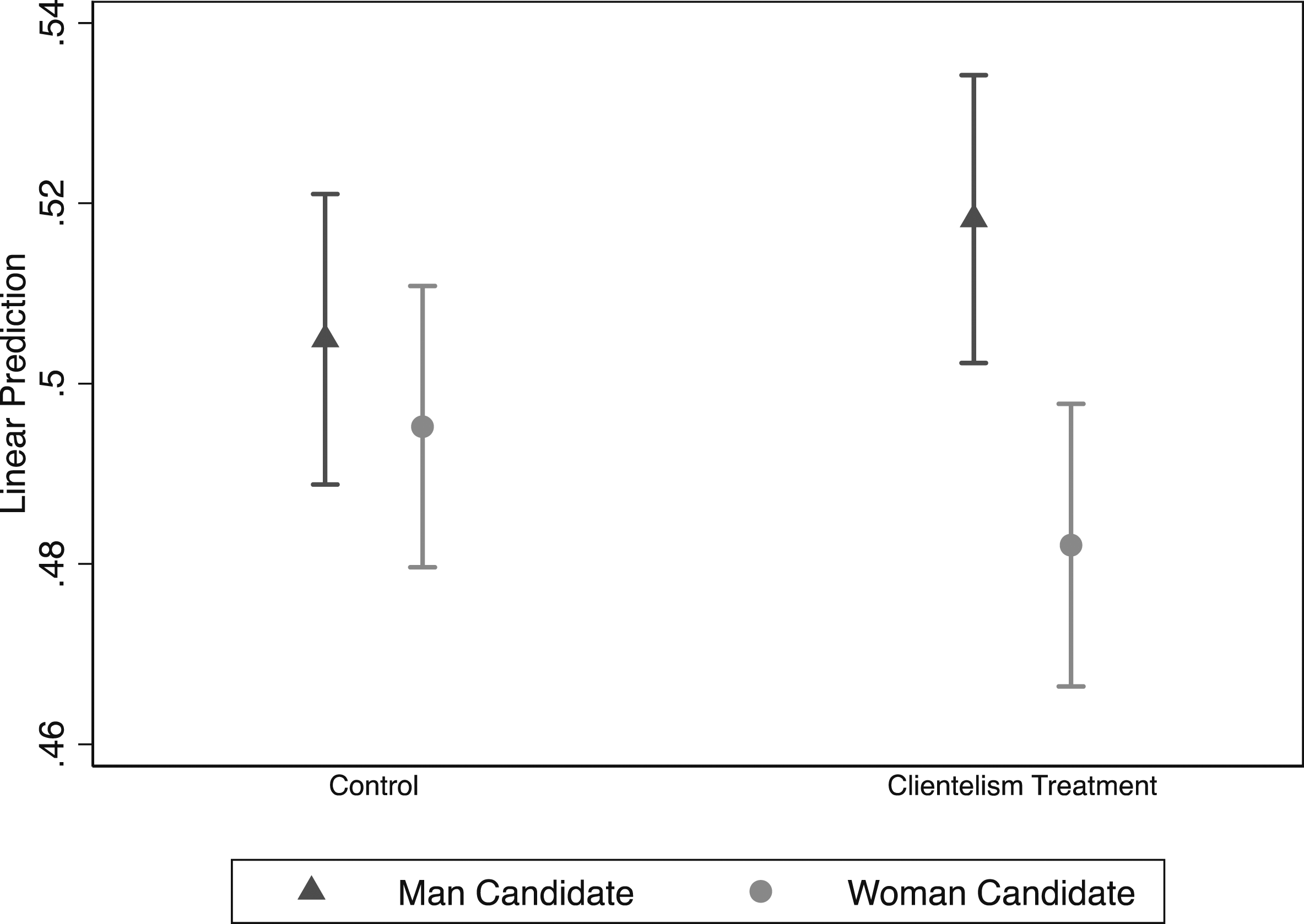
I am careful not to overstate the confidence in the results. The preregistered equation proposes testing the difference in the effect of gender and the treatment group based on equation (3). Rather than splitting the groups into subsamples and showing the impact of gender within each subsample as I do in Figure 3 and models 1 and 2 in Appendix B, equation (3) assesses whether the difference in effect of gender is statistically significant between the treatment group and the control group in an interaction model. This test requires greater power as it compares two coefficients to each other rather than a single coefficient compared to the null. As Model 3 in Appendix B shows, the interaction of the woman coefficient on treatment group is substantively similar to panel 2 in Figure 2. However, the difference in the effects between the treatment conditions does not reach standard levels of statistical significance.
With that said, when taking a broader view of these results in comparison to three additional waves of survey data from 2019, 2020, and 2021, confidence in the findings increases. In 4 years of conducting the conjoint, the clientelism primed conjoint generates the highest level of male bias. This provides further evidence that this finding was not spurious but in fact represents the effect of priming clientelism. With a larger sample size, the results would reach conventional levels of significance in the interaction model.
Alternative Mechanism – Perceived Honesty and Gender
The primary theory focuses on role congruity and homosocial capital. An alternative mechanism could be that voters think of women as more honest and therefore less likely to provide patronage if elected. As noted above, the survey experiment did include an “honesty” treatment, where I primed other respondents with a question asking “how important is it for elected officials to be honest?” If voters perceive women as more honest, we might expect voters to choose women candidates to a higher degree when primed to consider the honesty of the candidate. As Appendix D shows, the effect of candidate is almost precisely 0, similar to the control group. This suggests that the candidate traits mechanism appears to have less explanatory power. With that said, stereotyped perceptions could play a role if the survey asked about more other traits associated with clientelism such as willing to break the rules or risk tolerance. For instance, it could ask how important it is for candidates to bend the rules or risk punishment to benefit their communities and assess whether these primes drive heightened bias. This is an important avenue for future research.
Additional Analyses
Though not preregistered, I run a range of heterogeneous effects analyses to see if the effects vary based on subgroups. Some natural covariates that could lead to increased sensitivity to demand for clientelism and hence bias against women candidates could include region (rural vs. urban), gender, or income level. With regard to gender specifically, studies have shown that women legislators may be more likely to provide constituency service and possibly clientelistic exchanges with women voters than male legislators (Benstead 2016, 2019). If this is the case, it is possible that women will prefer women legislators to a greater degree than male respondents in a clientelistic setting. Alternatively, men might oppose women legislators more in a clientelistic setting because they fear being cut out of networks.
The analyses suggest that none of these factors are clearly linked with increased sensitivity to the clientelism treatment. Interestingly, women in the conjoint are if anything more biased against women candidates regardless of whether the respondent was in control or received the clientelistic treatment, though the interaction effect of women respondents on women legislators is only significant at the 80% level. With that said, the greater bias against women by women does match the direct question, where women are somewhat more biased against women candidates compared to men. It is possible that women in Vietnam are more strict adherents to traditional norms than men, which is a topic for future research.
With that said, the general lack of significance in the demographic subgroup analyses may be because these factors do not strongly link to demand for clientelism. Another possibility is that the research design lacks sufficient power to detect them. Conjoint experiments, like list experiments, require greater power than would be the case if the outcome was a simple, direct question (Blair, Coppock and Moor 2020). As such, I leave to future research the question of whether there are heterogeneous effects of the impact of clientelism on gender bias.
Conclusion
Taken together, the theory and findings provide an account for how clientelism may disproportionately punish women in elections. The tests add support to existing research suggesting that women face challenges embedding themselves in patronage networks (Aspinall et al., 2021; Benstead, 2016; Benstead, Jamal and Lust 2015; Bjarnegård, 2013; Clayton & Zetterberg, 2021; Daby, 2020; Mufti & Jalalzai, 2021; Shalaby & Barnett, 2021). That research finds that unequal access to networks can disproportionately impact the recruitment of women into politics. Due to a lack of access to networks, party leaders may be less likely to promote women to higher office or to consider them for nomination in elections.
In this paper, I consider how clientelism impacts women’s ability to win elections from the voter side. I theorize that if voters perceive women as less able to access patronage networks, this could disproportionately punish women candidates at election time. The findings show that voters who care about clientelism when voting are more likely to prefer men to women candidates in elections. More importantly, when I experimentally prime respondents to consider clientelism in an election, evidence suggests voters penalize women. Given the totality of the evidence from previous years, I believe that the findings are suggestive enough to show that the relationship is not spurious, though obviously readers must use their own discretion. With that said, the evidence shows that in environments where corruption and clientelism is rife, voters may believe men are more capable of delivering the goods. As such, even if voters are not explicitly biased against women, consistent with the role congruity framework, their beliefs about the ability of men to deliver patronage could lead them to vote for men at greater rates.
This study contributes to our understanding of voter-side explanations of women’s underrepresentation. Although research shows that in conjoint experiments, voters are not necessarily more likely to prefer men over women (Schwarz and Coppock 2022), certain conditions may increase that bias towards men. In the context of Vietnam, priming voters to consider clientelism increases the preference for male candidates. The findings should speak to the overall negative effect that clientelistic political systems could have on women’s representation. Even if voters do not prefer men to women, if expectations of patronage shift the scales in favor of men, this should still increase the barriers women face to winning office. If politicians can successfully shift discussion away from honesty and transparency and towards the ability to deliver goods or bring back patronage, this could penalize women.
A final point to consider is the possibility that these results could speak to the gendered effects of family legacies. A new wave of research suggests that women candidates are more likely to benefit from family legacies than male candidates (Folke et al., 2021; Mufti & Jalalzai, 2021; Schwindt-Bayer, Vallejo and Cantu 2022). Spouses or daughters of well-known men, for example, have the best chance of winning high-profile positions in contexts where women typically do not win. These findings offer a potential mechanism, which is that the family network could assuage an important concern that voters may have about women—which is that they are not embedded in networks that afford them the ability to deliver patronage.
Supplemental Material
Supplemental Material - Gender and Clientelism: Do Expectations of Patronage Penalize Women Candidates in Legislative Elections?
Supplemental Material for Gender and Clientelism: Do Expectations of Patronage Penalize Women Candidates in Legislative Elections? by Paul Schuler in Comparative Political Studies
Footnotes
Declaration of Conflicting Interests
The author(s) declared no potential conflicts of interest with respect to the research, authorship, and/or publication of this article.
Funding
The author(s) received no financial support for the research, authorship, and/or publication of this article.

Supplemental Material
Supplemental material for this article is available online.
Notes
Author Biography
References
Supplementary Material
Please find the following supplemental material available below.
For Open Access articles published under a Creative Commons License, all supplemental material carries the same license as the article it is associated with.
For non-Open Access articles published, all supplemental material carries a non-exclusive license, and permission requests for re-use of supplemental material or any part of supplemental material shall be sent directly to the copyright owner as specified in the copyright notice associated with the article.
