



Abstract
This study investigates whether protest movements consisting of students and educated protesters are more likely to (a) use nonviolent rather than violent resistance and (b) successfully reach their goals. Extant literature suggests that education is negatively linked to violent conflict, and the commonly assumed mechanism is that educated groups are less likely to resort to violence. Moreover, many argue that education is a force for regime change and democratization, by inducing successful protest movements. This article is the first to systematically test implications of these mechanisms at the protest level. The empirical analysis builds on original data on the educational background of participants in all protest campaigns aiming for regime change from 1900 to 2006 identified in the Nonviolent and Violent Campaigns and Outcomes Dataset 1.0. I find robust evidence that protest movements with a high degree of involvement by students and graduates are more likely to turn nonviolent. Moreover, there is some (although weaker) evidence that these movements are more likely to achieve their goals, but only due to their nonviolent dispositions. This adds to the literature explaining why some movements resort to nonviolence (and succeed), by establishing that the identity and socioeconomic background of protesters matter.
Introduction
Students and university graduates have been at the forefront of protests and opposition movements across the world, promoting government concessions and even overthrowing political regimes. For instance, university students played a prominent role in protests against Milosevic in Yugoslavia in 2000, in the 2003 Georgian “rose revolution,” and in protests against the Suharto dictatorship in Indonesia in 1998. Furthermore, university graduates, including professors, lawyers, and doctors, were crucial, for instance, in the 1986 protests against Marcos in the Philippines and in the 1986 Chilean pro-democracy campaign. These examples comport with the commonly held view that an educated population threatens authoritarian regime survival. Yet, we have little systematic knowledge about so-called “student protests,” and we do not know if movements consisting of educated and student protesters stand out, for example, regarding choice of strategies or effectiveness. While recent literature yields several insights regarding protest movements and their outcomes (e.g., Chenoweth & Stephan, 2011), it has not examined whether the social background of protesters matters.
The literature offers two important findings concerning the effects of education on political instability. First, studies of domestic conflict suggest that education has a pacifying effect, as educated countries have fewer instances of civil war (see, for example, Collier & Hoeffler, 2004; Thyne, 2006). Second, modernization theory postulates that education induces democratic, a claim supported by several empirical studies (see, for example, Glaeser, Ponzetto, & Shleifer, 2007; Murtin & Wacziarg, 2014; Sanborn & Thyne, 2014). This argument often assumes that an educated population is more capable of efficient mass resistance. Applying these findings and proposed mechanisms to protest movements, one should expect campaigns consisting of students and university graduates to be more likely to choose nonviolent methods and accomplish their aims.
This study is the first to tests these propositions. To this end, I extend the Nonviolent and Violent Campaigns and Outcomes Dataset 1.0 (NAVCO; Chenoweth & Stephan, 2011). I include all protest movements aiming for regime change or policy concessions, thereby excluding movements aiming for national self-determination or territorial secession. This offers an analysis at the group level that departs from the aggregated approach of previous studies investigating whether peace or regime change is more likely in educated countries. By investigating whether educated groups are more prone to instigate successful regime change and less likely to participate in civil war, this study should mitigate ecological fallacies. The article also speaks to a burgeoning literature on protest campaigns and their outcome—including why some movements turn nonviolent and successful (see, for example, Celestino & Gleditsch, 2013; Chenoweth & Stephan, 2011; K. G. Cunningham, 2013b). Although a couple of studies investigate structural explanations at the country level to explain protest outcomes (see, for example, Butcher & Svensson, 2016; Chenoweth & Ulfelder, 2017), no contributions consider the socioeconomic correlates and background of actual protesters.
The extended dataset contains information on whether and to what extent students and university graduates were involved in the 203 protest movements aiming for regime change between 1900 and 2006 listed in NAVCO. For each campaign, I record whether students or university graduates at a minimum participated, whether they dominated the movement, and whether the movement originated among these groups. Utilizing this information, I conduct tests showing that protest campaigns consisting of students and university graduates are indeed more likely to use nonviolent methods. This is a very robust finding that holds across numerous sensitivity tests. Although several potential causal channels may account for this finding, I present several arguments and tests suggesting that a causal effect of education on nonviolence is a plausible interpretation. Furthermore, I find some evidence, although weaker, that these movements are more likely to succeed in terms of achieving their goals—usually regime change. 1 However, results from causal mediation analysis suggests that this is only due to their pacifist inclinations, as there is no direct effect of education on success.
I suggest two mechanisms explaining why educated protest campaigns should adopt nonviolence: First, the preferences-effect suggests that educated people gain intrinsic preferences for nonviolent rather than violent protest. Second, the capacity-enhancing effect suggests that educated people have the required capacities for peaceful (and successful) movements, and hence will be more likely to choose nonviolent opposition. The latter mechanism also suggests that educated protest campaigns should be more successful.
The finding from this study adds to previous literature in several ways. First, it corroborates a plausible mechanism implicit in the argument that education breeds peace, by indicating that groups of students or educated individuals are more likely to employ nonviolent resistance. Second, it adds to the literature on democratization and regime change, by suggesting why education correlates with regime change (and democratization): By promoting nonviolent rather than violent campaigns, thereby potentially inducing outcomes such as transitions to democracy. This is in line with the finding that nonviolent resistance is more successful (Chenoweth & Stephan, 2011). It also suggests that although education has a pacifying effect, it does not make people less contentious. Rather, education pushes contention toward nonviolent forms. Finally, it contributes to the literature on protest campaigns and their outcome (see, for example, Chenoweth & Stephan, 2011), by showing that the social background of protest participants matters for whether movements turn nonviolent.
Education, Violence, and Collective Action
Violent Versus Nonviolent Mobilization
An important distinction between protest campaigns is their use or nonuse of violence. A recent literature on protest campaigns and their outcomes suggests that nonviolent campaigns are more likely to succeed (Chenoweth & Stephan, 2011) and thus more likely to induce outcomes such as democratic transitions (Celestino & Gleditsch, 2013).
When it comes to why movements use violence or not, most studies consider agent-centered factors such as the strategies adopted by protesters (K. G. Cunningham, 2013b), the interaction between protesters and the target (usually the government; Chenoweth & Stephan, 2011), and the competition between different factions of the movements (K. G. Cunningham, 2013a). We know less about the structural factors that facilitate nonviolent methods. Exceptions are Chenoweth and Ulfelder (2017), who consider state-level indicators of economic development, and Butcher and Svensson (2016), who consider level of industrialization. Both of these examine structural factors at the state level, and no studies investigate the socioeconomic correlates of protest participants. Dahl, Gates, Gleditsch, and González (2014) advocate for the need to link agents to their resources and constraints, by studying group characteristics and profiles, but their empirical analysis relies on country-level proxies such as urban population size and GDP. This study fills this gap, by studying how the socioeconomic correlates of protesters matter for protest outcomes, with a focus on education.
While no contributions look specifically at the educational background of groups and their conflict behavior, many have studied the education-armed conflict link at the country level. As noted in a recent review article, “there seems to be an emerging consensus in the literature that education has a general pacifying effect on conflict” (Østby & Urdal, 2011, p. 1). In the perhaps most comprehensive analysis of education and domestic conflict, Thyne (2006) finds that education indicators such as primary enrollment and literacy levels are negatively related to civil conflict. This finding is corroborated elsewhere (see, for example, Barakat & Urdal, 2009; Collier, Hoeffler, & Söderbom, 2004). 2
Regarding causal mechanisms, Thyne (2006) suggests that education pacifies by reducing grievances in the population and enabling peaceful dispute. Education also plays a prominent part in Pinker’s (2011) account of why violence is declining globally. He argues that education and literacy promote interhuman interaction and empathy, fostering aversions to violence. These mechanisms should also make protest campaigns less violent.
In short, there is evidence that an educated population is inversely related to armed conflict, and this implies that those who engage in violence are less likely to be educated. This is the first article to investigate this link at the group level, by applying the education-peace hypothesis to the study of mass protest campaigns. Hence, it offers an empirical test of a key assumption in the literature on education and political violence that is less vulnerable to ecological fallacies. 3
Education, Collective Action, and Regime Change
The second literature motivating this study deals with the relationship between socioeconomic development and democratization. It is commonly argued that educated societies are more likely to democratize (see, for example, Benavot, 1996; Lipset, 1959). This argument aligns with modernization theory, positing that socioeconomic development, and particularly education, is conducive to the emergence and survival of democracies (Lipset, 1959). Numerous studies investigate this proposition empirically, and many report a positive effect of education (or changes in education) on (changes in) democracy (Campante & Chor, 2012b; Glaeser, La Porta, Lopez-de Silanes, & Schleifer, 2004; Murtin & Wacziarg, 2014). Yet, it has been questioned if this is really due to education promoting democratization or rather, for instance, due to democracies investing in more education (see, for example, Acemoglu, Gallego, & Robinson, 2014; Acemoglu, Johnson, Robinson, & Yared, 2005). Other studies find that education is related to transitions from autocracy to democracy (Papaioannou & Siourounis, 2008; Sanborn & Thyne, 2014).
Those that do specify a causal mechanism tying education to democracy usually claim that education promotes successful collective action, due to the skills and resources obtained by educated individuals. Hence, although educated people may be less prone to violence, they should not necessarily participate less in (nonviolent) contentious politics. For instance, Glaeser et al. (2007) argue that education induces more people to participate in collective action. Yet, the proposed education-collective action link is rarely tested systematically at the country level (but see Campante & Chor, 2012a), and there are, to my knowledge, no examinations of whether educated protest movements are more likely to successfully promote regime change. 4 Moreover, it is rarely specified why educated movements should successfully induce regime change. I contribute by showing that education may induce successful collective action because it facilitates nonviolent over violent resistance.
How Education Affects Political Protest
This section outlines two mechanisms predicting that educated protest movements should stand out from other campaigns: First, I discuss the capacity-mechanism, implying that educated protesters have the capacities and leverage to pressure the regime without violence. Second, I consider the preferences-mechanism, suggesting that educated protesters have intrinsic preferences for nonviolent resistance.
Education and Capacity for Nonviolent Protest
In their study of nonviolent resistance, Chenoweth and Stephan (2011) argue that although nonviolent campaigns are less risky in terms of the costs imposed on individuals if the movement fails, nonviolent campaigns are no less demanding than violent ones. Violent campaigns can coerce the regime either through military defeat or the threat of violence. Nonviolent campaigns, on the contrary, can only coerce the regime through actions that reduce legitimacy or the government’s ability to rule.
Symbolic protest
This section argues that campaigns with educated participants have a greater potential for pressuring the regime in a nonviolent manner. I discuss two modes of nonviolent resistance—noncooperation and symbolic protest—and argue that both methods should match the resources and skills of educated protesters. This comparative advantage makes nonviolent protest a more feasible option for educated protest campaigns.
Nonviolent symbolic protest refers to attempts to undermine the regime’s legitimacy through expressing disapproval and mobilizing widespread discontent, using methods such as rallies, petitions, media campaigns, leafleting, or protest meetings (Nepstad, 2011; Sharp, 2005). If campaigns manage to win the hearts and minds of large portions of the population, the ruler’s legitimacy and thereby its power is undermined (Sharp, 2005). Waging such a “symbolic war” involves shaping public opinion and persuading key agents, including, for example, the military, the regime itself, or foreign actors. Education, especially at the tertiary level, is a resource that should enhance capacities for organizing and coordinating such resistance. I call this the capacity-enhancing effect of education.
First, the literature suggests that educated individuals have more advanced language and communication skills (see, for example, Green, Ashton, & Felstead, 2001). Relatedly, there is evidence that educated individuals use social and mass media more frequently, and are better at using it efficiently (e.g., Dee, 2004; Perrin, 2015). These skills are crucial for broadcasting the campaign agenda to mobilize the crowds. Communication skills and efficient use of media could, of course, also be useful for violent campaigns, for instance, as a coordinating tool. However, violent campaigns can also impose costs on the regime directly, through the use of force, and publicity is thus less crucial to violent resistance. 5 Meanwhile, violent campaigns are not to the same extent reliant on large participation numbers, as even smaller armed groups can generate significant costs if they are effective (White, Vidovic, González, Gleditsch, & Cunningham, 2015).
Nonviolent campaigns, on the contrary, can only gain leverage if they are public and explicit (Dahl et al., 2014), as this is necessary to create widespread opposition. Hence, communication skills are at the core of nonviolent protest dynamics.
Foreign language abilities and communication skills also enable information campaigns directed against external actors, such as foreign governments and nongovernmental organizations. And, it enables cooperation and communication with like-minded opposition movements abroad. For instance, the student-led Tiananmen Square protests in Beijing in 1989 were built up under close supervision from student members of Poland’s Solidarity Movement (P. J. Cunningham, 2014), and there has been strong transnational ties between student movements from various “color revolution” campaigns (see, for example, Wilson, 2005).
Second, there is evidence that educated individuals are more knowledgeable of politics, complex social mechanisms, and better at collecting and processing information (e.g., Carpini & Keeter, 1991; Dee, 2004). Due to this “political sophistication,” they should be well equipped to develop a suitable and well-informed campaign strategy. This can be illustrated by the Chilean anti-Pinochet movement, where a group of social scientists utilized focus groups and surveys to develop a campaign message that could appeal to as many Chileans as possible (Puryear, 1994). Such skills are particularly relevant for nonviolent symbolic protests, given that their main goal is to persuade fellow citizens and external actors. This requires insights into psychology, history, and politics; the tools to collect and analyze polls and surveys; and the ability to utilize existing research about effective resistance strategies.
Finally, educated protesters will often benefit from being strategically located in urban areas, where nonviolent protest is more feasible due to coordination benefits and proximity to strategic targets such as government or official buildings of symbolic value (Dahl et al., 2014). Students may have particular advantages when it comes to convenient location, as they can also benefit from the infrastructure of university campuses. Such venues should make it much easier to circulate ideas and gather large crowds. Hence, the location of educated protesters is a resource promoting nonviolent protest.
Noncooperation
Noncooperation refers to people refusing to carry out regular tasks or cooperate with the regime (Nepstad, 2011; Sharp, 2005). The aim of noncooperation is to pressure the ruler by disrupting the current system. This can happen through economic noncooperation, including actions such as economic boycotts, strikes, or bank withdrawals, or through social or political noncooperation, such as election boycotts, deliberate inefficiency by enforcement agents, or stay-at-home campaigns (Sharp, 2005). Resistance through noncooperation is an attractive method if the state is highly dependent on the protest movement’s networks, as this dependence raises the costs imposed on the regime (Butcher & Svensson, 2016; Nepstad, 2011).
Educated groups, including professionals such as doctors, lawyers, teachers, and university professors, possess specialized knowledge and skills crucial to the operation of key activities in society. Moreover, their level of specialization makes it hard to find replacements if large groups cease to cooperate. This aligns with insights from the strike literature, suggesting that the political outcomes of strikes are affected by the “disruptive capacities” of the employees—or the level of “costs of being replaced during a work stoppage” (Kimeldorf, 2013, p. 1033). Educated individuals often also have leverage through their roles in the bureaucracy and the judicial system. If the bureaucracy ceases to cooperate, the ruler is deprived of his implementing capacity. These considerations suggest that the regime is especially vulnerable to noncooperation by educated individuals.
These mechanisms allude to the jobs and positions that educated individuals are likely to have after graduating. Although there is far from a perfect overlap between educated individuals and the middle class, many individuals with a tertiary education degree will qualify as members of the middle class based on their professions and income. 6 Hence, arguments about the preferences and leverage of the middle class should be relevant to explaining the role of educated groups in promoting political change (see, for example, Lipset, 1959). Yet, the expected effect of education on protest behavior cannot be reduced to the position of the educated in the social class structure. Many of the skills and preferences tying education to nonviolent protest are direct products of education that are unrelated to economic position. Indeed, this is why students—who are often without gainful employment—should also be more likely to engage in nonviolent protest.
In sum, the particular skills and knowledge of educated individuals should lower the costs of nonviolent protest, and their high replacement costs should make noncooperation more costly for the regime. Due to these comparative advantages, educated protesters should be more likely to choose nonviolent opposition. And, these skills and resources suggest that educated campaigns should be more likely to succeed—at least with nonviolent resistance.
Education and Preferences for Nonviolent Protest
The choice between nonviolent and violent resistance is also affected by protesters’ preferences (in addition to their capacities). I argue that educated individuals are more likely to be ideologically averse to the use of violence. In addition, they may have higher opportunity costs associated with violent protest, making nonviolence a more attractive option. Due to this, educated protesters may stick to nonviolent resistance even when violence would have been more feasible given the strength and capacity of the campaign vis-à-vis the target.
Humans generally have a strong disposition to protect family and kin from harm. Yet, this empathy does not necessarily apply to groups of people that a person does not identify with, including political opponents or other ethnic groups (see, for example, Tajfel & Turner, 1979). Indeed, most political or organized violence is conducted against groups of people considered to be opponents or out-groups by the perpetrators (e.g., Gat, 2008). As a counterweight to these impulses, education should make people averse to violence in general.
First, educated people tend to be more knowledgeable about other people, cultures, and societies (see, for example, Dee, 2004; Galston, 2001), and, partly due to this, less ignorant and intolerant of people in general (Dixon & Rosenbaum, 2004). This knowledge may be acquired in classrooms, or due to higher consumption of mass media and books. Reading and learning about experiences of strangers arguably create a stronger sense of empathy with other people that again should reduce violent behavior. In line with this, Pinker (2011) describes how the flourishing of books and reading after the introduction of mass schooling increased general empathy and thus reduced violence.
Second, education should strengthen abilities for abstract moral reasoning (Kohlberg, 1976), and this may discourage use of violence. Abstract moral reasoning stimulates “the ability to detach oneself from parochial knowledge of one’s own little world and explore the implications postulated in purely hypothetical worlds” (Pinker, 2011, p. 791). This includes the ability to consider moral issues from a neutral standpoint and adopt other people’s perspective. In this sense, education may help to expand the “circle of moral considerations,” by strengthening the extent to which moral principles are applied to humans in general rather than only family and kin. 7
The notion that education promotes a tolerant and empathetic culture that is conducive to nonviolent activism resonates well with classic discussions such as Lipset (1959). It is also consistent with more recent individual-level studies establishing that educated individuals are more tolerant, trustful, and dismissive of violence (see, for example, Inglehart, Puranen, & Welzel, 2015; Inglehart & Welzel, 2005). 8
Preferences for nonviolent opposition may also emerge out of educated protesters’ relatively high opportunity costs. This builds on the assumption that individuals with low opportunity costs will be more likely to participate in collective violence, a notion commonly used to explain why poorer individuals and societies are more engaged in civil war (see, for example, Collier & Hoeffler, 2004). Education should generally increase the opportunity costs of violence, because educated individuals on average should have better jobs and economic prospects (see also Barakat & Urdal, 2009; Thyne, 2006). 9 Having more to loose, they should be more determined to avoid the risk of violent opposition, which can have much more serious consequences than nonviolent opposition.
These considerations suggest that educated protesters should opt for nonviolent resistance, due to preferences for nonviolence and capacity for organizing the coordinated, large-scale resistance necessary to sustain a peaceful campaign. This yields the following hypotheses:
The capacity-mechanism may also imply that educated campaigns should be more successful, due to their capacities for nonviolent protest.
The empirical section demonstrates that educated campaigns are indeed more likely to be nonviolent. However, it finds no evidence of a direct effect of education on success—only of an indirect effect on success operating through nonviolence.
Data
Campaign Participants’ Education Profile
There is no previous systematic data on socioeconomic characteristics of participants in protest campaigns. Hence, to test the arguments presented above, new data were compiled on the extent to which students and educated individuals participated in the campaigns are included in the NAVCO 1.0 dataset. This section describes the coding procedure and steps taken to ensure data validity and reliability.
In NAVCO, campaigns are defined by Chenoweth and Lewis (2013) as “a series of observable, continuous, purposive mass tactics or events in pursuit of a political objective” (p. 416). Campaigns should also have a discernible leadership, a minimum of 1,000 observed participants, and a coherent organization. 10 I include all campaigns except from self-determination and secession campaigns. 11 This yields a sample of 203 campaigns reported to aim for either regime change or “other goals,” the latter usually referring to goals such as policy concessions. By far, most of these (192 out of 203) fall within the former category. 12
The coding scheme distinguishes between students and university graduates. Students are defined as individuals enrolled in and actively studying in a tertiary education institution, including universities and colleges. I include all types of education offered by universities and colleges, including, for instance, religious or military education. 13 Graduates are defined as individuals with a completed degree from such institutions. The latter includes professionals such as university professors, lawyers, doctors, dentists, engineers, and clerics, who by definition should have tertiary education, but also groups are expected to be educated in most contexts, such as public officials, teachers, and journalists. 14 To gather the relevant information, I partly relied on databases and encyclopedias such as The International Encyclopedia of Revolution and Protest (Ness, 2015) and the Global Nonviolent Action Database (Swarthmore, 2015), and partly on news reports, books, journal articles, and various reports by international or nongovernmental organizations such as United Nations High Commissioner for Refugees (UNHCR) or Freedom House, where the relevant events were described. The main variables record the profile of the campaign’s mass membership, but I also record the educational background of the campaign leader(ship).
Determining the educational profile of large, complex movements is associated with some challenges, as many movements are broad-based, with coalitions covering a wide range of groups and actors. For instance, the Iranian revolution comprised a large number of groups, including students, teachers, doctors, communists, clerics, university professors, and merchants. Meanwhile, there is variation in the extent to which students and graduates were influential. This variation in degrees of involvement should matter for campaign outcomes and not only whether educated protesters participate or not. To distinguish between degrees of involvement, I collected data on several indicators. The codebook and details about the coding scheme are described in the online appendix (Section 2).
First, I coded a dichotomous variable with the value 1 if educated participants were explicitly reported to have participated in the movement and 0 if no educated participants were reportedly involved. Second, I code whether the movement originated among educated participants. Finally, I measure whether the movement was dominated by educated participants. These steps are repeated for students. To briefly illustrate the coding of the first two variables, the Swarthmore database lists the groups participating in the Bangladeshi protests against military rule from 1989 to 1990 as students, doctors, lawyers, intellectuals, including members of the opposition party, workers, and trade unionists. These groups are also listed by International Encyclopedia of Revolution and Protest and Freedom House (see also Immigration and Refugee Board of Canada, 1991). Thus, the campaign is coded as consisting of students and graduates. Another example is the Senderista Insurgency (Sendero Luminoso) against the Peruvian government from 1980 to 1999. As noted by several sources (e.g., McClintock, 1984; Swarthmore, 2015), this movement was founded among students in San Cristobal de Huamanga, implying that the movement both consists of and originated among students.
To determine whether a movement was dominated by students or educated individuals, I rely on a twin criteria requiring either that students and educated groups were in the majority, or, if not, that they had a critical impact on the campaign, by being the most important force behind the strategies and outcomes of the campaign. The majority of criteria are based on the sources’ descriptions of who the movement consisted of. The critical impact criterion is admittedly a more subjective criterion, but it also builds on explicit statements in the sources describing certain groups as the most crucial to the outcome.
To illustrate using the example of the Bangladeshi protests, the campaign was clearly a broad-based movement comprising many different groups, making it hard to determine whether students or graduates were in majority. But, as noted by several sources, students and graduates seemed to play a critical role, as claimed by Canada: Immigration and Refugee Board of Canada (2005) stating that “the student movement emerged as the driving force of protest, forcing the traditionally divided opposition parties to maintain a united front against Ershad.” Hence, the movement is coded as dominated by students. Regarding the Peruvian Senderista Insurgency, Global Britannica states that throughout its life span, the movement’s main recruiting base was indigenous peasants and the poorer urban districts, and these groups dominated the campaign (and were in majority) during its final 10 years (see also McClintock, 1984). Based on this information, it can be inferred that the movement was dominated by neither students nor graduates, although it originated among students.
The coding procedure requires a certain amount of subjective judgment, especially for the campaign “domination” variable, that may yield measurement errors.
To strengthen our confidence in the data, I did two things. First, I created an indicator (for each coding) assigning the level of certainty behind the coding, and rerun the test without uncertain cases. Second, I double-coded around 20% of the data using a research assistant and ran tests for reliability: Both of these probes increased my confidence in the quality of the data and robustness of the results (for a detailed discussion, see Section 4.2 of the online appendix).
Based on the three indicators of participation by graduates and students, I created two indexes, capturing degrees of involvement. The graduate index is coded as 0 if the movement either consisted of, originated among, or was dominated by graduates. If the movement is coded as 1 on either the involvement variable or the origin variable, and 0 on the dominate variable, the index was assigned the value 1. If the movement has the value 1 on both the involvement variable and the originate variable, but 0 on the dominate variable, the index was coded as 2. Finally, it was coded as 3 if the movement consisted of, originated among, and was dominated by graduates. The student index was created according to the same rule. In the main analysis, I combine the student and graduate indexes into one Combined Education Index. As the results may be influenced by the way this index is composed, I also run robustness tests with several alternative constructions of the education variable, all yielding similar results. 15
The variables discussed above describe campaigns’ mass participation profile. It could be argued, however, that to account for the involvement of educated groups, one should also study the campaign leader. One example where this is relevant is the Senderista insurgency discussed above, consisting primarily of indigenous peasants and the urban poor, but led by Abimael Guzman, a former philosophy professor who arguably had a crucial impact on the campaign. I also coded whether the campaign leader was a student or educated individual (see Section 2 of the online appendix for details) and ran analyses with this variable included (with no large change in results; see Section 10 of the online appendix).
Campaign Outcomes
To measure whether the campaign opted for nonviolent tactics, I use the dichotomous indicator from the NAVCO 1.0 dataset, with the value 1 if the campaign was primarily nonviolent and 0 if otherwise. To measure whether the campaign was successful, I use another dichotomous variable from NAVCO, with the value 1 if the campaign achieved all of its stated goals within a year of the “peak” of its activities and the value 0 if not. In a few instances, the campaigns’ goals were achieved years after the peak of the struggle, but if the success was considered a consequence of campaign activities, these campaigns are coded as successful (Chenoweth & Stephan, 2011).
Controls
Several confounding factors may affect both the extent to which students or educated were involved in the movement and the use of (non)violence. One potential confounder is campaign size. Large campaigns could be expected to contain some students or graduates (the larger the movement, the more likely that any group will participate). Meanwhile, studies suggest that campaign size correlates with nonviolence, for example, due to larger campaigns’ abilities to pressure the regime in a nonviolent manner or through nonviolent campaigns attracting more protesters (Chenoweth & Lewis, 2013). I therefore control for campaign size, using an indicator of the number of participants, from NAVCO. In the main models, I use the logged version of this variable, reflecting how increases in numbers should have more impact at low levels of participation, before participation has reached the threshold necessary to convince the large crowds that it is safe to join. This is also the conventional way of operationalizing this variable in the literature (e.g., Chenoweth & Stephan, 2011), but I also present models using the linear version of the number of participants (see the online appendix, p. 14), and this does not alter the results substantially. Controlling for size may also induce posttreatment bias, however, due to educated protesters facilitating larger movements. I therefore present models both with and without it, to check for coefficient stability.
I also include additional controls from NAVCO on characteristics of the campaign and the campaign target (usually the regime). I expect factors determining the strength of the campaign vis-à-vis the target, to also influence educated individuals’ decision to join a campaign. Educated individuals should face high opportunity costs and will therefore be more hesitant to join campaigns with low expected likelihood of success or where protest participation can yield repression. These factors may also influence choice of nonviolent versus violent opposition. I therefore control for regime capacity, foreign support for the regime, foreign support for the campaign, and the regime’s use of violence. In addition, key characteristics of the location country could affect both who participates and use of violence. For instance, various socioeconomic variables may influence the likelihood of violence and campaign’s social composition, by shaping the population’s class structure. To account for this, I control for GDP per capita, university enrollments, manufacturing as proportion of GDP, and democracy level (using the Polity index) in the main analysis.
Finally, region dummies are included to control for context-specific confounding factors, for instance, related to culture, history, or geopolitical factors, as well as decade dummies to account for time trends. Due to the low number of observations in each country and low number of campaigns in each year, there is not enough variation to include country fixed effects or year dummies.
Due to the structure of the data, it generally cannot be ruled out that the causal sequence of the campaign characteristic variables is different than what is hypothesized—especially as the data are purely cross-sectional. Several of the discussed controls could potentially induce both omitted variable bias if excluded and posttreatment bias if included. These issues call for agnosticism when choosing model specifications, and this is the reason why, for example, all models are also estimated with each control left out at a time (see Tables 4 and 5 of the online appendix). The issue of endogeneity in the education–nonviolence relationship, as well as the causal sequence of nonviolence and success, is returned to in the “Results” and “Endogeneity Issues” sections.
The extent to which the protest campaigns in the sample consist of educated individuals and students is summarized in Figures 1 and 2. Figure 1 shows the distribution of campaigns consisting of no graduates, some graduates, campaigns that originated among graduates, and was dominated by graduates. It shows that slightly more than half of the campaigns had at least some involvement by educated individuals. Meanwhile, only a few campaigns were dominated by educated protesters. Figure 2 shows the distribution of campaigns with different degrees of involvement by students, showing a similar distribution to the educated campaigns.

Involvement by graduates in protest campaigns.

Involvement by students in protest campaigns.
Figures 3 and 4 offer some preliminary insights suggesting that campaign involvement by graduates or students is related to nonviolence. 16 The bar charts in Figure 3 show the number of campaigns within each category (representing different degrees of involvement by university graduates), as well as the share of campaigns within each category that was nonviolent rather than violent. For instance, it shows that among campaigns with no reported graduates, a very large share (close to all) were nonviolent. Considering campaigns with at least some university graduates, the share of violent campaigns drops dramatically, and when considering campaigns dominated by university graduates, all campaigns were nonviolent (but the number of campaigns in this group is low). The pattern is similar when considering student involvement in Figure 4.
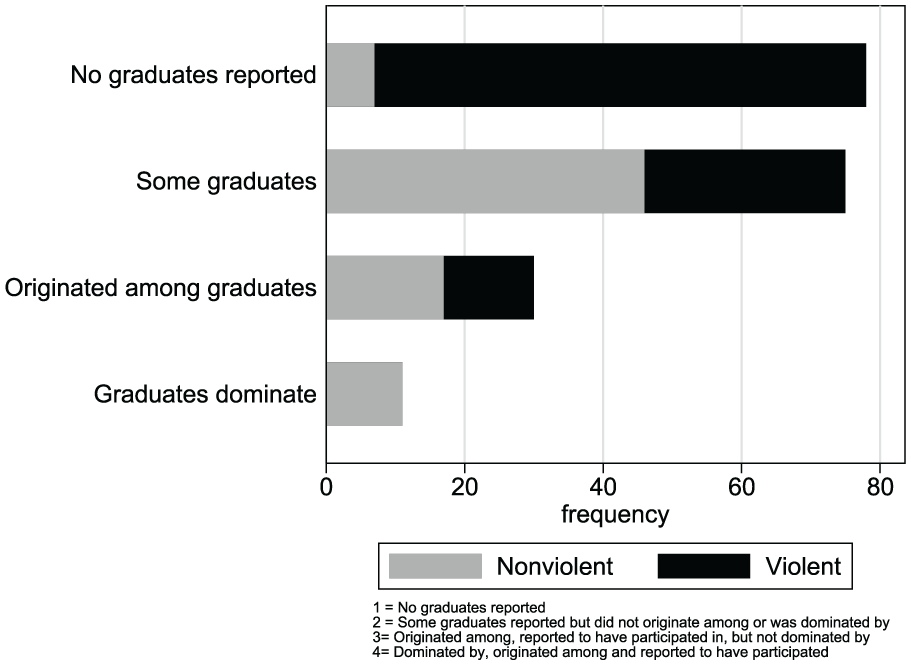
Involvement by the educated in violent and nonviolent campaigns.

Involvement by students in violent and nonviolent campaigns.
Results
I first present results from models investigating whether campaigns with educated protesters are associated with less violence, suggesting that there is robust evidence supporting this hypothesis. This motivates the second part of the analysis, examining whether campaigns with educated protesters are more likely to succeed. I find some evidence, although not very robust, that campaigns with a high degree of involvement by educated protesters are more prone to success, but, as I show, only due to their nonviolent dispositions.
Education and Nonviolent Protest
Table 1 shows results from logit models where the outcome is whether the campaign was nonviolent. The main explanatory variable is the education index, measuring the degree of involvement by students and graduates. 17
Nonviolent protest on campaign involvement by students and graduates.
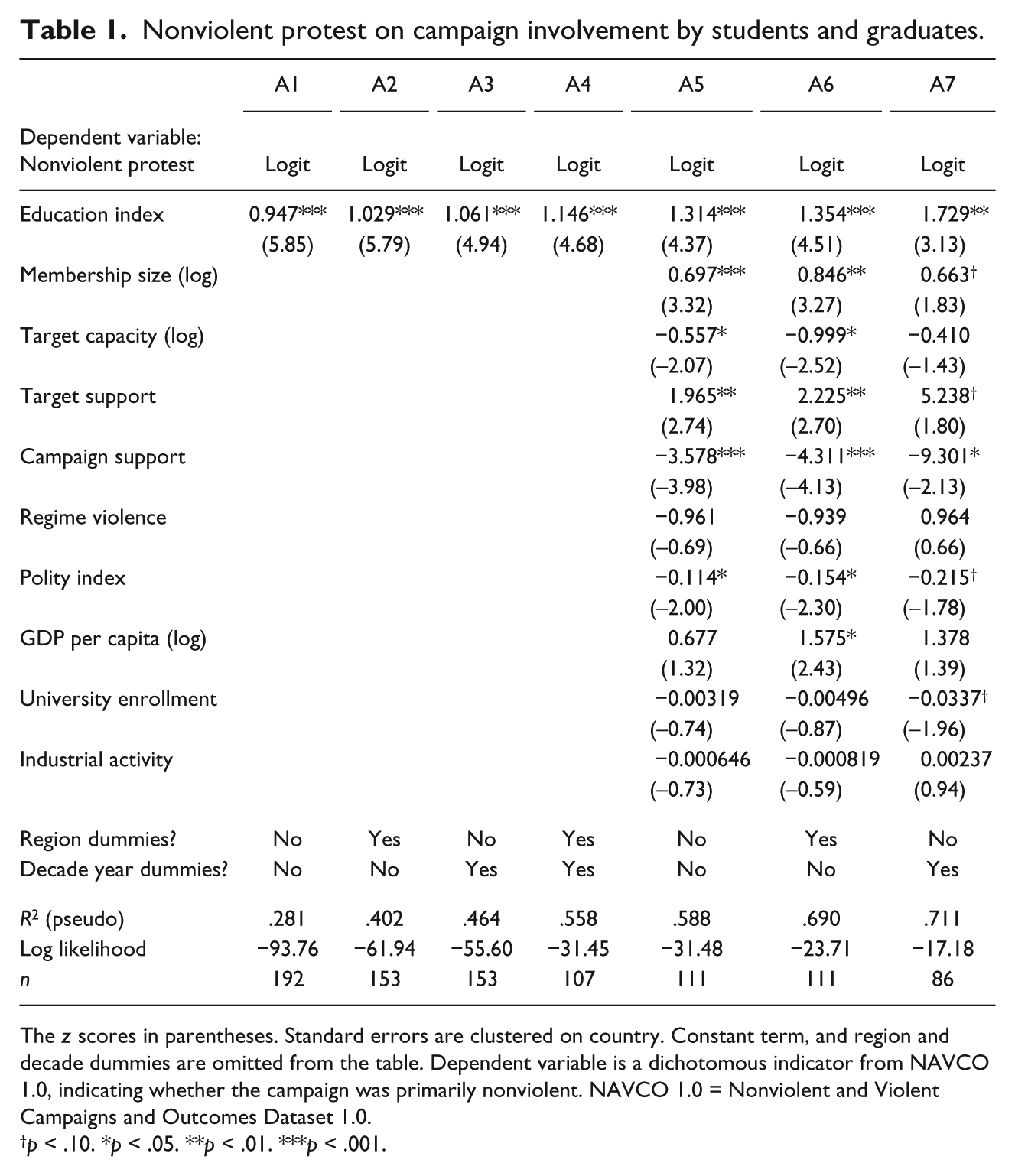
The z scores in parentheses. Standard errors are clustered on country. Constant term, and region and decade dummies are omitted from the table. Dependent variable is a dichotomous indicator from NAVCO 1.0, indicating whether the campaign was primarily nonviolent. NAVCO 1.0 = Nonviolent and Violent Campaigns and Outcomes Dataset 1.0.
p < .10. *p < .05. **p < .01. ***p < .001.
Model A1 is a simple bivariate regression of nonviolence on educated protesters. Here, the education index has a positive coefficient estimate of 0.947, which is highly significant at the .001 level. When including region dummies in Model A2, to account for cultural or geographic (time-invariant) variation between campaigns from different regions, the education index coefficient actually increases in size and is still significant at the .001 level. Furthermore, the coefficient estimate increases further and is still strongly significant when introducing decade dummies in Model A3, to account for campaign-invariant omitted variables varying over time, and when including both region dummies and decade dummies in Model A4.
In Models A5 to A7, I include several control variables capturing the strength of the campaign target and the dynamic between the campaign and the target. For instance, I control for a plausible potential confounder, namely, campaign size. In addition, I add log GDP per capita, university enrollment, manufacturing as share of GDP, and the Polity score for the country where the campaign is located. The coefficient estimate for the education index increases further (to 1.3) and is still precisely estimated (significant at the .001 level) when adding these controls in Model A5. When adding region dummies in Model A6 to account for cultural or regional variation between regions, the coefficient estimate for the education index increases further and is still precisely estimated (significant at the .001 level), and when replacing region dummies by decade dummies, the coefficient estimate jumps to 1.7 (and is now significant at the .01 level). 18 All models in Table 2 are also estimated with numerous additional controls (see Table 6 of the online appendix), to account for other sources of heterogeneity between campaigns.
Successful Outcome on Campaign Involvement by Students and Graduates (Logit Models).
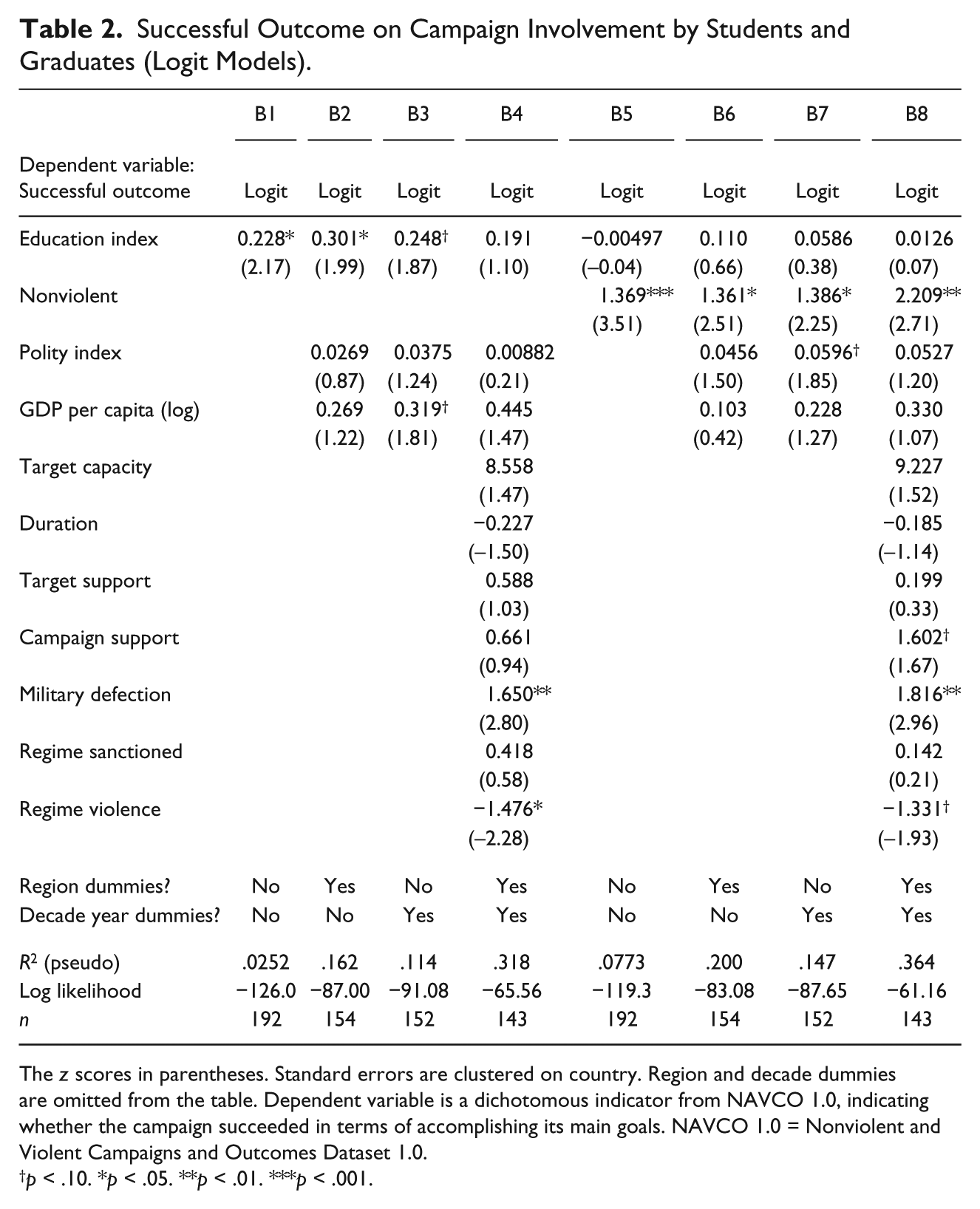
The z scores in parentheses. Standard errors are clustered on country. Region and decade dummies are omitted from the table. Dependent variable is a dichotomous indicator from NAVCO 1.0, indicating whether the campaign succeeded in terms of accomplishing its main goals. NAVCO 1.0 = Nonviolent and Violent Campaigns and Outcomes Dataset 1.0.
p < .10. *p < .05. **p < .01. ***p < .001.
The number of observations drops when adding region dummies and decade dummies, due to regions and decades without sufficient variation on the dependent variable being dropped. Due to missing values on the control variables, the number of observations also drops quite a bit when adding these (from 192 observations in the most simple Model A1 to 111 observations in Model A5 with full set of controls). To make sure that listwise deletion is not inducing selection bias—due to the possibility that missing values are correlated with nonviolence and campaigns’ social profile—I also conduct multiple imputation using the Amelia II software (Honaker, King, & Blackwell, 2011). When replicating Table 1 on the full imputed sample, the coefficient estimate(s) for the education index actually increases in size and is now always significant at the .001 level. 19 This suggests that missingness is not inducing bias.
In additional models in the online appendix, I also control for various other characteristics of campaign participants, using data on protest campaigns’ social class profile from (Dahlum, Knutsen, & Wig, 2018). In brief, I control for whether campaigns consisted of urban middle-class, public employees or urban groups (in general), as these groups could both be conducive to nonviolence and tend to colocate with educated groups. In addition, I control for whether the campaign is very diverse in terms of the number of social groups. The main results generally hold up when including these controls (see Section 12 of the online appendix for results and detailed discussions). The online appendix (Section 5, p. 13) also includes robustness tests with various additional controls, such as military defection.
In sum, despite the relatively low number of observations, there is robust evidence that involvement by educated protesters positively relates to nonviolence. To assess the substantial importance of education, Figure 5 displays predicted probabilities of being nonviolent for different values of the combined education index. The plot is based on Model A5 from Table 2, with all controls set to their mean. The graph illustrates how the likelihood of nonviolence increases with more involvement by educated protesters, from close to 0 for campaigns with no reported educated participants to around 0.9 for campaigns dominated by educated protesters. 20
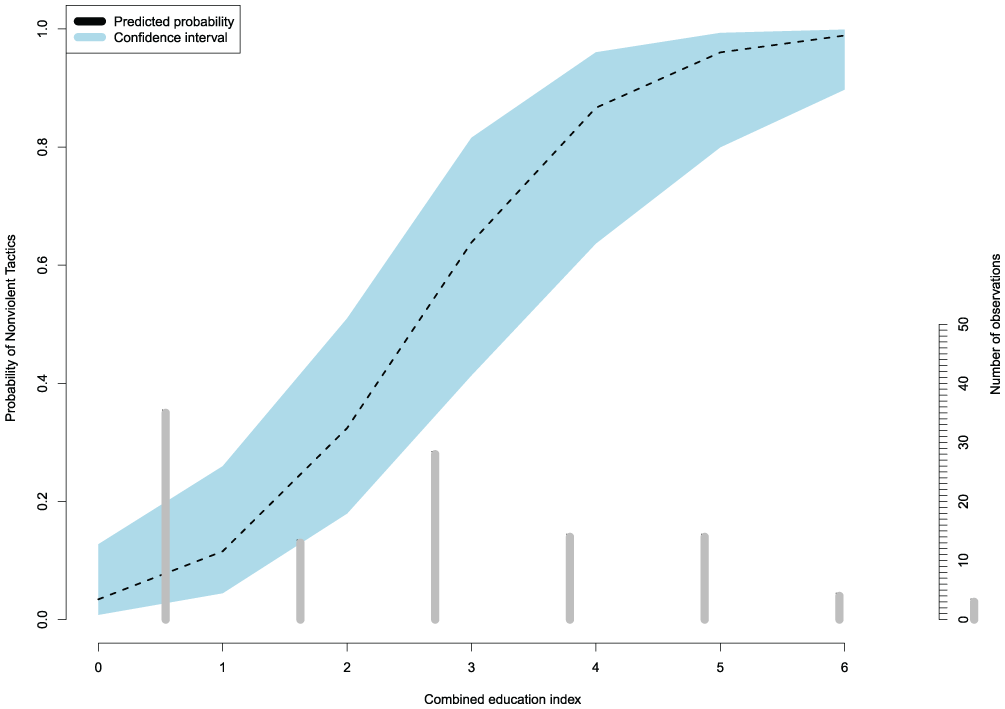
The predicted probability of nonviolence.
Education and Successful Outcomes
The finding that protest campaigns with considerable involvement by educated protesters are more likely to be nonviolent begs the question of whether educated movements, due to their pacifist inclinations, also are more likely to succeed. This is a plausible hypothesis when considering the capacities and skills of educated individuals, as well as studies indicating that nonviolent movements are more successful (Chenoweth & Stephan, 2011).
Table 2 presents results from logit models of the likelihood of a protest campaign succeeding (in terms of obtaining their main goals). I start by investigating the relationship between participation by educated protesters and success, without controlling for potential mechanisms. In brief, the education index coefficient is positive and significant at least at the .10 level in the simple bivariate regression in Model B1, when including log GDP, democracy level, and region dummies in Model B2 and when replacing region with decade dummies in Model B3. Yet, the coefficient estimate is no longer significant at conventional levels in the more complex Model B4. Hence, there is some, although not very strong, evidence that campaigns with educated protesters are more likely to succeed in terms of achieving their goals.
In Model B5, I include the indicator of nonviolent campaigns, to probe the mechanism through which education relates to success. In line with previous literature, the results indicate that nonviolent campaigns are associated with success. Meanwhile, the coefficient estimate for the education index drops dramatically (to close to zero) with a negative sign and far from statistically significant at conventional levels (with a z value of only −0.04). Hence, the effect of education on success is almost completely soaked up when controlling for nonviolence, suggesting that educated participants only affect success rates indirectly, through inducing peaceful resistance. Models B6 to B8 add the indicator of nonviolence to models with additional controls, region dummies, and decade dummies. There is still no significant coefficient for the education index, and in Models B7 and B8, the coefficient estimate is again approaching zero.
However, as has been pointed out by Imai, Keele, Tingley, and Yamamoto (2011), comparing coefficient estimates before and after adding the proposed mediating variable is often a poor way of estimating mediation effects, especially for nonlinear (logit) models as used in Table 2. Hence, I also apply the causal mediation analysis procedure proposed by Imai et al. Drawing on the potential outcomes framework for causal analysis, this procedure decomposes the average treatment effect of an explanatory variable into the average causal mediation effect (ACME) and the average direct effect (ADE). Figure 6 plots results from the causal mediation analysis with 95% confidence intervals. The ACME of education through nonviolence on the likelihood of success is 0.13, and this is statistically significant at the .001 level. It is estimated that 0.28% of the total effect of education on success is mediated through this channel. Moreover, there is no statistically significant direct effect of education on success. The online appendix (Section 9) contains additional discussions and tests of the robustness of the mediation analysis.
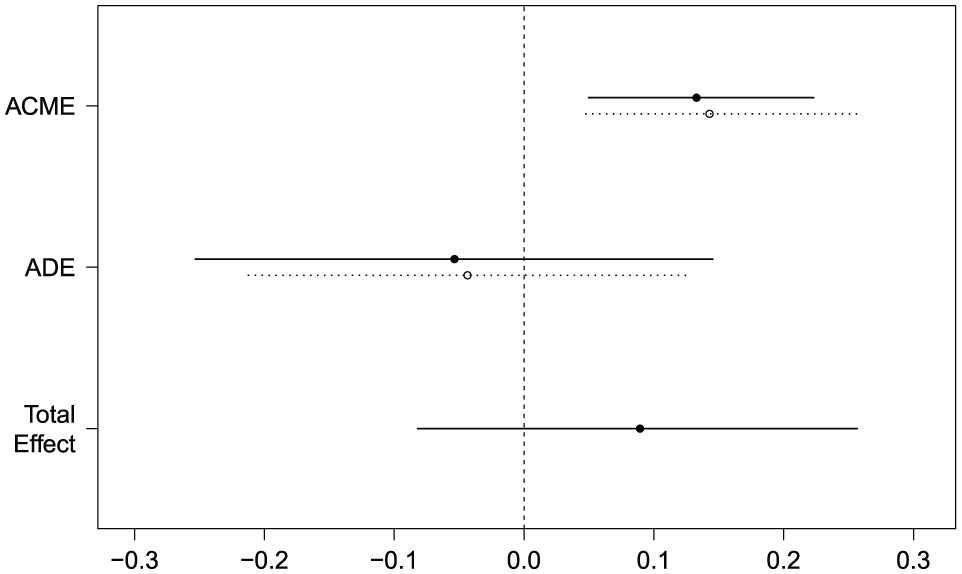
The mediation effect of education on successful outcome, mediated through nonviolence.
These results further corroborate the finding that protesters’ education level does not directly impact on success, but only indirectly, through nonviolence. In other words, educated protesters should be more successful if they use nonviolence, reflecting the argument that educated groups have skills and positions that facilitate nonviolent resistance. Why then are educated protesters no more likely to succeed overall? One potential reason could be that in addition to having comparative advantages when it comes to nonviolent resistance, educated protesters may have disadvantages when it comes to violent resistance. Educated protesters may lack the necessary skills, strategic location, and low opportunity costs that facilitate use of violence. Thus, they may be more likely to fail when using violent resistance. This could explain why no direct overall effect of education on protest is identified.
Endogeneity Issues
The finding that campaigns with students and educated protesters are clearly associated with a lower likelihood of violence is interesting in itself, because it yields the first systematic evidence of a link between the social background of protesters and their tactics and outcome. Ideally, however, we also want to assess whether this represents a causal effect. This is discussed below.
First, campaigns dominated by the educated will likely be different from other campaigns on dimensions that are not measured in the analysis. If the findings above are to support a causal interpretation, this heterogeneity cannot be correlated with the outcomes. While I do control for important potential confounders related to the economic and political context of the campaign country, or characteristics of the campaign and target—such as regime violence and capacity—there are still potential unobserved confounders. For example, the location of the campaign within the country is not captured, even if I control for country-level urbanization and participation by urban groups. It could be that nonviolent strategies are more popular in urban areas and that nonviolent movements join these movements because of their urban location. Other potential confounders are the motivations of the protesters, characteristics of the leadership, or unmeasured traits of the regime. To assess to what extent such unmeasured confounding is a threat, I use the strategy proposed by Imbens (2003), offering a benchmark to assess how large omitted variable bias has to be to reduce the “treatment” coefficient substantially—in this instance the coefficient estimate for the education index. If this method shows that potential unobserved confounders need to be implausibly larger than included confounders, this strengthens our confidence that the results are not driven by omitted variables. More specifically, I use the Generalized Sensitivity Analysis developed by Harada (2015). After identifying the treatment variable in the regression equation, the procedure generates a sequence of pseudo-random confounders that, once added to the regression equation, reduce the coefficient of interest by a chosen magnitude.
The curve in Figure 7 describes how much of the variance in nonviolence and in the education index an unobserved covariate would have to explain to reduce the education index coefficient by half. It shows that it would have to explain, for example, around 30% of nonviolent protest and 20% of participation by educated protesters. When compared with the variance explained by the included covariates, that lie far below the curve, this is a lot. For instance, level of socioeconomic development, measured using log GDP per capita, is among the variables explaining the most of nonviolence (less than 0.1), but it only explains less than around 0.03 of the variation in the education index. Meanwhile, government capacity, which explains more of the variation in the education index than any other variable, around 0.3, explains close to zero of the variation in nonviolence. For an unobserved covariate to wipe out the effect of the education index on the likelihood of nonviolence, it would have to explain more of the variation in the two variables than the combined variance explained by several plausible variables, including log GDP, the polity level, government capacity, campaign duration, external support, and whether the regime uses violence. Given that the existence of an unobserved variable of that magnitude is unlikely, this suggests that the identified effect of the education index is probably not driven by omitted variables. When running the generalized sensitivity analysis to investigate how large the omitted variable bias would be to push the coefficient estimate for the education index down to zero, it produces a curve that, as expected, is even further away from zero and the other included controls (see Figure 1 of the online appendix). 21
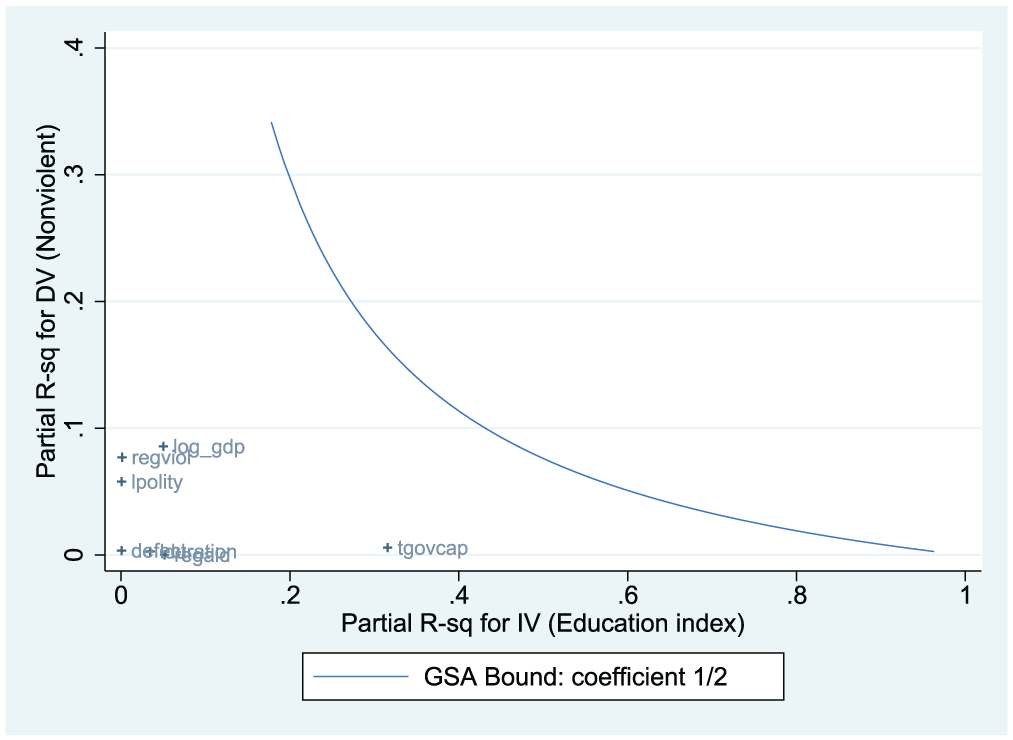
Assessing the threat of omitted variable bias.
Concerns about omitted confounders are also somewhat soothed by the identified relationship between the dichotomous indicator of whether the campaign originated among educated protesters and likelihood of nonviolence (see Table 7 of the online appendix). I have discussed how campaign characteristics suggesting it will turn nonviolent may attract educated protesters, inducing endogeneity, but whether the campaign originated among educated protesters is more plausibly exogenous to other protest characteristics evolving as the campaign develops, such as responses by the regime, choices made by leaders and participants, other groups entering or leaving the campaign, and third parties deciding to throw in their support. Hence, this indicator is less vulnerable to endogeneity bias.
So far I have discussed threats to inference arising from omitted variables, but another source of endogeneity is the possibility of reverse causation, due to a direct effect of nonviolence on campaign participation by educated protesters. Note, however, that many factors that may plausibly signal to potential protesters that the movement will turn violent, and thereby induce participation, are really factors correlated with nonviolence rather than the actual nonviolent campaign nature, such as, for instance, campaign leaders’ statements, personality and background, and previous use of violence in related protests. Moreover, although reverse causality cannot be completely ruled out, it is also made less plausible by the fact that I identify effects of campaigns originating among educated protesters on nonviolence. The indicator of nonviolence used in this article measures whether the movement is mainly nonviolent throughout its life span, and it is unlikely that this is already determined when the movement originates. In sum, while the main evidence presented here is associational, the above considerations make a causal interpretation of the education–nonviolence link significantly more plausible.
Conclusion
Why do some protest campaigns end in violence, while others commit to peaceful resistance? And why are some able to achieve their goals, while others fail? This article suggests that considering the education level of protesters can help to answer these questions. Existing literature on variations in protest movement outcomes has focused on explanations such as strategic choices and interactions between the campaign and the target, largely leaving out protesters’ social background. Against this backdrop, I explore implications from popular theories of how education relates to political violence and collective action. Utilizing new data on the educational profile of protest campaigns, that extends the NAVCO 1.0 dataset, this is the first investigation of whether students and educated protesters are more likely to become nonviolent and successful.
The analysis shows that educated protest movements are more likely to use nonviolent methods. This finding corroborates a key implication of the hypothesis that education breeds peace: that groups of educated people are more inclined to use peaceful resistance. I suggest that this is because educated protesters have inherent preferences for nonviolent resistance as well as resources and positions that yield a comparative advantage when it comes to nonviolent resistance. Meanwhile, I only find that education promotes success through nonviolent strategies, and little evidence that educated protest campaigns have a higher overall success rate. This finding could suggest that the identified relationship between education and nonviolence is not driven by protesters’ capacities. After all, should this capacity not also induce success? I propose, however, that although educated protesters have a comparative advantage for nonviolent protest, they may have a comparative disadvantage for violent resistance. This may explain the overall null finding between education and success. Hence, the capacity-mechanism may very well account for (parts) of the identified relationship between education and nonviolent protest. Meanwhile, the fact that I also seem to find an effect of educated protesters on nonviolence after controlling for participation by groups such as the urban middle class and public employees suggests that it is not only the position and leverage of graduates that is driving the results: Nonviolent preferences and particular skills received at universities are probably also playing in. This is consistent with the finding that students (as opposed to graduates) are also more likely to use nonviolence.
These findings speak to the importance of moving beyond the macro level (countries) when studying the link between education and political instability. By considering the group level, where many of the expected mechanisms are supposed to operate, we gain new insights. For example, these findings could suggest that the link between education on one hand and peace and democracy on the other hand could be due to something more fine-grained than countries’ education levels: namely, the collective action of educated individuals and protest movements.
This approach integrates structural factors with the role of agents, by showing how socioeconomic traits, such as education, impact the strategies of protest movements. While the literature on education and outcomes such as civil war has tended to study countries rather than the social agents as such, the agent-centered protest movement literature has (with few exceptions) paid little attention to socioeconomic factors. Future research should investigate how other socioeconomic characteristics of protesters interact with actors and their strategies. And, it should work to incorporate additional group characteristics into the study of nonviolent and violent mass protest. This suggests an important new research agenda.
The study also has implications for policy makers or third parties, such as foreign governments and nongovernmental organizations (NGOs), considering whether to throw their support behind ongoing antiregime movements. In a nutshell, it suggests that such actors should consider the social background of protesters when deciding whether to offer their support. Protest campaigns often fail or, even worse, culminate in violent clashes with the government or (enduring) civil war, such as in Libya or in Syria in recent years. In other instances, mass opposition promotes peaceful regime transitions (to democracy), such as in Tunisia after 2011. This finding suggests that third parties committed to avoiding supporting movements that may spur civil war should be well advised to consider who the participants in mass protest movements are, and not just the context they operate in and goals they are working for.
Supplemental Material
Online_appendix_final – Supplemental material for Students in the Streets: Education and Nonviolent Protest
Supplemental material, Online_appendix_final for Students in the Streets: Education and Nonviolent Protest by Sirianne Dahlum in Comparative Political Studies
Supplemental Material
Replication_data – Supplemental material for Students in the Streets: Education and Nonviolent Protest
Supplemental material, Replication_data for Students in the Streets: Education and Nonviolent Protest by Sirianne Dahlum in Comparative Political Studies
Supplemental Material
Replication_do_file – Supplemental material for Students in the Streets: Education and Nonviolent Protest
Supplemental material, Replication_do_file for Students in the Streets: Education and Nonviolent Protest by Sirianne Dahlum in Comparative Political Studies
Footnotes
Acknowledgements
For helpful comments, I thank Carl Henrik Knutsen, Tore Wig, Michael Miller, Ellen Lust, Magnus Rasmussen, Scott Gates, Björn Höyland, Zoltan Fazekas, Marianne Dahl, Kristian Gleditsch, Svend-Erik Skaaning, Silje Lyder Hermansen and participants at the MPSA Annual Conference 2015, the EPSA Annual Conference 2015, the workshop “Repression and violence” at Aarhus University in March 2016 and the workshop “Securing the Victory” at the Peace Research Institute of Oslo in December 2016.
Declaration of Conflicting Interests
The author declared no potential conflicts of interest with respect to the research, authorship, and/or publication of this article.
Funding
The author declared the following potential conflicts of interest with respect to the research, authorship, and/or publication of this article: This research project was partly supported by the Research Council Norway project pnr 240505 and Riksbankens Jubileumsfond, Grant M13-0559:1, principal investigator: Staffan I. Lindberg, V-Dem Institute, University of Gothenburg, Sweden.

Notes
Author Biography
References
Supplementary Material
Please find the following supplemental material available below.
For Open Access articles published under a Creative Commons License, all supplemental material carries the same license as the article it is associated with.
For non-Open Access articles published, all supplemental material carries a non-exclusive license, and permission requests for re-use of supplemental material or any part of supplemental material shall be sent directly to the copyright owner as specified in the copyright notice associated with the article.
