




Abstract
We present a temporally fine-grained data set on regimes, defined as the formal and informal rules essential for selecting leaders. The data set comprises more than 2,000 regimes from 197 polities, 1789 to 2016. We highlight how the frequency of breakdowns and particular modes of breakdown have followed cyclical rather than monotonic patterns across modern history. The most common breakdown modes, overall, are coups and incumbent-guided regime transformations. Furthermore, we report robust evidence that low income, slow or negative growth, and intermediate levels of democracy predict a higher likelihood of regime breakdown. Yet, by running change-point analysis we establish that breakdown risk has cycled substantively across periods of modern history, and the aforementioned explanatory factors are more clearly related to breakdown during certain periods. When disaggregating different breakdown modes, low income is related to, for example, breakdown due to popular uprisings, whereas intermediate democracy levels clearly predict coup-induced breakdowns and incumbent-guided transitions.
Introduction
All political regimes eventually die, but they do so in very different ways. Some regimes undergo self-imposed change and transform into something else “from the inside.” Examples are autocratic regimes liberalizing to become democracies or democratically elected presidents conducting self-coups. Other regimes are terminated by outside forces. Examples are popular protests setting off a revolution, military officers coordinating a coup d’état, or a foreign power intervening and forcing out the incumbent regime. In this article, we present a new global data set, the “Historical Regime Data” (HRD), extending from the French revolution to the present on political regimes and regime breakdowns. We define a regime as the set of (formal and informal) rules that are essential for selecting political leaders and maintaining them in power, and a regime breakdown as a substantive change to these essential rules for selecting leaders.
Some countries, for example, in Central and South America, have had very tumultuous political histories, experiencing numerous regime changes. This pattern resonates with existing research on Latin American politics that highlights the role played by frequent regime changes in shaping the political development of the region (Hochstetler & Edwards, 2009; Hochstetler & Samuels, 2011; Londregan & Poole, 1990), and it is very clearly illustrated by our new data. Take, for instance, Bolivia, where 44 regime changes have been recorded since 1789, with 43 changes from the declaration of independence from Spain on August 6, 1825, and onwards. These 44 changes are associated with nine different modes of breakdown (according to HRD’s 13-category scheme). Most notably, Bolivia has experienced 18 breakdowns due to military coups. Interestingly, these coups have mainly come during specific intervals of the country’s history, with three coups in the 1870s, three in the 1930s, and eight between November 4, 1964, and July 17, 1980. Yet, Bolivian history has also witnessed two regime breakdowns due to foreign interventions, four due to popular uprisings, and three democratic transitions guided (to some extent) by the sitting regimes. Bolivia has also experienced four regime transitions due to self-coups—the latest being the recent concentration of executive power by President Evo Morales, culminating with the scrapping of presidential term limits in 2017. In other countries, regime change has been a rare phenomenon. Take, for instance, the Sultanate of Oman, where no regime change has been recorded since before the French Revolution. The very same Al Bu Said dynasty has ruled, without any major interruption to the core rules for selecting and maintaining leaders in power, since 1749. But, why have regimes, historically, been so much more fragile in some countries, such as Bolivia, than in others, such as Oman? And, is the history of military coups d’état in Bolivia representative—do specific modes of regime breakdown tend to cluster temporally, being much more frequent during certain periods of time than others?
Exploring these questions and, more generally, understanding processes of regime breakdown and change has long been a core concern of social scientists (early contributions include Davies, 1962; Gurr, 1970; Lipset, 1959; Moore, 1966). While data from the post–World War II (WWII) era suggest that a minority of regime breakdowns were followed by democratization (Geddes, Wright, & Frantz, 2014), the contemporary literature places a special focus on such regime changes (Ansell & Samuels, 2014; Boix, 2003; Coppedge, 2012; Teorell, 2010). Yet, democratic breakdowns (Svolik, 2008) and transitions between different types of autocracies (Hadenius & Teorell, 2007) have also received attention. Furthermore, distinct literatures address particular processes of regime breakdown, such as popular revolutions (Chenoweth & Stephan, 2011) and coups d’état (J. Powell, 2012). Regarding the potential determinants of regime breakdown, some studies highlight structural factors, such as (various) regime-type characteristics (c.f. Gates, Hegre, Jones, & Strand, 2006; Geddes, 1999), poverty (Przeworski & Limongi, 1997), and natural resource abundance (Ross, 2012). Other studies highlight “trigger” factors—events that disrupt previous equilibria and prompt regime opponents to mobilize against the regime—including international wars (Bueno de Mesquita, Siverson, & Woller, 1992) and economic crises (Przeworski & Limongi, 1997). In this article, we will empirically assess the relevance of two structural factors: income level and democracy level, and one trigger factor: economic growth.
Despite all the attention given to regime breakdown (and change), our cumulative understanding of this key phenomenon has been restricted by the following features: (a) Extant studies often circumscribe their focus to consider particular types of transitions, notably democratization. (b) Most studies have a restrictive scope, mainly focusing on decades after WWII—a relatively short period of “modern history.” Even within this time frame, studies suggest that both the causes (Ross, 2012) and main modes (Kendall-Taylor & Frantz, 2014) of regime breakdown may have shifted. While there are benefits to studying a more homogeneous set of cases, we thus run the risk that our knowledge claims about regime breakdown and change, based on post-WWII data, may be less robust or generally applicable (Boix, 2011) than what is commonly supposed.
To help researchers overcome these limitations and further our systematic knowledge of regime breakdowns and durability, and their causes and consequences, we have constructed HRD. These data include measures on the identity, time period of existence, and mode of breakdown for more than 2,000 regimes. HRD spans most large polities, globally, after the French revolution, documenting the life-cycles of regimes at a high level of temporal precision. HRD is nested into the larger Historical Varieties of Democracy (HVDEM) data set (Knutsen et al., 2019)—which contains several hundred indicators that can easily be mapped on to the identified regimes to describe their institutional make-up and evolution—and thus covers the 91 countries, semiautonomous polities, and colonies in Historical V-Dem from 1789 to 1920. Furthermore, HRD covers all polities covered by V-Dem v.7 (Coppedge et al., 2017) from 1900 onwards.
But, why do we need HRD when other, carefully crafted regime data sets, which are reviewed below, already exist? First, due to its extensive coverage—197 polities with some time series extending from 1789 to 2016—HRD opens up for more powerful empirical tests and careful assessment of temporal heterogeneity in the study of regime breakdown. 1 Second, HRD offers a lower operational threshold for counting regime changes than most existing data sets, allowing researchers to detect episodes of change that would otherwise have been covered up by more conservative measurement strategies. Third, HRD offers a temporally much more detailed coding of regime births and deaths than most extant data sets, coding the vast majority of cases down to the exact date, thereby allowing for more precise analysis of regime duration. Finally, by integrating a nuanced scheme of modes of regime breakdown, HRD will be of use to researchers studying coups, self-coups, revolutions, and so on, as well as regime breakdown in general. We thus provide an integrative data source for different areas of study that have tended to rely on different data sets covering different sets of countries, time periods, and so on, enabling cross-fertilization between parallel literatures.
Regarding our substantive findings, we display interesting descriptive patterns on frequencies of different modes of regime breakdown as well as the frequency for regimes breakdown, overall, suggesting that these frequencies have moved in nonmonotonic, almost cyclical, fashions. For coups, for example, recent years are not the only low-frequency era observed in the data, but are comparable both to the late-1800s as well as the time period from the French Revolution to about 1820. The recent uptick in regime deaths due to popular uprisings is not unique either, parallelling upticks in such breakdowns during the interwar era and around 1848. For regime change, overall, we identify the period between 1798 and 1881 as well as between 1913 and 1995 to be high-frequency periods, whereas the three decades or so before World War I (WWI) and the last two decades have been periods with relatively few regime changes. We also display a number of interesting results on some core, proposed determinants of regime breakdown, namely income level, short-term economic growth and democracy level.
When analyzing our full sample, we find evidence that regimes mixing democratic and autocratic features are significantly more prone to break down than full democracies and autocracies, and high income levels and high short-term growth seem to inoculate regimes from breakdown. Also when considering various modes of breakdown, these factors often (though far from always) turn up as key predictors. Furthermore, we run change-point models to identify time periods with relatively frequent and infrequent regime changes, and assess the relevance of the mentioned predictors in different time periods. Interestingly, we find that democracy level, income level, and short-term growth are especially clearly related to regime breakdown from WWI to right after the Cold War ended, a period of modern history characterized by frequent regime changes.
In the following, we first elaborate on the concepts of “political regime” and “regime breakdown” (section “Alternative notions and measures of regime change”). We then discuss key issues and operational rules for identifying regimes and breakdowns (section “Operational criteria for identifying regimes in HRD”). Next, we describe and illustrate the specific variables contained in HRD while simultaneously using the data to map patterns of regime breakdown across modern history (section “The Contents of HRD and Patterns in Regime Development Throughout Modern History”). After that (section “Extant studies on determinants of regime breakdown”), we review extant literature on three proposed determinants of regime breakdown—level of democracy, income level, and short-term economic growth—before we present our empirical results (section “Correlates of regime duration and breakdown”).
Political Regimes and Regime Breakdown: Conceptualization and Operational Issues
We define a “political regime” as the set of rules that are essential for selecting political leaders and for maintaining them in power. These can be formal rules, for instance, embedded in constitutions, but also informal rules and practices, enforced by a broader or narrower group of people. A regime is therefore typically characterized by it determining who selects policies, and, in extension, how these policies are typically selected. This definition, which resembles the conceptual definition of Geddes et al. (2014), allows for capturing multiple, relevant instances of changes to a country’s political system. Thus, we need not limit ourselves to capturing only one particular type of regime change, such as “democratic transitions” or “democratic breakdowns,” nor do we need to restrict ourselves to transitions between predefined categories, or “types” of autocratic regimes (even if such transitions have been the operational focus of many extant regime data sets). For instance, the replacement of one type of autocratic monarchy (e.g., a dynasty selecting leaders based on primogeniture) with another one (e.g., an elective monarcy; see Kokkonen & Sundell, 2014) may constitute a substantial change in the set of rules that are essential for selecting political leaders and for maintaining them in power, that is, regime change.
We highlight that formal and informal rules for determining political leaders often coexist. If the formal and informal rules correspond— that is, the formal rules are followed—stability in the formal rules can be used to identify a regime. This situation is common in modern democracies with a strong rule of law. In these instances, evaluating the continuation of key formal rules—for example, as written in the constitution—provide clear operational criteria for judging the regime’s continued existence. If, however, the formal and informal rules for selecting and maintaining leaders do not correspond, such as in many dictatorships, the informal rules take precedence when identifying a regime, as they de facto determine who selects policies. To exemplify, if the constitution stipulates that leaders are elected through multiparty elections, but leaders were, in fact, selected through a military coup and maintained by a coalition of military officers, the latter features determine the regime, according to our definition. We elaborate on specific, operational issues for identifying regimes below, but first provide a contrast with alternative notions of regimes and regime change.
Alternative Notions and Measures of Regime Change
Table 1 illustrates that there are multiple ways to define what constitutes a regime or regime change. One common alternative in the political science literature is to invoke the distinction between democracies and autocracies, and define regime change (only or mainly) according to substantial changes along this dimension (Cheibub, Gandhi, & Vreeland, 2010; Marshall, Gurr, & Jaggers, 2013). Degree of democracy is critically associated with the formal rules through which leaders are selected and deposed, such as the existence of multiparty elections and universal franchise. But, most scholars acknowledge that also informal rules and practices matter for democracy, for example, pertaining to whether elections are conducted freely and fairly or if elections are associated with some kind of fraud—not described in the constitution—that determines outcomes.
Regime Data Sets With Global Coverage.
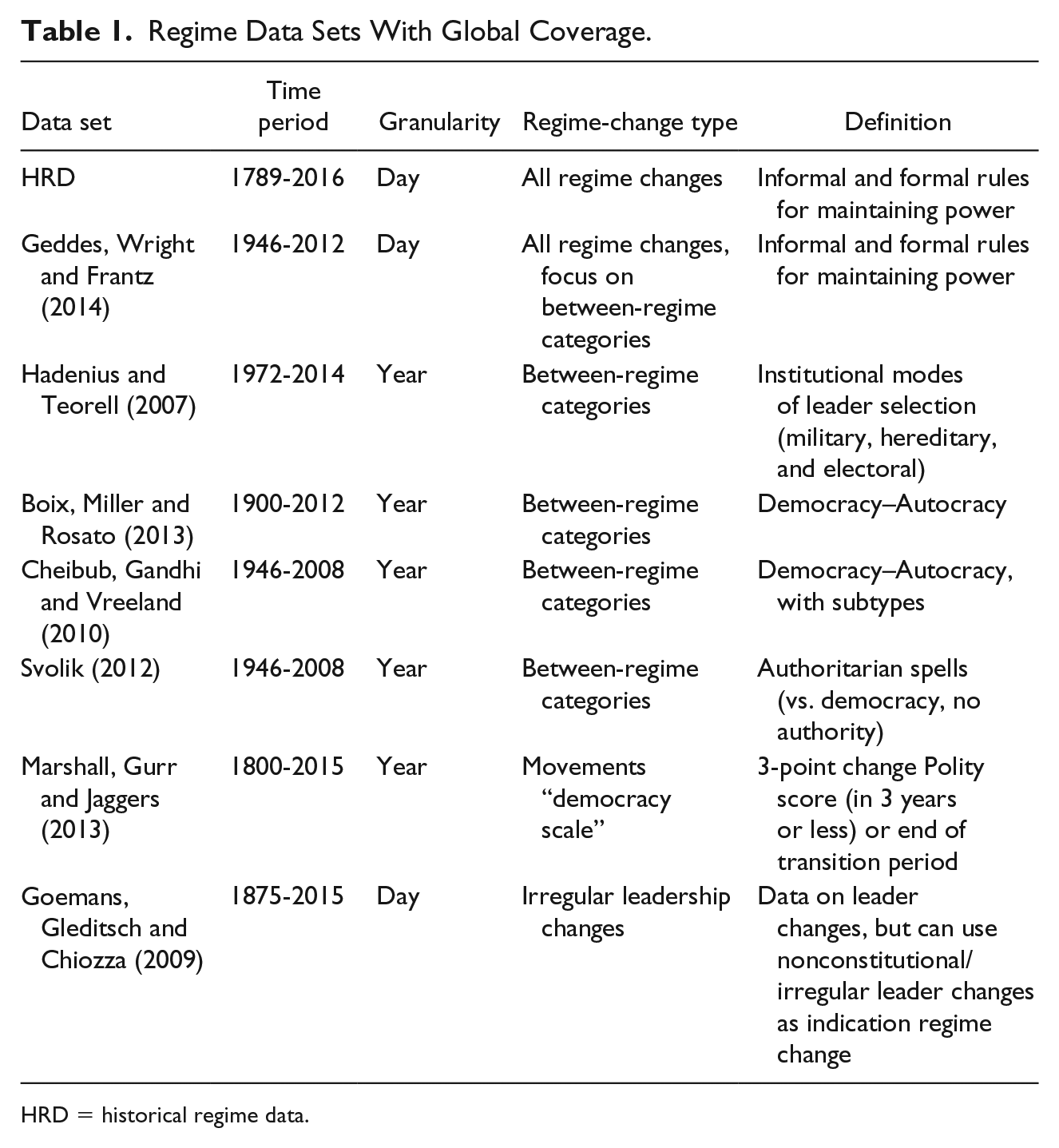
HRD = historical regime data.
While not restricted to considering these elements pertaining to democracy, our preferred regime definition encapsulates such elements, and thus allows us to capture regime changes stemming from substantial changes to, for example, electoral practices. 2 In other words, we consider episodes of substantial democratization, or reverse processes of democratic breakdown, sufficient, but not necessary, conditions for registering regime change. Critically, our definition also allows us to capture other regime breakdowns and subsequent changes, including changes between regimes that are equally (un)democratic. To exemplify, our definition covers changes between a harshly repressive one-party state, where party bosses select leaders through some formal or informal process, and an about equally repressive absolutist monarchy, where particular rules of dynastic succession determine leader selection. It also covers changes between two military regimes (i.e., regimes belonging to the same “autocracy type”) with distinct military juntas operating different informal rules for selecting the leadership.
A closely related concept is that of “irregular leader removal,” which is central to the Archigos data (Goemans, Gleditsch, & Chiozza, 2009). These events denote instances where the leader is removed from power through some unscripted process, such as a coup or a revolution. While many regime-change events will involve irregular leadership removal, there is significant daylight between these concepts. First, not all regime changes involve irregular leadership removals. The leader may, for example, stage a self-coup which transforms the regime (into a new one), without the leader losing office. Second, leaders could be removed from power without a regime change occurring. For example, if the leader is assassinated and his or her vice president takes over, this constitutes an irregular leader removal and a prescribed transfer of power that does not, in itself, imply a regime change. In addition, the leader might be removed “irregularly” by, for example, a military junta that de facto governs (both before and after the leader removal) in this regime. This would constitute an “irregular leader change” in Archigos, but not a regime change following our definition.
Extant data sets with global coverage that identify regimes or regime change include, but are not restricted to, Cheibub et al. (2010), Boix, Miller and Rosato (2013), Hadenius and Teorell (2007), Svolik (2012), Geddes et al. (2014), and Marshall et al. (2013). Table 1 provides an overview of the temporal and spatial scope of these widely used data sets, and their temporal granularity (i.e., whether regime changes are coded at the level of years or days). The table also describes the sort of changes to the political system that are considered to be regime changes, distinguishing between-category changes—that is, where the regime has to switch from one predefined regime type category to another, such as from “democracy” to “dictatorship” or from “military regime” to “monarchy” to be registered as a regime change—and regime changes that do not hinge on such changes in categories (“all regime changes”). Most data sets counting between-category regime changes rely on some version of the aforementioned democracy–autocracy distinction for identifying regimes, whereas Hadenius and Teorell (2007) rely on the different institutional modes of selecting leaders (military, hereditary, and electoral) for identifying (authoritarian) regimes. As we maintain that regime change can occur also between regimes that are commonly classified as belonging to the same “type,” our HRD data set thus includes more regime changes than these data sets focusing only on between-category transitions. HRD is most closely related to the Geddes et al. data set (henceforth “GWF”) in terms of conceptualization and delineating political regimes, though there are notable differences. Given this, but also because Geddes et al. (2014) carefully compare GWF with the other widely used data sets listed in Table 1, we focus our discussion on similarities and contrasts between HRD and GWF.
One notable difference between GWF and HRD is that the former—while remaining open to including clear instances of change between regimes of identical type—takes transitions between its own categories of autocratic regime types (military, dominant party, personalist, etc.) as a key point of departure when looking for regime change. HRD does not operate with a clear categorization of “types” as its basis for identifying regime changes.
Yet, we want to highlight that data enabling the construction of more refined regime categories exist in the wider V-Dem data set, which also contains several other indicators that can be used to describe the institutional variation between regimes or within regime life-spans, even if they do not serve as the basis for the HRD coding. This additional information in the form of other, independently coded V-Dem indicators is thus easily combined with analysis of the HRD data, allowing for instance for analysis of certain sub-sets of regimes. In the Supplemental Appendix, we illustrate this point by drawing on the “Regimes of the World” categorization (Luhrmann, Tannenberg, & Lindberg, 2018) to replicate our analysis of determinants of regime breakdown on subsamples containing (only) democracies or (only) dictatorships. 3 We could also have used data on bases of executive recruitment (Teorell & Lindberg, 2019) to analyze subsamples of, say, democracies with directly elected leaders (presidential and semipresidential systems) or autocracies where heads of states are selected through hereditary succession (autocratic monarchies), by the ruling party, or by the military.
Yet, when coding the HRD, we have taken the broader question of identifying when the formal or informal rules for selecting and maintaining leaders are substantially altered as our point of departure, instead of relying strictly on changes between predefined regime types to identify regime breakdown. Thus, we develop a large set of heuristics—a couple of examples are “credible historical sources tell that the chief executive was successfully removed by military officers” or “credible historical sources tell that the leader was removed by a popular uprising”—for identifying candidate events for substantial changes to these rules and for determining whether or not an the identified change was substantial enough to demarcate regime change (in a manner that is consistent across countries and time). These heuristics were used in conjunction with a thorough reading of secondary sources to delineate regime units and determine the dates of regime births and deaths directly.
As Geddes et al. (2014) point out, there is a tradeoff between using simple coding rules and the reliability that they bring versus the ability to capture complex concepts such as regime breakdown in a valid manner. A limited set of objective coding rules increase replicability, but may also disregard nuance and risk overlooking conceptually relevant instances that do not conform by a sparse set of “sharp rules.” HRD emphasizes the latter half of this tradeoff to a greater extent than GWF (and even more so than, for example, Cheibub et al. (2010)), but also seeks to enhance replicability and transparency for instance by providing detailed notes justifying each coding decision alongside lists of sources (see Supplemental Appendix B for a discussion of our intercoder reliability tests). Prioritizing the ability to capture various kinds of regime change and dispensing with a restrictive set of sharp rules becomes even more important because of the extensive time period HRD covers. Whereas GWF starts in 1946, HRD extends back to 1789, increasing the heterogeneity of regimes and changes covered.
Let us, however, illustrate the benefits of our approach by using a more recent case, Reza Shah’s Iran. GWF codes Iran as having a single regime from 1925 to the Shah’s flight in 1979 (Figure 1). In HRD, this regime spell—which is coded to start, more precisely, on December 15, 1925—is broken up by both the 1941 Anglo-Soviet invasion (November 16) and the coup of August 19, 1953. Although accounts disagree on, for example, the importance of Central Intelligence Agency (CIA) interference in the 1953 coup, several scholars agree on the coup’s significance for how Iran was governed in practice (Abrahamian, 2013; Gasiorowski, 1987; Gasiorowski & Byrne, 2004; Takeyh, 2014; Zahrani, 2002). Gasiorowski (1987, p. 1) notes that the “government of Prime Minister Mohammad Mosaddeq which was ousted in the coup was the last popular, democratically oriented government to hold office in Iran.” In this instance, we therefore consider that the nature of the pre-coup regime, including an actual elected Prime Minister functioning far beyond nominal status, is so different from the ensuing postcoup personal monarchy that the two should not be regarded a single regime defined by the Shah’s rule, even if the monarchy, as such, persists.
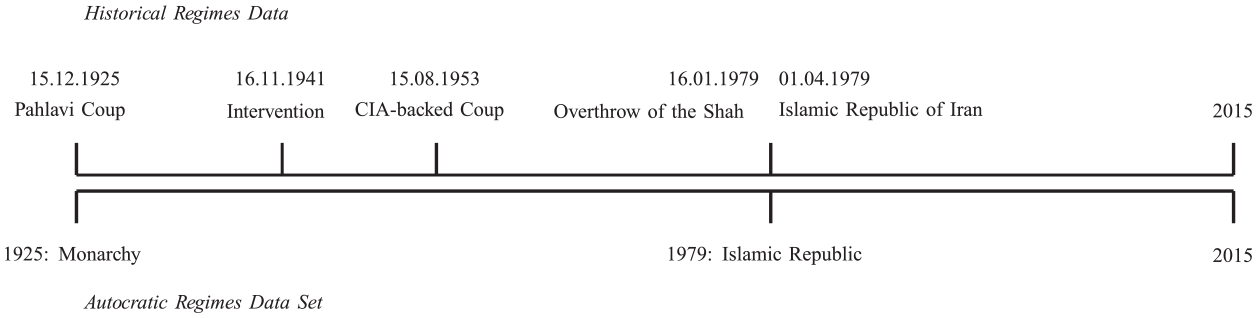
Regimes in Iran: Comparison of Historical Regime Data (top) and GWF (bottom) coding, 1925 to 2015.
More generally, HRD applies lower thresholds for coding regime deaths than GWF, mostly resulting from a more inclusive notion of what to count as a “substantial” change in rules for selecting political leaders. Hence, across the overlapping country-years, where Geddes et al. count 280 autocratic regimes and 207 democratic episodes, HRD contains 925 regimes. We emphasize that transitional regimes are important to count as separate regime spells (e.g., in order not to overestimate regime duration). Again, the HRD coding of Iran serves as a good example. When the Shah’s regime is, eventually, toppled by the clergy and Ayatollah Khomeini in 1979, there is a period of confusion between the Shah’s flight on January 16 and the declaration of the Islamic Republic on April 1. In this period, the Regency Council attempts to rule in the Shah’s absence (Rubinstein, 1981), separating it from the consolidated Khomeini rule beginning in April.
Operational Criteria for Identifying Regimes in HRD
While our definition opens up for a comprehensive and fine-grained account of countries’ regime histories, it also presents several operational challenges. How do we judge whether a rule change is substantial, and thus sufficient for constituting regime change? Furthermore, how do we ensure that we capture substantial changes to informal rules, which are inherently hard to observe? We devised several strategies in response to these challenges, constructing several heuristics for identifying substantial rule changes and for coding regime breakdowns consistently across time and space. While the bulk of discussion is presented in the Supplemental Appendix—with a particular focus on how we coded particularly difficult cases pertaining to self-coups and other incumbent-guided regime transitions, cases of decolonization, and cases where a polity splits up into several entities—we briefly discuss some key issues here.
First, we note that our definition implies that vastly different processes can premeditate regime breakdown. These include, but are not restricted to, coups conducted by the military or other actors, self-coups conducted by sitting leaders, losses in civil war or interstate war, popular uprisings, and substantial political liberalization with guidance by incumbents. These processes are covered in our 14-category mode of breakdown variable and served as key markers for our coders when considering when a regime ended. Second, we identified other marque events, notably leadership changes, as candidates for further scrutiny. Sometimes, regime changes are related to government or leadership changes, such as the change in Zaire/DR Congo from the Mobutu regime to the Kabila regime (Schatzberg, 1997). We immediately note that government or leadership changes do not necessarily bring regime changes, as exemplified by postelection government changes in democracies, or by the institutionalized changes to prime ministers and presidents in current China. We also note that regime changes can take place without leadership changes, for example, when military juntas institutionalize one-party rule.
But, for any potential candidate for regime breakdown, how did we identify whether a change in rules and practices for selecting and maintaining leaders is substantial or not? Such changes can, of course, be relatively minor—think, for instance, of the minimum voting age being lowered from 20 to 18 years. This, we surmise, is not a substantial change. Likewise, we do not consider minor constitutional amendments or changes to the electoral formulae to be sufficient for constituting regime change. While setting the threshold for what constitutes a substantial change is (inherently) open to discussion, we streamlined a set of criteria and pursue them consistently across contexts. 4 These criteria are presented and discussed in Supplemental Appendices E to F. To mention one prominent example, we consider a regime change to have occurred if suffrage—in a regime holding contested multiparty elections and where these formal rules for leader selection is followed—is extended from only being granted to males to being universal. Sometimes, a number of smaller changes to formal or informal rules, spaced out over a period of time, may incrementally add up to a substantial change. In such cases, it is hard to determine exactly when the regime change occurred. Yet, if the accumulated changes are substantial, we still count such processes as regime change. To illustrate this, we discuss in the following section the example of Italy in the 1920s and the transition to a Fascist regime led by Mussolini.
Finally, we highlight that in cases where formal and informal rules diverge (or where no formal rules exist at all), a key feature of the incumbent regime is the coalition of actors that select and sustain leaders; these actors administer the informal rules. When such coalitions change dramatically, so to, we presume, do the informal rules and practices of selecting and maintaining leaders. Thus, in settings where formal rules have little relevance, the make-up of the support coalition can help us in identifying regime units. As common examples of operational criteria, we consider who makes up a military junta and who supports them as relevant for delineating many military regimes, while royal families and their rules for familial inheritance help define monarchical regimes.
The Contents of HRD and Patterns in Regime Development Throughout Modern History
HRD includes variables on regime start dates, end dates, and modes of breakdown. The latter has 14 categories and exists in both a single-selection (most important) and multiple-selection format, capturing that multiple processes may lead up to, and be relevant for, breakdown. In addition, dichotomous variables record uncertainty in the date variables and whether a country experiences an interregnum period (which is used very sparsely; see Supplemental Appendix D). We code regime breakdowns and origins down to the day, where possible, describing even short-lived and transitory regimes in sequence, rather than settling for a coarse account of history. To exemplify, we capture the 12 different coups that took place in Haiti prior to the 1915 U.S. occupation, down to their date.
The 197 polities covered by HRD include the vast majority of sovereign states (e.g., Bavaria, 1789-1871 or Ethiopia, 1789-2016), several semiautonomous polities (e.g., Hungary under the Dual Austrian-Hungarian Monarchy), and numerous colonies (e.g., British India). Figure 2 displays the number of regimes that existed during a given year, from 1789 to 2016, with the increasing trend reflecting that the number of polities included is growing (especially around 1900). Supplemental Appendix Table A-1 lists all polity-years covered by HRD. As HRD is nested within V-Dem, the sample currently covers the countries included in Historical V-Dem (1789-1920) and by V-Dem v.7 (1900-2016), but will soon be updated to include all country-years covered in V-Dem v.9. The relevant units are described in more detail in V-Dem’s country-units document, and the decision rules for including and excluding polities in the pre-1900 period are described in Knutsen et al. (2019). HRD covers several observations that are often left out of similar data sets. These include colonies—especially after 1900, but also several pre-1900 colonies such as British India, Gran Colombia, Madagascar, and Singapore—and several extinct polities, including some small ones, particularly in Europe. That being said, colonies are underrepresented relative to independent states prior to 1900, as are many historical and contemporary small polities. Island microstates in the Pacific or Caribbean, for example, are missing. Likewise, while some extinct states are included, numerous such states, especially precolonial ones in Sub-Saharan Africa and Asia, are not currently covered. Such polities might “behave differently” than the polities that are more frequently included in HRD, notably larger states and more recent colonies, and we thus caution readers that our descriptive patterns and regression results should be interpreted with this caveat in mind. 5
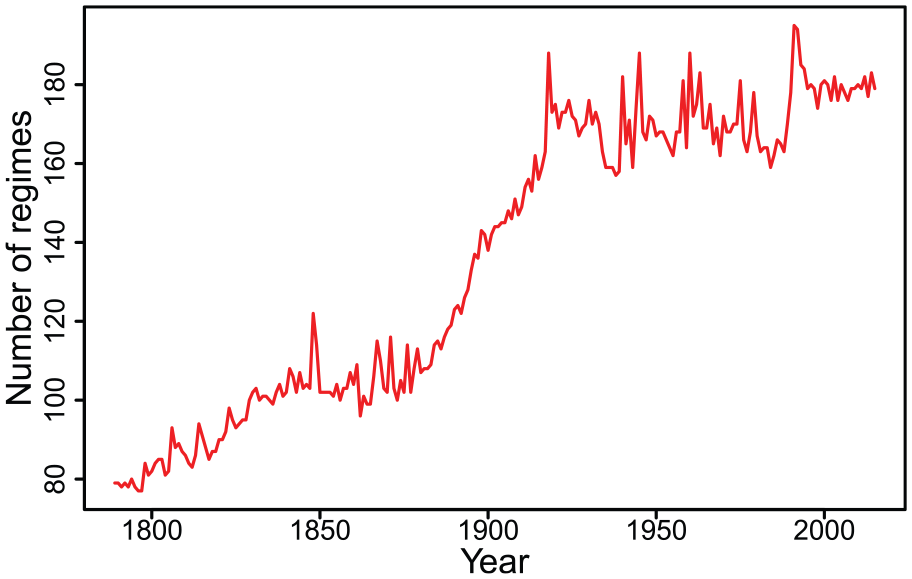
Absolute number of regimes per year included in the data set, 1789 to 2016.
Nonetheless, for the polities included from 1789, the first recorded regime is the one that existed on January 1 of that year. Thus, France’s first regime (Louis XV’s Maupeou parliaments) extends from 1768 to 1789, but other regimes have birth dates further back in time. Examples are Japan under Tokugawa rule, where the end of the siege of Osaka (January 22, 1615) marks the start date, and Peru under Spanish colonial administration, where the Viceroyalty of Peru is dated back to 1543. 6
There is substantial geographical variation in the frequency of regime changes in HRD, which stems partly from some countries having longer time series than others and partly from some countries having more “eventful” political histories. Figure 3 reveals that Central and South America have many recorded regimes. For example, Peru has 41 recorded regimes, Mexico has 43, and Bolivia has 45. But, also countries in West Africa, the Arabian peninsula, South Asia, and Southern Europe display relatively many regimes. Spain, for example, has 22 recorded regime changes, mainly owing to the seven tumultuous decades between the Napoleonic occupation in 1808 and the implementation of constitutional monarchy in 1876 counting 16 regimes. North America, North Europe, and East Asia display relatively few regime changes (despite long time series). For instance, Sweden only counts seven regimes, whereas Canada and Japan have six each. There is also considerable variation in regime-change frequency over time. The decades between 1880 and WWI were relatively “stable,” with between 1% and 5% of extant regimes breaking down in any given year. In addition, the recent period from 1995 onwards have experienced relative few breakdowns. In contrast, about 20% of regimes broke down in the revolutionary year of 1848, a number almost replicated in the years directly following WWI and WWII.
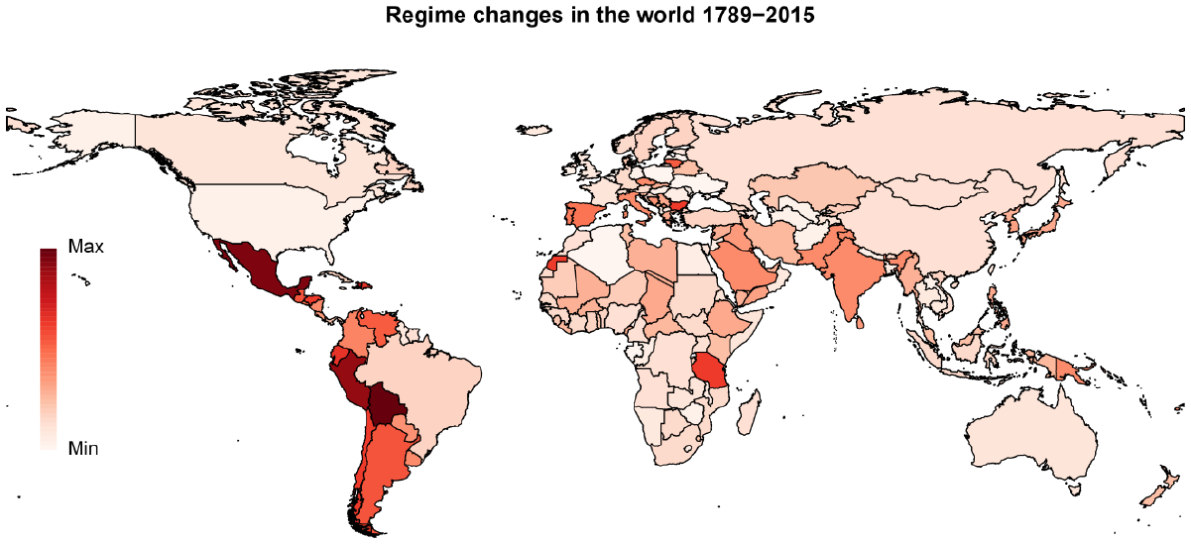
Number of recorded regime changes, 1789 to 2016.
We now turn to discussing the particular variables from HRD and clarifying and exemplifying coding decisions for important and recurring issues. In Supplemental Appendix B, we further describe the data collection process and routines and division of labor within the team. Supplemental Appendix C includes the notes contained in the data set for selected countries. 7
Start and End Dates
The regime start and end date variables, v3regstartdate and v3regenddate, respond to the questions: “When did the political regime obtain power?” and “When did the political regime lose power?” For about 140 of 2,000 cases, it proved extremely difficult to specify exact start dates, and month (about 120 instances) or even year (about 20 instances) was then coded (Table 2). The cases are assigned dates according to rules laid out in the Supplemental appendix, and we also code whenever dates are uncertain. Absent interregnum periods, we always code so that the end date of a regime is identical to the start date of the next one. Hence, these dates can be interpreted as denoting date of “regime change.”
Frequency of All Modes of Regime Change (v3regendtype), 1789 to 2016.
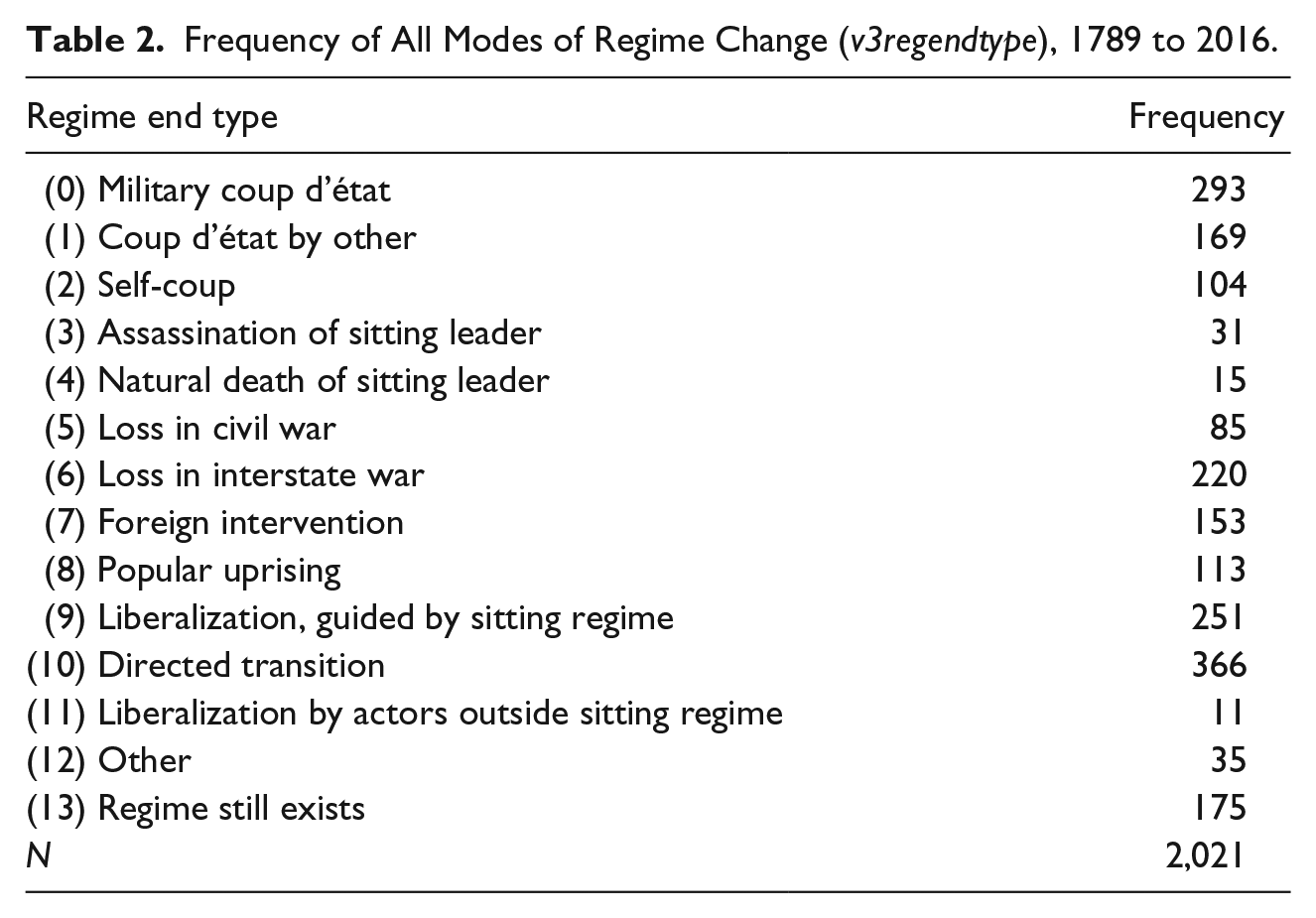
Figure 4 illustrates the granularity of the data, showing regime changes occurring in European countries in 1848, the “year of revolution” (Rapport, 2008). Several regime changes occured in March following right after the late-February revolution in France. In addition, some later changes are due to popular uprisings, but yet others are due to guided liberalization of existing regimes as well as “counter revolutions,” such as in Prussia in December (coded by HRD as a self-coup). The y-axis displays the duration of the “dying” regime, illustrating that both long-lived regimes, such as the (post–Pragmatic Sanction) Habsburg regime in Hungary, and very short-lived regimes, such as the “Provisional Government” of Modena that lasted from March 22 to August 8, 1848, broke down. 8
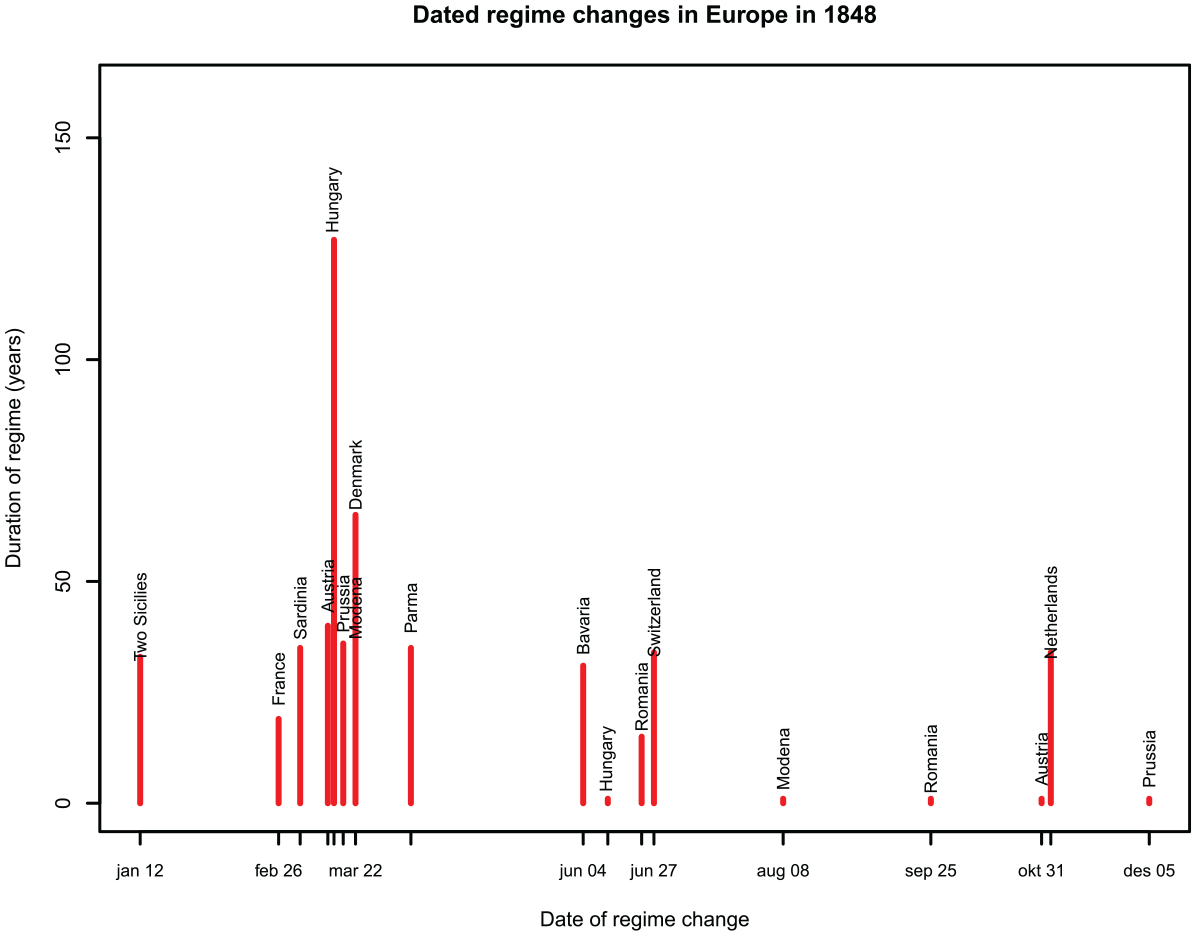
Regime end dates in Europe, 1848.
When the historical sources identified are adequate, military and civilian coup dates are generally clear-cut to register as exact end dates. In addition, for revolutionary episodes, end dates are often easy to pinpoint. Determining start and end dates for other cases are more difficult, including cases where a change obviously occurred while the event to mark it is unclear or cases where it is difficult to determine whether the change to formal or informal rules for selecting leaders is substantial enough to constitute breakdown. The former cases include situations when substantial, but gradual, liberalization takes place, and when substantial, but gradual, concentration of power within a narrower ruling elite occurs. Such transition periods are often coded as distinct, shorter-lived regimes. The Italian transition to Fascist rule under Mussolini illustrates this scenario. Clearly, the rules defining Mussolini’s reign differed substantially from those of the Kingdom of Italy under the House of Savoy. Yet, determining the exact transition is challenging. From 1921 to 1922, the biennio nero (“two black years”), national law enforcement crumbled, and paramilitary Fascist groups gained territory and eventually aimed at taking the capital (Smith, 1989). After King Victor Emmanuel III asked Mussolini to form a government on October 29, 1922, this government initially operated under the same constitutional rules as its predecessor. In November 1923, the so-called Acerbo electoral law was passed, stating that the party with the largest vote share—even if only 25%—would gain an absolute majority of Senate seats. This gradual transition is resolved in HRD by coding a separate regime, beginning with Victor Emmanuel’s decision on October 29, 1922, and ending with the passing of the Acerbo law, 9 before coding a new regime representing the definitive Fascist epoch.
Regime End Type
The regime end type codings respond to the questions “Could you specify the type of process that you consider the most important in leading to the end of the regime?” (v3regendtype) and “Could you specify the type of processes (one or more) that led to the end of the regime?” (v3regendtypems). HRD thus contains both a single-selection and multiple selection end type coding. The answers to both questions take the form of categories (0-13). Figure 2 lists the total frequency of all modes of regime breakdown, according to v3regendtype, for the entire historical period. Figure 5 shows the relative frequencies. The label of “regime end type” must be interpreted broadly, as some processes are tightly linked, conceptually, to the actual regime-change event (e.g., military coup, which entails the replacement of the old leadership), whereas others (e.g., natural death of leader or international war) are rather immediate causes of regime breakdown. “Other guided transformation”—which includes processes such as directed changes from monarchy to republic, the merging of two or more monarchies into one, changes in rules of succession, or colonial transfers to self-rule—is the most frequent mode of breakdown. However, military coups are almost equally frequent, and when combined with “coup by other” (e.g., palace coups in monarchies or coups by certain party members in single-party regimes), coups constitute the most common mode.
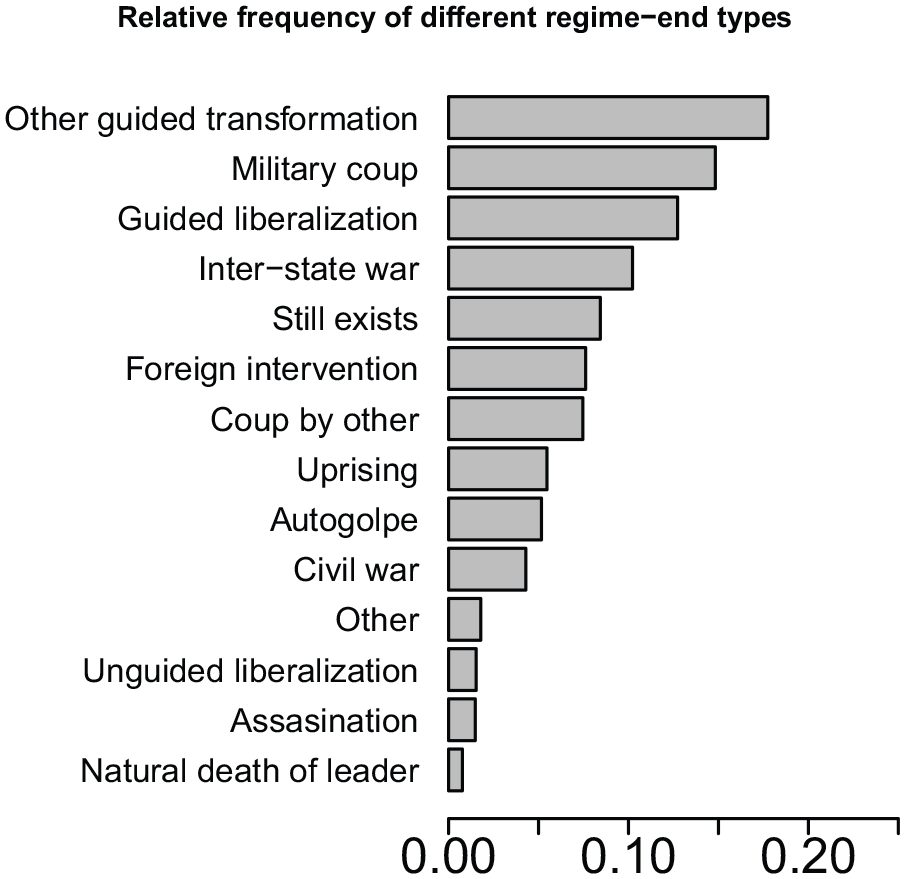
Relative frequency of all modes of regime change (v3regendtype), 1789 to 2016.
Figure 6, drawing on v3regendtype, displays how four particular modes of regime breakdown—coups (by military or others combined), uprisings, interstate war, and guided liberalization—have evolved from 1789 to 2016. For each mode, we fit a Loess smoothed line (span of 0.3) on the annualized relative frequencies, that is, the share of extant regimes that experienced breakdown associated with a particular mode. Notably, regime deaths associated with these modes have, historically, moved in wave-like fashions. Concerning regime breakdowns due to interstate wars, the early period around the French Revolutionary and Napoleonic wars as well as the mid-1900s with the end of WWII, were high-water marks. Smaller wave tops occur around the 1860s and 1870s and after WWI. For coups, the 1960s and 1970s stand out as a high-frequency period, and regime-ending coups have rapidly declined in more recent decades, as observed by several scholars (e.g., J. M. Powell & Thyne, 2011). Yet, a focus on the declining trend in the postcolonial era misses that coups were also relatively frequent in the 1840s and 1850s and in the 1930s, but notably less frequent at the turn of both the 18th and 19th centuries. For uprisings, peaks occur around 1848 and during the 1920s, and uprisings have increased in relative frequency to almost similar levels over the last decade. Hence, our long time series highlight that also this mode of breakdown has moved in a nonmonotonic fashion, a nuance that is easy to overlook when focusing on the recent positive trend in regime changes stemming from popular uprisings (Kendall-Taylor & Frantz, 2014). Likewise, guided liberalization peaked around and after the end of the Cold War, but also the 1820s and 1860s were notable high-water marks.
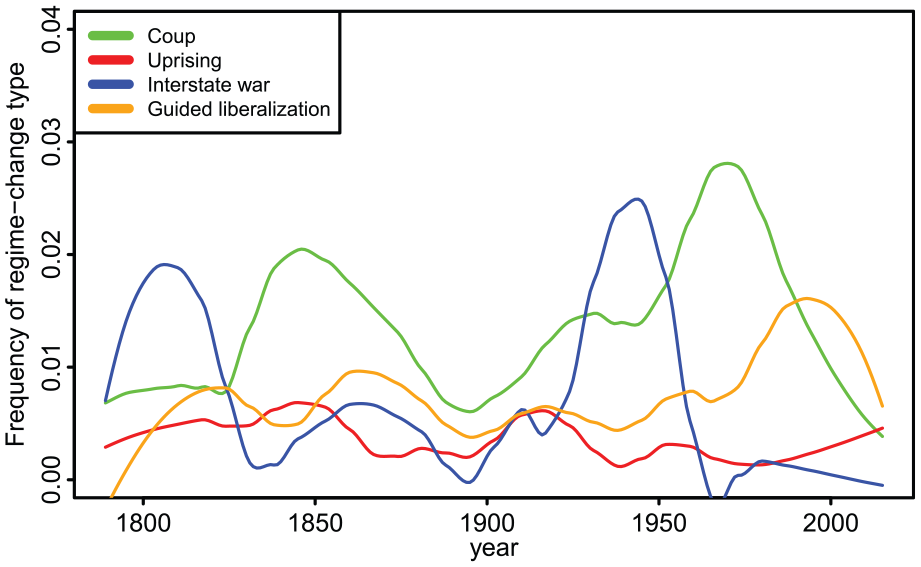
Yearly frequencies of regime deaths (Loess smoother, span of 0.3) due to coups, uprisings, international war, and guided liberalization, 1789 to 2016.
The multiple selection variable, v3regendtypems, is often identical to v3regendtype, indicating that one type of process was the dominant force behind the regime’s breakdown. In other cases, singling out only one relevant process is difficult, for example, when a regime breaks down after being faced by a large popular revolt that is subsequently followed by a military coup. If so, we make a decision, informed by the sources, on which of the two were relatively more influential behind removing the regime for v3regendtype, but code both as relevant for v3regendtypems.
Finally, we note that the nature of the processes leading to regime breakdown sometimes are susceptible to controversy among historians and other experts. 10 Take, for example, the regime death prior to the inclusion of Montenegro in the Kingdom of Serbs, Croats, and Slovenes in 1918. Montenegro had been occupied by Allied and Serbian forces in the final stages of WWI. During November 24 to 26, the Podgorica Assembly voted to unite Montenegro with the Kingdom under Prince-regent Aleksandar of the Karadjordjevic dynasty. Yet, the Podgorica Assembly has been widely criticized for not including representatives from a sufficiently broad segment of Montenegrins (Andrijašević and Rastoder, 2006; Roberts, 2007). Thus, deciding whether this is a directed and willed transition (category 10) or a result of foreign intervention by Serbia (category 7) is unavoidably controversial. For v3regendtype, we code this as a directed transition. But, the controversy is recognized in the accompanying notes and in the coding of v3regendtypems.
Extant Studies on Determinants of Regime Breakdown
The vast literature on why regimes break down suggests determinants related to international-systemic, geographical, demographic, cultural, economic, and political-institutional factors. We focus on three key determinants, two economic and one political-institutional, which are also the focus of our empirical analysis. We start by discussing two widely assumed structural conditions for regime breakdown, namely income level and level of democracy, before we turn to a prominent “trigger,” economic crisis.
One important strand of research has considered how “economic development” conditions regime change, notably including classic studies of democratization. Lipset (1959), for instance, proposed that the societal changes following economic development would, over time, undermine the legitimacy of autocratic regimes and make them struggle to govern effectively, ultimately spurring transition toward democracy. Yet, several recent studies fail to find a clear link between development, operationalized as (gross domestic product) GDP per capita, and democratizing regime changes (Acemoglu, 2008; Przeworski & Limongi, 1997). Subsequent studies have, however, questioned these recent null-results, for instance highlighting that results from the post-WWII era are not generalizable to earlier time periods (Boix, 2011). Furthermore, when disaggregating the process of democratization, Kennedy (2010) finds that the aggregate null-relationship stems from a high income level stabilizing all types of regimes—both autocratic and democratic—but that when an autocratic regime first breaks down, it is much more likely to be replaced by a democracy in rich countries. There are different reasons for why high income may stabilize not only democracies, but also autocratic regimes, including reduced poverty-related grievances and an improved availability of financial resources that the regime can leverage for repression or cooptation. The expectation that income stabilizes all types of regimes is, to some extent, backed up by extant findings on revolutions (Knutsen, 2014), one common mode of regime breakdown, and the relationship between low income levels and civil war onset is even more robust (Hegre & Sambanis, 2006). Yet, studies assessing the link between income and coups d’état in recent decades (Gassebner, Gutmann, & Voigt, 2016; J. Powell, 2012) do not find a clear association.
Other accounts of regime breakdown have focused on political institutions. 11 Notably, different studies find that regimes “in the middle” of the autocracy–democracy spectrum, that is, regimes displaying some combination of democratic and autocratic features, are more likely to break down than relatively autocratic and relatively democratic regimes (Gates et al., 2006; Goldstone et al., 2010; Knutsen & Nygård, 2015). One proposed reason for why mixed regimes are less stable, is that they, unlike autocracies, are unable to sufficiently repress and deter regime opposition, while they are also, unlike democracies, unable to accommodate opposition groups through institutionalized channels of influence and competition over positions of power. A related literature (Hegre, Ellingsen, Gates, & Gleditsch, 2001) has found that mixed regimes more often experience civil war (but, see Vreeland, 2008), whereas Bodea, Elbadawi and Houle (2017) find that (certain types of) mixed regimes experience more riots and coups d’état.
Regarding triggers of regime breakdown, the “revolutionary-threat” thesis, formalized by Acemoglu and Robinson (2006), emphasize sudden shocks in the capacity of the opposition to mobilize and threaten the regime from the outside. Revolutionary threats seem to have prompted democratization in several European countries in the 19th and early 20th centuries (Aidt & Jensen, 2014), either directly through revolution or indirectly through “forcing” the regime to liberalize in a guided manner. One key shock that may trigger revolts is economic crisis (Acemoglu and Robinson, 2006; Davies, 1962; Gurr, 1970). While economic crises come in different forms, a sharp drop in economic growth is a typical characteristic. Crises may induce grievances among opposition groups and key regime supporters through loss of income and employment, and also through reduced public revenue leading to less transfers through social policies (Ponticelli & Voth, 2011) or patronage (Bratton & van de Walle, 1997). Due to their relatively sudden and public nature, economic crises may also function as “coordination signals” (Kuran, 1989) for opposition actors, enabling collective action directed toward the regime. Hence, different studies show that crises, often proxied by slow/negative economic growth, are strongly correlated with regime breakdown or more specific processes associated with breakdown. Przeworski and Limongi (1997) find that economic crises spur both democratization and democratic breakdown (see also Aidt & Leon, 2016; Ciccone, 2011; Kennedy, 2010). Low short-term growth also predicts civil wars (Hegre & Sambanis, 2006), riots and protests (Ponticelli & Voth, 2011), revolutions (Knutsen, 2014), and coups (Gassebner et al., 2016).
Correlates of Regime Duration and Breakdown
To assess the relevance of the three discussed determinants, we employ a parsimonious model of regime breakdown. Income is measured by (logged, Purchasing Power Parity [PPP]-adjusted) GDP per capita from Fariss et al. (2017). Annual GDP per capita growth is also constructed from these data. Fariss et al. (2017) provide estimates of income (and population) by drawing on information from different historic and contemporary sources and using a dynamic latent trait model. We use their estimates benchmarked in the long time series data from the Maddison project. One benefit of using these data is the reduction of various types of measurement errors, and also the estimation of missing values and greatly extended time series. Yet, we note that these (yet unpublished) data rely heavily on imputation, and inspection suggest that the last year of the time series is associated with implausible “jumps.” We thus removed this last year of data, and also robustness test our results by using the (interpolated) raw data from the Maddison project, curated from V-Dem v.9 (see Supplemental Appendix). We further include the Polyarchy index (Teorell, Coppedge, Skaaning, & Lindberg, 2019) of (electoral) democracy from V-Dem (Coppedge et al., 2017), and its squared term, to investigate the anticipated inverted U-curve relationship between level of democracy and regime breakdown. As Polyarchy is also extended back in time by Historical V-Dem, the time frame of our analysis ranges from 1789 to recent years.
The baseline estimator is a logit model that incorporates duration dependence by capturing, capturing time since last regime change in addition to its squared and cubed terms, following Carter and Signorino (2010)—young regimes are typically more fragile, and regime fragility is a nonlinear function of regime duration (Svolik, 2012). We also include fixed effects on either regions or countries to pick up stable, unit-specific characteristics (e.g., geographic or climatic features) that affect breakdown and correlate with the three determinants. We further include year-dummies to model common global shocks. As various modes of regime breakdown have evolved in wave-like patterns, a linear trend would be unsuitable. Finally, we control for log population (from Fariss et al., 2017).
Table 3 displays variations of our baseline model on regime breakdown, measured 1 year after the covariates. The purpose of the first two models is to assess how sensitive results are to measurement choices. Model 1.1 employs GWF data for the dependent variable and Model 1.2 employs HRD data. As discussed, the conceptualization of what constitutes a regime is quite similar across the two data sets, although there are differences in operational rules, notably with HRD employing a lower threshold for conting regime change. To make results comparable, we estimate these models on the same sample, covering 7,246 country-years from 1946 to 2013.
Logit Models With Regime Breakdown (in
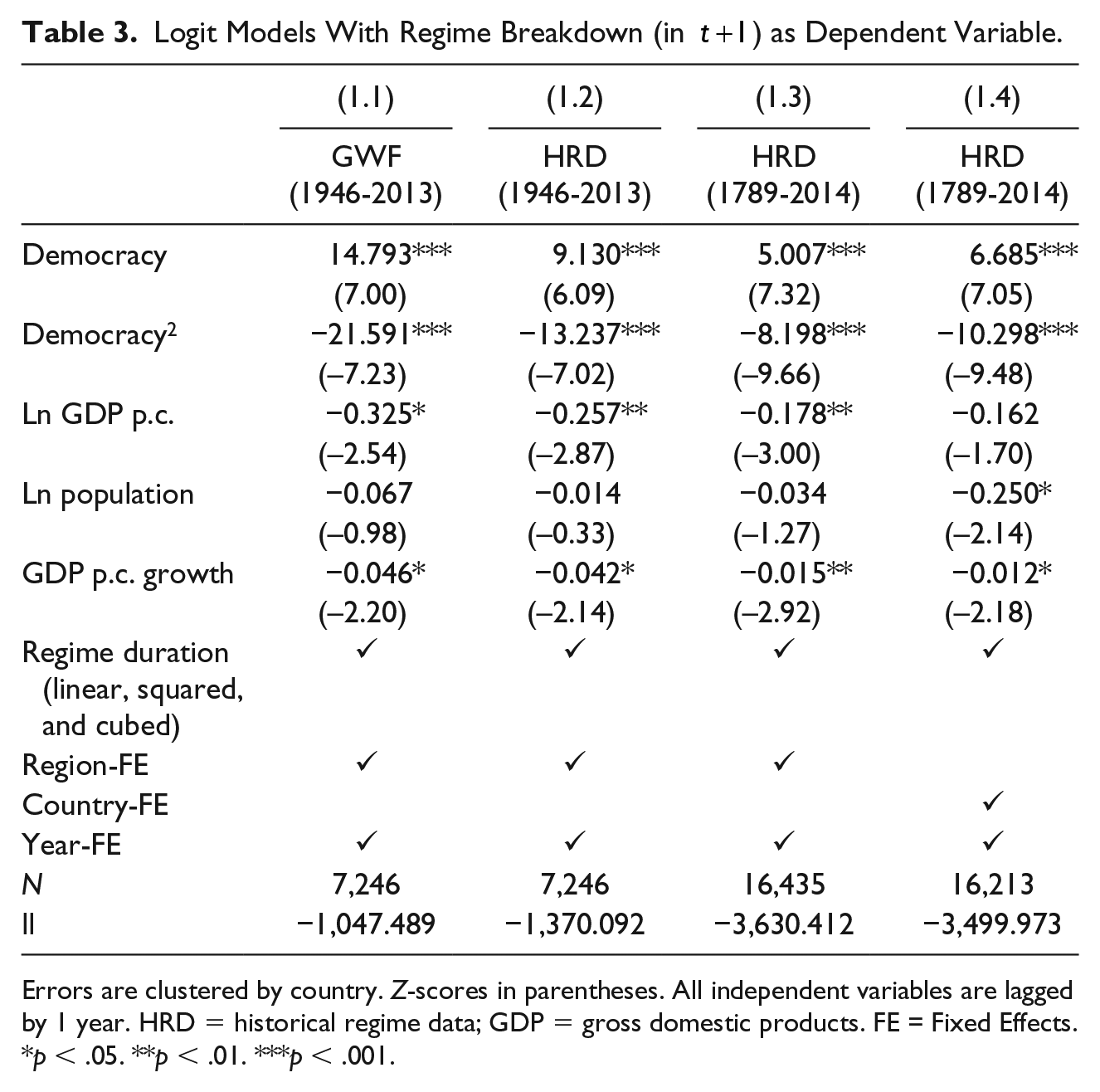
Errors are clustered by country. Z-scores in parentheses. All independent variables are lagged by 1 year. HRD = historical regime data; GDP = gross domestic products. FE = Fixed Effects.
p < .05. **p < .01. ***p < .001.
Several clear patterns emerge from Model 1.1 using GWF: High income levels and high short-term growth are both negatively related to probability of regime breakdown. Furthermore, regimes “in the middle” of the autocracy–democracy spectrum are more likely to experience breakdown, as indicated by the positive linear term and negative squared term. The results are very similar in Model 1.2 using HRD. While the coefficient for GDP per capita is moderately reduced, the t-value actually changes from
Still, the main advantage of the HRD data relative to GWF is the vastly expanded time series, extending back to 1789 instead of 1946. Leveraging these longer time series improves our ability to assess how robust, for instance, the level of democracy and income are as general determinants of regime breakdown. There are strong a priori reasons to believe that these relationships have varied substantially across modern history, including developments in potential moderating factors related, for example, to the international political system and communications and military technology. Model 1.3 represents the same specification as Model 1.2, but extends the time frame to the period between 1789 and 2014 (16,435 country-year observations). Surprisingly, the results turn out very similar when employing the extended time series. Low income levels, slow growth, and intermediate levels of democracy are clearly associated with enhanced risk of regime breakdown. Changes to the point estimates notwithstanding, the key take-away from comparing Models 1.2 and 1.3 is that standard errors are (often substantially) reduced. For instance, growth is now more precisely estimated, with a t-value of
While accounting for country-specific effects is often crucial for mitigating omitted variable bias, it is also often regarded as infeasible in analysis of regime change, and other infrequently occurring phenomena such as wars, when time series are limited (Beck & Katz, 2001). Luckily, the long time series and multiple, recorded regime changes for most countries in Model 1.3 opens up to accounting for country-specific factors without being too worried about loss of efficiency. Thus, Model 1.4 substitutes region-fixed effects with country-fixed effects. Polyarchy and growth remain stable, while the coefficient for income level decreases somewhat and loses statistical precision
Extensions: Investigating Heterogeneity Across Modes of Breakdown and Across Time
So far, we have highlighted how HRD’s extensive coverage allows us to more carefully assess robustness, for instance by controlling for country-fixed effects. However, the specific measures and extensive time series in HRD also open up for assessing different forms of heterogeneity. We assess whether the aforementioned predictors are differently linked to different modes of regime breakdown. The models in Table 4 leverage v3regendtype to distinguish four modes of breakdown: coups (military coups and coups by others, combined), interstate war, popular uprising, and “guided transformation” (combining the two categories for guided liberalization and other guided transformation).
Logit Models With Different Modes of Regime Breakdown (in
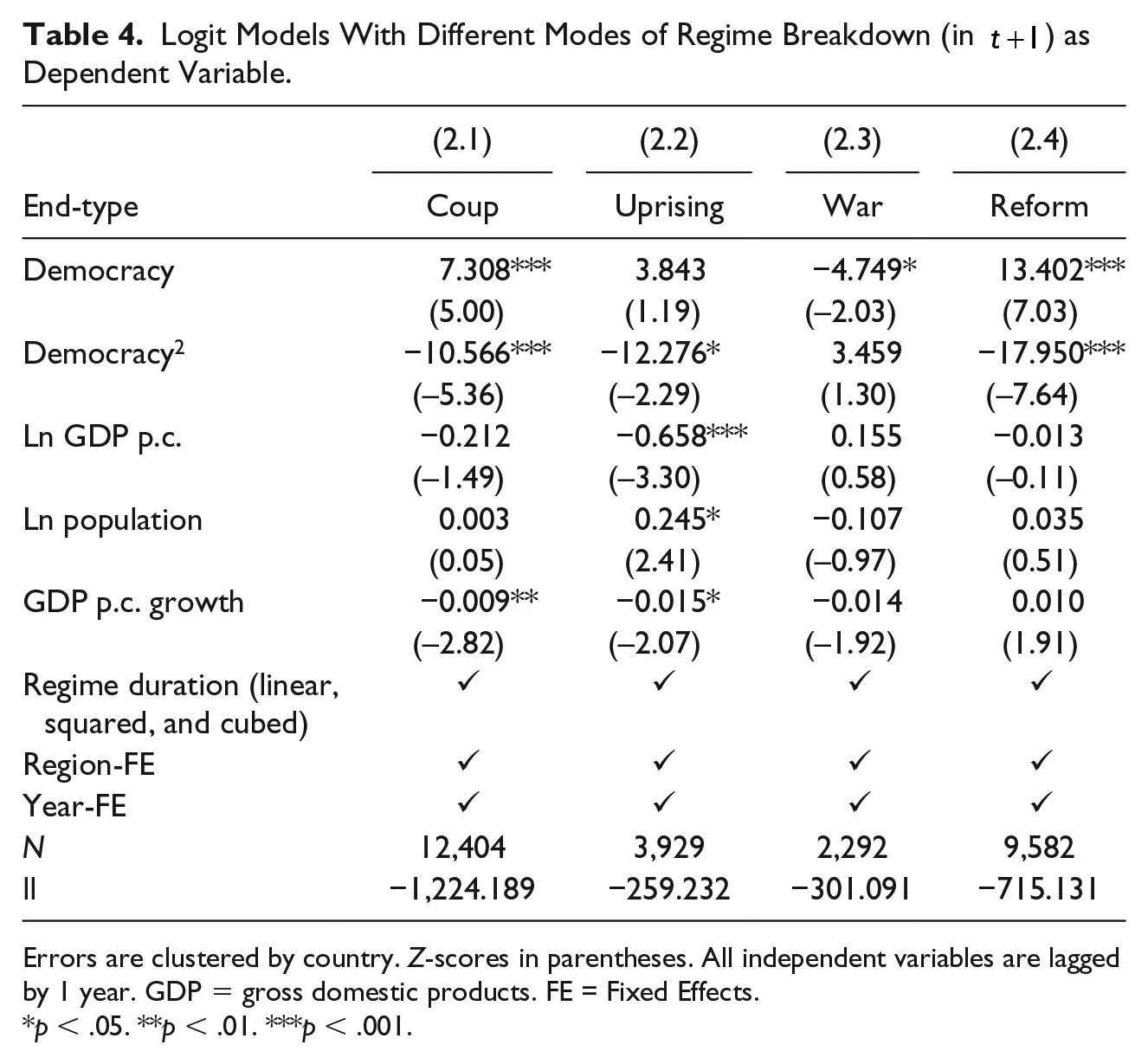
Errors are clustered by country. Z-scores in parentheses. All independent variables are lagged by 1 year. GDP = gross domestic products. FE = Fixed Effects.
p < .05. **p < .01. ***p < .001.
Model 2.1, Table 4 replicates Model 1.3, Table 3, but estimates the risk of experiencing a regime change through coups. Overall, these models report quite similar results. Regimes with intermediate levels of democracy are more prone to break down because of coups, and there is a negative and significant coefficient for short-term growth. Income level also has a similarly signed point estimate as in Model 1.3, but the t-value is only −1.5. Model 2.2 estimates the risk of breakdown due to popular uprisings, also showing similarly signed coefficients as for the (overall) regime breakdown model. Yet, the inverse U-shape relationship with democracy is less clear than for breakdowns overall or for coup breakdowns. In contrast, low income level has a much stronger relationship to uprisings than coups, and economic crises are also clearly linked to breakdowns emanating from popular uprisings (this result is not robust to using GDP data from Maddison; see Supplemental Appendix J). Model 2.3 considers regime breakdowns due to interstate war. Here, we find very little similarity with Model 1.3 on all breakdowns. Neither income levels nor intermediate levels of democracy are strong predictors of war-induced transitions, and short-term growth is only a weakly significant predictor
In sum, we find heterogeneity concerning which predictors explain different modes of breakdown. While an intermediate level of democracy is related to breakdowns via coups or guided regime transitions, it does not systematically relate to a higher probability of war-induced transitions. Economic crises increase the chances of transitions via coups and uprisings, but not guided regime transitions. In contrast, low levels of income are only clearly relevant for breakdowns spurred by popular uprisings.
Next, we investigate heterogeneity across time, returning to the dependent variable capturing all regime transitions (see Supplemental Appendix I for similar investigations of temporal heterogeneity for coup and uprising transitions, counted separately). Although the literature has focused on whether democratization episodes occur in “waves” (Huntington, 1991), one understudied question is whether there are marked “waves” also in the stability/breakdown of regimes, more generally. Are there certain periods of modern history with a sustained and statistically marked uptick in the frequency of regime breakdowns, followed by “crests” where breakdowns are less frequent?
To systematically study such structural breaks in the frequency of regime change, we estimate a Bayesian change-point model on average number of regime breakdowns (across all polities in a year), using Markov Chain Monte Carlo. 12
Using this procedure, we identify four structural breaks in the global frequency of regime breakdowns. We observe two “waves,” the first from 1798 to 1881 and the second from 1913 to 1995, both followed by two crest periods where the global frequency of breakdowns drops substantially. Figure 7 shows the posterior probability of each structural period (top) and the global mean of breakdown frequency (with structural break-years inserted; bottom). The identified change points are not without intuitive sense: Starting in 1798 (during the French Revolutionary Wars), the world observed a range of regime transitions, for instance with several occurring in German and Italian states invaded by (or allied with) France during the ensuing Napoleonic wars. While the number of transitions tailed off after the Congress of Vienna in 1815, the dip is insufficient for our model to identify a significant change point. The number of transitions then increased again, notably with the European revolutions and counter revolutions of 1848/1849, and also numerous coups in Latin American countries in the following decades. Only after the First Boer War in 1881 (with the Congress of Berlin coming 3 years later)—during a period of peace in Europe where major powers carved up the world into colonies—there is a lull in the number of breakdowns. This lull lasts until right before the peace in Europe is broken (1913) with WWI. From 1913 to 1995, there is again a long, high-intensity period of regime breakdowns that encapsulates the interwar period, WWII, the decolonization of Africa and Asia, and the Cold War—all global events associated with numerous regime changes. After the end of the Cold War, and the ensuing breakdown of (Communist and other) long-standing autocracies especially in Eastern Europe and Sub-Saharan Africa, our model suggests that we entered a new crest period around 1995.
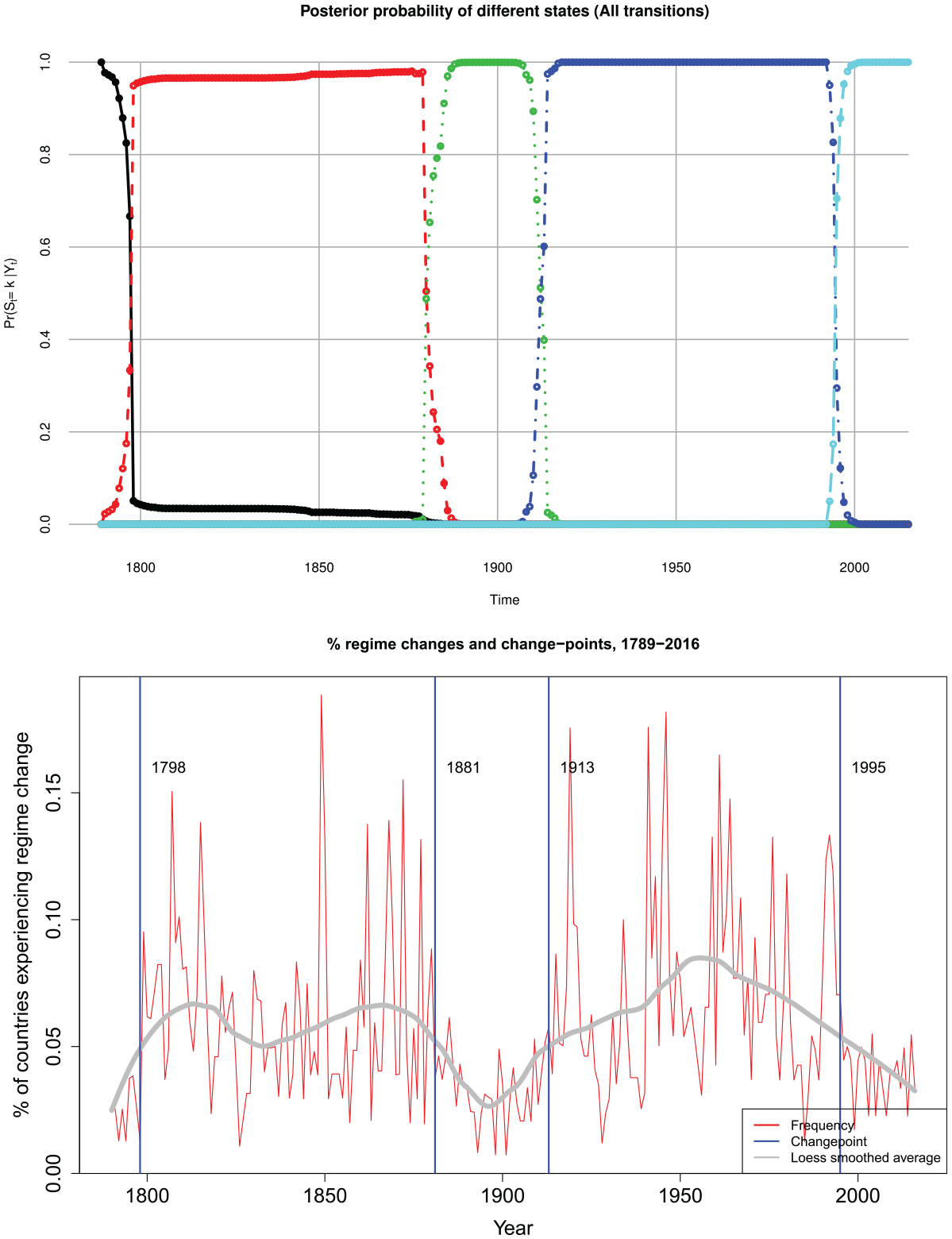
Results from change-point model.
Table 5 shows our baseline model estimated on samples split by the different wave and crest periods identified in Figure 7. While the coefficient sizes and significance levels vary somewhat across the periods, the signs of the coefficients are consistent for democracy level, income level, and short-term growth. The results are, however, more precisely estimated for the second wave 1913 to 1995 (which also contains the highest number of observations), whereas none of the predictors are significant at 5% for the first wave from 1798 to 1881. When merging the wave (Model 3.5) and crest (3.6) periods together, we find that intermediate levels of democracy and low income level are positively related to regime breakdown in both types periods, although the income coefficient is much more sizable during crests. For short-term growth, the coefficient size is fairly similar across wave and crest periods, but only statistically significant at conventional levels during waves.
Logit Models of Regime Breakdown (in t+1) in Wave and Crest Periods.
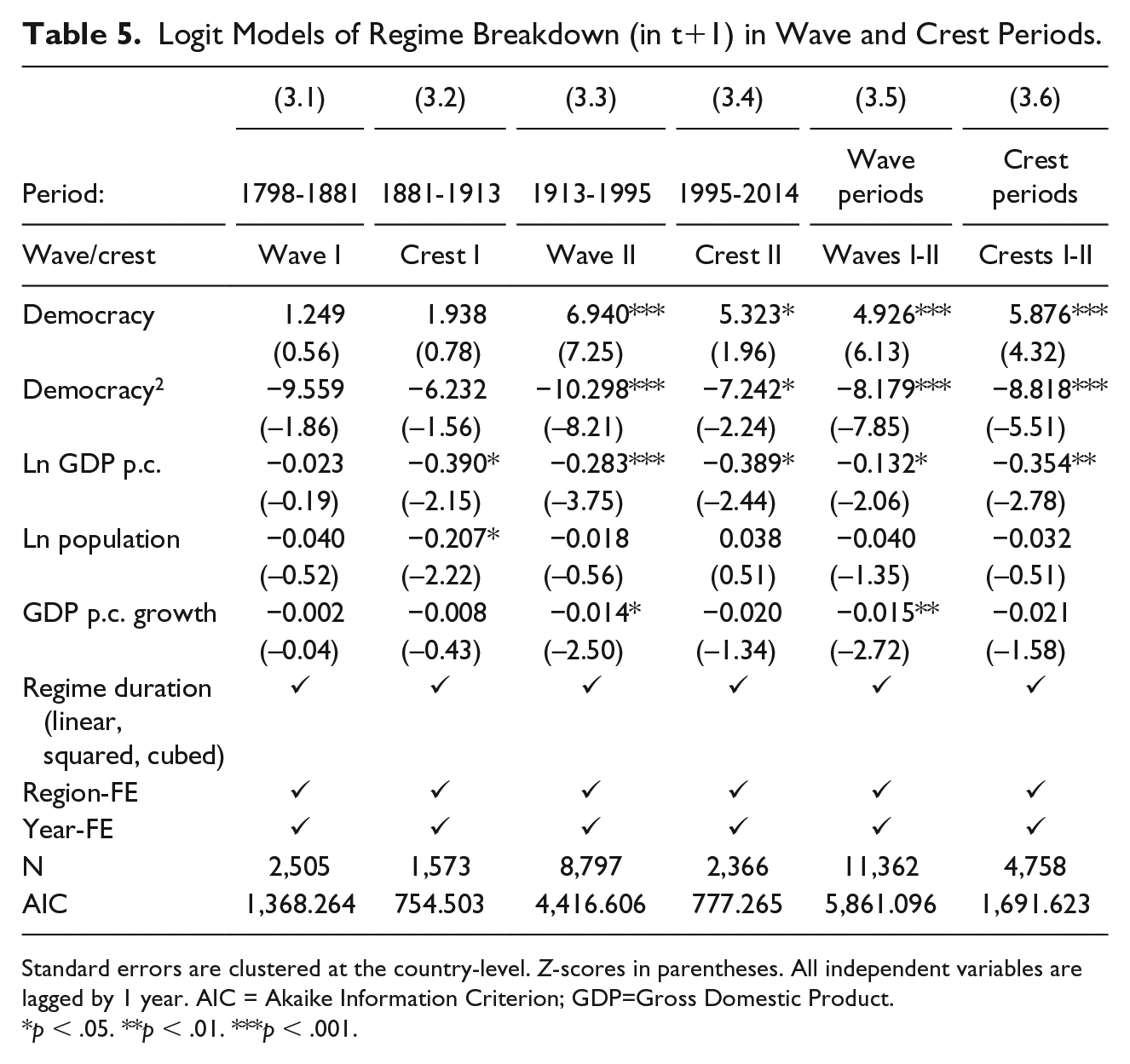
Standard errors are clustered at the country-level. Z-scores in parentheses. All independent variables are lagged by 1 year. AIC = Akaike Information Criterion; GDP=Gross Domestic Product.
p < .05. **p < .01. ***p < .001.
Conclusion
To explore the ebbs and flows of regime birth and breakdown since the French revolution, we chart the breakdown of political regimes globally across more than two centuries by using our new and comprehensive HRD data set. These data include information on more than 1900 regimes from 197 polities, recording, for example, the precise duration and mode of breakdown of these regimes. These data will help future efforts to study the life and death of regimes, and various forms of regime transitions, in a systematic manner.
Drawing on this unique source, we have described various patterns of regime duration and breakdown throughout modern history and investigated three proposed determinants of regime change. We find fairly robust evidence that regimes in poor countries, countries that experience slow short-term growth, and regimes that display intermediate levels of democracy are more likely to suffer regime breakdown. All of these relationships are particularly clear when focusing on the period from the beginning of WWI to after the end of the Cold War, a period of modern history characterized by frequent regime changes. When investigating distinct modes of regime breakdown, however, we find indications of heterogeneity—some predictors are more relevant for certain modes of breakdown than others. For instance, intermediate levels of democracy are associated with more regime breakdowns due to coups and guided regime transformations, whereas low income levels are associated with regime deaths due to popular uprisings.
The nonmonotonic patterns in breakdown frequency and the temporally heterogeneous relationships that we detect have implications for future work. Concerning theory-building, scholars should pay more attention to the possible historical scope conditions of their theories. As Boix (2011) highlights, determinants of regime change may work very differently in different historical contexts, due to interactions with factors such as geo-political balance of power or current technologies. Empirically, our findings suggest that future studies should include explicit tests of temporal heterogeneity, for instance by running simple split-sample tests or more complex Bayesian change-point models. Our findings also raise questions about the specific mechanisms that generate temporal clustering in specific modes of regime change (such as coups or revolutions). Such clustering could result from as different processes as diffusion through learning or through regional instability, or through the clustering of similar causal forces, such as financial crises or power shifts, affecting several countries simultaneously.
Supplemental Material
Regime_breakdown_Appendix_CPS_FINAL_ACCEPTED – Supplemental material for Patterns of Regime Breakdown Since the French Revolution
Supplemental material, Regime_breakdown_Appendix_CPS_FINAL_ACCEPTED for Patterns of Regime Breakdown Since the French Revolution by Vilde Lunnan Djuve, Carl Henrik Knutsen and Tore Wig in Comparative Political Studies
Supplemental Material
Replication_data_CPS – Supplemental material for Patterns of Regime Breakdown Since the French Revolution
Supplemental material, Replication_data_CPS for Patterns of Regime Breakdown Since the French Revolution by Vilde Lunnan Djuve, Carl Henrik Knutsen and Tore Wig in Comparative Political Studies
Footnotes
Acknowledgements
The authors thank Haakon Jernsletten, Konstantinos Skenteris, Katharina Sibbers, Bernardo Isola, Ida Smedstad, Solveig Bjørkholt, and Sindre Haugen for excellent research assistance. The authors specially thank Haakon Gjerløw for technical assistance with the data set. They are grateful for the valuable comments and inputs, at various stages in the process, from three anonymous reviewers and the editors of CPS, Jan Teorell, Svend-Erik Skaaning, Haakon Gjerløw, Agnes Cornell, John Gerring, Andrej Kokkonen, Joe Wright, Espen Geelmuyden Rød, Charles Crabtree, Holger Kern, Natasha Lindstaedt, Christian Houle, Ryan Kennedy as well as participants at the 2017 APSA Annual Meeting in San Francisco, the “State-Building and Regime Change in a Historical-Political Science Perspective Workshop” at Aarhus University, the “Autocratic Diversity Workshop” at Aarhus University, the “Historical Varieties of Democracy Workshop” at University of Oslo, The Departmental Speaker Series Seminar, November 27, 2017, at the Department of Government, University of Essex, the “The Empirical Study of Autocracy Workshop” at University of Konstanz, and the “Virtual Workshop on Authoritarian Regimes.”
Declaration of Conflicting Interests
The authors declared no potential conflicts of interest with respect to the research, authorship, and/or publication of this article.
Funding
The authors disclosed receipt of the following financial support for the research, authorship, and/or publication of this article: This data collection and research project was mainly funded by the Research Council Norway, “Young Research Talent” (grant, pnr 240505), PI: Carl Henrik Knutsen, but also by a “2016 Småforsk Grant” from the Department of Political Science, University of Oslo, PI: Carl Henrik Knutsen, and by Riksbankens Jubileumsfond (grant no. M13-0559:1), PI: Staffan I. Lindberg, V-Dem Institute, University of Gothenburg, Sweden.

Notes
Author Biographies
References
Supplementary Material
Please find the following supplemental material available below.
For Open Access articles published under a Creative Commons License, all supplemental material carries the same license as the article it is associated with.
For non-Open Access articles published, all supplemental material carries a non-exclusive license, and permission requests for re-use of supplemental material or any part of supplemental material shall be sent directly to the copyright owner as specified in the copyright notice associated with the article.
